Tag:

Subalpine (2500-3500 m)

Alston

Bh09 349 P564
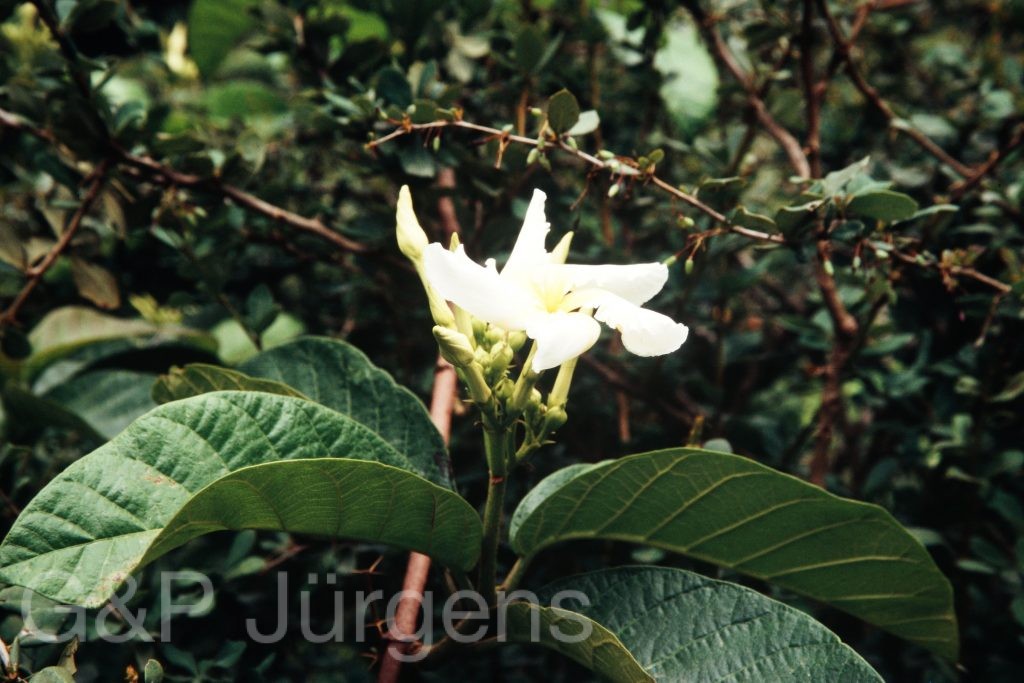
Bhutan Wangdi, 2600m June
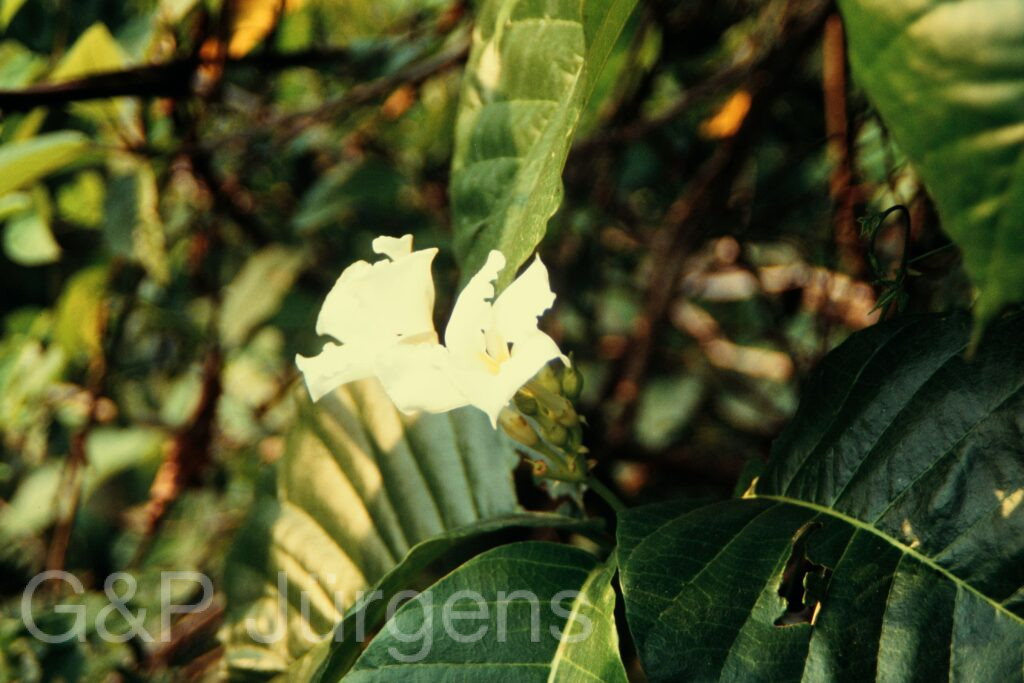
Nepal 97 552 G1079
Nepal Sabha-Khola 550m May

Description

Chonemorpha fragrans Alston is a large woody climber of tropical and subtropical Asia, ranging from India, Nepal and Myanmar through southern China and Indochina to Thailand, Sri Lanka and western Malesia; GBIF documents about 769 occurrences across this Indo-Malesian span. It is a liana of moist forest, forest margins and riverine thickets, climbing into the canopy from low elevations into the lower hills. The photographed material spans this amplitude, from the Sabha-Khola in lowland Nepal at 550 m in May to Wangdi in Bhutan at 2,600 m in June, the latter an unusually high record for an essentially subtropical climber.

It is a robust, twining liana with stout woody stems exuding milky latex when cut, as is general in the family. The leaves are opposite, large, broadly ovate to obovate, often softly tomentose beneath, with an acuminate apex and entire margin. The flowers are large and showy, borne in terminal cymes; the salverform corolla is white with a yellow throat, fragrant, and 5-8 cm across, with five broad, asymmetric, overlapping lobes. The fruit is a pair of long, slender, cylindrical follicles that split to release numerous flattened seeds, each bearing an apical tuft of silky hairs (coma) for wind dispersal.

Chonemorpha belongs to the Apocynaceae (subfam. Apocynoideae), the woody twining members of the dogbane family. C. fragrans is grown as an ornamental for its large fragrant blooms and yields a stem fibre and medicinally used alkaloids. Widespread across forested Indo-Malesia and tolerant of forest-edge and disturbed habitats, it is not of conservation concern; its comose seeds and liana habit support effective dispersal and rapid colonisation of canopy gaps.

Author: Alston · Sources: POWO (Kew), GBIF, Flora of China, Flora of Nepal, Flora of Bhutan, Apocynaceae treatment in Flora Malesiana, Middleton studies of Asian Apocynaceae
(L.) Banfi

Nepal 99 947 ergebnis
Nepal Parela 3000m, July

Description

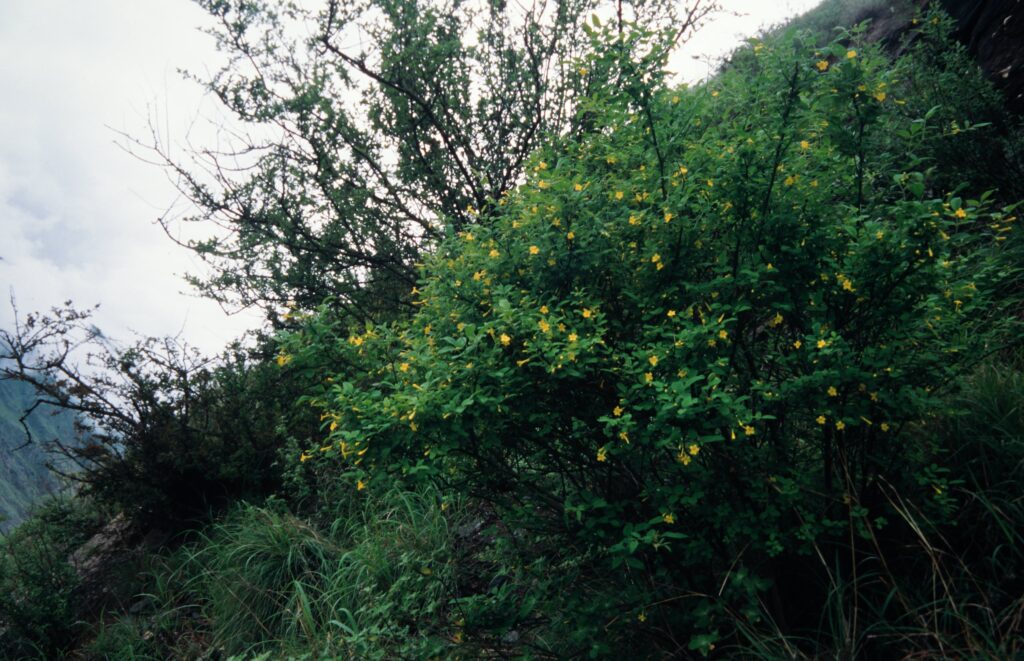
Chrysojasminum fruticans, formerly placed in Jasminum and long known as Jasminum fruticans, is a small evergreen to semi-evergreen shrub of the family Oleaceae. The bulk of its GBIF records lie around the Mediterranean basin and into Western Asia, encompassing France, Spain, Portugal, Italy, the Balkans, Turkey, the Caucasus and North Africa, where it is a classic component of dry maquis and garrigue. Its appearance in the western Himalaya, as in the Nepalese collection from Parela at about 3,000 m in July, represents the eastern extremity of an essentially Irano-Turanian to Mediterranean distribution, where it occupies sunny, rocky, calcareous slopes, open scrub and woodland margins.

The plant forms a much-branched shrub up to about 1–2 m with slender, green, angular twigs. The leaves are alternate and pinnately compound, usually trifoliolate or with up to five small obovate to oblong leaflets, glabrous and somewhat leathery, the foliage persisting through mild winters. The flowers are borne in small terminal cymes of a few blooms; the corolla is salverform with a slender tube expanding into five spreading lobes and is a distinctive bright yellow, only faintly scented in contrast to the white-flowered jasmines. The fruit is a small, shining, globose berry that ripens from green to black.

The transfer of this and allied yellow-flowered jasmines to the segregate genus Chrysojasminum reflects molecular phylogenetic evidence that the yellow jasmines form a distinct lineage within tribe Jasmineae, separate from the white-flowered Jasminum sensu stricto. Ecologically it is drought-adapted and characteristic of thermophilous, calcicolous communities, valued in horticulture as a hardy ornamental. Its scattered, peripheral Himalayan occurrence is biogeographically notable, illustrating the westerly Mediterranean affinities present in the dry inner valleys of the Himalaya.

Author: (L.) Banfi · Sources: POWO (Kew), GBIF, Flora Europaea Vol. 3, Flora of Pakistan, Green: A Revision of Jasminum (Oleaceae), Flora Iberica

D.Don

Bh2008 378 P588
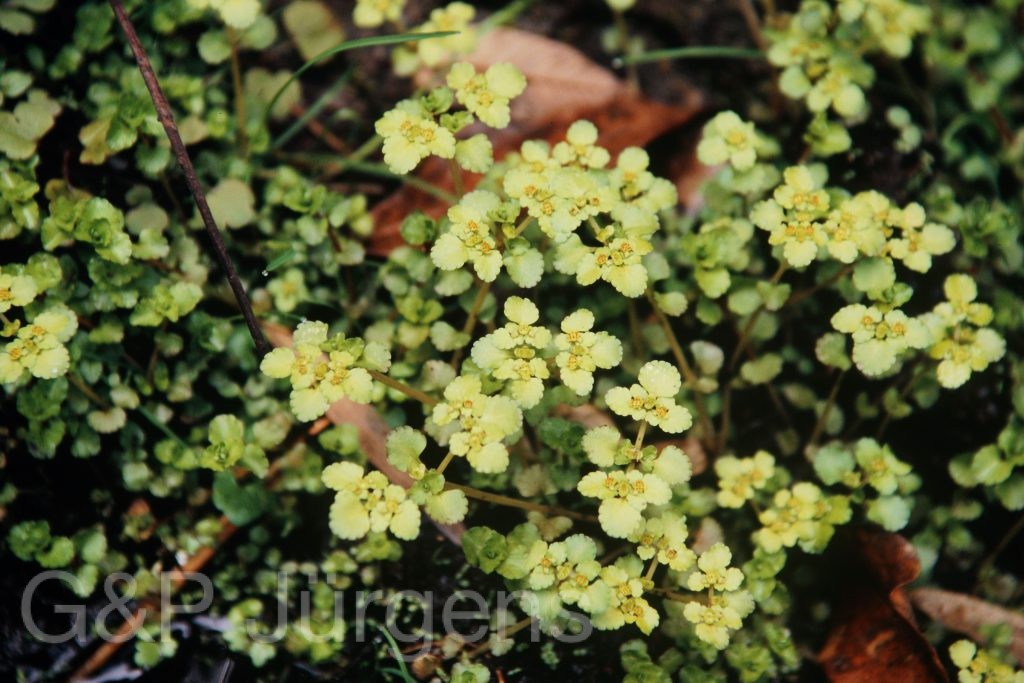
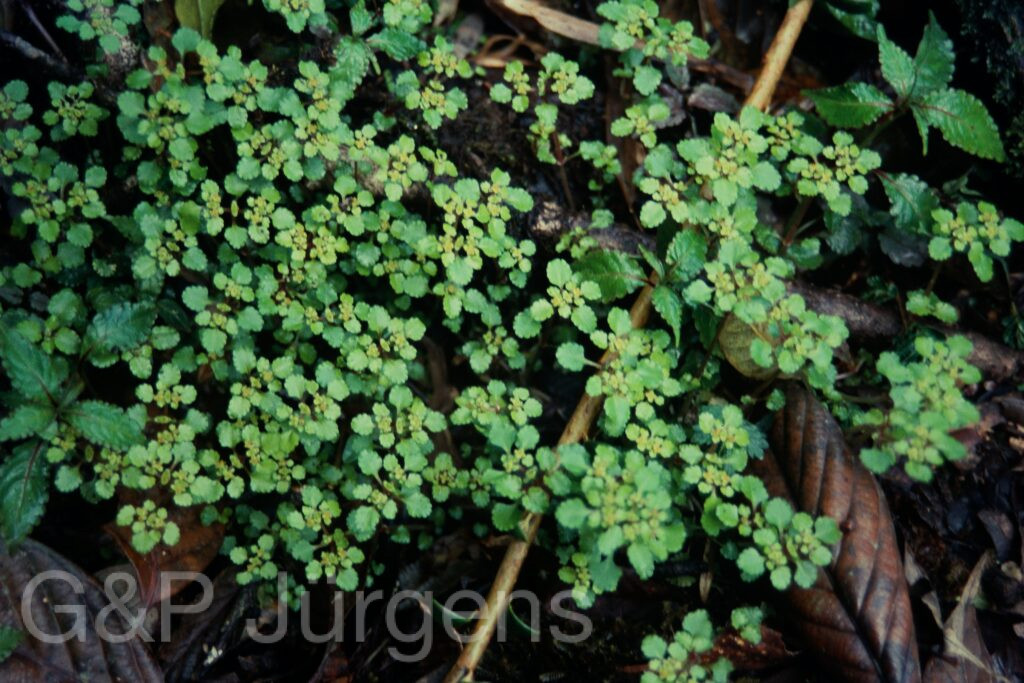
Bhutan Thimphu-Chu, 2800m April
Bh2008 10 P16
Bhutan Thimphu-Chu, 2800m April
Sikkim2004 54 P97
Sikkim West-Bengal, Bersay 2810m April

Description

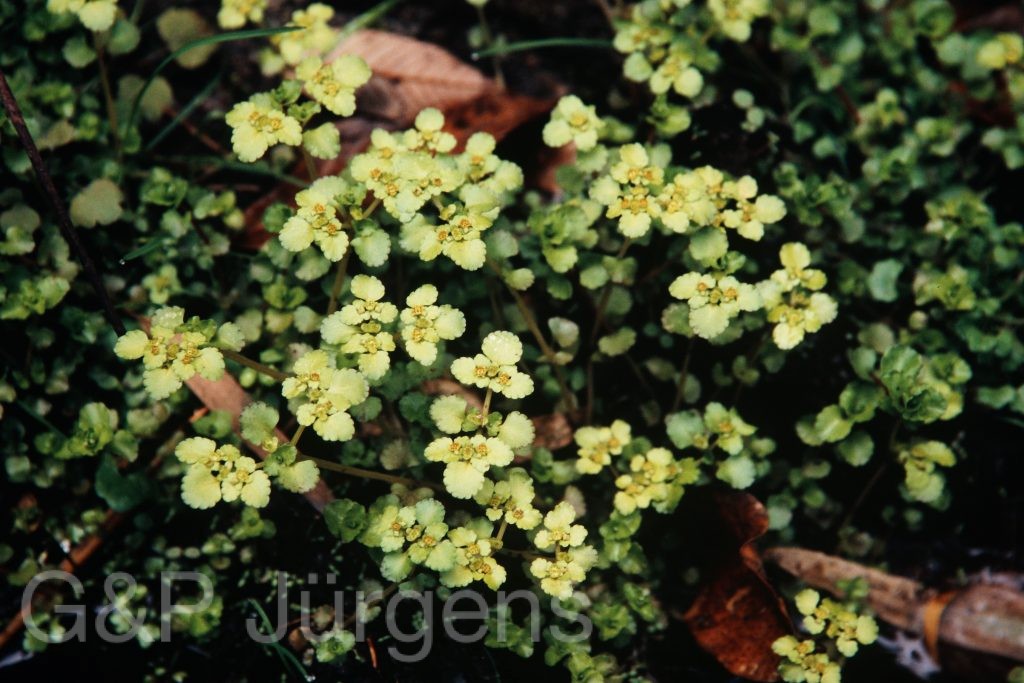
Chrysosplenium nepalense is a small herbaceous perennial of the eastern Himalaya and adjacent mountains, recorded by GBIF (339 occurrences) from Nepal, India, Bhutan, Myanmar and southwestern China. It is a plant of cool, perpetually moist habitats, colonising shaded stream banks, dripping rock faces, springs and damp humus-rich ground within temperate forest, generally between about 2500 and 3500 m. The collections illustrated from the Thimphu Chu in Bhutan at 2800 m and from Bersay in Sikkim, West Bengal, at 2810 m, both in April, are typical of its early-season flowering when snowmelt keeps the substrate saturated.

The plant is a low, mat-forming herb with slender, creeping and rooting stems that produce leafy stolons. The leaves are opposite, petiolate and reniform to broadly ovate, with a shallowly crenate margin and a cordate base. As in the genus, the flowers lack petals; the inflorescence is a flattened terminal cyme subtended by conspicuous yellowish-green leafy bracts that function as the principal visual attractant. Each small flower has four greenish-yellow sepals, four or eight stamens inserted around a flattened disc, and a half-inferior ovary. The fruit is a two-lobed, beaked capsule that splits widely to expose numerous minute seeds.

Chrysosplenium is a taxonomically intricate genus of moisture-loving saxifrages, and C. nepalense belongs to the opposite-leaved Himalayan assemblage that has been variously circumscribed. The petal-less flowers are pollinated by small flies and beetles drawn to the bract display, while the dispersal of seeds is aided by raindrop splash from the open capsules. The species is widespread within its moist montane niche and faces no recognised conservation threat, though its dependence on undisturbed seeps makes it locally sensitive to changes in hydrology and forest cover.

Author: D.Don · Sources: POWO (Kew), GBIF, Flora of China, Flora of Bhutan, Annotated Checklist of the Flowering Plants of Nepal, Monograph of Chrysosplenium (Hara)

(Asch. & Magnus) Kitam.

Garw 2005 83 ergebnis ergebnis
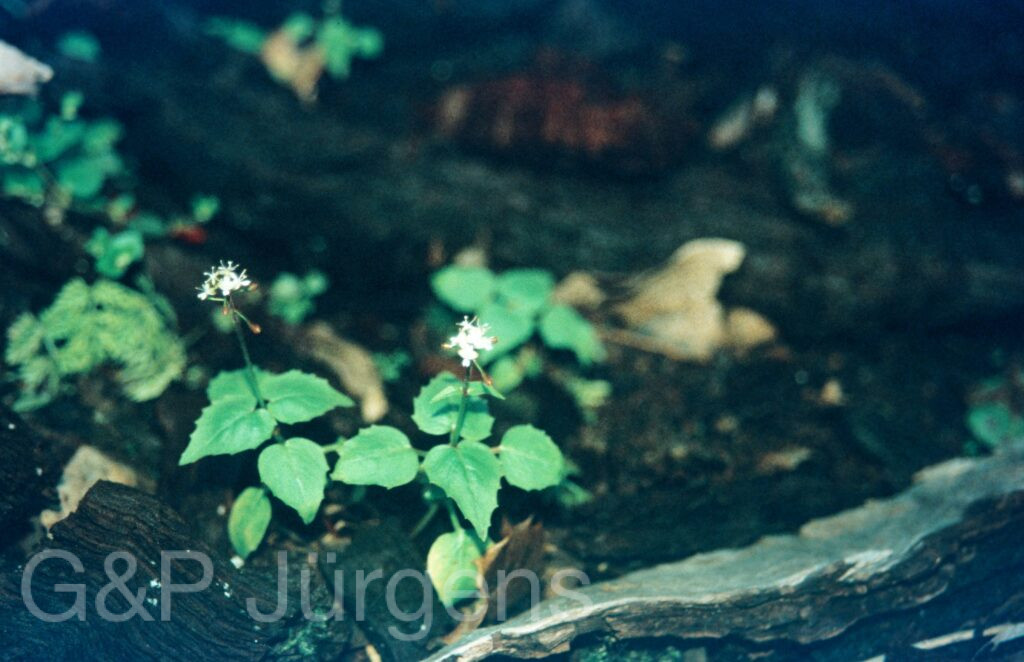
India Garhwal Gaushon 3100m, September

Description

Circaea alpina subsp. imaicola (Asch. & Magnus) Kitam. is the Asian montane race of the circumboreal enchanter's nightshade complex, distributed according to GBIF across China, Taiwan, the Himalaya (India, Nepal, Pakistan), Myanmar, Thailand, Vietnam, Japan and Korea. It is a delicate herb of cool, moist, shaded habitats: damp coniferous and mixed forest floors, mossy banks, stream sides and humus-rich rocky places, typically between about 2,000 and 3,800 m. The September record from Gaushon in Garhwal, India, at 3,100 m reflects its occurrence in the shaded understorey of temperate Himalayan forest, where it grows in moist leaf litter amongst ferns and bryophytes.

The plant is a slender, glabrous to sparsely pubescent perennial spreading by thread-like, often tuber-tipped stolons, with erect stems usually only 5–25 cm tall. The leaves are opposite, thin, ovate to broadly cordate-ovate, with shallowly toothed margins and a translucent texture. The tiny flowers are borne in a lax terminal raceme that elongates in fruit; each flower has two white, deeply notched (bifid) petals, two sepals and two stamens, in the characteristic two-merous floral plan of Circaea. The small, club-shaped fruit is an indehiscent nutlet covered with soft, hooked bristles that promote epizoochorous dispersal.

Within the Circaea alpina complex, subspecies imaicola is distinguished by features of stolon, leaf shape and fruit, and it represents the principal Himalayan and East Asian element of this widespread, taxonomically intricate species. As a shade-demanding mesophyte it is a reliable indicator of humid, undisturbed montane forest. Circaea itself is of phylogenetic interest as one of the few temperate woodland genera in the otherwise largely tropical and warm-temperate Onagraceae.

Author: (Asch. & Magnus) Kitam. · Sources: POWO (Kew), GBIF, Flora of China Vol. 13, Flora of Pakistan (Onagraceae), Boufford: The Systematics of Circaea (Annals of the Missouri Botanical Garden)

DC.

Bhutan2015 492
Bhutan Pele-La 2900m, October
Bhutan2015 399
Bhutan Jakar 3100m, October
Bhutan2015 398
Bhutan Jakar 3100m, October

Description

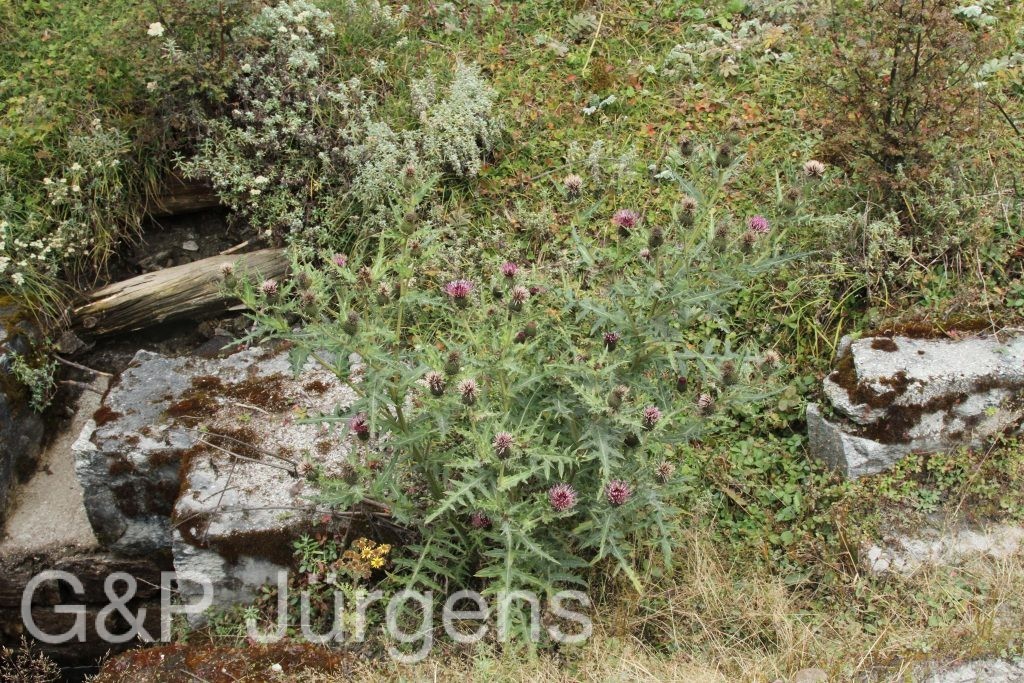
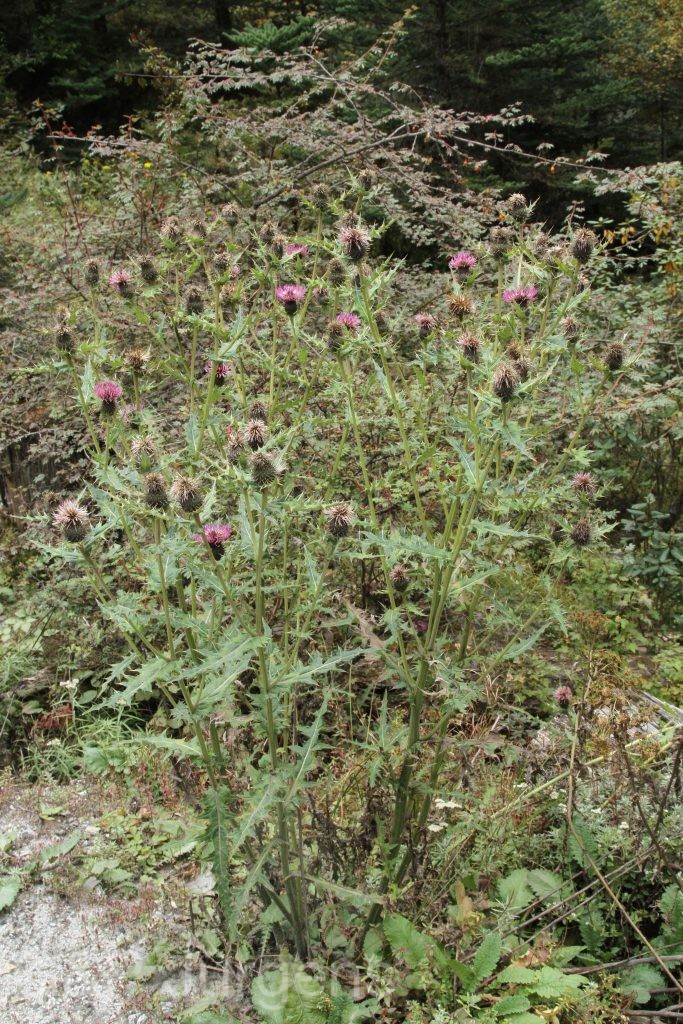
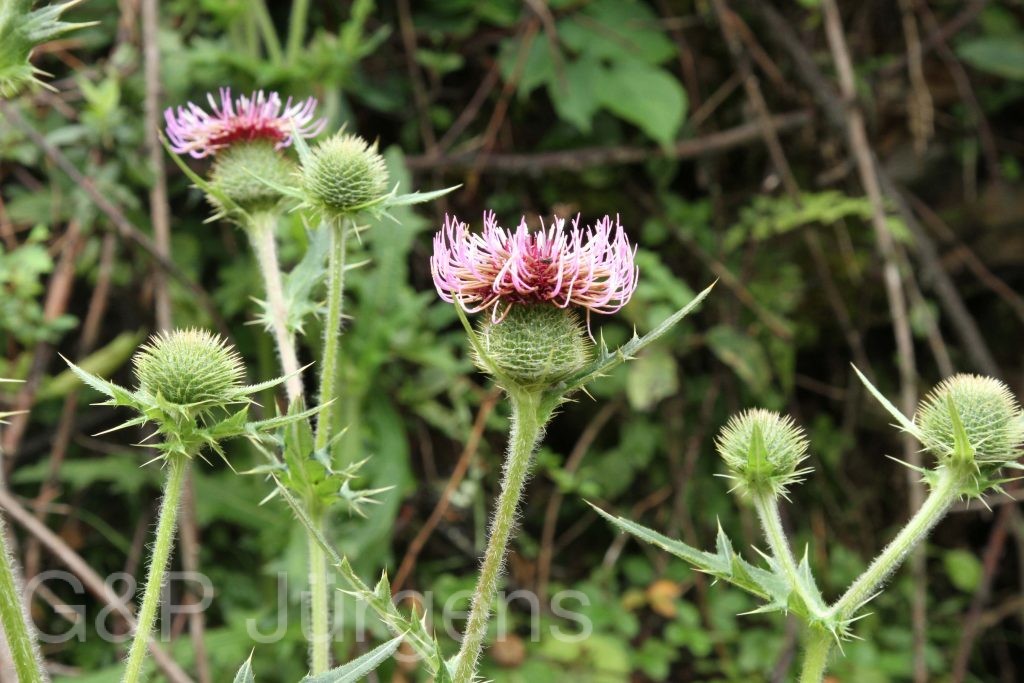
Cirsium argyracanthum is a Sino-Himalayan thistle distributed across China, India, Nepal, Afghanistan, Bhutan and Pakistan, with GBIF holding around 150 occurrences along this mountain belt. It is characteristic of open, sunny, frequently disturbed ground in the temperate and subalpine zones, growing on grassy slopes, pasture, fallow fields, trackside banks and forest clearings where grazing keeps the sward open. The cited records from the Pele-La pass at 2900 m and from Jakar in central Bhutan at 3100 m, both in October, illustrate its occurrence in upper temperate to subalpine settings, where it persists and fruits late into the autumn after the main summer flowering.

It is a stout biennial or perennial herb with an erect, longitudinally ribbed, spiny-winged stem. The leaves are oblong to lanceolate in outline, pinnatifid to pinnatisect with spinose-toothed lobes, the upper surface green and the lower paler and thinly tomentose, the margins armed with stiff spines. The capitula are discoid and ovoid, solitary or few at the branch tips, subtended by spiny upper leaves; the involucre bears numerous imbricate phyllaries tipped with conspicuous silvery, spreading spines that give the species its epithet. The florets are all tubular and bisexual, purple to pinkish. The cypselae are oblong and smooth, crowned by a pappus of long, plumose bristles aiding wind dispersal.

Within the large, taxonomically intricate genus Cirsium (tribe Cardueae), C. argyracanthum is distinguished by its silvery-spined involucre, and it has often been confused with related Himalayan thistles such as C. verutum, reflecting the difficulty of delimiting species in this group. Its spiny defences deter grazing, while the purple heads attract bees and butterflies. As a tolerant plant of disturbed montane habitats it is widespread and secure, of no conservation concern across its range.

Author: DC. · Sources: POWO (Kew), GBIF, Flora of Bhutan, Flora of China, Annotated Checklist of the Flowering Plants of Nepal, Petrak's revision of Asiatic Cirsium (Cardueae)

Petr.

Sikkim2011 257
Sikkim Lada-La 3800m, June
BhutanPG2011 284
Bhutan Jule-Tso, 4200m June
Sikkim2003 412 W574
Sikkim Zemu Valley 3400m August

Description

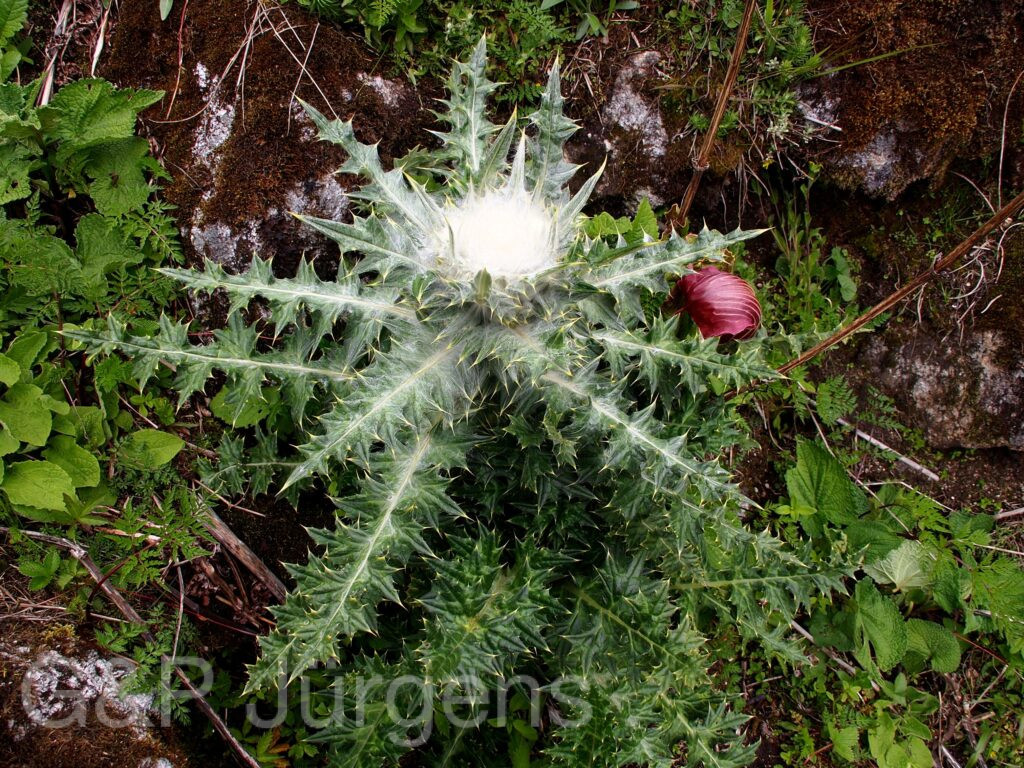
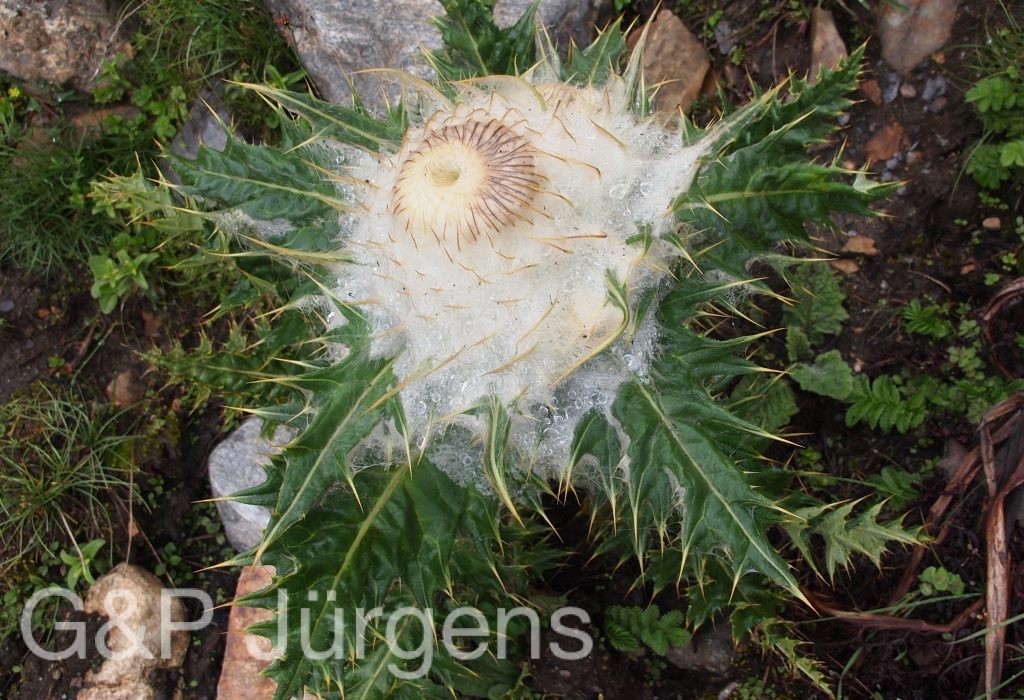
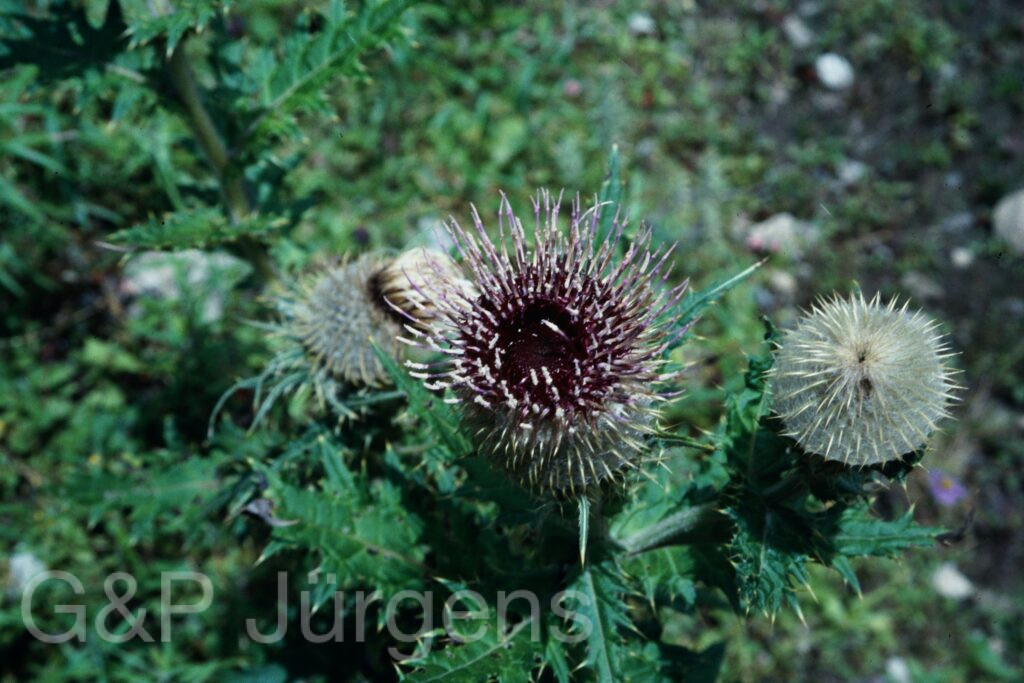
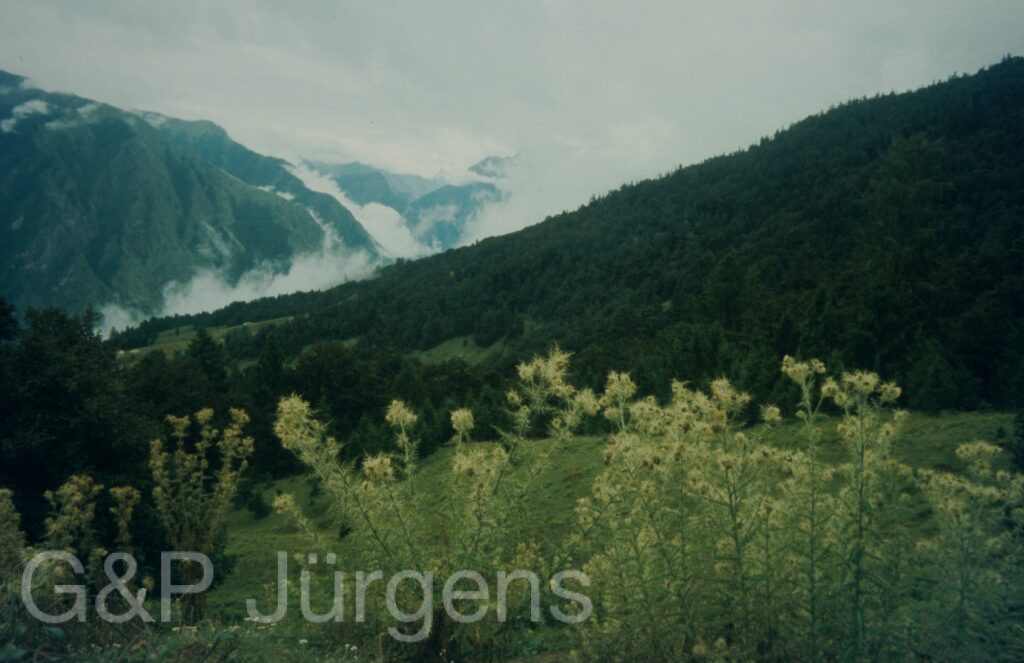
Cirsium eriophoroides is a robust alpine thistle of the eastern Himalaya and Sino-Tibetan mountains, recorded from China, India, Bhutan, Myanmar and Nepal, with about 234 GBIF occurrences. It grows in subalpine to alpine meadows, open grassy slopes, forest clearings and disturbed pasture, generally between about 3000 and 4500 m. The photographed plants come from Lada-La in Sikkim (3800 m, June), Jule-Tso in Bhutan (4200 m, June) and the Zemu Valley in Sikkim (3400 m, August), spanning the early and late high-Himalayan growing season.

The plant is a stout biennial or perennial herb with an erect, ridged, cobwebby-woolly stem reaching well over a metre. The leaves are oblong-lanceolate, deeply pinnatifid and conspicuously spiny along the margins, decurrent on the stem and white-tomentose beneath. The large capitula are solitary or few at the stem apex, subtended by leafy bracts and densely enveloped in long, white, arachnoid wool, the epithet "eriophoroides" likening this to the cottongrass Eriophorum. The involucral phyllaries are narrow and spine-tipped; the florets are tubular and purple to reddish, the fruit a smooth cypsela bearing a plumose pappus of feathery bristles.

Cirsium is a large genus of the tribe Cardueae, and C. eriophoroides represents the woolly-headed high-montane element well developed in the Sino-Himalaya. Its conspicuous capitula are visited by bumblebees and other long-tongued insects. Widespread and often associated with grazed ground, it is not regarded as threatened.

Author: Petr. · Sources: POWO (Kew), GBIF, Flora of China, Flora of Bhutan, Annotated Checklist of the Flowering Plants of Nepal, Compositae of the Sino-Himalaya (Cardueae studies)

(M.Bieb.) Fisch.

Bh09 287 P470
Bhutan Pele-La, 2900m June

Description

Cirsium laniflorum is a thistle whose GBIF-documented range lies chiefly in the Pontic–Caucasian and adjacent regions, with records from Ukraine, Turkey, Azerbaijan, Russia and Belgium among its roughly 92 occurrences; the himalayaflora image, taken at the Pele La in central Bhutan at 2900 m in June, documents a Himalayan population of a Cirsium of this affinity flowering in early summer. The plant occupies open grassy slopes, meadow margins, disturbed ground and roadside banks, growing on well-drained mineral soils in cool montane conditions where it forms part of the tall-herb and pasture vegetation.

The species is a robust biennial or perennial herb with an erect, often longitudinally ridged stem arising from a stout rootstock. The leaves are alternate, oblong-lanceolate in outline and pinnatifid, their lobes and margins armed with stiff yellowish spines, and the surfaces are more or less woolly, particularly beneath. The capitula are terminal, solitary or in small clusters, subtended by spine-tipped involucral bracts and conspicuously clothed in cobwebby, woolly indumentum, a feature evoked by the epithet laniflorum ("woolly-flowered"). The florets are all tubular and purple to pink-purple, and the cypselae bear a plumose, feathery pappus that detaches as a unit.

Cirsium belongs to tribe Cardueae of the Asteraceae, the spiny thistle group, in which the woolly involucres of species like C. laniflorum help insulate the developing florets and deter herbivores. The tubular flowers are visited by bumblebees, butterflies and other long-tongued insects, and the plumed achenes disperse on the wind. With a broad if scattered Eurasian distribution, the species is not of conservation concern; like many thistles it can behave as a ruderal coloniser of disturbed and grazed ground.

Author: (M.Bieb.) Fisch. · Sources: POWO (Kew), GBIF, Flora of China (Asteraceae), Flora of Bhutan, Werner Cirsium revision

Petr.

Bhutan2012 167
Bhutan Haar-Valley, 3200m September

Description

Cirsium shansiense is an Asian thistle distributed from China through the Himalaya, recorded from China, India, Bhutan, Japan and Turkey, with 575 georeferenced occurrences indicating a broad and well-collected range. It grows on grassy slopes, in open scrub, along forest margins, roadsides and disturbed clearings, from the warm-temperate into the montane zone. It was photographed in the Haa Valley of western Bhutan at 3200 m in September, flowering in the late-monsoon to early-autumn period when it is conspicuous on open montane slopes and pastures.

It is a robust erect perennial herb 0.5 to 1.5 m or more tall, with ribbed, often somewhat cobwebby stems arising from a stout root. The alternate leaves are lanceolate to elliptic in outline, pinnately lobed and conspicuously spiny along the margins, green above and grey-arachnoid-tomentose beneath, with bases that are sessile or slightly decurrent. The flower heads are ovoid, solitary or few at the branch tips, with an involucre of numerous imbricate, narrow, spine-tipped phyllaries that are usually arachnoid-hairy. All florets are tubular and reddish-purple to rose-purple. The fruit is a smooth oblong cypsela crowned by a pappus of long plumose bristles.

The species belongs to tribe Cardueae; like other members of Cirsium it is separated from Carduus by the feathery (plumose) pappus bristles. Cirsium shansiense is one of the more widespread and variable East Asian thistles, and its broad distribution from Japan to Turkey reflects considerable ecological tolerance. Its nectar-rich heads attract bees and butterflies, and it readily colonises grazed and disturbed ground. It is common and of no conservation concern.

Author: Petr. · Sources: POWO (Kew), GBIF, Flora of China, Flora of Bhutan, Cirsium monograph (Cardueae systematics, Petrak & Werner)

(Hook.f.) Aswal & Mehrotra

Garw 2005 76 ergebnis ergebnis
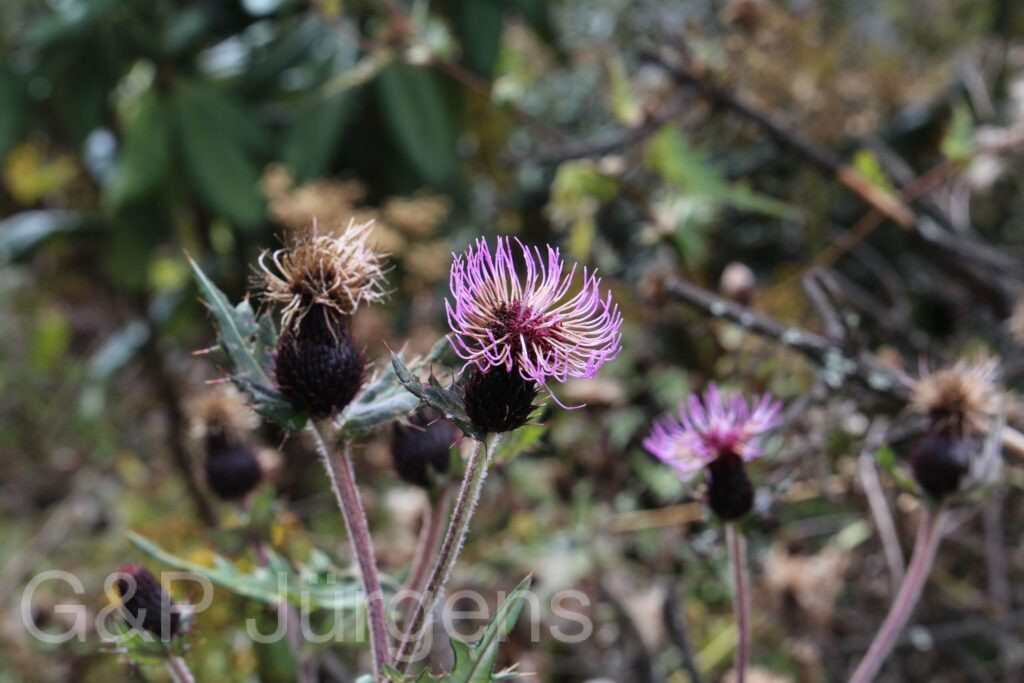
India Gaushon 3000m, September

Description

Cirsium wallichii var. platylepis is a Himalayan thistle taxon recorded by GBIF only from India, with about 8 occurrences, reflecting its status as a narrowly recognised variety raised by Aswal and Mehrotra from a Hooker name. It occupies open grassy slopes, pastures, forest margins, clearings and disturbed banks through the temperate and subalpine zones, broadly 2000 to 3300 m. The plant photographed at Gaushon in the Indian Himalaya at 3000 m in September, flowering and fruiting at the close of the monsoon, is consistent with its preference for sunny, somewhat disturbed montane grassland.

It is a robust biennial or perennial herb forming an erect, often winged and spiny stem from a stout rootstock. The leaves are oblong to lanceolate in outline, pinnatifid to pinnatisect, the lobes and margins armed with sharp spines and the undersurface frequently whitish-tomentose. The capitula are large and ovoid to subglobose, solitary or clustered, subtended by an involucre of many spine-tipped bracts; the variety platylepis is distinguished chiefly by its broader involucral phyllaries. The florets are tubular and pinkish-purple to whitish, and the cypselae are smooth and crowned by a pappus of plumose, feathery bristles that aid wind dispersal.

Cirsium is a large genus of true thistles in which Himalayan taxa form a difficult complex, and the variety platylepis represents fine-scale infraspecific differentiation within the widespread C. wallichii. The spiny armature and bitter foliage deter grazing in heavily pastured uplands, while the plumose pappus disperses the achenes effectively across open ground. As a narrowly defined variety with few records, its taxonomic standing merits further study, though the parent species is common and the entity is of no immediate conservation concern.

Author: (Hook.f.) Aswal & Mehrotra · Sources: POWO (Kew), GBIF, Flora of India (Asteraceae), Annotated Checklist of the Flowering Plants of Nepal, Flora of China (Asteraceae), Petrak revision of Asian Cirsium

L.

Bhutan2014 691
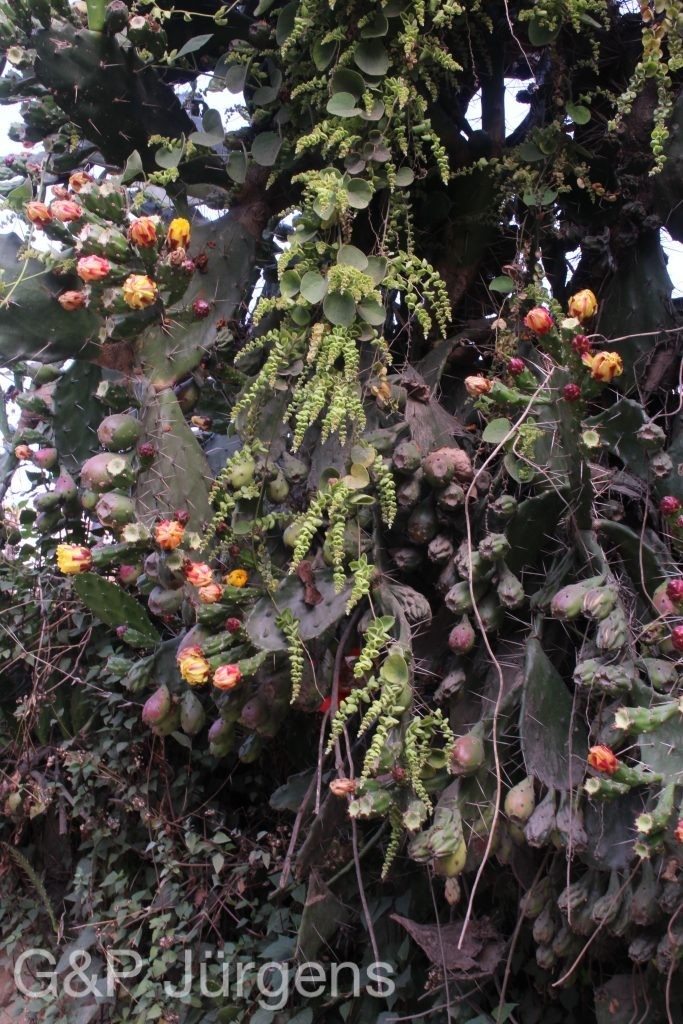
Bhutan Phobjika 2810m, May (see also Opuntia humifusa)
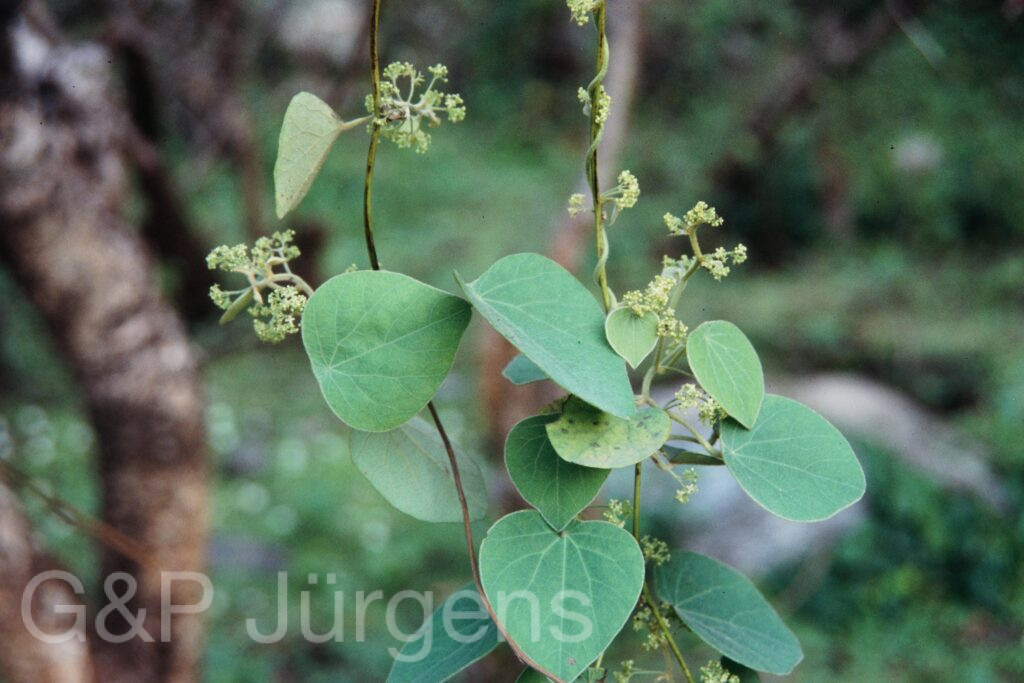
Nepal 97 29 P46 ergebnis
Nepal Dhoban 735m, April

Description

Cissampelos pareira is a pantropical climbing vine with an exceptionally broad distribution spanning the Americas, Africa, Madagascar and tropical Asia; GBIF records some 12107 occurrences across Mexico, Brazil, Costa Rica, Colombia, Argentina, India, Madagascar, Nepal, the Philippines, Ecuador and many other countries. It is a plant of warm, often disturbed habitats, scrambling over hedges, thickets, forest margins, fences and waste ground from sea level well into the hills. The collections cited from Phobjika in Bhutan at about 2810 m in May and from Dhoban in Nepal at about 735 m in April illustrate its wide ecological amplitude in the Himalayan foothills, where it persists from the subtropical lowlands up into cool mid-montane settings.

It is a slender, twining perennial herb or woody-based liana, the stems wiry and often finely pubescent. The leaves are alternate, broadly ovate to orbicular or peltate, frequently emarginate or mucronate at the apex and cordate to truncate at the base, with a long petiole inserted near the margin. The species is dioecious: the small greenish male flowers have fused sepals and a cup-shaped corolla with united stamens, while the female flowers are borne in axillary clusters subtended by conspicuous, often enlarged leaf-like bracts. The fruit is a small, laterally compressed, hairy red drupe with a characteristically curved (horseshoe-shaped) endocarp.

A member of the moonseed family (Menispermaceae), C. pareira is famous as a source of bisbenzylisoquinoline alkaloids and is used pan-tropically in traditional medicine, where it forms part of the complex of plants known as pareira brava. The curved endocarp and fleshy drupe are adapted to bird dispersal, which together with its tolerance of disturbance underlies its remarkable cosmopolitan spread. Taxonomically the species is broadly circumscribed and notoriously variable, encompassing numerous infraspecific forms, and it is widespread and of no conservation concern.

Author: L. · Sources: POWO (Kew), GBIF, Flora of China Vol. 7, Flora of Bhutan Vol. 1, Flora of Nepal, Diels Menispermaceae (Das Pflanzenreich)