Tag:

Subalpine (2500-3500 m)

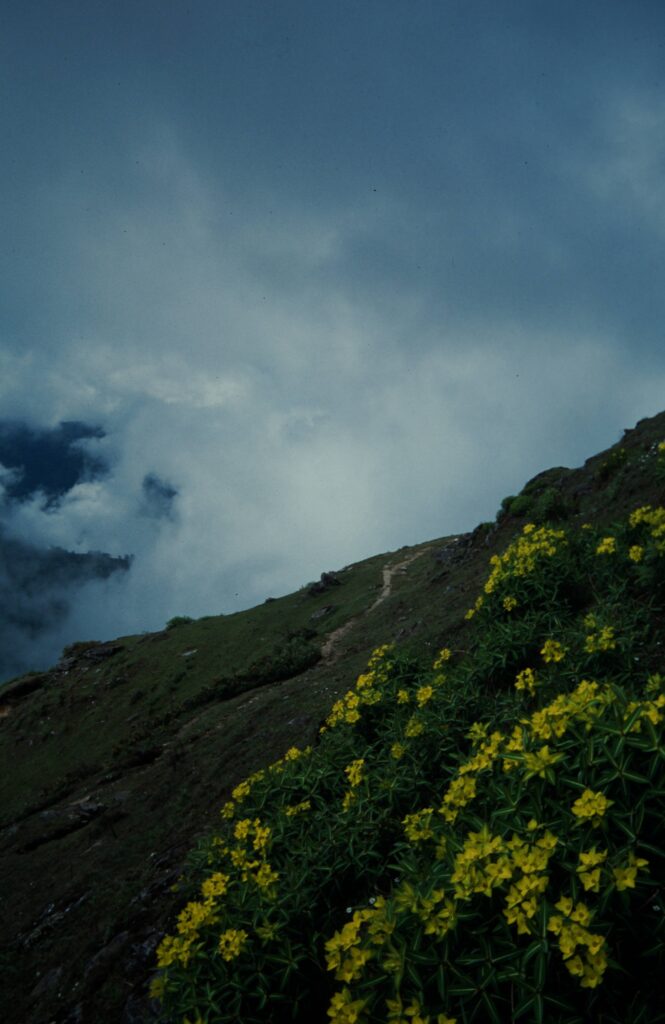
Boiss.

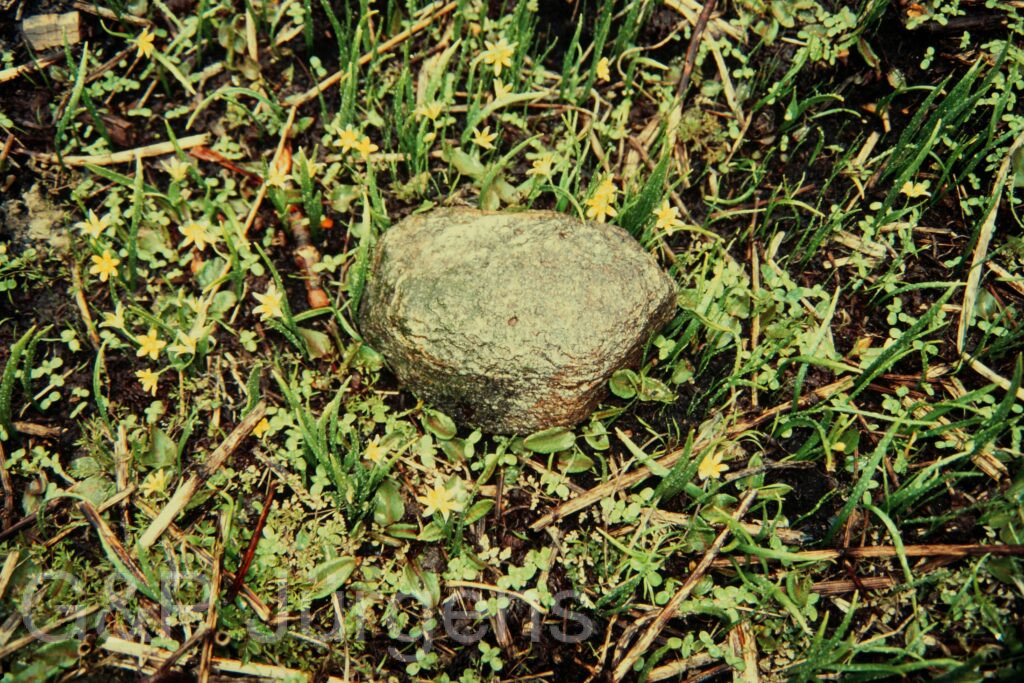
Nepal 2001 302 ergebnis ergebnis
Nepal (Gorkha) Lambra Kharka 3100m, May
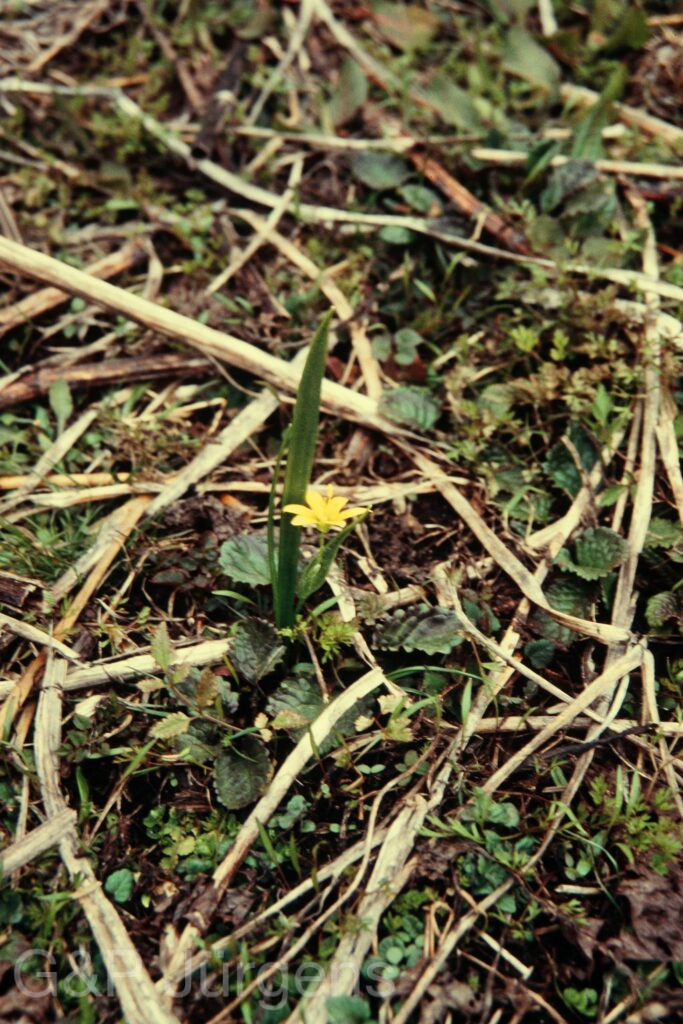
Nepal 2001 301 ergebnis
Nepal (Gorkha) Lambra Kharka 3100m, May
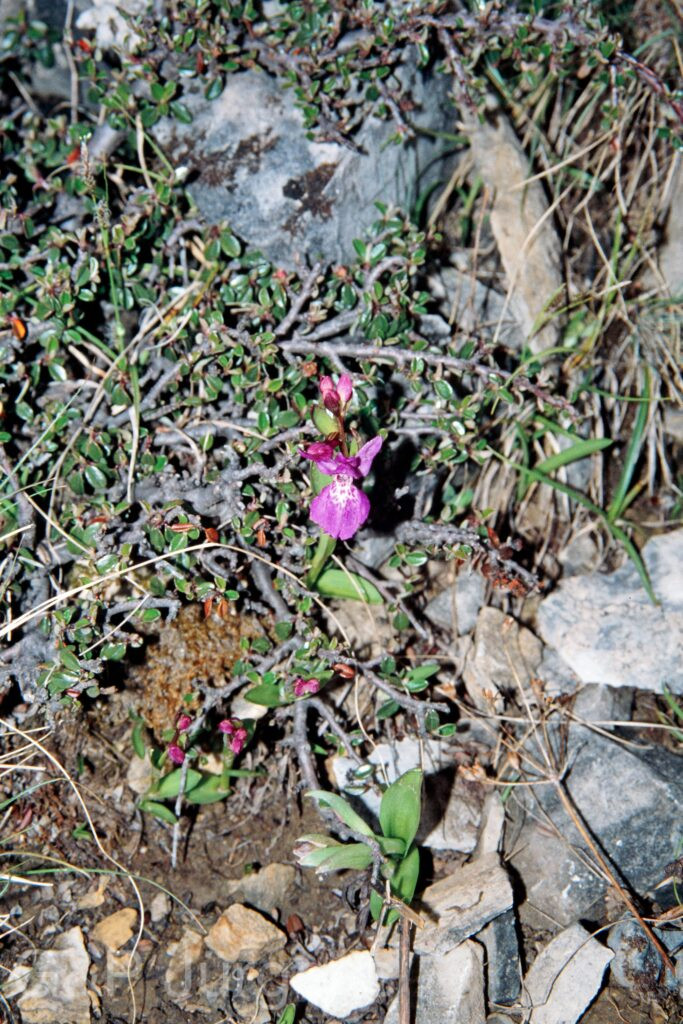
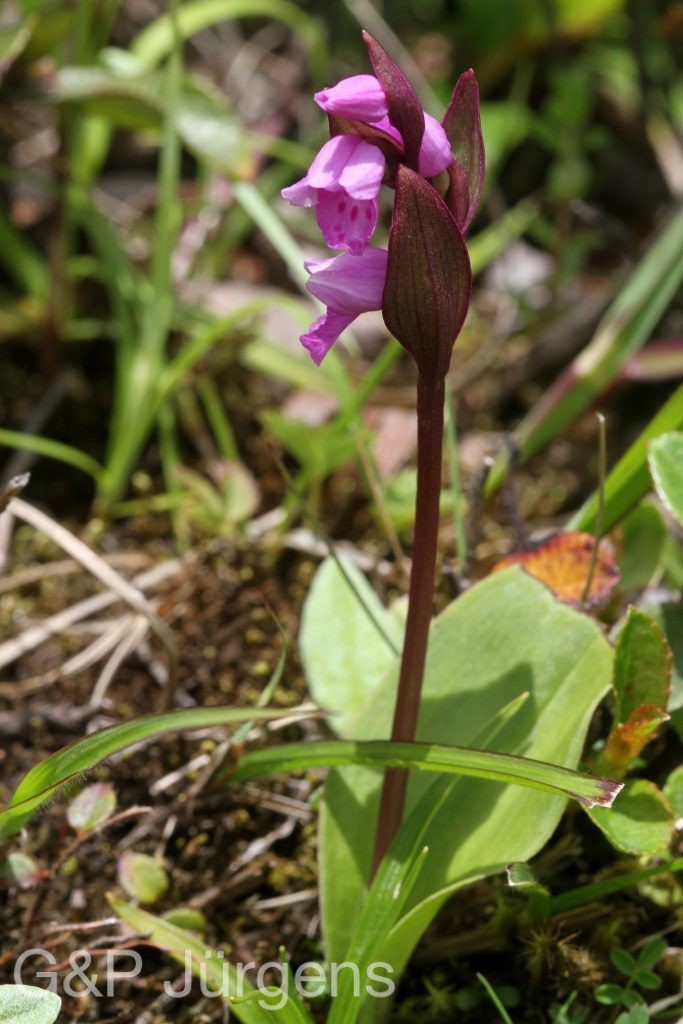
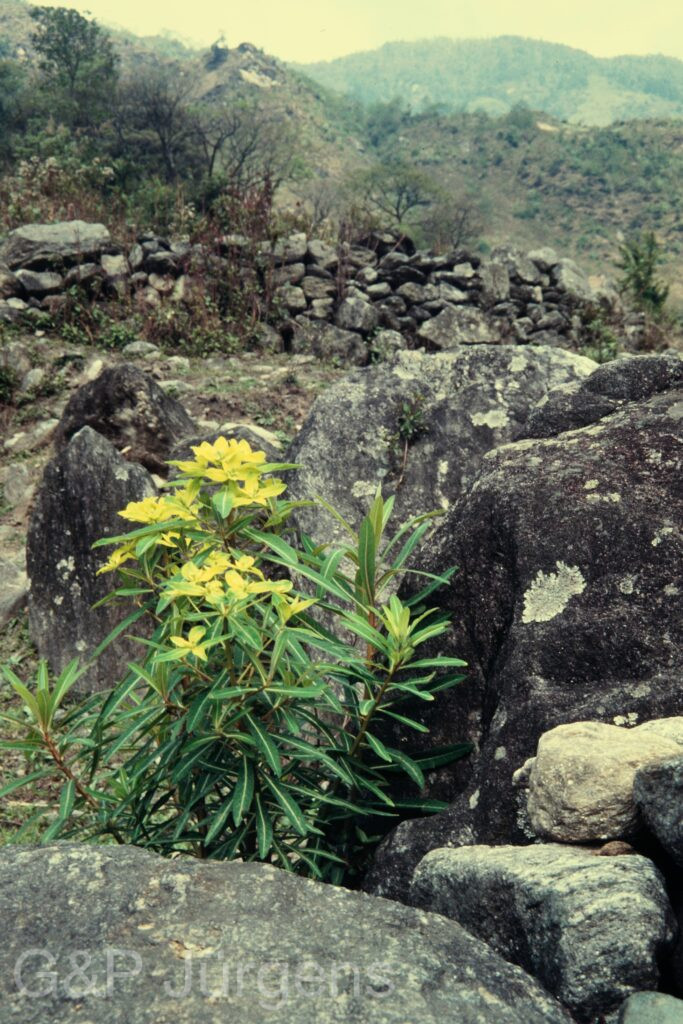
Nepal 97 86 P146
Nepal Tankhu 2100m April

Description

Euphorbia sikkimensis is a robust herbaceous spurge distributed across the eastern and central Himalaya, from central Nepal through Sikkim, Bhutan, and northeast India into southern China (Xizang, Yunnan), with peripheral records from Myanmar, Laos, and Vietnam. It occurs in subalpine meadows, forest clearings, scrub margins, and open hillsides at elevations of 1,800–3,500 m. The species has been documented from the Gorkha district of Nepal at Lambra Kharka at 3,100 m in May and near Tankhu at 2,100 m in April, indicating a broad elevational amplitude and early-season phenology at lower altitudes.
The plant is a stout, erect perennial herb, 30–80 cm tall, with thick, fleshy rootstock and unbranched or sparingly branched stems that exude copious white latex when cut. Leaves are alternate, sessile, linear-lanceolate to oblanceolate, 8–15 cm long and 1–2.5 cm wide, with a prominent pale midrib, entire margins, and a glaucous undersurface. The inflorescence is a terminal, compound cyathium typical of the genus, with a broad umbel of 4–8 primary rays, each ray subtended by obovate, yellowish-green floral bracts. The cyathia bear crescent-shaped glands with short horns. The fruit is a smooth, trilocular capsule approximately 6–8 mm in diameter, explosively dehiscent at maturity, with carunculate seeds.
Euphorbia sikkimensis was described by Boissier from Sikkim collections and belongs to Euphorbia subgenus Esula, a predominantly Eurasian clade of herbaceous spurges. It is notable for its striking appearance in early spring, when the bright red or pink-tinged new stems contrast with the yellowish-green inflorescences. The species has gained horticultural recognition in temperate gardens and is increasingly cultivated as an ornamental perennial in Europe. Ecologically, its copious latex deters herbivory, and it plays a role in early-season pollinator support in montane grassland ecosystems.

Author: Boiss. · Sources: POWO (Kew), GBIF, Flora of China Vol. 11, Annotated Checklist of the Flowering Plants of Nepal
Moench

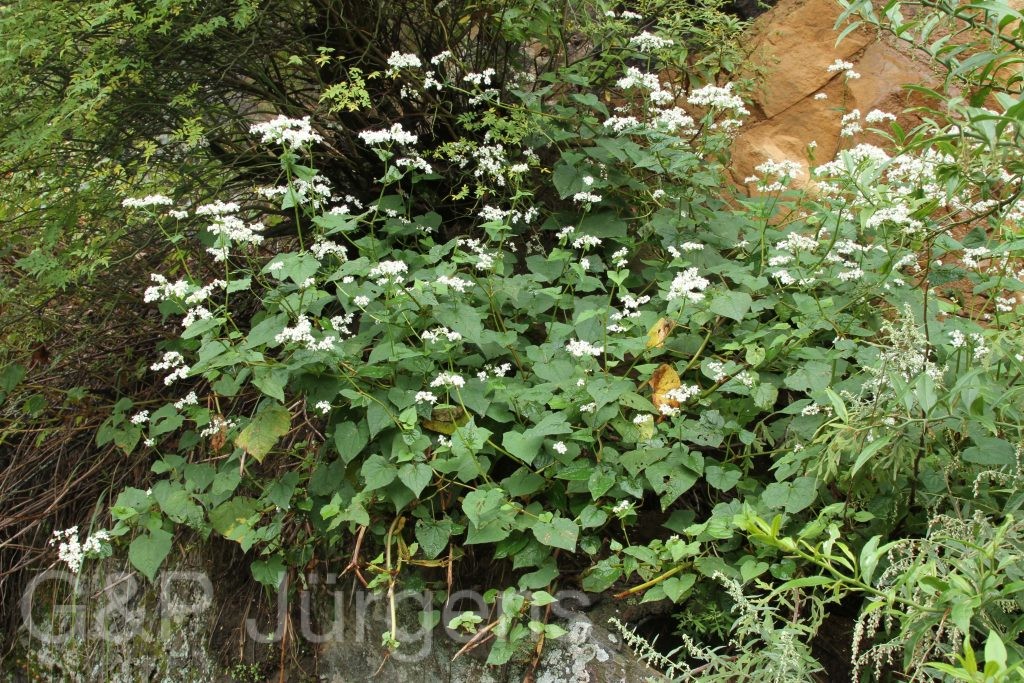
Bhutan2012 155
Bhutan Haar-Valley, 3100m September

Description

Fagopyrum esculentum, common buckwheat, is a domesticated annual of South-East Asian and Sino-Himalayan origin now cultivated and naturalised across the temperate world, accounting for its more than 72,000 GBIF occurrences in France, the Netherlands, Germany, Russia, China, Korea, Japan, the United States and Canada among many others. In the Himalaya it is a traditional mountain crop grown on terraced fields and as an escape on disturbed ground at middle to high elevations. The record from the Haa Valley of western Bhutan at 3100 m in September captures it in flower and early fruit at the close of a typical subalpine growing season.

It is an erect, glabrous annual 30-90 cm tall with reddish, somewhat fleshy stems and characteristic membranous ochreae sheathing the nodes. The leaves are alternate, broadly triangular-cordate to hastate, the lower ones petiolate and the upper sessile and clasping. The flowers are small, borne in dense axillary and terminal corymbose racemes, with a five-parted white to pinkish perianth, eight nectary-bearing stamens and a tristylous heterostylous breeding system promoting outcrossing. The fruit is a sharply three-angled, smooth brown achene (the buckwheat "grain") much exceeding the persistent perianth.

Within Polygonaceae the genus Fagopyrum is distinguished by its trigonous achenes and heterostyly; F. esculentum is the principal cultivated species, complemented by Tartary buckwheat F. tataricum. It is insect-pollinated, valued as a nectar source and pseudocereal, and is of agricultural rather than conservation interest, persisting widely as a weedy escape from cultivation.

Author: Moench · Sources: POWO (Kew), GBIF, Flora of China, Flora of Bhutan, Flora Europaea, Ohnishi monograph of Fagopyrum

Roxb.

Description

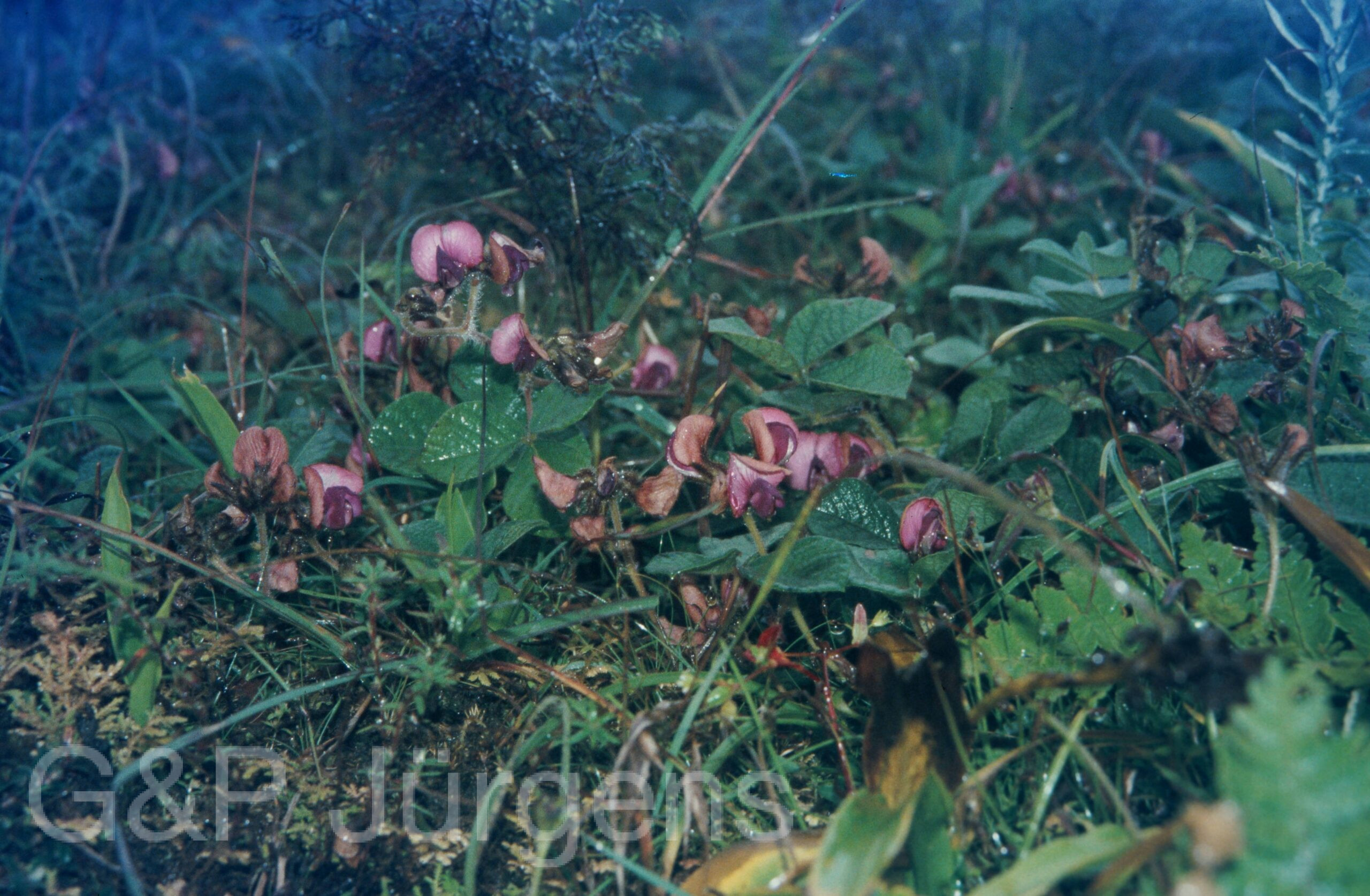
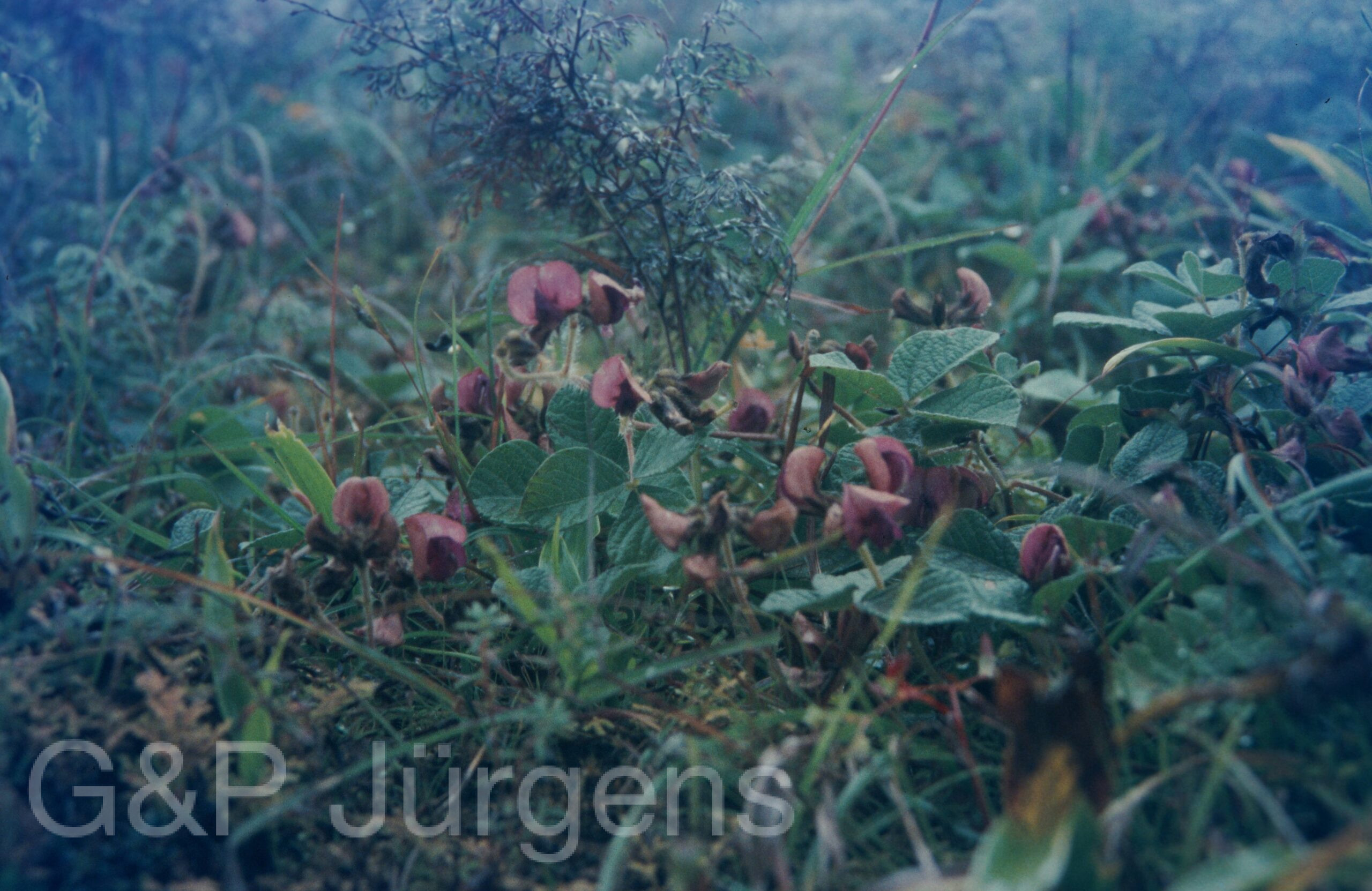
Flemingia procumbens is a prostrate, sub-Himalayan legume distributed from the western Himalaya eastward through Nepal into southern China, with scattered records reaching Laos and New Guinea. GBIF documents some 61 occurrences across India, China, Nepal, Laos and Papua New Guinea, reflecting a discontinuous range spanning warm-temperate montane slopes and submontane grasslands. The species favours open, sunny banks, terraced field margins, dry hill grasslands and stony, well-drained soils, typically flowering in late summer and early autumn. The material illustrated here was gathered in India at Garhwal, Simkarok, at about 2600 m in September, an elevation characteristic of its mid-altitude preference along the outer Himalayan ranges.

The plant is a low perennial herb or subshrub with trailing to decumbent, often somewhat woody stems arising from a stout rootstock, the younger branches finely pubescent. The leaves are pinnately trifoliolate with prominent stipules, the leaflets elliptic to obovate, entire-margined and glandular-punctate beneath, borne on short petiolules. Small papilionaceous flowers, pink to purplish, are aggregated in dense axillary or terminal racemes subtended by bracts; the calyx is deeply lobed and the standard petal exceeds the wings and keel. The fruit is a small, turgid, two-seeded pod which dehisces explosively at maturity, releasing minute, smooth seeds.

Flemingia is a genus of the tribe Phaseoleae closely allied to Moghania and frequently subsumed within or segregated from it by various authors; the gland-dotted foliage and inflated pods are diagnostic of the group. Several species yield the orange resinous dye and dusting powder known as waras, harvested from glandular hairs of the inflorescences. F. procumbens has no recognised conservation concern given its broad if sparse distribution, though montane grassland habitats face pressure from grazing and land conversion.

Author: Roxb. · Sources: POWO (Kew), GBIF, Flora of China, Flora of British India, The Legumes of the Indian Subcontinent, A Revision of the Genus Flemingia (Leguminosae-Papilionoideae)

Lour.

Bhutan2012 662
Bhutan Chele-La 3400m, September

Description

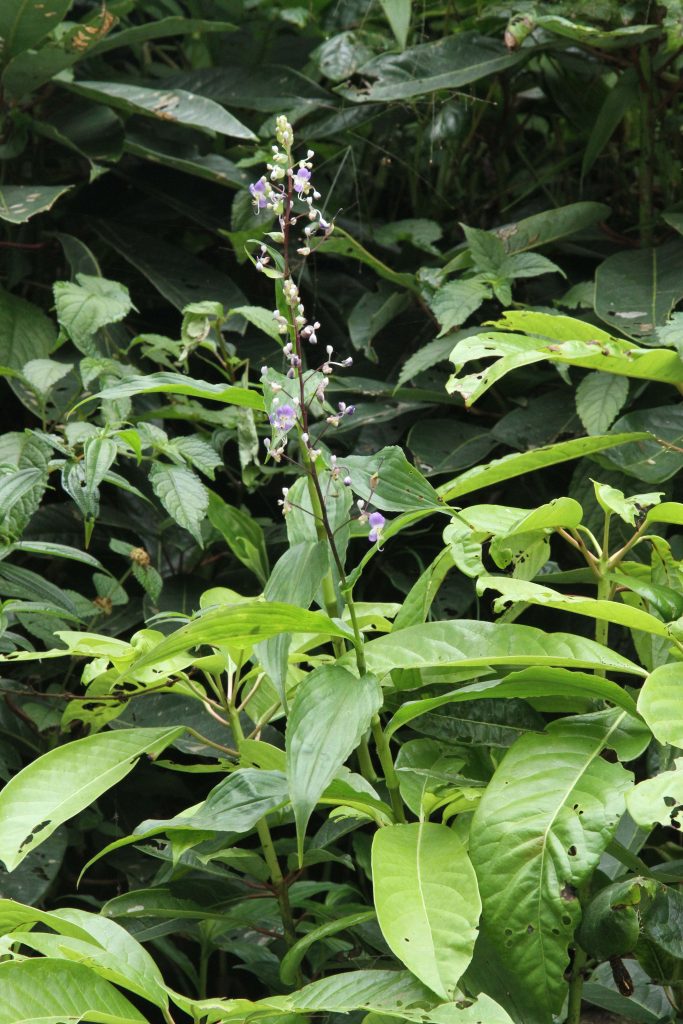
Floscopa scandens is a perennial spiderwort with a very broad Indo-Malesian to Australasian range, documented by GBIF (2373 occurrences) from China, India, Indochina, the Malay Archipelago, the Philippines, New Guinea, Sri Lanka, Bangladesh, Nepal and Australia. It is a plant of wet, shaded ground, growing along streams, ditches, marshes, paddy margins and damp forest floors, predominantly at low and middle elevations though ascending higher locally. The cited record from Chele-La in Bhutan at 3400 m in September lies at the upper end of its range, where it persists in moist hollows and seepage zones flowering into the late monsoon.

The species is a soft, somewhat straggling to decumbent or scrambling herb with elongate, often reddish stems rooting at the lower nodes. The leaves are alternate, sessile or shortly petiolate, lanceolate to elliptic, with closed sheathing bases that are usually ciliate at the mouth. The inflorescence is a dense, much-branched terminal thyrse or panicle of small flowers subtended by membranous bracts and bracteoles; each flower has three free sepals, three free blue to pinkish or whitish petals, and typically six stamens, the filaments often bearded. The fruit is a small, two-locular, laterally compressed capsule containing few seeds.

Floscopa is distinguished within Commelinaceae from the closely related Commelina and Tradescantia by its many-flowered, paniculate inflorescence not enclosed in a folded spathe, and by its compressed bilocular capsule. The genus favours permanently moist, often disturbed wetland habitats and is pollinated by small insects. Widespread and ecologically plastic, F. scandens is common throughout its range and faces no conservation threat.

Author: Lour. · Sources: POWO (Kew), GBIF, Flora of China Vol. 24, Flora of Bhutan Vol. 3, Flora of Nepal, Faden Commelinaceae systematic studies

J.Gay

Bh09 291 P480
Bhutan Pele-La, 3200m June

Description

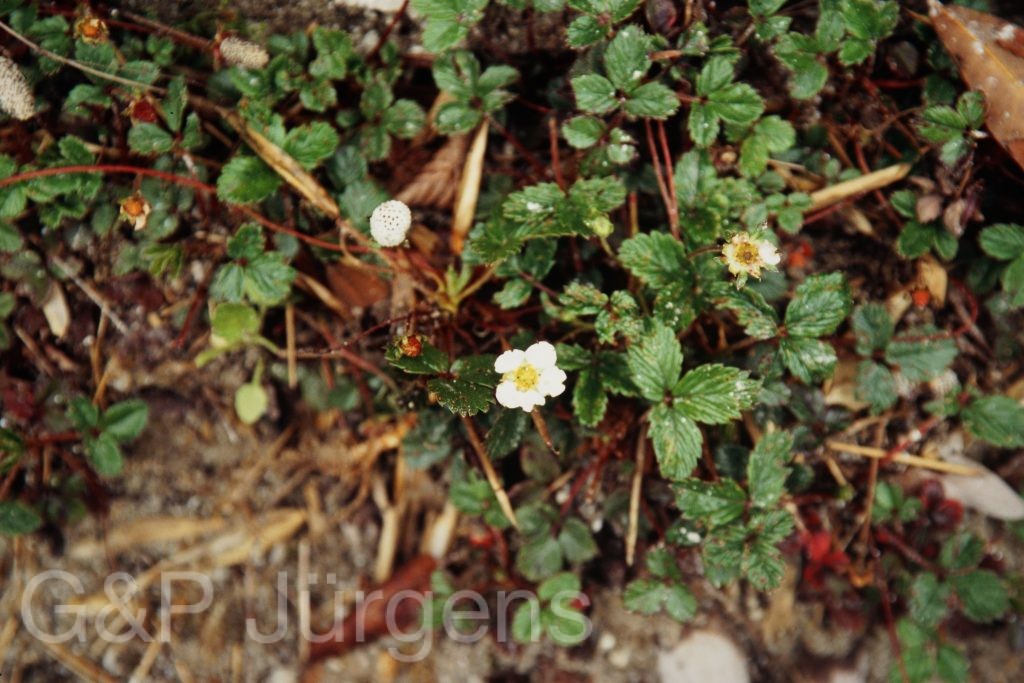
Fragaria daltoniana, the Sikkim strawberry, is a Himalayan wild strawberry native to Nepal, India, Bhutan, southern Tibet (China) and northern Myanmar; the additional GBIF country codes (USA, Norway, France, Sweden, Armenia) reflect cultivated material and herbarium holdings rather than wild range, the dataset listing some 181 records. It grows in moist montane forest margins, clearings, mossy banks, grassy slopes and along streamsides, generally between about 2500 and 4000 m. The plant photographed at the Pele-La in Bhutan at around 3200 m in June represents its typical temperate-forest belt habitat.

It is a slender, stoloniferous perennial herb forming open mats by rooting runners. The trifoliolate leaves are long-petiolate, the leaflets thin, obovate and coarsely serrate, sparsely hairy. Solitary or few white flowers are borne on slender pedicels, each with five spreading petals, numerous stamens and an epicalyx alternating with the sepals. The fleshy receptacle ripens into the diagnostic fruit: an elongate, narrowly ovoid to oblong scarlet 'strawberry' bearing numerous achenes superficially on its surface, larger and more cylindrical than in most relatives but reputedly insipid.

Fragaria daltoniana is one of the few strawberries of the Sino-Himalayan region and is notable to horticulturists and breeders as a wild diploid genetic resource within the genus. Its long, narrow red receptacle distinguishes it from the rounder fruits of F. nubicola and F. vesca, with which it can co-occur. The species is not considered threatened, being locally common across a wide range, though it depends on cool, humid forest-edge microhabitats vulnerable to deforestation and to climatic drying at the lower limits of its altitudinal band.

Author: J.Gay · Sources: POWO (Kew), GBIF, Flora of Bhutan, Flora of China, Annotated Checklist of the Flowering Plants of Nepal, Staudt Taxonomic Studies in the Genus Fragaria

Fragaria nubicola

by GP Jürgens

Lindl. ex Lacaita

Bhutan2014 571
Bhutan Phobjika 3000m, May

Description

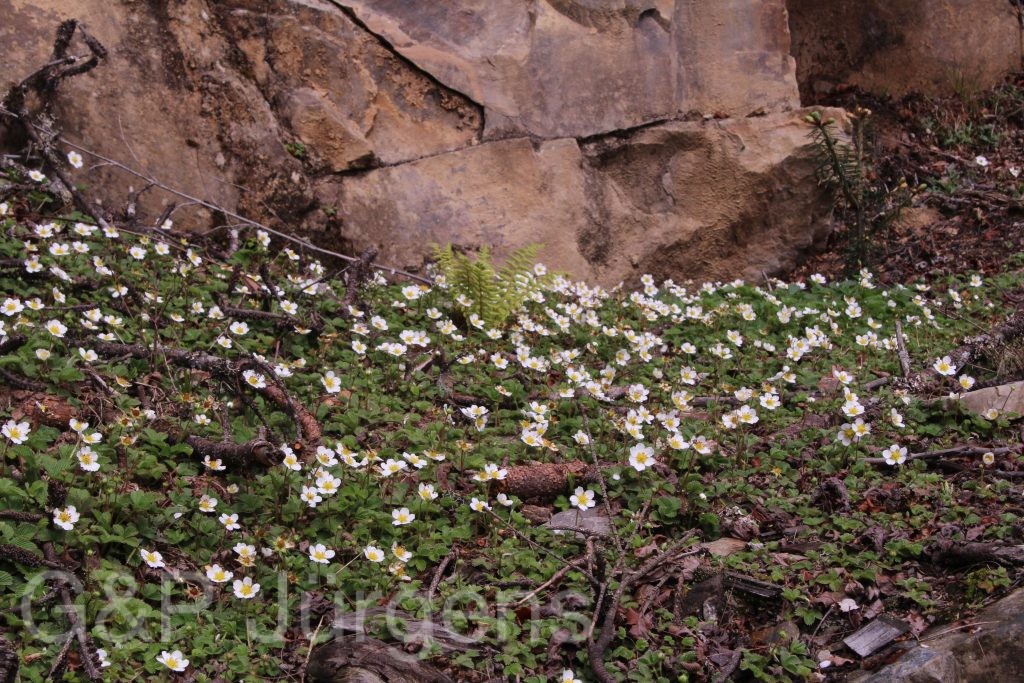
Fragaria nubicola, the Himalayan wild strawberry, is widely distributed along the Himalaya and into the mountains of Central Asia, recorded from Nepal, India, Pakistan, China, Bhutan and Afghanistan, with naturalised and cultivated records accounting for the European and North American points among its 545 GBIF occurrences. It inhabits open temperate forest, forest margins, grassy clearings, banks and damp meadow turf, typically between 1500 and 4000 m. The plant photographed in the Phobjika valley of central Bhutan at about 3000 m in May exemplifies the moist, partly shaded montane grassland where it flowers and fruits through the warm season.

The species is a low stoloniferous perennial herb spreading by long, slender, rooting runners from a short woody rootstock. The leaves are basal and trifoliolate, with broadly obovate, coarsely serrate leaflets that are bright green and thinly hairy above and paler and silky-pubescent beneath, borne on long villous petioles. The flowers are solitary or few in a lax cyme on hairy scapes; each has five white obovate petals, an epicalyx alternating with the sepals, and numerous yellow stamens around a domed receptacle. The fleshy red accessory fruit (the edible strawberry) bears the true fruits as small achenes sunk in shallow pits on its surface.

Fragaria nubicola belongs to the diploid lineage of the genus and is considered one of the wild progenitor groups relevant to strawberry evolution and breeding, making it of interest for crop genetic resources. Its trifoliolate leaves and stoloniferous spread are typical of the genus, while the silky lower leaf surface and montane ecology distinguish it from lowland relatives. Reproduction is both clonal, by stolons, and sexual, with fruit dispersed by birds and mammals. The species is common and not threatened, though wild germplasm conservation is valued for its potential in cultivated Fragaria improvement.

Author: Lindl. ex Lacaita · Sources: POWO (Kew), GBIF, Flora of China, Flora of Bhutan, Staudt Monograph of the Genus Fragaria

Gagea lutea

by GP Jürgens

Ker Gawl.

Nepal 97 140 G265
Nepal Mewa-Khola 3100m April
Nepal 97 141 P266
Nepal Mewa-Khola 3100m April

Description

Gagea lutea is a widely distributed Eurasian geophyte, abundant across temperate Europe and northern Asia, with a very large GBIF dataset of over 97000 records from Sweden, Germany, France, Britain, Poland, Russia, Norway, the Netherlands and many other countries, extending eastward to Japan. It grows in deciduous woodland, riverine forest, hedgerows, damp meadows and shaded slopes, typically on moist, base-rich soils. As a spring ephemeral it flowers early and dies back by summer. The photographed plant from the Mewa-Khola valley in eastern Nepal at 3100 m, flowering in April, marks the southeastern Himalayan edge of its range, where it persists in cool, humid montane forest.

It is a small bulbous perennial with a single ovoid bulb. The defining feature is the solitary, broadly linear to linear-lanceolate basal leaf, which is flat, hooded at the apex, somewhat keeled and usually exceeds the inflorescence. Two unequal leaf-like bracts subtend the umbel-like cyme of few flowers. Each flower has six free, narrowly oblong tepals that are bright yellow within and green-striped outside, blunt to subacute at the apex. There are six stamens with yellow anthers and a superior three-locular ovary bearing a single style. The fruit is a loculicidal, obovoid to subglobose capsule producing flattened, subglobose seeds.

Gagea lutea is the type species of its genus and belongs to the tribe Tulipeae of the Liliaceae. It is the well-known Yellow Star-of-Bethlehem, often forming clonal patches; many populations are non-flowering and reproduce vegetatively by bulbils, complicating field census. Pollination is by early-flying bees and flies, and the elaiosome-bearing seeds are partly ant-dispersed (myrmecochory). Though locally declining through woodland loss, it remains common over its vast range and is of least concern.

Author: Ker Gawl. · Sources: POWO (Kew), GBIF, Flora of China Vol. 24, Flora of Nepal, Flora of Pakistan, Levichev Studies in the Genus Gagea (monograph)

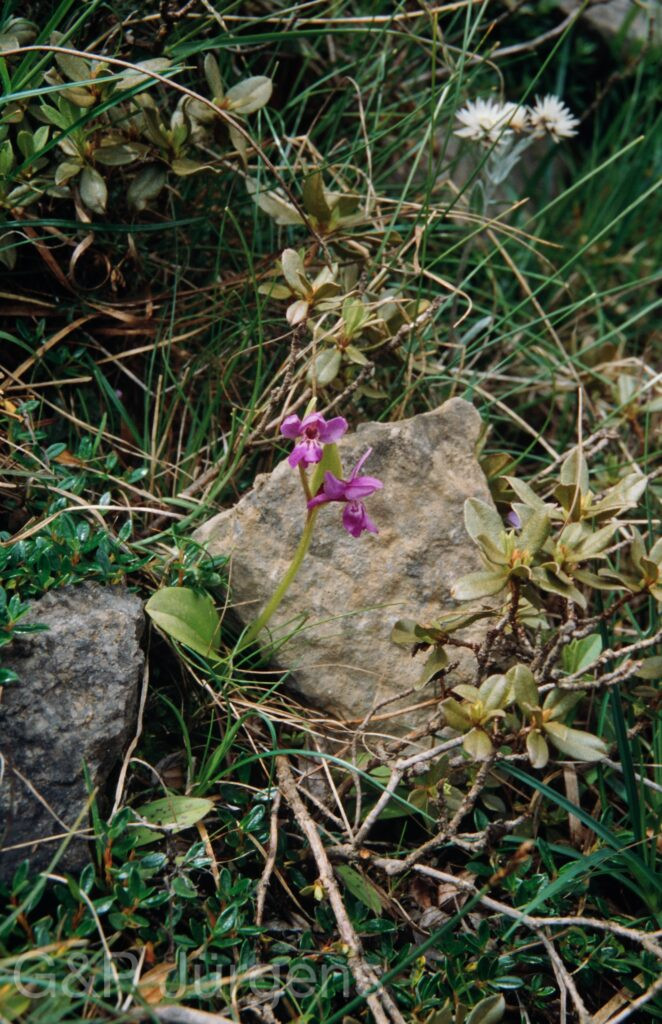
(Maxim.) S.C.Chen, P.J.Cribb & S.W.Gale

Nepal 99 34 ergebnis
West-Nepal Chere 3000m June

Description

Galearis roborovskii is a terrestrial orchid distributed across the high mountains of Central and East Asia, with georeferenced records documented from China, Nepal, Bhutan, India, Myanmar, Japan and Russia, comprising about 154 occurrences in GBIF. It is a plant of cool, moist alpine and subalpine habitats, favouring open meadows, grassy slopes, streambanks and forest margins where snowmelt maintains soil moisture through the growing season. The species generally occurs between roughly 2500 and 4000 m, and the population photographed at Chere in West Nepal at about 3000 m in June, at the onset of the monsoon flowering season, falls within this montane belt.

It is a small, glabrous, tuberous geophyte arising from ovoid to oblong fleshy tuberoids. The slender, erect stem bears one or two basal leaves that are oblong-elliptic to lanceolate, sheathing at the base and often fleshy. The inflorescence is a short, few-flowered terminal raceme subtended by leaf-like bracts. The flowers are purple to rose-pink, with the dorsal sepal and petals converging to form a loose hood (galea) over the column; the lateral sepals spread or are reflexed, and the trilobed labellum is deflexed and produced basally into a slender, cylindric to clavate spur. The fruit is a small erect dehiscent capsule releasing abundant dust-like seeds.

The genus Galearis was resurrected and recircumscribed on molecular grounds, and this species was transferred from Orchis by S.C.Chen, P.J.Cribb and S.W.Gale; it sits within subtribe Orchidinae. Like most temperate terrestrial orchids it depends on mycorrhizal fungi for germination and establishment, rendering it sensitive to grazing, trampling and habitat disturbance. Though presently widespread and not formally assessed as threatened across its broad Himalayan to Sino-Russian range, localised populations warrant monitoring against alpine land-use pressures.

Author: (Maxim.) S.C.Chen, P.J.Cribb & S.W.Gale · Sources: POWO (Kew), GBIF, Flora of China, Flora of Bhutan, Flora of Nepal, Pearce & Cribb The Orchids of Bhutan

(Lindl.) P.F.Hunt

Sikkim2011 207
Sikkim Lachung 3100m, June
Nepal 99 809 ergebnis
West-Nepal Baga-La-Phedi 4300m, July

Description

Galearis spathulata is a small terrestrial orchid of the high Himalaya and the mountains of western China, recorded from China, India, Nepal, Bhutan and Myanmar, with over 500 occurrences in GBIF. It is a plant of moist alpine and subalpine meadows, open Rhododendron and juniper scrub, grassy slopes and rocky turf, generally between about 3,000 and 4,500 m. The illustrated gatherings span this range, from Lachung in Sikkim at around 3,100 m in June to Baga-La-Phedi in West Nepal at about 4,300 m in July, where the species flowers through the early summer monsoon.

It is a dwarf, glabrous perennial herb arising from slender, fleshy root-tubers and bearing usually one or two basal, spathulate to oblong leaves that taper to a sheathing base. The short, erect stem terminates in a few-flowered raceme of small purplish-pink flowers, each subtended by a bract. The dorsal sepal and petals converge to form a hood over the column, the lateral sepals spreading; the labellum is entire to obscurely lobed, directed forward and produced at the base into a short, cylindrical to saccate spur. The fruit is an erect, ribbed capsule releasing dust-like seeds.

Galearis is a small holarctic-temperate to Sino-Himalayan genus segregated from Orchis, and G. spathulata is distinguished by its spathulate basal leaves and short-spurred, hooded flowers. Pollination is by insects, with seedling establishment dependent on mycorrhizal association, as in all orchids. Widespread and locally common across the alpine Himalaya, the species is not regarded as threatened, although, being an orchid, it falls under the general CITES Appendix II listing for the family.

Author: (Lindl.) P.F.Hunt · Sources: POWO (Kew), GBIF, Flora of China, Flora of Bhutan, Annotated Checklist of the Flowering Plants of Nepal, Pridgeon et al. Genera Orchidacearum

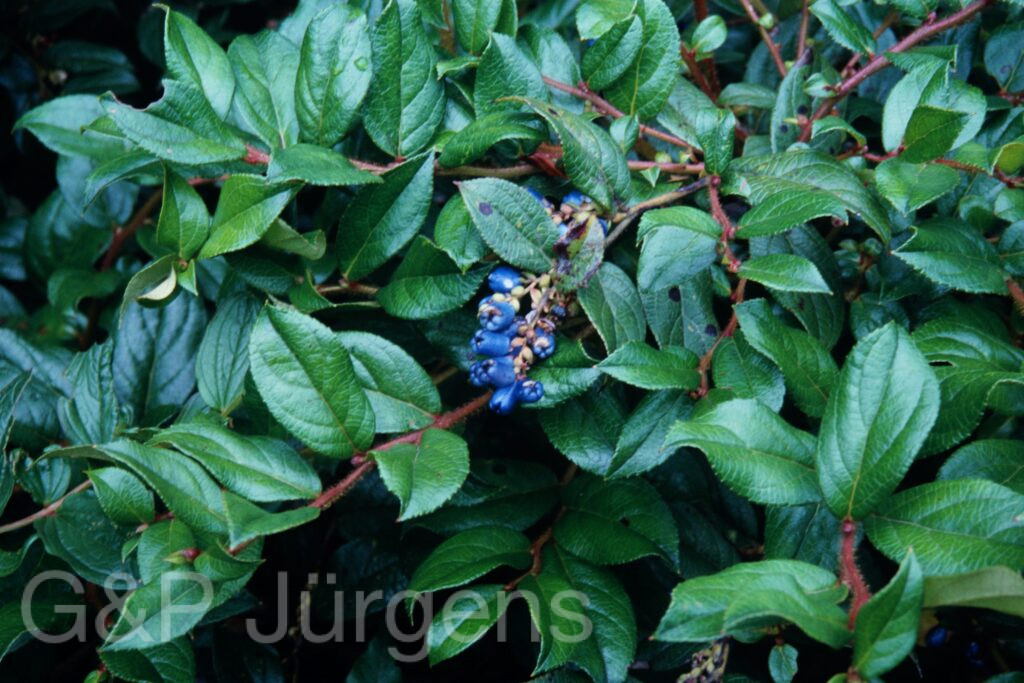
C.B.Clarke

Sikkim2003 409 P569
Sikkim Zemu Valley 3400m August

Description

Gaultheria hookeri is an evergreen shrub native to the eastern Himalayas and extending into southwestern China and northern Myanmar. Its range encompasses Nepal, northeast India (Sikkim, Arunachal Pradesh), Bhutan, Myanmar, and China (Yunnan, Xizang, Sichuan). The species is a characteristic element of upper temperate to subalpine forests, occurring at elevations of 2,500–4,000 m in Rhododendron-Abies forests, bamboo thickets, and along stream margins. It is well documented from the Zemu Valley in Sikkim at 3,400 m, where it can be found growing in the understorey of dense montane forests during August.
Gaultheria hookeri forms a densely branched, spreading to erect shrub 0.3–1.5 m tall. The young branchlets are setose-hispid with rusty brown hairs. The leaves are alternate, coriaceous, ovate to elliptic-ovate, 4–10 cm long, with a serrate to serrulate margin, the veins impressed above and prominent beneath. The flowers are borne in short axillary racemes; each flower has a campanulate to urceolate corolla, white to pinkish, 4–6 mm long. The calyx is five-lobed and becomes fleshy and enlarged in fruit, enclosing the capsule to form a conspicuous, globose, fleshy pseudoberry that is blue to deep purple-black at maturity, 8–12 mm in diameter.
Described by C.B. Clarke and named in honour of Sir Joseph Dalton Hooker, who extensively explored the Sikkim Himalaya, G. hookeri is one of the more robust and widely collected species in the genus across the eastern Himalayan region. With over 750 occurrence records in GBIF, it is comparatively well documented. The species is of ecological importance as a food source for montane birds and mammals that disperse its fleshy fruits. Its aromatic, wintergreen-scented foliage, rich in methyl salicylate, is occasionally used in traditional medicine. The species has also been introduced to cultivation in botanical gardens in Europe and North America.

Author: C.B.Clarke · Sources: POWO (Kew), GBIF, Flora of Bhutan Vol. 2, Flora of China Vol. 14, Hooker: Flora of British India Vol. 3 (1882)