Tag:

Subalpine (2500-3500 m)

Lindl.

Nepal 99 177 ergebnis
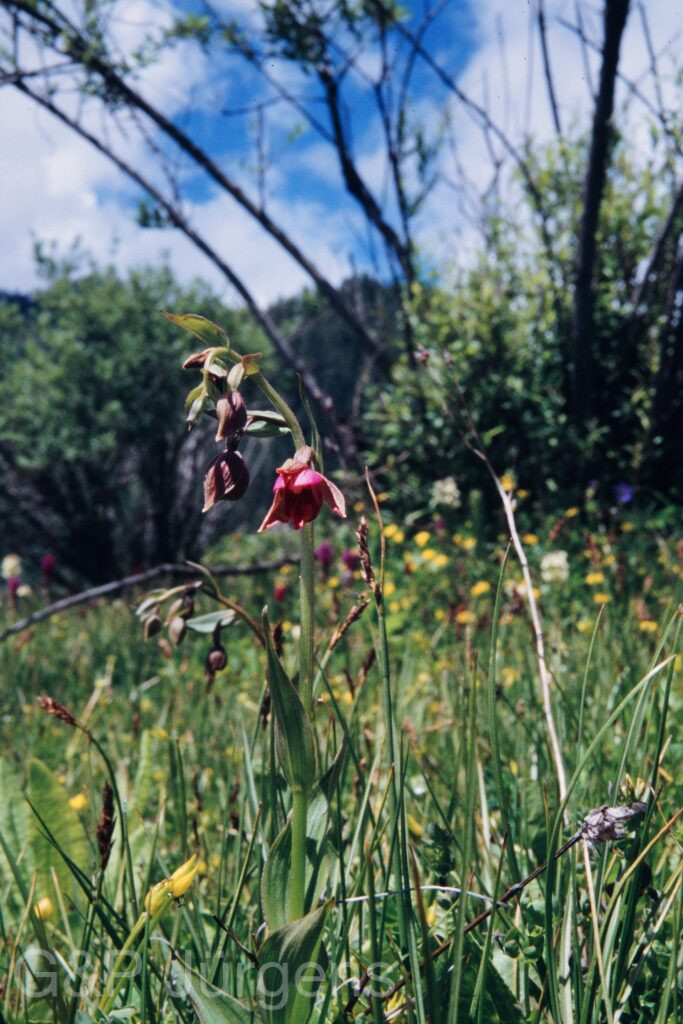
West-Nepal Lara-Lake 3000m, June

Description

Epipactis royleana Lindl. is a terrestrial orchid of central and western Asia and the Himalaya, with GBIF documenting some 262 occurrences across Nepal, India, China, Pakistan, Afghanistan, Tajikistan, Kyrgyzstan, Uzbekistan, Bhutan, Myanmar and Russia, with scattered records farther afield. It typically grows in moist habitats such as streamsides, marshy meadows, seepage slopes and open coniferous woodland from the montane to subalpine zones, often between about 1500 and 3500 m. The plant photographed at Lara-Lake in West Nepal, at roughly 3000 m in June, illustrates its preference for the damp, lake-margin grasslands of the high Himalayan valleys.

The species is a rhizomatous perennial with erect, leafy stems arising from a short creeping rootstock. The leaves are alternate, ovate to lanceolate, sheathing at the base and prominently veined. The inflorescence is a lax, one-sided terminal raceme of several to many resupinate flowers; each flower has spreading, greenish to purplish-tinged sepals and petals, with a labellum divided into a cup-like basal hypochile and a triangular, often pinkish epichile. As in all Epipactis, the column bears a single anther and the pollinia are mealy, and the fruit is a pendulous, ridged capsule releasing dust-like seeds.

Epipactis is a Holarctic genus in which Himalayan and central Asian taxa form a distinct group; E. royleana is among the more widespread members, exhibiting considerable variation in flower colour across its range. Like other members of the genus it depends on mycorrhizal fungi for germination and early establishment, and its small seeds are wind-dispersed. The species is not currently regarded as threatened across its broad distribution, though, as a wetland-associated orchid, local populations are sensitive to drainage and habitat disturbance.

Author: Lindl. · Sources: POWO (Kew), GBIF, Flora of China, Flora of Pakistan, Flora of Nepal, Delforge Orchids of Europe and Asia
(Buch.-Ham. ex D.Don) Benth. ex C.B.Clarke

Nepal 97 284 G577
Nepal Chamtrug 2550m May
Nepal 97 284 G577
Nepal Chamtrug 2550m May

Description

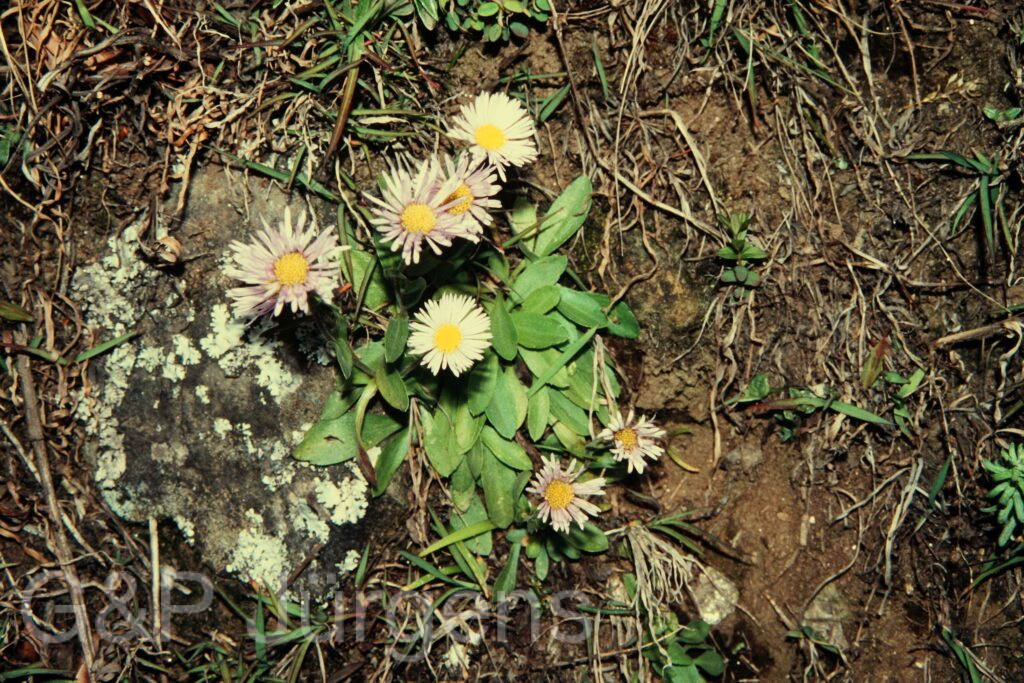
Erigeron bellidioides is a small fleabane of the Western and Central Himalaya, with verified GBIF occurrences confined to Pakistan, Nepal and India. It is a plant of open grassy slopes, forest clearings, banks and stony pastures through the temperate zone, generally between about 1800 and 3000 m. The material photographed at Chamtrug in central Nepal at around 2550 m in May illustrates its flowering at the onset of the growing season in just such open montane grassland, where it forms low, daisy-like tufts among the sward.

The species is a low perennial or short-lived herb forming a basal rosette of obovate to spathulate, entire or slightly toothed leaves that, as the epithet bellidioides suggests, recall those of a daisy (Bellis). The stems are slender, sparingly leafy and finely hairy, each typically bearing a solitary terminal capitulum. The involucre is hemispherical with narrow, hairy phyllaria in a few rows; the head carries numerous slender, thread-like ray florets that are white, pink or pale lilac surrounding a disc of yellow tubular florets. The fruit is a small flattened achene crowned by a pappus of fine bristles that facilitates wind dispersal.

Within Erigeron, a large genus easily confused with related Aster, this species is distinguished by its rosette habit, narrow many-rayed heads and Himalayan distribution; it was transferred to the genus by C.B. Clarke from a Buchanan-Hamilton and Don basionym. Ecologically it behaves as a pioneer of open and disturbed ground and provides a nectar and pollen source for generalist insects. It is widespread and locally common in suitable grassland and is not regarded as being of conservation concern.

Author: (Buch.-Ham. ex D.Don) Benth. ex C.B.Clarke · Sources: POWO (Kew), GBIF, Flora of Pakistan, Annotated Checklist of the Flowering Plants of Nepal, Flora of British India

(Buch.-Ham. ex DC.) Christenh. & Byng

Bh09 197 P337
Bhutan above Thimphu, 3000m June
Bh09 68 P118
Bhutan above Thimphu, 3000m June
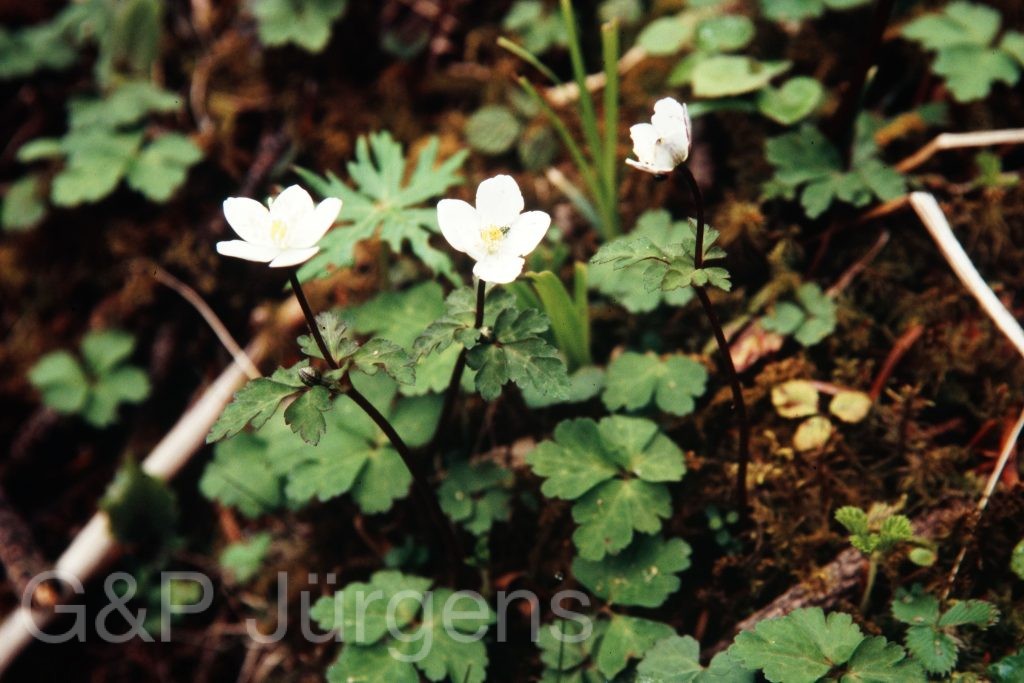
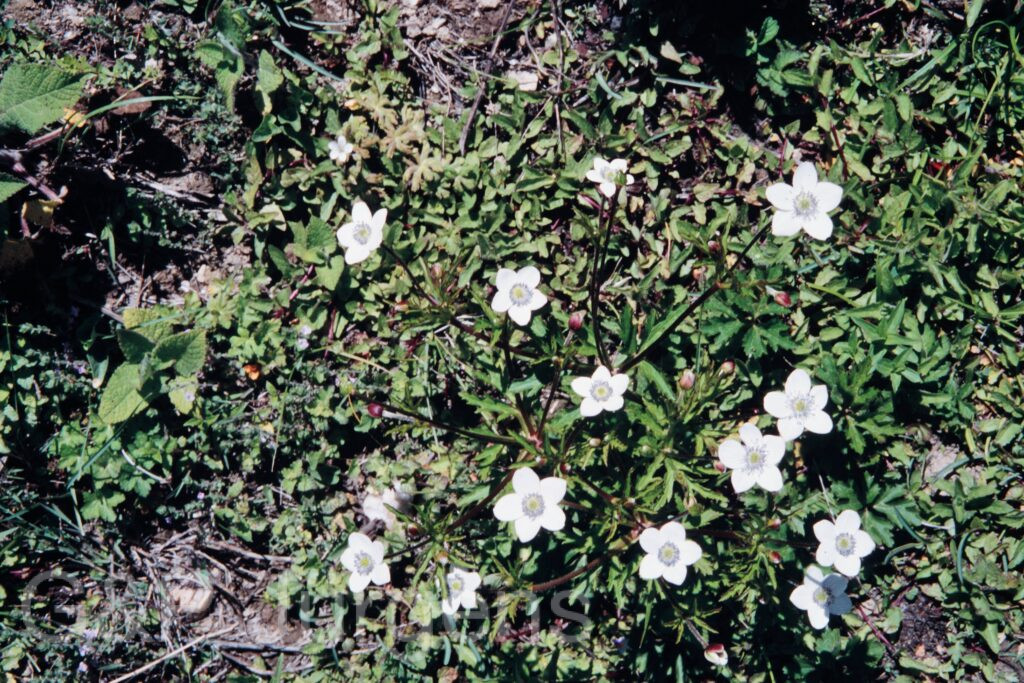
Nepal 99 169 ergebnis
West-Nepal South of Tara-Lake 3000m, June

Description

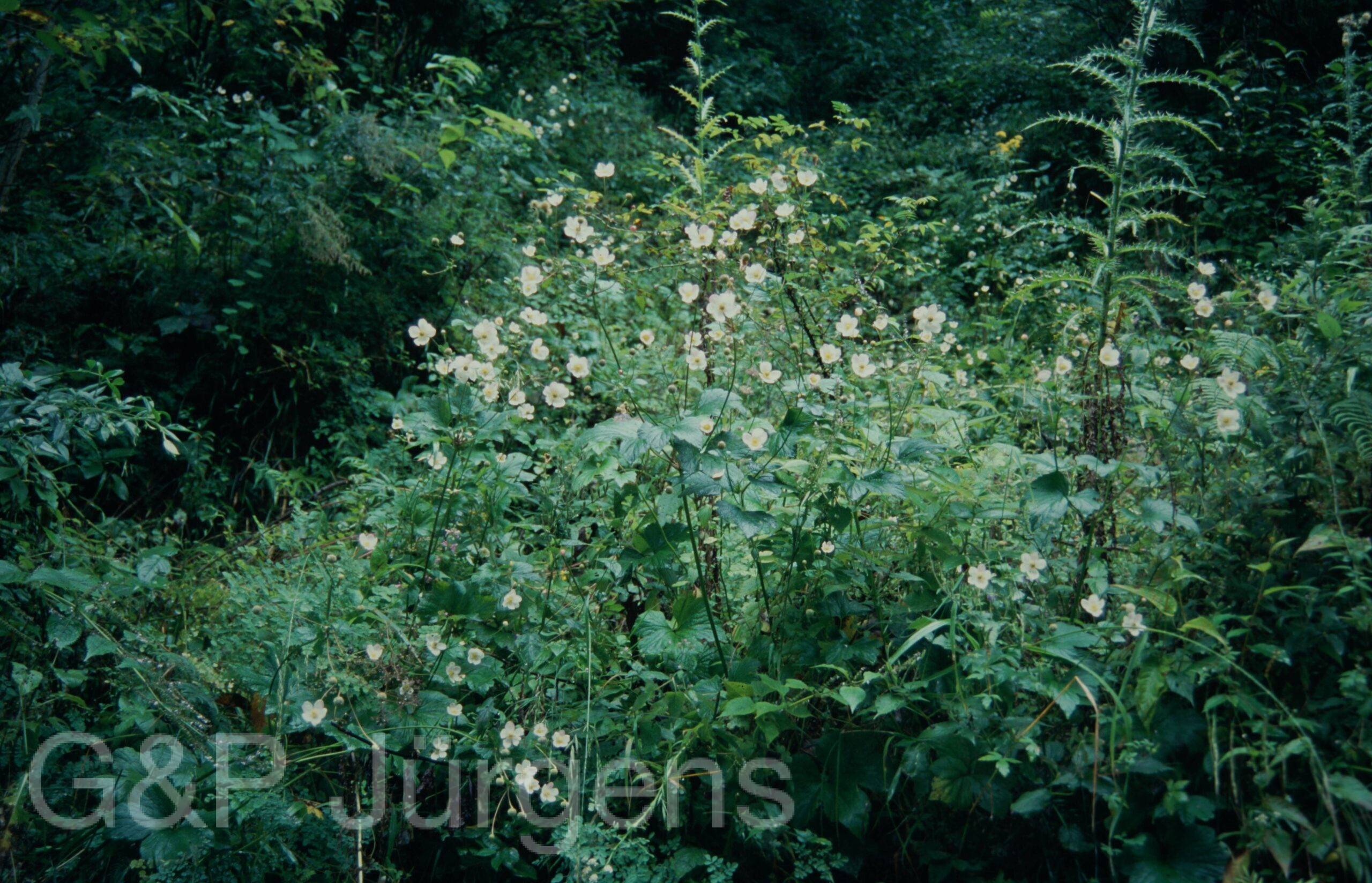
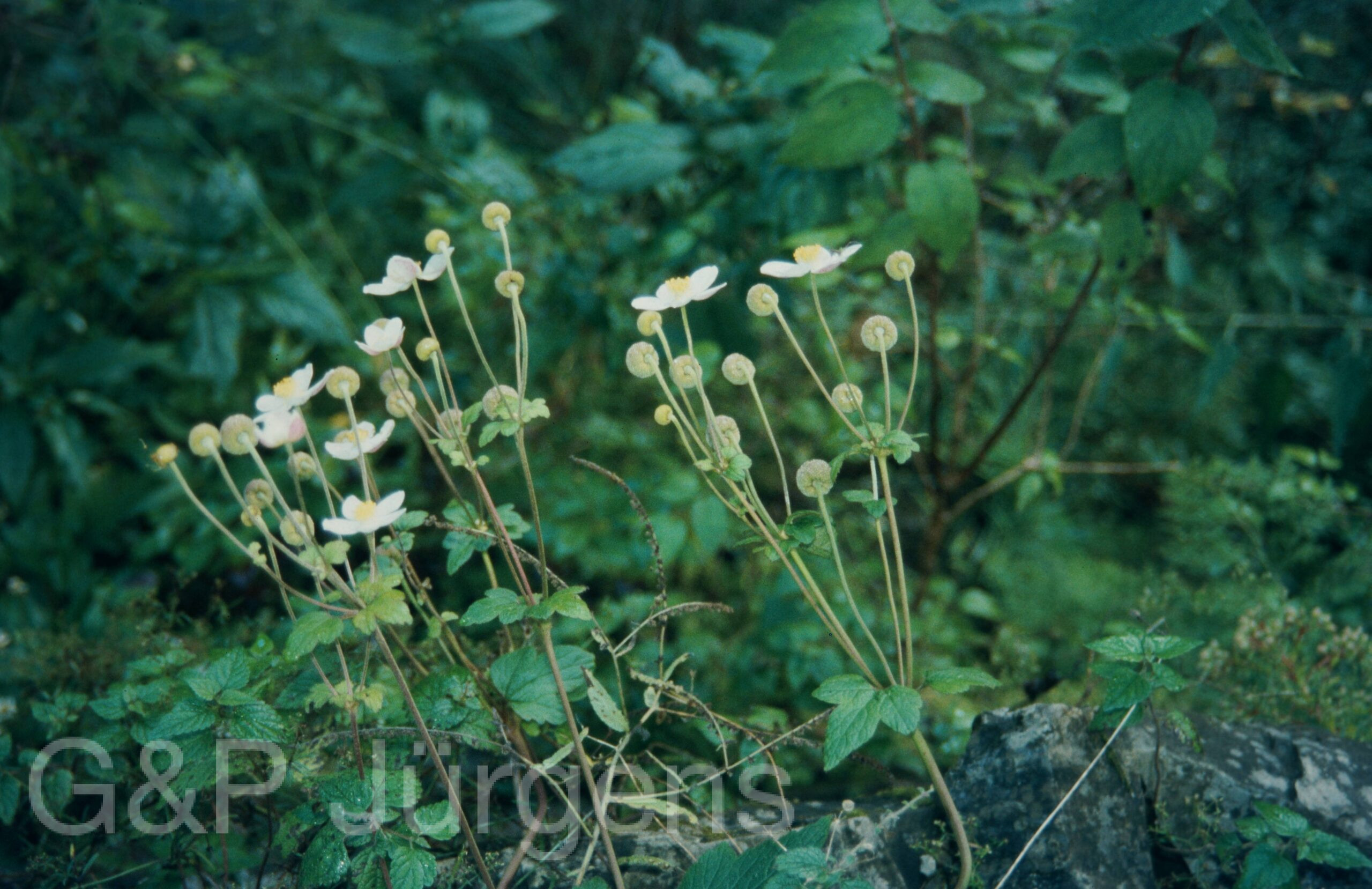
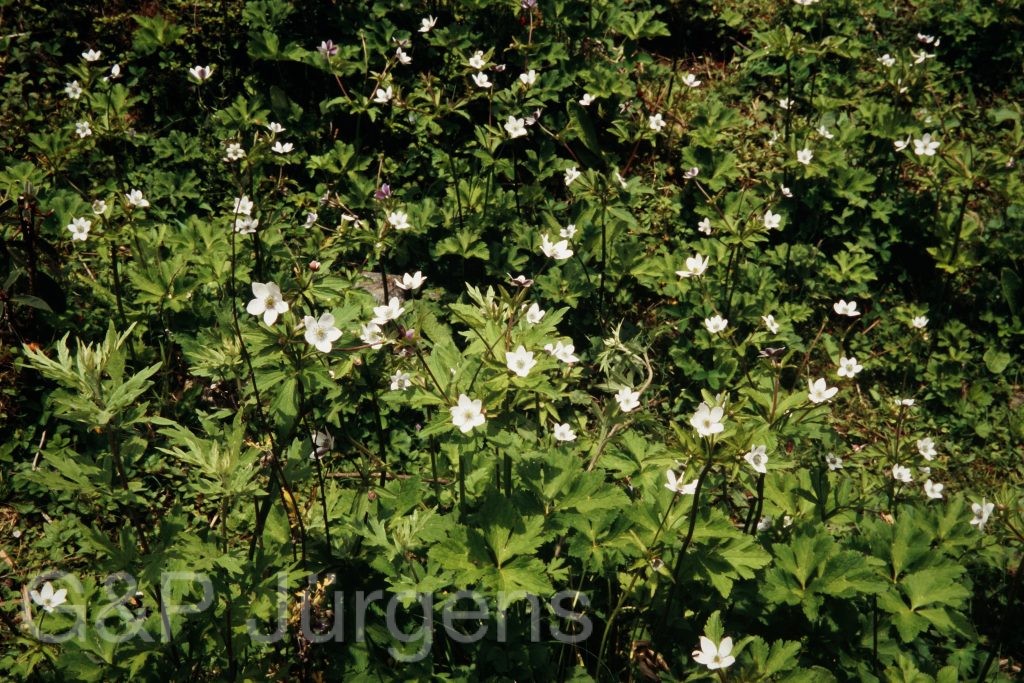
Eriocapitella rivularis (formerly Anemone rivularis) is a widely distributed montane herb of the Sino-Himalayan region. GBIF records span China, Nepal, India, Bhutan, Myanmar and Pakistan, extending to Sri Lanka, with introduced or cultivated occurrences in Europe, Japan and North America, totalling close to 2000 georeferenced collections. It favours moist alpine and subalpine meadows, stream banks, open slopes and forest margins, generally between 2000 and 4200 m. The populations illustrated here were photographed above Thimphu in Bhutan and south of Tara-Lake in West Nepal, both at around 3000 m and flowering in June, typical of its early-summer phenology in the central Himalaya.

It is an erect perennial 20-80 cm tall arising from a stout rootstock, the stems and petioles clothed in spreading white hairs. Basal leaves are long-petiolate and palmately 3-5-lobed, the segments coarsely toothed and bristly. The inflorescence is a lax cyme subtended by a leafy involucre of sessile bracts. Flowers are showy, with 5-6 white petaloid sepals often tinged bluish on the reverse and numerous stamens bearing conspicuous blue-violet anthers; true petals are absent. The fruit is an aggregate of flattened, narrowly winged achenes terminating in a slender hooked beak that aids epizoochorous dispersal.

The transfer to the segregate genus Eriocapitella reflects molecular work resolving the paraphyly of Anemone sensu lato. Pharmacologically it is notable as a source of triterpenoid saponins and is used in Himalayan folk medicine. Its broad ecological amplitude, abundant achene production and wind-aided dispersal render it locally common and of no conservation concern, a characteristic component of grazed Himalayan pasture.

Author: (Buch.-Ham. ex DC.) Christenh. & Byng · Sources: POWO (Kew), GBIF, Flora of China, Flora of Bhutan, Annotated Checklist of the Flowering Plants of Nepal, Monograph of the genus Anemone (Ranunculaceae)

(Buch.-Ham. ex DC.) Nakai

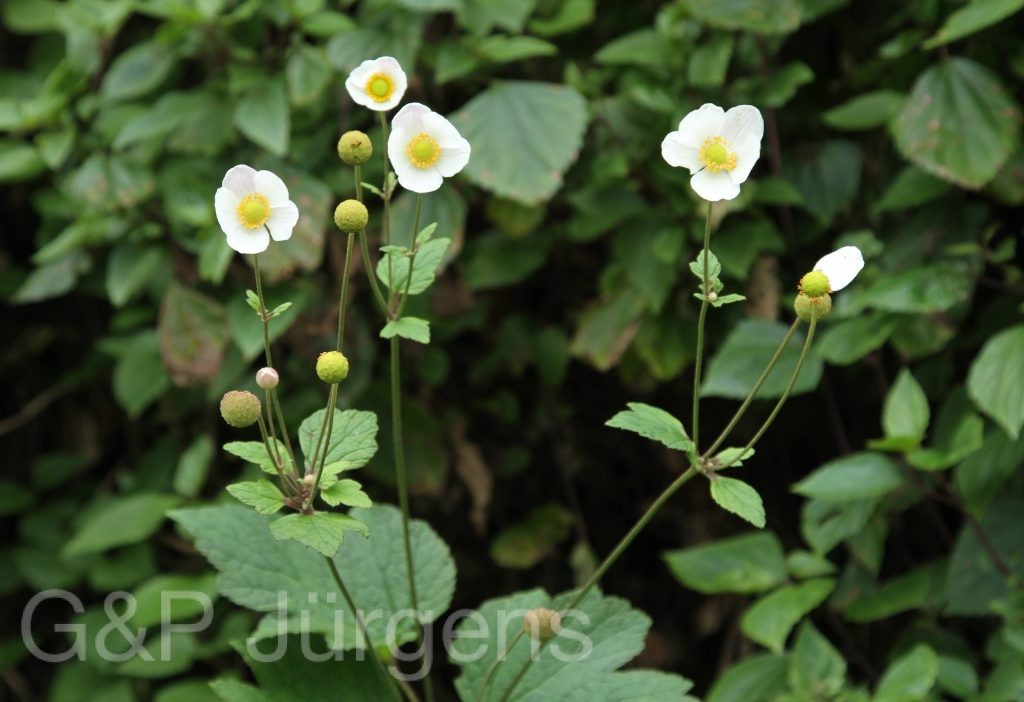
Bhutan2012 1325
Bhutan Pemagatse 1900m, October
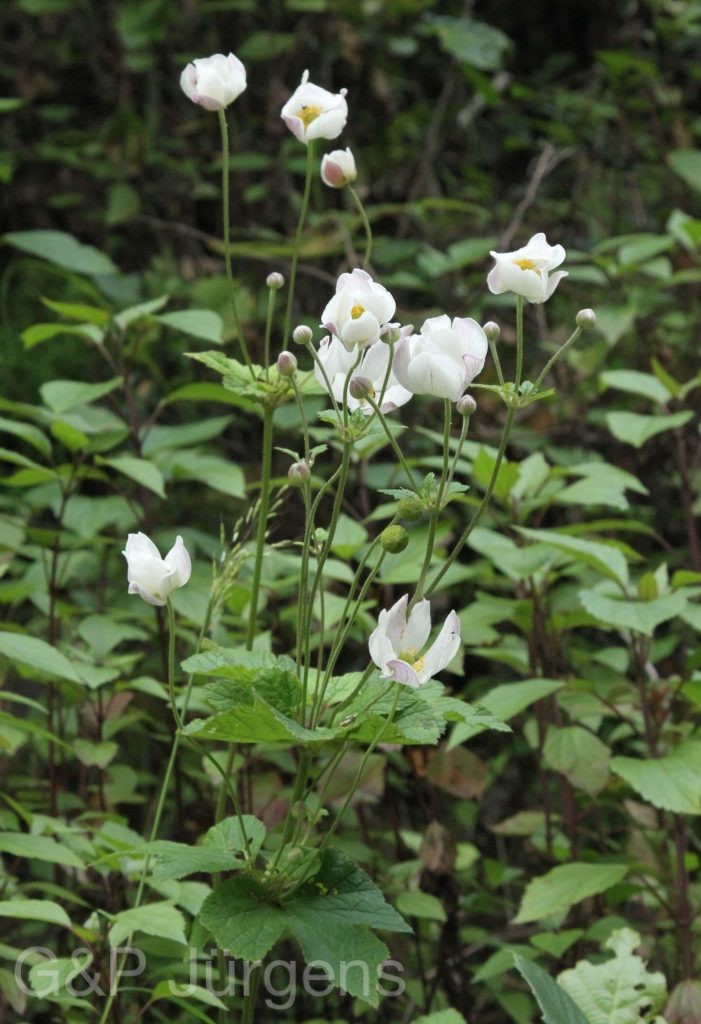
Bhutan2012 447
Bhutan Wangdi 2500m, September

Description

Eriocapitella vitifolia (formerly Anemone vitifolia) is a robust perennial herb widespread across the Himalaya and East Asia, recorded from China, Nepal, India, Bhutan, Taiwan, Myanmar, Pakistan and beyond, with nearly 2000 georeferenced occurrences in GBIF reflecting both its native range and ornamental cultivation. It favours forest margins, open slopes, shrubberies and disturbed banks, mainly in the warm- to cool-temperate belt between about 1500 and 3000 m. The plants illustrated were photographed in Bhutan at Pemagatse (1900 m) and Wangdi (2500 m) and in the Indian Garhwal at Sitel (1850 m), flowering from September into October.

The species arises from a stout, woody rootstock and produces long-petiolate basal leaves with broadly cordate-ovate, vine-like (vitifolia, grape-leaved) blades that are shallowly three- to five-lobed, toothed, and densely white-tomentose beneath. Tall, branching flowering scapes bear cymose clusters of showy flowers, each with five to many petaloid sepals (true petals absent) that are white to pale pink, surrounding a central mass of numerous yellow stamens and a domed cluster of carpels. The fruiting head is globose and conspicuously woolly, the densely hairy achenes being adapted for wind dispersal, a feature reflected in the generic name.

Eriocapitella was segregated from Anemone (Ranunculaceae) on molecular and morphological grounds, comprising the woolly-fruited Asian anemones, and E. vitifolia is one of its most familiar Himalayan representatives. It is widely grown in temperate gardens and is an ancestral parent of the cultivated Japanese anemones, explaining scattered records in Europe, North America and southern Africa. Containing acrid ranunculaceous compounds, it is avoided by grazers and, common and adaptable, is of no conservation concern.

Author: (Buch.-Ham. ex DC.) Nakai · Sources: POWO (Kew), GBIF, Flora of China, Flora of Bhutan, Annotated Checklist of the Flowering Plants of Nepal, Hoot et al. Phylogeny of Anemone and Allies

D.Don

Nepal 99 423 ergebnis
Nepal Talphi 2830m, July
Nepal 99 72 ergebnis
Nepal Chauta-valley, 2800m, July

Description

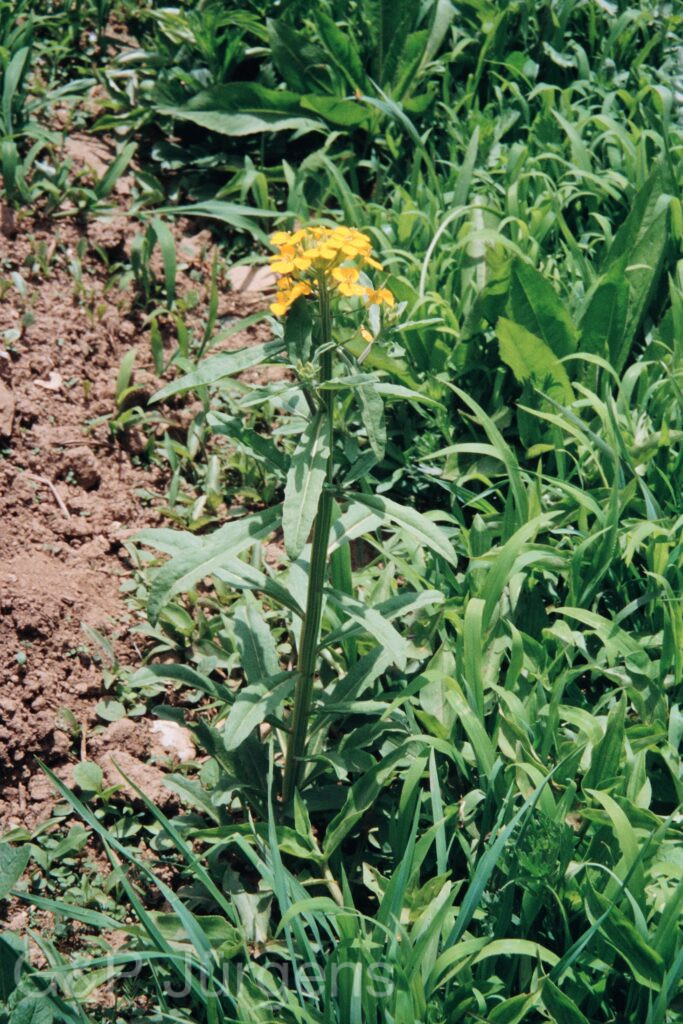
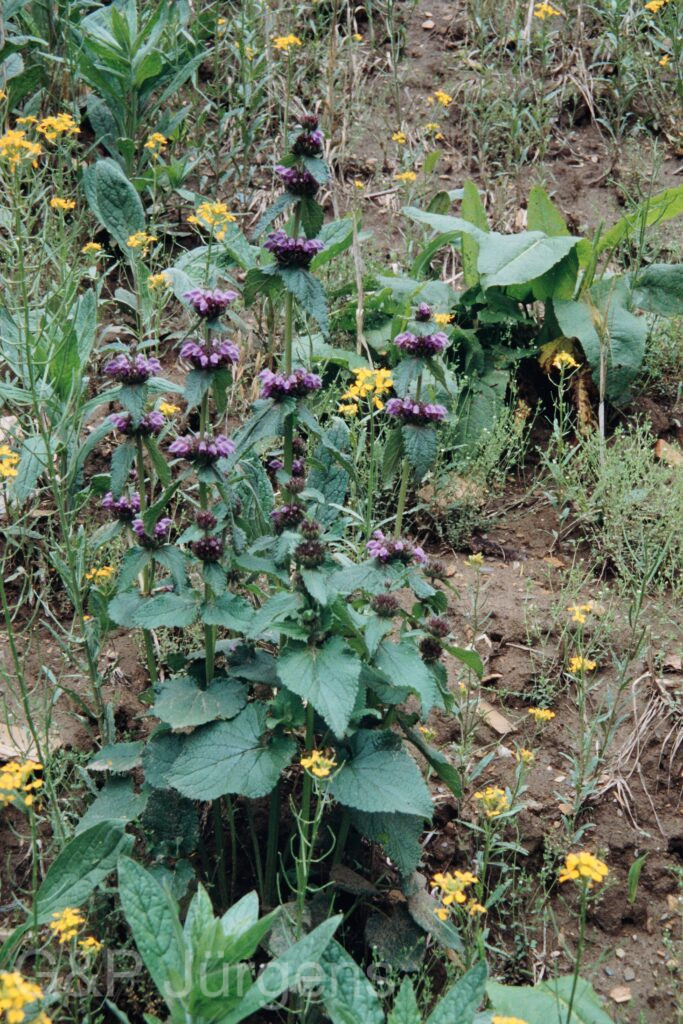
Erysimum robustum is a Himalayan wallflower distributed through Nepal, northern India and SW China (Xizang and Yunnan), as reflected in the GBIF country records (NP, IN, CN) and some 89 occurrences. The plants illustrated here were photographed in western Nepal at Talphi (c. 2,830 m) and in the Chauta valley (c. 2,800 m) in July. It is a montane to subalpine species favouring open, well-drained sites: stony pastures, dry slopes, roadside banks and the margins of cultivation, generally between 2,500 and 3,800 m, where it forms conspicuous yellow-flowered stands during the summer monsoon. The GBIF backbone treats the name as a synonym, but it is here regarded as the accepted name Erysimum robustum following regional floristic usage.

It is a biennial or short-lived perennial herb with an erect, robust, often branched stem clothed, like the rest of the plant, in appressed two- to several-rayed malpighiaceous hairs that give a greyish cast. The leaves are linear to oblanceolate, entire to remotely denticulate, the lower ones petiolate and the upper sessile. The inflorescence is an elongating ebracteate raceme of bright yellow flowers with four clawed petals in the cruciferous pattern and tetradynamous stamens. The fruit is a long, narrow, four-angled siliqua, somewhat torulose and ascending on a stout pedicel, containing a single row of oblong seeds in each locule.

The genus Erysimum is taxonomically difficult owing to extensive variation in indumentum and habit, and several Himalayan entities have been variously lumped or split; trichome branching patterns and siliqua characters remain the most reliable diagnostic features. As a widespread, weedy-tolerant species of disturbed montane ground, E. robustum is not of conservation concern and can act as an early colonist of bare slopes.

Author: D.Don · Sources: POWO (Kew), Flora of China Vol. 8, Flora of Nepal, GBIF, Polatschek: Revision der Gattung Erysimum

(Benth.) G.L.Nesom

Bhutan2014 855
Bhutan Thimphu 2600m, May

Description

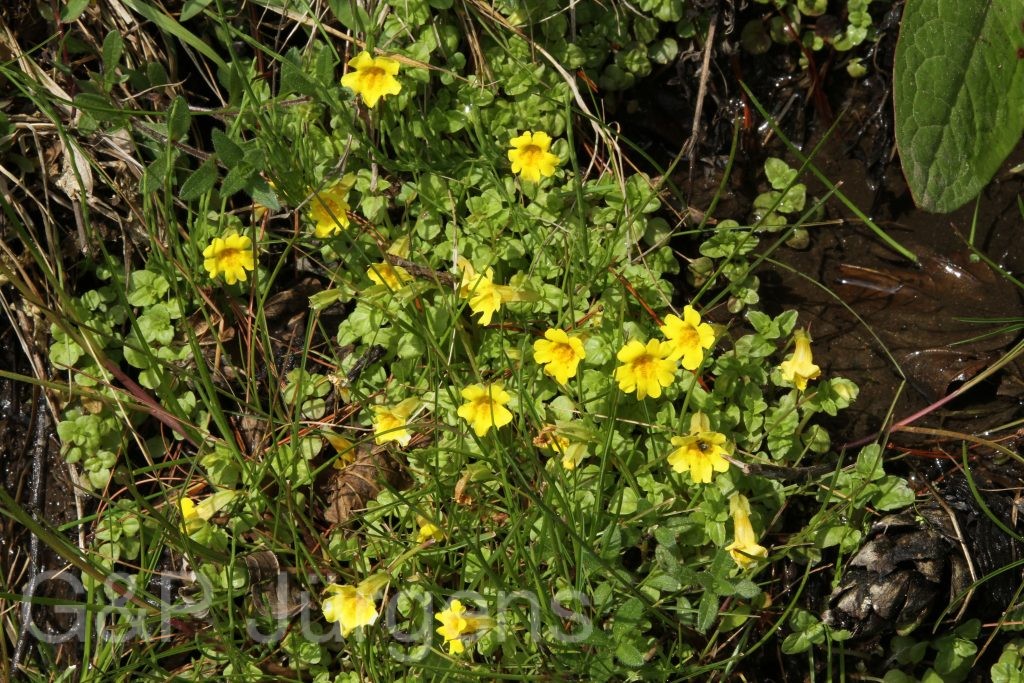
Erythranthe nepalensis is a small wetland herb of temperate East and South Asia, recorded from Japan, China, Korea, Taiwan, Nepal, Bhutan, India, Myanmar, Pakistan and Bhutan, with around 2199 georeferenced occurrences in GBIF. It grows in damp, open ground: stream banks, ditch margins, wet meadows, seepages, rice-field bunds and moist rock crevices from the foothills into the temperate montane zone. The photographed plant from Thimphu in Bhutan at 2600 m in May is characteristic of such cool, moist Himalayan habitats, where it flowers in spring along watercourses and on dripping banks.

It is a slender annual or short-lived perennial herb with weak, decumbent to ascending, often rooting stems forming low mats. The leaves are opposite, small, ovate to broadly ovate, palmately veined, with a few shallow teeth and short petioles. The flowers are solitary in the leaf axils on slender pedicels; the calyx is tubular-campanulate and angled-ribbed, with short triangular lobes, and the corolla is bilabiate and yellow, the throat marked with reddish-brown to purplish spots and the lower lip prominent. There are four didynamous stamens, and the fruit is an oblong capsule enclosed by the persistent ribbed calyx, releasing numerous tiny seeds.

Formerly placed in Mimulus (as Mimulus tenellus var. nepalensis), the species was transferred to Erythranthe by G.L. Nesom following the molecular recircumscription that divided the old Mimulus among several genera and moved them from Scrophulariaceae to Phrymaceae. The spotted, bilabiate yellow flowers are adapted to bee pollination, and the plant's affinity for moist, disturbed ground allows ready local colonisation. Common and widespread across its range, it is of no particular conservation concern.

Author: (Benth.) G.L.Nesom · Sources: POWO (Kew), GBIF, Flora of China Vol. 18, Flora of Bhutan Vol. 2, Flora of Nepal, Taxonomy of Erythranthe (Phrymaceae) (Nesom)

Roxb.

Bhutan2015 65
Bhutan Wangdi Phodrang 1900m, October
Bhutan2012 464
Bhutan Wangdi 2500m, September

Description

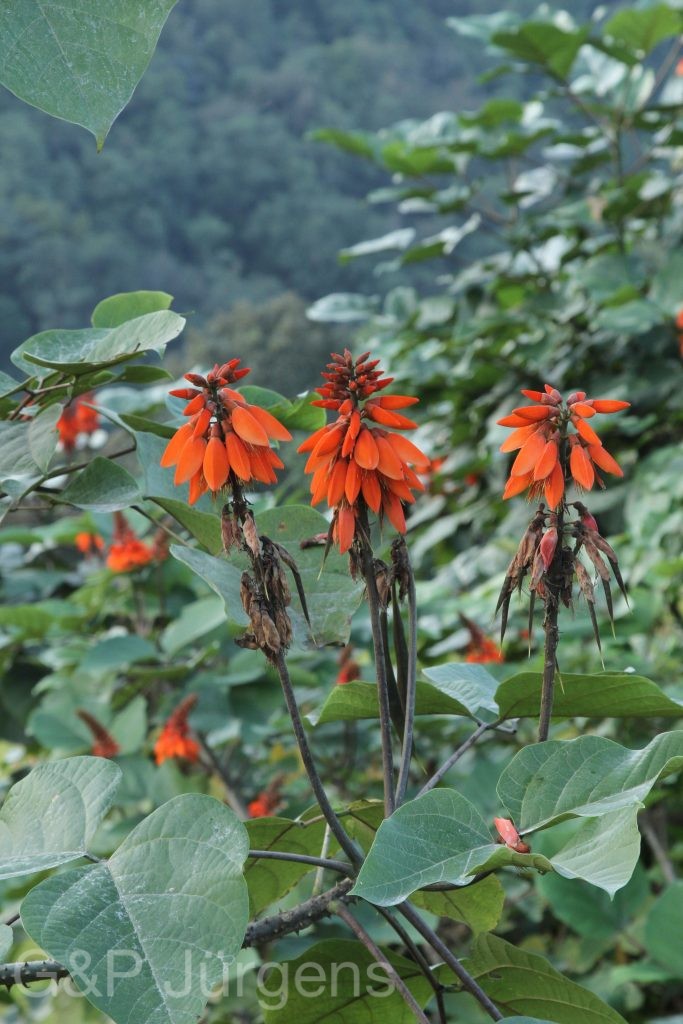
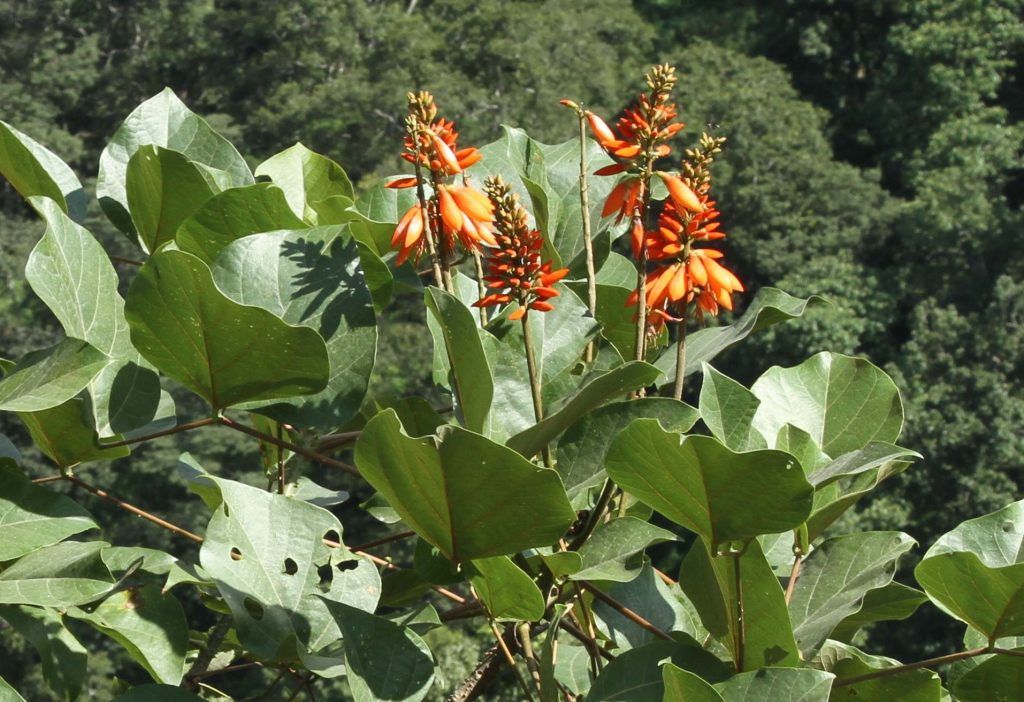
Erythrina arborescens is a Himalayan to Southeast Asian coral tree distributed across China, India, Nepal, Bhutan, Myanmar, Bangladesh, Japan and Thailand, with about 369 GBIF occurrences spanning this wide subtropical to warm-temperate range. It grows in open broad-leaved forest, forest margins, valley slopes and disturbed ground, generally from about 1300 to 3000 m. The trees photographed near Wangdi Phodrang in Bhutan at about 1900 m in October and at about 2500 m in September illustrate its mid-elevation valley habitat, where its scarlet flower spikes appear after the leaves toward the close of the monsoon.

The species is a small to medium-sized deciduous tree with a stout trunk and branches armed with scattered conical prickles. The leaves are alternate and trifoliolate, with broadly ovate to rhombic leaflets, the terminal one largest, on a long prickly petiole. The inflorescence is a dense terminal raceme of large, showy, bright red papilionaceous flowers in which the broad standard petal is conspicuously enlarged while the wings and keel are reduced, an arrangement adapted to bird pollination. The fruit is an elongate, torulose, dehiscent legume constricted between the few shining red-brown seeds.

Erythrina is a pantropical genus of about 130 species notable for ornithophilous, nectar-rich flowers and seeds containing toxic isoquinoline alkaloids. E. arborescens is among the few species extending into temperate Himalayan elevations, its post-monsoon flowering and copious nectar attracting sunbirds and other nectarivorous birds that serve as pollinators. Widely distributed and tolerant of disturbance, it is of least concern; it is locally valued as a shade and ornamental tree and features in traditional medicine across its range.

Author: Roxb. · Sources: POWO (Kew), GBIF, Flora of China, Flora of Bhutan, Annotated Checklist of the Flowering Plants of Nepal, Krukoff & Barneby studies of Erythrina

Wall.

Sikkim 2006 184 ergebnis
India West-Bengal, Samadan 2300m, May
BhutanPG2011 82 ergebnis scaled
Bhutan Menchuang 2850m, June

Description

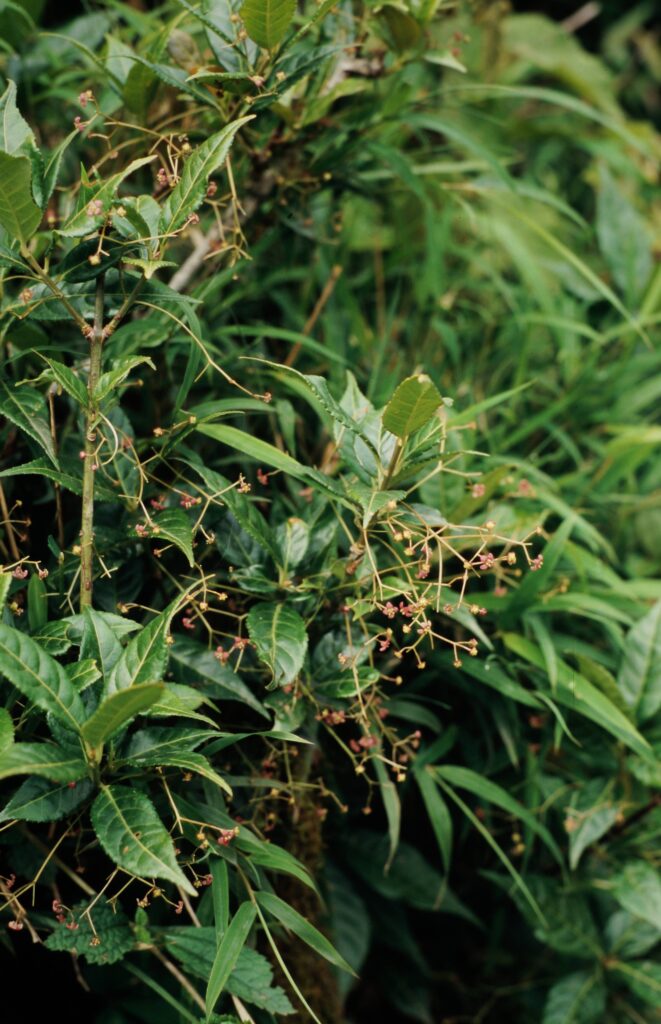
Euonymus frigidus is a Himalayan spindle tree distributed from central Nepal through northeast India, Sikkim, Bhutan, and northern Myanmar to southwest China (Yunnan, Sichuan, Xizang). GBIF records over 1,570 occurrences, with the majority from China and the eastern Himalayas. The species inhabits cool-temperate and subalpine broadleaved and mixed forests, often growing along forest margins, stream gullies, and shaded slopes at elevations of 1,800–3,200 m. Collections from Samadan in West Bengal at 2,300 m and from Menchuang in Bhutan at 2,850 m illustrate its typical occurrence in the mid-elevation broadleaved forest zone of the eastern Himalayan slopes.
Euonymus frigidus is a large deciduous shrub or small tree, reaching 3–8 m in height, with smooth, greyish-green bark on younger branches. Leaves are opposite, elliptic to oblong-lanceolate, 6–14 cm long, acuminate at the apex, cuneate at the base, with finely crenate-serrate margins, glabrous on both surfaces, and turning reddish-purple in autumn. The inflorescence is an axillary, dichasial cyme bearing 7–15 flowers on slender peduncles. Flowers are tetramerous, small, 6–8 mm in diameter, with greenish-yellow to purplish petals and a conspicuous four-lobed disc. The fruit is a deeply four-lobed capsule, pink to crimson at maturity, splitting to reveal four seeds each enclosed in a bright orange aril — a striking ornamental feature.
The specific epithet 'frigidus' alludes to the cold-temperate habitats in which this species predominantly occurs. Euonymus frigidus is distinguished from the closely related E. hamiltonianus by its generally larger leaves, more deeply lobed capsules, and preference for higher elevations. The conspicuous arillate fruits are an important food source for frugivorous birds, including minivets and laughingthrushes, which serve as effective dispersal agents. The species is occasionally cultivated as an ornamental in European and North American gardens for its vivid autumn colour and decorative fruit.

Author: Wall. · Sources: POWO (Kew), GBIF, Flora of China Vol. 11, Flora of Bhutan Vol. 2, Grierson & Long: Flora of Bhutan (1991)

Hook.f.

Bhutan2014 976
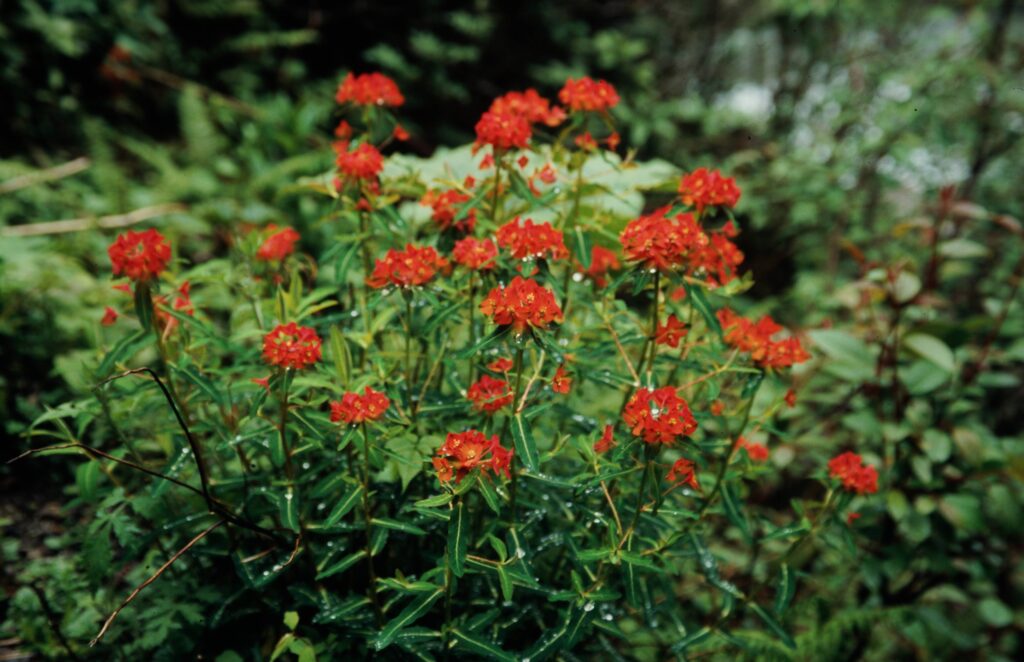
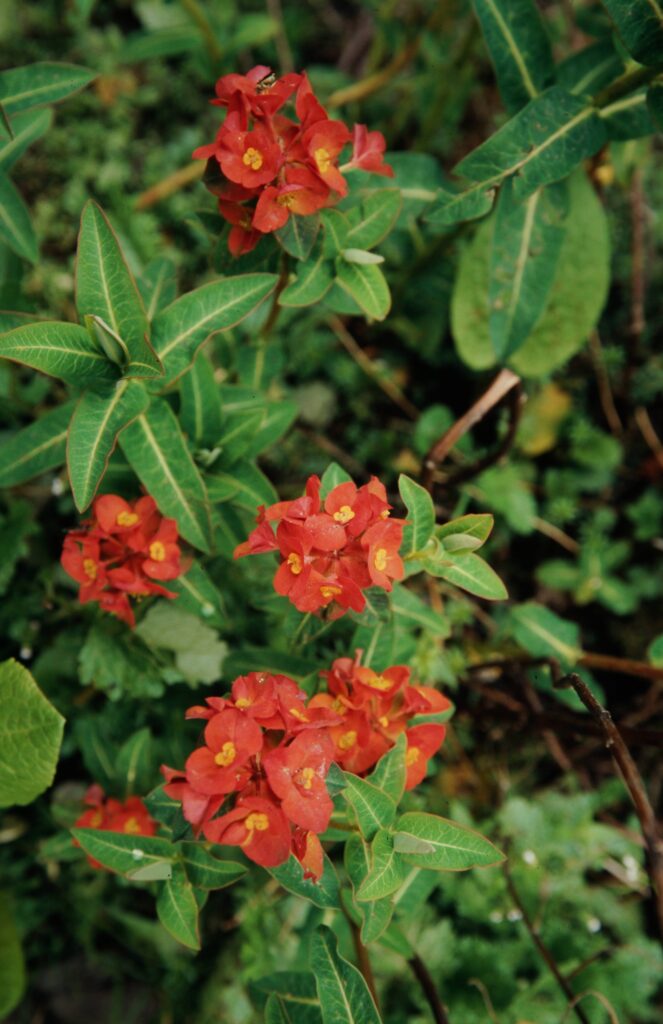
Bhutan Chele-La 3400m, May
Bhutan2014 397
Bhutan Chele-La 3400m, May
Bh09 245 P408
Bhutan 2009

Description

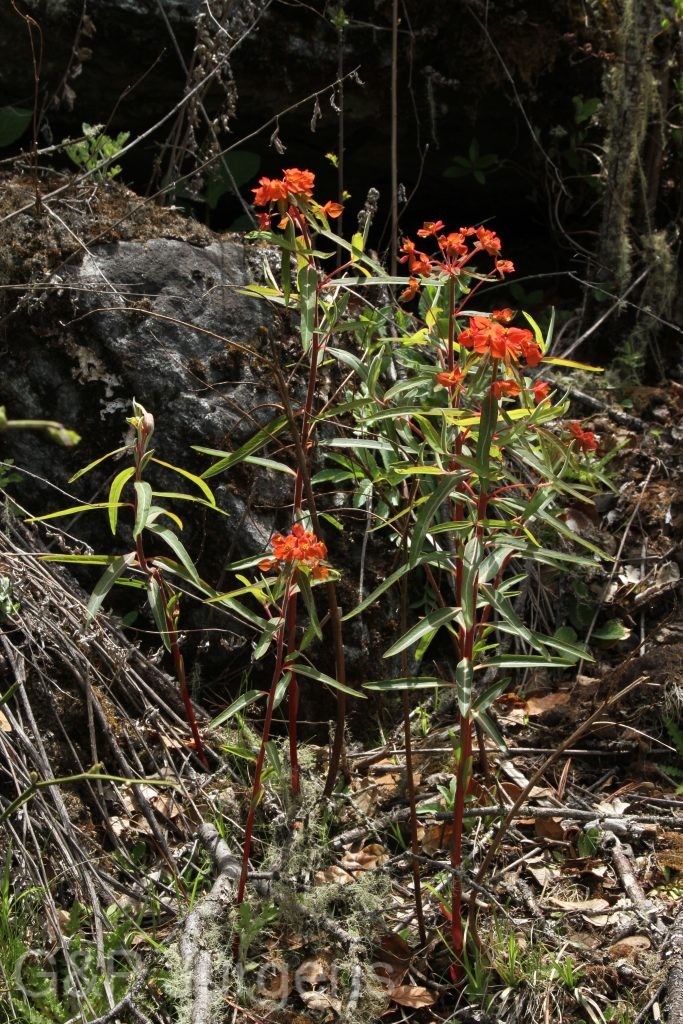
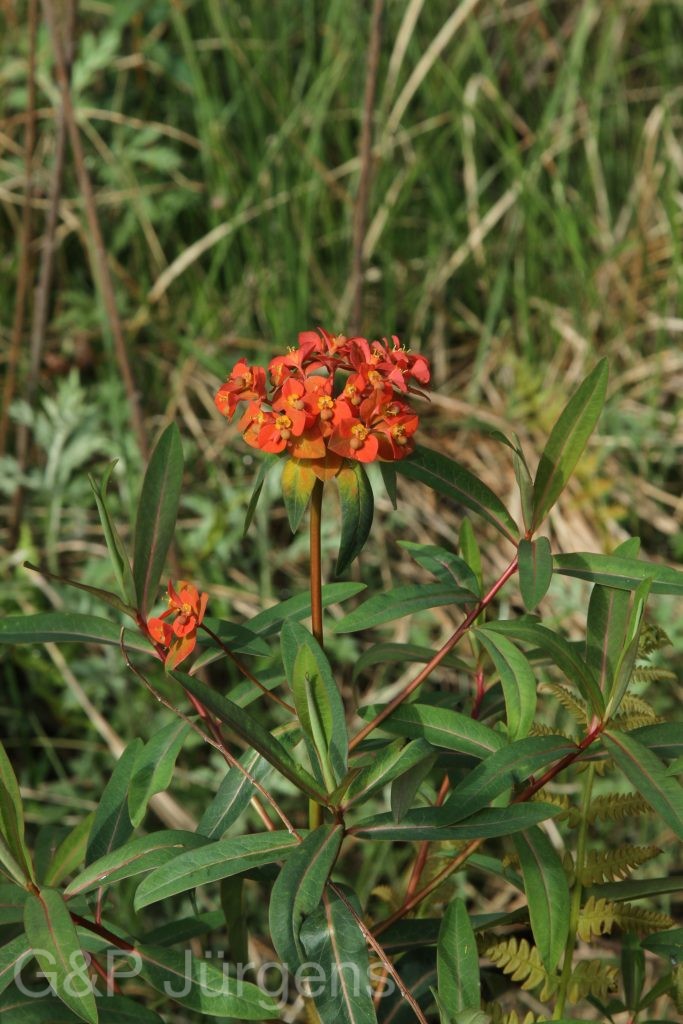
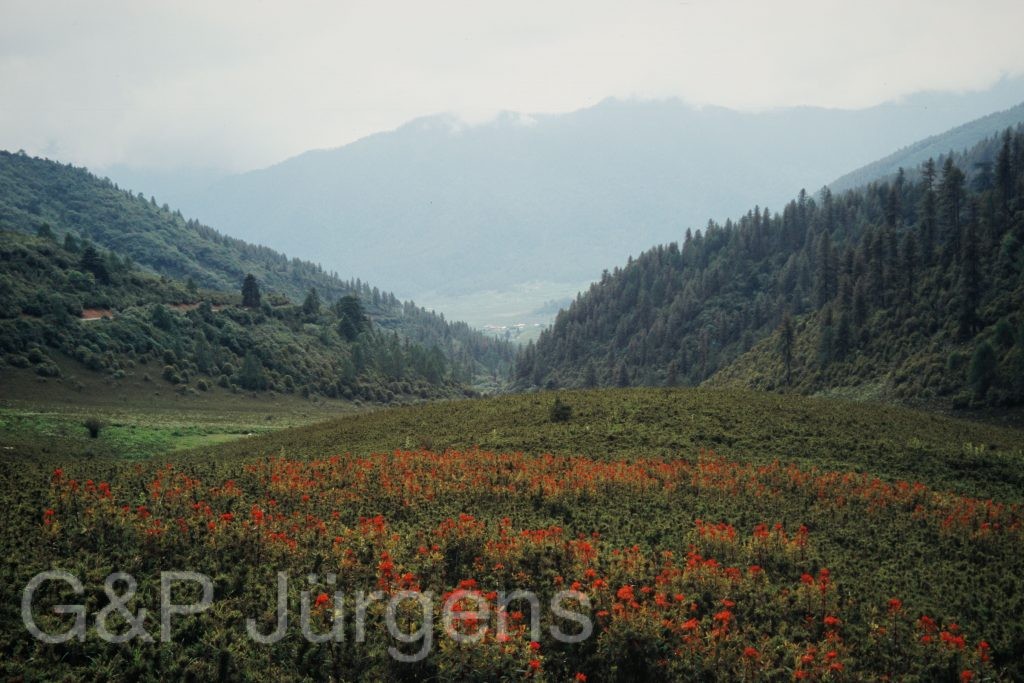
Euphorbia griffithii is a herbaceous perennial spurge of the eastern Himalayan mountains, with 538 GBIF occurrences spanning China, Bhutan, Myanmar, India and Nepal, alongside numerous cultivated records from Britain, Germany, France and North America, reflecting its popularity as a hardy garden perennial. It grows in open subalpine meadows, forest clearings, scrub and grassy slopes in the upper temperate to subalpine zone. It was recorded on the Chele-La in Bhutan at about 3400 m and at Tamrong in West Bengal, India, at about 2650 m, both in May, when the bracts colour vividly at the start of the growing season.

It is an erect, clump-forming herb arising from a creeping rhizome, the unbranched or sparingly branched stems exuding white latex when cut. The leaves are alternate, oblong to oblanceolate, entire, often flushed reddish and frequently with a pale midrib. The inflorescence is a terminal umbel-like cyme of cyathia, each cyathium a cup of fused bracts enclosing reduced flowers; the floral leaves and bracts beneath the cyathia turn fiery orange-red, providing the conspicuous display, while the involucral glands are typically yellowish. The fruit is a three-lobed capsule splitting into mericarps.

Euphorbia (Euphorbiaceae) is one of the largest plant genera, and E. griffithii belongs to its temperate, rhizomatous, herbaceous element rather than the succulent xerophytes. Long in cultivation, with selections such as the well-known coloured-bracted cultivars, it is widespread and secure across its native range. Its brilliant bract colouration and montane meadow habitat make it both a horticulturally important and biogeographically representative member of the eastern Himalayan herbaceous flora.

Author: Hook.f. · Sources: POWO (Kew), GBIF, Flora of China, Flora of Bhutan, Annotated Checklist of the Flowering Plants of Nepal, Radcliffe-Smith's treatment of Euphorbia (Euphorbiaceae)

U.C.Bhattach.

Garh 07 272 ergebnis
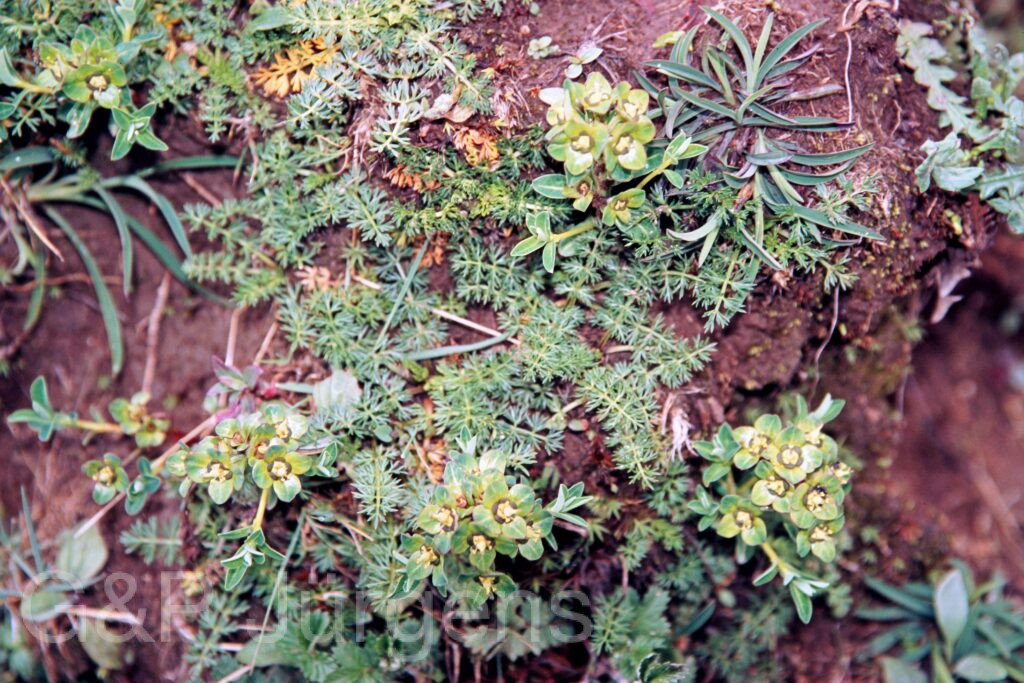
India Garhwal Belak Khal 2900m, June

Description

Euphorbia sharmae is a poorly known spurge apparently endemic to the western Himalaya of India, where it is recorded only from the Garhwal Himalaya of Uttarakhand. With very few documented occurrences, it appears to be a narrow regional endemic of temperate montane habitats, growing on open grassy slopes, forest clearings and rocky banks. The plant photographed at Belak Khal in Garhwal at 2,900 m in June occupies the cool temperate belt, flowering early in the warm season; the scarcity of records underscores how localised and infrequently collected the species is.

Like other members of the genus, the plant is a herbaceous perennial exuding milky white latex when damaged. It produces erect to ascending stems from a perennating rootstock, bearing alternate, entire, oblong to lanceolate cauline leaves and a terminal umbel-like arrangement of branches subtended by a whorl of leaf-like ray-leaves. The reproductive units are cyathia, the specialised pseudanthia diagnostic of Euphorbia, each comprising a cup-shaped involucre bearing crescent-shaped nectar glands and enclosing reduced unisexual flowers around a central stalked ovary. The fruit is a three-lobed schizocarpic capsule splitting into mericarps to release the seeds.

Euphorbia is among the largest and most cosmopolitan of angiosperm genera, and its Himalayan herbaceous representatives belong to the diverse subgenus Esula. Euphorbia sharmae, described by U. C. Bhattacharyya, is one of several narrowly distributed Indian endemics whose limits remain incompletely understood owing to sparse collection. Its restricted known range and the absence of population data place it among taxa of potential conservation concern, warranting targeted survey to clarify its distribution and status.

Author: U.C.Bhattach. · Sources: POWO (Kew), Flora of India (BSI), Flora of Uttar Pradesh, GBIF, Radcliffe-Smith: Euphorbia systematics