
(Buch.-Ham. ex D.Don) Benth. ex C.B.Clarke
Description
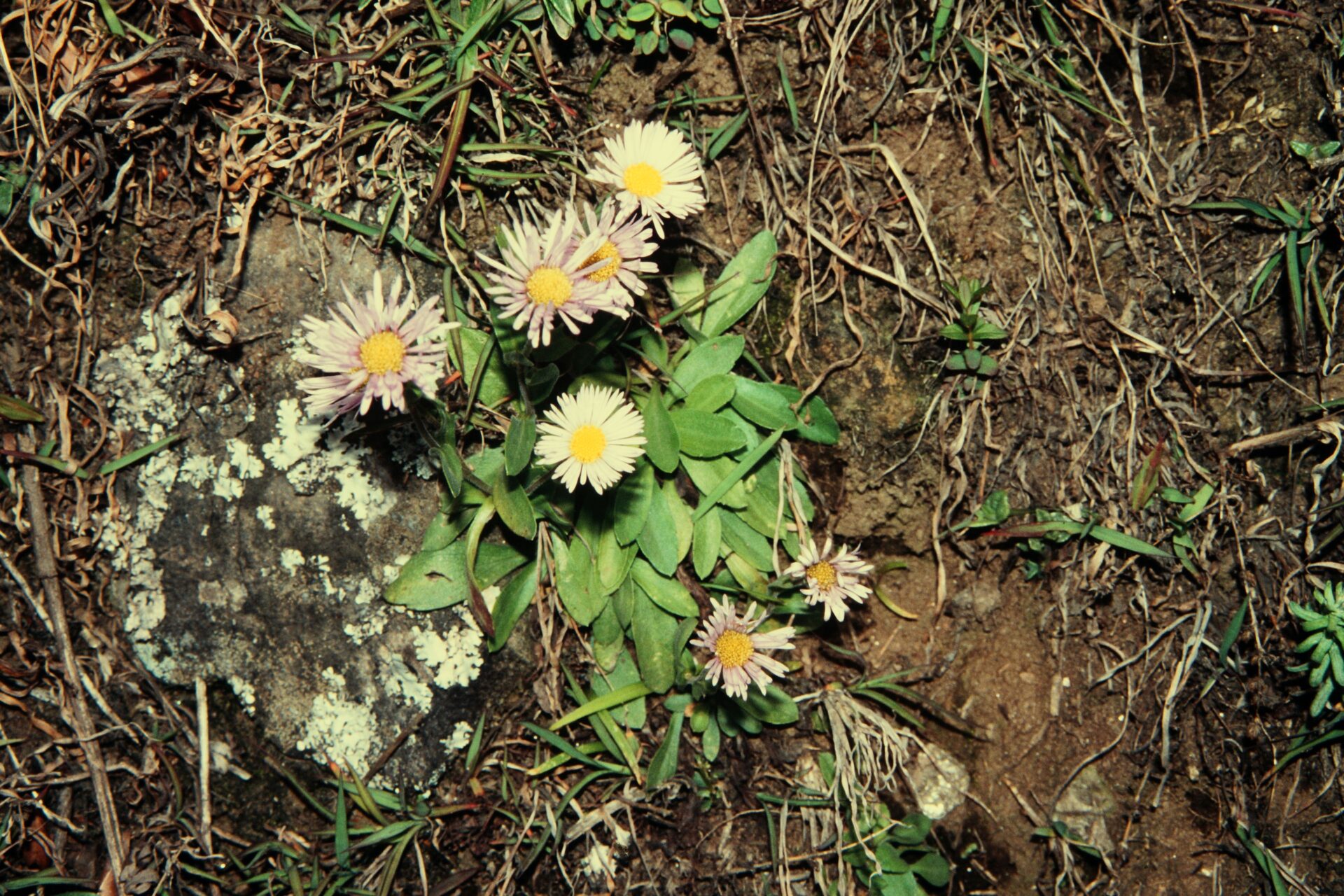
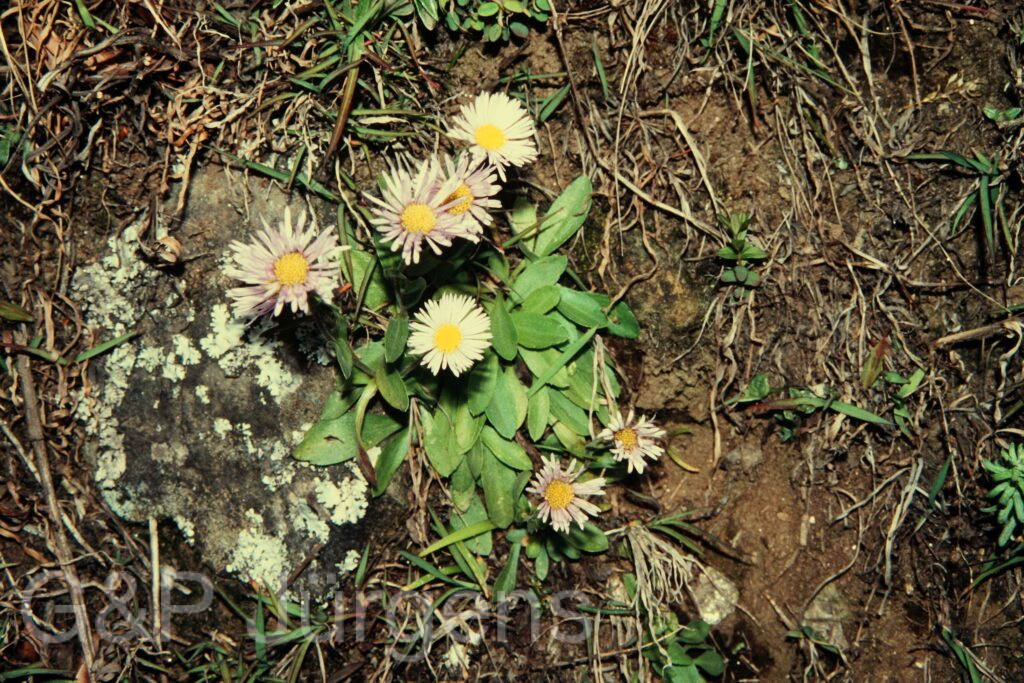
Erigeron bellidioides is a small fleabane of the Western and Central Himalaya, with verified GBIF occurrences confined to Pakistan, Nepal and India. It is a plant of open grassy slopes, forest clearings, banks and stony pastures through the temperate zone, generally between about 1800 and 3000 m. The material photographed at Chamtrug in central Nepal at around 2550 m in May illustrates its flowering at the onset of the growing season in just such open montane grassland, where it forms low, daisy-like tufts among the sward.
The species is a low perennial or short-lived herb forming a basal rosette of obovate to spathulate, entire or slightly toothed leaves that, as the epithet bellidioides suggests, recall those of a daisy (Bellis). The stems are slender, sparingly leafy and finely hairy, each typically bearing a solitary terminal capitulum. The involucre is hemispherical with narrow, hairy phyllaria in a few rows; the head carries numerous slender, thread-like ray florets that are white, pink or pale lilac surrounding a disc of yellow tubular florets. The fruit is a small flattened achene crowned by a pappus of fine bristles that facilitates wind dispersal.
Within Erigeron, a large genus easily confused with related Aster, this species is distinguished by its rosette habit, narrow many-rayed heads and Himalayan distribution; it was transferred to the genus by C.B. Clarke from a Buchanan-Hamilton and Don basionym. Ecologically it behaves as a pioneer of open and disturbed ground and provides a nectar and pollen source for generalist insects. It is widespread and locally common in suitable grassland and is not regarded as being of conservation concern.
Author: (Buch.-Ham. ex D.Don) Benth. ex C.B.Clarke · Sources: POWO (Kew), GBIF, Flora of Pakistan, Annotated Checklist of the Flowering Plants of Nepal, Flora of British India