Tag:

Summer

O.E.Schulz

BhutanPG2011 656
Bhutan Thitha-Tso 4360m, July

Description

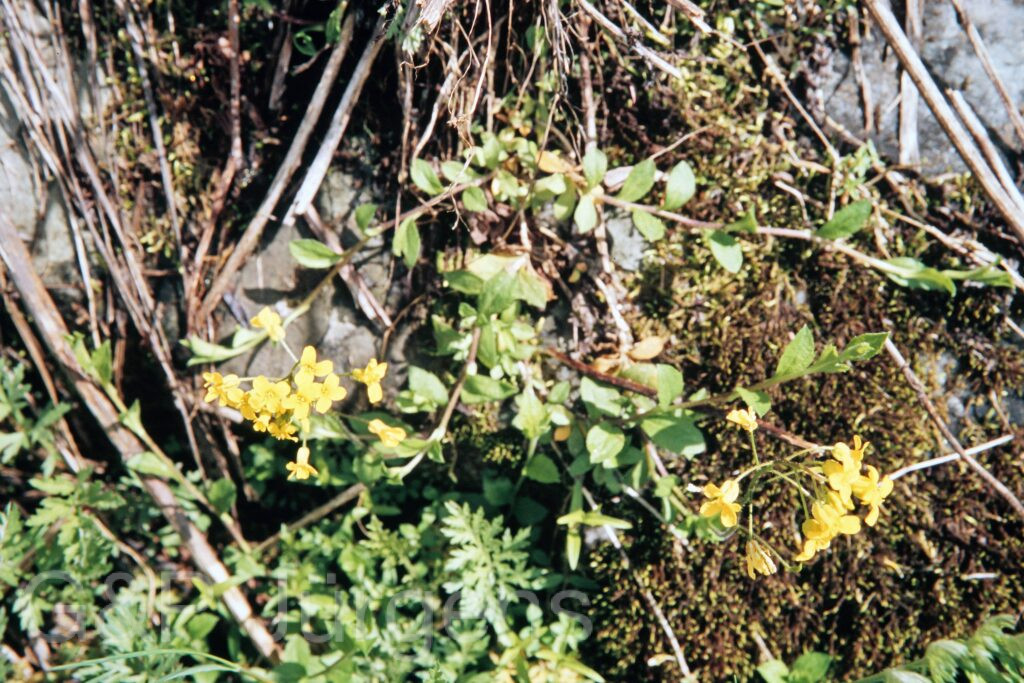
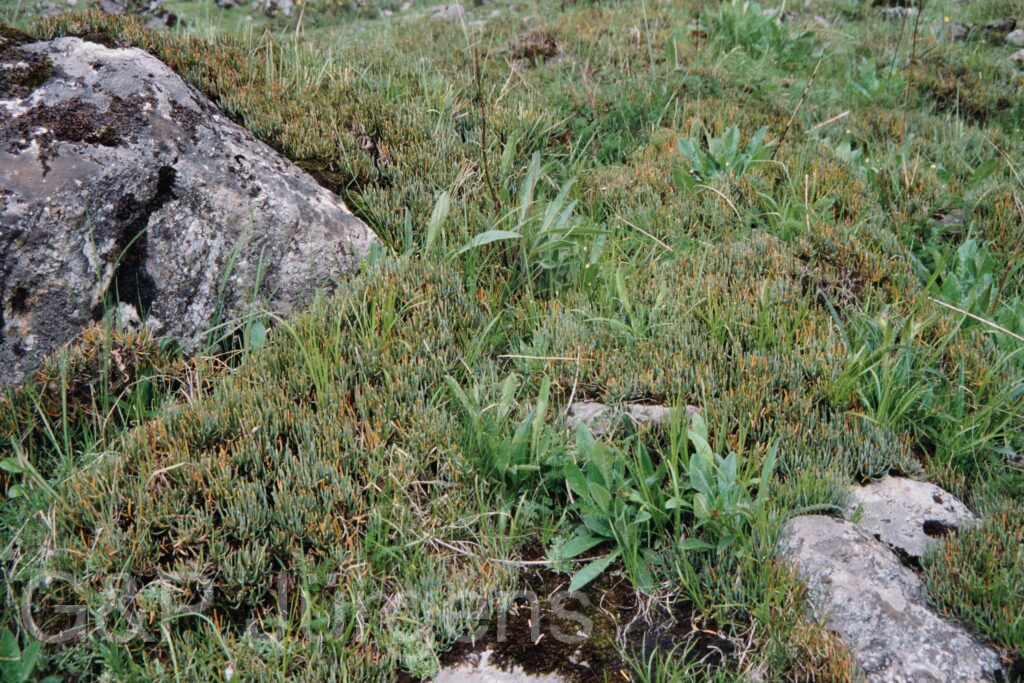
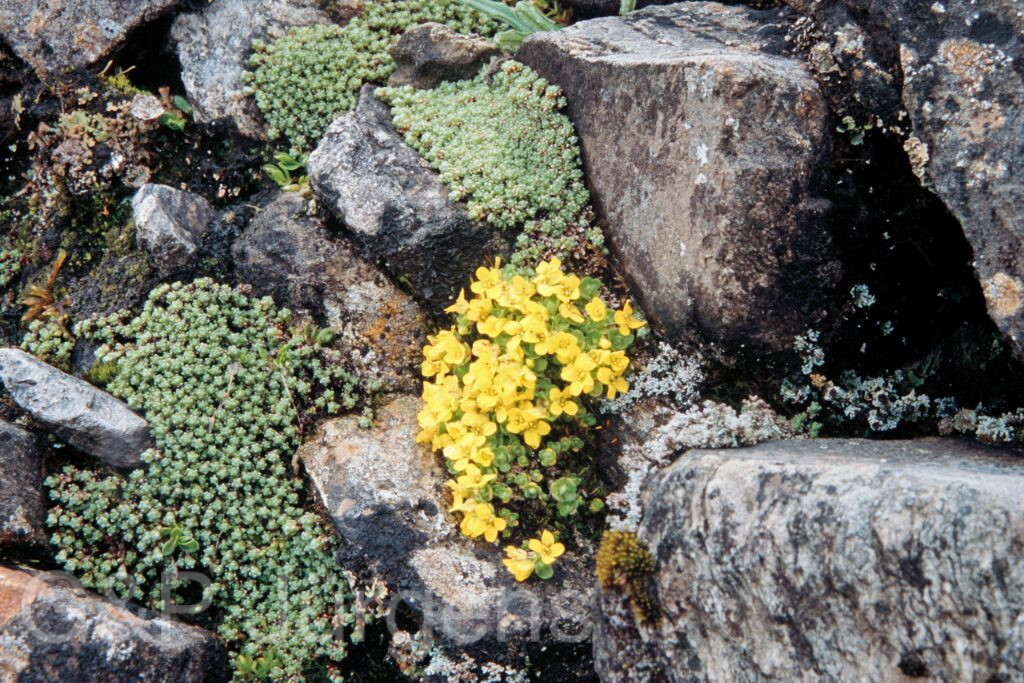
Draba oariocarpa is a high-alpine crucifer of the eastern Himalaya, known principally from Bhutan and adjoining areas, where GBIF holds only a single occurrence record, reflecting both its narrow distribution and its remote habitat. It is a plant of open alpine screes, stony slopes, moraines and frost-disturbed gravels of the upper alpine and subnival zones, generally above 4000 m. The photograph from the Thitha Tso in Bhutan at about 4360 m in July shows the species flowering in the brief high-summer window in its harsh, exposed lakeside scree habitat.

The plant is a small, tufted or cushion-forming perennial arising from a branched caudex topped by rosettes of leaves. The leaves are small, oblong to spathulate, entire or nearly so, and clothed in the stellate and simple hairs characteristic of the genus, giving a greyish, roughened texture. From the rosettes arise short, leafless or few-leaved scapes bearing a compact raceme of small flowers; these have four sepals and four yellow (sometimes fading whitish) petals in the cruciform arrangement typical of the Brassicaceae, with six stamens. The fruit, alluded to in the epithet oariocarpa (egg-fruited), is a small, ovate to elliptic, somewhat flattened silicula containing several seeds.

Draba is a very large, predominantly arctic-alpine genus of the Brassicaceae, taxonomically intricate owing to widespread polyploidy, apomixis and minor morphological differentiation, so that many narrowly defined species and synonyms have been described from the Himalaya and Tibet. The dwarf cushion habit and dense indumentum are classic adaptations to the cold, desiccating and intensely irradiated subnival environment. Given its apparently very restricted range and few documented collections, D. oariocarpa is poorly known and warrants further field assessment of its distribution and status.

Author: O.E.Schulz · Sources: POWO (Kew), GBIF, Flora of Bhutan, Flora of China, Annotated Checklist of the Flowering Plants of Nepal, Al-Shehbaz's systematic studies of Draba and the Brassicaceae
Schrenk

Nepal 99 656 ergebnis
West-Nepal, Kagmara-La, July

Description

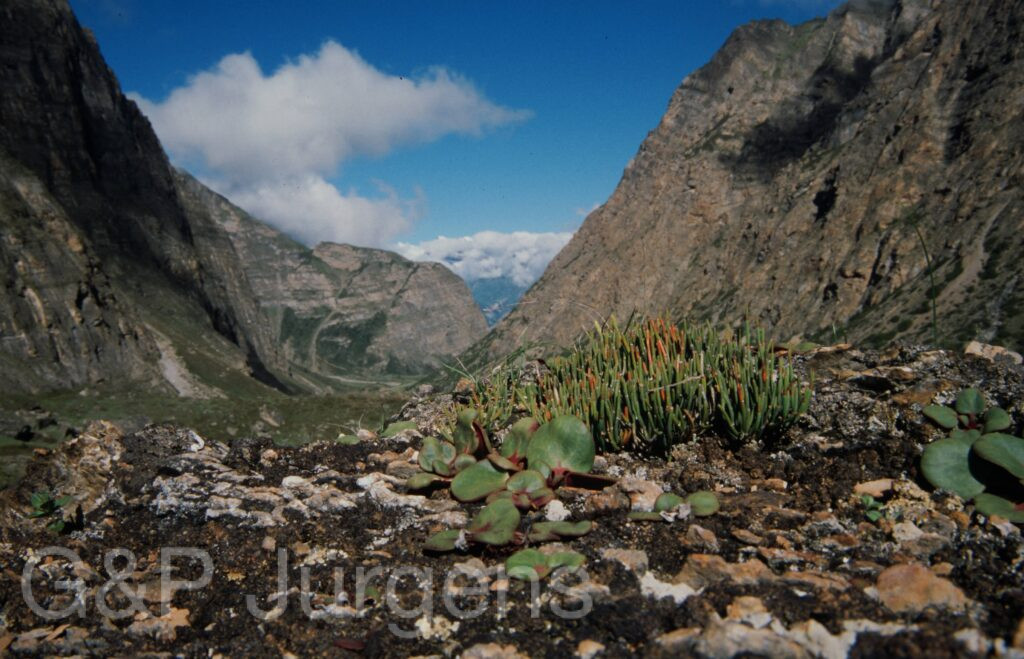
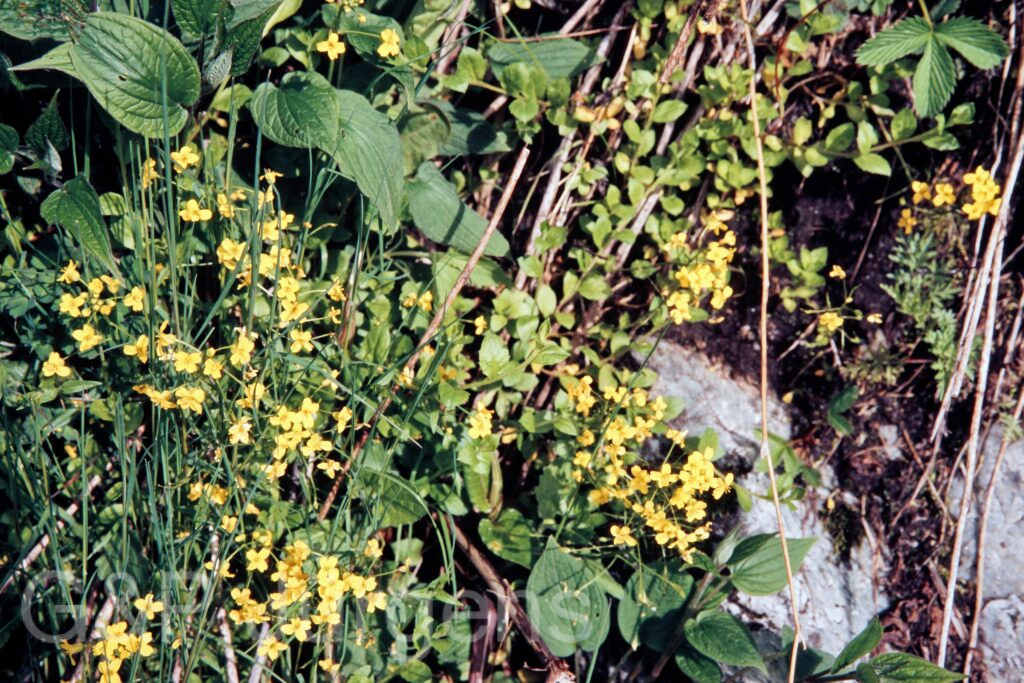
Draba oreades is a circum-Asian alpine crucifer with a wide range across the mountains of Central Asia and the Himalaya into Siberia and Mongolia; GBIF records nearly 1200 occurrences spanning China, India, Pakistan, Nepal, Kazakhstan, Russia, Kyrgyzstan, Tajikistan and beyond. It is a true alpine, growing on stony slopes, screes, moraines, rock ledges and gravelly alpine turf, generally above 3500 m and ascending well beyond 4500 m. The photograph from the Kagmara-La in West Nepal in July depicts it flowering in midsummer on a high Himalayan pass, the brief window when these cold-desert and alpine habitats become accessible to its yellow-flowered cushions.

It is a small, tufted or cushion-forming perennial herb arising from a branched, often woody caudex clothed in persistent old leaves. The leaves are mostly in dense basal rosettes, oblong to oblanceolate or spathulate, entire, and covered with stellate and simple hairs giving a greyish, scabrid texture. The flowering stems are short, leafless or few-leaved and bear compact corymbose racemes that elongate in fruit. Flowers are small with four bright yellow petals, fading paler. The fruit is a short, ovate to oblong-elliptic silicula, somewhat compressed and often twisted or hairy, containing several small seeds in two rows.

Draba is a large and notoriously complex genus of cold and high-mountain regions, and D. oreades belongs to the yellow-flowered, cushion-forming alpine assemblage adapted to short seasons, intense radiation and frost. Such compact, taprooted, densely hairy growth forms are classic alpine convergences conserving heat and moisture. The species is widespread and not threatened, serving as a characteristic pioneer of unstable high-elevation substrates throughout the Asian highlands.

Author: Schrenk · Sources: POWO (Kew), GBIF, Flora of China (Brassicaceae), Flora of Pakistan, Jordal & Al-Shehbaz studies of Draba

Royle

Description

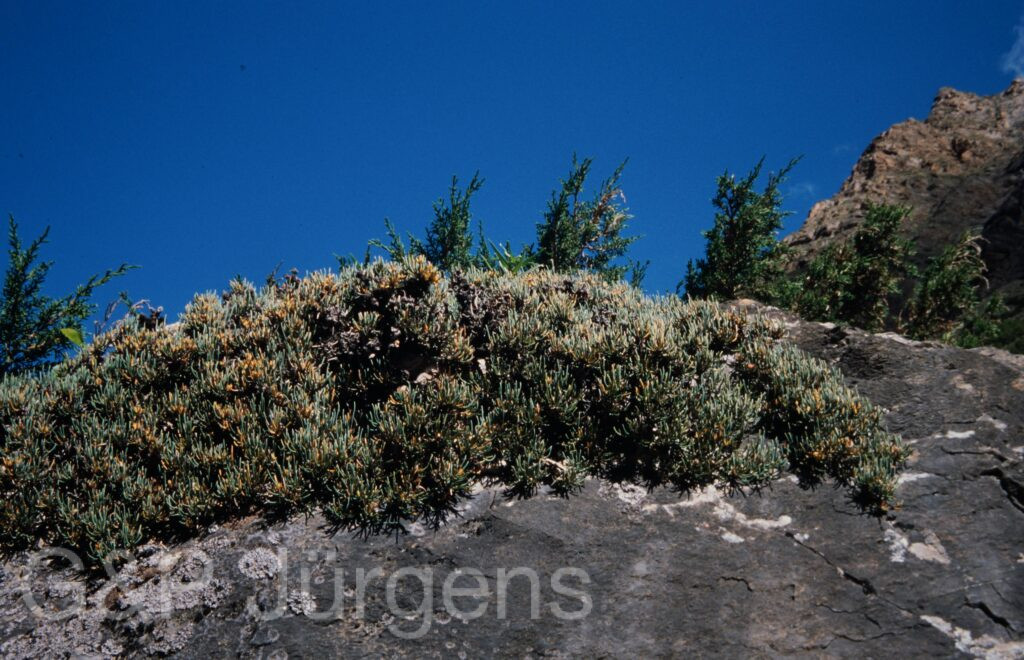
Draba radicans is a high-alpine crucifer of the Himalayan chain, with GBIF documenting 55 occurrences from Nepal, India and Bhutan. It is a plant of the upper subalpine to alpine zone, growing among rocks, screes, moist turf and the margins of snowmelt flushes where competition from taller vegetation is slight. The image was taken at Dohdi-Tal in Garhwal, India, at about 3400 m in June, when receding snow exposes the open stony slopes and the rosettes come into flower at the start of the brief alpine growing season.

It is a small perennial herb forming low rosettes or loose mats from a slender taproot and branching caudex, the specific epithet radicans alluding to its tendency to root and spread at the base. The leaves are mostly basal, oblanceolate to spathulate, entire or obscurely toothed, and clothed in simple, forked and stellate hairs characteristic of the genus. The flowering stems are short and often leafless or few-leaved, bearing a short raceme of small flowers with four yellow (fading whitish) petals, four sepals and the tetradynamous stamens of the family. The fruit is a flattened, oblong to elliptic silicula on a short pedicel, containing several small seeds.

Draba (Brassicaceae) is one of the largest genera of arctic and alpine plants, with numerous narrowly distributed Himalayan species whose delimitation rests on trichome type and fruit shape. D. radicans is part of the diverse Himalayan alpine Draba assemblage, an element sensitive to climatic warming and the upward retreat of snowbeds. Though not formally assessed, its restriction to cold high-elevation habitats makes such alpine specialists of conservation interest as indicators of mountain ecosystem change.

Author: Royle · Sources: POWO (Kew), GBIF, Flora of Pakistan, Annotated Checklist of the Flowering Plants of Nepal, Jafri's Flora of West Pakistan (Brassicaceae), Schulz monograph of Draba

Sealy

BhutanPG2011 790 01 01
Bhutan Chele-La, 3800m July
BhutanPG2011 791 01 01
Bhutan Chele-La, 3800m July

Description

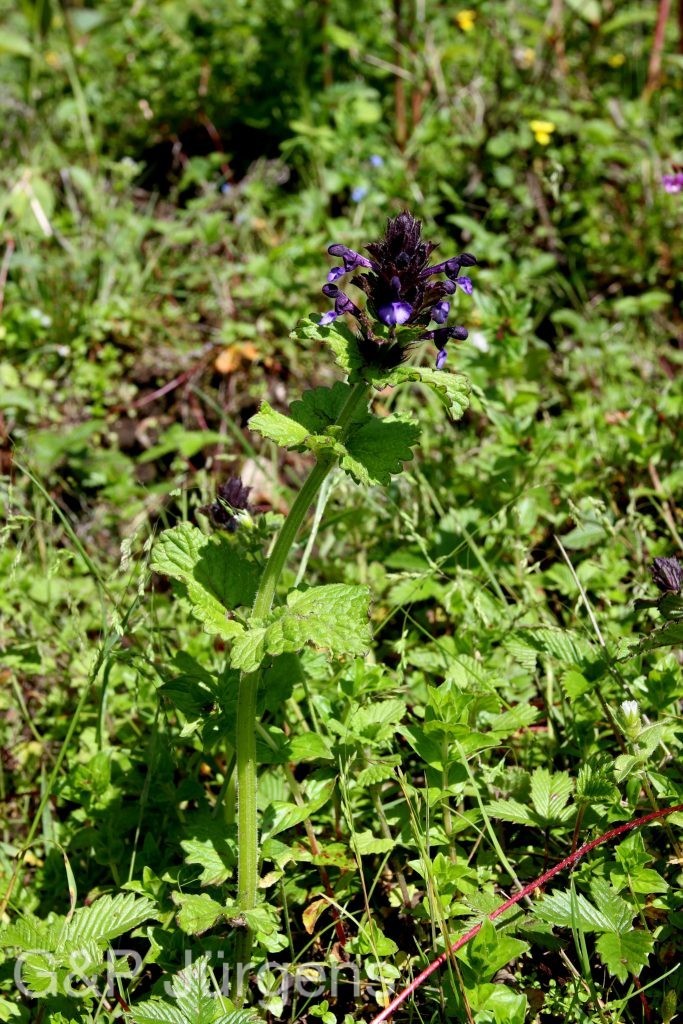
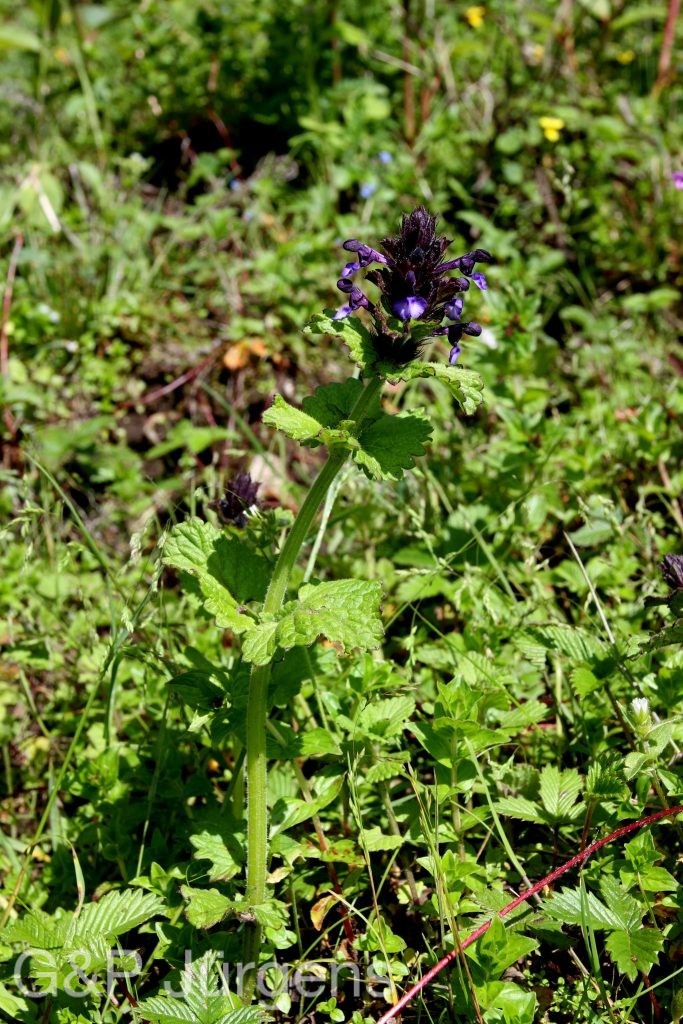
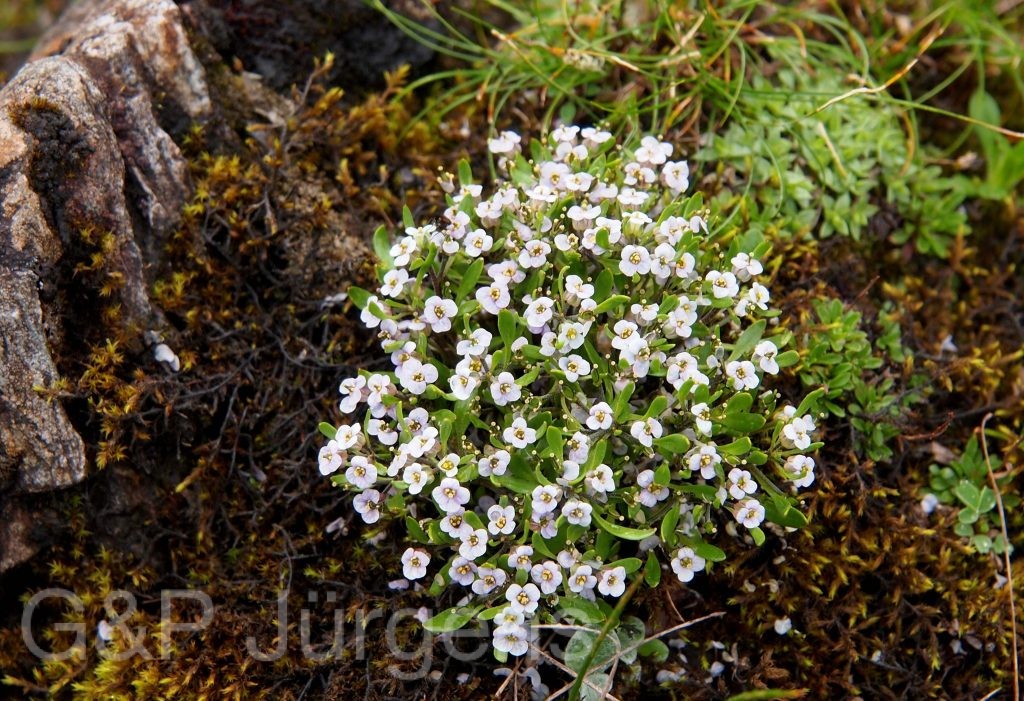
Dracocephalum wallichii is a Himalayan dragonhead recorded from India, China (Xizang), Nepal and Bhutan, with GBIF holding around 175 occurrences across the high eastern and central ranges. It is a plant of the alpine zone, growing on open stony slopes, gravelly meadows, scree and grassy banks typically between about 3500 and 4500 m. The photographed material from the Chele-La in western Bhutan at 3800 m, flowering in July, is characteristic: at this high pass the species blooms in the brief summer window after snowmelt, exploiting well-drained, sunny ground among the alpine turf and rock where competition from taller vegetation is limited.

It is a perennial herb with a woody rootstock giving rise to several erect or ascending quadrangular stems. The leaves are opposite, oblong to narrowly ovate, the margin crenate to incised, and often somewhat aromatic, as is general in the genus. The inflorescence is a dense, head-like to interrupted terminal spike of verticillasters subtended by conspicuous, often spine-toothed and ciliate floral bracts that are a notable feature of the species. Each flower has a tubular, two-lipped calyx and a strongly two-lipped corolla coloured blue to violet-purple, the hooded upper lip arching over the four didynamous stamens and the lower lip spreading and three-lobed as a landing platform for bees. The fruit comprises four smooth nutlets enclosed in the persistent calyx.

The species was described by Sealy and honours Nathaniel Wallich, an early collector of Himalayan plants. Dracocephalum is a genus of the temperate northern hemisphere centred on central Asia, well represented in alpine and steppe habitats; D. wallichii is one of its few truly Himalayan-alpine members and is distinguished by its bracteal armature and dense spike. Pollinated chiefly by bumblebees, it is a typical short-season alpine perennial, and being widespread in remote high terrain it is of no immediate conservation concern.

Author: Sealy · Sources: POWO (Kew), GBIF, Flora of China, Flora of Bhutan, Annotated Checklist of the Flowering Plants of Nepal, Budantsev revision of the genus Dracocephalum

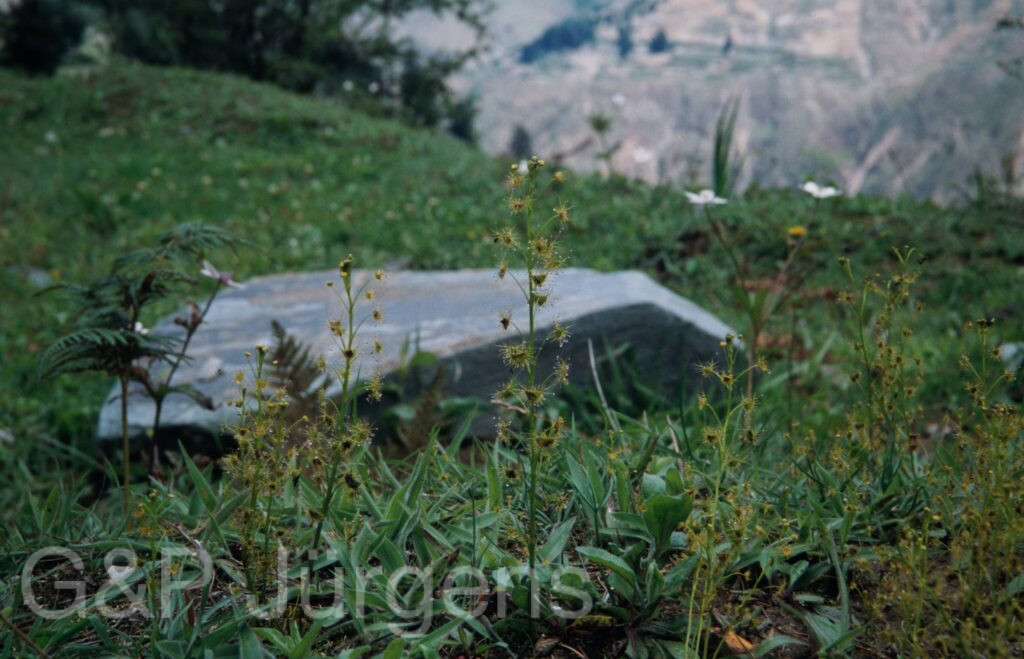
Drosera peltata

by GP Jürgens

Thunb.

Sikkim2011 185
Sikkim Lachung 2600m, June
Nepal 99 996 ergebnis
West-Nepal Juphal 2550m, July

Description

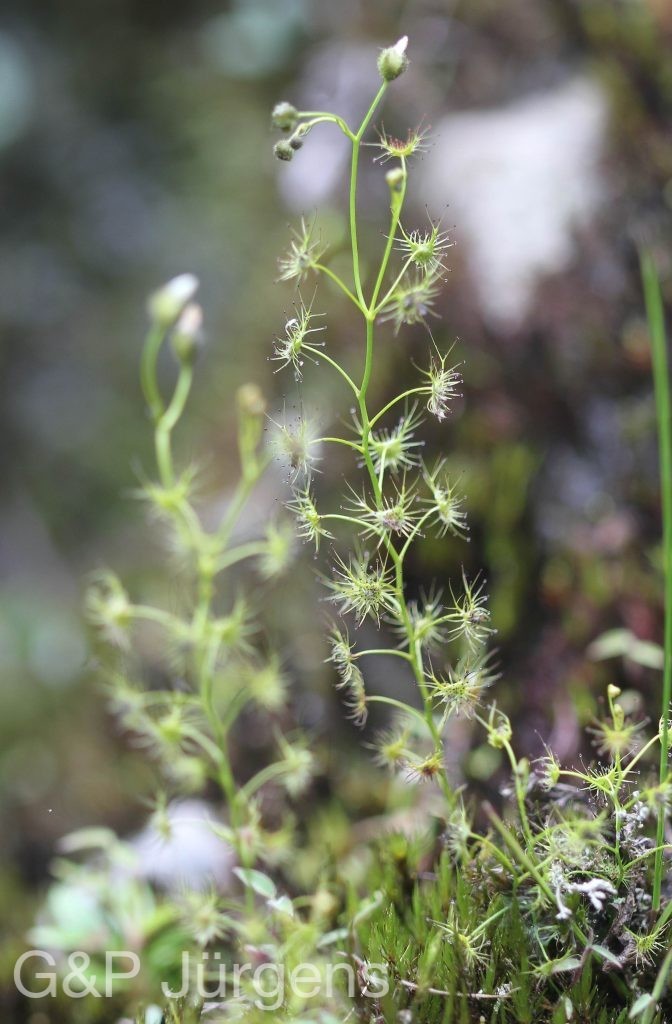
Drosera peltata is one of the most widely distributed of all sundews, a carnivorous herb ranging from Australia and New Zealand through East and Southeast Asia to the Himalaya, with GBIF holding an exceptional 32363 occurrences across Australia, China, Japan, India, Nepal, Thailand, Indonesia, the Philippines, Korea and many further countries. In the Himalaya it grows in open, wet, nutrient-poor situations: boggy grassland, mossy banks, seepage slopes, marshy meadows and damp roadside cuttings, generally between 1500 and 3000 m. The localities cited for the image, Lachung in Sikkim at about 2600 m in June and Juphal in West Nepal at around 2550 m in July, are typical mid-montane wet-meadow sites where the plant flowers during the early monsoon.

Unlike the rosette-forming sundews, D. peltata is an erect, often tuberous-rooted herb whose slender stem bears alternate, peltate to lunate leaves on long petioles. The leaf blades are crescent-shaped and clothed on their margins and upper surface with stalked glandular hairs (tentacles) tipped with glistening mucilaginous droplets that entrap small insects; the tentacles then bend inward and the leaf secretes enzymes to digest the prey. Basal rosette leaves may be present at germination but wither as the stem elongates. The inflorescence is a one-sided raceme of small white to pinkish five-merous flowers, opening in bright sunshine, and the fruit is a small capsule with numerous minute seeds.

Droseraceae are carnivorous, and the tuberous, stem-forming peltata complex constitutes a distinctive lineage within Drosera that has been variously subdivided into segregate species and subspecies by different authors, making it one of the more taxonomically contentious sundew groups. Insect capture supplies nitrogen and phosphorus otherwise scarce in the acidic, waterlogged soils it inhabits, and the underground tuber permits dormancy through dry or unfavourable seasons. Given its enormous geographic range the species as a whole is of no conservation concern, although individual Himalayan wetland populations are locally susceptible to drainage and habitat loss.

Author: Thunb. · Sources: POWO (Kew), GBIF, Flora of China Vol. 8, Flora of Bhutan Vol. 1, Flora of Nepal, Lowrie Carnivorous Plants of Australia Magnum Opus

Schltdl.

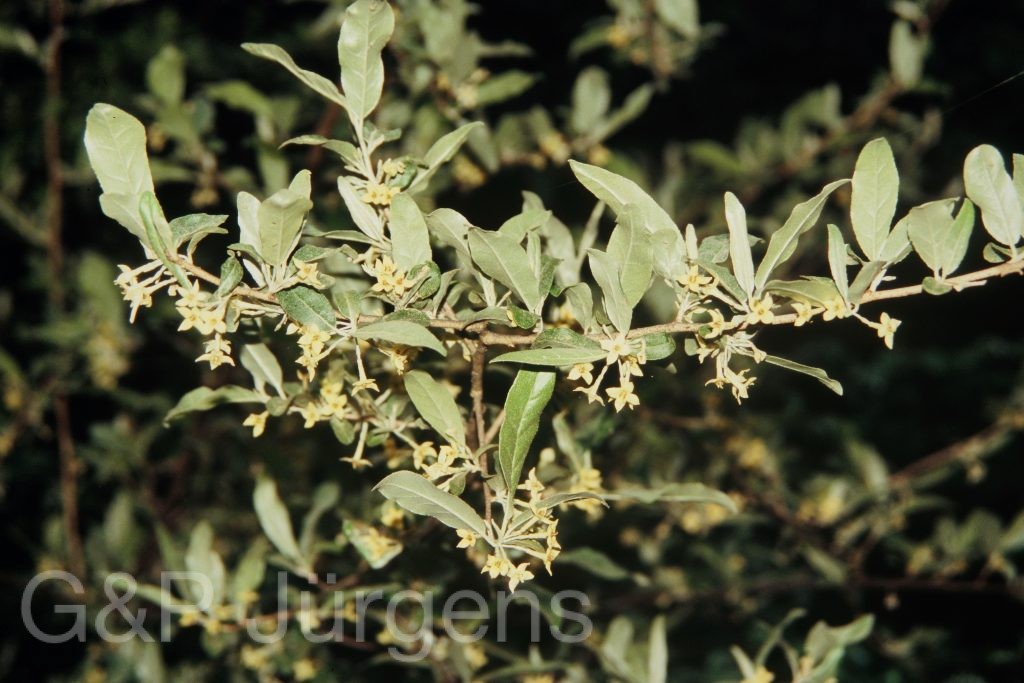
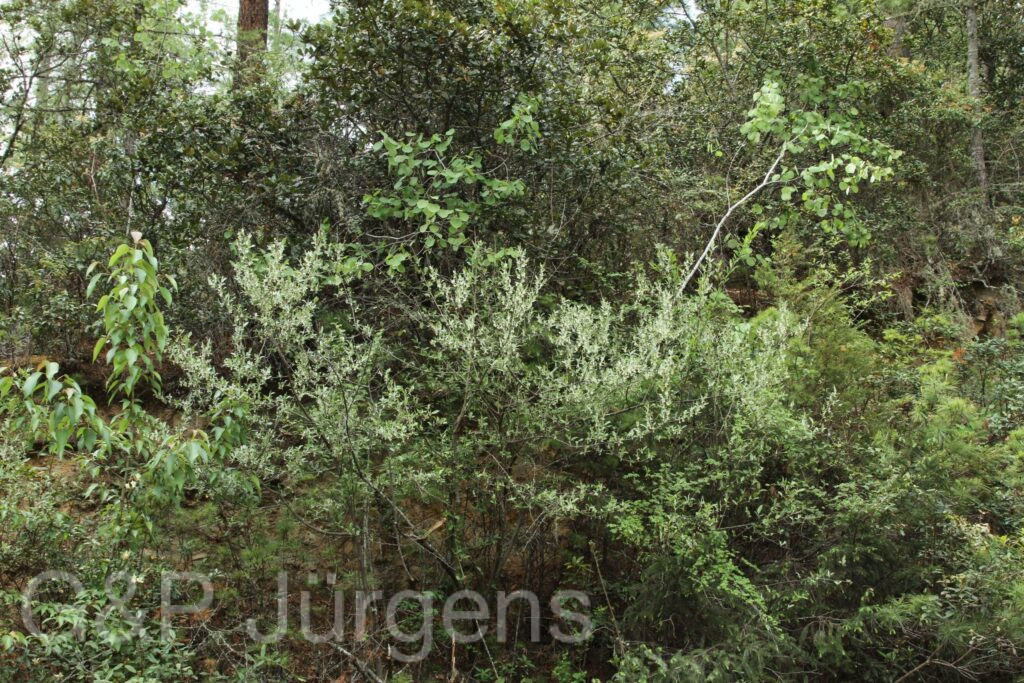
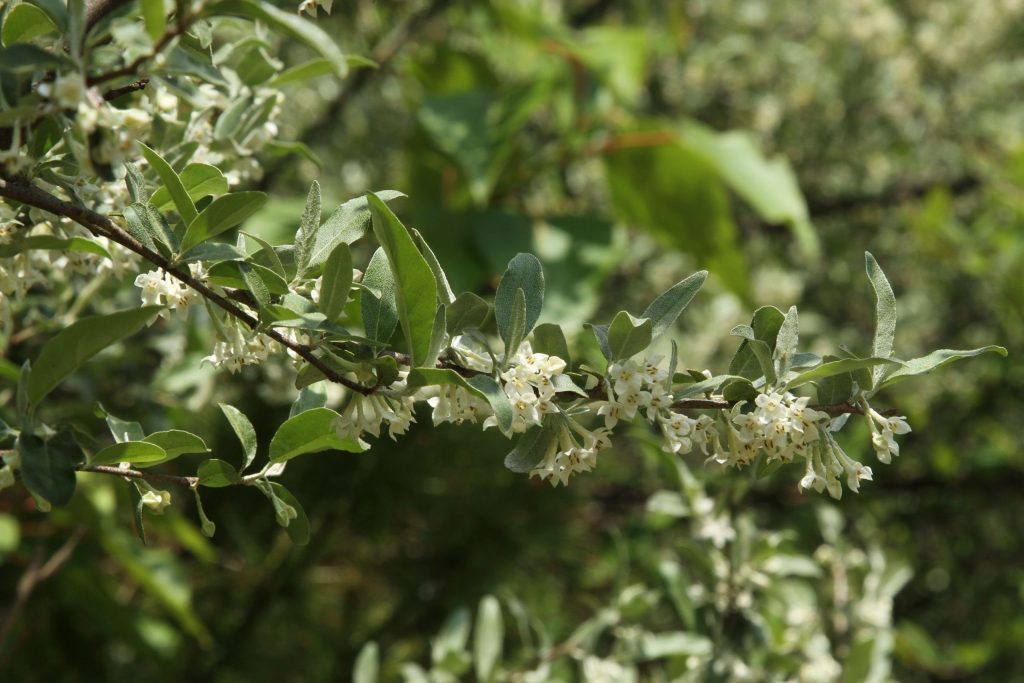
Bh09 46 G84
Bhutan Paro 2400m, June
Bhutan2014 852 scaled
Bhutan Thimphu 2500m, May
Bhutan2014 853 scaled
Bhutan Thimphu 2500m, May

Description

Elaeagnus caudata Schltdl. ex Momiy. is a shrub or small tree of the Elaeagnaceae endemic to the central and eastern Himalaya, known from Nepal, northern India and Bhutan. Documented from only a small number of georeferenced collections, it grows in temperate forest margins, thickets, shrubby slopes and along the edges of cultivation in the mid-montane zone. The photographed plants from the Paro and Thimphu valleys of Bhutan, recorded at 2,400–2,500 m in May and June, are characteristic of its preference for the cool, well-lit temperate belt where it flowers in late spring and early summer.

The plant is densely clothed throughout in the silvery to rusty-brown peltate scales typical of the family, which give the young shoots, leaf undersides and flowers a metallic lustre. The leaves are alternate, elliptic to ovate, often long-acuminate (the caudate apex giving the species its name), green and stellate-scaly above and silvery-lepidote beneath. The flowers are small, tubular and apetalous, with a four-lobed, silvery-scaly perianth, fragrant and borne in axillary clusters. The fruit is an oblong, drupe-like achene enclosed by the fleshy, accrescent perianth tube, ripening reddish and scaly, edible when fully mature.

Like other members of Elaeagnus, the species harbours nitrogen-fixing Frankia actinobacteria in root nodules, enabling it to colonise poor soils and contribute to soil fertility, a trait that makes such shrubs significant in montane succession. Its restricted Himalayan range and the small number of records suggest it is genuinely localised, though the difficulty of distinguishing the many scaly-leaved Himalayan Elaeagnus species means its true distribution may be under-documented and warrants further survey.

Author: Schltdl. · Sources: POWO (Kew), GBIF, Flora of Bhutan Vol. 1, Flora of China Vol. 13, Sun & Lin: Revision of Elaeagnus

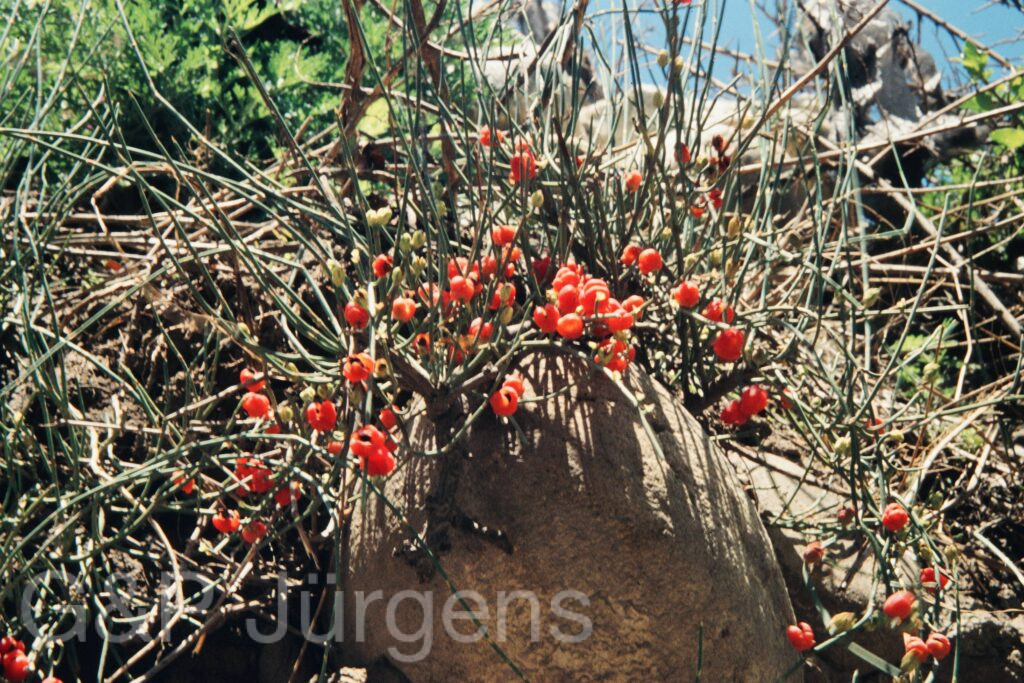
Wall. ex  Klotzsch & Garcke

Nepal 99 7 ergebnis
Westnepal, Jumla 2300m June

Description

Ephedra gerardiana is a dwarf gymnosperm shrub of the high mountains of central and southern Asia, native across China, Nepal, India, Pakistan, Afghanistan, Bhutan, Tajikistan and Kyrgyzstan; its roughly 539 GBIF occurrences cluster along the Himalaya and the Tibetan plateau margins. It is a plant of dry, cold, high-elevation environments, as recorded near Jumla in West Nepal at about 2300 m in June, and ascends well above the treeline into the alpine and steppe zone. It thrives on stony slopes, gravel terraces and dry riverbeds, tolerating intense insolation, drought and winter cold in the rain-shadow valleys of the inner Himalaya.

The plant is a low, densely tufted, mat-forming shrublet with rigid, jointed, green photosynthetic stems that perform the work of the much-reduced, scale-like leaves borne in pairs at the swollen nodes. As a gymnosperm it bears no true flowers; reproductive structures are small cones, the plants typically dioecious, with pollen in axillary microsporangiate cones and ovules in compact megasporangiate cones. After pollination the female bracts become fleshy and bright red, forming a berry-like structure enclosing one or two seeds, dispersed by birds.

Ephedra is the sole genus of Ephedraceae within the gnetophytes, an isolated lineage of seed plants; E. gerardiana is the principal Himalayan species and a traditional source of the alkaloid ephedrine, harvested medicinally as somlata. This value, combined with slow growth and harsh, slowly regenerating habitats, has made wild populations locally vulnerable to over-collection and grazing, prompting conservation attention in parts of its range even though the species remains widespread overall.

Author: Wall. ex  Klotzsch & Garcke · Sources: POWO (Kew), GBIF, Flora of China Vol. 4, Flora of Pakistan, Flora of Nepal, Monograph of the Genus Ephedra (Stapf)

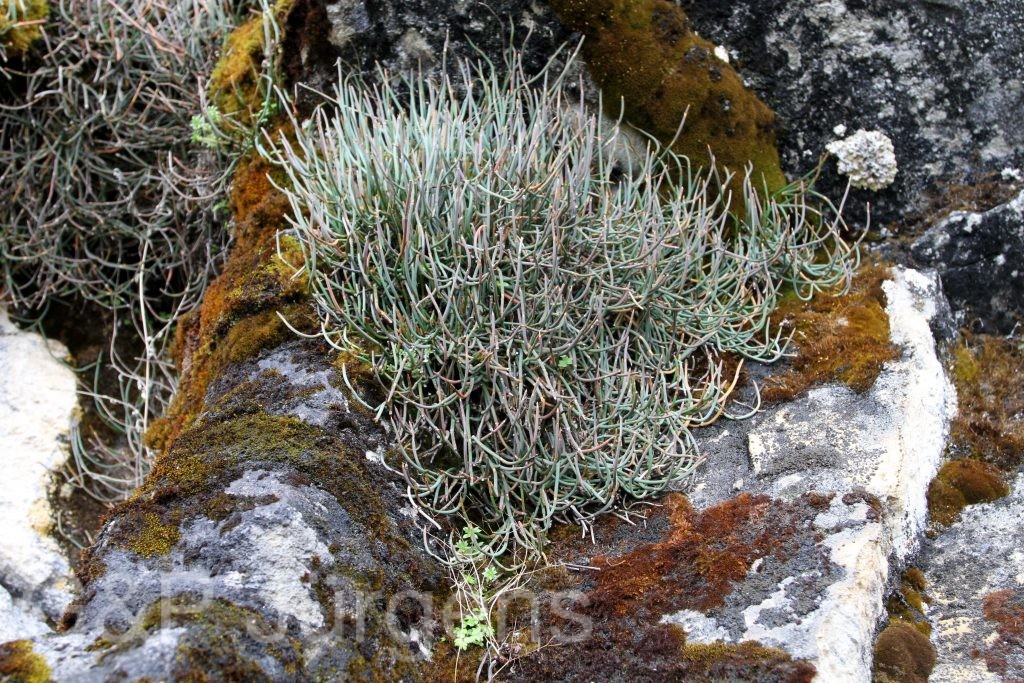
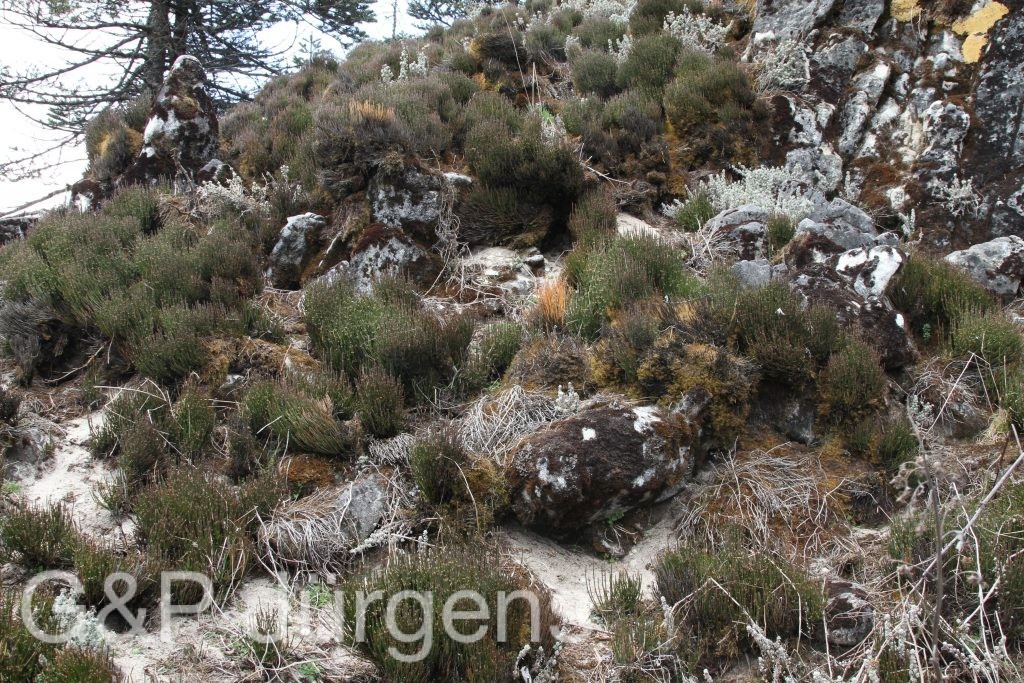
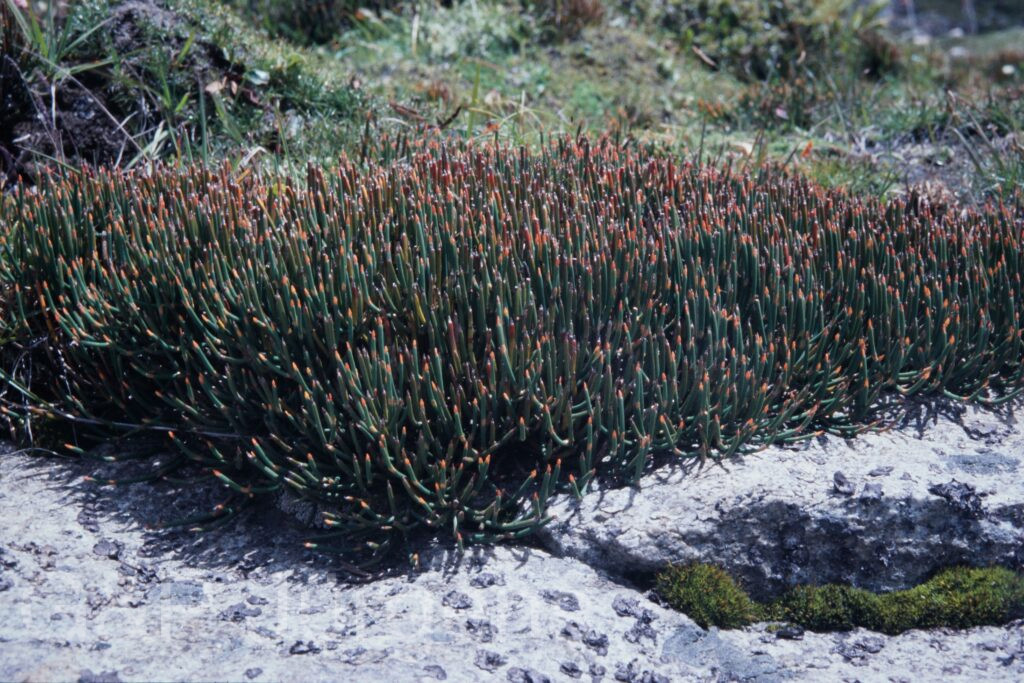
Stapf.

BhutanPG2011 338
Bhutan Jule-Tso 4250m, June
Bhutan2014 937
Bhutan Chele-La 4100m, May
Sikkim2003 522 P727
Sikkim Yume Samdong 4700m August

Description

Ephedra gerardiana var. sikkimensis is a high-alpine gymnosperm shrublet of the Himalaya and Tibetan plateau margins, recorded from China, Bhutan, India and Nepal, with the species complex widely held in cultivation across Europe and North America. It is a plant of dry, exposed, stony alpine slopes, gravel flats, moraine and rocky pasture in the arid trans-Himalayan and high-alpine zone, characteristically between about 3500 and 5000 m. The cited collections from Jule-Tso (4250 m) and Chele-La (4100 m) in Bhutan and Yume Samdong in Sikkim at 4700 m exemplify its occurrence at the very upper limits of vascular plant growth, on wind-swept, well-drained, frost-exposed ground.

The plant is a low, densely tufted, mat-forming or cushion shrublet with slender, jointed, longitudinally grooved green branchlets that perform photosynthesis, the true leaves reduced to small connate scales at the nodes. Like all Ephedra it is dioecious and non-flowering: pollen is borne in small ovoid male strobili, while the female cones, after fertilisation, develop fleshy red, berry-like seed cones enclosing one or two seeds, an adaptation to bird dispersal in an otherwise austere environment.

The epithet sikkimensis denotes the type region in the eastern Himalaya, var. sikkimensis being a high-elevation segregate of the polymorphic E. gerardiana. Members of this genus are notable sources of ephedrine alkaloids and have a long history of medicinal and ritual use. As pioneers of stabilised scree and moraine, these dwarf shrubs are ecologically important in fragile alpine systems; though not currently threatened, harvesting and climate-driven habitat shifts warrant monitoring.

Author: Stapf. · Sources: POWO (Kew), GBIF, Flora of China Vol. 4, Flora of Bhutan Vol. 1, Flora of Nepal, A Monograph of the Genus Ephedra (Stapf)

Schrenk & C.A.Mey.

Nepal 99 527 ergebnis
West-Nepal Churta-Khola 3800m, June

Description

Ephedra intermedia Schrenk & C.A.Mey. is a gymnospermous, ephedroid shrub of the Ephedraceae, widely distributed across the arid mountains and steppes of Central Asia, ranging from China, Mongolia and Kazakhstan through Kyrgyzstan, Tajikistan, Turkmenistan, Uzbekistan, Afghanistan, Iran and Pakistan to the dry trans-Himalayan valleys of India and Nepal (GBIF: c. 1,587 occurrences). It is a xerophyte of stony slopes, dry riverbeds, gravelly steppe and arid montane scrub. The photographed plant from Churta-Khola in west Nepal at about 3,800 m, recorded in June, illustrates its occurrence in the high, dry inner-Himalayan rain-shadow zone.

The plant is a densely branched, erect to spreading shrub up to about 1 m tall, with rigid, jointed, longitudinally grooved green stems that carry out photosynthesis; the leaves are reduced to small membranous scales fused into sheaths at the nodes. As a gnetophyte it is non-flowering: the reproductive structures are unisexual cones, the plants generally dioecious. Male cones are clustered with stamens bearing pollen sacs, while the female cones, after fertilisation, develop fleshy red bracts surrounding the ovule, forming a berry-like, fleshy false fruit that is bird-dispersed.

Ephedra is the sole genus of Ephedraceae and one of three living genera of the Gnetales, of considerable interest in seed-plant phylogeny. Species of the genus, including E. intermedia, are a traditional source of the alkaloid ephedrine and have a long history of medicinal use ("ma huang"). The species is widespread and of least conservation concern, though it is locally harvested.

Author: Schrenk & C.A.Mey. · Sources: POWO (Kew), Flora of China Vol. 4, Flora of Pakistan, Flora of Nepal, GBIF, Freitag & Maier-Stolte: Ephedraceae monograph

Boiss.

Nepal 99 836 ergebnis
Nepal Baga-La Phedi 4000m, July
Nepal 99 840 ergebnis
Nepal Baga-La Phedi 4000m, July

Description

Ephedra pachyclada Boiss. is a xerophytic, gymnospermous shrub of the Ephedraceae ranging from the eastern Mediterranean and Arabia through Iran, Afghanistan and Pakistan to the western and central Himalaya. Its records extend across Egypt, Israel, Jordan, Saudi Arabia, Yemen, Oman, Iran, Afghanistan, Pakistan and into India and Nepal. The species is adapted to arid and semi-arid, sun-exposed habitats: dry rocky slopes, gravelly fans, cliff ledges and the stony soils of cold high-mountain deserts and the trans-Himalayan rain shadow. It occurs over a wide altitudinal span, and the population at Baga-La Phedi in Nepal, photographed at 4,000 m in July, exemplifies its occurrence in the cold, dry alpine zone.

The plant is a densely branched, often cushion-like or rigidly erect shrub with stout, jointed, longitudinally grooved green stems that perform photosynthesis in place of the reduced, scale-like leaves, which are paired and connate into small sheaths at the nodes. Like all Ephedra it is dioecious and wind- or insect-pollinated; the male cones bear clustered microsporangia, while the female cones produce ovules whose enveloping bracts become fleshy and red, forming a berry-like, succulent seed cone that aids in dispersal by birds.

Ephedra pachyclada is a taxonomically variable species, divided into several subspecies and forming part of a complex of robust Asian ephedras whose delimitation remains debated. The genus is renowned as a source of the alkaloids ephedrine and pseudoephedrine, giving it a long history of medicinal use, and several Asian species have been subject to harvesting pressure. As a hardy stabiliser of dry, eroding mountain slopes the species also has ecological value in fragile high-altitude desert ecosystems.

Author: Boiss. · Sources: POWO (Kew), GBIF, Flora of Pakistan, Flora Iranica, Freitag & Maier-Stolte: Revision of Ephedra in the Old World