Author

GP Jürgens

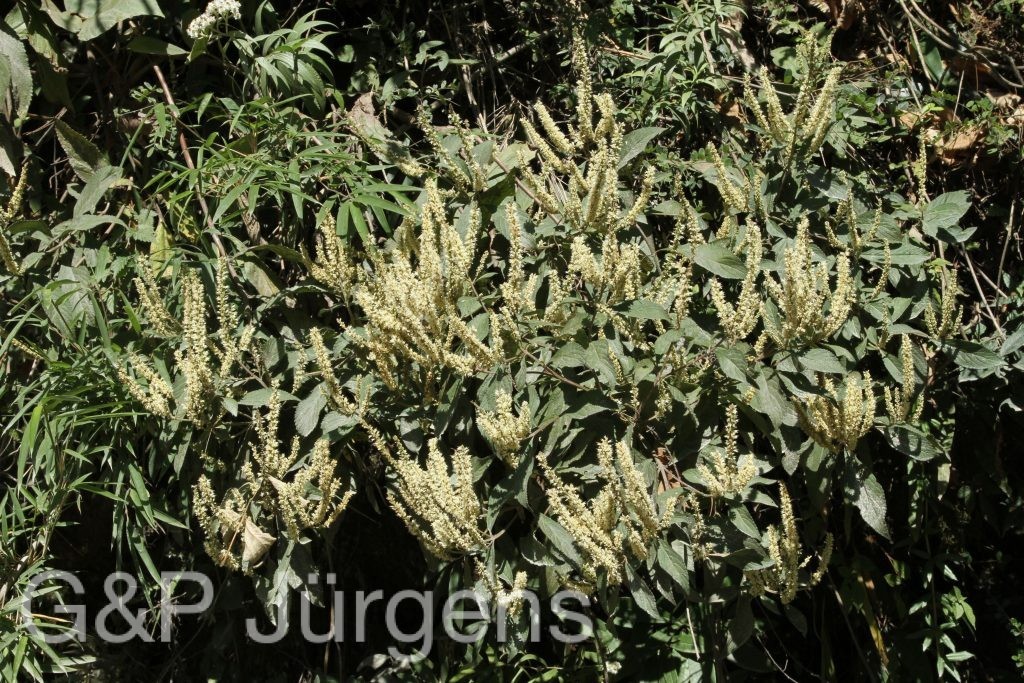
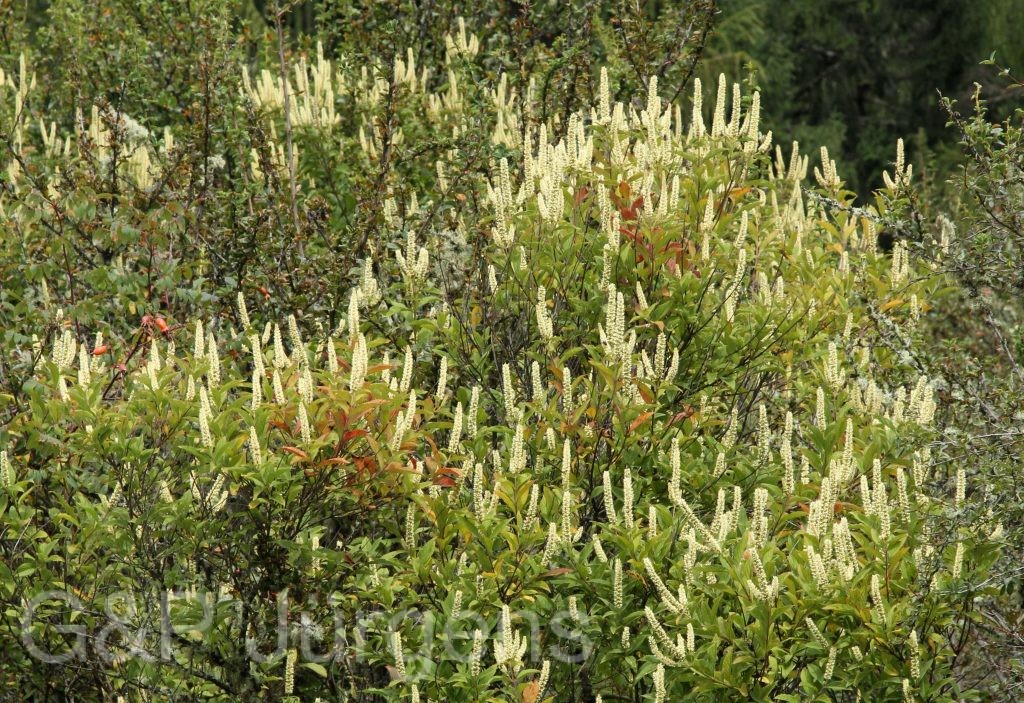
(Wall.) Meisn.

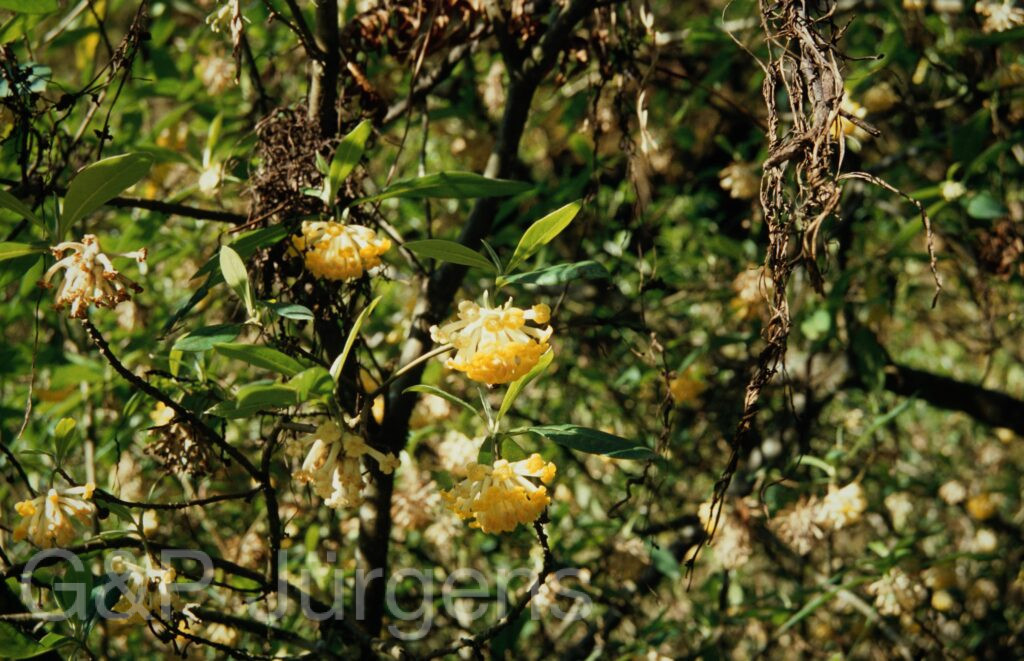
Nepal 1994 255 ergebnis
Ost-Nepal Mewa-Khola
2100m April
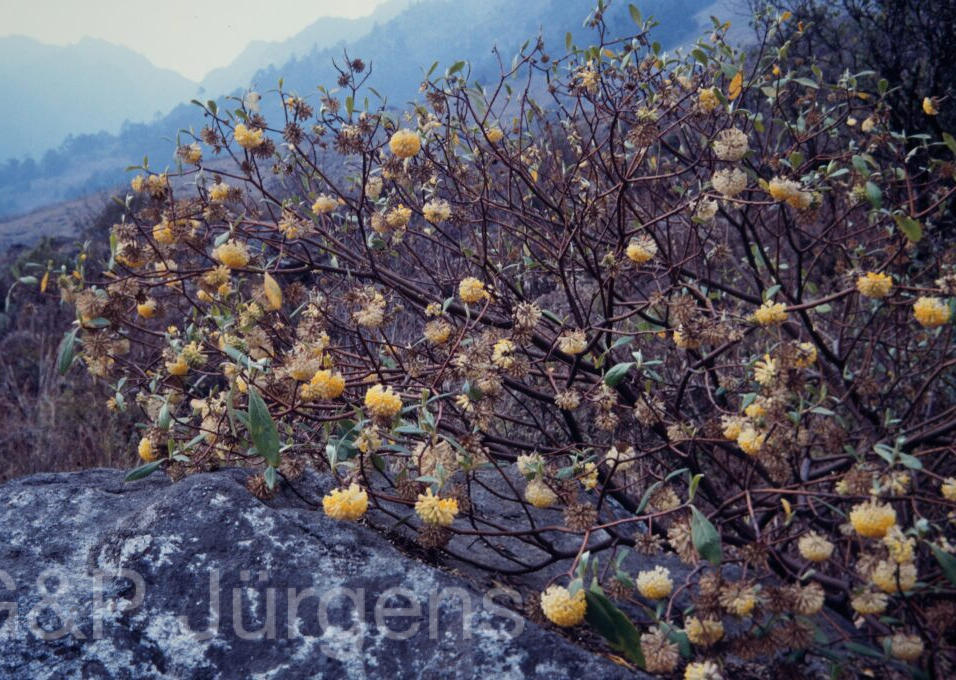
Nepal 1994 197 ergebnis
Ost-Nepal Mewa-Khola
2100m April
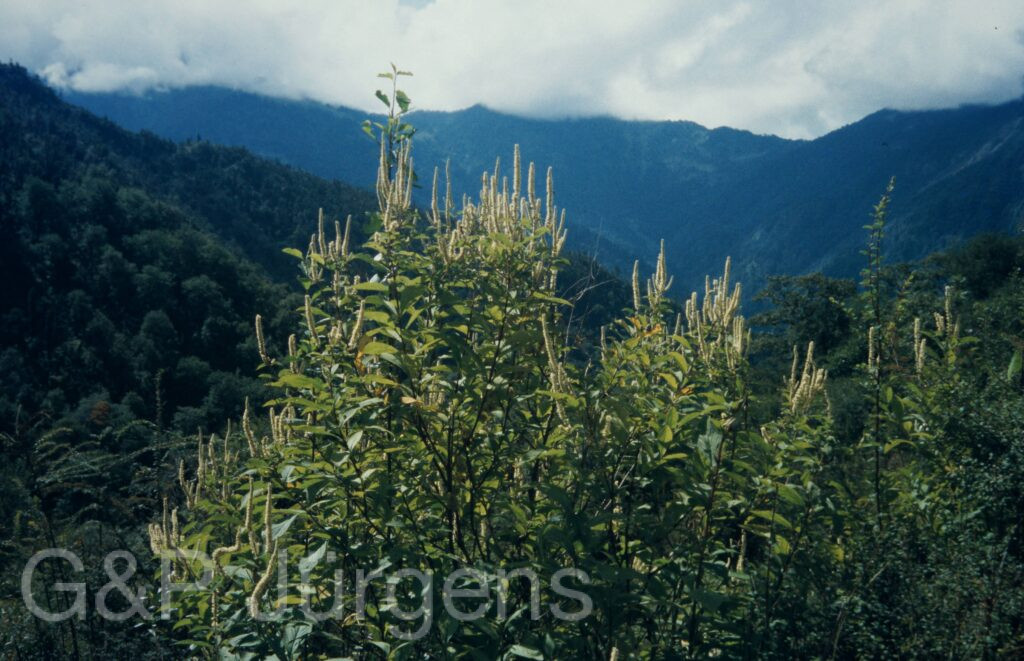
sub1hsn8
Nepal Amjilassa 2400m March

Description

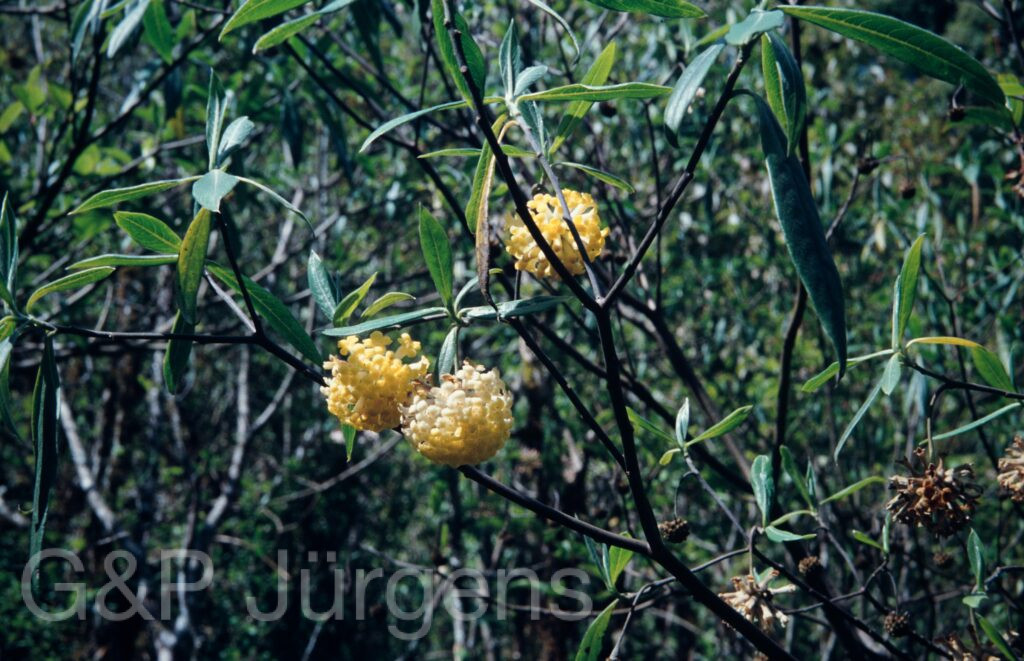
Edgeworthia gardneri is a deciduous to semi-evergreen shrub of the eastern Himalaya and adjacent mountains. GBIF records (some 484 occurrences) place it in China, Nepal, India, Bhutan, Myanmar, Bangladesh and Vietnam, with cultivated material in Japan, France, New Zealand and elsewhere. It grows in moist temperate broadleaved forest, forest margins, ravines and shrubby slopes, typically between about 1,500 and 2,800 m. The illustrated plants are from eastern Nepal at Mewa-Khola (2,100 m, April) and Amjilassa (2,400 m, March), flowering in late winter to early spring before or with leaf flush, characteristic of its phenology in the warm temperate zone.

The plant is a shrub 1–3 m tall with flexible, tough-barked branches that can be tied in a knot without breaking. The leaves are alternate, lanceolate to oblong-lanceolate, entire and somewhat silky beneath. The flowers are aggregated into dense, pendent, hemispherical heads on short peduncles; each flower lacks petals, the floral tube being silky-tomentose outside and yellow within, fragrant. The fruit is a small dry achene-like drupe enclosed in the persistent perianth base.

Like its relative Daphne, Edgeworthia yields strong bast fibre: the bark is an important source of traditional handmade paper (lokta-type) in Nepal and Bhutan, giving the genus economic significance. It is also valued as a winter-flowering ornamental. The species is widespread and not globally threatened, though bark harvesting represents a localised pressure on accessible wild stands.

Author: (Wall.) Meisn. · Sources: POWO (Kew), Flora of China Vol. 13, Flora of Bhutan Vol. 1, GBIF, Halda: The Genus Daphne (and allied Thymelaeaceae)
Schltdl.

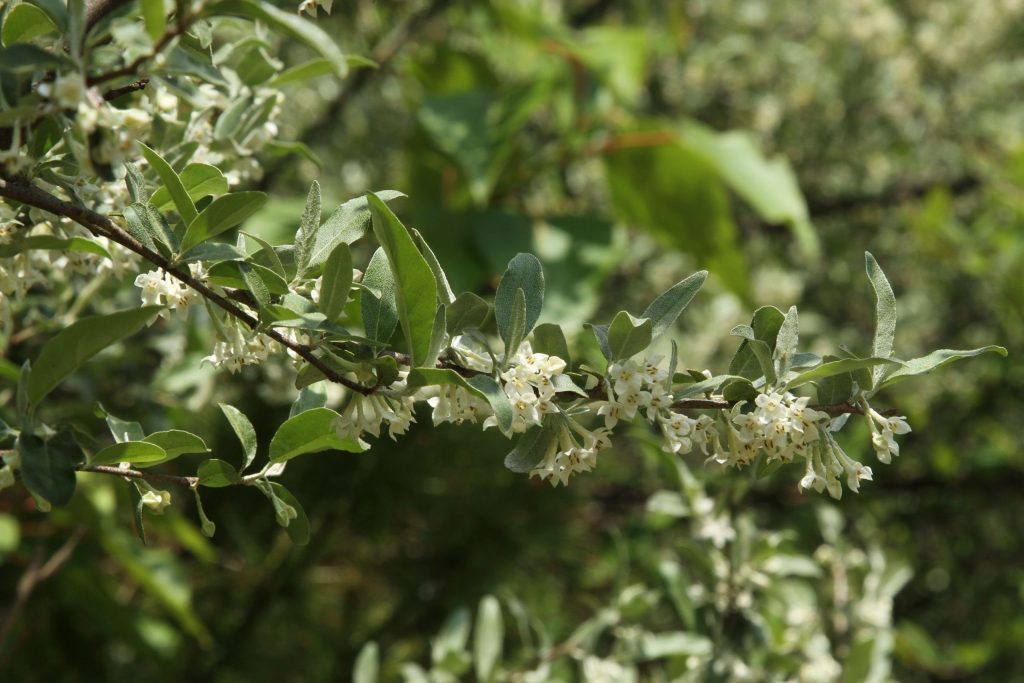
Bh09 46 G84
Bhutan Paro 2400m, June
Bhutan2014 852 scaled
Bhutan Thimphu 2500m, May
Bhutan2014 853 scaled
Bhutan Thimphu 2500m, May

Description

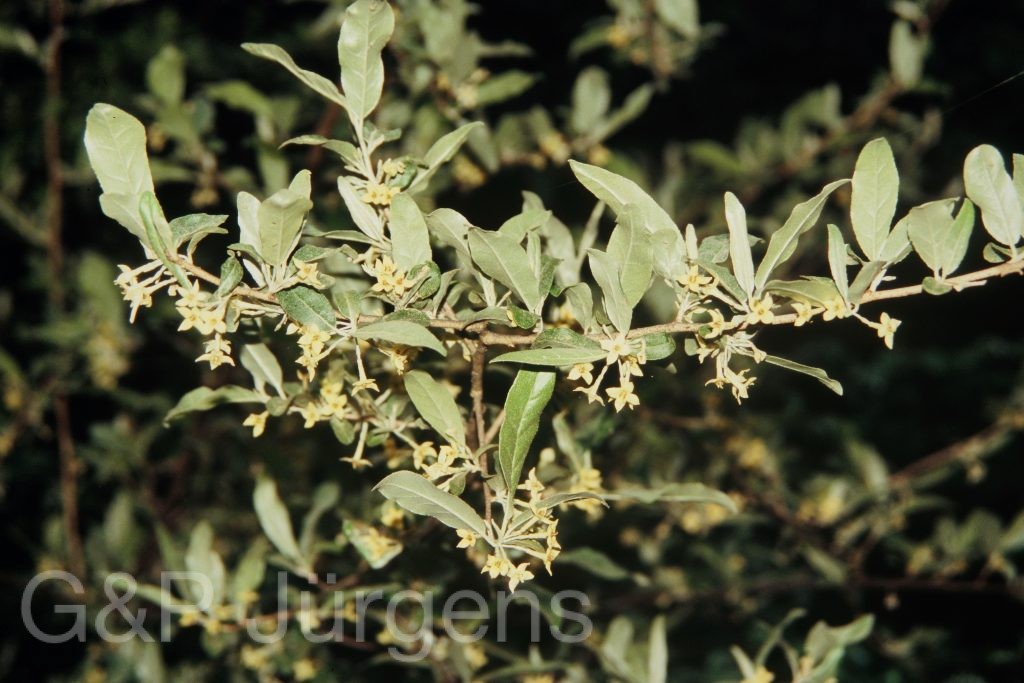
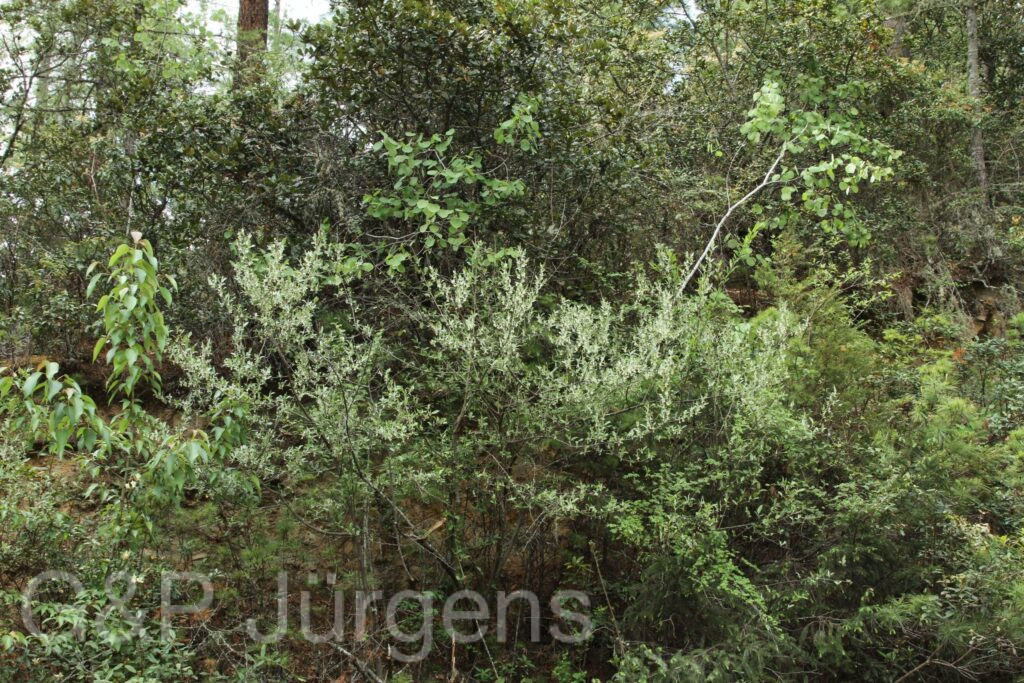
Elaeagnus caudata Schltdl. ex Momiy. is a shrub or small tree of the Elaeagnaceae endemic to the central and eastern Himalaya, known from Nepal, northern India and Bhutan. Documented from only a small number of georeferenced collections, it grows in temperate forest margins, thickets, shrubby slopes and along the edges of cultivation in the mid-montane zone. The photographed plants from the Paro and Thimphu valleys of Bhutan, recorded at 2,400–2,500 m in May and June, are characteristic of its preference for the cool, well-lit temperate belt where it flowers in late spring and early summer.

The plant is densely clothed throughout in the silvery to rusty-brown peltate scales typical of the family, which give the young shoots, leaf undersides and flowers a metallic lustre. The leaves are alternate, elliptic to ovate, often long-acuminate (the caudate apex giving the species its name), green and stellate-scaly above and silvery-lepidote beneath. The flowers are small, tubular and apetalous, with a four-lobed, silvery-scaly perianth, fragrant and borne in axillary clusters. The fruit is an oblong, drupe-like achene enclosed by the fleshy, accrescent perianth tube, ripening reddish and scaly, edible when fully mature.

Like other members of Elaeagnus, the species harbours nitrogen-fixing Frankia actinobacteria in root nodules, enabling it to colonise poor soils and contribute to soil fertility, a trait that makes such shrubs significant in montane succession. Its restricted Himalayan range and the small number of records suggest it is genuinely localised, though the difficulty of distinguishing the many scaly-leaved Himalayan Elaeagnus species means its true distribution may be under-documented and warrants further survey.

Author: Schltdl. · Sources: POWO (Kew), GBIF, Flora of Bhutan Vol. 1, Flora of China Vol. 13, Sun & Lin: Revision of Elaeagnus

nn

Bhutan2014 184
Bhutan Trashyangtse 2150m, May

Description

Elaeagnus umbellata var. umbellata is the typical variety of the autumn olive, a deciduous shrub of the Elaeagnaceae native to eastern and southern Asia, with records (GBIF: c. 1,148 occurrences) from Japan, Korea, China, Nepal and India, and naturalised in parts of Europe and North America. In the Himalaya it occupies forest margins, open slopes, thickets and disturbed ground in the temperate zone, roughly between 1,200 and 3,000 m. The photographed plant from Trashyangtse in eastern Bhutan at about 2,150 m, flowering in May, reflects its spring flowering on sunny montane slopes.

The plant is a spreading shrub up to 3–4 m tall, often armed with short thorny lateral branchlets, and the young shoots, leaf undersides and fruits are densely covered with silvery and rufous peltate scales (lepidote indumentum) characteristic of the family. The leaves are alternate, elliptic to oblong-lanceolate, green above and silvery-scaly beneath, with undulate margins. The flowers are small, fragrant, tubular-campanulate and creamy white to pale yellow, borne in axillary clusters; they are apetalous, the showy part being the four-lobed calyx tube. The fruit is a fleshy, drupe-like achene that ripens red, speckled with silvery scales, and is edible and sweet-acidic.

Like other Elaeagnus species, var. umbellata is an actinorhizal nitrogen-fixer hosting symbiotic Frankia in root nodules, allowing it to thrive on poor soils. This trait, combined with prolific bird-dispersed fruiting, has made it a notorious invasive shrub where introduced, though within its native Himalayan range it is a benign, locally useful component of the flora. The GBIF accepted name is rendered as Elaeagnus umbellata umbellata.

Author: nn · Sources: POWO (Kew), Flora of China Vol. 13, Flora of Bhutan Vol. 2, Flora of Nepal, GBIF, Servettaz: Monographie des Elaeagnacees

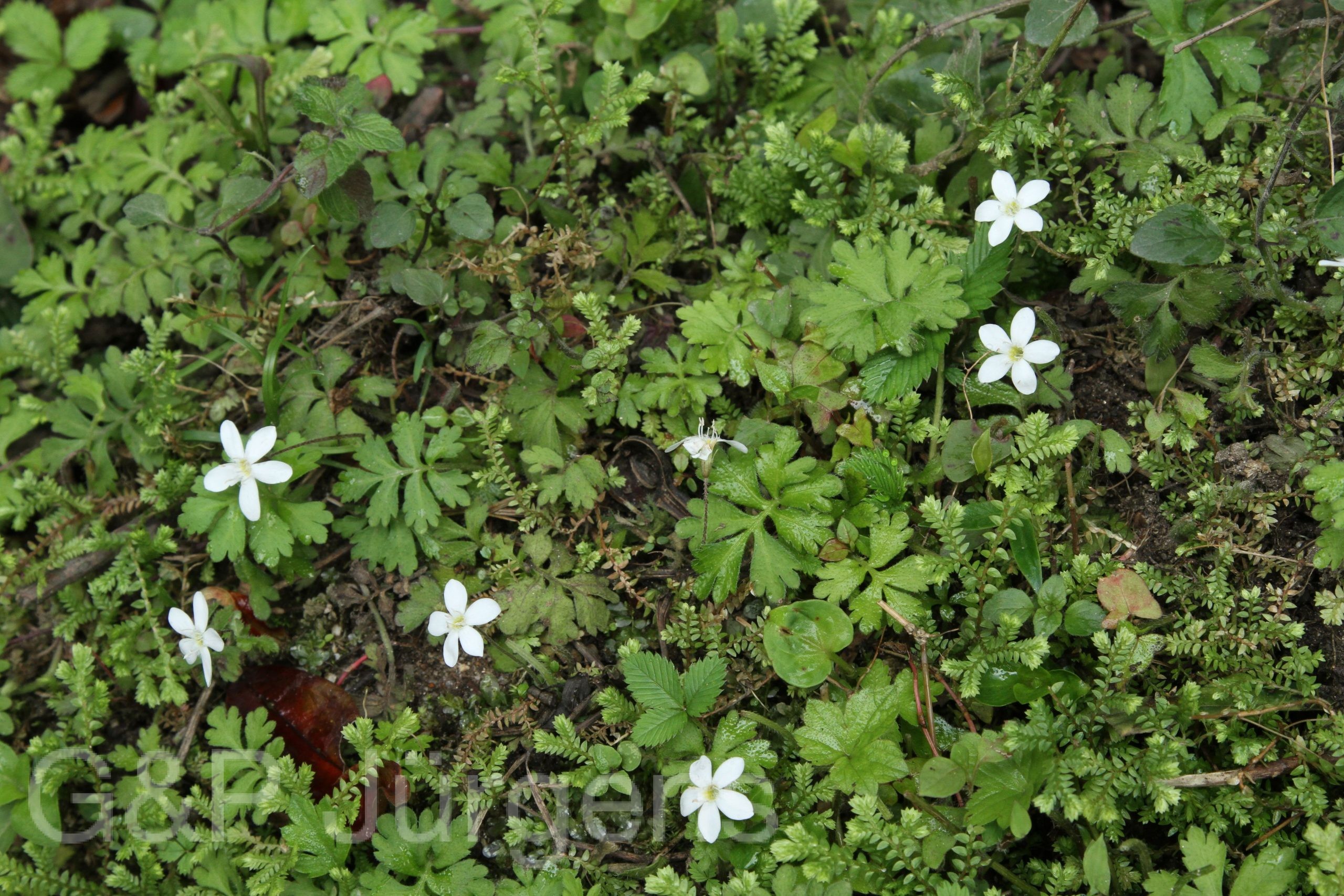
(Wall. ex Benth.) Makino

Description

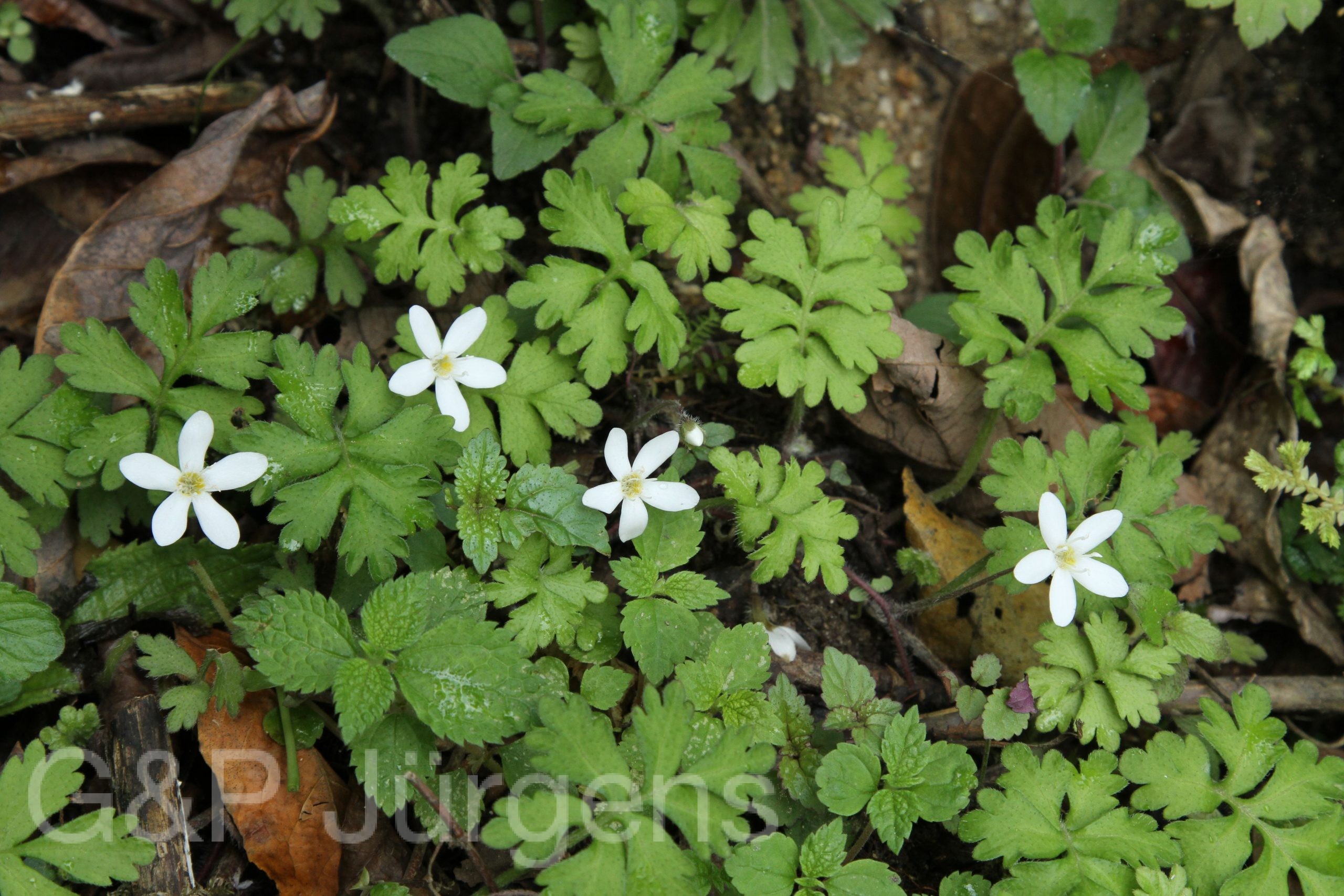
Ellisiophyllum pinnatum is a wide-ranging creeping herb distributed across temperate and montane East and South-East Asia, from the Himalaya through China, Taiwan and Japan to the Philippines, New Guinea and Papua. Its 1616 GBIF records, the highest in this group, confirm a broad native range, with the few European and North American points representing cultivated or herbarium material. It favours moist, shaded ground along streamsides, damp banks, ditches and forest margins, often at lower to middle montane elevations. The plant photographed along the Mo-Chu in Bhutan at about 1500 m in May reflects this preference for cool, humid riparian habitats in the Eastern Himalaya.

It is a slender, softly pubescent perennial that creeps and roots at the nodes, forming loose mats by means of prostrate, filiform stolons. The leaves are alternate, long-petiolate and deeply pinnately lobed to pinnatisect, with rounded, crenate segments. The flowers are solitary on long, slender axillary pedicels; the campanulate calyx has five lobes, and the white, broadly campanulate to rotate corolla is five-lobed, enclosing four didynamous stamens. The fruit is a small capsule enclosed within the accrescent calyx.

Ellisiophyllum is a monotypic genus, E. pinnatum being its sole species, and its placement has long been debated; once referred to the Scrophulariaceae, it is now placed in the Plantaginaceae following molecular phylogenetic studies of the lamiid families. The creeping, stoloniferous, node-rooting habit suits colonisation of unstable, frequently disturbed streambanks. Given its extensive geographic range and ecological adaptability, the species is of no conservation concern.

Author: (Wall. ex Benth.) Makino · Sources: POWO (Kew), GBIF, Flora of Bhutan, Flora of China, Flora of Japan

Rehder

Bhutan2015 463
  Bhutan Jakar 2100m, October
Bhutan2012 104
Bhutan Shele-La, 3600m September
Garw 2005 203 ergebnis ergebnis
India Garhwal Pana 2750m, September
Bhutan2015 607
Bhutan Gasa 1950m, October

Description

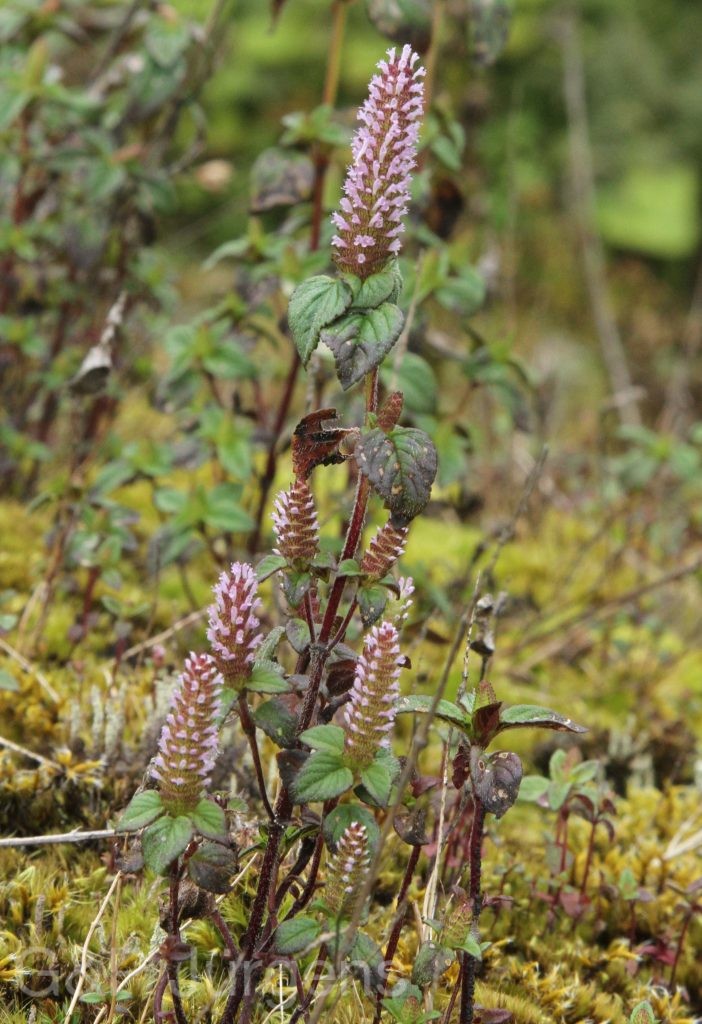
Elsholtzia fruticosa is a widespread shrubby mint of the Himalaya and south-western China, recorded by GBIF (1928 occurrences) from China, Nepal, India, Bhutan, Pakistan, Malaysia and Myanmar. It is a plant of open, disturbed and sunny situations, colonising forest margins, scrub, roadsides, terraced field edges, river banks and clearings, broadly between 1500 and 3600 m. The cited collections span a wide elevational and seasonal range, from Bhutan's Gasa (1950 m) and Jakar (2100 m), through Garhwal in India (Pana, 2750 m), up to the Shele-La pass at 3600 m, flowering from September into October, reflecting its autumn-blooming habit across the central and eastern Himalaya.

The species is an aromatic, much-branched shrub or subshrub reaching 1-3 m, with quadrangular, pubescent stems woody at the base. The opposite leaves are lanceolate to elliptic, serrate, pinnately veined, often greyish-tomentose beneath and dotted with aromatic glands. The small flowers are crowded into dense, cylindrical, spike-like terminal and axillary thyrses, frequently secund, with the whitish to pale-yellow flowers turned to one side of the axis. Each flower has a campanulate calyx and a bilabiate corolla; the four stamens are exserted, giving the inflorescence a feathery aspect. The fruit comprises four small, smooth nutlets (mericarps) enclosed within the persistent calyx.

Described under the combination by Rehder, the species belongs to genus Elsholtzia (subfamily Nepetoideae, tribe Elsholtzieae), a group of aromatic herbs and shrubs centred on temperate Asia. Its essential-oil-rich foliage is used in local traditional medicine and as a minor source of nectar for late-season pollinators. As a vigorous, pioneer-like colonist of disturbed ground with a very broad range, it is of least conservation concern and is locally abundant rather than rare.

Author: Rehder · Sources: POWO (Kew), GBIF, Flora of China, Flora of Bhutan, A Revision of the Genus Elsholtzia (Lamiaceae)

Benth.

Bhutan2012 306
Bhutan Shele-La 4100m, October
Bhutan2012 915
Bhutan Tumching-La 4000m, October

Description

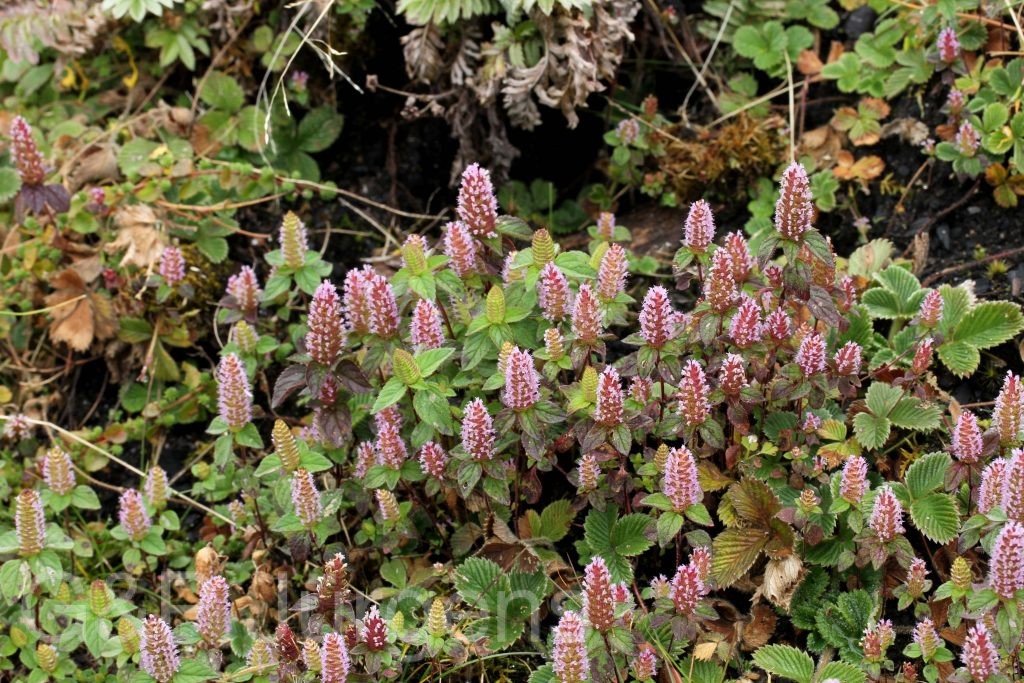
Elsholtzia strobilifera is a high-montane to alpine herb widely distributed across the Sino-Himalayan region, recorded from Nepal, India, Bhutan, Pakistan, Myanmar, China and Taiwan, with some 493 georeferenced occurrences documented in GBIF. It is a plant of open stony slopes, grazed alpine meadows, screes and forest margins, typically between 3000 and 4300 m. The collections illustrated here, from the Bhutanese passes Shele-La at 4100 m and Tumching-La at 4000 m in October, exemplify its characteristic late-season flowering at the upper limits of vegetation, where it often forms part of dwarf-herb communities on disturbed and well-drained substrates.

It is an annual or short-lived herb, usually 5-30 cm tall, with erect or ascending, often purplish, quadrangular stems that are puberulent and frequently branched from the base. The leaves are opposite, ovate to elliptic, shortly petiolate, with crenate-serrate margins and gland-dotted surfaces emitting an aromatic scent when bruised. The inflorescence is a dense, ovoid to shortly cylindrical terminal spike of crowded verticillasters, the conspicuous broad floral bracts giving the cone-like appearance reflected in the epithet. Each tubular, bilabiate corolla is pale violet to pinkish, two-lipped and exserted-stamened; the fruit comprises four smooth, ellipsoid nutlets enclosed in the persistent calyx.

The genus Elsholtzia (Lamiaceae, subfamily Nepetoideae) comprises aromatic herbs and subshrubs centred on eastern Asia, several yielding essential oils. E. strobilifera is among the most cold-tolerant members, ascending higher than most congeners. Its capacity to colonise grazed and physically disturbed alpine ground confers ecological resilience, and it is not regarded as threatened given its broad range and abundance, though high-altitude populations are sensitive to changing grazing regimes and warming treelines.

Author: Benth. · Sources: POWO (Kew), GBIF, Flora of China, Flora of Bhutan, A Revision of the Genus Elsholtzia (Lamiaceae)

(Griff.) C.K.Schneid.

Sikkim2004 377 G654
Sikkim/India Lachung 2900m May
Nepal 1994 259 ergebnis
Ost-Nepal Milka-Danda 2850m May 

Description

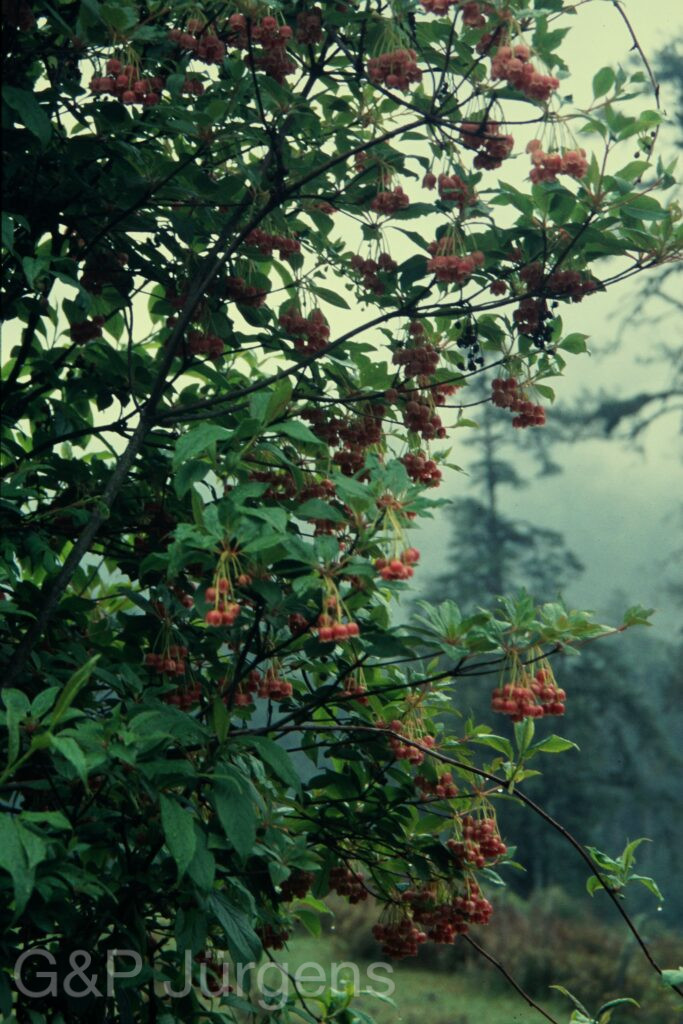
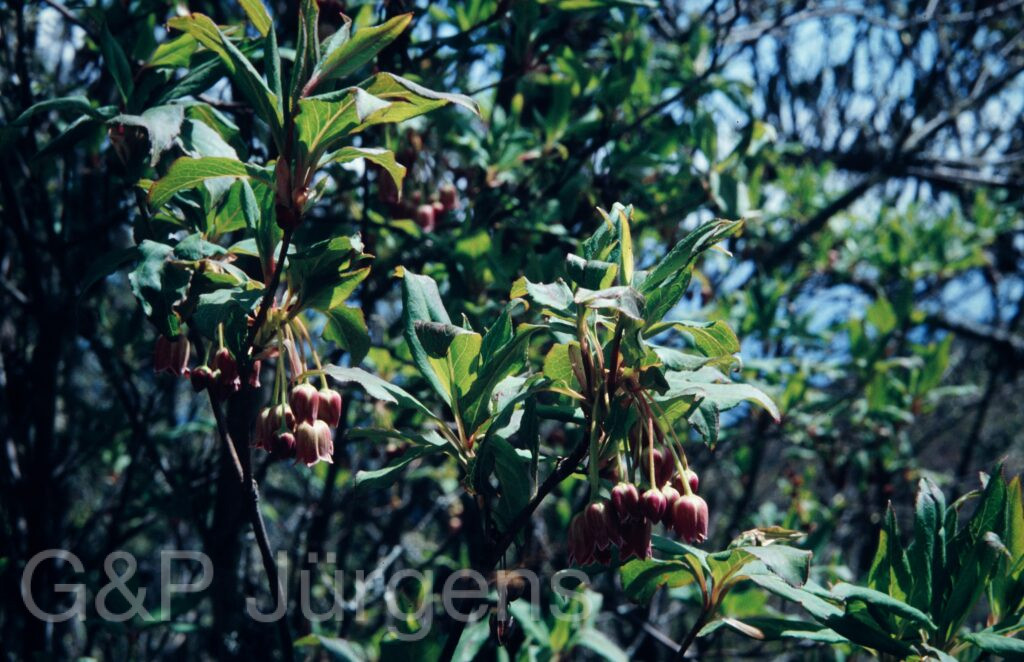
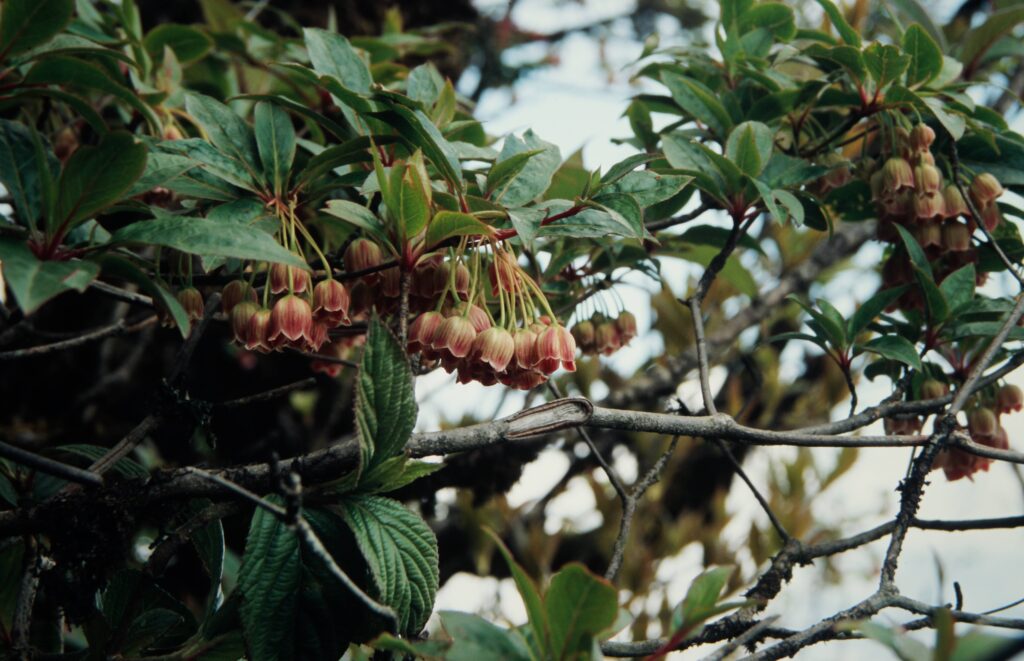
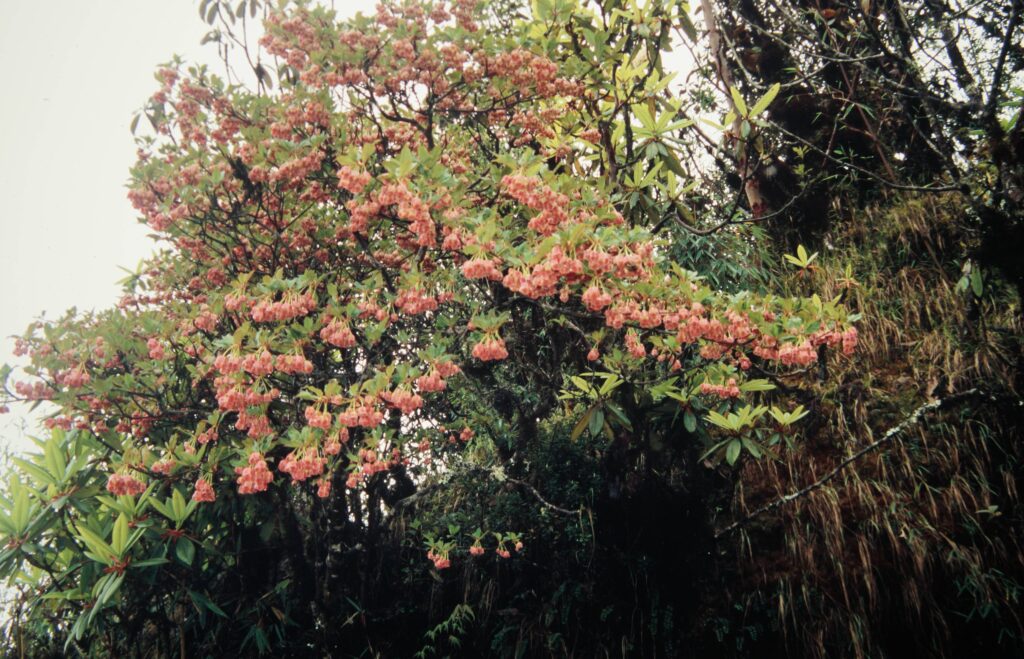
Enkianthus deflexus is a deciduous shrub or small tree of the temperate Himalaya and southwestern China, distributed through China, India, Nepal, Bhutan and Myanmar, and very well documented with around 1667 GBIF records (further records reflect wide cultivation in Europe, North America and East Asia). It forms part of the understorey and forest-margin vegetation of moist temperate forest and Rhododendron-dominated slopes, typically between about 2400 and 3600 m. The cited collections from Lachung in Sikkim (2900 m), Milka Danda in east Nepal (2850 m) and Tonglu in West Bengal (3100 m), all flowering in May, mark its synchronous late-spring anthesis across the cool, humid mid-montane belt.

The species is a many-branched shrub whose leaves cluster toward the ends of the twigs in pseudowhorls; they are obovate to elliptic, finely serrulate, often colouring richly in autumn, and subtended by reddish young growth. The flowers are borne in pendent terminal racemes or umbel-like clusters, each on a slender, often reflexed pedicel (whence deflexus). The corolla is campanulate, creamy to yellowish suffused with red veining, with five short recurved lobes; ten stamens are enclosed within. The fruit is an erect, dehiscent woody capsule on the recurving pedicel, releasing small winged or angled seeds.

Enkianthus is an early-diverging genus of the Ericaceae, sister to much of the rest of the family, and its bell-shaped, nectar-bearing flowers are pollinated by bees and other insects. E. deflexus is valued horticulturally for its dainty blossoms and brilliant autumn foliage, explaining its broad cultivated footprint. Within its native range it is common and not of conservation concern, a characteristic and widespread component of Himalayan temperate forest understoreys.

Author: (Griff.) C.K.Schneid. · Sources: POWO (Kew), GBIF, Flora of Bhutan, Flora of China (Ericaceae), Stevens Revision of Enkianthus

(Grierson & D.G.Long) Panigrahi

Nepal 97 51 P77
Nepal Mewa-Khola 1130m April
Nepal 97 50 P76
Nepal Mewa-Khola 1130m April

Description

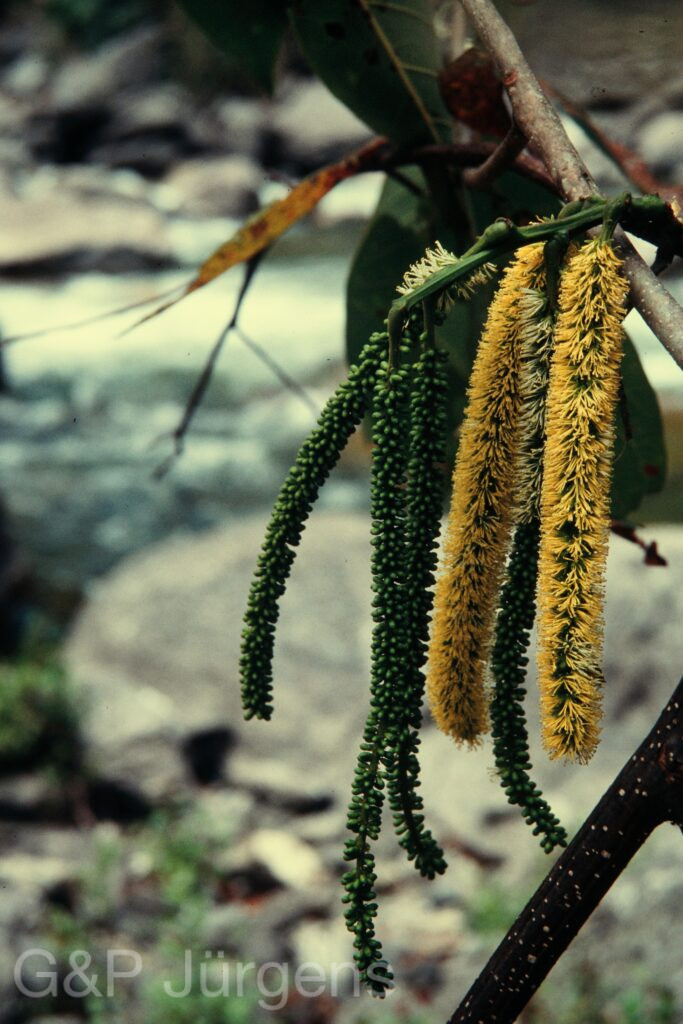
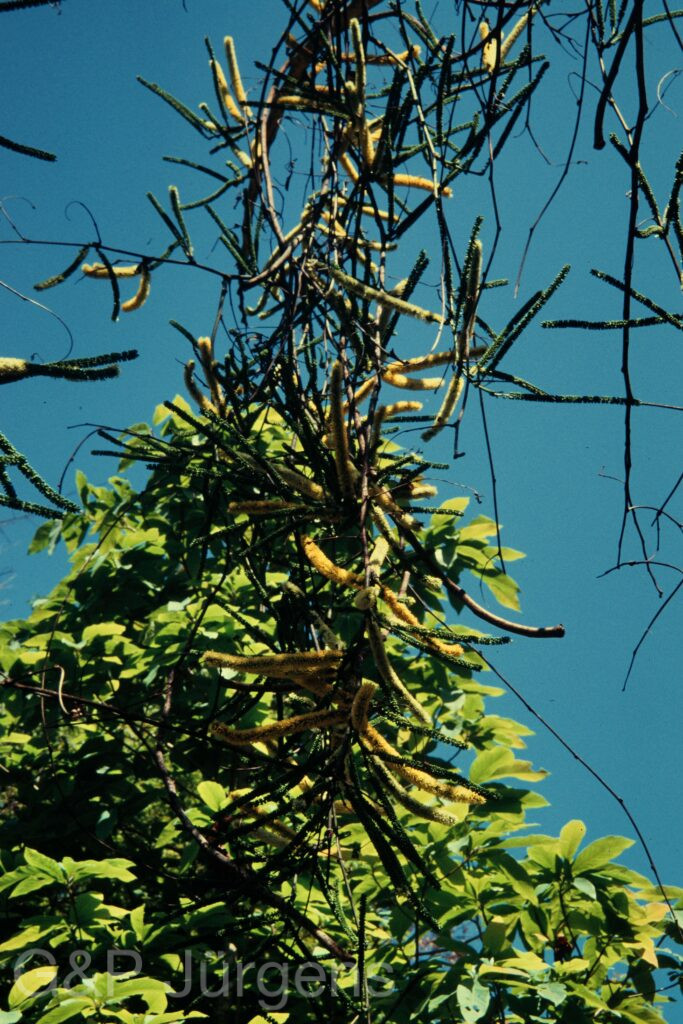
Entada rheedii subsp. sinohimalensis is a Sino-Himalayan liana of warm lower-montane forest, treated by GBIF as a synonym of the accepted Entada rheedii sinohimalensis (under E. rheedii Spreng.). It is a localised eastern Himalayan taxon ranging from Nepal and Sikkim into Bhutan and adjacent China and Myanmar; GBIF holds a single Bangladesh record, underscoring how sparsely this giant climber is documented. It grows in broadleaved subtropical forest and ravine vegetation at low elevations, as in the Mewa Khola of eastern Nepal at 1130 m in April, where it scrambles high into the canopy along humid river valleys.

It is a massive woody liana with stout, twining stems and tendrillate, bipinnate leaves whose pinnae bear several pairs of asymmetric oblong leaflets, the terminal pair of pinnae often modified into a coiling tendril. The flowers are small, sessile and crowded in slender elongate spikes, creamy white to greenish-yellow, with a five-toothed calyx, five free petals and ten exserted stamens giving the inflorescence a feathery aspect. The fruit is among the largest of any legume – a huge, woody, flattened pod up to a metre long that breaks transversely into one-seeded segments, each enclosing a large, hard, glossy brown "sea bean" capable of long-distance hydrochory.

Within the mimosoid clade of Fabaceae, Entada is a pantropical genus of lianas, and subsp. sinohimalensis represents the inland Himalayan-Chinese expression of the widespread E. rheedii. The buoyant, durable seeds are dispersed by water and ocean currents and are used as charms and in folk medicine. The taxon is rarely collected and its conservation status remains unassessed.

Author: (Grierson & D.G.Long) Panigrahi · Sources: POWO (Kew), GBIF, Flora of China, Flora of Bhutan, Annotated Checklist of the Flowering Plants of Nepal, Brenan monograph of Entada

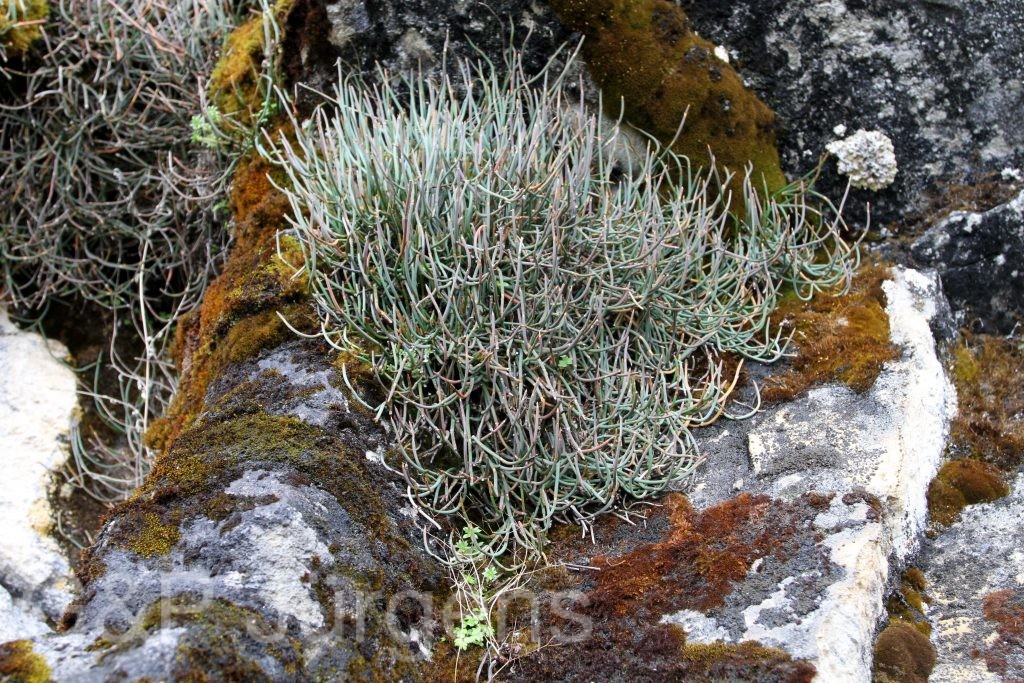
Stapf.

BhutanPG2011 338
Bhutan Jule-Tso 4250m, June
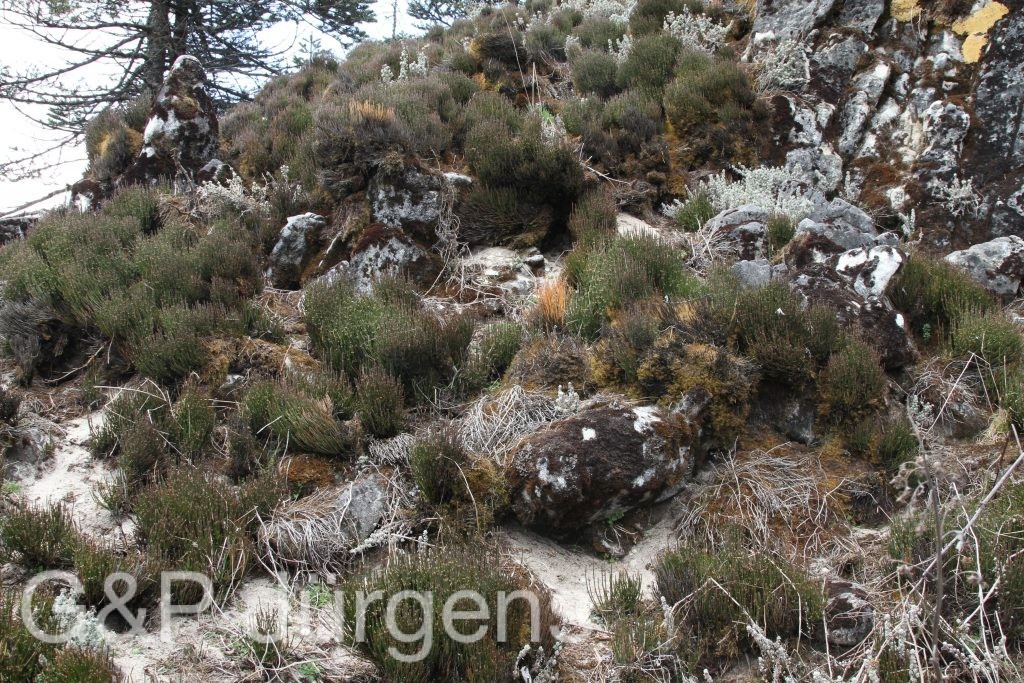
Bhutan2014 937
Bhutan Chele-La 4100m, May
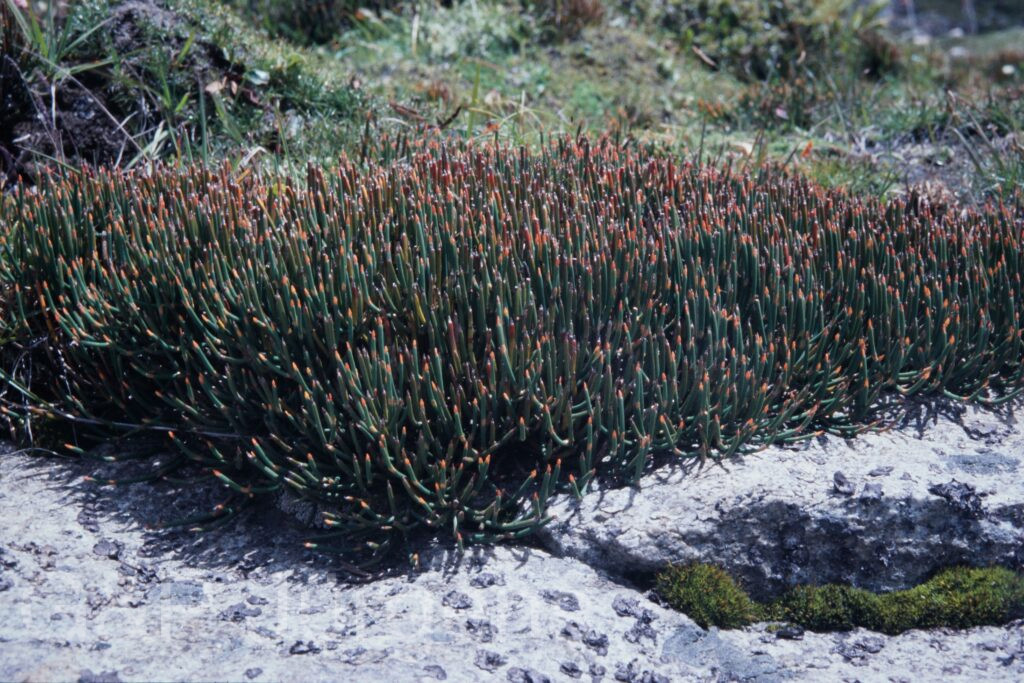
Sikkim2003 522 P727
Sikkim Yume Samdong 4700m August

Description

Ephedra gerardiana var. sikkimensis is a high-alpine gymnosperm shrublet of the Himalaya and Tibetan plateau margins, recorded from China, Bhutan, India and Nepal, with the species complex widely held in cultivation across Europe and North America. It is a plant of dry, exposed, stony alpine slopes, gravel flats, moraine and rocky pasture in the arid trans-Himalayan and high-alpine zone, characteristically between about 3500 and 5000 m. The cited collections from Jule-Tso (4250 m) and Chele-La (4100 m) in Bhutan and Yume Samdong in Sikkim at 4700 m exemplify its occurrence at the very upper limits of vascular plant growth, on wind-swept, well-drained, frost-exposed ground.

The plant is a low, densely tufted, mat-forming or cushion shrublet with slender, jointed, longitudinally grooved green branchlets that perform photosynthesis, the true leaves reduced to small connate scales at the nodes. Like all Ephedra it is dioecious and non-flowering: pollen is borne in small ovoid male strobili, while the female cones, after fertilisation, develop fleshy red, berry-like seed cones enclosing one or two seeds, an adaptation to bird dispersal in an otherwise austere environment.

The epithet sikkimensis denotes the type region in the eastern Himalaya, var. sikkimensis being a high-elevation segregate of the polymorphic E. gerardiana. Members of this genus are notable sources of ephedrine alkaloids and have a long history of medicinal and ritual use. As pioneers of stabilised scree and moraine, these dwarf shrubs are ecologically important in fragile alpine systems; though not currently threatened, harvesting and climate-driven habitat shifts warrant monitoring.

Author: Stapf. · Sources: POWO (Kew), GBIF, Flora of China Vol. 4, Flora of Bhutan Vol. 1, Flora of Nepal, A Monograph of the Genus Ephedra (Stapf)

Hausskn.

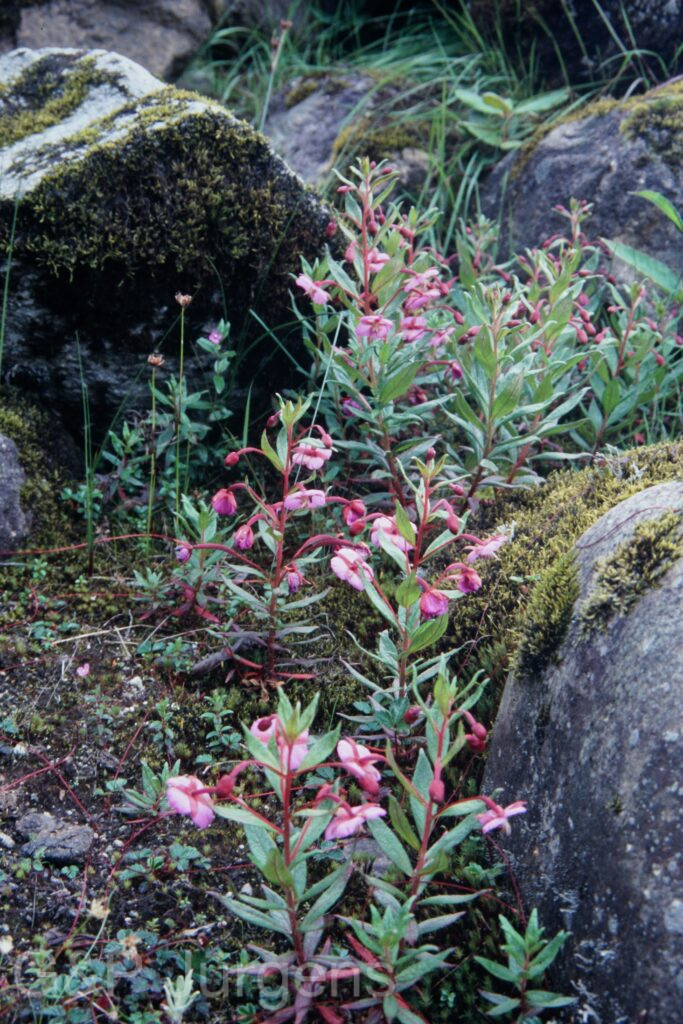
Sikkim2003 213 G297
Sikkim Dzongri 3900m, August

Description

Epilobium conspersum is a perennial herb of the Sino-Himalayan and East Asian mountains, distributed through southwestern China, Nepal, northern India, Myanmar, Bhutan and Japan, with introduced records in the United States; GBIF documents about 134 occurrences. It is a plant of moist, open subalpine and alpine habitats such as stream banks, wet meadows and gravelly flushes, typically between about 3000 and 4200 m. The photographed plant was collected at Dzongri in western Sikkim at around 3900 m in August, on the cool, wet ground this willowherb favours during the monsoon. In GBIF the name carries the status SYNONYM, while Epilobium conspersum is here recognised as the accepted name for this Himalayan material.

The plant produces erect to ascending stems from a perennating base that overwinters by leafy rosettes or short turions. The leaves are opposite below and alternate above, sessile or shortly petiolate, lanceolate to ovate, with a toothed margin, the stems often finely hairy in lines. The flowers are borne in the upper leaf axils; as in the genus they have an inferior, elongate ovary, four notched pink to rose-purple petals, four sepals and eight stamens. The fruit is a long, slender, four-valved capsule that splits to release numerous seeds, each bearing a silky coma for wind dispersal.

Epilobium (Onagraceae) is a large temperate and cold-region genus in which the comose seeds and elongate capsular fruit are diagnostic. The Himalayan species form a taxonomically intricate group, and the synonymy reflected in the GBIF status underscores their nomenclatural complexity. Widespread along its moist alpine corridor, the species is not considered threatened.

Author: Hausskn. · Sources: POWO (Kew), GBIF, Flora of China Vol. 13, Flora of Bhutan Vol. 2, Flora of Nepal, Flora of Pakistan, Raven monograph of Old World Epilobium