
nn

Description
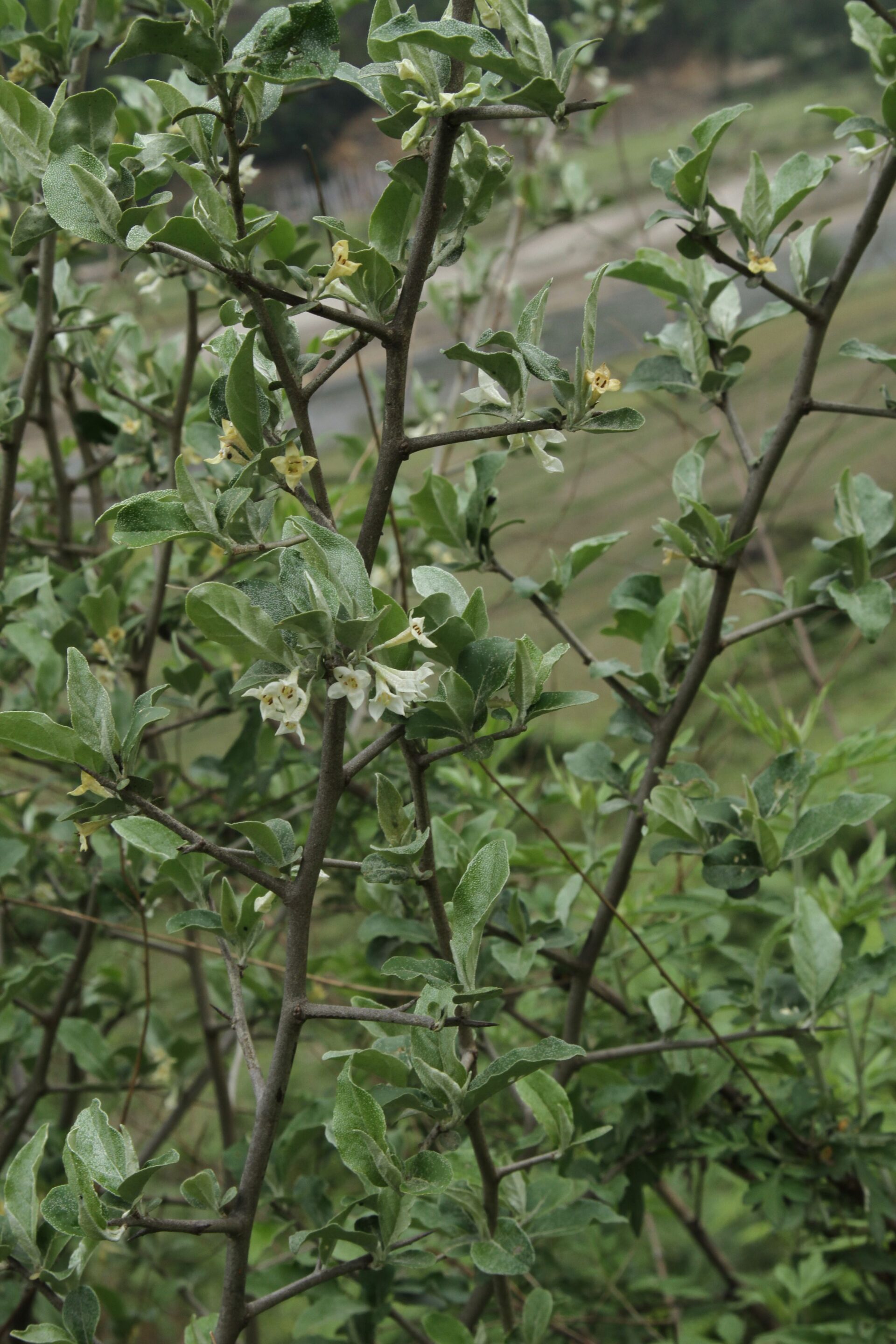
Elaeagnus umbellata var. umbellata is the typical variety of the autumn olive, a deciduous shrub of the Elaeagnaceae native to eastern and southern Asia, with records (GBIF: c. 1,148 occurrences) from Japan, Korea, China, Nepal and India, and naturalised in parts of Europe and North America. In the Himalaya it occupies forest margins, open slopes, thickets and disturbed ground in the temperate zone, roughly between 1,200 and 3,000 m. The photographed plant from Trashyangtse in eastern Bhutan at about 2,150 m, flowering in May, reflects its spring flowering on sunny montane slopes.
The plant is a spreading shrub up to 3–4 m tall, often armed with short thorny lateral branchlets, and the young shoots, leaf undersides and fruits are densely covered with silvery and rufous peltate scales (lepidote indumentum) characteristic of the family. The leaves are alternate, elliptic to oblong-lanceolate, green above and silvery-scaly beneath, with undulate margins. The flowers are small, fragrant, tubular-campanulate and creamy white to pale yellow, borne in axillary clusters; they are apetalous, the showy part being the four-lobed calyx tube. The fruit is a fleshy, drupe-like achene that ripens red, speckled with silvery scales, and is edible and sweet-acidic.
Like other Elaeagnus species, var. umbellata is an actinorhizal nitrogen-fixer hosting symbiotic Frankia in root nodules, allowing it to thrive on poor soils. This trait, combined with prolific bird-dispersed fruiting, has made it a notorious invasive shrub where introduced, though within its native Himalayan range it is a benign, locally useful component of the flora. The GBIF accepted name is rendered as Elaeagnus umbellata umbellata.
Author: nn · Sources: POWO (Kew), Flora of China Vol. 13, Flora of Bhutan Vol. 2, Flora of Nepal, GBIF, Servettaz: Monographie des Elaeagnacees