Author

GP Jürgens

A. Berger

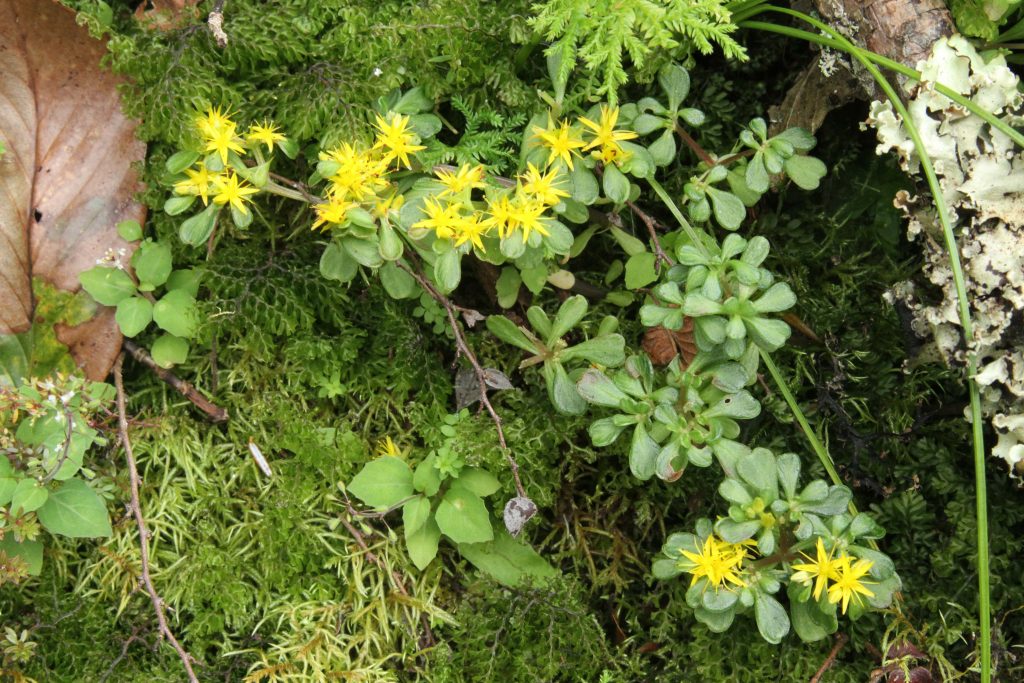
Bhutan2012 328
Bhutan Dochu-La 3200m, September
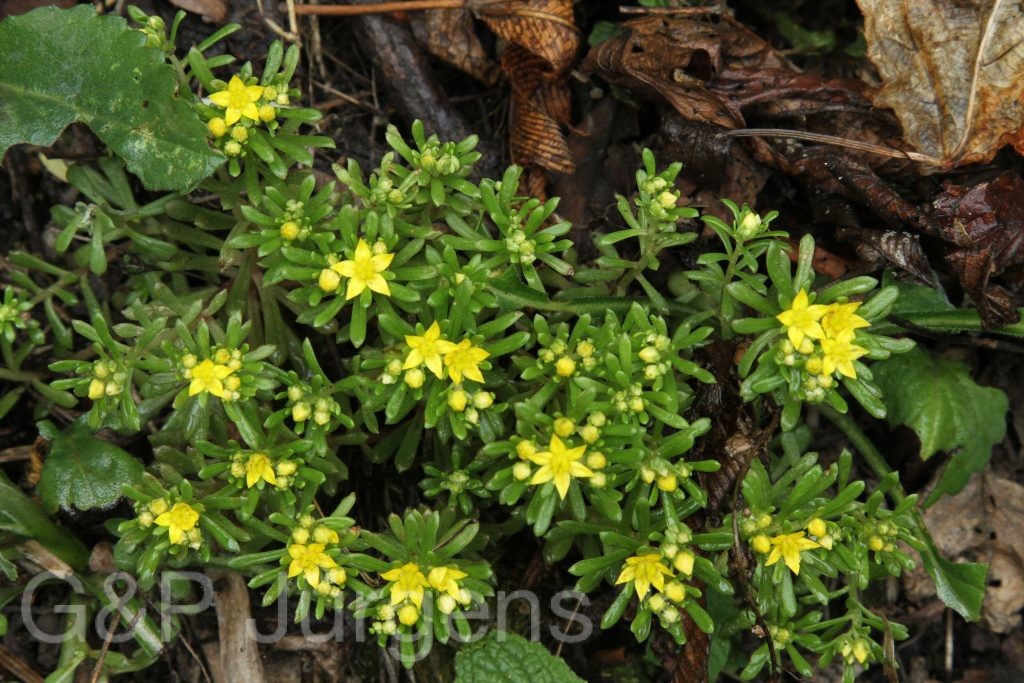
Bhutan2014 35
Bhutan Trashigang 1570m, May

Description

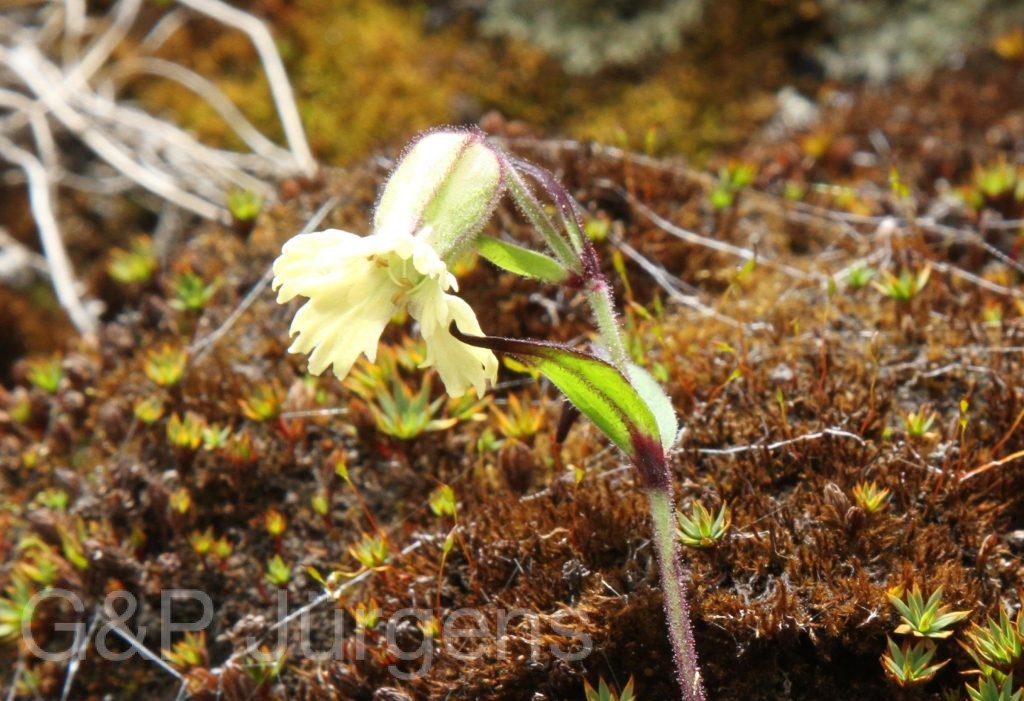
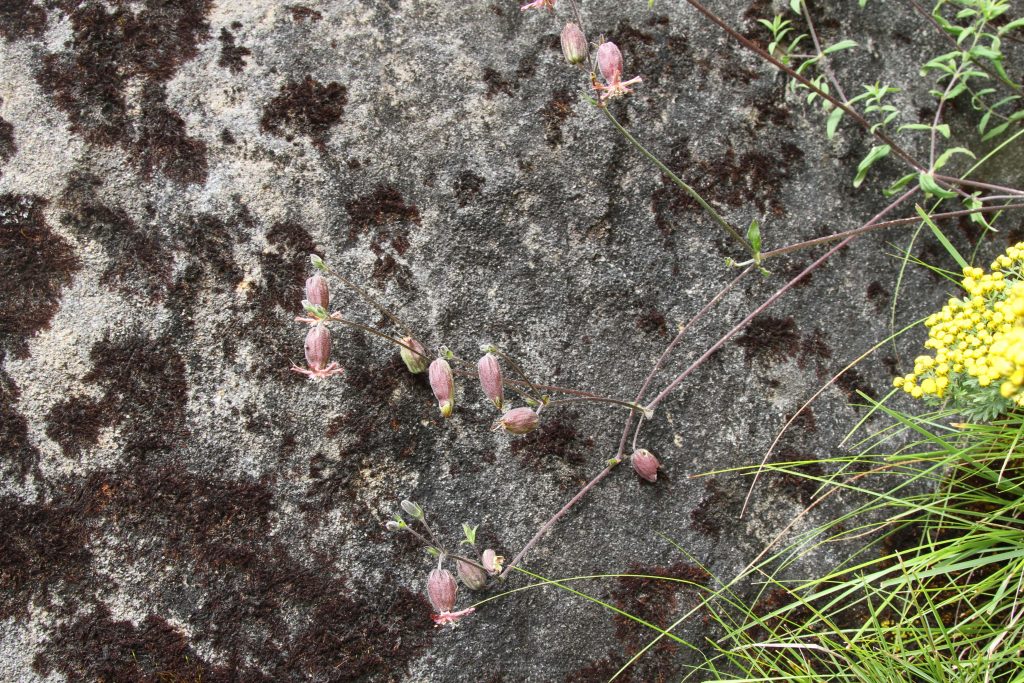
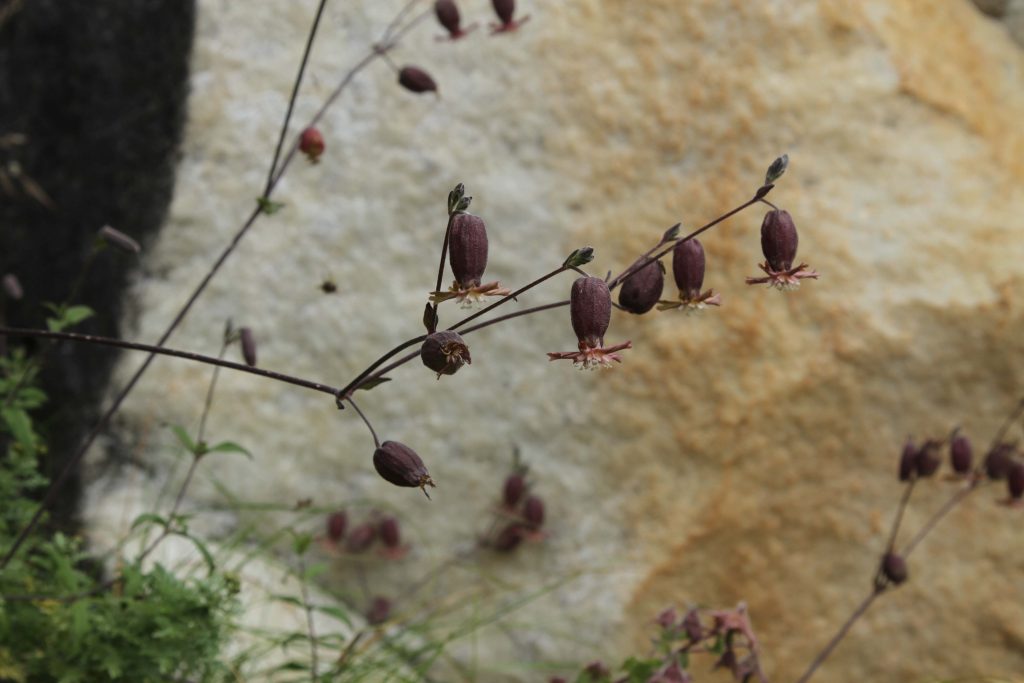
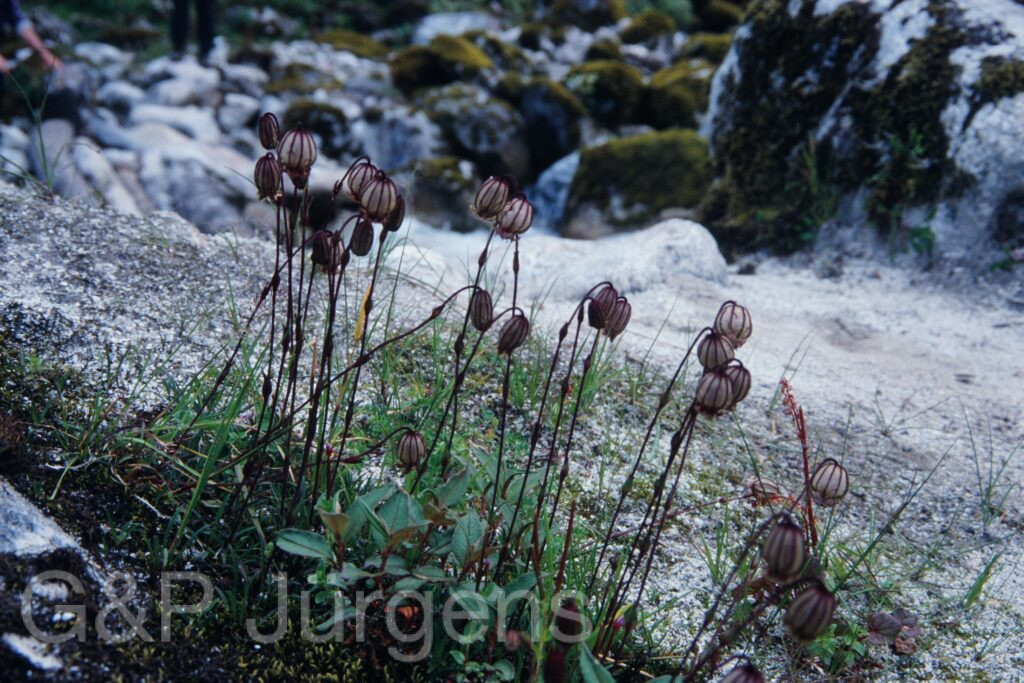
Sedum triactina is a succulent herb of the eastern Himalaya and Sino-Himalayan region, recorded from China, Nepal, India and Bhutan; its c. 329 georeferenced records span a wide temperate to subalpine altitudinal range. It grows on damp rocks, mossy banks, cliff ledges, stream margins and forest floor, generally between 1500 and 3500 m. The two Bhutanese localities documented in the image, Dochu-La at 3200 m in September and Trashigang at 1570 m in May, illustrate the species' broad ecological tolerance, occurring both in cool subalpine forest passes and warmer mid-elevation valleys.

It is a small, fleshy perennial herb with slender, often decumbent to ascending stems rising from a delicate creeping base, sometimes rooting at the nodes. The leaves are succulent, alternate, oblong to spathulate, entire and rather flat, glabrous and somewhat glaucous. The inflorescence is a lax, few-flowered terminal cyme. The flowers are typically pentamerous (the epithet "triactina" alluding to a three-rayed or three-parted character in some flowers), with narrow, spreading, pale yellow to greenish-yellow or whitish petals, ten stamens, and free or basally connate carpels. The fruit comprises several spreading, many-seeded follicles releasing minute seeds.

Described by A. Berger, S. triactina belongs to the large genus Sedum of the stonecrop family Crassulaceae, a group employing CAM photosynthesis as an adaptation to the desiccating conditions of rock and cliff microhabitats. Its small flowers are visited by generalist insects, and vegetative fragmentation supplements seed reproduction. The species is widespread and locally common across its montane range, with no recognised conservation concern, persisting readily on disturbed rocky and roadside substrates.

Author: A. Berger · Sources: POWO (Kew), GBIF, Flora of Bhutan, Flora of China, Flora of Nepal, 't Hart & Bleij's account of Sedum (Crassulaceae)
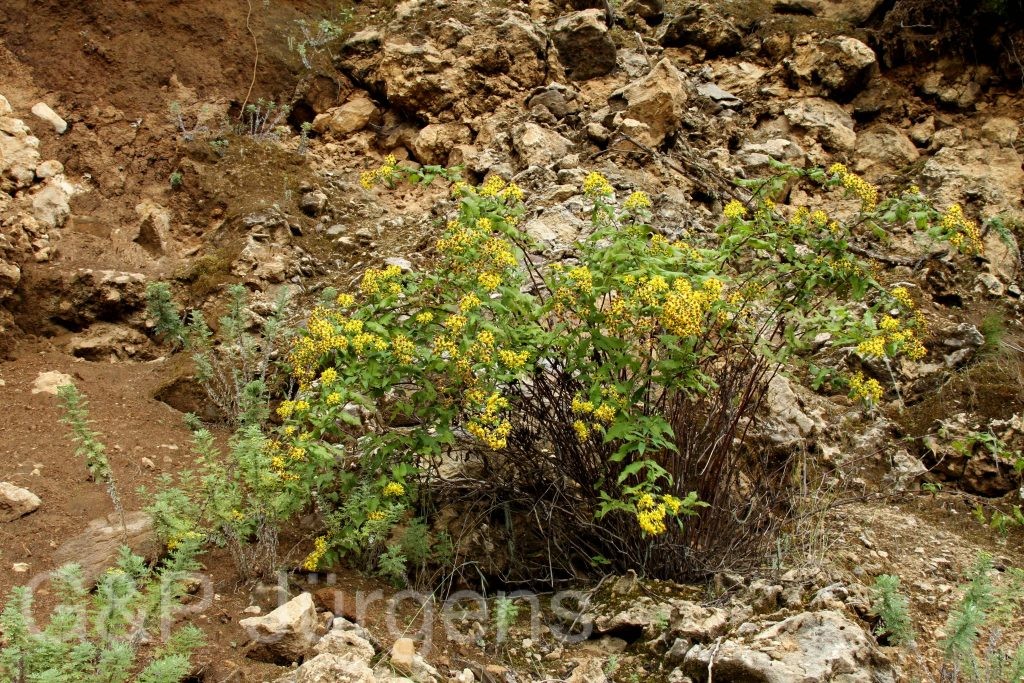
Senecio scandens

by GP Jürgens

Buch.-Ham. ex D.Don

Bhutan2012 109
Bhutan Chogcham 2900m, June

Description

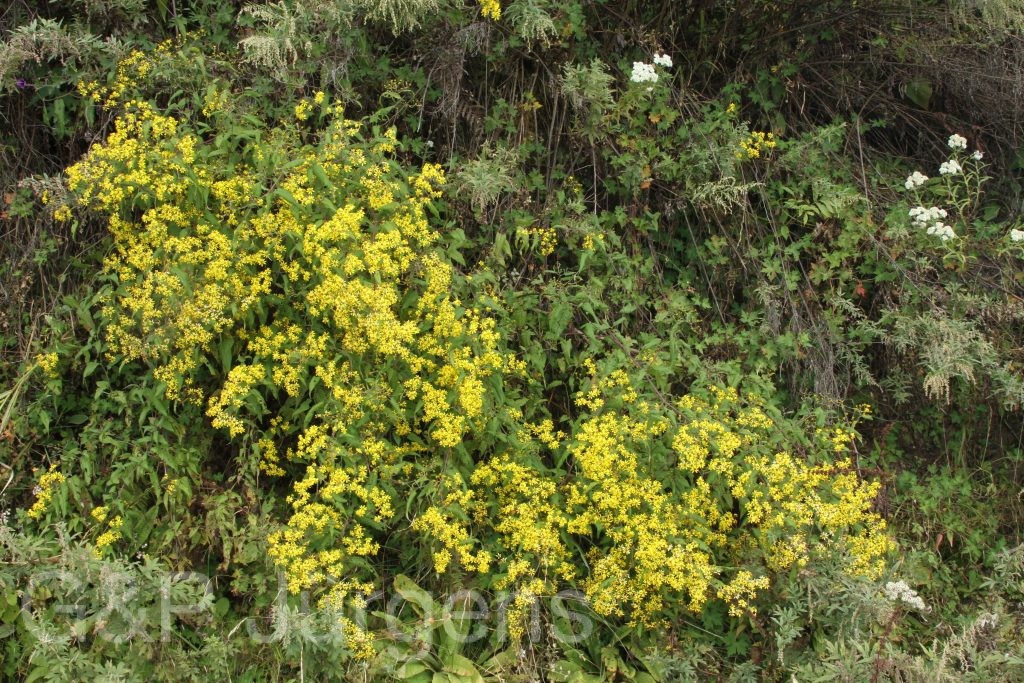
Senecio scandens, the climbing groundsel, is a widely distributed scrambling composite of South, East and Southeast Asia, with 5,659 GBIF occurrences across China, Taiwan, Japan, India, Nepal, Bhutan, Myanmar, Vietnam, Korea, Sri Lanka, Thailand and the Philippines, plus scattered records as an introduction elsewhere. It grows in forest margins, thickets, hedgerows, ravines and disturbed slopes over a very broad altitudinal range from the foothills to over 3000 m. The plant pictured was recorded at Chogcham in Bhutan at 2900 m in June, an upper-temperate setting where this vigorous scrambler clambers over shrubs and forms tangled masses.

It is a perennial herb or subshrub with elongate, climbing or trailing, much-branched stems that can reach several metres. The leaves are alternate, ovate-lanceolate to triangular, often hastate or with a few basal lobes or teeth, acuminate at the apex and shortly petiolate. The numerous yellow capitula are arranged in broad terminal and axillary corymbose panicles; each radiate head has about eight to ten short ray florets around a yellow disc, subtended by a calyculate involucre of narrow phyllaries with conspicuous outer bracteoles. The cypselae are cylindrical and ribbed, bearing a copious white pappus of fine capillary bristles that aids wind dispersal.

Described by Buchanan-Hamilton ex D. Don, the species belongs to the large, cosmopolitan genus Senecio (tribe Senecioneae). Like many of its relatives it contains pyrrolizidine alkaloids and is used in traditional Asian herbal medicine, particularly in Chinese pharmacopoeia. Abundant, fast-growing and tolerant of disturbance, it is in no way threatened and can behave weedily where introduced.

Author: Buch.-Ham. ex D.Don · Sources: POWO (Kew), GBIF, Flora of Bhutan, Flora of China, Senecioneae of the World (Nordenstam), Flowers of the Himalaya (Polunin & Stainton)

Franch.

Bhutan2015 327
Bhutan, Trongsa 3100m, October

Description

Senecio scandens var. incisus is a regional variant of the widespread climbing groundsel, recorded from China, Taiwan, Hong Kong and Nepal, with 338 georeferenced occurrences across the type species' range; the variety is part of an East Asian to Himalayan complex. It grows in moist montane forest margins, thickets, scrub and along streamsides and clearings, scrambling over shrubs and rocks, generally in the temperate zone. It was photographed near Trongsa, Bhutan, at 3100 m in October, flowering in the cool post-monsoon season when its golden heads brighten forest edges and disturbed slopes.

It is a scrambling or climbing perennial herb with long, slender, ribbed and often woody-based stems reaching several metres through surrounding vegetation. The alternate leaves are ovate to triangular-lanceolate, in var. incisus more deeply and irregularly incised or lobed than in the typical form, with toothed margins, an acuminate apex and frequently a pair of small basal lobes. The numerous radiate flower heads are arranged in broad terminal and axillary corymbose panicles; each head has bright yellow ray and disc florets subtended by a uniseriate involucre of green phyllaries with small outer calyculate bracts. The fruit is a cylindrical cypsela bearing a white pappus of fine bristles.

The species belongs to Senecio s.str. in tribe Senecioneae, one of the largest genera of flowering plants; the scandent climbing habit is unusual within an otherwise herbaceous genus. The variety incisus, described by Franchet, is distinguished by its more dissected leaves and treated as part of the variable S. scandens aggregate. Like the type, it contains pyrrolizidine alkaloids and is used in traditional Chinese medicine. It is common and not of conservation concern.

Author: Franch. · Sources: POWO (Kew), GBIF, Flora of China, Flora of Bhutan, Senecioneae of the World (Nordenstam & Pelser studies)

Senna alata

by GP Jürgens

(L.) Roxb.

Bhutan2012 728
Bhutan Galephu 380m, September

Description

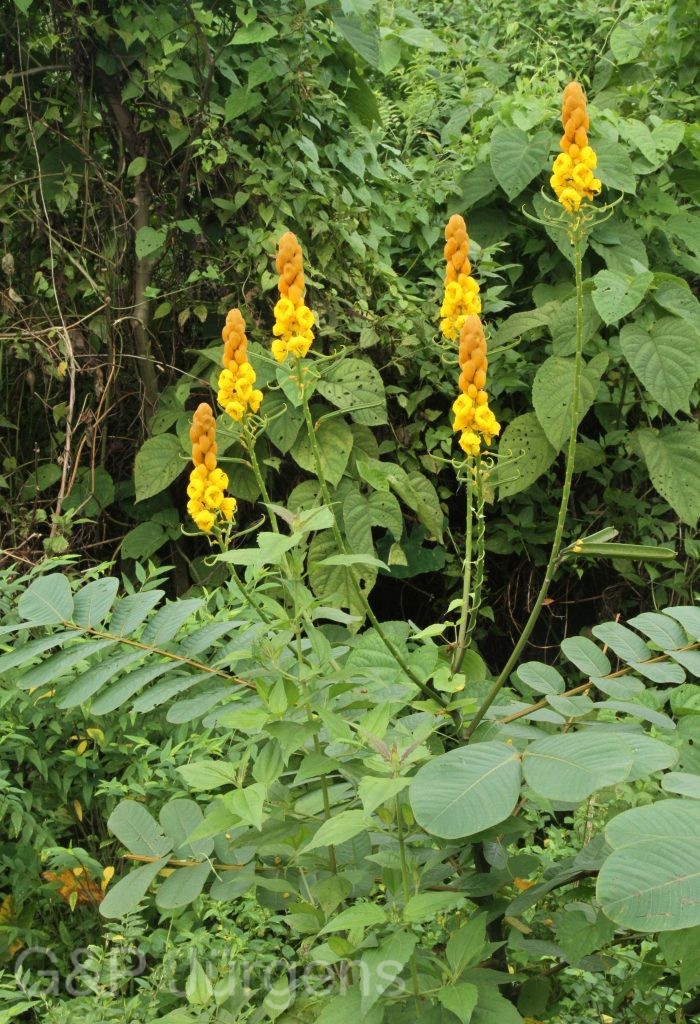
Senna alata, the candle bush or ringworm shrub, is a pantropical species of probable Neotropical origin, now widely naturalised throughout the tropics; GBIF records (12391 occurrences) span Brazil, the United States, Mexico, India, Australia, Indonesia, Taiwan, the Philippines, West Africa and much of Southeast Asia. It thrives in warm, humid lowland habitats, occupying riverbanks, ditches, waste ground, field margins and other disturbed, moist sites, generally below about 1000 m. The photographed plant from Galephu in southern Bhutan at only 380 m, flowering in September, marks its presence in the hot, subtropical Himalayan foothills where it occurs as an introduced or cultivated ornamental and medicinal plant.

The species is a robust, fast-growing shrub or small tree reaching 2-4 m, with stout, sparsely branched stems. The large pinnate leaves bear 6-14 pairs of oblong leaflets that are rounded at the apex, the rachis often narrowly winged. The inflorescence is a dense, erect, candle-like terminal raceme of bright golden-yellow flowers, each enclosed in bud by an orange bract that falls at anthesis. The flowers have five subequal petals and fertile and reduced stamens characteristic of Senna. The distinctive fruit is a straight, oblong, four-winged (alate) pod, dehiscing to release numerous flattened seeds, the wings giving the species its epithet.

Described by Linnaeus and transferred by Roxburgh, the species belongs to genus Senna (Fabaceae, subfamily Caesalpinioideae), segregated from the broad old concept of Cassia. It is renowned in ethnomedicine, its anthraquinone-rich leaves used as a topical antifungal treatment for ringworm and other skin conditions. While valued horticulturally and medicinally, its vigour and prolific seed make it a potential weed of disturbed tropical land. It is of least conservation concern given its enormous, partly anthropogenic range.

Author: (L.) Roxb. · Sources: POWO (Kew), GBIF, Flora of China, Flora of Bhutan, Cassiinae: A Synoptic Revision of Senna (Irwin & Barneby)

C.F.Gaertn.

Nepal 97 35 P54
Nepal Dhoban 800m April
Nepal 97 37 P56
Nepal Dhoban 800m April
Nepal 1994 33 ergebnis
Ost-Nepal Simbhuwa Kola 
1000m April

Description

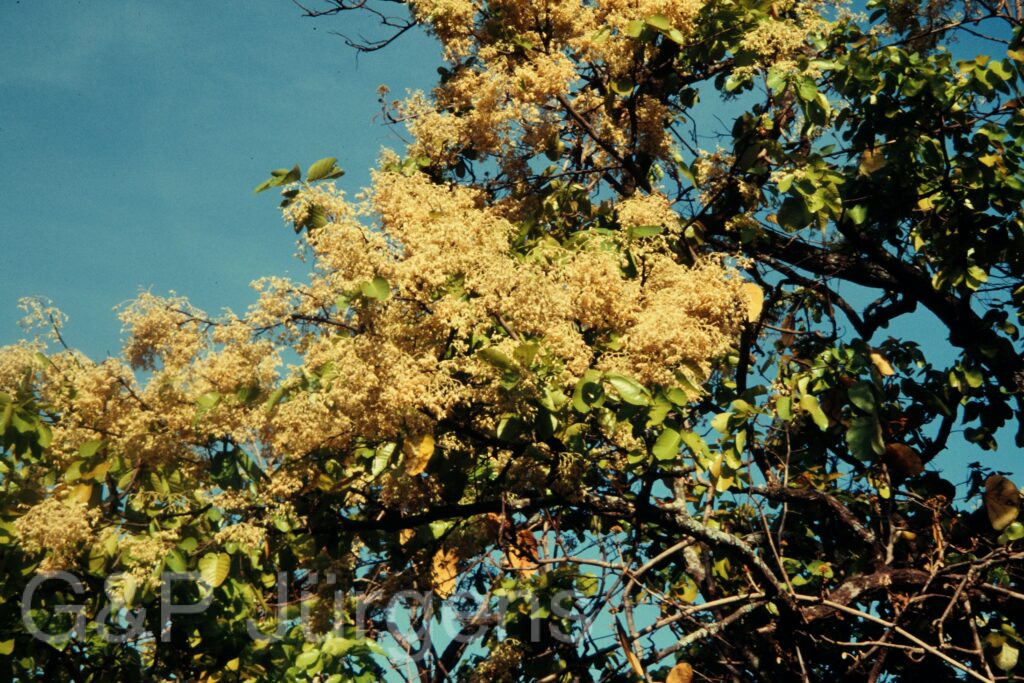
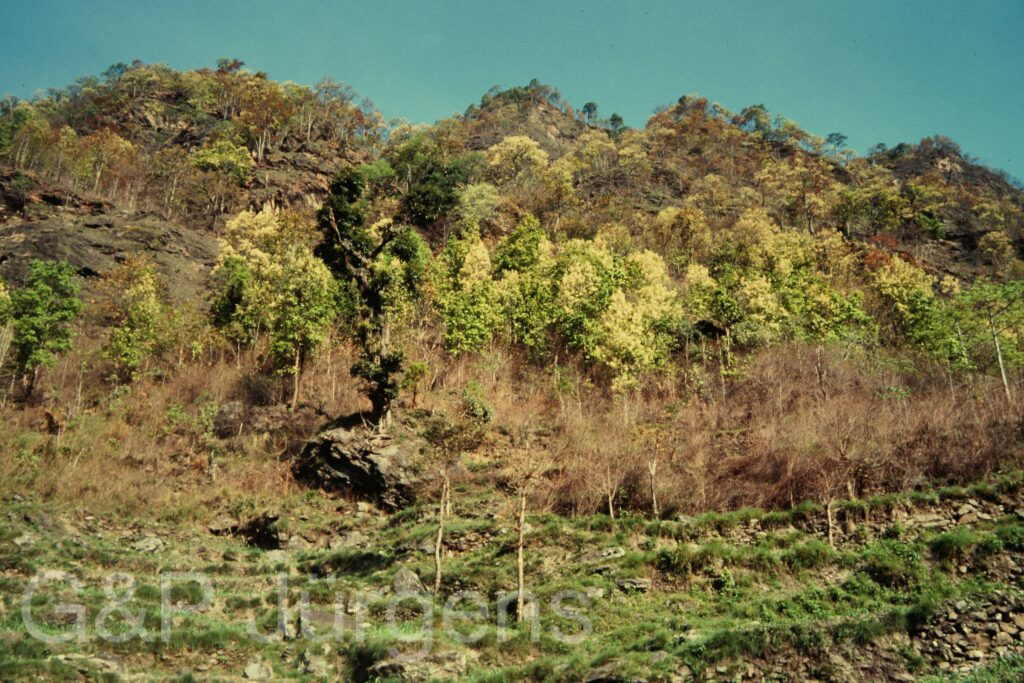
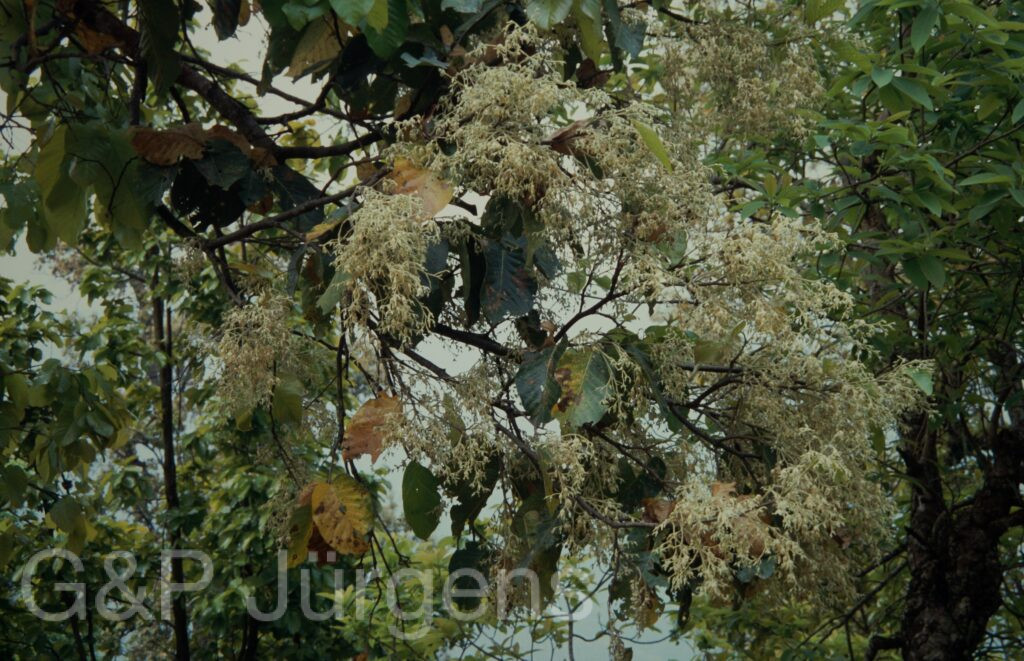
Shorea robusta, the sal tree, is a large, often gregarious dipterocarp dominating extensive lowland and submontane forests of the Indian subcontinent, documented by GBIF (596 occurrences) from India, Nepal, Bangladesh, Bhutan and adjacent regions. It forms the characteristic sal forest of the outer Himalayan foothills, terai and plains, on deep, well-drained alluvial and lateritic soils, typically below about 1200 m. The gatherings from Dhoban at 800 m and the Simbhuwa Kola in East Nepal at 1000 m, both in April, capture its phenology in the foothill belt, where it flushes new leaves and flowers in the hot pre-monsoon season.

The tree is large and may exceed 30 m, with a straight bole, thick longitudinally fissured bark and a dense, spreading crown; in moist sites it is nearly evergreen, briefly leaf-exchanging in the dry season. The leaves are simple, alternate, ovate-oblong, glabrous, shining and acuminate. The fragrant, pale yellow flowers are borne in axillary and terminal panicles, each with five sepals, five petals and numerous stamens. The fruit is a single-seeded nut crowned by the persistent, accrescent calyx, three lobes of which enlarge into elongate, wing-like sepals that aid wind dispersal.

A keystone of the Dipterocarpaceae in South Asia, sal is renowned for its durable timber, its dammar resin and its periodic mast-flowering, in which whole stands fruit synchronously. Ecologically it is a strong dominant forming nearly monospecific canopies and supporting a distinctive forest fauna and flora. Although heavily exploited and locally reduced by clearance, the species remains widespread and is not globally threatened, while being central to forestry and conservation in the region.

Author: C.F.Gaertn. · Sources: POWO (Kew), GBIF, Flora of Bhutan Vol. 1, Flora of Nepal, Flora of Pakistan, Ashton Dipterocarpaceae monograph (Flora Malesiana)

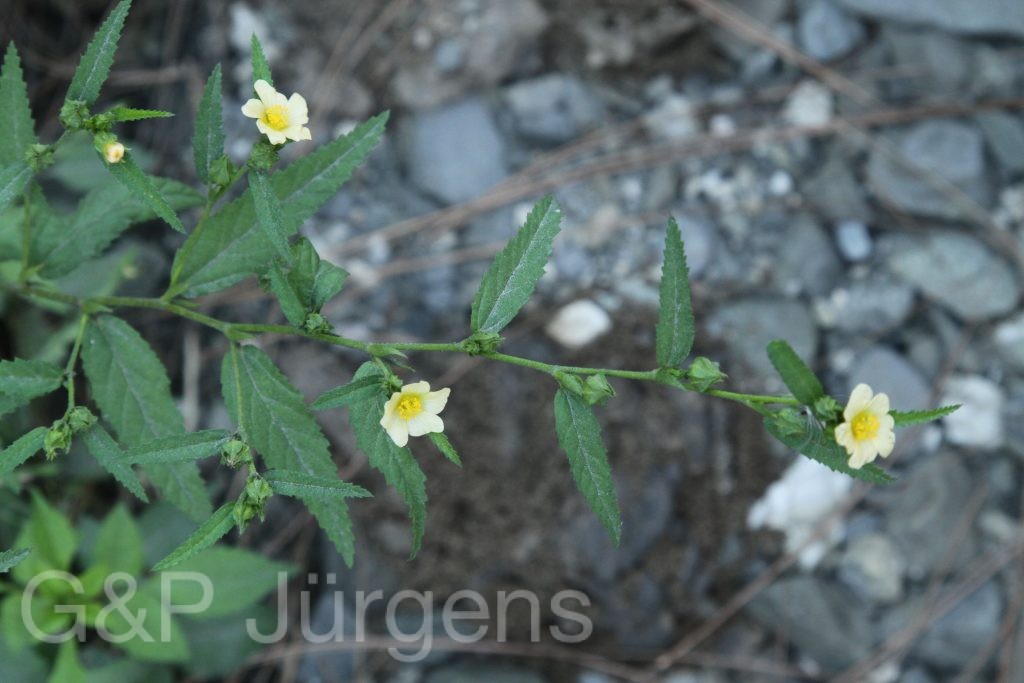
Sida acuta

by GP Jürgens

Burm.f.

Bhutan2015 66
Bhutan Wangdi Phodrang 1800m, October

Description

Sida acuta Burm.f. is a pantropical subshrub of the mallow family, one of the most widespread weeds in warm regions, documented by GBIF in over 23,000 occurrences spanning the Americas (Colombia, Mexico, Brazil, Argentina, Venezuela, El Salvador, USA), Africa (Ghana, Cameroon, Nigeria, Benin, Burkina Faso, DR Congo), Asia (India, China, Taiwan, Indonesia) and Australia. It thrives in disturbed ground, roadsides, pastures, fallow fields and waste places from sea level into the subtropical foothills, and was photographed in Bhutan at Wangdi Phodrang at 1800 m in October, near the upper margin of its altitudinal range.

The plant is an erect, much-branched perennial subshrub woody at the base, with tough fibrous stems. The leaves are alternate, narrowly lanceolate to oblong, with a sharply serrate margin and acute apex, and short stipules at the base of the petiole. The flowers are solitary or few in the leaf axils, with a five-lobed calyx and a corolla of five pale yellow to cream petals that open briefly in the morning; the stamens are united into a characteristic staminal column typical of Malvaceae. The schizocarpic fruit splits into several mericarps, each tipped with two short awns aiding epizoochorous dispersal.

Sida acuta is a notorious invasive and agricultural weed, forming dense stands that suppress pasture and crops, and is the target of biological control programmes in northern Australia. Despite its weedy status it yields a strong bast fibre and is used in traditional medicine across its range. Probably of neotropical origin, it has become naturalised throughout the tropics through human activity, and its tolerance of poor soils and disturbance ensures its continued spread.

Author: Burm.f. · Sources: POWO (Kew), GBIF, Flora of Bhutan, Flora of China, Sida revision (Fryxell, Malvaceae of the World)

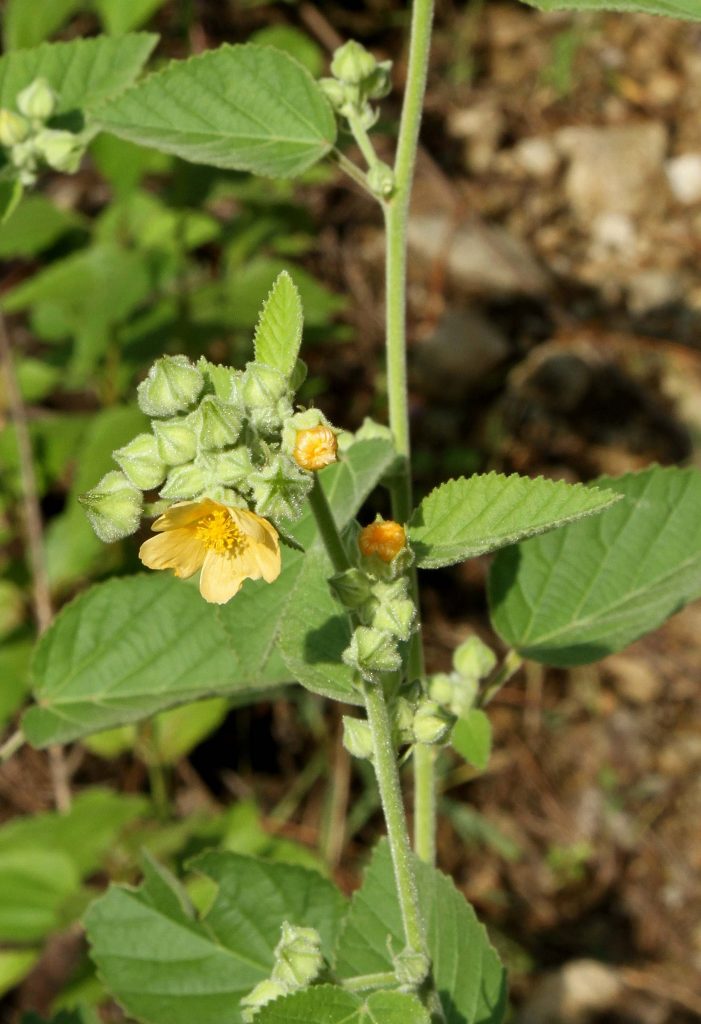
Herb.Madr. ex Wight & Arn.

Bhutan2012 976
Bhutan Trithangebe 1000m, October
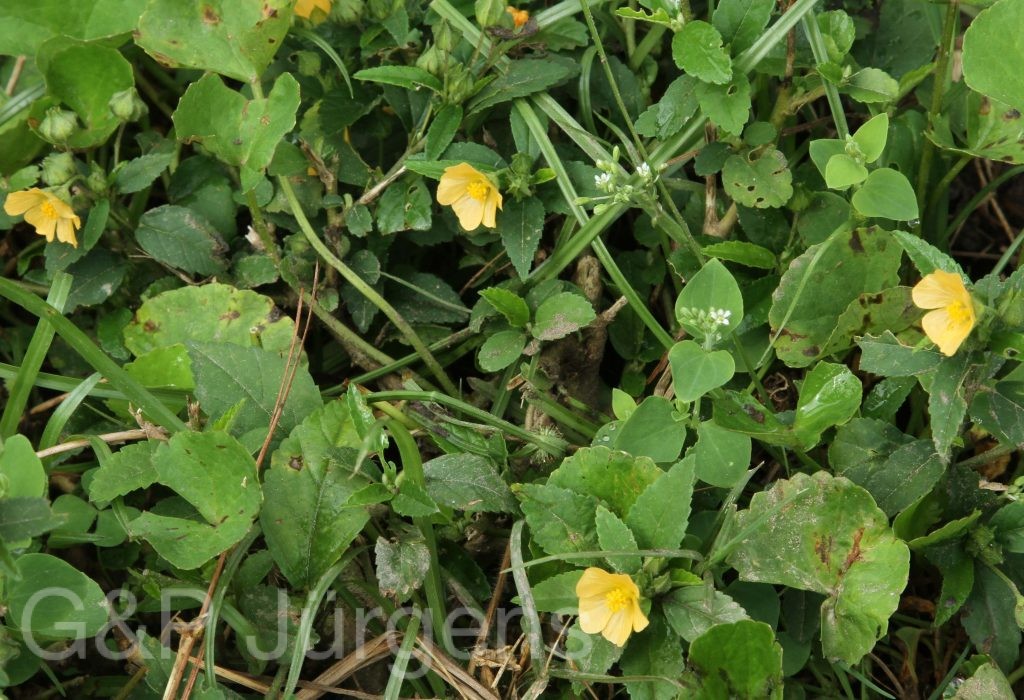
Bhutan2012 806 Kopie
Bhutan Trithangebe 1000m, October
also included: Drymaria cordata

Description

Sida mysorensis is an Old World tropical, weakly pantropical weedy herb, GBIF recording some 630 occurrences across South and Southeast Asia (India, Sri Lanka, China, Taiwan, Myanmar, Thailand, Vietnam, Cambodia, Laos, the Philippines, Indonesia), the Himalayan states (Nepal, Bhutan) and naturalised in the Neotropics (Mexico, Brazil, Colombia, Cuba, Guatemala). It is a plant of warm low to mid elevations, colonising roadsides, waste ground, fallow fields and forest margins. The Bhutanese record from Trithangebe at about 1000 m, flowering in October beside Drymaria cordata, is characteristic of its association with humid, weedy subtropical foothills after the monsoon.

It is an erect to ascending annual or short-lived perennial herb or subshrub, 30–120 cm tall, the stems and foliage softly pubescent to stellate-tomentose and often viscid. The leaves are alternate, ovate to cordate, crenate-serrate and stipulate. Flowers are small, solitary or few in the leaf axils; the corolla is yellow to pale orange, of five obovate petals around a staminal column typical of Malvaceae. The fruit is a schizocarp of several reticulate mericarps, each usually bearing short apical awns aiding dispersal.

Described from a Madras herbarium specimen by Wight and Arnott, S. mysorensis belongs to the large, taxonomically complex genus Sida, in which softly hairy, axillary-flowered species are frequently confused. It is of no conservation concern, being a widespread ruderal and minor agricultural weed, and like many Sida species has been used in folk medicine and as a bast fibre. Ecologically it is an early colonist of disturbed tropical ground.

Author: Herb.Madr. ex Wight & Arn. · Sources: POWO (Kew), GBIF, Flora of Bhutan, Flora of China, Malvaceae of the World (Bayer & Kubitzki treatment)

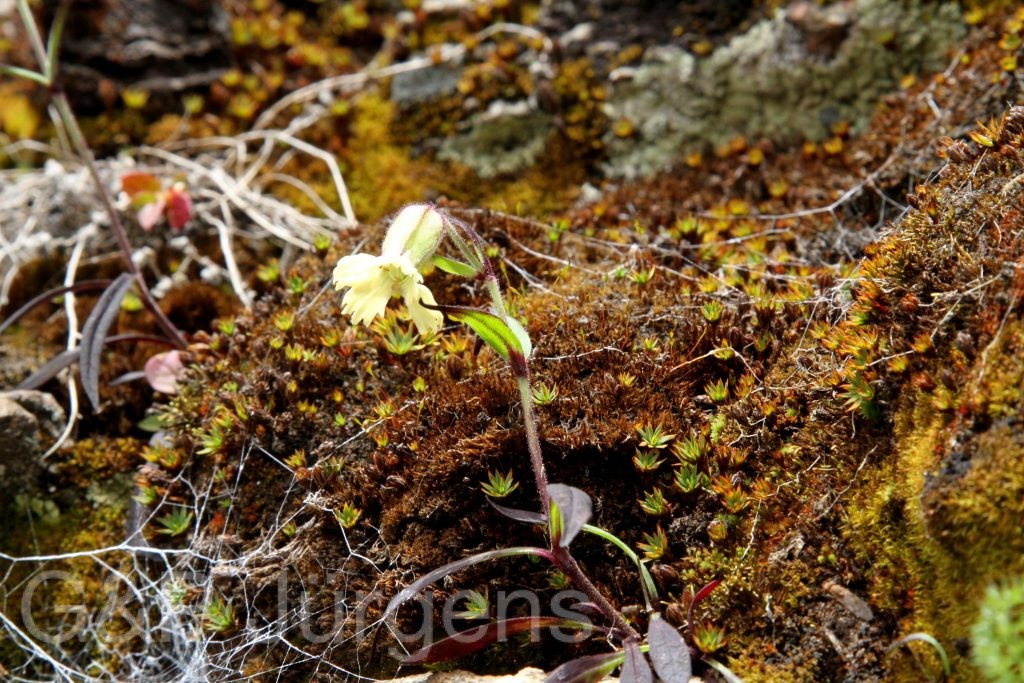
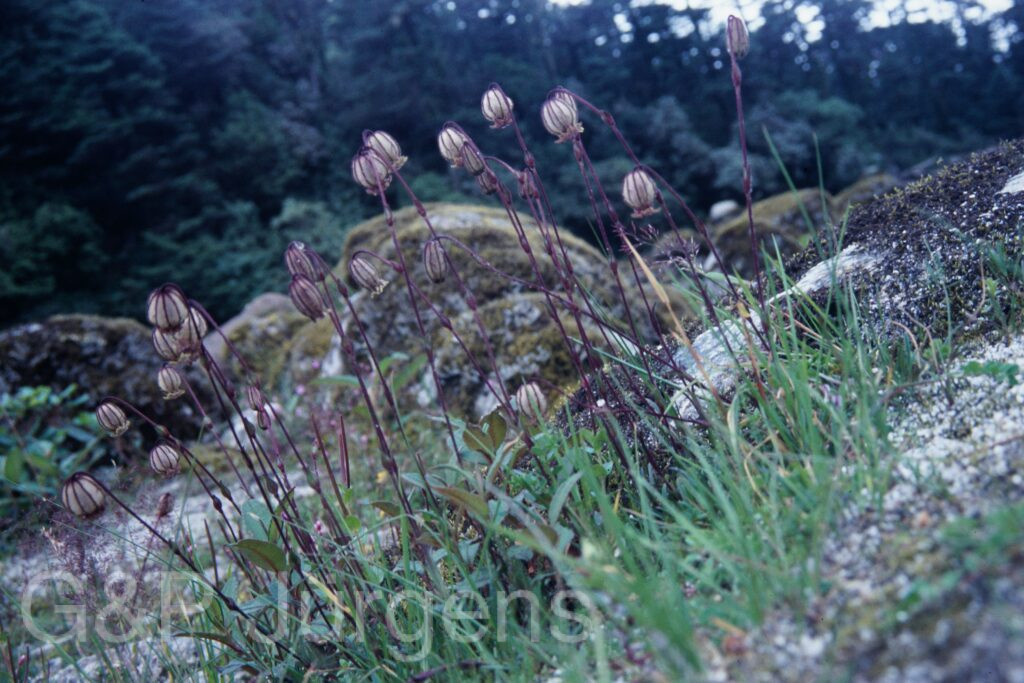
(W.W. Sm.) Bocquet

Bhutan2012 276
Bhutan Shele-La, 4000m September
Bhutan2012 277
Bhutan Shele-La, 4000m September

Description

Silene indica var. bhutanica is a campion of the high Himalaya, recorded from Nepal, Bhutan, India and adjacent China. It occupies alpine and upper subalpine habitats, growing on open grassy slopes, stony pastures, screes and rocky ground in the high mountains, generally between about 3500 and 4500 m. The photographed plant comes from the Shele-La in Bhutan at around 4000 m, flowering in September towards the close of the monsoon season. With only eighteen georeferenced records this variety is sparsely documented, in keeping with its restricted eastern Himalayan range and the difficulty of access to its high-altitude habitats.

It is an erect to ascending perennial herb arising from a stout rootstock, the stems usually several, simple or sparingly branched and often glandular-pubescent above. The leaves are opposite, linear-lanceolate to oblong, sessile or shortly stalked, with entire ciliate margins. The flowers are borne in a lax cymose inflorescence; each has a tubular, inflated and prominently 10-veined calyx, often glandular and tinged purple, enclosing the claws of the petals. The five petals are pink to purplish, the limb bifid or notched and bearing a small scaly corona at the throat. There are ten stamens and three styles, characteristic of the genus, and the fruit is a capsule dehiscing by apical teeth and shedding numerous reniform seeds.

Silene is the largest genus of Caryophyllaceae, and var. bhutanica is distinguished within the variable S. indica complex by features of indumentum, calyx and petal form, its delimitation depending on revisionary treatment of Himalayan Silene. Given its narrow range and few records, its conservation status is poorly known; restricted high-alpine taxa of this kind are potentially vulnerable to grazing and climatic shifts.

Author: (W.W. Sm.) Bocquet · Sources: POWO (Kew), GBIF, Flora of Bhutan, Flora of China, Bocquet's revisions of Asian Silene

Majumdar

Bhutan2012 241
Bhutan, Shele-La 4000m, September
Bhutan2012 242
Bhutan, Shele-La 4000m, September

Description

Silene nepalensis is a Himalayan campion distributed from Pakistan through Nepal and northern India to Bhutan and south-central China, the nearly four hundred GBIF records confirming a fairly broad high-montane range across the range. It occupies alpine and subalpine meadows, open stony slopes, rock crevices and the margins of scrub above the forest, where it flowers into the late season. The photographed plant from the Shele-La in Bhutan at 4000 m, flowering in September, illustrates its tolerance of the cold, exposed high passes and its comparatively late, autumn flowering at the upper limits of the alpine zone.

The species is a tufted perennial herb arising from a stout, often woody rootstock and producing several ascending to erect stems. The leaves are opposite, narrowly lanceolate to linear and somewhat ciliate at the margins. The flowers are borne in a lax cyme; the calyx is tubular to clavate, ten-veined and inflated in fruit, while the five petals are clawed with a bifid, white to pinkish limb and a small coronal scale at the throat. The androecium has ten stamens and the ovary three styles; the fruit is a capsule dehiscing by six apical teeth and containing numerous reniform seeds.

Silene nepalensis is an accepted species of the large, taxonomically difficult genus Silene (Caryophyllaceae, tribe Sileneae), where the inflated ten-veined calyx and clawed coronate petals are diagnostic. Its perennating woody base and crevice habit are adaptations to the desiccating winds and shallow soils of the high Himalaya. The species is widespread and not currently regarded as threatened, though its alpine populations are sensitive to grazing pressure and warming-driven range contraction.

Author: Majumdar · Sources: POWO (Kew), GBIF, Flora of China, Flora of Bhutan, Bocquet & Chowdhuri revision of Himalayan Silene (Caryophyllaceae monograph)

(Edgew.) Majumdar

Sikkim2003 215 G299
Sikkim Dzongri 3900m, August
Sikkim2003 216 P300
Sikkim Dzongri 3900m, August

Description

Silene nigrescens is an alpine campion of the Himalaya and adjacent mountains, ranging across China, Nepal, India and Bhutan and into Myanmar; GBIF records about 410 occurrences concentrated in the eastern and central Himalaya. It grows in high alpine meadows, grassy slopes, screes and stony pastures, generally between about 3500 and 4800 m. The illustrated plant was photographed at Dzongri in Sikkim at around 3900 m in August, during the monsoon flowering season when these dark-flowered campions colour the short turf of the eastern Himalayan uplands above the rhododendron scrub.

The species is a perennial herb growing from a slender, branched rootstock, forming low tufts of ascending to erect stems that are often glandular-hairy above. The leaves are opposite, sessile, narrowly lanceolate to oblanceolate, the lower ones crowded near the base. The flowers are nodding and few, with an inflated, ten-nerved, often dark-purple to nearly blackish calyx that gives the species its name; the petals are dingy purple to brownish with a bilobed limb and a small ligulate scale at the throat. The flower has three styles, and the capsule dehisces by six teeth, releasing numerous reniform seeds.

Described as (Edgew.) Majumdar from an Edgeworth basionym, Silene nigrescens belongs to the high-alpine, dark-calyx group of Himalayan Silene whose species limits are notoriously difficult owing to variation in vestiture and flower colour. Its broad eastern-Himalayan to southwest Chinese distribution makes it secure, and it forms part of the characteristic flora of monsoon-influenced alpine meadows, pollinated mainly by insects drawn to its sombre nodding flowers.

Author: (Edgew.) Majumdar · Sources: POWO (Kew), GBIF, Flora of China, Flora of Bhutan, Bocquet: Revision of Himalayan Silene