Author

GP Jürgens

Bocquet & N.P.Saxena

Sikkim2003 259 P357
Sikkim Dzongri 4200m, August

Description

Silene purii is a narrowly distributed high-alpine herb of the eastern Himalaya, recorded by GBIF only from Bhutan, with just four occurrences and closely allied populations extending into adjacent Sikkim. It occupies open turf, rocky slopes, moraine and grassy hollows above the treeline, generally between about 3900 and 4500 m. The illustrated plant was photographed at Dzongri in Sikkim at roughly 4200 m in August, during the brief monsoon flowering season when these tufted campions exploit the short, cool growing window of the eastern Himalayan summits.

The species is a perennial herb forming low tufts from a branched woody rootstock. The stems are short, ascending and often glandular-pubescent, bearing opposite, narrowly lanceolate to linear, somewhat fleshy leaves crowded toward the base. The flowers are few, terminal and shortly stalked; the calyx is tubular to inflated, ten-nerved and frequently purplish, while the petals are pink to purple with a bilobed or notched limb and a small scale at the throat. The ovary bears three styles and matures into a capsule dehiscing by six apical teeth, releasing numerous reniform seeds.

Named for its collector, Silene purii (Bocquet & N.P.Saxena) is one of many Himalayan campions whose limits remain poorly understood owing to scant collections and the plasticity of alpine Silene. Its extreme rarity in the herbarium record and restricted known range make it of considerable phytogeographic interest as an eastern Himalayan endemic. The paucity of records suggests it may be genuinely localised and potentially vulnerable, warranting targeted survey and conservation assessment.

Author: Bocquet & N.P.Saxena · Sources: POWO (Kew), GBIF, Flora of Bhutan, Flora of China, Bocquet: Revision of Silene sect. Physolychnis
Edgew.

BhutanPG2011 832 01 01
Bhutan Chele-La, 3400m July

Description

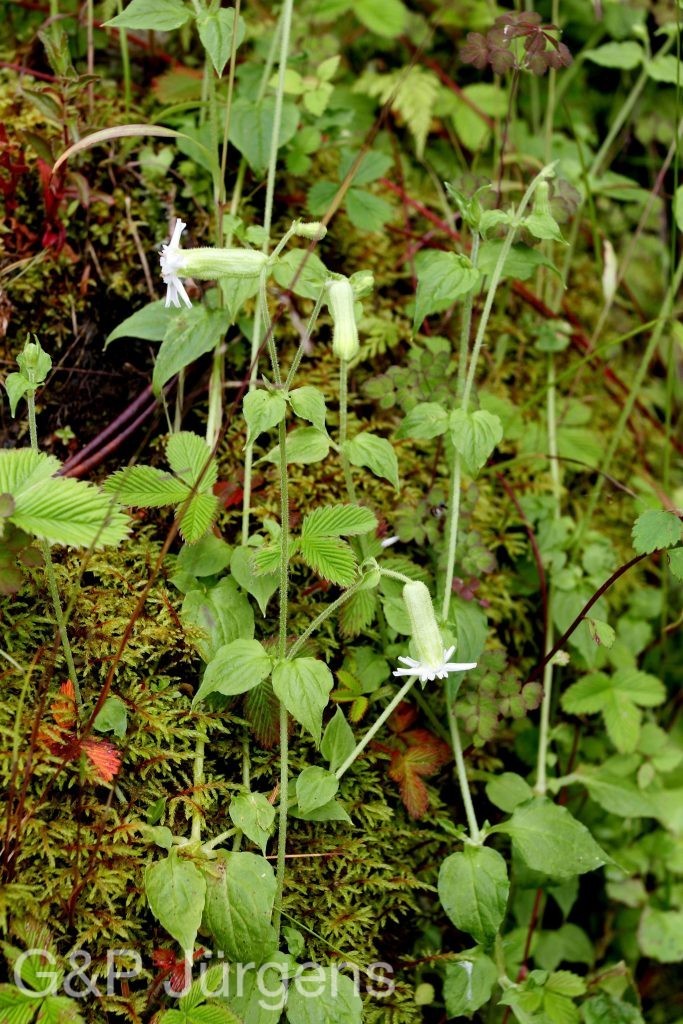
Silene stracheyi is a Himalayan campion restricted to the high mountains of India, Bhutan and Nepal, known from only about 17 GBIF records and thus among the more poorly documented members of the genus in the region. It grows in open subalpine and alpine habitats, including rocky slopes, grassy pastures, scrub margins and stony banks, generally between about 3000 and 4000 m. The plant photographed at Chele-La in western Bhutan at 3400 m in July, flowering at the height of the monsoon summer, typifies its association with cool, well-drained high-mountain grassland and rock.

It is a perennial herb arising from a stout rootstock, with erect to ascending stems that are often glandular-pubescent in the upper parts. The leaves are opposite, narrowly lanceolate to oblong, sessile or shortly stalked and entire. The flowers are borne in a lax cyme; each has the inflated, tubular to campanulate, conspicuously veined calyx characteristic of Silene, within which sit five clawed petals, usually pink to purplish, the limbs notched or bifid and often bearing a small corona at the throat. The stamens and styles are typical of the genus, and the fruit is a capsule dehiscing by apical teeth to scatter the numerous reniform seeds.

Silene is one of the largest genera of Caryophyllaceae, with many narrowly endemic high-alpine species in the Sino-Himalayan region, of which S. stracheyi is one. The tubular calyx and clawed petals reflect adaptation to long-tongued and nocturnal pollinators. Given its small known range and few documented populations, the species warrants conservation attention, as such restricted Himalayan campions are vulnerable to grazing intensification and the upslope shifts driven by a warming climate.

Author: Edgew. · Sources: POWO (Kew), GBIF, Flora of Bhutan, Annotated Checklist of the Flowering Plants of Nepal, Flora of China (Caryophyllaceae), Bocquet monographic studies of Silene

(Fedde ex H. Wolff) A.K. Mukh. & Constance

Bhutan2012 79
Bhutan Shele-La, 4000m September

Description

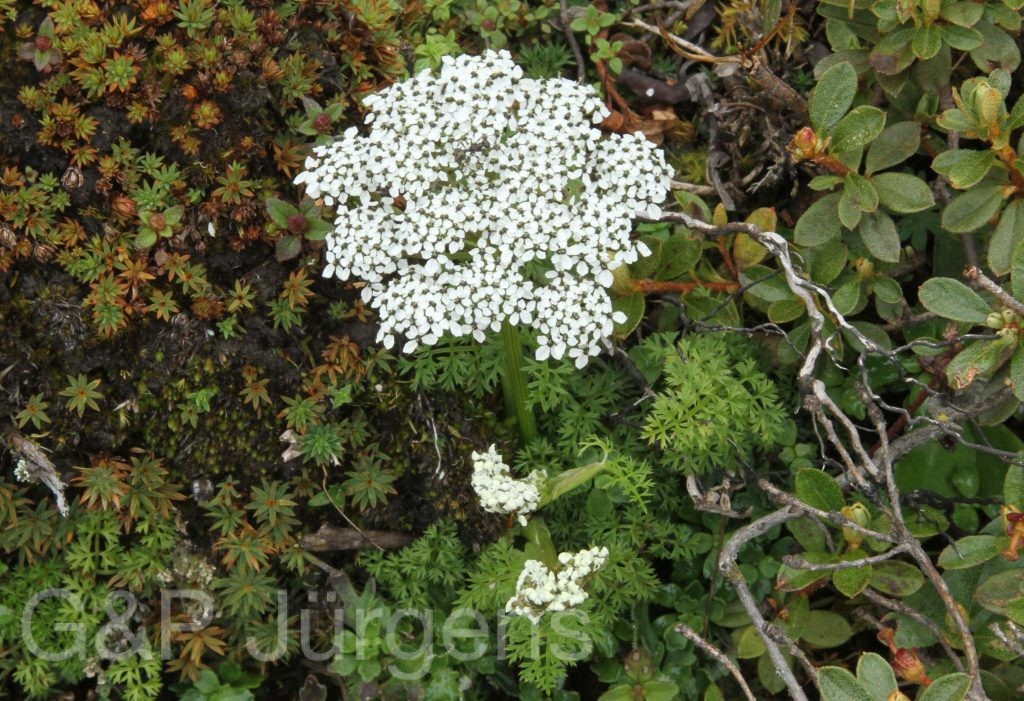
Sinocarum wolffianum is a small alpine umbellifer of the Himalaya and south-western China, recorded from China, northern India, Nepal and Bhutan, a restricted distribution reflected in only about 54 occurrence records. It grows on open alpine meadows, turf, screes and rocky slopes, typically between roughly 3500 and 4500 m. The specimen photographed at Shele-La in Bhutan at about 4000 m in September illustrates its late-season presence in the high alpine zone, where short-statured umbellifers persist among the cushion vegetation.

The plant is a small, slender perennial arising from a tuberous or fusiform root, usually only a few centimetres to about 15 cm tall. The leaves are mostly basal, finely divided (ternately to pinnately dissected) into narrow, linear ultimate segments, on slender petioles sheathing at the base. The inflorescence is a small, lax compound umbel, often lacking or with few bracts and bracteoles; the flowers are minute, with white to pinkish petals and the inferior ovary typical of the family. The fruit is a small, ovoid to oblong schizocarp splitting into two ribbed mericarps.

Sinocarum (Apiaceae, subfamily Apioideae) is a small Sino-Himalayan genus of dwarf alpine umbellifers segregated from Carum and allied genera, and its species circumscription has been revised by workers including Mukherjee and Constance, who established the present combination. The genus is taxonomically intricate, with several narrow-range high-mountain taxa. Pollinated by generalist alpine insects, the mericarps are dispersed passively. As a localised high-elevation endemic of limited known range, it is of biogeographic interest and likely sensitive to climatic change in its alpine habitat.

Author: (Fedde ex H. Wolff) A.K. Mukh. & Constance · Sources: POWO (Kew), GBIF, Flora of China, Flora of Bhutan, Annotated Checklist of the Flowering Plants of Nepal, Pimenov & Leonov The Genera of the Umbelliferae

A. Berger

Nepal 99 949 ergebnis
West-Nepal Pamela 2700m, July

Description

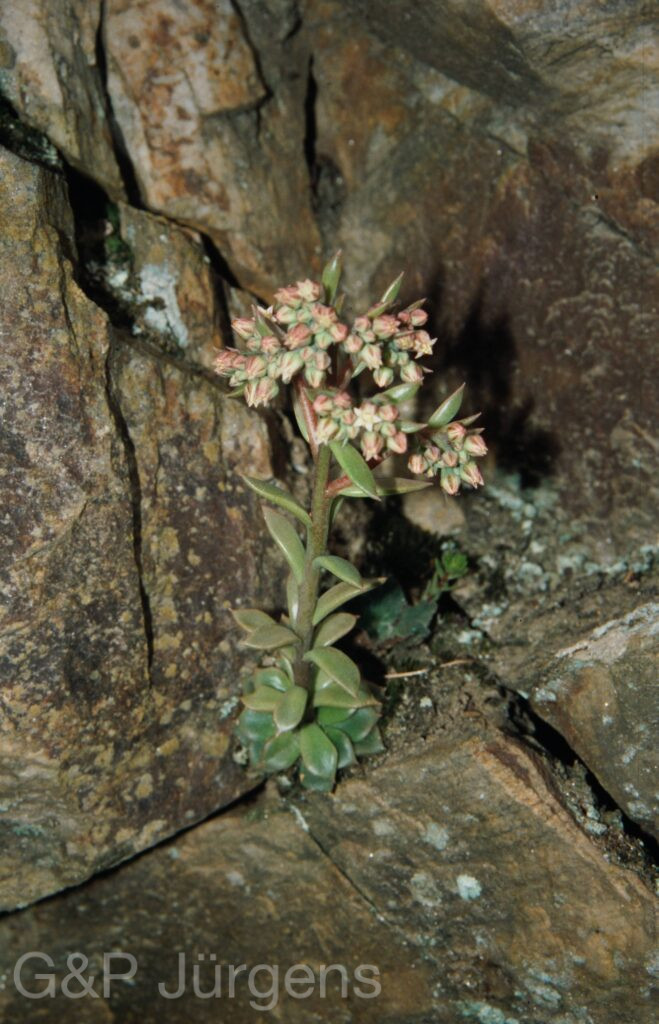
Sinocrassula indica is a succulent biennial to short-lived perennial herb distributed through the Sino-Himalayan region, with records from China, India, Nepal and Bhutan and scattered naturalised or cultivated occurrences elsewhere. It grows on dry rocky banks, cliff ledges, stony slopes and walls in the montane belt, typically from about 1500 to 3500 m, rooting in shallow gritty pockets and crevices where competition is slight. The photographed plant comes from Pamela in West Nepal at around 2700 m, flowering in July during the monsoon. With over 650 georeferenced occurrences it is a frequently collected and widely recognised crassulaceous element of the Himalayan foothills and ranges.

The plant produces a basal rosette of fleshy, oblanceolate to spathulate leaves, glabrous or finely papillose, often flushed reddish, from which arises an erect, leafy, sometimes branched inflorescence-bearing stem. The cauline leaves are smaller, sessile and crowded. Flowers are numerous, borne in a dense terminal thyrse of cymes; they are small, with five erect or connivent petals that are greenish-yellow to dull red, scarcely spreading, giving the flower an urn-shaped appearance. There are five stamens, and the carpels are erect with short styles. The fruit is a cluster of follicles releasing fine seeds, after which the monocarpic flowering rosette dies.

Sinocrassula was segregated from Crassula and Sedum on the basis of its erect, barely opening petals and Asian distribution, and S. indica is the most widespread species of the genus. The taxon is morphologically variable in leaf shape and flower colour, and several infraspecific forms have been described. It is occasionally grown by succulent enthusiasts. Being common and ecologically adaptable across a broad range, it is of no conservation concern.

Author: A. Berger · Sources: POWO (Kew), GBIF, Flora of China, Flora of Nepal, Crassulaceae of the World (monograph)

Mill.

Bhutan2014 108
Bhutan Trashigang 1550m, May

Description

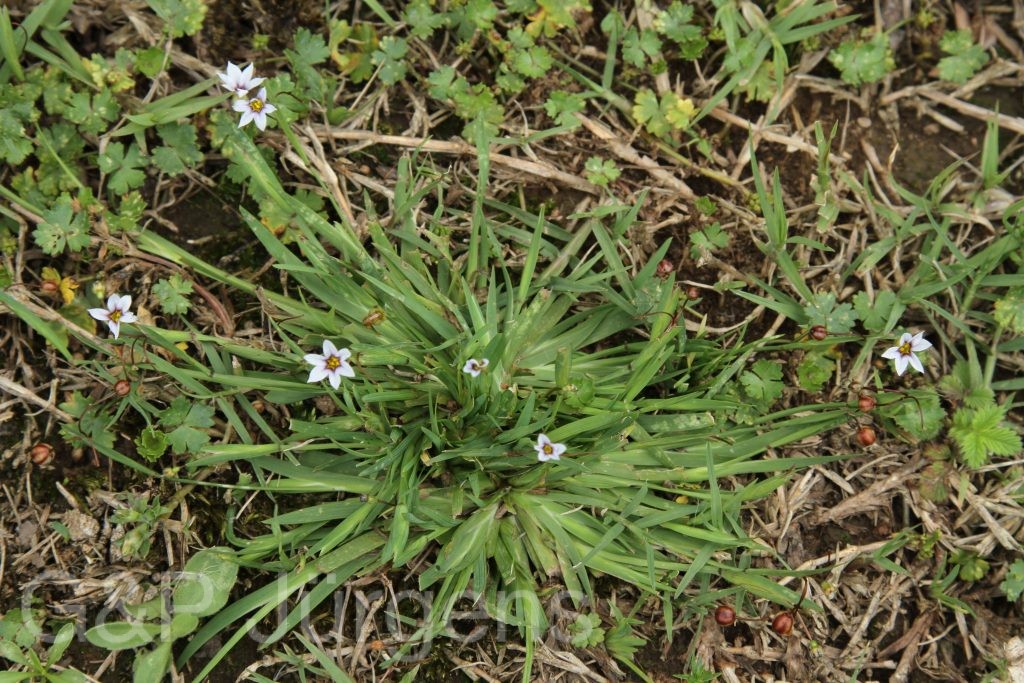
Sisyrinchium angustifolium, the narrow-leaved blue-eyed grass, is native to eastern North America (US, CA) but is widely naturalised, with more than 15,000 GBIF occurrences extending across western Europe (FR, ES, IE, GB, DE, BE), eastern Asia (KR, JP) and elsewhere. In the Himalaya it occurs as an introduced and locally established plant of damp meadows, lawns, ditches and grassy roadsides. The individual recorded at Trashigang in eastern Bhutan at 1550 m in May reflects its naturalisation in moist, open, subtropical to warm-temperate grassland, where it flowers in spring on seasonally moist ground.

Despite the common name it is no grass but a tufted perennial of the Iridaceae, forming clumps of narrow, linear, equitant leaves arising in two ranks from a short rhizome. The flowering stems are markedly flattened and conspicuously winged, often branched, and bear terminal clusters of flowers subtended by paired green spathes. Each ephemeral flower has six spreading blue to violet tepals abruptly apiculate with a small terminal mucro, contrasting with a yellow centre; the three stamens have filaments united into a tube around the style. The fruit is a small globose to obovoid loculicidal capsule containing numerous black, rounded seeds.

The species belongs to the large American genus Sisyrinchium and is taxonomically complex, with several allied microspecies and frequent confusion with S. montanum and S. bermudiana. Its flowers open only in sunshine and are bee-pollinated, while prolific seed favours self-establishment in mown swards. Outside its native range it behaves as a benign garden escape.

Author: Mill. · Sources: POWO (Kew), GBIF, Flora of Bhutan Vol. 3, Flora of Nepal, Flora of China Vol. 24, The Genus Sisyrinchium (Iridaceae) Monograph

C.C. Huang

Bhutan2014 596
Bhutan Phobjika 2400m, May
Nepal 1994 84 ergebnis
Ost-Nepal Jaljale Himal
3000m April

Description

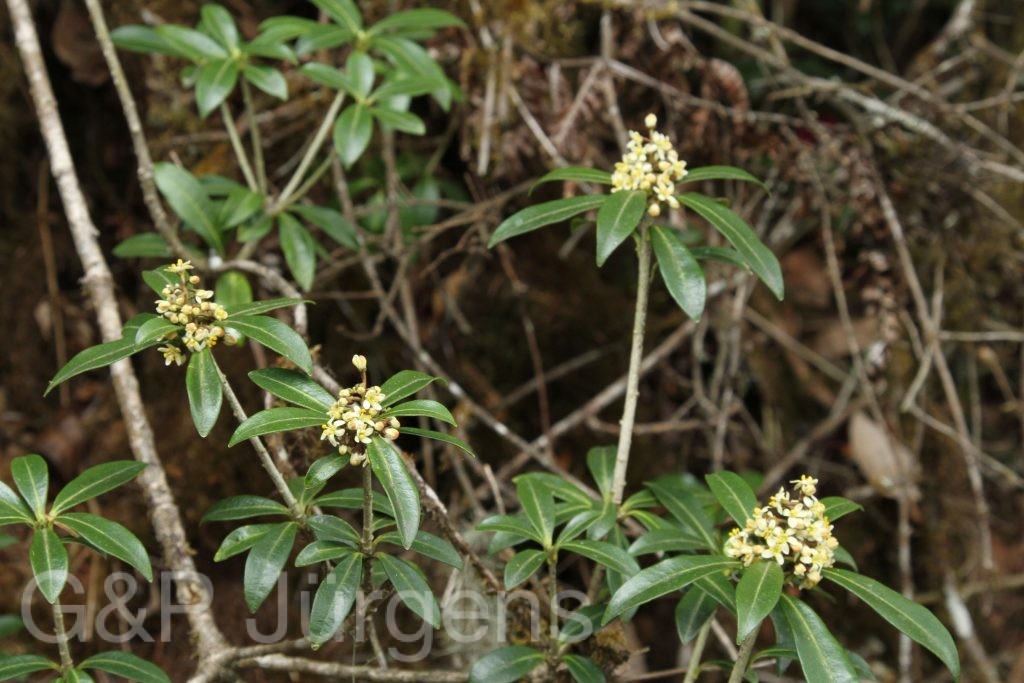
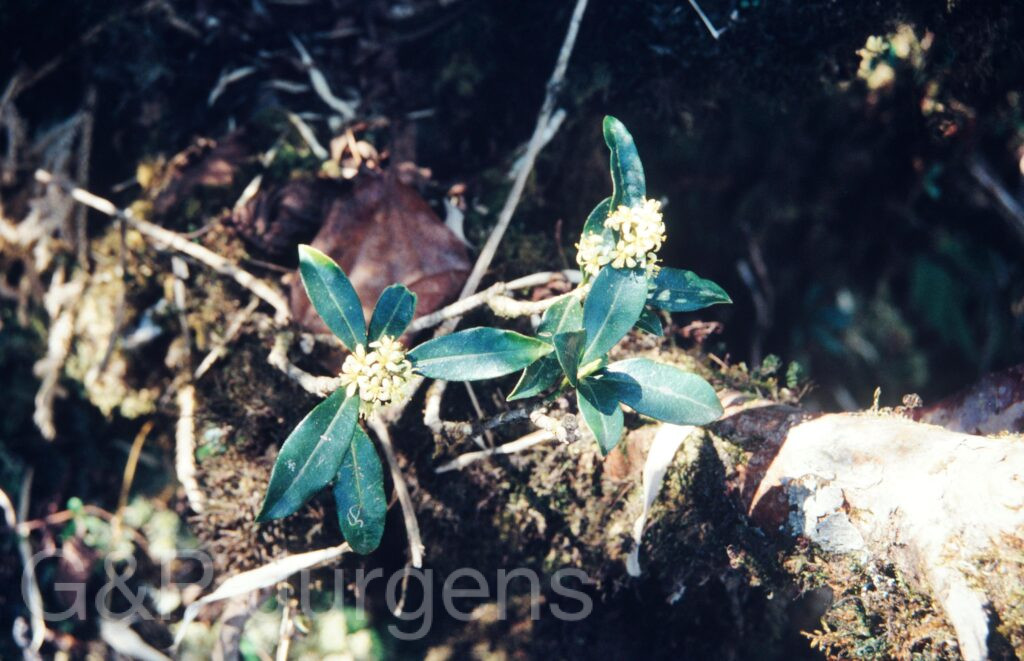
Skimmia multinervia is an evergreen shrub of the eastern Himalaya and adjacent China, with GBIF records (about 294) confined to China and Bhutan but its wider native range extending along the Himalaya into Nepal and northeastern India. It occupies the cool, humid montane and subalpine forest zone, as shown by collections at Phobjika in Bhutan around 2400 m in May and on the Jaljale Himal in eastern Nepal near 3000 m in April. There it grows in the shaded understorey of broad-leaved and conifer forest, among rhododendrons and on mossy slopes, favouring moist, organic-rich, well-drained soils.

The plant is a compact, much-branched aromatic shrub whose foliage releases a pungent citrus scent when crushed, owing to the translucent oil glands typical of Rutaceae. The leaves are alternate, often crowded toward the branch tips, elliptic to oblanceolate, leathery and entire, with the numerous lateral veins to which the epithet refers. The species is functionally dioecious, bearing small whitish to cream flowers in terminal panicles with four to five petals; male and female plants must grow together for fruit to set. The fruit is a fleshy, bright red drupe persisting through the colder months and dispersed by birds.

Skimmia is a small Asian genus within the citrus family, distinguished by its evergreen aromatic habit, dioecy and red drupaceous fruits; its species, including S. multinervia, are valued in temperate horticulture for winter colour. As a forest-understorey shrub dependent on intact, moist montane woodland, it is sensitive to forest clearance and grazing, though across its range it remains locally frequent and is not regarded as globally threatened.

Author: C.C. Huang · Sources: POWO (Kew), GBIF, Flora of China Vol. 11, Flora of Bhutan Vol. 1, Flora of Nepal, A Monograph of the Genus Skimmia (Rutaceae)

A.DC.

Nepal 2001 232 ergebnis ergebnis
Nepal (Gorkha) Tullikot 1800m, May

Description

Smilax orthoptera is a climbing monocot of the eastern and central Himalaya, recorded by GBIF from India, Nepal and Bhutan in a modest dataset of about 35 occurrences, an accepted species of the warm-temperate hill forests. It scrambles through the understorey and along forest margins, thickets and shrubby slopes of the lower and middle hill zone, broadly between roughly 1500 and 2500 m, where moist, monsoon-fed broad-leaved forest provides the supports its tendrils require. The image from Tullikot in the Gorkha district of Nepal at 1800 m, in May, places the plant in this mid-hill belt at the start of the growing season, climbing over neighbouring vegetation in dappled forest shade.

It is a woody to subwoody climber arising from a tough, knotty rhizome, with slender, angular to ridged, often prickly stems. The alternate leaves are stalked and bear at the base of the petiole a pair of tendrils derived from stipular appendages, by which the plant climbs; the blades are ovate to ovate-lanceolate, leathery, with several prominent curving main veins running from base to apex in the manner characteristic of the genus. The plant is dioecious, the small greenish to yellowish flowers borne in axillary umbels with six tepals and, in staminate flowers, six stamens; female flowers develop into small globose berries containing few seeds, dispersed by birds.

Smilax is a large, mainly tropical and warm-temperate genus and the principal element of the family Smilacaceae, set apart within the monocots by its climbing habit, paired petiolar tendrils and net-veined yet parallel-ribbed leaves. S. orthoptera is one of several Himalayan species distinguished by stem armature, leaf shape and the form of the tendril-bearing petiole. Restricted in range but locally frequent within its forest habitat, it has not been assessed as threatened, although the species depends on the persistence of intact mid-elevation Himalayan forest.

Author: A.DC. · Sources: POWO (Kew), GBIF, Flora of China Vol. 24, Flora of Nepal, Flora of Bhutan Vol. 3, Koyama's monographic studies of Asian Smilax

Lour.

Bhutan2014 216
Bhutan Mongar 1920m, May
Bhutan2014 217
Bhutan Mongar 1920m, May

Description

Smilax perfoliata is a robust scrambling climber of the eastern Himalaya, Indo-China and East Asia, ranging from Nepal, Bhutan and north-east India through Myanmar, Thailand, Laos, Cambodia and Vietnam to southern China, Taiwan, Japan, Korea and Sri Lanka, with records also in Indonesia. GBIF holds around 618 occurrences. It is a woody liana of broad-leaved evergreen and semi-evergreen forest, thickets and forest margins, scrambling over shrubs and into the lower canopy at low to middle elevations. The plant from Mongar in eastern Bhutan at 1920 m in May is typical of the temperate to subtropical forest belt it favours.

It is a dioecious vine arising from a thick woody rhizome, the climbing stems and branches armed with scattered prickles. Its leaves are alternate, leathery, broadly ovate to elliptic with several prominent arching main veins; the petiole bears a conspicuous sheathing, clasping wing (whence perfoliata) from which spring a pair of slender tendrils that anchor the climber. The small greenish-yellow flowers are unisexual in axillary umbels, the perianth of six free tepals, staminate flowers with six stamens, pistillate with a superior trilocular ovary. The fruit is a small globose berry ripening dark blue-black, with one to few bird-dispersed seeds.

Smilax, the sole large genus of Smilacaceae, is set apart among monocots by its net-veined, petiole-tendril-bearing leaves and woody climbing habit. S. perfoliata belongs to a complex of broad-leaved Asian climbers delimited by petiole-sheath morphology and leaf venation. Several species of the genus yield sarsaparilla-type saponins and have medicinal uses, the young shoots sometimes eaten. Widespread and adaptable to disturbed forest, S. perfoliata is of no conservation concern.

Author: Lour. · Sources: POWO (Kew), GBIF, Flora of China Vol. 24, Flora of Bhutan Vol. 3, Annotated Checklist of the Flowering Plants of Nepal, Koyama revision of Asiatic Smilax

Solanum betaceum

by GP Jürgens

Cav.

Bhutan2015 313
Bhutan Zhemgang 1650m, October
Bhutan2015 314
Bhutan Zhemgang 1650m, October

Description

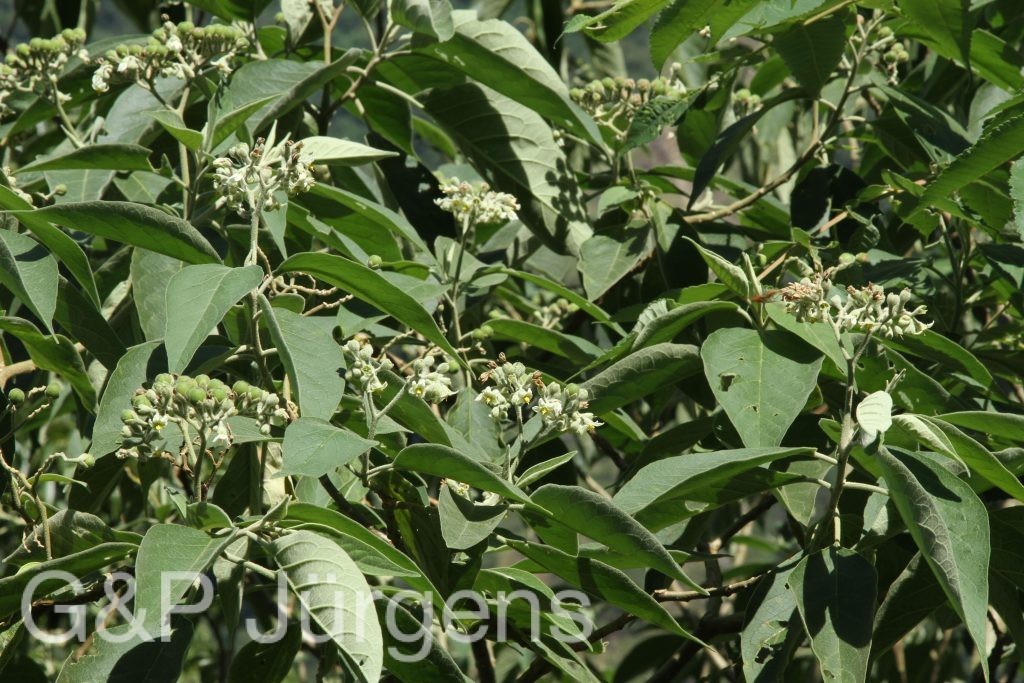
Solanum betaceum Cav. (the tamarillo or tree tomato, long known as Cyphomandra betacea) is a small tree native to the Andean region of South America but now cultivated and naturalised pantropically and in warm-temperate areas; GBIF records (about 4,314 occurrences) span Colombia, Ecuador, Peru, Bolivia, Argentina and Brazil in its native range, together with widespread introductions in Europe, Australasia, southern Africa and South Asia. In the Himalaya it is grown and locally escapes in warm mid-elevation valleys; the photographed plant is from Zhemgang in central Bhutan at about 1,650 m, fruiting in October in cultivation on subtropical hill slopes.

It is a fast-growing, soft-wooded shrub or small tree 2-5 m tall with a brittle, sparingly branched trunk. The leaves are large, alternate, ovate-cordate, softly pubescent and pungently scented, with entire margins and a long petiole. The flowers are borne in lateral cymes and are fragrant, with a rotate to shallowly campanulate pale pink to lilac corolla 1-2 cm across and the connivent yellow anthers typical of Solanum. The fruit is a smooth, egg-shaped berry 4-8 cm long, ripening orange-red to deep purplish, with two locules of small flat seeds embedded in tart, jelly-like pulp.

Molecular phylogenetics has subsumed the former genus Cyphomandra within Solanum, where these arborescent species form a distinct clade pollinated by fragrance-collecting bees. S. betaceum is economically important as the tamarillo, cultivated commercially in New Zealand, the Andes and elsewhere for its vitamin-rich fruit. As a domesticated and widely naturalised crop it is of no conservation concern; in some regions it behaves as a minor environmental weed.

Author: Cav. · Sources: POWO (Kew), GBIF, Flora of China, Solanaceae Source database, Bohs revision of Cyphomandra (Solanum), Flora of Bhutan, Solanaceae treatments in Andean floras

Dunal

Bhutan2015 219
Bhutan Zhemgang 910m, October
Nepal 97 9 P14
Nepal Taplejung 1000m April

Description

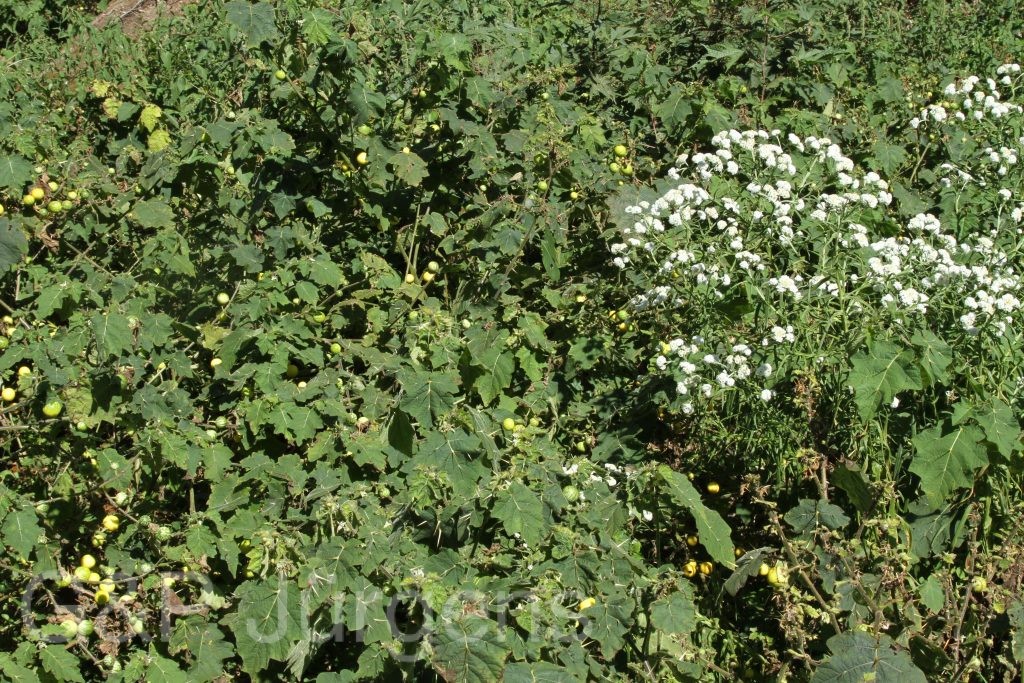
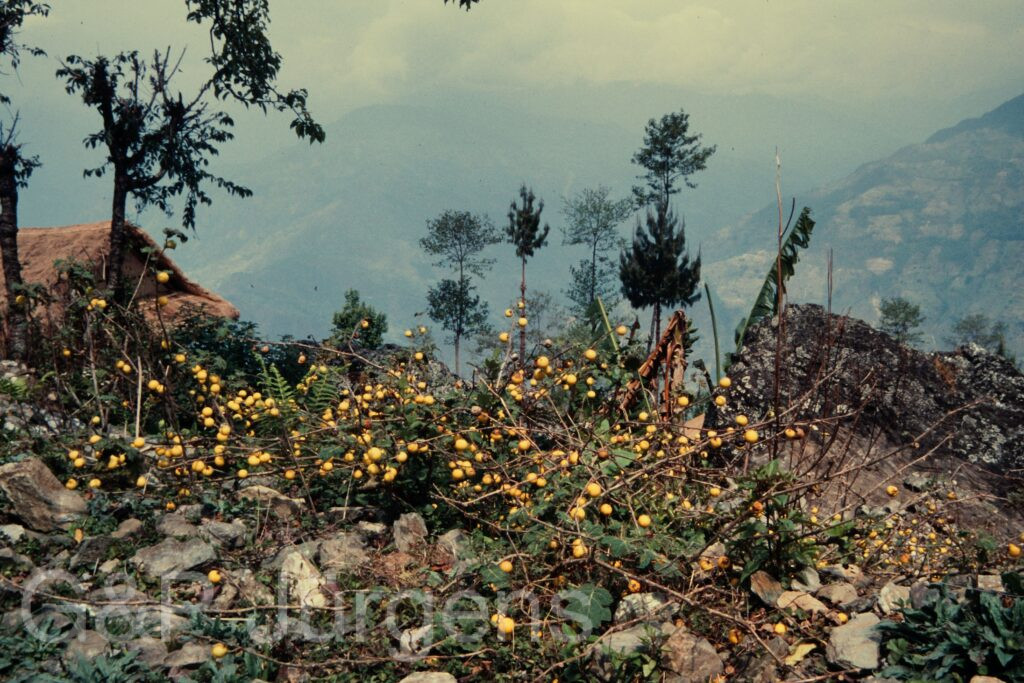
Solanum viarum, the tropical soda apple, is native to subtropical South America, notably Brazil, Argentina, Paraguay and Uruguay, but is now a widespread invasive weed; the GBIF dataset of roughly 32000 records spans the United States, Australia, South Africa, India, China, Vietnam, Thailand, Korea, Mexico and the Himalayan countries Nepal and Bhutan. It colonises pastures, roadsides, field margins, waste ground and disturbed forest edges at low to mid elevations, thriving in open, grazed and ruderal habitats. The illustrated material from Zhemgang in Bhutan at 910 m in October and Taplejung in eastern Nepal at 1000 m in April reflects its establishment in the warm subtropical foothills, where it behaves as an aggressive colonist of disturbed ground.

It is a robust erect prickly perennial herb or subshrub 1–2 m tall, the stems, petioles, leaf veins and calyx armed with stout, broad-based yellowish prickles and clothed in stellate hairs. The leaves are alternate, ovate, deeply lobed and sinuate, prickly on both surfaces along the veins. The inflorescence is a small extra-axillary cyme of white, stellate, five-merous flowers with reflexed petals and a cone of connivent yellow anthers. The fruit is a globose berry about 2–3 cm across, mottled green like a tiny melon when immature and ripening pale yellow, containing numerous flattened seeds embedded in juicy pulp.

Solanum viarum belongs to the spiny Leptostemonum clade of Solanum. Its prolific, animal-dispersed berries, toxic to many vertebrates but readily spread by livestock and wildlife, underlie its notoriety as a noxious weed subject to quarantine and biological control in the United States and elsewhere. In the Himalayan foothills it is a naturalised invader rather than a native element, and its spread is monitored as a threat to pasture and native vegetation.

Author: Dunal · Sources: POWO (Kew), GBIF, Flora of China Vol. 17, Flora of Bhutan Vol. 2, Flora of Nepal, Solanaceae: A Monograph of Solanum (Solanaceae Source)