Tag:

Alpine (>3500 m)

(Nannf.) K.K.Shrestha
Sikkim2003 127 G173
Sikkim Dzongri 4000
Sikkim2003 128 G174
Sikkim Dzongri 4000m 08.2003

Description

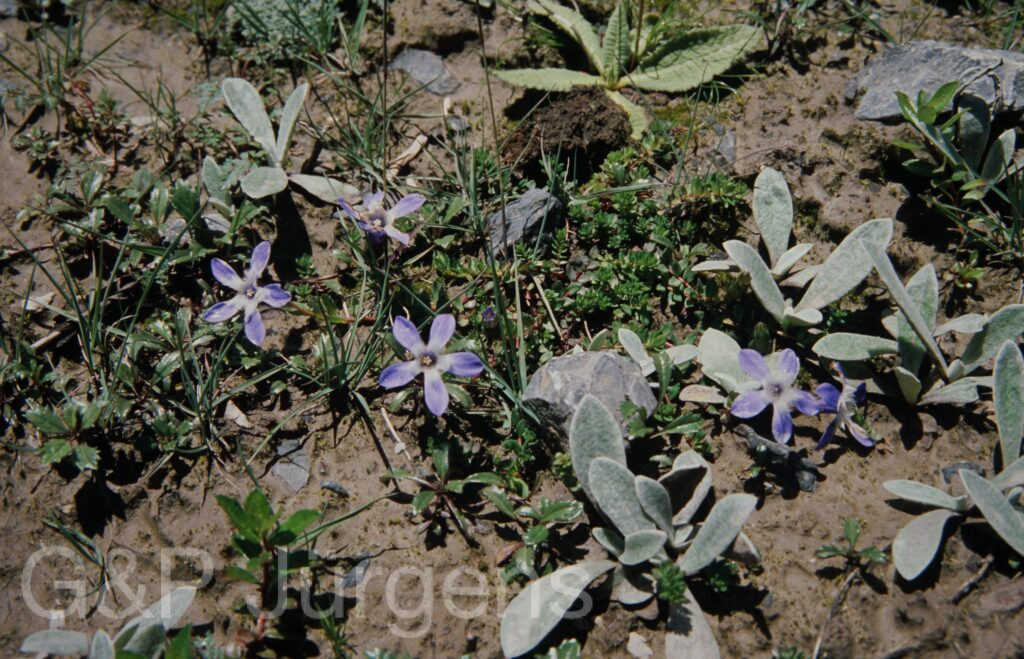
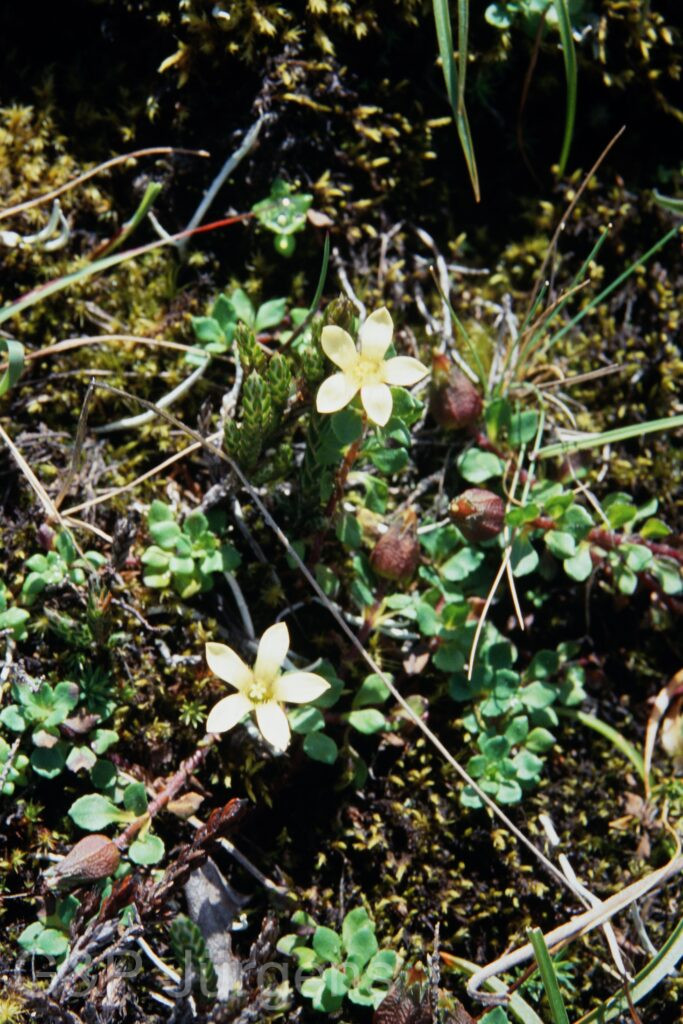
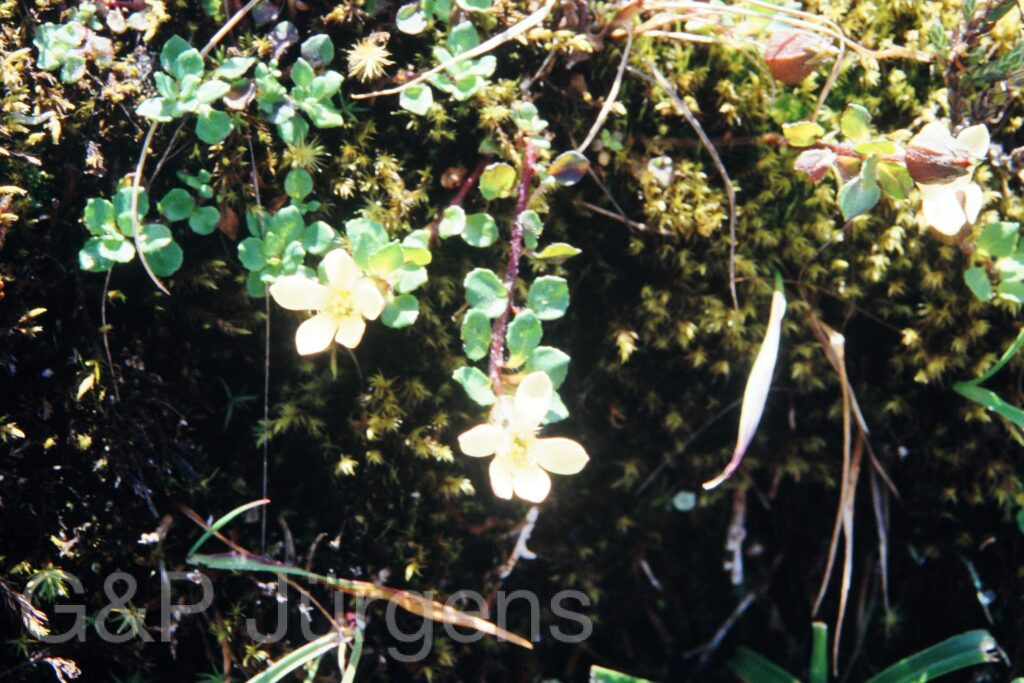
Cyananthus macrocalyx subsp. spathulifolius is a high-alpine perennial of the eastern and central Himalaya and adjacent China, recorded from China, Nepal, Bhutan and India, with GBIF documenting about 56 occurrences for the taxon. It grows on open alpine turf, rocky slopes, stabilised scree and moraine in the alpine zone, commonly between 3500 and 4500 m. The photographed plant was found at Dzongri in Sikkim at about 4000 m in August, flowering late in the monsoon summer when its broad blue corollas appear among low alpine herbage on these exposed high ridges.

The plant is a low, somewhat tufted to prostrate perennial with slender, ascending or trailing stems arising from a stout rootstock and exuding milky latex when broken. The leaves are small, alternate and crowded, with spathulate to obovate blades (the source of the subspecific epithet), the margins entire to few-toothed. The flowers are solitary and terminal, comparatively large for the plant; the calyx is conspicuously inflated and large, as the specific epithet "macrocalyx" indicates, often hairy. The corolla is broadly campanulate, blue to purplish-blue, with five spreading lobes and a bearded throat; there are five stamens and an inferior to half-inferior ovary, maturing into a capsule.

The taxon belongs to Cyananthus (Campanulaceae), a Sino-Himalayan genus distinguished from Campanula by its hypogynous nectary disc and large calyx. Recombined by K.K. Shrestha, this subspecies is a regional variant of the polymorphic C. macrocalyx complex. A specialist of high, well-drained alpine habitats, it is naturally localised but not known to be threatened, though sensitive to grazing and warming-driven contraction of the alpine zone.

Author: (Nannf.) K.K.Shrestha · Sources: POWO (Kew), GBIF, Flora of China, Flora of Nepal, Flora of Bhutan, revision of Cyananthus (Shrestha)
Edgew.

Garw 2005 300 ergebnis
India Garhwal Kunol 3100m, September
Nepal 99 855 ergebnis
West-Nepal Sanu Bheri 3850m, July
Nepal 99 856 ergebnis
West-Nepal Sanu Bheri 3850m, July
Garw 2005 44 ergebnis ergebnis
India Garhwal Valley of flowers 3150m, September

Description

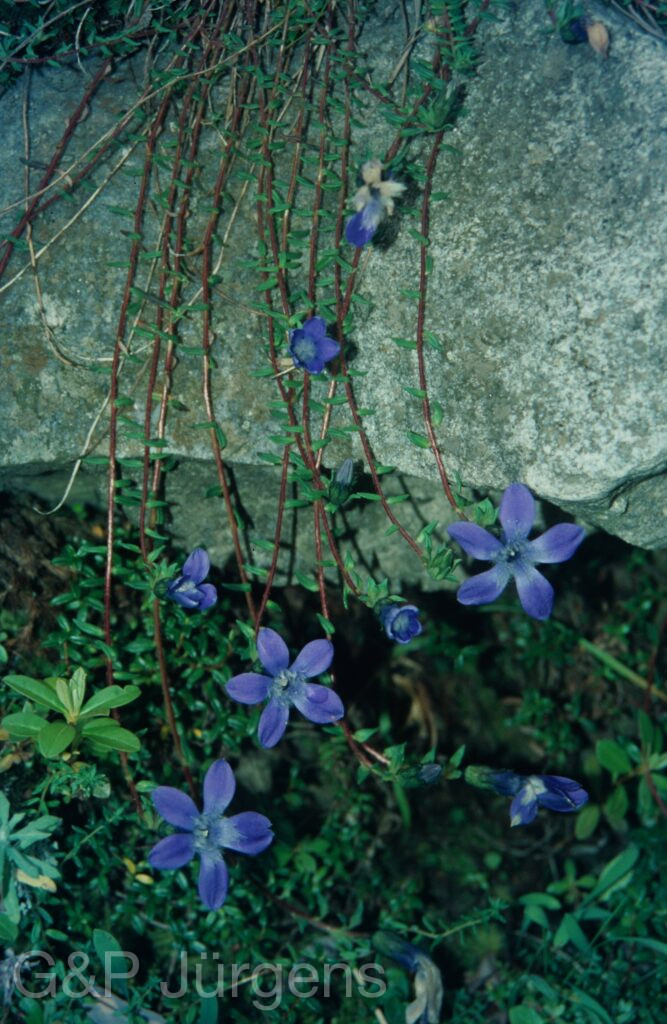
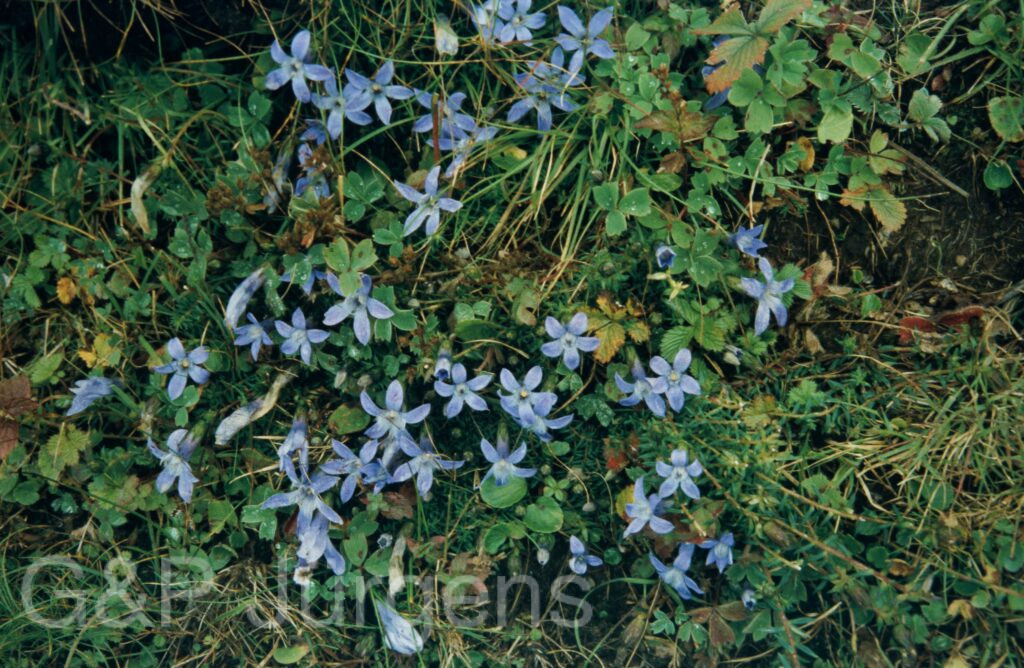
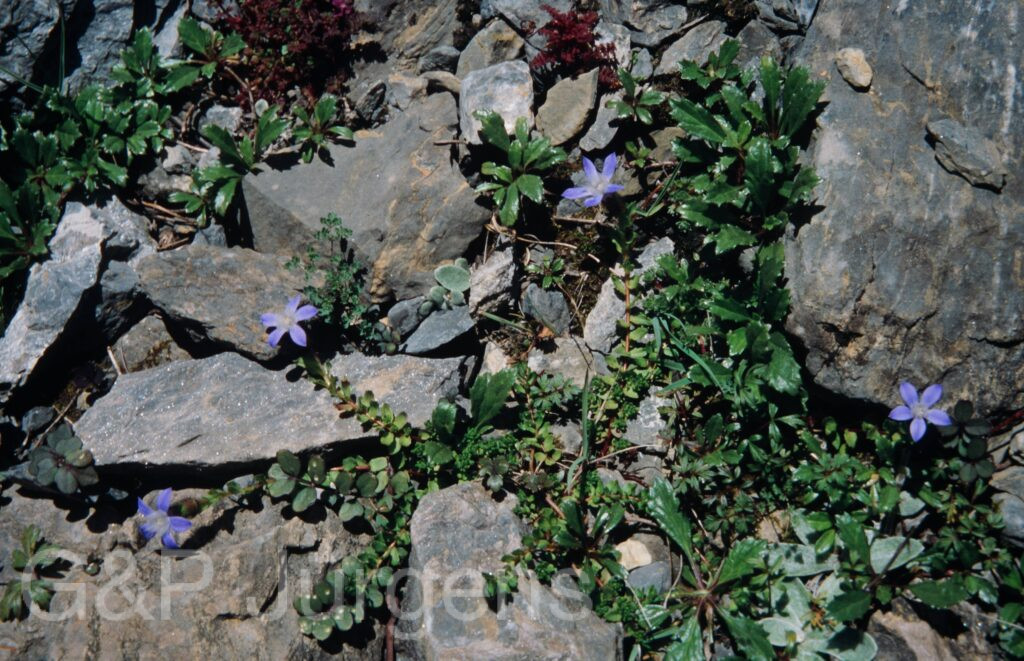
Cyananthus microphyllus is an alpine cushion-forming herb endemic to the Himalaya, documented from Nepal, India and China, with the available occurrence records concentrated along the central and western Himalayan arc. It grows in alpine meadows, on open stony slopes, rock ledges and the gravelly margins of glacial moraines, generally between about 3000 and 4500 m. The images, gathered at Kunol in Garhwal at 3100 m and in the Valley of Flowers at 3150 m in September and at Sanu Bheri in West Nepal at 3850 m in July, capture its late-monsoon flowering in high pastures and rocks where the mats anchor in thin, well-drained soils.

The plant forms low, much-branched, somewhat woody-based mats from a slender taproot. The wiry, prostrate to ascending stems are clothed in numerous small, alternate, ovate to elliptic leaves that are often revolute at the margin and sparsely hairy. The flowers are solitary and terminal, with a campanulate, conspicuously hairy calyx whose tube is shorter than the deeply five-lobed, blue corolla; the corolla throat bears a dense ring of white hairs, a defining feature of the genus. Five stamens alternate with the corolla lobes, and the inferior to half-inferior ovary develops into a capsule that exceeds the persistent calyx and dehisces to release numerous small seeds.

Cyananthus is a small Sino-Himalayan genus of perhaps two dozen species, allied to the bellflowers but distinguished by the bearded corolla throat and largely inferior ovary. Cyananthus microphyllus is recognised among the small-leaved, blue-flowered species by its diminutive, densely leafy mats. Its restricted high-elevation distribution makes it sensitive to climatic shifts and trampling by grazing livestock, and as a late-flowering alpine it provides an important resource for bumblebees and other cold-adapted pollinators.

Author: Edgew. · Sources: POWO (Kew), GBIF, Flora of China, Annotated Checklist of the Flowering Plants of Nepal, Flowers of the Himalaya (Polunin & Stainton), revision of Cyananthus (Campanulaceae)

C.B.Clarke

Sikkim2003 430 P597
Sikkim below Dzongri 4000m 08.2003
Sikkim2003 430 P597
Sikkim below Dzongri 4000m 08.2003
Sikkim2003 504 P704
Sikkim below Dzongri 4000m 08.2003

Description

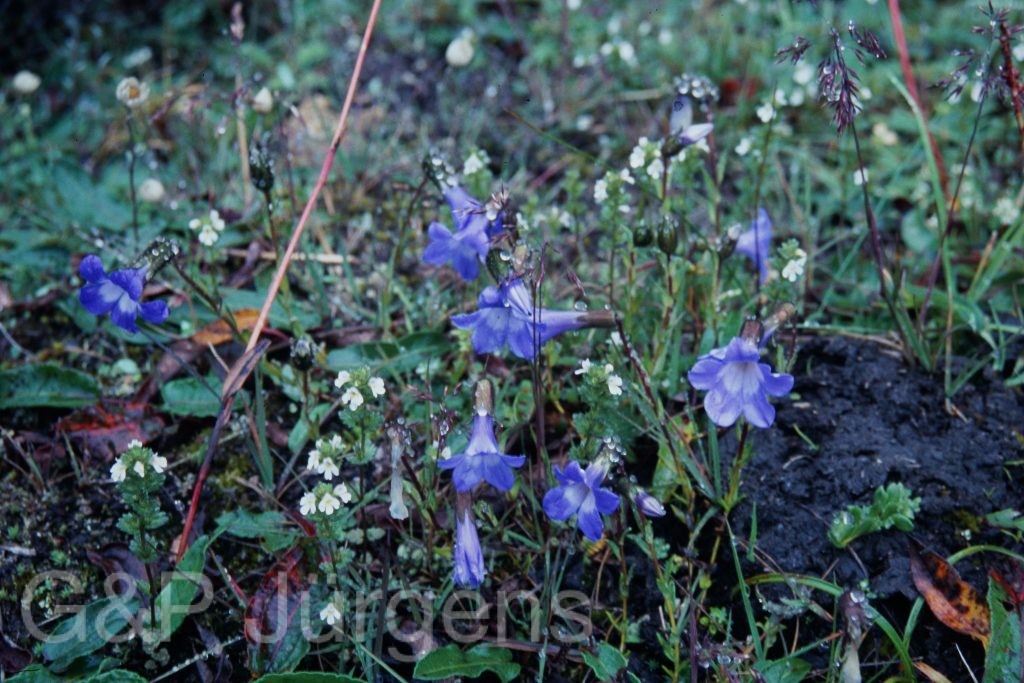
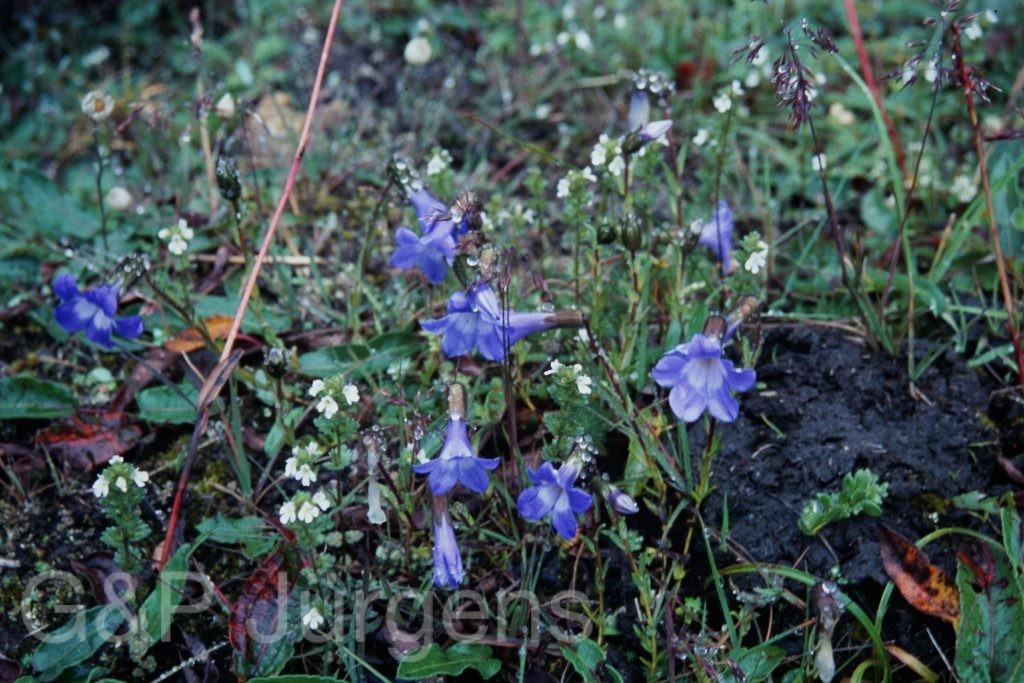
Cyananthus pedunculatus C.B.Clarke is an eastern Himalayan alpine herb confined to the high mountains of Nepal, India (Sikkim, Darjeeling), Bhutan and adjacent southern China, the GBIF record of about 60 occurrences underscoring its restricted distribution. It is a plant of moist alpine turf, rock ledges, scrub margins and grassy slopes in the subalpine to alpine zone, typically between 3500 and 4500 m. The photographed plant below Dzongri in Sikkim at around 4000 m, flowering in August, exemplifies its monsoon-season anthesis in cool, humid, well-drained high-altitude meadows beneath the snow peaks of the eastern ranges.

The species is a low, tufted or shortly ascending perennial arising from a slender woody rootstock, the stems several, prostrate to decumbent and clothed with small, alternate, entire to crenate leaves that are often revolute-margined and sparsely hairy. The flowers are solitary and terminal, borne on conspicuously elongate peduncles that distinguish the species. The corolla is broadly campanulate to funnel-shaped, blue to violet-blue, with five spreading lobes and a dense ring of white hairs in the throat; the calyx is tubular and hairy. Five stamens and a half-inferior ovary are present, the fruit a many-seeded capsule dehiscing apically.

Cyananthus is a genus of around twenty species centred on the Sino-Himalaya and characterised by its throat-bearded, campanulate corollas, sometimes treated near the Lobelioideae but retained within Campanulaceae. C. pedunculatus is recognised by its long flower-stalks, separating it from cushion-forming congeners such as C. lobatus and C. microphyllus. As a localised high-elevation endemic it is potentially sensitive to climate-driven upslope shifts and disturbance, though not formally assessed; it is occasionally grown by alpine-plant specialists.

Author: C.B.Clarke · Sources: POWO (Kew), GBIF, Flora of China, Flora of Bhutan, Annotated Checklist of the Flowering Plants of Nepal, T. T. Yü — Monograph of the genus Cyananthus

Benth.

Garh 07 558 ergebnis
India Garhwal Sena 3760m,

Description

Cynoglossum microglochin is a high-altitude species of hound's-tongue distributed across the western and central Himalayas, from Afghanistan and Pakistan through northwest India (Kashmir, Himachal Pradesh, Uttarakhand) to Nepal, Bhutan, and into southwestern China. GBIF records document 209 occurrences across its range. The species typically inhabits open alpine meadows, grassy slopes, and disturbed ground along trails at elevations of 2,800–4,200 m, where it grows in well-drained, often stony soils among other subalpine and alpine herbaceous communities.
The plant is an erect or ascending perennial herb, 20–50 cm tall, with stems covered in appressed or spreading hairs. Basal leaves are oblanceolate to spatulate, 5–15 cm long, petiolate, with entire margins and a dense indumentum of short, stiff hairs on both surfaces. Cauline leaves are progressively smaller, sessile, and semi-amplexicaul. The inflorescence consists of terminal, ebracteate, scorpioid cymes that elongate considerably in fruit. Flowers are small, 3–5 mm in diameter, with blue to violet corollas; the tube is short, with rounded fornices closing the throat. The nutlets, typically four per flower, are ovoid, 2–3 mm long, and densely covered with short, glochidiate (barbed) prickles — notably smaller than those of congeners such as C. zeylanicum, a character reflected in the epithet 'microglochin' (small barb).
This species is distinguished from the widespread Cynoglossum glochidiatum by its smaller nutlet spines and generally more compact inflorescence. It was photographed at Sena in Garhwal at 3,760 m, near the upper limit of its elevational range. Though not currently assessed by the IUCN, its preference for undisturbed alpine habitats makes it potentially sensitive to grazing pressure and climate-driven upward shifts in vegetation zones. Its biogeographical range, extending from the Hindu Kush to the eastern Himalayas, indicates a broadly adapted yet montane-restricted taxon.

Author: Benth. · Sources: POWO (Kew), GBIF, Flora of British India Vol. 4, Flora of Pakistan (Boraginaceae), Kazmi (1970) — Revision of Boraginaceae

(Sw. ex Lehm.) Thunb. ex Brand

Nepal 99 361 ergebnis
Nepal Kalomura 4050m, July
Nepal 99 556 ergebnis
Nepal Churta-Khola 3800m, July

Description

Cynoglossum zeylanicum (Sw. ex Lehm.) Thunb. ex Brand is a widely distributed herb of the borage family, ranging across tropical and warm-temperate Asia and now widely naturalised elsewhere. GBIF documents a very large number of records (c. 2,637) from China, India, Nepal, Sri Lanka, the Philippines, Japan, Korea and beyond, with introduced populations in the Americas and the Caucasus. In the Himalaya it ascends from foothill grasslands to subalpine meadows; the photographed material from west Nepal at Kalomura (c. 4,050 m) and Churta-Khola (c. 3,800 m), both flowering in July, shows it reaching the upper limits of its altitudinal range on open, disturbed slopes during the monsoon.

The plant is an erect biennial or short-lived perennial herb, 30–80 cm tall, clothed throughout in appressed to spreading hispid hairs. The leaves are alternate, the basal ones petiolate and oblong-lanceolate, the cauline leaves sessile and progressively reduced upward. The inflorescence is a scorpioid, bracteate cyme. Flowers are small with a five-lobed campanulate corolla, blue to pale blue with white fornices closing the throat. The fruit is a schizocarp splitting into four ovoid nutlets densely covered with glochidiate (barbed) bristles, an epizoochorous adaptation aiding dispersal on animal fur.

The species has at times been treated under Cynoglossum or segregated genera within tribe Cynoglosseae, and the glochidiate nutlets are diagnostic for the group. Its wide ecological amplitude and effective animal dispersal explain its near-cosmopolitan, often weedy distribution; it is of no conservation concern and is locally regarded as a minor pasture weed.

Author: (Sw. ex Lehm.) Thunb. ex Brand · Sources: POWO (Kew), Flora of China Vol. 16, Flora of Nepal, Flora of Pakistan, GBIF, Brand: Das Pflanzenreich – Borraginaceae

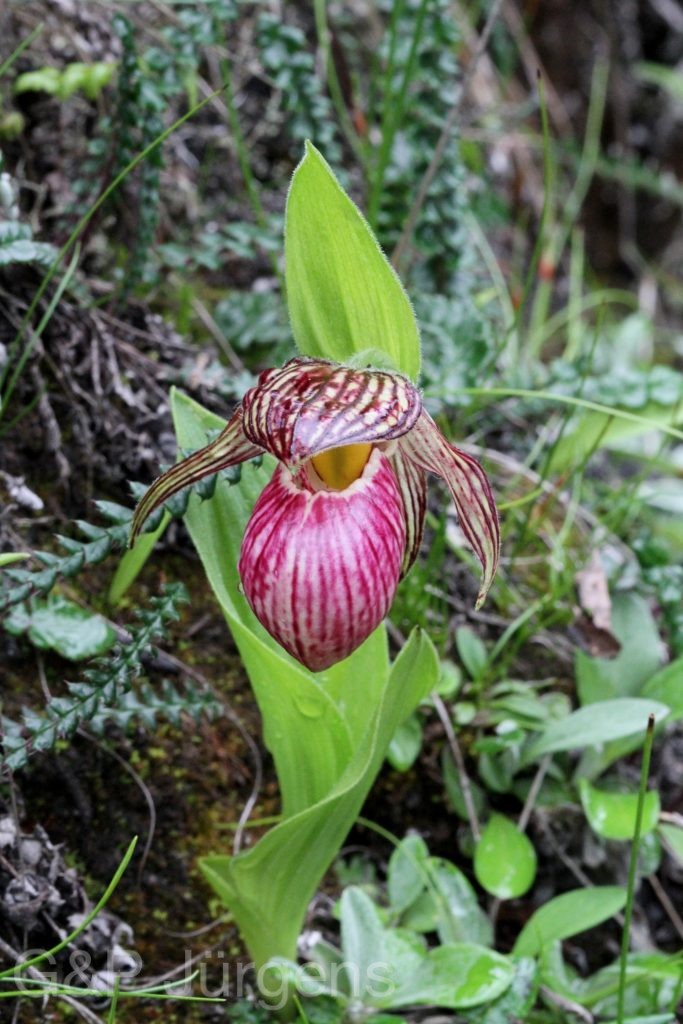
Rchb.f.

BhutanPG2011 228
Bhutan Tsochenchen, 3600m June

Description

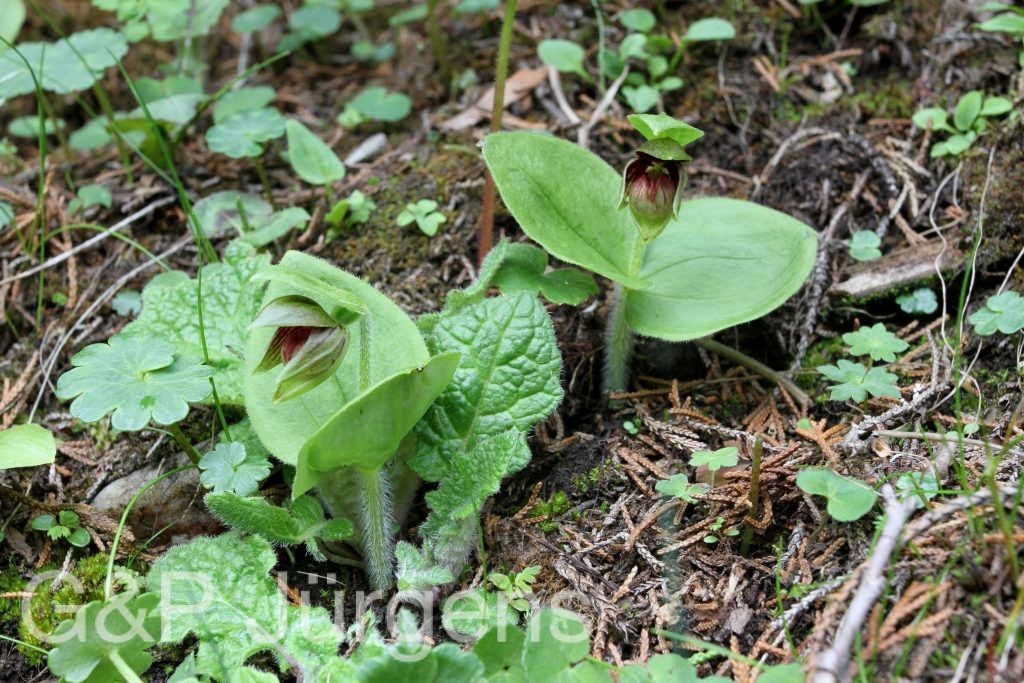
Cypripedium elegans Rchb.f. is a diminutive lady's-slipper orchid of the eastern Himalaya, recorded by GBIF from India, Nepal, Bhutan and China across some 59 occurrences. It is a plant of cool, humid high-altitude habitats, growing in mossy alpine and subalpine scrub, beneath Rhododendron and dwarf bamboo, and on shaded humus-rich banks, generally between about 3000 and 4000 m. The individual photographed at Tsochenchen in Bhutan at around 3600 m in June, early in the alpine season, reflects its preference for sheltered, perennially moist sites with deep leaf litter and a stable cool microclimate.

The plant arises from a short creeping rhizome and produces a slender, low erect stem bearing usually two broadly elliptic to ovate, plicate, prominently veined leaves that are held more or less opposite or subopposite near the top of the stem. The single nodding flower is small for the genus; the dorsal sepal and the synsepal (the fused lateral sepals) are ovate and the petals narrow, the whole pale yellowish-green to greenish, often faintly marked. The labellum is modified into the characteristic inflated, slipper-shaped pouch that traps and temporarily detains pollinating insects, which exit past the staminode and stigma, effecting pollination.

Cypripedium belongs to subfamily Cypripedioideae, the slipper orchids, marked by their two fertile anthers and saccate lip. Cypripedium elegans is one of the smallest and most delicate Himalayan members of the genus. It is uncommon, slow to establish, and like all Cypripedium it is highly sensitive to collection and habitat disturbance; the genus is listed on CITES Appendix II and several species are of conservation concern. Its restricted high-Himalayan range makes it a notable narrow-altitude alpine specialist.

Author: Rchb.f. · Sources: POWO (Kew), GBIF, Flora of Bhutan, Flora of China, Cribb monograph The Genus Cypripedium, Pearce and Cribb Orchids of Bhutan

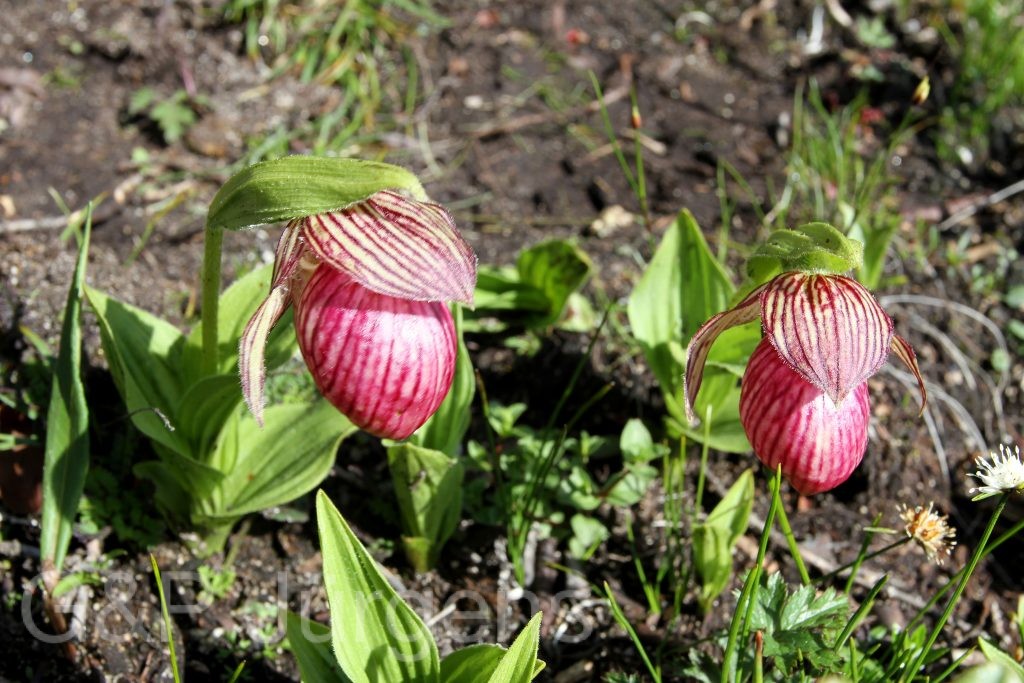
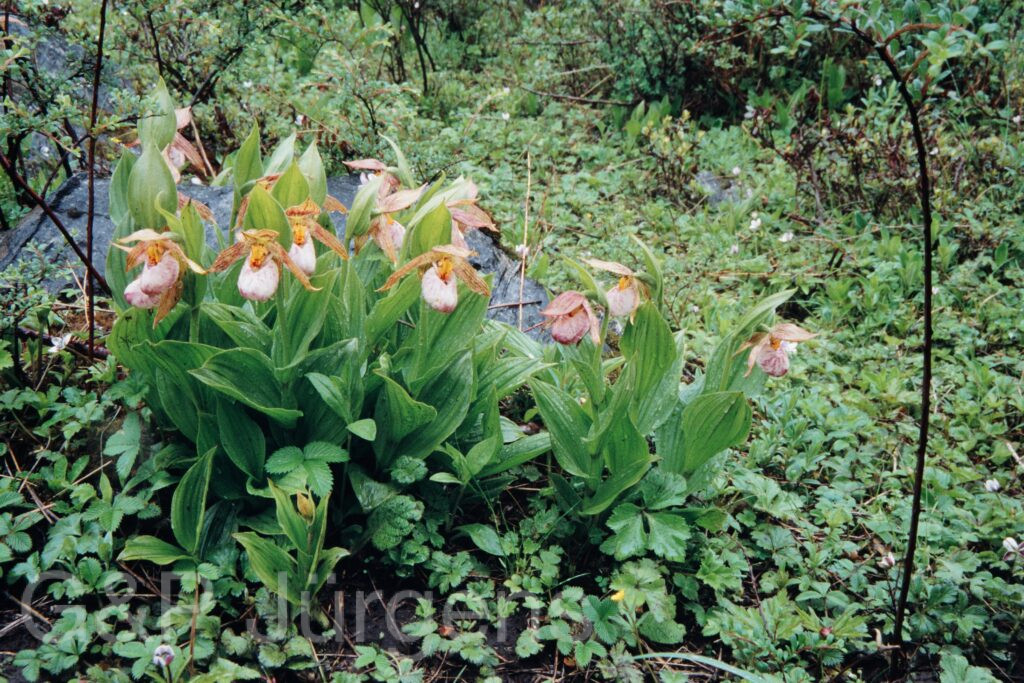
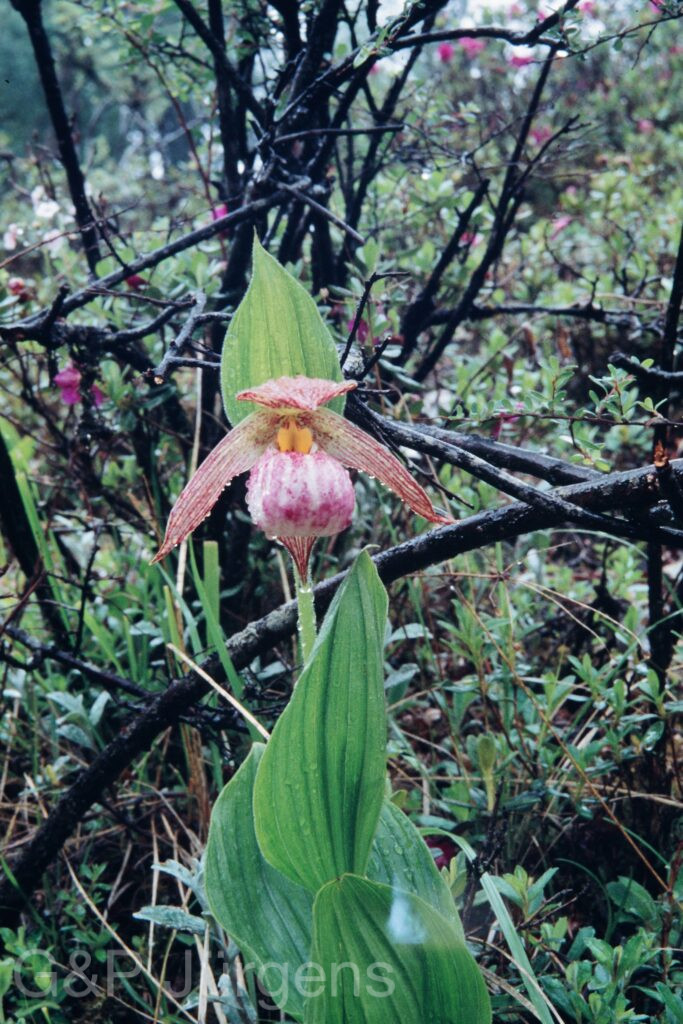
Rolfe ex. Hemsl.

BhutanPG2011 188
Bhutan Tsochenchen, 3600m June
BhutanPG2011 794
Bhutan Chele-La, 3850m July
Nepal 99 48 ergebnis
West-Nepal Nyor Gaad 2700m, June
Nepal 99 51 ergebnis
West-Nepal Nyor Gaad 2700m, June
Nepal 99 370 ergebnis
West-Nepal Nyor Gaad 2700m, June

Description

Cypripedium himalaicum is a terrestrial slipper orchid native to the eastern Himalayas, found in Bhutan, Nepal, Sikkim, and southern Tibet. It grows in alpine meadows and open forests at elevations of 3,000 to 4,500 m.

The plant reaches 15–35 cm in height, bearing one or two broadly elliptic leaves. The solitary flower is distinctive: the dorsal sepal is greenish-white with purple veins, the petals are narrow and twisted, and the lip forms a large inflated pouch, pale yellowish-green with purple spotting. Flowering occurs from May to July.

Cypripedium himalaicum is one of the highest-altitude slipper orchids in the world. It is classified as vulnerable due to habitat loss and overcollection. All Cypripedium species are listed under CITES Appendix II.

Author: Rolfe ex. Hemsl. · Sources: POWO (Kew), Flora of Bhutan, CITES Checklist

King ex Rolfe

BhutanPG2011 177
Bhutan Tsochenchen, 3600m June

Description

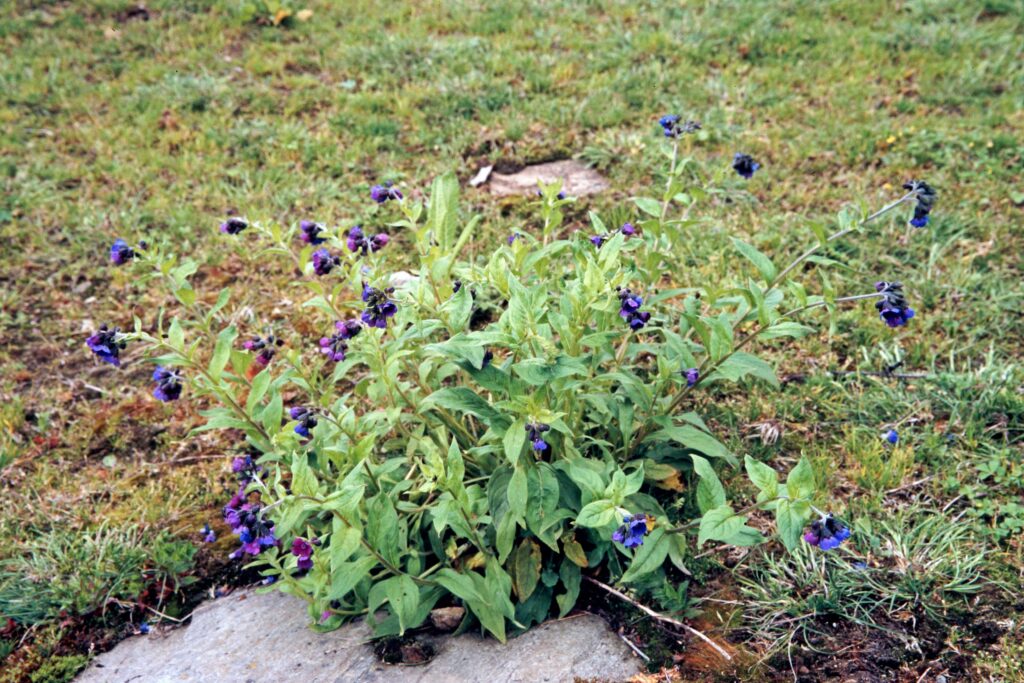
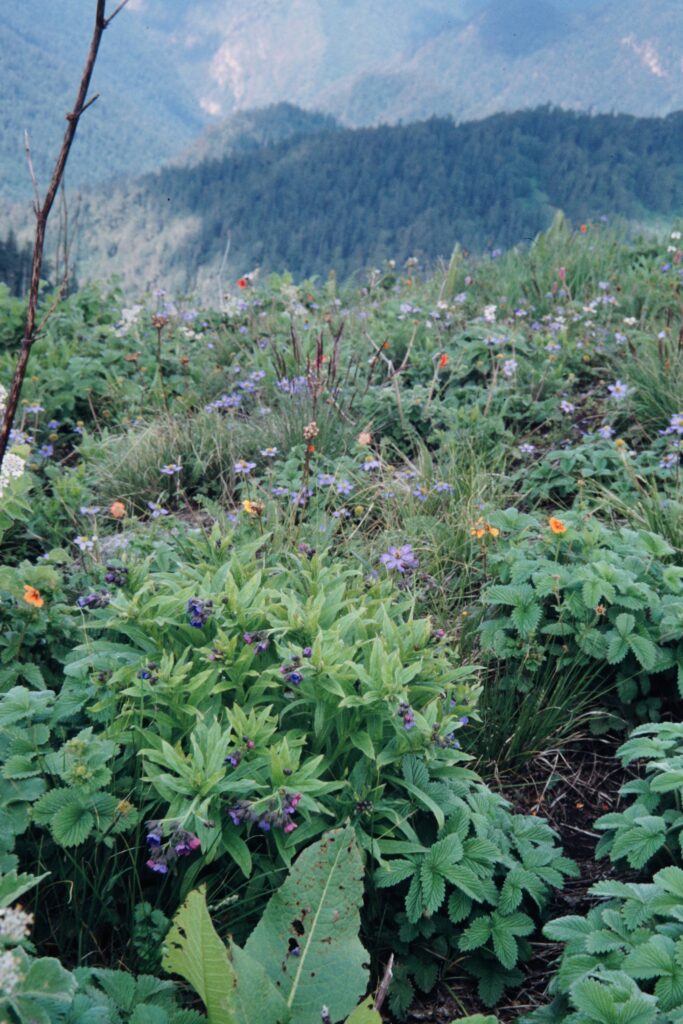
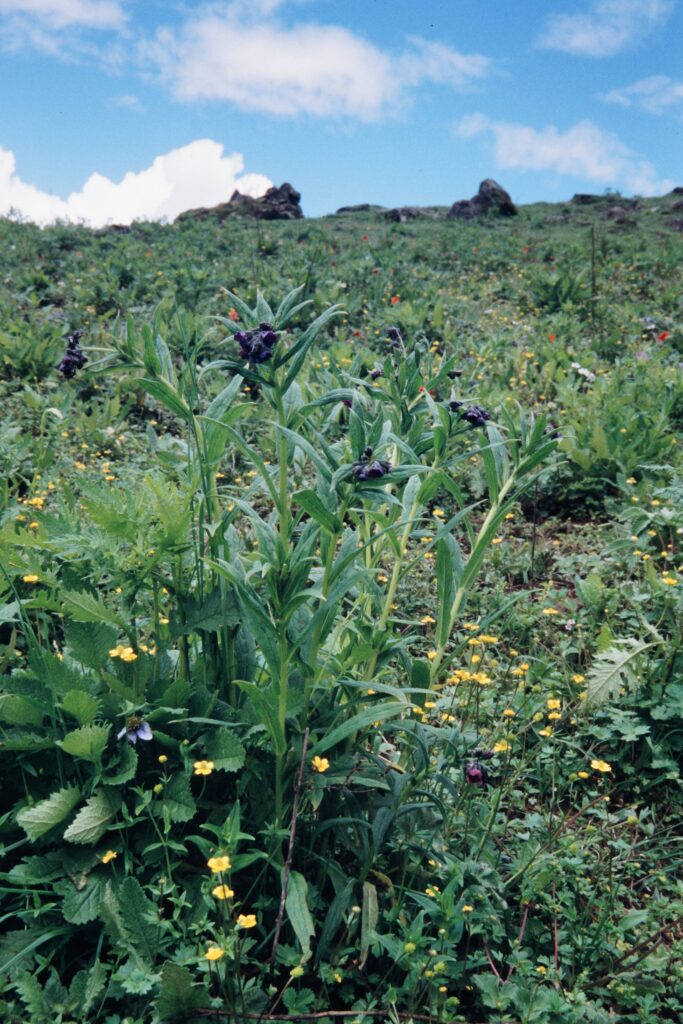
Cypripedium tibeticum is a terrestrial slipper orchid of the high Sino-Himalaya, native to China, India and Bhutan and reaching the eastern Tibetan plateau, with several hundred recorded occurrences concentrated in the mountains of southwest China. It is a plant of subalpine and alpine habitats, growing in open coniferous and Rhododendron woodland, scrub margins, grassy slopes and damp meadows, generally between about 2300 and 4200 m. The individual shown at Tsochenchen in Bhutan at 3600 m in June illustrates its flowering in early summer in cool, humus-rich montane turf.

The plant is a perennial herb arising from a short, creeping rhizome with fleshy roots, producing erect stems each bearing usually three to four broadly elliptic to ovate, plicate leaves with prominent venation. The solitary, terminal flower is large and conspicuous, subtended by a leafy bract. The sepals and petals are deep purple to blackish-maroon, often paler-veined, the dorsal sepal broad and the lateral sepals fused into a synsepal beneath the lip. The defining feature is the large, inflated, pouch-like labellum, deep wine-purple and reticulately veined, which functions as a trap pollination chamber. The column bears a flat, sterile staminode, and the fruit is an erect capsule.

The species belongs to Cypripedium section Cypripedium, the temperate slipper orchids, and is among the most variable and widespread members in the Himalayan–Tibetan region, with several varieties described. Its showy flowers and deceptive food-mimic pollination by bees make it of pollination-biological interest. Heavily threatened by collection and habitat disturbance, it is listed on CITES Appendix II and is of genuine conservation concern across its range.

Author: King ex Rolfe · Sources: POWO (Kew), GBIF, Flora of China, The Orchids of Bhutan (Pearce & Cribb), Cribb The Genus Cypripedium, CITES Appendices

(D.Don) Soó

Nepal 99 109 ergebnis
West-Nepal South of Rara-Lake 3600m, June
Garh 07 43 ergebnis
India Garhwal Nanu at Mandakini 2400m, June

Description

Dactylorhiza hatagirea (D.Don) Soó is a terrestrial marsh orchid of the Himalaya and Central Asia, recorded from Afghanistan, Pakistan, India, Nepal, Bhutan, China, Mongolia and Russia; the GBIF dataset of 311 occurrences reflects a wide but increasingly fragmented high-altitude range. It grows in moist alpine and subalpine meadows, marshy grassland, streamsides and damp slopes, broadly between 2500 and 4000 m. The photographed plants from south of Rara Lake in West Nepal at about 3600 m and from Nanu at the Mandakini in Garhwal, India, at about 2400 m, both flowering in June, exemplify its early-summer anthesis in cool, wet, open meadows across the western and central Himalaya.

The species is an erect, glabrous, tuberous perennial herb arising from palmately lobed, hand-shaped root-tubers — the digitate tubers giving both the generic name and the local trade name "Hatajari" or "Salampanja." The stem is stout and hollow, bearing several oblong-lanceolate, sheathing, usually unspotted leaves grading into bracts above. The inflorescence is a dense, many-flowered terminal spike of pink to purple-violet flowers; each has spreading sepals, a hooded arrangement of the upper segments, and a broad, three-lobed, darkly spotted labellum with a stout, descending spur. The column bears two pollinia, and the fruit is a ribbed, dehiscent capsule releasing minute, dust-like seeds.

Dactylorhiza (Orchidaceae, subtribe Orchidinae) is a north-temperate genus of tuberous marsh orchids defined by palmately divided tubers and spurred, lobed labella; D. hatagirea is its principal Himalayan representative. The dried tubers are intensively harvested for the salep trade and traditional medicine, and this over-collection, compounded by grazing and habitat loss, has driven steep population declines. It is consequently listed on CITES Appendix II and regarded as threatened and legally protected across much of its range, making it a priority for conservation and sustainable management.

Author: (D.Don) Soó · Sources: POWO (Kew), GBIF, Flora of China, Flora of Bhutan, Annotated Checklist of the Flowering Plants of Nepal, Pridgeon et al. — Genera Orchidacearum

Daphne bholua

by GP Jürgens

Buch.-Ham. ex D.Don

Sikkim2011 45
Sikkim Vista-valley 3750m, June
Sikkim2011 49
Sikkim Vista-valley 3750m, June

Description

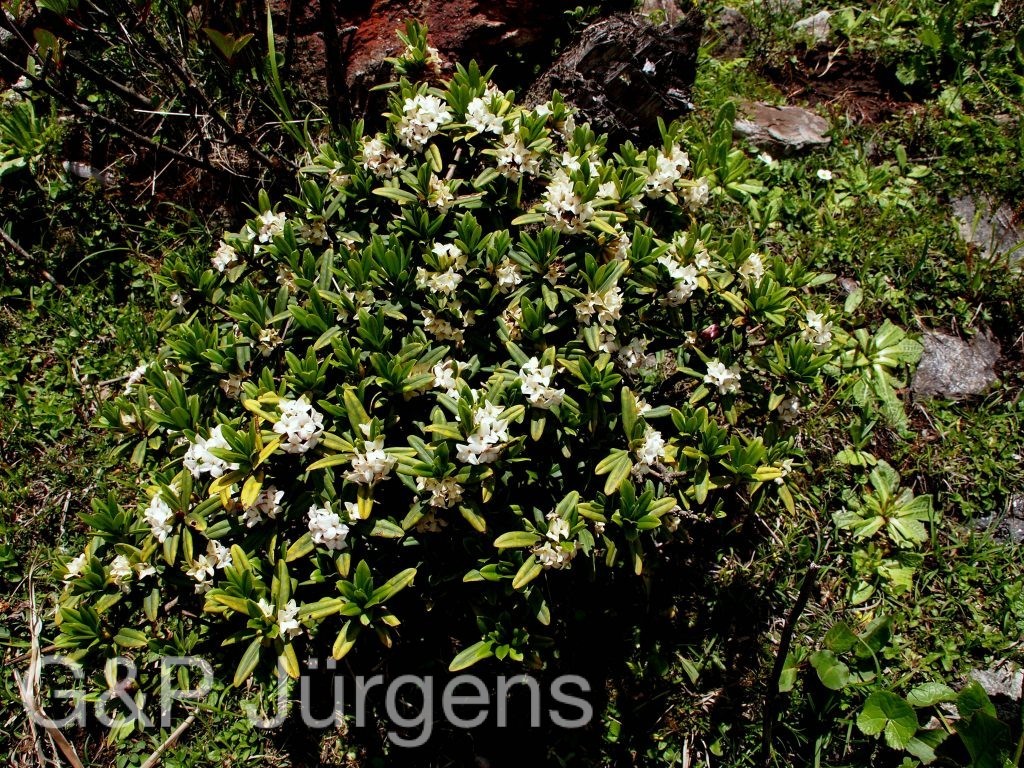
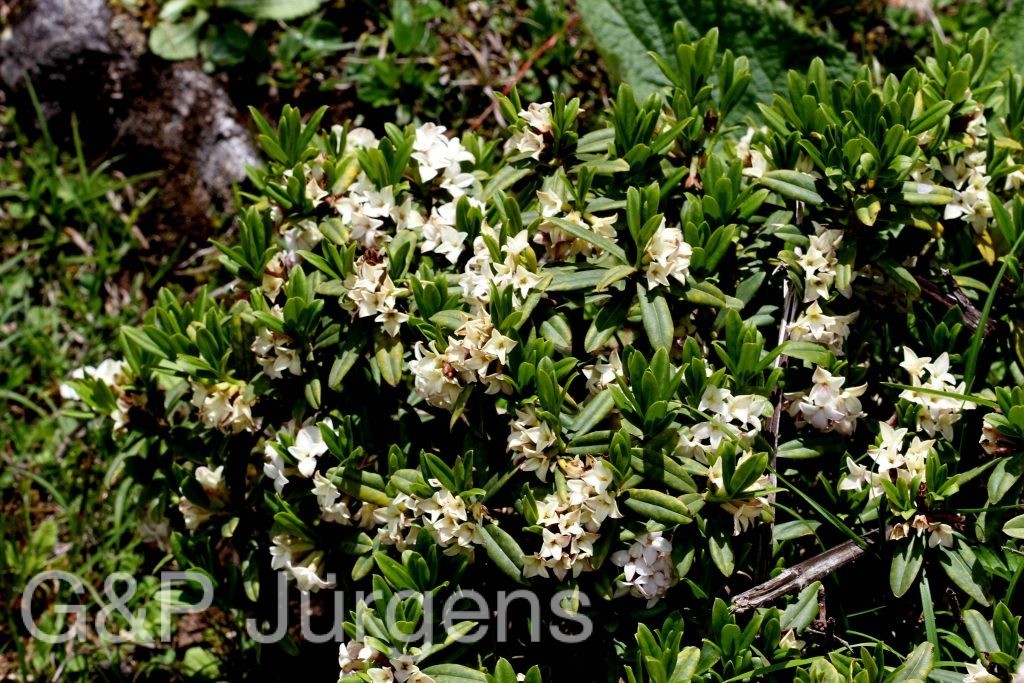
Daphne bholua is an evergreen to semi-deciduous shrub of the central and eastern Himalaya, distributed through Nepal, China, Bhutan and India, with around 758 georeferenced records; its appearance in numerous temperate countries reflects its extensive horticultural cultivation. In the wild it occupies temperate and subalpine forest, scrub and clearings, often in oak, rhododendron and conifer woodland and on open hillsides. The plant photographed in Sikkim's Vista valley at 3750 m, flowering in June, exemplifies its upper-elevation range, where it forms thickets on moist, well-drained slopes.

It grows as an erect shrub to about 2.5 m with tough, fibrous bark and densely leafy branches. The leaves are alternate, clustered toward the branch tips, oblong-lanceolate, leathery, glossy dark green above and entire-margined. The fragrant flowers are borne in dense terminal and subterminal clusters; each has no petals but a petaloid, salverform perianth tube, white within and flushed rose-purple outside, the four spreading lobes strongly scented. The fruit is a fleshy ovoid berry-like drupe, blackening when ripe.

Daphne bholua, described by Buchanan-Hamilton ex D. Don, is celebrated in horticulture for its intensely fragrant winter-to-spring flowers and has given rise to many cultivars. In its homeland the strong bast fibres of the bark are a principal source of traditional Nepali handmade paper (lokta). Like other Thymelaeaceae it contains acrid, toxic compounds. Although widespread and not formally threatened, intensive bark harvesting for paper-making places localised pressure on wild populations.

Author: Buch.-Ham. ex D.Don · Sources: POWO (Kew), GBIF, Flora of Bhutan, Annotated Checklist of the Flowering Plants of Nepal, Halda The Genus Daphne