Tag:

Bhutan

Flowers of Bhutan — 1326 plant species documented across the Bhutanese Himalaya, from dense broadleaf and conifer forests to alpine scrub and meadows. Bhutan’s largely intact wilderness shelters an exceptional diversity of orchids, rhododendrons, primulas and Himalayan poppies, many of them regional endemics. Each species page includes a botanical description, distribution, habitat and flowering time, with the original photograph and its recorded altitude and locality.

Blume

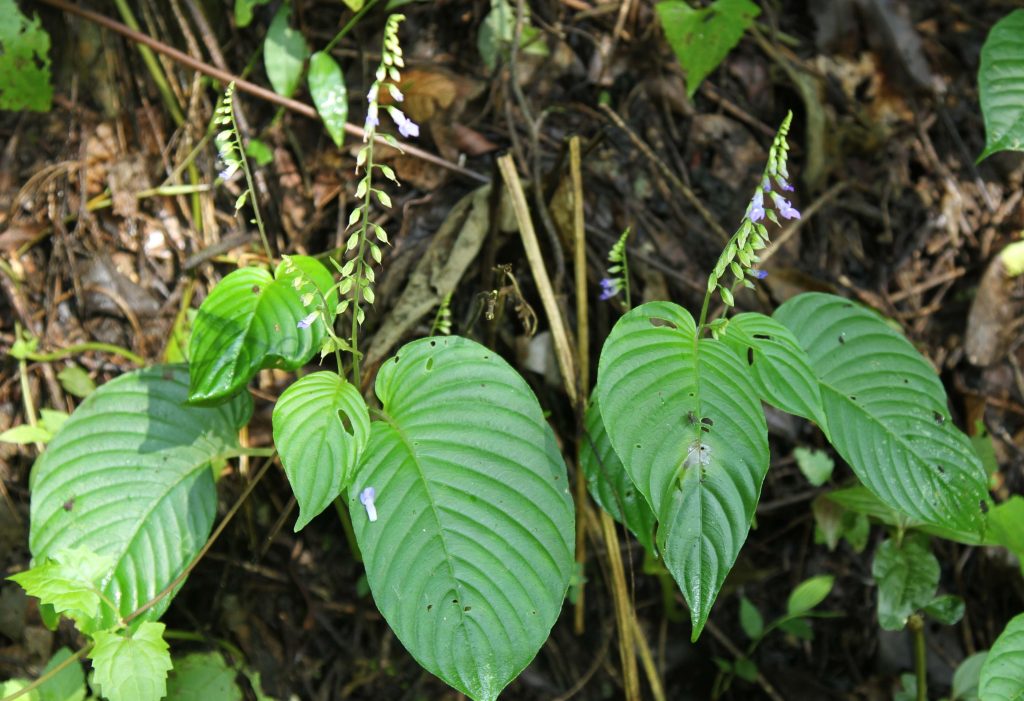
Bhutan2012 983
Bhutan Trithangebe 1100m, October
Bhutan2012 984
Bhutan Trithangebe 1100m, October

Description

Rhynchoglossum obliquum is a widespread tropical Asian gesneriad ranging from India, Nepal, Bhutan and Bangladesh through Myanmar, Thailand, southern China, Taiwan and the Malesian region (Malaysia, Indonesia, Philippines, New Guinea, Timor) to Indochina, with more than 2200 GBIF occurrences. It is an annual herb of moist, shaded habitats on forest floors, damp rock faces, stream banks and roadside cuttings in the subtropical to tropical lowland and lower-montane zone. The plant recorded at Trithangebe in southern Bhutan at 1100 m, flowering in October at the close of the monsoon, typifies its occurrence on humid, shaded ground at low to mid elevations.

It is a soft, erect annual with succulent, often translucent stems. The leaves are markedly asymmetric (oblique) at the base, ovate to ovate-lanceolate, membranous and entire to obscurely toothed, the strong inequilaterality reflected in the epithet and frequently arranged so that the lamina appears one-sided. The flowers are borne in slender, secund, one-sided terminal racemes; each has a tubular, winged or keeled calyx and a small two-lipped blue to violet corolla with a short tube, the lower lip often marked white. There are two fertile stamens, and the superior ovary ripens into a small ellipsoid capsule enclosed by the persistent calyx, releasing numerous minute seeds.

The input places the species in the subtribe Loxonieae (here as Loxodinae) within Gesneriaceae, where Rhynchoglossum is distinguished by its oblique leaves and secund racemes. Its small bilabiate flowers are insect-pollinated and the dust-like seeds dispersed by rain-wash, aiding colonisation of disturbed shaded ground. As a widespread weedy annual it is of no conservation concern.

Author: Blume · Sources: POWO (Kew), GBIF, Flora of China Vol. 18, Flora of Bhutan Vol. 2, Flora of Nepal, The Gesneriaceae of the Old World (Rhynchoglossum)
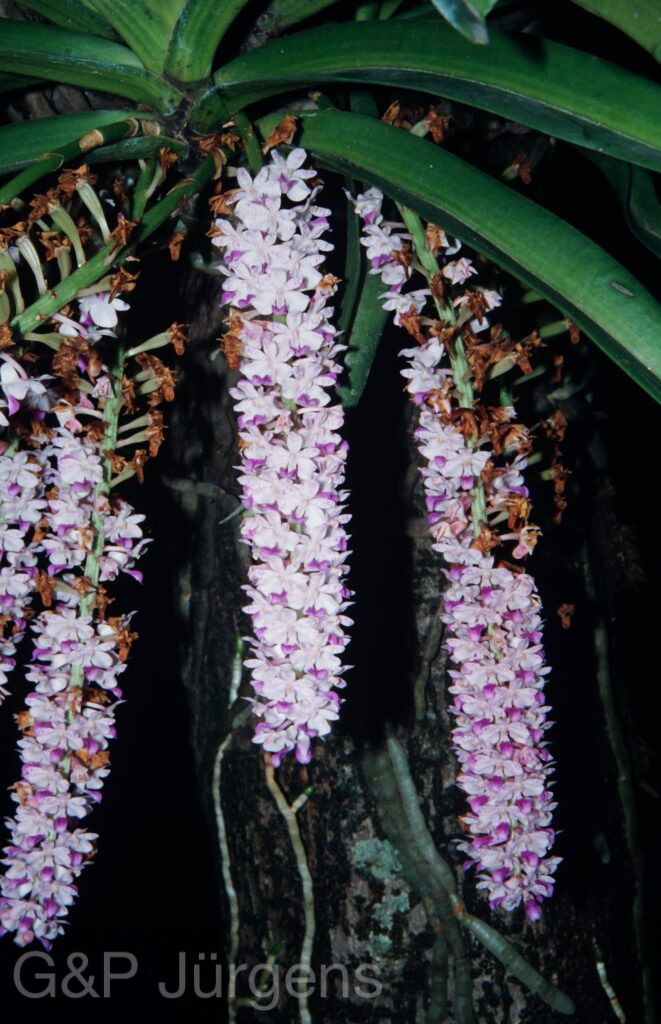
(L.) Blume

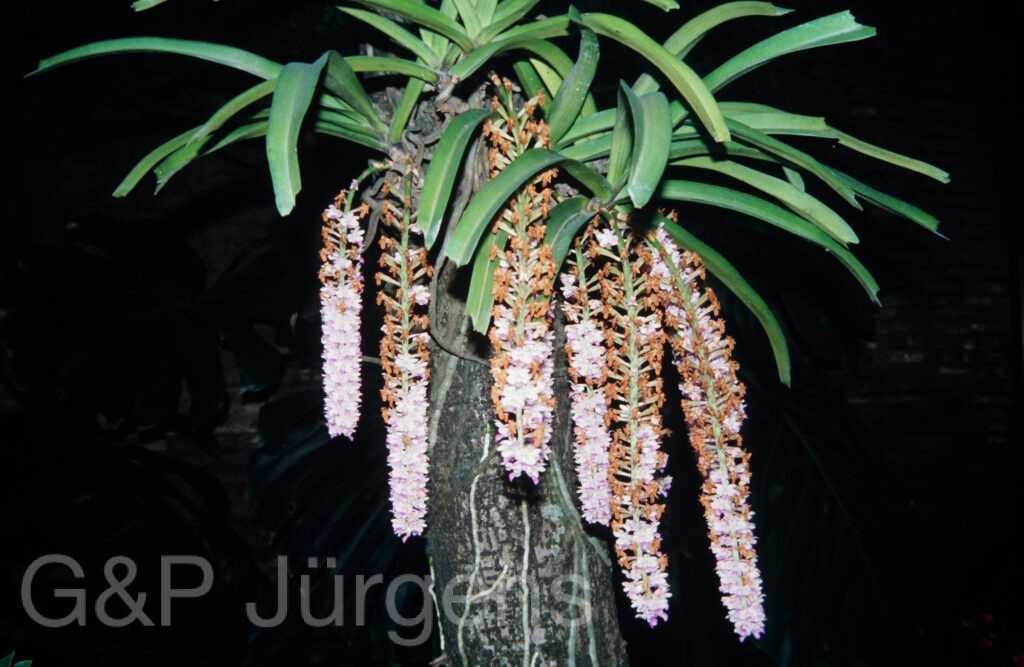
Nepal 99 1024 ergebnis ergebnis
Nepal Kathmandu 1300m, July
Nepal 99 1025 ergebnis ergebnis
Nepal Kathmandu 1300m, July

Description

Rhynchostylis retusa (L.) Blume, the foxtail orchid, is an epiphyte widely distributed across tropical and subtropical Asia, with GBIF (617 occurrences) recording it from India, Nepal, Bhutan, China, Myanmar, Thailand, Laos, Vietnam, Cambodia, Sri Lanka, Bangladesh, Indonesia and the Philippines, plus many cultivated records. It grows on the trunks and branches of broadleaved trees in humid lowland and submontane forest, along forest edges and on roadside trees, flowering during the warm, wet summer. The photographed plant from the Kathmandu valley in Nepal at 1300 m in July reflects its typical occurrence in the warm-temperate to subtropical foothill belt of the Himalaya, where it flowers with the monsoon.

The species is a monopodial epiphyte with a short, stout stem clad in the persistent bases of distichous, fleshy, strap-shaped leaves that are channelled and conspicuously praemorse (retuse to unequally bilobed) at the apex, giving the epithet. Numerous thick, greyish aerial roots clasp the host bark. The inflorescence is a dense, pendent, cylindrical raceme of many small fragrant flowers, each white spotted and suffused with rose-purple or violet, with a spurred, entire to obscurely lobed labellum and a small column. The fruit is a pendent dehiscent capsule shedding dust-like wind-dispersed seeds.

Within the vandaceous alliance Rhynchostylis is a small genus of showy, scented epiphytes much esteemed in horticulture, and R. retusa holds particular cultural significance, being the state flower (kopou phul) of Assam. Like all orchids it is protected under CITES Appendix II. While still locally common, wild populations are reduced by habitat loss and unsustainable collection for the ornamental trade.

Author: (L.) Blume · Sources: POWO (Kew), GBIF, Flora of Nepal, The Orchids of the Himalaya (King & Pantling), Genera Orchidacearum (vandaceous orchids), CITES Appendix II

Wall.

Nepal 2001 373 ergebnis ergebnis
Nepal Kharka 3140m, May

Description

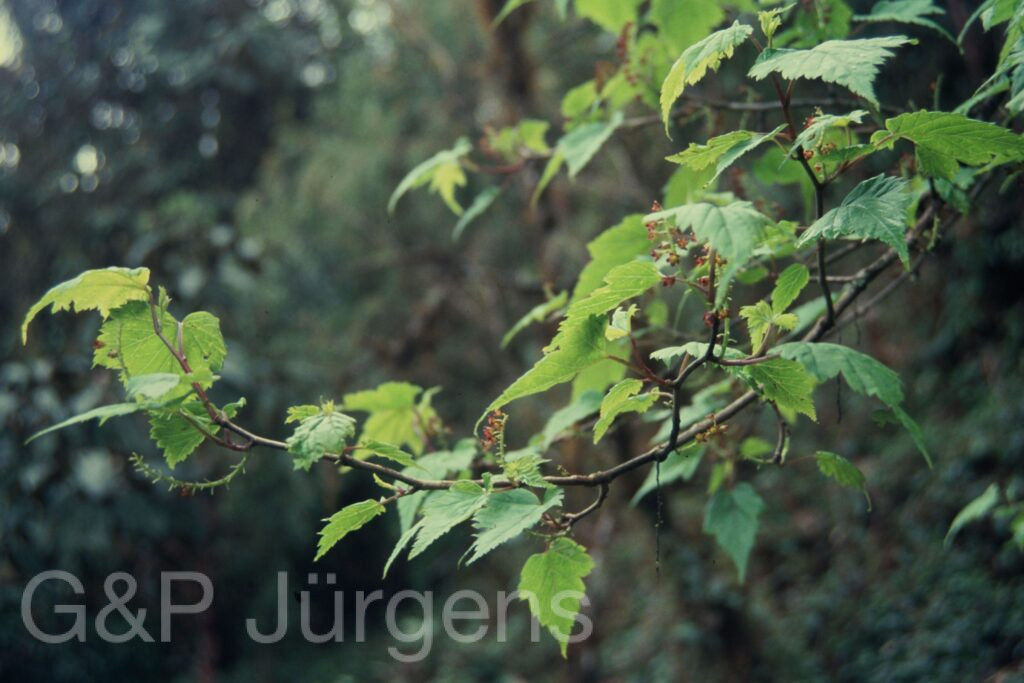
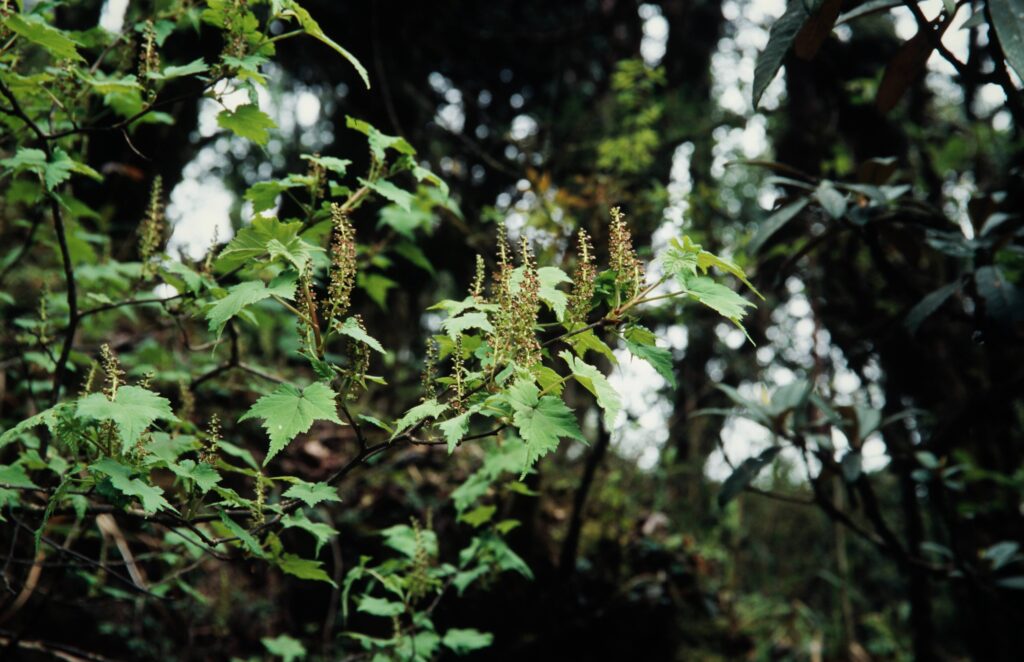
Ribes glaciale is a Himalayan and Sino-Himalayan currant distributed from Afghanistan and Pakistan through Nepal, NW India and Bhutan into SW and central China, with 2,141 GBIF occurrences (records from Europe and the Americas reflect cultivated or naturalised material). It is a shrub of subalpine and temperate forest, forest margins, shrubberies and rocky slopes, typically between about 2,500 and 4,000 m. The Nepalese collection from a kharka (high pasture) at 3,140 m in May captures it flowering in the spring, when it forms a component of mixed deciduous and conifer understorey thickets.

It is a deciduous, unarmed shrub 1–2 m tall with slender, glabrous to sparsely glandular branches. The leaves are alternate, small, broadly ovate to suborbicular, 1.5–4 cm wide, palmately 3–5-lobed with the central lobe longer, the margins toothed, on slender petioles. The plant is functionally dioecious or sub-dioecious; the flowers are borne in short erect racemes, small and reddish to purplish, with a shallow campanulate hypanthium, five reflexed sepals and minute petals. The fruit is a small, globose to ovoid red berry crowned by the persistent calyx.

The species belongs to Ribes subgen. Ribes and is one of several closely allied, lobed-leaved Himalayan currants that can be difficult to separate. GBIF treats the name as accepted; note that the image filename references R. laciniatum, but the named taxon R. glaciale is followed here. The red berries are taken by birds and provide effective dispersal, and the species is widespread and of least concern.

Author: Wall. · Sources: POWO (Kew), Flora of China Vol. 8, Flora of Pakistan, GBIF, Berger: A Taxonomic Review of Currants and Gooseberries (1924)

Hook. f. & Thomson

Sikkim2011 366
Sikkim Lada-La 3900m, June

Description

Ribes griffithii is a Sino-Himalayan currant of high-elevation shrubberies, distributed through China, Nepal, Bhutan and India (with a few scattered extralimital records); GBIF lists 277 occurrences, the great majority along the Himalayan and Tibetan margins. It occupies subalpine forest edges, Rhododendron and juniper scrub, moist rocky slopes and streamside thickets, generally between about 3000 and 4000 m. The illustrated plant was recorded in Sikkim near Lada-La at 3900 m in June, a characteristic upper-montane to subalpine station where the shrub leafs out and flowers as the snow recedes.

The plant is a deciduous, unarmed shrub with arching to ascending branches and smooth or flaking bark. Leaves are alternate, palmately three- to five-lobed with a cordate base and a serrate to crenate-dentate margin, glabrescent to slightly pubescent and borne on slender petioles. The flowers are arranged in pendulous, many-flowered racemes; each is small, with a saucer-shaped to shallowly campanulate hypanthium, five reflexed greenish to reddish sepals, five smaller petals, five stamens and an inferior ovary. The fruit is a glabrous, ellipsoid to globose berry, reddening to dark red at maturity and crowned by the persistent perianth.

The species belongs to subgenus Ribes among the unarmed true currants, distinguished from the spiny gooseberries by its racemose, many-flowered inflorescences. POWO and GBIF accept the name. As a fleshy-fruited shrub it contributes to the diet of Himalayan birds and small mammals that disperse its seeds across the subalpine mosaic.

Author: Hook. f. & Thomson · Sources: POWO (Kew), GBIF, Flora of China, Flora of Bhutan, Annotated Checklist of the Flowering Plants of Nepal, A Monograph of the Genus Ribes (Grossulariaceae)

Royle ex Decne.

Garh 07 113 ergebnis
India Garhwal Meggu Kichatti 3200m, June
Garh 07 114 ergebnis
India Garhwal Meggu Kichatti 3200m, June

Description

Ribes himalense Royle ex Decne. is a deciduous currant of the Himalaya and the mountains of western China. Its native range, reflected in GBIF records from India, Nepal, Pakistan, Bhutan, Afghanistan, China and Myanmar (with numerous European and North American records representing cultivated or naturalised material), spans the Himalaya into the Hengduan ranges. It inhabits subalpine forest, forest margins, streamsides and rocky slopes, typically between about 2,500 and 4,000 m. The plant from Meggu Kichatti in Garhwal at 3,200 m, fruiting in June, illustrates its occurrence in the upper temperate to subalpine belt.

The species is an erect, unarmed (spineless) shrub up to about 1–2 m tall with glabrous to glandular young branches. The alternate leaves are palmately three- to five-lobed, cordate at the base, with serrate lobes, glabrous or sparsely hairy. The flowers are borne in erect to spreading racemes; each flower has a shallowly saucer-shaped, greenish to purplish hypanthium, small reflexed sepals and minute petals, and is subtended by a bract. The fruit is a smooth, glabrous, red berry that is edible, ripening to a translucent crimson.

Ribes himalense belongs to the subgenus Ribes (the true unarmed currants) and is closely related to the European R. rubrum, with which it shares edible red fruit; it has been treated by some authors as a subspecies. The fruits are gathered locally and consumed, and the species is of interest as a wild relative of cultivated currants for breeding. It is widespread and of least concern.

Author: Royle ex Decne. · Sources: POWO (Kew), GBIF, Flora of China Vol. 8, Flora of Pakistan, Berger: A Taxonomic Review of Currants and Gooseberries

Hook. f. & Thomson

Bhutan2014 606
BhutanPhobjika 2810, May
Sikkim2011 76
Sikkim Tanghu 3900m, June

Description

Ribes luridum is a Sino-Himalayan currant distributed from south-western China through northern Myanmar, Nepal, northern India and Bhutan, with around 348 GBIF occurrences (the records from US, CA, PL and RU largely representing cultivated or herbarium material). It is a shrub of cool-temperate to subalpine forest, scrub margins and rocky slopes, typically between about 2800 and 4000 m. The collections from Phobjika in Bhutan at 2810 m in May and from Tanghu in Sikkim at 3900 m in June bracket this altitudinal range and its late-spring to early-summer flowering, on moist, humus-rich ground at and above the upper forest belt.

It is a deciduous, unarmed shrub with spreading branches and finely glandular young growth. The leaves are alternate, orbicular-cordate in outline and palmately three- to five-lobed, the lobes crenate-serrate, sparsely pubescent and often glandular beneath. The species is dioecious or functionally so, the small flowers borne in short, few-flowered, pendulous racemes; each has a saucer-shaped to shortly campanulate hypanthium and five small, dull purplish to lurid greenish-brown petals and sepals, the colouration alluded to by the epithet. The fruit is a small subglobose berry, glandular-bristly and reddish to dark purple when ripe.

Within Ribes the species sits in the section of unarmed currants and is distinguished by its dingy, glandular flowers and dioecious tendency. The pendulous berries are dispersed by frugivorous birds, an important agent in fragmented montane forest, while the inconspicuous flowers attract small bees and flies. The species is widespread across the eastern Himalaya and faces no recognised conservation threat.

Author: Hook. f. & Thomson · Sources: POWO (Kew), GBIF, Flora of China Vol. 8, Flora of Bhutan Vol. 1, Flora of Nepal, A Monograph of the Genus Ribes

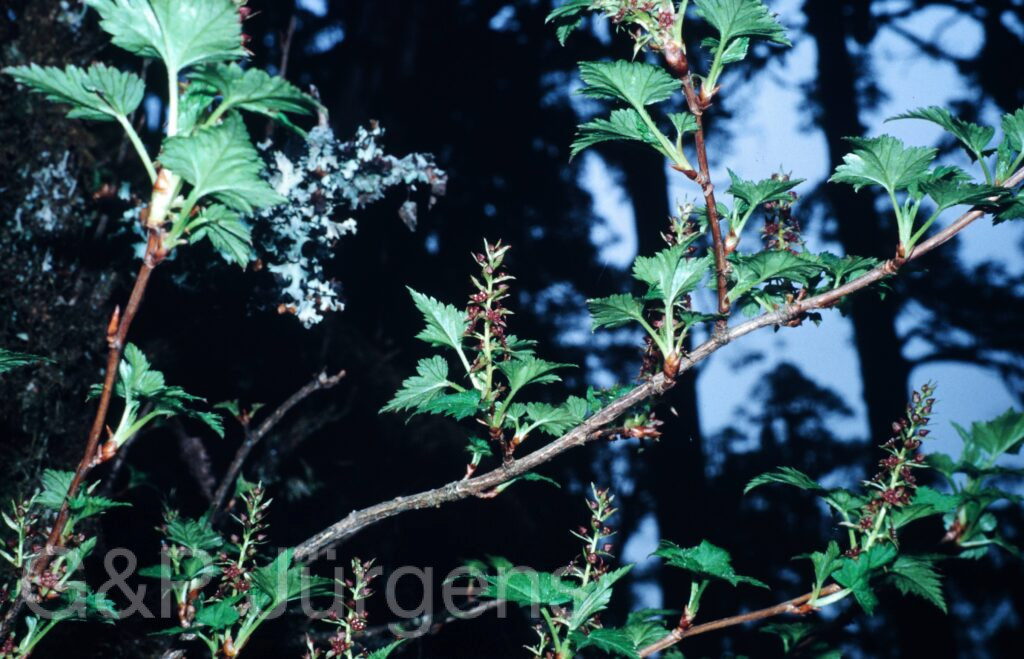
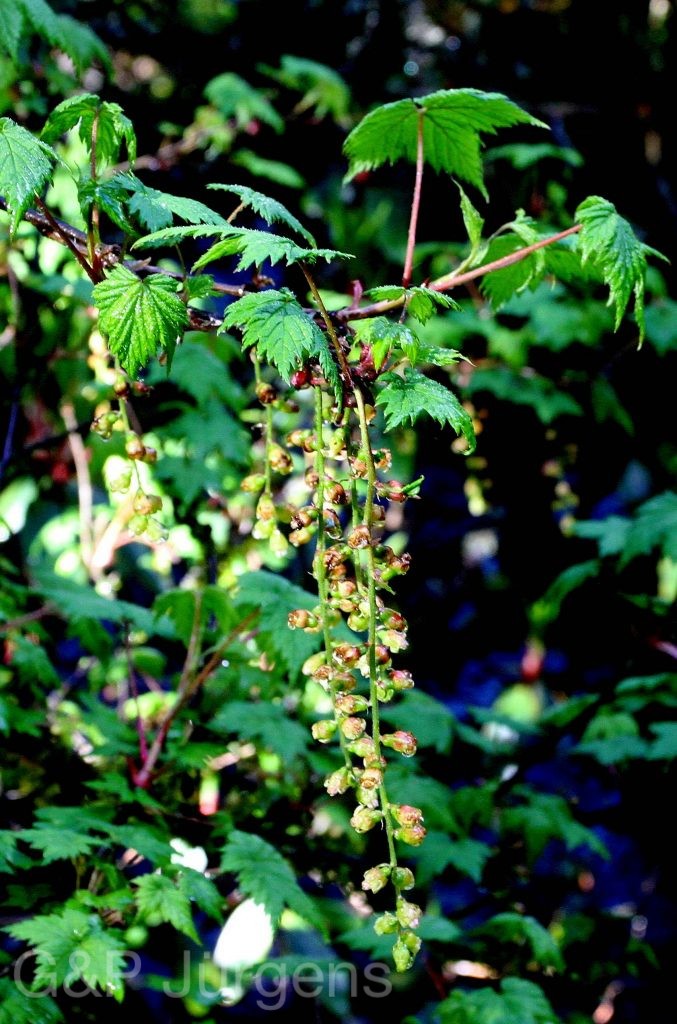
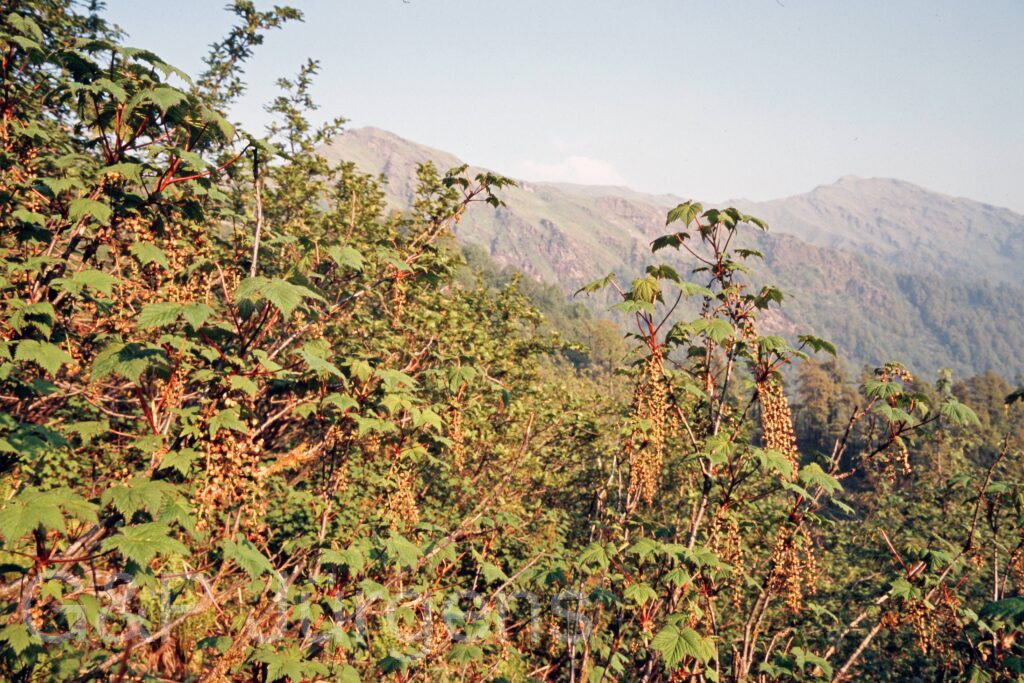
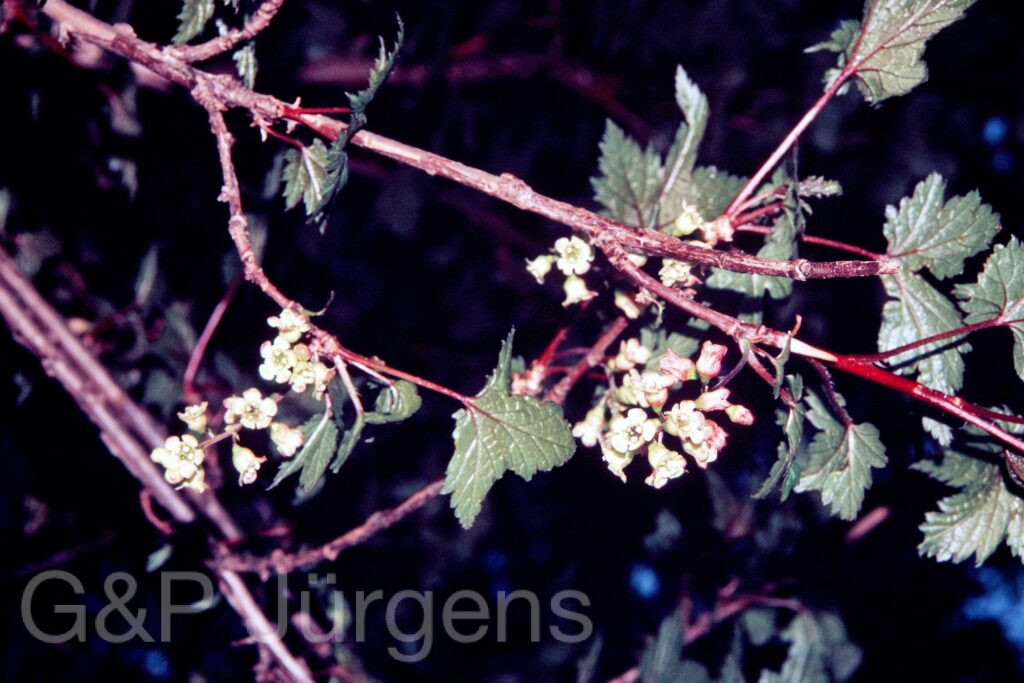
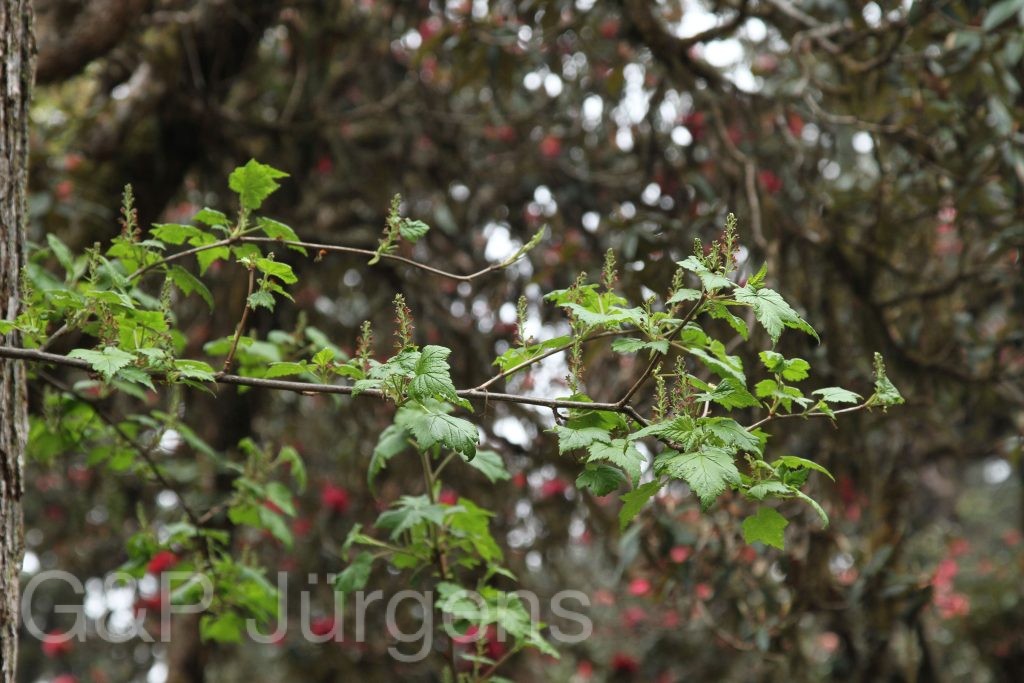
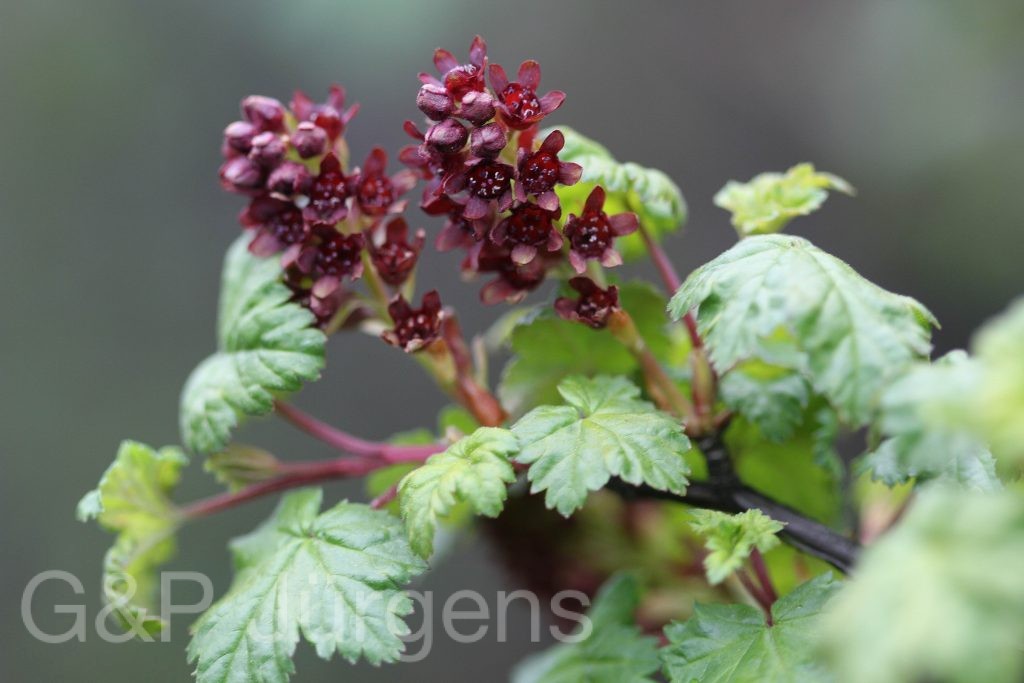
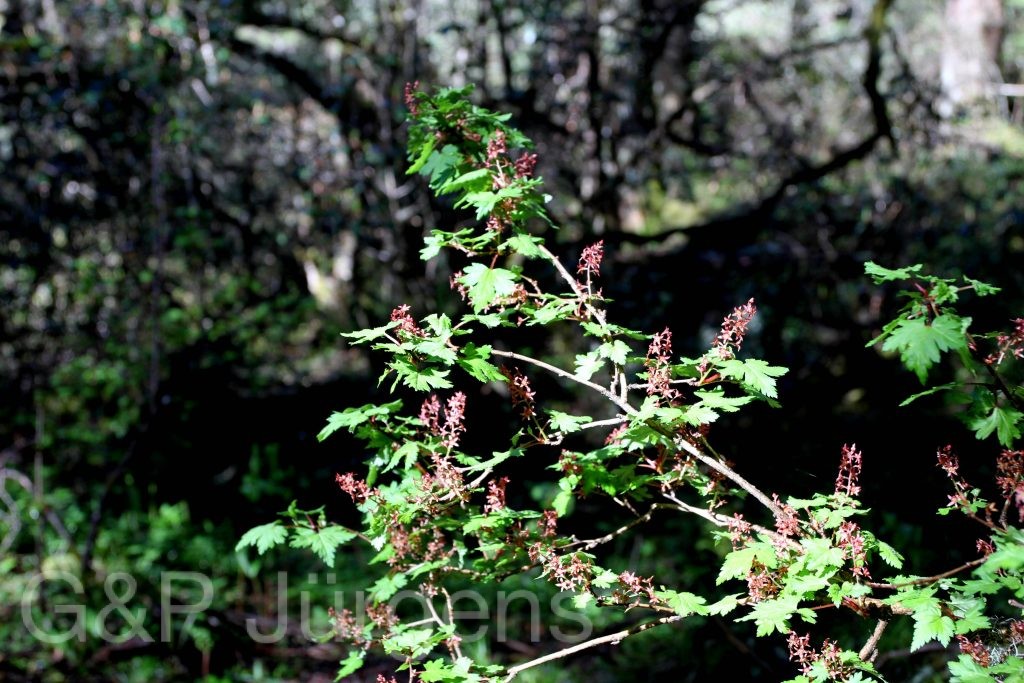
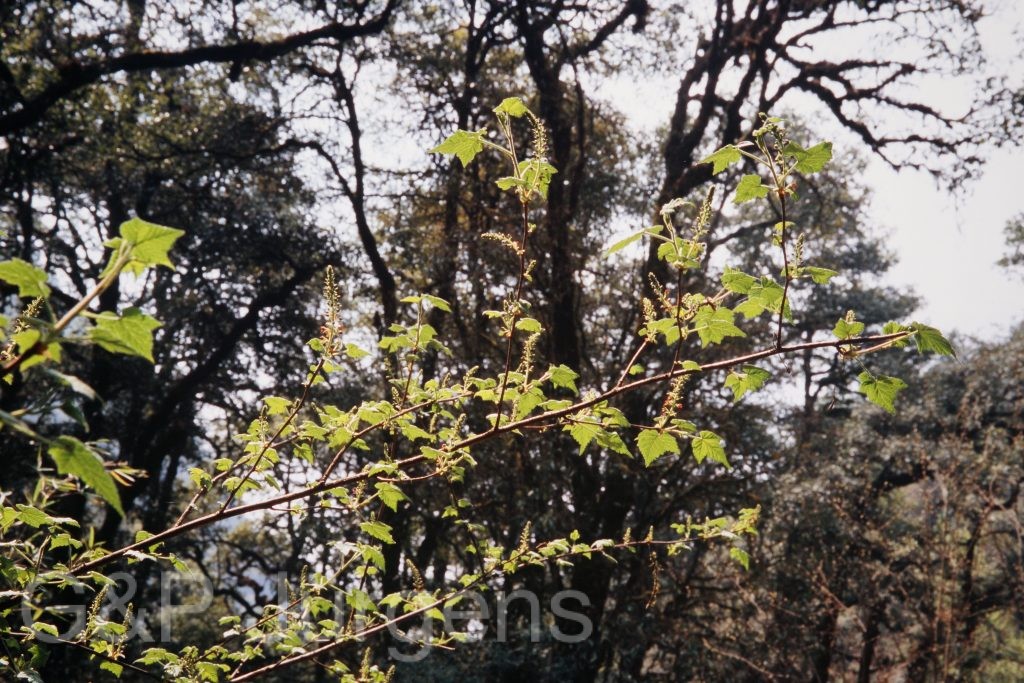
D. Don

Sikkim2011 365
Sikkim Lada-La 3900m, June
Bh2008 12 P20
Bhutan Thimphu-Chu, 2750m April
Sikkim2004 62 P110
Sikkim West-Bengal, Bersay 2700m April
Sikkim 2006 30 ergebnis
India West-Bengal Tonglu 3150m, May

Description

Ribes takare is a Himalayan currant distributed along the temperate and subalpine belt from Afghanistan through Pakistan, Nepal, India and Bhutan into southwestern China and Myanmar, with GBIF recording close to a thousand occurrences across this arc. It grows in moist temperate and upper montane forest, forest margins, shrubberies, ravines and rocky slopes, typically between about 2500 and 4000 m. The image caption documents this range well, with collections from the Lada La in Sikkim at 3900 m in June, the Thimphu Chu in Bhutan at 2750 m in April, Bersay in West Bengal at 2700 m in April, and Tonglu at 3150 m in May, showing both its broad altitudinal span and its spring-to-early-summer flowering as the snowline retreats.

It is a deciduous, spineless (unarmed) shrub up to about 2-3 m tall, with greyish, peeling bark and glandular-pubescent young shoots. The leaves are alternate, palmately three- to five-lobed with crenate-serrate margins and a cordate base, somewhat resembling a maple leaf and often glandular-hairy beneath. The flowers are borne in many-flowered, pendulous racemes; they are small and reddish to purplish-brown, with a saucer-shaped to shallowly campanulate hypanthium, five reflexed sepals, five smaller petals, five stamens and an inferior ovary. The fruit is a glandular-bristly, reddish to purplish-black berry that is edible but rather acidic and somewhat resinous.

The genus Ribes, sole genus of Grossulariaceae, is well represented in the Himalaya, where R. takare belongs to the unarmed, raceme-flowered black-currant alliance and has been treated under synonyms including R. acuminatum and R. glaciale-related names by various authors. Its pendent racemes of nectariferous flowers attract bees and other insects, while the berries are dispersed by birds and small mammals; the species forms an understorey component of moist Himalayan forest. It is widespread and common across its extensive range and is of no conservation concern, while its acidic fruits are gathered locally and its hardiness has drawn modest horticultural interest.

Author: D. Don · Sources: POWO (Kew), GBIF, Flora of China Vol. 8, Flora of Bhutan Vol. 1, Flora of Nepal, Flora of Pakistan, Berger's taxonomic review of Ribes

(Raf.) N.Tanaka

Nepal1992 155 P227 ergebnis
Nepal Simbua-Khola 2000m March 

Description

Rohdea nepalensis is a rhizomatous perennial herb of the Himalaya and adjacent montane Asia, documented by GBIF from China, India, Nepal, Bhutan, Myanmar, Bangladesh and Thailand across some 133 occurrences. It is a forest-floor species of shaded, moist broadleaved and evergreen forest, growing on humus-rich slopes, banks and rocky ground in the subtropical to warm-temperate zone. The photographed plant was recorded in Nepal in the Simbua-Khola at 2000 m in March, an early-season flowering in the cool, damp understorey characteristic of the species.

It forms clumps from a short, stout rhizome and produces basal, distichous, strap-shaped to oblanceolate leaves that are leathery, arching, prominently veined and tapered to a sheathing base. The inflorescence is a short, dense, sessile or shortly pedunculate spike borne near ground level, carrying numerous small, crowded flowers; each flower has a fleshy, urceolate to campanulate perianth of six connate tepals, usually pale yellow to greenish, with six included stamens and a superior ovary. The fruit is a one- to few-seeded berry that ripens red.

GBIF accepts the name, recombined by N. Tanaka, who expanded Rohdea to include species formerly placed in Tupistra and Campylandra; under that classification the plant appears in older literature under those genera. It is treated within an enlarged Asparagaceae (subfamily Nolinoideae, the former Convallariaceae/Ruscaceae). Several Rohdea are cultivated as evergreen ornamentals and used in traditional medicine. Widely distributed in suitable forest, R. nepalensis is of no conservation concern.

Author: (Raf.) N.Tanaka · Sources: POWO (Kew), GBIF, Flora of China, Flora of Nepal, Tanaka revision of Rohdea

Rosa brunonii

by GP Jürgens

Lindl.

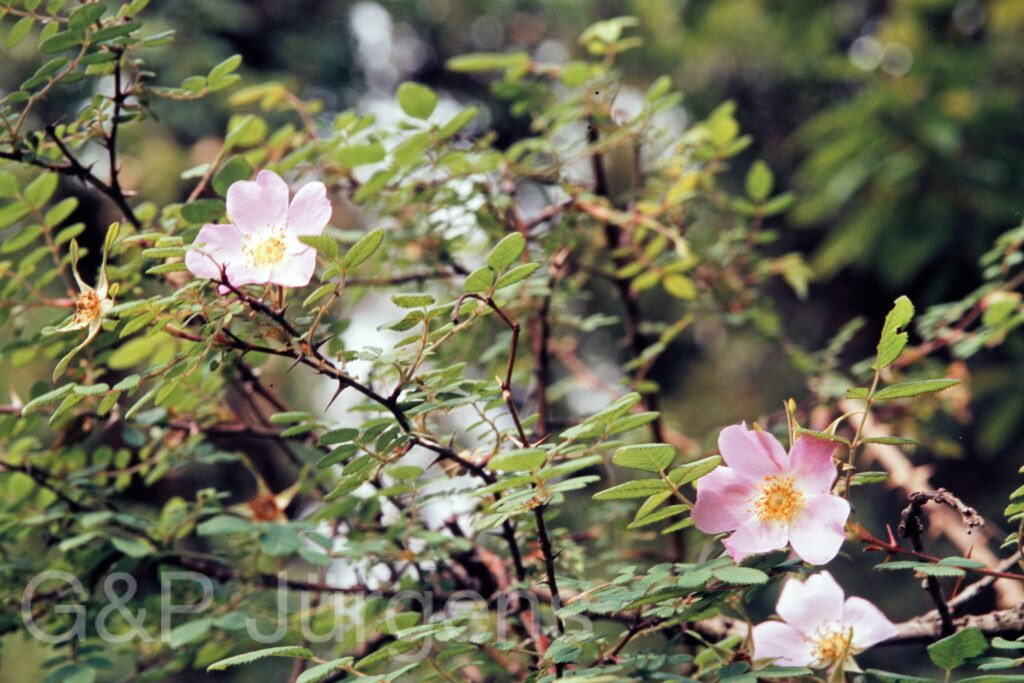
Bh09 42 P79
Bhutan Timphu 2500m, May
Nepal 99 165 ergebnis
West-Nepal South of Tara-Lake 3000m, June

Description

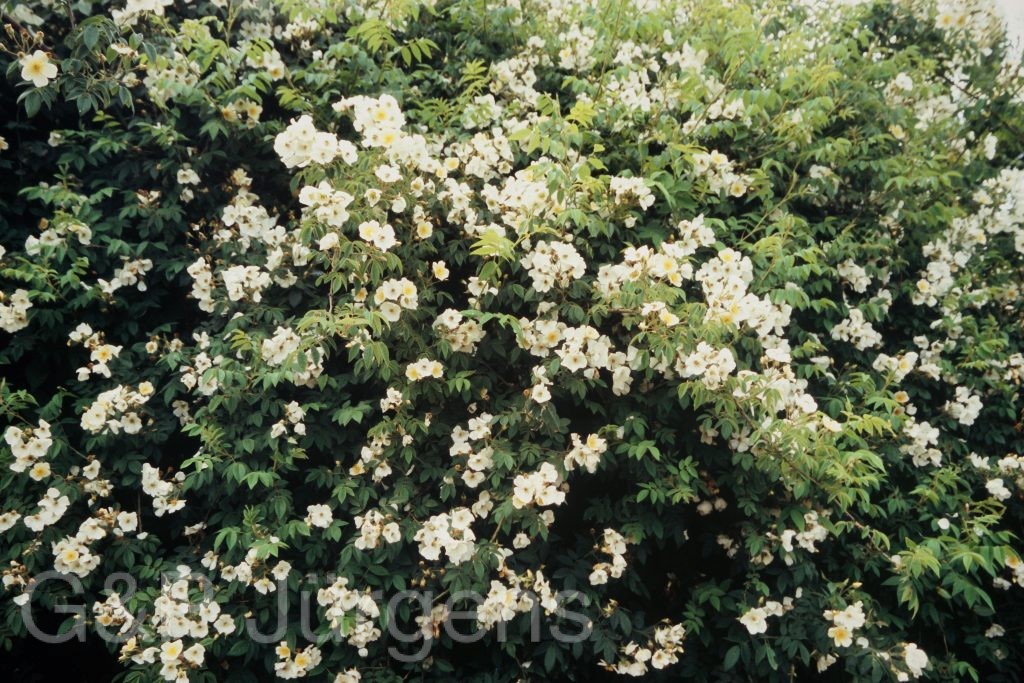
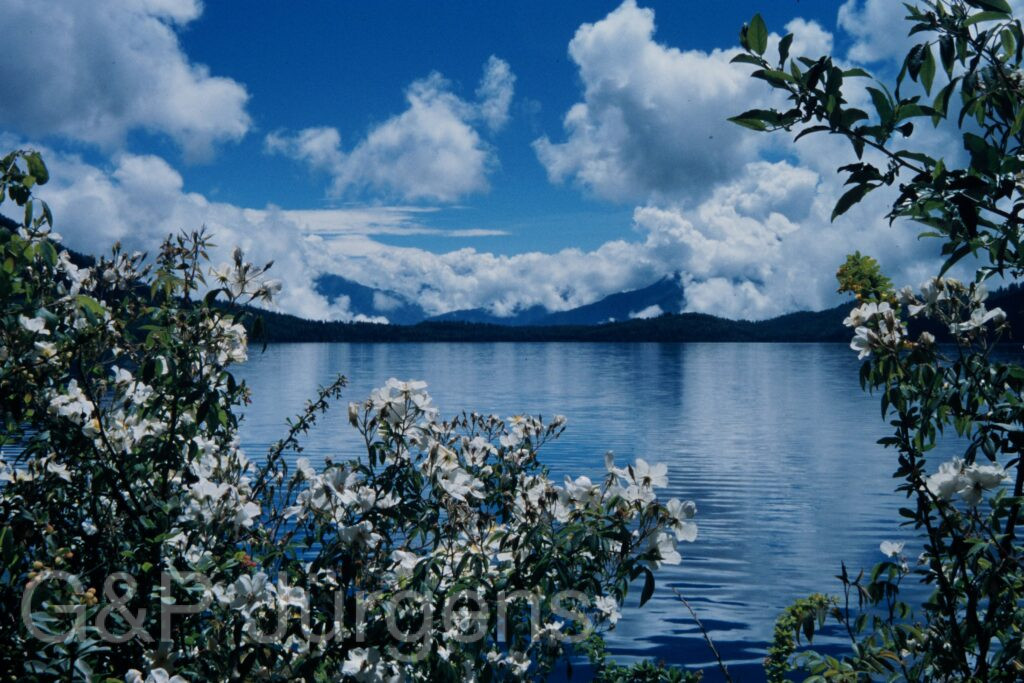
Rosa brunonii, the Himalayan musk rose, is a vigorous climbing or scrambling shrub of the Himalaya and adjacent ranges, recorded by GBIF (435 occurrences) from China, Nepal, India, Bhutan, Pakistan and Afghanistan, with cultivated and naturalised reports in Europe, North America and elsewhere reflecting its long history in gardens. It grows in forest margins, thickets, ravines, hedgerows and on open slopes throughout the temperate zone, generally between about 1500 and 3500 m. The plants illustrated from Thimphu in Bhutan at 2500 m in May and from south of Tara Lake in western Nepal at 3000 m in June capture its early-summer flowering across this elevational band.

The species is a robust, long-trailing shrub with arching, often reddish stems armed with stout, recurved, flattened prickles. The leaves are alternate, imparipinnate with usually five to seven leaflets that are oblong-lanceolate, finely serrate and characteristically greyish-green and softly pubescent beneath, with stipules adnate to the petiole. The flowers are borne in many-flowered corymbose cymes; each is fragrant, with five white, broadly obovate and emarginate petals surrounding numerous yellow stamens, the styles united into an exserted column. The receptacle ripens into a small, ovoid to subglobose, orange-red hip crowned by the deciduous sepals.

Rosa brunonii belongs to section Synstylae, the white-flowered, united-styled climbing roses, and is the principal Himalayan representative of the musk rose group long valued horticulturally and used in the parentage of cultivated ramblers. The clustered, scented flowers attract bees and other insects, and the bird-dispersed hips spread the species along forest edges. It is abundant and ecologically robust throughout its native range and is of no conservation concern.

Author: Lindl. · Sources: POWO (Kew), GBIF, Flora of China, Flora of Bhutan, Flora of Pakistan, The Genus Rosa (Phillips & Rix)

Lindl.

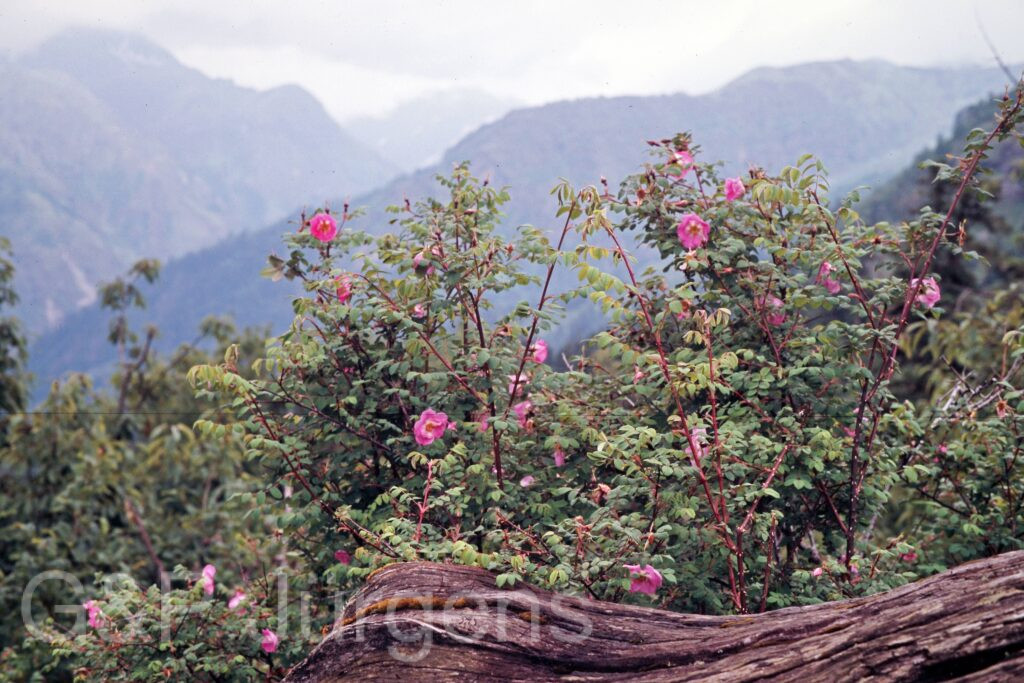
Garh 07 246 ergebnis
India Garhwal Barron Chatti 2450m, June
Garh 07 571 ergebnis
India Garhwal Barron Chatti 2450m, June

Description

Rosa macrophylla is a wild rose of the Himalaya and southwestern China, recorded from China, India, Nepal, Bhutan, Pakistan and Afghanistan, with numerous cultivated occurrences across Europe and North America; GBIF holds around 1506 georeferenced records. It grows in open temperate to subalpine habitats: forest margins, scrub, shrubberies, riverbanks and grassy slopes, typically between about 2400 and 3700 m. The photographed plant from Barron Chatti in Garhwal, India, at 2450 m in June is characteristic of these mid-montane Himalayan settings, where it flowers in early summer along trails and woodland edges.

It is a deciduous shrub 2–4 m tall with stout, erect to arching reddish-purple stems that are usually sparsely armed with straight or slightly curved prickles, sometimes nearly unarmed. The leaves are imparipinnate with usually 7–11 leaflets, these elliptic to oblong, serrate, glaucous or pubescent beneath. The flowers are large, solitary or in few-flowered corymbs, with five broad bright deep-pink to crimson petals, numerous stamens, and a glandular-setose pedicel and receptacle. The fruit is a large, conspicuous, flask-shaped to oblong-ellipsoid scarlet-red hip crowned by the persistent erect sepals, enclosing numerous bony achenes.

Described by Lindley, Rosa macrophylla belongs to section Cinnamomeae, the cinnamon roses, and is distinguished by its large flowers, large persistent-sepalled hips and big leaflets, having contributed to garden roses and several named cultivars and hybrids. The showy hips are dispersed by birds and mammals, while the flowers attract bees and other insects. Locally common across its Himalayan range and widely cultivated, it is of no conservation concern.

Author: Lindl. · Sources: POWO (Kew), GBIF, Flora of China Vol. 9, Flora of Bhutan Vol. 1, Flora of Nepal, The Genus Rosa (Phillips & Rix)