

Blume

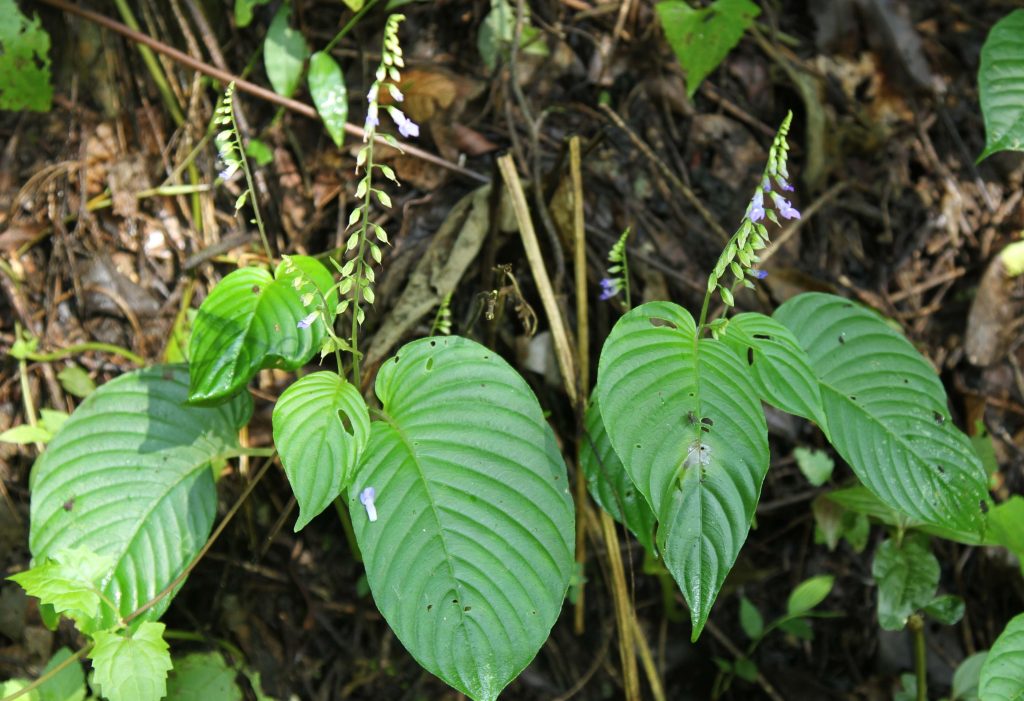
Description
Rhynchoglossum obliquum is a widespread tropical Asian gesneriad ranging from India, Nepal, Bhutan and Bangladesh through Myanmar, Thailand, southern China, Taiwan and the Malesian region (Malaysia, Indonesia, Philippines, New Guinea, Timor) to Indochina, with more than 2200 GBIF occurrences. It is an annual herb of moist, shaded habitats on forest floors, damp rock faces, stream banks and roadside cuttings in the subtropical to tropical lowland and lower-montane zone. The plant recorded at Trithangebe in southern Bhutan at 1100 m, flowering in October at the close of the monsoon, typifies its occurrence on humid, shaded ground at low to mid elevations.
It is a soft, erect annual with succulent, often translucent stems. The leaves are markedly asymmetric (oblique) at the base, ovate to ovate-lanceolate, membranous and entire to obscurely toothed, the strong inequilaterality reflected in the epithet and frequently arranged so that the lamina appears one-sided. The flowers are borne in slender, secund, one-sided terminal racemes; each has a tubular, winged or keeled calyx and a small two-lipped blue to violet corolla with a short tube, the lower lip often marked white. There are two fertile stamens, and the superior ovary ripens into a small ellipsoid capsule enclosed by the persistent calyx, releasing numerous minute seeds.
The input places the species in the subtribe Loxonieae (here as Loxodinae) within Gesneriaceae, where Rhynchoglossum is distinguished by its oblique leaves and secund racemes. Its small bilabiate flowers are insect-pollinated and the dust-like seeds dispersed by rain-wash, aiding colonisation of disturbed shaded ground. As a widespread weedy annual it is of no conservation concern.
Author: Blume · Sources: POWO (Kew), GBIF, Flora of China Vol. 18, Flora of Bhutan Vol. 2, Flora of Nepal, The Gesneriaceae of the Old World (Rhynchoglossum)