Tag:

Myanmar

Flowers of the Myanmar Himalaya — 604 species recorded from northern Myanmar (Burma) and the eastern Himalayan borderlands, a biodiversity hotspot linking the Himalaya to the mountains of Yunnan and Southeast Asia. The region’s forests and alpine slopes hold a rich flora of rhododendrons, orchids, balsams and gentians. Every page gives a botanical description, distribution, habitat and flowering time with the original photograph.

(Wall.) Schott

Bhutan2015 214
Bhutan Zhemgang 1000m, October

Description

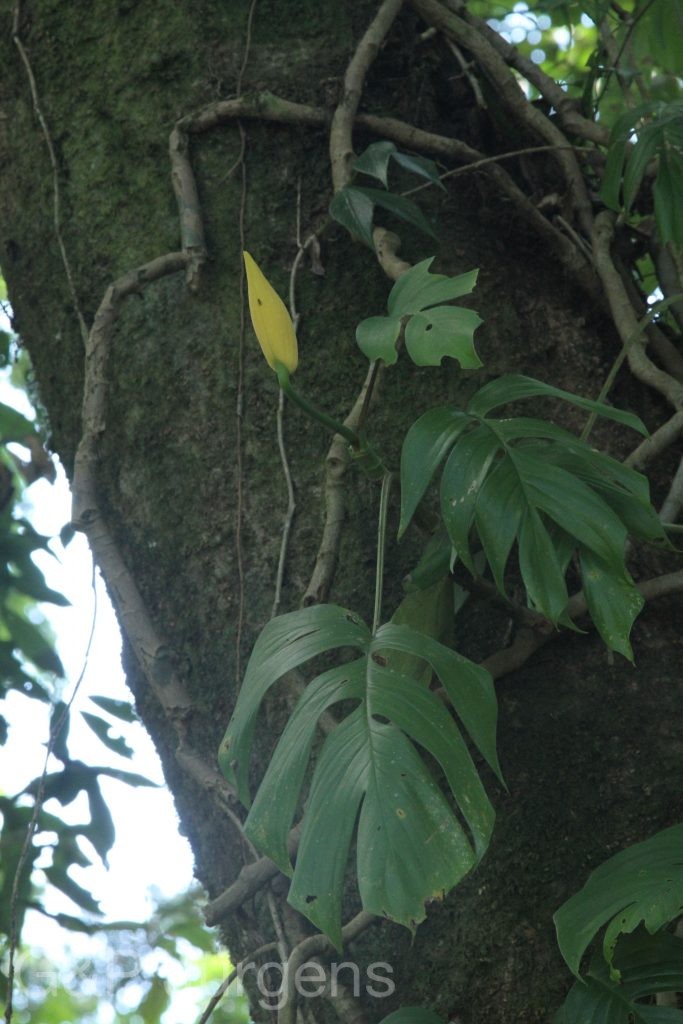
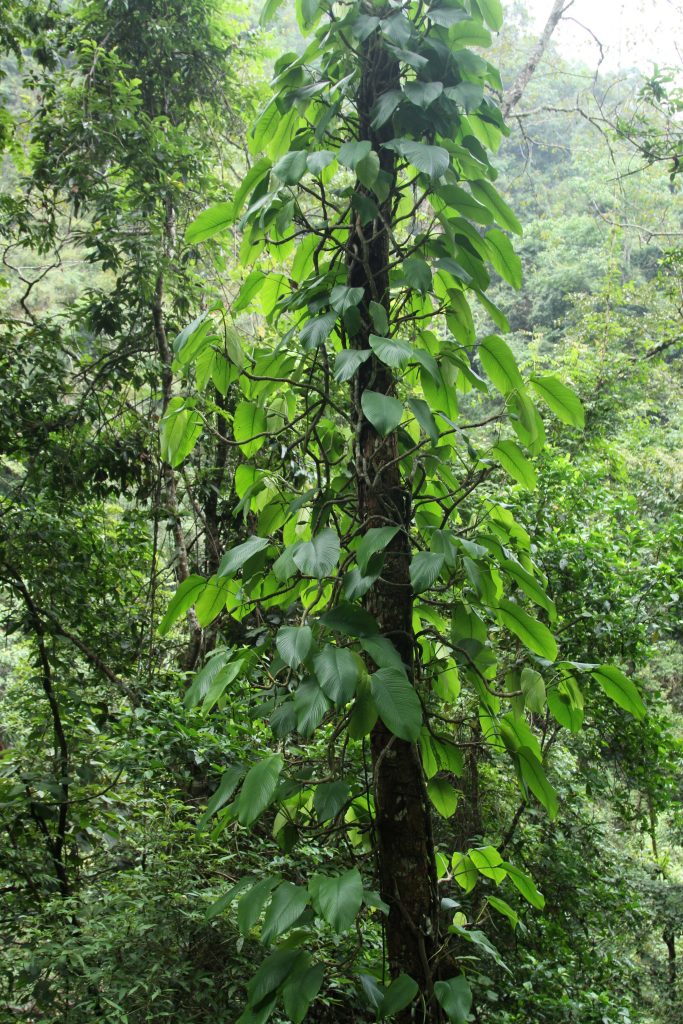
Rhaphidophora glauca (Wall.) Schott is a root-climbing aroid of the eastern Himalaya and Indo-Burmese region, recorded from India, Nepal, Bhutan, China, Myanmar, Thailand, Indonesia and Bangladesh; the GBIF total of about 195 occurrences reflects its frequent presence in humid subtropical and lower montane forest. It grows as a hemiepiphytic liana ascending tree trunks and rock faces in moist broad-leaved evergreen forest, broadly between 600 and 1800 m. The photographed plant from Zhemgang in central Bhutan at about 1000 m, in October, typifies its occurrence in the shaded, humid foothill forest of southern Bhutan, clinging by adventitious roots to mossy bark.

The species is a robust, evergreen, root-climbing hemiepiphyte with stout, terete, green to glaucous stems bearing clasping adventitious roots at the nodes. The leaves are alternate, large, ovate to oblong with an obliquely cordate to unequal base, often glaucous beneath as the epithet implies, the petiole sheathing and geniculate near the apex. The inflorescence is a solitary, axillary spadix subtended by a thick, boat-shaped, caducous spathe; the flowers are small, bisexual and naked, densely covering the cylindrical spadix in the manner of the Monstereae. The fruit is a fleshy, many-seeded berry crowded along the infructescence, the seeds bearing the curved raphide-laden tissue characteristic of the genus.

Rhaphidophora (Araceae, tribe Monstereae) is a palaeotropical genus of root-climbing aroids closely allied to Epipremnum and Monstera and distinguished by its raphide-bearing seeds and shuttlecock-like spathe. R. glauca is the principal Himalayan representative, recognised by its glaucous, oblique-based leaves. As a widespread, tolerant forest liana it is of no conservation concern, though as a hemiepiphyte it depends on intact forest structure; it is occasionally grown as a foliage ornamental and used locally in folk medicine.

Author: (Wall.) Schott · Sources: POWO (Kew), GBIF, Flora of China, Flora of Bhutan, Flora of British India, Boyce & Croat — The Überlist of Araceae and Monstereae studies
Schott

Bhutan2012 769
Bhutan Zemgang 1500m, October

Description

Rhaphidophora hookeri is a robust root-climbing aroid of the warm-temperate and subtropical broad-leaved forests of the eastern Himalaya and northern Indochina. GBIF occurrences place it across China, Thailand, India, Vietnam, Bhutan, Laos, Bangladesh, Myanmar and Nepal, with around 253 records reflecting its sparse but wide montane distribution. It is a hemiepiphyte of humid, shaded forest, ascending tree trunks and rock faces by adventitious clasping roots in evergreen ravines and along stream margins. The photographed plant from Zemgang in central Bhutan at 1500 m, recorded in October, is typical of the mid-elevation foothill forests where the species favours high atmospheric humidity, deep shade and moss-covered substrates.

It is a perennial climber with thick, fleshy stems that adhere closely to the support, the internodes marked by prominent scars and bearing dense feeding roots. The leaves are large, glossy and entire to obliquely ovate-elliptic, the petioles geniculate and sheathing at the base. The inflorescence is a cylindrical spadix subtended by a thick, deciduous, boat-shaped spathe; the flowers are bisexual and naked, lacking a perianth, densely packed over the spadix. The fruit is a fleshy syncarp of berries, releasing numerous small seeds at maturity.

The genus Rhaphidophora comprises some hundred species of palaeotropical climbing aroids, distinguished within the Monstereae by their bisexual flowers and the absence of a perianth. R. hookeri, named in honour of J. D. Hooker, is one of the few representatives reaching the Himalayan region. Like related climbing aroids it shows marked heteroblastic development, juvenile shingle-leaved shoots differing strongly from the adult climbing stems, an adaptation to the vertical microhabitats of dense forest interiors.

Author: Schott · Sources: POWO (Kew), GBIF, Flora of Bhutan, Flora of China (Araceae), Revision of Rhaphidophora (Boyce, Araceae monographs)

Hook. f. & Thomson

BhutanPG2011 778 01 01
Bhutan Chele-La, 3900m July
Sikkim2003 485 P673
Sikkim Lachung Valley 3500m August

Description

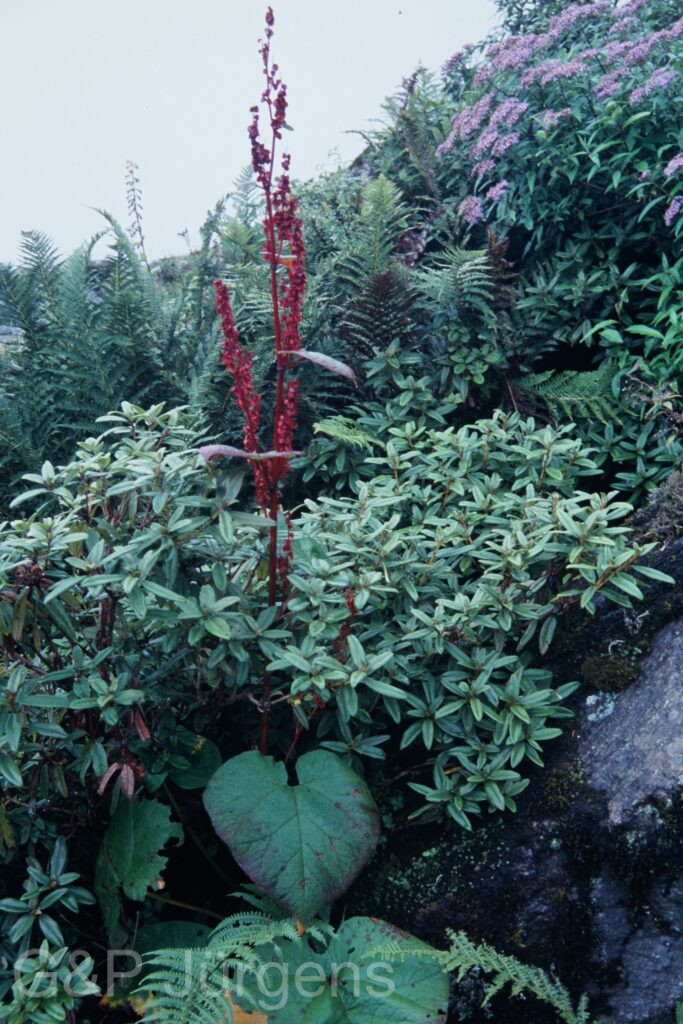
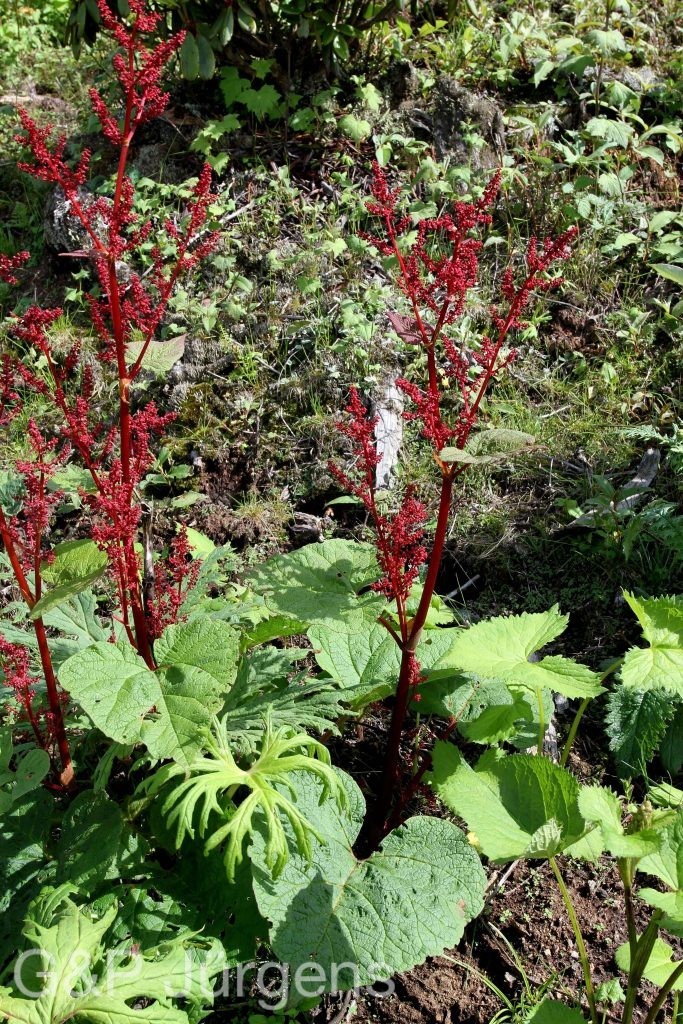
Rheum acuminatum is a stout perennial wild rhubarb of the eastern and central Himalaya, distributed through China, Nepal, India, Bhutan and Myanmar, with some 370 documented records. It is a plant of subalpine and alpine slopes, rocky meadows, open shrubberies and stream margins, generally growing between 3000 and 4300 m. The illustrated plants come from Chele-La in Bhutan at 3900 m in July and the Lachung Valley in Sikkim at 3500 m in August, spanning the high-summer flowering and fruiting period characteristic of the species at these elevations.

The plant arises from a thick woody rhizome and produces erect, often reddish, hollow stems up to a metre or more tall. The basal leaves are large, long-petiolate and broadly ovate-cordate with an acuminate apex giving the epithet, the blade more or less glabrous above and with prominent venation; an ochrea sheaths the stem at each node. The inflorescence is a tall, branched panicle bearing numerous small flowers with a coloured perianth of six segments, white to greenish or reddish. The fruit is a broadly winged triangular achene (a three-angled, three-winged nutlet) adapted to wind and water dispersal.

The genus Rheum reaches its richest diversity in the Himalaya and the Qinghai-Tibetan plateau, where high-altitude rhubarbs show striking adaptations to cold, exposed habitats. R. acuminatum lacks the inflated bracts of the alpine glasshouse rhubarbs but shares the family's ochreate, trigonous-fruited architecture. The rhizomes have a history of local medicinal use, and although the species is widespread and not threatened, related wild rhubarbs are subject to harvesting pressure across the region.

Author: Hook. f. & Thomson · Sources: POWO (Kew), GBIF, Flora of China, Flora of Bhutan, Annotated Checklist of the Flowering Plants of Nepal, Losina-Losinskaja revision of Rheum

Rheum nobile

by GP Jürgens

Hook. f. & Thomson

Sikkim2011 328
Sikkim Lada-La 4400m, June
Sikkim2003 309 G438
Sikkim Saniti-Lake 4300m August
Sikkim2003 310 W439
Sikkim Saniti-Lake 4300m August

Description

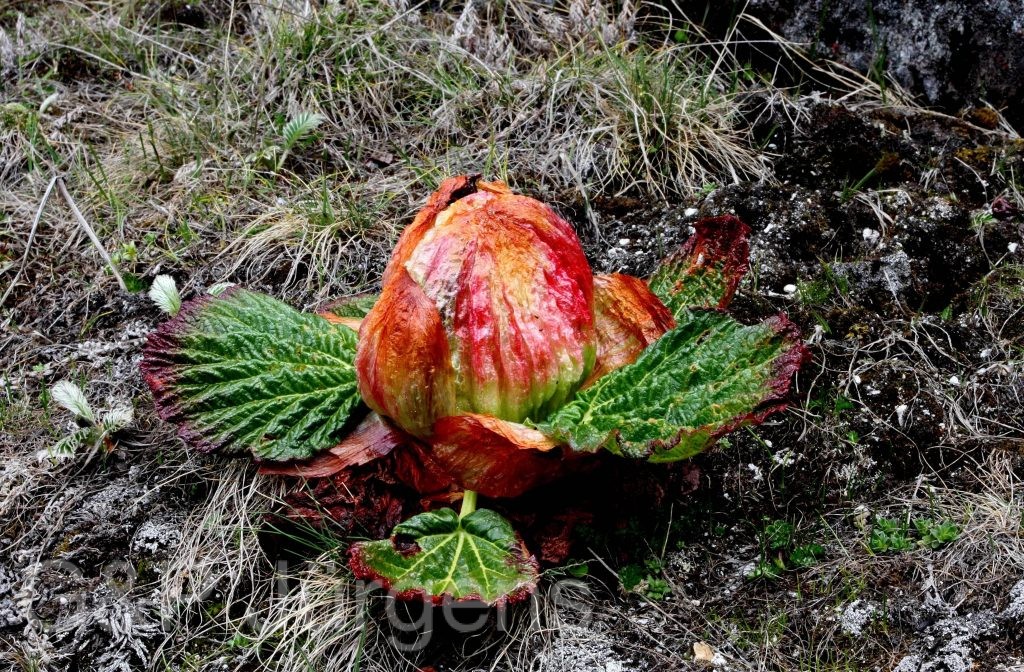
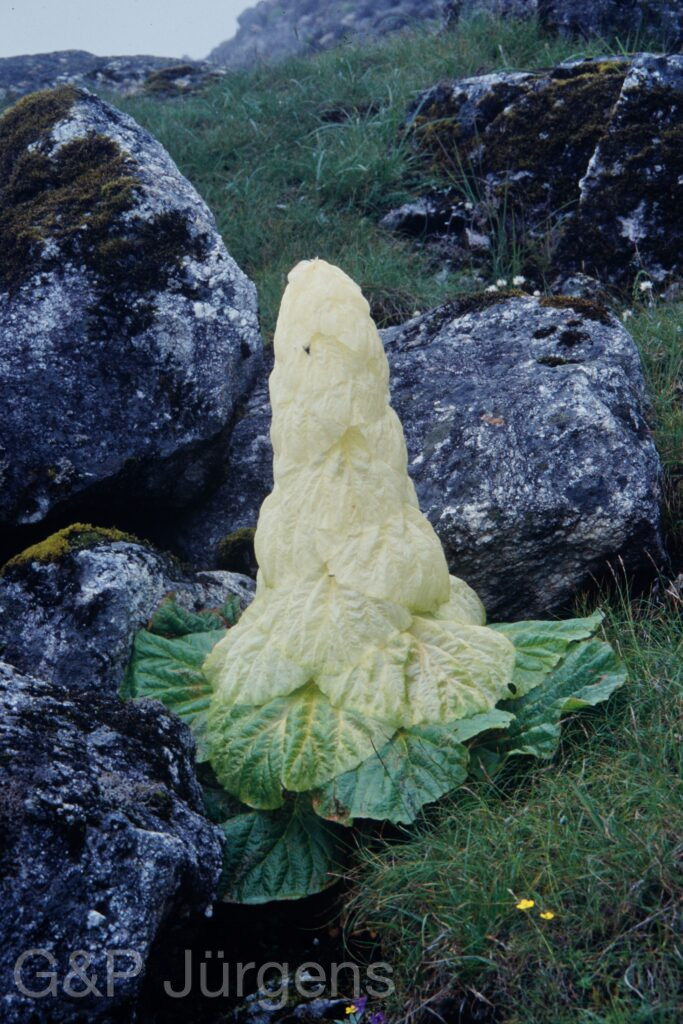
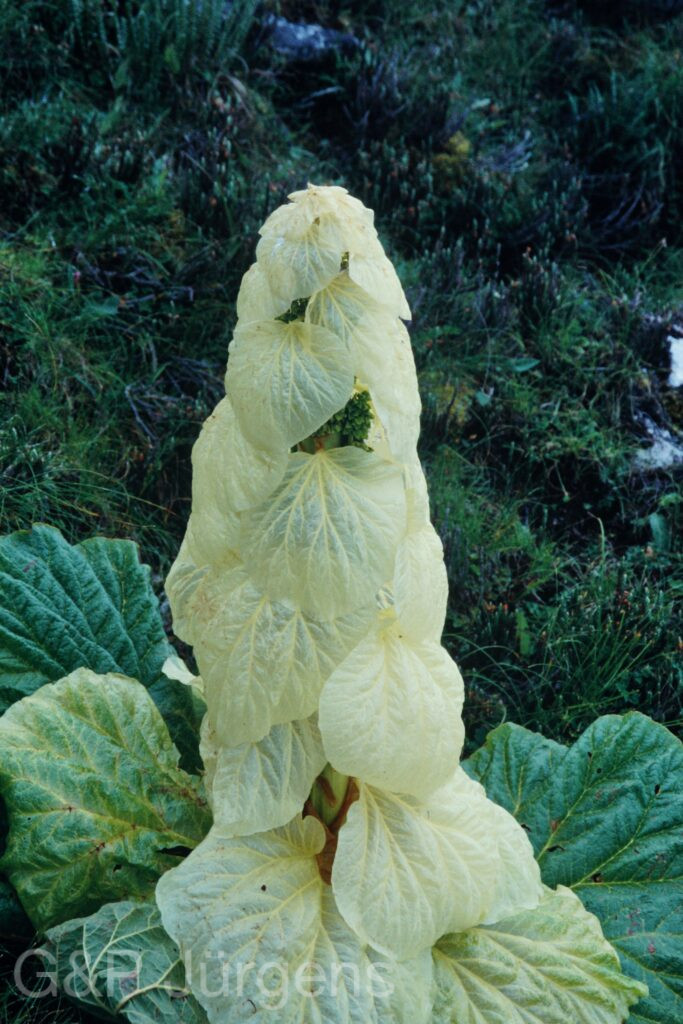
Rheum nobile, the Sikkim or noble rhubarb, is a spectacular high-alpine perennial of the eastern Himalaya, distributed from Nepal through Sikkim and northern India into Bhutan, Myanmar and south-western China, with around 220 occurrence records. It is a strict specialist of open alpine screes, moraines and rocky slopes, typically between about 4000 and 4800 m. The images derive from Sikkim at Lada-La (4400 m, June) and near Saniti Lake (4300 m, August), localities characteristic of the high, exposed scree habitat in which this iconic "glasshouse plant" grows.

The species forms a stout, columnar flowering spike to about 1-2 m, arising from a thick taproot. Its most striking feature is the dense, overlapping series of large, translucent, straw-coloured to pale yellow bracts that sheathe the entire inflorescence, hiding the small flowers within. The basal leaves are large, broadly ovate to orbicular and reddish-margined, forming a rosette. The numerous small flowers are greenish and inconspicuous, concealed beneath the bracts, and develop into small, three-winged nutlets (achenes) typical of the genus.

Rheum nobile (Polygonaceae) is a classic example of a Himalayan "greenhouse" or glasshouse plant: the translucent bracts trap solar heat and create a warm, sheltered microclimate that protects the developing flowers from cold, wind and intense ultraviolet radiation while attracting and harbouring specialist pollinating midges. This remarkable adaptation, much studied in plant ecophysiology, makes the species a celebrated model of high-altitude floral biology. Though localised, it is of least conservation concern, but its restriction to a narrow alpine belt makes it potentially vulnerable to climatic warming.

Author: Hook. f. & Thomson · Sources: POWO (Kew), GBIF, Flora of China, Flora of Bhutan, Annotated Checklist of the Flowering Plants of Nepal, Losina-Losinskaja monograph of Rheum

(Wall. ex Hook. f. & Thomson) Fu

Nepal 99 839 ergebnis
West-Nepal Baga-La-Phedi 4000m, July

Description

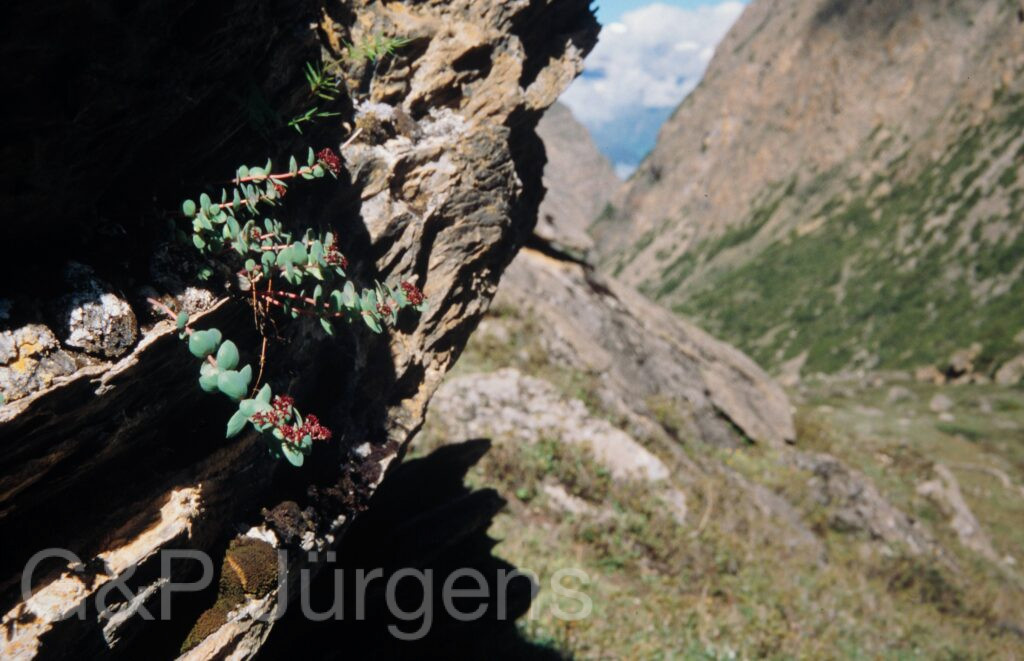
Rhodiola bupleuroides is a perennial succulent herb of the high Himalaya and the Qinghai-Tibetan Plateau, recorded by GBIF from China, Nepal, India, Bhutan and Myanmar across roughly 956 occurrences, with additional cultivated or erroneous records from Europe. It is a plant of alpine and subalpine habitats, growing on rocky slopes, screes, cliff ledges, grassy turf and the margins of alpine scrub, generally from about 3000 to over 5000 m. The plant photographed at Baga-La-Phedi in west Nepal at about 4000 m, flowering in July at the height of the brief alpine summer, is typical of these cold, exposed, well-drained sites.

The plant arises from a stout, woody, branched caudex topped by a swollen rootstock, from which emerge several erect or ascending unbranched flowering stems. The leaves are alternate, sessile, flat and fleshy, elliptic to oblong or obovate, with an entire to obscurely toothed margin, recalling the foliage of Bupleurum as the epithet suggests. The species is dioecious, the small flowers crowded in a dense terminal corymbose cyme; they are usually four- to five-merous, the petals dark red, purplish or greenish-yellow, with the staminate and pistillate flowers on separate plants. The fruit is a cluster of erect follicles that split to shed numerous minute seeds.

Rhodiola, segregated from Sedum, is a characteristic genus of cold high-mountain and arctic regions, and R. bupleuroides is one of the most widespread Himalayan-Tibetan species, displaying considerable variation in stature, leaf shape and flower colour. Several Rhodiola species are harvested for traditional medicine and adaptogenic compounds, and the genus as a whole is of pharmacological interest. The dioecious breeding system and dependence on cold alpine conditions make it a useful indicator of high-elevation environments under climatic change, and harvesting pressure affects some related taxa.

Author: (Wall. ex Hook. f. & Thomson) Fu · Sources: POWO (Kew), GBIF, Flora of China, Flora of Bhutan, Ohba revision of Himalayan Crassulaceae (Rhodiola/Sedum), Annotated Checklist of the Flowering Plants of Nepal

(Hook. f. & Thomson) S.H. Fu

Bh09 103 P181
Bhutan Jimilangtso, 4000m June
Garh 07 455 ergebnis
Garhwal Khiar-Kutti 3840m, June
Garh 07 538.7JPG ergebnis
Garhwal Khiar-Kutti 3840m, June

Description

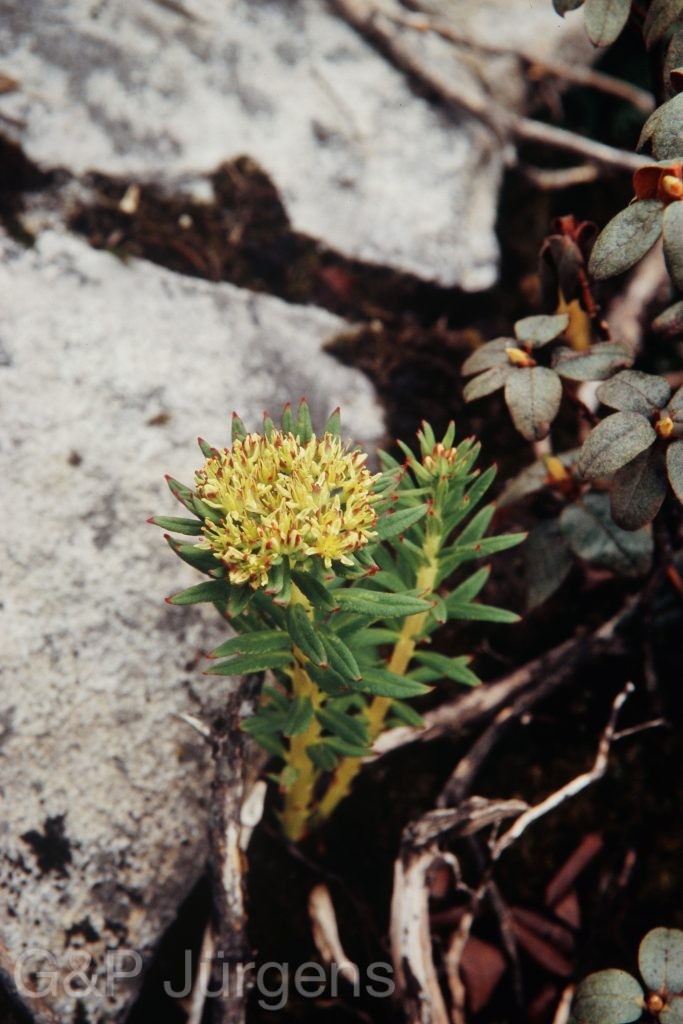
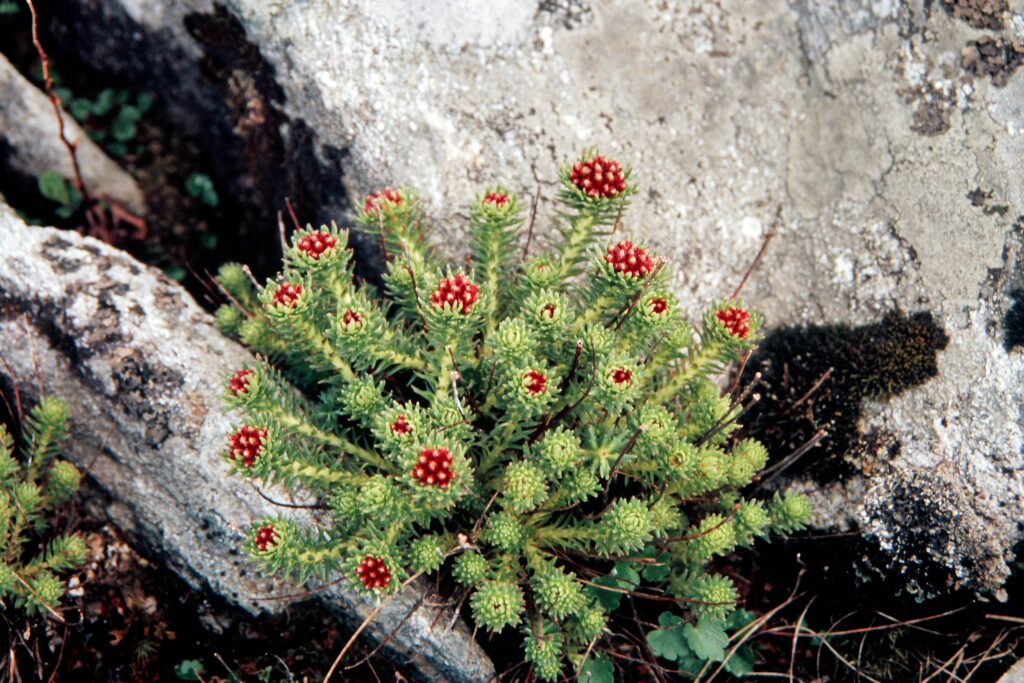
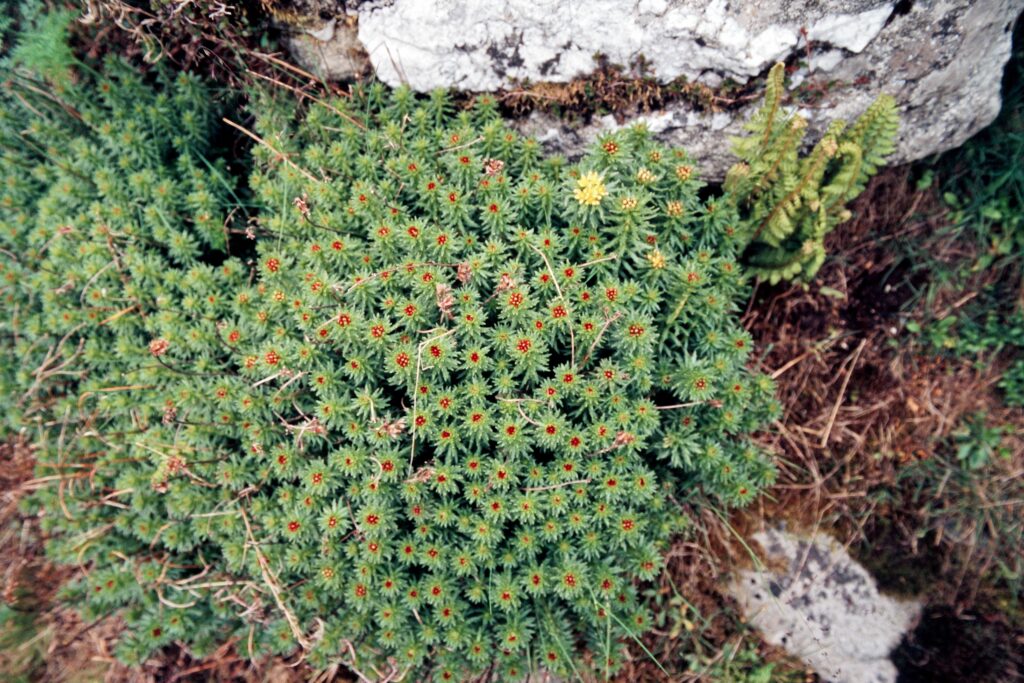
Rhodiola fastigiata is a widespread high-alpine succulent of the Himalaya and the Sino-Himalayan ranges, well represented by some 724 georeferenced collections spanning China (CN), Nepal (NP), India (IN), Pakistan (PK), Bhutan (BT) and Myanmar (MM), with peripheral records from Mongolia (MN) and Afghanistan (AF). It is a plant of the upper subalpine and alpine zones, characteristically between roughly 3500 and 5000 m, colonising rocky slopes, screes, cliff ledges, moist alpine turf and the margins of snow-melt rills. The populations illustrated from Jimilangtso in Bhutan at about 4000 m and from Khiar-Kutti in Garhwal at 3840 m, both flowering in June, typify its occurrence in open, well-drained, high-elevation habitats.

It is a perennial herb arising from a stout, scaly, often branched caudex and thickened rootstock. Several erect, unbranched, fleshy flowering stems are produced, densely clothed throughout their length with crowded, overlapping, sessile leaves; these are narrowly oblong to linear-oblong, flat, entire or minutely toothed, somewhat glaucous and fleshy, giving the shoots a neat fastigiate aspect that gives the species its name. The inflorescence is a dense terminal corymb of small flowers, usually functionally dioecious, with five reddish to purplish-red sepals and petals; the staminate flowers bear ten stamens. The fruit is a cluster of erect, reddish, several-seeded follicles.

Rhodiola (Crassulaceae), formerly merged with Sedum, comprises stress-tolerant CAM succulents adapted to cold, arid, high-radiation alpine environments, where the swollen rootstock stores water and carbohydrate. Several Himalayan species, including this one, are harvested for traditional medicine for their adaptogenic rhizomes, creating localised collection pressure. R. fastigiata is broadly distributed and not currently considered threatened, but high-altitude Rhodiola populations are slow-growing and vulnerable to overharvesting.

Author: (Hook. f. & Thomson) S.H. Fu · Sources: POWO (Kew), GBIF, Flora of China, Flora of Bhutan, Flora of Pakistan, Ohba monographic studies of Himalayan Crassulaceae (Rhodiola)

Sm.

Bh2008 31 G54
Bhutan
Nepal1992 220 P322 ergebnis
Nepal Nundhaki 1400m March 
Nepal1992 228 P337 ergebnis
Nepal Nundhaki 1400m March 
Nepal1992 237 P348 ergebnis
Nepal Nundhaki 1400m March 

Description

Rhododendron arboreum is the tree rhododendron of the Himalaya and the broader Indian subcontinent, ranging from Pakistan through India, Nepal, Bhutan and Myanmar into southwestern China, with a notable disjunct presence in the hills of Sri Lanka; widely cultivated, it appears in GBIF from many temperate countries and totals nearly 3000 occurrences. It is the most familiar species of the genus across its native range, growing in temperate broadleaved and oak-laurel forest, on hill slopes and in scrub, here recorded at Nundhaki in Nepal at 1400 m and in Bhutan. Spanning a broad elevational band, it flowers conspicuously in late winter and spring (March), painting Himalayan hillsides crimson.

It is an evergreen shrub or tree reaching 10-20 m, with a gnarled trunk and rough, flaking bark. The leaves are leathery, oblanceolate to elliptic, dark glossy green above and clothed beneath with a dense silvery, fawn or rusty indumentum that varies between subspecies. The flowers are massed in dense, rounded, terminal trusses of 15-20; each corolla is tubular-campanulate, 3-5 cm long, ranging from deep blood-red through pink to white, the throat marked with darker nectar spots. Stamens are typically 10, and the ovary tomentose with a long style. The fruit is a curved, woody, ribbed capsule splitting to release numerous small winged seeds.

Described by James Edward Smith, the species belongs to subgenus Hymenanthes, subsection Arborea, and is highly variable, with several recognised subspecies (e.g. subsp. cinnamomeum, subsp. nilagiricum, subsp. zeylanicum) differing in leaf indumentum and altitude. It is the national flower of Nepal (lali gurans) and the state tree of Uttarakhand, and the nectar-rich corollas are sought by sunbirds and bees, with the flowers used to make a local beverage. Although widespread and not globally threatened, lower-elevation populations face pressure from fuelwood harvesting, grazing and forest conversion.

Author: Sm. · Sources: POWO (Kew), GBIF, Flora of Bhutan, Flora of China, The Genus Rhododendron (Cullen & Chamberlain monograph)

Hook. f.

Bh2008 237 P374
Bhutan Tumching-La, 3600m April
Bh09 83 G141
Bhutan Langchlakha, 3700m June
Sikkim2004 403 G687
Sikkim/India Lachung 3300m May
Sikkim 2006 372 ergebnis
India West-Bengal, Tamrong 2850m, May

Description

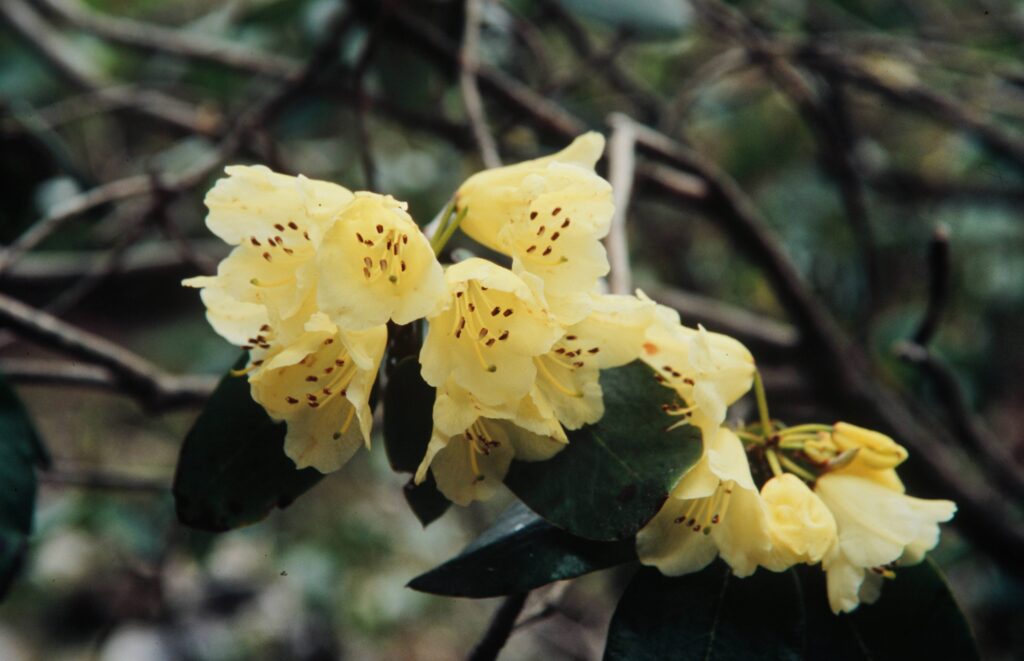
Rhododendron campylocarpum is an East Himalayan species distributed through the higher ranges of Nepal, Sikkim and Darjeeling in India, Bhutan, southern Tibet (China) and northern Myanmar, with abundant horticultural records (GB, US, NZ, etc.) reflecting long cultivation in temperate gardens; GBIF holds some 676 occurrences. It grows in the upper temperate and subalpine zone, typically between about 2850 and 3700 m, as documented at Tumching-La (3600 m) and Langchlakha (3700 m) in Bhutan, at Lachung (3300 m) in Sikkim and at Tamrong (2850 m) in West Bengal, inhabiting conifer and Abies forest margins, rhododendron thickets and moist rocky slopes near the treeline. It flowers in late spring and early summer (April-June).

It is an evergreen, much-branched shrub or small tree reaching 1-4 m, with smooth, peeling bark. The leaves are alternate, clustered toward the branch tips, broadly ovate to elliptic-oblong, 4-10 cm long, rounded to cordate at the base, glabrous and dark green above and conspicuously glaucous beneath. The inflorescence is a lax, terminal truss of 5-12 flowers; the corolla is campanulate, 3-4 cm across, clear sulphur- to canary-yellow, frequently with a crimson basal blotch within. Stamens are 10, included; the ovary and slender style are usually glandular. The fruit is a curved, cylindrical capsule, the epithet ("campylocarpum", bent fruit) referring to this curvature.

The species belongs to subgenus Hymenanthes, subsection Campylocarpa, a small group of yellow-flowered Himalayan rhododendrons including R. wardii and R. callimorphum, and it hybridises freely in the wild and in cultivation. Introduced by J. D. Hooker in the 1850s, it became an important parent of many garden hybrids and is an early-summer nectar source for bumblebees and other high-altitude pollinators. Though locally common and not globally threatened, individual populations are subject to grazing, fuelwood collection and the upward shift of the treeline.

Author: Hook. f. · Sources: POWO (Kew), GBIF, Flora of Bhutan, Flora of China, The Genus Rhododendron (Cullen & Chamberlain monograph)

Franch.

Bh2008 21 P38
Bhutan Thimphu-Chu, 2800m
Bh2008 23 P40
Bhutan Thimphu-Chu, 2800m

Description

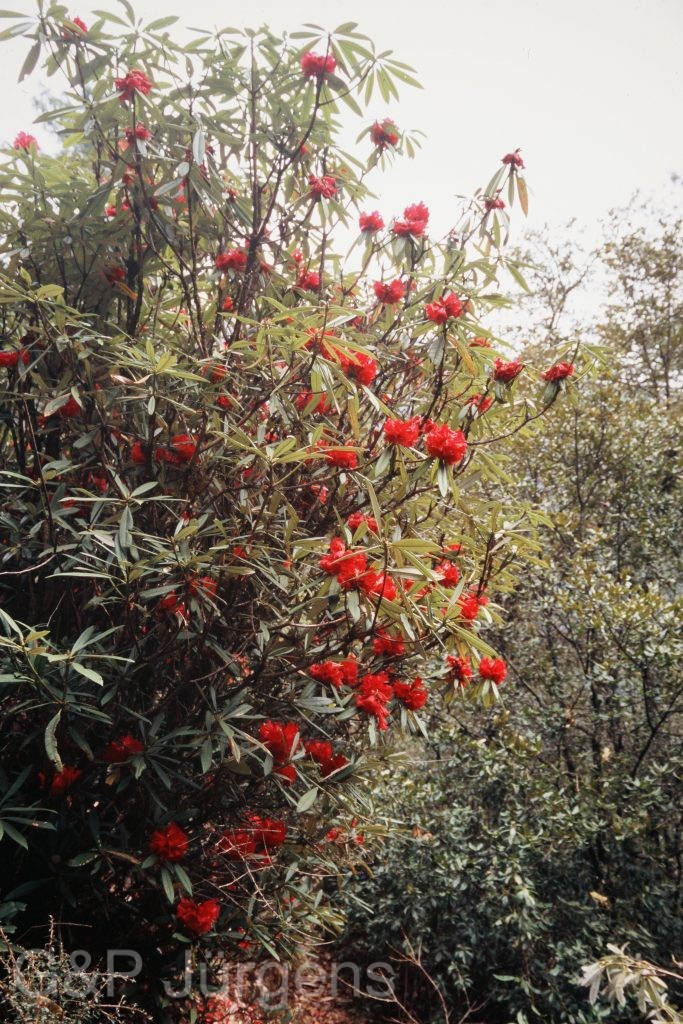
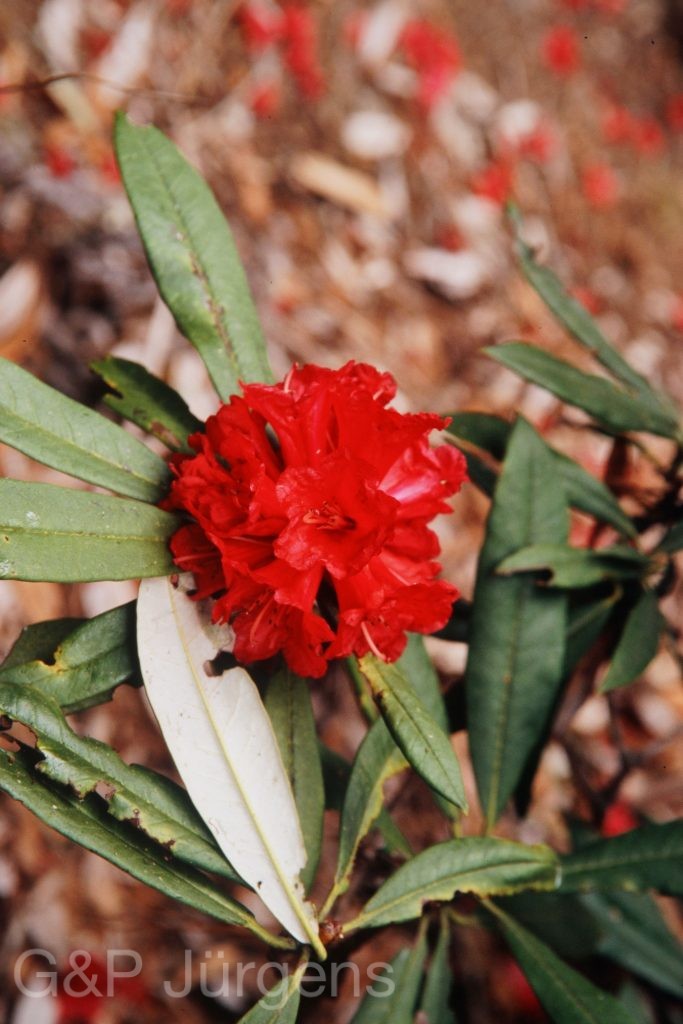
Rhododendron delavayi Franch. is a shrub or small tree of the Sino-Himalayan region, distributed through south-western China (Yunnan, Guizhou, Sichuan, Xizang), Myanmar, Thailand, Vietnam, north-eastern India, Bhutan and Nepal, with horticultural records from the United Kingdom, United States, Canada and Belgium contributing to a GBIF total of around 1,290 occurrences. It grows in evergreen broadleaf forest, pine forest, open thickets and on rocky montane slopes, typically on acidic soils in the warm-temperate to lower montane belt. The illustrated plant comes from the Thimphu-Chu valley in Bhutan at about 2800 m, an elevation characteristic of the species where it forms a conspicuous element of the forest canopy and understorey and flowers in spring.

It is an evergreen shrub to small tree with stout branches and a thick, often flaking bark. The leaves are leathery, oblong-lanceolate to oblanceolate, dark green and glabrous above, the lower surface densely covered with a felted, persistent, fawn to greyish or whitish tomentum (indumentum) that is diagnostic of the species. The flowers are borne in dense, rounded, terminal trusses; each is broadly campanulate with a deep crimson to scarlet corolla of about five lobes, marked at the base with darker nectar pouches, and contains about ten stamens and a glabrous or hairy ovary with a long style. The fruit is a woody, cylindrical, ribbed capsule dehiscing by valves to release numerous minute seeds.

Rhododendron delavayi is the type species of subsection Arborea and is closely related to the Himalayan R. arboreum, with which it intergrades and shares the tree habit and red flowers; it is distinguished by its compact indumentum and floral details. Ecologically it is bird- and insect-pollinated and is a dominant component of warm broadleaf forest, while in cultivation it is valued as a parent of many hybrids. Although widespread, it is locally affected by deforestation and habitat conversion in parts of its range, but overall it remains common and is not regarded as globally threatened.

Author: Franch. · Sources: POWO (Kew), GBIF, Flora of China, Flora of Bhutan, The Genus Rhododendron (Edinburgh, Chamberlain et al.)

Hook. f.

Bhutan2014 315
Bhutan Tumching-La 2600m, May
Bhutan2014 317
Bhutan Tumching-La 2600m, May
Bh2008 159 P260
Bhutan Chendebji, 2600m April
Bh2008 160 P261
Bhutan Chendebji, 2600m April

Description

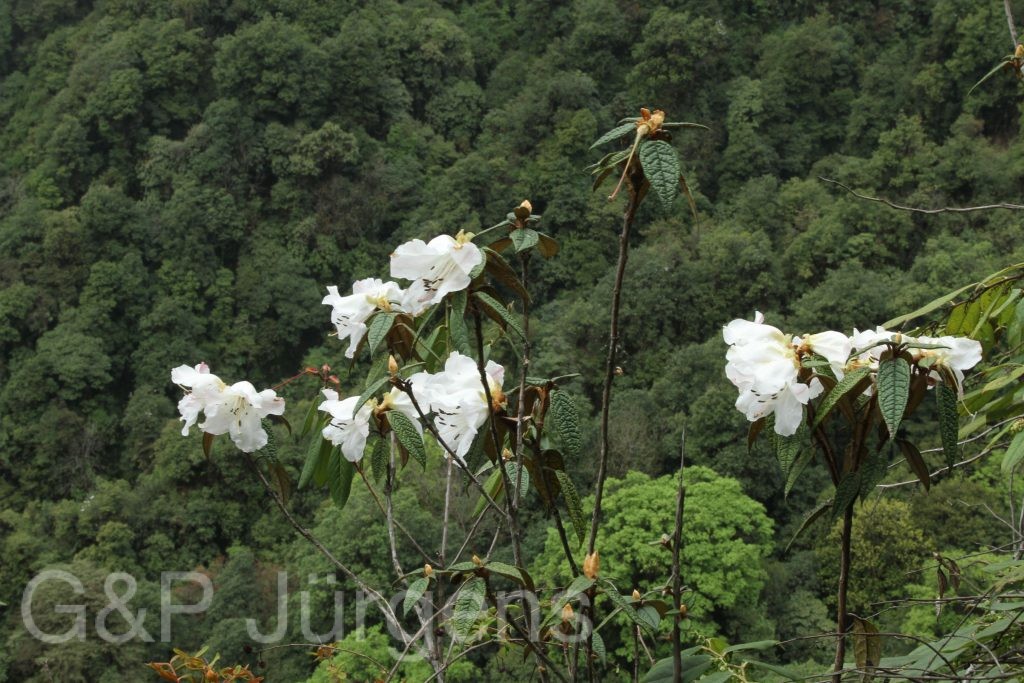
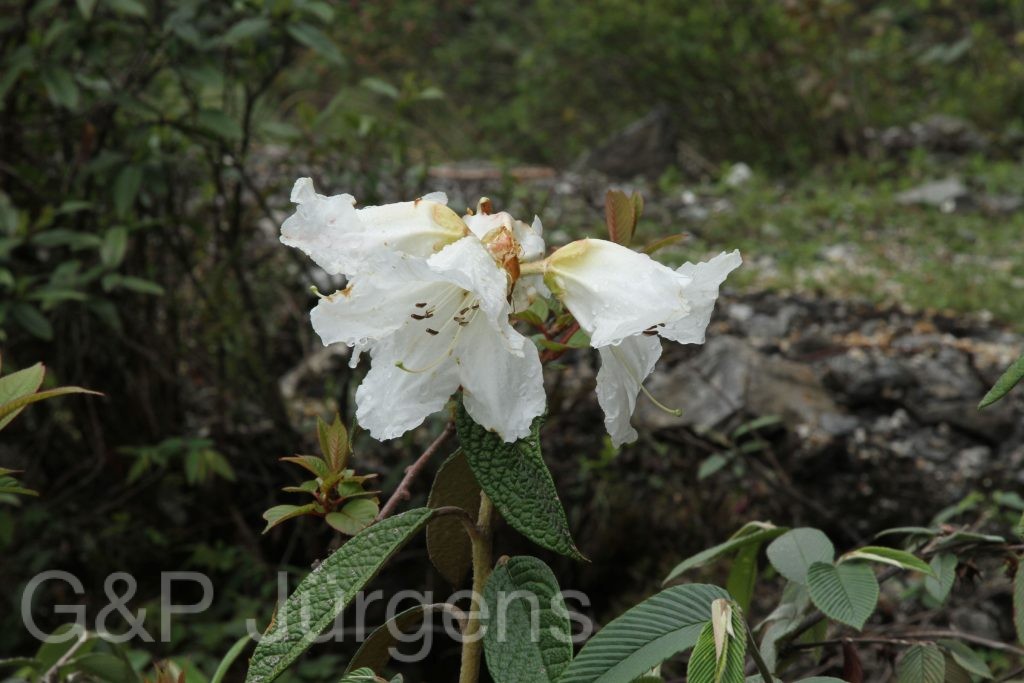
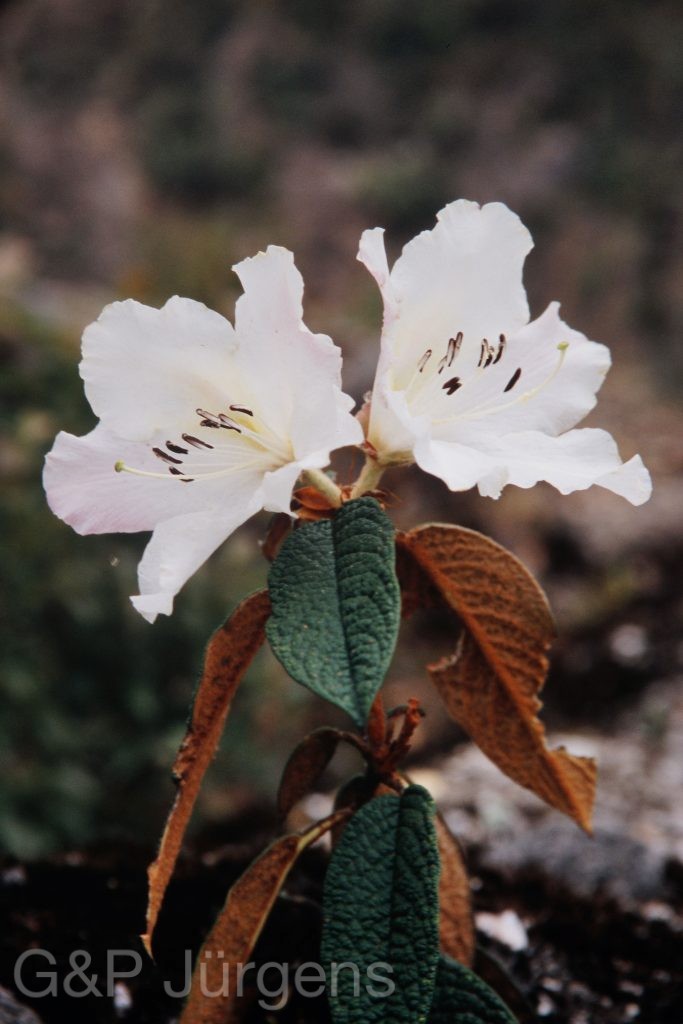
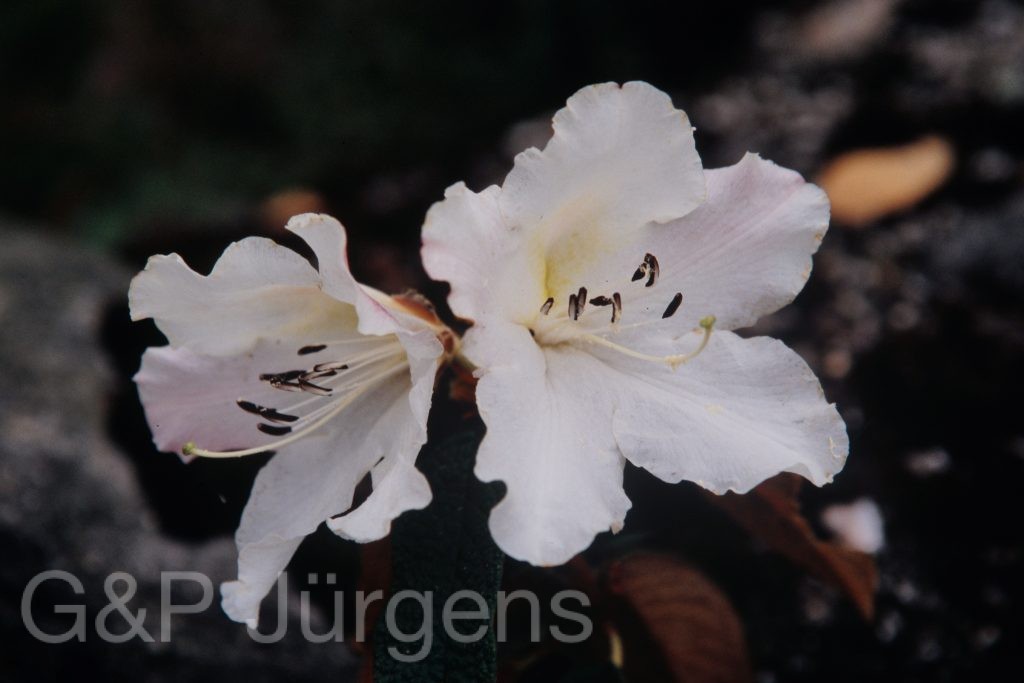
Rhododendron edgeworthii is distributed through the eastern Himalaya and adjacent montane south-west China, with native records spanning Bhutan, north-east India, Myanmar and Yunnan and Xizang (China); the remaining records among 665 georeferenced occurrences (United States, Canada, New Zealand, Britain, Belgium, Korea) reflect its long cultivation as an ornamental. It is characteristically epiphytic or saxicolous, growing on mossy tree trunks, boulders and humus-rich banks in cool, humid temperate forest with oak, Tsuga and other rhododendrons. The species was collected in Bhutan at Tumching-La and Chendebji at around 2600 m, consistent with its typical altitudinal range of roughly 2000-3700 m in the upper temperate zone.

It is a straggling, often epiphytic shrub to about 2-3 m, the young shoots and undersides of the leaves densely clothed in tawny, woolly-tomentose to setose indumentum. The leaves are elliptic to ovate, leathery, bullate-rugose above and conspicuously brown-felted beneath. The flowers, borne in lax trusses of two or three, are large, broadly funnelform-campanular, white usually flushed rose, and strongly fragrant, with the outer surface scaly and the lobes spreading; stamens are typically ten and the ovary densely scaly, ripening into a scaly capsule.

Within the genus the species belongs to subgenus Rhododendron (lepidote rhododendrons), section Rhododendron, subsection Edgeworthia, distinguished by the combination of bullate foliage, dense woolly indumentum and large scented blooms. It hybridises readily in cultivation and has contributed to fragrant hybrid groups. Though locally frequent across a wide range and assessed as of Least Concern, its dependence on undisturbed humid forest makes it sensitive to deforestation and collection pressure.

Author: Hook. f. · Sources: POWO (Kew), GBIF, Flora of Bhutan, Flora of China, The Rhododendron Handbook (Royal Horticultural Society), Cox & Cox The Encyclopedia of Rhododendron Species