Tag:

Myanmar

Flowers of the Myanmar Himalaya — 604 species recorded from northern Myanmar (Burma) and the eastern Himalayan borderlands, a biodiversity hotspot linking the Himalaya to the mountains of Yunnan and Southeast Asia. The region’s forests and alpine slopes hold a rich flora of rhododendrons, orchids, balsams and gentians. Every page gives a botanical description, distribution, habitat and flowering time with the original photograph.

(D.Don) Anderb.

Nepal 2001 436 ergebnis ergebnis
Nepal (Gorkha) Gunda 1850m, May

Description

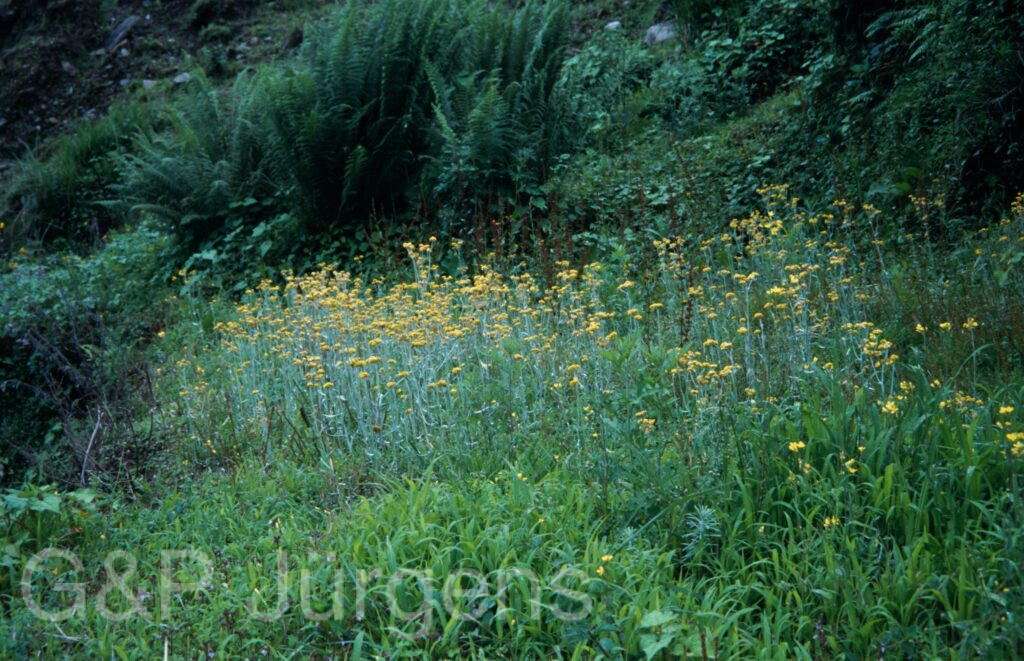
Pseudognaphalium affine is a widespread woolly cudweed of East Asia and the Indo-Himalaya, ranging across China, Japan, Korea, Taiwan, the Himalaya (Nepal, India, Bhutan, Pakistan, Afghanistan), Myanmar, Thailand, Sri Lanka and South-East Asia, and now naturalised more widely (with records as far afield as Argentina and Georgia); its very large dataset of over 7400 georeferenced occurrences confirms its abundance and weedy success. It grows on open grassy slopes, field margins, fallow ground, roadsides and other disturbed sites from the lowlands to the mid-montane belt, broadly from near sea level to about 2500 m. The plant recorded near Gunda in Gorkha, Nepal, at 1850 m in May is typical of such open, sunny, anthropogenic habitats.

It is an annual or biennial herb with erect, simple or branched stems clothed, like the foliage, in dense white-woolly (arachnoid) tomentum. The leaves are alternate, oblanceolate to spathulate, sessile and somewhat decurrent, grey-green and persistently woolly on both surfaces. The numerous small, discoid capitula are aggregated into dense terminal corymbs; each head is enclosed by several rows of pale yellow to straw-coloured, scarious involucral bracts, the florets all tubular, the outer female and filiform, the inner bisexual. The fruit is a tiny oblong cypsela bearing a pappus of slender, basally connate bristles aiding wind dispersal.

Formerly placed in Gnaphalium, this species was transferred to Pseudognaphalium on the basis of capitulum and pappus characters within tribe Gnaphalieae. It is used in East Asian cuisine and folk medicine and is a familiar ruderal weed; its broad ecological tolerance and prolific seed make it abundant and entirely unthreatened.

Author: (D.Don) Anderb. · Sources: POWO (Kew), GBIF, Flora of China, Flora of Nepal, Flora of Bhutan, Anderberg's monograph of the Gnaphalieae
(Roxb.) R.Br.

Sikkim 2006 285 ergebnis
India West-Bengal, Chaana 1650m, May

Description

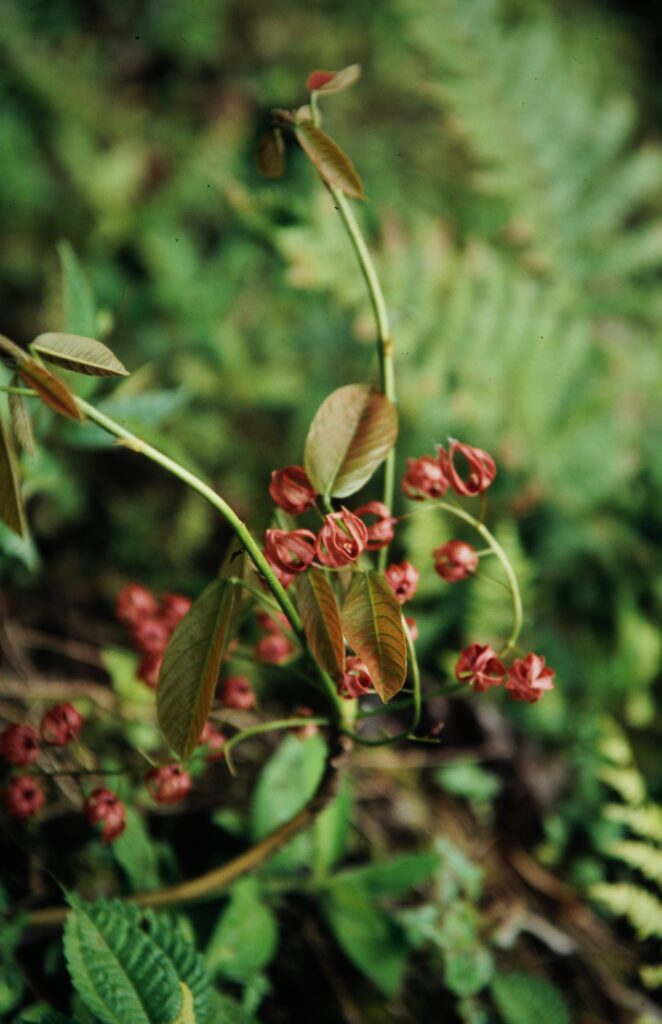
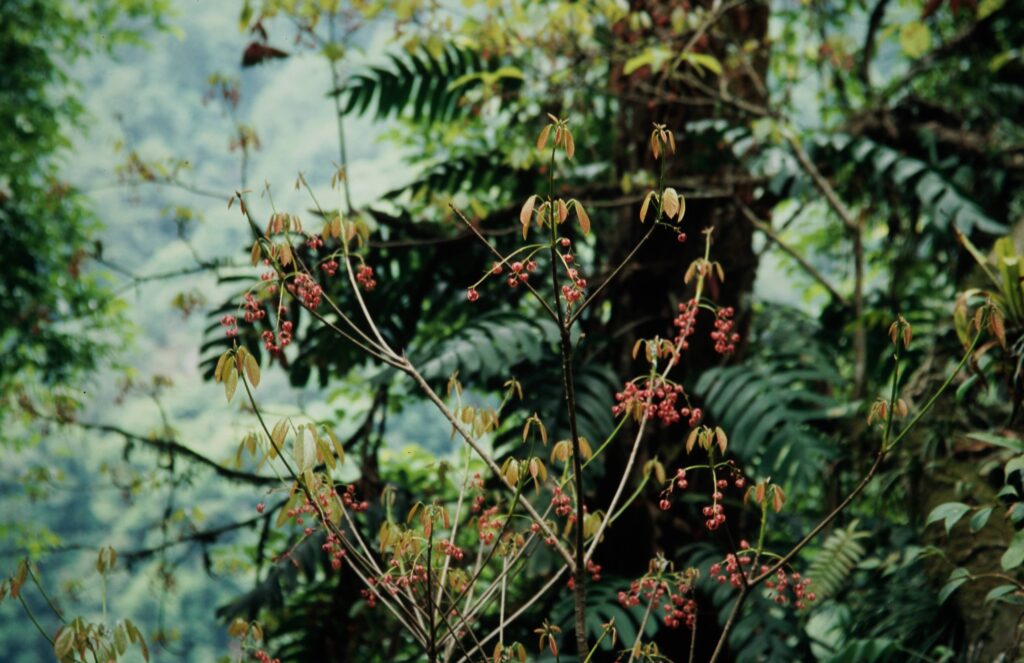
Pterygota alata is a large deciduous tree of tropical and subtropical Asia, distributed from India, Bangladesh, Sri Lanka and Nepal eastward through Myanmar, Thailand, the Malay Peninsula, Indonesia, the Philippines and southern China, with cultivated records elsewhere; GBIF lists some 350 occurrences, a number inflated by its frequent planting as an avenue and shade tree. It grows in lowland and lower-montane evergreen and semi-evergreen forest, often along valley bottoms on deep moist soils. The photographed individual was recorded in the West Bengal hills at Chaana around 1650 m in May, near the upper margin at which this tropical tree persists in the eastern Himalayan foothills.

It is a tall tree with a straight bole and spreading crown, the bark grey and rather smooth, often buttressed at the base. The leaves are alternate, large, broadly ovate to orbicular with a cordate base and abruptly acuminate apex, palmately veined and clustered toward the branch tips. The flowers are borne in axillary panicles, lacking a corolla, with a coloured, campanulate, lobed calyx. The most distinctive feature is the fruit, a cluster of large, woody, globose follicles that split to release numerous broadly winged seeds adapted for wind dispersal, the wing giving the genus its name.

Formerly placed in Sterculiaceae, Pterygota is now treated within an expanded Malvaceae (subfamily Sterculioideae), as reflected in the family given here. The winged seed and apetalous flowers ally it with Sterculia and Firmiana. Valued for its light timber and as an ornamental, P. alata is not considered globally threatened, although natural lowland-forest populations are locally reduced by logging.

Author: (Roxb.) R.Br. · Sources: POWO (Kew), GBIF, Flora of China Vol. 12, Flora of Bhutan Vol. 1, Flora of Nepal, Flora of Pakistan, Kostermans revision of Asian Sterculiaceae

Quercus glauca

by GP Jürgens

Thunb.

Bhutan2015 571
Bhutan Mo-Chu 1550m, October
Bhutan2015 572
Bhutan Mo-Chu 1550m, October

Description

Quercus glauca, the ring-cupped or Japanese blue oak, is one of the most widespread evergreen oaks of East and South Asia. GBIF documents nearly 14,910 occurrences spanning Japan, China, Taiwan, Korea, Nepal, India, Bhutan, Myanmar, Laos and Pakistan, with numerous introduced records in Europe and North America. It is a dominant or co-dominant of subtropical and warm-temperate broadleaved evergreen forest, frequently on hill slopes, ravines and along watercourses at low to mid elevations. The photographed tree grew in Bhutan along the Mo-Chu at 1550 m in October, a typical mid-montane riparian situation within the species' Himalayan range.

It is an evergreen tree with smooth greyish bark and alternate, coriaceous, oblong-lanceolate leaves whose upper half is conspicuously serrate while the lower margin is entire; the lamina is glossy dark green above and glaucous, often whitish-waxy and pubescent beneath, giving the species its epithet. Young shoots are silky-villous. As a member of subgenus Cerris, section Cyclobalanopsis, it bears its acorns in a distinctive cupule formed of concentric, ring-like fused bracts rather than separate scales; the ovoid nut ripens in a single season. Flowers are unisexual, the staminate in slender pendent catkins, the pistillate few in short spikes.

GBIF accepts the name. Its placement in section Cyclobalanopsis, sometimes treated as a separate genus, unites the Asian ring-cupped oaks. Quercus glauca is an important timber and afforestation tree, widely planted and naturalised, and ecologically central to evergreen oak forests. It is abundant and assessed as of least conservation concern.

Author: Thunb. · Sources: POWO (Kew), GBIF, Flora of China, Flora of Bhutan, monograph of Asian Quercus (Cyclobalanopsis)

Quercus lanata

by GP Jürgens

Sm.

Nepal 97 83 P138
Nepal Tankhu 2100m April
Nepal 97 84 P141
Nepal Tankhu 2100m April

Description

Quercus lanata is an evergreen oak of the Himalaya and adjacent uplands, documented in 317 GBIF occurrences across Nepal, Bhutan, India, Pakistan, China, Myanmar, Thailand and Vietnam. It is a characteristic tree of subtropical to lower temperate broad-leaved forest, occurring on hill slopes and ridges, often in association with other evergreen oaks, rhododendrons and laurels, generally between about 1000 and 2400 m. The tree photographed at Tankhu in Nepal at 2100 m in April occupies the mid-montane oak belt, flowering in spring before or with the flush of new foliage on warm, well-drained slopes.

The species forms a small to medium-sized evergreen tree with a rounded crown and bark that is grey and fissured. The leaves are alternate, simple, coriaceous, ovate-lanceolate to elliptic, with serrate or crenate-dentate margins, the lower surface densely covered in a persistent greyish to tawny wool from which the epithet lanata derives. The flowers are unisexual and monoecious, the staminate borne in slender pendulous catkins and the pistillate few, in short spikes. The fruit is an acorn, ovoid, seated in a shallow, scaly cupule, maturing over one season.

Quercus lanata belongs to subgenus Cerris, section Cyclobalanopsis or the ring-cupped oak alliance recognised in older treatments, and has historically been confused with Q. leucotrichophora and other woolly-leaved Himalayan oaks. It is an important component of mid-elevation watershed forests, providing fuelwood, fodder and leaf litter, and is locally subject to pressure from lopping and forest clearance, though it remains widespread and not globally threatened.

Author: Sm. · Sources: POWO (Kew), GBIF, Flora of China Vol. 4, Flora of Bhutan Vol. 1, Flora of Nepal, Flora of Pakistan, Menitsky's Oaks of Asia

A.Camus

Garh 07 580 ergebnis
India Garhwal Seena 3350m, June

Description

Quercus leucotrichophora, commonly known as banj oak, is a dominant broadleaved tree of the western and central Himalaya, distributed from northern Pakistan through India (Jammu & Kashmir, Himachal Pradesh, Uttarakhand) to Nepal, Bhutan, and adjacent parts of Myanmar. It forms extensive forests on north-facing slopes and mesic sites at elevations of 1,500–3,500 m, constituting one of the most ecologically important tree species in the Himalayan mid-montane zone. The species has been documented at Seena in the Garhwal Himalaya of Uttarakhand at 3,350 m in June, representing the upper elevational margin of its range where it transitions into subalpine communities.
Quercus leucotrichophora is an evergreen tree, typically 15–25 m tall, with a stout trunk and spreading, dense crown. The bark is dark grey to blackish, deeply furrowed on mature trees. Leaves are elliptic to lanceolate, 6–15 cm long and 2–5 cm wide, with a sharply serrate margin bearing spine-tipped teeth, coriaceous in texture, dark green and glabrous above, and distinctly white-tomentose beneath — the specific epithet referring to these white (leuco-) hairs (tricho-) on the leaf (phora). Flowers are unisexual and monoecious; male catkins are pendulous, 5–10 cm long, while female flowers are borne in short, erect spikes. The acorn is ovoid, 1–1.5 cm long, seated in a shallow, scaly cupule with appressed, imbricate scales.
Quercus leucotrichophora belongs to the subgenus Cerris, section Ilex, a group of evergreen oaks centred in East and South Asia. It is a keystone species in western Himalayan forests, supporting a rich community of epiphytes, mycorrhizal fungi, and avifauna. The leaf litter is a critical source of organic matter and nutrient cycling in montane soils. Banj oak forests are widely exploited for fuelwood and fodder — the leaves being an essential winter fodder resource for livestock — and ongoing lopping pressure has led to degradation of many stands, prompting conservation and restoration efforts across Uttarakhand and Himachal Pradesh.

Author: A.Camus · Sources: POWO (Kew), GBIF, Flora of China Vol. 4, Singh & Rawat: Flora of the Great Himalayan National Park (2000), Troup: Silviculture of Indian Trees Vol. 3

Sm.

Bhutan2014 857
Bhutan Chele-La 3000m, May
Bhutan2014 1039
Bhutan Chele-La 3000m, May
Nepal 99 374 ergebnis
West-Nepal Linji-Khola 3300m, June

Description

Quercus semecarpifolia, the kharsu oak, is an evergreen oak forming the highest-altitude oak forests of the Himalaya, native across China, Nepal, India, Bhutan, Pakistan and Afghanistan and extending into Myanmar and Thailand. It dominates upper montane and subalpine slopes, often at the treeline, generally between about 2400 and 3800 m, on cool, moist exposures. The trees photographed at Chele-La in Bhutan at 3000 m in May and along the Linji-Khola in West Nepal at 3300 m in June illustrate its role as the uppermost broad-leaved forest belt, frequently mixed with rhododendron, fir and birch near the limit of arborescent growth.

It is a large evergreen tree, gnarled and spreading at high elevations, with thick, fissured bark. The leaves are leathery and elliptic to oblong, dark glossy green above and golden- to rusty-tomentose beneath when young, the margin entire or with a few spiny teeth, especially on younger and coppice growth. It is monoecious, the male flowers in slender pendulous catkins and the female flowers solitary or few. The fruit is a large, hemispherical acorn seated in a shallow cup of appressed scales, maturing over a second season and providing important mast.

Quercus semecarpifolia belongs to subgenus Cerris (section Ilex, the ring-cupped oaks), the predominant oak lineage of the Sino-Himalayan mountains. As a treeline keystone it stabilises soils, supports rich epiphyte and understorey communities and yields hard timber, fuelwood and fodder, which makes it heavily exploited and in places poorly regenerating. Its acorns are dispersed by birds and rodents, and the species is regarded as ecologically critical yet locally threatened by overcutting and grazing across the Himalaya.

Author: Sm. · Sources: POWO (Kew), GBIF, Flora of China, Annotated Checklist of the Flowering Plants of Nepal, Flora of Bhutan, Menitsky's Oaks of Asia

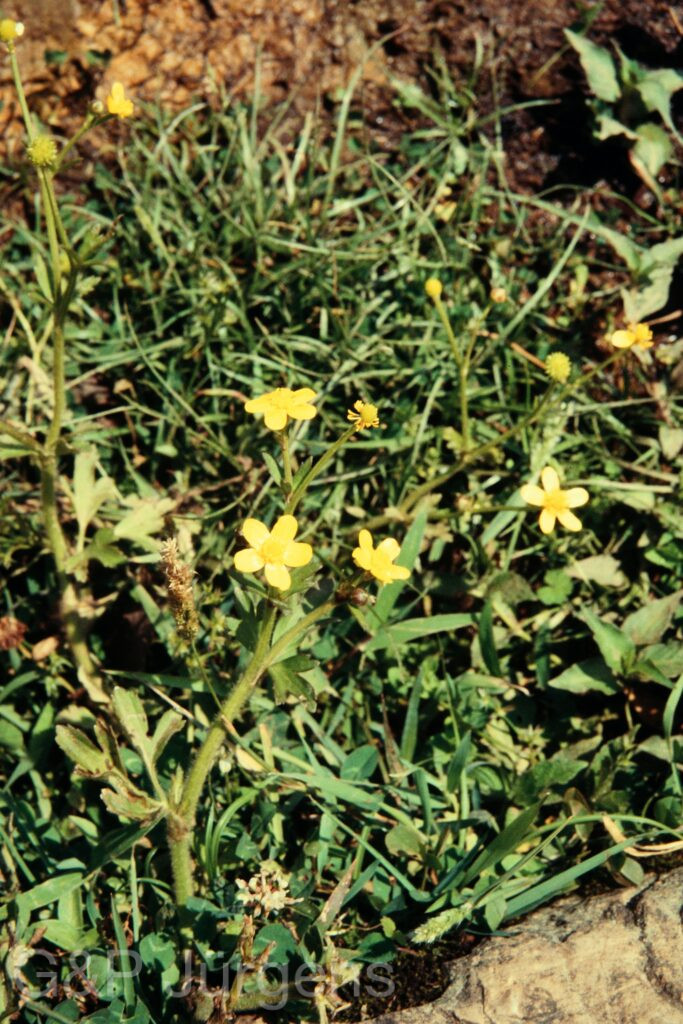
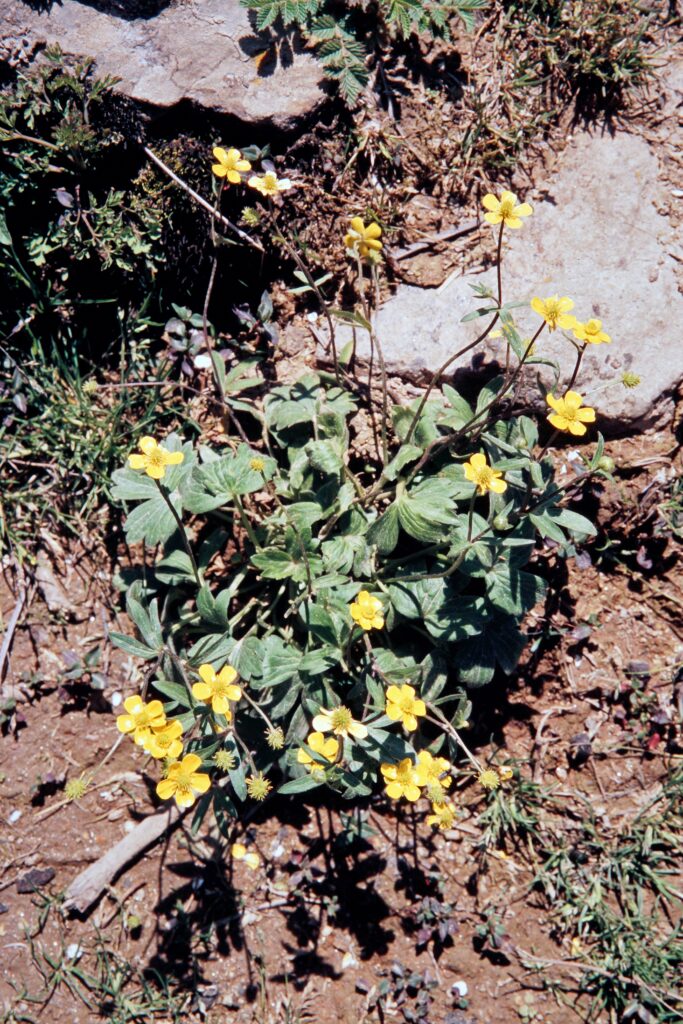
DC.

Nepal 97 611 P1182
Nepal Godawari 1350m May
Garh 07 47 ergebnis
India Garhwal Mandakini 2360m, June

Description

Ranunculus diffusus is a widely distributed buttercup of the Himalaya and montane Asia, recorded from India, Nepal, China, Pakistan, Bhutan, Myanmar, Vietnam, Malaysia, Indonesia, Sri Lanka and Taiwan, with some 618 occurrences in GBIF. It favours moist, shaded habitats such as forest floors, streamsides, damp banks and the margins of cultivation, ranging widely from the subtropical foothills into the temperate zone, roughly between 1000 and 3000 m. The photographs from Godawari in Nepal at about 1350 m in May and from the Mandakini valley in Garhwal at about 2360 m in June illustrate its broad ecological and altitudinal tolerance across the spring and early-monsoon flowering period.

The plant is a perennial herb with slender, diffusely spreading and often decumbent or rooting stems, the habit that gives the species its name. The basal and lower leaves are long-petioled and ternately divided into three lobed and toothed segments, more or less hairy. The flowers are small, solitary or few on slender pedicels, with usually five spreading, reflexed sepals and five glossy yellow petals each bearing a nectary scale at the base, surrounding numerous stamens and carpels. The fruiting head is a globose to ovoid cluster of small, compressed achenes tipped by a short curved or hooked beak.

Within the cosmopolitan genus Ranunculus, R. diffusus is a member of the diverse Asian assemblage of small-flowered, woodland and streamside buttercups and shows considerable variation in leaf division and pubescence across its wide range. Like most buttercups it contains the acrid glycoside ranunculin, rendering it unpalatable and somewhat toxic to livestock. Common and ecologically plastic, it is not of conservation concern and frequently behaves as a weed of moist disturbed ground.

Author: DC. · Sources: POWO (Kew), GBIF, Flora of China, Flora of Bhutan, Annotated Checklist of the Flowering Plants of Nepal, Tamura's treatment of Ranunculaceae

Dumort.

Nepal 2001 457 ergebnis ergebnis
Nepal (Gorkha) Gunda 1700m, May

Description

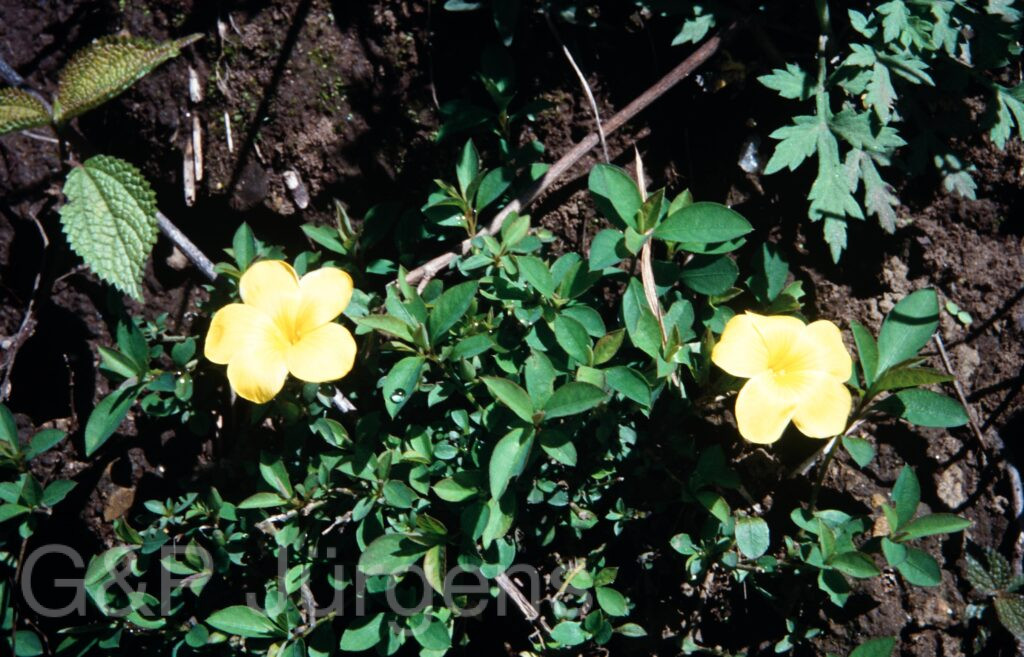
Reinwardtia indica Dumort., the yellow flax, is a subshrub of the flax family widely distributed through the Himalaya and the mountains of southern China and Southeast Asia. GBIF documents it in India, Nepal, Bhutan, Pakistan, China, Myanmar and Thailand, with numerous extralimital records reflecting its frequent cultivation as an ornamental. It grows on shaded banks, forest margins, hillside scrub and roadside slopes in the subtropical to lower temperate zone, generally between about 800 and 2,300 m. The plant from Gunda in the Gorkha district of Nepal at 1,700 m, flowering in May, is typical of its hill-forest habitat, though it also flowers conspicuously in the cooler months.

The species is a low, much-branched perennial subshrub to about 1 m tall with slender, glabrous green stems. The leaves are alternate, elliptic to obovate, entire or minutely toothed, with small caducous stipules. The bright golden-yellow flowers are borne singly or in few-flowered axillary and terminal clusters; each has five sepals, five large obovate petals that are fugacious (lasting only a day), and stamens united below into a tube with alternating staminodes. The fruit is a septicidal capsule splitting into several one-seeded segments.

Reinwardtia is a small genus of one or two species closely allied to Linum, distinguished by its woody habit and persistent yellow flowers. R. indica is much grown in gardens and is used in folk medicine and as a dye source. It is widespread, frequently semi-naturalised through cultivation, and of no conservation concern.

Author: Dumort. · Sources: POWO (Kew), GBIF, Flora of China Vol. 11, Flora of Pakistan, Mildbraed: Linaceae in Das Pflanzenreich

Remusatia pumila

by GP Jürgens

(D.Don) H.Li & A.Hay

Bhutan2012 715
Bhutan Galephu 850m, October
Nepal 1994 228 ergebnis
Ost-Nepal Mewa-Khola 1900m April 

Description

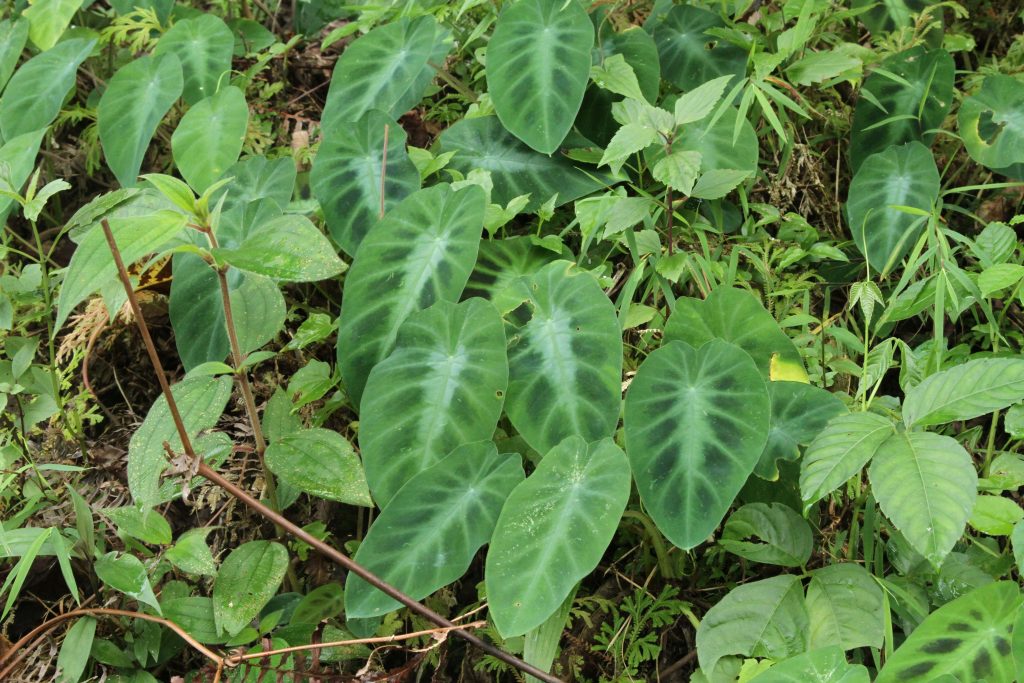
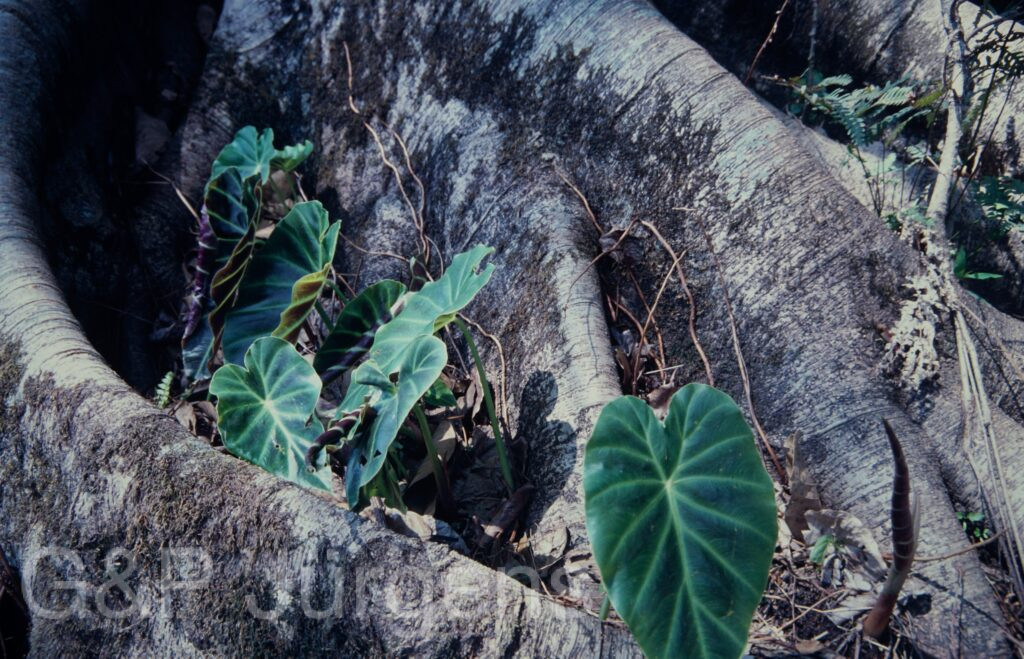
Remusatia pumila (D.Don) H.Li & A.Hay is a small tuberous aroid of the eastern Himalaya and Indo-Burmese region, documented by about 269 records spanning India, Nepal, Bhutan, China, Myanmar, Thailand, Malaysia, Indonesia and Vietnam, with naturalised reports elsewhere. It grows as a lithophyte and epiphyte on mossy rocks, boulders and tree trunks in humid broad-leaved and subtropical forest, favouring shaded, seepage-moistened microsites. The cited gatherings from Galephu in southern Bhutan at 850 m in October and the Mewa Khola of East Nepal at 1900 m in April reflect its span across the warm-temperate to subtropical foothill belt.

The plant is a diminutive geophyte arising from a small subglobose tuber that produces clusters of bulbil-bearing structures. The leaves are few, with slender petioles and ovate to ovate-cordate, peltate or sagittate blades. As in all Remusatia, vegetative reproduction is conspicuous: erect to spreading bulbiliferous shoots bear numerous hooked, scale-covered bulbils that detach and disperse epizoochorously. The inflorescence is a spathe enclosing a spadix with basal female and upper male flower zones separated by sterile flowers; flowering is comparatively infrequent relative to the prolific bulbil production.

The species was long placed in Gonatanthus, a genus now subsumed within Remusatia, the combination reflecting molecular and morphological reassessment of the tribe Colocasieae. Reliance on hooked bulbils for dispersal by passing animals is a key adaptation to its epilithic and epiphytic, often ephemerally exposed habitats. Widespread and locally frequent, it is not considered threatened, though its dependence on undisturbed humid forest links its persistence to lowland and submontane habitat integrity.

Author: (D.Don) H.Li & A.Hay · Sources: POWO (Kew), GBIF, Flora of China, Flora of Bhutan, Flora of Nepal, Araceae of the Indian subcontinent / monograph of Remusatia and Colocasieae

(Roxb.) Schott

Sikkim 2006 487 ergebnis
India West-Bengal, Ruigi-Chu 1800m, May
Bhutan2015 147
Bhutan Galephug 800m, October

Description

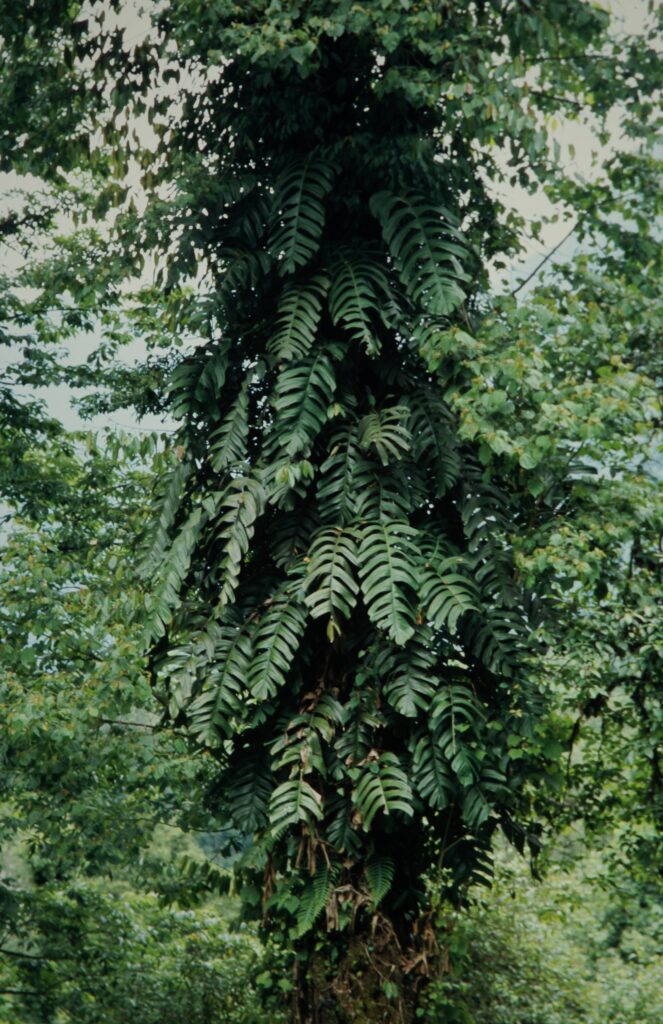
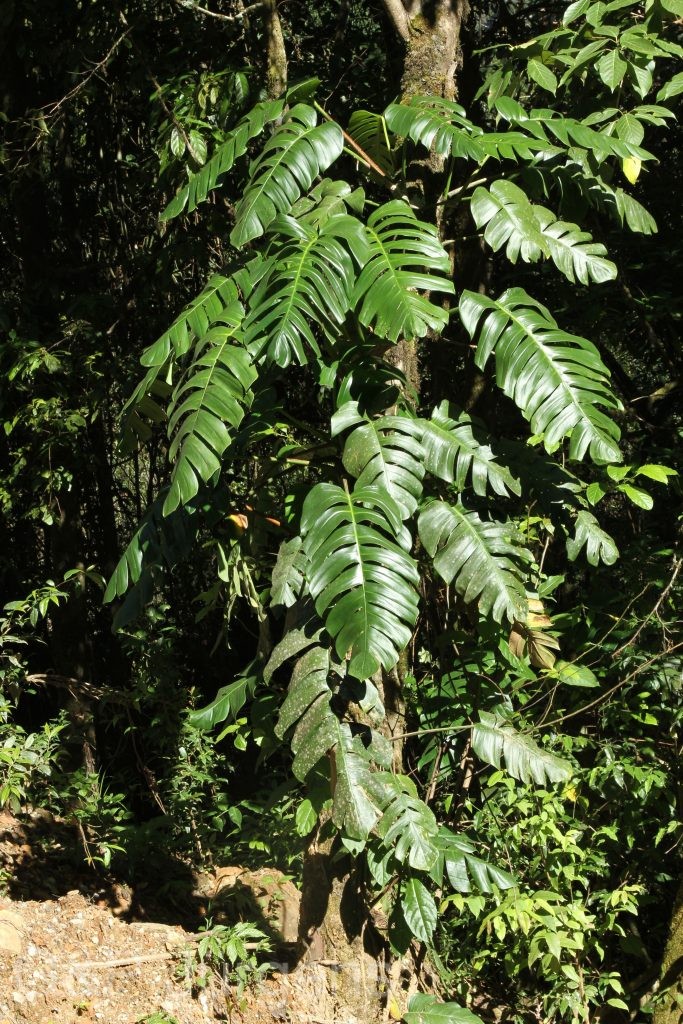
Rhaphidophora decursiva ((Roxb.) Schott) is a robust root-climbing aroid widely distributed across tropical and subtropical Asia, ranging from the eastern Himalaya and northeast India through Bangladesh, Myanmar, Thailand, Laos, Vietnam and southern China to Sri Lanka and the Malay region. The roughly 700 GBIF records confirm a strong concentration in the Indo-Burmese hill forests. It is a hemiepiphyte of humid evergreen and semi-evergreen broad-leaved forest, climbing tree trunks and clambering over rocks in shaded, moist ravines from near sea level to about 2,000 m. The cited material from Ruigi-Chu in West Bengal at 1,800 m in May and from Galephug, Bhutan, at 800 m in October illustrates its wide altitudinal amplitude across the Himalayan foothills.

The plant produces stout, scandent stems that cling by abundant clasping adventitious roots, the internodes green to brownish and somewhat flattened against the support. The leaves are large and long-petiolate, the lamina ovate-oblong in juveniles but becoming deeply pinnatifid in adults, divided almost to the midrib into numerous decurrent segments that give the species its epithet. The inflorescence is a cylindrical spadix subtended by a thick, boat-shaped, yellowish to greenish spathe; the flowers are bisexual and naked, lacking a perianth, and the infructescence ripens into a dense cluster of berries.

The genus Rhaphidophora belongs to the tribe Monstereae and is distinguished from the Neotropical Monstera by its Old World distribution and bisexual flowers. R. decursiva is among the most widespread members of the genus and shows considerable leaf heteroblasty between juvenile shingling and mature pinnatifid stages. Locally the plant is used in traditional medicine and is occasionally grown as a foliage ornamental. It is common and not regarded as threatened.

Author: (Roxb.) Schott · Sources: POWO (Kew), Flora of Bhutan Vol. 3, GBIF, Flora of China Vol. 23, Boyce & Croat: The Überlist of Araceae (Monstereae)