Tag:

Nepal

Flowers of Nepal — 1313 wild plant species documented from the Nepalese Himalaya, from subtropical foothills to high alpine meadows above 4,000 m. Nepal’s dramatic elevation gradient makes it one of the richest botanical regions on Earth, home to rhododendrons, primulas, gentians and the famed blue poppies (Meconopsis). Every entry gives a botanical description, native distribution, habitat and flowering season, alongside the original field photograph and the location where it was taken.

Senecio scandens

by GP Jürgens

Buch.-Ham. ex D.Don

Bhutan2012 109
Bhutan Chogcham 2900m, June

Description

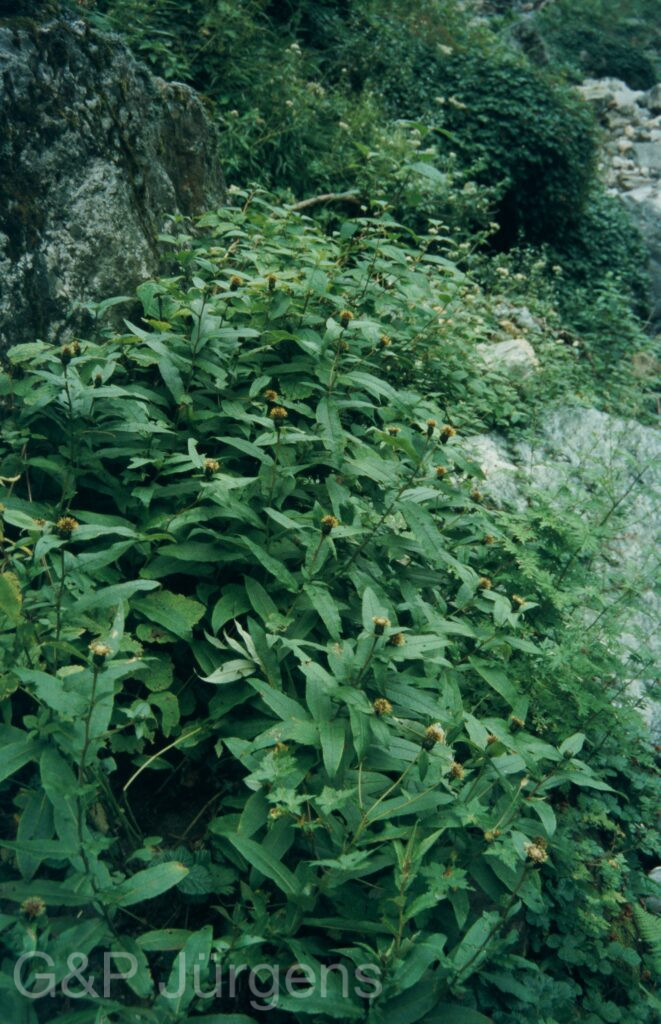
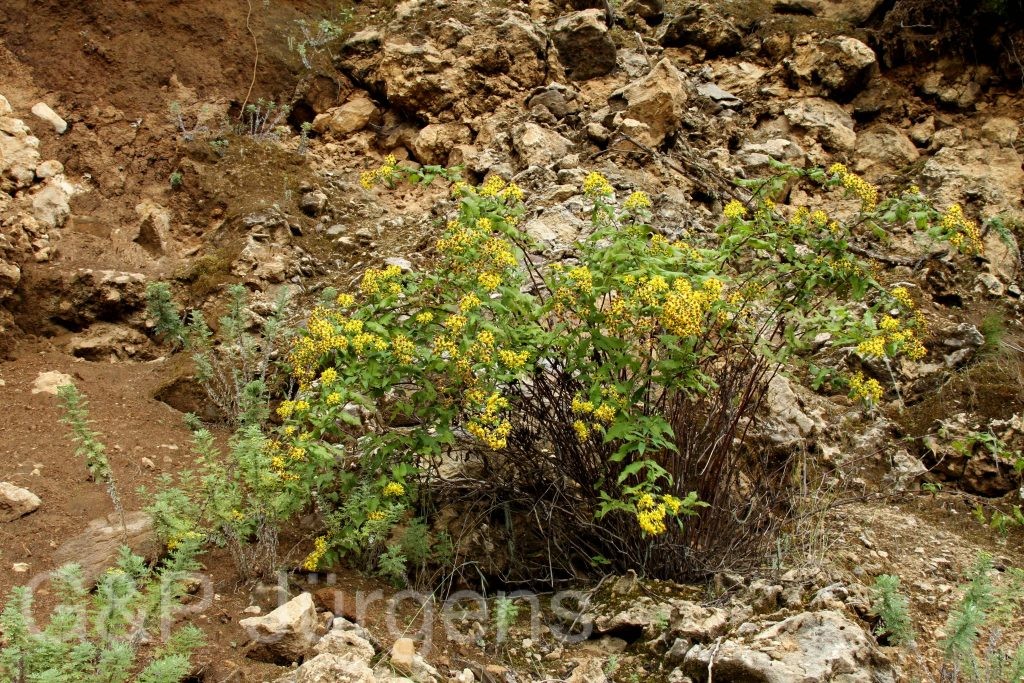
Senecio scandens, the climbing groundsel, is a widely distributed scrambling composite of South, East and Southeast Asia, with 5,659 GBIF occurrences across China, Taiwan, Japan, India, Nepal, Bhutan, Myanmar, Vietnam, Korea, Sri Lanka, Thailand and the Philippines, plus scattered records as an introduction elsewhere. It grows in forest margins, thickets, hedgerows, ravines and disturbed slopes over a very broad altitudinal range from the foothills to over 3000 m. The plant pictured was recorded at Chogcham in Bhutan at 2900 m in June, an upper-temperate setting where this vigorous scrambler clambers over shrubs and forms tangled masses.

It is a perennial herb or subshrub with elongate, climbing or trailing, much-branched stems that can reach several metres. The leaves are alternate, ovate-lanceolate to triangular, often hastate or with a few basal lobes or teeth, acuminate at the apex and shortly petiolate. The numerous yellow capitula are arranged in broad terminal and axillary corymbose panicles; each radiate head has about eight to ten short ray florets around a yellow disc, subtended by a calyculate involucre of narrow phyllaries with conspicuous outer bracteoles. The cypselae are cylindrical and ribbed, bearing a copious white pappus of fine capillary bristles that aids wind dispersal.

Described by Buchanan-Hamilton ex D. Don, the species belongs to the large, cosmopolitan genus Senecio (tribe Senecioneae). Like many of its relatives it contains pyrrolizidine alkaloids and is used in traditional Asian herbal medicine, particularly in Chinese pharmacopoeia. Abundant, fast-growing and tolerant of disturbance, it is in no way threatened and can behave weedily where introduced.

Author: Buch.-Ham. ex D.Don · Sources: POWO (Kew), GBIF, Flora of Bhutan, Flora of China, Senecioneae of the World (Nordenstam), Flowers of the Himalaya (Polunin & Stainton)
Franch.

Bhutan2015 327
Bhutan, Trongsa 3100m, October

Description

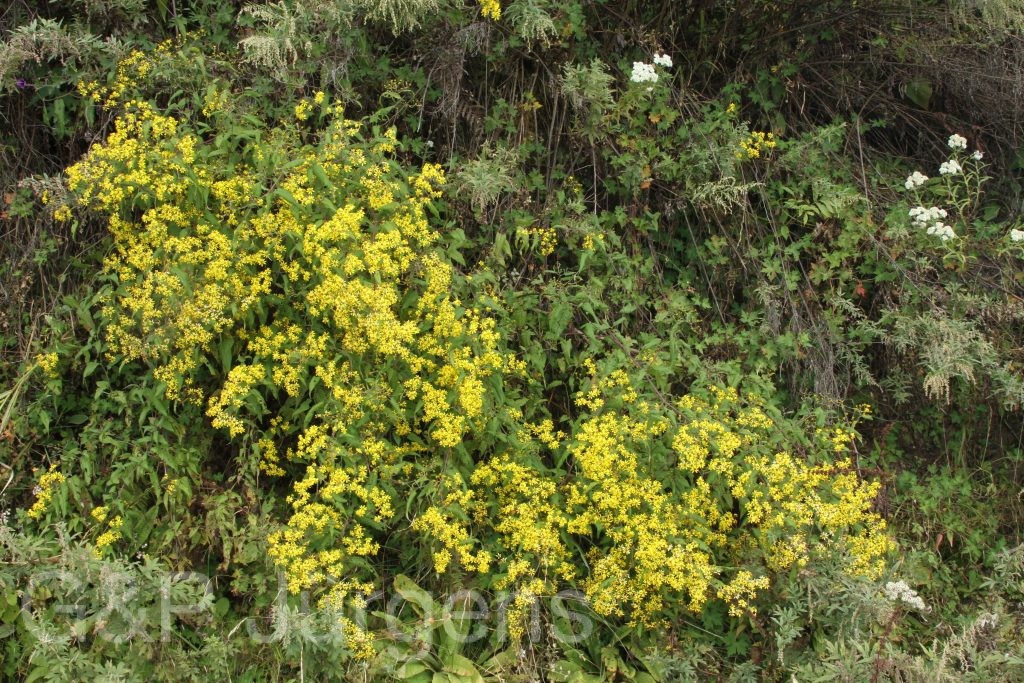
Senecio scandens var. incisus is a regional variant of the widespread climbing groundsel, recorded from China, Taiwan, Hong Kong and Nepal, with 338 georeferenced occurrences across the type species' range; the variety is part of an East Asian to Himalayan complex. It grows in moist montane forest margins, thickets, scrub and along streamsides and clearings, scrambling over shrubs and rocks, generally in the temperate zone. It was photographed near Trongsa, Bhutan, at 3100 m in October, flowering in the cool post-monsoon season when its golden heads brighten forest edges and disturbed slopes.

It is a scrambling or climbing perennial herb with long, slender, ribbed and often woody-based stems reaching several metres through surrounding vegetation. The alternate leaves are ovate to triangular-lanceolate, in var. incisus more deeply and irregularly incised or lobed than in the typical form, with toothed margins, an acuminate apex and frequently a pair of small basal lobes. The numerous radiate flower heads are arranged in broad terminal and axillary corymbose panicles; each head has bright yellow ray and disc florets subtended by a uniseriate involucre of green phyllaries with small outer calyculate bracts. The fruit is a cylindrical cypsela bearing a white pappus of fine bristles.

The species belongs to Senecio s.str. in tribe Senecioneae, one of the largest genera of flowering plants; the scandent climbing habit is unusual within an otherwise herbaceous genus. The variety incisus, described by Franchet, is distinguished by its more dissected leaves and treated as part of the variable S. scandens aggregate. Like the type, it contains pyrrolizidine alkaloids and is used in traditional Chinese medicine. It is common and not of conservation concern.

Author: Franch. · Sources: POWO (Kew), GBIF, Flora of China, Flora of Bhutan, Senecioneae of the World (Nordenstam & Pelser studies)

(DC.) Raab-Straube & Yu J.Wang

Garw 2005 64 ergebnis ergebnis
India Garhwal Valley of flowers 3400m, September
Garw 2005 170 ergebnis ergebnis
India Garhwal Shertoli 3100m, September

Description

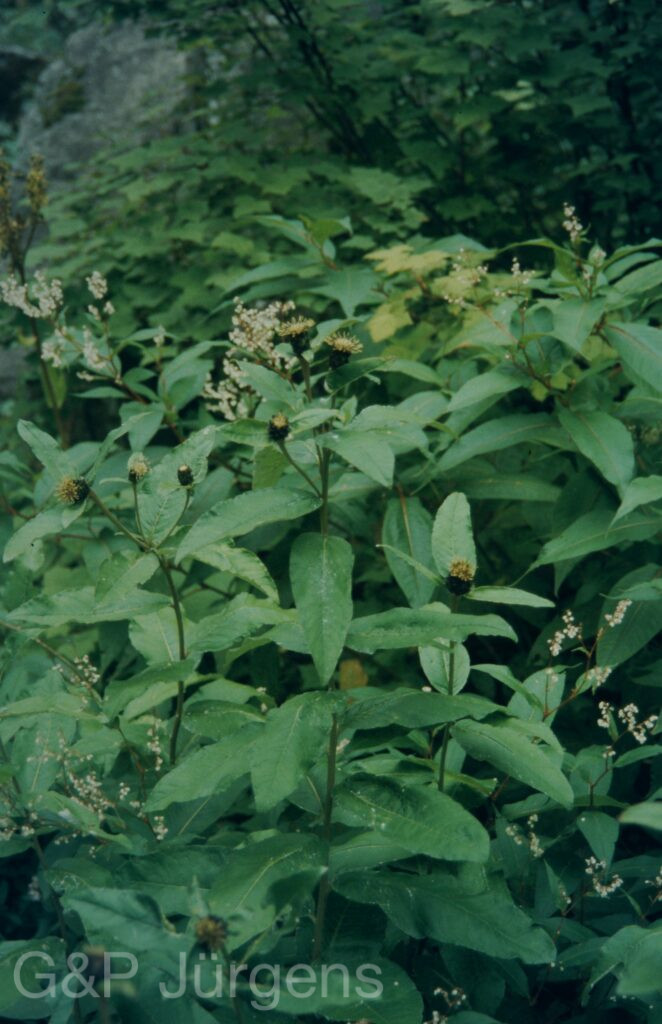
Shangwua denticulata is an alpine perennial herb of the Himalaya and the Tibetan plateau region, recorded from China, Nepal, India and Bhutan, with about 170 occurrences in GBIF. It is a plant of high open habitats, growing on alpine and subalpine slopes, in meadows, on screes and among rocks, generally above the treeline. The photographed plants come from the Garhwal Himalaya of India, at the Valley of Flowers (3400 m) and at Shertoli (3100 m), both recorded in September as the late-summer alpine flora comes into flower and fruit, an elevation and setting characteristic of this cold-mountain specialist.

The plant arises from a perennial rootstock and produces erect or ascending stems bearing alternate leaves; the leaves are oblong to lanceolate with toothed (denticulate) margins, as the epithet records, and are often somewhat hairy. The flower heads (capitula) are borne singly or in small clusters and are surrounded by a many-rowed involucre of bracts, the latter frequently tinged dark or purplish as in many alpine composites. As a member of the tribe Cardueae the capitula are discoid, composed wholly of tubular, purplish florets, and the achenes are crowned by a pappus of fine bristles that aids wind dispersal.

Shangwua is a small genus recently segregated from Saussurea on molecular and morphological grounds, the species formerly treated under that genus; the recombination by Raab-Straube and Wang reflects modern phylogenetic revision of the Saussurea complex. As a high-alpine thistle relative, S. denticulata is adapted to short growing seasons, intense radiation and cold, and its specialised montane distribution makes it of biogeographic interest within the rich Sino-Himalayan Cardueae flora.

Author: (DC.) Raab-Straube & Yu J.Wang · Sources: POWO (Kew), GBIF, Flora of China, Flora of Bhutan, Saussurea and allies revision (Raab-Straube)

(Edgew.) Pusalkar & D.K.Singh

Garw 2005 333 ergebnis
India Garhwal Bagubas 4000m, October

Description

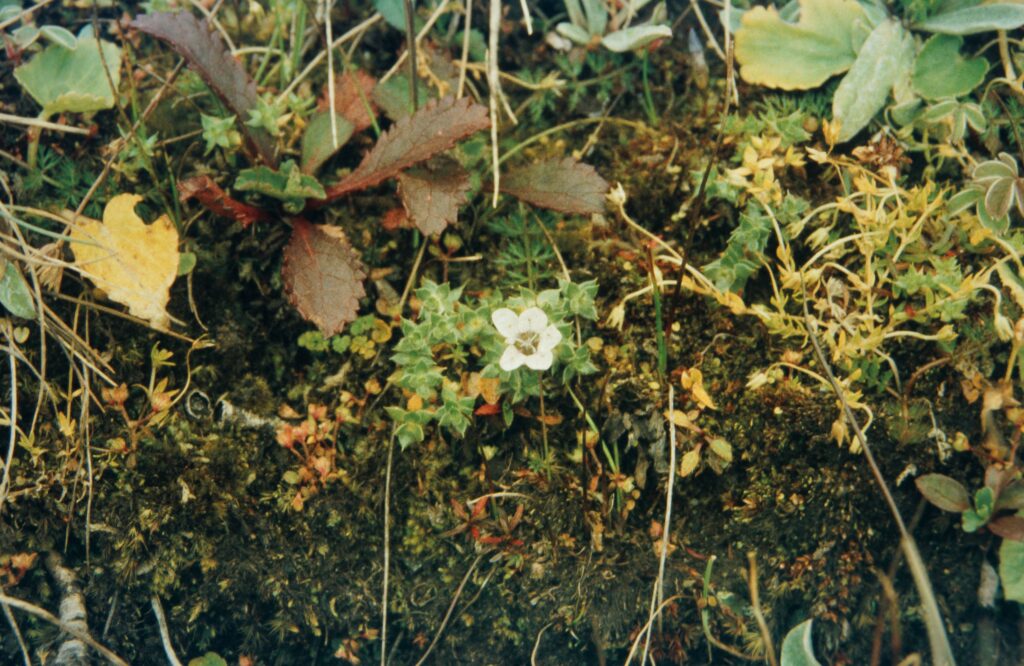
Shivparvatia glanduligera is an alpine herb of the Caryophyllaceae distributed across the Himalaya from northern India (Kashmir, Himachal Pradesh, Uttarakhand) through Nepal and Bhutan to southwestern China (Tibet). GBIF records 256 occurrences, making it one of the more frequently collected high-altitude caryophylls in the region. The species inhabits alpine meadows, moist scree, rocky slopes, and gravel flats at elevations of 3,500–5,200 m. The photograph from Bagubas in the Garhwal Himalaya at 4,000 m, taken in October, shows the species in the western part of its range during its late-season flowering.
The plant is a low, tufted perennial herb, 3–12 cm tall, with ascending stems that are characteristically glandular-pubescent throughout — the feature referenced in the epithet glanduligera. Leaves are opposite, linear-lanceolate to narrowly elliptic, 5–15 mm long, acute, with glandular hairs on both surfaces and margins. Flowers are solitary or in few-flowered terminal cymes. Sepals five, ovate-lanceolate, glandular-hairy, 3–5 mm long. Petals five, white, obovate, slightly exceeding the sepals, entire or shallowly emarginate at the apex. Stamens 10. Styles three. The capsule is ovoid, dehiscing by six teeth, containing numerous small, reniform, tuberculate seeds.
This species was long placed in Arenaria as A. glanduligera Edgew. before molecular phylogenetic analyses revealed that the traditional genus Arenaria was massively polyphyletic. Pusalkar and D.K. Singh transferred it to the newly erected genus Shivparvatia, named after the Hindu deities Shiva and Parvati in reference to the Himalayan home of these plants. The reclassification reflects a broader reorganisation within Caryophyllaceae tribe Arenarieae based on molecular evidence. The species is ecologically significant as a component of high-alpine plant communities and is not currently assessed as threatened.

Author: (Edgew.) Pusalkar & D.K.Singh · Sources: POWO (Kew), GBIF, Pusalkar & Singh (2015) in Phytotaxa, Flora of China Vol. 6, Naithani: Flora of Chamoli Vol. 1

C.F.Gaertn.

Nepal 97 35 P54
Nepal Dhoban 800m April
Nepal 97 37 P56
Nepal Dhoban 800m April
Nepal 1994 33 ergebnis
Ost-Nepal Simbhuwa Kola 
1000m April

Description

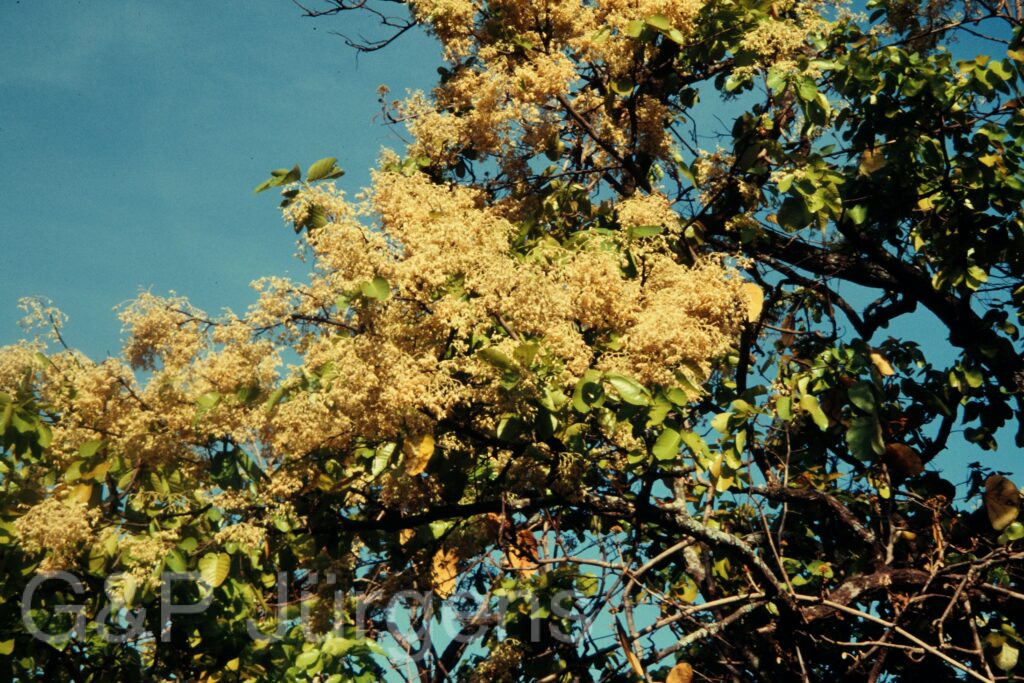
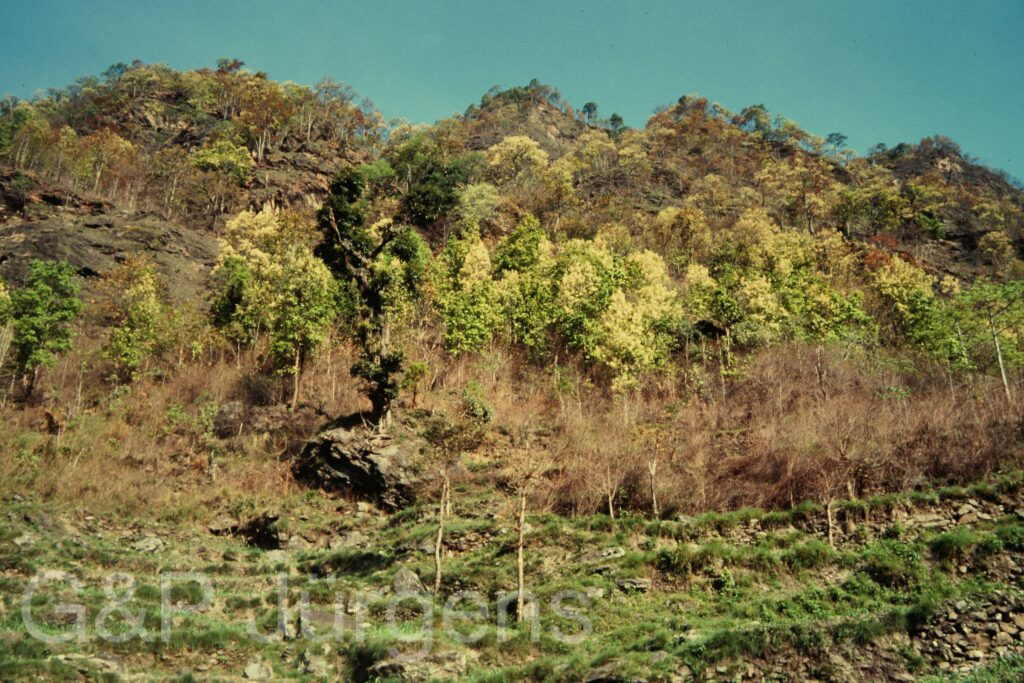
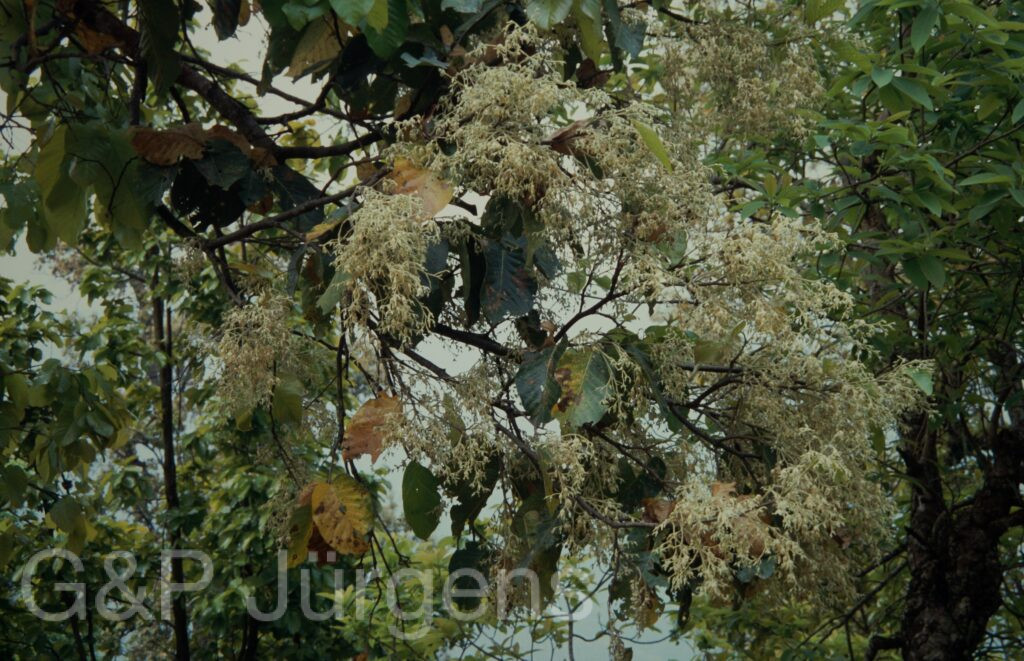
Shorea robusta, the sal tree, is a large, often gregarious dipterocarp dominating extensive lowland and submontane forests of the Indian subcontinent, documented by GBIF (596 occurrences) from India, Nepal, Bangladesh, Bhutan and adjacent regions. It forms the characteristic sal forest of the outer Himalayan foothills, terai and plains, on deep, well-drained alluvial and lateritic soils, typically below about 1200 m. The gatherings from Dhoban at 800 m and the Simbhuwa Kola in East Nepal at 1000 m, both in April, capture its phenology in the foothill belt, where it flushes new leaves and flowers in the hot pre-monsoon season.

The tree is large and may exceed 30 m, with a straight bole, thick longitudinally fissured bark and a dense, spreading crown; in moist sites it is nearly evergreen, briefly leaf-exchanging in the dry season. The leaves are simple, alternate, ovate-oblong, glabrous, shining and acuminate. The fragrant, pale yellow flowers are borne in axillary and terminal panicles, each with five sepals, five petals and numerous stamens. The fruit is a single-seeded nut crowned by the persistent, accrescent calyx, three lobes of which enlarge into elongate, wing-like sepals that aid wind dispersal.

A keystone of the Dipterocarpaceae in South Asia, sal is renowned for its durable timber, its dammar resin and its periodic mast-flowering, in which whole stands fruit synchronously. Ecologically it is a strong dominant forming nearly monospecific canopies and supporting a distinctive forest fauna and flora. Although heavily exploited and locally reduced by clearance, the species remains widespread and is not globally threatened, while being central to forestry and conservation in the region.

Author: C.F.Gaertn. · Sources: POWO (Kew), GBIF, Flora of Bhutan Vol. 1, Flora of Nepal, Flora of Pakistan, Ashton Dipterocarpaceae monograph (Flora Malesiana)

(Bertol.) Paule & Soják

Bhutan2012 910
Bhutan Tumching-La 4000m, October
Sikkim2011 27
Bhutan Lachen 2800m, June

Description

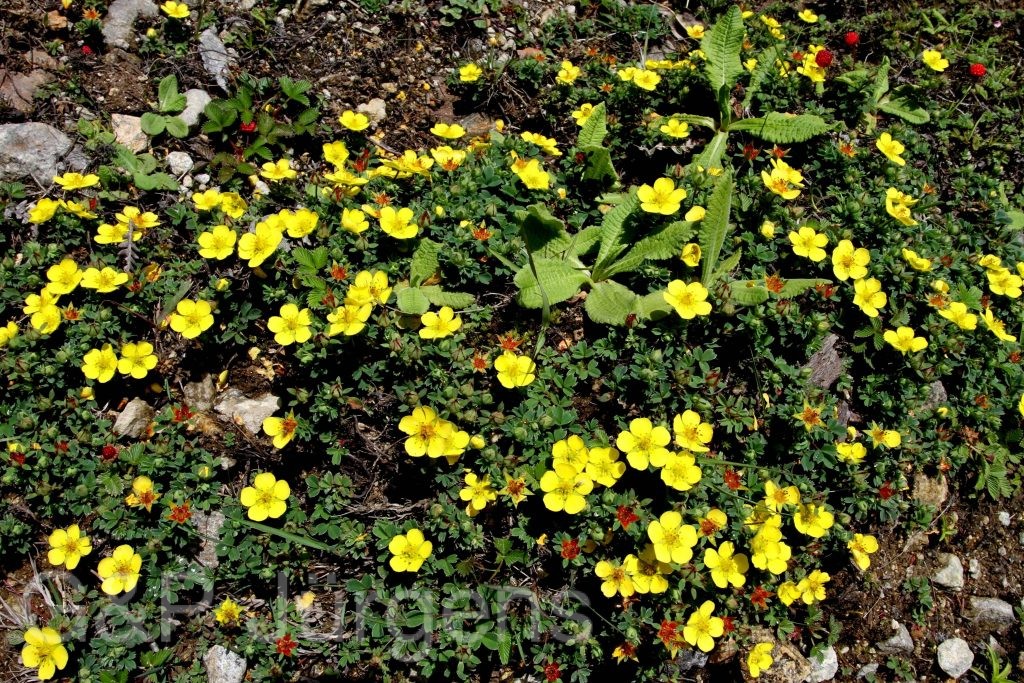
Sibbaldia cuneifolia (Bertol.) Paule & Soják is a cushion-forming perennial of the high Himalaya and adjoining Central Asian mountains, distributed across India, Nepal, Bhutan, Pakistan and SW China, with additional records from temperate Europe (Austria, Switzerland, Britain, Sweden, Finland) reflecting both a wide alpine range and naturalised or rock-garden occurrences; the roughly 184 georeferenced collections concentrate in the Sino-Himalayan alpine belt. It inhabits open stony slopes, screes, glacial moraine, alpine turf and the margins of late-melting snowbeds. The species ascends to considerable altitude, as the photographed material from the Tumching-La pass in Bhutan at about 4,000 m in October and from Lachen at 2,800 m in June illustrates, spanning the subalpine to high-alpine zones.

It is a low, mat-forming herb arising from a woody, branched rootstock and slender creeping rhizome. The leaves are trifoliolate and basal in dense rosettes, the obovate-cuneate leaflets wedge-shaped at the base and conspicuously few-toothed at the truncate apex, often somewhat fleshy and sparsely strigose. Short cymes bear small flowers with five green sepals alternating with smaller epicalyx segments, and five minute yellow petals shorter than the calyx; stamens are typically five, and the carpels few, ripening into small dry achenes seated on a dry receptacle.

The genus Sibbaldia is closely allied to Potentilla, into which it is sometimes merged, and the basionym links this taxon to the Potentilla ambigua complex referenced on the source page. Adapted to short growing seasons, intense insolation and frost, these prostrate cushions exemplify alpine stress tolerance. The species is widespread and not considered threatened, though high-altitude populations are sensitive to grazing pressure and climate-driven upslope shifts.

Author: (Bertol.) Paule & Soják · Sources: POWO (Kew), Flora of China Vol. 9, Flora of Bhutan Vol. 1, GBIF, Soják: Notes on Potentilla and allied genera (2008)

Willd.

Garh 07 206 ergebnis
India Garhwal Panwali 3300m, June

Description

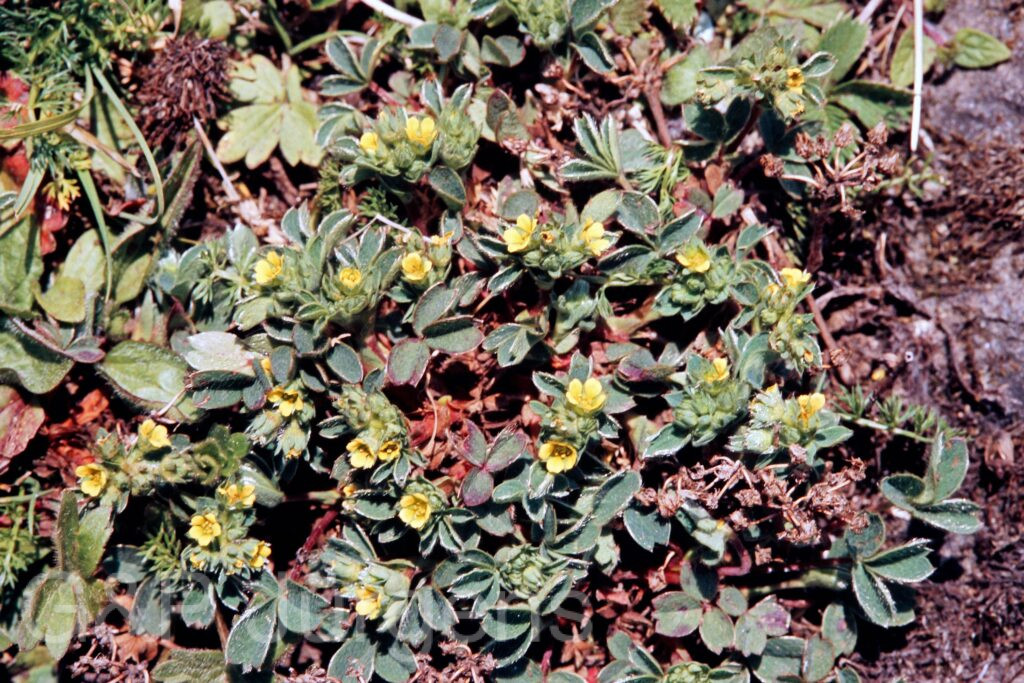
Sibbaldia parviflora is a low alpine herb with a broad distribution spanning the Caucasus, Anatolia, Iran, Central Asia and the Himalaya, recorded from Russia, Georgia, Armenia, Turkey, Azerbaijan, Iran, Afghanistan, India, Nepal, Bhutan and China, with scattered European and other collections reflecting cultivation and herbarium material. Its roughly 662 georeferenced records mark a common and wide-ranging mountain species. It grows in alpine meadows, short grassy turf, stony slopes and grazed pasture, typically at about 2700-4500 m. The collection from Panwali in Garhwal, India at 3300 m in June is representative of its early-summer flowering on open Himalayan pasture.

It is a small, tufted, somewhat hairy perennial growing from a stout, branched, woody rootstock that gives rise to crowded rosettes. The leaves are trifoliolate with obovate to cuneate leaflets that are toothed at the truncate apex, often silky-pubescent and greyish-green. The small flowers are clustered in compact cymes on short scapes; each has five sepals alternating with an epicalyx and five small, narrow, pale yellow to whitish petals shorter than the sepals, hence parviflora, with five to ten stamens and few carpels seated on a slightly hairy receptacle. The fruit is a small cluster of dry glabrous achenes.

Sibbaldia is a small genus of cushion- and mat-forming alpine herbs closely allied to Potentilla, and recent molecular work has both narrowed and reshaped its limits; S. parviflora remains among its core species. The dwarf rosette habit and reduced flowers are adaptations to cold, grazed, high-radiation alpine environments, and pollination is by generalist alpine insects. Given its very wide trans-Asian range and tolerance of grazing, it is of least conservation concern.

Author: Willd. · Sources: POWO (Kew), GBIF, Flora of China, Flora of Pakistan, Sibbaldia phylogeny (Smedmark) monograph

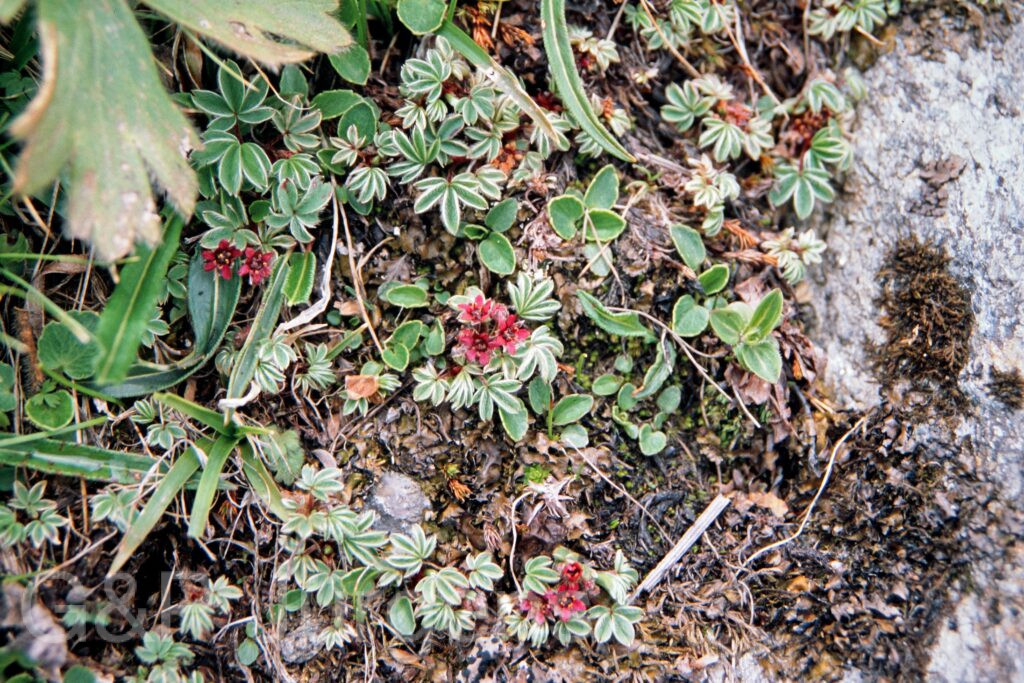
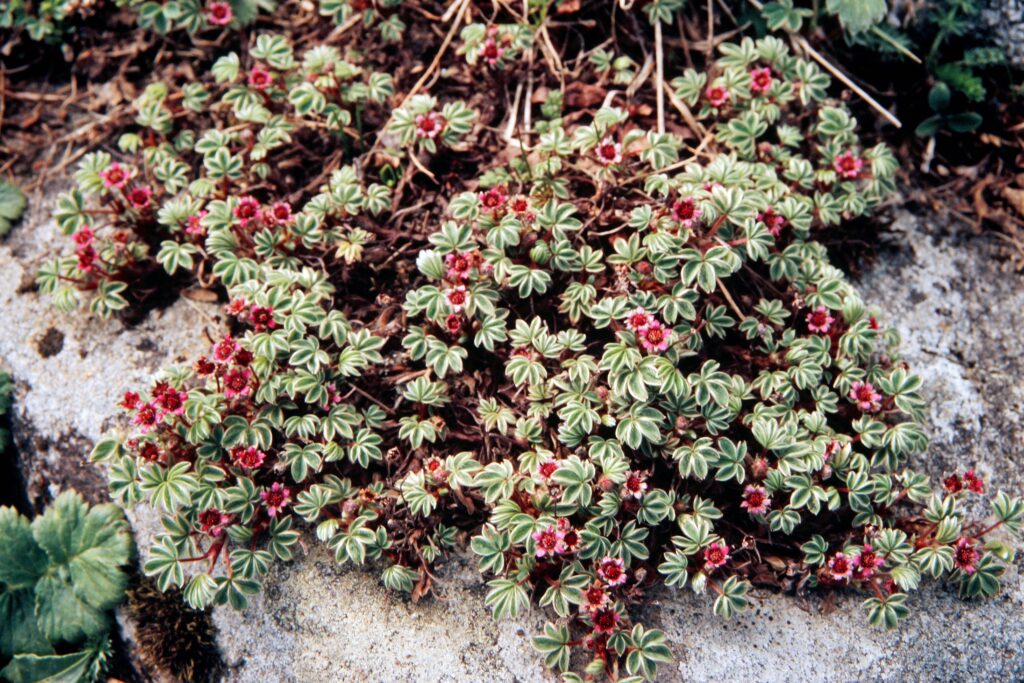
Royle

Nepal 99 315 ergebnis
West-Nepal Kalmura 4200m, June
Garh 07 454 ergebnis
India Garhwal Khiar Kutti 3900m, June

Description

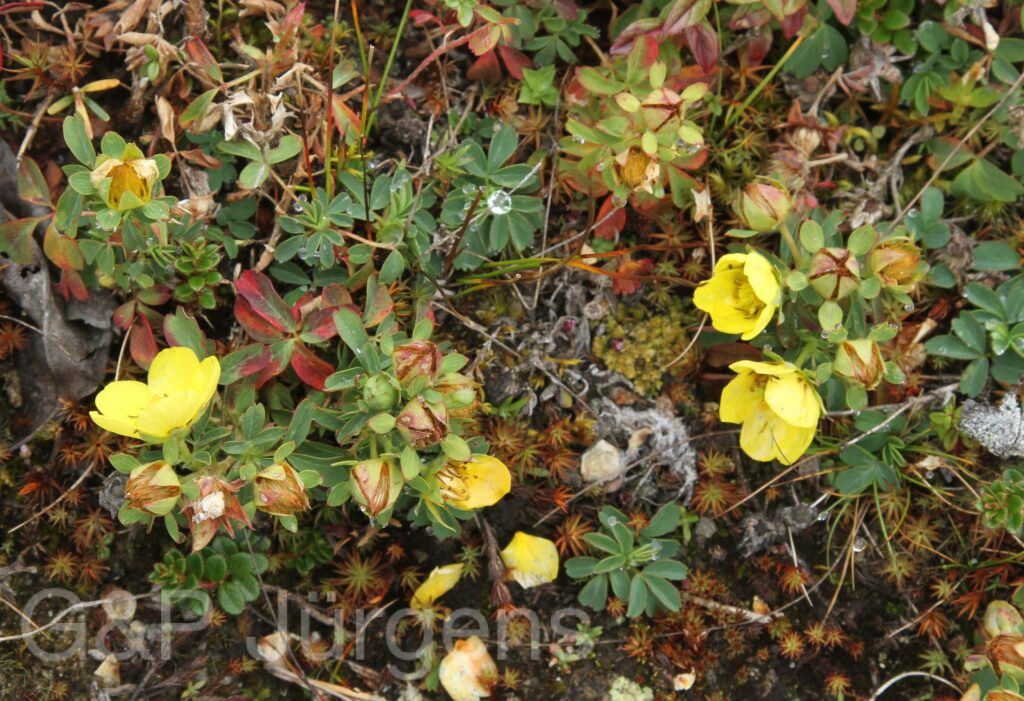
Sibbaldia purpurea is a low, cushion-forming alpine perennial of the high Himalaya and adjacent Tibetan ranges, recorded from China, India, Nepal, Bhutan and Pakistan (gbif_countries: CN, IN, NP, BT, ZZ, PK), with some 252 GBIF occurrences. It inhabits open alpine turf, gravelly slopes, screes and stony pastures, typically above the treeline in cold, well-drained, exposed sites. The illustrated gatherings come from Kalmura in West Nepal at about 4200 m and Khiar Kutti in Garhwal, India, near 3900 m, both flowering in June as the brief high-alpine growing season opens. In GBIF the name is treated under gbif_status SYNONYM, with Sibbaldia purpurea itself given as the accepted name.

The plant forms dense mats or low tufts from a branched woody caudex, with prostrate to ascending stems and crowded leaves. The leaves are trifoliolate, the leaflets small, wedge-shaped and toothed at the apex, frequently silky-hairy. The flowers are small and borne singly or in few-flowered cymes; they are distinctive within the genus for their reddish-purple to purple petals, contrasting with the yellow flowers of most Sibbaldia, set against a persistent calyx with an epicalyx. The fruit is a cluster of small, dry achenes.

Sibbaldia is a small genus of the rose family closely allied to Potentilla, from which it is segregated chiefly by its reduced stamen and carpel number, and recent molecular studies have repeatedly examined the boundary between the two; some treatments subsume part of Sibbaldia into Potentilla, accounting for the synonymy noted above. S. purpurea is a hardy cushion plant well adapted to alpine extremes. Widespread across the high Himalaya, it is of no conservation concern.

Author: Royle · Sources: POWO (Kew), GBIF, Flora of Nepal, Flora of China, Annotated Checklist of the Flowering Plants of Nepal, Eriksson et al. phylogenetic studies of Potentilleae

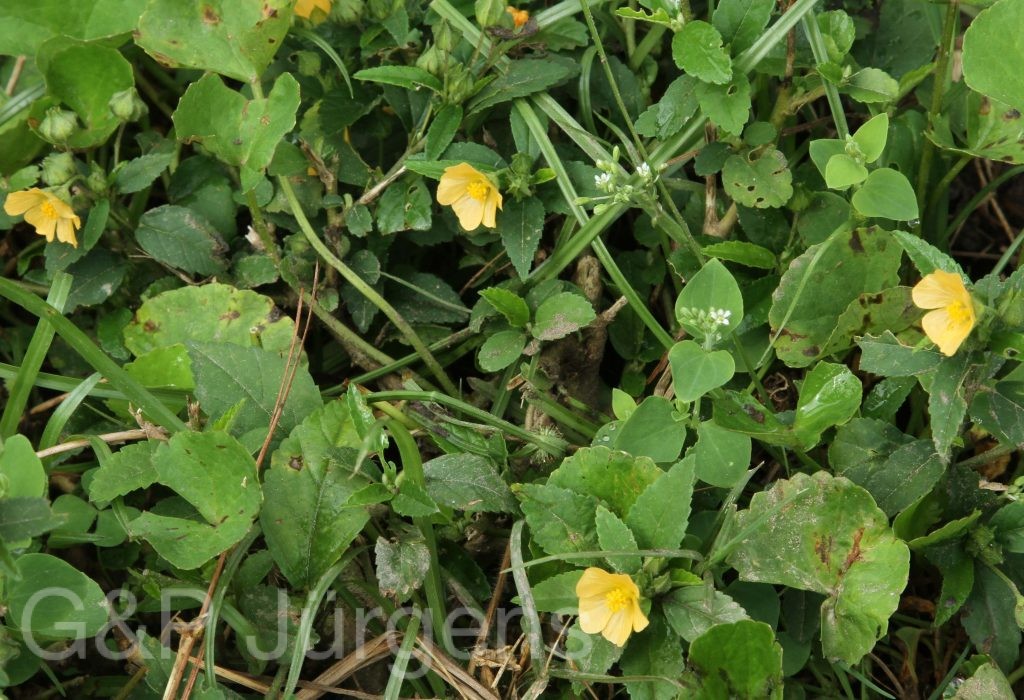
Herb.Madr. ex Wight & Arn.

Bhutan2012 976
Bhutan Trithangebe 1000m, October
Bhutan2012 806 Kopie
Bhutan Trithangebe 1000m, October
also included: Drymaria cordata

Description

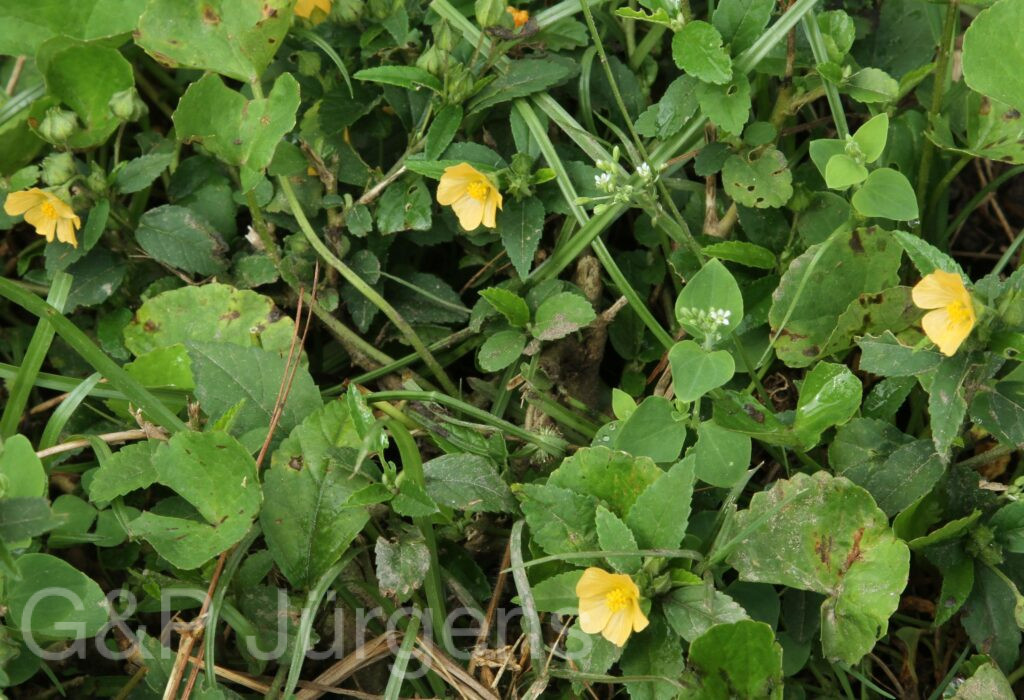
Sida mysorensis is an Old World tropical, weakly pantropical weedy herb, GBIF recording some 630 occurrences across South and Southeast Asia (India, Sri Lanka, China, Taiwan, Myanmar, Thailand, Vietnam, Cambodia, Laos, the Philippines, Indonesia), the Himalayan states (Nepal, Bhutan) and naturalised in the Neotropics (Mexico, Brazil, Colombia, Cuba, Guatemala). It is a plant of warm low to mid elevations, colonising roadsides, waste ground, fallow fields and forest margins. The Bhutanese record from Trithangebe at about 1000 m, flowering in October beside Drymaria cordata, is characteristic of its association with humid, weedy subtropical foothills after the monsoon.

It is an erect to ascending annual or short-lived perennial herb or subshrub, 30–120 cm tall, the stems and foliage softly pubescent to stellate-tomentose and often viscid. The leaves are alternate, ovate to cordate, crenate-serrate and stipulate. Flowers are small, solitary or few in the leaf axils; the corolla is yellow to pale orange, of five obovate petals around a staminal column typical of Malvaceae. The fruit is a schizocarp of several reticulate mericarps, each usually bearing short apical awns aiding dispersal.

Described from a Madras herbarium specimen by Wight and Arnott, S. mysorensis belongs to the large, taxonomically complex genus Sida, in which softly hairy, axillary-flowered species are frequently confused. It is of no conservation concern, being a widespread ruderal and minor agricultural weed, and like many Sida species has been used in folk medicine and as a bast fibre. Ecologically it is an early colonist of disturbed tropical ground.

Author: Herb.Madr. ex Wight & Arn. · Sources: POWO (Kew), GBIF, Flora of Bhutan, Flora of China, Malvaceae of the World (Bayer & Kubitzki treatment)

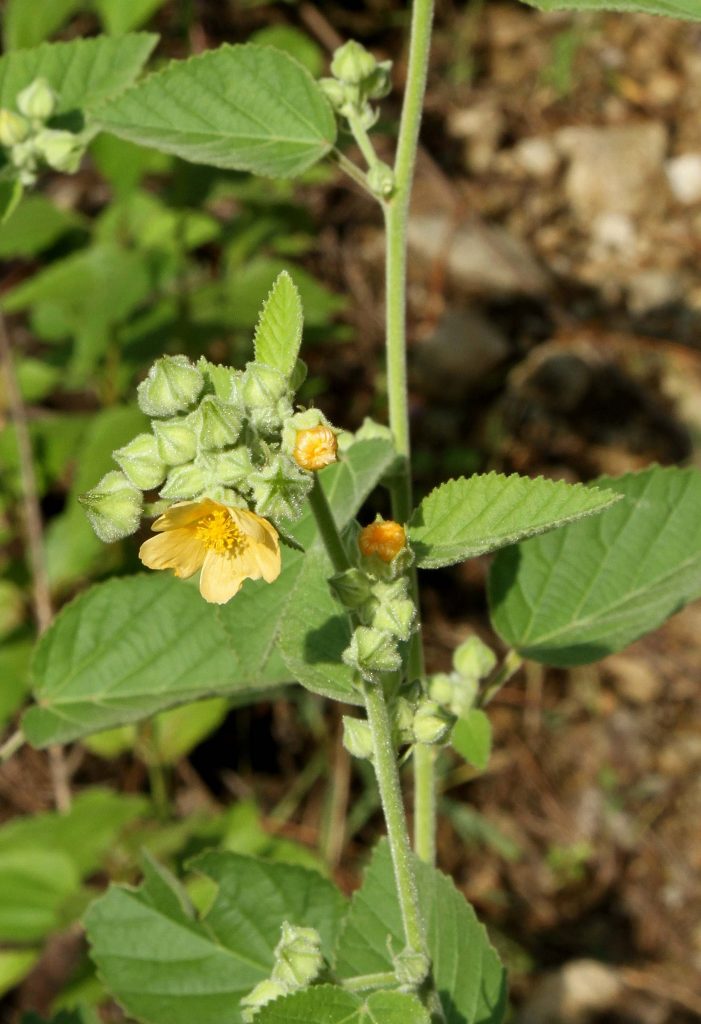
L.

Bhutan2012 804
Bhutan Zemgang 1950m, October

Description

Sida rhombifolia L. is a near-cosmopolitan subshrub of tropical and warm-temperate regions, one of the most widely distributed weeds in the Malvaceae. GBIF documents over 50,000 records from every inhabited continent — Australia, the Americas (USA, Brazil, Mexico, Colombia, Argentina, Bolivia, Ecuador), Africa (South Africa, Cameroon, DR Congo), and Asia including China, India, Taiwan and Japan. In the Himalaya it occurs on roadsides, fallow fields, waste ground and open slopes; the photographed plant is from Bhutan, Zemgang, 1,950 m, in October. It thrives on disturbed, well-drained soils from sea level to around 2,000 m and is a pioneer of ruderal and pastoral habitats.

The plant is an erect, much-branched perennial subshrub 30–100 cm tall with tough, fibrous stems bearing stellate to simple appressed hairs. Leaves are alternate, shortly petiolate, rhombic to lanceolate (rhombifolia), 1.5–5 cm long, serrate in the upper half, entire toward the cuneate base, paler and pubescent beneath. Flowers are solitary in the leaf axils on slender, jointed pedicels, the corolla pale yellow to orange-yellow, 5–10 mm across, with five obovate petals; the staminal column is characteristic of the family. The schizocarpic fruit is a flattened ring of 8–12 mericarps, each with two short apical awns.

A polymorphic and taxonomically complex aggregate, S. rhombifolia has yielded numerous infraspecific taxa and segregates. The stem yields a strong bast fibre used for cordage and brooms, and the plant is widely employed in traditional medicine. Owing to its weedy vigour it is naturalised and sometimes invasive far beyond its presumed Old World tropical origin.

Author: L. · Sources: POWO (Kew), GBIF, Flora of China Vol. 12, Flora of Bhutan Vol. 2, Flora of Nepal, Borssum Waalkes: Malesian Malvaceae revised (Blumea)