Tag:

Nepal

Flowers of Nepal — 1313 wild plant species documented from the Nepalese Himalaya, from subtropical foothills to high alpine meadows above 4,000 m. Nepal’s dramatic elevation gradient makes it one of the richest botanical regions on Earth, home to rhododendrons, primulas, gentians and the famed blue poppies (Meconopsis). Every entry gives a botanical description, native distribution, habitat and flowering season, alongside the original field photograph and the location where it was taken.

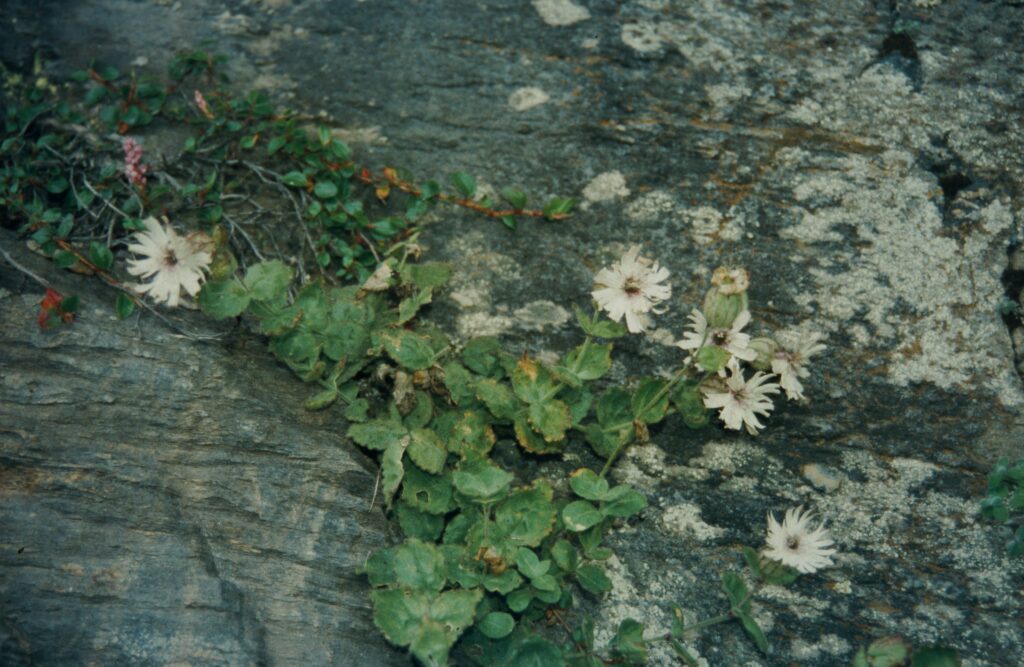
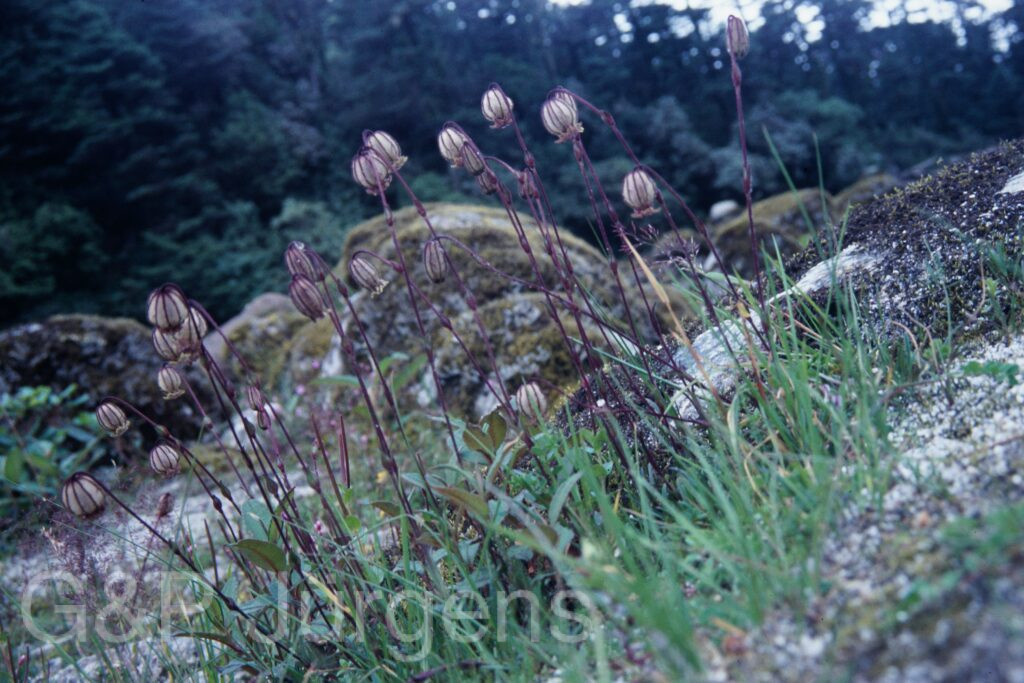
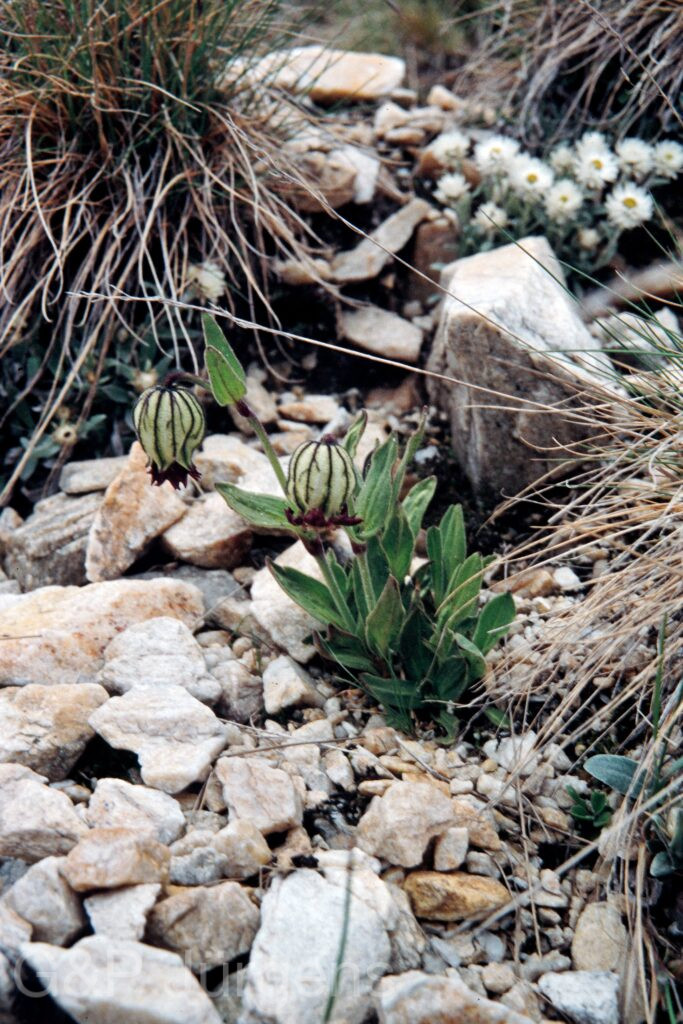
(Rupr.) Bocquet

Nepal 99 320 ergebnis
West-Nepal Kalmura 4200m, June

Description

Silene gonosperma is a high-mountain perennial campion with a wide Central Asian, Himalayan and boreal distribution, recorded from Afghanistan, Tajikistan, Kyrgyzstan, Kazakhstan, Pakistan, the Himalaya (India, Nepal, Bhutan), Mongolia, Russia, China and even reaching Sweden in the broad sense. GBIF aggregates around 657 occurrences spanning this trans-Asiatic range. It is a plant of the alpine zone, growing in stony and grassy meadows, screes, moraines and exposed slopes, commonly above 3500 m and reaching well over 4000 m. The West-Nepal population photographed at Kalmura (4200 m, June) typifies its occurrence in cold, open high-alpine turf near the upper limit of flowering plants.

The species forms small tufts or cushions from a branched woody caudex, producing short, ascending, often glandular-hairy flowering stems. The leaves are opposite, linear to narrowly oblanceolate, the basal ones crowded and the cauline pairs few and reduced. The flowers are usually solitary or few, often nodding, with a tubular to inflated, many-nerved calyx frequently flushed dark purple, and five clawed petals, pink-purple to dull violet or greenish, with shallowly emarginate to bifid laminae. Ten stamens and three styles are present. The fruit is an ovoid capsule opening by six teeth and bearing the distinctive angular, often winged seeds that give the epithet.

Silene gonosperma, transferred by Bocquet from earlier placements in Melandrium and Wahlbergella, exemplifies the taxonomic flux around the boreal-alpine campions, and several subspecies and varieties have been described across its enormous range. Its cushion habit, dark calyx and angular seeds aid identification among co-occurring high-alpine Silene. As a widespread, locally frequent species of remote high-mountain habitats it faces no significant threats, though its uppermost populations may be sensitive to warming.

Author: (Rupr.) Bocquet · Sources: POWO (Kew), GBIF, Flora of China, Flora of Pakistan, Flora of USSR, Annotated Checklist of the Flowering Plants of Nepal, Caryophyllaceae monograph of Silene (Bocquet)
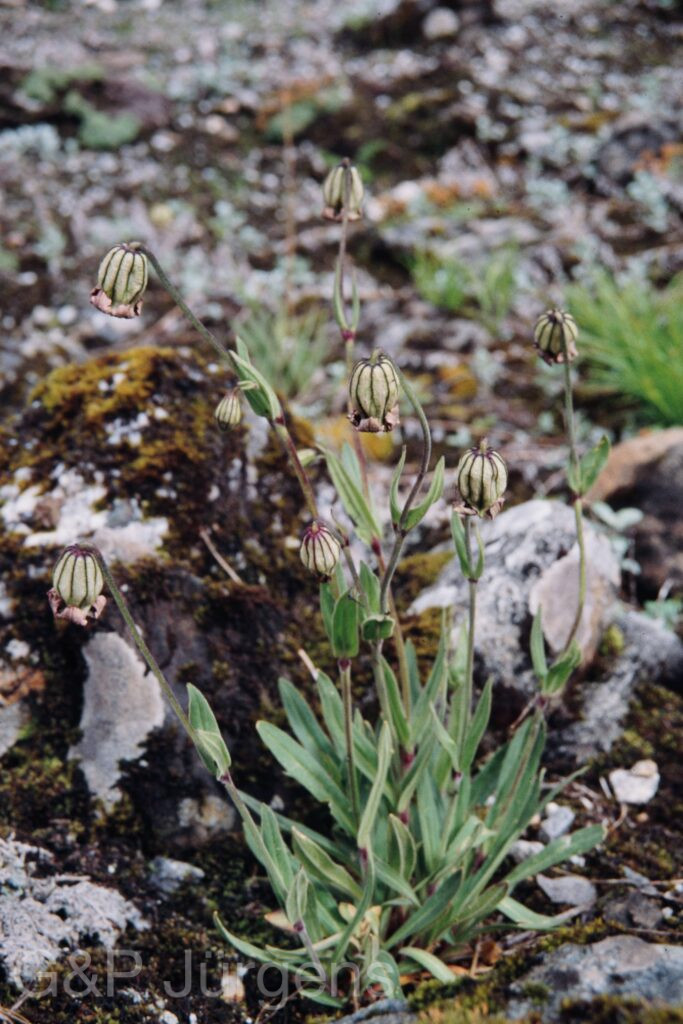
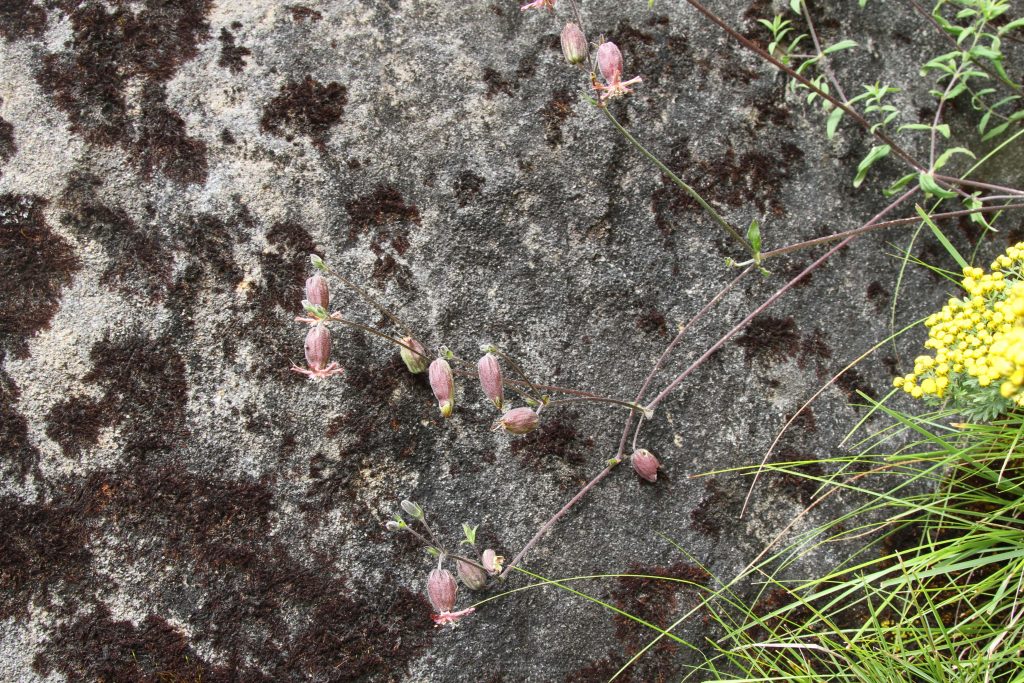
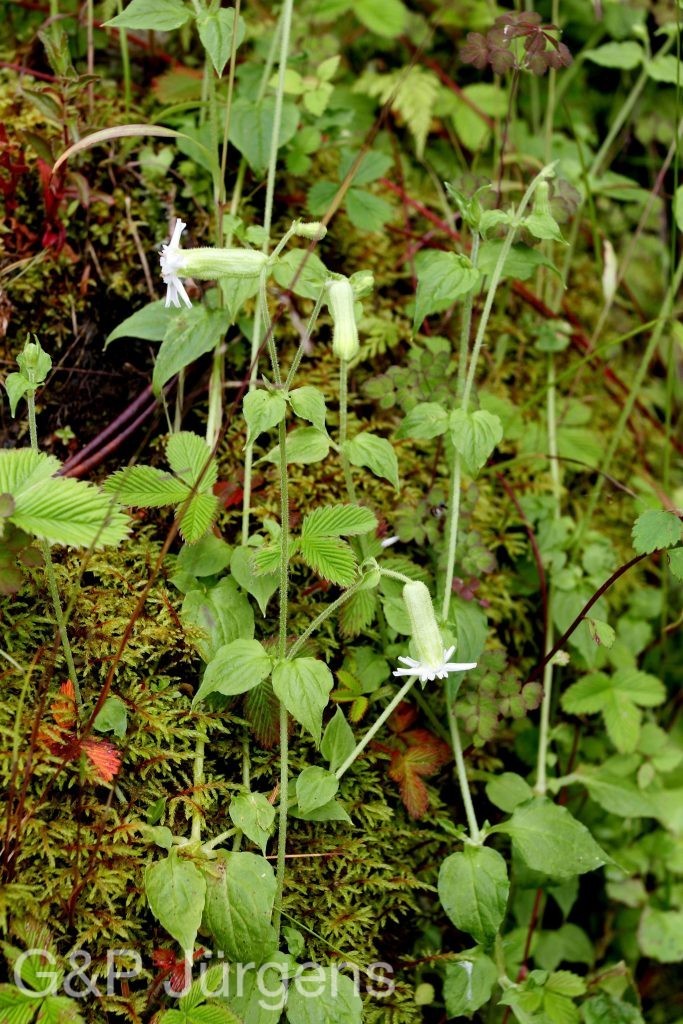
(Rohrb.) Majumdar

Nepal 99 517 ergebnis
West-Nepal Churta-Khola 3800m, June

Description

Silene himalayensis is a perennial campion widely distributed across the high mountains of Central and South Asia, ranging from Afghanistan and Tajikistan through Pakistan and the Himalaya (India, Nepal, Bhutan) into south-western China. GBIF records around 817 occurrences, concentrated in the Himalayan arc and the Chinese borderlands. It grows in alpine and subalpine habitats, favouring open meadows, grassy and stony slopes, screes and streambanks, generally between about 3000 and 4500 m. The West-Nepal population photographed at Churta-Khola (3800 m, June) is characteristic of its occurrence in moist alpine turf at the height of the short montane summer.

The species forms tufts from a branched woody rootstock, producing several ascending to erect, slender, often glandular-pubescent stems. The leaves are opposite, linear-lanceolate to oblanceolate, the basal ones tapering to the base and the cauline pairs sessile. The inflorescence is few-flowered, the flowers solitary or in lax dichasia and frequently nodding in bud. Each flower has a tubular to clavate, ten-nerved, glandular calyx, often suffused with purple, and five clawed petals, pink to purplish or whitish, the laminae bifid and bearing small coronal scales. Ten stamens and three styles are present; the fruit is an ovoid capsule opening by six apical teeth on a short carpophore, releasing reniform, tuberculate seeds.

The genus Silene is taxonomically complex in the Himalaya, and this species was transferred by Majumdar from Melandrium, reflecting uncertainty about generic limits between Silene and its segregates. Its glandular indumentum, nodding flowers and high-elevation ecology aid recognition among the many regional campions. As a broadly distributed, locally frequent alpine perennial it is not considered threatened, although high-altitude grazing and warming may locally affect marginal populations.

Author: (Rohrb.) Majumdar · Sources: POWO (Kew), GBIF, Flora of China, Flora of Pakistan, Flora of Bhutan, Annotated Checklist of the Flowering Plants of Nepal, Caryophyllaceae monograph of Silene (Bocquet)
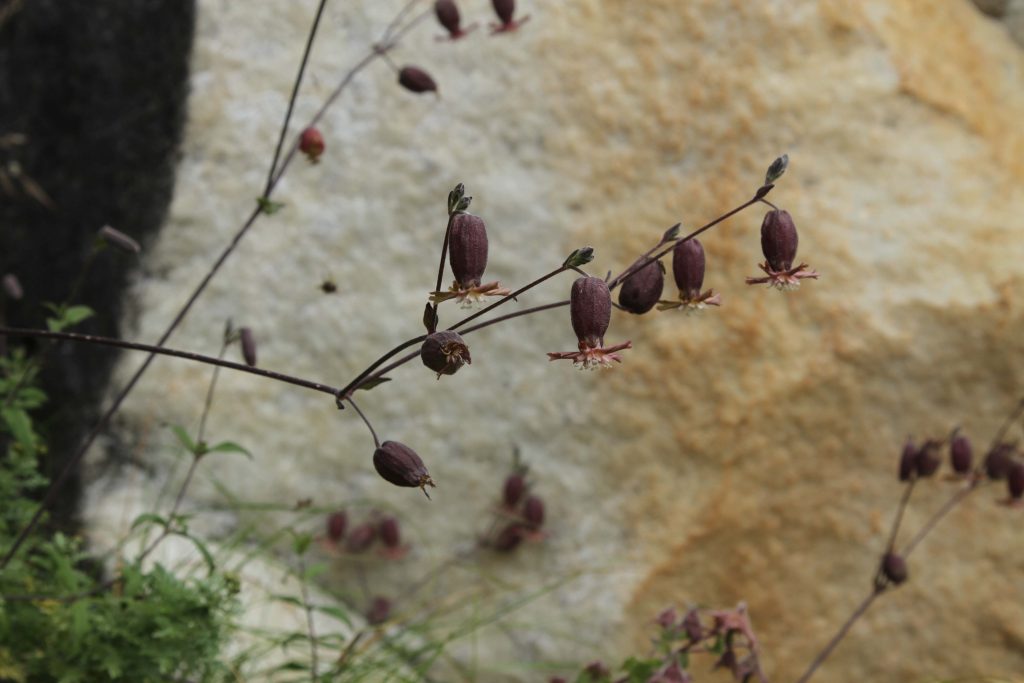
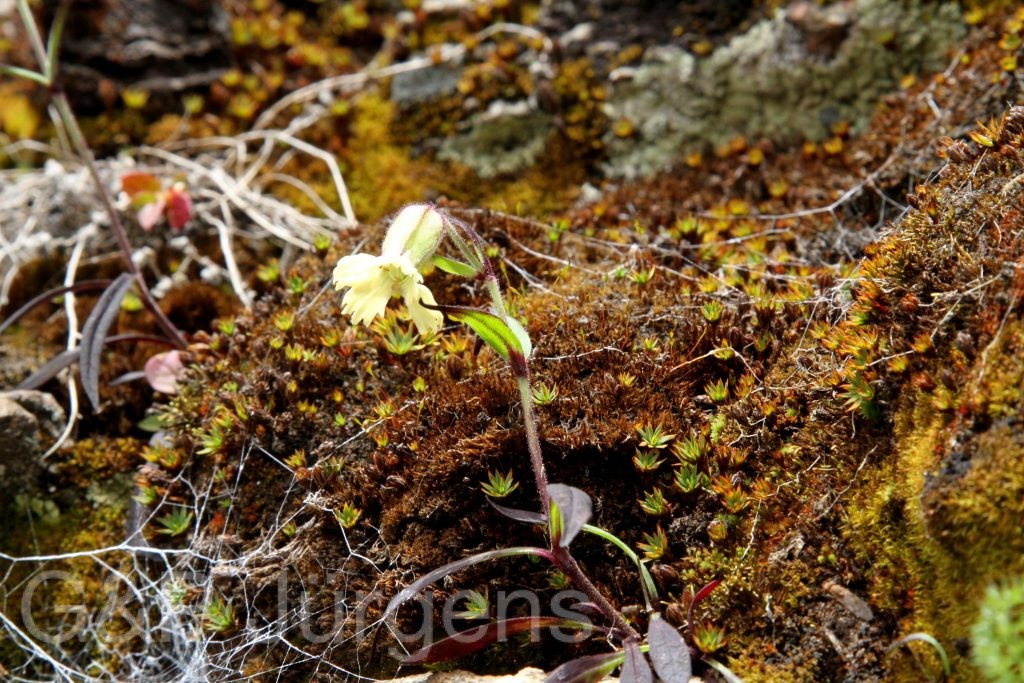
(W.W. Sm.) Bocquet

Bhutan2012 276
Bhutan Shele-La, 4000m September
Bhutan2012 277
Bhutan Shele-La, 4000m September

Description

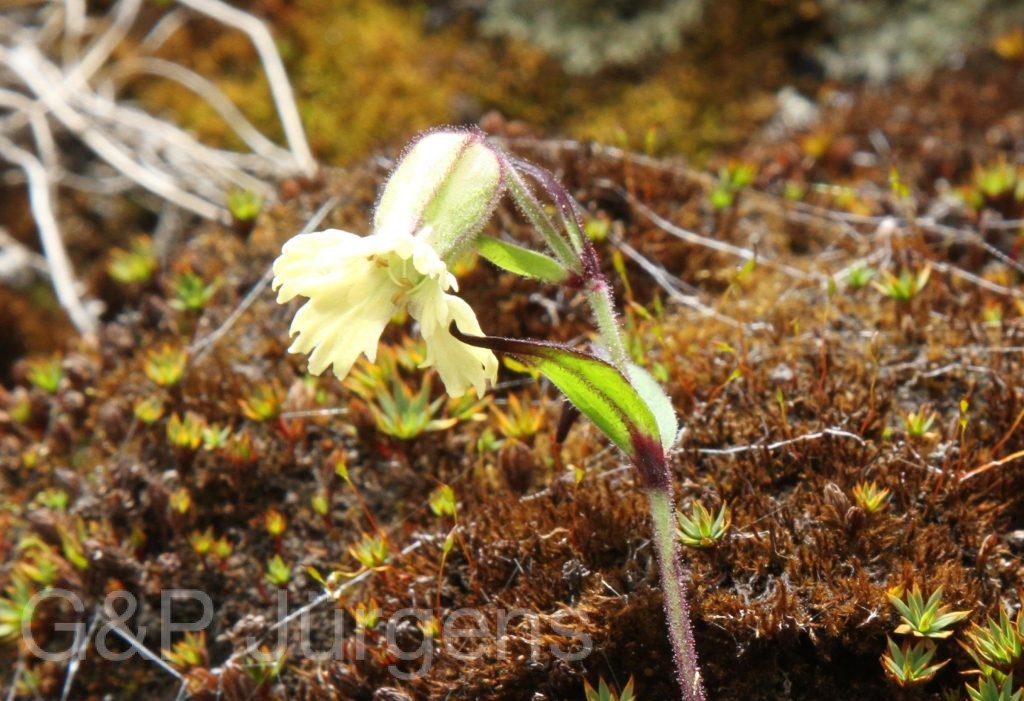
Silene indica var. bhutanica is a campion of the high Himalaya, recorded from Nepal, Bhutan, India and adjacent China. It occupies alpine and upper subalpine habitats, growing on open grassy slopes, stony pastures, screes and rocky ground in the high mountains, generally between about 3500 and 4500 m. The photographed plant comes from the Shele-La in Bhutan at around 4000 m, flowering in September towards the close of the monsoon season. With only eighteen georeferenced records this variety is sparsely documented, in keeping with its restricted eastern Himalayan range and the difficulty of access to its high-altitude habitats.

It is an erect to ascending perennial herb arising from a stout rootstock, the stems usually several, simple or sparingly branched and often glandular-pubescent above. The leaves are opposite, linear-lanceolate to oblong, sessile or shortly stalked, with entire ciliate margins. The flowers are borne in a lax cymose inflorescence; each has a tubular, inflated and prominently 10-veined calyx, often glandular and tinged purple, enclosing the claws of the petals. The five petals are pink to purplish, the limb bifid or notched and bearing a small scaly corona at the throat. There are ten stamens and three styles, characteristic of the genus, and the fruit is a capsule dehiscing by apical teeth and shedding numerous reniform seeds.

Silene is the largest genus of Caryophyllaceae, and var. bhutanica is distinguished within the variable S. indica complex by features of indumentum, calyx and petal form, its delimitation depending on revisionary treatment of Himalayan Silene. Given its narrow range and few records, its conservation status is poorly known; restricted high-alpine taxa of this kind are potentially vulnerable to grazing and climatic shifts.

Author: (W.W. Sm.) Bocquet · Sources: POWO (Kew), GBIF, Flora of Bhutan, Flora of China, Bocquet's revisions of Asian Silene

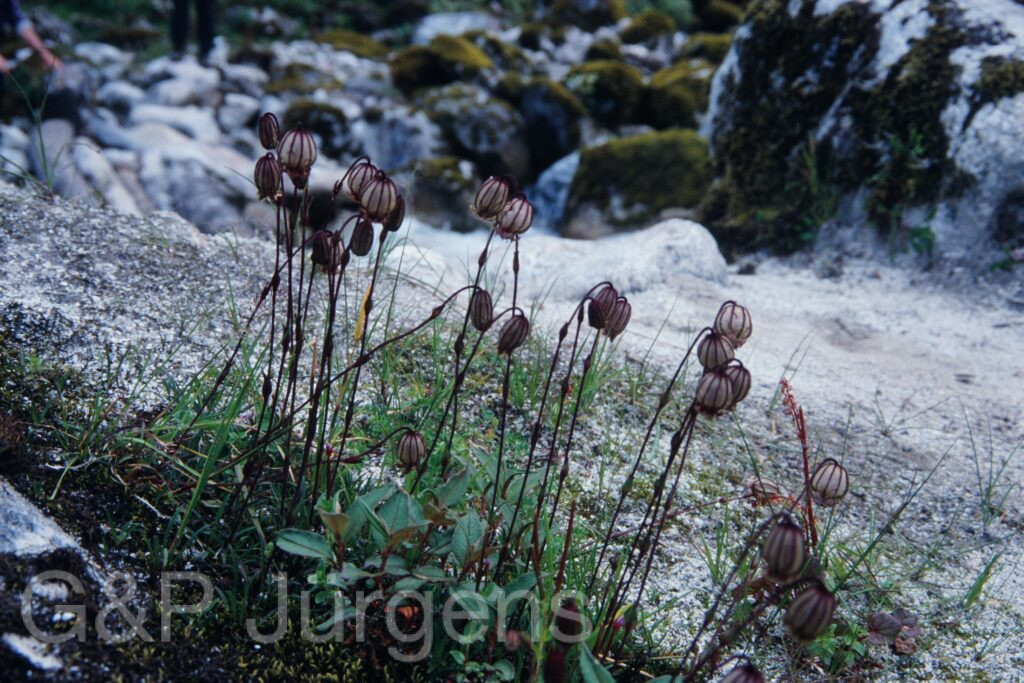
(Bocquet) Y.J.Nasir

Garw 2005 312 ergebnis
India Garhwal Bagubas 3800m, October

Description

Silene indica var. edgeworthii is a western Himalayan campion recorded from Pakistan, India and Nepal, known from a small set of around 18 georeferenced occurrences that together delimit a fairly narrow distribution along the inner ranges. It is a plant of open, high-elevation habitats, favouring alpine and subalpine meadows, stony slopes, grassy hollows and the margins of moraines where snowmelt provides seasonal moisture. The individual illustrated near Bagubas in Garhwal (India) at about 3800 m in October exemplifies this affinity for the upper alpine zone, where it flowers and fruits late in the growing season as the surrounding turf begins to senesce. According to GBIF, the name carries a SYNONYM status, with Silene indica edgeworthii treated as the accepted name.

It is a perennial herb arising from a stout rootstock, producing erect to ascending stems that are often glandular-pubescent in the upper parts. The leaves are opposite and entire, the basal ones spathulate to oblanceolate and the cauline pairs narrower and sessile. The flowers are borne in a lax, few-flowered cyme; each is subtended by a tubular, prominently ten-nerved calyx that is frequently inflated and contracted at the mouth. The five petals are pink to whitish, clawed, and bear a bifid or shallowly lobed limb with a small coronal scale at the throat. The fruit is a many-seeded capsule dehiscing by apical teeth, the seeds reniform and minutely tuberculate.

Within Silene, this taxon belongs to a Himalayan complex in which infraspecific variation in calyx form, indumentum and petal limb has prompted repeated reassessment, hence its fluctuating rank as a variety versus an accepted entity. Its restricted range and dependence on intact alpine grassland make it a useful indicator of high-pasture condition, while heavy summer grazing and trampling along transhumance routes represent the principal pressures on its populations.

Author: (Bocquet) Y.J.Nasir · Sources: POWO (Kew), GBIF, Flora of Pakistan, Flora of Nepal, Flora of Bhutan Vol. 1, Bocquet Revision der Gattung Silene (Caryophyllaceae)

Majumdar

Bhutan2012 241
Bhutan, Shele-La 4000m, September
Bhutan2012 242
Bhutan, Shele-La 4000m, September

Description

Silene nepalensis is a Himalayan campion distributed from Pakistan through Nepal and northern India to Bhutan and south-central China, the nearly four hundred GBIF records confirming a fairly broad high-montane range across the range. It occupies alpine and subalpine meadows, open stony slopes, rock crevices and the margins of scrub above the forest, where it flowers into the late season. The photographed plant from the Shele-La in Bhutan at 4000 m, flowering in September, illustrates its tolerance of the cold, exposed high passes and its comparatively late, autumn flowering at the upper limits of the alpine zone.

The species is a tufted perennial herb arising from a stout, often woody rootstock and producing several ascending to erect stems. The leaves are opposite, narrowly lanceolate to linear and somewhat ciliate at the margins. The flowers are borne in a lax cyme; the calyx is tubular to clavate, ten-veined and inflated in fruit, while the five petals are clawed with a bifid, white to pinkish limb and a small coronal scale at the throat. The androecium has ten stamens and the ovary three styles; the fruit is a capsule dehiscing by six apical teeth and containing numerous reniform seeds.

Silene nepalensis is an accepted species of the large, taxonomically difficult genus Silene (Caryophyllaceae, tribe Sileneae), where the inflated ten-veined calyx and clawed coronate petals are diagnostic. Its perennating woody base and crevice habit are adaptations to the desiccating winds and shallow soils of the high Himalaya. The species is widespread and not currently regarded as threatened, though its alpine populations are sensitive to grazing pressure and warming-driven range contraction.

Author: Majumdar · Sources: POWO (Kew), GBIF, Flora of China, Flora of Bhutan, Bocquet & Chowdhuri revision of Himalayan Silene (Caryophyllaceae monograph)

(Edgew.) Majumdar

Sikkim2003 215 G299
Sikkim Dzongri 3900m, August
Sikkim2003 216 P300
Sikkim Dzongri 3900m, August

Description

Silene nigrescens is an alpine campion of the Himalaya and adjacent mountains, ranging across China, Nepal, India and Bhutan and into Myanmar; GBIF records about 410 occurrences concentrated in the eastern and central Himalaya. It grows in high alpine meadows, grassy slopes, screes and stony pastures, generally between about 3500 and 4800 m. The illustrated plant was photographed at Dzongri in Sikkim at around 3900 m in August, during the monsoon flowering season when these dark-flowered campions colour the short turf of the eastern Himalayan uplands above the rhododendron scrub.

The species is a perennial herb growing from a slender, branched rootstock, forming low tufts of ascending to erect stems that are often glandular-hairy above. The leaves are opposite, sessile, narrowly lanceolate to oblanceolate, the lower ones crowded near the base. The flowers are nodding and few, with an inflated, ten-nerved, often dark-purple to nearly blackish calyx that gives the species its name; the petals are dingy purple to brownish with a bilobed limb and a small ligulate scale at the throat. The flower has three styles, and the capsule dehisces by six teeth, releasing numerous reniform seeds.

Described as (Edgew.) Majumdar from an Edgeworth basionym, Silene nigrescens belongs to the high-alpine, dark-calyx group of Himalayan Silene whose species limits are notoriously difficult owing to variation in vestiture and flower colour. Its broad eastern-Himalayan to southwest Chinese distribution makes it secure, and it forms part of the characteristic flora of monsoon-influenced alpine meadows, pollinated mainly by insects drawn to its sombre nodding flowers.

Author: (Edgew.) Majumdar · Sources: POWO (Kew), GBIF, Flora of China, Flora of Bhutan, Bocquet: Revision of Himalayan Silene

Edgew.

BhutanPG2011 832 01 01
Bhutan Chele-La, 3400m July

Description

Silene stracheyi is a Himalayan campion restricted to the high mountains of India, Bhutan and Nepal, known from only about 17 GBIF records and thus among the more poorly documented members of the genus in the region. It grows in open subalpine and alpine habitats, including rocky slopes, grassy pastures, scrub margins and stony banks, generally between about 3000 and 4000 m. The plant photographed at Chele-La in western Bhutan at 3400 m in July, flowering at the height of the monsoon summer, typifies its association with cool, well-drained high-mountain grassland and rock.

It is a perennial herb arising from a stout rootstock, with erect to ascending stems that are often glandular-pubescent in the upper parts. The leaves are opposite, narrowly lanceolate to oblong, sessile or shortly stalked and entire. The flowers are borne in a lax cyme; each has the inflated, tubular to campanulate, conspicuously veined calyx characteristic of Silene, within which sit five clawed petals, usually pink to purplish, the limbs notched or bifid and often bearing a small corona at the throat. The stamens and styles are typical of the genus, and the fruit is a capsule dehiscing by apical teeth to scatter the numerous reniform seeds.

Silene is one of the largest genera of Caryophyllaceae, with many narrowly endemic high-alpine species in the Sino-Himalayan region, of which S. stracheyi is one. The tubular calyx and clawed petals reflect adaptation to long-tongued and nocturnal pollinators. Given its small known range and few documented populations, the species warrants conservation attention, as such restricted Himalayan campions are vulnerable to grazing intensification and the upslope shifts driven by a warming climate.

Author: Edgew. · Sources: POWO (Kew), GBIF, Flora of Bhutan, Annotated Checklist of the Flowering Plants of Nepal, Flora of China (Caryophyllaceae), Bocquet monographic studies of Silene

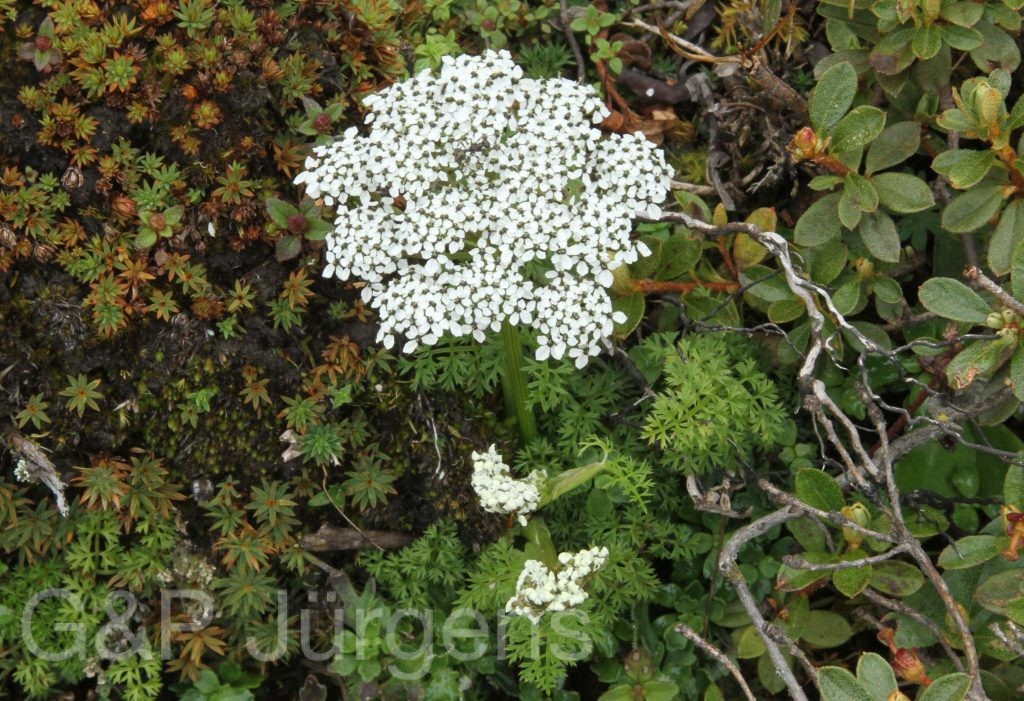
(Fedde ex H. Wolff) A.K. Mukh. & Constance

Bhutan2012 79
Bhutan Shele-La, 4000m September

Description

Sinocarum wolffianum is a small alpine umbellifer of the Himalaya and south-western China, recorded from China, northern India, Nepal and Bhutan, a restricted distribution reflected in only about 54 occurrence records. It grows on open alpine meadows, turf, screes and rocky slopes, typically between roughly 3500 and 4500 m. The specimen photographed at Shele-La in Bhutan at about 4000 m in September illustrates its late-season presence in the high alpine zone, where short-statured umbellifers persist among the cushion vegetation.

The plant is a small, slender perennial arising from a tuberous or fusiform root, usually only a few centimetres to about 15 cm tall. The leaves are mostly basal, finely divided (ternately to pinnately dissected) into narrow, linear ultimate segments, on slender petioles sheathing at the base. The inflorescence is a small, lax compound umbel, often lacking or with few bracts and bracteoles; the flowers are minute, with white to pinkish petals and the inferior ovary typical of the family. The fruit is a small, ovoid to oblong schizocarp splitting into two ribbed mericarps.

Sinocarum (Apiaceae, subfamily Apioideae) is a small Sino-Himalayan genus of dwarf alpine umbellifers segregated from Carum and allied genera, and its species circumscription has been revised by workers including Mukherjee and Constance, who established the present combination. The genus is taxonomically intricate, with several narrow-range high-mountain taxa. Pollinated by generalist alpine insects, the mericarps are dispersed passively. As a localised high-elevation endemic of limited known range, it is of biogeographic interest and likely sensitive to climatic change in its alpine habitat.

Author: (Fedde ex H. Wolff) A.K. Mukh. & Constance · Sources: POWO (Kew), GBIF, Flora of China, Flora of Bhutan, Annotated Checklist of the Flowering Plants of Nepal, Pimenov & Leonov The Genera of the Umbelliferae

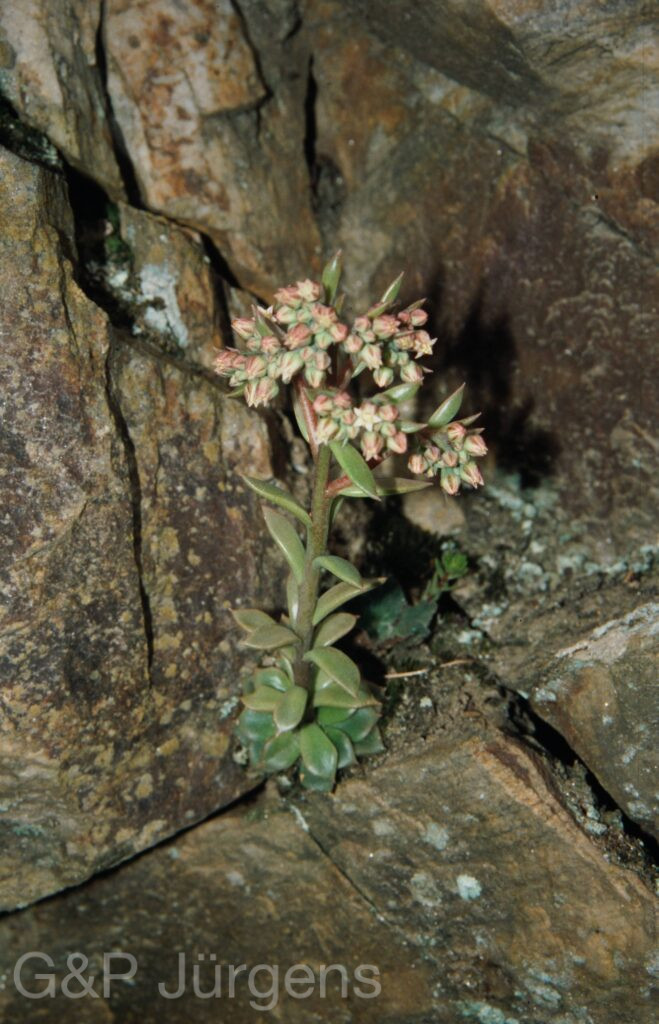
A. Berger

Nepal 99 949 ergebnis
West-Nepal Pamela 2700m, July

Description

Sinocrassula indica is a succulent biennial to short-lived perennial herb distributed through the Sino-Himalayan region, with records from China, India, Nepal and Bhutan and scattered naturalised or cultivated occurrences elsewhere. It grows on dry rocky banks, cliff ledges, stony slopes and walls in the montane belt, typically from about 1500 to 3500 m, rooting in shallow gritty pockets and crevices where competition is slight. The photographed plant comes from Pamela in West Nepal at around 2700 m, flowering in July during the monsoon. With over 650 georeferenced occurrences it is a frequently collected and widely recognised crassulaceous element of the Himalayan foothills and ranges.

The plant produces a basal rosette of fleshy, oblanceolate to spathulate leaves, glabrous or finely papillose, often flushed reddish, from which arises an erect, leafy, sometimes branched inflorescence-bearing stem. The cauline leaves are smaller, sessile and crowded. Flowers are numerous, borne in a dense terminal thyrse of cymes; they are small, with five erect or connivent petals that are greenish-yellow to dull red, scarcely spreading, giving the flower an urn-shaped appearance. There are five stamens, and the carpels are erect with short styles. The fruit is a cluster of follicles releasing fine seeds, after which the monocarpic flowering rosette dies.

Sinocrassula was segregated from Crassula and Sedum on the basis of its erect, barely opening petals and Asian distribution, and S. indica is the most widespread species of the genus. The taxon is morphologically variable in leaf shape and flower colour, and several infraspecific forms have been described. It is occasionally grown by succulent enthusiasts. Being common and ecologically adaptable across a broad range, it is of no conservation concern.

Author: A. Berger · Sources: POWO (Kew), GBIF, Flora of China, Flora of Nepal, Crassulaceae of the World (monograph)

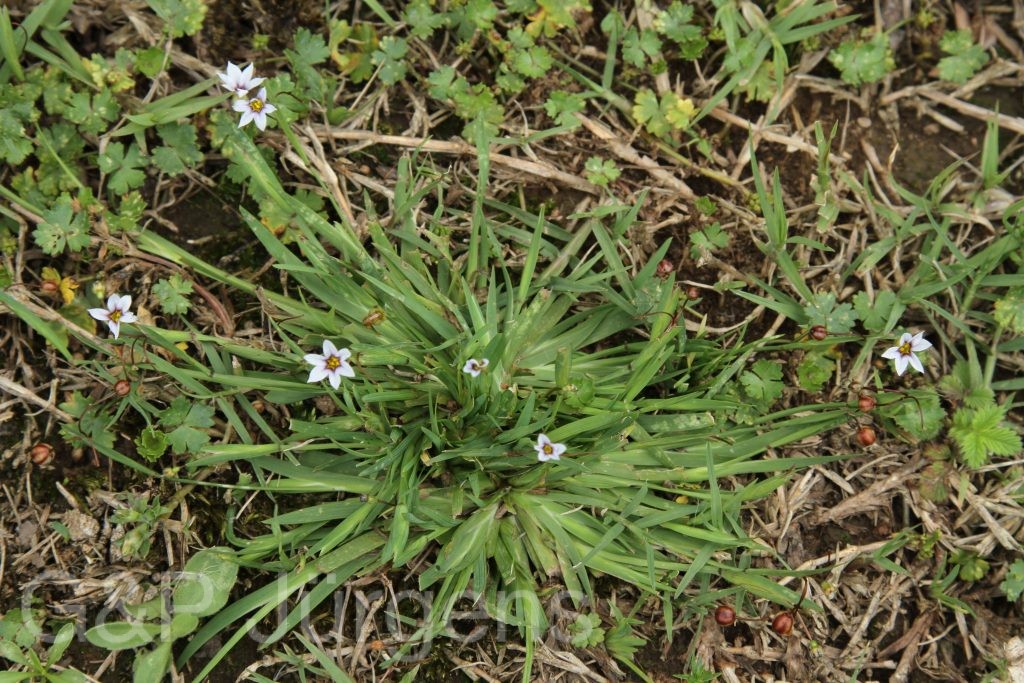
Mill.

Bhutan2014 108
Bhutan Trashigang 1550m, May

Description

Sisyrinchium angustifolium, the narrow-leaved blue-eyed grass, is native to eastern North America (US, CA) but is widely naturalised, with more than 15,000 GBIF occurrences extending across western Europe (FR, ES, IE, GB, DE, BE), eastern Asia (KR, JP) and elsewhere. In the Himalaya it occurs as an introduced and locally established plant of damp meadows, lawns, ditches and grassy roadsides. The individual recorded at Trashigang in eastern Bhutan at 1550 m in May reflects its naturalisation in moist, open, subtropical to warm-temperate grassland, where it flowers in spring on seasonally moist ground.

Despite the common name it is no grass but a tufted perennial of the Iridaceae, forming clumps of narrow, linear, equitant leaves arising in two ranks from a short rhizome. The flowering stems are markedly flattened and conspicuously winged, often branched, and bear terminal clusters of flowers subtended by paired green spathes. Each ephemeral flower has six spreading blue to violet tepals abruptly apiculate with a small terminal mucro, contrasting with a yellow centre; the three stamens have filaments united into a tube around the style. The fruit is a small globose to obovoid loculicidal capsule containing numerous black, rounded seeds.

The species belongs to the large American genus Sisyrinchium and is taxonomically complex, with several allied microspecies and frequent confusion with S. montanum and S. bermudiana. Its flowers open only in sunshine and are bee-pollinated, while prolific seed favours self-establishment in mown swards. Outside its native range it behaves as a benign garden escape.

Author: Mill. · Sources: POWO (Kew), GBIF, Flora of Bhutan Vol. 3, Flora of Nepal, Flora of China Vol. 24, The Genus Sisyrinchium (Iridaceae) Monograph