Tag:

Nepal

Flowers of Nepal — 1313 wild plant species documented from the Nepalese Himalaya, from subtropical foothills to high alpine meadows above 4,000 m. Nepal’s dramatic elevation gradient makes it one of the richest botanical regions on Earth, home to rhododendrons, primulas, gentians and the famed blue poppies (Meconopsis). Every entry gives a botanical description, native distribution, habitat and flowering season, alongside the original field photograph and the location where it was taken.

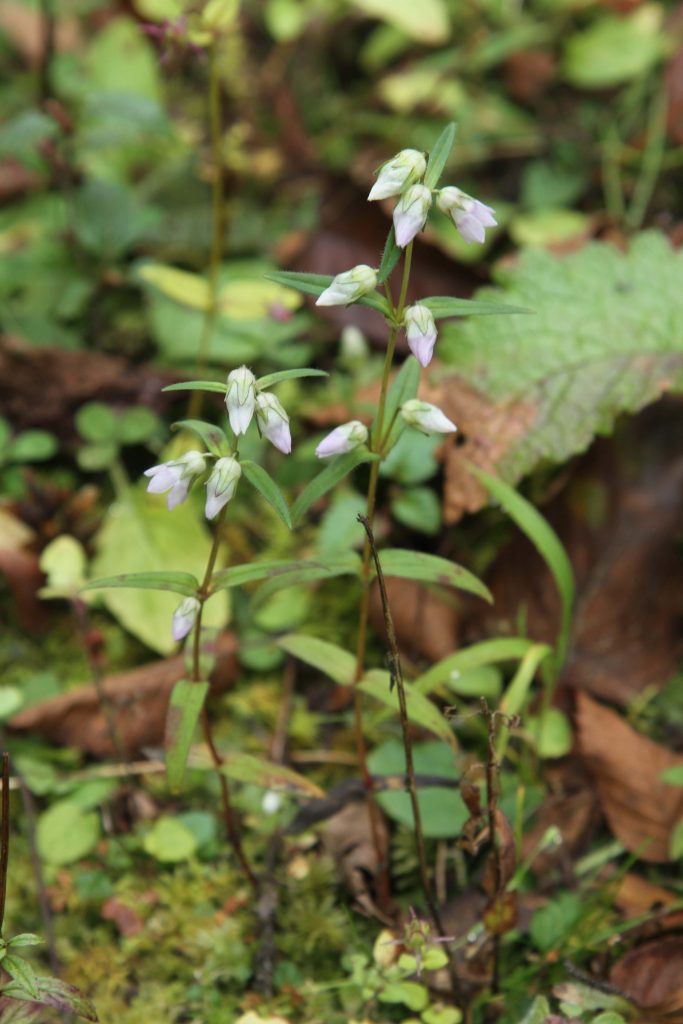
(G. Don) Wall. ex. C.B. Clarke
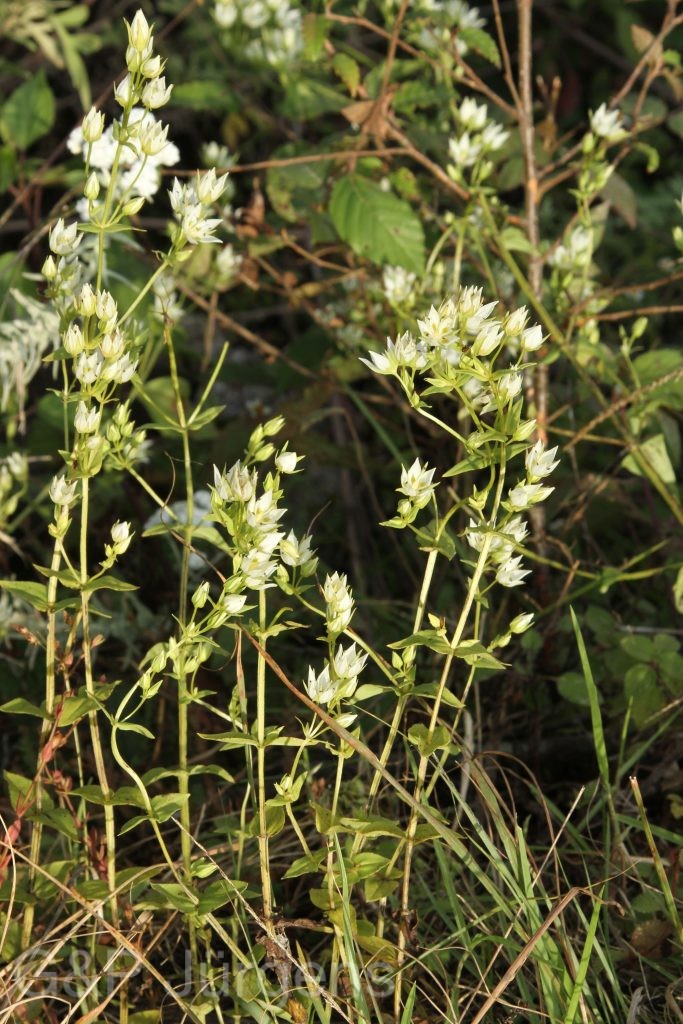
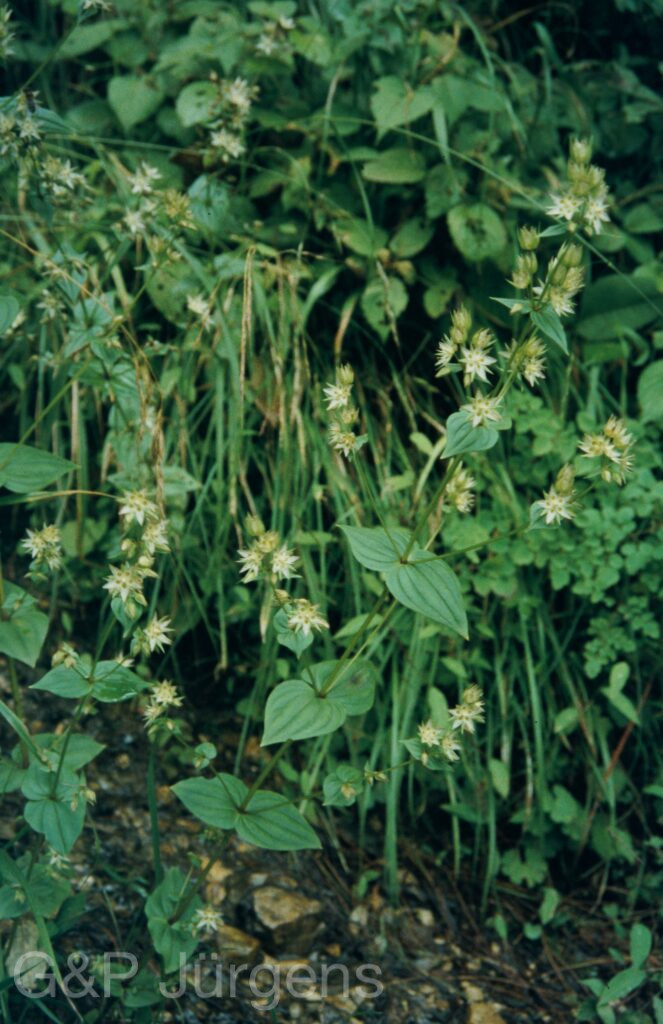
Bhutan2015 464
Bhutan Trongsa 2100m, October
Garw 2005 276 ergebnis
India Garhwal Kunol 2600m, September

Description

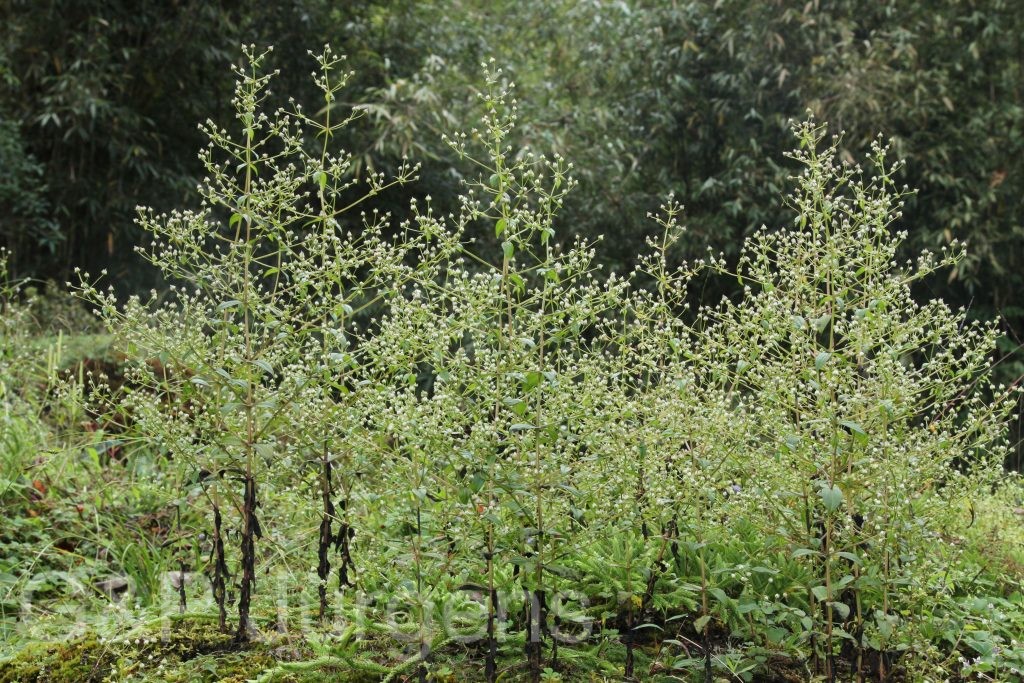
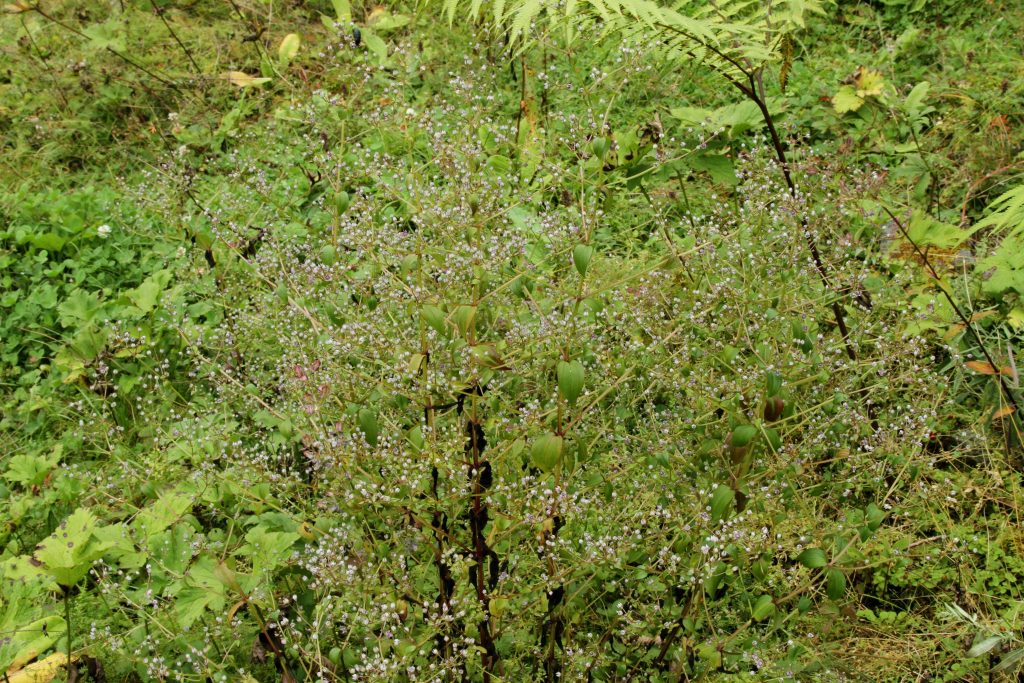
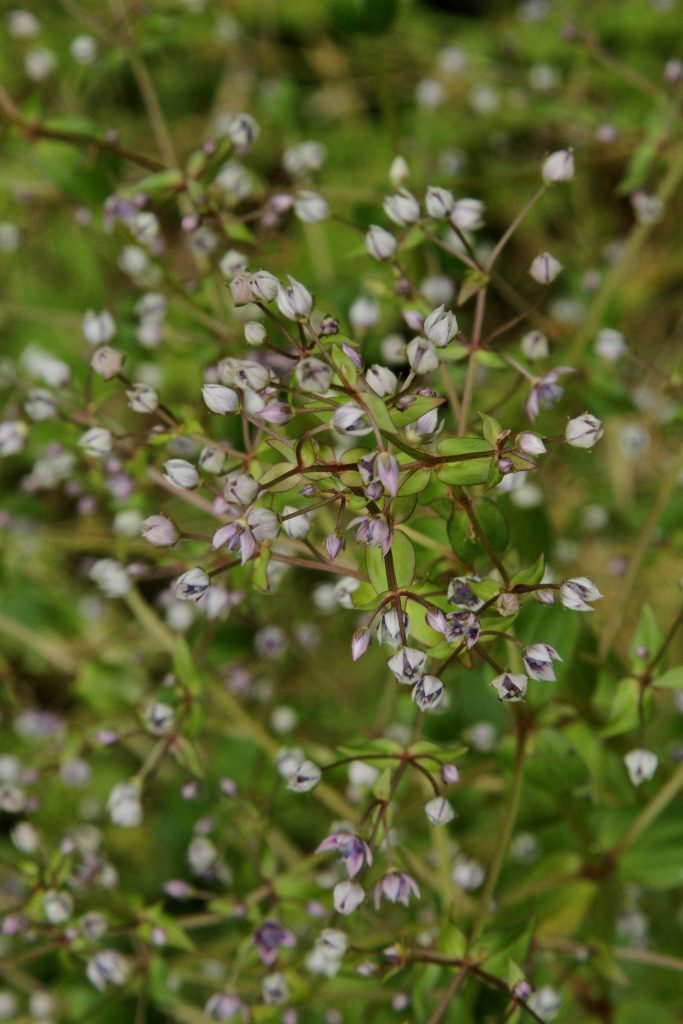
Swertia cordata is a Himalayan gentian relative ranging along the entire arc from Afghanistan and Pakistan through India, Nepal, Bhutan and into south-western China and Myanmar, documented by some 332 GBIF records. It favours moist, shaded banks, grassy forest clearings, stream margins and humid open slopes within the temperate zone, broadly between 1800 and 3000 m. The material illustrated from Trongsa in central Bhutan at 2100 m in October and from Kunol in the Garhwal Himalaya at 2600 m in September reflects its late-season flowering, when the post-monsoon humidity sustains the soft foliage of this short-lived herb.

It is an erect annual or biennial with a slender, quadrangular and often branched stem. The basal and lower cauline leaves are conspicuously cordate at the base and shortly petiolate, while the upper leaves become sessile and amplexicaul; all are thin, ovate and prominently veined. The flowers are borne in lax terminal and axillary cymose panicles, the corolla typically four-merged, rotate and pale blue to lilac with darker veining, each lobe bearing the nectary pits or foveae diagnostic of Swertia, fringed by scale-like appendages. The fruit is a septicidal capsule containing numerous small seeds.

Swertia is a large, taxonomically demanding genus widely exploited in Himalayan ethnomedicine for its bitter secoiridoid glycosides, and S. cordata shares this chemistry. The basal foveae govern a specialised pollination relationship in which nectar is hidden beneath protective fringes. The species is not regarded as threatened given its wide distribution, but collection for medicinal use and habitat loss along forest margins warrant monitoring of accessible populations.

Author: (G. Don) Wall. ex. C.B. Clarke · Sources: POWO (Kew), GBIF, Flora of Bhutan, Annotated Checklist of the Flowering Plants of Nepal, Flora of China (Gentianaceae), Revision of the genus Swertia
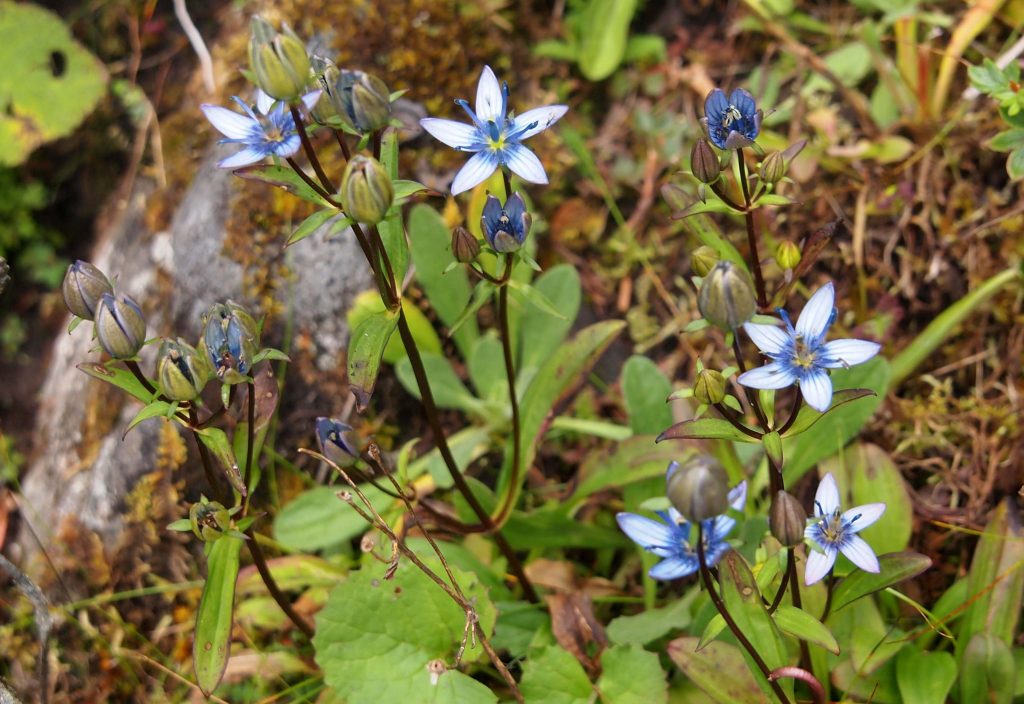
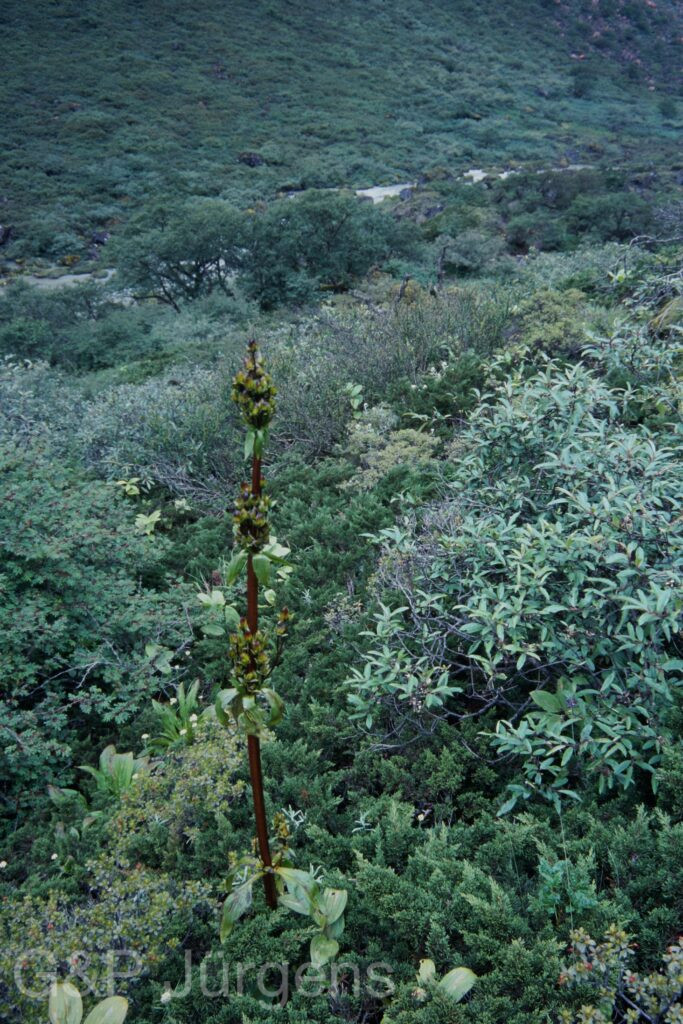
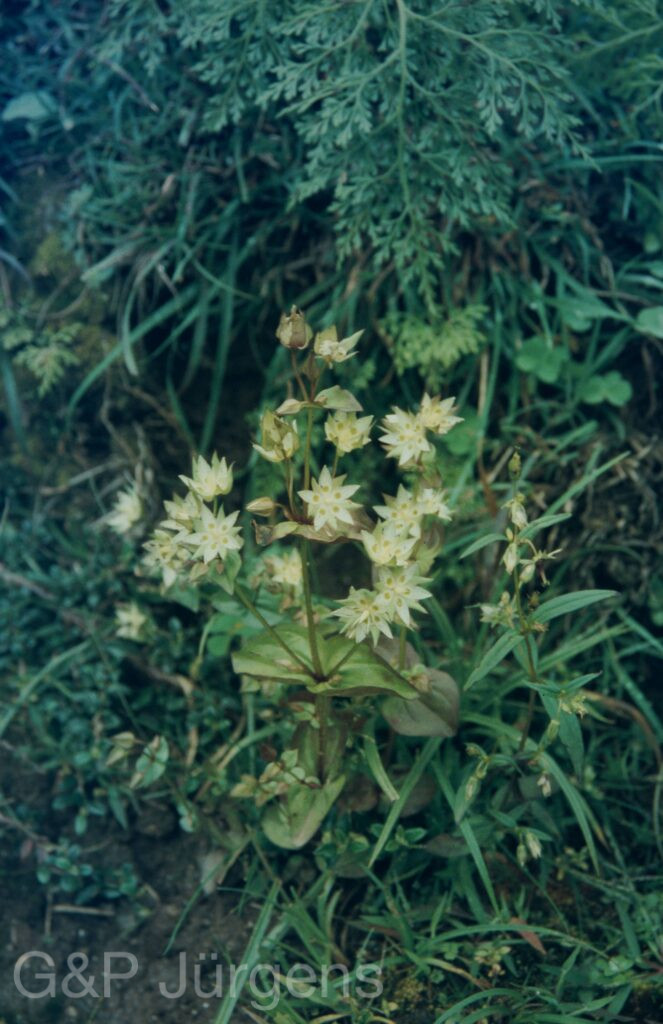
D. Don

Bhutan2012 299
Bhutan Shale-La, 4300m September

Description

Swertia cuneata is a Himalayan gentian relative distributed from Pakistan through India, Nepal, China and Bhutan, with around 157 GBIF records. It is a plant of the alpine and upper subalpine zone, growing in open meadows, turfy slopes, rocky pastures and streamsides, broadly between about 3500 and 4500 m. The gathering from the Shale-La in Bhutan at 4300 m in September documents its late-summer flowering, when these high passes carry a colourful display of gentians, swertias and other alpine herbs at the close of the monsoon.

It is an erect annual or short-lived perennial herb with a simple or branched, often four-angled stem. The leaves are opposite, sessile, oblong to lanceolate and cuneate (wedge-shaped) at the base, the feature recalled by the epithet "cuneata". The flowers are borne in terminal and axillary cymes forming a loose panicle; each is rotate and four- or five-merous, with spreading lobes that are pale blue to purplish or yellowish and conspicuously veined or spotted, and bearing the nectary glands (nectaries fringed with fimbriae) on the corolla lobes that are diagnostic of Swertia. The fruit is a septicidal capsule containing numerous small seeds.

Swertia belongs to tribe Gentianeae and is well diversified in the Sino-Himalayan alpine flora, distinguished from Gentiana by its deeply divided, wheel-shaped corollas with open nectar glands rather than a tubular flower. Several species are important in Himalayan traditional medicine (the "chiretta" group), and although S. cuneata itself is widespread and not of conservation concern, harvesting pressure affects related taxa. Pollination is by generalist insects attracted to the exposed nectaries.

Author: D. Don · Sources: POWO (Kew), GBIF, Flora of China, Flora of Bhutan, Swertia revision (Clarke / Ho & Liu)

C.B. Clarke

Sikkim2003 447 P620
Sikkim Chopta Valley 3800m August
Sikkim2003 448 K620.2
Sikkim Chopta Valley 3800m August

Description

Swertia hookeri is an eastern Himalayan gentian of comparatively restricted range, recorded from India (chiefly Sikkim and Darjeeling), Nepal, Bhutan and the bordering provinces of southern China, GBIF holding around 63 occurrences consistent with a regional endemic. It inhabits moist alpine and upper subalpine zones, growing on open grassy slopes, among shrubberies, on rock ledges and along stream margins where snowmelt maintains high soil moisture. The plant photographed in August in the Chopta Valley of Sikkim at about 3800 m is typical of its elevation band, flowering at the height of the monsoon when the alpine turf is lush and humid.

It is a robust perennial or biennial herb with a stout, erect, often purple-tinged stem arising from a thick rootstock. The leaves are largely basal, broadly elliptic to ovate, conspicuously several-nerved and narrowed to a sheathing base, the cauline leaves becoming smaller and sessile upward. The inflorescence is a leafy branched panicle of large, broadly campanulate flowers; the corolla is usually 4- or 5-merous, pale greenish-yellow to whitish and densely veined with purplish-blue reticulation, each lobe bearing a pair of fimbriate nectary pits at the base. Stamens alternate with the lobes, and the superior ovary develops into a septicidal capsule with numerous small seeds.

Described by C. B. Clarke, Swertia hookeri belongs to a large, taxonomically intricate genus centred on the Sino-Himalayan region, forming part of a species swarm noted for diagnostic nectary morphology. Like many congeners it is rich in bitter secoiridoid and xanthone compounds and is gathered locally for medicinal and febrifugal use. Its dependence on intact high-altitude grassland renders it potentially sensitive to grazing pressure and climate-driven treeline shifts, though it has not been formally evaluated.

Author: C.B. Clarke · Sources: POWO (Kew), GBIF, Flora of Bhutan, Flora of China, Hara Flora of Eastern Himalaya, Clarke revision of Swertia

(C.B. Clarke) C.B. Clarke

Bhutan2015 31
Bhutan Thimphu 2300m, October
Bhutan2012 321
Bhutan Dochu-La, 3100m September
Bhutan2012 322
Bhutan Dochu-La, 3100m September

Description

Swertia macrosperma is a widespread gentian-family herb of Asia, exceptionally well represented in GBIF with about 1613 occurrences spanning Taiwan, China, India, Nepal, Bhutan, Myanmar, Bangladesh, Japan and beyond. It is a plant of open, moist montane settings, growing on grassy slopes, forest margins, clearings, banks and damp meadows in the temperate to lower subalpine belt. The material photographed in Bhutan, at Thimphu around 2300 m in October and at the Dochu-La pass near 3100 m in September, illustrates its autumn flowering season, when these post-monsoon slopes carry the late display typical of many Himalayan swertias.

It is an erect annual to biennial herb with slender, often quadrangular and branched stems arising from a basal rosette of leaves. The cauline leaves are opposite, sessile to shortly petiolate and ovate to lanceolate. The flowers are borne in lax terminal and axillary cymes forming a diffuse panicle; each is usually four- or five-merous with a rotate, deeply parted corolla that is whitish, pale greenish or tinged with purple and frequently spotted, and each corolla lobe bears one or two fringed nectary glands (foveolae) diagnostic of the genus. The fruit is a septicidal capsule that, as the epithet indicates, releases comparatively large seeds.

Swertia is a large genus of tribe Swertieae, distinguished from Gentiana by its rotate, deeply divided corolla and conspicuous nectary pits. Several species, including this one, are gathered for traditional medicine on account of their bitter secoiridoid compounds. As an abundant and ecologically tolerant species across a vast range, S. macrosperma is of no conservation concern, though localised harvesting pressure on bitter Swertia species is documented elsewhere in the genus.

Author: (C.B. Clarke) C.B. Clarke · Sources: POWO (Kew), GBIF, Flora of China, Flora of Bhutan, Flora of Nepal, Ho & Pringle Gentianaceae revision

D. Don

Sikkim2003 301 G422
Sikkim Saniti-Lake 4250m August

Description

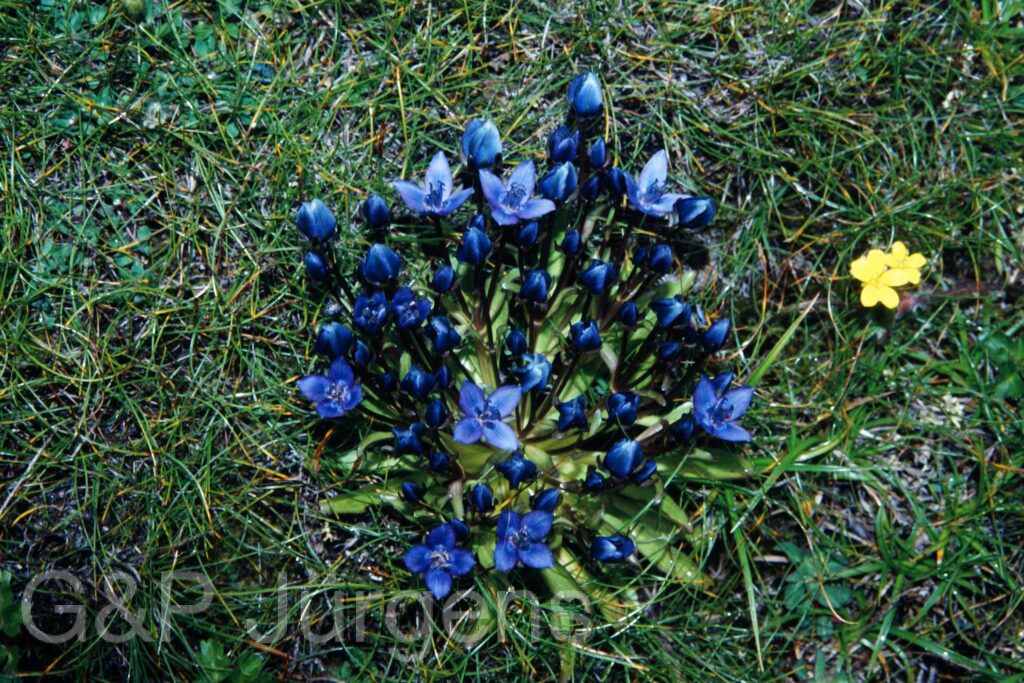
Swertia multicaulis is a high-alpine Himalayan gentian distributed through Nepal, China, India, Bhutan and recorded marginally from Kazakhstan, with GBIF holding around 144 occurrences along the main Himalayan chain. It is a plant of the upper alpine zone, growing on damp, peaty or gravelly meadows, moist rock ledges, seepage slopes and the margins of glacial lakes and snowbeds. The specimen from Saniti Lake in Sikkim at about 4250 m in August typifies its preference for cold, moisture-saturated high-altitude turf, where it flowers late in the short growing season as the monsoon wanes and snowmelt keeps the substrate constantly wet.

As its epithet indicates, it is a low perennial herb producing several stems from a stout, often branched rootstock crowned by a rosette of leaves. The basal leaves are obovate to spathulate, entire and narrowed to a petiolar base, forming a compact tuft, while the few stem leaves are small and sessile. The flowers are borne singly or in few-flowered clusters and are typically 4- or 5-merous; the corolla is rotate and deep blue-purple to violet, the lobes ovate-lanceolate and each furnished at the base with one or two fringed nectary scales characteristic of the genus. The stamens alternate with the corolla lobes, and the superior ovary ripens into a many-seeded capsule.

Described by D. Don, Swertia multicaulis is part of the speciose, taxonomically complex Sino-Himalayan radiation of the genus, where species are separated largely by nectary structure, corolla colour and habit. Its cushion-forming, multi-stemmed growth is an adaptation to wind-swept, frost-prone high-alpine conditions. The plant accumulates bitter secoiridoids and xanthones and, like other swertias, has a reputation in local folk medicine. Restricted to intact high-elevation wetland and meadow habitats, it may be vulnerable to grazing and to upward habitat compression under a warming climate.

Author: D. Don · Sources: POWO (Kew), GBIF, Flora of China, Flora of Bhutan, Hara Enumeration of Flowering Plants of Nepal, Clarke revision of Swertia

(G.Don) Wall. ex. C.B.Clarke

Garw 2005 242 ergebnis ergebnis
India Garhwal Bora 2200m, September

Description

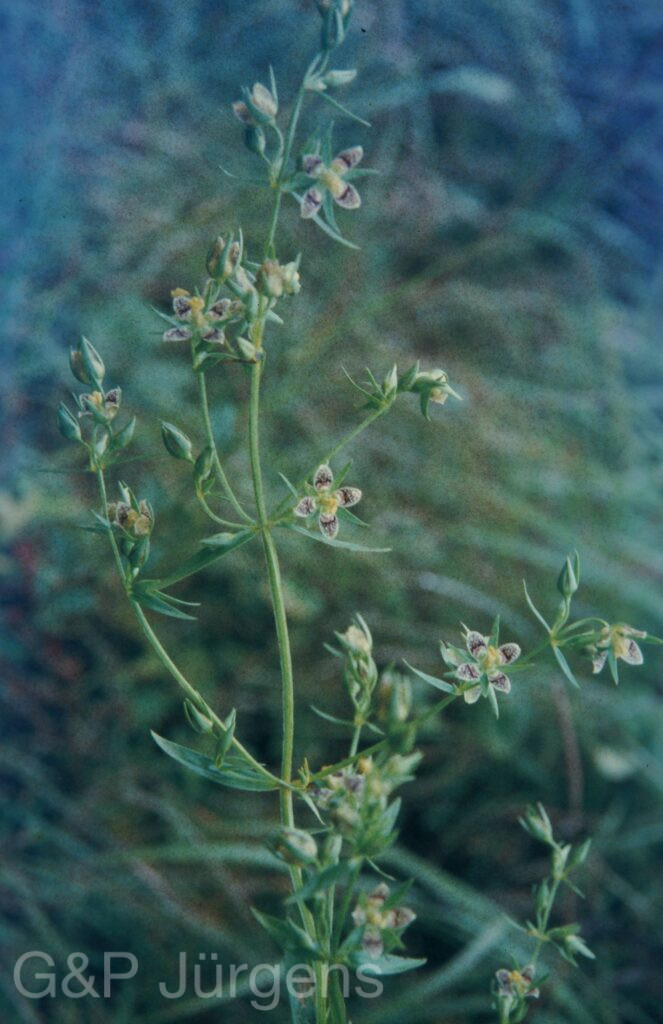
Swertia nervosa is an annual gentian-relative widely distributed across the Himalaya and montane Southeast Asia, recorded from China, Nepal, India, Bhutan, Myanmar and Taiwan, with around 331 occurrences in GBIF. It is a plant of moist open slopes, grassy banks, forest clearings, streamsides and disturbed ground in the subtropical to lower temperate belt, typically between 1500 and 2800 m. The photograph from Bora in Garhwal, India, at about 2200 m in September shows it in flower at the close of the monsoon, the period when the genus reaches its peak of flowering across the mid-elevation Himalaya.

The plant is an erect annual herb with an angular, often four-winged or ridged stem branching in the upper part. The leaves are opposite, sessile, lanceolate to ovate-lanceolate and conspicuously several-nerved, the prominent venation reflected in the epithet nervosa. The numerous small flowers are borne in a lax, much-branched terminal panicle; they are usually four-merous with a deeply parted, pale yellowish to greenish corolla often marked with purplish veins, and each lobe bears a fringed nectary gland at its base, a diagnostic feature of Swertia. The fruit is an ovoid bivalved capsule containing many minute seeds.

Swertia is a large genus of the Gentianaceae centred on the Sino-Himalayan region, distinguished by the nectariferous glands (foveae) on the corolla lobes; S. nervosa belongs to the annual, paniculate-flowered group sometimes segregated under Ophelia. Like several relatives it is rich in bitter secoiridoid compounds and is used in traditional medicine as a substitute for the famed chiretta (S. chirayita). Common, weedy and broadly distributed, it is of no conservation concern.

Author: (G.Don) Wall. ex. C.B.Clarke · Sources: POWO (Kew), GBIF, Flora of China, Flora of Bhutan, Annotated Checklist of the Flowering Plants of Nepal, Clarke's treatment of Gentianaceae in Flora of British India

Harry Sm.

BhutanPG2011 341
Bhutan Jule-Tso, 4000m June

Description

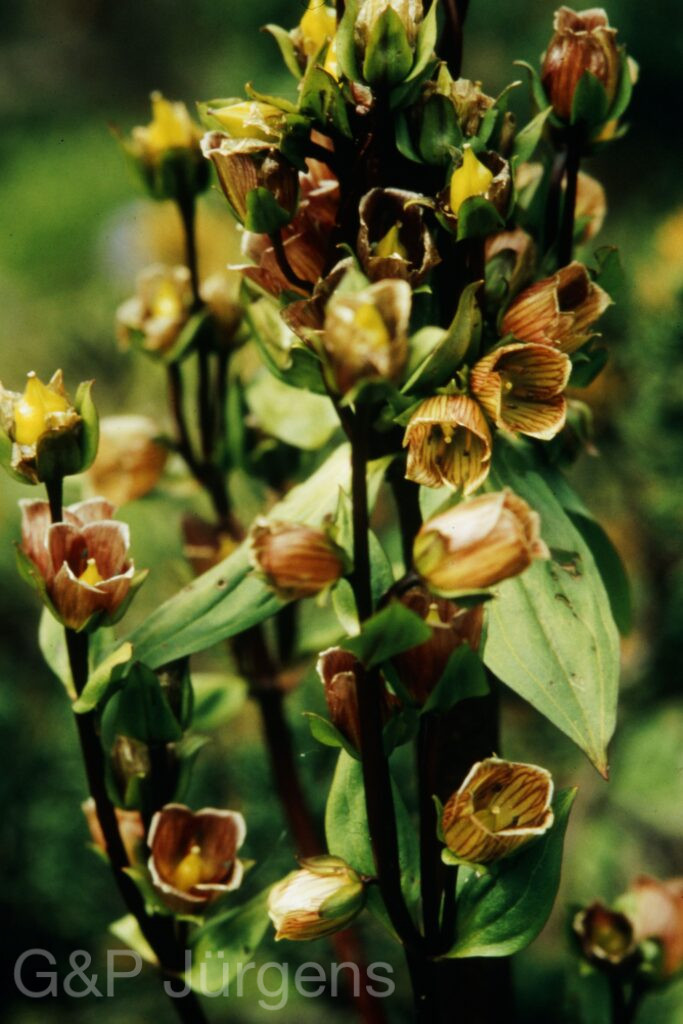
Swertia pseudohookeri is an eastern Himalayan species recorded from Bhutan, Nepal and India, represented in occurrence databases by a modest 17 georeferenced records that reflect both its restricted distribution and its limited collection. It is a plant of high-alpine habitats—moist meadows, open turf, streamsides and the damp margins of glacial lakes—generally near and above 4000 m. The illustrated population at Jule-Tso in Bhutan, photographed at 4000 m in June, typifies its occurrence around tarns and snowmelt flushes where it flowers in the brief alpine summer.

It is an erect annual or short-lived perennial herb with a slender, often quadrangular and sometimes narrowly winged stem arising from a fibrous root. The leaves are opposite, sessile and lanceolate to ovate, with the basal leaves usually larger and the upper ones progressively reduced and bract-like. The inflorescence is a lax, few- to many-flowered cyme; the flowers are typically four- to five-merous with a deeply divided rotate corolla, the lobes pale to bluish or purplish and marked with darker veining, each bearing nectary pits fringed with fimbriae. The fruit is a septicidal, ovoid capsule containing numerous small seeds.

The epithet pseudohookeri, coined by Harry Smith, signals its close morphological resemblance to Swertia hookeri, from which it is distinguished by floral and nectary characters. Swertia is a large, taxonomically intricate genus in the Gentianaceae whose Himalayan members have long been used in traditional medicine for their bitter secoiridoid compounds. Owing to its narrow range and high-elevation niche, S. pseudohookeri is potentially vulnerable to climatic shifts and habitat disturbance, though it has not been formally evaluated.

Author: Harry Sm. · Sources: POWO (Kew), GBIF, Grierson & Long Flora of Bhutan, Annotated Checklist of the Flowering Plants of Nepal, Flora of China (Gentianaceae), Harry Smith's monographic studies on Asiatic Swertia

(D.Don) C.B.Clarke

Nepal 95 109 P195 ergebnis
Nepal below Rupien La 3100m October
Bhutan2012 857

Description

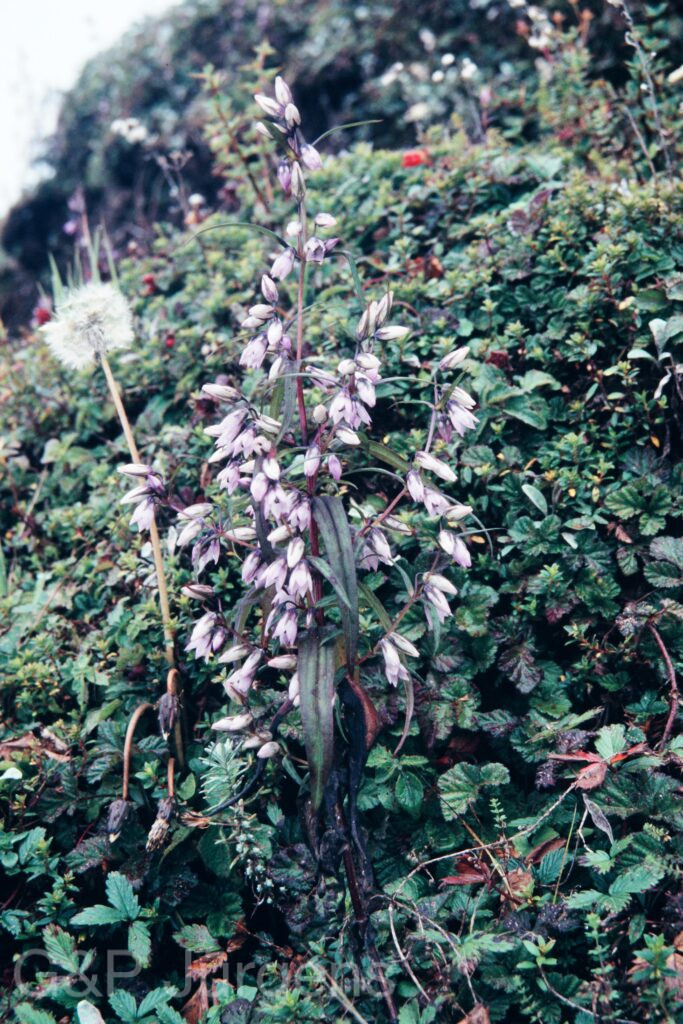
Swertia purpurascens is a Himalayan gentian distributed across Nepal, India, Pakistan, Afghanistan, Bhutan and adjacent China, with around 322 occurrences recorded in GBIF. It grows on open grassy slopes, in subalpine scrub, along forest margins and in moist montane meadows, generally between about 1800 and 3600 m. The individual illustrated below the Rupien La in Nepal at 3100 m, flowering in October at the close of the monsoon, reflects the species' characteristic late-season phenology, when many Himalayan swertias bloom on rain-moistened upper slopes before the onset of cold and the senescence of the herb layer.

The plant is an erect annual or short-lived herb 20–80 cm tall, with a slender, four-angled, often branched stem arising from a thin taproot. The leaves are opposite, sessile or shortly petiolate, lanceolate to ovate-lanceolate, three- to five-nerved and entire-margined. The inflorescence is a lax, narrow panicle of numerous flowers. Each flower is typically four-merous, the corolla rotate and divided nearly to the base into lobes that are pale purplish to greenish, often purple-tinged or veined, each lobe bearing one or two nectary pits fringed with characteristic fimbriae. The four stamens alternate with the corolla lobes, and the superior ovary develops into a many-seeded septicidal capsule.

Swertia is a large genus of the Gentianaceae centred on the Sino-Himalayan region, where it has radiated extensively, and the nectary fimbriae of the corolla provide key diagnostic characters separating its species. The nomenclatural history of this taxon is entangled with that of S. ciliata, with which it has frequently been confused; the source page links it to that name, but POWO and GBIF treat S. purpurascens as the accepted entity. As with other swertias, the plant has a reputation in Himalayan ethnomedicine as a bitter febrifuge. It remains widespread and is not considered threatened across its broad montane range.

Author: (D.Don) C.B.Clarke · Sources: POWO (Kew), GBIF, Flora of Nepal, Flora of Bhutan Vol. 2, Flora of Pakistan, A Revision of the Genus Swertia (Gentianaceae) in Asia

G.Don

Garw 2005 59 ergebnis ergebnis
India Garhwal Valley of flowers 3400m, September

Description

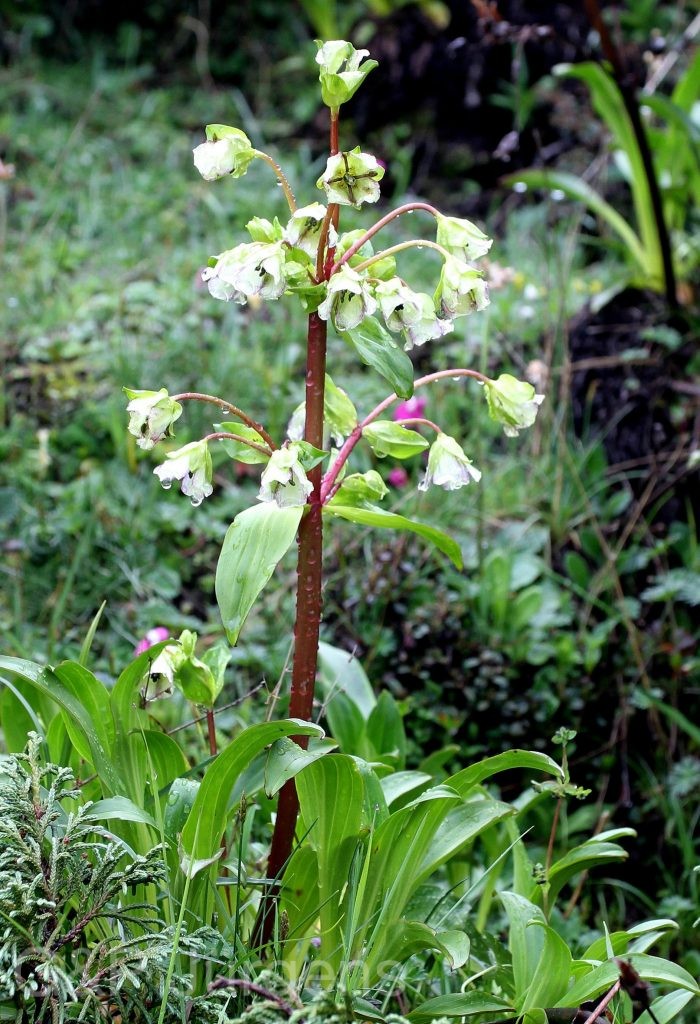
Swertia speciosa is a robust Himalayan gentian distributed through India, Pakistan, Nepal and China, the roughly 132 georeferenced records spanning the moist temperate and subalpine zones of the western and central Himalaya. It favours damp, open situations: tall-herb meadows, forest clearings, streamsides, shrubberies and grassy slopes, generally between about 2700 and 3900 m. The plant was photographed in the Garhwal Valley of Flowers at 3400 m in September, a habitat typical of the species, where it flowers in the late monsoon among lush herbaceous vegetation on cool, humus-rich soils.

It is one of the largest swertias, a stout erect biennial or short-lived perennial herb reaching well over a metre, with a hollow, often purple-tinged, four-angled stem. The leaves are large, ovate to elliptic, prominently several-nerved, the basal ones petiolate and the cauline ones sessile and opposite. The inflorescence is a broad, leafy, much-branched panicle of numerous flowers. Each flower is four- or five-merous with a rotate, greenish-yellow corolla conspicuously veined and dotted with dark purple, the lobes bearing paired fringed nectary pits (foveolae) near the base. The fruit is a many-seeded ovoid capsule splitting septicidally.

Swertia (tribe Gentianeae) is a large Old World genus in which species are separated chiefly by nectary number, position and the form of their marginal fringes, and S. speciosa is distinguished by its great stature and richly veined corolla. Like its relatives it is rich in bitter secoiridoid glycosides and is gathered in Himalayan folk medicine as a tonic and febrifuge, sold under the trade complex of "chiretta." Though widespread and not formally assessed as threatened, such medicinal harvesting warrants monitoring of wild stands.

Author: G.Don · Sources: POWO (Kew), GBIF, Flora of China, Annotated Checklist of the Flowering Plants of Nepal, Flowers of the Himalaya (Polunin & Stainton)

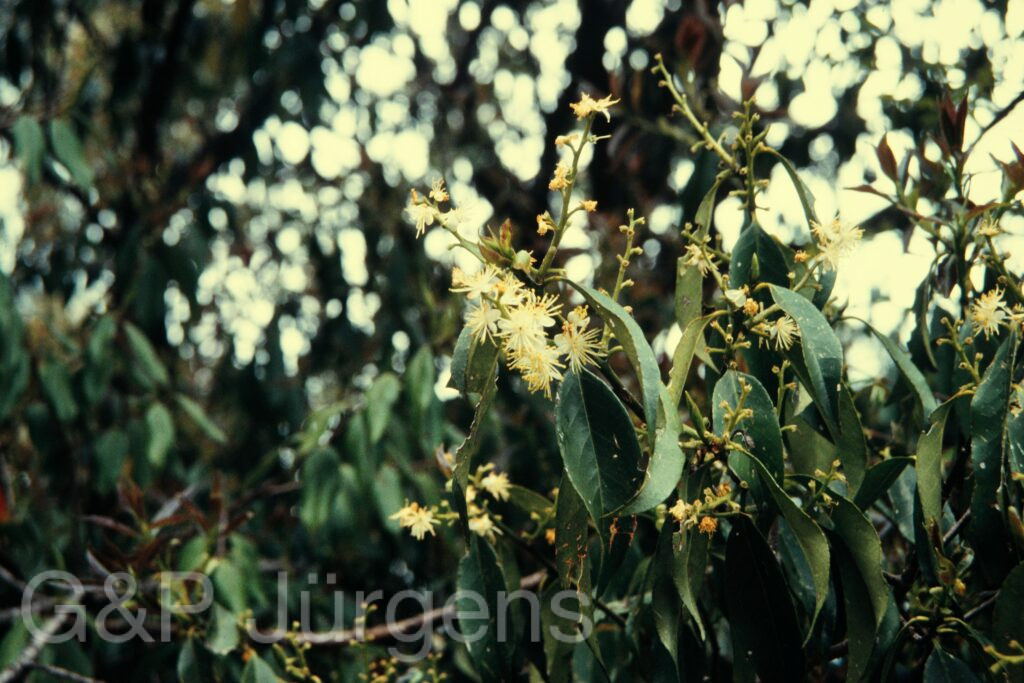
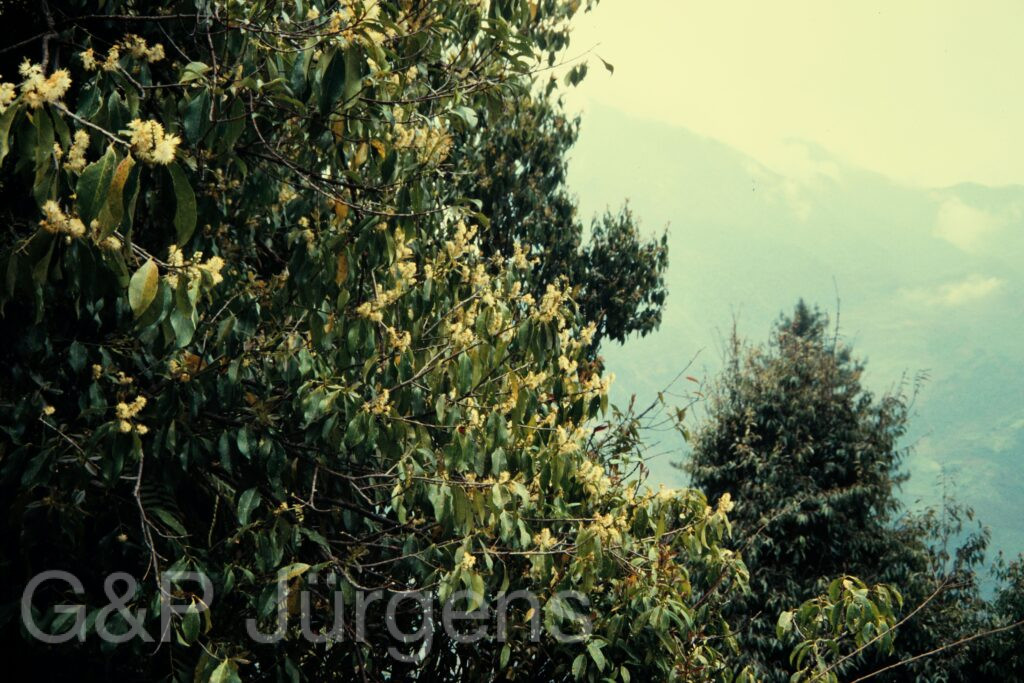
S.Moore

Nepal 97 95 P157
Nepal Dongen 2300m April
Nepal 97 94 P155
Nepal Dongen 2300m April

Description

Symplocos cochinchinensis is one of the most widely distributed members of the Symplocaceae, with an extraordinary pantropical range extending from West Africa across Madagascar and the Indian subcontinent through mainland and insular Southeast Asia, China, Japan, Taiwan, the Philippines, Papua New Guinea, Australia, and into the western Pacific islands. GBIF records nearly 5,840 occurrences from more than 20 countries. In the Himalayas, the species inhabits subtropical and warm-temperate evergreen broadleaved forests at 800–2,500 m elevation. At Dongen in eastern Nepal at 2,300 m, it occurs in the canopy and sub-canopy layer of Schima–Castanopsis forests, where it flowers in the pre-monsoon month of April.
Symplocos cochinchinensis is an evergreen tree or large shrub, typically 5–15 m tall, occasionally reaching 25 m. The bark is smooth, greyish-brown. Leaves are alternate, elliptic to oblong-elliptic, 7–15 cm long, with an acuminate apex, cuneate base, and serrate to crenate-serrate margins; the upper surface is glabrous and dark green, while the lower surface may be sparsely pubescent along the midrib. The inflorescence is an axillary raceme or panicle, 3–8 cm long, bearing numerous small, fragrant white flowers. Each flower has a five-lobed calyx, five petals fused at the base, and numerous stamens (20–60) in several series. The fruit is a cylindric to ovoid drupe, 5–8 mm long, dark blue to black at maturity, crowned by the persistent calyx lobes.
The vast geographical range of Symplocos cochinchinensis has led to considerable infraspecific taxonomic complexity, and numerous varieties and subspecies have been described. The treatment in POWO recognises several subspecies, with the Himalayan populations generally referred to subsp. laurina. The species is ecologically significant as a component of mid-elevation broadleaved forests across the Old World tropics and plays a role in forest regeneration on disturbed sites. In parts of South and Southeast Asia, the leaves and bark have traditional uses as a mordant in textile dyeing owing to their high aluminium content.

Author: S.Moore · Sources: POWO (Kew), GBIF, Flora of China Vol. 15, Flora of Nepal Checklist, Nooteboom: Symplocaceae in Flora Malesiana Ser. I, Vol. 8 (1977)