Tag:

Nepal

Flowers of Nepal — 1313 wild plant species documented from the Nepalese Himalaya, from subtropical foothills to high alpine meadows above 4,000 m. Nepal’s dramatic elevation gradient makes it one of the richest botanical regions on Earth, home to rhododendrons, primulas, gentians and the famed blue poppies (Meconopsis). Every entry gives a botanical description, native distribution, habitat and flowering season, alongside the original field photograph and the location where it was taken.

King ex C.B. Clarke

Bhutan2014 793
Bhutan
Sikkim2004 94 P164
Sikkim West-Bengal, Bersay 2700m April
Sikkim2004 329 P530
Sikkim West-Bengal, Bersay 2700m April

Description

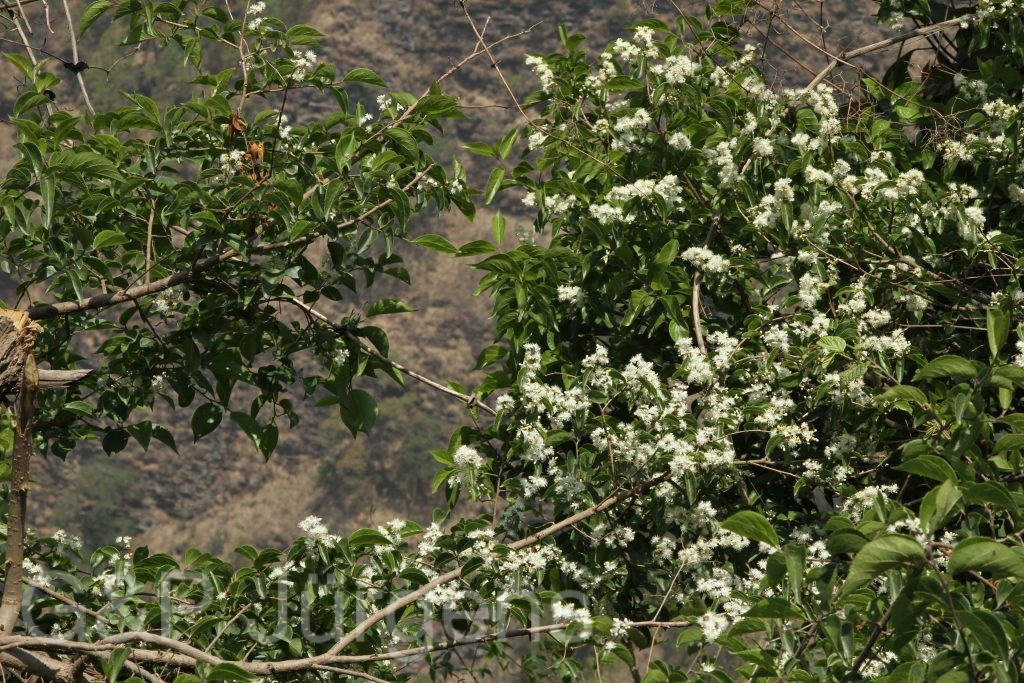
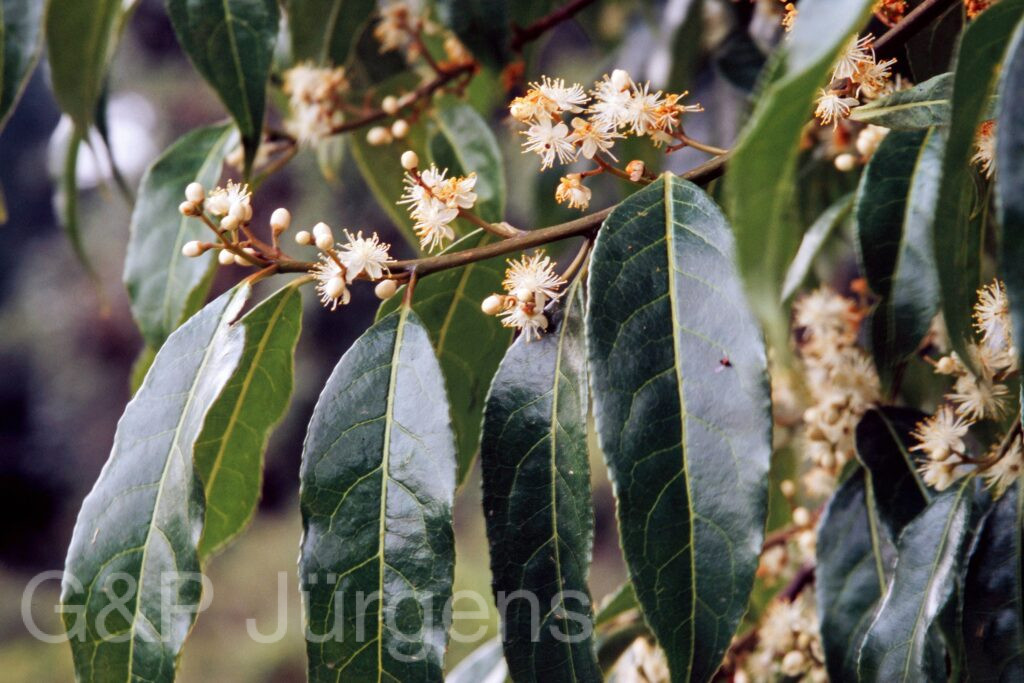
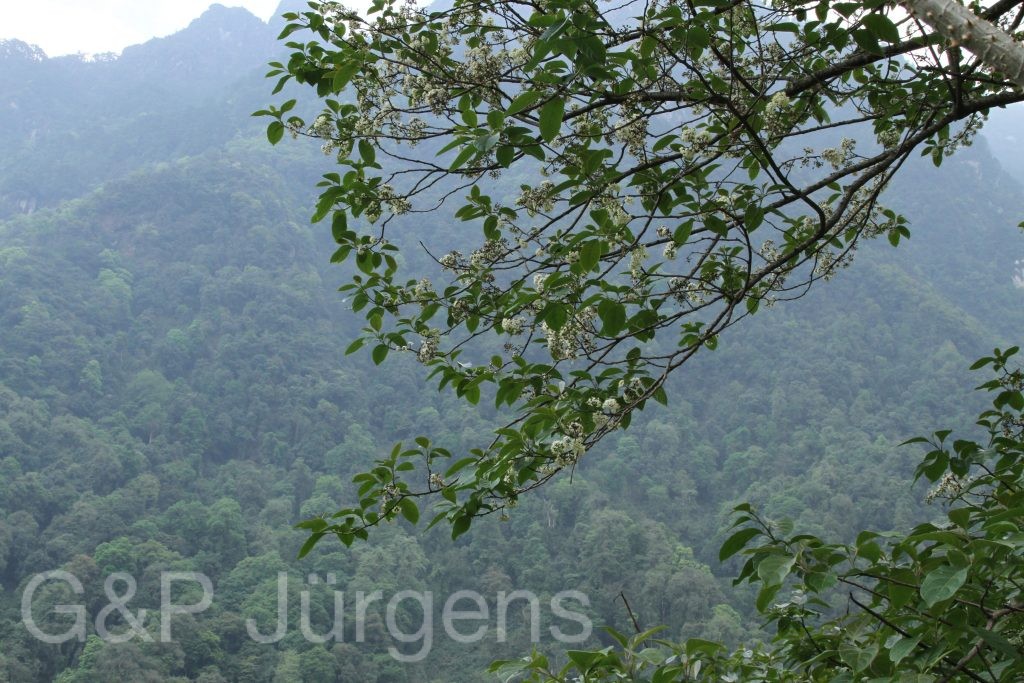
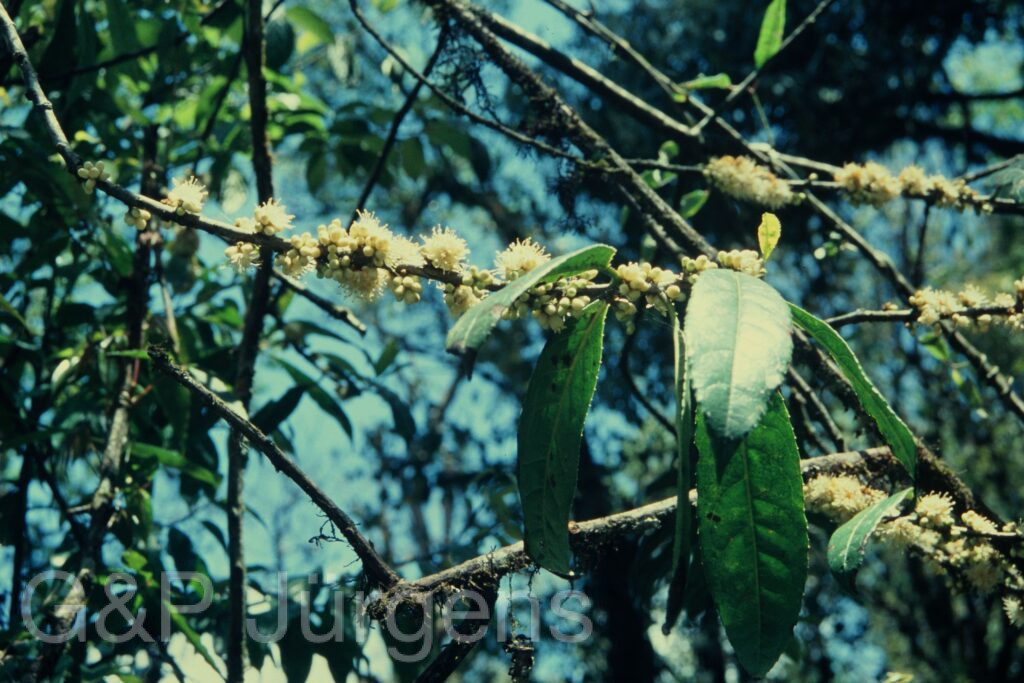
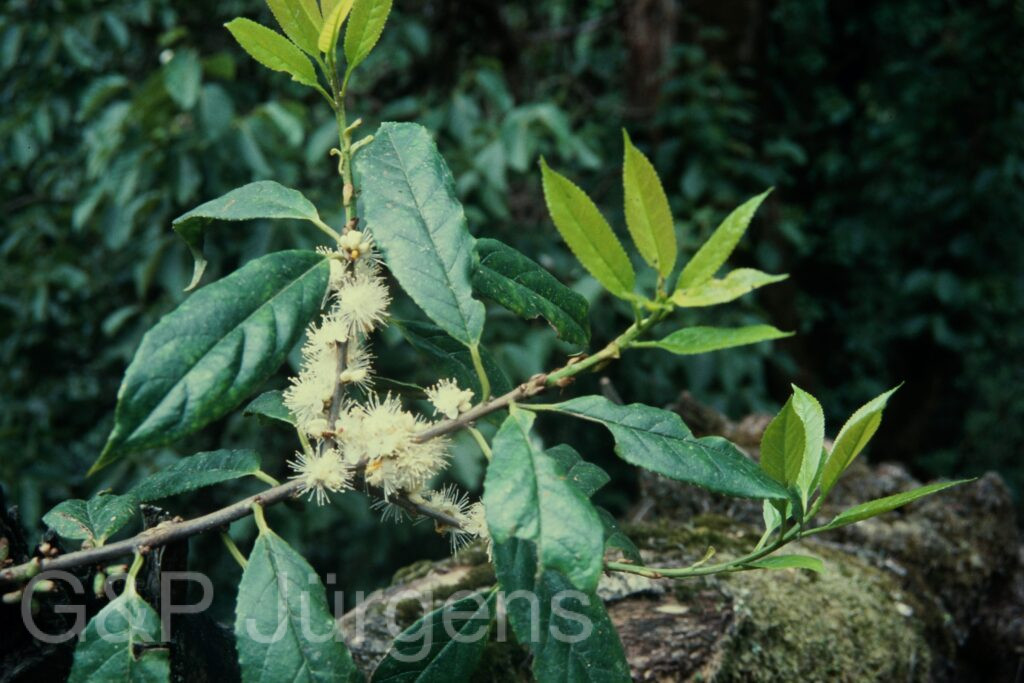
Symplocos glomerata is an Asian tree distributed from the Himalaya and northern India through Bhutan, Nepal and Myanmar into southern China, Taiwan, Indochina and the Malesian region. Its 572 GBIF records span this broad range, indicating a widespread but locally distributed species of evergreen and mixed montane forest. It grows in broadleaved and laurel-dominated forests, on slopes and ridges, typically in the warm-temperate to lower-subtropical montane belt. The plant photographed at Bersay in the Sikkim-West Bengal border region at about 2700 m in April illustrates its occurrence in the moist mid-elevation forests of the Eastern Himalaya, flowering in early spring.

It is a small evergreen tree or shrub with leathery, alternate leaves that are elliptic to oblong, with serrate to crenate margins and a glabrous, glossy upper surface. The flowers are borne in dense, sessile, glomerate clusters in the leaf axils, as the epithet glomerata indicates; each is small, white and fragrant, with a five-lobed corolla and numerous stamens united at the base in fascicles, a characteristic of the genus. The fruit is a small, ovoid to cylindric drupe crowned by the persistent calyx lobes.

Symplocos is the sole genus of the Symplocaceae, distinguished by its polyandrous flowers and aluminium-accumulating tissues; several species, including this one, have been used to yield yellow dyes and mordants. S. glomerata varies considerably across its wide range and has accumulated numerous synonyms and infraspecific names. Widely distributed and ecologically tolerant, it is not regarded as threatened and is a common constituent of Asian montane forest.

Author: King ex C.B. Clarke · Sources: POWO (Kew), GBIF, Flora of Bhutan, Flora of China, Nooteboom Symplocaceae monograph
Siebold & Zucc.

Bhutan2015 531
Bhutan Phobjika 2450m, October
Bhutan2015 529
Bhutan Phobjika 2450m, October

Description

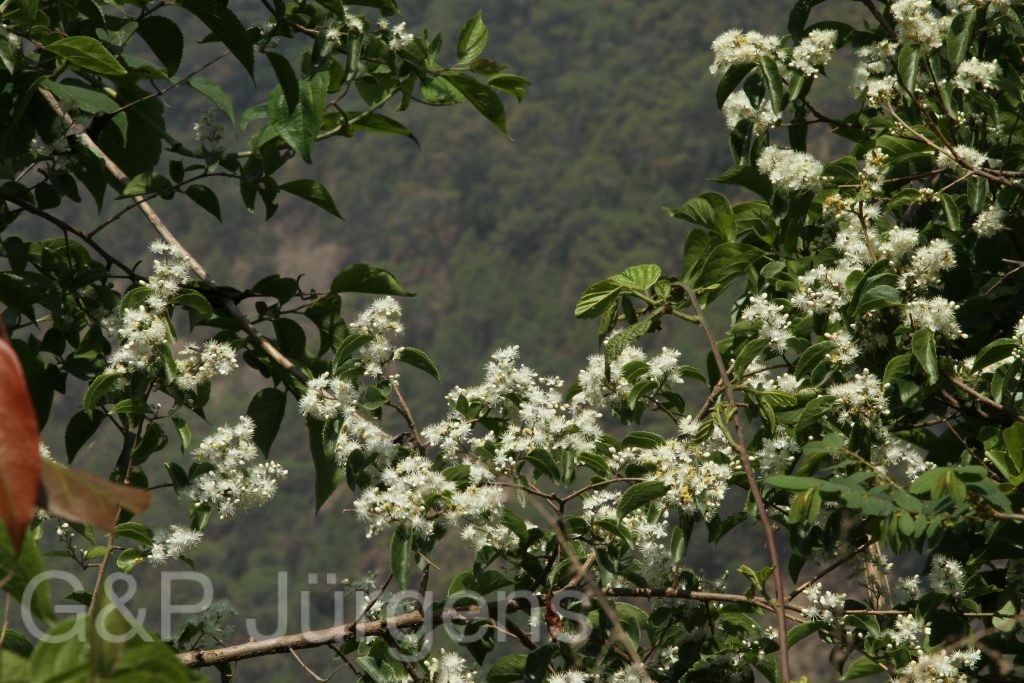
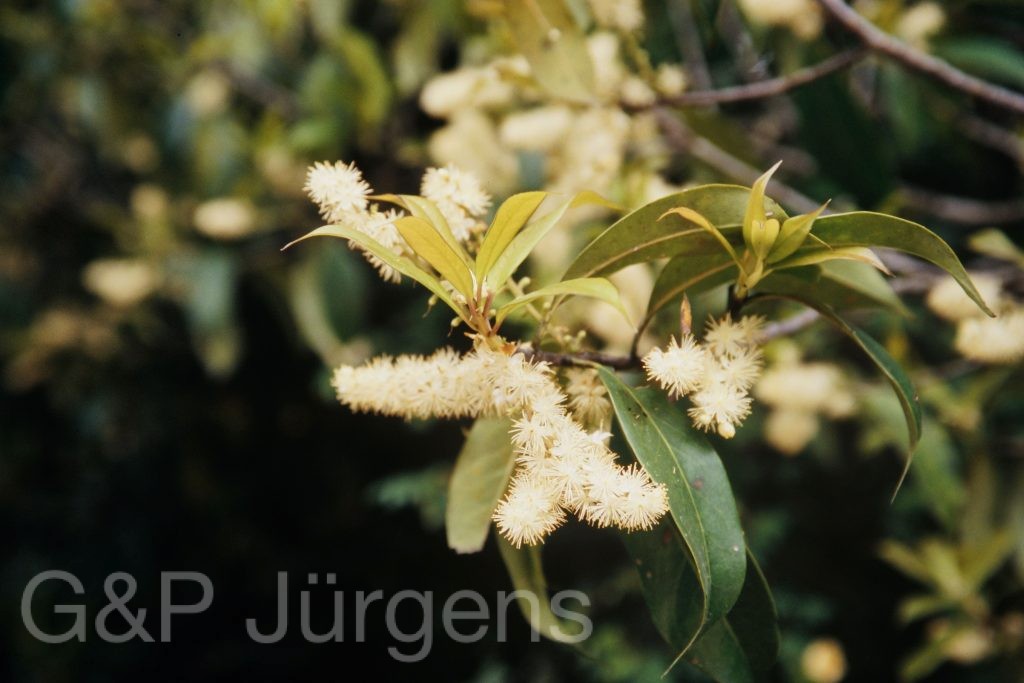
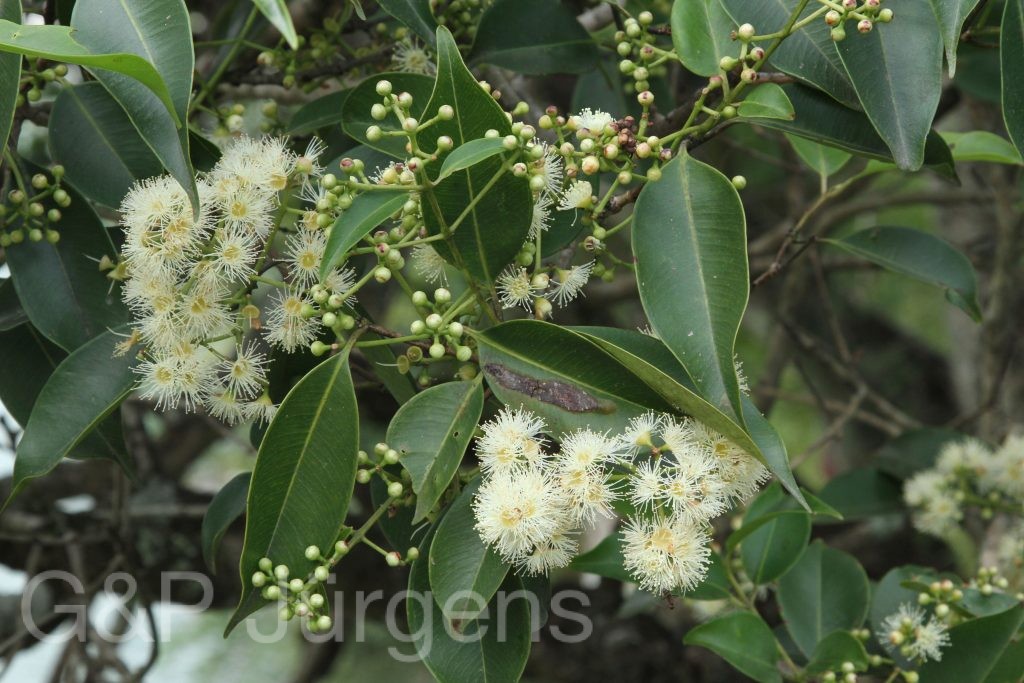
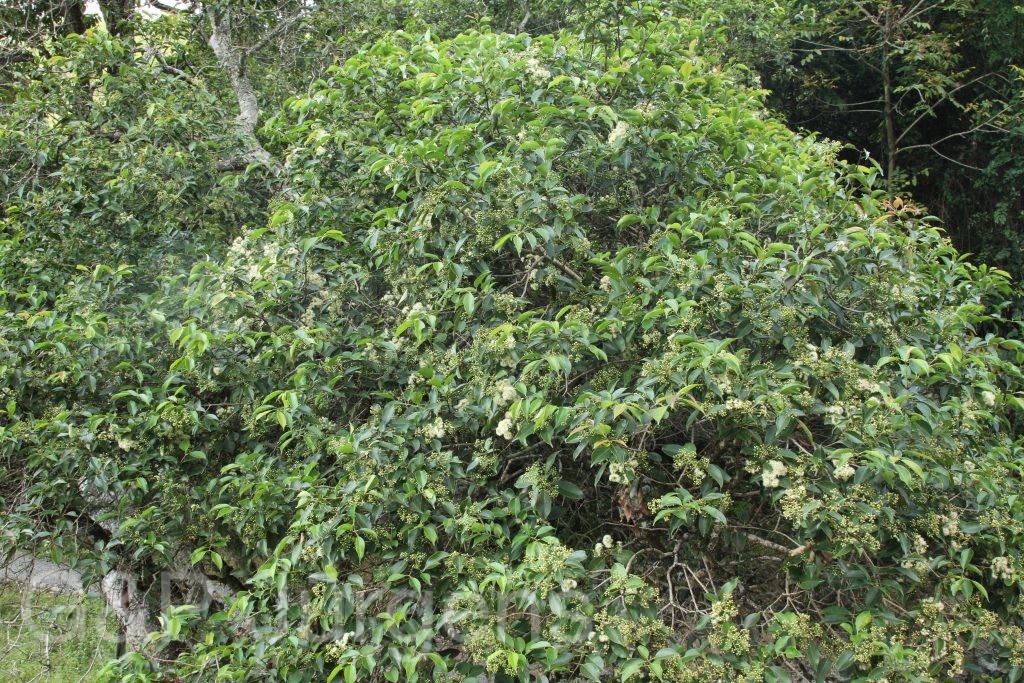
Symplocos lucida is a broadly distributed evergreen of eastern and southern Asia, occurring from China, Japan, Korea and Taiwan through Hong Kong, the Philippines, Vietnam, Thailand, Malaysia and Indonesia to the Himalayan countries of Nepal, India and Bhutan; its more than 413 GBIF records reflect this wide range, with the United States accessions cultivated or herbarium-based. It grows in evergreen broad-leaved and mixed mid-montane forests, on forest margins and shrubby slopes, generally between about 1500 and 2800 m. The photographed tree at Phobjika in central Bhutan at 2450 m in October illustrates its occurrence in cool, humid temperate forest of the eastern Himalaya.

It is an evergreen shrub or small tree with smooth grey bark and glabrous young shoots. The alternate, leathery leaves are elliptic to oblong-lanceolate, glossy (whence lucida) and dark green above, with a serrate to crenate margin and a short petiole. The flowers are small, white and fragrant, borne in short axillary spikes or racemes; each has a five-lobed calyx and corolla and numerous stamens fused in fascicles at the base. The fruit is a small, ovoid to oblong drupe, dark blue-black or purplish when ripe, crowned by the persistent calyx and enclosing a single hard stone.

Symplocos is the sole genus of the Symplocaceae, a pantropical to warm-temperate family of some hundreds of species centred on Asia. S. lucida belongs to a taxonomically complex aggregate, and its leaves and bark have a long history of use as a mordant (aluminium-accumulating) source in natural dyeing. Widespread and ecologically plastic, it is not considered threatened, though its forest habitats face regional pressure from logging and land conversion.

Author: Siebold & Zucc. · Sources: POWO (Kew), GBIF, Flora of China, Flora of Bhutan, Flora of Japan, Symplocaceae revision (Nooteboom monograph)

Miq.

Bhutan2014 663
Bhutan Phobjika 2250m, May
Bhutan2014 664
Bhutan Phobjika 2250m, May
Bh2008 58 P96
Bhutan Punakha 2400m, April

Description

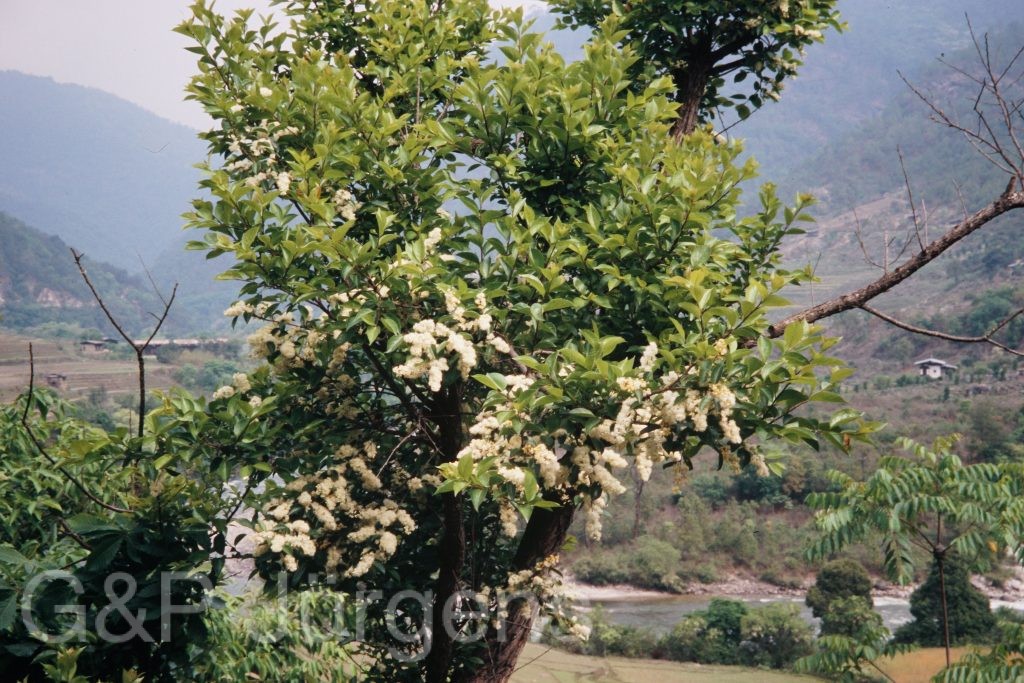
Symplocos paniculata is a widely distributed eastern Asian shrub or small tree ranging from the Himalaya (Nepal, Bhutan, northeast India) across China, Taiwan, Korea and Japan, with extensive cultivated and naturalised records elsewhere; GBIF documents 9858 occurrences spanning these and many other countries. In the Himalaya it grows in temperate broad-leaved and mixed forests, forest margins, scrub and open hillsides, generally between about 1500 and 2800 m. The photographed plants from Phobjika in Bhutan at 2250 m in May and from Punakha at 2400 m in April show it flowering in spring, when the white, fragrant blossoms appear ahead of full leaf expansion in the temperate Bhutanese valleys.

It is a deciduous shrub or small tree with grey, often lenticellate bark and finely pubescent young twigs. The alternate leaves are elliptic to obovate, acuminate, with a serrulate to crenate-serrate margin and pinnate venation. The fragrant white flowers are borne in terminal and axillary panicles; each flower has a five-lobed calyx, a deeply five-parted corolla and numerous stamens that are basally connate into fascicles, giving the inflorescence a feathery appearance. The fruit is a small ovoid to ellipsoid drupe ripening blue-black to deep blue, crowned by the persistent calyx and containing a single hard stone.

The species belongs to Symplocos, the sole genus of the family Symplocaceae, a group of Old and New World woody plants noted for accumulating aluminium and historically valued as mordant ("sapphire-berry") plants whose bark and leaves were used in dyeing. The blue, lipid-rich drupes are dispersed by frugivorous birds. Common, ecologically tolerant and widely planted as an ornamental, S. paniculata is of least conservation concern across its extensive natural range.

Author: Miq. · Sources: POWO (Kew), GBIF, Flora of China Vol. 15, Flora of Bhutan Vol. 2, Flora of Nepal, Revision of the Asiatic Symplocaceae (Nooteboom)

Wall. ex G. Don

Garh 07 237 ergebnis
India Garhwal Barron Chatti 2450m, June

Description

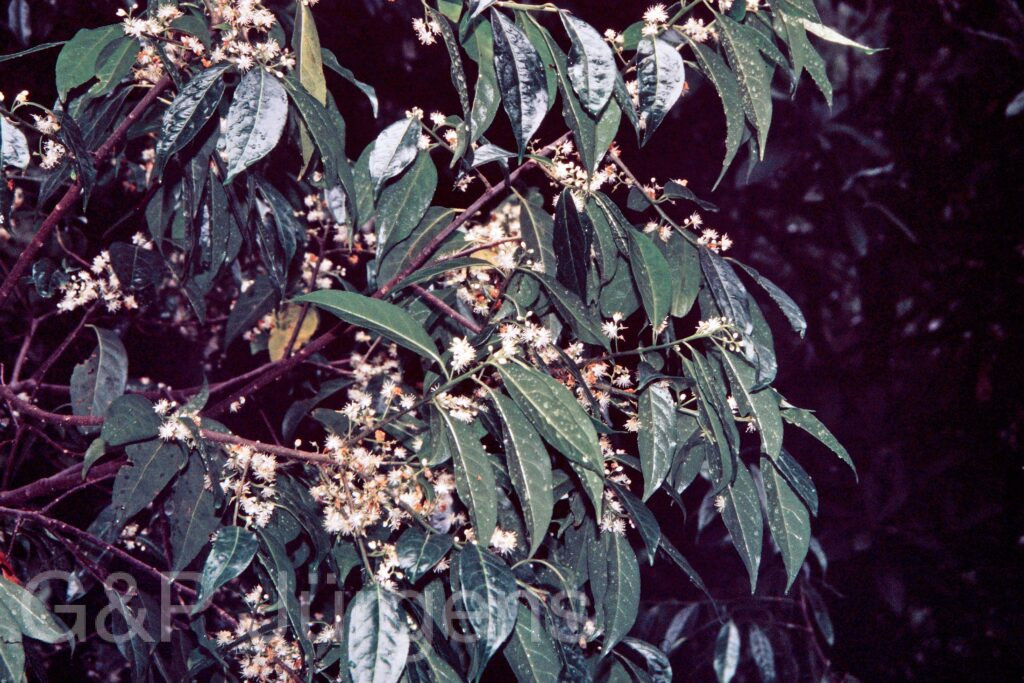
Symplocos ramosissima is an evergreen shrub or small tree widely distributed through the Sino-Himalayan and Indochinese region, with GBIF recording around 1472 occurrences across China, Nepal, India, Myanmar, Bhutan, Bangladesh, Vietnam, Sri Lanka and Taiwan. It is a characteristic component of moist broad-leaved evergreen and mixed temperate forests, occurring on humid slopes, ridge forests and forest margins generally between 1500 and 3000 m. The individual photographed at Barron Chatti in Garhwal, India, at about 2450 m in June sits within this mid-montane band, where the species forms part of the dense understorey and lower-canopy layer of laurel-oak and rhododendron-rich forests on the southern Himalayan flank.

Morphologically it is a much-branched evergreen with glabrous or finely pubescent young twigs and alternate, simple, coriaceous leaves; the blades are elliptic to lanceolate, with a serrate to crenate-serrate margin and an acuminate apex. The flowers are small, white, fragrant and borne in short axillary spikes or racemes, each with a persistent calyx, a rotate to shortly campanulate corolla of five lobes and numerous stamens fused into fascicles at the base, the pollination biology favouring small generalist insects. The fruit is a small ovoid to cylindric drupe, blue-black to purplish when ripe, crowned by the persistent calyx lobes and containing a hard stone, dispersed largely by frugivorous birds.

The family Symplocaceae comprises the single large genus Symplocos, a taxonomically intricate group well represented in the Himalaya and East Asia. The genus is notable for accumulating aluminium and for the yellow dye historically obtained from the bark and leaves of several species, which were used as mordants in traditional textile dyeing. As a common and ecologically wide-ranging forest element, S. ramosissima is not considered threatened, though its dependence on intact mid-elevation evergreen forest links its local persistence to the conservation of those increasingly fragmented montane habitats.

Author: Wall. ex G. Don · Sources: POWO (Kew), GBIF, Flora of China Vol. 15, Flora of Bhutan Vol. 2, Flora of Nepal, Nooteboom Revision of Symplocaceae of the Old World

Buch.-Ham. ex D. Don

Bh2008 155 P254
Bhutan Phobjika 2650m, April

Description

Symplocos sumuntia is a broadly distributed East Asian and Himalayan tree, recorded from Nepal, north-east India, Bhutan and Bangladesh eastward through China, Taiwan, Japan and Korea to Indochina and Myanmar, with thousands of catalogued occurrences spanning this wide range. It is a constituent of broadleaved evergreen and mixed montane forests, occurring on slopes, ridges and forest margins from the warm subtropical lowlands to the cool temperate belt, broadly between about 800 and 2,800 m. The tree photographed at Phobjika in central Bhutan at 2,650 m in April was recorded in flower, the white blossom opening in spring before or with the new foliage.

It is an evergreen shrub or small to medium tree with smooth grey bark and slender, often glabrous twigs. The leaves are alternate, simple, coriaceous, narrowly elliptic to lanceolate, acuminate, with finely serrate to subentire margins and an entire to undulate texture. The flowers are small, white and fragrant, borne in short axillary racemes or panicles; the corolla is five-lobed, the numerous stamens united at the base into fascicles adnate to the corolla, a hallmark of the family. The fruit is an ovoid to ellipsoidal drupe crowned by the persistent calyx, ripening blue-black to purple.

Symplocos, the sole genus of Symplocaceae, is taxonomically complex, and S. sumuntia (Buch.-Ham. ex D. Don) has historically encompassed numerous regional variants and synonyms. The leaves and bark are valued locally as a source of mordant (aluminium-accumulating tissues used in dyeing) and in traditional medicine. As a widespread forest species it is not of conservation concern, though it depends on the integrity of subtropical montane forest.

Author: Buch.-Ham. ex D. Don · Sources: POWO (Kew), Flora of China Vol. 15, Flora of Bhutan Vol. 2, GBIF, Nooteboom: Revision of Symplocaceae (1975)

(Wall. ex DC.) C.Jeffrey & Y.L.Chen

Garw 2005 172 ergebnis ergebnis
India Garhwal Shertoli 3100m, September

Description

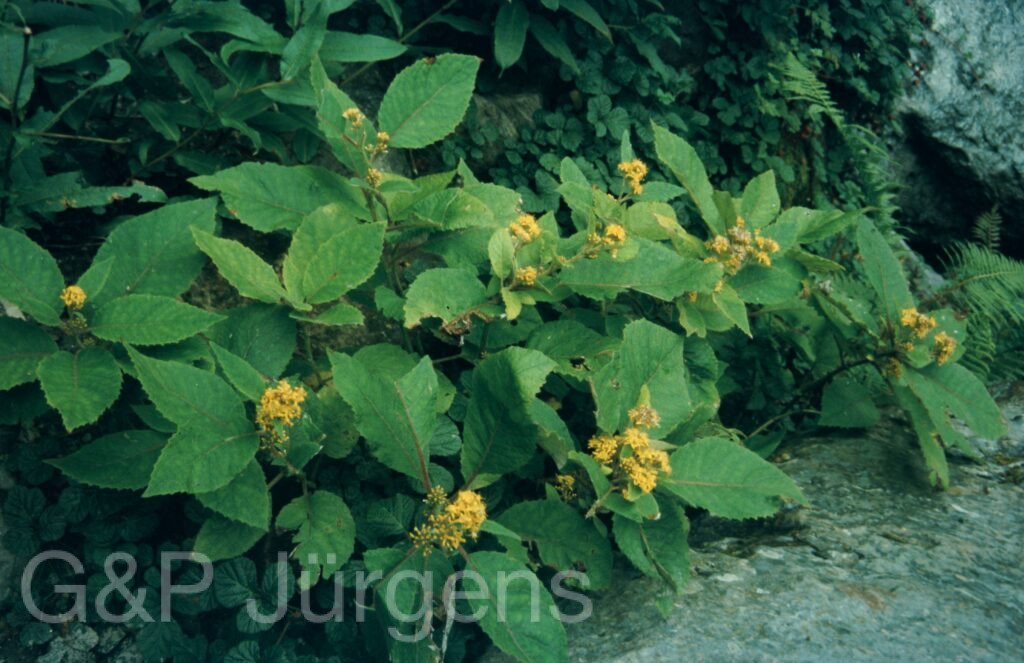
Synotis alata is a robust ragwort-allied composite of the Himalaya and southwestern China, documented by GBIF (330 occurrences) from Nepal, India, Bhutan, Myanmar and China. It grows in forest clearings, shrubberies, along streamsides and on grassy slopes within the upper temperate and subalpine zones, typically between about 2500 and 3500 m. The plant photographed at Shertoli in Garhwal, India, at 3100 m in September captures its late-monsoon to autumn flowering, when these tall herbs come into bloom along moist montane margins after the rains.

The species is a perennial herb with erect, often winged or narrowly alate stems, a feature reflected in the epithet "alata". The leaves are alternate, ovate to elliptic-lanceolate, sharply toothed and frequently decurrent down the stem to form the characteristic wings, with a thinly hairy lower surface. The capitula are numerous and arranged in a broad terminal corymbose panicle; each head is radiate with a few yellow ligulate ray florets surrounding a disc of yellow tubular florets, subtended by an involucre of uniseriate phyllaries with small calyculate bracts. The fruit is a cylindrical, ribbed cypsela bearing a copious white pappus of fine barbellate bristles that aids wind dispersal.

Synotis was segregated from the vast genus Senecio by C. Jeffrey and Y. L. Chen, who recognised its distinctive style and pollen characters; S. alata is a typical member of this Sino-Himalayan group. The wind-borne pappus permits rapid colonisation of disturbed and successional ground, and the bright capitula attract a range of generalist butterfly and bee pollinators. The species is common and widespread across its range and is not considered to be of conservation concern.

Author: (Wall. ex DC.) C.Jeffrey & Y.L.Chen · Sources: POWO (Kew), GBIF, Flora of China, Flora of Bhutan, Annotated Checklist of the Flowering Plants of Nepal, The Senecioneae of the Himalaya (Jeffrey)

(Wall. ex DC.) C.Jeffrey & Y.L.Chen

Garw 2005 51 ergebnis ergebnis
India Garhwal Valley of flowers 3400m, September

Description

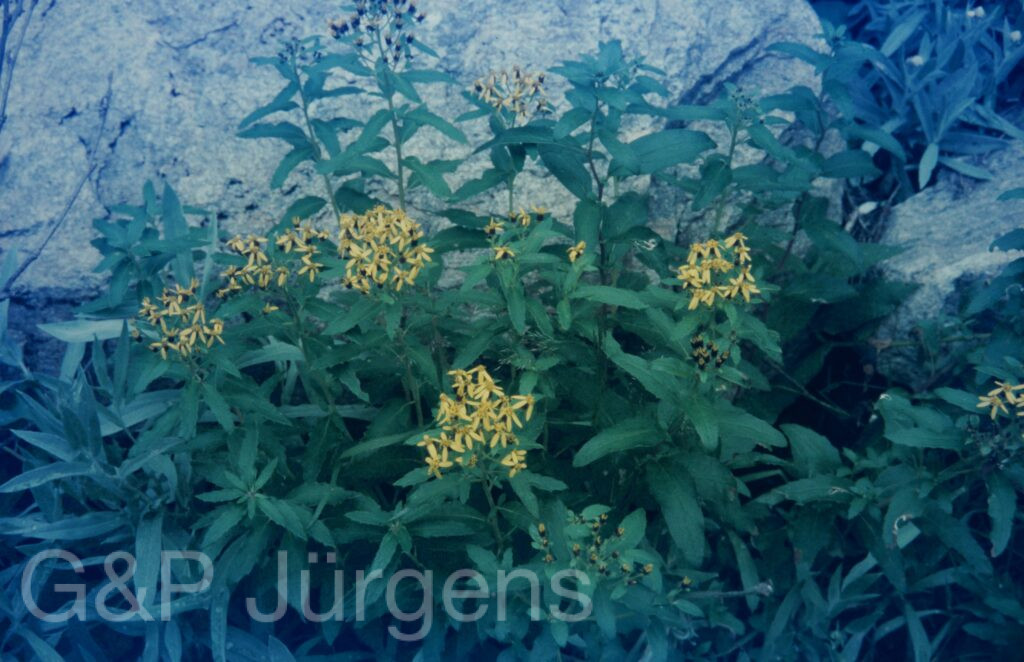
Synotis kunthiana is a Sino-Himalayan composite distributed across the central and eastern Himalaya, with verified records from India, Nepal and Bhutan and roughly 56 georeferenced occurrences in GBIF. It is a plant of the upper temperate and subalpine zones, typically occupying moist forest margins, shrubberies, streamsides and open herb-rich slopes between about 2800 and 3800 m. The photographed population in the Garhwal Himalaya, in the renowned Valley of Flowers at around 3400 m, flowering in September, exemplifies its late-season phenology in tall-herb communities flushed by the receding monsoon.

It is a perennial herb with erect, often somewhat woody-based stems arising from a short rhizome, the stems leafy and frequently floccose-tomentose when young. The leaves are alternate, ovate to elliptic-lanceolate, acuminate, with a serrate to denticulate margin and a thinly arachnoid-pubescent abaxial surface. The capitula are numerous, small and arranged in lax terminal corymbose-paniculate cymes; each head bears an involucre of uniseriate phyllaries subtended by a few calyculate bracteoles, with yellow radiate ray florets surrounding the disc. The fruit is a cylindrical, ribbed cypsela crowned by a copious white pappus of fine barbellate bristles.

The genus Synotis was segregated from Senecio sensu lato by C. Jeffrey and Y. L. Chen on the basis of style-branch and capitular characters, and S. kunthiana is based on the Wallichian Senecio kunthianus. The species remains locally common across its range and is not considered threatened, though its dependence on intact subalpine tall-herb meadows makes it a useful indicator of grazing pressure and habitat continuity.

Author: (Wall. ex DC.) C.Jeffrey & Y.L.Chen · Sources: POWO (Kew), GBIF, Flora of Bhutan, Flora of China, Jeffrey & Chen revision of Asiatic Senecioneae (Synotis)

Wall. ex Royle

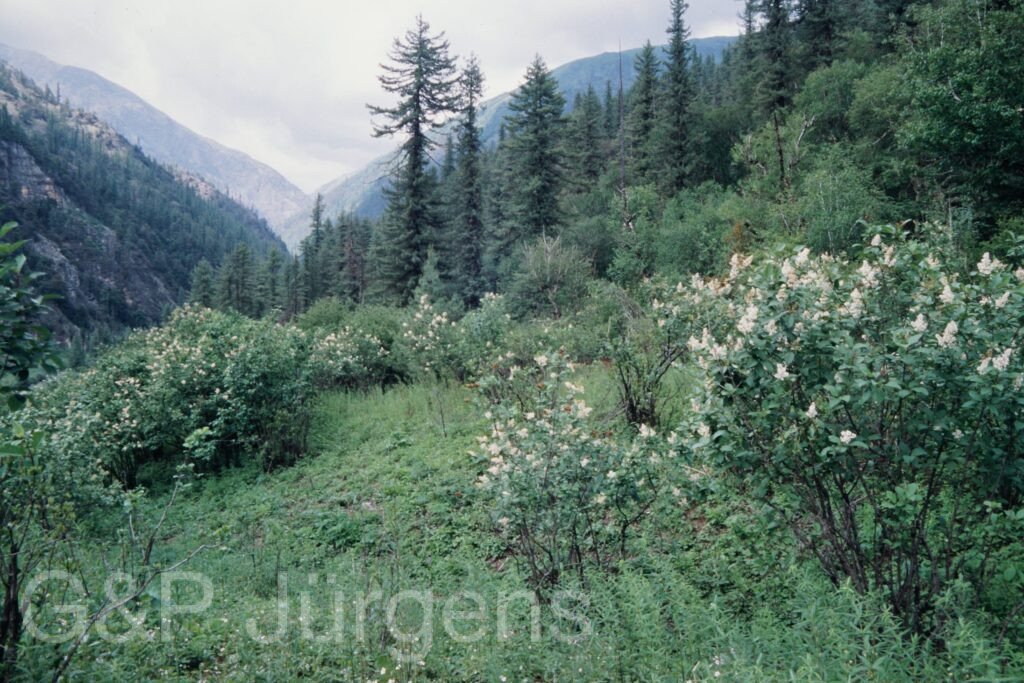
Nepal 99 390 ergebnis
West-Nepal, Sallibagar-Khola, Juni

Description

Syringa emodi, the Himalayan lilac, is a deciduous shrub native to the western and central Himalaya, distributed from Afghanistan and Pakistan through Kashmir and India into Nepal, with records extending toward southwestern China. GBIF documents well over three hundred occurrences, though a substantial share derive from cultivated plantings across Europe and North America, where the species has long been grown as an ornamental and used in lilac breeding. In the wild it inhabits open coniferous and mixed forest, forest margins, shrubberies, ravine slopes and streamsides in the temperate zone, generally between about 2400 and 3600 m. The plant photographed in West Nepal along the Sallibagar Khola in June reflects this habitat preference for moist, partly shaded montane valleys where it flowers in early summer.

The plant is a robust, erect shrub reaching three to four metres, with stout, lenticellate branches and a coarse aspect. The leaves are simple, opposite, elliptic to oblong and acuminate, glabrous and dark green above but conspicuously pale and often finely hairy along the veins beneath, distinguishing it from most other lilacs. The flowers are borne in large, erect terminal panicles; the corolla is pale lilac to nearly white, with a slender tube abruptly expanding into four spreading lobes, and the blooms are notably less fragrant, or even faintly unpleasant in scent, compared with the common lilac. Two stamens are inserted within the corolla tube. The fruit is a smooth, oblong, somewhat warty loculicidal capsule splitting to release winged seeds.

Syringa belongs to the olive family and is centred on temperate Asia, with S. emodi representing the genus's principal Himalayan outpost. Its distinctive pale leaf undersides and warty capsules render it readily identifiable, and it has contributed to horticulture both directly and as a parent of hybrid lilacs valued for foliage and hardiness. As a widespread and adaptable species occupying a broad elevational range, it is not considered threatened; its ecological tolerance and capacity to colonise forest edges and disturbed slopes underpin its persistence, while its ornamental and breeding value sustains continued ex situ cultivation worldwide.

Author: Wall. ex Royle · Sources: POWO (Kew), GBIF, Flora of China Vol. 15, Flora of Bhutan Vol. 2 Part 1, Flora of Nepal, Flora of Pakistan, Lilacs: The Genus Syringa (John L. Fiala)

(C.B.Clarke) Kitam.

Sikkim2003 135 P183
India Sikkim Dzongri 4000m, August

Description

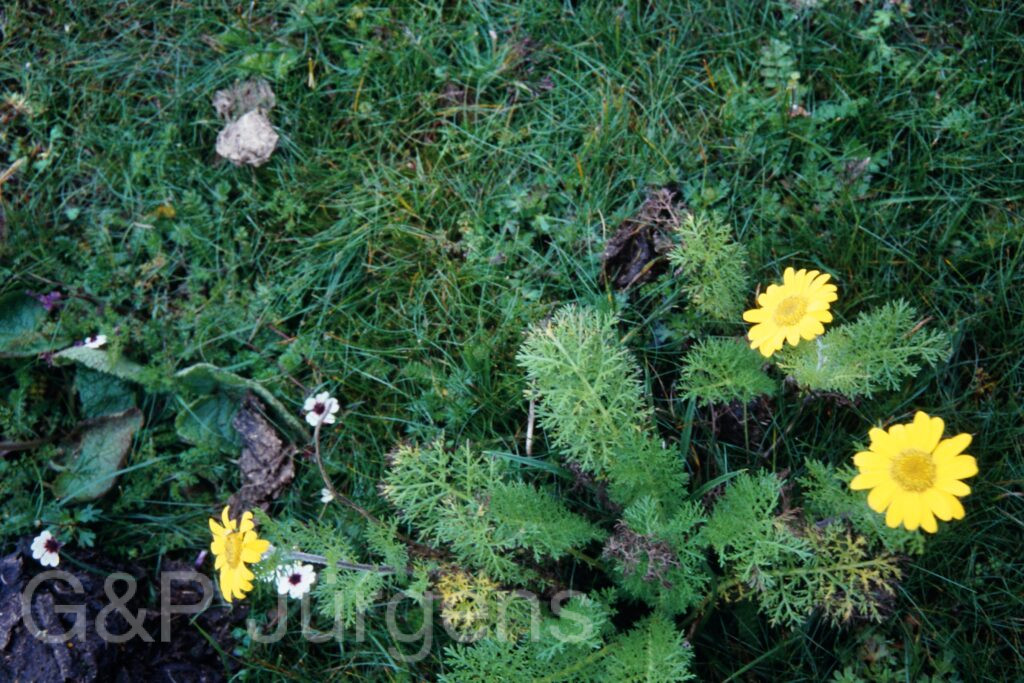
Tanacetum atkinsonii is an aromatic alpine composite of the Himalaya, recorded from Nepal, India, Bhutan and southern China, with GBIF holding around 102 occurrences across this range. It grows on open, stony alpine slopes, rocky pastures, screes and dry grassy banks in the high alpine zone, generally between about 3500 and 4500 m, where it tolerates strong insolation, cold and free-draining substrates. The illustrated plant from Dzongri in Sikkim at 4000 m, flowering in August, is characteristic of these exposed high-altitude habitats and of its late-summer flowering after the monsoon.

It is a perennial, aromatic herb with a woody rootstock producing erect to ascending stems and finely divided, pinnately dissected or bipinnatisect leaves that are grey-green and often hairy, releasing a tansy-like scent when crushed. The capitula (flower heads) are borne in a terminal corymb; each head has an involucre of imbricate, scarious-margined bracts and the typical Tanacetum structure of yellow disc florets, with the marginal florets reduced or shortly rayed rather than conspicuously ligulate. The fruit is a small, ribbed, glandular cypsela, usually with a short membranous corona rather than a true pappus.

Transferred to Tanacetum by Kitamura from an original placement under Chrysanthemum/Pyrethrum by C.B. Clarke, the species sits within the taxonomically fluid tansy group of the tribe Anthemideae, distinguished by its dissected aromatic foliage and reduced ray florets. A widespread high-Himalayan element, it is of no particular conservation concern.

Author: (C.B.Clarke) Kitam. · Sources: POWO (Kew), GBIF, Flora of Bhutan, Flora of China, Compositae of the Himalaya (specialist treatments)

Hand.-Mazz.

Sikkim2003 512 G712 2 ergebnis
Sikkim Yumedzandong 4500m, August

Description

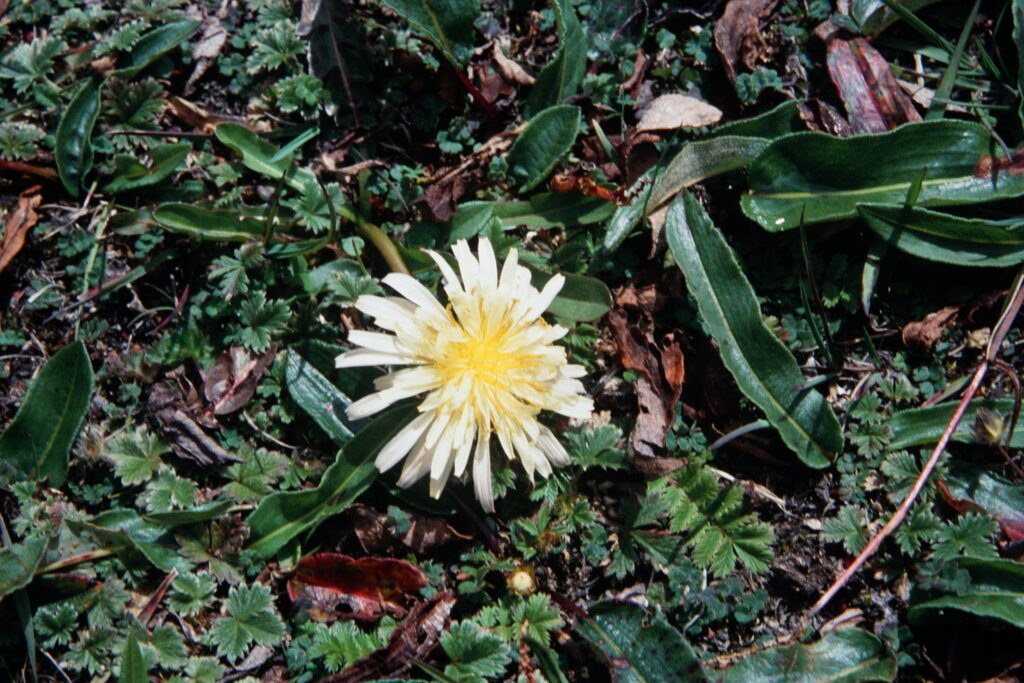
Taraxacum sikkimense is a high-alpine dandelion of the Himalaya and Tibetan Plateau margins, recorded from China, India, Nepal, Bhutan and Pakistan, with a modest set of records (c. 128 in GBIF) reflecting its restricted high-elevation range. It occupies alpine meadows, turfy slopes, moist gravelly ground and the surrounds of snowmelt flushes, typically between about 4000 and 4800 m. The photographed plant from Yumedzandong in Sikkim, at 4500 m and flowering in August, exemplifies the species in its short alpine growing season, when warmth and meltwater briefly permit growth and flowering near the upper limit of vascular plant life.

The plant is a small, acaulescent, rosette-forming perennial herb with a thick, often blackened taproot and a milky white latex characteristic of the tribe Cichorieae. The leaves are all basal, runcinate to pinnatifid or shallowly toothed, sometimes nearly entire in dwarfed alpine forms. The flowering scapes are short, each bearing a single capitulum subtended by an involucre of imbricate phyllaries, the outer often appressed or recurved with a coloured margin. The capitulum is homogamous, composed entirely of yellow ligulate (ray) florets; the fruit is a ribbed, spinulose-muricate cypsela narrowed above into a slender beak that bears a pappus of simple white bristles, dispersed by wind.

Taraxacum is a taxonomically formidable genus owing to widespread apomixis (agamospermy) and polyploidy, which generate innumerable stable microspecies; the Himalayan high-elevation taxa form a distinctive assemblage that remains incompletely revised. Taraxacum sikkimense belongs to this alpine radiation. As a specialised high-altitude plant with a naturally fragmented distribution, it is potentially sensitive to alpine habitat change, though it has not been formally assessed.

Author: Hand.-Mazz. · Sources: POWO (Kew), GBIF, Flora of China (Asteraceae), Flora of Bhutan, Taraxacum: A monograph (Richards)