Tag:

Nepal

Flowers of Nepal — 1313 wild plant species documented from the Nepalese Himalaya, from subtropical foothills to high alpine meadows above 4,000 m. Nepal’s dramatic elevation gradient makes it one of the richest botanical regions on Earth, home to rhododendrons, primulas, gentians and the famed blue poppies (Meconopsis). Every entry gives a botanical description, native distribution, habitat and flowering season, alongside the original field photograph and the location where it was taken.

Wall.ex A.DC.

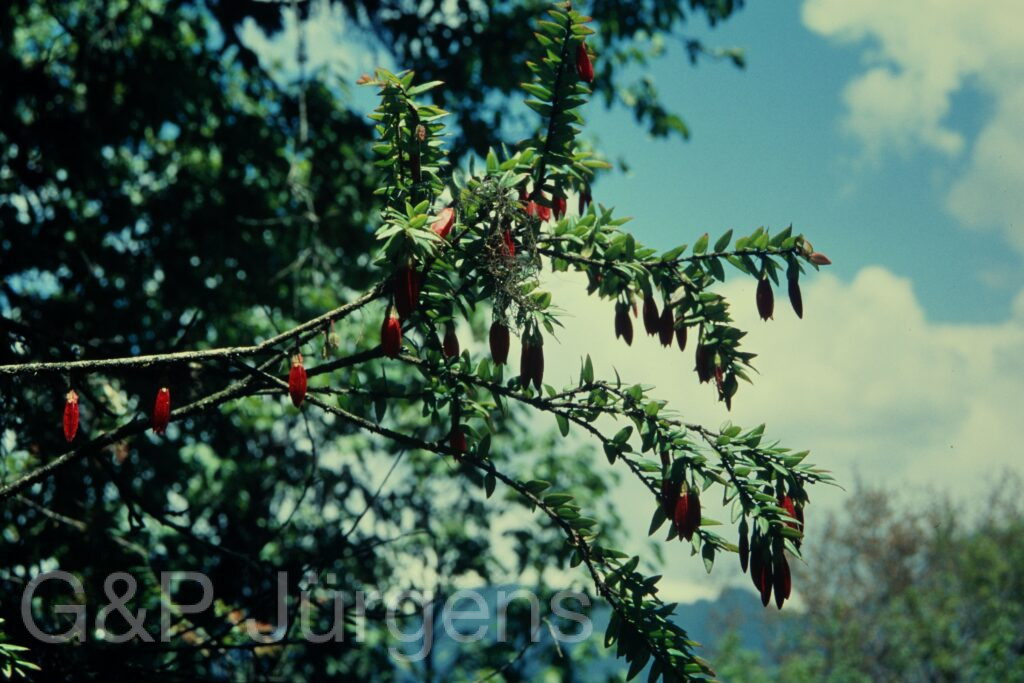
Bhutan2012 946
Bhutan Trithangebe 2100m, October
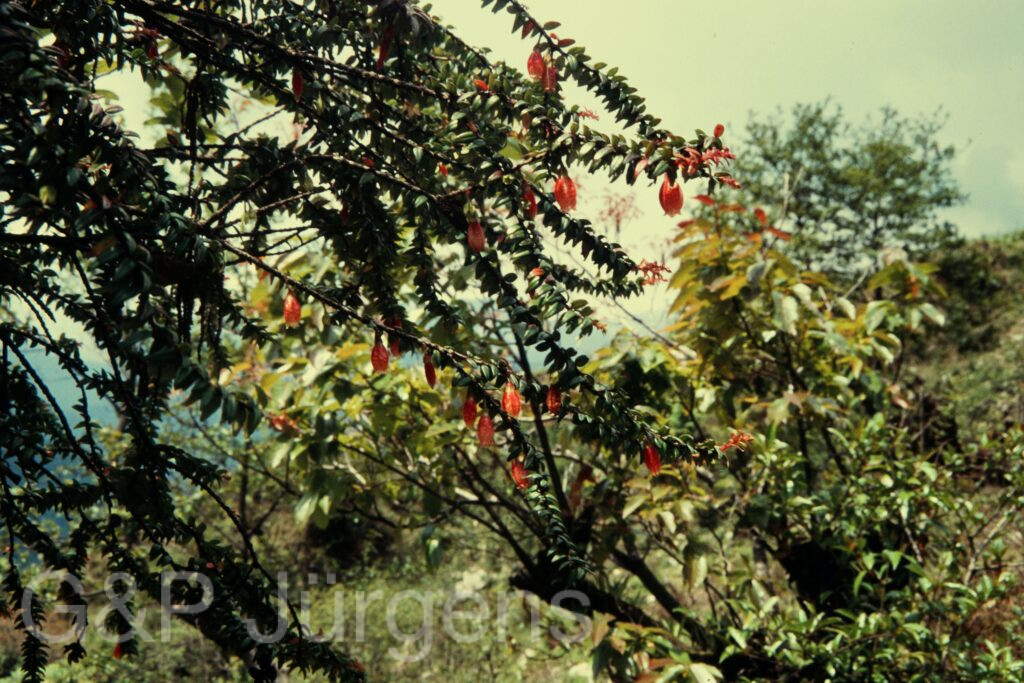
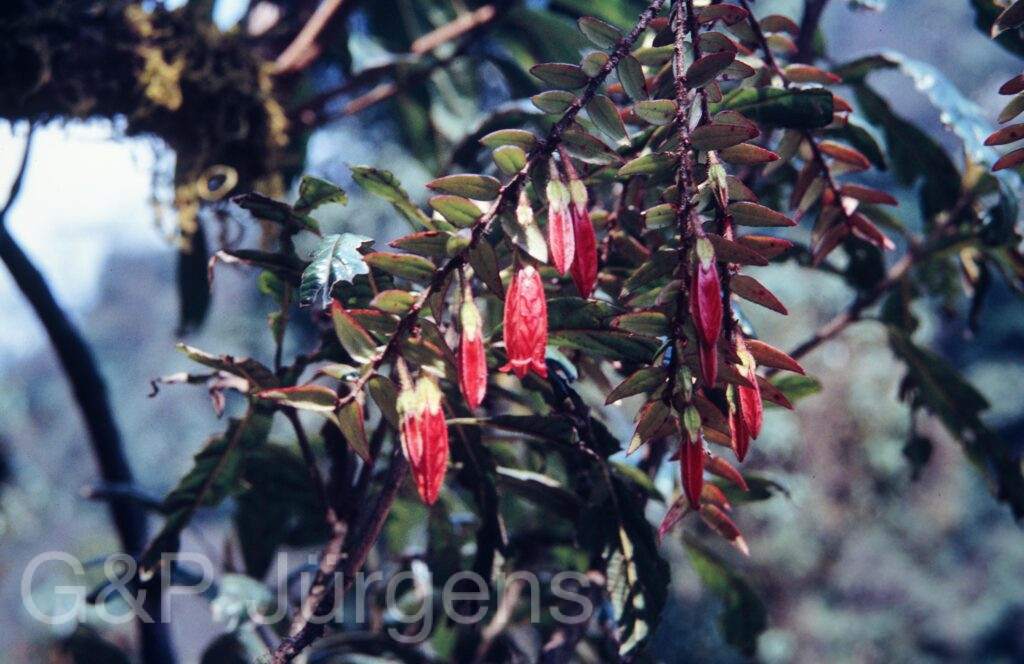
Bhutan2012 947
Bhutan Trithangebe 2100m, October

Description

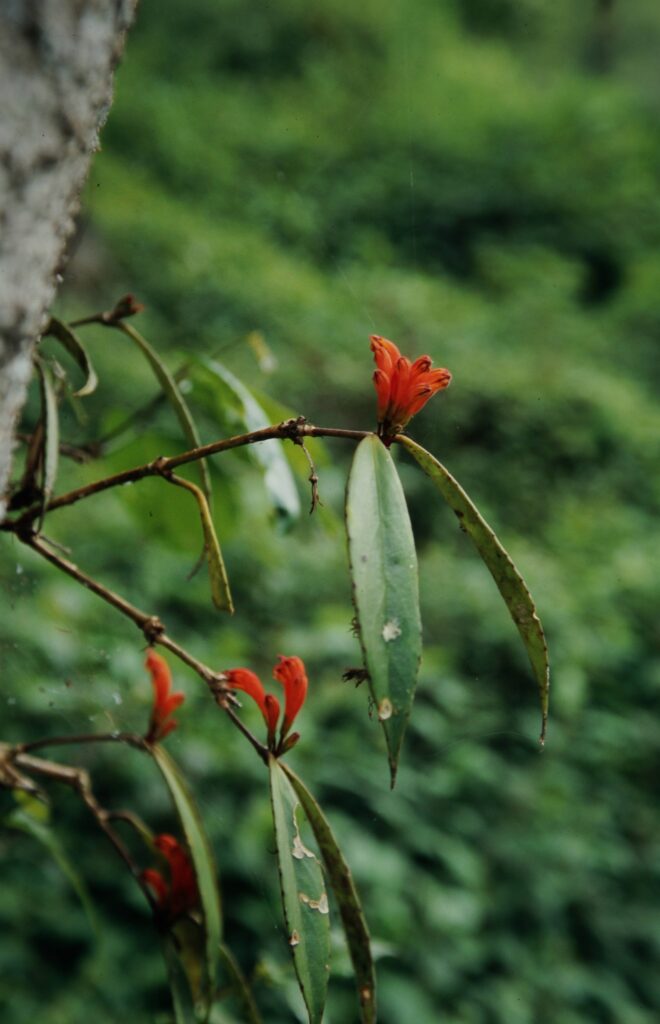
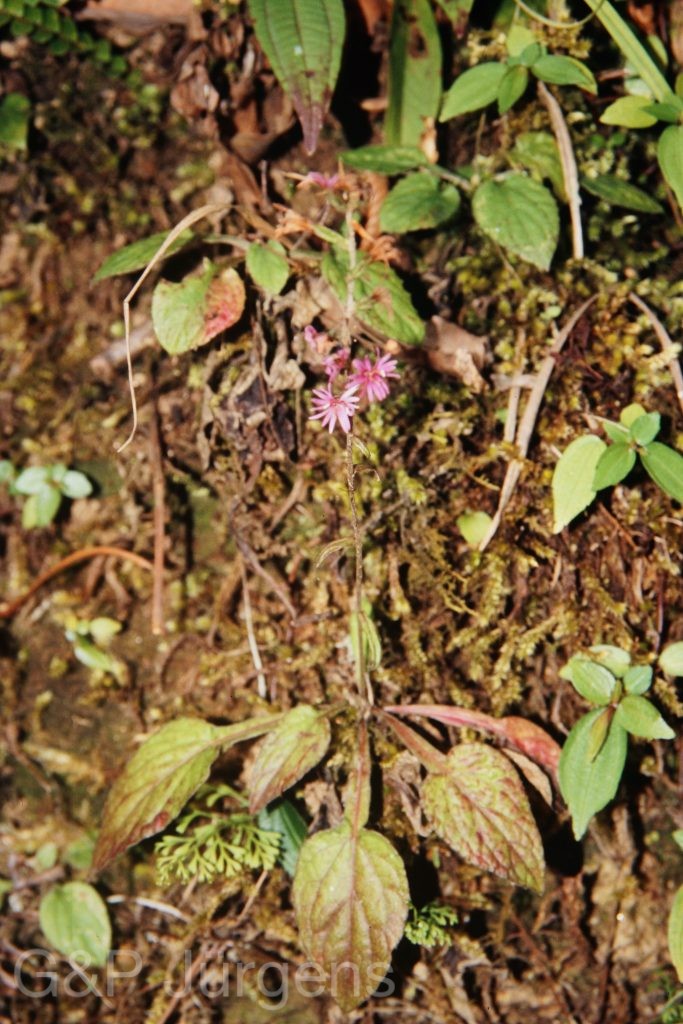
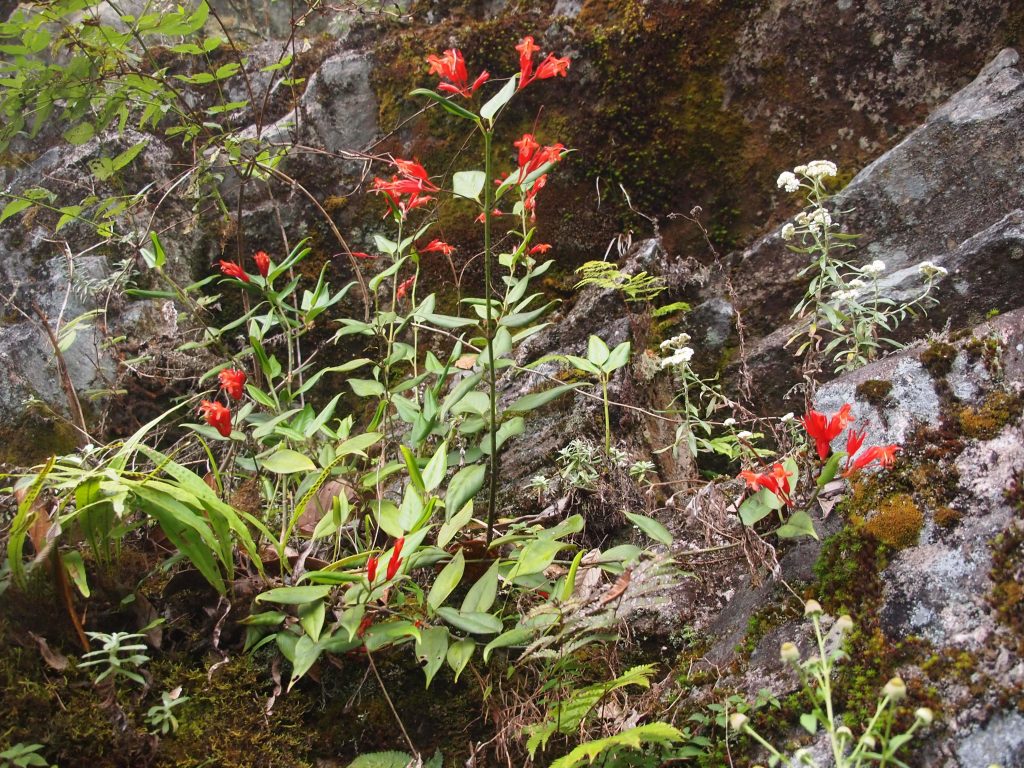
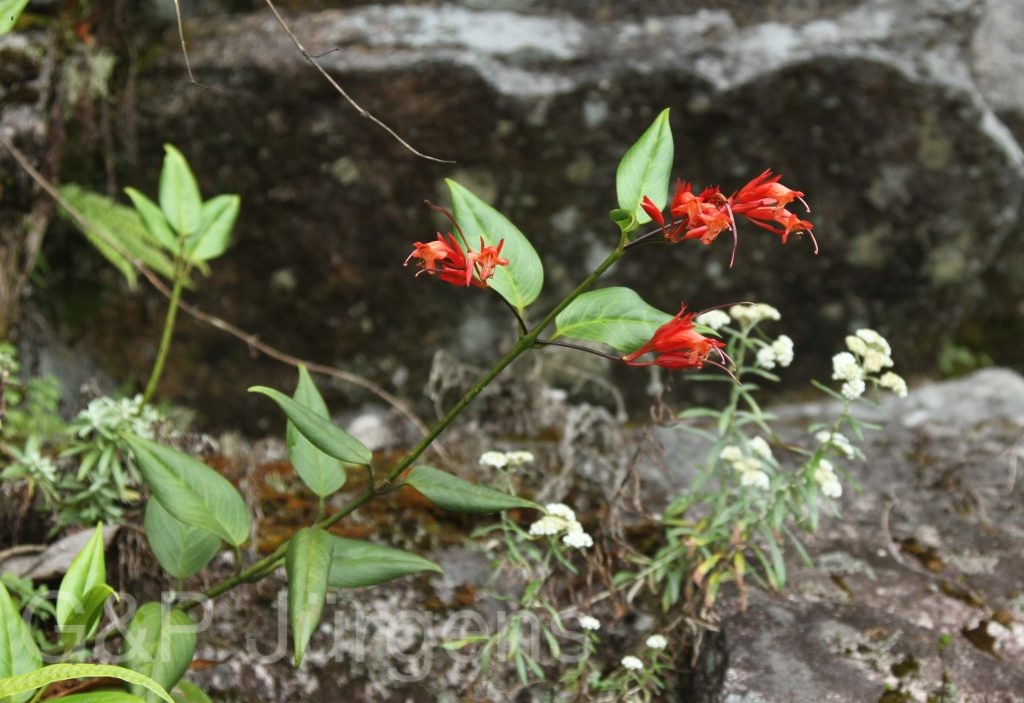
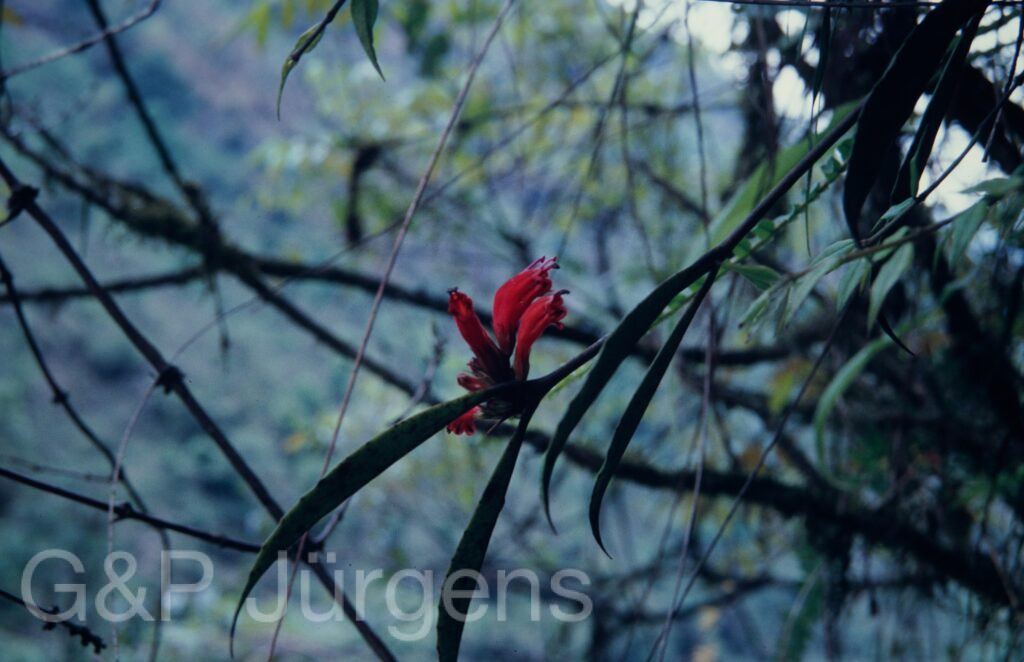
Aeschynanthus bracteatus is an epiphytic subshrub of the eastern Himalaya and Indo-Chinese region, distributed from Nepal and northern India through Bhutan and Bangladesh into Myanmar, south-western China, Laos and Vietnam, with around 906 occurrence records. It grows as an epiphyte or lithophyte on mossy tree trunks, branches and shaded rocks in humid evergreen broad-leaved montane forest, typically between about 1500 and 2500 m. The specimen photographed at Trithangbe in Bhutan at 2100 m in October illustrates its autumn flowering within the moist, mist-laden forests where epiphytic gesneriads thrive.

The plant has trailing to pendulous, somewhat fleshy stems rooting at the nodes, bearing opposite, thick, elliptic to lanceolate leaves that are entire and glabrous, with an obscurely veined, leathery texture suited to its epiphytic life. The inflorescences are terminal or axillary clusters subtended by conspicuous bracts, the feature reflected in the epithet bracteatus. The flowers have a tubular, often dark calyx and a curved, tubular two-lipped corolla in shades of red to orange-red, the throat sometimes marked within. The fruit is a long, slender, capsule splitting to release numerous small seeds furnished with hair-like appendages aiding wind dispersal.

Aeschynanthus (Gesneriaceae) is a large palaeotropical genus of climbing and epiphytic herbs and subshrubs; the input file places it under Didymocarpinae, a subtribal name within Gesneriaceae, whereas the genus is conventionally treated in subtribe Loxonia/Trichosporeae allies. The tubular red flowers and protruding stamens indicate bird (sunbird) pollination, while the plumose-appendaged seeds are wind-dispersed. The species is widespread across the Indo-Burmese hills and is of least conservation concern, serving as a characteristic epiphyte of eastern Himalayan cloud forest.

Author: Wall.ex A.DC. · Sources: POWO (Kew), GBIF, Flora of China, Flora of Bhutan, Annotated Checklist of the Flowering Plants of Nepal, Mendum revision of Aeschynanthus
Spreng.

Nepal 1994 226 ergebnis
Ost-Nepal Mewa-Khola 1900m April 
Nepal 1994 218 ergebnis
Ost-Nepal Mewa-Khola 1900m April 
Sikkim 2006 301 ergebnis
India West-Bengal, Chaana 1750m, May

Description

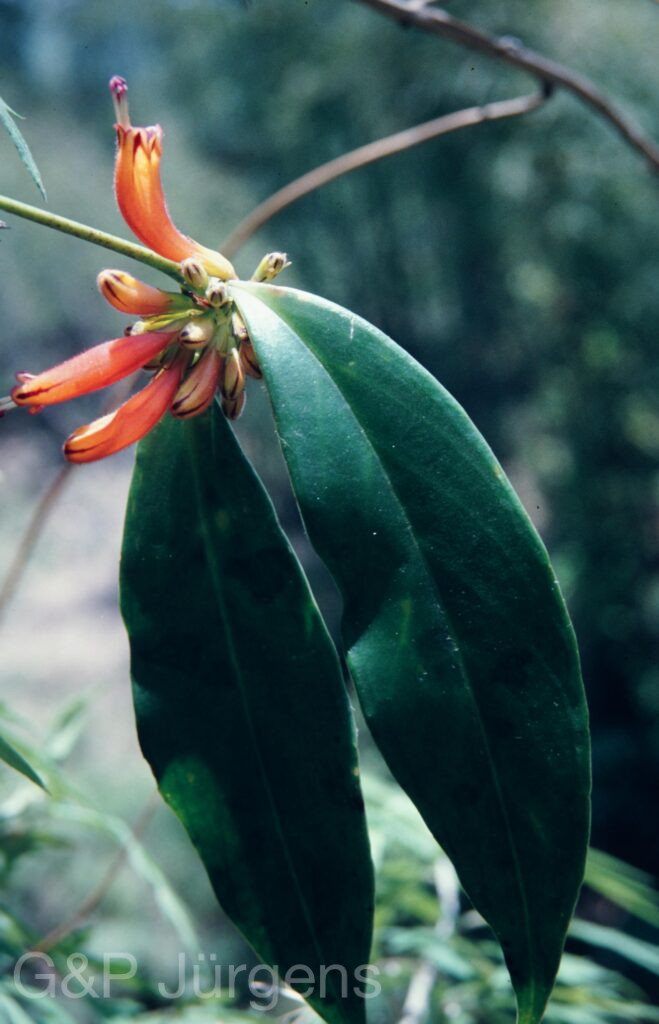
Aeschynanthus parviflorus is an epiphytic gesneriad widely distributed through the eastern Himalaya and into Southeast Asia, with GBIF records from Nepal, northeast India, Bhutan, Bangladesh, Myanmar, Thailand, Vietnam and southern China (additional codes represent herbaria and cultivation). It grows as an epiphyte or lithophyte on mossy trunks, branches and shaded rocks in humid broad-leaved evergreen and subtropical forest, mainly between 1,000 and 2,200 m. The featured collections come from the Mewa Khola in eastern Nepal at about 1,900 m in April and from Chaana in West Bengal at around 1,750 m in May, within its core mid-montane belt.

The plant has pendent to scrambling, somewhat fleshy stems rooting at the nodes and bearing opposite, coriaceous, elliptic to lanceolate leaves with entire margins and an acuminate apex. The flowers are clustered in the leaf axils or at the branch tips; the calyx is short and cupular, and the corolla is a curved, narrowly tubular structure, red to orange-red, with small spreading lobes, suited to nectarivorous bird and insect pollination. The fruit is a long, slender, two-valved capsule releasing numerous minute seeds, each furnished with a tuft of fine hairs that aids wind dispersal in the canopy.

The species is treated within Gesneriaceae (subtribe Didymocarpinae, genus Aeschynanthus), a large Asian genus of canopy epiphytes whose long-tubed flowers exemplify ornithophily in the Old World tropics. Aeschynanthus parviflorus is common and not regarded as threatened, but as a canopy specialist it depends on intact humid forest and declines where mid-elevation forest is fragmented or logged.

Author: Spreng. · Sources: POWO (Kew), GBIF, Flora of China Vol. 18 (Gesneriaceae), Grierson & Long: Flora of Bhutan Vol. 2, Mendum et al.: Revision of Aeschynanthus (Gesneriaceae)
(Wall. ex Cambess.) Hook.

Nepal 97 610 G1181
Nepal Godawari 1350m May
Garh 07 82 ergebnis
India Garhwal Trijugi Narayan 2300m, June

Description

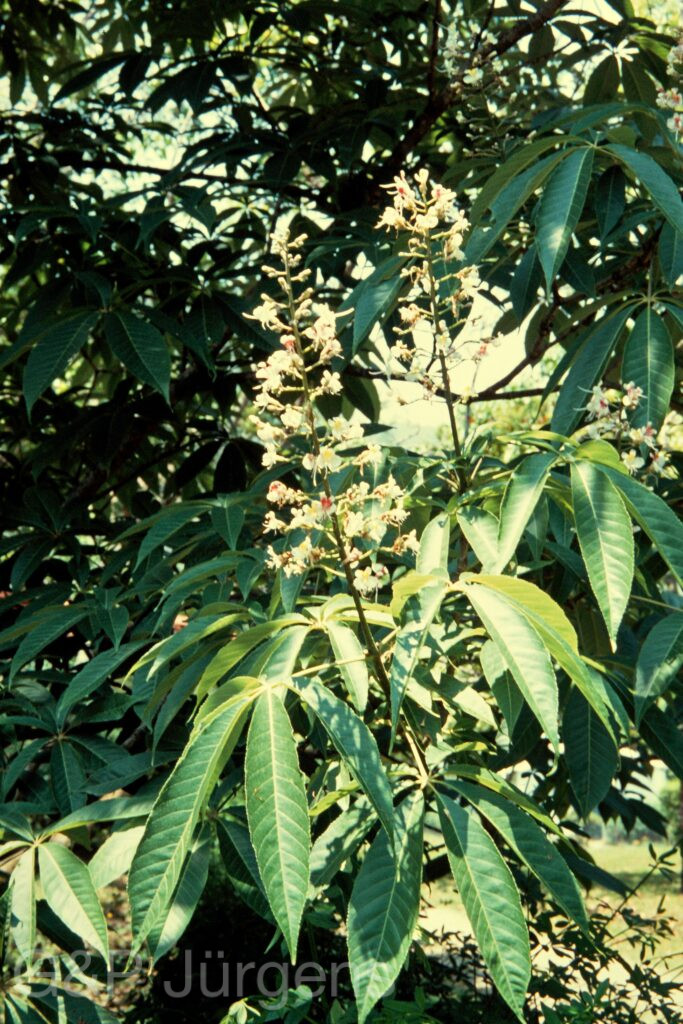
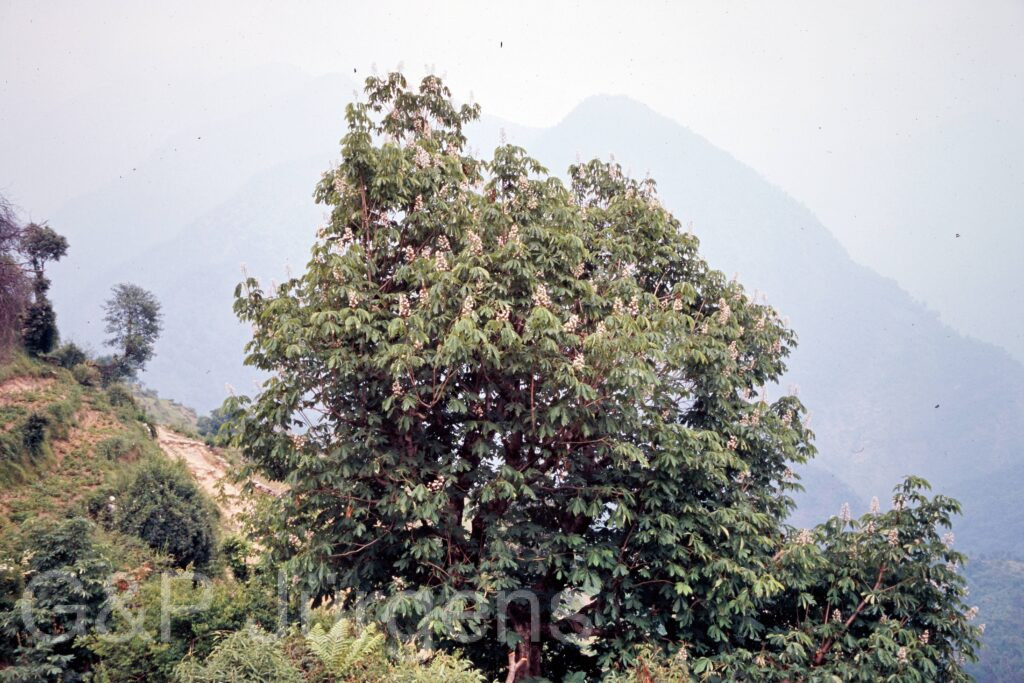
Aesculus indica ((Wall. ex Cambess.) Hook.), the Indian horse-chestnut, is a large deciduous tree endemic to the western and central Himalaya, occurring from Afghanistan and Pakistan through northern India and Nepal to Bhutan. The roughly 1,140 GBIF records, supplemented by numerous cultivated occurrences in Britain, Europe and North America, reflect both its native montane range and its popularity as an ornamental and avenue tree. It is a characteristic component of moist temperate forest, growing along streamsides, in shady ravines and on cool north-facing slopes, generally between 1,200 and 3,000 m, as illustrated by the Nepal record from Godawari at 1,350 m in May and the Garhwal collection from Trijugi Narayan at 2,300 m in June.

The tree reaches 20–30 m, with a broad rounded crown and smooth greenish-grey bark. The leaves are opposite and palmately compound, with five to nine lanceolate, finely serrate, long-acuminate leaflets that are sessile to shortly stalked and taper to the base. The flowers are borne in large, erect, terminal thyrses (panicles) up to 30 cm long; each flower is white to pinkish with a yellow or red blotch at the base of the petals, the stamens long-exserted. The fruit is a large, rough, pyriform, spineless capsule containing one to three glossy dark-brown seeds ("conkers").

The seeds are rich in bitter saponins and, after laborious leaching to remove toxicity, have traditionally been ground into a flour ("tattwakhar" or "bankhor") used as famine food and livestock fodder in the Himalaya. Distinguished from the European A. hippocastanum by its smooth, unarmed fruit and narrower leaflets, A. indica is widely planted for shade and timber. Though locally heavily exploited, the species remains relatively common within its range.

Author: (Wall. ex Cambess.) Hook. · Sources: POWO (Kew), Flora of Pakistan, GBIF, Flora of China Vol. 12, Hardin: A Revision of the American Hippocastanaceae and the genus Aesculus

Agapetes serpens

by GP Jürgens

(Wight) Sleumer

Bhutan2014 476
Bhutan Tongsa 2000m, May
Sikkim2004 95 P165
India West-Bengal, Bersay 2700m April
Nepal 97 309 P613
Nepal Honggaon 2360m May
Nepal1992 156 P228 ergebnis
Nepal Simbua-Khola 1800m March 

Description

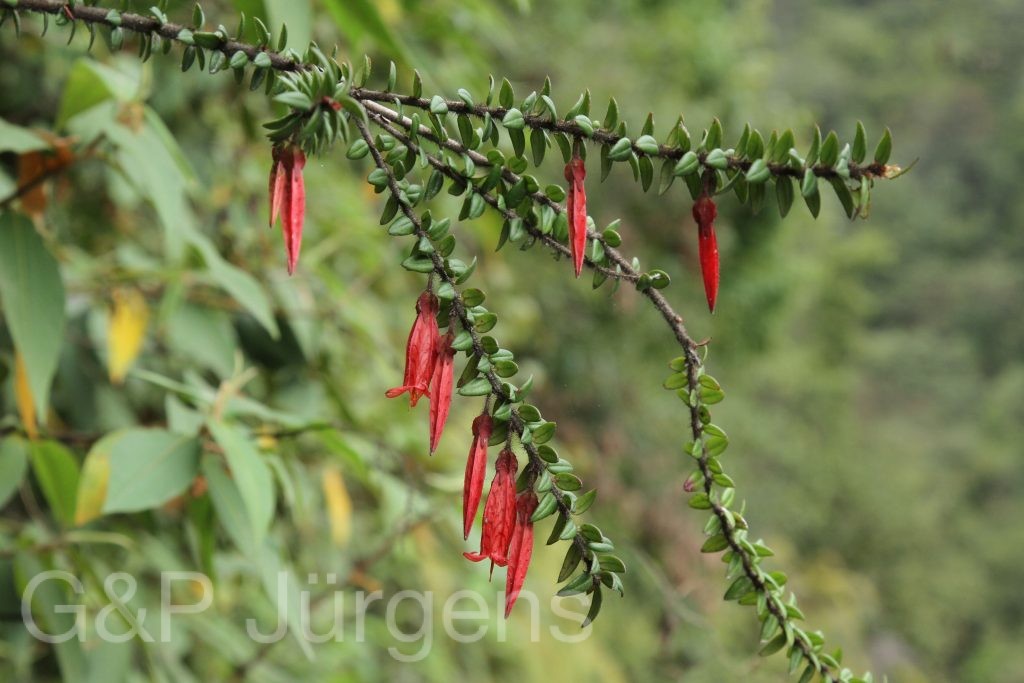
Agapetes serpens is an eastern Himalayan epiphytic shrub distributed across India, Bhutan, Nepal and adjacent China, with around 267 GBIF occurrences; long cultivated for its pendulous flowers, it is recorded in glasshouse collections from Great Britain, Germany, the United States and New Zealand. It grows in humid temperate broad-leaved and mixed forest, perched on mossy tree trunks, branches and shaded rock faces. The images document it across a broad elevational span: Bhutan at Tongsa around 2000 m in May, West Bengal at Bersay near 2700 m in April, and Nepal at Honggaon (2360 m) and the lower Simbua-Khola valley (1800 m).

It is a scrambling to pendent evergreen shrub arising from a swollen, tuberous, woody rootstock, with long arching, bristly-hairy stems. The leaves are small, numerous, lanceolate to elliptic, leathery and arranged distichously along the stems. The flowers hang in profusion from the leaf axils on slender pedicels; the corolla is tubular, five-angled, bright red and marked with darker chevron- or V-shaped lines, with five short reflexed lobes. The stamens are included and the ovary inferior. The fruit is a small fleshy berry.

Agapetes belongs to tribe Vaccinieae of the Ericaceae, the group that includes the blueberries, and the genus is centred on the Sino-Himalayan and Southeast Asian mountains. The tuberous lignotuber is an adaptation to the epiphytic habit, storing water and nutrients, while the tubular red flowers are adapted to bird pollination. Valued as an ornamental, A. serpens is widely grown; in the wild it is locally frequent and not currently regarded as threatened.

Author: (Wight) Sleumer · Sources: POWO (Kew), GBIF, Flora of China, Flora of Bhutan, Flora of Nepal, Airy Shaw revision of Agapetes

Mill.

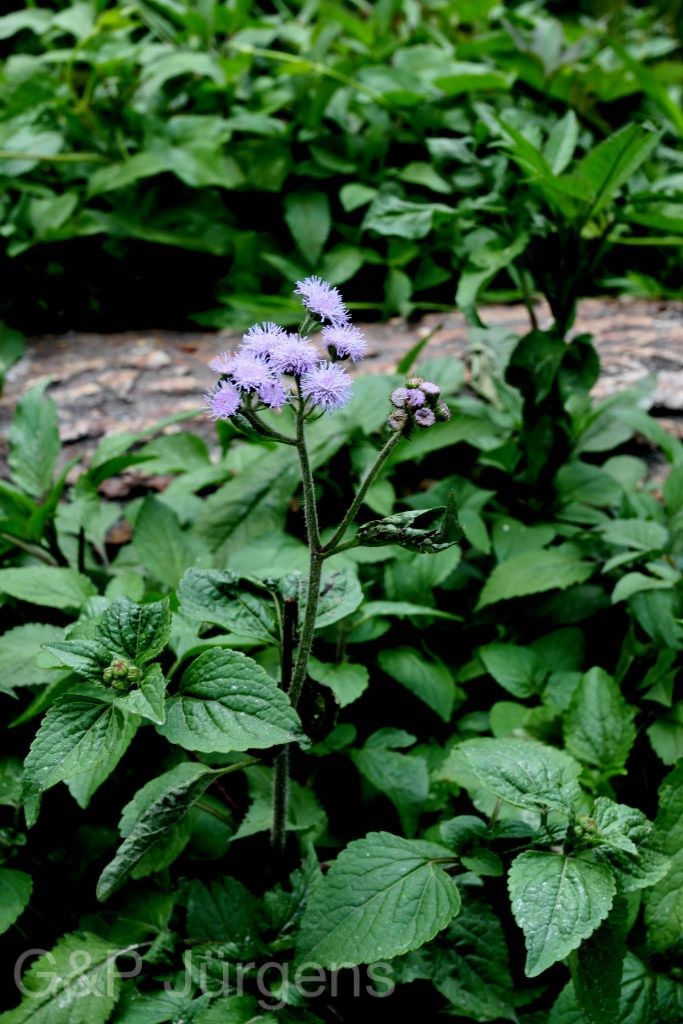
Sikkim2011 9
India Sikkim Tista valley 1800m, June

Description

Ageratum houstonianum Mill. is native to Mexico and Central America but is now a widely naturalised tropical and subtropical weed; GBIF records over 25,000 occurrences spanning Mexico, the United States, China, Taiwan, Hong Kong, Nepal, India, South Africa, Tanzania, Malawi and much of western and central Europe. It colonises waste ground, roadsides, field margins, ditches and clearings, particularly in moist, disturbed habitats. The record from the Tista valley in Sikkim at 1800 m in June reflects its thorough naturalisation in the lower Eastern Himalaya, where it flowers through the warm, humid monsoon season.

It is an erect to ascending annual herb with stems clothed in spreading, often viscid hairs. The leaves are mostly opposite, ovate to deltoid, with a crenate-serrate margin, a truncate to cordate base and conspicuous palmate venation, and are softly pubescent. The small capitula are aggregated in dense, flat-topped corymbs; each head is wholly discoid, lacking ray florets, with an involucre of narrow phyllaries and numerous blue, lavender or occasionally white tubular florets whose long, exserted styles give the inflorescence a characteristic fluffy texture. The fruit is a black, five-angled cypsela bearing a pappus of awned scales.

Widely grown as the ornamental "floss flower", A. houstonianum has escaped cultivation throughout the warmer world and is regarded as an invasive weed in parts of Asia, Africa and Australia; like its relatives it contains pyrrolizidine alkaloids and is toxic to livestock. It is of no conservation concern and is instead managed as a weed.

Author: Mill. · Sources: POWO (Kew), GBIF, Flora of China, Flora of North America, Johnson revision of Ageratum

Agrimonia pilosa

by GP Jürgens

Ledeb.

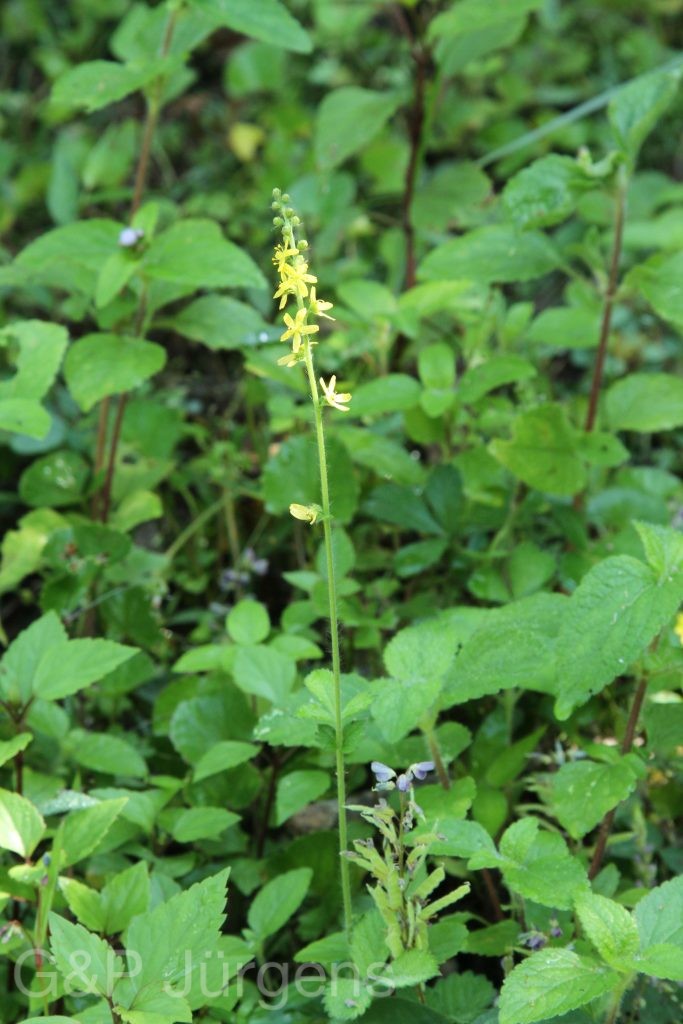
Bhutan2015 301
Bhutan Trongsa 2000m,October

Description

Agrimonia pilosa is a broadly distributed temperate herb ranging across much of Eurasia, from central and eastern Europe through Russia, Kazakhstan and Mongolia to China, Korea, Japan and Taiwan, and southward into the Himalaya in Nepal, India and Bhutan as well as Vietnam and Indonesia. With over 25,600 GBIF records it is among the most frequently collected agrimonies. It grows in grassy and disturbed places, forest margins, meadows, roadsides and scrub over a wide elevational range. The Bhutanese material photographed near Trongsa at 2000 m in October represents the species in mid-montane meadow habitat of the eastern Himalaya, flowering and fruiting late in the season.

The plant is an erect perennial herb arising from a short rhizome, with stems clothed in spreading hairs. The leaves are imparipinnate, comprising several principal toothed leaflets interspersed with much smaller intercalary leaflets, and bear conspicuous toothed stipules at the base. The small yellow flowers are borne in a long, slender, terminal raceme; each has five sepals, five obovate petals and numerous stamens. The diagnostic fruit is a top-shaped, grooved hypanthium crowned by a ring of hooked bristles that close over the apex and act as an epizoochorous dispersal mechanism, catching on fur and clothing.

Agrimonia pilosa is distinguished from the related A. eupatoria by its more obconical, deeply furrowed fruit whose outermost hooked bristles are spreading to deflexed rather than erect. The species has a long history of use in traditional East Asian and European herbal medicine, where it is valued for astringent and haemostatic properties. Ecologically it is a competitive component of secondary grassland and forest-edge communities, and its hooked fruits ensure effective animal dispersal; it is common throughout its vast range and of no conservation concern.

Author: Ledeb. · Sources: POWO (Kew), GBIF, Flora of China, Flora of Bhutan, Annotated Checklist of the Flowering Plants of Nepal, Skalicky's revision of Agrimonia (monograph)

Ainsliaea aptera

by GP Jürgens

DC.

Bhutan2014 513
Bhutan Yatong-La 3200m, May
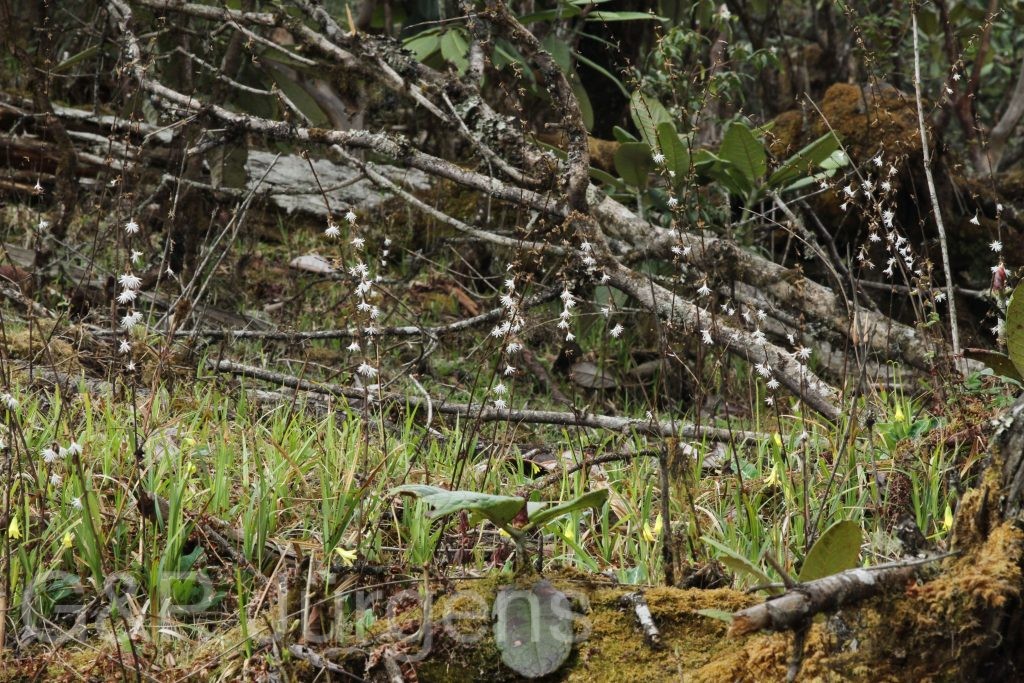
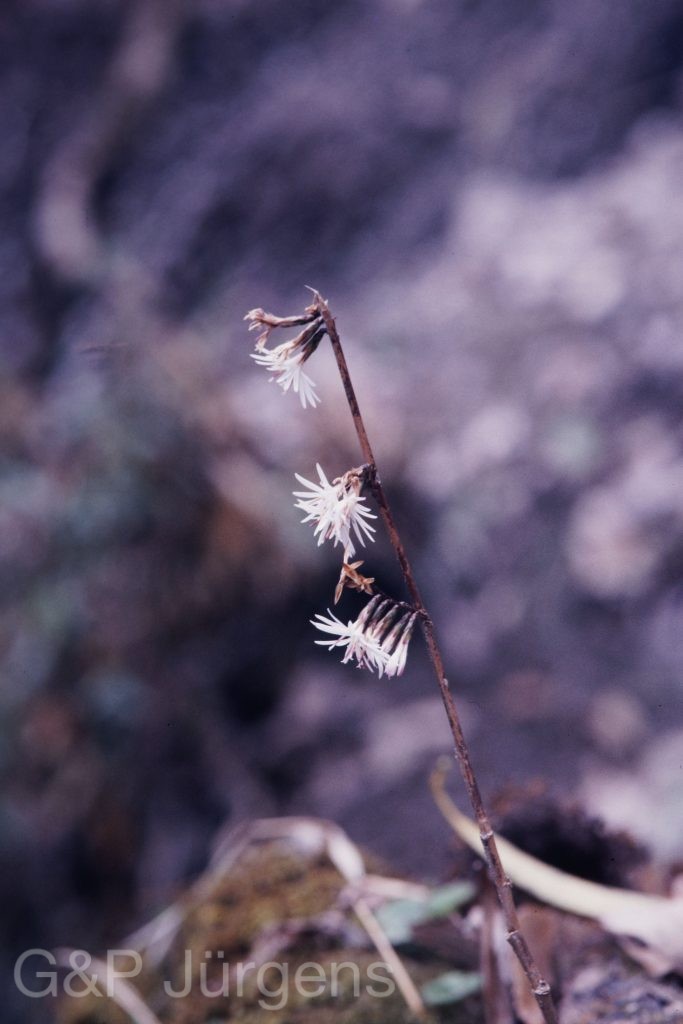
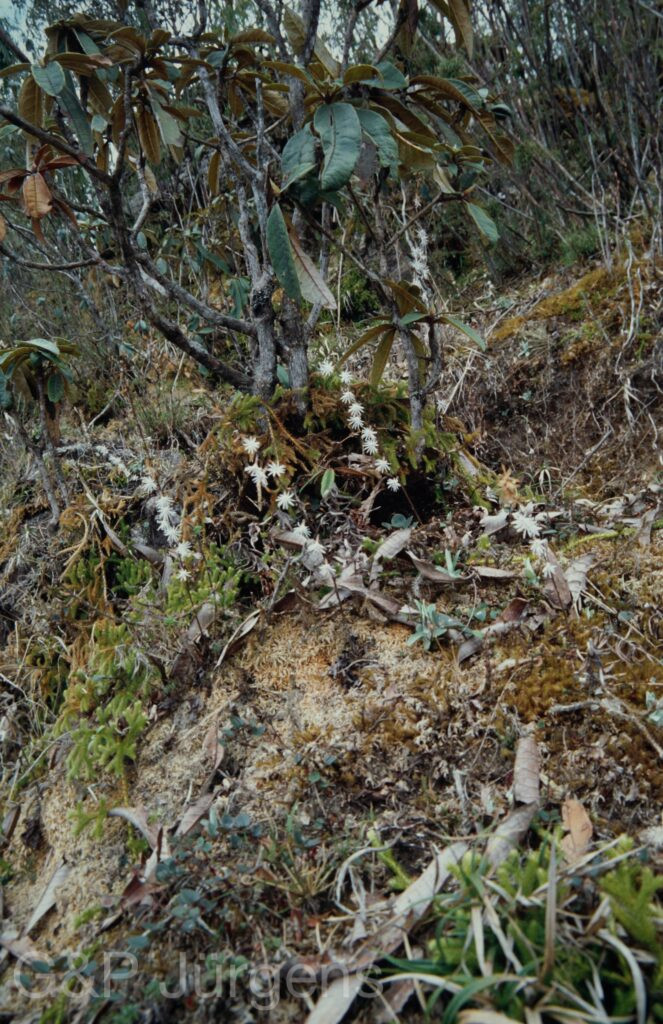
Nepal 1989 58
Nepal Bagachap 2300m, April
Nepal 1994 76 ergebnis
Ost-Nepal Jaljale Himal
3000m April

Description

Ainsliaea aptera is a Himalayan rosette herb distributed along the range from Afghanistan and Pakistan through India, Nepal and Bhutan into China and Myanmar, with 358 GBIF occurrences. It grows in the understorey and on shaded banks of temperate broadleaved and conifer forest, on mossy slopes and rock ledges, generally between about 2000 and 3500 m. The illustrated material spans Bhutan's Yatong-La at 3200 m in May, Bagachap in central Nepal at 2300 m in April, and the Jaljale Himal of eastern Nepal at 3000 m in April, indicating a spring-flowering plant of cool, humid forest floors.

It is a perennial herb with a short rhizome bearing a basal rosette of ovate to elliptic, long-petiolate leaves that are firm, with cordate to rounded bases, entire or shallowly toothed margins, and often a sparse covering of hairs. From the centre rises a slender, nearly leafless scape carrying a narrow, spike-like or racemose arrangement of small, sessile capitula. Each head contains a few tubular florets with slender, deeply lobed, white to pinkish corollas. The cypselae are ribbed and clothed in a pappus of plumose (feathery) bristles, a diagnostic feature of the genus.

Described by de Candolle, Ainsliaea belongs to the basal asteraceous tribe Pertyeae (formerly Mutisieae), an Asian lineage notable for its plumose pappus and frequently spike-like inflorescences. The genus is centred on the Sino-Himalayan region and is of interest for the phylogeny of early-diverging Asteraceae. Widespread along the Himalayan forest belt, A. aptera is not regarded as threatened, though it depends on intact shaded forest habitat.

Author: DC. · Sources: POWO (Kew), GBIF, Flora of Bhutan, Flora of China, Revision of Ainsliaea (Mitsui & others), Flowers of the Himalaya (Polunin & Stainton)

 (D.Don) Sch.Bip.

Bh2008 62 G102
Bhutan Punaka-Chu, 1500m April

Description

Ainsliaea latifolia is a widely distributed perennial herb of the Sino-Himalayan and Southeast Asian region, recorded from China, India, Nepal, Bhutan, Pakistan, Bangladesh, Sri Lanka, Myanmar, Thailand, Vietnam, Taiwan, Malaysia and Indonesia, with over a thousand documented occurrences. It is a characteristic understorey plant of subtropical and warm-temperate broadleaved forest, growing on shaded banks, forest floors, grassy clearings and stream margins from the foothills to the middle hills. The individual shown was recorded along the Punakha Chu in western Bhutan at about 1500 m in April, a setting typical of its preference for moist, humus-rich ground beneath oak and evergreen forest.

The plant arises from a short, stout rhizome and is conspicuous for its basal rosette of broad, long-petiolate leaves; the laminae are ovate to broadly ovate or orbicular, cordate at the base, with a shortly acuminate apex and entire to denticulate margins, often purplish and pubescent beneath. From the centre of the rosette rises a slender, leafless or bracteate scape bearing an elongate, spike-like to narrowly paniculate inflorescence. The small capitula are cylindrical and characteristically three-flowered, each floret with a deeply lobed, bilabiate corolla typical of the Mutisioideae. The achenes are ribbed and pubescent, crowned by a copious pappus of plumose, reddish-brown bristles.

The species belongs to Ainsliaea, a genus of the basal asteraceous subfamily Mutisioideae centred on East Asia and the Himalaya, distinguished by its three-flowered heads and rosulate habit. It exhibits considerable variation in leaf shape and indumentum across its extensive range, and several infraspecific taxa have been recognised. Long used in regional folk medicine, it is locally common and faces no significant conservation concern across most of its distribution.

Author: (D.Don) Sch.Bip. · Sources: POWO (Kew), GBIF, Flora of China, Flora of Bhutan, Flora of British India, Revision of the genus Ainsliaea (Mutisieae)

Ajania myriantha

by GP Jürgens

(Franch.) Ling ex C.Shih

Bhutan2015 679
Bhutan Chele-La 4000m, October
Bhutan2012 100
Bhutan Shele-La, 3600m September

Description

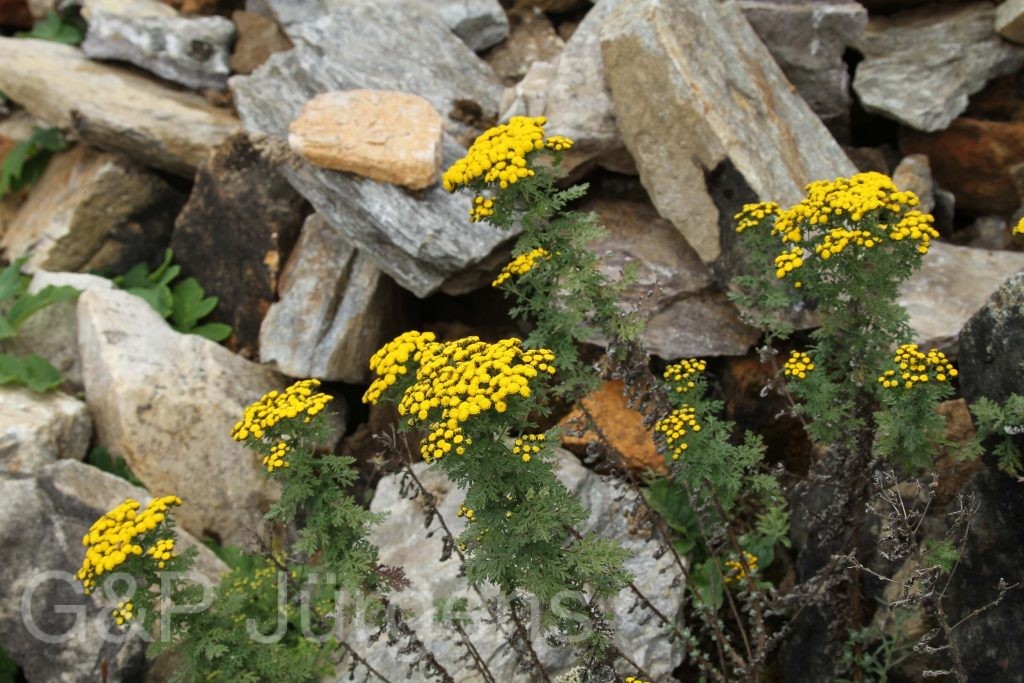
Ajania myriantha is a subshrubby composite of the Sino-Himalaya, native to China, Nepal, Bhutan and India and recorded by aggregated databases from a fair number of high-elevation localities. It is a plant of the upper subalpine and alpine zone, growing on dry, open stony slopes, rocky banks, cliff ledges and exposed pastures, generally between about 3000 and 4200 m. The individuals shown were photographed at Chele-La in Bhutan at 4000 m in October and at Shele-La at 3600 m in September, their autumn flowering being typical of this late-blooming high-mountain genus.

The plant forms a low, much-branched, somewhat woody-based perennial or dwarf subshrub, often grey-green with appressed silvery indumentum that reduces water loss in the exposed alpine environment. The leaves are alternate, ovate to obovate in outline and pinnately to bipinnately divided into small, narrow lobes, greyish-tomentose especially beneath. The capitula are small, numerous and discoid, lacking ray florets, and are aggregated into dense, flat-topped corymbose clusters, as the epithet myriantha (many-flowered) implies. Each head bears an involucre of imbricate, scarious-margined phyllaries enclosing yellow tubular florets; the achenes are small and ribbed and typically lack a conspicuous pappus.

Ajania is a Central and East Asian genus segregated from Chrysanthemum and its allies within the Chrysantheminae of tribe Anthemideae, distinguished by its discoid heads of tubular florets only. The generic limits of Ajania, Chrysanthemum and related taxa remain debated following molecular study, and some authors have proposed transfers. Locally common on dry alpine slopes, the species is not of conservation concern, though it is of interest as part of the aromatic Sino-Himalayan Anthemideae flora.

Author: (Franch.) Ling ex C.Shih · Sources: POWO (Kew), GBIF, Flora of China, Flora of Bhutan, Anthemideae systematic studies, Compositae of the Himalaya

Ajania nubigena

by GP Jürgens

(Wall. ex DC.) Muldashev

Bhutan2012 303
Bhutan Shale-La, 4300m September

Description

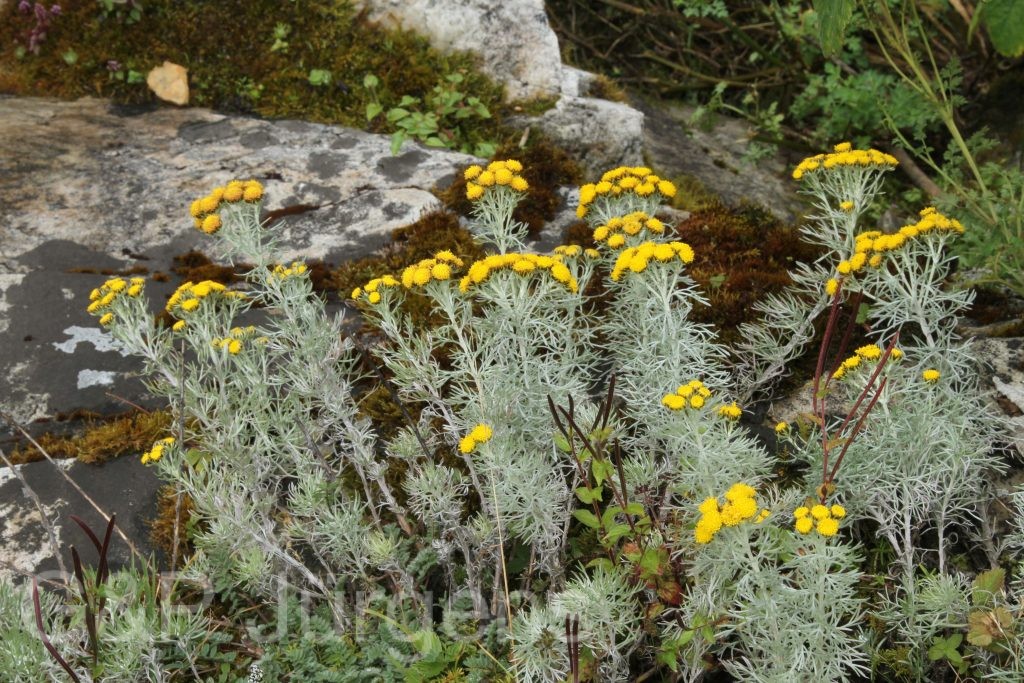
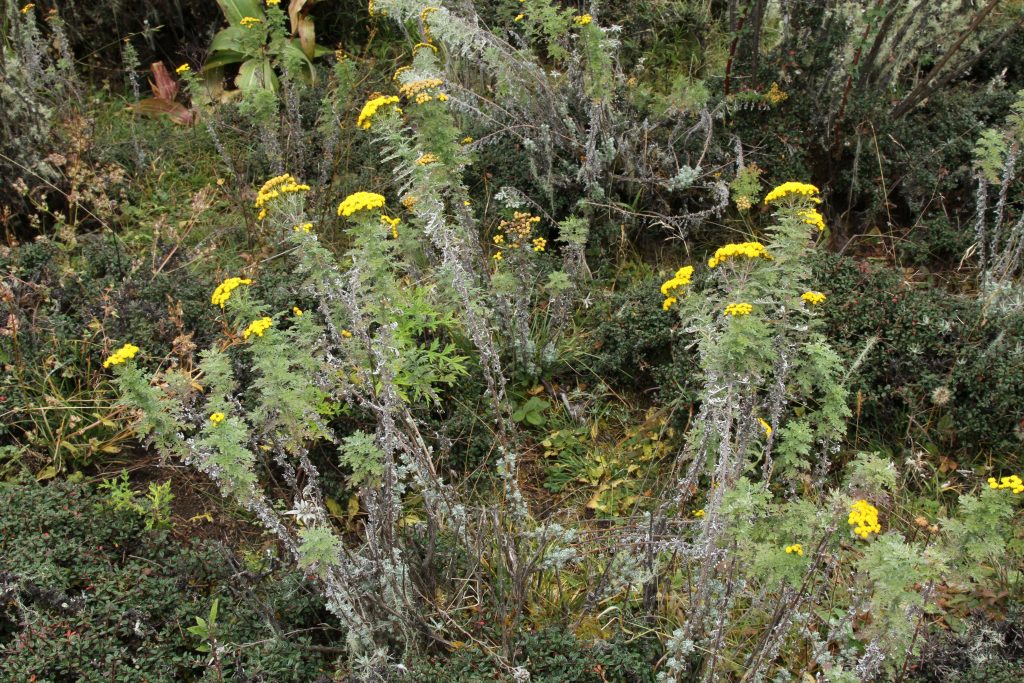
Ajania nubigena is a high-altitude aromatic composite of the Himalaya and Tibetan borderlands, recorded from Nepal, China (Tibet), India and Bhutan, with 266 georeferenced occurrences spanning the alpine zone of the main range. It grows on dry, stony alpine slopes, gravelly screes, rock crevices and exposed ridges, typically in the upper subalpine to alpine belt. It was photographed on the Shale-La in Bhutan at 4300 m and in Garhwal, India, at Patanathi at 3600 m, both in September, when its yellow heads flower amid the dry autumn alpine turf of these high passes.

It is a low, tufted, somewhat woody-based perennial subshrub or herb forming compact clumps, the stems and foliage clothed in dense grey to silvery appressed hairs that give a felted appearance and impart drought and frost tolerance. The leaves are small, alternate and pinnately or bipinnately dissected into narrow lobes, grey-tomentose especially beneath. The flower heads are small, discoid (lacking ray florets) and yellow, aggregated into dense terminal corymbs; each head has an involucre of imbricate, scarious-margined phyllaries and numerous tubular hermaphrodite and marginal female florets. The fruit is a small ribbed cypsela, usually lacking a pappus.

The genus Ajania, segregated from Chrysanthemum and Tanacetum within tribe Anthemideae, comprises mostly silvery-leaved, discoid-headed species of arid Central Asian and Himalayan uplands; the combination (Wall. ex DC.) Muldashev reflects this transfer. Its dense indumentum and dissected leaves are adaptations to the cold, dry, high-radiation alpine environment. Ecologically it is a xerophytic specialist of open stony ground, widespread within its altitudinal band and of no conservation concern.

Author: (Wall. ex DC.) Muldashev · Sources: POWO (Kew), GBIF, Flora of Bhutan, Flora of China, Anthemideae systematics (Bremer & Humphries monograph)