Tag:

Nepal

Flowers of Nepal — 1313 wild plant species documented from the Nepalese Himalaya, from subtropical foothills to high alpine meadows above 4,000 m. Nepal’s dramatic elevation gradient makes it one of the richest botanical regions on Earth, home to rhododendrons, primulas, gentians and the famed blue poppies (Meconopsis). Every entry gives a botanical description, native distribution, habitat and flowering season, alongside the original field photograph and the location where it was taken.

C.H.Wright

Sikkim2003 206 P288
Sikkim Dzongri 4000m, August

Description

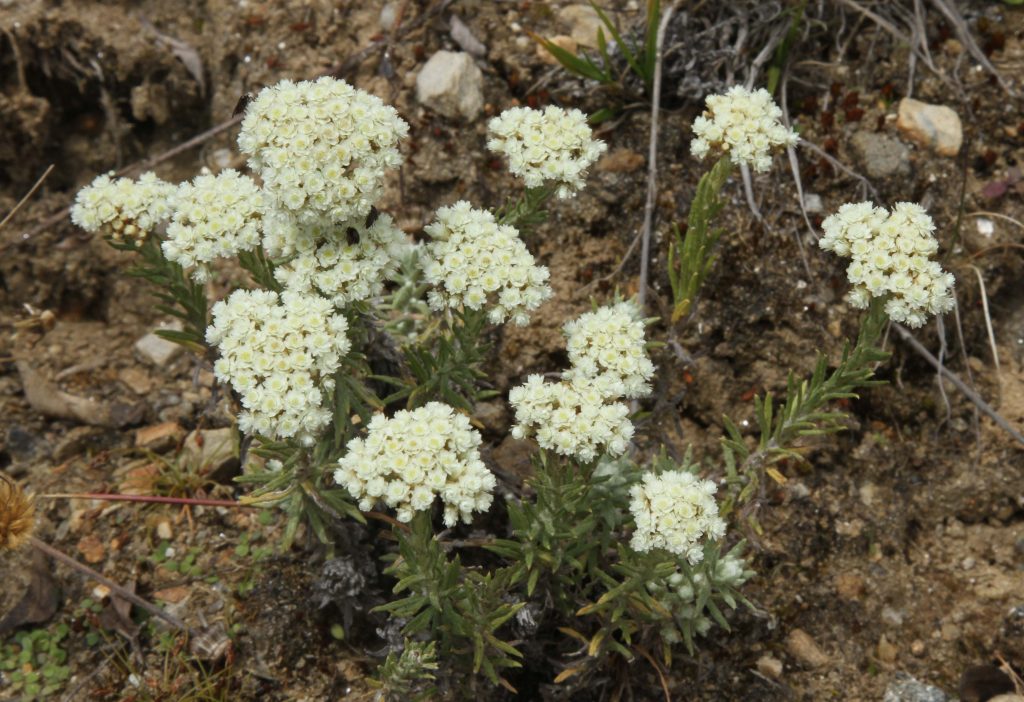
Allium prattii is a widespread alpine onion of the Himalaya and adjacent ranges, distributed across China, Nepal, Bhutan, India, Afghanistan, Myanmar and Mongolia, and is among the better-documented species in this set with nearly 1500 georeferenced records in GBIF. It grows in subalpine and alpine meadows, forest clearings, scrub and damp grassy slopes, generally between about 2500 and 4500 m. The plant illustrated was photographed at Dzongri in Sikkim at 4000 m in August, a characteristic high-alpine setting where it flowers during the summer monsoon.

The species is a bulbous perennial with a narrowly cylindrical to ovoid bulb sheathed in fibrous to membranous tunics. It typically bears two flat, lanceolate to elliptic basal leaves that are shorter than to about equalling the scape. The leafless flowering stem is erect and terete, bearing a terminal, more or less hemispherical umbel subtended by a persistent papery spathe. The flowers are stellate to campanulate, with six purplish-red, rose to lilac tepals, exserted stamens and a superior ovary; the fruit is a small loculicidal capsule containing black seeds.

Allium prattii is placed in Allium (Amaryllidaceae, subfamily Allioideae), a very large genus whose Himalayan and Central Asian members form a notable centre of diversity. Like several relatives it is edible, gathered locally as a wild vegetable and seasoning, and grazed by livestock. Its broad geographic and altitudinal range and large population base make it secure overall, and it is not regarded as threatened, though particular alpine stands are subject to heavy collection and grazing pressure in well-frequented high-pasture areas.

Author: C.H.Wright · Sources: POWO (Kew), GBIF, Flora of China, Flora of Bhutan, Annotated Checklist of the Flowering Plants of Nepal, Stearn Monograph of the Genus Allium
Allium wallichii

by GP Jürgens

Kunth

Bhutan2012 30
Bhutan Chele-La 3400m, September

Description

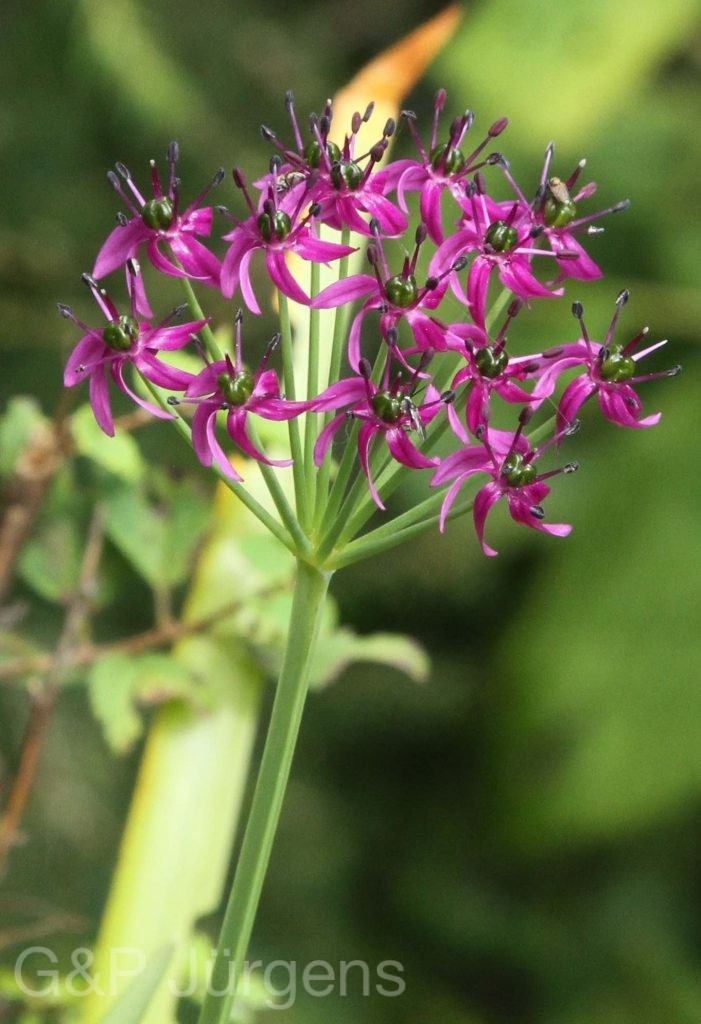
Allium wallichii is a Himalayan and Sino-Himalayan onion widely distributed through SW China, Nepal, NE India, Bhutan, Myanmar and Pakistan, GBIF recording around 1,300 occurrences (with cultivated records reaching Europe). It is a plant of the subalpine and alpine zone, growing in open meadows, grassy slopes, forest clearings and damp pastures, generally between about 2,300 and 4,800 m. The photographed plant from Chele-La in western Bhutan at 3,400 m (September) is characteristic, flowering in the late-monsoon period when the high meadows are at their richest.

It is a perennial herb arising from a slender, oblique rhizome bearing a poorly developed, narrowly conic bulb. The leaves are basal, several, narrowly linear to lorate and flat or shallowly keeled, sheathing the lower part of the triangular or angled scape. The inflorescence is a terminal, many-flowered umbel that is hemispherical to globose and lacks bulbils; the flowers are stellate, with six spreading purple to reddish-purple (rarely whitish) tepals, exserted stamens and a superior ovary. The fruit is a small loculicidal capsule.

The family is given verbatim as Alliaceae, the segregate now generally subsumed within Amaryllidaceae subfamily Allioideae. Allium wallichii is gathered as a wild vegetable and flavouring (jimbu and related condiments) across the Himalaya and is used medicinally, which together with grazing places local pressure on accessible populations. The species is morphologically variable across its wide range, and its rhizomatous, non-bulbous habit and flat leaves distinguish it within the alpine Himalayan alliums; it is not currently regarded as globally threatened.

Author: Kunth · Sources: POWO (Kew), Flora of Bhutan Vol. 2, GBIF, Flora of China Vol. 24, Stearn: The Genus Allium in the Himalaya

Alnus nepalensis

by GP Jürgens

D.Don

Bhutan2012 1150
Bhutan Tashiyangtse 1750m, October
Nepal 1994 159 ergebnis
Ost-Nepal Mewa-Khola
1800m, April

Description

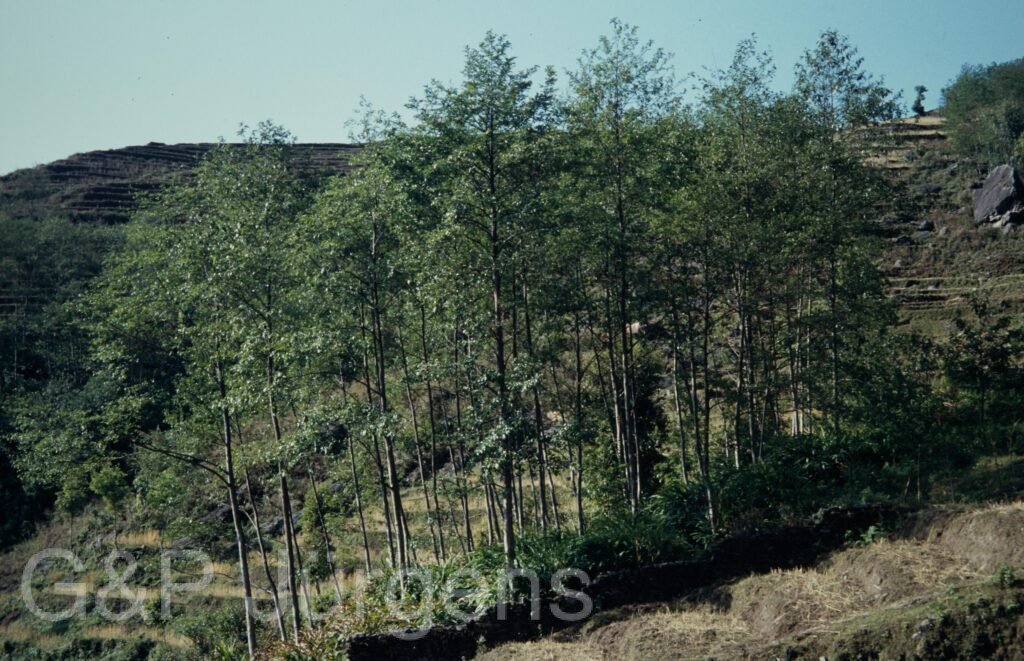
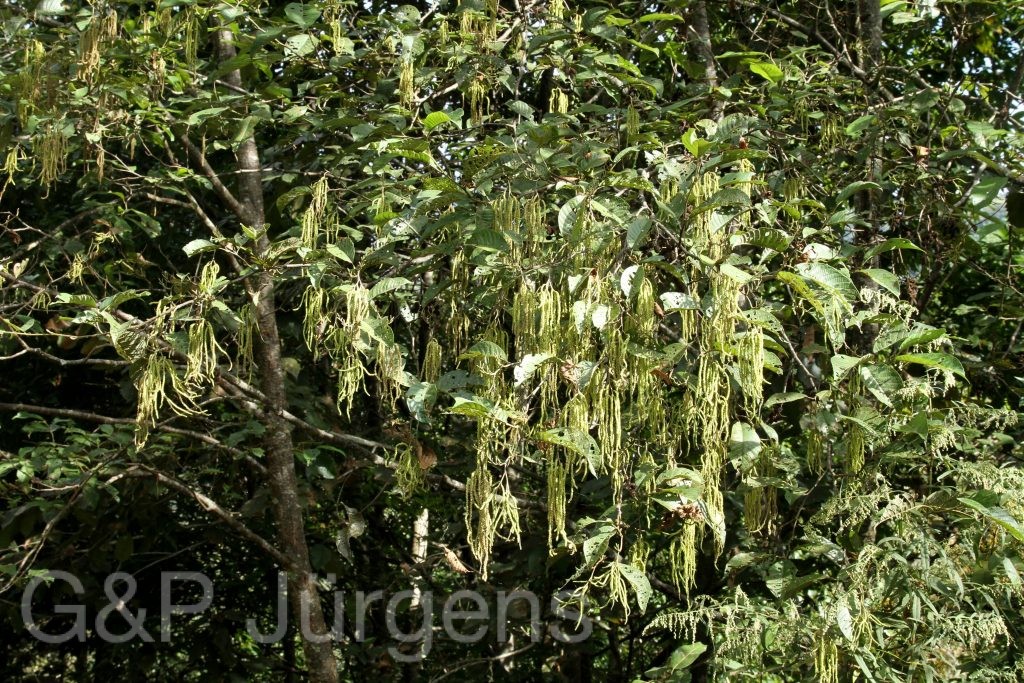
Alnus nepalensis D.Don, the Nepalese alder, is a deciduous tree of the Betulaceae distributed throughout the Himalaya and adjacent ranges, from Nepal and India through Bhutan to southwestern China, Myanmar and Vietnam (GBIF: c. 1,931 occurrences). It is a fast-growing pioneer of moist temperate and subtropical zones, colonising landslides, river terraces, abandoned fields and forest gaps, typically between about 900 and 2,700 m. The photographed trees from Tashiyangtse in eastern Bhutan (c. 1,750 m) and the Mewa-Khola in eastern Nepal (c. 1,800 m) exemplify its dominance on moist, disturbed mid-montane slopes.

The tree reaches 10–25 m, with smooth grey bark becoming fissured with age. The leaves are alternate, broadly elliptic to ovate, acuminate, with finely serrate to nearly entire margins and prominent pinnate venation. Unusually for the genus, A. nepalensis flowers in autumn: the slender pendulous male catkins and short erect female inflorescences appear together, and the female structures mature into small, woody, cone-like infructescences (strobiles) that persist on the tree and release tiny winged nutlets (samaras) for wind dispersal.

Alnus nepalensis is ecologically and economically significant as a nitrogen-fixing species, harbouring symbiotic actinomycetes of the genus Frankia in root nodules; this enables it to enrich degraded soils, making it valuable in agroforestry, soil reclamation, watershed restoration and as a shade tree in cardamom cultivation. The wood is used for timber, fuel and matchwood. The species is abundant and of least conservation concern.

Author: D.Don · Sources: POWO (Kew), Flora of China Vol. 4, Flora of Bhutan Vol. 1, Flora of Nepal, GBIF, Chen & Li: Betulaceae of China

D.Don

Nepal 97 45 G67
Nepal Mewa-Khola 1100m, April
Nepal 97 46 P68
Nepal Mewa-Khola 1100m, April

Description

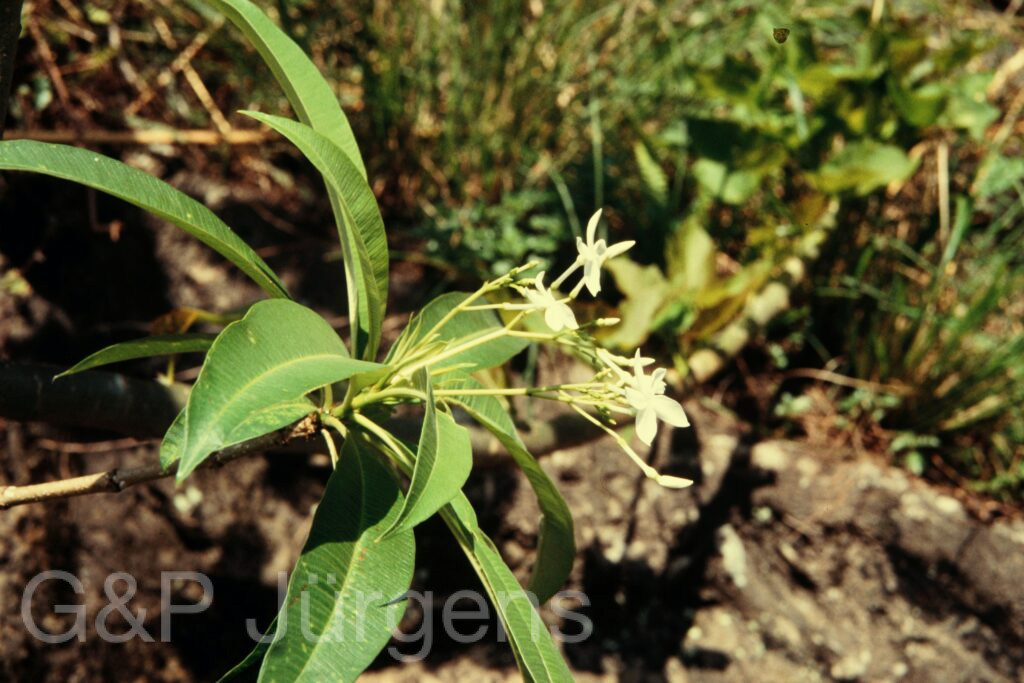
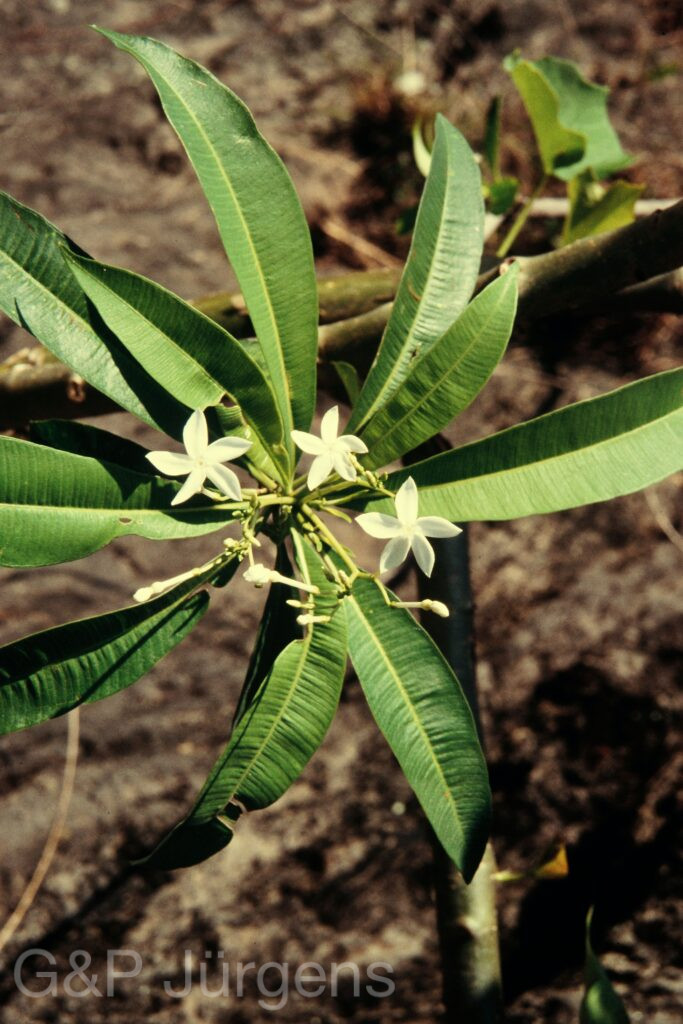
Alstonia neriifolia is a shrub or small tree of the warm, humid lower hills of the eastern Himalaya and Indo-Burmese region, recorded from India, Nepal, Bhutan, China and southwards into mainland and insular Southeast Asia including Vietnam, Indonesia and Singapore. It occupies subtropical broad-leaved forest, forest margins, stream banks and shaded ravines at low to moderate elevations. The specimen photographed at Mewa-Khola in eastern Nepal at 1100 m in April reflects its preference for the warm, moist foothill belt, where it flowers as the pre-monsoon temperatures rise.

Like other members of its genus it exudes a white latex when cut. The leaves are arranged in whorls of three or more, narrowly lanceolate to oblong and acuminate, recalling those of Nerium (oleander) and giving the species its epithet; the lamina is glabrous and leathery with numerous closely parallel lateral veins running to a marginal collecting vein. The flowers are borne in terminal cymose clusters, with a small five-lobed calyx and a salverform white to cream corolla whose lobes overlap to the left in bud. The fruit is a pair of slender, elongate follicles that split to release numerous flattened seeds bearing tufts of hairs at both ends for wind dispersal.

Alstonia is a pantropical genus of the Apocynaceae, subfamily Rauvolfioideae, well known for the indole alkaloids in its bark, several species of which are valued in traditional medicine and as timber. Alstonia neriifolia, described by D.Don, is distinguished from the better-known A. scholaris by its narrower, oleander-like leaves and smaller stature. Its comma-shaped, comose seeds and reliance on insect pollination of the fragrant flowers underpin its ecology in disturbed and successional foothill forest.

Author: D.Don · Sources: POWO (Kew), GBIF, Flora of China, Annotated Checklist of the Flowering Plants of Nepal, Flora of Bhutan, Middleton's revision of Asian Alstonia (Apocynaceae)

Roxb.

Nepal 97 57 P87
Nepal Mewa-Khola 1160m, April

Description

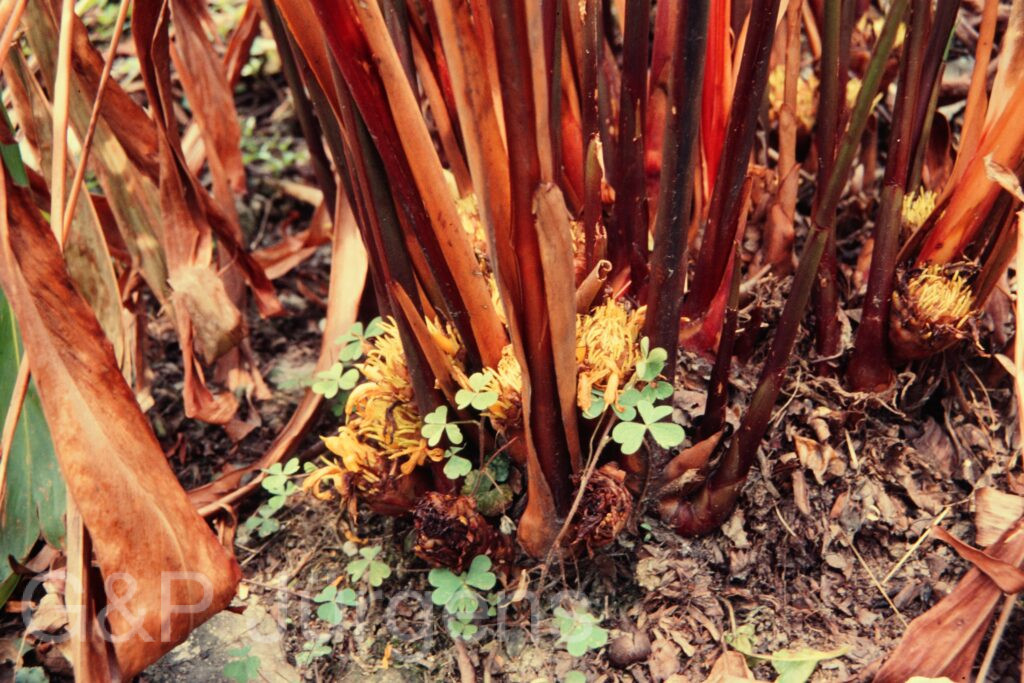
Amomum subulatum, the large or black cardamom, is native to the moist sub-Himalayan tracts of eastern Nepal, north-eastern India, Bhutan and adjacent China, the roughly 108 GBIF records reflecting both wild and extensively cultivated populations; records from the United States, Germany and Korea derive from cultivation and herbarium material. It grows in the shaded understorey of moist broad-leaved forest, along streams, ravines and damp shaded slopes, typically between about 600 and 2000 m, and is widely grown under forest shade as a cash crop. The photographed plant from the Mewa-Khola valley of Nepal at 1160 m in April is characteristic of its warm, humid lower-montane habitat.

It is a tall, tufted, rhizomatous perennial forming dense clumps of leafy pseudostems one to two metres high arising from a stout, creeping rhizome. The leaves are large, lanceolate, glabrous and distichous, with a long-acuminate (subulate) apex giving the species its name, and clasping sheaths. The inflorescence is a dense, head-like spike borne on a short scape at the base of the clump, the flowers with a yellowish, red-streaked labellum subtended by bracts. The fruit is a globose to ovoid, reddish-brown, ribbed and warty capsule containing numerous aromatic, blackish seeds.

Amomum belongs to the ginger family Zingiberaceae (here misspelled in the source) and is a major economic plant of the eastern Himalaya, the dried capsules forming the black cardamom of commerce, valued as a spice and in traditional medicine. Cultivation under natural forest canopy makes it an important agroforestry species. It is not of conservation concern, though wild genetic resources and the shade-forest systems that sustain its cultivation merit protection.

Author: Roxb. · Sources: POWO (Kew), GBIF, Flora of China, Flora of Bhutan, Annotated Checklist of the Flowering Plants of Nepal, Zingiberaceae of the Himalaya (taxonomic monograph)

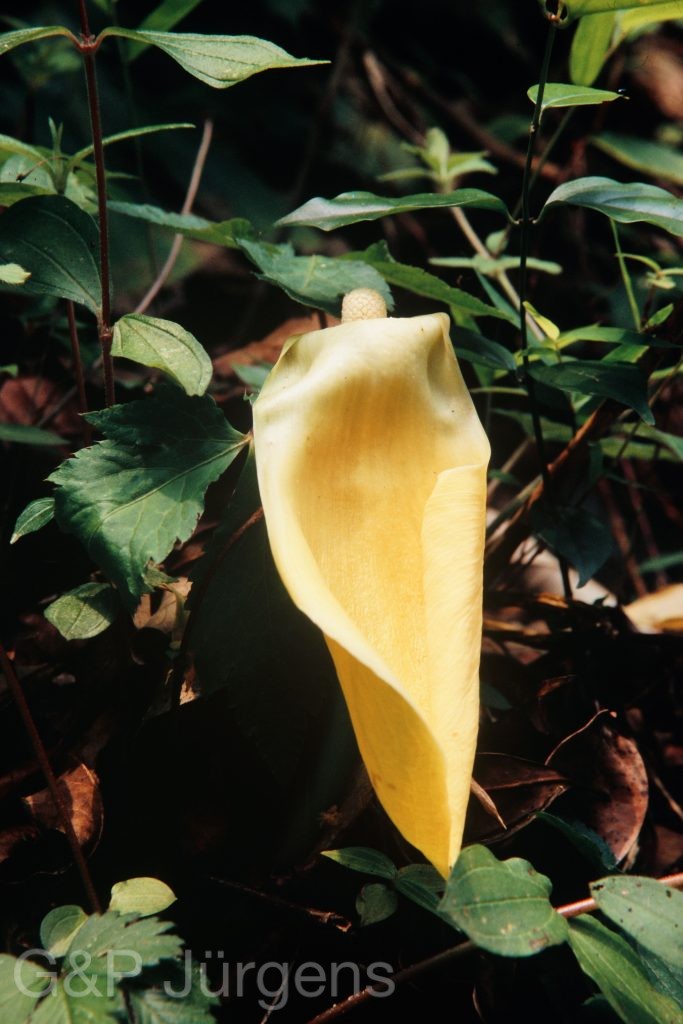
(Wall.) Bogner & Mayo

Bh2008 63 P103
Bhutan Punaka-Chu, 1500m April

Description

Amorphophallus napalensis is a tuberous aroid of the subtropical Himalaya and adjacent Southeast Asia, recorded from India, Nepal, Thailand, Bhutan, Myanmar and Bangladesh across some 80 GBIF occurrences. The photographed plant was found along the Punaka-Chu in Bhutan at about 1500 m in April. It grows in moist broad-leaved forest, on shaded slopes, ravines and forest floors, typically between roughly 500 and 1800 m, emerging with the pre-monsoon and monsoon rains from a dormant underground tuber.

The plant arises from a depressed-globose subterranean tuber and produces, in season, a single large solitary leaf with a long mottled petiole and a blade divided into numerous segments giving an umbrella-like, much-dissected appearance. The inflorescence, typical of the genus, is a spadix subtended by a spathe; the spadix bears a basal zone of female flowers below a zone of male flowers, topped by a sterile appendix. At anthesis the inflorescence emits a fetid odour and may generate heat (thermogenesis) to attract carrion-feeding flies and beetles, which effect pollination. The infructescence ripens into a cluster of fleshy berries.

Amorphophallus is a large palaeotropical genus notable for these protogynous, often malodorous inflorescences and their fly-and-beetle (sapromyophilous) pollination, with the berries subsequently dispersed by birds. The seasonal solitary leaf and dormant tuber adapt the species to the marked wet-dry rhythm of the monsoon forest. A. napalensis is widespread and not regarded as threatened, though, like many forest aroids, it depends on the maintenance of shaded, humid woodland habitat.

Author: (Wall.) Bogner & Mayo · Sources: POWO (Kew), GBIF, Flora of China, Flora of Bhutan, Flora of Nepal, Hetterscheid & Ittenbach – Revision of the Genus Amorphophallus

Planch.

Garw 2005 268 ergebnis
India Garhwal Kunol 2400m, September

Description

Ampelocissus rugosa is a tendril-climbing vine of the Himalaya and adjacent south-east Asia, recorded from Nepal, India, Bangladesh, Bhutan, China, Myanmar and Vietnam. Its roughly 95 georeferenced collections, the fewest in this group, indicate a relatively restricted and under-collected distribution along the subtropical-to-warm-temperate forest belt of the Himalayan foothills. It grows in forest margins, thickets, ravines and along streams, scrambling over shrubs and trees. The photographed plant from Garhwal at Kunol at 2400 m in September represents the upper part of its altitudinal range and its late-monsoon fruiting period, when the vine bears its grape-like infructescences.

It is a robust herbaceous to woody climber with leaf-opposed tendrils characteristic of the grape family. The simple leaves are broadly ovate to cordate in outline, sometimes shallowly lobed, with a toothed margin and a rugose (wrinkled) upper surface that gives the species its epithet; the lower surface is often tomentose. The inflorescence is a leaf-opposed, compound cyme or panicle, typically with a basal tendril, bearing many small, greenish flowers with a four- to five-merous calyx and corolla and a fleshy disc around the ovary. The fruit is a small, globose, fleshy berry, ripening dark purple to black and containing one or few hard seeds, the cluster superficially resembling a wild grape.

Ampelocissus is a pantropical genus of the Vitaceae closely allied to Vitis, distinguished by its tendril-bearing inflorescences and frequently tuberous rootstock. Several Asian species are gathered locally for their edible, acidic fruits and have potential as wild relatives of the cultivated grape. A. rugosa is a sparsely documented Himalayan vine; while not formally assessed, its limited collection record warrants attention to forest-margin habitats under pressure from clearance.

Author: Planch. · Sources: POWO (Kew), GBIF, Flora of China Vol. 12, Flora of Bhutan Vol. 2, Flora of Nepal, Latiff's Revision of Asian Ampelocissus

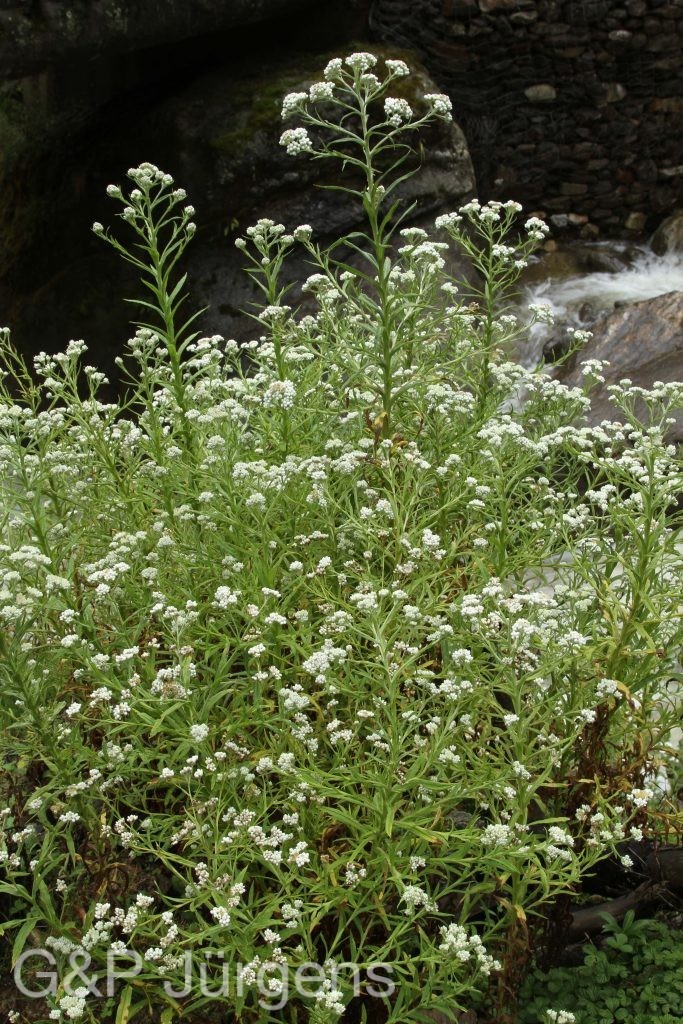
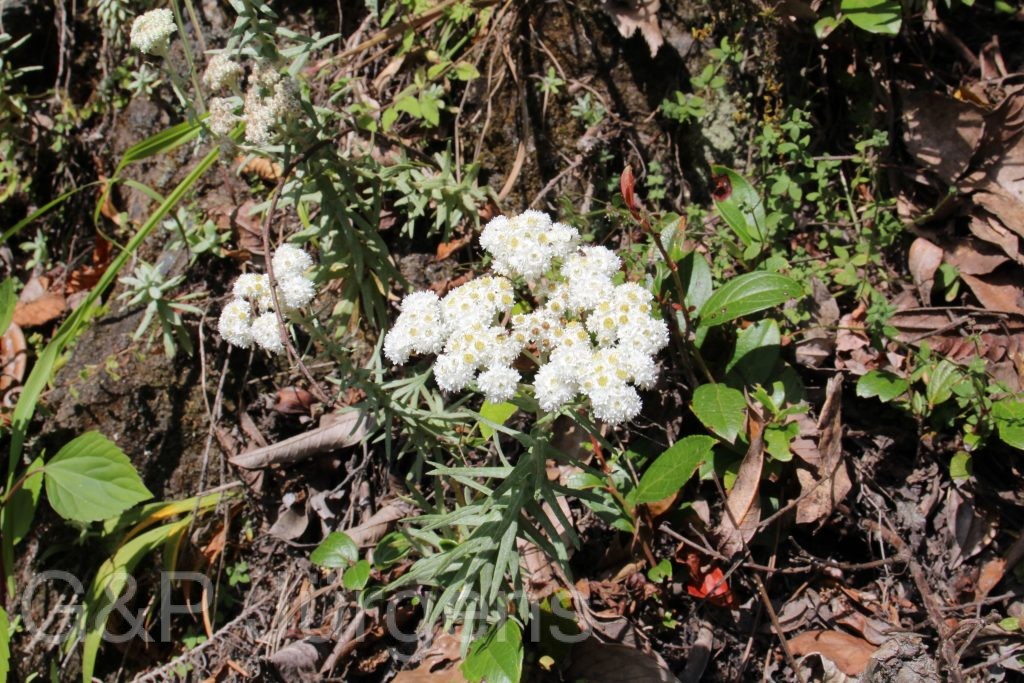
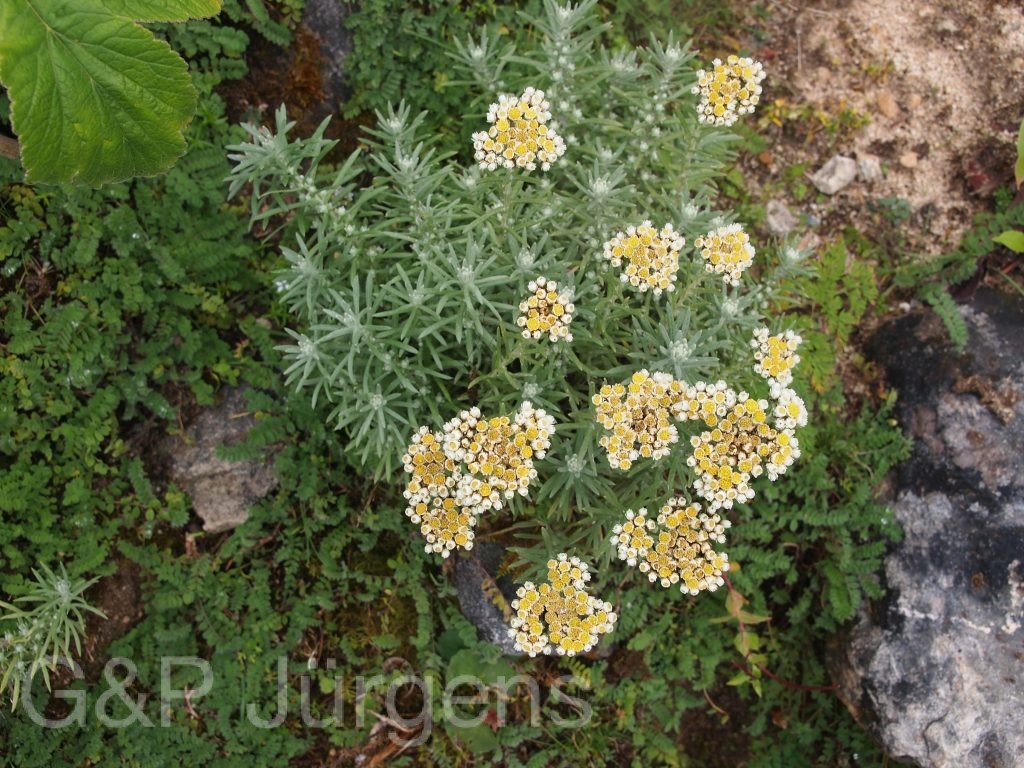
Anaphalis busua

by GP Jürgens

DC.

Bhutan2012 160
Bhutan Haar-Valley, 3200m September
Bhutan2012 160
Bhutan Haar-Valley, 3200m September
BhutanPG2011 833 01 01 1
Bhutan Chele-La, 3400m July

Description

Anaphalis busua is a Himalayan everlasting widespread from Pakistan and India through Nepal, Bhutan and Myanmar into south-western China, with additional records from Sri Lanka; the 619 occurrences confirm a broad montane range, while points labelled Belgium represent cultivated or erroneous data. It occupies open grassy slopes, forest clearings, banks and disturbed ground from roughly 1500 to 3600 m. The documented Bhutanese material from the Haa Valley at about 3200 m in September and from the Chele-La at 3400 m in July illustrates its long flowering season across the temperate and lower subalpine zones of the eastern Himalaya.

The species is a perennial herb with a woody rootstock producing erect, white-woolly stems. The leaves are sessile, linear to oblong-lanceolate, somewhat decurrent, green and thinly arachnoid above and densely white-tomentose beneath, with revolute margins. The capitula are small and numerous, aggregated into dense terminal corymbs; each head is heterogamous and functionally dioecious, with the involucre of papery, pearly-white, radiating phyllaries that give the genus its everlasting quality. The florets are tubular and whitish, the outer female and filiform, the inner mostly functionally male. The cypselae are minute and oblong, crowned by a pappus of slender, barbellate, basally free bristles.

Anaphalis is a large genus of the Gnaphalieae especially diverse in the Sino-Himalayan region, distinguished from Helichrysum and Gnaphalium by its scarious involucres and predominantly dioecious heads. A. busua belongs to the broad-leaved Himalayan group and is taxonomically variable, with several related forms intergrading. The dry chaffy phyllaries persist long after flowering, favouring wind dispersal of the small achenes. The species is common and weedy in disturbed montane habitats and is of no conservation concern.

Author: DC. · Sources: POWO (Kew), GBIF, Flora of China Vol. 20-21, Flora of Bhutan, Flora of Nepal, Hilliard & Burtt Gnaphalieae studies

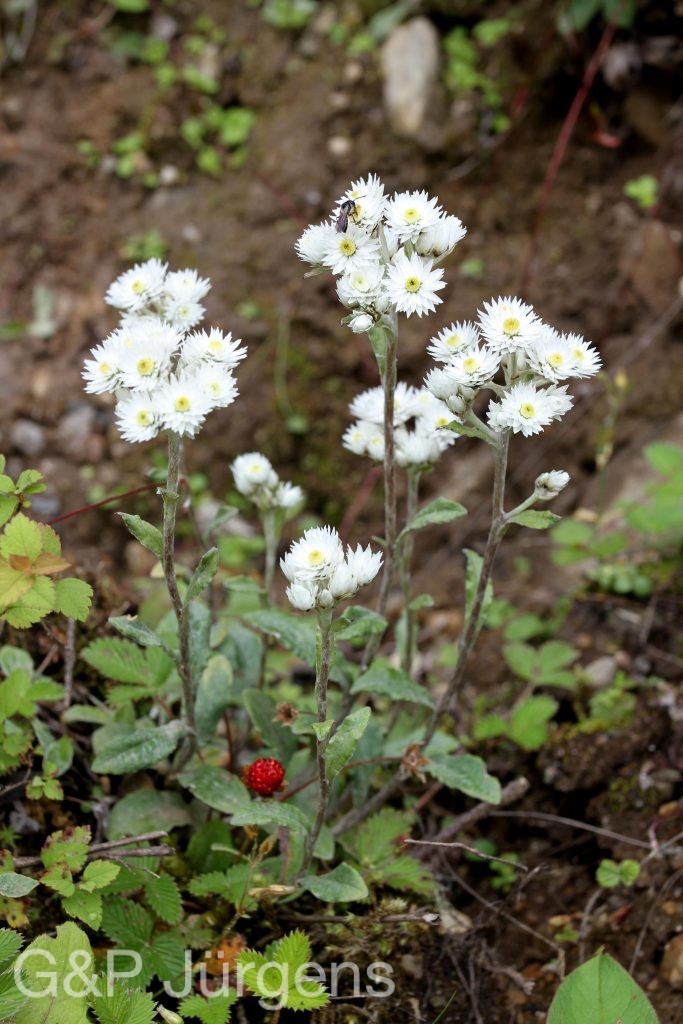
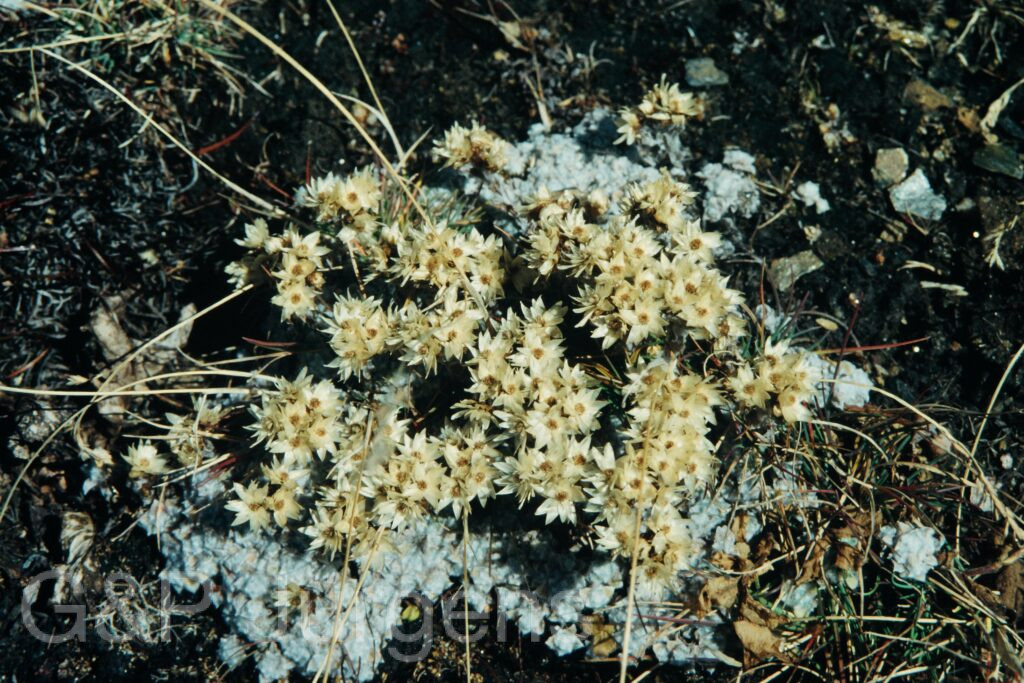
Anaphalis cavei

by GP Jürgens

Chatterjee

Nepal 95 418 W728 ergebnis
Nepal Jaisuli Kund 4200m, October

Description

Anaphalis cavei is a Himalayan high-alpine species recorded from Nepal, northern India, Bhutan and southwestern China, with around 91 occurrences concentrated along the main Himalayan axis. It is a plant of the upper alpine zone, the accompanying image documenting it at Jaisuli Kund in Nepal at about 4200 m in October, as the brief autumn growing season closes. It inhabits open stony slopes, alpine meadow turf, moraine and rocky ground near and above the treeline, growing in well-drained, often gravelly substrates exposed to intense insolation and cold, where its dense indumentum mitigates desiccation and ultraviolet stress.

It is a small, perennial, white-woolly herb forming low tufts or mats from a branched, somewhat woody caudex. The stems and leaves are densely covered in appressed lanate-tomentose hairs giving a silvery-grey aspect; the leaves are narrowly oblanceolate to spathulate, often with margins revolute and bases decurrent or semi-amplexicaul. The capitula are aggregated into a compact terminal corymb; each head is surrounded by several rows of dry, papery, pearly-white involucral bracts characteristic of the genus. The plants are functionally dioecious, with female and male florets borne predominantly on separate heads, and the cypselae are small, glabrous and crowned by a deciduous capillary pappus.

The species, described by Chatterjee, belongs to tribe Gnaphalieae, the genus Anaphalis being a taxonomically intricate group of "everlasting" daisies whose papery bracts persist long after flowering. Its restricted high-elevation range, dense wool and cushion-like habit are adaptations to the harsh alpine environment, and seed dispersal is anemochorous via the pappus. Owing to its narrow, remote montane distribution it has not been formally assessed, but it appears locally frequent within suitable alpine habitat.

Author: Chatterjee · Sources: POWO (Kew), GBIF, Flora of China, Annotated Checklist of the Flowering Plants of Nepal, Gnaphalieae monograph (Asteraceae)

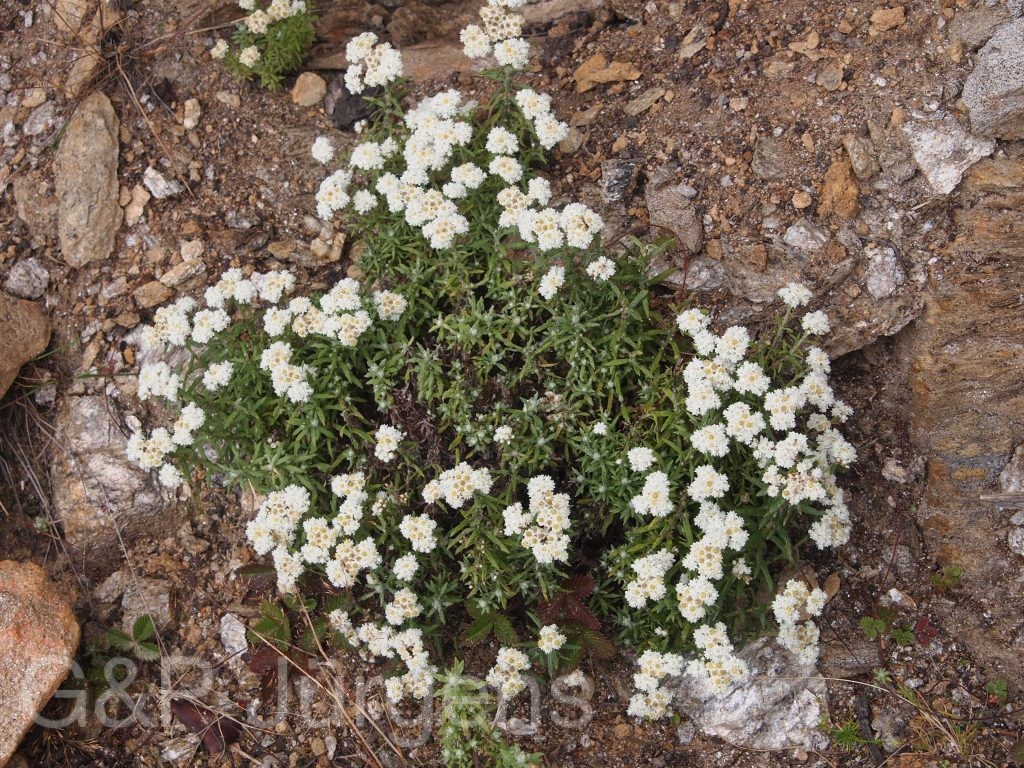
Hook.f.

Bhutan2015 325
Bhutan Trongsa 2000m, October
Bhutan2012 294
Bhutan Shele-La, 3900m September
Bhutan2012 892
Bhutan Tumching-La, 3700m October
Bhutan2012 893
Bhutan Tumching-La, 3700m October

Description

Anaphalis contorta is a widespread Asian everlasting distributed from Nepal, India and Bhutan through China to the Philippines, Taiwan, Pakistan, Bangladesh and Afghanistan, with GBIF recording over 1280 occurrences across this broad range. It is a plant of open, sunny, often dry and stony ground, favouring grassy slopes, banks, rocky pasture, trackside verges and forest margins from the temperate zone up into the subalpine. The cited Bhutanese localities span this breadth, from Trongsa at 2000 m in October to the Shele-La at 3900 m in September and the Tumching-La at 3700 m in October, demonstrating its occurrence from mid-montane forest country to high subalpine passes where it persists and flowers into the autumn.

It is a perennial herb forming tufts from a woody rootstock, the erect stems and the linear to narrowly lanceolate leaves clothed in dense white or greyish woolly tomentum, the leaf margins frequently revolute and somewhat contorted, a feature alluded to in the epithet. The capitula are small and numerous, aggregated into dense terminal corymbose clusters. Each head is surrounded by an involucre of dry, papery, persistent white phyllaries that constitute the showy part of the inflorescence, the plant being functionally dioecious with male and female heads on separate individuals. The minute tubular florets give rise to tiny cypselae bearing a pappus of slender barbellate bristles.

A member of tribe Gnaphalieae, Anaphalis comprises numerous Himalayan and East Asian species whose papery white "everlasting" bracts are an adaptation to exposed, drought-prone montane habitats and aid in attracting pollinators to the small florets. The dried inflorescences are long-lasting and locally gathered for decoration. Tolerant of poor soils and disturbance and very widely distributed, A. contorta is a secure species of no conservation concern.

Author: Hook.f. · Sources: POWO (Kew), GBIF, Flora of Bhutan, Flora of China, Annotated Checklist of the Flowering Plants of Nepal, Hilliard's revision of Anaphalis (Gnaphalieae)