Tag:

Spring

G.Taylor

Nepal 95 136.P229 ergebnis
Nepal south of Rupina La October

Description

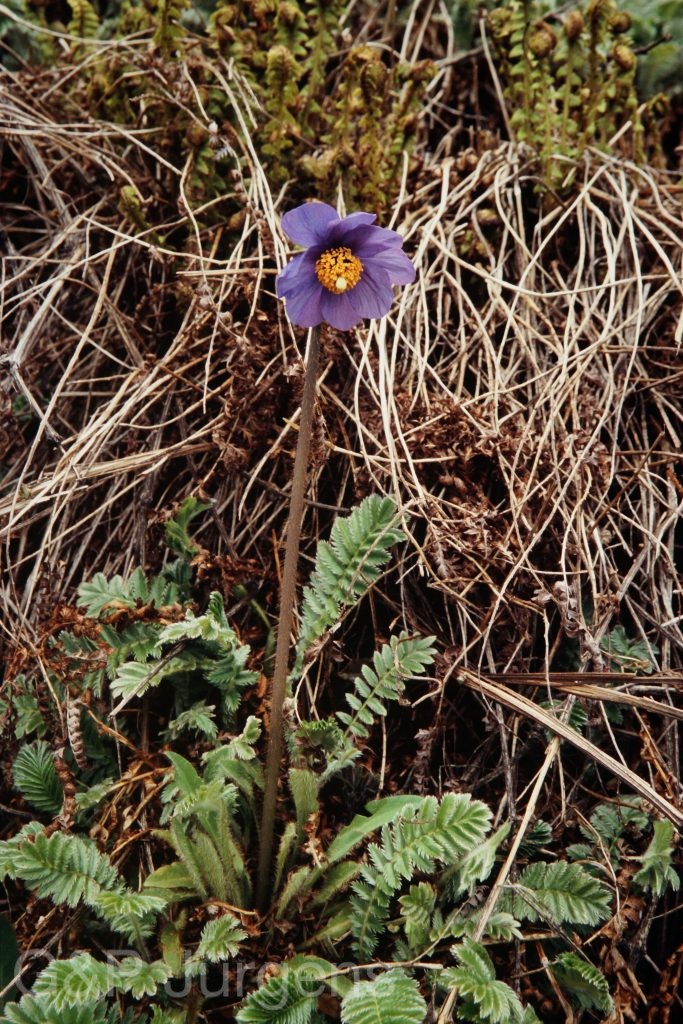
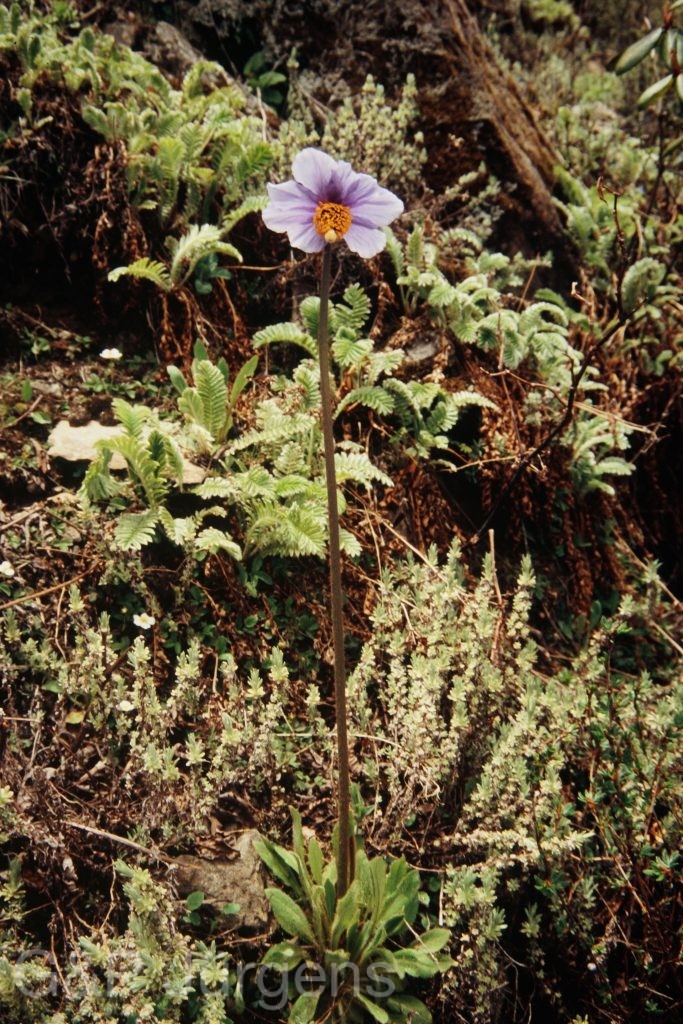
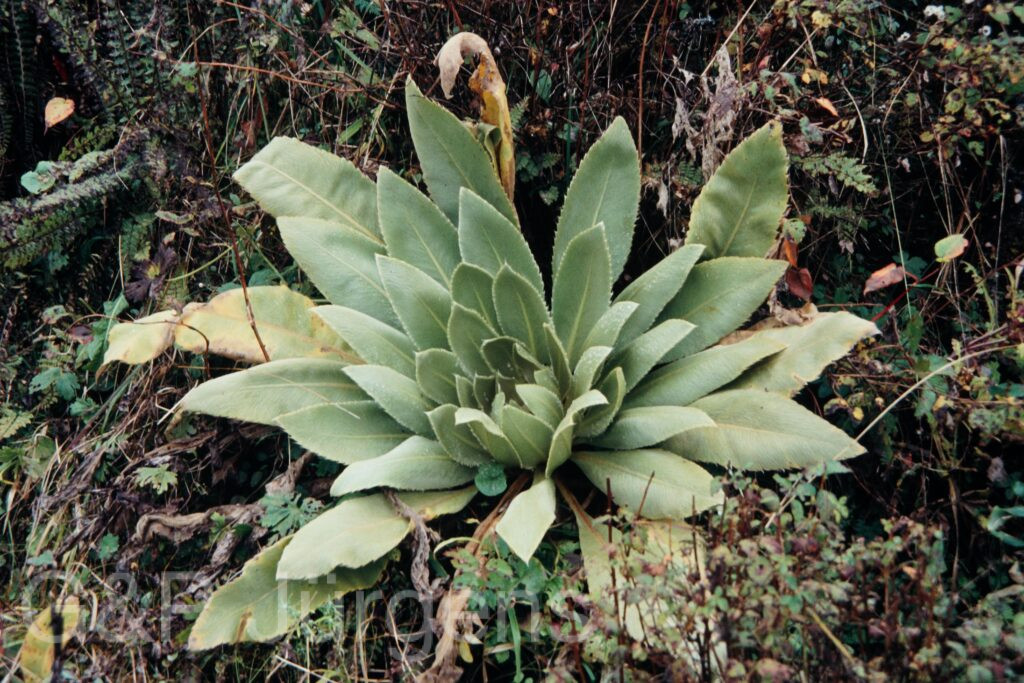
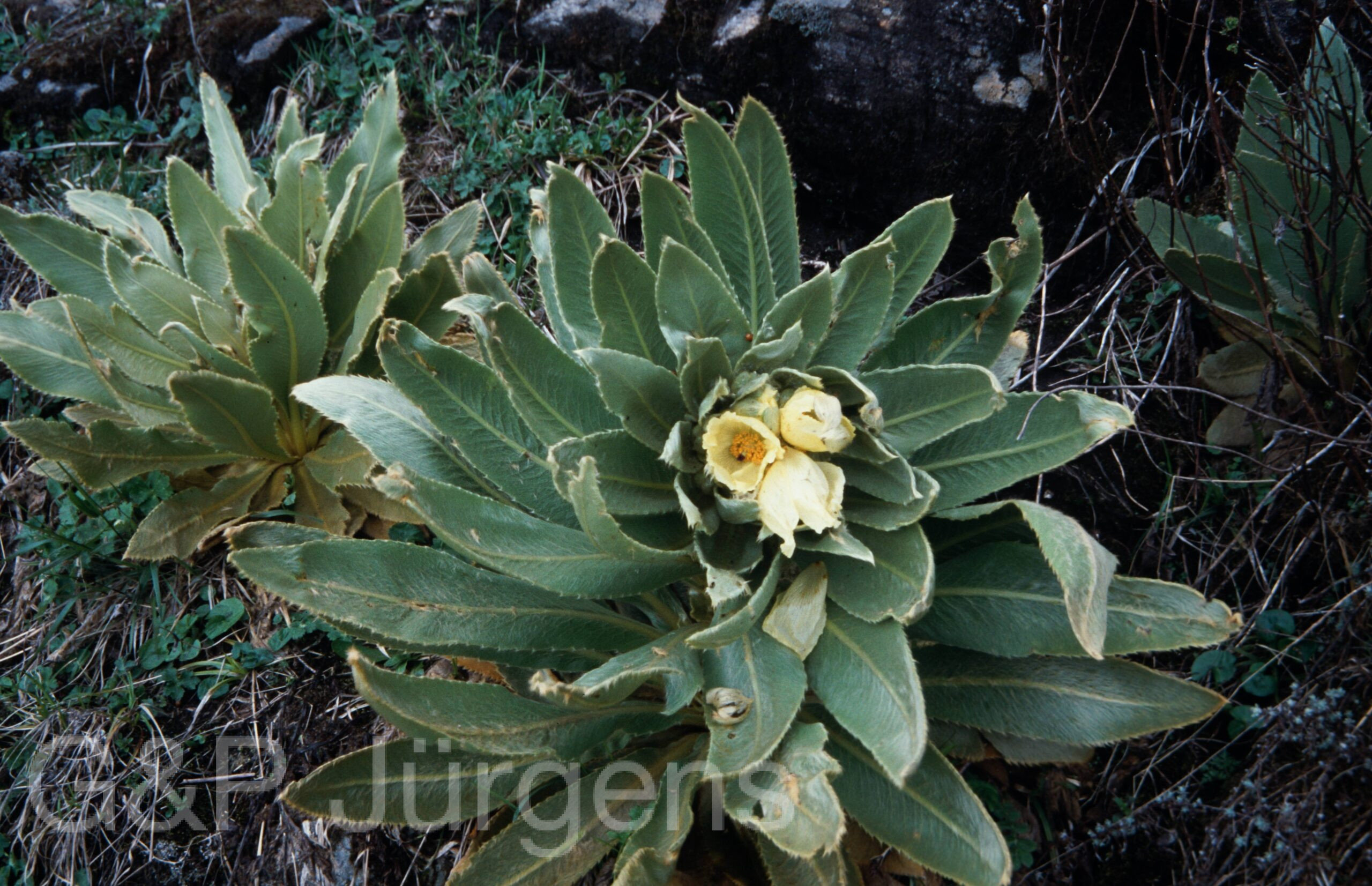
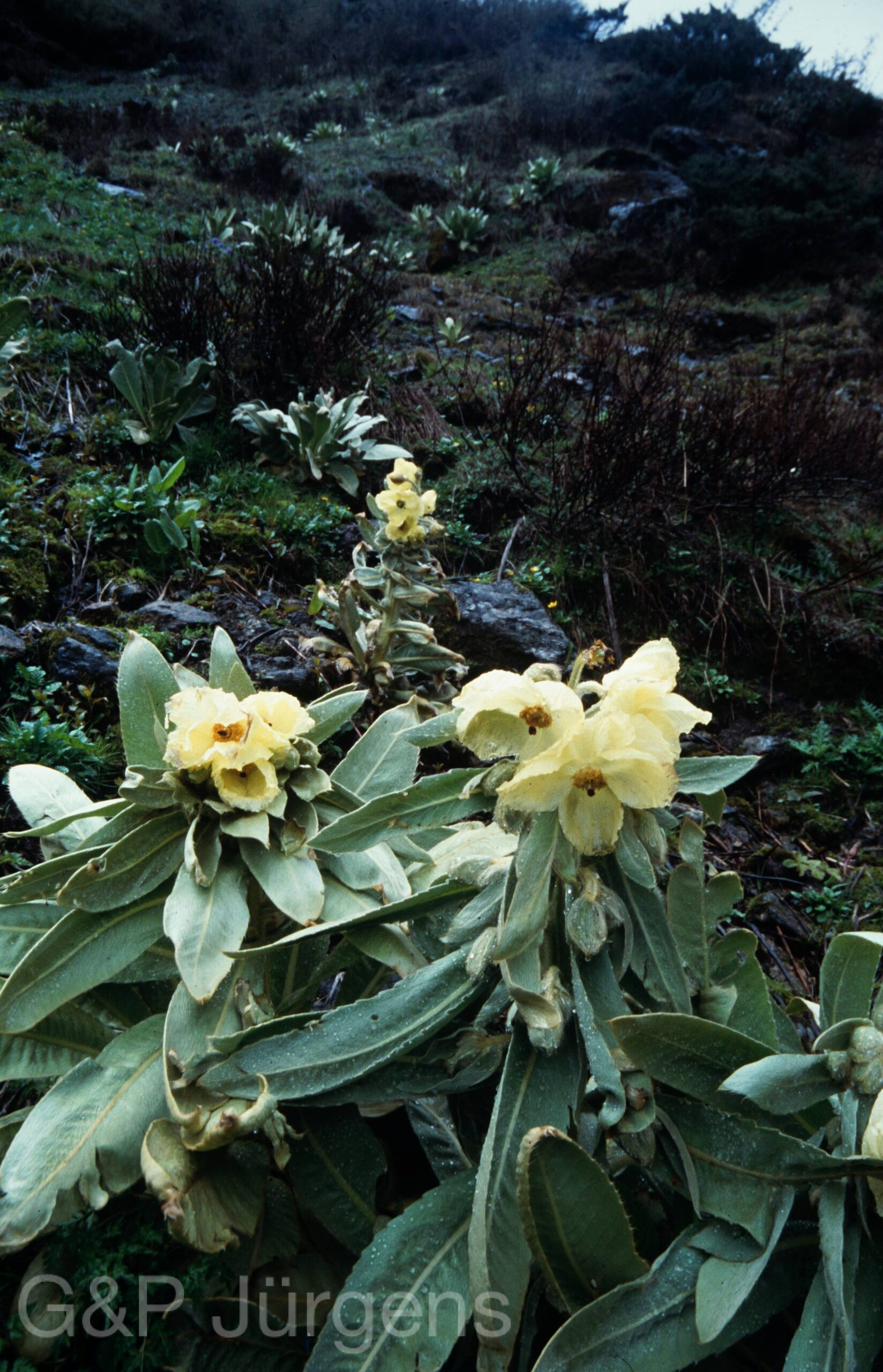
Meconopsis regia is a stately monocarpic poppy endemic to central Nepal, the great majority of its roughly 100 documented records lying within that country. It is a plant of open rocky slopes, screes, cliff ledges and alpine grassland of the subalpine to alpine zones, typically between about 3000 and 4200 m. The illustrated material derives from the Rupina-La area in the Gorkha region of Nepal: a flowering plant at 3350 m in May and a withered specimen recorded south of the pass in October, together documenting the full annual cycle from spring growth to autumn senescence.

The species is celebrated for its magnificent overwintering rosette of large oblanceolate leaves clothed in dense golden to rusty-red silky hairs, which protect the resting bud through the alpine winter. After several years of rosette growth it bolts to produce a tall, stout, leafy flowering stem bearing numerous large flowers. The blooms are saucer-shaped with four broad, satiny petals of pale to golden yellow, surrounding a boss of many stamens and a stout ovary topped by a short style and capitate stigma. After flowering the plant dies, the ovary maturing into an elongate ribbed capsule that dehisces by apical pores to scatter the seeds.

Meconopsis is the iconic genus of Himalayan and Sino-Tibetan poppies, distinguished from Papaver largely by its distinctive style and stigma. As a narrow-range Nepalese endemic with a monocarpic, hapaxanthic life-history, M. regia is intrinsically vulnerable to over-collection and habitat disturbance and is of conservation interest despite lacking a formal IUCN assessment; it is also prized by alpine horticulturists.

Author: G.Taylor · Sources: POWO (Kew), GBIF, Annotated Checklist of the Flowering Plants of Nepal, Flowers of the Himalaya, The Genus Meconopsis (Grey-Wilson monograph), Flora of Nepal
(D. Don) Walp.

Description

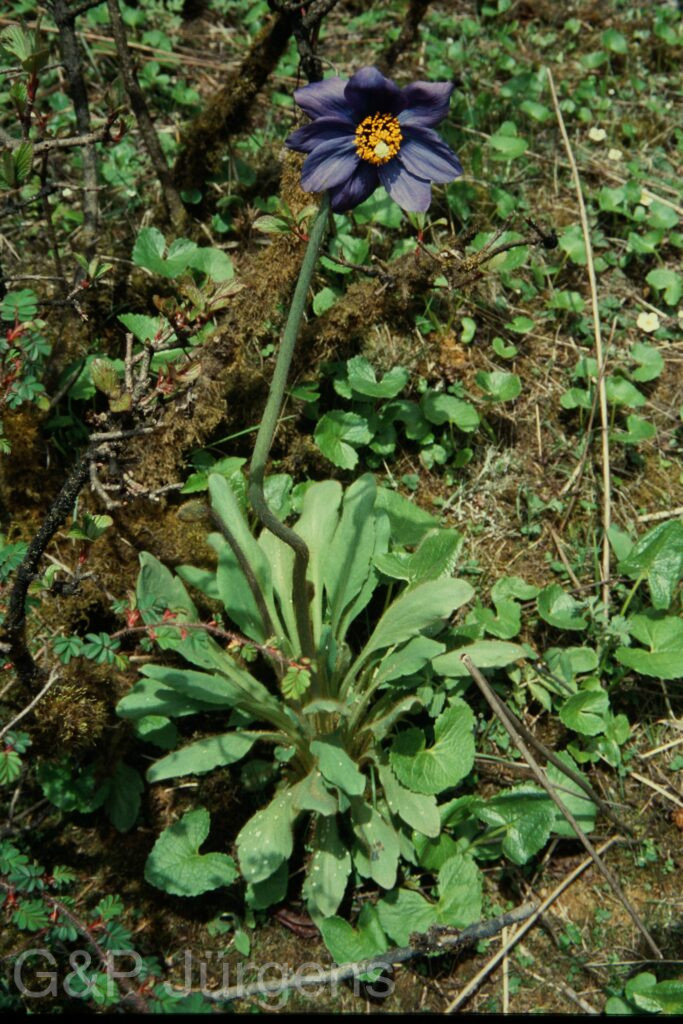
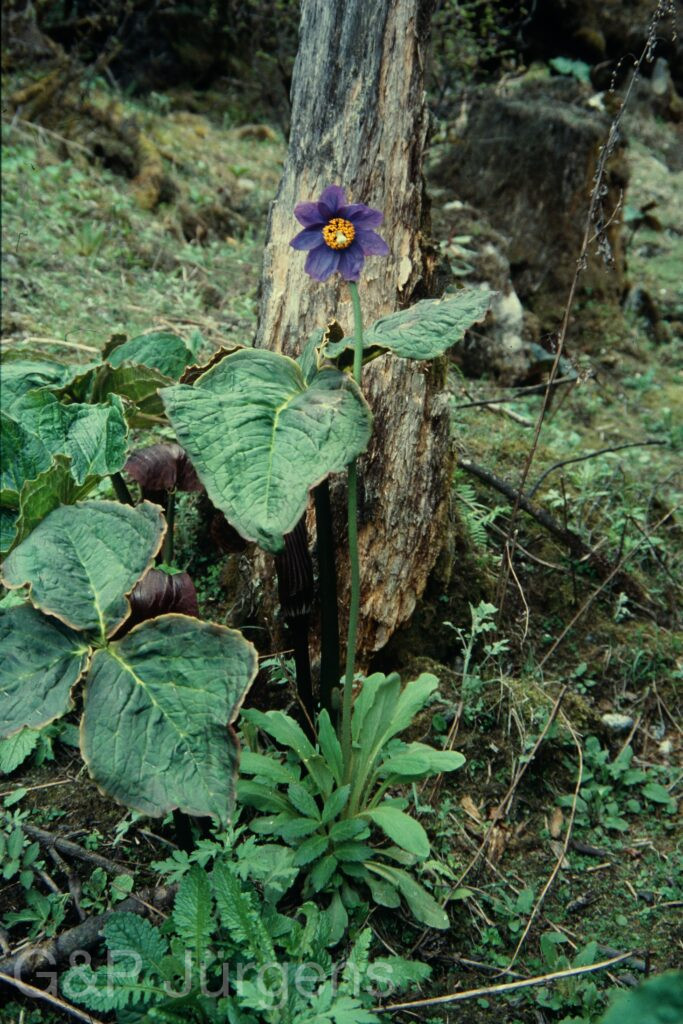
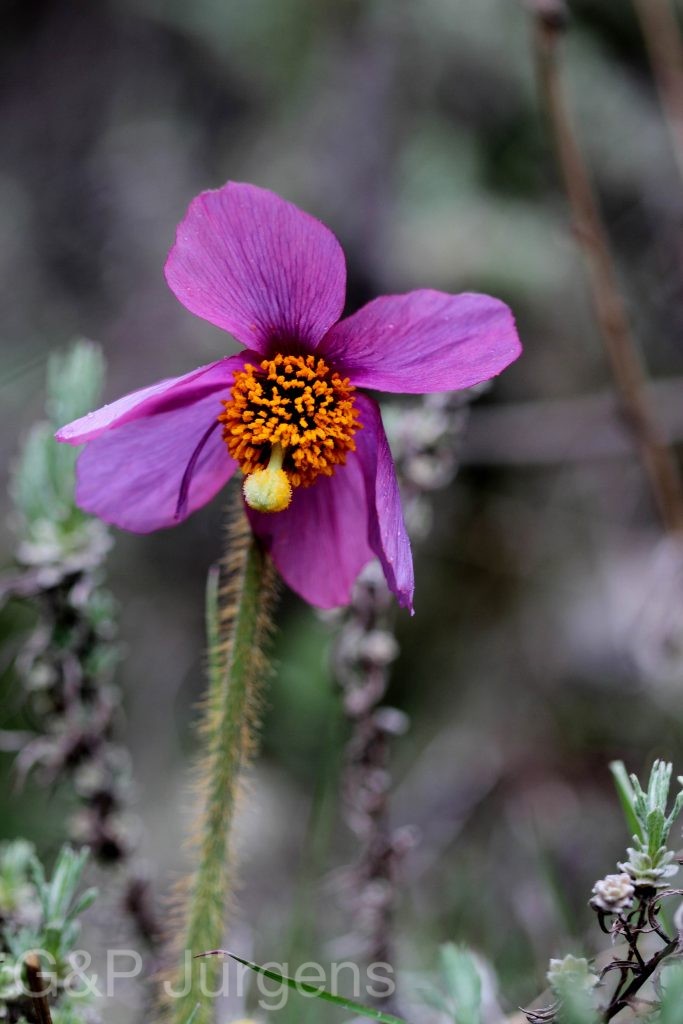
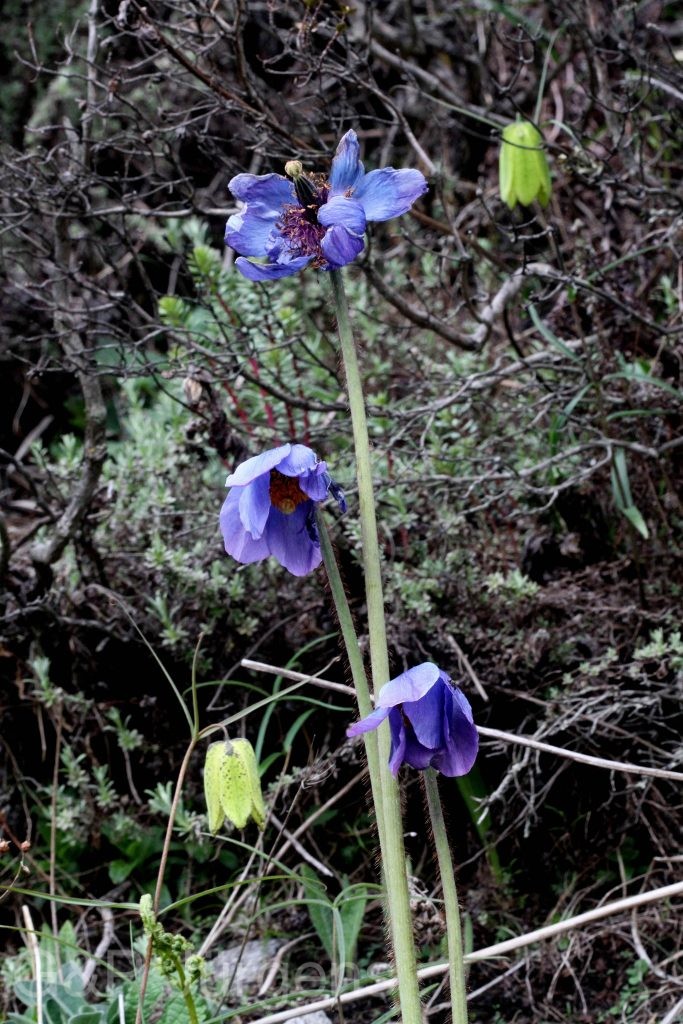
Meconopsis simplicifolia (D. Don) Walp. is a high-mountain perennial blue poppy of the central and eastern Himalaya, ranging through Nepal, Sikkim and northern India, Bhutan and southern Tibet (China), with cultivated records accounting for the United Kingdom entries in a GBIF dataset of roughly 267 occurrences. It inhabits alpine meadows, open turf, rocky slopes and the margins of Rhododendron scrub on moist, humus-rich, well-drained acidic soils, typically within the snowmelt-fed alpine zone. The illustrated collections cluster between about 3200 and 3900 m, from Tanghu in Sikkim at 3900 m and Chele-La in Bhutan at 3200 m in June to Yumthang on the Sikkim-India border at 3600 m in May, marking a late-spring to early-summer flowering as the snow retreats.

It forms a perennial herb with a basal rosette of simple, undivided leaves, oblanceolate to elliptic or narrowly lanceolate, entire to faintly toothed and clothed in soft, often fulvous to fawn-coloured bristly hairs, narrowing to a winged petiole; the simple, unlobed foliage gives the species its epithet. From the rosette arise one or several slender, bristly, leafless scapes, each bearing a solitary, nodding flower. The flowers have four (sometimes more) broad, silky, overlapping petals of clear sky-blue to violet or, in some forms, reddish-purple, surrounding a tuft of golden stamens and a stout ovary topped by a short, distinct style and capitate stigma. The fruit is an ellipsoid, bristly capsule opening by short apical valves.

Meconopsis simplicifolia is part of the perennial, scapose blue-poppy assemblage and is distinguished from allies such as M. grandis by its single-flowered scapes and entirely simple leaves; it is variable in flower colour and in whether it behaves as monocarpic or polycarpic. Pollinated chiefly by bumblebees, it is a celebrated ornamental long grown in cool temperate gardens. Across its range populations are localised and sensitive to grazing, trampling and the warming of alpine habitats, making it, like its relatives, a species of interest for Himalayan alpine conservation though not formally assessed as threatened.

Author: (D. Don) Walp. · Sources: POWO (Kew), GBIF, Flora of Bhutan, Flora of Nepal, Christopher Grey-Wilson – The Genus Meconopsis

L.

Nepal 1994 11 ergebnis
Ost-Nepal Tumlingtar 400m April
Nepal 1994 304 ergebnis
Ost-Nepal Tumlingtar 400m April
Nepal 2001 22 ergebnis ergebnis
East-Nepal Sabha-Khola 1400m, April

Description

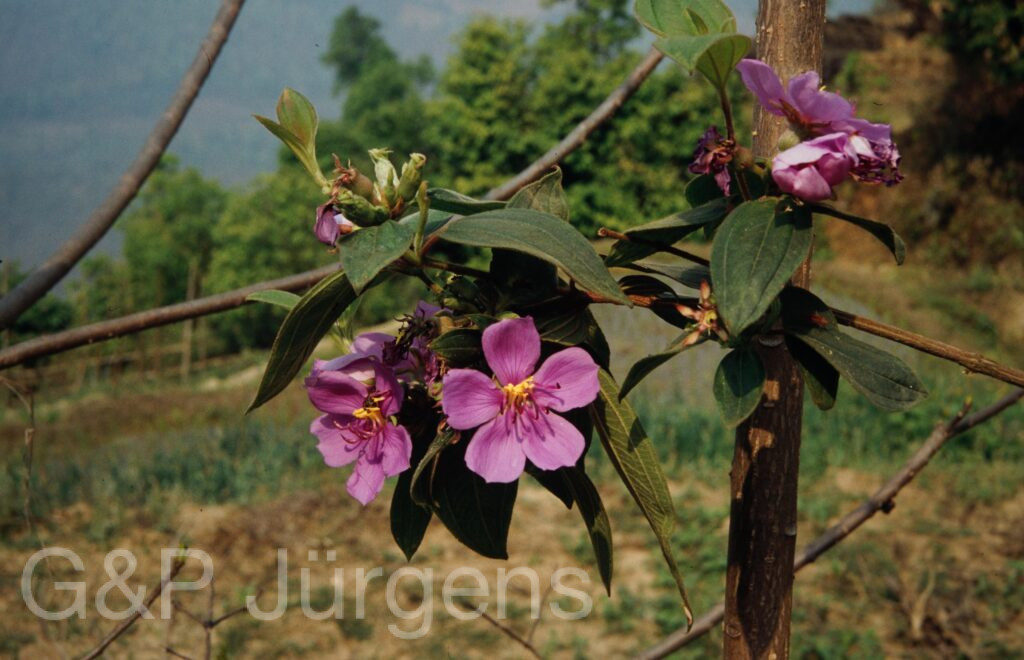
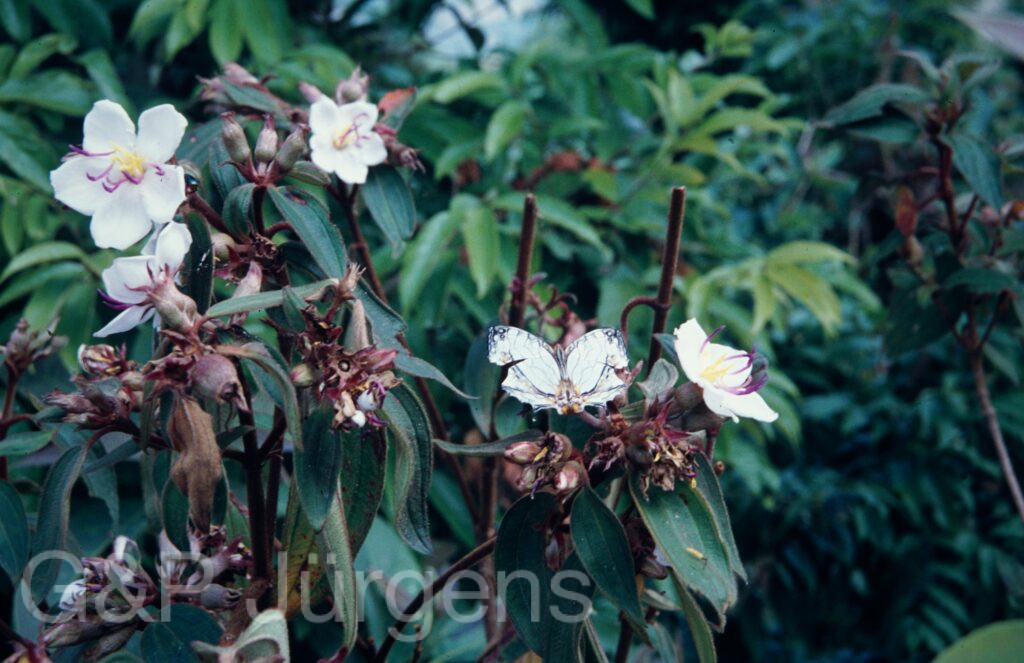
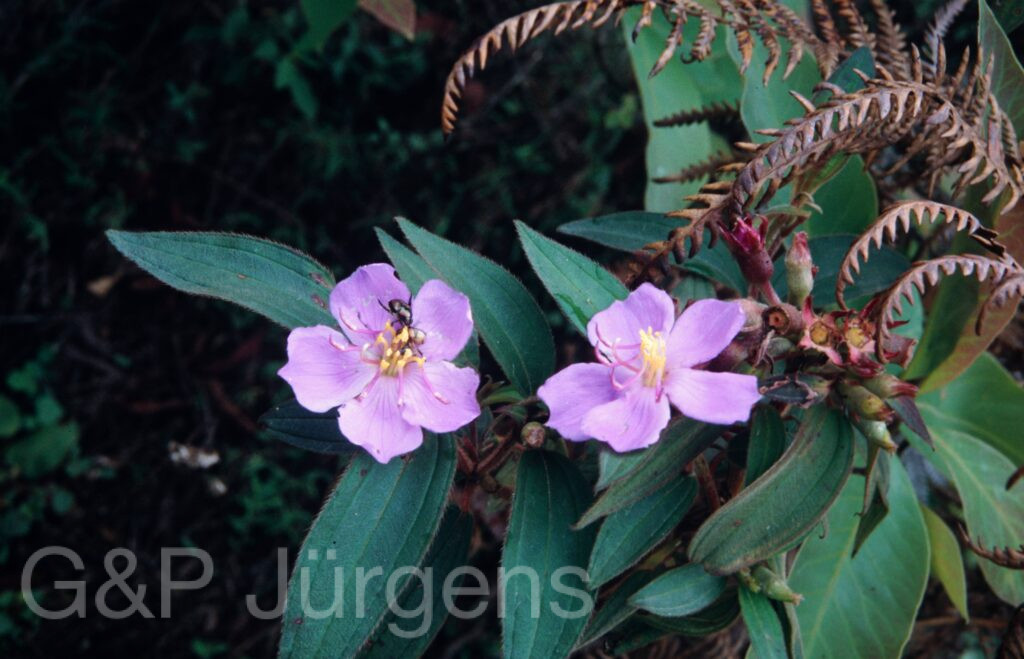
Melastoma malabathricum L. is an extremely widespread shrub of the Melastomataceae, ranging from the Indian subcontinent and the Himalayan foothills through Southeast Asia and Malesia to southern China, Taiwan, Japan, New Guinea and Australia, with naturalised populations in the Pacific and elsewhere; GBIF records are exceptionally numerous (c. 19,800 occurrences). It is a pioneer of open, disturbed and secondary habitats, roadsides, clearings, grasslands and forest margins, mostly in the tropical lowland to lower montane zone. The photographed plants from eastern Nepal at Tumlingtar (c. 400 m) and Sabha-Khola (c. 1,400 m), both flowering in April, lie at the northwestern margin of its vast range.

The plant is an erect, much-branched shrub 0.5–3 m tall, with stems and leaves clothed in appressed, stiff, scaly-bristly hairs. The leaves are opposite, ovate-lanceolate, and bear the three to five prominent, arcuate, longitudinal veins characteristic of the family. The flowers are large and showy, 4–6 cm across, with five rose-purple to mauve obovate petals. The androecium is dimorphic, with longer purple, geniculate stamens bearing curved appendaged connectives and shorter yellow stamens. The fruit is a fleshy, berry-like capsule that ruptures irregularly to expose abundant small seeds embedded in dark purple pulp, attractive to birds.

Melastoma malabathricum is a taxonomically variable aggregate that has accumulated numerous synonyms, and infraspecific forms are recognised across its range. It is an early-successional coloniser tolerant of acidic, aluminium-rich soils and is widely used in traditional medicine. Of least concern, it can behave as an invasive weed outside its native range.

Author: L. · Sources: POWO (Kew), Flora of China Vol. 13, Flora of Nepal, Flora of Bhutan Vol. 2, GBIF, Renner et al.: Melastomataceae studies

L.

Bhutan2015 547
Bhutan Mo-Shu 1450m, October
Bhutan2015 548
Bhutan Mo-Shu 1450m, October
Nepal 97 70 P109
Nepal above Mewa-Khola 1400m April

Description

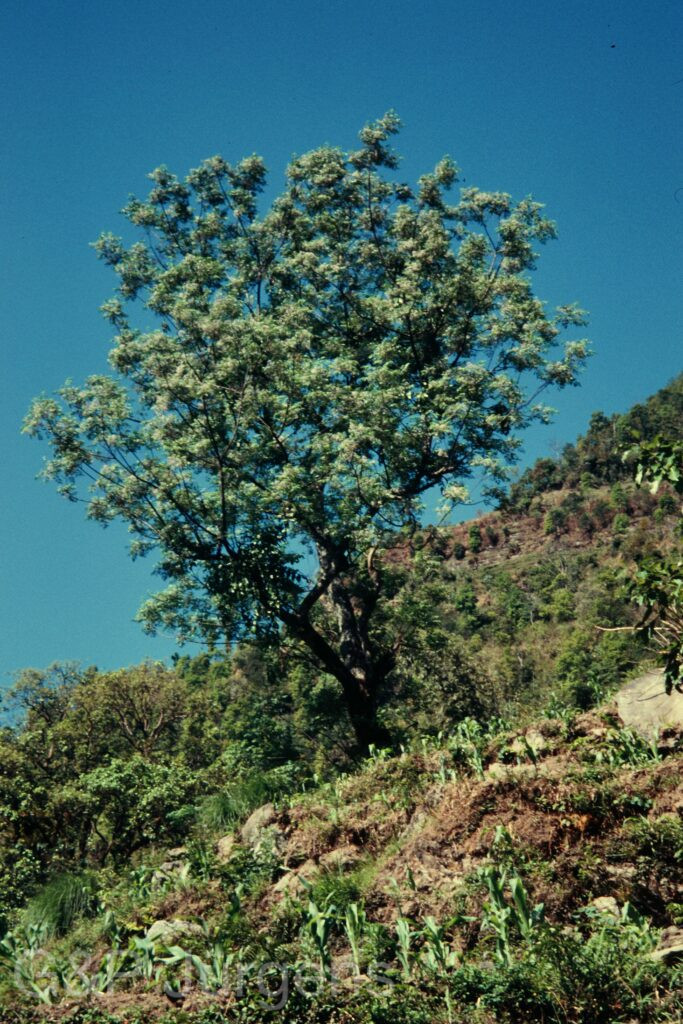
Melia azedarach, the chinaberry or Persian lilac, is a fast-growing deciduous tree of immense range, native across South and Southeast Asia and into Australia but now widely cultivated and naturalised throughout the warm temperate and tropical world, a ubiquity reflected in its GBIF total of over 66,000 occurrences spanning the United States, Australia, South Africa, Spain, France, China, Brazil, India, Japan, Korea, Argentina and far beyond. In the Himalayan region it is common in the lower hills, around villages, on field margins and along roadsides up to about 1800 m. The images from Mo-Shu in Bhutan at 1450 m, in October, and from above the Mewa-Khola in Nepal at 1400 m, in April, capture both its fruiting and flowering seasons in the warm subtropical hill belt where it thrives on a wide range of soils.

It is a tree to 10-20 m with a spreading, rounded crown and fissured, dark bark. The large leaves are alternate and bipinnate to tripinnate, with numerous ovate-lanceolate, serrate, acuminate leaflets giving a light, feathery canopy. The fragrant flowers are borne in lax axillary panicles, each with five spreading lilac to pale-purple petals and a characteristic dark purple staminal tube formed from the fused filaments, a hallmark of the genus. The fruit is a globose, yellowish drupe that persists on the bare branches well into winter, containing a hard, ridged, several-seeded stone dispersed by birds.

Melia is a small Old World genus of the mahogany family Meliaceae, of which M. azedarach is by far the most widespread and variable, with numerous forms and cultivated selections; it is valued for timber, shade and traditional medicine, though its fruits and foliage are toxic to humans and many animals owing to limonoid compounds. Outside its native range it is frequently an aggressive coloniser of disturbed ground and is classed as an invasive weed in parts of the Americas, Africa and Australia, even as it remains a familiar and useful tree across the Himalayan foothills.

Author: L. · Sources: POWO (Kew), GBIF, Flora of China Vol. 11, Flora of Nepal, Flora of Pakistan, Pennington and Styles' monograph of the Meliaceae

(C.B.Clarke) C.B.Shang

Sikkim2011 387
Sikkim Lachung 3200m, June
Sikkim2011 389
Sikkim Lachung 3200m, June
Sikkim 2006 327 ergebnis
India West-Bengal, Tolung 2400m, May

Description

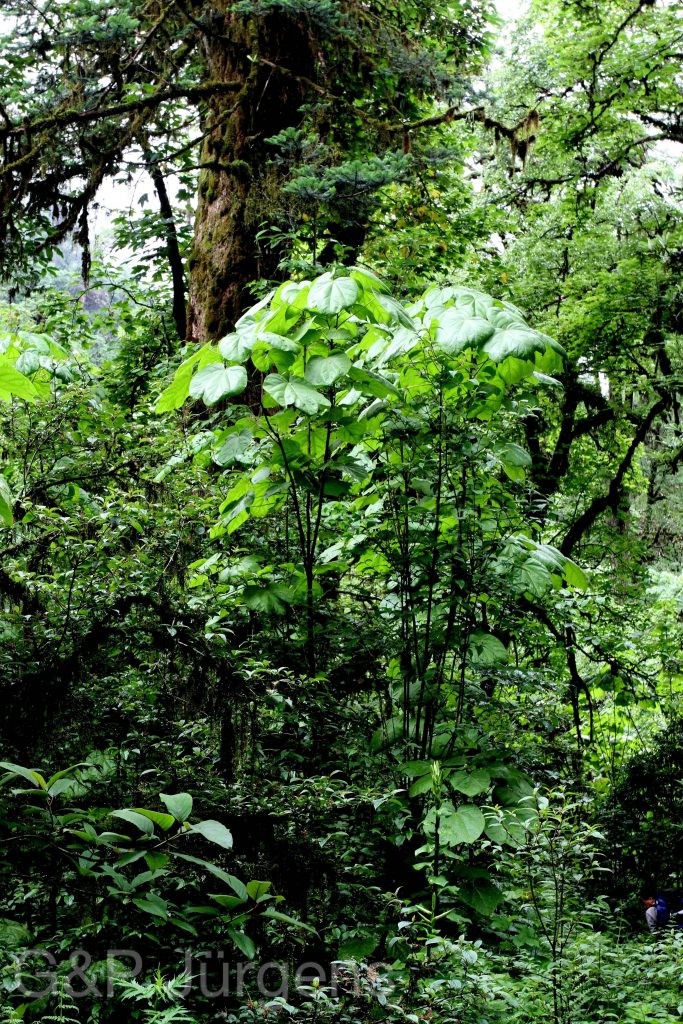
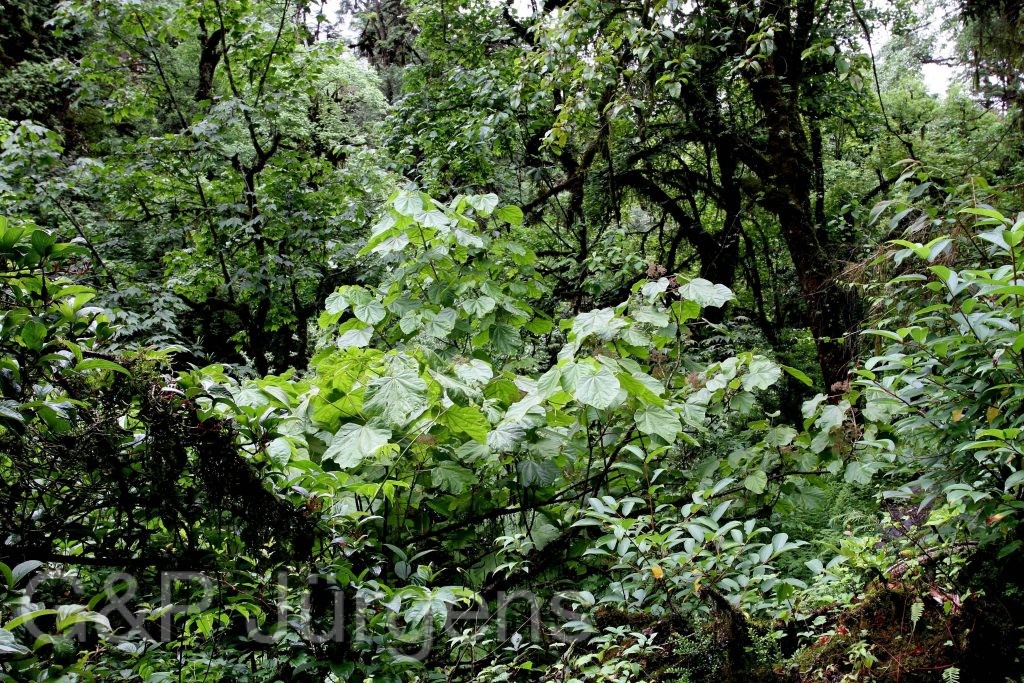
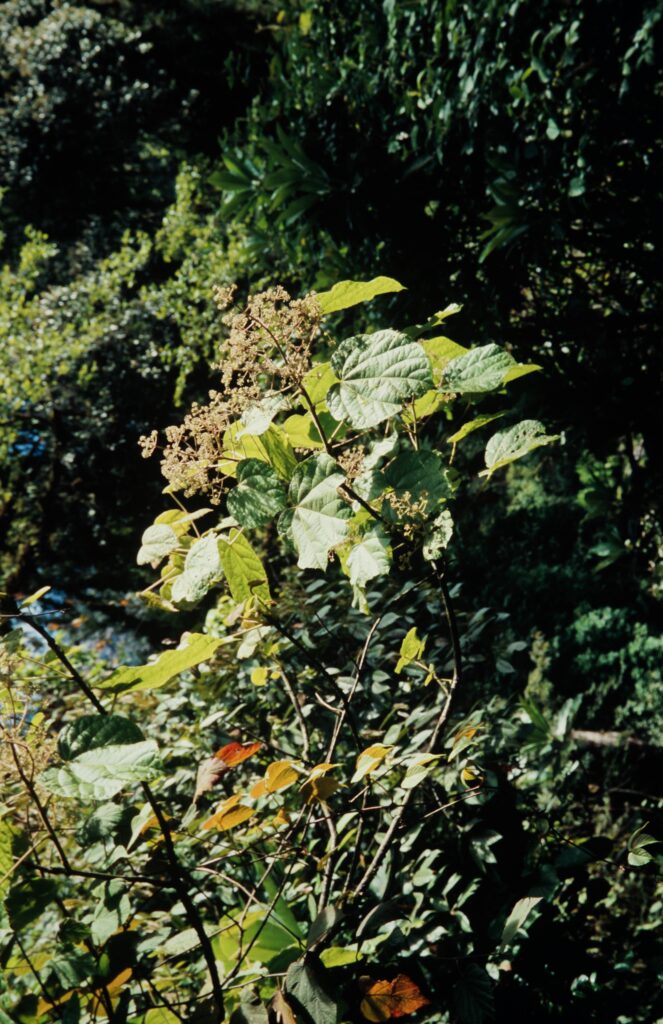
Merrilliopanax alpinus is a small tree or shrub of the eastern Himalaya and south-western China, recorded from Nepal, northern India, Bhutan and Yunnan, a comparatively narrow range reflected in only some 59 occurrence records. It inhabits moist, evergreen broad-leaved and mixed montane forest and forest margins, generally between about 2000 and 3500 m, often in shaded, humid ravines. The images here derive from Sikkim at Lachung (3200 m, June) and from the Tolung area of West Bengal (2400 m, May), localities typical of the rich, mist-bathed mid-montane forests where the genus reaches its diversity.

The plant is an evergreen with stout, sparingly branched stems bearing simple, leathery leaves clustered toward the branch tips. The leaves are large, ovate to elliptic, entire or shallowly toothed, glabrous and shining above and frequently rusty-tomentose beneath, on long petioles. The inflorescence is a terminal panicle of small umbels; the flowers are small, polygamous and greenish, with a reduced calyx, several petals and stamens, and an inferior ovary. The fruit is a small, globose to ellipsoid drupe crowned by the persistent styles.

Merrilliopanax is a small genus of the Araliaceae segregated from the broadly defined Schefflera/Aralia complex and is restricted to the Sino-Himalayan region; M. alpinus was described by C.B.Clarke and transferred to the genus by C.B.Shang. Its simple (rather than compound) leaves distinguish it from many relatives. The drupes are bird-dispersed, and the species is a localised but characteristic element of eastern Himalayan cloud forest. Its restricted range makes it of biogeographic interest and potentially sensitive to forest loss, though no formal threat assessment is widely established.

Author: (C.B.Clarke) C.B.Shang · Sources: POWO (Kew), GBIF, Flora of China, Flora of Bhutan, Shang revision of Merrilliopanax, Frodin & Govaerts World Checklist of Araliaceae

Benth.

Bhutan2014 1027
Bhutan Paro 2320m, May
Bh2008 553 G837
Bhutan Paro 1900m April

Description

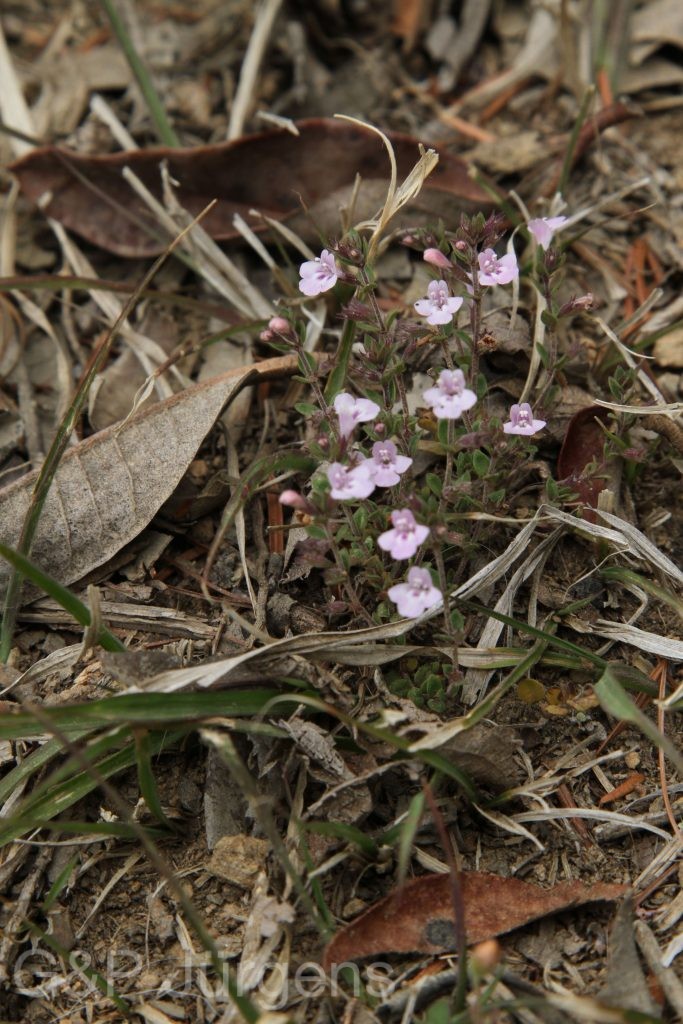
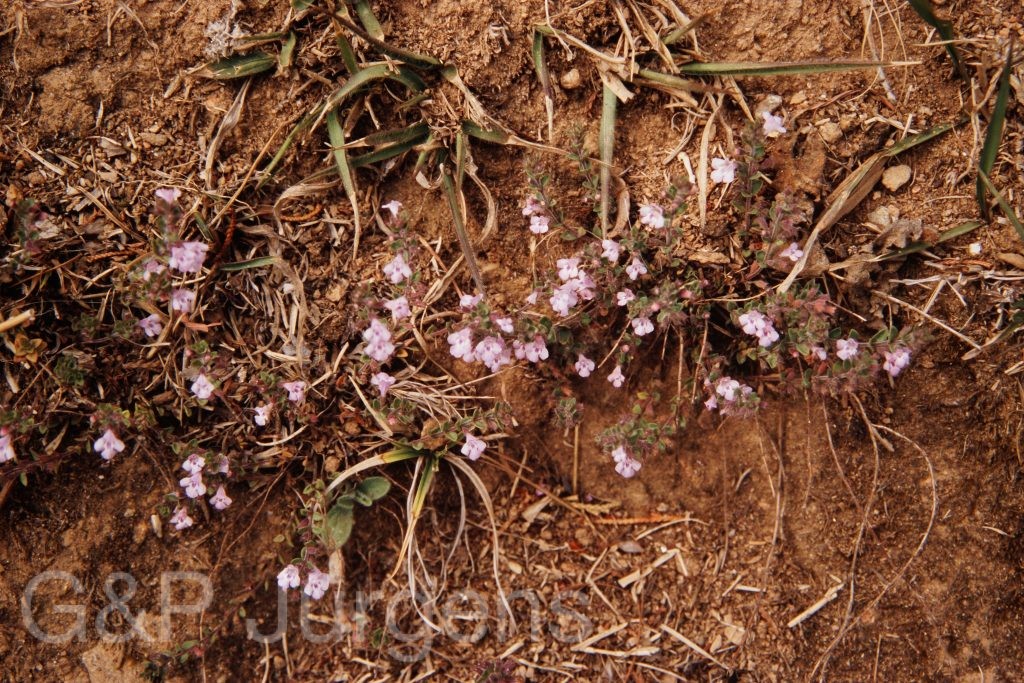
Micromeria biflora is an aromatic herb of remarkably wide Palaeotropical-to-Himalayan distribution, ranging from tropical and southern Africa (Ethiopia, Kenya, Tanzania, South Africa, Zimbabwe, Cameroon, Congo and others) through the Arabian Peninsula (Saudi Arabia, Yemen) and across to Afghanistan, Pakistan, India, Nepal, Bhutan, Myanmar and China; its nearly 1700 georeferenced occurrences underline this broad Old World range. It grows on dry, open, rocky and grassy slopes, banks and disturbed ground in the warm-temperate and montane belts, commonly between about 1500 and 2800 m. The plants documented around Paro in Bhutan at 1900-2320 m in April and May occupy exactly such sunny, well-drained hillsides.

It is a slender, much-branched perennial subshrub forming low, wiry tufts from a woody base, the quadrangular stems finely pubescent and clothed with a strong thyme-like aroma. The leaves are small, opposite, ovate to elliptic, entire and often revolute-margined, gland-dotted and short-petiolate. The pink to pale purple flowers are borne in axillary pairs or small few-flowered whorls, hence the epithet biflora; each has a tubular, ribbed, two-lipped calyx and a bilabiate corolla with the lower lip three-lobed, with four didynamous stamens. The fruit comprises four smooth, ovoid nutlets enclosed in the persistent calyx.

Micromeria belongs to tribe Mentheae of the Lamiaceae, allied to Clinopodium and Satureja, and the generic limits of this group have been much revised on molecular grounds. Rich in volatile monoterpene oils, M. biflora is widely used in folk medicine and as an aromatic herb. Its extensive range and tolerance of disturbed, arid habitats make it a successful and unthreatened species.

Author: Benth. · Sources: POWO (Kew), GBIF, Flora of China, Flora of Bhutan, Flora of Pakistan, Flora of Tropical East Africa, Harley's treatment of Labiatae

Benth.

Sikkim 2006 269 ergebnis
India West-Bengal, Lingza 1300m, May

Description

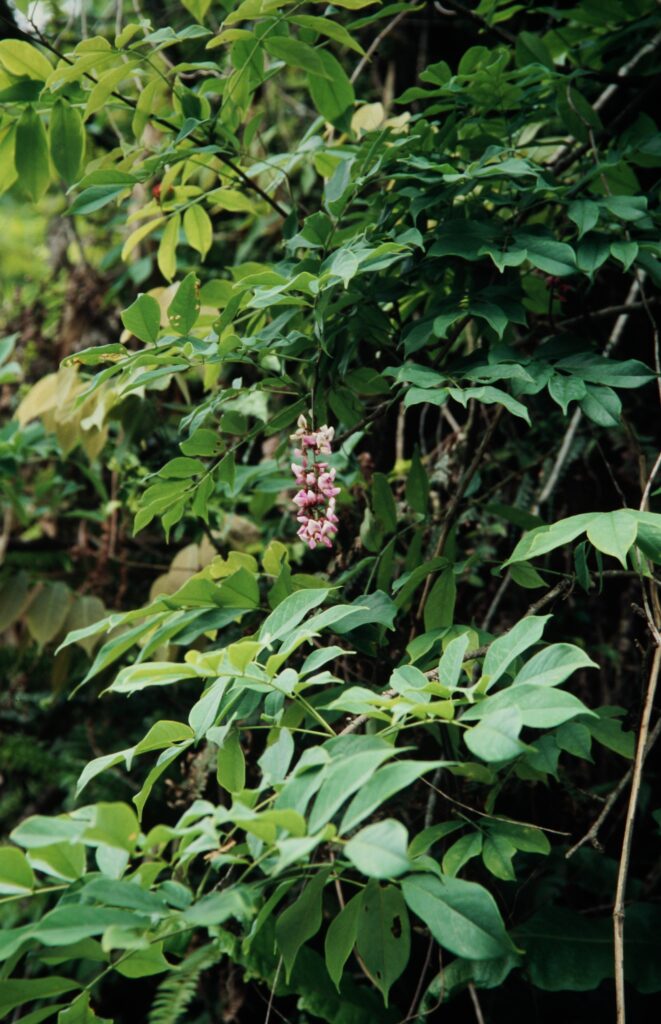
Millettia pachycarpa is a robust woody climber of the eastern Himalaya and South-East Asia, ranging from Nepal, Bhutan and north-east India through Bangladesh, Myanmar, Thailand, Laos and Vietnam to southern China and Taiwan. GBIF holds around 2140 occurrences across this subtropical to warm-temperate range. It grows in broad-leaved forest, forest margins, ravines and along streams, scrambling over trees at low to middle elevations. The plant from Lingza in the Darjeeling hills of West Bengal at 1300 m in May represents a typical eastern Himalayan population, flowering in spring before the monsoon.

It is a large, woody, deciduous liana with stout twining stems. Its leaves are alternate and imparipinnate, with numerous opposite, oblong to oblong-lanceolate leaflets that are dark green and somewhat leathery, glabrescent above and finely appressed-hairy beneath. The flowers are borne in long, dense, pendulous axillary racemes or panicles, the corolla papilionaceous and lilac to purplish-pink, the standard broad and often silky-hairy outside enclosing the wing and keel petals; the stamens are diadelphous and the ovary superior. The fruit is a large, thick, woody pod (the epithet pachycarpa meaning thick-fruited), pendulous and often tuberculate, indehiscent or tardily so, with one to several large hard seeds.

Millettia belongs to tribe Millettieae of the papilionoid Fabaceae, a group much revised in recent decades with several Asian species transferred to allied genera; M. pachycarpa is retained in Millettia in current treatments. The plant is notable for its high content of rotenoids and isoflavonoids: the seeds and roots have long been used as fish poison and insecticide across its range, and it is an important source of rotenone-type compounds. Widespread and frequent in eastern Himalayan forests, it is of no conservation concern.

Author: Benth. · Sources: POWO (Kew), GBIF, Flora of China Vol. 10, Flora of Bhutan Vol. 1, Annotated Checklist of the Flowering Plants of Nepal, Geesink revision of Millettieae

Morus indica

by GP Jürgens

L.

Nepal 97 362 P710
Nepal Arun-Valley 1700m May

Description

Morus indica L. is a deciduous tree or shrub of the mulberry family, widely distributed across temperate and subtropical Asia and extensively cultivated. GBIF documents over 14,000 records from China, India, Taiwan, Korea, Japan, Myanmar, the Philippines and Thailand, together with introductions in Europe and the Americas, reflecting its long history of cultivation for sericulture and fruit. In the Himalaya it occurs in subtropical and lower temperate forest, along valley sides, field margins and roadsides; the photographed plant is from Nepal, the Arun Valley, at 1,700 m in May, a typical mid-elevation montane setting.

The plant is a small to medium tree with grey, fissured bark and milky latex. The leaves are alternate, ovate, often unequally cordate at the base, with a serrate or dentate margin and an acuminate apex; juvenile and coppice leaves are frequently variously lobed, a common feature of the genus. The plant is dioecious or monoecious, the inconspicuous unisexual flowers borne in short, dense, pendent axillary catkins (spikes); staminate flowers have four tepals and four stamens, pistillate flowers a superior ovary with a bifid stigma. The fruit is a fleshy sorosis (multiple fruit) formed from the accrescent perianths, ripening from greenish through red to dark purple-black and edible.

The taxonomy of Asian Morus is unsettled, with M. indica often treated as part of the variable M. alba complex and subject to differing circumscriptions. The species is of major economic importance as the principal food plant of the silkworm and as a fruit and fodder tree, and is consequently both wild and widely naturalised; it is not of conservation concern.

Author: L. · Sources: POWO (Kew), GBIF, Flora of China Vol. 5, Flora of Nepal, Flora of Bhutan Vol. 1, Berg: Moraceae (Flora Malesiana)

Mucuna macrocarpa

by GP Jürgens

Wall.

Nepal 1994 57 ergebnis
Ost-Nepal Bhalukhob 
1800m April
Nepal 1994 55 ergebnis
Ost-Nepal Bhalukhob 
1800m April

Description

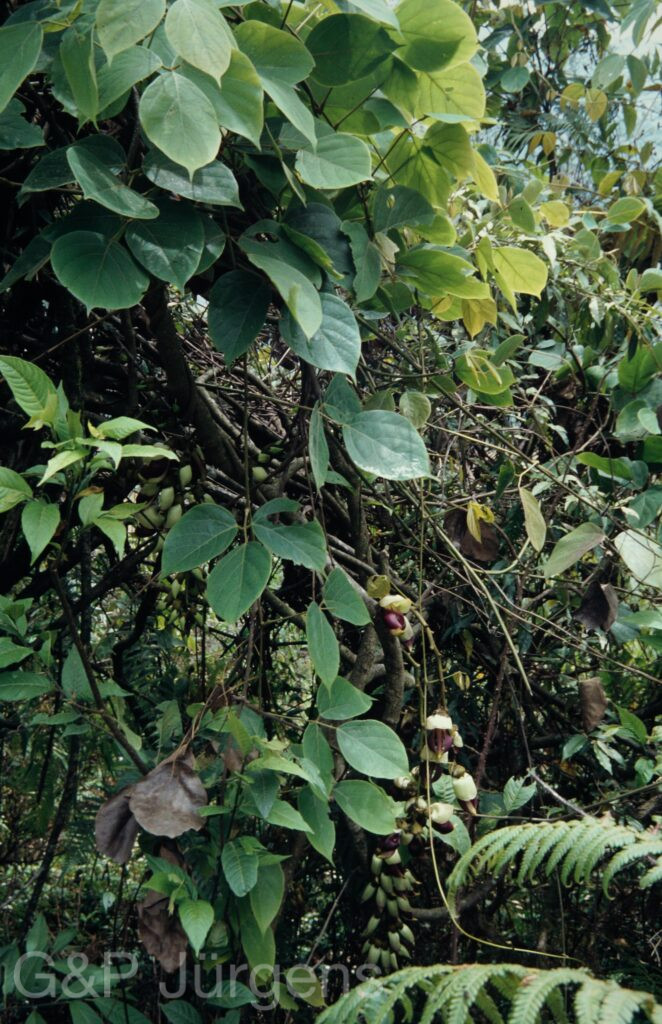
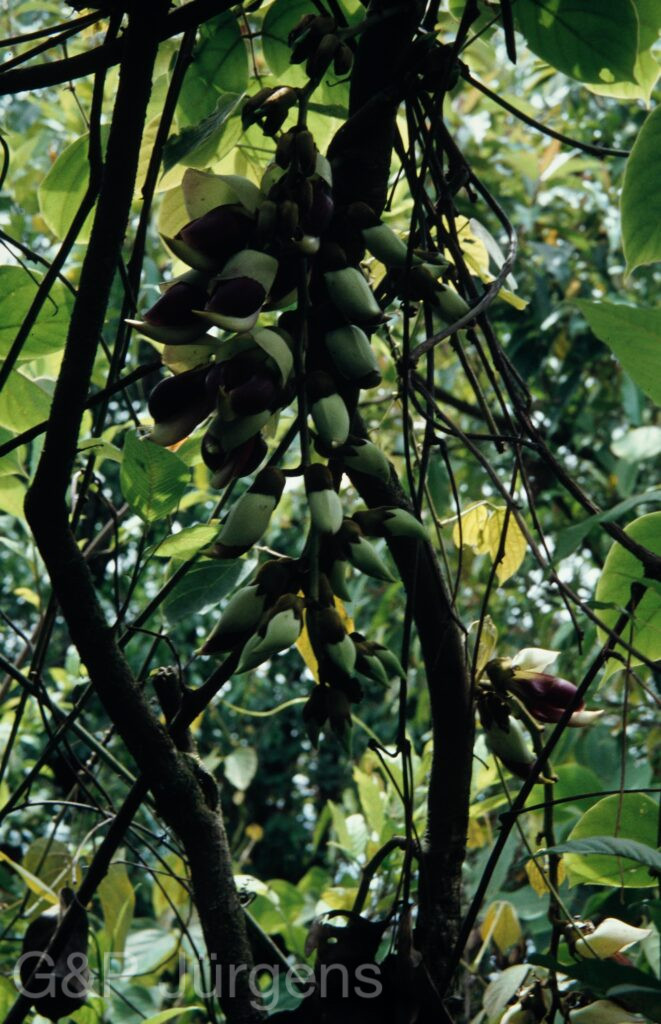
Mucuna macrocarpa is a large woody climber of subtropical and tropical Asia, ranging from Taiwan, Japan and China through Thailand, Laos, Myanmar, India, Vietnam, Nepal, Malaysia and Bhutan; GBIF records some 2100 occurrences, making it by far the best-documented species in this set. It scrambles through warm broadleaved and evergreen forest, along forest edges and ravine slopes at lower montane elevations. The photographed plant grows at Bhalukhob in East Nepal at about 1800 m, flowering in April, in humid subtropical hill forest.

It is a robust, perennial liana with stout woody stems and trifoliolate leaves bearing large, broadly ovate to elliptic leaflets. The pendent, cauliflorous to ramiflorous inflorescences carry showy papilionaceous flowers with a dark, often deep purple to maroon or greenish keel and standard, the keel curved and enclosing the stamens and style. The fruit is a large, woody, oblong pod, broad and often flattened, conspicuously ribbed or winged and clothed in irritant hairs, enclosing several hard, disc-shaped seeds.

The species is accepted. Mucuna is noted for explosive, mechanically triggered flowers adapted to vertebrate pollination: in this and related species the keel snaps open under the manipulation of nectar-feeding bats and, locally, other mammals or large birds, a celebrated case of chiropterophily. The stinging pod hairs deter herbivores, while the buoyant seeds are reported to disperse by water. Its wide range and frequency indicate a secure conservation status across monsoon Asia.

Author: Wall. · Sources: POWO (Kew), GBIF, Flora of China, Flora of Bhutan, Wilmot-Dear's revisions of Asian Mucuna (Leguminosae)

(Stokes) Faden

Description

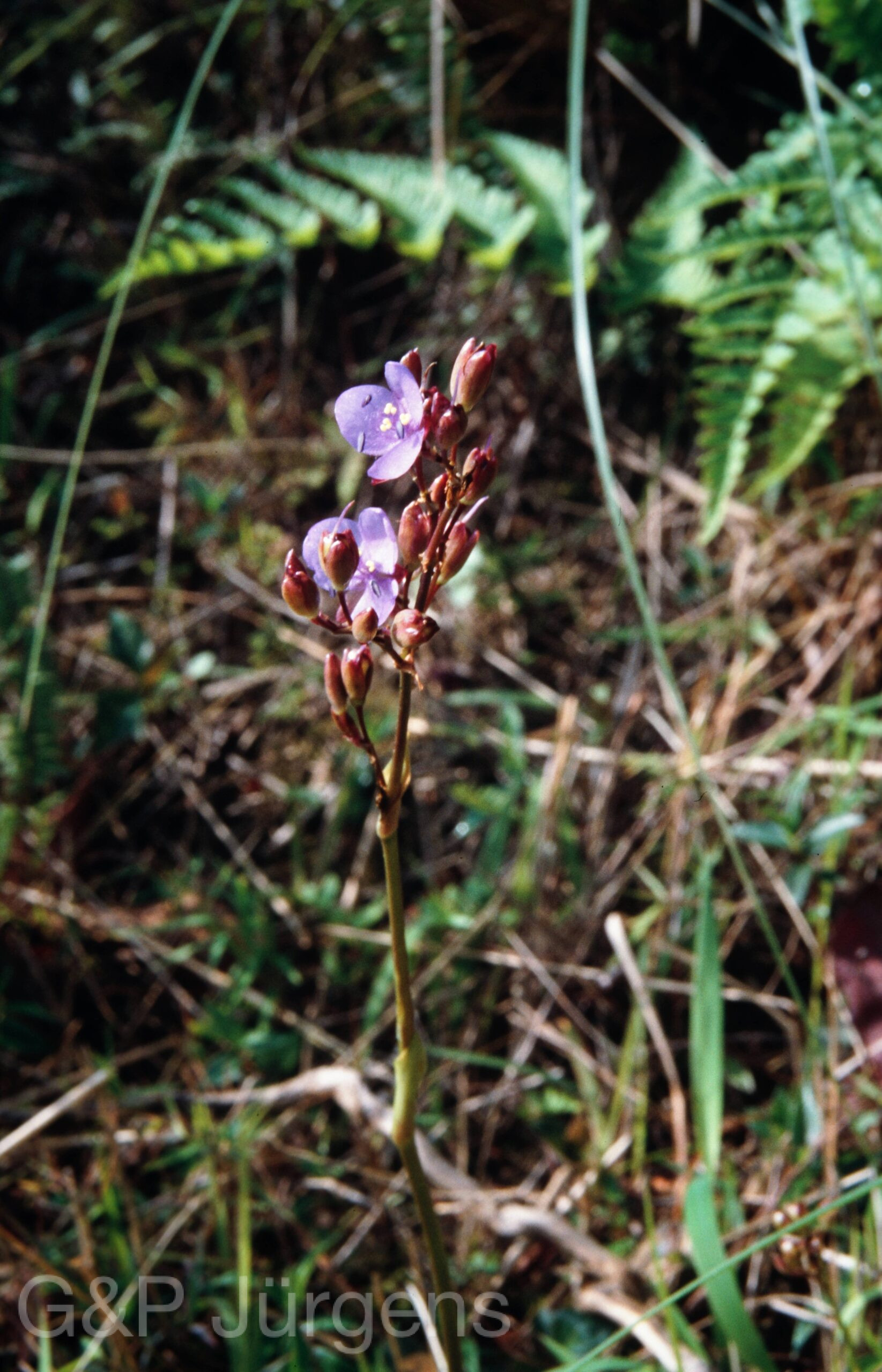
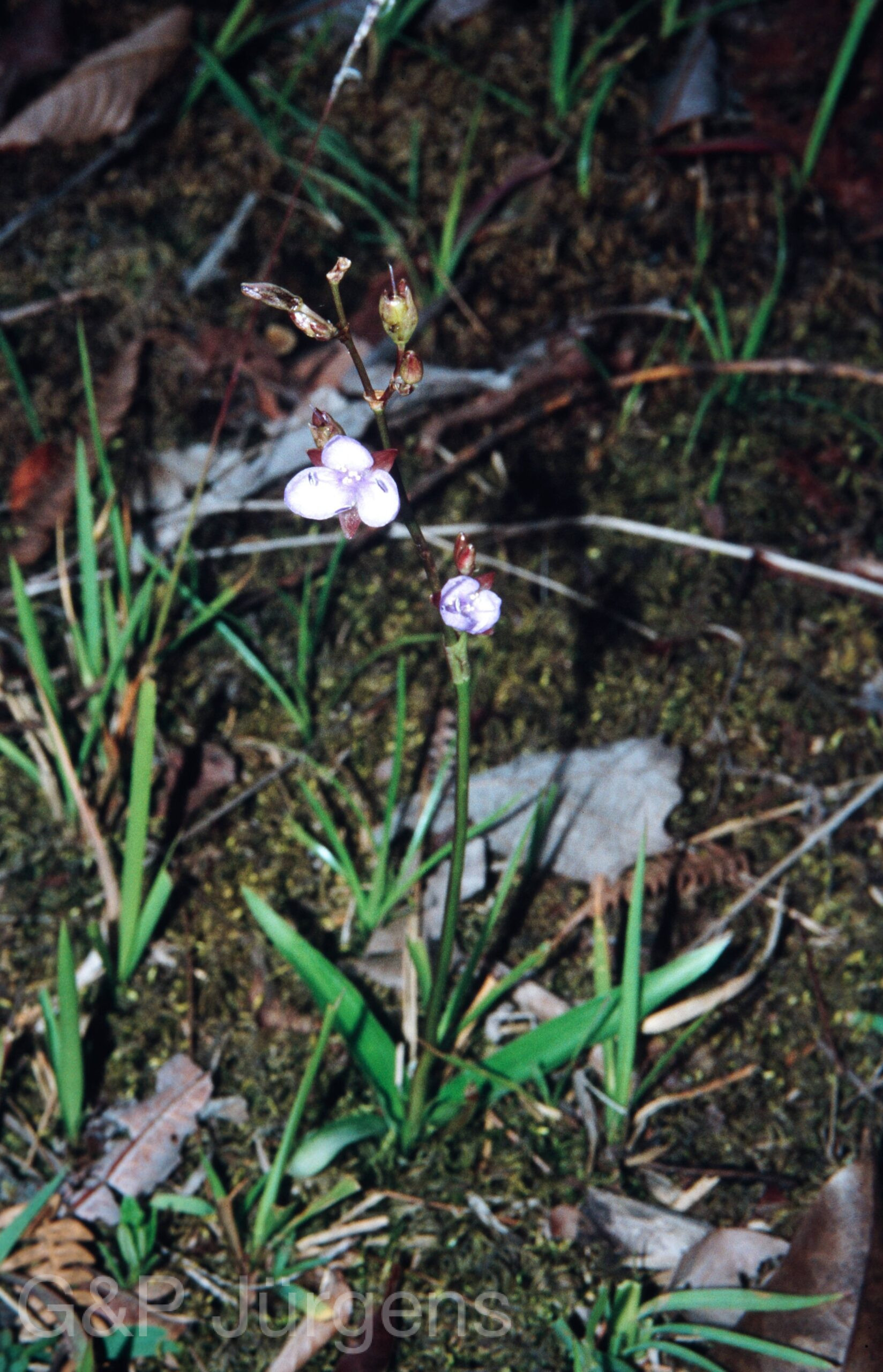
Murdannia edulis is a tuberous-rooted dayflower relative distributed across tropical and subtropical Asia, from the Himalaya (Nepal, Bhutan, northeast India) through southern China, Taiwan, Myanmar, Thailand and Indochina to Malesia, the Philippines and New Guinea. It grows in open grassland, scrub, forest margins and seasonally moist banks, often on disturbed or cultivated ground, principally at low to mid elevations. The plant recorded at Mulabari in the Gorkha district of Nepal at 1,340 m in May represents its presence in the warm subtropical foothill zone, where it emerges and flowers with the onset of the pre-monsoon rains.

The plant is a perennial herb arising from a cluster of fleshy, fusiform, fascicled tuberous roots that store water and nutrients. The leaves are mostly radical, linear to lanceolate, sheathing at the base and arranged in a basal tuft, with parallel venation typical of the family. The inflorescence is a scapose, terminal panicle of cincinni bearing ephemeral, actinomorphic flowers with three free, pink to pale blue or mauve petals and conspicuous bearded staminodes accompanying the fertile stamens. The fruit is a small, loculicidal, ellipsoid capsule containing few angular seeds.

The genus Murdannia, segregated from Aneilema and Commelina, is distinguished by its enantiostylous, regular flowers and characteristic stamen arrangement; M. edulis was transferred to the genus by Faden, its basionym attributed to Stokes. As the epithet indicates, the starchy tuberous roots are edible and have been used as a famine or supplementary food across its range. The species is widespread, weedy and adaptable, and is of no conservation concern.

Author: (Stokes) Faden · Sources: POWO (Kew), Flora of China Vol. 24, Flora of Nepal, GBIF, Faden: Commelinaceae systematics