Tag:

Subalpine (2500-3500 m)

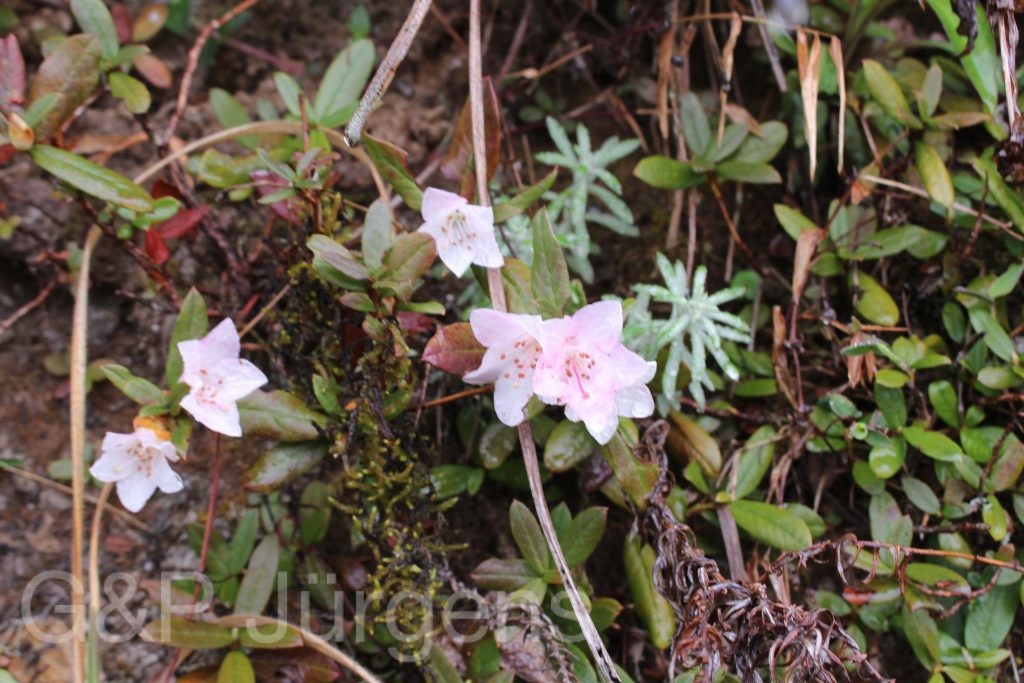
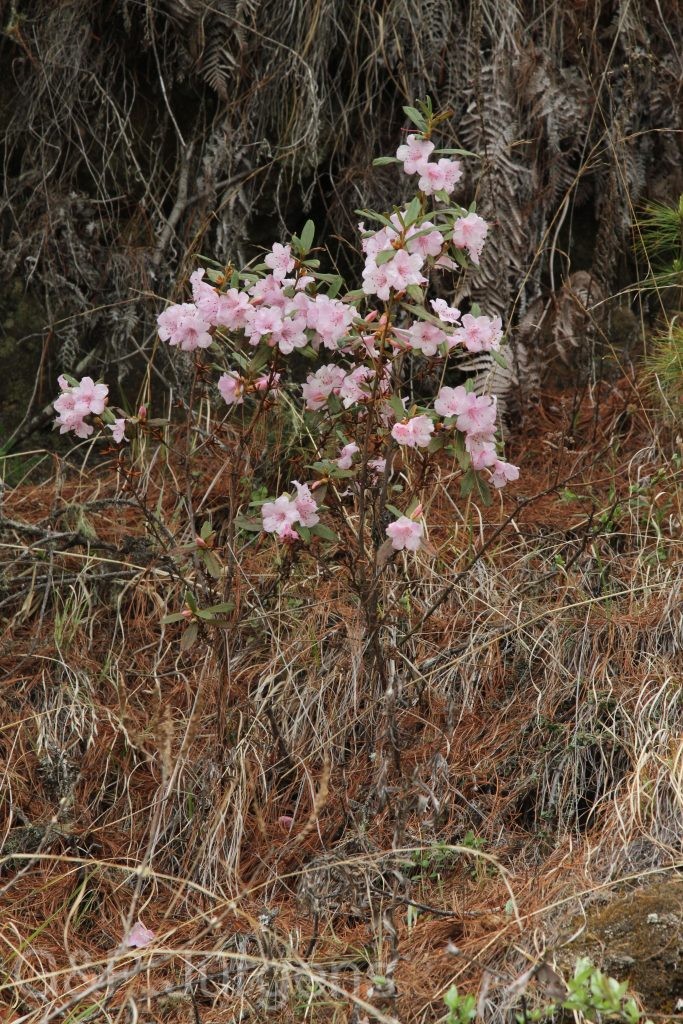
Hook. f.

Bhutan2014 357
Bhutan Tumching-La 3100m, May
Bhutan2014 402
Bhutan Yatong-La 2900m, May
Bhutan2014 403
Bhutan Yatong-La 2900m, May

Description

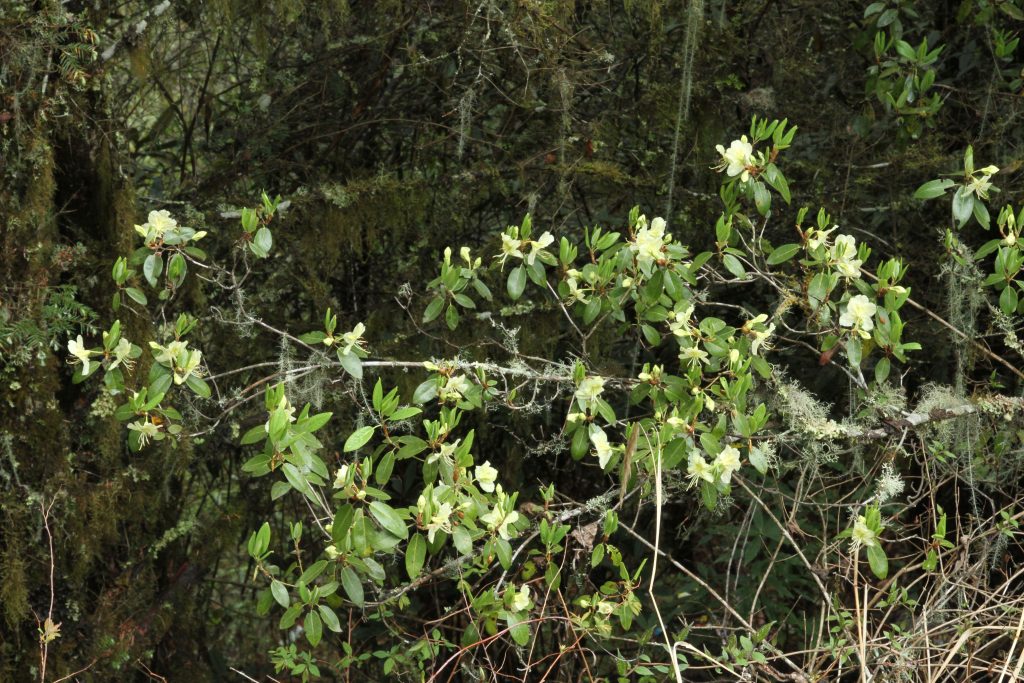
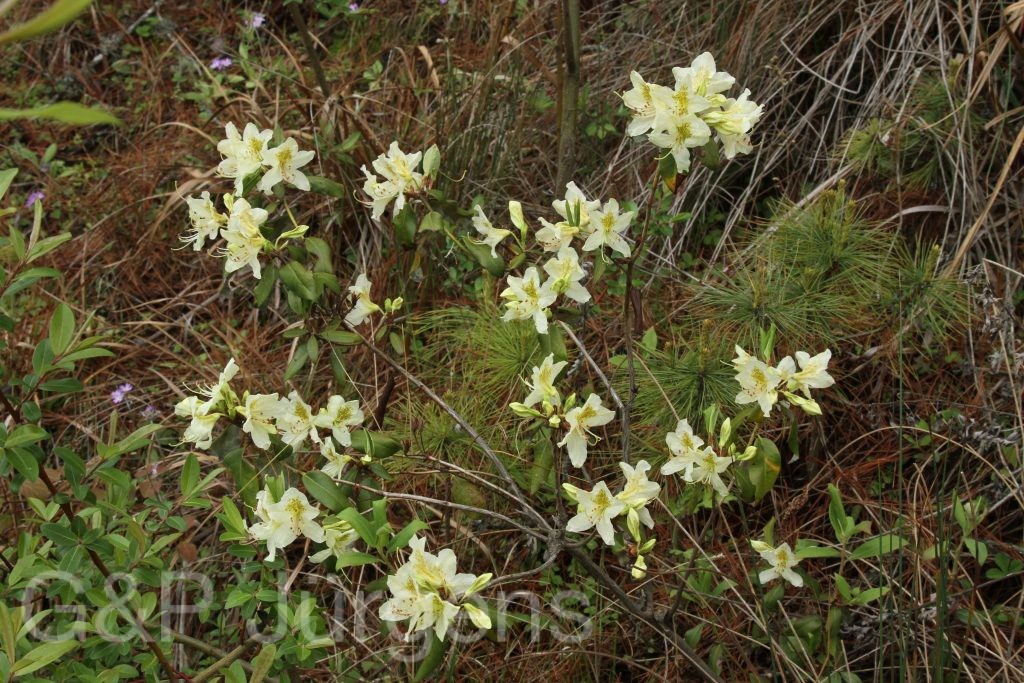
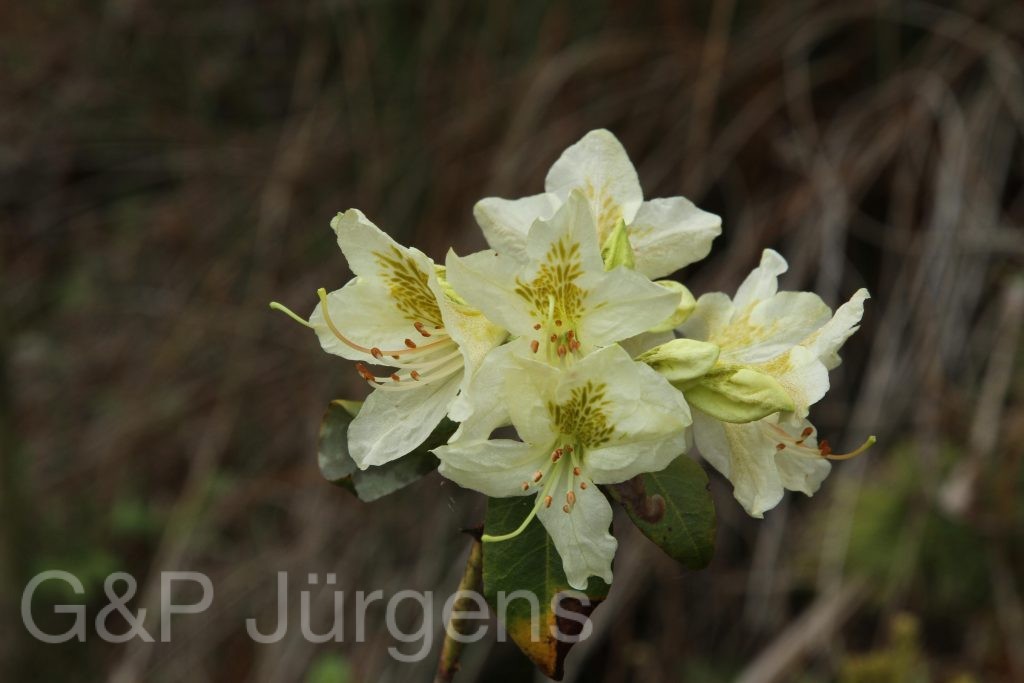
Rhododendron triflorum is an eastern Himalayan rhododendron distributed across China, Bhutan, India, Nepal and Myanmar, with about 484 GBIF occurrences (additional records abroad reflecting its popularity in cultivation). It grows in temperate forest, forest margins, rhododendron and conifer thickets and open shrubby slopes, generally between roughly 2700 and 3700 m. The plants photographed at Tumching-La (about 3100 m) and Yatong-La (about 2900 m) in Bhutan, both in May, exemplify its mid-montane forest habitat, where it flowers in late spring among mixed broad-leaved and coniferous woodland.

The species is an erect shrub or small tree with smooth, attractive coppery to reddish-brown, peeling bark. The leaves are evergreen, ovate to elliptic, glabrous above and conspicuously scaly (lepidote) beneath, the scales characteristic of the lepidote rhododendrons. The flowers are borne in small terminal clusters, typically in threes as the epithet triflorum indicates; the broadly funnel-campanulate corolla is pale yellow, often flushed or spotted with green, and densely scaly outside. There are ten stamens and a scaly ovary, and the fruit is a small dry capsule splitting to release numerous minute seeds.

Rhododendron triflorum belongs to subgenus Rhododendron (the lepidote, scaly-leaved rhododendrons), section Triflora, a group of slender-flowered species centred on the Sino-Himalaya. The lepidote indumentum and small capsular fruits with abundant wind-dispersed seed are characteristic of this clade. With a wide eastern Himalayan distribution the species is of least concern, and its handsome bark and yellow flowers have made it a valued ornamental; like its congeners it is an important component of the rhododendron-dominated temperate forests of the eastern Himalaya.

Author: Hook. f. · Sources: POWO (Kew), GBIF, Flora of China, Flora of Bhutan, Annotated Checklist of the Flowering Plants of Nepal, Cullen revision of lepidote Rhododendron
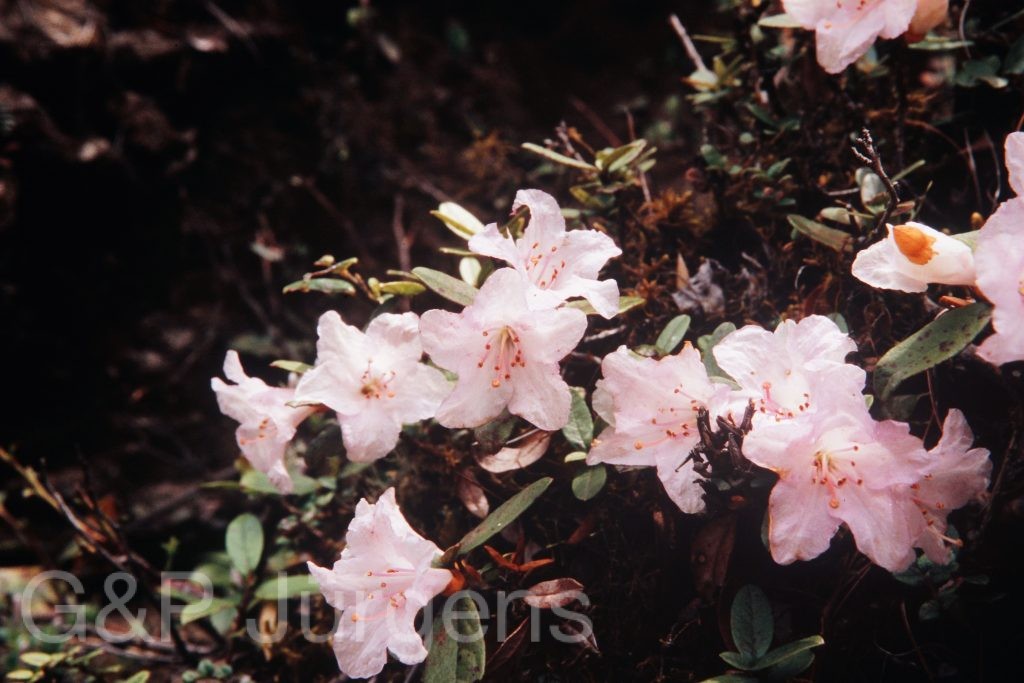
Hook. f.

Bhutan2014 43
Bhutan Trashigang 1300m, May
Bhutan2014 391
Bhutan Tumching-La 3000m, May
Bh2008 146 P243
Bhutan Chendebji, 2450m April

Description

Rhododendron vaccinioides Hook. f. is a small epiphytic rhododendron of the eastern Himalaya and adjacent montane Asia, ranging from Nepal and India through Bhutan to southern China, Myanmar and Vietnam, with around 245 GBIF occurrences. It grows characteristically as an epiphyte on mossy trunks and branches, and occasionally on rocks, in humid broadleaved and mixed evergreen forest, across a wide altitudinal span. The three Bhutan gatherings cited, from Trashigang at 1300 m and Chendebji at 2450 m flowering in April and May, and Tumching-La at 3000 m, illustrate its broad range from warm subtropical to cool temperate cloud forest where atmospheric moisture is high.

The species is a dwarf, much-branched epiphytic shrub with slender twigs clothed in scales and bearing small, obovate, leathery leaves whose lower surface is densely lepidote, resembling the foliage of Vaccinium as the epithet implies. The flowers are small, solitary or few together at the branch tips, with a short tubular to campanulate, white to pale pink corolla, the lobes spreading; the ovary and style are scaly. The fruit is a small lepidote capsule splitting septicidally to release numerous minute seeds adapted to wind dispersal in the canopy.

Rhododendron vaccinioides belongs to subgenus Rhododendron, section Vireya-allied scaly rhododendrons, an epiphytic lineage radiating through the wet forests of Asia. Its diminutive epiphytic habit is unusual among Himalayan rhododendrons. Widespread and locally frequent, it is of least conservation concern, though dependent on intact humid forest canopy.

Author: Hook. f. · Sources: POWO (Kew), GBIF, Flora of Bhutan, Flora of China, The Genus Rhododendron (Royal Botanic Garden Edinburgh), Cullen monograph of lepidote Rhododendron
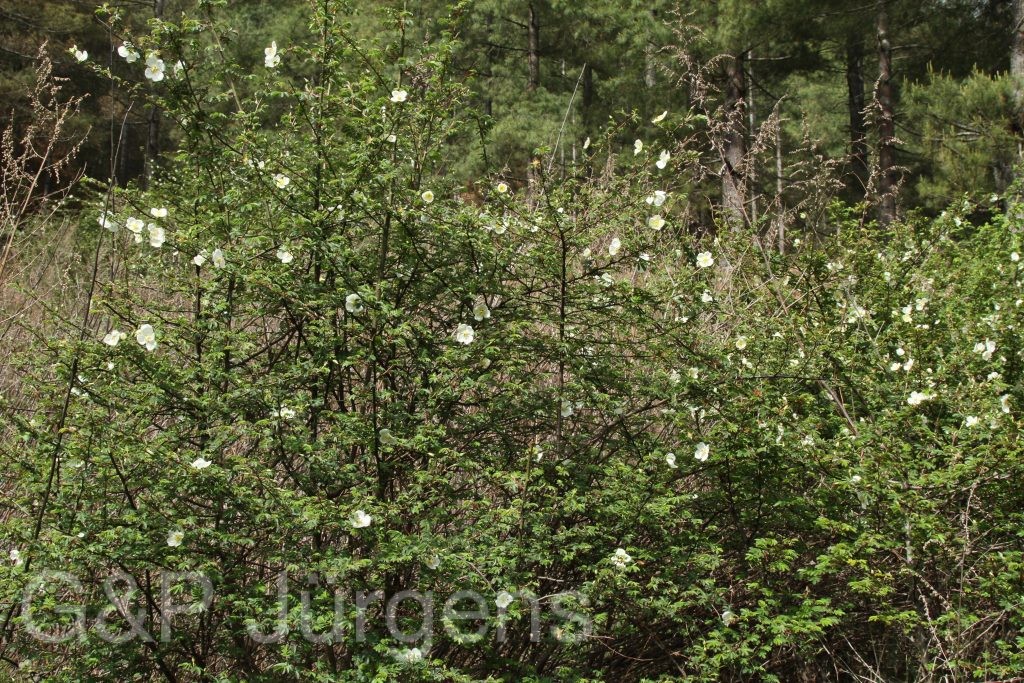
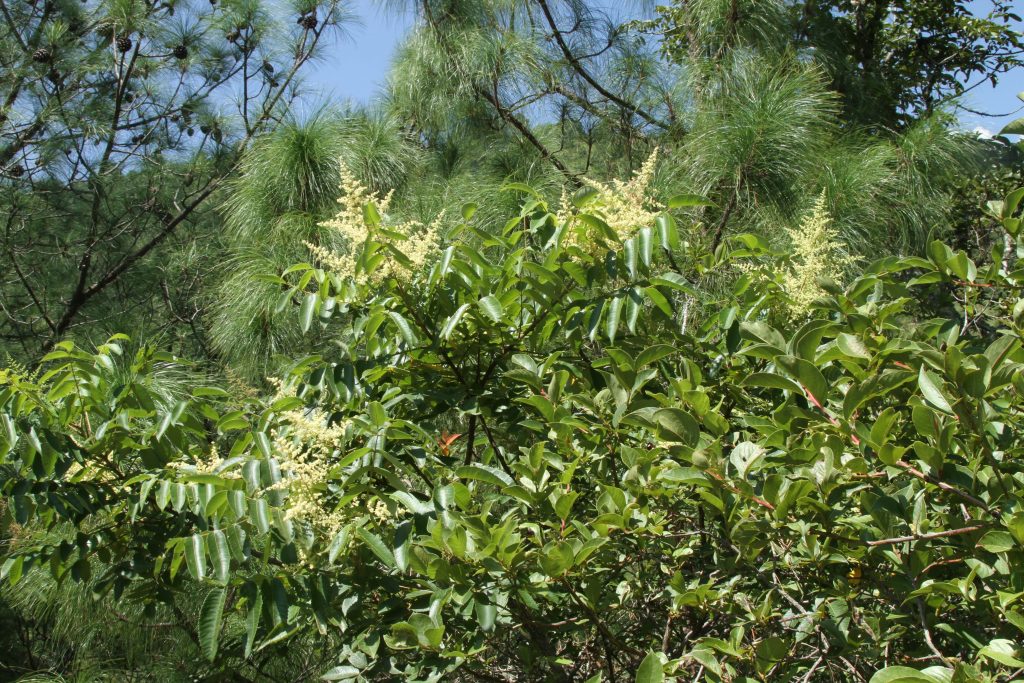
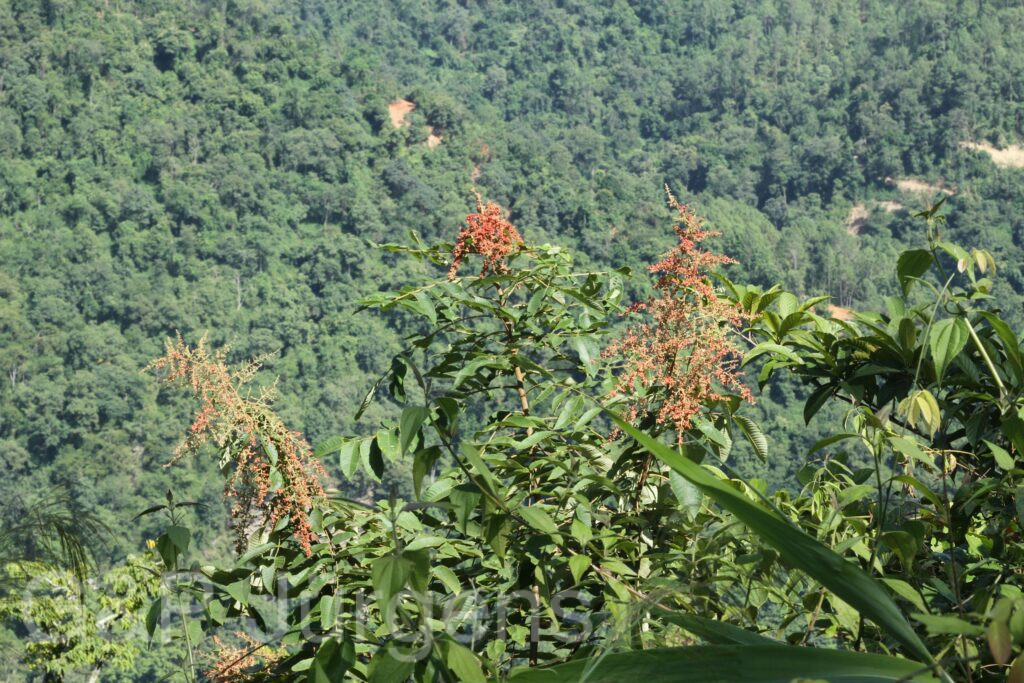
Mill.

Bhutan2012 535
Bhutan Wangdi 2600m, September
Bhutan2015 252
Bhutan Zhemgang 900m, October

Description

Rhus chinensis is a widespread deciduous shrub or small tree of East and South Asia, recorded across China, Taiwan, Japan, Korea, India, Vietnam, Thailand, Myanmar, Nepal, Bhutan and beyond, with more than ten thousand documented occurrences making it one of the most frequently collected sumacs in the region. It is a pioneer of open and disturbed ground, colonising forest margins, clearings, roadsides, scrub and abandoned cultivation from the lowlands into the montane zone. In Bhutan it ranges over a wide elevational band, as shown by collections near Wangdi at about 2600 m in September and at Zhemgang at 900 m in October, the autumn dates corresponding to fruiting.

The plant is a shrub to small tree with greyish bark and stout, often warted branchlets. The leaves are alternate and odd-pinnate, the rachis characteristically winged between the leaflets; the leaflets are ovate to oblong, coarsely serrate, acuminate, and tomentose beneath, turning red in autumn. The inflorescence is a large terminal pubescent panicle of numerous small whitish to greenish-yellow flowers, the plant functionally dioecious. The fruit is a small, flattened, reddish drupe covered with short hairs and a sour, salty surface bloom.

Rhus chinensis is the principal host of the Chinese sumac aphid Schlechtendalia chinensis, whose feeding induces large hollow leaf galls extraordinarily rich in tannins; these galls, known as Chinese galls or wubeizi, are harvested as a major commercial source of gallotannic acid and are valued in traditional medicine and dyeing. Wax from the fruit and the tannin-laden tissues have long been utilised economically. Hardy, fast-growing and broadly tolerant of disturbance, the species is abundant throughout its range and faces no conservation concern, functioning ecologically as an early-successional colonist.

Author: Mill. · Sources: POWO (Kew), GBIF, Flora of China Vol. 11, Flora of Bhutan Vol. 2, Flora of Nepal, Flora of Pakistan, Min & Barfod treatment of Anacardiaceae

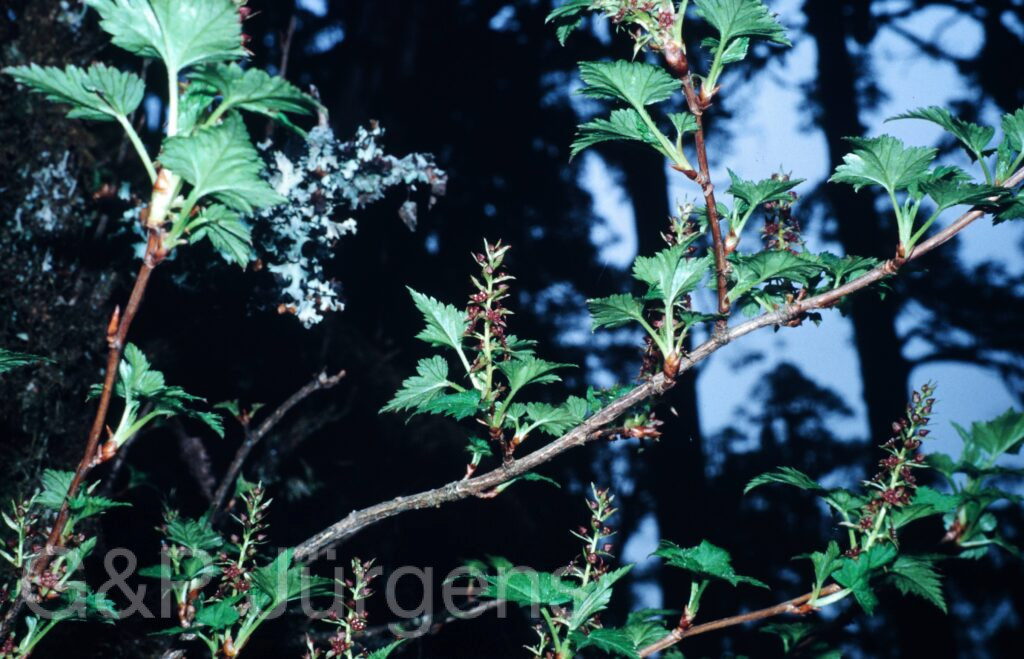
Wall.

Nepal 2001 373 ergebnis ergebnis
Nepal Kharka 3140m, May

Description

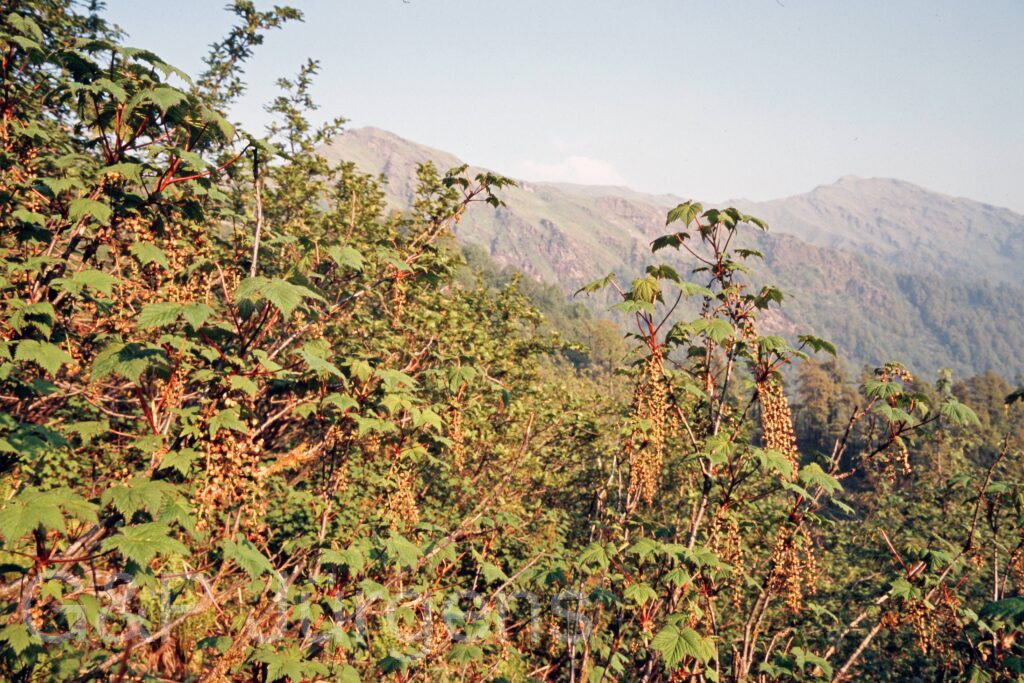
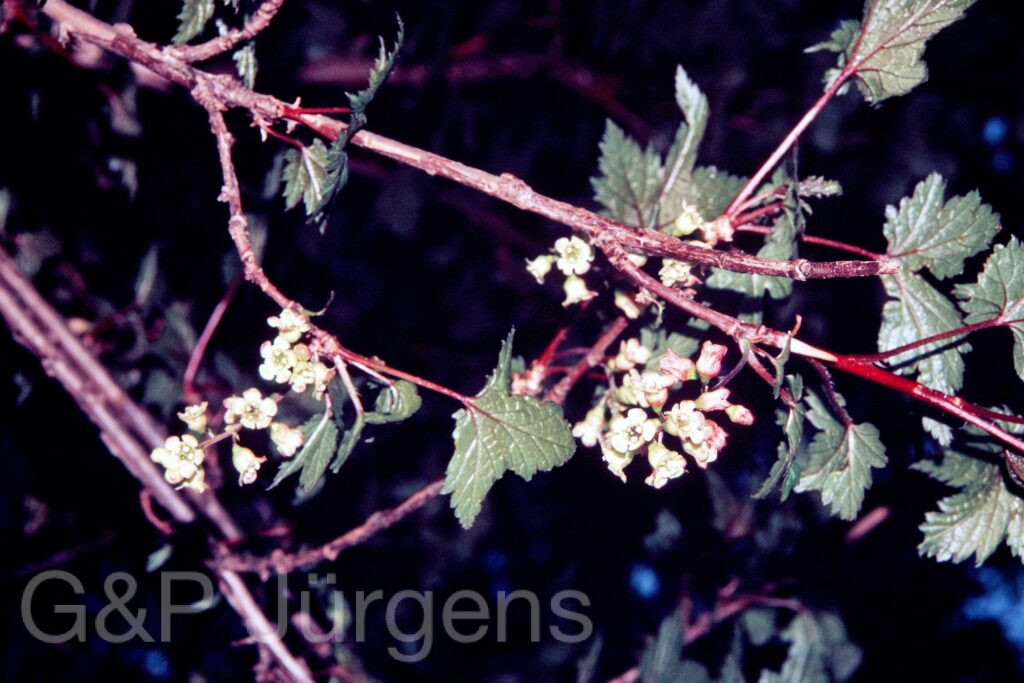
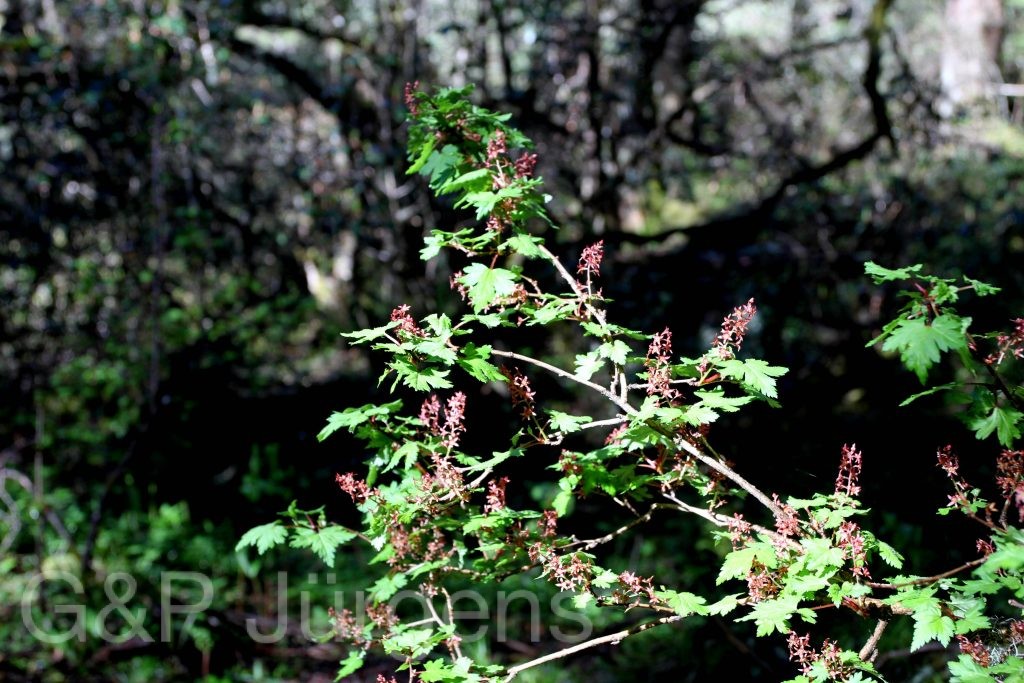
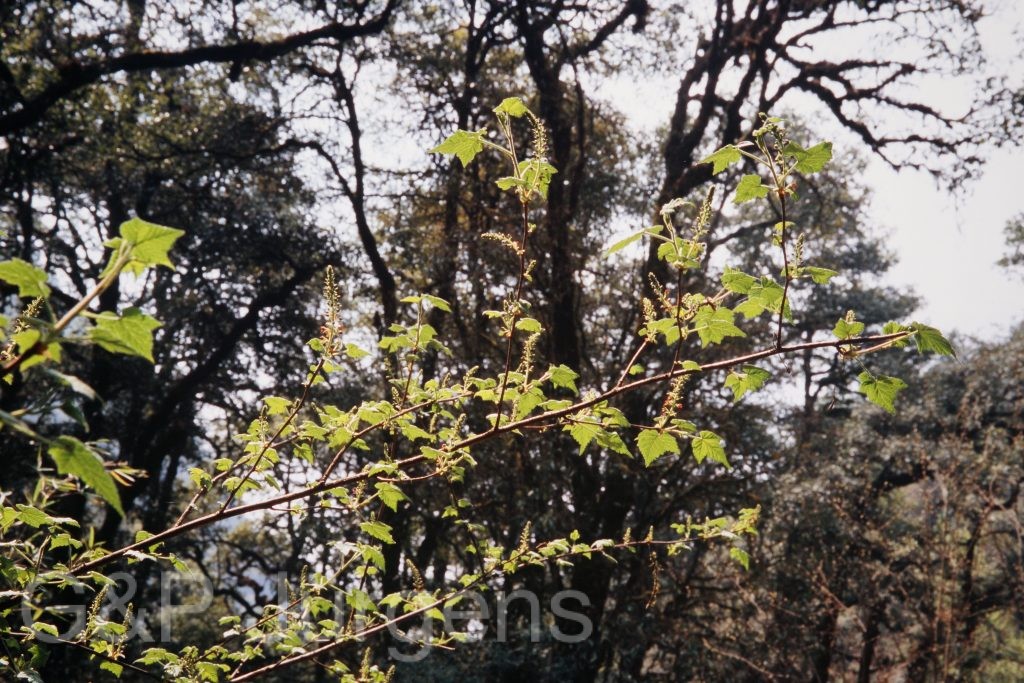
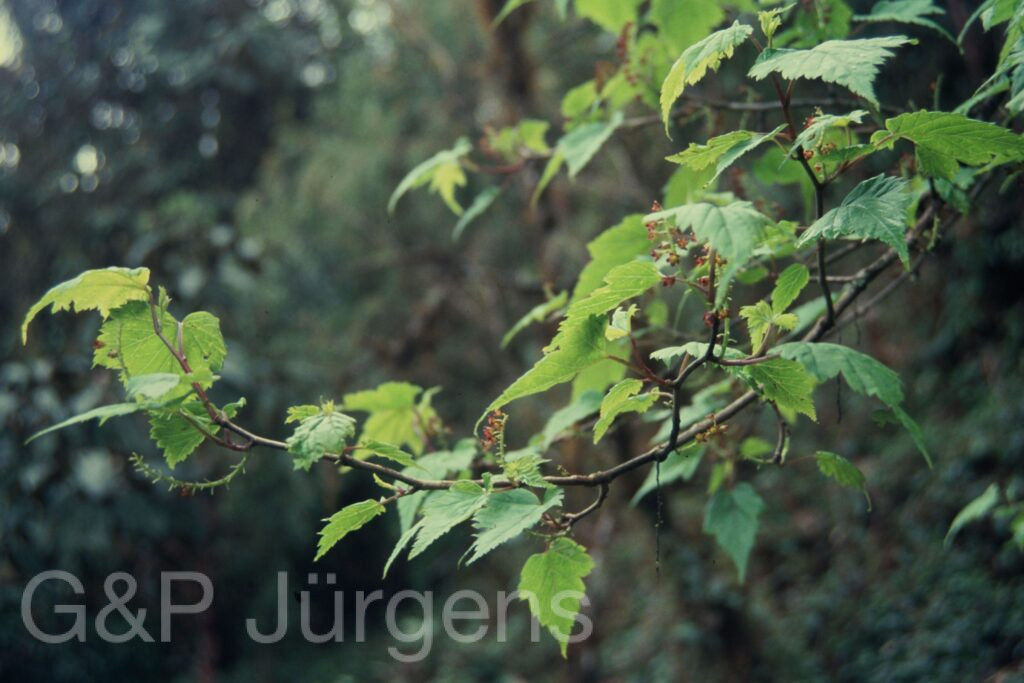
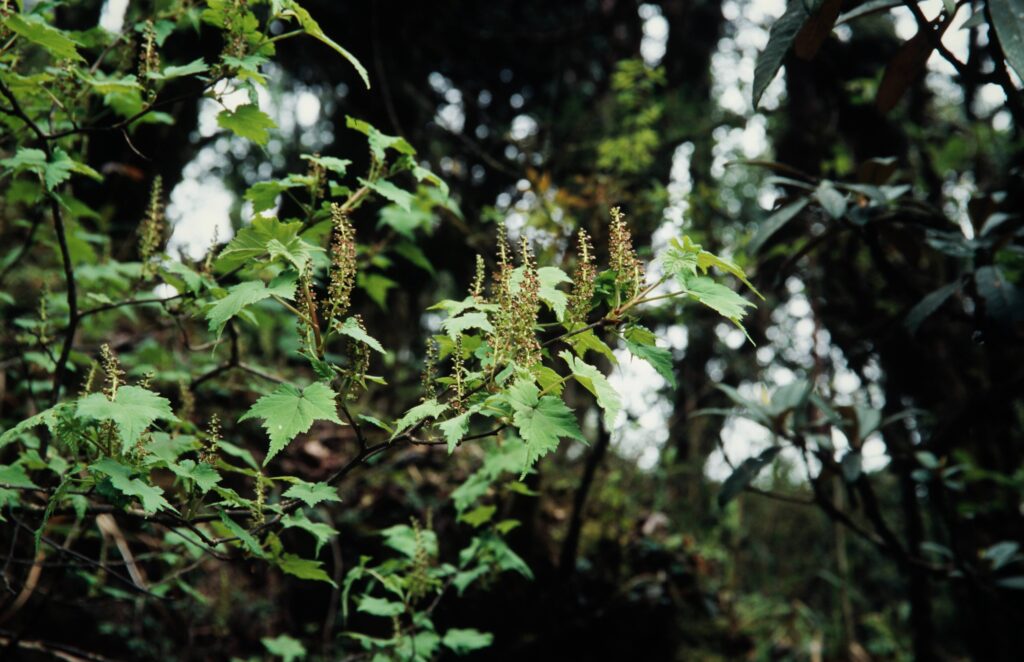
Ribes glaciale is a Himalayan and Sino-Himalayan currant distributed from Afghanistan and Pakistan through Nepal, NW India and Bhutan into SW and central China, with 2,141 GBIF occurrences (records from Europe and the Americas reflect cultivated or naturalised material). It is a shrub of subalpine and temperate forest, forest margins, shrubberies and rocky slopes, typically between about 2,500 and 4,000 m. The Nepalese collection from a kharka (high pasture) at 3,140 m in May captures it flowering in the spring, when it forms a component of mixed deciduous and conifer understorey thickets.

It is a deciduous, unarmed shrub 1–2 m tall with slender, glabrous to sparsely glandular branches. The leaves are alternate, small, broadly ovate to suborbicular, 1.5–4 cm wide, palmately 3–5-lobed with the central lobe longer, the margins toothed, on slender petioles. The plant is functionally dioecious or sub-dioecious; the flowers are borne in short erect racemes, small and reddish to purplish, with a shallow campanulate hypanthium, five reflexed sepals and minute petals. The fruit is a small, globose to ovoid red berry crowned by the persistent calyx.

The species belongs to Ribes subgen. Ribes and is one of several closely allied, lobed-leaved Himalayan currants that can be difficult to separate. GBIF treats the name as accepted; note that the image filename references R. laciniatum, but the named taxon R. glaciale is followed here. The red berries are taken by birds and provide effective dispersal, and the species is widespread and of least concern.

Author: Wall. · Sources: POWO (Kew), Flora of China Vol. 8, Flora of Pakistan, GBIF, Berger: A Taxonomic Review of Currants and Gooseberries (1924)

Royle ex Decne.

Garh 07 113 ergebnis
India Garhwal Meggu Kichatti 3200m, June
Garh 07 114 ergebnis
India Garhwal Meggu Kichatti 3200m, June

Description

Ribes himalense Royle ex Decne. is a deciduous currant of the Himalaya and the mountains of western China. Its native range, reflected in GBIF records from India, Nepal, Pakistan, Bhutan, Afghanistan, China and Myanmar (with numerous European and North American records representing cultivated or naturalised material), spans the Himalaya into the Hengduan ranges. It inhabits subalpine forest, forest margins, streamsides and rocky slopes, typically between about 2,500 and 4,000 m. The plant from Meggu Kichatti in Garhwal at 3,200 m, fruiting in June, illustrates its occurrence in the upper temperate to subalpine belt.

The species is an erect, unarmed (spineless) shrub up to about 1–2 m tall with glabrous to glandular young branches. The alternate leaves are palmately three- to five-lobed, cordate at the base, with serrate lobes, glabrous or sparsely hairy. The flowers are borne in erect to spreading racemes; each flower has a shallowly saucer-shaped, greenish to purplish hypanthium, small reflexed sepals and minute petals, and is subtended by a bract. The fruit is a smooth, glabrous, red berry that is edible, ripening to a translucent crimson.

Ribes himalense belongs to the subgenus Ribes (the true unarmed currants) and is closely related to the European R. rubrum, with which it shares edible red fruit; it has been treated by some authors as a subspecies. The fruits are gathered locally and consumed, and the species is of interest as a wild relative of cultivated currants for breeding. It is widespread and of least concern.

Author: Royle ex Decne. · Sources: POWO (Kew), GBIF, Flora of China Vol. 8, Flora of Pakistan, Berger: A Taxonomic Review of Currants and Gooseberries

D. Don

Sikkim2011 365
Sikkim Lada-La 3900m, June
Bh2008 12 P20
Bhutan Thimphu-Chu, 2750m April
Sikkim2004 62 P110
Sikkim West-Bengal, Bersay 2700m April
Sikkim 2006 30 ergebnis
India West-Bengal Tonglu 3150m, May

Description

Ribes takare is a Himalayan currant distributed along the temperate and subalpine belt from Afghanistan through Pakistan, Nepal, India and Bhutan into southwestern China and Myanmar, with GBIF recording close to a thousand occurrences across this arc. It grows in moist temperate and upper montane forest, forest margins, shrubberies, ravines and rocky slopes, typically between about 2500 and 4000 m. The image caption documents this range well, with collections from the Lada La in Sikkim at 3900 m in June, the Thimphu Chu in Bhutan at 2750 m in April, Bersay in West Bengal at 2700 m in April, and Tonglu at 3150 m in May, showing both its broad altitudinal span and its spring-to-early-summer flowering as the snowline retreats.

It is a deciduous, spineless (unarmed) shrub up to about 2-3 m tall, with greyish, peeling bark and glandular-pubescent young shoots. The leaves are alternate, palmately three- to five-lobed with crenate-serrate margins and a cordate base, somewhat resembling a maple leaf and often glandular-hairy beneath. The flowers are borne in many-flowered, pendulous racemes; they are small and reddish to purplish-brown, with a saucer-shaped to shallowly campanulate hypanthium, five reflexed sepals, five smaller petals, five stamens and an inferior ovary. The fruit is a glandular-bristly, reddish to purplish-black berry that is edible but rather acidic and somewhat resinous.

The genus Ribes, sole genus of Grossulariaceae, is well represented in the Himalaya, where R. takare belongs to the unarmed, raceme-flowered black-currant alliance and has been treated under synonyms including R. acuminatum and R. glaciale-related names by various authors. Its pendent racemes of nectariferous flowers attract bees and other insects, while the berries are dispersed by birds and small mammals; the species forms an understorey component of moist Himalayan forest. It is widespread and common across its extensive range and is of no conservation concern, while its acidic fruits are gathered locally and its hardiness has drawn modest horticultural interest.

Author: D. Don · Sources: POWO (Kew), GBIF, Flora of China Vol. 8, Flora of Bhutan Vol. 1, Flora of Nepal, Flora of Pakistan, Berger's taxonomic review of Ribes

Rosa brunonii

by GP Jürgens

Lindl.

Bh09 42 P79
Bhutan Timphu 2500m, May
Nepal 99 165 ergebnis
West-Nepal South of Tara-Lake 3000m, June

Description

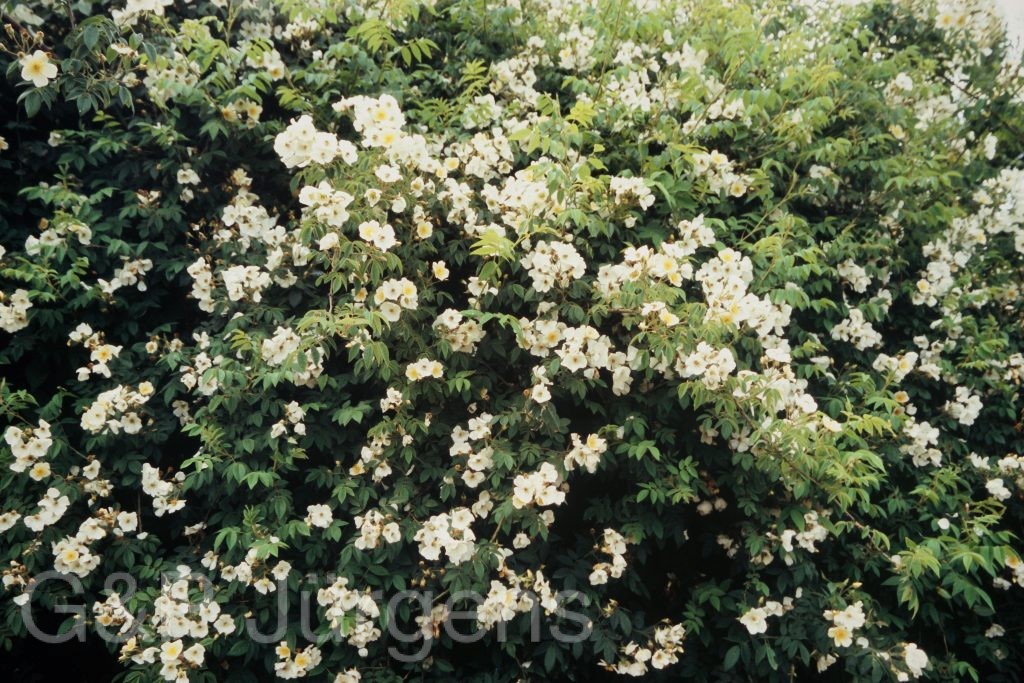
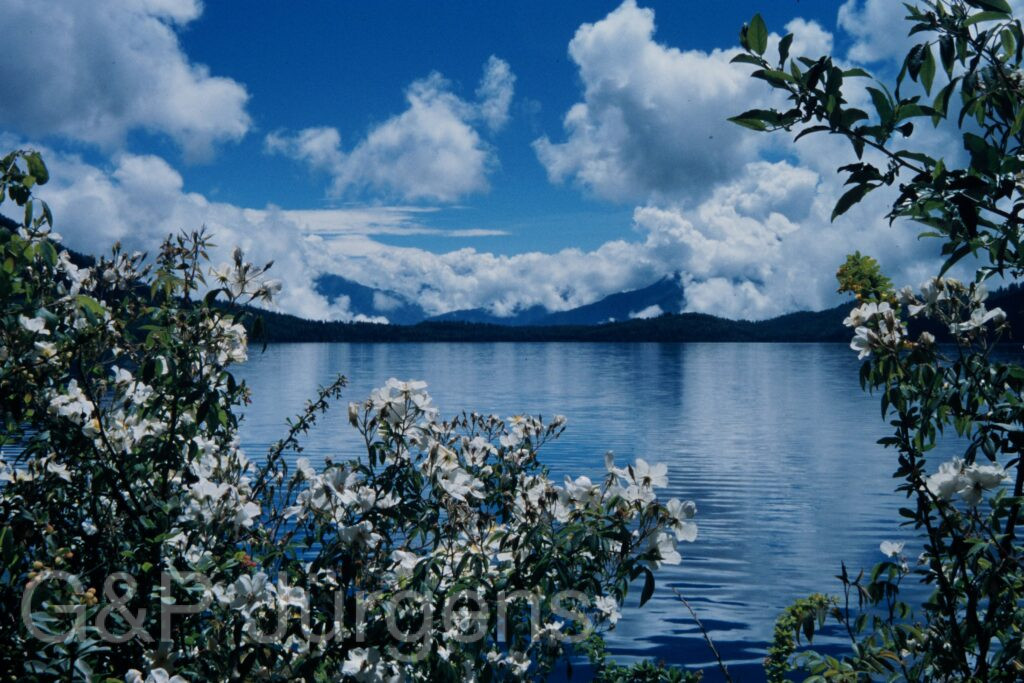
Rosa brunonii, the Himalayan musk rose, is a vigorous climbing or scrambling shrub of the Himalaya and adjacent ranges, recorded by GBIF (435 occurrences) from China, Nepal, India, Bhutan, Pakistan and Afghanistan, with cultivated and naturalised reports in Europe, North America and elsewhere reflecting its long history in gardens. It grows in forest margins, thickets, ravines, hedgerows and on open slopes throughout the temperate zone, generally between about 1500 and 3500 m. The plants illustrated from Thimphu in Bhutan at 2500 m in May and from south of Tara Lake in western Nepal at 3000 m in June capture its early-summer flowering across this elevational band.

The species is a robust, long-trailing shrub with arching, often reddish stems armed with stout, recurved, flattened prickles. The leaves are alternate, imparipinnate with usually five to seven leaflets that are oblong-lanceolate, finely serrate and characteristically greyish-green and softly pubescent beneath, with stipules adnate to the petiole. The flowers are borne in many-flowered corymbose cymes; each is fragrant, with five white, broadly obovate and emarginate petals surrounding numerous yellow stamens, the styles united into an exserted column. The receptacle ripens into a small, ovoid to subglobose, orange-red hip crowned by the deciduous sepals.

Rosa brunonii belongs to section Synstylae, the white-flowered, united-styled climbing roses, and is the principal Himalayan representative of the musk rose group long valued horticulturally and used in the parentage of cultivated ramblers. The clustered, scented flowers attract bees and other insects, and the bird-dispersed hips spread the species along forest edges. It is abundant and ecologically robust throughout its native range and is of no conservation concern.

Author: Lindl. · Sources: POWO (Kew), GBIF, Flora of China, Flora of Bhutan, Flora of Pakistan, The Genus Rosa (Phillips & Rix)

Rosa sericea

by GP Jürgens

Lindl.

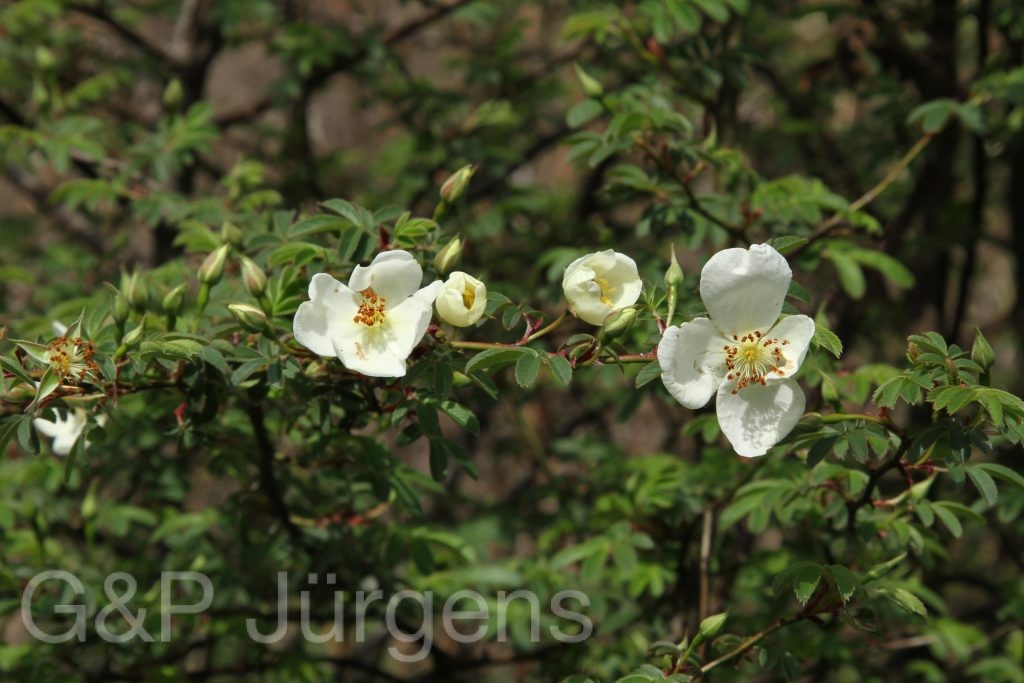
Bhutan2014 399
Bhutan Yatong-La 2800m, May
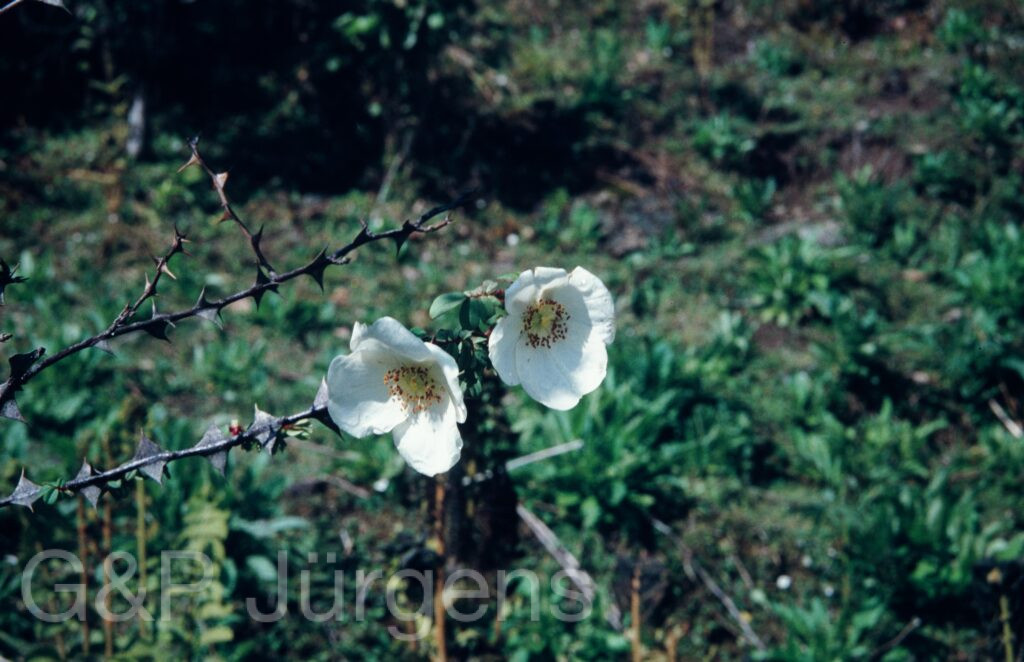
Bhutan2014 400
Bhutan Yatong-La 2800m, May
Nepal 1994 253 ergebnis
Ost-Nepal Milka-Danda 2600m May 

Description

Rosa sericea is a Sino-Himalayan rose native to China, Nepal, India, Bhutan and Myanmar, widely grown and naturalised so that GBIF's roughly 2293 occurrences include records from Britain, Germany, the Netherlands, North America and beyond. In the wild it is a shrub of the temperate and subalpine zones, occupying open slopes, forest margins, scrub and ravine sides generally between about 2200 and 4000 m. The cited material from the Yatong-La in Bhutan at 2800 m and from the Milka-Danda in eastern Nepal at 2600 m, both flowering in May, is typical of its preference for sunny, well-drained montane situations where it blooms in late spring.

It is an erect, much-branched deciduous shrub whose stout stems bear paired prickles, in some forms broadly flattened and translucent. The leaves are imparipinnate with several pairs of small, oblong, serrate leaflets, the lower surface frequently silky-pubescent, a feature reflected in the epithet sericea. The flowers are solitary and famously distinctive in being four-petalled rather than five-petalled, a rarity in the genus, the petals white to creamy and broadly obcordate, surrounding numerous yellow stamens. After flowering the receptacle develops into a fleshy, pear-shaped to subglobose hip, often red and in some variants bearing conspicuously swollen yellow or red pedicels.

Rosa sericea is placed in section Pimpinellifoliae, the group of small-leaved, prickly Asian and European roses, and is closely allied to R. omeiensis, with which it intergrades; the form with enlarged winged prickles is much prized horticulturally as 'Pteracantha'. Its four-merous corolla is of botanical interest as an exception within a genus otherwise rigidly pentamerous. The bright hips provide autumn forage for birds and small mammals, aiding seed dispersal, and the species is in no way threatened, being common in the wild and long established in cultivation.

Author: Lindl. · Sources: POWO (Kew), GBIF, Flora of China, Flora of Bhutan, Flora of British India, Krüssmann 'Roses' and the genus Rosa monographic literature

Rosa webbiana

by G & P Jürgens

Wall. ex. Royle

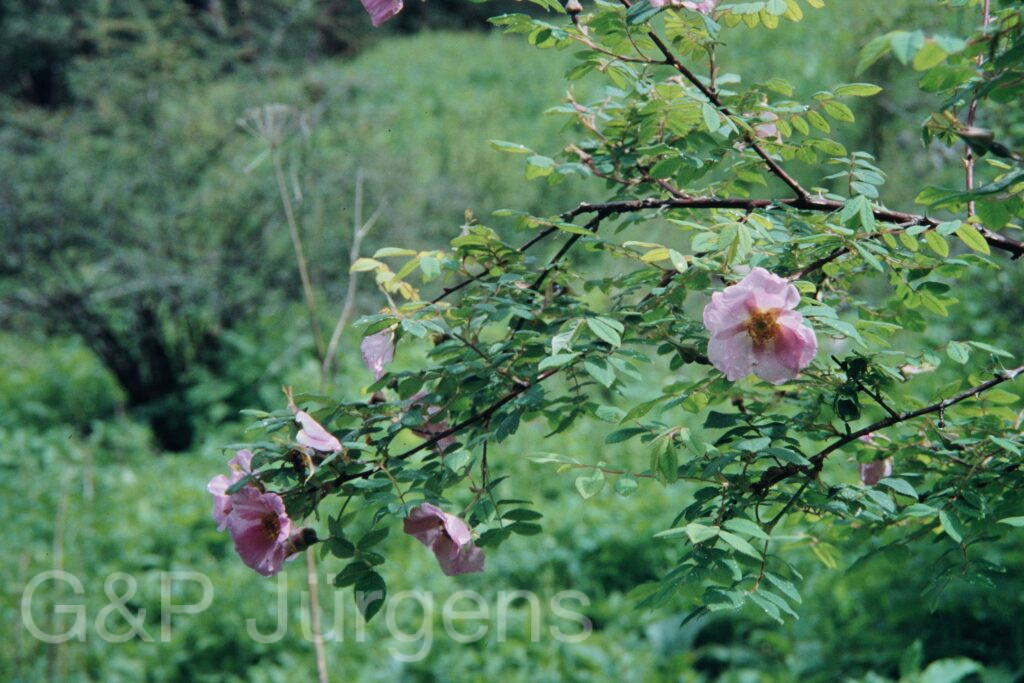
Nepal 99 45 ergebnis
West-Nepal Nyor Gaad 2800m, June
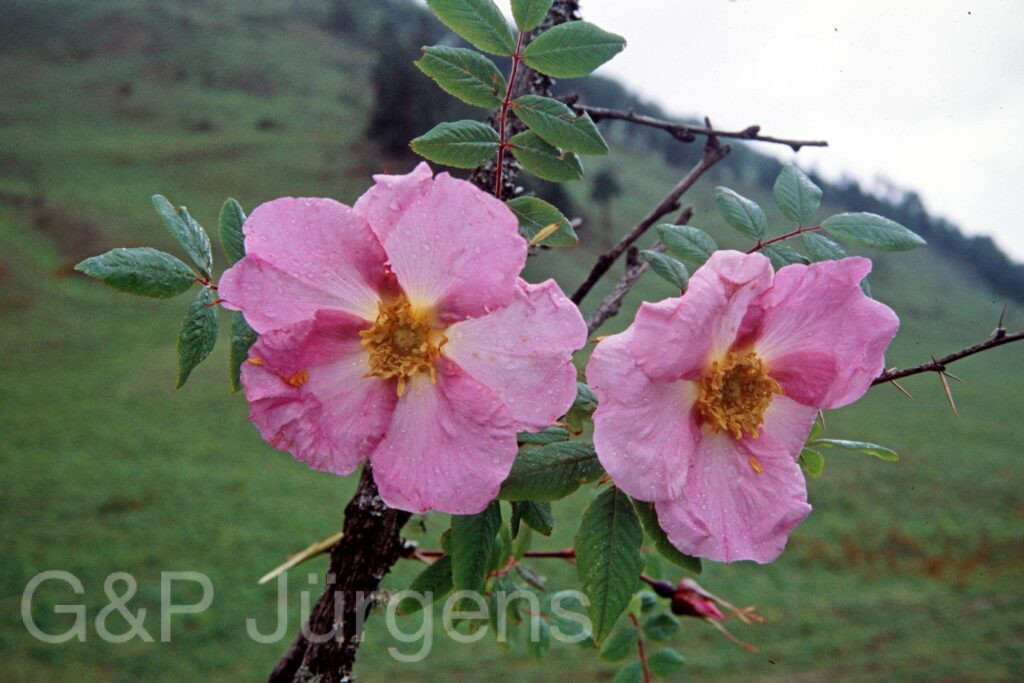
Nepal 99 46 ergebnis
West-Nepal Nyor Gaad 2800m, June

Description

Rosa webbiana is a wild rose of the dry inner Himalaya and the mountains of Central Asia, with a broad distribution reflected in its 1266 georeferenced records spanning India (IN), China (CN), Pakistan (PK), Afghanistan (AF) and the Central Asian republics of Kazakhstan (KZ), Kyrgyzstan (KG), Tajikistan (TJ), Turkmenistan (TM) and Uzbekistan (UZ); many European and North American records represent cultivation. It is a plant of arid and semi-arid montane environments, favouring open stony slopes, dry valley scrub, riverbanks and forest margins, generally between about 1500 and 3500 m. The plant photographed at Nyor Gaad in West Nepal at 2800 m in June is typical of these sunny, well-drained inner-valley habitats where it flowers in early summer.

It is a deciduous, much-branched shrub with arching to erect stems armed with slender, straight or slightly curved, paired prickles. The leaves are pinnately compound with usually five to nine small, obovate to elliptic, simply serrate leaflets, often glaucous and somewhat glandular. The flowers are solitary or few, with a pink (rarely white) corolla of five broad, notched petals surrounding numerous stamens, and an entire, persistent calyx. The fruit is a smooth, globose to ovoid, bright red hip crowned by the persistent erect sepals, ripening in late summer.

Rosa (Rosaceae) is a large and taxonomically intricate genus with widespread hybridisation and polyploidy; R. webbiana belongs to the dry-zone section of true roses adapted to continental, low-rainfall mountain climates. Its hips are rich in vitamin C and are gathered locally for food, while the species is also of horticultural and breeding interest. Widespread and frequent across its range, it is of no conservation concern, though it is an important component of fragile, grazing-pressured inner-Himalayan scrub vegetation.

Author: Wall. ex. Royle · Sources: POWO (Kew), GBIF, Flora of Pakistan, Flora of China, Annotated Checklist of the Flowering Plants of Nepal, Boulenger and Ku monographic treatments of Asian Rosa

Royle

Nepal 99 25 ergebnis
West-Nepal Chere 2850m June

Description

Roscoea alpina is a diminutive, hardy ginger relative widely distributed along the Himalayan arc from Pakistan and Kashmir eastward through India, Nepal and Bhutan into southwestern China (Xizang, Yunnan and Sichuan), with outlying records reaching Myanmar. With well over three hundred occurrences in GBIF and a long horticultural history, it is among the most familiar of the alpine Roscoeas; many of the country records from Europe, North America and Korea reflect cultivated and naturalised material rather than native populations. It grows on open grassy slopes, forest clearings, banks and alpine pastures, generally between about 2400 and 4000 m. The plant photographed at Chere in West Nepal at 2850 m, flowering in June, is characteristic of these summer-moist meadow habitats, where the species emerges with the onset of the monsoon and dies back to a tuberous rootstock as the soil dries.

The plant is a small herbaceous perennial arising from a cluster of fleshy, fascicled root tubers. The short pseudostem is formed by overlapping leaf sheaths and bears a few narrowly lanceolate to linear leaves. Unlike most of its relatives, R. alpina typically produces a single flower at a time, opening successively. The flower is rose-pink to purple, with a long slender perianth tube; the dorsal corolla lobe arches as a hood over the floral parts, the lateral lobes are narrow, and the prominent two-lobed labellum, formed from staminodes, is reflexed and notched, serving as a landing platform for bee pollinators. A single fertile stamen and an inferior ovary complete the flower, the latter maturing into an elongate, several-seeded capsule.

Roscoea is a remarkable temperate offshoot of the otherwise tropical Zingiberaceae, having adapted to seasonal montane climates through its tuberous, deciduous habit and monsoon-synchronised phenology; the genus shows a striking Sino-Himalayan distributional disjunction. R. alpina sits among the small-flowered, solitary-flowered species and is one of the most cold-tolerant, accounting for its popularity in alpine and rock gardens. The family is here spelled "Zingiberacaea" following the source; the accepted form is Zingiberaceae. Though not globally threatened owing to its broad range, local populations are vulnerable to overgrazing and habitat conversion, and the species remains a model for studying the evolution of montane life in a predominantly lowland tropical lineage.

Author: Royle · Sources: POWO (Kew), GBIF, Flora of China Vol. 24, Flora of Bhutan Vol. 3 Part 1, Flora of Nepal, Flora of Pakistan, The Genus Roscoea (Jill Cowley, Kew)