Tag:

Subalpine (2500-3500 m)

Andersson

BhutanPG2011 377
Bhutan Dur Tsa-Cho 3100m, June

Description

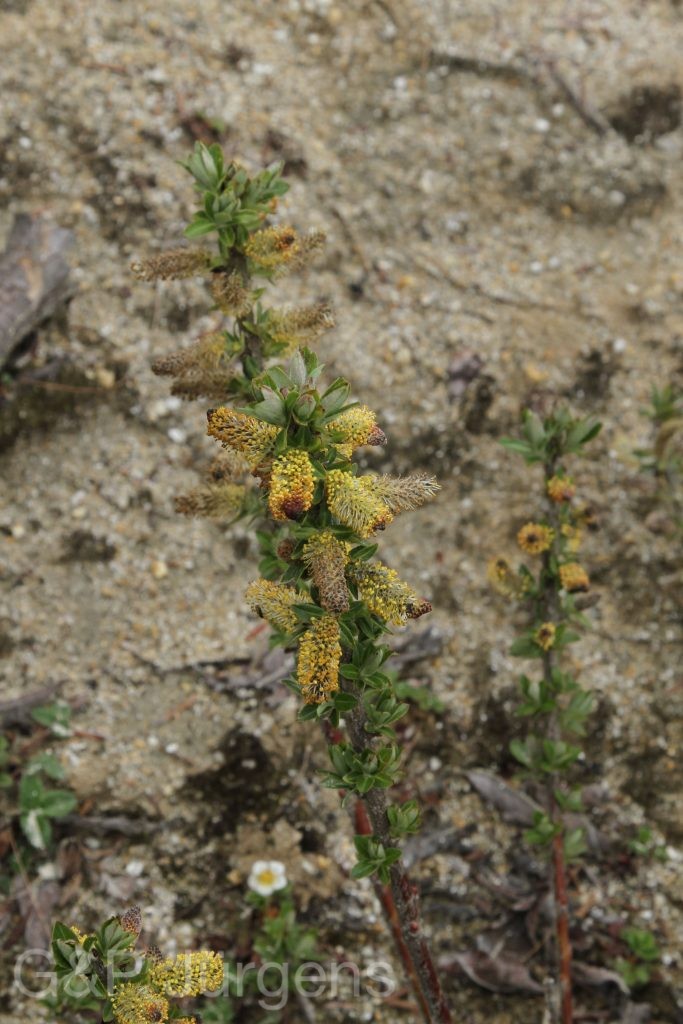
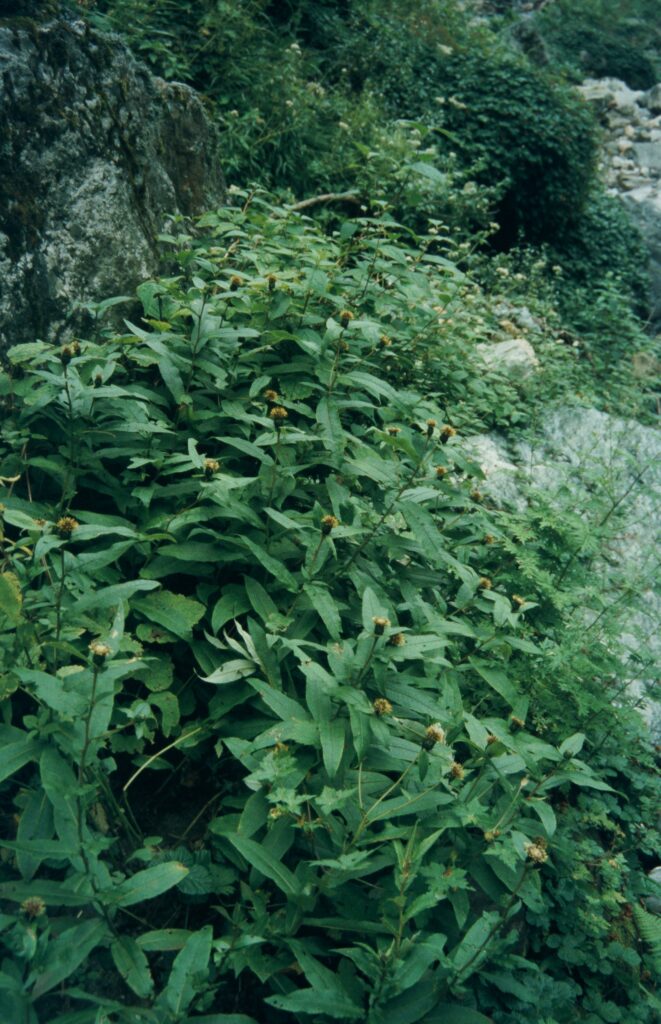
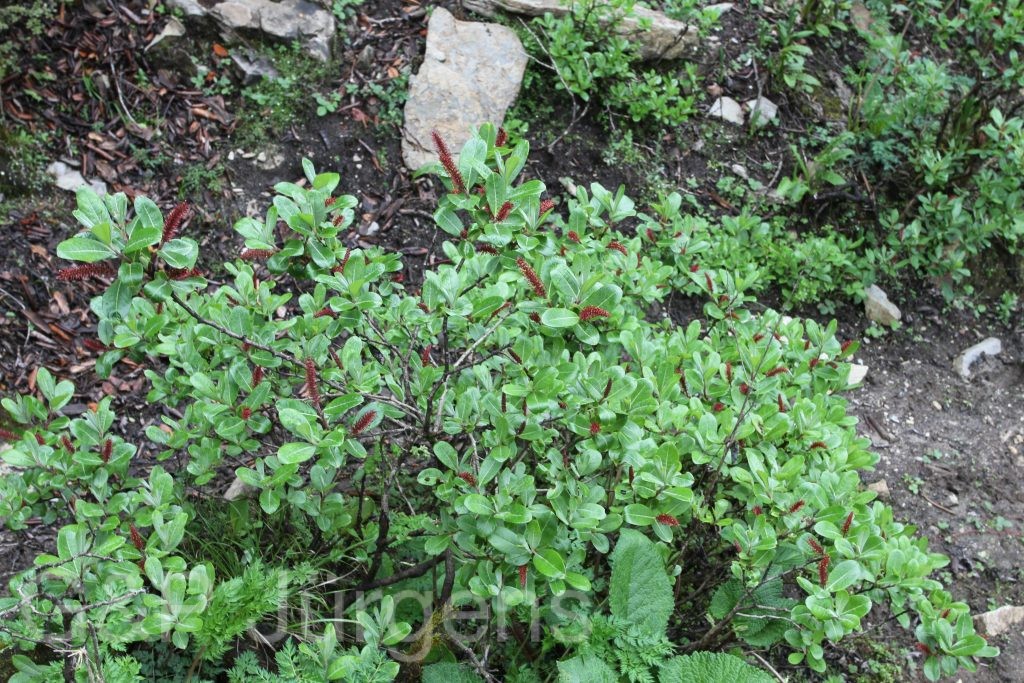
Salix daltoniana Andersson is a Himalayan willow ranging through China, Nepal, India and Bhutan, with about 399 GBIF occurrences. It is a riparian and montane species growing along streams, riverbanks, moist gullies and forest margins in the temperate and subalpine belts, generally between 2500 and 3800 m. It was recorded in central Bhutan at Dur Tsa-Cho near 3100 m in June, a typical streamside setting where willows form thickets along glacier-fed watercourses and contribute to bank stabilisation in the high valleys.

It is a shrub or small tree with slender, glabrous, often reddish-brown twigs. The leaves are alternate, lanceolate to oblong-lanceolate, acuminate, finely serrulate at the margin, green and glabrescent above and paler, somewhat glaucous beneath, with stipules variably developed on vigorous shoots. As in all willows the species is dioecious, the flowers arranged in erect catkins appearing with or slightly before the leaves; each tiny flower is subtended by a hairy bract and reduced to stamens or a single ovary with a nectary gland. The fruit is a small conical capsule splitting to release numerous minute seeds bearing long silky hairs for wind dispersal.

Salix is a vast, taxonomically difficult genus prone to hybridisation, and the Himalayan species including S. daltoniana have been the subject of repeated revision. Wind- and insect-pollinated and pioneering on unstable alluvium, the species plays an ecological role in colonising disturbed riverine ground and providing browse. It is not regarded as threatened, being widespread along Himalayan watercourses, though it is sensitive to changes in river hydrology and montane land use.

Author: Andersson · Sources: POWO (Kew), GBIF, Flora of China, Flora of Bhutan, Flora of Nepal, Salicaceae monograph (Skvortsov, Willows of the USSR and adjacent regions)
Hand.-Mazz. ex Enander

Bhutan2014 451
Bhutan Phobjika 2810m, May

Description

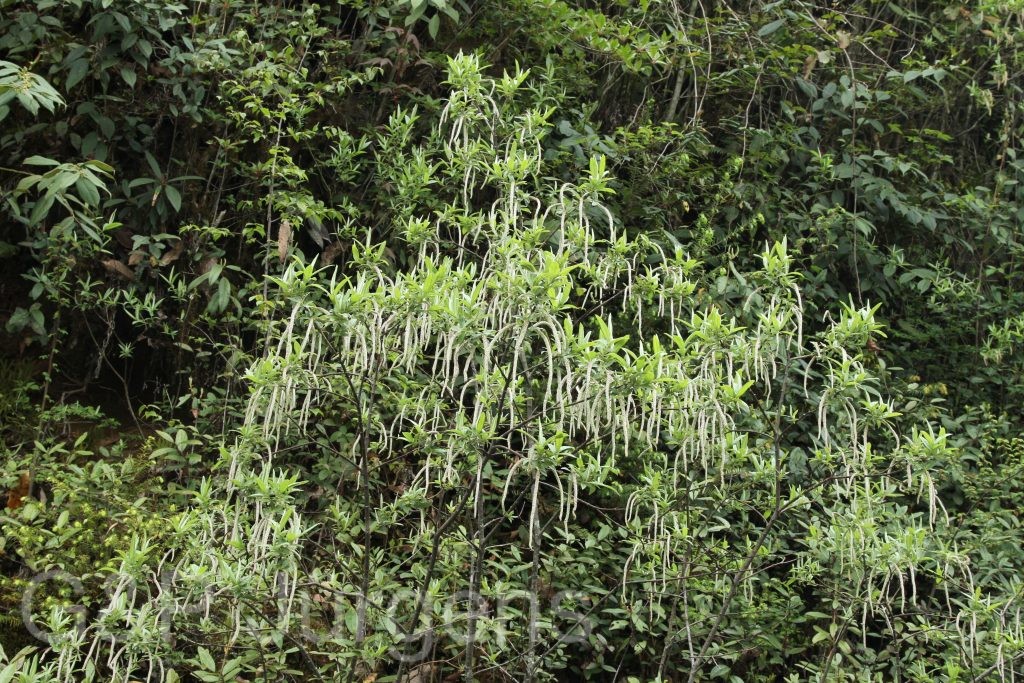
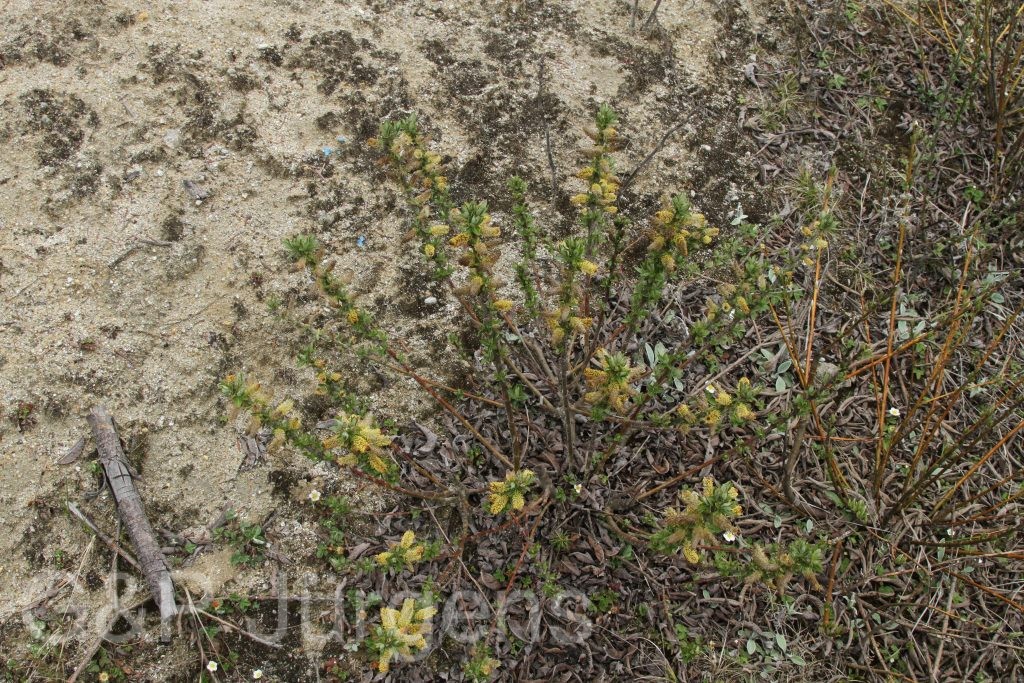
Salix salwinensis is a Sino-Himalayan willow distributed from SW China (the Salween, Mekong and upper Yangtze drainages, whence the epithet) through NE India, Nepal and Bhutan, GBIF recording some 92 occurrences across the eastern Himalaya and southwestern China. It is a shrub or small tree of high-montane and subalpine habitats, growing along streamsides, in damp thickets, at forest margins and on open slopes. The photographed plant from Phobjika in Bhutan at 2,810 m (May) reflects its occurrence in the cool temperate to subalpine belt, where willows form a conspicuous component of riparian and meadow-edge vegetation.

It is a deciduous, dioecious shrub or small tree with reddish-brown to purplish, glabrous young twigs. The leaves are oblong to oblanceolate or elliptic, acute, often glaucous beneath, with finely serrate or entire margins and a short petiole, the young foliage sometimes silky. As in all willows the flowers are reduced and borne in erect catkins appearing with or before the leaves; each flower is subtended by a hairy bract and lacks a perianth, the male with two stamens and the female with a single pistil bearing a basal nectary. The fruit is a small, two-valved capsule releasing numerous comose, wind-dispersed seeds.

Salix is a large and taxonomically intricate genus in which hybridisation and clinal variation blur species boundaries; the Himalayan willows in particular require careful study of catkin and leaf characters for identification. The dioecious, catkin-bearing, anemophilous and partly entomophilous flowers, the comose seeds and the capacity for vegetative regeneration are classic adaptations of the genus to dynamic, disturbed riparian habitats. The species is not considered threatened across its montane range.

Author: Hand.-Mazz. ex Enander · Sources: POWO (Kew), Flora of Bhutan Vol. 1, GBIF, Flora of China Vol. 4, Skvortsov: Willows of Russia and Adjacent Countries

Flod.

Bhutan2014 442
Bhutan Yatong-La 3200m, May
Bhutan2014 443
Bhutan Yatong-La 3200m, May

Description

Salix stomatophora is a Himalayan willow distributed across the high mountains of southwestern China (Xizang), Bhutan, Nepal and northern India, with GBIF recording roughly eighty occurrences from this region (records from the United States and Mexico reflect herbarium and cultivated material). It is a plant of the upper-montane to subalpine zone, occupying streamsides, moist forest margins, thickets and open slopes, generally between about 2800 and 3800 m. The individual photographed at Yatong-La in Bhutan at 3200 m, catkins emerging in May, is typical of these cool, humid Bhutan Himalayan habitats, where willows flush early in spring as snowmelt swells the mountain streams along which the species characteristically grows.

The plant is a shrub or small tree with slender, often reddish-brown to purplish young twigs that are glabrous or nearly so. The leaves are alternate, lanceolate to elliptic, acuminate, finely glandular-serrate at the margin, green above and conspicuously glaucous beneath, with prominent stomatal banding on the lower surface that gives the species its epithet (stomatophora, "bearing stomata"). As in all willows the plant is dioecious, the flowers borne in erect catkins appearing with or slightly before the leaves; each tiny flower subtended by a hairy bract, the staminate flowers with two stamens, the pistillate with a single ovary bearing a short style and notched stigmas. The fruit is a small, glabrous, two-valved capsule releasing minute, silky-tufted, wind-dispersed seeds.

Salix is a large, taxonomically difficult genus, and the Sino-Himalayan region harbours a rich assemblage of montane and alpine species whose delimitation rests heavily on leaf indumentum, stipule form and catkin and capsule characters. The pronounced glaucous, stomatiferous lower leaf surface of S. stomatophora is a key diagnostic trait. Note that this Himalayaflora page links the synonym S. bhutanensis, underscoring the nomenclatural fluidity common in the genus. Ecologically the species contributes to streambank stabilisation and provides early-season forage and pollen for emerging insects in high-altitude communities. With a wide if scattered Himalayan range it is not regarded as threatened, though localised populations depend on the integrity of subalpine riparian corridors.

Author: Flod. · Sources: POWO (Kew), GBIF, Flora of China Vol. 4, Flora of Bhutan Vol. 1 Part 1, Flora of Nepal, Salix (Salicaceae) of the Sino-Himalaya (K.S. Hao; A.K. Skvortsov, Willows of the World)

Salvia castanea

by GP Jürgens

Diels

BhutanPG2011 828 01 01
Bhutan Chele-La, 3400m July

Description

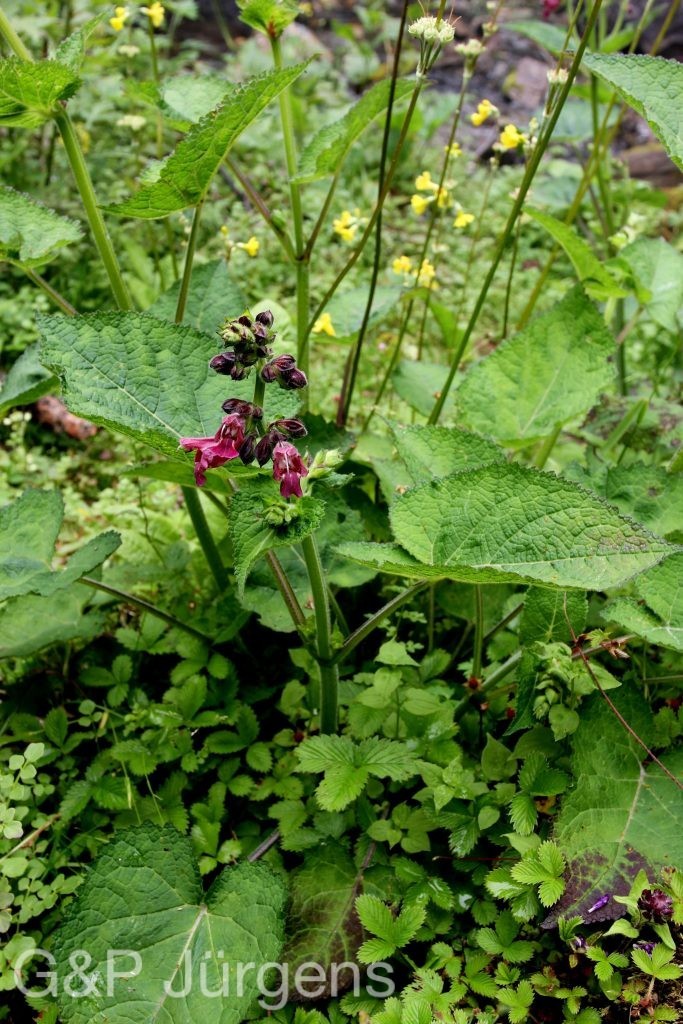
Salvia castanea is a montane perennial distributed across the eastern Himalaya and adjoining south-western China, with georeferenced collections recorded from China, Bhutan, Nepal and India; some 202 occurrences are documented in GBIF. It favours open forest margins, scrub, alpine meadows and grassy slopes between roughly 2700 and 4000 m, the photographed plant having been gathered at Chele-La in Bhutan at about 3400 m in July, at the height of the monsoon flowering season. It thrives on humus-rich, well-drained soils in cool, moist subalpine conditions.

The plant forms an erect, woody-based perennial herb 30-60 cm tall from a stout rootstock, with quadrangular, sparsely pubescent stems. The basal and lower cauline leaves are long-petiolate, the lamina ovate to oblong-lanceolate, cordate or subcordate at the base, crenate-serrate, and rugose with impressed venation. The inflorescence is a lax raceme of distant 2-6-flowered verticillasters; flowers bear a campanulate calyx and a chestnut-brown to dull purplish-red corolla 2.5-3.5 cm long, with an arched, galeate upper lip and the characteristic Salvia lever mechanism of two stamens. The fruit comprises four smooth nutlets enclosed in the persistent calyx.

The distinctive chestnut corolla colour, reflected in the epithet castanea, separates this species from most Himalayan sages, which tend toward blue or violet flowers. As a member of the large genus Salvia (Lamiaceae, subfamily Nepetoideae), it relies on long-tongued bees and occasionally birds for pollination via the staminal lever. Though not formally assessed as threatened, it is locally frequent within its restricted Sino-Himalayan range, where habitat continuity in subalpine meadows underpins its persistence.

Author: Diels · Sources: POWO (Kew), GBIF, Flora of China, Flora of Bhutan, A Revision of Salvia (Lamiaceae) in Asia

Wall. ex Benth.

Nepal 99 913 ergebnis
West-Nepal Roha 2800m, July

Description

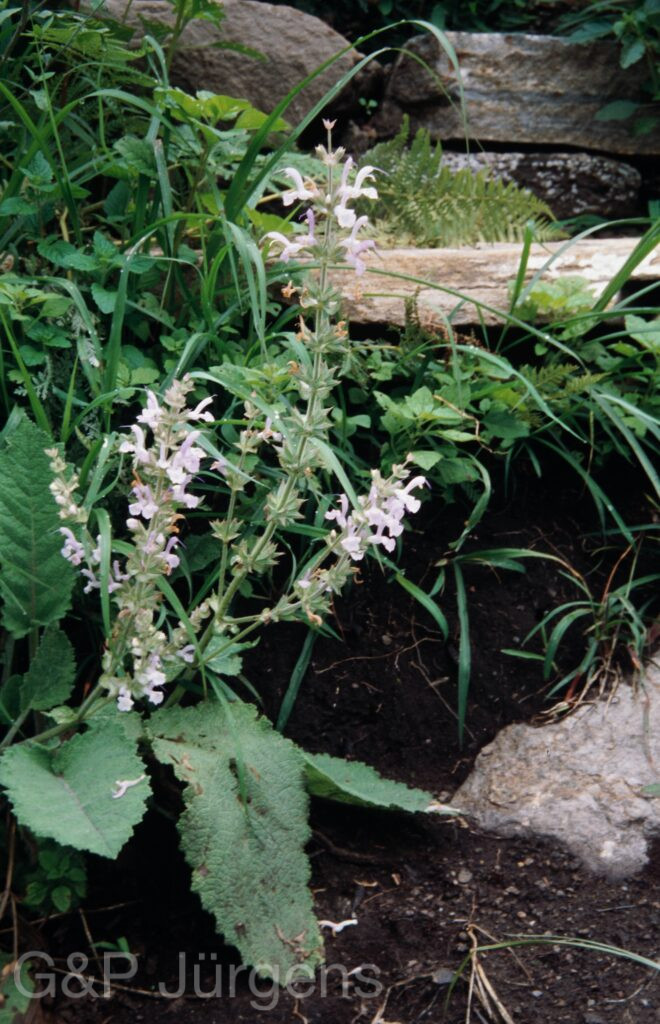
Salvia moorcroftiana is a stout perennial sage of the western and central Himalaya, ranging from Afghanistan and Pakistan through northern India into Nepal, with cultivated and adventive records noted from Iran, Britain, Brazil and the United States. GBIF holds some 403 occurrences, concentrated in Pakistan, India, Afghanistan and Nepal. It is a plant of dry, open hillsides, overgrazed pastures, road banks, fallow fields and stony waste ground, generally between about 1500 and 3000 m, often forming conspicuous stands on degraded land. The specimen illustrated was recorded in West Nepal at Roha at 2800 m in July, flowering during the monsoon on open montane slopes.

The plant forms a large basal rosette of broadly ovate to oblong, rugose, wavy-margined leaves that are densely white-woolly beneath and borne on long petioles. From this rises a tall, branched, glandular inflorescence axis bearing well-separated verticillasters of large flowers subtended by coloured bracts. The two-lipped corolla is white to pale lilac, often flushed or veined with purple, the hooded upper lip enclosing two stamens with the characteristic lever-like connective of Salvia. The calyx is bell-shaped and persistent, and the fruit comprises four smooth nutlets retained within the dry calyx until dispersed.

Salvia, the largest genus of the Lamiaceae, is defined by its specialised staminal lever mechanism promoting precise pollen placement on visiting bees. S. moorcroftiana, named for the explorer William Moorcroft, is a long-established medicinal plant of the Himalayan foothills, its mucilaginous seeds and leaves used in traditional remedies for skin and digestive ailments. Tolerant of grazing and disturbance, it is widespread and of no conservation concern; indeed it often increases on degraded rangeland.

Author: Wall. ex Benth. · Sources: POWO (Kew), GBIF, Flora of Pakistan, Flora of British India, An Annotated Checklist of the Flowering Plants of Nepal, Salvia: The Genus Salvia

Maxim.

Sikkim2003 359 P502 ergebnis
India Sikkim Lachen 2840m, August

Description

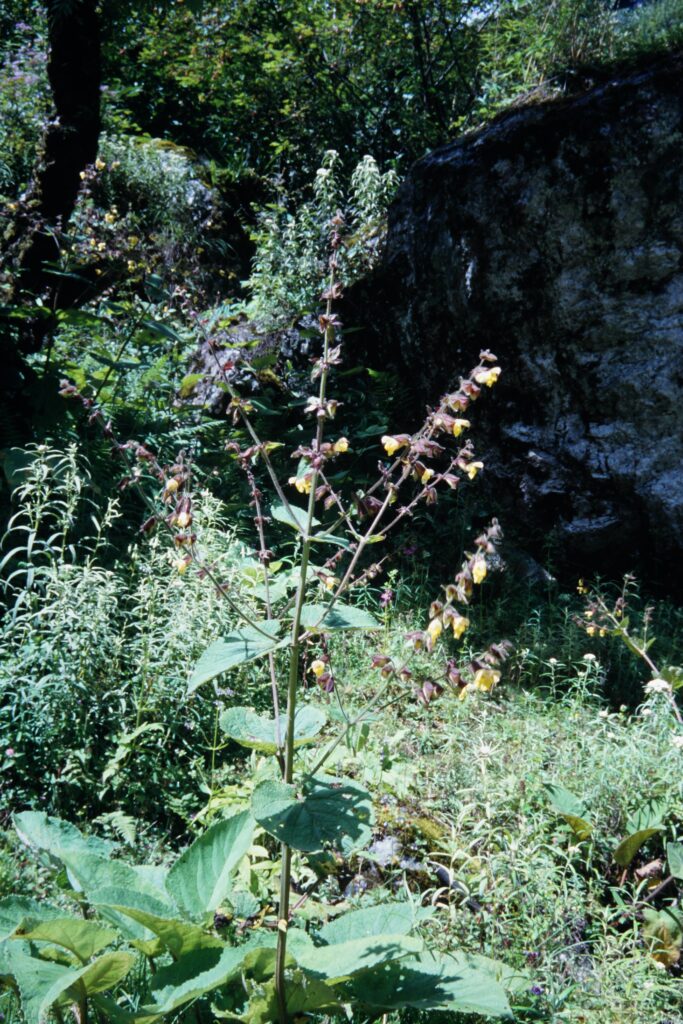
Salvia roborowskii is a perennial herb distributed from the Himalayas across the Sino-Himalayan region to western China. Its range encompasses Nepal, northeast India (Sikkim), Bhutan, and China (Xizang, Yunnan, Sichuan, Qinghai, Gansu). The species inhabits montane forest clearings, grassy slopes, thicket margins, and alpine meadows at elevations of 2,400–4,200 m. It has been recorded from the Lachen Valley in Sikkim at 2,840 m, flowering profusely in August during the monsoon season, where it grows in open, herbaceous vegetation along stream margins and disturbed ground.
The plant produces erect, square stems 30–80 cm tall from a perennial rootstock, often branched in the upper portion. The stems are pubescent with short, retrorse hairs. The basal and lower cauline leaves are pinnately compound to pinnatisect, with 1–3 pairs of lateral lobes and a larger terminal lobe, the lobes ovate to oblong, irregularly crenate-serrate, sparsely pilose on both surfaces. The upper leaves are progressively reduced. The inflorescence is a series of verticillasters arranged in elongate, terminal, spike-like racemes. The calyx is bilabiate, glandular-pubescent. The corolla is blue to violet-purple, 8–12 mm long, bilabiate with an arched upper lip and a spreading, trilobed lower lip. The nutlets are ovoid, smooth, dark brown.
Salvia roborowskii was described by Maximowicz from material collected during Przewalski's expeditions in the Sino-Tibetan borderlands. With over 400 occurrence records in GBIF, it is one of the more frequently collected high-altitude salvias in the region. The species is ecologically significant as a nectar source for montane bumblebees and other long-tongued pollinators. Its broad elevational range and tolerance of disturbed habitats suggest a degree of ecological resilience, though it remains dependent on the persistence of open montane grasslands and forest margins. Taxonomically, it is placed within Salvia subgenus Salvia and is allied to other pinnate-leaved species of the Sino-Himalayan region.

Author: Maxim. · Sources: POWO (Kew), GBIF, Flora of China Vol. 17, Flora of Bhutan Vol. 2, Hedge: Salvia in Flora Iranica (1982)

Sambucus adnata

by GP Jürgens

Wall. ex DC.

Bhutan2015 322
Bhutan Trongsa 2100m, October
Bh09 202 P341
Bhutan Thimphu, 2500m June

Description

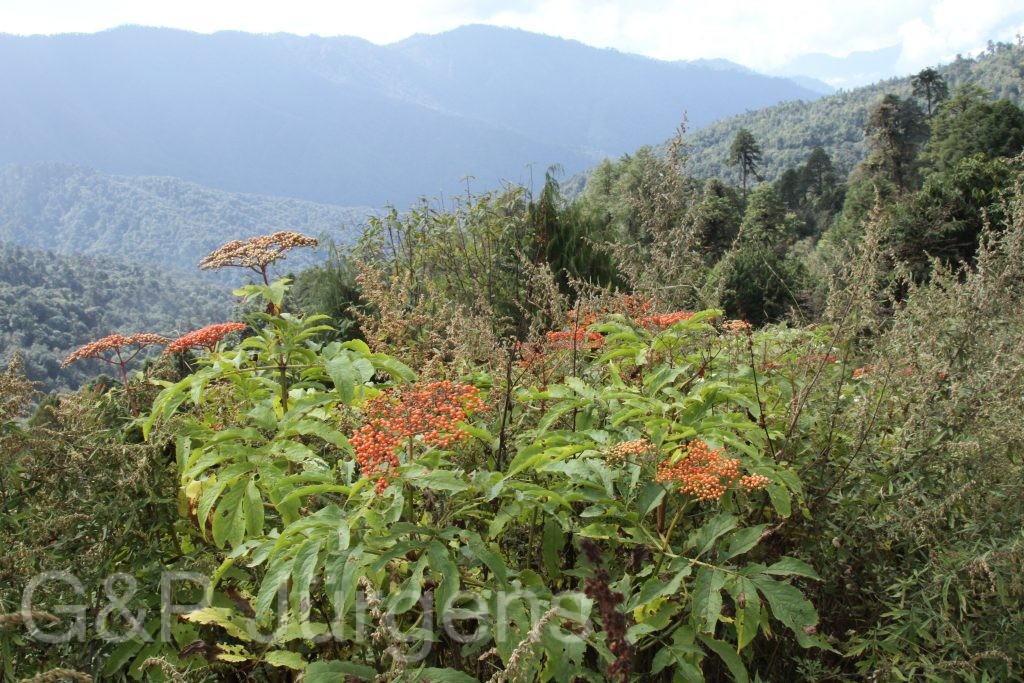
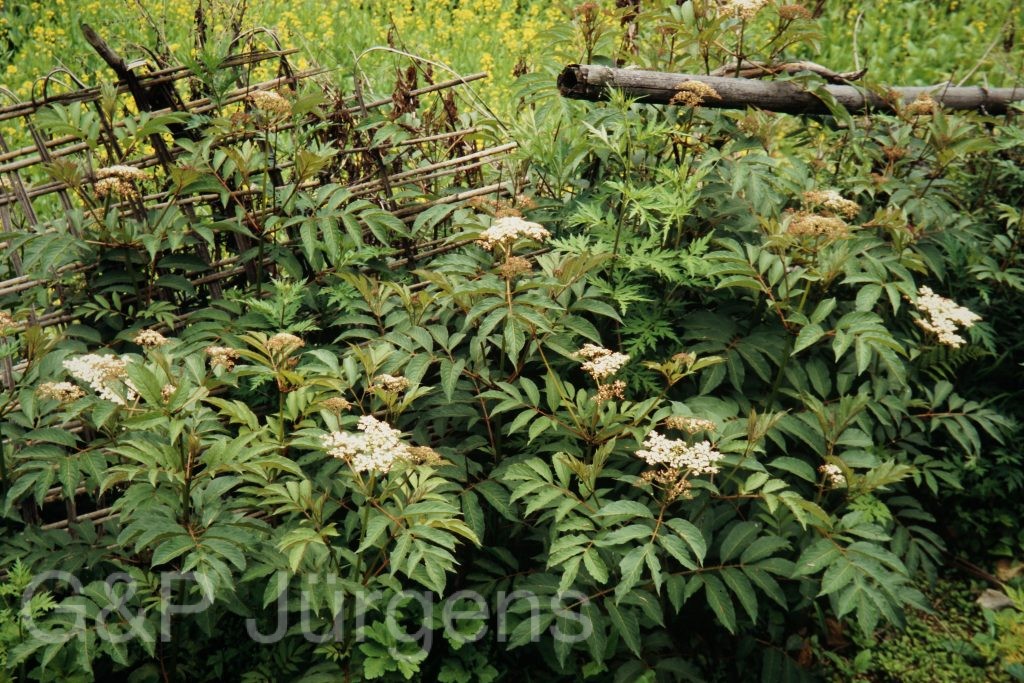
Sambucus adnata is a herbaceous elder distributed across the Himalaya and western to central China, occurring in Nepal, Bhutan, northern India and widely in China, with its very numerous GBIF records (over 1700) concentrated in this region; records from Germany, the United States, Austria, Japan and elsewhere reflect cultivation and herbarium accessions. It grows in moist forest clearings, on shrubby slopes, along stream banks, roadsides and at forest margins, generally between about 1600 and 3600 m. The photographed plants from Trongsa (2100 m, October) and Thimphu (2500 m, June) in Bhutan illustrate its range through the cool, humid mid-montane belt of the eastern Himalaya.

Unlike its woody relatives, S. adnata is a tall, robust perennial herb dying back to a thick, fleshy, creeping rhizome. The stout, erect, ridged stems bear large, opposite, imparipinnate leaves with several pairs of lanceolate, serrate leaflets, the lowest leaflets often adnate to the rachis or with adnate stipule-like outgrowths, a feature reflected in the epithet. The inflorescence is a large, flat-topped to convex compound cyme of numerous small flowers with a rotate, whitish to pinkish corolla and conspicuous reddish anthers or nectaries. The fruit is a small, globose, red drupe containing a few seed-like stones.

Sambucus, formerly placed in the Caprifoliaceae, is now referred with the genus Adoxa and Viburnum to the Adoxaceae on molecular and morphological grounds. S. adnata is distinctive among elders for its fully herbaceous, rhizomatous habit. It is widespread, common and weedy in disturbed montane habitats, and is of no conservation concern; the plant has a record of local medicinal use for bruises and swellings.

Author: Wall. ex DC. · Sources: POWO (Kew), GBIF, Flora of China, Flora of Bhutan, Annotated Checklist of the Flowering Plants of Nepal, Sambucus (Adoxaceae) monograph

D.Don

Sikkim2003 363 P512
Sikkim Lachen Tista Tal 3450m August
Sikkim2003 364 P511
Sikkim Lachen Tista Tal 3450m August
Nepal 95 100 P178 ergebnis
Nepal Barphak 2450m October
Nepal 95 135 P228 ergebnis
Nepal Barphak 2450m October

Description

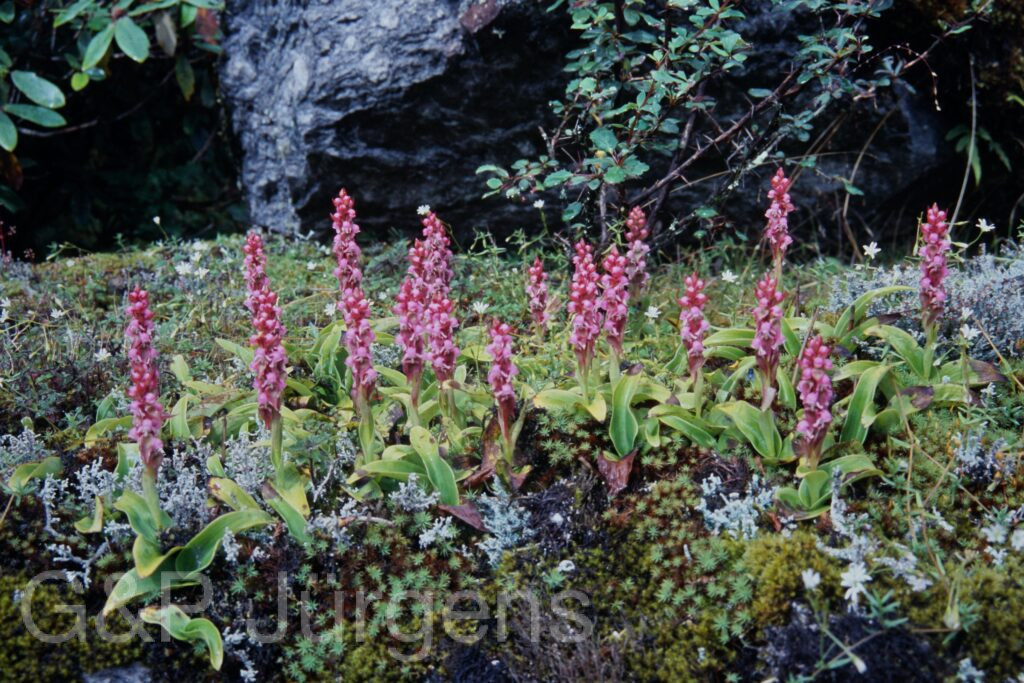
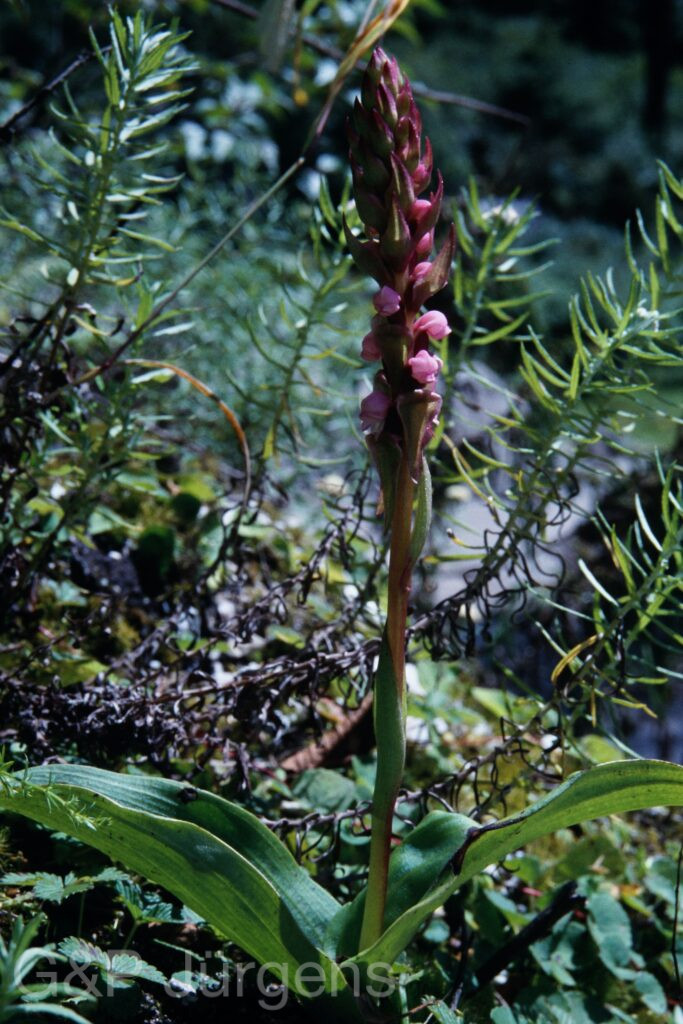
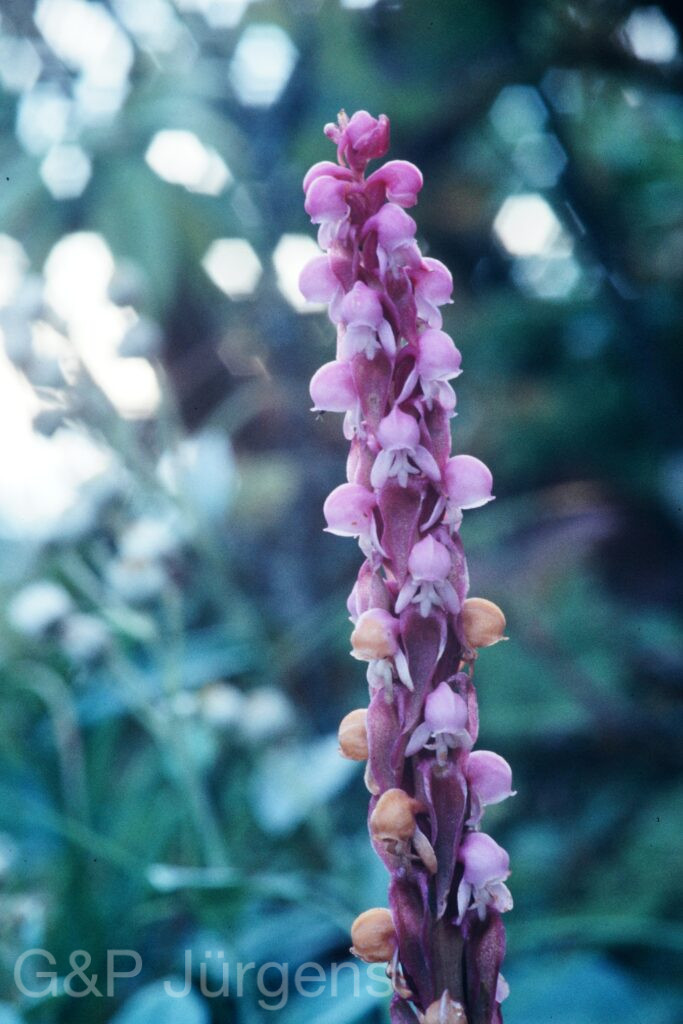
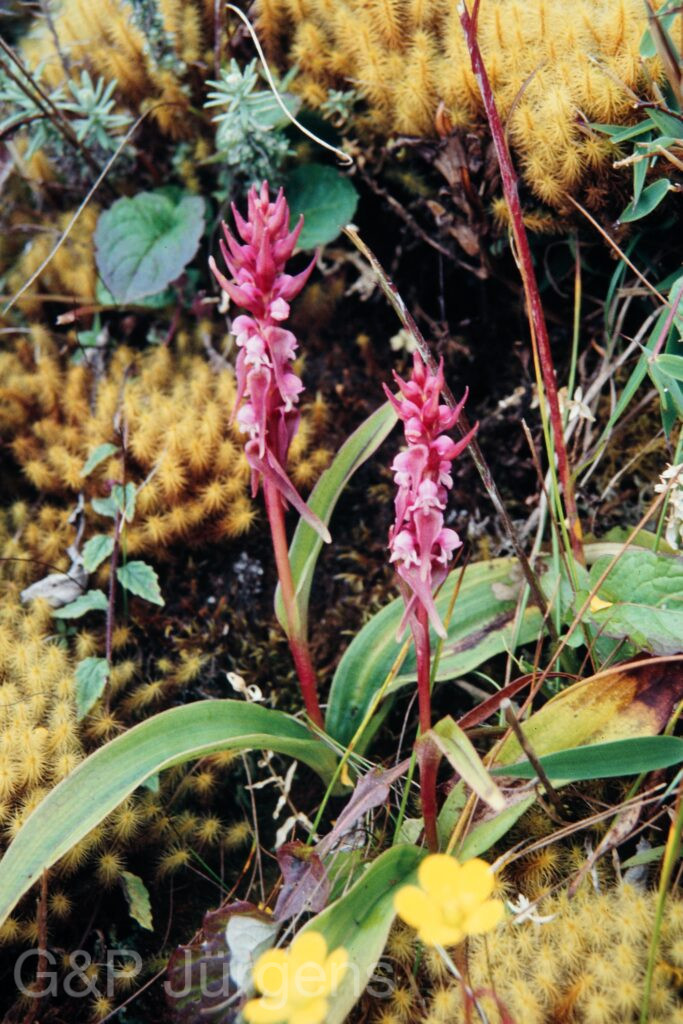
Satyrium nepalense D.Don is a terrestrial orchid of remarkably wide distribution, ranging across the Himalaya and southern Asia from Pakistan, India, Nepal, Bhutan, Sri Lanka and southern China to Myanmar, and extending through tropical and southern Africa; GBIF records nearly 1921 occurrences, reflecting its broad ecological tolerance. It grows in open grassy slopes, meadows, scrub and forest clearings from the submontane belt to high alpine pastures, broadly between about 1500 and 3700 m. The cited material from Lachen in Sikkim at 3450 m in August and Barphak in central Nepal at 2450 m in October illustrates its long flowering season across a wide altitudinal range.

The species is a terrestric herb arising from paired ovoid, tomentose tubers, with an erect leafy stem bearing a few ovate to lanceolate sheathing leaves. The inflorescence is a dense cylindrical raceme of many small, pink to rose-purple, fragrant flowers; each flower is non-resupinate, with the lip uppermost and produced into two slender, parallel spurs at its base, a diagnostic feature of the genus. The fruit is a small dehiscent capsule releasing abundant dust-like seeds.

Satyrium (Orchidaceae, subtribe Satyriinae) is a chiefly African genus with an outlying Asian representation, of which S. nepalense is the most widespread; its twin-spurred, non-resupinate flowers and moth pollination are characteristic. Valued in traditional medicine for its tubers, the species is locally collected, and although still common it warrants monitoring where harvesting pressure is intense.

Author: D.Don · Sources: POWO (Kew), GBIF, Flora of Bhutan, Flora of China, Orchids of Sikkim Himalaya, Pridgeon et al. Genera Orchidacearum

(Wall. ex Schott) Cusimano & Hett.

Nepal 99 241 ergebnis
West-Nepal Tallekh 3000m, June
Nepal 2009 97 ergebnis
Nepal Helambu Samathang 2410, May

Description

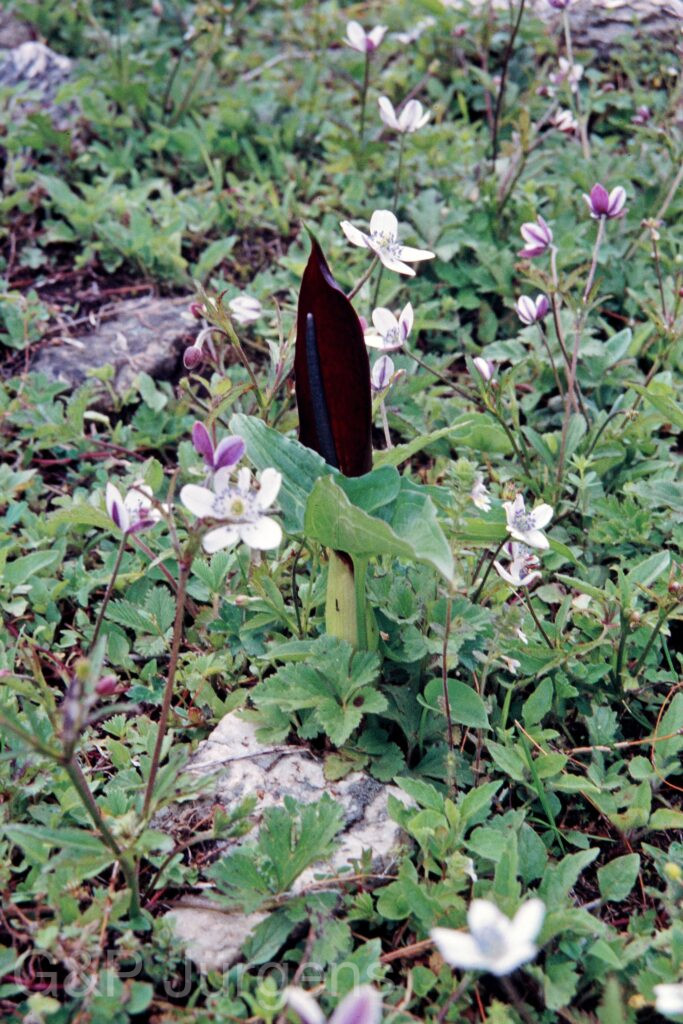
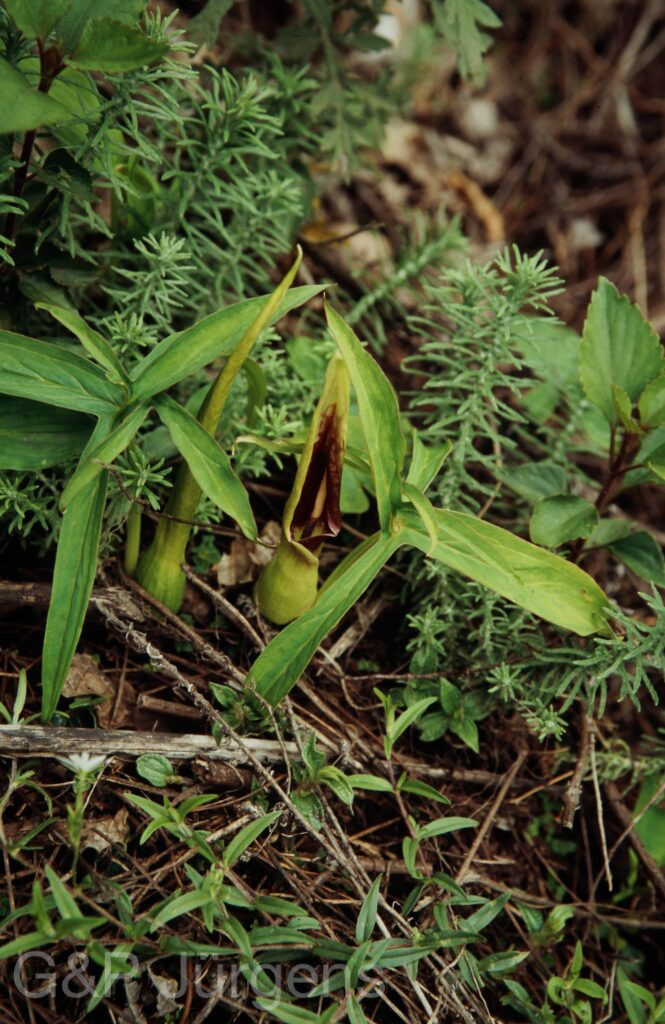
Sauromatum diversifolium is a tuberous aroid of the Himalaya and adjacent uplands, distributed through India, China, Nepal, Bhutan, Myanmar and Thailand, with around 146 recorded occurrences. It grows in moist temperate forest, on shaded banks, in open grassy slopes and among rocks where seasonal soil moisture is reliable, emerging with the onset of the warm season and dying back to its tuber during the dry winter. In Nepal it occupies the middle to upper montane zone, as shown by collections from Tallekh in the west at about 3000 m in June and from Samathang in the Helambu region at 2410 m in May, the latter dates coinciding with its early-season flowering.

The plant arises from a subglobose, depressed tuber and typically produces a single long-petiolate leaf whose blade is deeply pedately divided into several lanceolate to elliptic segments, the lobes acuminate and the petiole often mottled. The inflorescence is a typical aroid spadix subtended by a spathe, the spathe tube convolute and the limb expanded, lanceolate and often dull purple or marked within. The spadix bears a sterile terminal appendix above separated zones of female and male flowers, and emits a faint odour at anthesis to attract small dipteran and beetle pollinators. The fruiting head is a cluster of small berries.

The species was transferred to Sauromatum by Cusimano and Hettich on molecular and morphological evidence that united the former Typhonium diversifolium with the saururoid lineage. The genus is protogynous and largely sapromyophilous, with thermogenic spadices that volatilise scent to lure pollinators into the floral chamber. Widespread and locally frequent in suitable montane habitat, S. diversifolium is not regarded as threatened, though like many tuberous aroids it is sensitive to grazing pressure and the loss of forest-edge microhabitats.

Author: (Wall. ex Schott) Cusimano & Hett. · Sources: POWO (Kew), GBIF, Flora of China Vol. 23, Flora of Bhutan Vol. 3, Flora of Nepal, Cusimano et al. molecular phylogeny of Areae (Araceae)

(Decne.) Sch.Bip.

Garw 2005 170 ergebnis
India Garhwal Simka 2800m, October

Description

Saussurea fastuosa is a Sino-Himalayan species distributed across the high mountain ranges of China, India, Nepal and Bhutan, with around 94 georeferenced occurrences documenting a coherent eastern Himalayan to southwest Chinese range. It is a plant of temperate and subalpine zones, favouring forest margins, moist grassy slopes, scrub and stream banks, typically between roughly 2500 and 3800 m. The photographed material from Simka in Indian Garhwal at 2800 m, flowering in October, is representative of its autumn-flowering behaviour in the western part of its range, where it occupies cool, humid clearings within mixed conifer and broad-leaved forest.

It is a robust perennial herb with an erect, leafy, often glandular-pubescent stem arising from a stout rootstock. The leaves are alternate, the lower ones petiolate and lyrate-pinnatifid to broadly ovate, the upper progressively smaller, sessile and somewhat amplexicaul, with dentate margins and a thinly arachnoid-hairy lamina beneath. The capitula are medium-sized and aggregated in a corymbose synflorescence, each surrounded by an ovoid to campanulate involucre of imbricate, often purple-tinged, frequently squarrose phyllaries. The florets are all tubular and purple; the achenes are glabrous and crowned by a double pappus, the outer row scabrid and caducous, the inner of plumose, basally connate bristles.

Within the very large and taxonomically complex genus Saussurea, this species belongs to the broad-leaved, lowland-to-subalpine assemblage rather than the cushion-forming snow lotuses of the highest alpine zone. The name S. fastuosa (Decne.) Sch.Bip. is the accepted name. As an entomophilous late-season nectar source it is visited by bumblebees and other long-tongued insects, and like its congeners it disperses by anemochory via the plumose pappus. It is locally frequent and not regarded as threatened.

Author: (Decne.) Sch.Bip. · Sources: POWO (Kew), GBIF, Flora of China Vol. 20-21, Flora of Bhutan Vol. 2, Flora of Nepal, Lipschitz Genus Saussurea (monograph)