Tag:

Subalpine (2500-3500 m)

(Cardot) Hand.-Mazz.
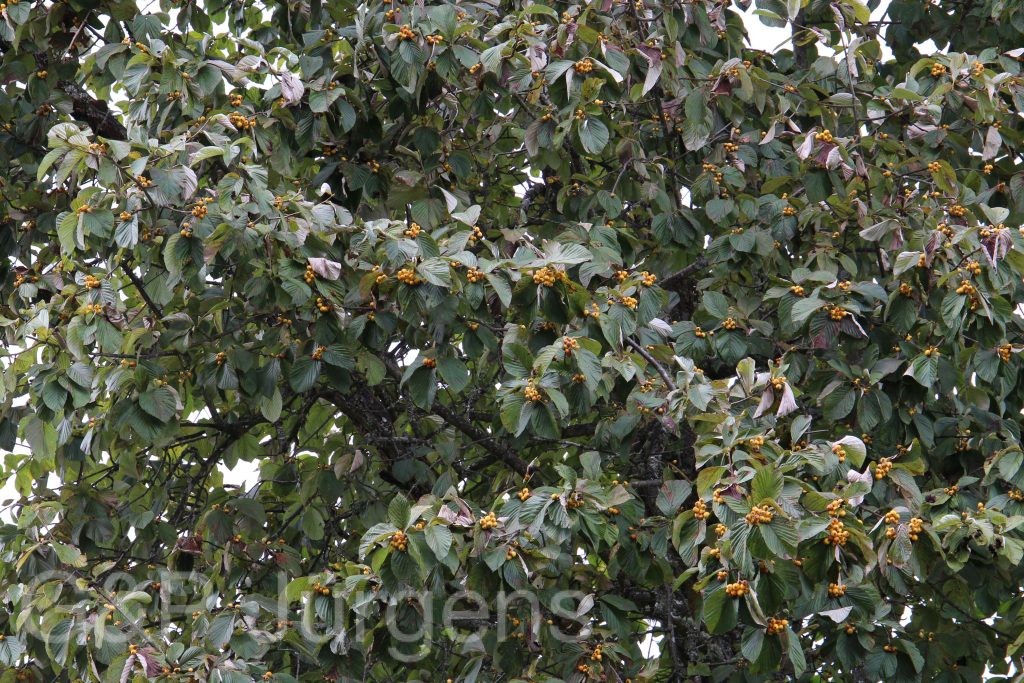
Bhutan2015 495
  Bhutan Pele-La 3000m, October
Bhutan2015 497
  Bhutan Pele-La 3000m, October

Description

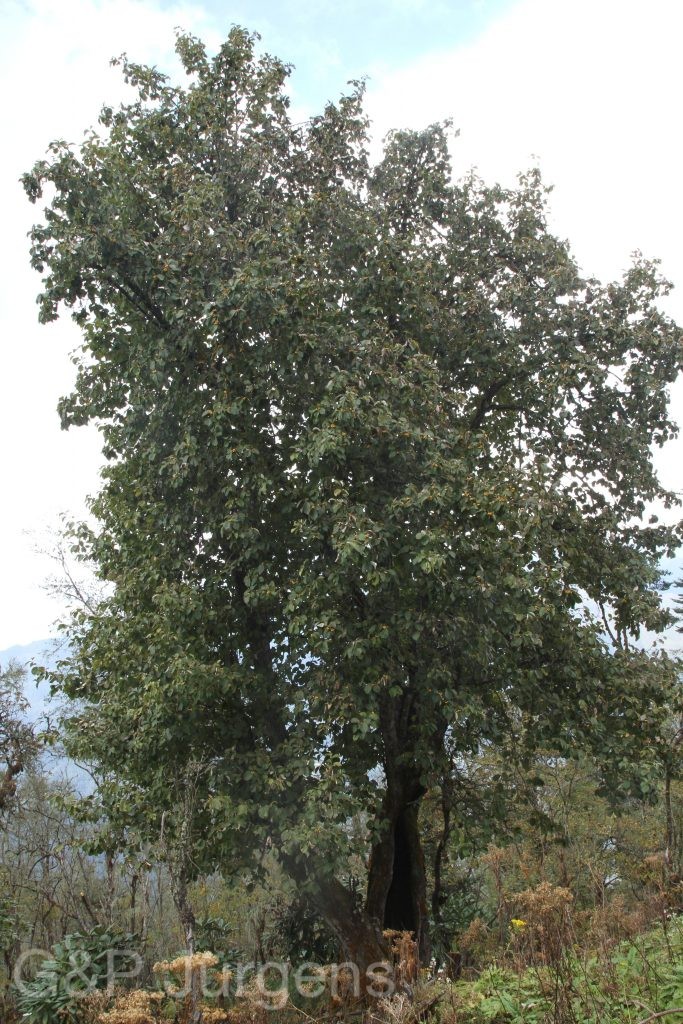
Sorbus thibetica is a Sino-Himalayan whitebeam distributed along the eastern Himalaya and adjacent China, from Nepal through northern India, Sikkim and Bhutan into south-western China (Xizang, Yunnan) and northern Myanmar; its roughly 470 georeferenced occurrences include numerous cultivated records in Britain and northern Europe (GB, NO, DK), reflecting its long-standing horticultural use. It grows in temperate and subalpine forest, woodland margins, rocky slopes and open hillsides, generally between about 2500 and 3600 m. The tree photographed at Pele-La in Bhutan at 3000 m in October, in autumn fruit and leaf-colour, is typical of its cool, montane forest habitat.

It is a deciduous tree to 10-20 m, with a rounded crown and grey bark; the stout twigs and buds are densely white-tomentose when young. The leaves are simple (not pinnate), broadly elliptic to obovate, entire-leaved members of the Aria group, dark green and glabrescent above but persistently covered beneath with a thick, silvery-white felted tomentum, the margins finely and shallowly toothed. The white flowers are borne in flat-topped corymbs, each with five petals, numerous stamens and an inferior ovary. The fruit is a small subglobose pome, ripening orange-brown to russet and bearing scattered lenticels, typical of the simple-leaved whitebeams.

Sorbus thibetica belongs to the Aria group of simple-leaved whitebeams (sometimes segregated as the genus Aria), distinct from the pinnate-leaved rowans of Sorbus sensu stricto. The selection 'John Mitchell', with very large leaves, is widely grown ornamentally. Apomixis and hybridisation complicate species limits throughout the group. Widespread and frequent, it is not considered threatened.

Author: (Cardot) Hand.-Mazz. · Sources: POWO (Kew), GBIF, Flora of China, Flora of Bhutan, Flora of Nepal, McAllister's The Genus Sorbus: Mountain Ash and other Rowans
Hedl.

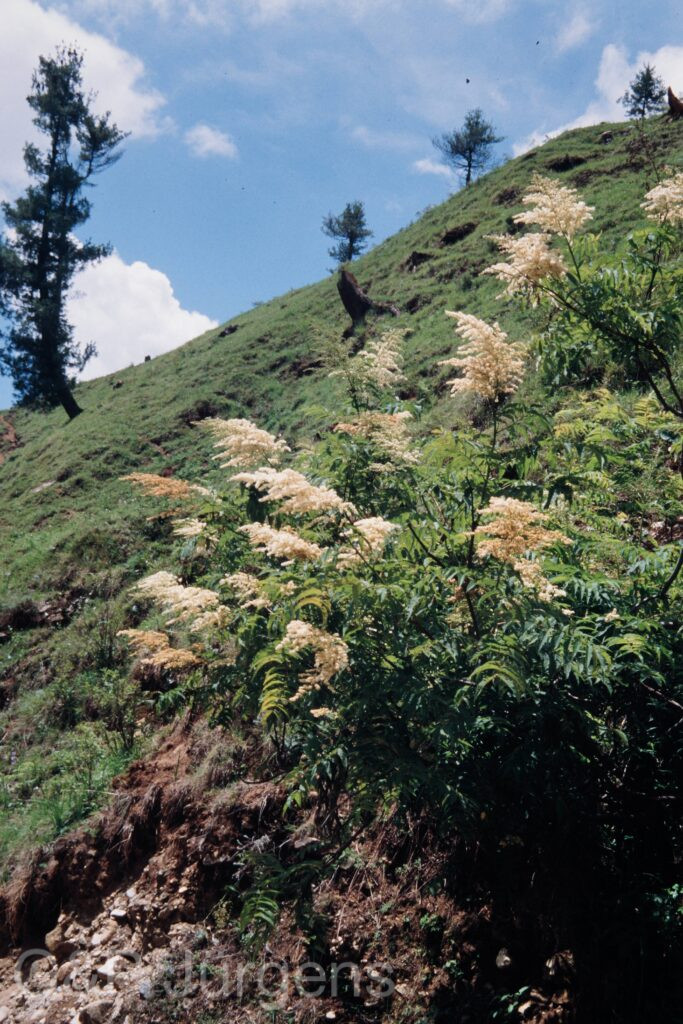
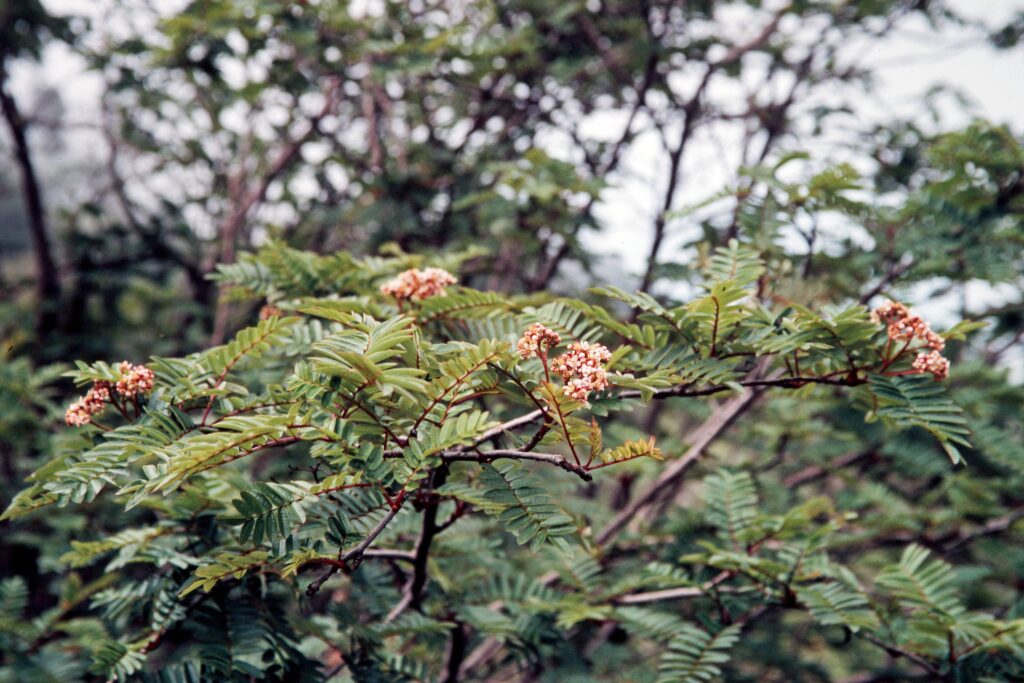
Nepal 99 397 ergebnis
West-Nepal Talphi 2830m, June

Description

Sorbus tomentosa is a Sino-Himalayan tree of the temperate forest belt, distributed along the central and western Himalaya. Although GBIF records remain sparse, with the photographed material gathered at Talphi in West Nepal at about 2830 m in June, the species is characteristic of the upper temperate zone between roughly 2500 and 3500 m. It occupies the canopy gaps and margins of mixed broad-leaved and conifer forest, frequently associating with Quercus, Acer, Betula and Abies, and favouring cool, humid, well-drained slopes where it acts as a light-demanding component of montane woodland.

It is a small deciduous tree or large shrub with pinnate leaves bearing numerous oblong-lanceolate, serrate leaflets that are densely white- or grey-tomentose beneath, giving the foliage a markedly hoary aspect that lends the species its epithet. The young shoots, petioles and rachis are likewise woolly-pubescent. Flowers are small, white, five-petalled and borne in flattened terminal corymbs in early summer; the gynoecium develops into small subglobose pome fruits that ripen red to orange-red in autumn, each crowned by the persistent calyx and containing few seeds.

The species belongs to Sorbus subgenus Sorbus (the pinnate-leaved "true" rowans), a taxonomically intricate group in which apomixis and hybridisation have generated numerous microspecies and rendered circumscriptions difficult. Ecologically its fruits are an important autumn food for thrushes and other frugivorous birds, which act as the principal dispersal agents. Though not presently regarded as threatened, populations are localised and vulnerable to forest clearance and grazing pressure across the Himalayan range.

Author: Hedl. · Sources: POWO (Kew), GBIF, Flora of Nepal, Flora of Bhutan, Flora of China, McAllister – The Genus Sorbus: Mountain Ash and Other Rowans

Sorbus ursina

by G & P Jürgens

(Wall. ex G.Don) S.Schauer

Garh 07 557 ergebnis
India Garhwal Seema 3450m, June

Description

Sorbus ursina is a Himalayan rowan distributed along the southern margins of the high mountains, with documented occurrences in Nepal, India, China, Myanmar and Bhutan, and a comparatively modest record base of around 126 georeferenced collections. It is a tree of the upper temperate to subalpine forest belt, typically occupying the transition between mixed broadleaved-coniferous woodland and the open shrub zone, where it grows on cool, humid, often steep slopes and along forest margins. The plant photographed at Seema in Garhwal (India) at about 3450 m in June reflects this characteristic elevational preference, where the species ascends to the upper limit of arborescent vegetation amid Abies, Quercus and ericaceous undergrowth.

It forms a small deciduous tree or large shrub with a spreading crown, the young twigs initially tomentose and becoming glabrescent and dark with age. The leaves are imparipinnate (pinnately compound), comprising numerous oblong to lanceolate leaflets that are sharply serrate along the margins, glabrous and green above and conspicuously paler, frequently whitish-tomentose, beneath. The flowers are borne in many-flowered terminal corymbs and are small, pentamerous and white, with five free petals, numerous stamens and a partly inferior ovary. The fruit is a small subglobose pome, ripening through pink to deep red and often persisting on the branches after leaf-fall.

Within the large and taxonomically intricate genus Sorbus, S. ursina belongs to the pinnate-leaved (subgenus Sorbus) assemblage, a group complicated across the Himalaya by hybridisation and apomixis. The conspicuous autumn fruiting renders it ecologically important as a food source for thrushes, accentors and other montane frugivorous birds, which act as the principal seed dispersers. Although not presently regarded as threatened given its broad range, populations are tied to intact subalpine forest and are therefore sensitive to grazing pressure, fuelwood collection and the upward shift of timberlines.

Author: (Wall. ex G.Don) S.Schauer · Sources: POWO (Kew), GBIF, Flora of China Vol. 9, Flora of Bhutan Vol. 2, Flora of Nepal, McAllister The Genus Sorbus: Mountain Ash and Other Rowans

Hook.f.

Bhut09 528G 14.06.
Bhutan Jakar 2600m, June
Nepal 99 585 ergebnis
West-Nepal Garpung-Khola 3500m, July

Description

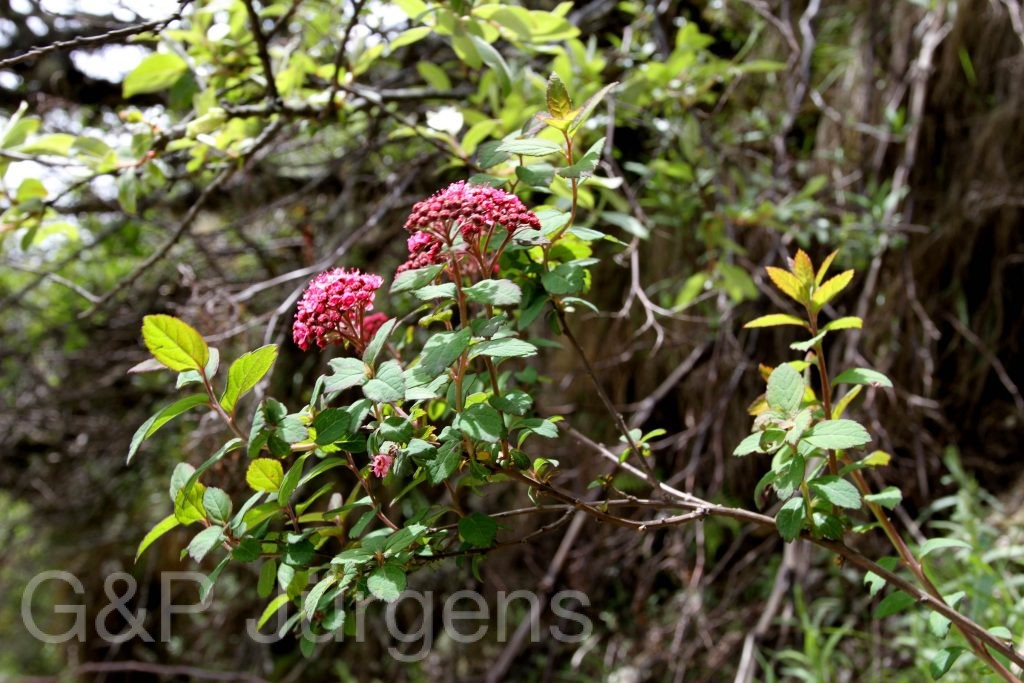
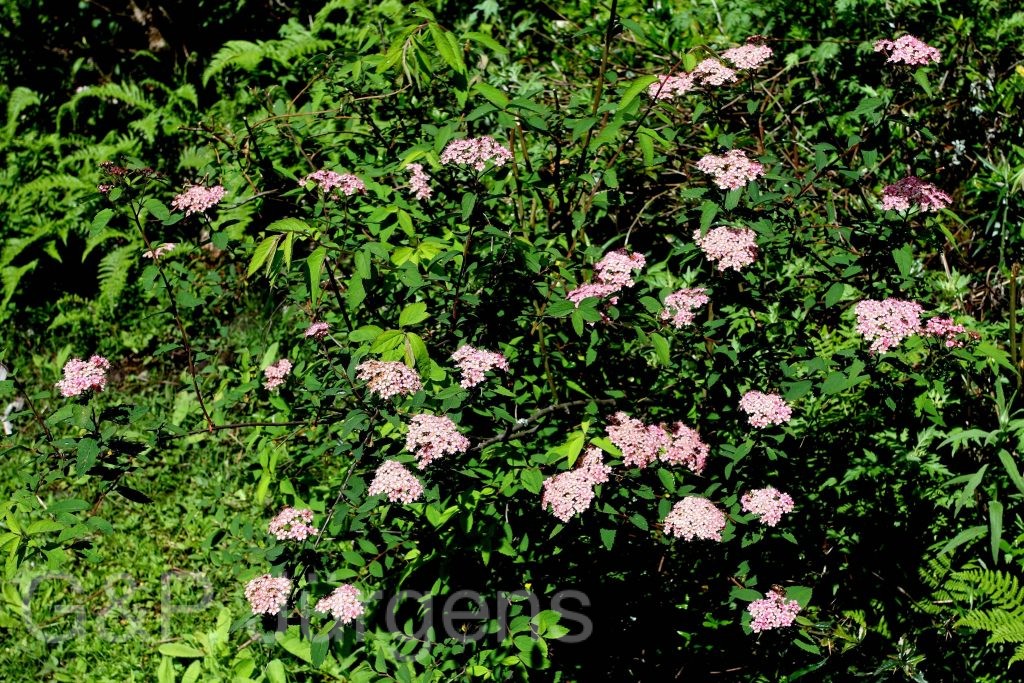
Spiraea arcuata is a Himalayan and Sino-Himalayan shrub native to Nepal, China, India, Bhutan and Myanmar, with about 376 GBIF records, supplemented by cultivated occurrences in Europe and North America. It grows in the temperate and subalpine zone on open hillsides, forest margins, scrub and rocky slopes. The cited records span its altitudinal range, from Jakar in central Bhutan at around 2600 m flowering in June to the Garpung-Khola in western Nepal at about 3500 m in July, where it forms part of the deciduous shrub component of montane vegetation on well-drained slopes.

The plant is a deciduous shrub with slender, arching to recurved branches, the epithet alluding to their curving habit. The leaves are small, alternate, simple, obovate to oblong-elliptic, entire or with a few apical teeth, glabrous to thinly hairy and often paler beneath. The white flowers are numerous and crowded in dense, rounded, corymb-like clusters borne along the branches; each small flower has five petals, a shallow hypanthium, numerous stamens, and several free carpels. The fruit is a cluster of small, dehiscent follicles each containing several narrow seeds.

Described by Hooker f., S. arcuata belongs to the section of pink- to white-flowered Himalayan spiraeas. The genus is taxonomically intricate, with much intergradation among the alpine and subalpine species of the region. Several Himalayan Spiraea, including this one, are valued horticulturally for their profuse spring and early-summer flowering. With its broad distribution and tolerance of open and disturbed montane habitats, the species is not regarded as threatened.

Author: Hook.f. · Sources: POWO (Kew), GBIF, Flora of Bhutan, Flora of China, Rehder's account of Spiraea

Spiraea bella

by GP Jürgens

Sims

Sikkim2011 38
Sikkim Lachung 2850m, June
Sikkim2011 194
Sikkim Lachung 2850m, June
Sikkim2011 196
Sikkim Lachung 2850m, June

Description

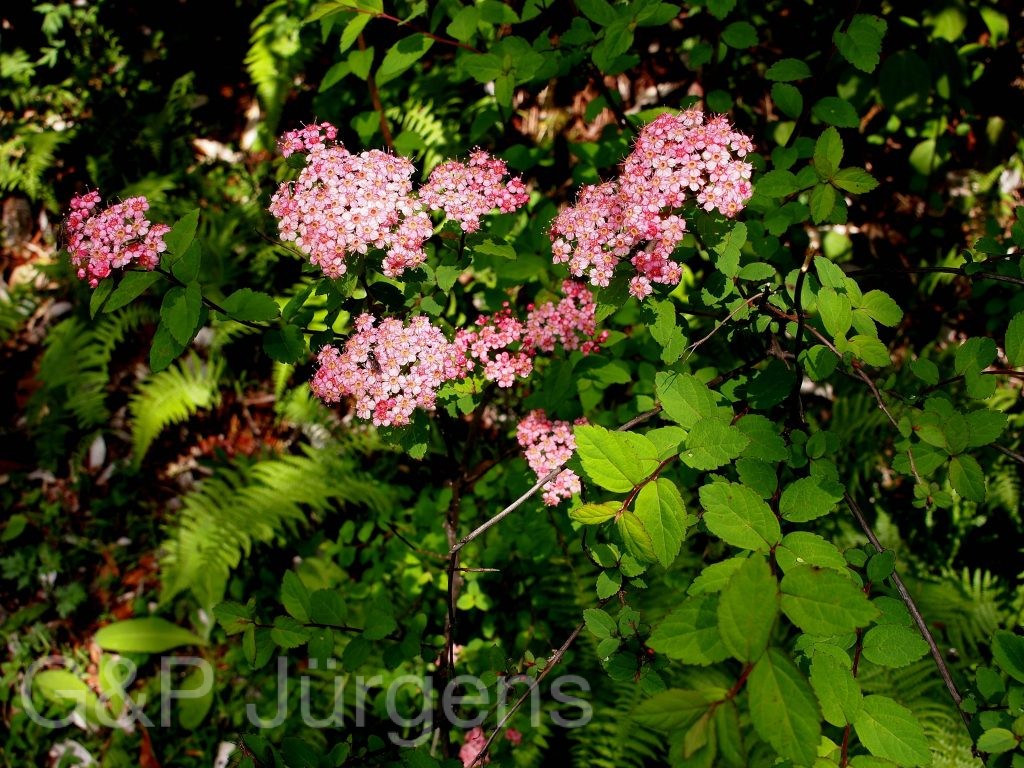
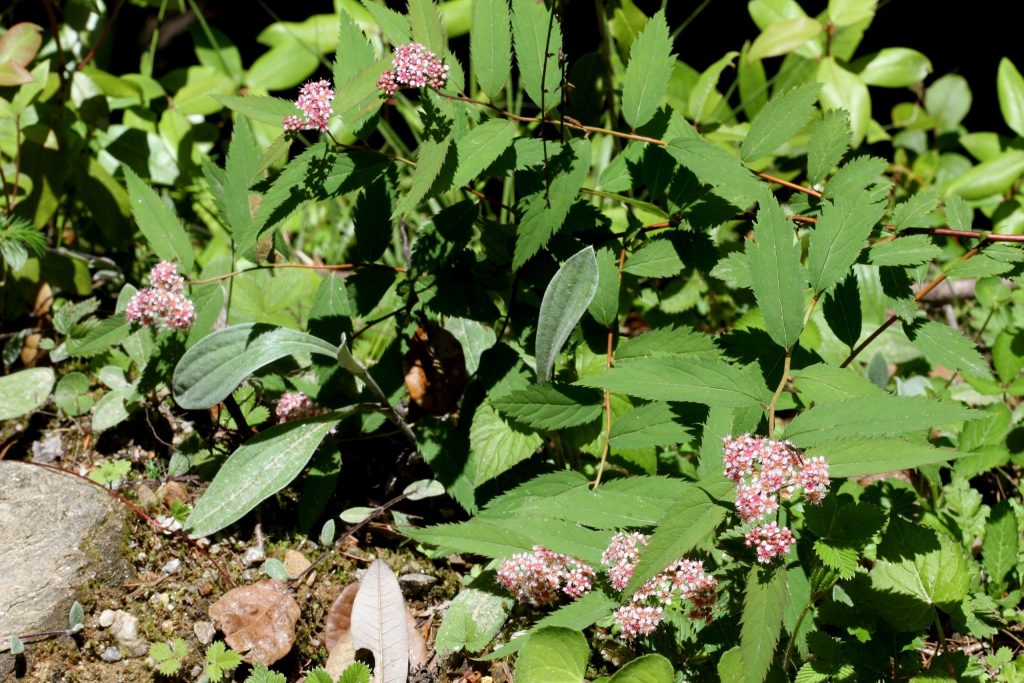
Spiraea bella is a deciduous shrub distributed along the Himalaya and into adjacent China, with verified occurrences spanning China, India, Nepal, Bhutan, Pakistan and Myanmar; further GBIF records from Japan, Korea and numerous European and North American countries reflect its long cultivation as an ornamental. It is a plant of temperate forest margins, open slopes, ravines and shrubberies, typically between about 2000 and 3500 m. The photographed material from Lachung in northern Sikkim at around 2850 m in June, in full bloom, exemplifies its montane habitat in moist, cool valleys.

The species forms an erect to spreading shrub usually 1-2 m tall with slender, angled, reddish-brown branchlets. The alternate, shortly petiolate leaves are ovate to ovate-lanceolate, sharply and often doubly serrate, green above and paler, sometimes thinly pubescent on the veins beneath. Flowers are crowded into terminal corymbs borne on short lateral shoots; each small flower has five rounded pink to rose petals and numerous stamens that exceed the petals, giving the inflorescence a feathery aspect. The fruit is an aggregate of small glabrous to sparsely hairy follicles that split along the inner suture to release minute seeds.

Spiraea bella belongs to a complex of pink-flowered Himalayan spiraeas allied to S. canescens and S. japonica, within which leaf shape and indumentum provide the principal diagnostic characters. Long valued in gardens for its early-summer flowering, it functions ecologically as a nectar source for insects and a component of regenerating forest-edge scrub. It is widespread and locally common, and faces no recognised conservation threat across its broad native range.

Author: Sims · Sources: POWO (Kew), GBIF, Flora of China, Flora of Bhutan, Flowers of the Himalaya

Hook.f.

BhutanPG2011 83 ergebnis scaled
Bhutan Chogcham, 3000m June

Description

Spiraea micrantha is a deciduous shrub of the temperate forests and forest margins of the eastern Himalaya, native to Nepal, Bhutan, India and adjacent China, with around 208 documented occurrences (records from Britain and North America representing cultivated material). It grows in open mixed and conifer forest, woodland edges, scrub and along streambanks, typically between about 2500 and 3300 m. The photographed plant was recorded at Chogcham in Bhutan at 3000 m, flowering in June, when these mid-montane shrubs come into bloom at the start of the summer growing season.

The species is a much-branched shrub with slender, arching, glabrous to thinly pubescent reddish-brown branches. The leaves are alternate, simple and ovate to elliptic-lanceolate, acuminate at the apex and serrate to doubly serrate along the margin, glabrous or sparsely hairy and somewhat glaucous beneath, on short petioles. The inflorescences are lax, terminal, leafy-based corymbose panicles of numerous small flowers (the epithet micrantha denoting the small blooms); each flower has five rounded white to pinkish petals, a shallow campanulate hypanthium, and numerous exserted stamens longer than the petals. The fruit is a cluster of small, glabrous, dehiscent follicles.

Spiraea, of the family Rosaceae and subfamily Amygdaloideae (tribe Spiraeeae), is a north-temperate genus of ornamental shrubs; S. micrantha belongs to the group of Himalayan species with terminal panicle-like inflorescences, distinguished by its small flowers and acuminate, sharply serrate leaves. As a forest-margin shrub it is insect-pollinated and contributes to montane understorey structure. Widespread across the eastern Himalaya and locally common, it is not considered to be of conservation concern.

Author: Hook.f. · Sources: POWO (Kew), GBIF, Flora of Bhutan, Flora of China, A Monograph of the Genus Spiraea

Benth.

BhutanPG2011 841
Bhutan Paro-Chu, 2400m July
Nepal 99 587 ergebnis
West-Nepal Garpung-Khola 3300m, July

Description

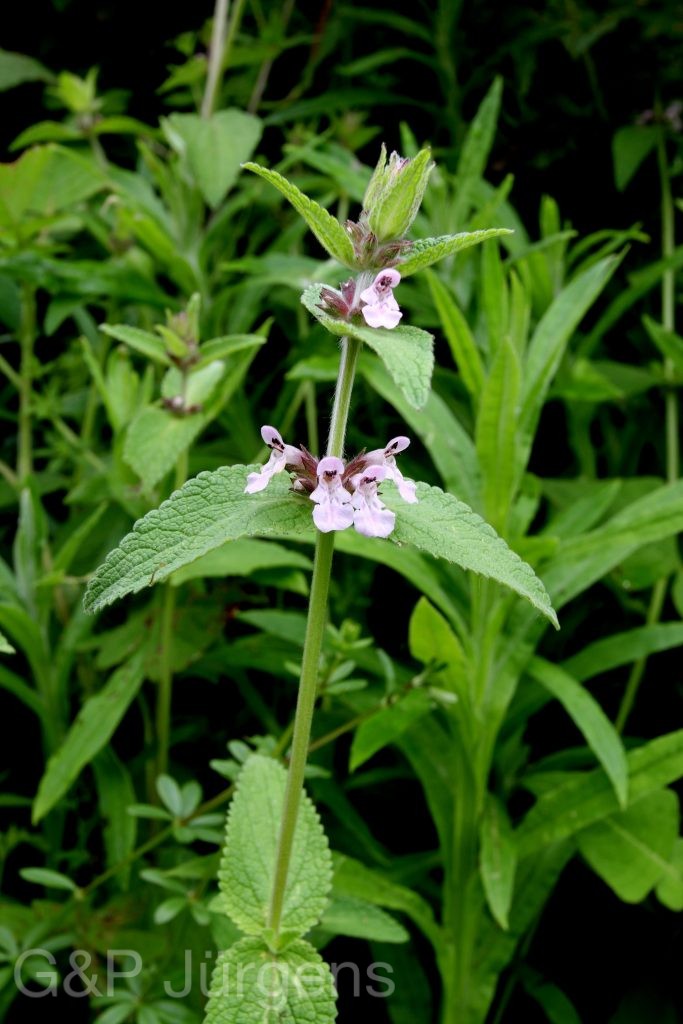
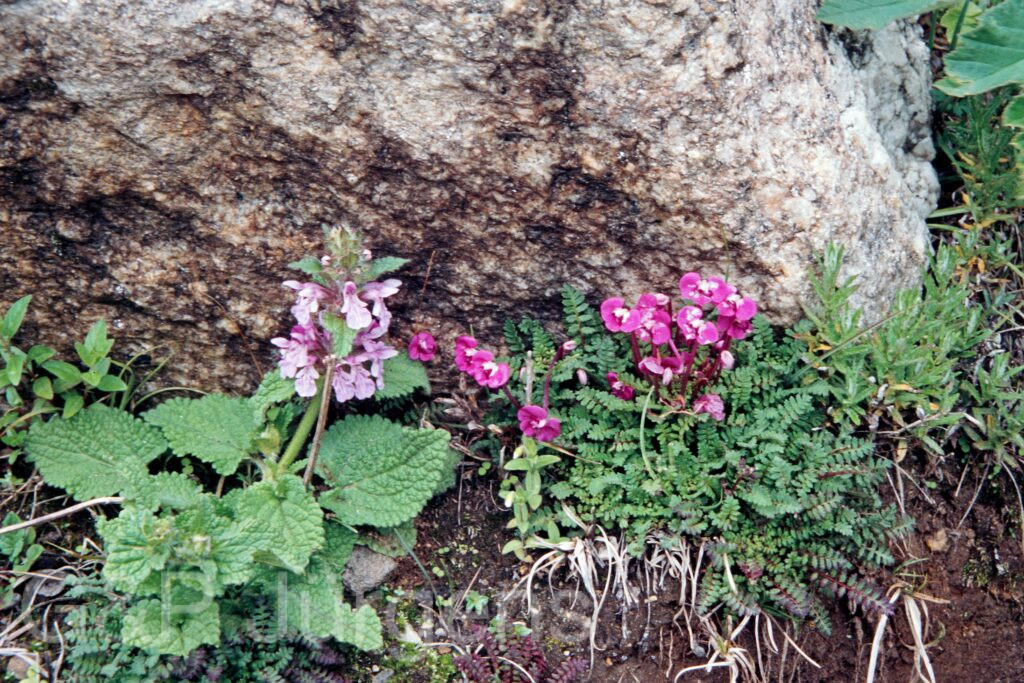
Stachys melissifolia is a perennial mint-family herb of the Himalaya and adjacent mountains, recorded from Nepal, China, India, Bhutan and Pakistan, with around 146 occurrences in GBIF; under its current treatment the name is accepted for the Himalayan plant. It occupies forest margins, moist shaded banks, shrubberies and grassy slopes of the temperate and lower subalpine belt, broadly between 2000 and 3500 m. The photographs from the Paro Chu in Bhutan at about 2400 m and from the Garpung Khola in West Nepal at about 3300 m, both in July, show the species in flower during the summer monsoon in its typical mid-montane woodland-edge habitat.

The plant is an erect to ascending perennial with the quadrangular stems characteristic of the Lamiaceae, usually softly hairy. The leaves are opposite, ovate to oblong with a cordate to rounded base, crenate-serrate margins and a rugose, wrinkled surface, somewhat resembling those of balm (Melissa), as the epithet melissifolia denotes. The flowers are borne in distinct whorls (verticillasters) forming an interrupted terminal spike; the calyx is tubular-campanulate with five subequal teeth, and the bilabiate corolla is pinkish to purple with a short, erect upper lip and a spreading three-lobed lower lip. The fruit comprises four small ovoid nutlets enclosed in the persistent calyx.

Stachys is a large, cosmopolitan genus of the Lamiaceae subfamily Lamioideae, and its Himalayan members have been subject to repeated nomenclatural revision, several names having passed in and out of synonymy. The verticillate inflorescence and bilabiate corolla are adapted to pollination by bees and other long-tongued insects. Widely distributed through the temperate Himalaya, S. melissifolia is common and of no conservation concern.

Author: Benth. · Sources: POWO (Kew), GBIF, Flora of China, Flora of Bhutan, Annotated Checklist of the Flowering Plants of Nepal, Harley et al. Labiatae in The Families and Genera of Vascular Plants

Hook.f. & Thomson ex. Benth.

Bh2008 17 P30
Bhutan Thimphu-Chu, 2800m April
Nepal 97 125 G217
Nepal Mewa-Khola 2470m April

Description

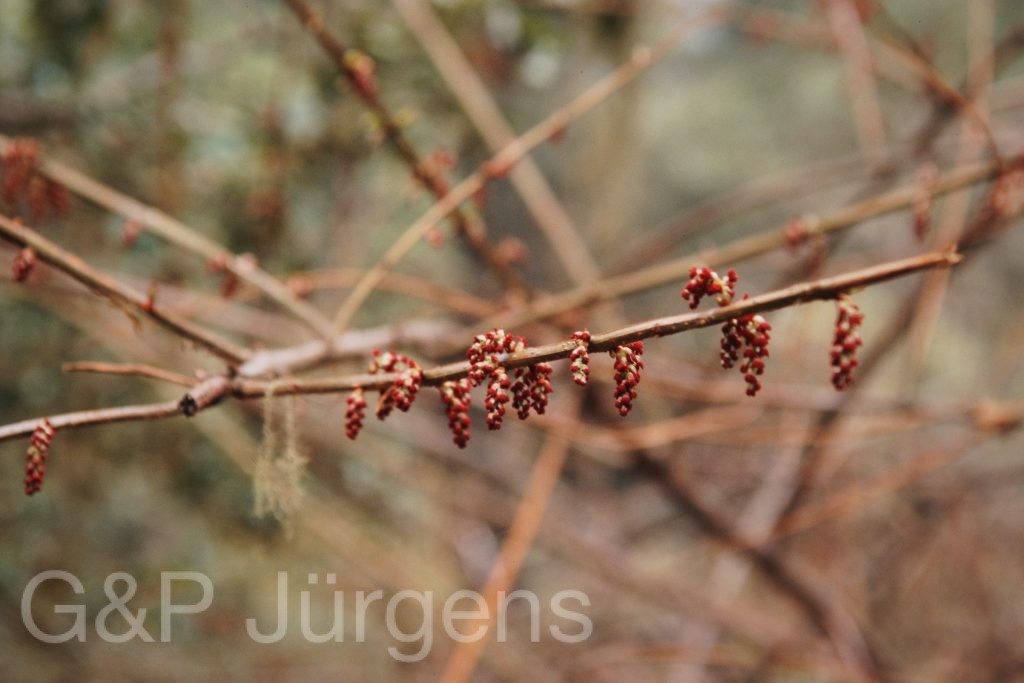
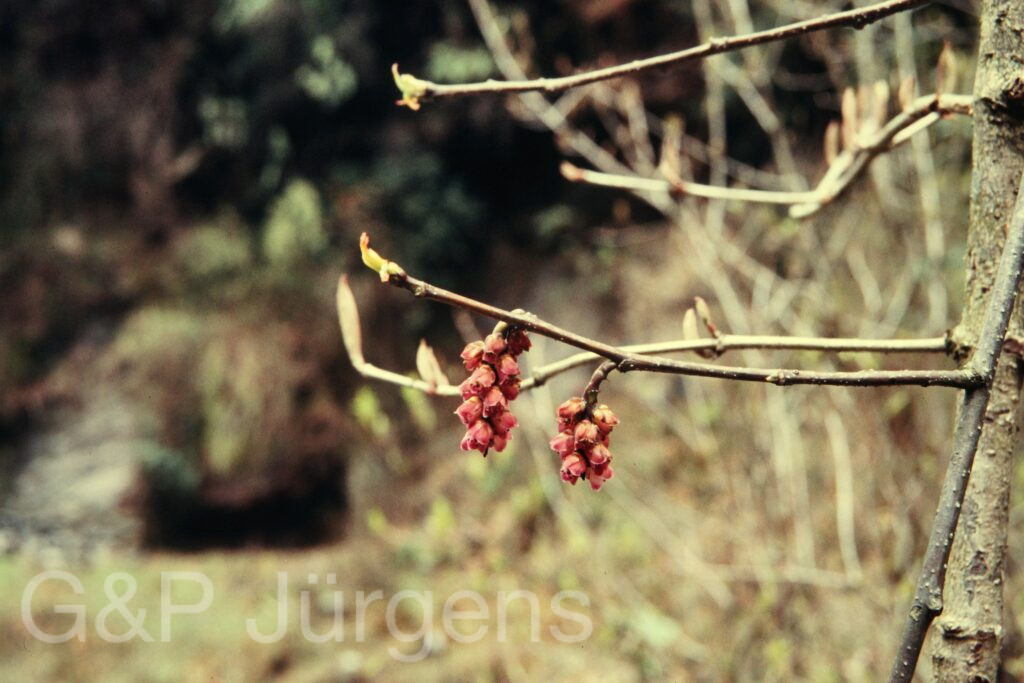
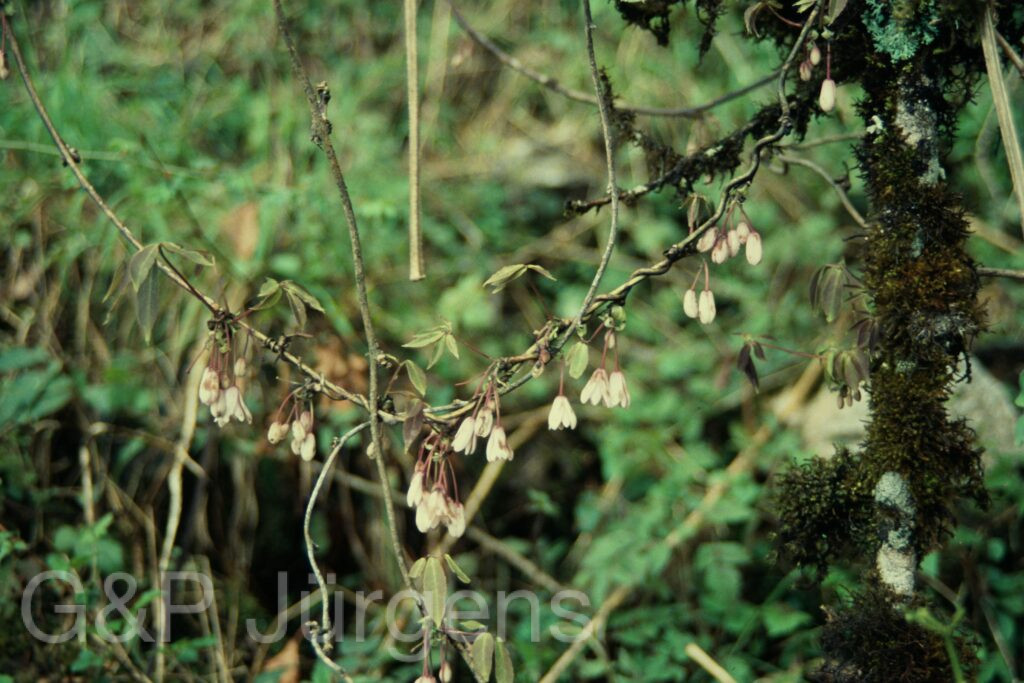
Stachyurus himalaicus is a Sino-Himalayan shrub distributed from Nepal and northern India through Bhutan, northern Myanmar and southern China to Taiwan, with around 4100 GBIF occurrences and a peripheral introduced presence in Japan, Korea and cultivation in Belgium. It grows in moist broad-leaved and mixed evergreen forest, along streamsides, forest margins and shrubby slopes in the warm-temperate to lower cool-temperate belt, roughly 1500 to 3000 m. The plants recorded along the Thimphu-Chu in Bhutan at 2800 m and at Mewa-Khola in Nepal at 2470 m, both flowering in April before leaf expansion, exemplify its precocious early-spring display on humid montane slopes.

It is a deciduous shrub or small tree with reddish-brown, glabrous, lenticellate branchlets. The leaves are alternate, ovate-lanceolate to oblong, acuminate, with serrate to serrulate margins and a slender petiole, the young foliage sometimes flushed reddish. Its diagnostic feature is the inflorescence: stiff, pendent, spike-like racemes produced from the leafless nodes, each bearing numerous small, shortly pedicellate, bell-shaped pale yellow flowers with four sepals, four petals and eight stamens. The superior ovary develops into a small, globose, leathery to fleshy berry containing many minute seeds embedded in pulp.

Stachyurus is the sole genus of the small family Stachyuraceae, an isolated lineage within the Crossosomatales, and S. himalaicus is its principal Himalayan representative, distinguished from the Chinese S. chinensis by leaf and inflorescence characters. The pre-foliar flowering exploits an open canopy and attracts early-season bees, while the berries are bird-dispersed. The species is common and not of conservation concern.

Author: Hook.f. & Thomson ex. Benth. · Sources: POWO (Kew), GBIF, Flora of China Vol. 13, Flora of Bhutan Vol. 2, Flora of Nepal, A Revision of the Genus Stachyurus (Stachyuraceae)

(Wall.) R.Br. ex. Wall.

Bhutan2012 357
Bhutan Dochu-La 2900m, September
Bhutan2014 609
Bhutan Phobjika 3100m, May
Sikkim2004 26 P41
Sikkim West-Bengal, Sambon 1850m April

Description

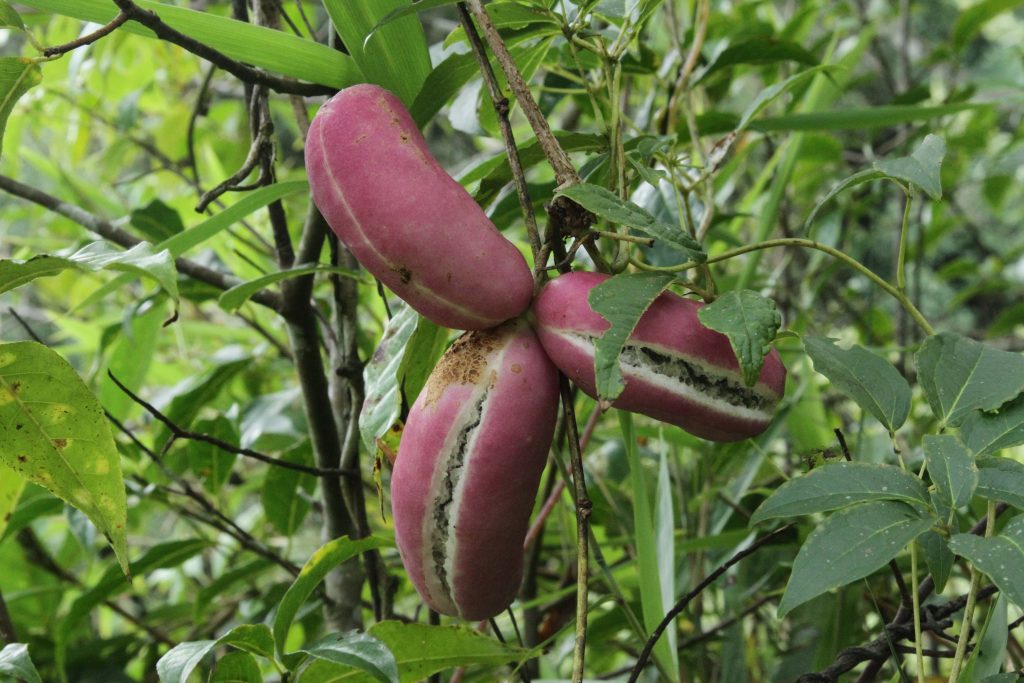
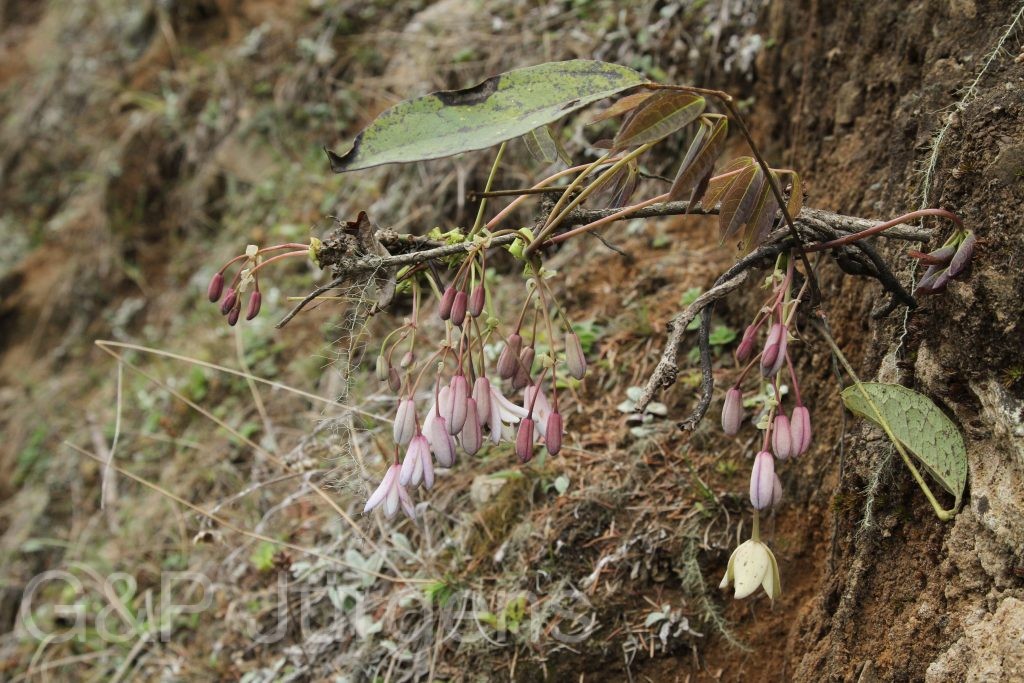
Stauntonia latifolia is a Himalayan woody climber distributed through China, India, Nepal, Bhutan and Myanmar, with GBIF aggregating some 517 occurrences across the warm temperate belt. It is a liana of moist broad-leaved and mixed forest, scrambling over shrubs and into the canopy along forest margins, ravines and streamsides typically between about 1500 and 3100 m. The accompanying records span this range well, from Sambon on the Sikkim–West Bengal border at 1850 m in April, through the Dochu-La in Bhutan at 2900 m in September, to Phobjika at 3100 m flowering in May, reflecting an extended phenology across elevation and longitude in the eastern Himalaya.

The family is here cited as Ranunculaceae, but the plant in fact belongs to the Lardizabalaceae; the description follows the true affinity. It is an evergreen twining climber with palmately compound leaves of three to seven leathery, entire, ovate to elliptic leaflets borne on long petioles. The plant is functionally monoecious, the flowers unisexual and borne in axillary racemes; they are greenish-white to purplish, lacking true petals, the showy parts being six sepals in two whorls, with six stamens in male flowers and three carpels in female ones. The fruit is a fleshy, oblong, purple berry-like follicle, edible and sweet, containing numerous black seeds embedded in a juicy pulp.

The taxon was described by Wallich and is widely treated under the synonym Holboellia latifolia, the generic limits between Holboellia and Stauntonia having been repeatedly debated and revised; under recent circumscriptions the Himalayan plant is placed in Stauntonia. The Lardizabalaceae are a small east-Asian and Chilean family of considerable phylogenetic interest as an early-diverging lineage of the Ranunculales. The succulent fruits are locally gathered and eaten and serve to disperse the seeds via birds and mammals; the species is common and faces no significant conservation concern.

Author: (Wall.) R.Br. ex. Wall. · Sources: POWO (Kew), GBIF, Flora of China, Flora of Bhutan, Annotated Checklist of the Flowering Plants of Nepal, monographic studies of Lardizabalaceae (Holboellia and Stauntonia)

Edgew.

Nepal 2009 68 ergebnis
Nepal Helambu Yangri 1330, May
Garh 07 340 ergebnis
India Garhwal Dohdi-Tal 3070m, June

Description

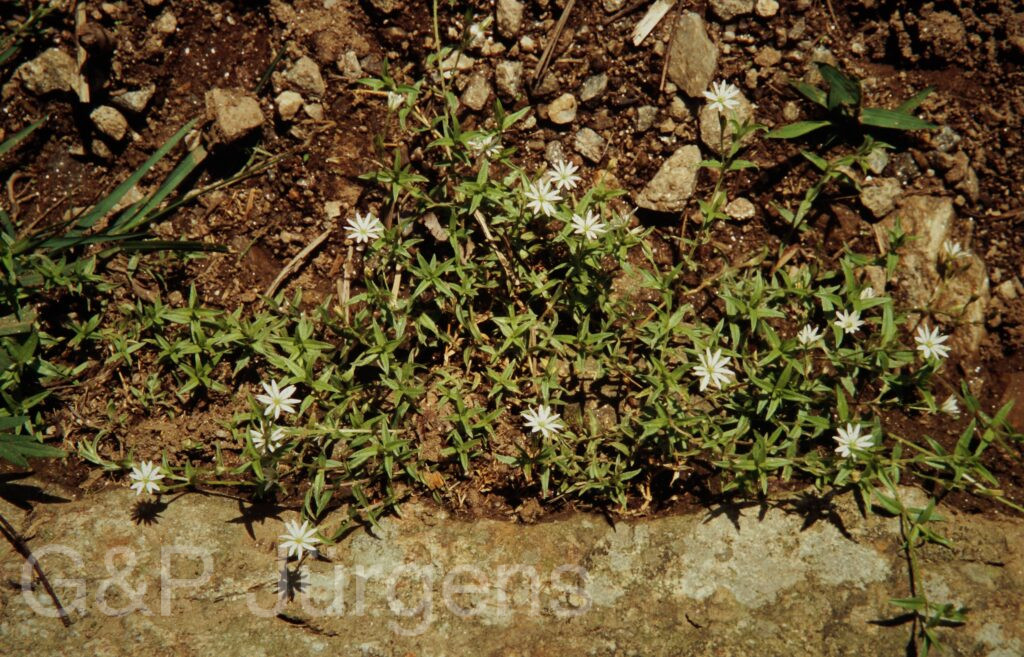
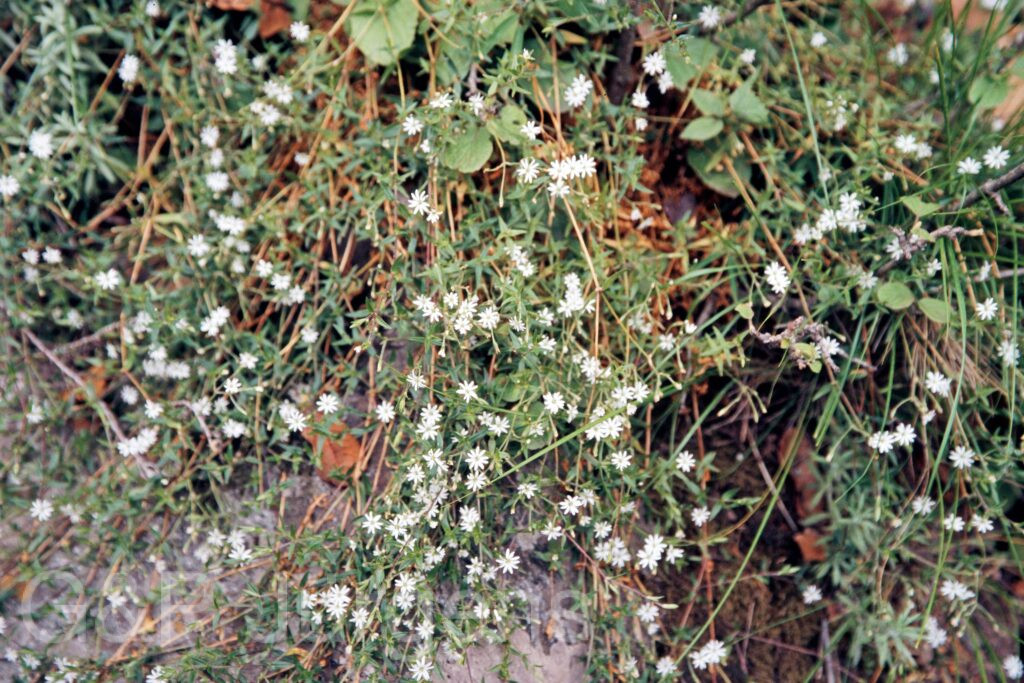
Stellaria semivestita Edgew. is a delicate herbaceous member of the Caryophyllaceae native to the Himalaya and the mountains of southwestern China. GBIF data place it in Nepal, India and China, with a modest 22 georeferenced records reflecting its inconspicuous habit and uneven collection. The species occupies a broad altitudinal span, from warm-temperate forest understorey and shaded banks at around 1,300 m up to subalpine meadows and damp rocky slopes near 3,000 m. The cited gatherings from Helambu (Yangri, Nepal) at 1,330 m and from Dohdi-Tal in Garhwal at 3,070 m illustrate this ecological amplitude across the monsoon-influenced Himalayan front.

The plant is a weak-stemmed, ascending to straggling perennial with quadrangular stems that are pubescent at least in lines, the indumentum being uneven or "half-clothed" as the epithet implies. The leaves are opposite, sessile to shortly petiolate, ovate-lanceolate to lanceolate, acuminate and ciliate at the margins. Flowers are borne in lax, leafy dichasial cymes; the five sepals are lanceolate and the five white petals are deeply bifid, equalling or slightly exceeding the calyx. The fruit is an ovoid capsule dehiscing by six valves and containing numerous reniform, finely tuberculate seeds.

Stellaria semivestita belongs to a taxonomically complex genus in which species delimitation rests on subtle differences in pubescence, petal length and seed sculpture. It is of no conservation concern, being widespread and adaptable, but it contributes to the ground-layer diversity of Himalayan forests and clearings and exemplifies the genus's success across a wide elevational gradient.

Author: Edgew. · Sources: POWO (Kew), GBIF, Flora of China Vol. 6, Flora of Nepal, Flora of Pakistan (Caryophyllaceae), Majumdar: Caryophyllaceae of India