
Hedl.
Description
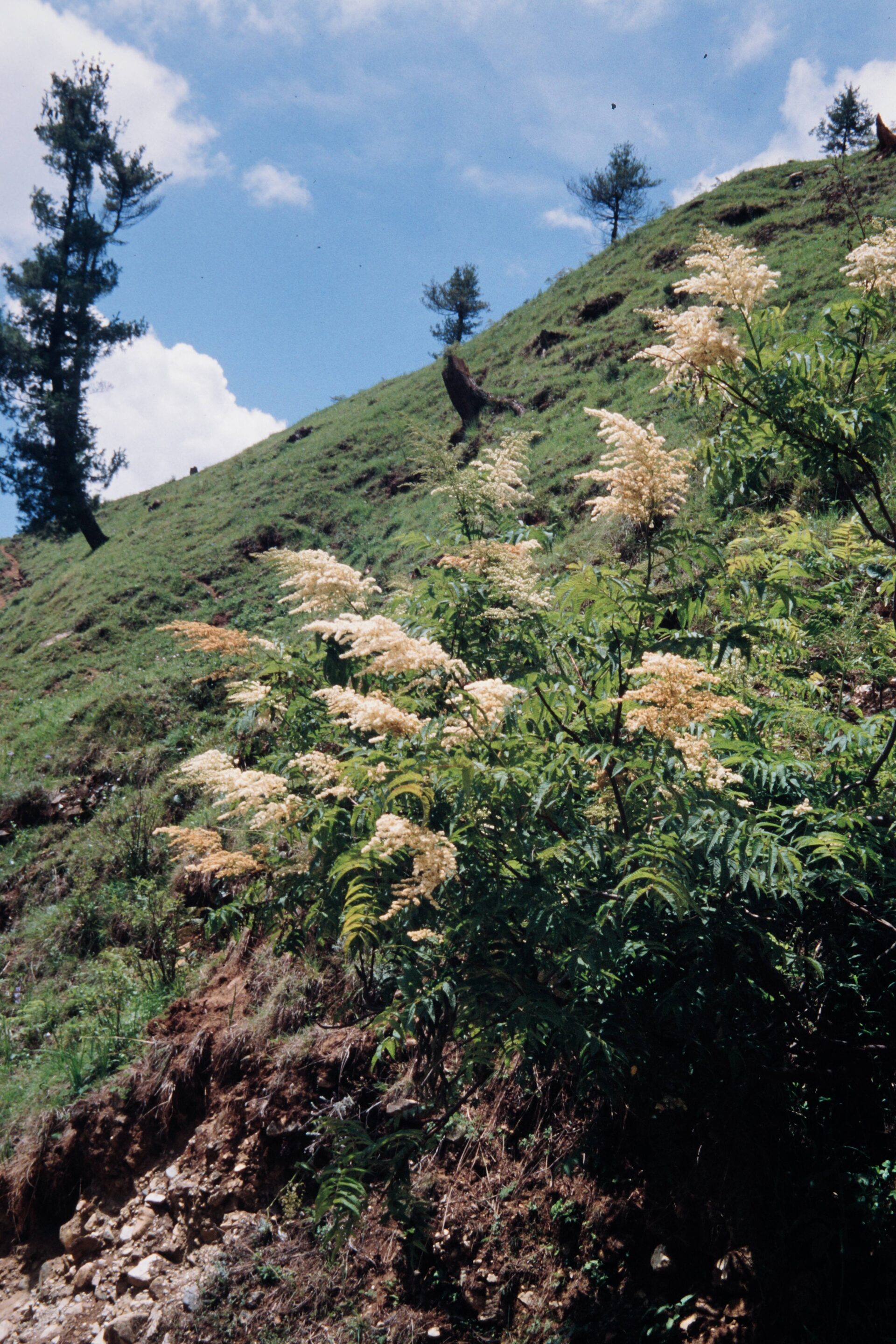
Sorbus tomentosa is a Sino-Himalayan tree of the temperate forest belt, distributed along the central and western Himalaya. Although GBIF records remain sparse, with the photographed material gathered at Talphi in West Nepal at about 2830 m in June, the species is characteristic of the upper temperate zone between roughly 2500 and 3500 m. It occupies the canopy gaps and margins of mixed broad-leaved and conifer forest, frequently associating with Quercus, Acer, Betula and Abies, and favouring cool, humid, well-drained slopes where it acts as a light-demanding component of montane woodland.
It is a small deciduous tree or large shrub with pinnate leaves bearing numerous oblong-lanceolate, serrate leaflets that are densely white- or grey-tomentose beneath, giving the foliage a markedly hoary aspect that lends the species its epithet. The young shoots, petioles and rachis are likewise woolly-pubescent. Flowers are small, white, five-petalled and borne in flattened terminal corymbs in early summer; the gynoecium develops into small subglobose pome fruits that ripen red to orange-red in autumn, each crowned by the persistent calyx and containing few seeds.
The species belongs to Sorbus subgenus Sorbus (the pinnate-leaved "true" rowans), a taxonomically intricate group in which apomixis and hybridisation have generated numerous microspecies and rendered circumscriptions difficult. Ecologically its fruits are an important autumn food for thrushes and other frugivorous birds, which act as the principal dispersal agents. Though not presently regarded as threatened, populations are localised and vulnerable to forest clearance and grazing pressure across the Himalayan range.
Author: Hedl. · Sources: POWO (Kew), GBIF, Flora of Nepal, Flora of Bhutan, Flora of China, McAllister – The Genus Sorbus: Mountain Ash and Other Rowans