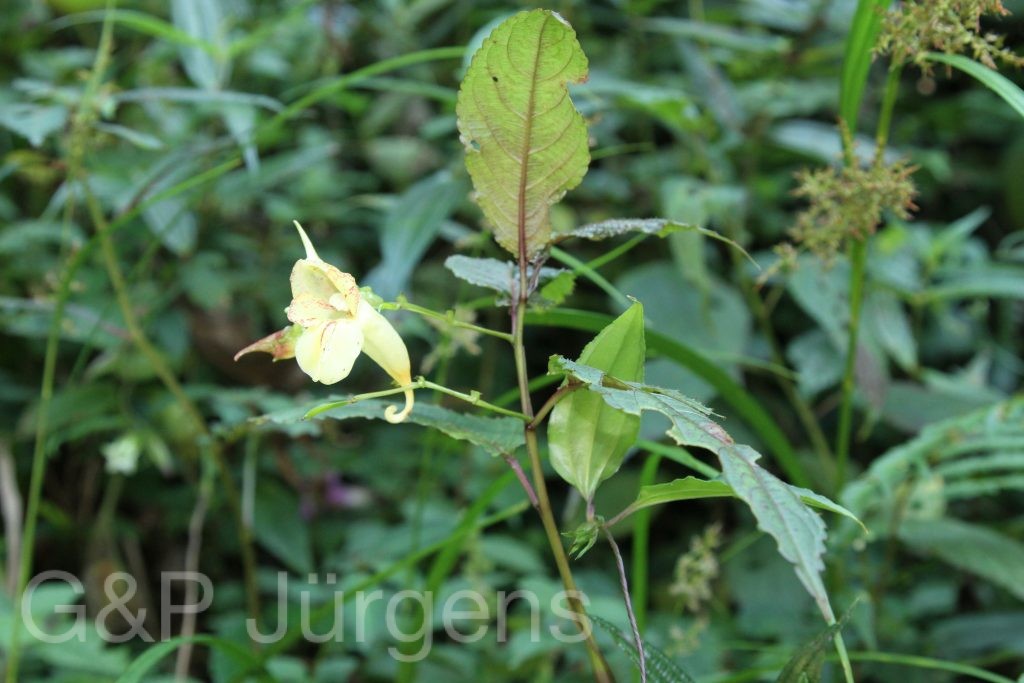
Tag:

Subtropical (<1500 m)

(Thunb.) Ser.

Bhutan2015 285
Bhutan Zhemgang 910m, October

Description

Hydrangea macrophylla is a deciduous shrub of East Asian origin, now among the most widely cultivated ornamental hydrangeas worldwide; this is reflected in its very large GBIF record (over 16,000 occurrences) spanning Japan, China, Korea, much of Europe, the Americas, Australasia and beyond, where most points represent garden or naturalised plants. In the Himalaya it occurs chiefly in cultivation and around settlements, growing in moist, humus-rich, partially shaded ground at low to mid elevations. The documented plant from Zhemgang in Bhutan at 910 m in October indicates such a subtropical montane setting, flowering and fruiting late in the season in the warm-temperate belt.

The species is a rounded, much-branched shrub with stout, glabrous stems and large, opposite, broadly ovate to elliptic leaves that are coarsely serrate, glossy and somewhat fleshy. The inflorescence is a broad, flattened to globose terminal corymb; in wild and lacecap forms the small fertile flowers occupy the centre while showy sterile flowers with four enlarged, petaloid sepals form the margin, whereas cultivated mopheads are dominated by sterile flowers. Corolla colour ranges from white through pink to blue, the latter influenced by soil acidity and available aluminium. The fruit is a small ribbed capsule with numerous minute seeds.

Within Hydrangeaceae the species belongs to the mophead and lacecap group and has given rise to innumerable cultivars. Its sterile marginal flowers act as visual attractants for pollinators of the inner fertile florets, and its pigment chemistry makes flower colour a notable indicator of substrate pH. Wild populations are restricted to coastal Japan, while elsewhere occurrence is overwhelmingly anthropogenic.

Author: (Thunb.) Ser. · Sources: POWO (Kew), GBIF, Flora of China Vol. 8, Flora of Bhutan Vol. 1, McClintock A Monograph of the Genus Hydrangea
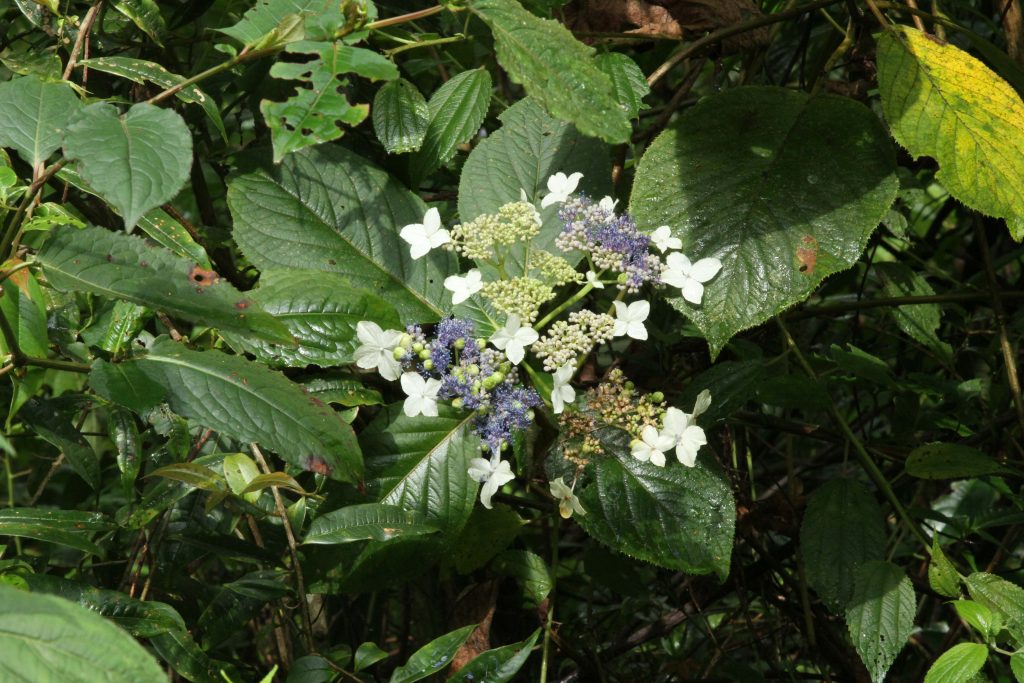
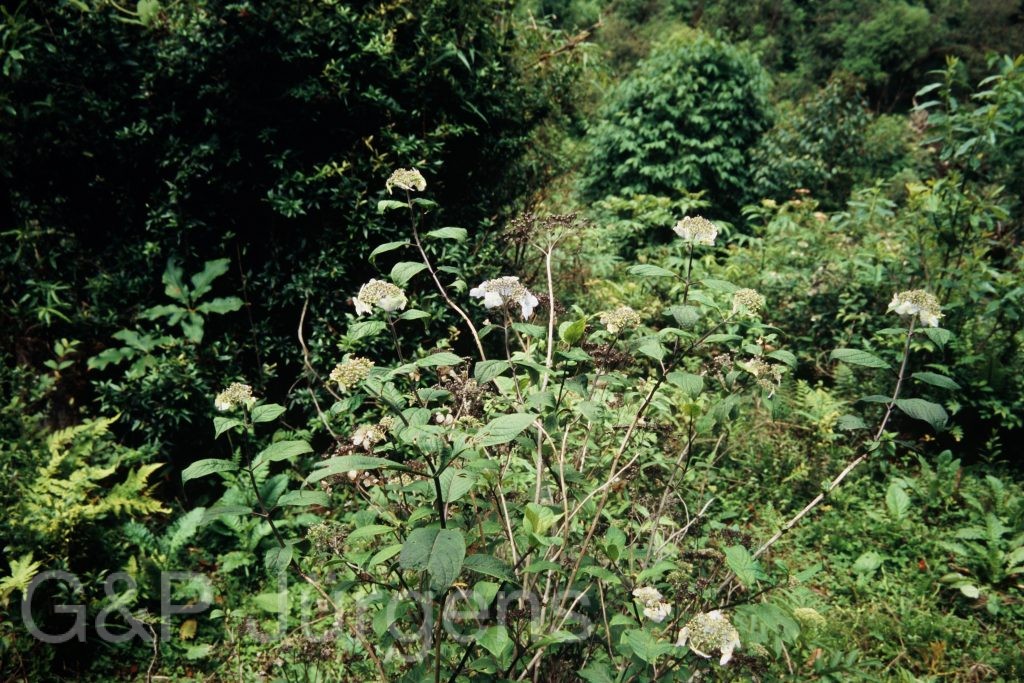
Hook. f. & Thomson

Bhutan2012 692
Bhutan Galephu, 850m September
Bh09 216 G363
Bhutan Dochu-La, 3000m June
Bh09 217 P364 2
Bhutan Dochu-La, 3000m June

Description

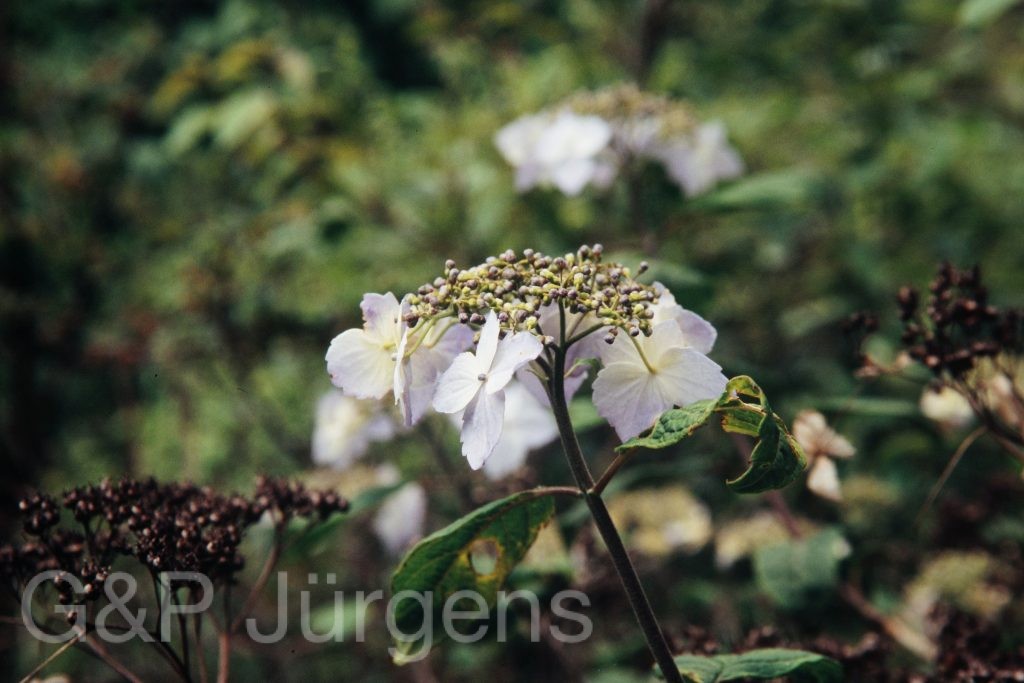
Hydrangea stylosa Hook.f. & Thomson is a Sino-Himalayan shrub recorded by GBIF from China, Bhutan, India, Vietnam and Japan, with cultivated occurrences from Canada and New Zealand, totalling about 85 records. It occupies a broad altitudinal range in moist broad-leaved and mixed forest, thickets and forest margins, on shaded slopes and along ravines. The Bhutanese material spans this amplitude strikingly, with collections from Galephu at 850 m in September and from the Dochu-La at 3000 m in June, showing occurrence from low submontane forest up into the cool temperate zone.

It is a deciduous shrub with terete branches, the young growth often pubescent and the bark exfoliating on older stems. The leaves are opposite, ovate to oblong-lanceolate, with a serrate margin, an acuminate apex and pinnate venation, pilose along the veins beneath. The inflorescence is a terminal corymbose cyme bearing two kinds of flowers: numerous small fertile flowers with minute petals, and a marginal ring of showy sterile flowers whose enlarged, petaloid white to pinkish sepals attract pollinators. The fertile flowers are notable for their elongate, persistent styles, emphasised by the epithet stylosa; the fruit is a small ribbed capsule opening between the styles.

Within Hydrangea, H. stylosa belongs to the lacecap-type species, in which marginal sterile flowers advertise the fertile centre to insects. Its distribution forms part of the eastern Himalayan to Sino-Japanese floristic continuum, and the species is of horticultural interest, accounting for the cultivated records beyond its native range. As a forest understorey shrub it depends on humid montane woodland.

Author: Hook. f. & Thomson · Sources: POWO (Kew), GBIF, Flora of Bhutan Vol. 1, Flora of China Vol. 8, McClintock monograph of the genus Hydrangea, Flora of Nepal

Thunb.

Bhutan2015 150
Bhutan Zhemgang 900m, October

Description

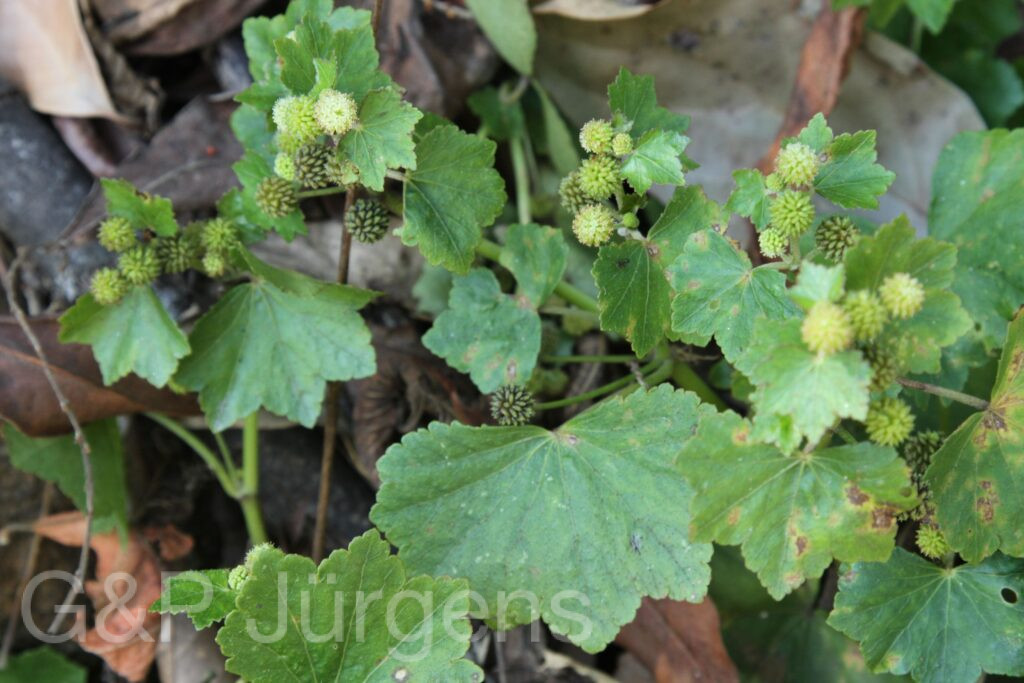
Hydrocotyle javanica is a widespread perennial herb of tropical and subtropical Asia and the western Pacific, recorded from the Himalaya (Nepal, NE India, Bhutan) through southern China, Taiwan, Japan and Korea to Sri Lanka, Myanmar, Indochina, Malesia, the Philippines, New Guinea, Australia and Fiji; with 2,061 GBIF occurrences it is among the better-documented members of its genus. It favours moist, shaded ground along streams, forest floors, seepage banks and damp roadside verges. The Bhutan record from Zhemgang at about 900 m in October places it in warm, humid subtropical forest, where it grows as a creeping ground cover.

It is a creeping to ascending herb rooting at the nodes, with slender, often pilose stems. The leaves are alternate, long-petioled, orbicular to reniform in outline, 2–7 cm wide, palmately 5–7-lobed with the lobes again toothed, cordate at the base, and frequently bearing scattered hairs. The inflorescences are condensed simple umbels, sometimes verticillate along the stem, on peduncles shorter than the petioles; the minute flowers are whitish to greenish, with five petals and an inferior bicarpellate ovary. The fruit is a small, laterally compressed schizocarp, broader than long, the mericarps with conspicuous lateral ribs.

Long placed in Apiaceae, Hydrocotyle is now segregated into Araliaceae (Hydrocotyloideae) on molecular grounds, so the input family is botanically defensible. GBIF lists the name as accepted. The species is highly variable across its enormous range, and several infraspecific taxa have been described; it is common, weedy and of no conservation concern.

Author: Thunb. · Sources: POWO (Kew), Flora of China Vol. 14, Flora of Bhutan Vol. 2, GBIF, Pimenov & Leonov: The Genera of the Umbelliferae (1993)

Wight & Arn.

Bhutan2014 8
Bhutan Sandrup 750m, May
Bhutan2014 222
Bhutan Karu-Chu 1800m, May

Description

Hypericum hookerianum is a Himalayan and Sino-Himalayan shrubby St John's wort, native across China, NE India, Nepal, Bhutan and Myanmar, with GBIF recording some 638 occurrences including numerous cultivated and naturalised records from Europe, North America and Australasia. In the wild it grows in forest margins, clearings, scrub and on open rocky slopes. The photographed Bhutanese plants from Sandrup (750 m) and Karu-Chu (1,800 m), both in May, illustrate its wide altitudinal tolerance from the subtropical foothills to the warm temperate belt.

It is an evergreen or semi-evergreen shrub with terete, often reddish branches. The leaves are opposite, ovate to oblong or lanceolate, sessile or nearly so, frequently glaucous beneath and dotted with pale translucent glands. The flowers are large and showy, borne singly or in few-flowered cymes; they are cup-shaped to bowl-shaped, deep golden-yellow, with five broad concave petals and a dense central boss of numerous stamens grouped in five fascicles surrounding a stout ovary with several styles. The fruit is a many-seeded septicidal capsule.

Hypericum hookerianum is a parent of several widely grown ornamental cultivars and hybrids, valued for its robust habit and bold flowers, which accounts for its scattered occurrence well beyond its native range. The translucent and dark glands of the foliage, characteristic of the genus, contain hypericin and hyperforin and related bioactive compounds. Within the large and complex genus Hypericum, the species belongs to the woody section Ascyreia, distinguished by its shrubby habit, large bowl-shaped flowers and fascicled stamens; it is of no conservation concern given its breadth of range and cultivation.

Author: Wight & Arn. · Sources: POWO (Kew), Flora of Bhutan Vol. 1, GBIF, Flora of China Vol. 13, Robson: Studies in the Genus Hypericum (Bulletin of the Natural History Museum)

(Loes.) S.Y. Hu

Bhutan2015 536
Bhutan Mo-Chu 1300m, October
Bhutan2015 540
Bhutan Mo-Chu 1300m, October

Description

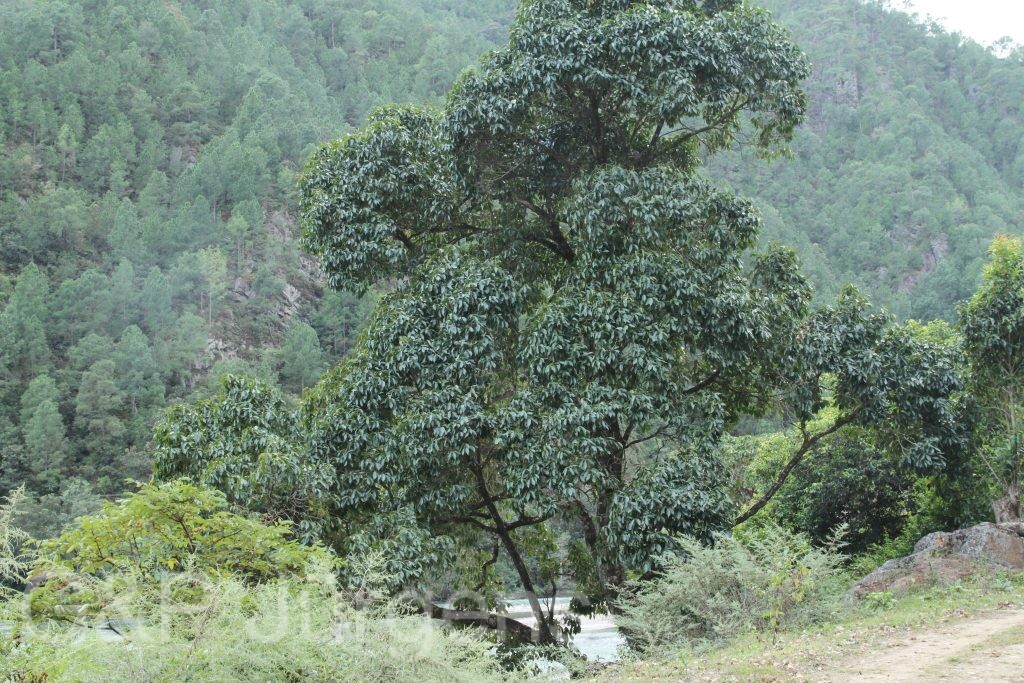
Ilex excelsa var. hypotricha is a holly of the eastern Himalaya and adjacent China, distributed through Bhutan, Nepal, NE India, Bangladesh and SW China as recorded by GBIF (CN, IN, NP, BD) on the basis of about 39 occurrences. The photographed tree was found in western Bhutan along the Mo-Chu at about 1,300 m in October. It is a component of subtropical and warm-temperate broadleaf forest, growing on humid hill slopes, along streams and forest margins, generally between about 1,000 and 2,200 m, where it occurs as an understorey to mid-canopy evergreen tree in mixed laurophyllous woodland.

It is an evergreen tree or large shrub with smooth grey bark and glabrous to finely puberulent young shoots. The leaves are alternate, leathery, elliptic to oblong-lanceolate, with an entire to remotely crenulate margin and an acuminate apex; this variety is distinguished by a thin pubescence on the lower surface, particularly along the midrib, the feature signalled by the epithet hypotricha. As in all Ilex the plants are dioecious, the small four-merous white to greenish flowers borne in axillary fascicles or short cymes, the staminate and pistillate flowers on separate trees. The fruit is a small globose red drupe containing several hard pyrenes (stones), characteristically ornamented as is diagnostic in the genus.

The genus Ilex is large and taxonomically intricate, with infraspecific variation in leaf indumentum often used to delimit varieties such as this one; the bony pyrene sculpturing remains an important systematic character. As a forest tree of moderately wide range, this taxon is not regarded as threatened, though its dependence on intact mid-elevation broadleaf forest links its fortunes to the conservation of eastern Himalayan woodland.

Author: (Loes.) S.Y. Hu · Sources: POWO (Kew), Flora of China Vol. 11, Flora of Bhutan Vol. 2, GBIF, Loesener: Monographia Aquifoliacearum

Hook.f.

Bhutan2015 90
Bhutan Wangdi 1400m, October

Description

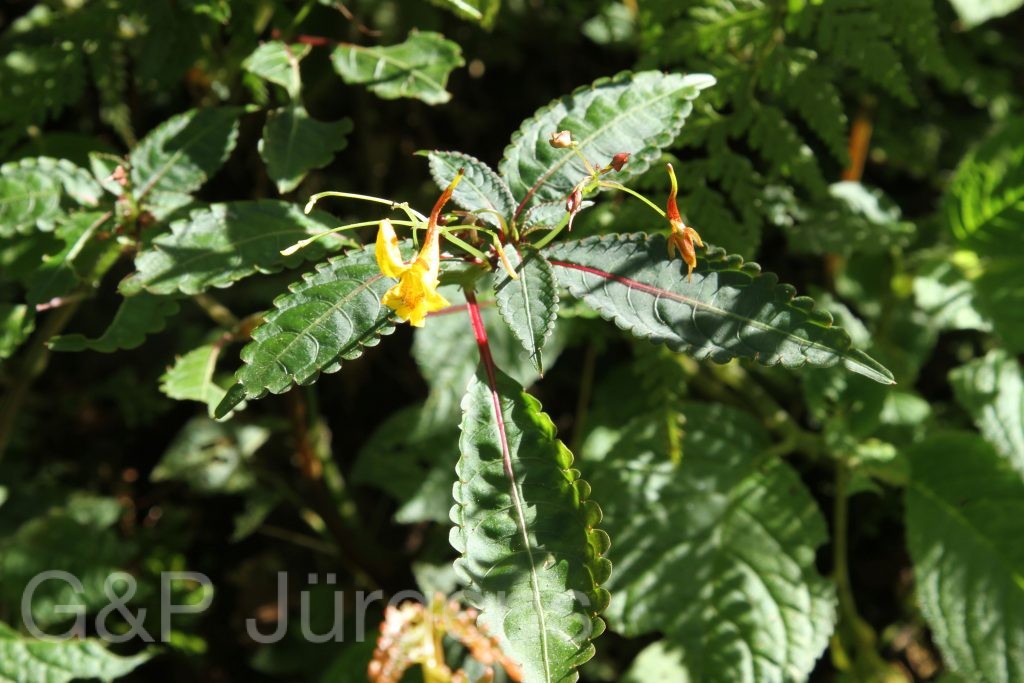
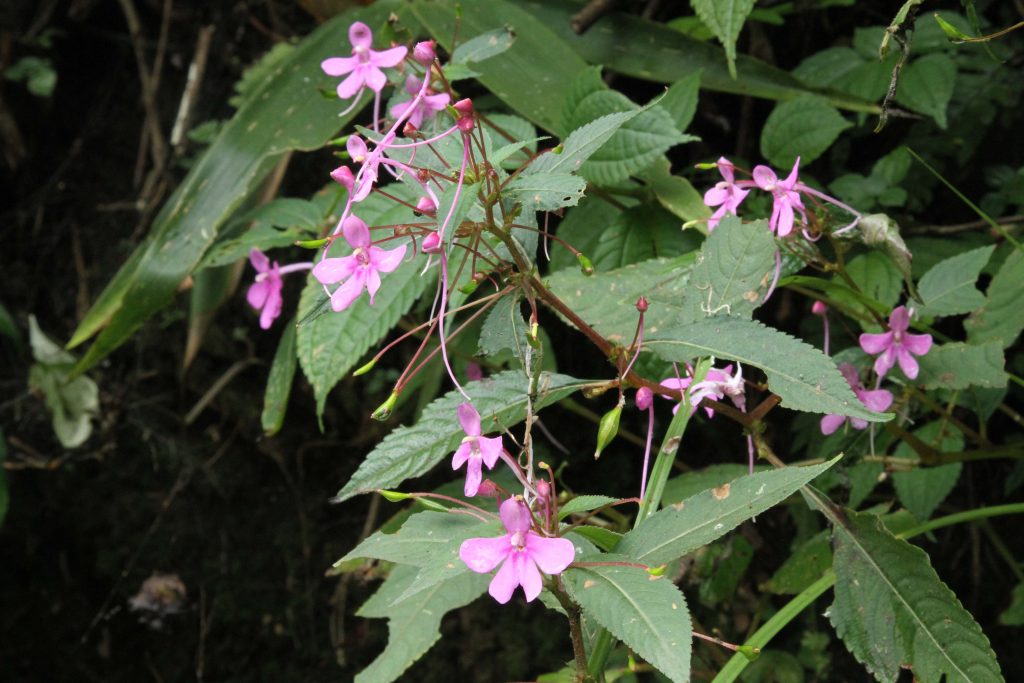
Impatiens drepanophora is a wide-ranging balsam of the eastern Himalaya and Indo-Burmese region, documented from Myanmar, China, India, Nepal, Bangladesh, Bhutan, Laos and Thailand, with around 126 recorded occurrences across this broad arc. It is a plant of warm-temperate to subtropical montane habitats, growing on moist shaded banks, along forest streams, in damp ravines and on disturbed roadside ground where seepage and high humidity prevail. The photographed plant from Wangdi in western Bhutan, at about 1400 m and flowering in October, reflects its mid-elevation preference and its characteristically late, post-monsoon flowering season.

It is a succulent annual with stout, translucent, often reddish-tinged stems that root at the lower nodes and branch freely. The leaves are alternate, ovate to elliptic-lanceolate with a long-acuminate apex and a crenate-serrate margin, the basal teeth or petiole base sometimes bearing stalked glands. The flowers are showy and zygomorphic, borne in axillary clusters, with a slender, conspicuously curved or sickle-shaped spur from which the epithet derives, the lower sepal forming the spurred sac; the lateral united petals and dorsal standard give the characteristic balsam form, the colouring pink to purplish. The fruit is the typical fleshy, explosively dehiscent capsule that scatters seeds when touched at maturity.

The genus Impatiens reaches exceptional richness in the eastern Himalaya, where wet forested slopes and a long monsoon foster numerous species distinguished largely by spur curvature, flower colour and leaf glands. The diagnostic falcate spur of I. drepanophora exemplifies the floral architecture that mediates pollination by long-tongued insects probing for spur-borne nectar. Being relatively widespread and tolerant of disturbed moist habitats, it is not of conservation concern, and like other balsams it can locally form abundant seasonal stands along watercourses and forest margins.

Author: Hook.f. · Sources: POWO (Kew), GBIF, Flora of Bhutan, Flora of China, Flora of British India, Grey-Wilson's Asian Impatiens revisions

Hook.f.

Bhutan2012 696
Bhutan Galephu 850m, September

Description

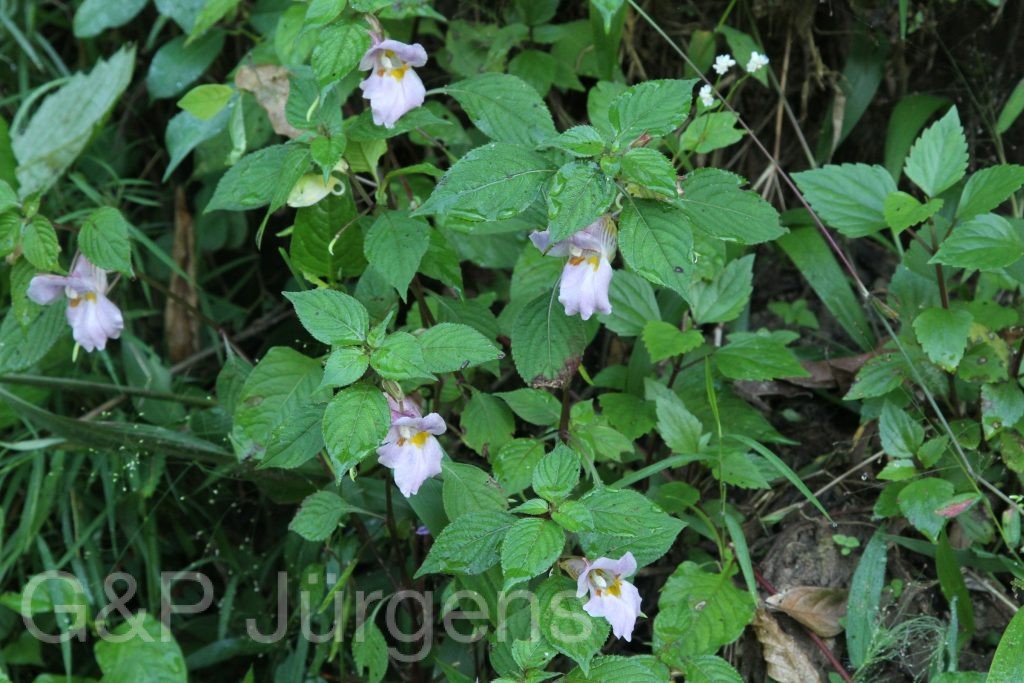
Impatiens exilis is an eastern Himalayan balsam restricted to a relatively narrow range, with confirmed occurrences in India, Nepal and Bhutan and only some 66 documented collections, marking it as a comparatively localised species. It favours warm, humid lower- to mid-montane settings, growing on shaded, moist banks, along forest streams and in disturbed wayside ground where seepage maintains moisture through the late monsoon. The photographed plant from Galephu in southern Bhutan, at around 850 m and flowering in September, reflects its preference for the foothill belt, considerably lower than many alpine congeners, and its tendency to bloom late in the rainy season.

In keeping with its epithet, it is a slender, delicate annual with translucent, watery, branching stems that root at the lower nodes. The leaves are alternate, thin in texture, ovate to elliptic-lanceolate with a serrate to crenate-serrate margin and a tapering apex, borne on slim petioles. The flowers are small and zygomorphic, solitary or few in the leaf axils, with the lateral sepals reduced and the lower sepal modified into a saccate spur typical of the genus; the corolla comprises an upper standard and paired lateral united petals, the colouring pale. The fruit is the explosively dehiscent fleshy capsule characteristic of Impatiens, propelling the seeds when ripe and disturbed.

Balsaminaceae, and especially Impatiens, form one of the great centres of diversity and endemism in the Himalaya, where rapid speciation has produced numerous narrow-range taxa distinguished by fine differences in spur shape, flower size and leaf form. The explosive ballistic seed dispersal aids short-distance colonisation of disturbed moist ground. As a small, restricted-range species, I. exilis warrants attention to habitat continuity along streams and forest edges, since such delicate annuals are vulnerable to drainage alteration and clearance, although no formal conservation assessment is currently in place.

Author: Hook.f. · Sources: POWO (Kew), GBIF, Flora of Bhutan, Flora of British India, Grey-Wilson's monographic Impatiens studies

Buch.-Ham. ex Hook.f. & Thomson

Bhutan2015 299
Bhutan Galephug 500m, October

Description

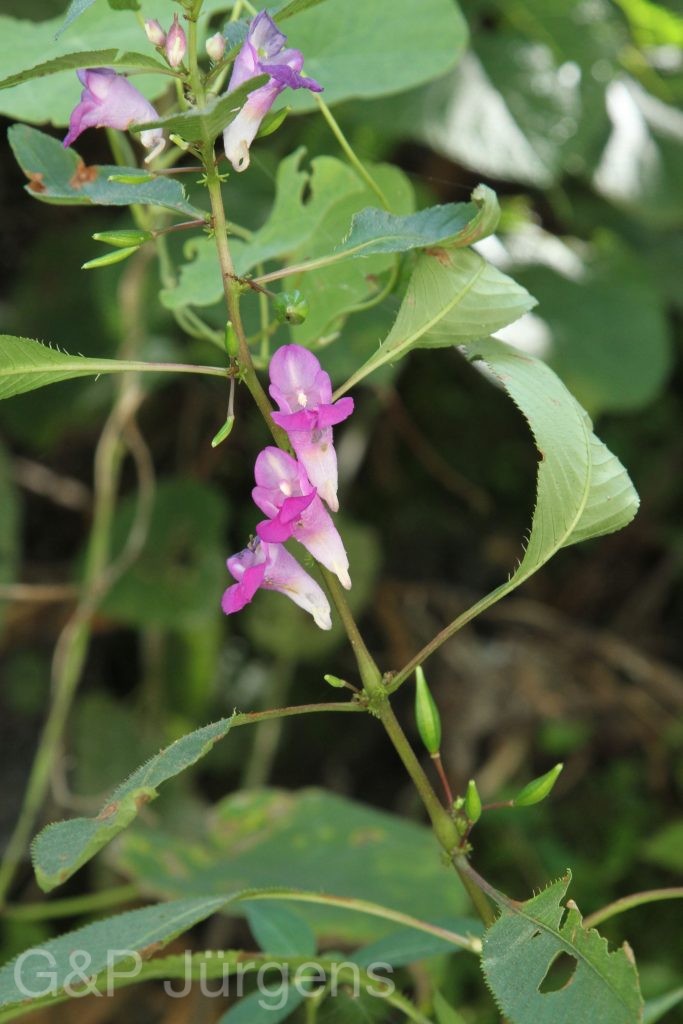
Impatiens jurpia is a Himalayan balsam ranging through northern India, Nepal, Bhutan and southward into Thailand and Malaysia. It is a hygrophilous herb of moist, shaded habitats, characteristically inhabiting wet forest margins, ravines, dripping banks and the verges of streams within subtropical and warm-temperate woodland. It occurs across a wide altitudinal span; the plant recorded at Gelephu in southern Bhutan at around 500 m in October illustrates its presence in the humid subtropical foothills, where it flowers in the post-monsoon season when soil moisture remains high.

The plant is a succulent annual herb with translucent, swollen, glabrous stems that are often reddish at the nodes, rooting at the lower joints. The leaves are alternate, ovate to elliptic-lanceolate, with a crenate-serrate margin frequently bearing minute setae in the sinuses, and taper into a petiole. The flowers are zygomorphic and borne on slender axillary pedicels; the lateral sepals are small, the lower sepal forms a navicular spur curving downward, and the corolla, pink to purplish or pale, comprises a standard and two bilobed lateral united petals. The fruit is a fusiform capsule that dehisces explosively, ejecting the seeds.

Impatiens is one of the largest genera of flowering plants and a major centre of diversity in the Himalaya and Southeast Asia, where rapid speciation has produced many narrowly distributed taxa. Impatiens jurpia, attributed to Buchanan-Hamilton ex Hooker f. and Thomson, is a comparatively widespread and morphologically variable member of the genus. Its ballistic seed dispersal and dependence on perennially moist microhabitats make it a useful indicator of intact, humid forest streamside ecosystems.

Author: Buch.-Ham. ex Hook.f. & Thomson · Sources: POWO (Kew), Flora of Bhutan Vol. 2, Flora of China Vol. 12, GBIF, Grey-Wilson: Impatiens of Africa and the Himalaya

Roxb. ex DC.

Bhutan2015 120
Bhutan Galephug 600m, October
Bh09 288 G471
Bhutan Galephug 600m, October

Description

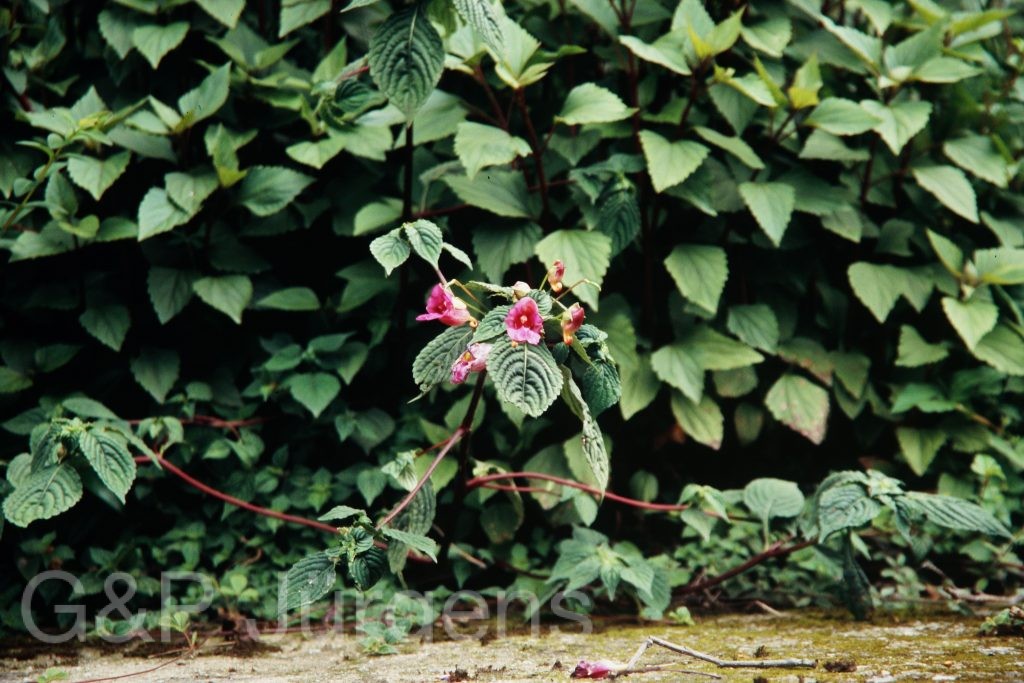
Impatiens tripetala is a succulent annual balsam of the warm, humid lowlands and foothills of the eastern Himalaya and Indo-Burma. GBIF lists 77 occurrences, centred on India, Myanmar, Bhutan and Nepal, with additional scattered or cultivated records reported under several country codes. It grows in moist shaded ground along forest streams, ditches and disturbed seepage sites in the subtropical belt, flowering late in and after the monsoon. The species was recorded at Galephug in southern Bhutan at about 600 m in October, a low foothill elevation reflecting its preference for warm, perhumid habitats.

It is an erect, glabrous herb with translucent, watery stems that are swollen at the nodes, rooting at the lower joints. The leaves are alternate, ovate to elliptic-lanceolate, crenate-serrate with the teeth often gland-tipped, and narrowed to a petiole. The zygomorphic flowers are borne on axillary peduncles; the lower sepal forms a spurred saccate pouch, and the corolla shows the reduced, apparently three-petalled appearance to which the epithet tripetala refers. The fruit is the characteristic fleshy, explosively dehiscent capsule of the genus, scattering its seeds by elastic recoil of the valves.

Impatiens (Balsaminaceae) is an enormous genus with a major centre of diversity in the Sino-Himalayan region, where many species are narrow endemics distinguished by flower colour, spur form and capsule shape. I. tripetala forms part of the rich lowland-to-submontane balsam flora of the eastern Himalaya. As an annual of moist, often disturbed ground it can be locally common, but the wider group is notable for high endemism and sensitivity to forest loss and hydrological change, themes relevant to its conservation context.

Author: Roxb. ex DC. · Sources: POWO (Kew), GBIF, Flora of Bhutan, Flora of British India, Annotated Checklist of the Flowering Plants of Nepal, Grey-Wilson monograph Impatiens of Africa and Asian revisions of Balsaminaceae

C.B.Clarke ex Hook.f.

Bhutan2015 91
Bhutan Galephug 1200m, October

Description

Impatiens uncipetala is a Himalayan balsam recorded from India, Nepal, China and Bhutan, with 43 georeferenced occurrences across the central and eastern Himalaya. As with most Impatiens it is a moisture-demanding herb of shaded, humid habitats, growing along stream banks, on dripping rock faces, in ditches and on the floor of moist subtropical to lower temperate forest. The plant photographed at Galephug in Bhutan at 1200 m in October reflects its low-elevation, post-monsoon flowering, when the soft, succulent annuals reach maturity and bloom freely in the warm, wet foothill forests.

The plant is a tender annual herb with translucent, watery, brittle stems that are often swollen at the nodes and root readily where they touch the ground. The leaves are simple, alternate or sometimes subopposite, ovate to lanceolate, with toothed margins. The zygomorphic flowers hang on slender pedicels and display the characteristic balsam architecture: three sepals, the lowermost enlarged into a saccate nectar spur, and five petals in which the two lateral pairs are fused into wing-like structures. The epithet uncipetala refers to a hooked petal appendage. The fruit is a fleshy, five-valved capsule that splits and coils explosively, ejecting the seeds.

Impatiens is one of the largest angiosperm genera, with a major centre of diversity in the Sino-Himalayan and Indo-Burmese region where narrowly endemic species abound. Its explosive capsules and reliance on humid microhabitats foster localised, often patchy distributions. The moderate occurrence count for I. uncipetala suggests a regional but uncommon species best conserved through maintenance of intact moist forest.

Author: C.B.Clarke ex Hook.f. · Sources: POWO (Kew), GBIF, Flora of Bhutan, Flora of China, Impatiens of the Himalaya and China monographic studies (Balsaminaceae), Flowers of the Himalaya (Polunin & Stainton)