Tag:

Subtropical (<1500 m)

(J.Koenig) Govaerts

Bhutan2012 720
Bhutan Galephu 850m, October

Description

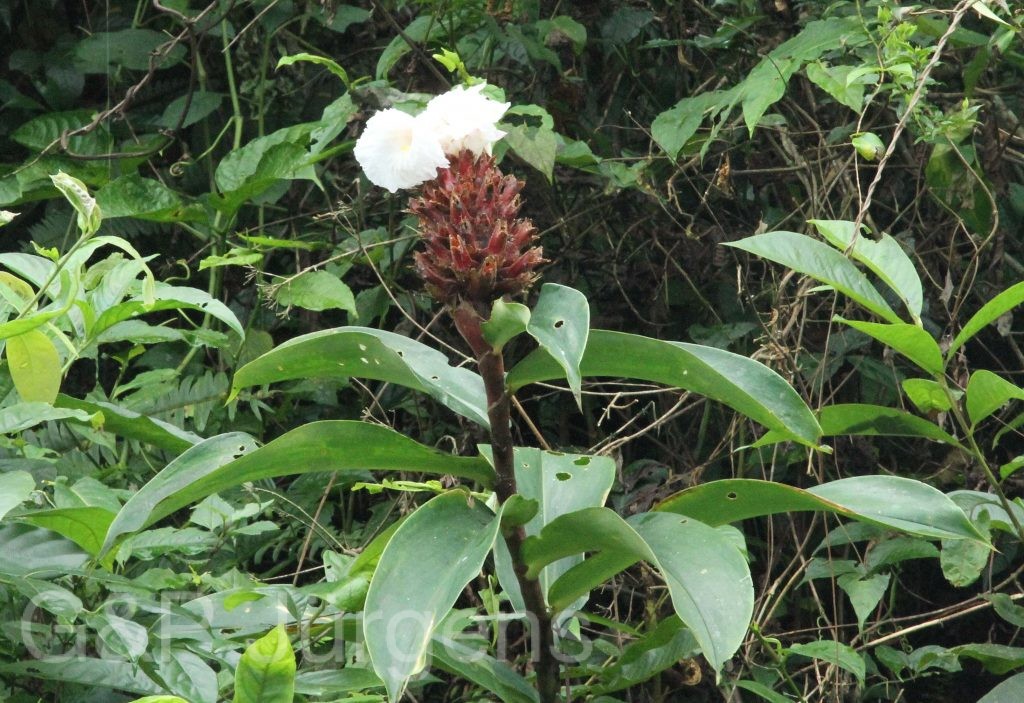
Hellenia speciosa is a robust rhizomatous herb of tropical and subtropical Asia, very widely distributed from India and Sri Lanka through Myanmar, Thailand, Malaysia, Indonesia, the Philippines and southern China to New Guinea and Australia, and widely cultivated and naturalised in the Neotropics and Pacific; its more than 6600 georeferenced records reflect this broad range and horticultural spread. It grows in moist forest understorey, forest margins, stream banks and disturbed ground, generally from near sea level to about 1200 m. The plant photographed at Galephu in southern Bhutan at 850 m in October grows in the warm subtropical foothill forest at the Himalaya's lowland fringe.

It is a tall, leafy herb 1-3 m high with a creeping fleshy rhizome and stout, characteristically spirally twisted leafy stems. The leaves are large, oblong-lanceolate, spirally arranged, with conspicuous sheaths. The inflorescence is a dense terminal cone-like spike of bright red, imbricate bracts from which emerge the showy flowers; each has a large, crinkled, funnel-shaped white labellum with a yellowish centre, subtended by a single fertile stamen with a petaloid filament. The fruit is a globose to ovoid red capsule containing numerous black, arillate seeds.

Formerly placed in Costus as Costus speciosus, the species was transferred to Hellenia by Govaerts; the input labels the family "Zingiberacaea" (Zingiberaceae), retained here verbatim, though the spiral-leaved costaceous gingers are now usually treated as a distinct family. The rhizome, rich in diosgenin, is widely used in traditional medicine and as a steroid precursor. The flowers are bee-pollinated and the bright capsules attract birds. Widespread, weedy and frequently cultivated, H. speciosa is of no conservation concern.

Author: (J.Koenig) Govaerts · Sources: POWO (Kew), GBIF, Flora of Bhutan, Flora of China, Flora of British India, Specht's monograph of Costus and allied genera (Costaceae)
(D.Don) A.Dietr.

Bhutan2015 203
Bhutan Zhemgang 1000m, October

Description

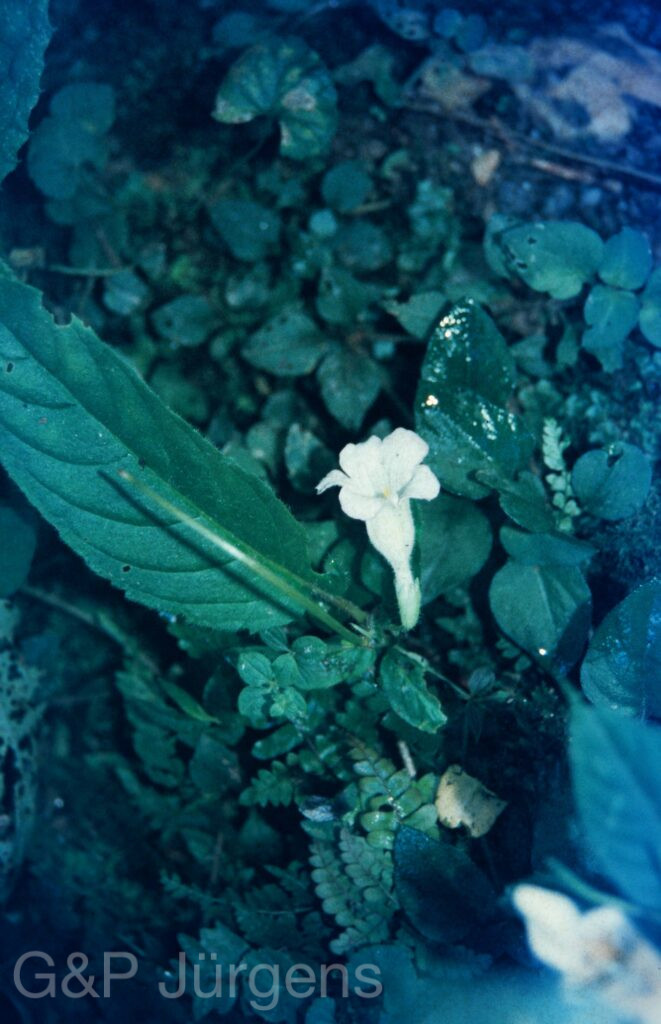
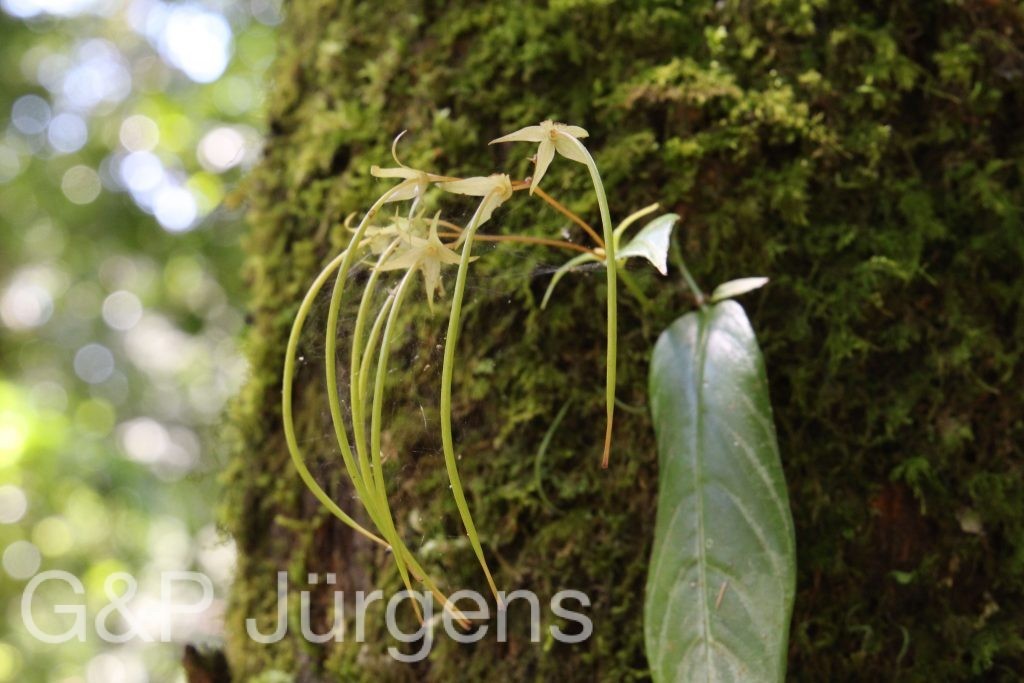
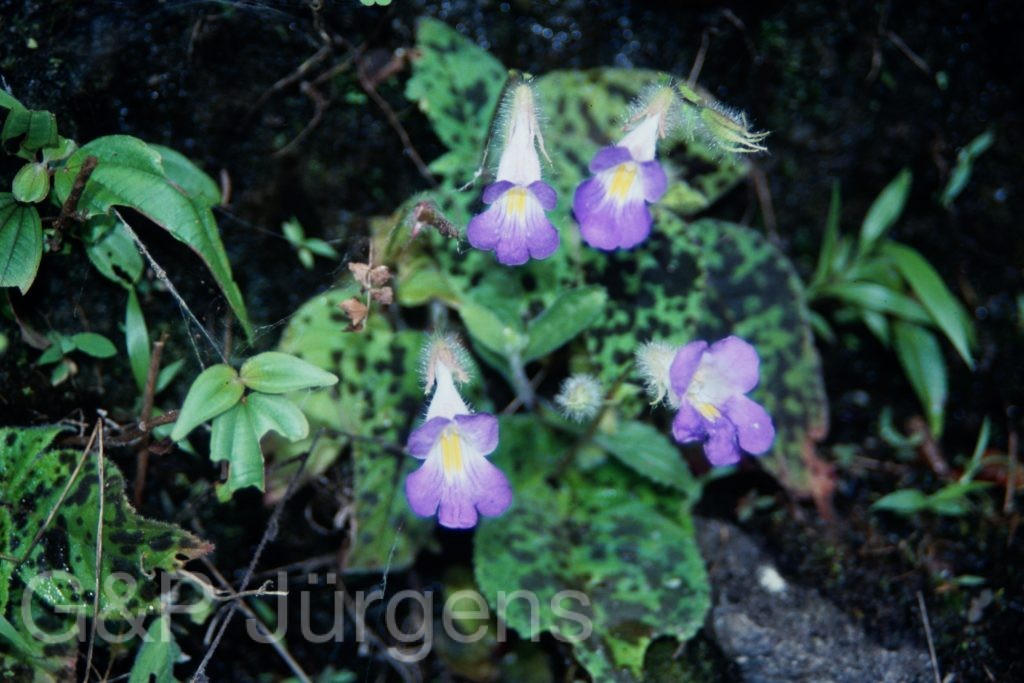
Henckelia bifolia is a Himalayan gesneriad recorded from India, Nepal, Bhutan and Sri Lanka, with about 124 georeferenced occurrences indicating a distribution along the humid southern Himalayan and northeast Indian foothills. It is a plant of warm, shaded, moist habitats: it grows on dripping rock faces, shaded banks, ravines and the floor and margins of subtropical broadleaved forest, generally at lower montane elevations, broadly from about 800 to 1800 m. The illustrated material was gathered at Zhemgang in Bhutan at 1000 m in October, a low, humid forested setting typical of the species, which flowers toward the close of the monsoon season.

It is a small perennial herb, often nearly stemless, with the leaves few and basal; as the epithet bifolia implies, the plant frequently develops a pair of opposite, sometimes markedly unequal leaves that are ovate, soft-textured, crenate to toothed and pubescent. The flowers are borne on slender axillary peduncles in few-flowered cymes; the corolla is zygomorphic, tubular and bilabiate, pale violet to bluish-lilac, with a short erect upper lip and a larger spreading three-lobed lower lip. Two stamens are fertile, and the superior ovary matures into the straight, narrowly cylindrical capsule diagnostic of Henckelia.

Henckelia (Gesneriaceae) was recircumscribed in the molecular reclassification of the didymocarpoid gesneriads, absorbing many species previously placed in Didymocarpus and Chirita; the name listed here as the family, Didymocarpinae, is in fact the subtribe to which Henckelia belongs, and the species properly sits in Gesneriaceae. The genus is characterised by its straight undivided capsules and bilabiate flowers. As a humid-forest understorey herb of restricted, fragmented habitats, H. bifolia depends on intact low-montane forest, and although not formally assessed it is potentially vulnerable to deforestation.

Author: (D.Don) A.Dietr. · Sources: POWO (Kew), GBIF, Flora of Bhutan, A Revised Handbook to the Flora of Ceylon, Weber & Möller revision of Henckelia (Gesneriaceae)

D.Don A.Dietr.

Sikkim2003 23 G27
Sikkim Rathong-Chu 1200m, August
Garw 2005 214 ergebnis ergebnis
India Garhwal Simkarok 2680m, September
Bhutan2015 89
Bhutan Galephug 600m, October

Description

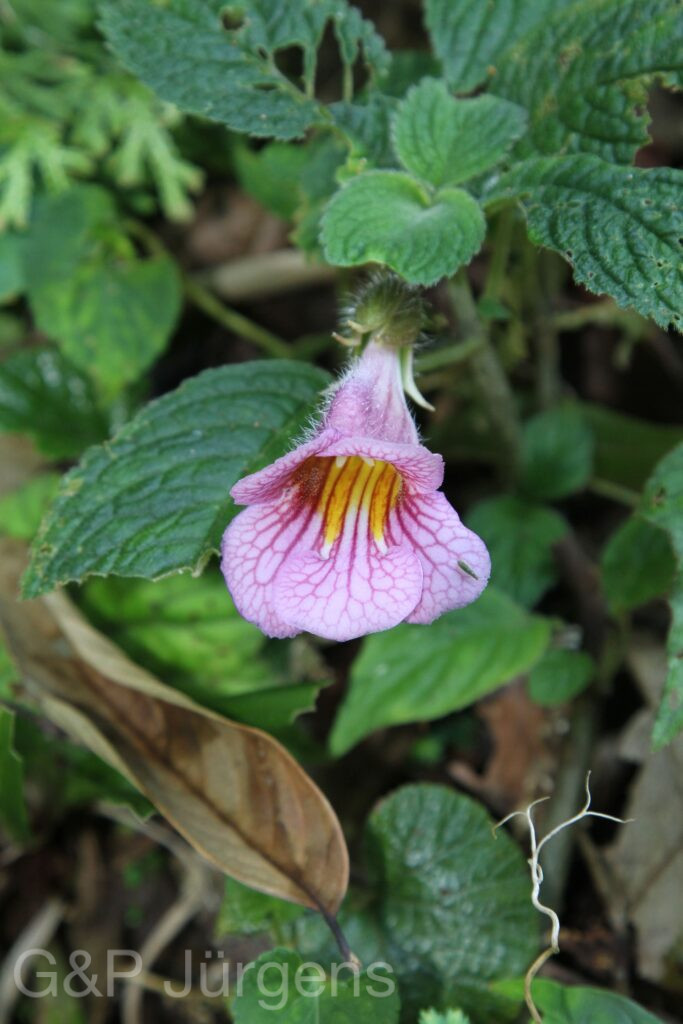
Henckelia pumila is a small gesneriad of the eastern and central Himalaya and adjacent Indo-Burma, recorded from China, India, Nepal, Myanmar, Bhutan, Thailand and Vietnam, with close to 600 occurrences in GBIF. It is a plant of shaded, humid habitats, growing on moist rock faces, mossy boulders, stream banks and shaded earth cuttings within evergreen broad-leaved and subtropical hill forest. Its wide altitudinal amplitude is reflected in the collection localities given for the illustrated material, ranging from the Rathong Chu in Sikkim at 1200 m in August and Galephug in Bhutan at only 600 m in October up to Simkarok in Indian Garhwal at 2680 m in September, indicating tolerance of both warm subtropical and cool temperate forest understorey.

The plant is a small perennial or facultatively annual herb with a short, often weak stem and crowded, opposite or subopposite leaves that are ovate to elliptic, crenate-serrate and softly hairy, frequently somewhat fleshy and unequal in a pair. The flowers are borne singly or in few-flowered cymes on slender peduncles from the leaf axils. The corolla is tubular and weakly two-lipped, white to pale lilac or bluish, often with a yellow throat or coloured markings, with the lower lip the more spreading. There are two fertile stamens with coherent anthers, and the ovary is superior, developing into the slender, elongate, twisted or straight loculicidal capsule typical of the genus.

The family is given as Didymocarpinae on the source page, the subtribal name within the Gesneriaceae to which Henckelia belongs; the species is correctly a member of the Gesneriaceae. The genus Henckelia has been substantially recircumscribed following molecular study, with numerous Asiatic didymocarpoid species transferred into and out of it, and H. pumila sits within this Sino-Himalayan radiation of rock-dwelling gesneriads. Its capacity to colonise moist shaded rock and its broad elevational range make it locally frequent, and it is not regarded as threatened.

Author: D.Don A.Dietr. · Sources: POWO (Kew), GBIF, Flora of China Vol. 18, Flora of Bhutan Vol. 2, Flora of Nepal, A Revision of the Genus Henckelia (Gesneriaceae)

(G.Don ex Loudon) Lowry & G.M.Plunkett

Bhutan2014 71
Bhutan Trashigang 1350m, May

Description

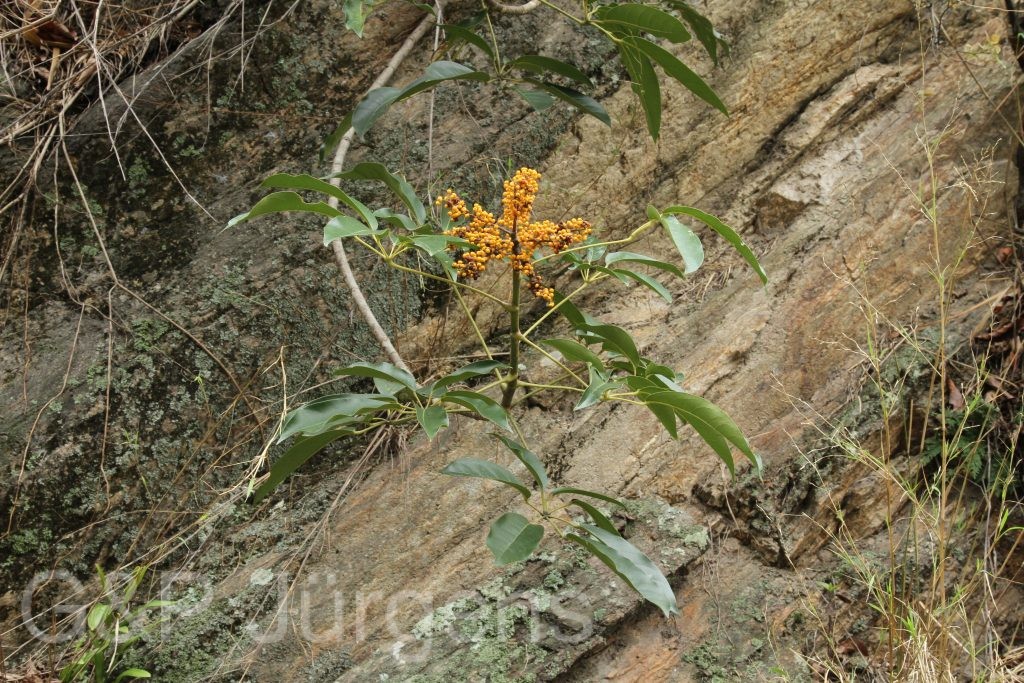
Heptapleurum digitatum is an Indo-Himalayan and Indo-Malesian tree distributed from the eastern Himalaya through northeastern India, Bangladesh, Myanmar and Thailand into the Malesian region, with GBIF recording around 116 occurrences across India, Bhutan, Nepal, Bangladesh, Myanmar, Thailand, Indonesia and Malaysia. It is a plant of warm subtropical to lower montane broadleaf forest, occurring in the foothill belt; the illustrated material comes from Trashigang in eastern Bhutan at 1350 m, flowering in May. It favours humid, evergreen and semi-evergreen forest, ravine slopes and stream banks, where it grows as an understorey to canopy tree, sometimes epiphytic or hemi-epiphytic when young.

The species is a small to medium-sized evergreen tree with stout, often sparsely branched stems bearing conspicuous leaf scars. The leaves are large, alternate, long-petiolate and digitately (palmately) compound, with several to many oblong-elliptic, entire, glabrous, coriaceous leaflets radiating from the petiole apex, the whole giving the characteristic umbrella-plant silhouette of the genus. The numerous small flowers are five-merous, with minute petals and an inferior ovary, arranged in umbellules grouped into large, much-branched terminal panicles. The fruit is a small, subglobose, slightly ribbed drupe with several pyrenes, attractive to birds.

The combination (G.Don ex Loudon) Lowry & G.M.Plunkett reflects the segregation of the Asian "Schefflera" lineages, this species having long been treated under Schefflera. Heptapleurum sensu stricto is now recognised as a large palaeotropical genus within Araliaceae. Widespread and frequent in suitable forest, the species is not considered threatened, and its bird-dispersed drupes and accessible nectar make it an important resource in subtropical forest food webs.

Author: (G.Don ex Loudon) Lowry & G.M.Plunkett · Sources: POWO (Kew), GBIF, Flora of Bhutan, Flora of China, Flora of British India (Hooker), Lowry & Plunkett revision of Schefflera/Heptapleurum (Araliaceae), Frodin & Govaerts World Checklist of Araliaceae

(Dyer) Hook.f.

Nepal 1994 17 ergebnis
Ost-Nepal Kandbari 490m April

Description

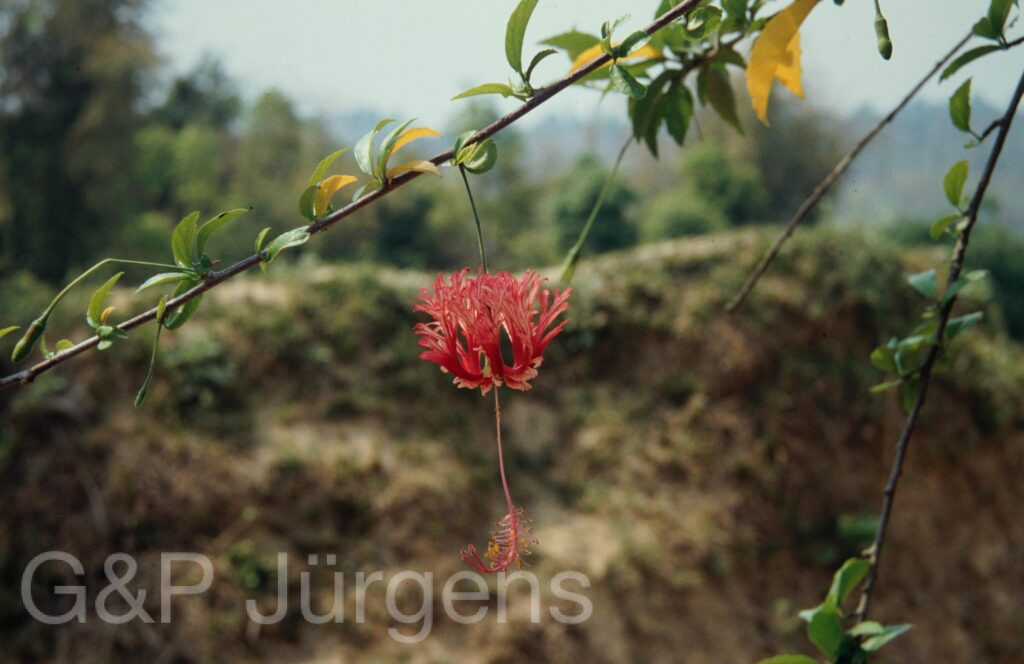
Hibiscus schizopetalus is native to coastal East Africa, particularly Kenya, Tanzania and Mozambique, but is now a pantropical ornamental, the GBIF dataset of some 2536 records spanning India, China, Hong Kong, Thailand, Indonesia, the Philippines, Japan, Fiji, French Polynesia, Réunion, and the Neotropics from Brazil and Colombia to Mexico, Costa Rica, Panama and Puerto Rico. In its introduced range it is grown as a garden and hedge shrub in warm lowland to lower-montane settings, escaping locally in disturbed and ruderal sites. The photographed plant from Khandbari in eastern Nepal at 490 m in April reflects this cultivated occurrence in the warm subtropical foothills, well outside its African origin.

It is an evergreen shrub reaching 2–3 m, with slender, often arching to pendulous glabrous branches. The leaves are alternate, ovate to elliptic, 4–7 cm long, with serrate margins, an acuminate apex and short petioles. The flowers are solitary, axillary and conspicuously pendulous on long jointed pedicels; the distinctive corolla consists of five deeply laciniate, recurved petals that are intricately fringed and pinnatifid, coloured pink to red, giving the species its common name fringed or coral hibiscus. The staminal column is long-exserted and pendent, bearing numerous anthers and a five-branched style with capitate stigmas. The fruit is a loculicidal capsule, though fruiting is sparse in cultivation.

Hibiscus schizopetalus belongs to section Lilibiscus of Hibiscus, allied to H. rosa-sinensis with which it readily hybridises and shares ornamental use. The deeply dissected, dangling flowers are an adaptation favouring sunbird and butterfly pollination in its native range. Widely propagated by cuttings, it is of no conservation concern as a cultivar, though wild African populations warrant attention.

Author: (Dyer) Hook.f. · Sources: POWO (Kew), GBIF, Flora of China Vol. 12, Flora of Tropical East Africa (Malvaceae), Flora of Nepal, Hibiscus: A Monograph

Wall. ex G.Don

Nepal 1994 329 ergebnis
Ost-Nepal Chainpur 1300m May 
Nepal 2001 503 ergebnis ergebnis
Nepal (Gorkha) Arkhet 720m, May

Description

Holarrhena pubescens is a widely distributed paleotropical shrub or small tree with one of the broadest ranges in this set, documented by over 3,000 GBIF records spanning the Indian subcontinent (India, Nepal, Bangladesh, Pakistan), Southeast Asia (Myanmar, Thailand, Laos, Vietnam, Cambodia, Malaysia), southern China and much of sub-Saharan Africa (Tanzania, Malawi, Mozambique, Zimbabwe, Zambia, South Africa, Kenya, Democratic Republic of the Congo). It is a plant of dry deciduous forest, savanna woodland, scrub and ravine margins, generally below about 1,300 m. The cited Nepalese plants, from Chainpur in the east at 1,300 m and from Arkhet in Gorkha at 720 m, both flowering in May, mark the upper Himalayan foothill edge of its altitudinal range.

The plant is a deciduous shrub to small tree exuding milky latex when cut. The leaves are opposite, simple, broadly elliptic to ovate, shortly petiolate, softly pubescent beneath and entire-margined. The flowers appear with or before the new leaves in dense terminal corymbose cymes; each is salverform with five white, fragrant, contorted petals on a slender tube, collectively giving a showy, jasmine-like display. The fruit is a pair of long, slender, pendulous cylindrical follicles, often spotted, splitting to release numerous flat seeds bearing an apical tuft of silky hairs adapted for wind dispersal.

The species is medicinally important: its bark and seeds (the drug "Kurchi") yield steroidal alkaloids such as conessine, long used against amoebic dysentery. It is the type-related species of the small Old World genus Holarrhena within tribe Malouetieae of subfamily Apocynoideae. Despite extensive harvesting for traditional medicine, its wide range and habitat tolerance keep it secure.

Author: Wall. ex G.Don · Sources: POWO (Kew), Flora of China Vol. 16, Flora of Pakistan, GBIF, Endress & Bruyns: A revised classification of the Apocynaceae

Retz.

Bhutan2015 276
Bhutan Zhemgang 1000m, October
Bhutan2012 1040
Bhutan Trithangebe 900m, October
Bhutan2012 1042
Bhutan Trithangebe 900m, October

Description

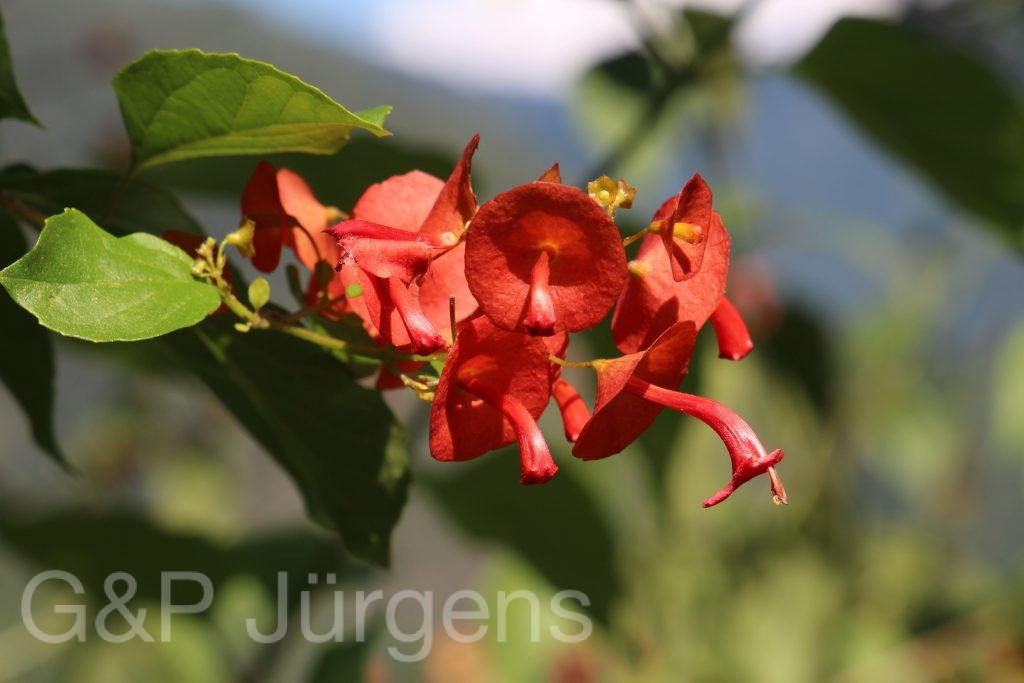
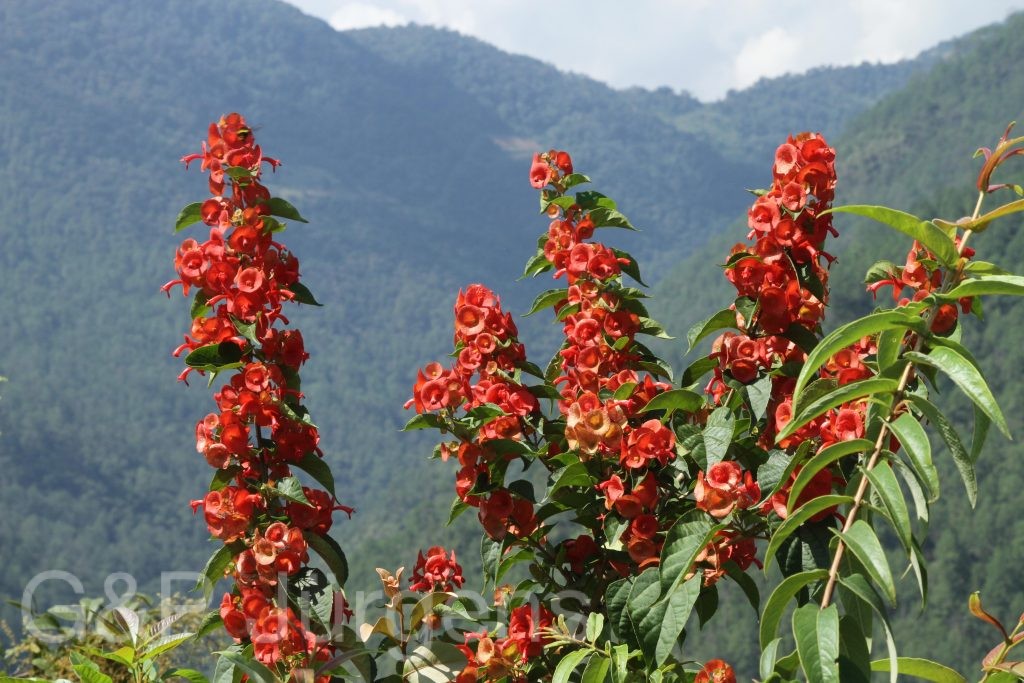
Holmskioldia sanguinea Retz., the Chinese hat plant or cup-and-saucer plant, is a subtropical shrub native to the foothills of the Himalaya in India, Nepal and Bhutan; GBIF lists nearly 1995 occurrences, the great majority from cultivation across the tropics, with records from the Americas, the Caribbean, the Philippines, Mauritius and Reunion attesting to its global ornamental dispersal. In its native range it grows along forest margins, ravines and warm valley slopes in the subtropical zone, generally below about 1500 m. The Bhutan records from Zhemgang at 1000 m and Trithangebe at 900 m, flowering in October, exemplify its occurrence in warm, low-elevation submontane habitats.

The species is a straggling to scandent evergreen shrub with quadrangular branches. The leaves are opposite, ovate, acuminate and serrate. The conspicuous flowers are borne in axillary cymes and are remarkable for the large, brick-red to orange, persistent, saucer-shaped calyx, from the centre of which the slender, curved, tubular corolla projects like a cup upon a saucer, with exserted stamens; this striking calyx accounts for both the common and specific names. The fruit is a small, four-lobed schizocarp seated within the persistent calyx.

Formerly placed in Verbenaceae, Holmskioldia is now classified in the Lamiaceae (subfamily Viticoideae) following molecular reappraisal of the verbenoid genera. Widely cultivated as a flowering ornamental in warm climates, it is of no conservation concern and occasionally naturalises beyond its native range.

Author: Retz. · Sources: POWO (Kew), GBIF, Flora of Bhutan, Flora of British India, Flora of China, Harley et al. Labiatae treatment in The Families and Genera of Vascular Plants

Hook.f.

Bhutan2015 213
Bhutan Zhemgang 910m, October

Description

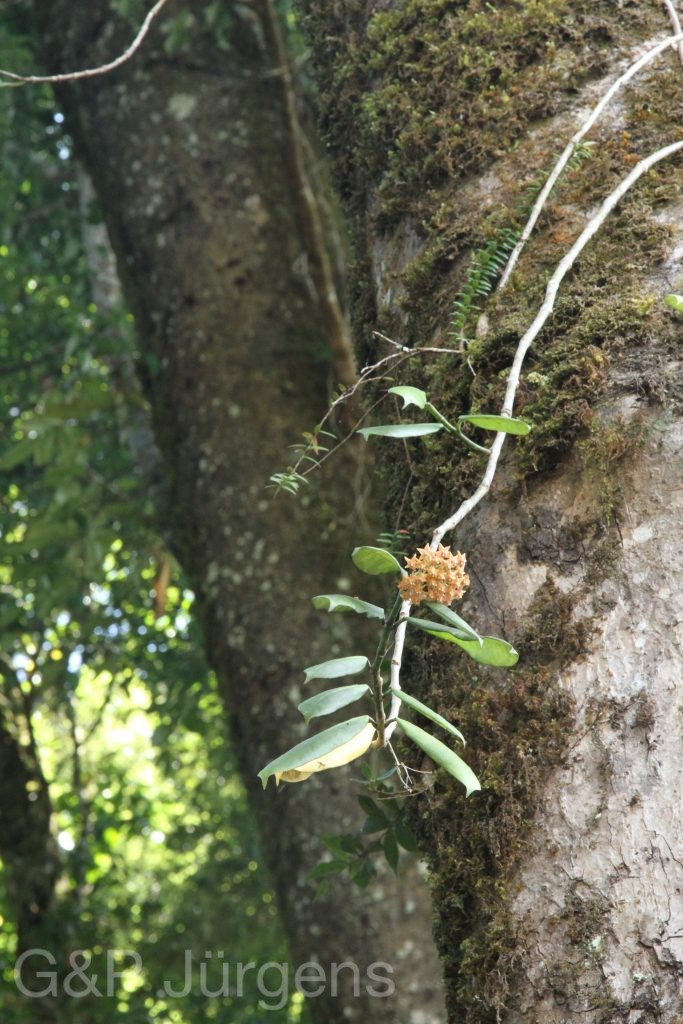
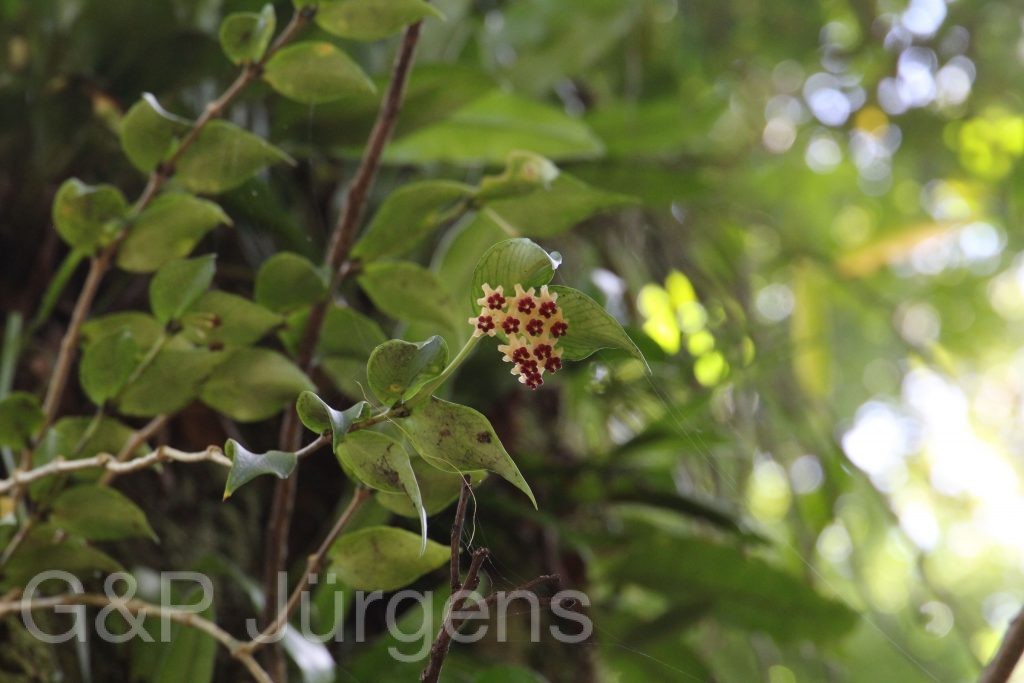
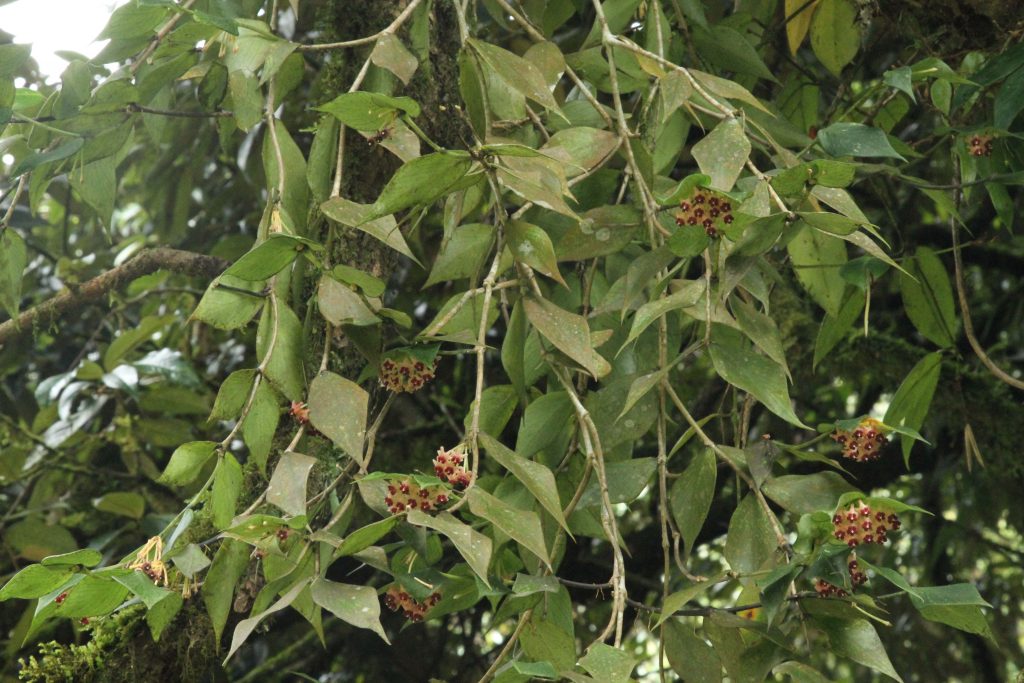
Hoya globulosa Hook.f. is an epiphytic climber of the eastern Himalaya and adjoining Indochina, recorded from India, Bhutan, China and Vietnam, with scattered cultivated material elsewhere; the GBIF total of about 115 occurrences reflects its moderately frequent presence in warm, humid montane forest. It grows as an epiphyte on mossy trunks and branches, occasionally as a lithophyte, in subtropical to warm-temperate broad-leaved evergreen forest, broadly between 700 and 1800 m. The photographed plant from Zhemgang in central Bhutan at about 910 m, flowering in October, typifies its occurrence in the moist, shaded foothill forests of southern Bhutan during the post-monsoon season.

The species is a robust, woody, climbing or pendent epiphytic vine with stout stems rooting at the nodes and exuding milky latex when broken. The leaves are opposite, thick and coriaceous, large, elliptic to oblong-lanceolate, acuminate, with a stout midrib and prominent, somewhat impressed lateral venation. The inflorescence is a dense, many-flowered, globose, umbelliform cyme on a persistent peduncle — the rounded flower-head giving the epithet globulosa. The flowers are small, with a fleshy, reflexed, hairy-margined corolla, pale yellow to greenish-white often suffused pink, surmounted by the characteristic waxy, glistening, star-shaped staminal corona. Pollen is borne in paired pollinia, and the fruit is a slender, elongate paired follicle releasing plumed seeds.

Hoya (Apocynaceae, subfamily Asclepiadoideae) is a large palaeotropical genus distinguished by its waxy coronate flowers and pollinarial reproduction; H. globulosa belongs to the large-leaved, dense-umbelled Himalayan-Indochinese assemblage. Its bold foliage and tight spherical flower-heads have made it sought-after in specialist Hoya cultivation. As a forest-dependent epiphyte it is potentially threatened by lowland deforestation and collection pressure, although formally unassessed and locally not uncommon within intact forest.

Author: Hook.f. · Sources: POWO (Kew), GBIF, Flora of China, Flora of Bhutan, Flora of British India, Surveswaran et al. — Phylogeny and revision of Hoya

Hoya obcordata

by GP Jürgens

Hook.f.

Nepal 97 554 P1081
Nepal Sabha-Khola 550m May
Nepal 97 553 P1080
Nepal Sabha-Khola 550m May

Description

Hoya obcordata is an epiphytic climber of the eastern Himalayan foothills and adjacent subtropical forests, documented from north-east India and Bhutan, with collections also referable to lowland Nepal. It is poorly recorded, GBIF holding only five georeferenced occurrences, reflecting both its restricted range and the difficulty of collecting canopy epiphytes. It grows as a twining liana or root-climber on tree trunks and rocks in humid broad-leaved and riverine forest at low elevations. The plant from Sabha Khola in eastern Nepal at 550 m in May occupies just such a warm, humid valley floor, flowering in the late dry season.

It is a glabrous, somewhat succulent vine with slender twining stems rooting adventitiously at the nodes and exuding milky latex. The leaves are opposite, thick and fleshy, obovate to obcordate with a notched or rounded apex (whence obcordata) and shortly petiolate. The flowers are borne in pendent, umbelliform cymes from extra-axillary peduncles, each umbel of many small star-shaped blooms. The corolla is rotate and five-lobed, pale and reflexed, surmounted by the fleshy five-parted corona typical of Hoya around the gynostegium of fused stamens and stigma. The pollen forms waxy pollinia, and the fruit is a slender paired follicle releasing comose, wind-dispersed seeds.

Hoya belongs to subfamily Asclepiadoideae of an expanded Apocynaceae, defined by the gynostegium, corona and pollinium-bearing flowers formerly placed in Asclepiadaceae. H. obcordata is among the less collected Himalayan members of this largely Malesian genus, and its scarcity in herbaria leaves its full distribution imperfectly known. Such epiphytes are vulnerable to lowland deforestation, and the species would merit targeted survey to clarify its conservation status.

Author: Hook.f. · Sources: POWO (Kew), GBIF, Flora of China Vol. 16, Flora of Bhutan Vol. 2, Annotated Checklist of the Flowering Plants of Nepal, Wallich revisions of Asiatic Hoya

Hook.f.

Bhutan2015 202
Bhutan Zhemgang 1000m, October
Bhutan2012 764
Bhutan Zemgang 1400m, October

Description

Hoya polyneura Hook.f. is an epiphytic vine of the eastern Himalaya and adjoining ranges, recorded from India, Bhutan, Nepal and China, with disjunct material from Japan; the GBIF total of about 59 occurrences reflects its scattered, locally frequent presence in humid mid-montane forest. It grows as an epiphyte or lithophyte on mossy trunks and damp rock faces in subtropical to warm-temperate broad-leaved evergreen forest, broadly between 800 and 2000 m. The photographed plants from Zhemgang in central Bhutan at about 1000 and 1400 m, flowering in October, illustrate its occurrence in the moist, shaded forest interior of the southern Bhutanese foothills.

The species is a slender, twining to pendent epiphytic subshrub with thin, flexible stems rooting at the nodes and exuding milky latex when cut. The leaves are opposite, distinctly thin-textured and elliptic to ovate, with a prominent, fish-bone-like venation of fine, parallel lateral nerves arching to the margin — the feature giving the epithet polyneura. The inflorescence is an axillary, umbelliform cyme of few to several flowers; each has a fleshy, reflexed, five-pointed corolla, cream to yellowish often marked with red, surmounted by the waxy, star-shaped, glistening staminal corona typical of the genus. Pollen is aggregated into paired pollinia, and the fruit is a slender paired follicle releasing comose seeds.

Hoya (Apocynaceae, subfamily Asclepiadoideae) is a large palaeotropical genus distinguished by its waxy, coronate flowers and pollinarial pollination. H. polyneura is among the most distinctive Himalayan species owing to its conspicuously veined, almost translucent leaves, a prized character in cultivation where it is grown as the "fishtail Hoya." As a forest-dependent epiphyte it is sensitive to deforestation and over-collection for the ornamental trade, though formally unassessed and locally not uncommon within intact montane forest.

Author: Hook.f. · Sources: POWO (Kew), GBIF, Flora of China, Flora of Bhutan, Flora of British India, Surveswaran et al. — Phylogeny and revision of Hoya