Tag:

Subtropical (<1500 m)

(L.) Lam.

Bhutan2012 785
Bhutan Zemgang 1850m, October
Nepal 95 42 P74 ergebnis
Nepal Darondi-Khola 670m
Nepal 95 43 W75 ergebnis
Nepal Darondi-Khola 670m

Description

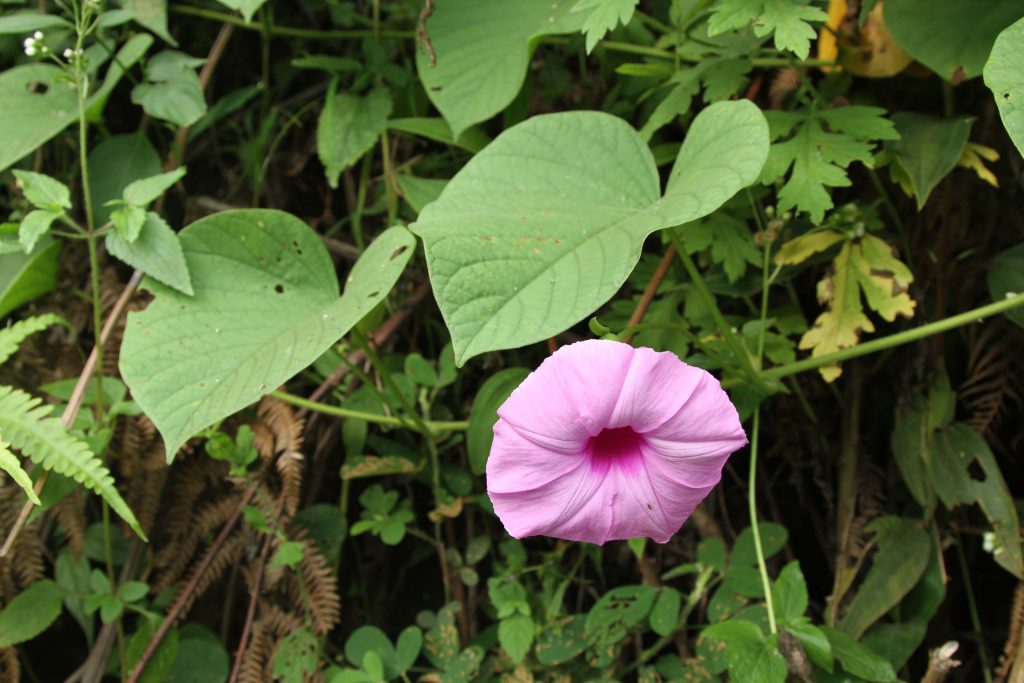
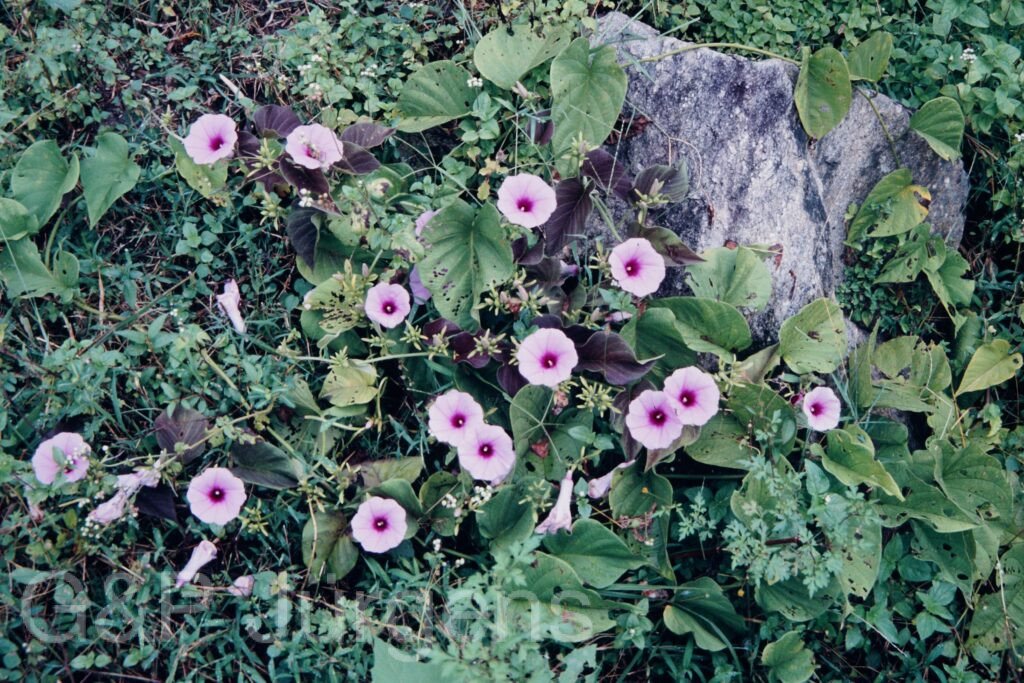
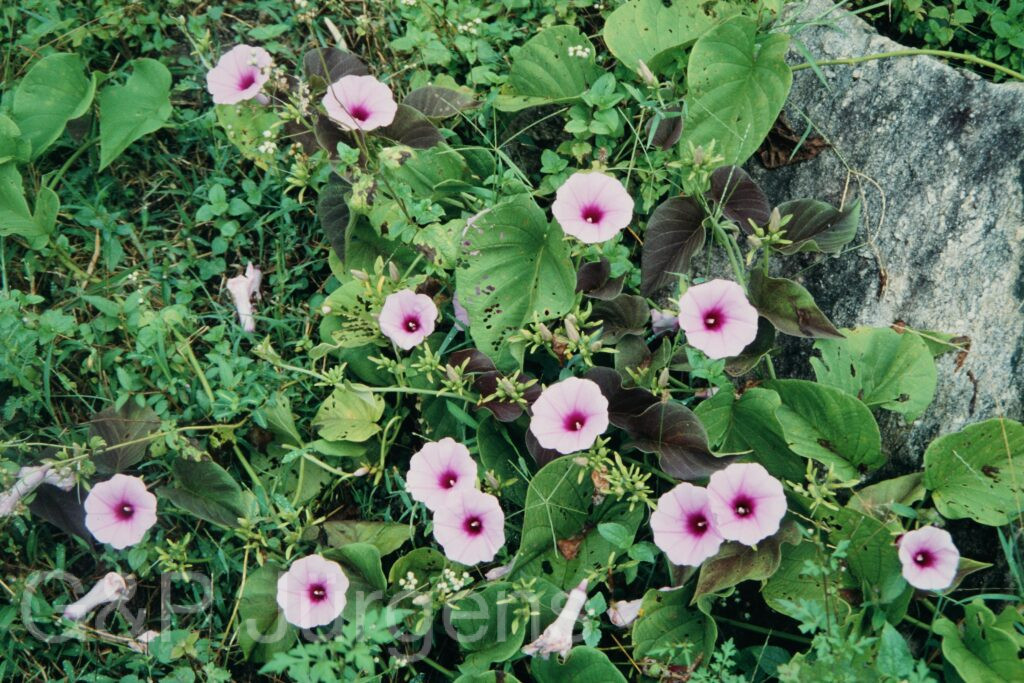
Ipomoea batatas, the sweet potato, is a cultigen of Neotropical origin now grown and naturalised throughout the tropics and warm-temperate world; GBIF records 38,679 occurrences spanning the Americas (Peru, Mexico, Brazil, the United States, Colombia, Ecuador and others) through to Asia and Oceania, including Thailand, Taiwan, the Philippines, Indonesia, China and Papua New Guinea. In the Himalaya it is a cultivated and escaped plant of village margins, terraced fields and warm valley bottoms. The illustrated material comes from Bhutan, Zhemgang, at about 1850 m in October, and from Nepal along the Darondi Khola at around 670 m, reflecting the sub-tropical farmed elevations where it is grown.

The plant is a perennial herbaceous vine with prostrate or twining stems that root at the nodes and arise from swollen, edible storage roots (tubers) of variable colour. Leaves are alternate, petiolate and highly variable, from broadly ovate-cordate to deeply palmately lobed, with an entire or sinuate margin. Flowers are borne in few-flowered axillary cymes; the corolla is funnelform and infundibuliform, lavender to pink-purple with a darker throat, subtended by a small calyx of unequal sepals. The five stamens are unequal and included, the ovary superior; the fruit is a small capsule, though many cultivars set seed poorly.

The sweet potato is a hexaploid of long domestication, its wild progenitors lying in Central America, and it ranks among the world's most important root crops. POWO and GBIF accept the name. Its trans-Pacific presence in pre-Columbian Oceania remains a celebrated biogeographic puzzle bearing on early human dispersal.

Author: (L.) Lam. · Sources: POWO (Kew), GBIF, Flora of China, Flora of Bhutan, Annotated Checklist of the Flowering Plants of Nepal, World Checklist of Convolvulaceae (Ipomoea monograph)
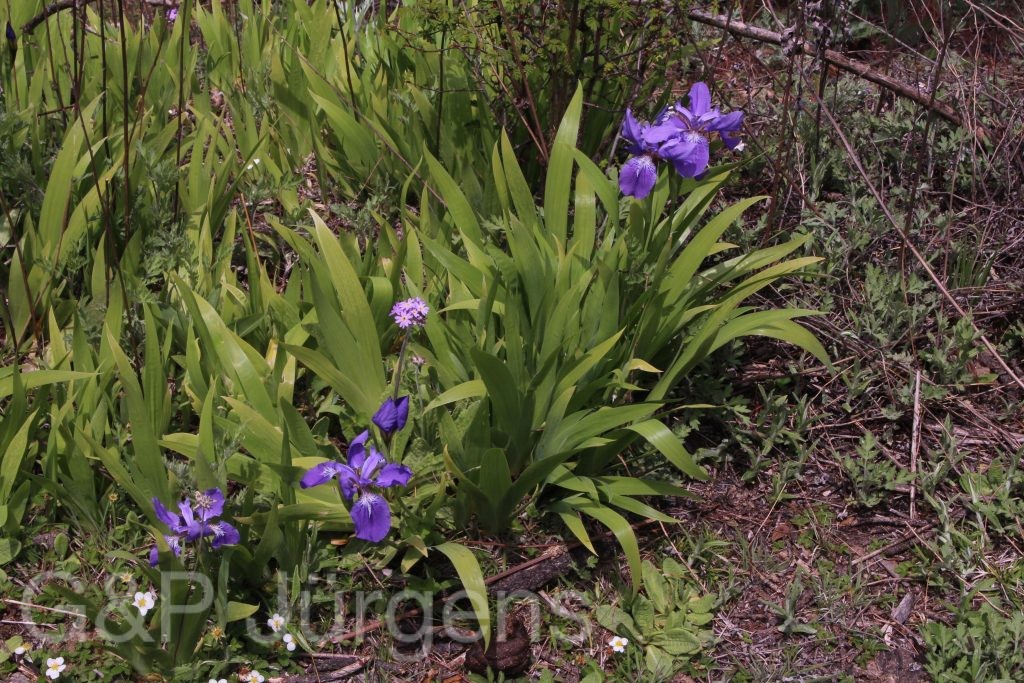
Iris tectorum

by G & P Jürgens

Maxim.

Bhutan2014 42
Bhutan Trashigang 1200m, May
Bhutan2014 974
Bhutan Chele-La 3400m, May
Bhutan2014 975
Bhutan Chele-La 3400m, May

Description

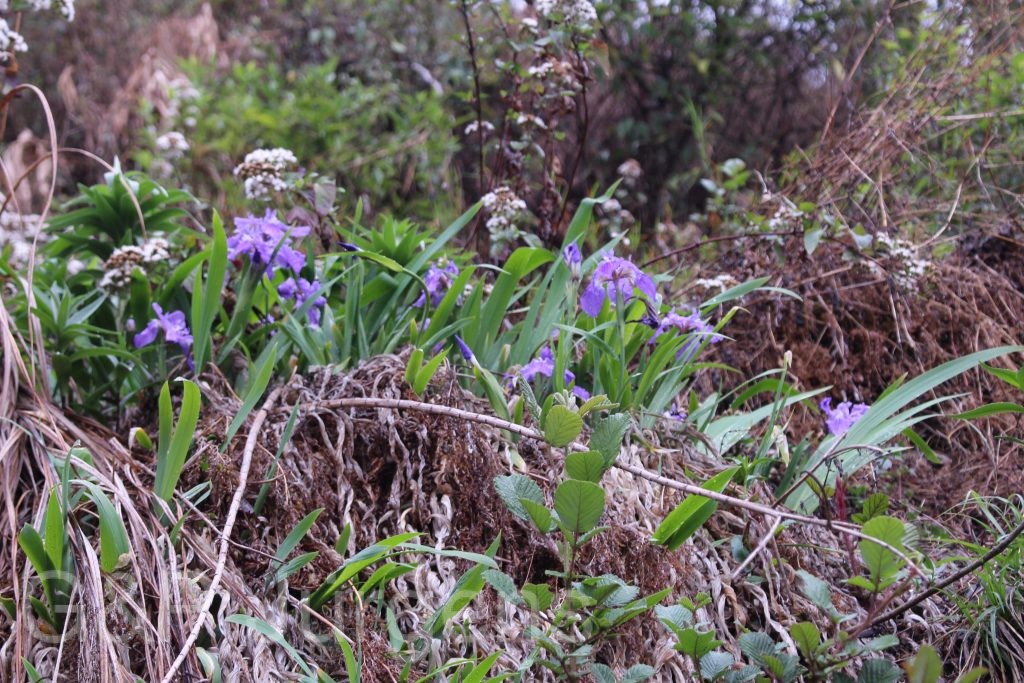
Iris tectorum, the roof iris or wall iris, is native to China and long cultivated across East Asia, with naturalised and planted populations widely recorded; GBIF documents 1128 occurrences in China, Japan, Korea, the United States, India, Bhutan, Myanmar, Taiwan, Kazakhstan and parts of Europe. It grows on dry banks, grassy slopes, rocky ground and, famously, on thatched roofs and old walls where it was traditionally established. In Bhutan the illustrated plants span a wide range, from Trashigang at about 1200 m to Chele-La at 3400 m, both flowering in May, showing its tolerance of both warm valley and high-pass conditions.

The plant is a rhizomatous perennial with a stout, shortly creeping rhizome bearing tufts of broadly ensiform, soft, ribbed leaves arranged in flat fans. The flowering stem is branched and bears several large flowers; each has the iris structure of three spreading, reflexed outer perianth segments (falls) and three smaller erect inner segments (standards). The falls are pale lilac-blue, conspicuously veined and mottled with darker blue, and bear a fringed or crested white-and-violet ridge in place of a beard, identifying it as a crested (Evansia) iris. The three petaloid style branches arch over the stamens; the inferior ovary matures into an oblong, ridged loculicidal capsule releasing rounded seeds.

Assigned to subgenus Limniris and the crested-iris alliance, I. tectorum is a long-standing ornamental and the source material for traditional medicinal use of its rhizome. POWO and GBIF accept the name. Its frequent cultivation accounts for the scattered extralimital records far beyond its East Asian native range.

Author: Maxim. · Sources: POWO (Kew), GBIF, Flora of China, Flora of Bhutan, The Iris (Iridaceae monograph), Annotated Checklist of the Flowering Plants of Nepal

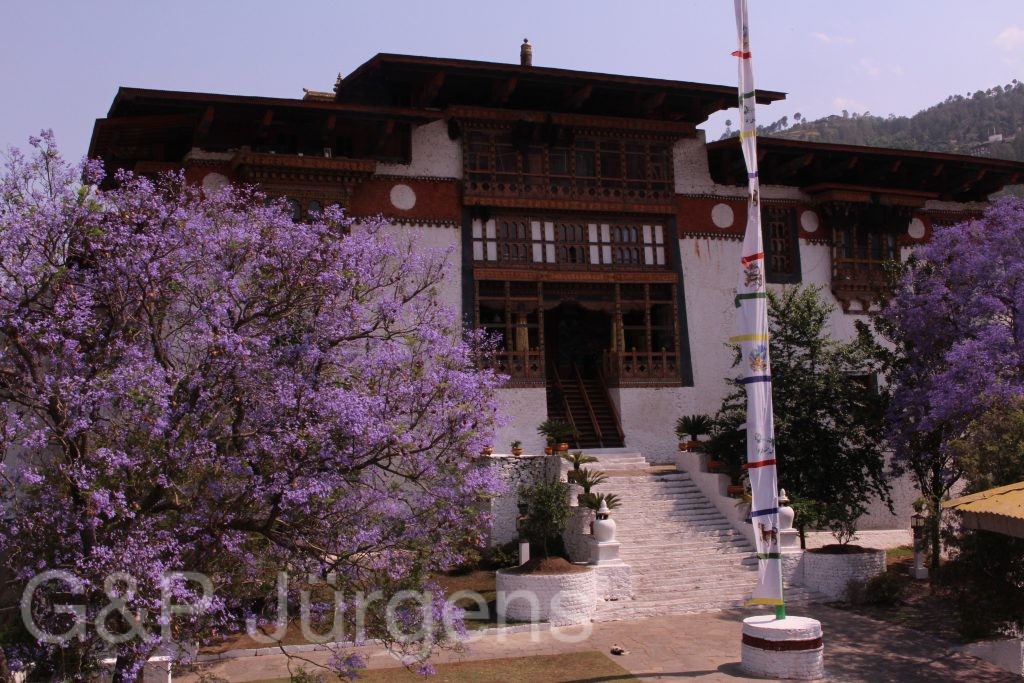
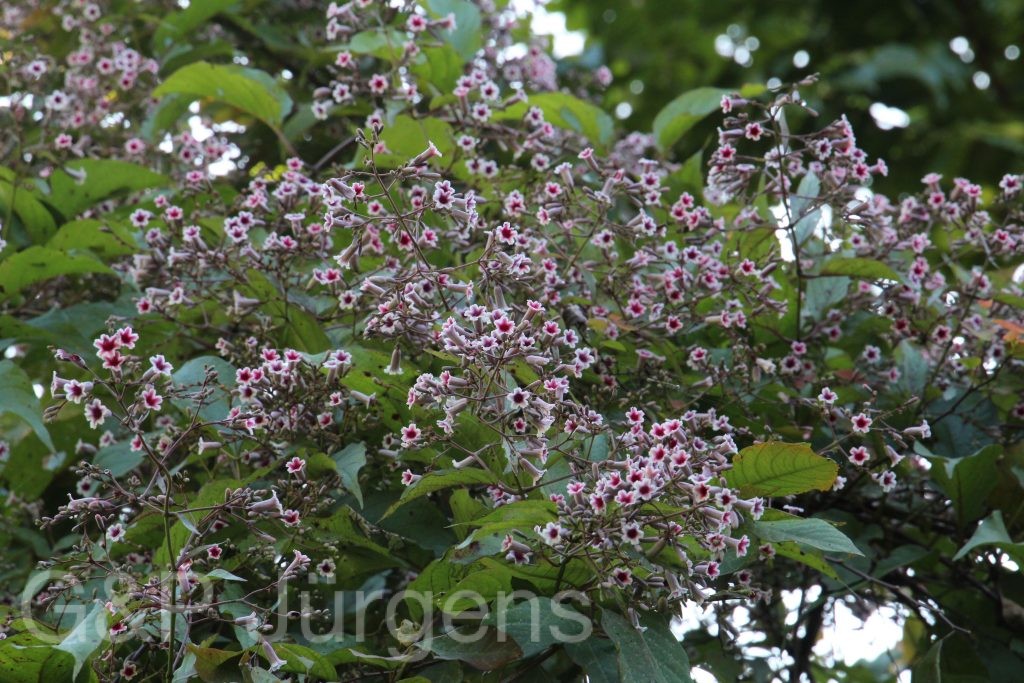
D.Don

Bhutan2014 737
Bhutan Punaka 1200m, May

Description

Jacaranda mimosifolia is a deciduous tree native to subtropical South America, in particular northwestern Argentina and adjacent Bolivia, but it is now one of the most widely planted ornamental trees in warm-temperate and tropical regions worldwide; its more than twenty thousand occurrence records span Australia, South Africa, Spain, Kenya, Mexico, the United States and far beyond. It thrives in well-drained soils in warm valleys, parks and roadsides and is frost-sensitive. The tree photographed at Punakha in Bhutan at 1200 m in May is a cultivated street or garden specimen, flowering in its characteristic spring blaze in the warm lower Himalayan valley, well outside its native New World range.

It is a medium to large tree with a spreading, rounded crown and smooth grey bark. The leaves are large, opposite and bipinnate with many small, oblong, mucronate leaflets, recalling those of mimosoid legumes and giving the species its epithet. The flowers are produced in showy terminal panicles, typically before or with the new foliage; each has a small campanulate calyx and a tubular, two-lipped blue to violet corolla that swells above a narrow base. Four didynamous stamens and a staminode are enclosed within. The fruit is a flattened, woody, rounded to oblong capsule that splits along two valves to release numerous thin, broadly winged, wind-dispersed seeds.

Jacaranda is a Neotropical genus of the Bignoniaceae, and J. mimosifolia is its most familiar member, prized for its lavender-blue spring flowering. In its native range it is assessed as Vulnerable owing to limited and fragmented wild populations, even as it flourishes in cultivation globally; in several regions it has become naturalised or weedy. Its nectar-rich flowers attract bees and other insects, and its showy display has made it an emblematic urban tree across the subtropics.

Author: D.Don · Sources: POWO (Kew), GBIF, Flora Argentina, IUCN Red List assessment, Gentry's treatment of Bignoniaceae

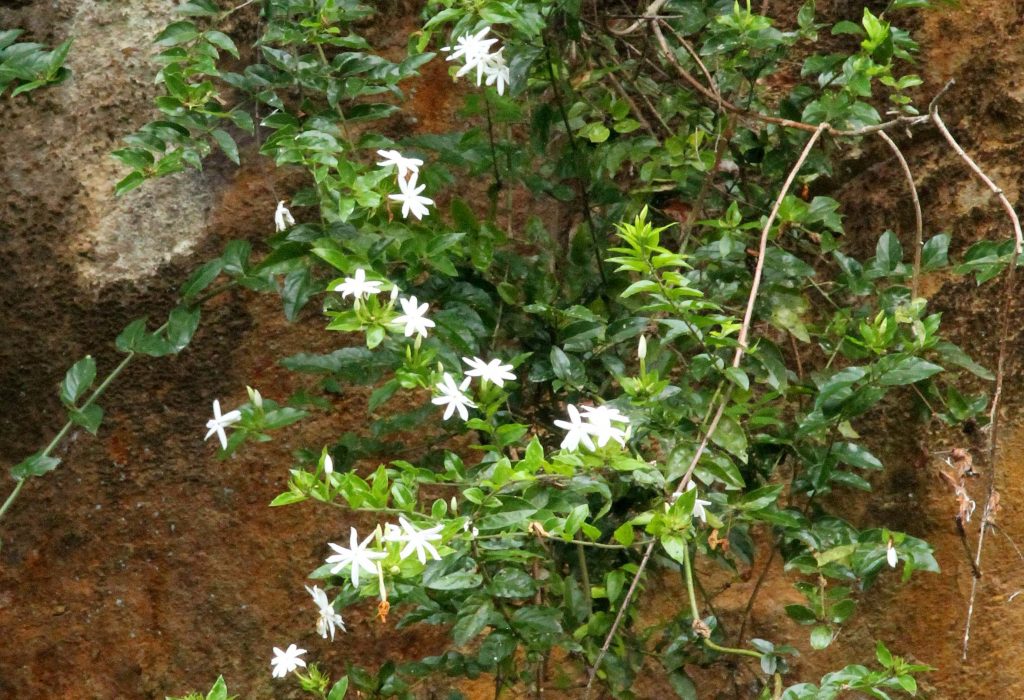
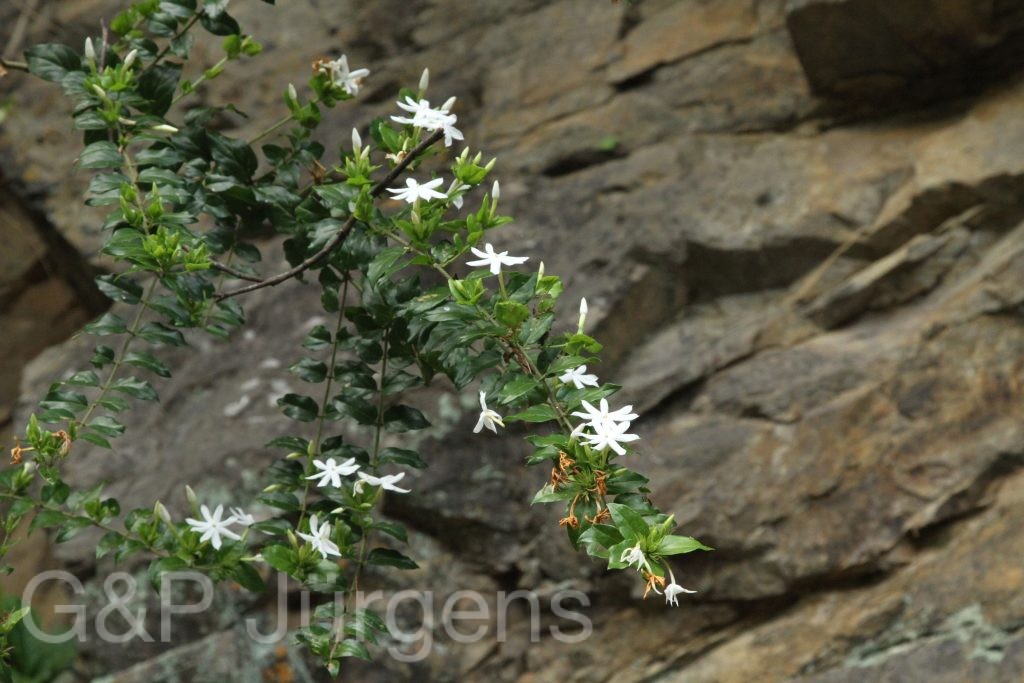
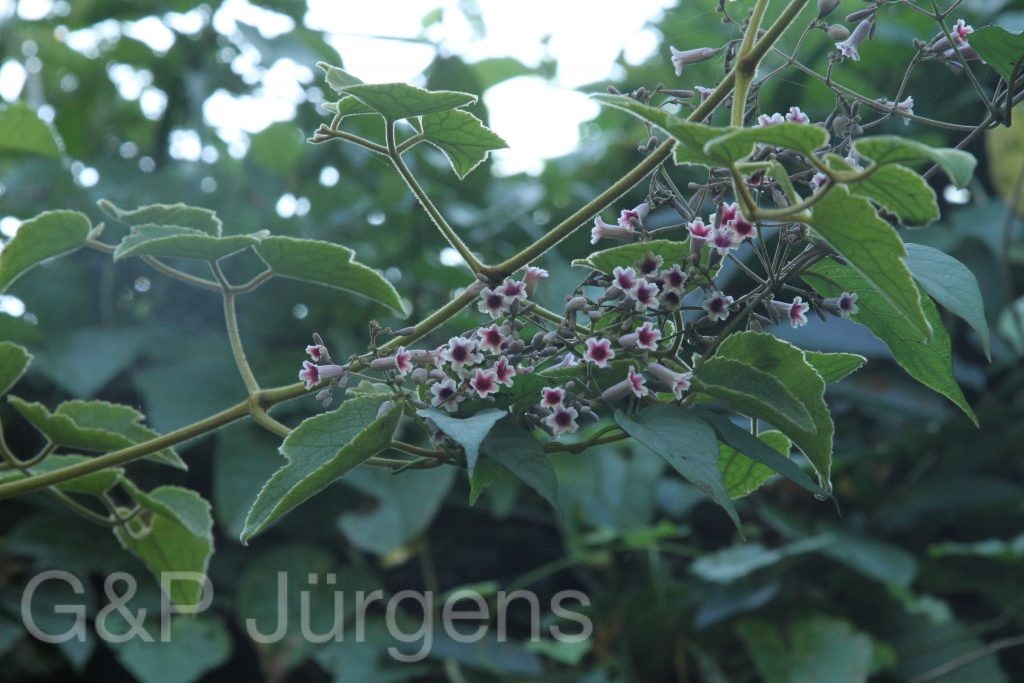
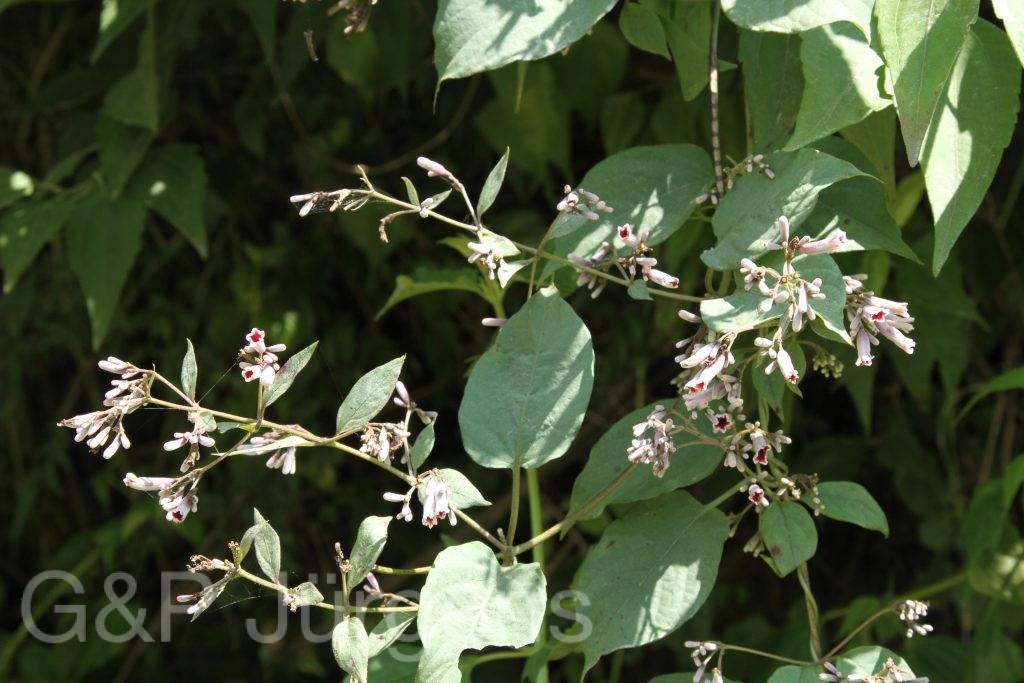
(P.J.Bergius) Willd.

Bhutan2012 787
Bhutan Zemgang 1900m, October
Bhutan2015 277
Bhutan Zhemgang 1000m, October

Description

Jasminum elongatum is a scrambling jasmine of broad Indo-Pacific distribution, recorded by GBIF from Australia, Indonesia, China, Malaysia, the Philippines, New Guinea, Thailand, Vietnam and the eastern Himalaya, with over 2270 occurrences. It grows in subtropical and tropical forest margins, secondary thickets, riverine scrub and clearings, often climbing over shrubs and small trees on warm, well-watered slopes. The illustrated plants come from Bhutan in the Zhemgang district between about 1000 and 1900 m, flowering in October; across its range the species spans the lowlands to roughly 2000 m in the warm submontane belt.

The plant is a woody climber or sprawling shrub with slender, terete to slightly angled, pubescent twigs. The leaves are opposite and simple, ovate to ovate-lanceolate, acuminate, rounded to subcordate at the base, with appressed hairs especially along the veins beneath. The flowers are borne in terminal and axillary cymes, white and fragrant, with a slender corolla tube much longer than the calyx (the epithet elongatum referring to this elongated tube) opening into several spreading lobes; the calyx bears narrow, elongate teeth. The fruit is a black, two-lobed berry.

Jasminum is a large Old World genus of the Oleaceae whose white-flowered, opposite-leaved species form the core lineage distinct from the segregated yellow jasmines. Jasminum elongatum is variable in indumentum and leaf shape across its wide range, prompting a long synonymy. Its fragrant flowers are moth- and bee-pollinated and the berries bird-dispersed. Common, weedy and adaptable, it is of least concern and is occasionally grown for its scented blossom in tropical gardens.

Author: (P.J.Bergius) Willd. · Sources: POWO (Kew), GBIF, Flora of China, Flora of Bhutan, Jasminum monograph (Green)

L.

Nepal1992 15 P20 ergebnis
Nepal Tumlingtar 1200m March 
Nepal1992 16 P21 ergebnis
Nepal Tumlingtar 1200m March 

Description

Justicia adhatoda, the Malabar nut or vasaka, is a widely distributed shrub native to the Indian subcontinent and now naturalised or cultivated across much of the tropics and subtropics; GBIF records (over 1500) span India, Nepal, Pakistan, Sri Lanka, China, Southeast Asia and many introduced regions in the Americas, Europe and beyond. In its Himalayan range it grows in the subtropical foothills and warm valleys, along streamsides, forest margins, fallow land and roadside scrub, generally below about 1300 m. The photographed plant from Tumlingtar in eastern Nepal (1200 m, flowering in March) sits squarely within this lower-elevation, dry-season-flowering habitat.

The plant is a robust, evergreen, much-branched shrub reaching 1–3 m, with opposite, lanceolate to elliptic-oblong, entire leaves that are pinnately veined and emit a strong odour when crushed. The flowers are borne in dense, axillary or terminal, bracteate spikes, the large ovate bracts conspicuous. Each flower is strongly two-lipped (bilabiate): the corolla is white to pale, the lower lip marked with purple to pinkish veining and a yellow throat. There are two stamens with bithecous anthers whose cells are unequally inserted. The fruit is a clavate, four-seeded capsule that dehisces explosively, the seeds projected from retinacula in the manner characteristic of Acanthaceae.

The species is of considerable economic and ethnobotanical importance, long used in Ayurvedic and Unani medicine for respiratory complaints; its leaves contain the quinazoline alkaloid vasicine (peganine) and related compounds with bronchodilatory and expectorant activity. Taxonomically it was formerly segregated in the monotypic genus Adhatoda but is now embedded within a broadly circumscribed Justicia. Being weedy and widely cultivated, it is of no conservation concern.

Author: L. · Sources: POWO (Kew), GBIF, Flora of Nepal, Flora of British India, Flora of China (Acanthaceae), A Revision of the genus Justicia (Acanthaceae)

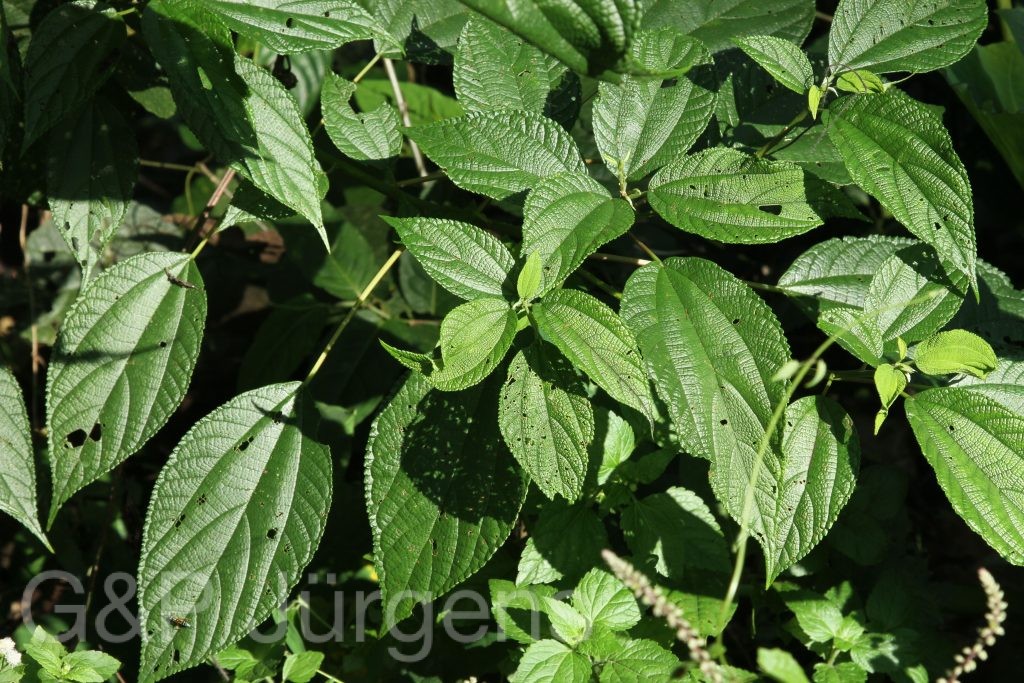
(Royle) Wedd.

Bhutan2015 105
Bhutan Galephug 600m, October

Description

Lecanthus peduncularis is a widespread herb of tropical and subtropical Asia and beyond, ranging from the Himalaya (Nepal, India, Bhutan, Pakistan) through China, Taiwan, Japan and South-East Asia to Indonesia, the Philippines, Papua New Guinea and parts of Africa (Cameroon, Equatorial Guinea, Ethiopia); its very numerous GBIF records (over 2150) reflect this broad distribution. It grows in moist, shady places in evergreen and mixed forest, on damp banks, by streams, on dripping rocks and at forest margins, from the lowlands up to mid-montane elevations of around 2500 m. The photographed plant from Galephug in southern Bhutan at 600 m in October is typical of its warm, humid foothill habitat.

It is a soft, succulent perennial or annual herb with weak, ascending to creeping stems, glabrous to sparsely hairy and rooting at the lower nodes. The opposite leaves are ovate to elliptic, membranous, with a serrate to crenate-dentate margin, an acuminate apex and conspicuous cystoliths, borne on slender petioles. The minute, unisexual flowers are crowded in flat, disc-like receptacular heads subtended by an involucre and carried on long, slender axillary peduncles, the long peduncle giving the species its epithet. The fruit is a small, compressed, ovoid achene.

The small genus Lecanthus belongs to the Urticaceae and is allied to Pilea and Elatostema, distinguished by its long-stalked, involucrate flower-heads. As a shade- and moisture-loving understorey herb of wide ecological tolerance, L. peduncularis is common and not of conservation concern; it has minor local use as a potherb and in traditional remedies across its Asian range.

Author: (Royle) Wedd. · Sources: POWO (Kew), GBIF, Flora of China, Flora of Bhutan, Annotated Checklist of the Flowering Plants of Nepal, Urticaceae revision (Friis & Wilmot-Dear)

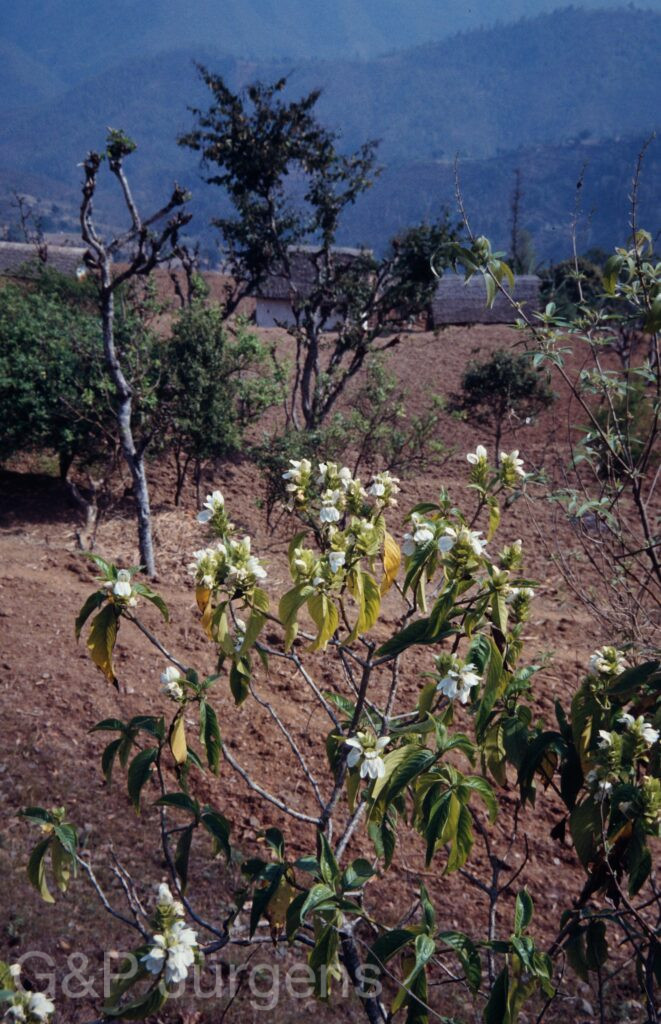
Spring.

Bhutan2015 289 1
Bhutan Zhemgang 1100m, October
Bhutan2015 291
Bhutan Zhemgang 1100m, October

Description

Leptodermis amoena is a narrowly distributed eastern Himalayan shrub recorded from Bhutan, neighbouring north-east India and adjacent southern China; with only about 18 GBIF occurrences it is among the more poorly collected members of its genus. It is a plant of warm-temperate to subtropical hill forest, occupying forest margins, open thickets, roadside banks and rocky slopes, broadly from 1,000 to 2,500 m. The plant photographed at Zhemgang in central Bhutan at 1,100 m in October illustrates its occurrence at the lower, subtropical end of this range, flowering late in the season on warm, well-drained slopes within the broad-leaved forest zone.

It is an erect, much-branched deciduous shrub up to about 1-2 m tall, with slender greyish to brownish branchlets that are puberulent when young. The leaves are opposite, small, elliptic to ovate-lanceolate, entire and shortly petiolate, subtended by interpetiolar stipules bearing a slender awn typical of the genus. The flowers are borne in few-flowered axillary or terminal cymose clusters and are tubular and funnelform, with a narrow corolla tube expanding into five spreading lobes and an often pubescent exterior; the colour ranges from pale lilac to pinkish or whitish. As in Leptodermis, the species is heterostylous, and the fruit is a small capsule splitting into valves to release narrow seeds.

Leptodermis (Rubiaceae, tribe Paederieae) comprises some forty species centred on the Sino-Himalayan region, distinguished by their awned stipules, tubular heterostylous flowers and septicidal capsules. L. amoena is characterised by its delicate, attractively coloured corollas, reflected in the epithet amoena ('charming'). Its restricted range, low collection density and dependence on mid-elevation forest suggest a species potentially sensitive to habitat conversion, though it has not been formally assessed and no global IUCN status is published. Targeted survey across the eastern Himalaya would clarify its true distribution and conservation needs.

Author: Spring. · Sources: POWO (Kew), GBIF, Flora of China, Flora of Bhutan, Rubiaceae of the Himalaya, monograph of Leptodermis

H.J.P.Winkl

Bhutan2012 1036
Bhutan Trithangebe 900m, October

Description

Leptodermis stapfiana H.J.P.Winkl. is a shrub of the Rubiaceae distributed through the central and eastern Himalaya and into adjacent China. GBIF records it from Nepal, Bhutan, India and China, with 76 georeferenced occurrences. The species favours warm to cool temperate slopes, forest margins, scrub and roadside thickets, typically on well-drained, often rocky ground. The illustrated plant from Trithangebe in Bhutan at 900 m, flowering in October, reflects its preference for the lower montane belt, where it can form conspicuous patches of bloom late in the growing season after the main monsoon.

The plant is an erect to spreading, much-branched shrub with slender, greyish, often finely pubescent branchlets. The leaves are opposite, small, ovate to lanceolate, entire, shortly petiolate, and subtended by triangular, aristate stipules characteristic of the genus. Flowers are sessile and clustered in the leaf axils and at the branch tips; the corolla is narrowly funnel-shaped, white to pale lilac or pinkish, with five (rarely four) spreading lobes that are valvate and crisped-pubescent within the throat. The species is typically heterostylous, and the fruit is a small dry capsule splitting into valves to release angular seeds enclosed in a delicate membranous testa, the feature that gives Leptodermis its name.

Leptodermis is a taxonomically difficult Sino-Himalayan genus in which species are separated largely by leaf size, calyx-lobe number and indumentum, and L. stapfiana sits within this radiation centred on the eastern Himalaya and southwest China. It is not regarded as threatened, but as a hardy, late-flowering nectar source it contributes to montane pollinator networks and to the structural diversity of Himalayan scrub vegetation.

Author: H.J.P.Winkl · Sources: POWO (Kew), GBIF, Flora of China Vol. 19, Flora of Bhutan Vol. 2, Flora of Nepal, Deb & Rout: Studies in Indian Leptodermis (Rubiaceae)

(Willd.) Sm.

Sikkim 2006 260 ergebnis
India West-Bengal, Lingza 1300m, May

Description

Leucas decemdentata is one of the most widely distributed members of its genus, ranging across tropical and subtropical Asia and out into the western Pacific. GBIF records, totalling more than 1,600 occurrences, document its presence in India, Nepal, Pakistan and Myanmar through China, Taiwan and Japan to Thailand, the Philippines, Indonesia, Timor-Leste and Papua New Guinea, and onward to Australia, Fiji, Tonga, Samoa, the Cook Islands and French Polynesia, as well as Christmas Island. In the eastern Himalaya it is a plant of warm-temperate to subtropical situations, frequenting open hillsides, roadside banks, cultivated margins, fallow fields and other disturbed ground. The photographed plant from Lingza in West Bengal, India, at about 1300 m and flowering in May, is typical of its lower montane occurrence, where it behaves as a weedy ruderal of sunny, well-drained slopes.

The species is an erect or ascending annual to short-lived perennial herb, usually 30-100 cm tall, with quadrangular stems that are retrorsely hairy along the angles. Leaves are opposite and decussate, ovate to lanceolate, with a crenate-serrate margin, an acute apex and a cuneate to attenuate base, the lamina sparsely pubescent and borne on short petioles. The white flowers are crowded into dense, globose, axillary verticillasters subtended by linear bracts. Each flower has a tubular, ten-toothed calyx with subequal spinescent teeth and a strongly two-lipped corolla, the upper lip arched and densely white-villous, the lower lip three-lobed with a larger middle lobe; the four didynamous stamens lie beneath the hood. The fruit comprises four smooth, trigonous nutlets enclosed in the persistent calyx.

The ten conspicuous calyx teeth give the species its epithet decemdentata and are a useful diagnostic character within the large, taxonomically intricate genus Leucas. Long included with the white-flowered, capitate-inflorescenced "thumbergia group" of species, it has frequently been confused with L. ciliata, L. mollissima and other allies, and several Asian names have been treated as synonyms. Ecologically it is a pioneer of open, disturbed habitats and a minor melliferous plant visited by bees and other insects. It carries no conservation concern, being abundant and adaptable across an enormous geographic range, and like many Leucas species it is used locally in folk medicine for fevers and skin complaints.

Author: (Willd.) Sm. · Sources: POWO (Kew), GBIF, Flora of China Vol. 17, Flora of Bhutan Vol. 2, Flora of Nepal, Flora of Pakistan, Revision of the genus Leucas (Lamiaceae) by Ryding

(Roxburgh ex D. Don) Brühl

Bhutan2015 73
Bhutan Wangdi Phodrang 1500m, October
Bhutan2012 410
Bhutan Wangdi 2700m, September
Bhutan2012 654
Bhutan Tserang 1200m, September

Description

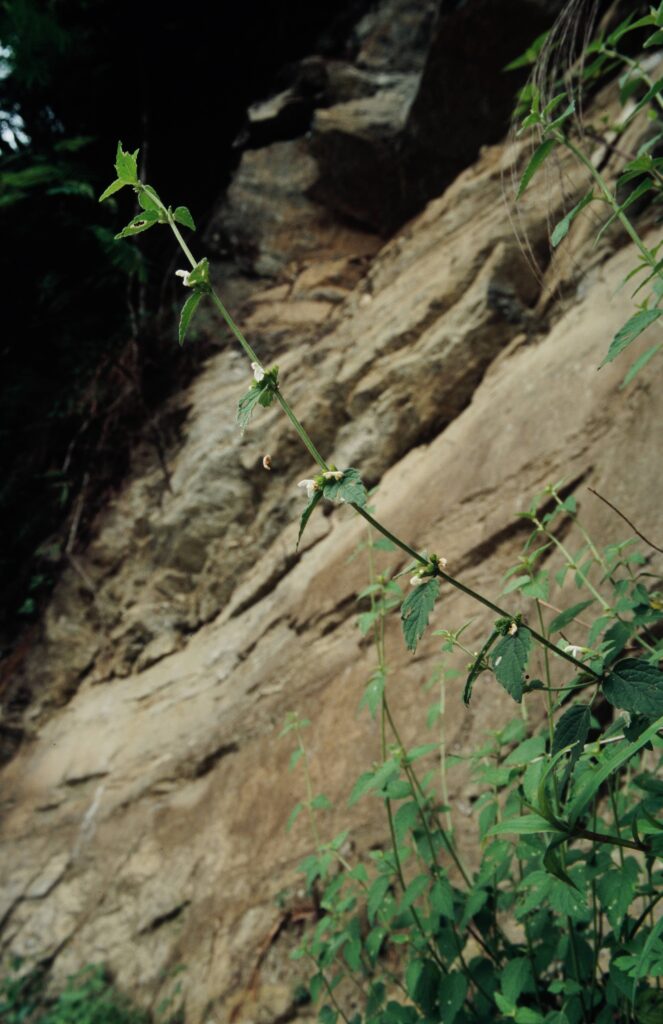
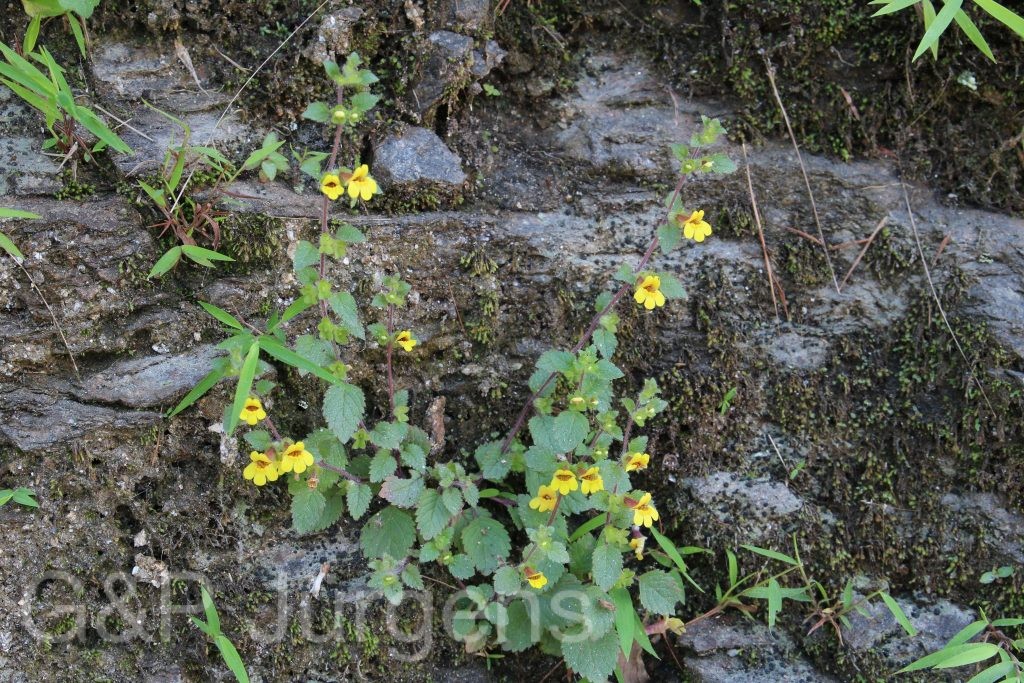
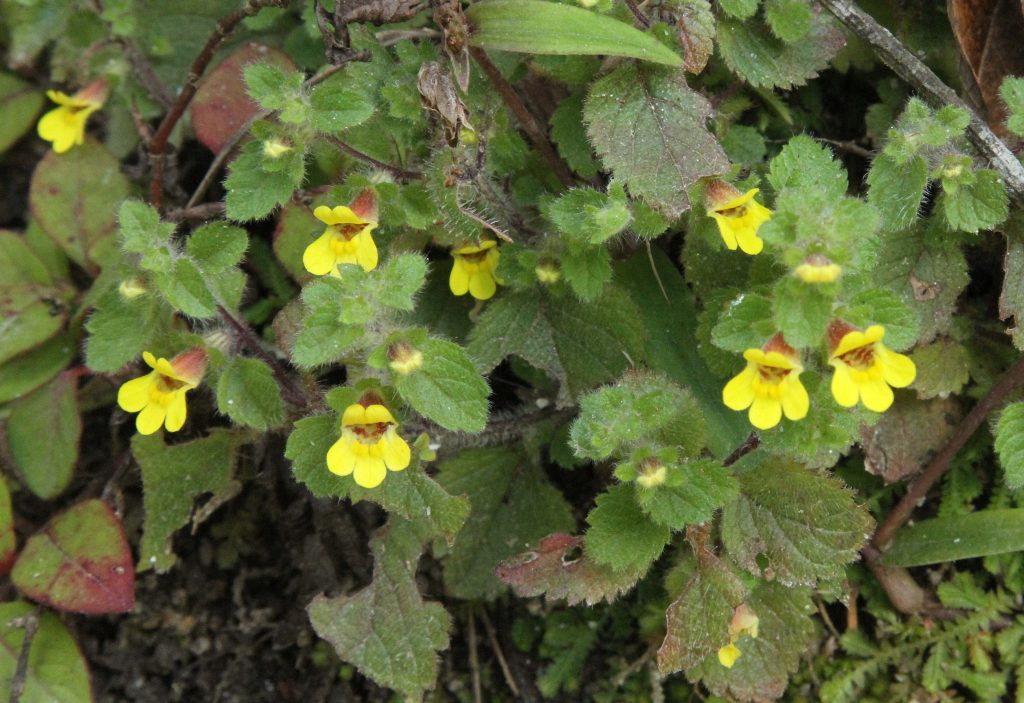
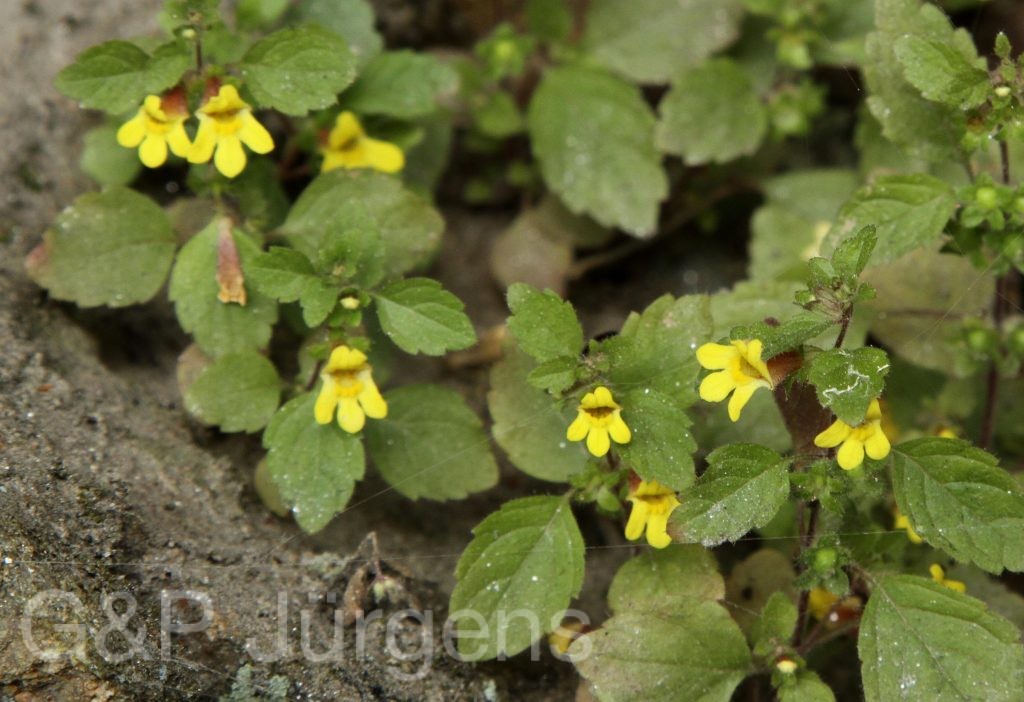
Lindenbergia muraria is a widespread herb of warm-temperate and subtropical Asia, recorded across India, China, Nepal, Bhutan, Myanmar, Thailand, Vietnam, Cambodia, Bangladesh, Pakistan and into parts of Arabia and Africa; GBIF logs 585 occurrences over this broad range. As its epithet implies, it is a colonist of old walls, rock crevices, stony banks, roadsides and waste ground, generally from the lowlands up to about 2700 m. The illustrated plants come from several Bhutanese stations, Wangdue Phodrang at 1500 m in October, Wangdue at 2700 m in September and Tsirang at 1200 m in September, spanning the autumn flowering of this ruderal species across a wide elevational band.

The plant is an erect to ascending annual or short-lived perennial herb, the stems softly pubescent and often glandular-hairy. Leaves are opposite below and sometimes alternate above, ovate to ovate-lanceolate, with a serrate margin and short petiole. The flowers are solitary or paired in the upper leaf axils, forming a leafy terminal spike-like inflorescence; each has a tubular, five-toothed calyx and a yellow, two-lipped corolla with a short tube, the lower lip three-lobed and often marked. There are four didynamous stamens, and the superior ovary ripens into a small, ovoid, septicidal capsule containing numerous minute seeds.

Lindenbergia, long placed in Scrophulariaceae, is now referred to the broadly circumscribed Plantaginaceae (consistent with the input family) following molecular reclassification, occupying a basal position near the family's scrophularioid lineages. POWO and GBIF accept the name. Its tolerance of walls and disturbed mineral substrates underlies its wide, weedy distribution across monsoon Asia.

Author: (Roxburgh ex D. Don) Brühl · Sources: POWO (Kew), GBIF, Flora of China, Flora of Bhutan, Flora of British India, Annotated Checklist of the Flowering Plants of Nepal, Revision of Lindenbergia (Plantaginaceae/Scrophulariaceae)