(Thunberg) Lindl.
Also included: Cotoneaster microphyllus Lindb.


Lithocarpus fenestratus is an evergreen stone-oak widely distributed across the eastern Himalaya and Indo-Burma, ranging from Nepal, Bhutan and north-eastern India through Bangladesh, Myanmar, Thailand, Laos, Vietnam and Cambodia into southern China and Taiwan. GBIF aggregates over 1080 occurrences, concentrated in the montane forests of South-East Asia and the Sino-Himalayan borderlands. It is a canopy or sub-canopy tree of subtropical and warm-temperate evergreen broad-leaved forest, often in mixed laurel-oak associations on hill slopes, generally from the lowlands up to around 2000 m. The tree photographed in Bhutan near Wangdue/Gelephu (800 m, October) reflects its presence in the warm foothill forests of the southern Bhutanese duars.
The species is a medium to large tree with greyish, fissured bark and stout twigs. The leaves are simple, alternate, coriaceous, elliptic to oblong-elliptic, entire and pinnately veined, glabrous and lustrous above and often glaucous or thinly tomentose beneath. The flowers are unisexual, borne in erect catkin-like spikes, the male inflorescences elongate and the female flowers seated singly or in clusters at the base of mixed spikes. The diagnostic fruit is the acorn: a hard nut wholly or largely enclosed by a woody cupule covered in concentric, often lamellate rings, maturing over more than one season and dispersed by gravity and rodents.
Lithocarpus is a large Asian genus distinguished from Quercus by its erect (rather than pendulous) male catkins and its frequently enclosing, ringed cupules. L. fenestratus, transferred to the genus by Rehder, has a broad range and considerable foliar variation, and several infraspecific taxa have been recognised regionally. As a widespread, often dominant forest tree it is not globally threatened, though locally exploited for timber and important as mast for forest wildlife.
Author: (Roxb.) Rehder · Sources: POWO (Kew), GBIF, Flora of China, Flora of Bhutan, Flora of Thailand, Annotated Checklist of the Flowering Plants of Nepal, monograph of Asian Lithocarpus (Camus)
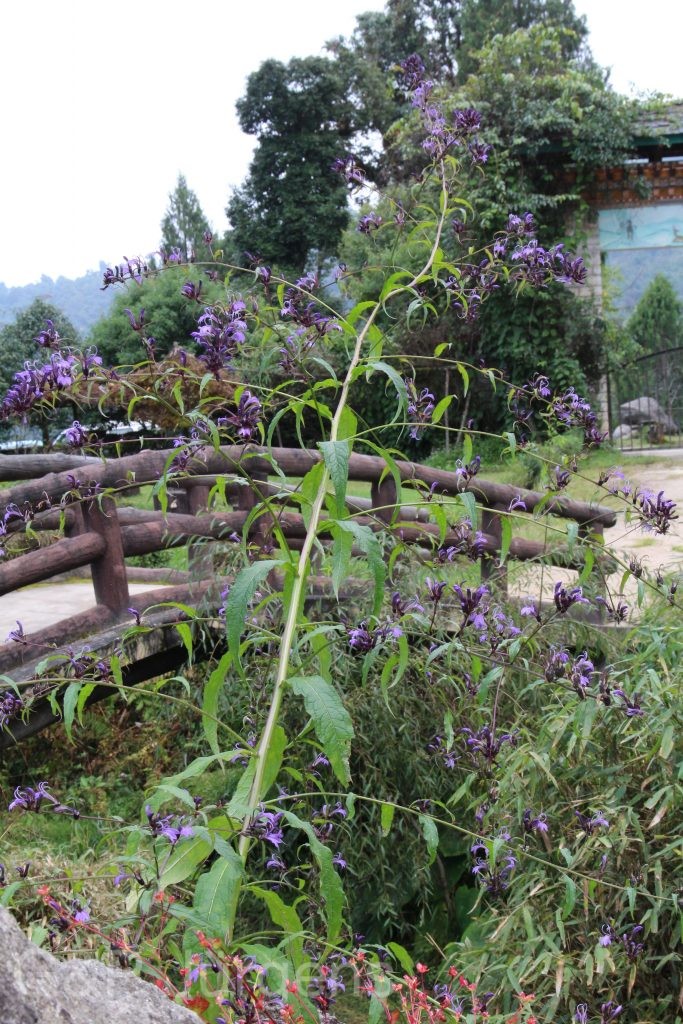
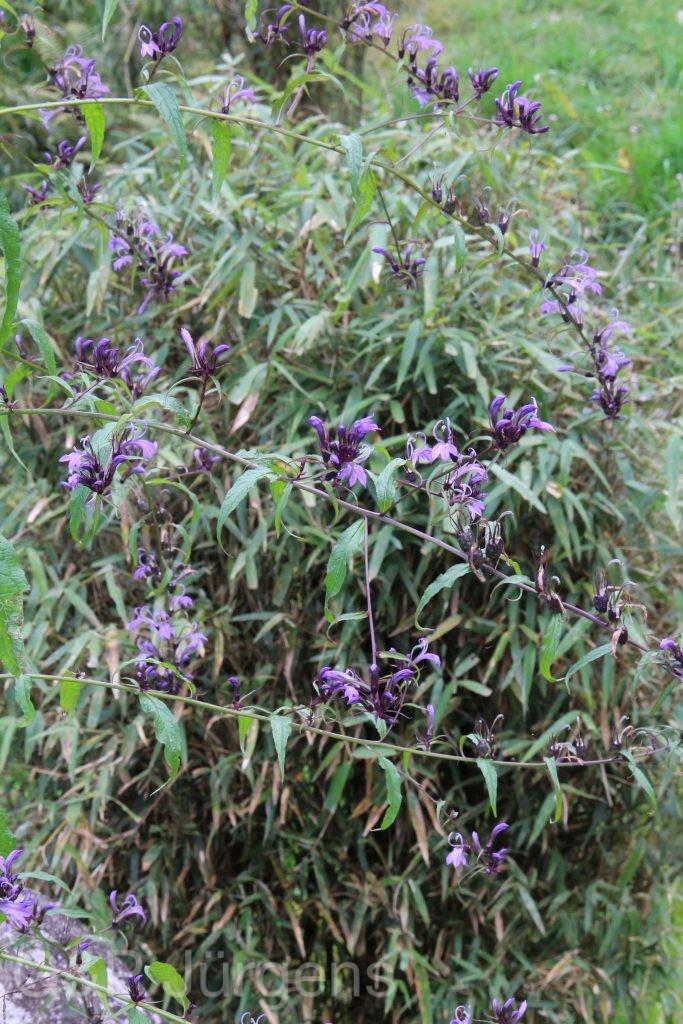
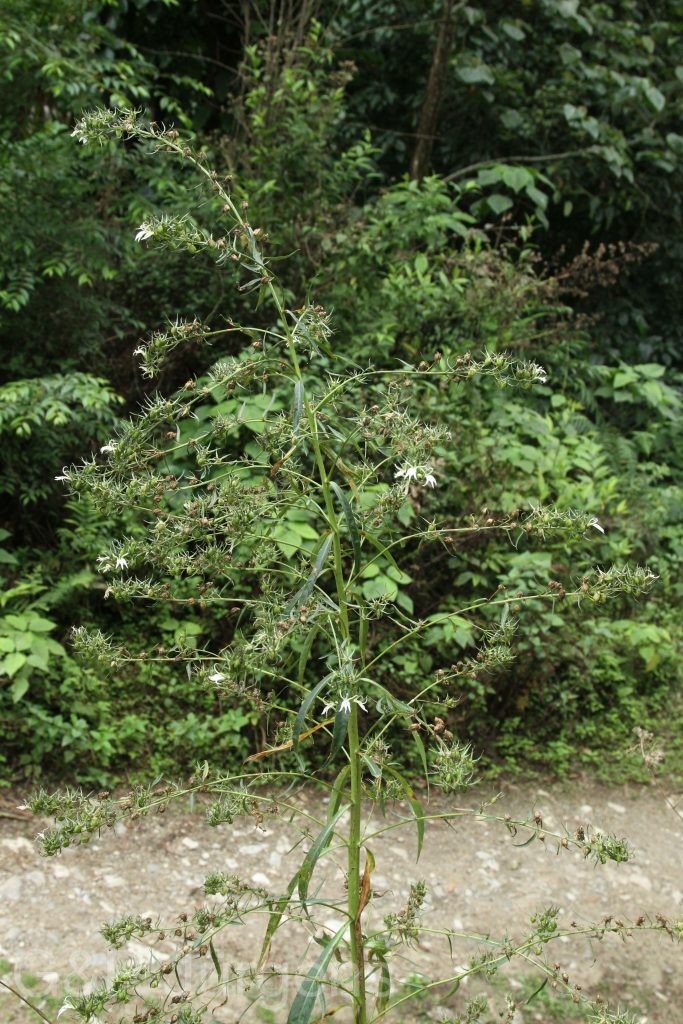
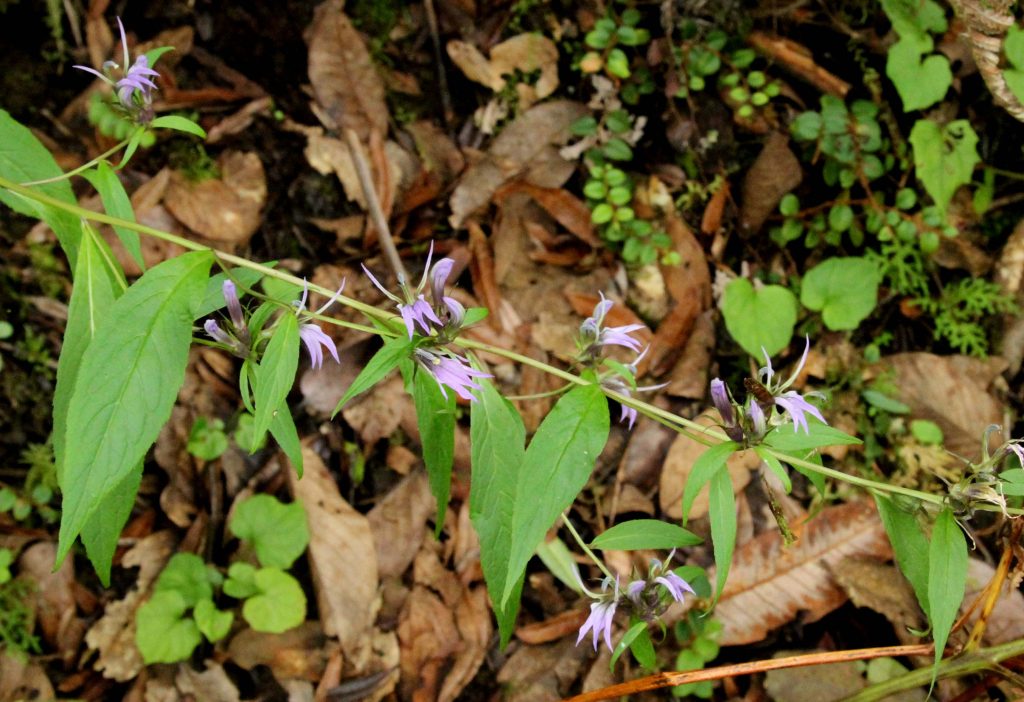
Lobelia nicotianifolia is a robust, wide-ranging lobelia of the Indian subcontinent and tropical Asia, documented from India, China, Sri Lanka, Nepal, the Philippines, Thailand, Myanmar, Indonesia, Bangladesh, Vietnam, Bhutan, Laos, Malaysia and Taiwan, with around 763 occurrences making it one of the better-collected species in this set; New World records reflect cultivation or error. It occupies a wide altitudinal span, from warm foothill farmland to cool montane forest margins, favouring open, disturbed, moist ground along roadsides, clearings and field edges. The Bhutanese collections illustrate this breadth, ranging from a farm at Trithangebe at about 800 m in May to the Dochu-La between roughly 2700 and 3000 m flowering in September and October.
It is a tall, stout biennial or short-lived perennial herb, sometimes exceeding two metres, with an erect, little-branched stem exuding acrid milky latex when cut. The leaves are large, alternate, lanceolate to elliptic, finely toothed and tobacco-like in size and texture, hence the epithet nicotianifolia, the lower ones forming a substantial basal array. The flowers are borne in a long, dense terminal raceme; each is zygomorphic with a tubular, two-lipped corolla, typically pale greenish-white to bluish, split nearly to the base, the upper lip of two narrow lobes and the lower of three, the stamens connate into a staminal tube around the style. The fruit is a many-seeded capsule dehiscing at the apex.
Within Campanulaceae, Lobelia is a large genus distinguished by strongly bilabiate flowers and syngenesious anthers, and tall species such as this are notable for their imposing single-stemmed inflorescences and their pyridine alkaloids related to lobeline, giving them a long history of medicinal and folk use. The acrid latex deters herbivores, and the protandrous flowers favour outcrossing by insect visitors. Common and adaptable across a vast range, the species is of no conservation concern and behaves as a colonist of disturbed, anthropogenic habitats.
Author: Roth · Sources: POWO (Kew), GBIF, Flora of Bhutan, Flora of China, Flora of British India, Lammers's monographic studies of Lobelia (Campanulaceae)
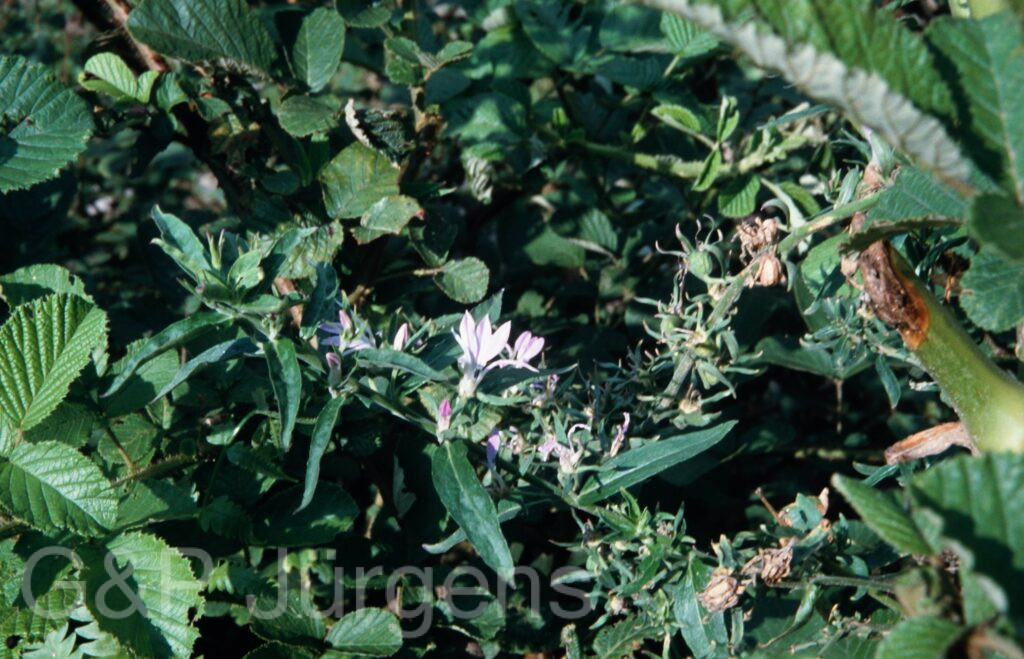
Lobelia rosea is a slender annual or short-lived herb of the eastern Himalaya and Indo-Burmese region, ranging from Nepal, Bhutan and north-east India through Myanmar, Thailand, Laos and Vietnam to southern China and peninsular Malaysia. GBIF records 112 occurrences across this subtropical to warm-temperate arc. It favours moist open ground, stream and paddy margins, damp grassy banks and disturbed clearings at low to middle elevations. The plant from Mulabari in Gorkha, central Nepal, at 1340 m in May is a typical pre-monsoon population on humus-rich soil in light shade.
It is a delicate herb with erect or ascending, simple or sparingly branched stems exuding milky latex when broken. The leaves are alternate, sessile or shortly petiolate, ovate to lanceolate, serrate to denticulate and thin in texture. The flowers are borne in lax terminal racemes on slender pedicels. The corolla is markedly zygomorphic and two-lipped, pink to rose-purple (whence rosea), the tube split dorsally and the lower lip three-lobed; the five anthers are connate around the style into the Lobelia tube, the two lower ones tufted apically. The fruit is a small two-valved capsule dehiscing apically to shed numerous minute, reticulate seeds.
Lobelia, the largest genus of Campanulaceae (subfamily Lobelioideae), is sometimes segregated, but molecular evidence supports its retention within an expanded Campanulaceae. L. rosea belongs to a group of small-flowered Asian annuals delimited chiefly by corolla colour, leaf shape and capsule form. Like its congeners it contains piperidine alkaloids, and several Asian Lobelia species feature in traditional medicine. Widespread and weedy, persisting readily in disturbed seasonally moist habitats, it is of no conservation concern.
Author: Wall. · Sources: POWO (Kew), GBIF, Flora of China Vol. 19, Flora of Bhutan Vol. 2, Annotated Checklist of the Flowering Plants of Nepal, Lammers world checklist of Campanulaceae
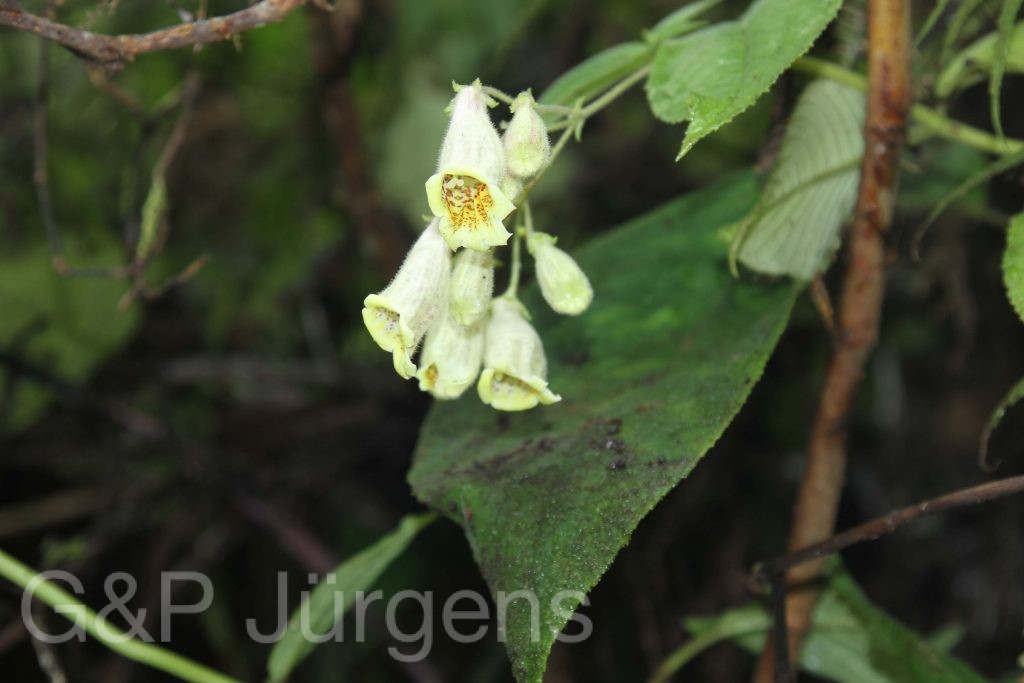
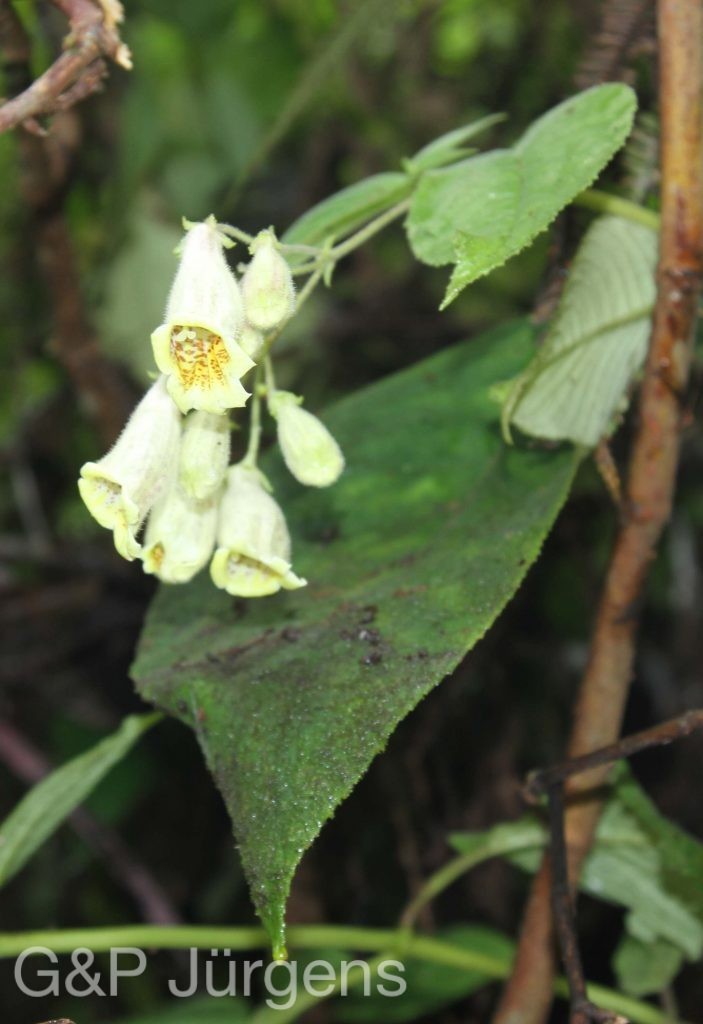
Loxostigma kurzii is an epiphytic or lithophytic gesneriad of the eastern Himalaya and the Sino-Himalayan borderlands, recorded by GBIF (about 165 occurrences) from China, India, Nepal, Bhutan and Myanmar. It inhabits the humid subtropical and warm-temperate forest belt, growing on mossy tree trunks, shaded cliffs and dripping rock faces in deep shade and high humidity. The illustrated plant was found in Bhutan at Trithangebe at about 900 m in October, a low, frost-free montane forest locality typical of the species, which descends well below the conifer zone into the broadleaved evergreen forests of the foothills.
The plant is a soft, somewhat fleshy herb with pendulous or ascending, often rooting stems clothed in soft hairs. The leaves are opposite, those of a pair frequently unequal, ovate to elliptic, with a crenate-serrate margin and a pubescent surface. The flowers are solitary or few in the leaf axils, each on a slender pedicel; the calyx is five-parted, and the corolla is large, tubular-funnelform and yellow, often marked within with purplish lines and slightly two-lipped at the mouth. There are four didynamous stamens with coherent anthers, and a superior ovary bearing the obliquely placed stigma from which the genus takes its name (Loxostigma). The fruit is a long, slender, twisted capsule splitting to release many minute seeds.
The taxon is sometimes treated as Briggsia kurzii, reflecting past uncertainty over generic limits within the didymocarpoid Gesneriaceae; molecular work has placed Loxostigma as a distinct lineage near Briggsia. As a forest epiphyte dependent on undisturbed, humid woodland it is sensitive to deforestation, though it remains locally frequent and is not formally assessed as threatened.
Author: (C.B.Clarke) B.L.Burtt. · Sources: POWO (Kew), GBIF, Flora of China, Flora of Bhutan, Annotated Checklist of the Flowering Plants of Nepal, Weber and Burtt's classification of the Gesneriaceae
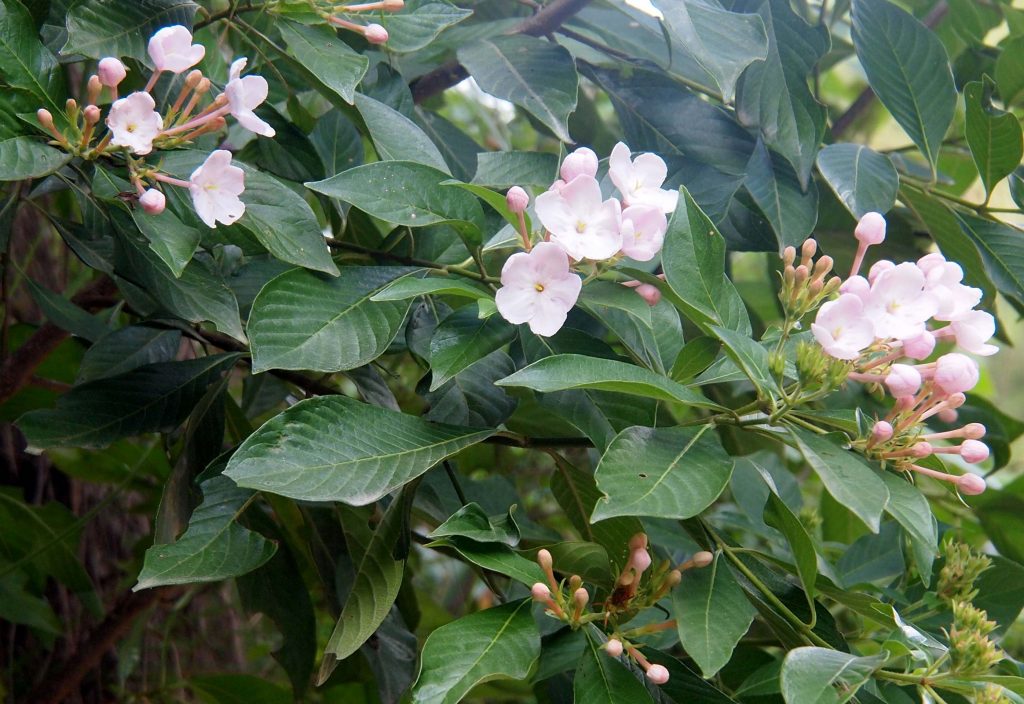
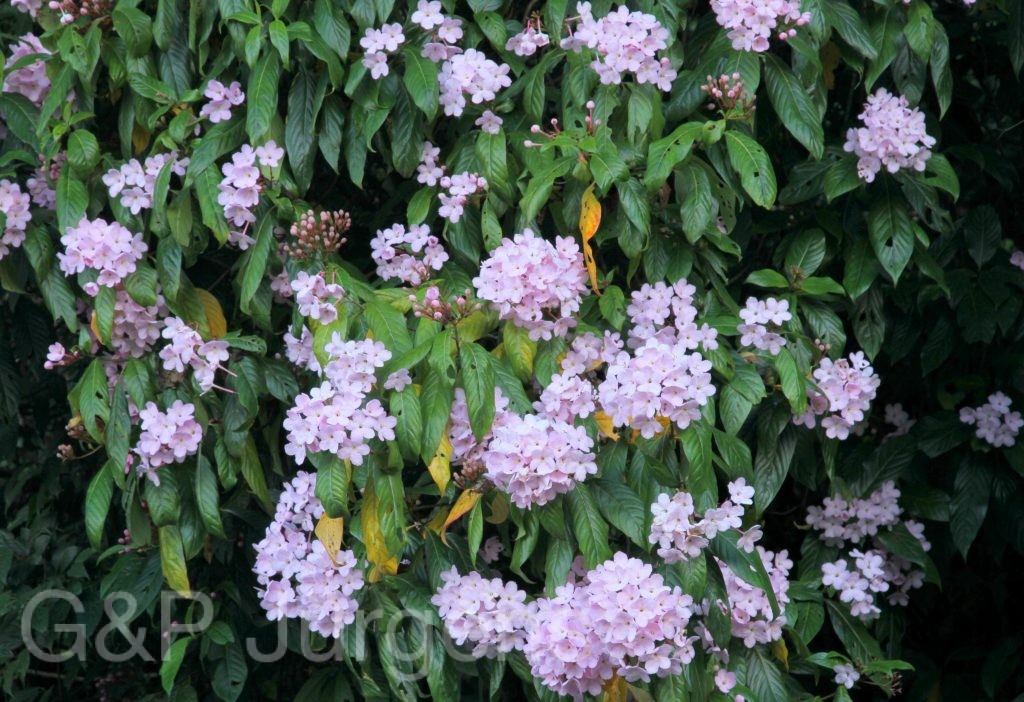
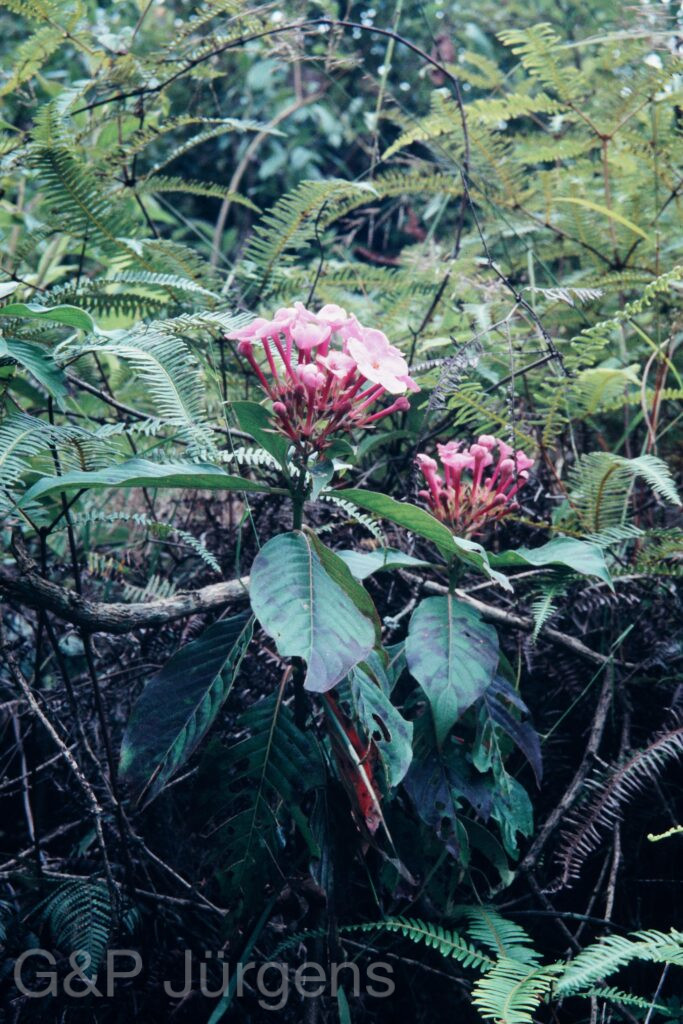
Luculia gratissima is a Himalayan and southwest Chinese shrub or small tree ranging from Nepal through Bhutan and northeast India into southern China, Myanmar, Thailand and Vietnam. GBIF records some 404 occurrences, including many cultivated specimens in temperate and subtropical regions worldwide. It inhabits subtropical to warm-temperate forest, forest margins, open hillsides and stream banks, generally between about 1000 and 2500 m. The photographed plants come from Bhutan at Tserang (1300 m) and Sandrup (1500 m) in September and from Tibling in Nepal at about 2200 m in October, the autumn flowering period typical of this fragrant species.
The species is an erect, branched shrub or small tree with terete, glabrescent branchlets. The leaves are opposite, large, elliptic to ovate-lanceolate, acuminate, with prominent pinnate venation and interpetiolar stipules. The flowers are borne in large terminal corymbose cymes and are showy and sweetly scented; each has a slender, elongate corolla tube opening into five spreading pink lobes, with small paired scales at the throat and exserted anthers. The fruit is an obovoid, ribbed, two-valved capsule that splits to release numerous small winged seeds adapted to wind dispersal.
Luculia gratissima Sweet is prized horticulturally for its fragrant pink autumn flowers and is widely grown in mild and subtropical gardens, which accounts for its many extralimital GBIF records. Within its native Himalayan and Indo-Chinese range it is widespread and not considered threatened. The genus Luculia, with its long-tubed scented flowers and winged capsular seeds, is of phylogenetic interest as an early-diverging lineage within the Rubiaceae.
Author: Sweet · Sources: POWO (Kew), GBIF, Flora of Bhutan, Flora of China, taxonomic revisions of Luculia (Rubiaceae)
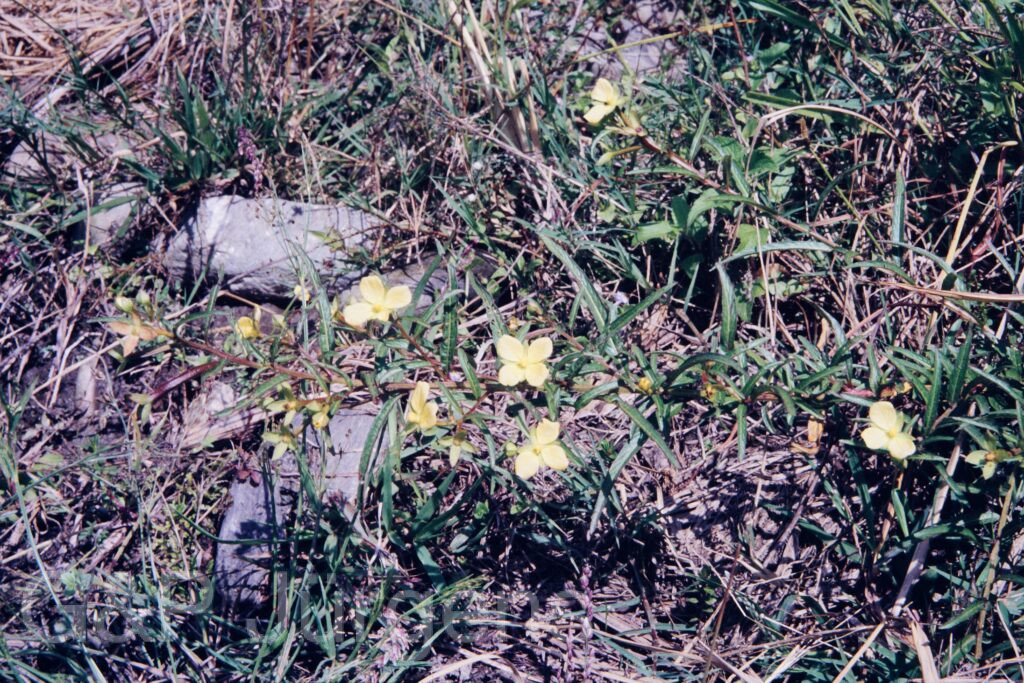
Ludwigia octovalvis (Jacq.) P.H.Raven is a pantropical wetland herb or subshrub of the willowherb family, one of the most widespread members of the genus. GBIF documents over 37,000 records across the tropics and warm temperate zones — the Americas (USA, Mexico, Brazil, Peru, Ecuador, Cuba, Puerto Rico), Africa and the western Indian Ocean (South Africa, Madagascar, Réunion), Australia, and tropical and subtropical Asia (China, Taiwan, Japan, Indonesia). In the Himalayan foothills it occupies marshes, ditches, paddy margins, riverbanks and other seasonally wet ground at low elevations, as for the photographed plant from Nepal, Darondi-Khola, 630 m, in October.
The plant is an erect, much-branched annual or short-lived perennial 0.5–2 m tall with terete to weakly four-angled, often reddish stems that are pubescent above. Leaves are alternate, lanceolate to narrowly elliptic, entire, acuminate and shortly petiolate. Flowers are solitary in the upper leaf axils, 4-merous, with four bright yellow, obovate petals and four green sepals; the inferior, narrowly cylindric ovary is conspicuous. The fruit is a slender, ribbed, octovalved (eight-grooved) capsule — the source of the epithet — splitting to release numerous small seeds embedded in the dry pith, well suited to water and gravity dispersal.
Ludwigia is taxonomically complex, and L. octovalvis is a variable aggregate within which several subspecies and forms have been recognised. Its broad pantropical range, weediness in rice agriculture and ready colonisation of disturbed wet ground make it ecologically successful and locally a useful medicinal plant. It is not of conservation concern.
Author: (Jacq.) P.H.Raven · Sources: POWO (Kew), GBIF, Flora of China Vol. 13, Flora of Nepal, Flora of Bhutan Vol. 2, Raven: Monograph of the genus Jussiaea / Ludwigia (Reinwardtia)
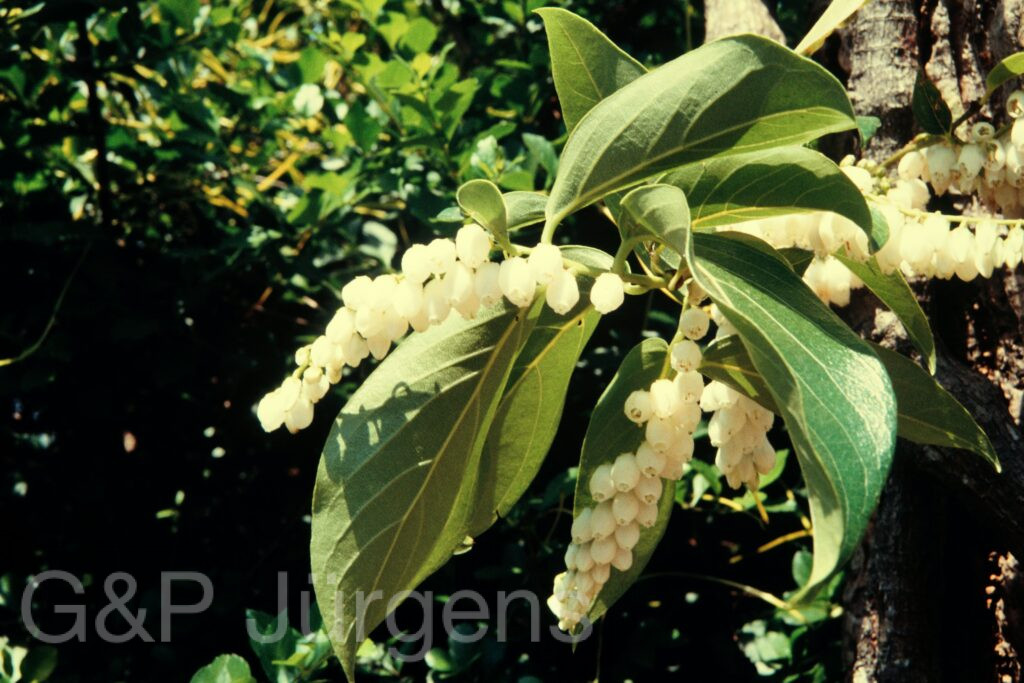
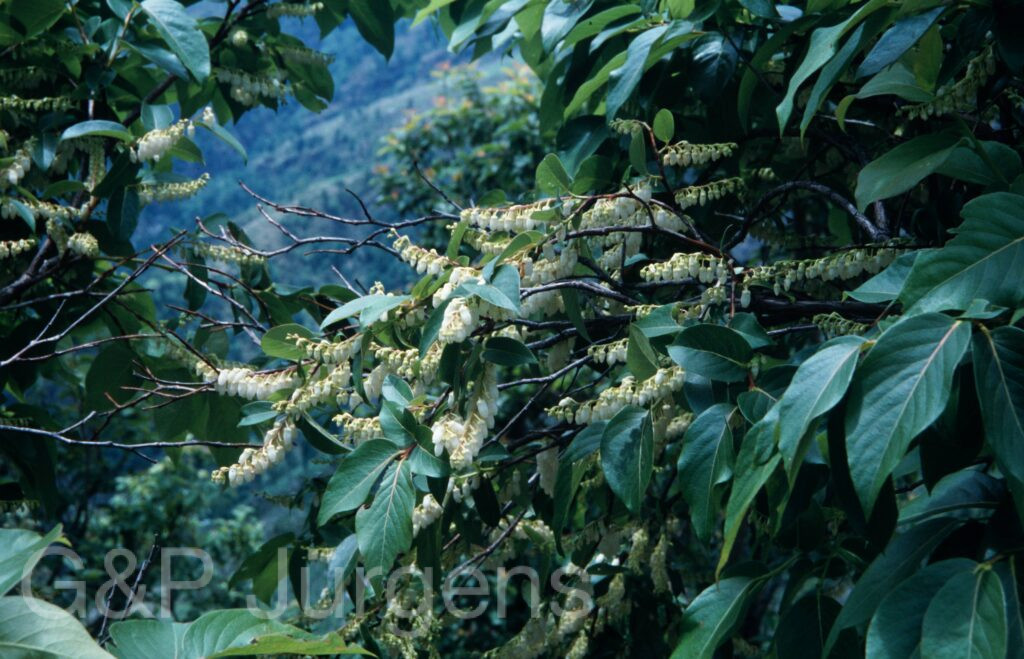
Lyonia ovalifolia is a widespread Sino-Himalayan and East Asian shrub or small tree distributed from China, Japan and Taiwan through Nepal, India, Bhutan, Pakistan, Myanmar, Thailand and Indochina, with a large GBIF dataset of over 13000 records. It grows on open hillsides, forest margins, thickets and in pine and oak forest understorey, typically between about 1000 and 3000 m. The illustrated plants from Chinchilla at 1950 m and Mulabari in Gorkha at 1360 m in Nepal, both flowering in May, are typical of its subtropical to temperate montane habitats, where it is a common component of the secondary scrub and open forest of the Himalayan midlands.
It is a deciduous to semi-evergreen shrub or small tree with reddish-brown, often somewhat zigzag young branchlets. The leaves are alternate, ovate to ovate-elliptic or ovate-lanceolate, with an entire margin, an acuminate apex and a rounded to subcordate base, with pinnate venation. The flowers are borne in axillary racemes along the shoots, each with a small five-lobed calyx and an urceolate (urn-shaped) white corolla with five short recurved lobes, ten included stamens and a superior ovary. The fruit is a small, ovoid, woody, five-valved loculicidal capsule with a persistent thickened placental axis, releasing numerous minute seeds.
Lyonia belongs to the subfamily Vaccinioideae of the Ericaceae and, in common with many members of that family, contains grayanotoxin-type diterpenes, making the foliage toxic to livestock; the plant has local uses as an insecticide and in folk medicine. The urn-shaped flowers are pollinated by bees and other insects, and the tiny seeds are wind-dispersed from the dehiscing capsules. As an abundant and ecologically tolerant species across a vast range, L. ovalifolia is of least conservation concern.
Author: (Wall.) Drude · Sources: POWO (Kew), GBIF, Flora of China Vol. 14, Flora of Bhutan Vol. 2, Flora of Nepal, Flora of Pakistan, Judd Revision of Lyonia (Ericaceae) monograph
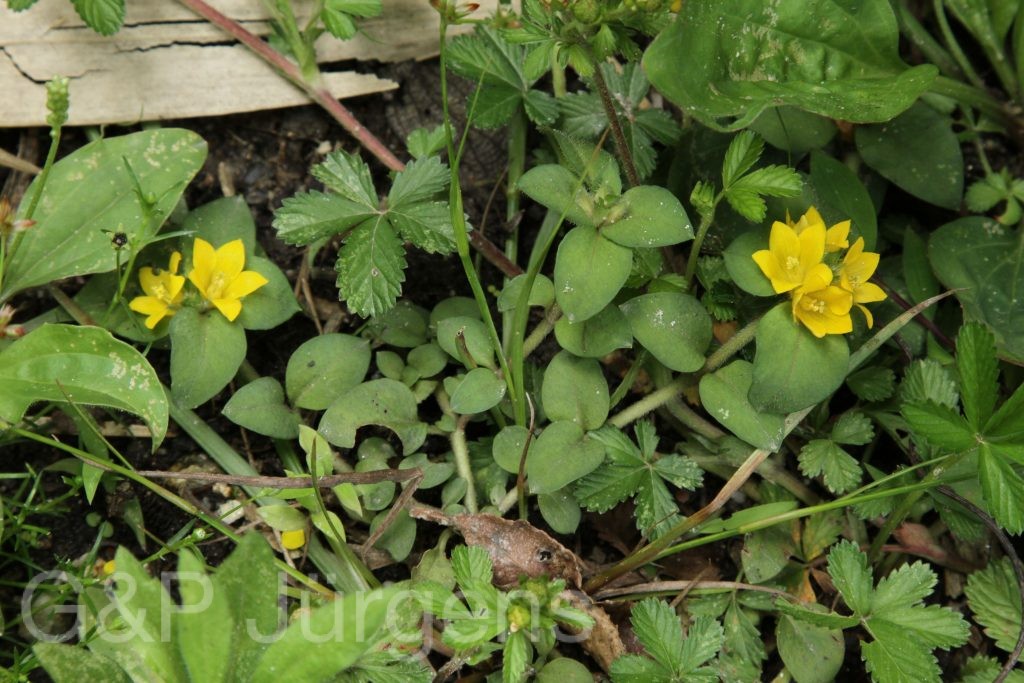
Lysimachia congestiflora is a wide-ranging species native across China, Taiwan, the Himalaya (Nepal, north-east India, Bhutan) and into Myanmar, Vietnam, Laos, Thailand and Japan; its very large total of 1844 georeferenced records includes numerous naturalised and cultivated points in the United States, Brazil, Ecuador, Mexico, Australia and Europe, reflecting its popularity as a creeping ground-cover and basket plant. It grows in moist, shaded to open ground on grassy banks, streamsides, ditches, field margins and damp roadside slopes. The Bhutan collection at Wangdi along the Mo-Chu at about 1200 m typifies its preference for warm, humid lower-montane habitats.
It is a low, mat-forming perennial herb with slender, decumbent to creeping stems that root at the lower nodes and are sparsely villous. The leaves are opposite, ovate to broadly elliptic, often gland-dotted and minutely hairy. The flowers are crowded in dense terminal clusters (hence congestiflora), each on a short pedicel; the corolla is yellow, rotate to broadly campanulate, five-lobed and frequently marked with reddish spots or a darker throat. There are five stamens, and the fruit is a small globose capsule enclosed by the persistent calyx.
Within Primulaceae the genus Lysimachia (sometimes segregated as Lysimachiopsis or placed in subgenus Idiophyton) comprises loosestrifes characterised by rotate corollas and capsular fruit. The clustered yellow flowers attract a range of generalist insect pollinators. Exceptionally adaptable and frequently weedy in cultivation, the species is abundant throughout its native range and of no conservation concern; its capacity to naturalise has even made it a minor garden escape in several regions.
Author: Hemsl. · Sources: POWO (Kew), GBIF, Flora of China, Flora of Bhutan, Flora of Nepal, Hu & Kelso Primulaceae monographic treatments
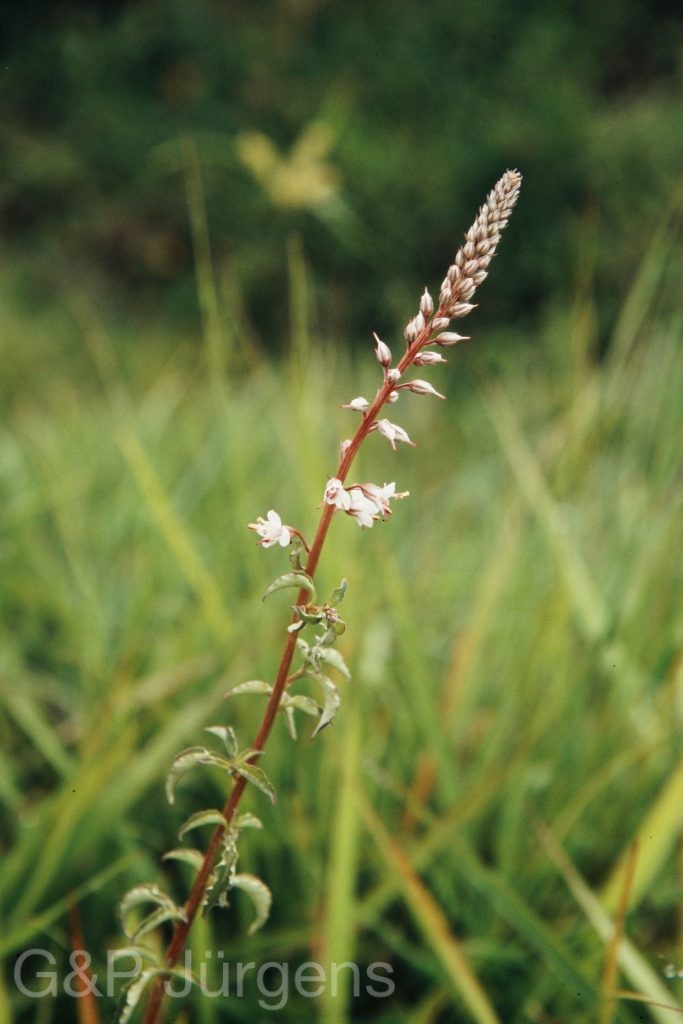
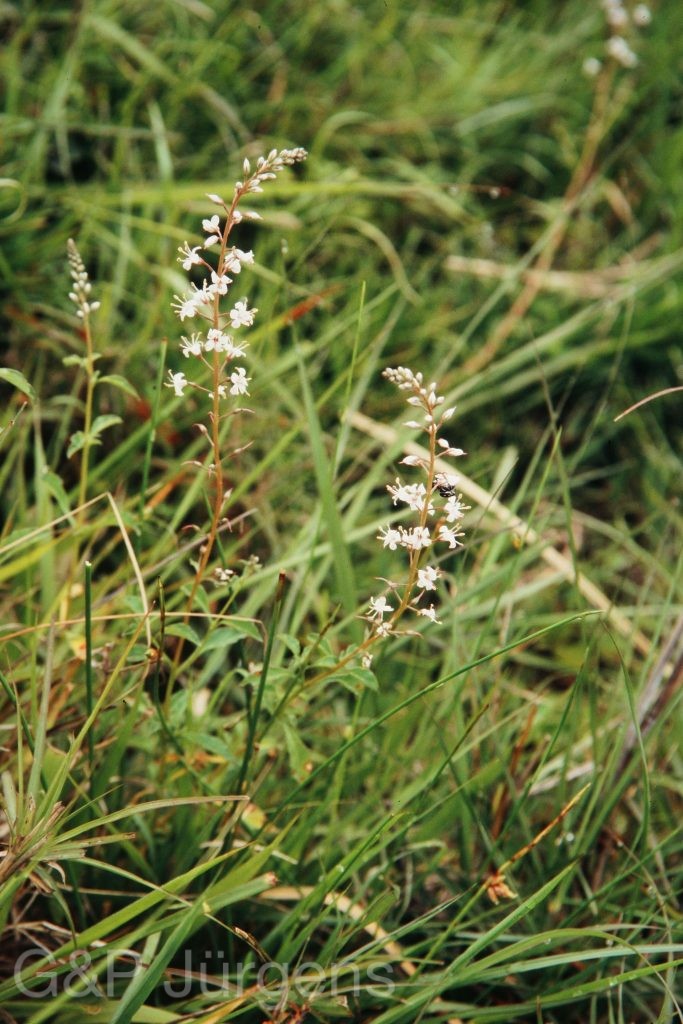
Lysimachia lobelioides is a slender herb ranging widely through the Himalaya and Southeast Asia, recorded from China, India, Bhutan, Nepal, Myanmar, Thailand, Laos, Vietnam, Taiwan and New Caledonia, with 647 occurrences logged in GBIF. It favours moist, shaded and disturbed places at low to middle elevations: stream banks, ditches, damp grassy ground, field margins and open forest, broadly between 300 and 2500 m. The Bhutanese collection illustrated, from the Mo-Chu valley at 1350 m in June, typifies its occurrence in warm subtropical river-valley habitats during the early monsoon, when it flowers freely on damp, fertile soils.
It is an annual or short-lived perennial with weak, erect to decumbent, often quadrangular stems 10-40 cm long, glabrous and sometimes rooting at the lower nodes. The leaves are alternate, ovate to lanceolate, thin in texture, shortly petiolate and frequently dotted with dark glandular punctations. The small flowers are borne singly in the upper leaf axils on filiform pedicels; the corolla is white to pale pink, deeply five-lobed and shorter than or about equalling the lanceolate calyx lobes, with five stamens. The fruit is a small globose capsule dehiscing by valves and releasing numerous minute angular seeds.
Lysimachia (Primulaceae, formerly Myrsinaceae in part) is a large, near-cosmopolitan genus best developed in eastern Asia; L. lobelioides belongs to a group of small-flowered, axillary-flowered annuals. Its wide distribution, weedy tendency and tolerance of disturbed wet ground make it ecologically adaptable and of no conservation concern. The disjunct New Caledonian records are biogeographically notable, pointing to long-distance dispersal of this colonising species across the Indo-Pacific.
Author: Wall. · Sources: POWO (Kew), GBIF, Flora of China, Flora of Bhutan, Revision of the Genus Lysimachia (Primulaceae)