Tag:

Subtropical (<1500 m)

Griff.

Bhutan2015 449
  Bhutan Jakar 2500m, October
Bhutan2015 450
  Bhutan Jakar 2500m, October
Bhutan2015 451
  Bhutan Jakar 2500m, October
Bhutan2012 1129
Bhutan Koma-Chu-Valley 950m, October
Bhutan2012 1131
Bhutan Koma-Chu-Valley 950m, October
Bhutan2012 1358
Bhutan Sandrup 1500m, October

Description

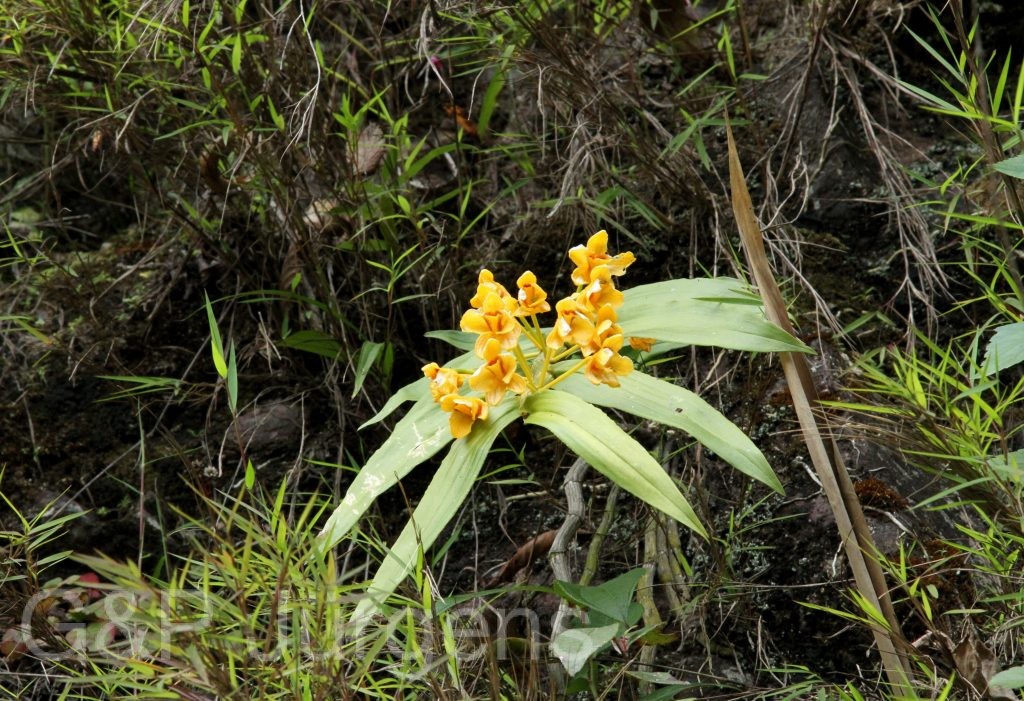
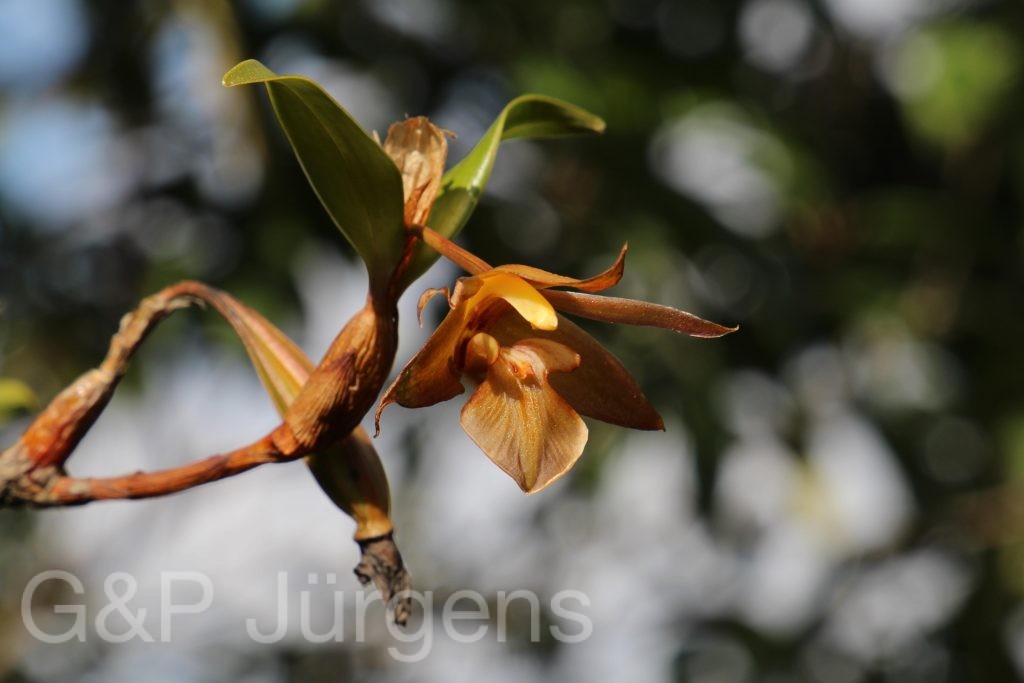
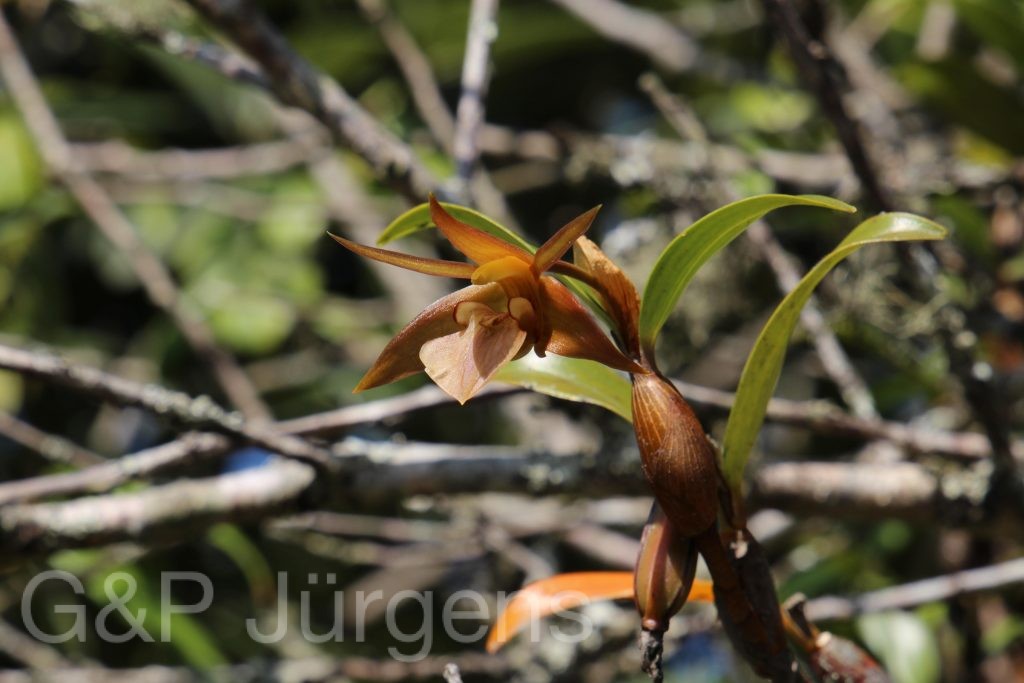
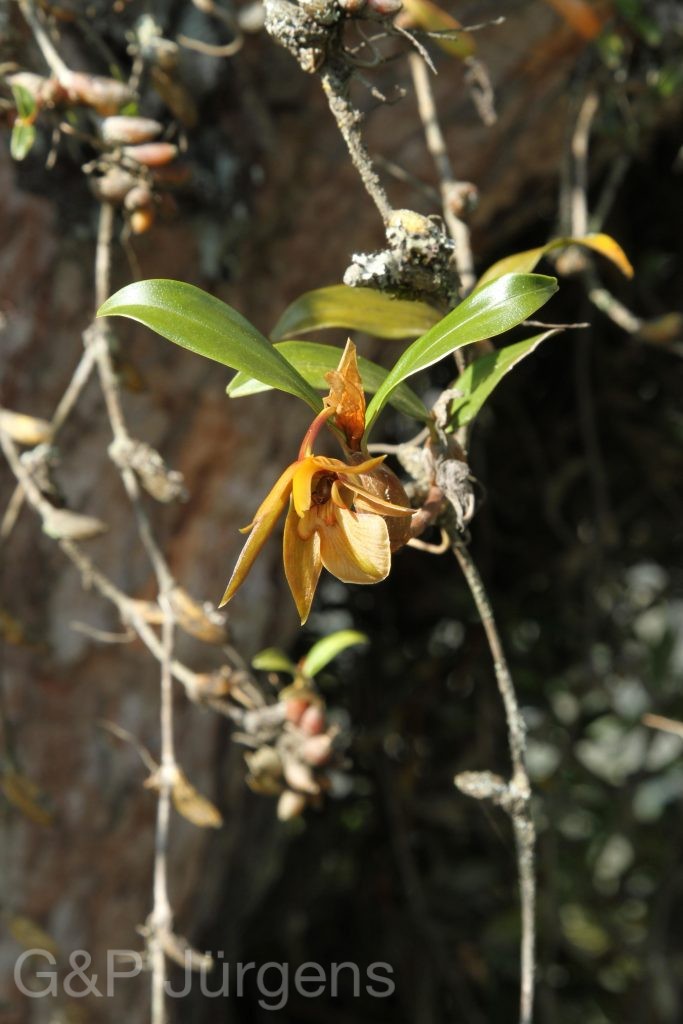
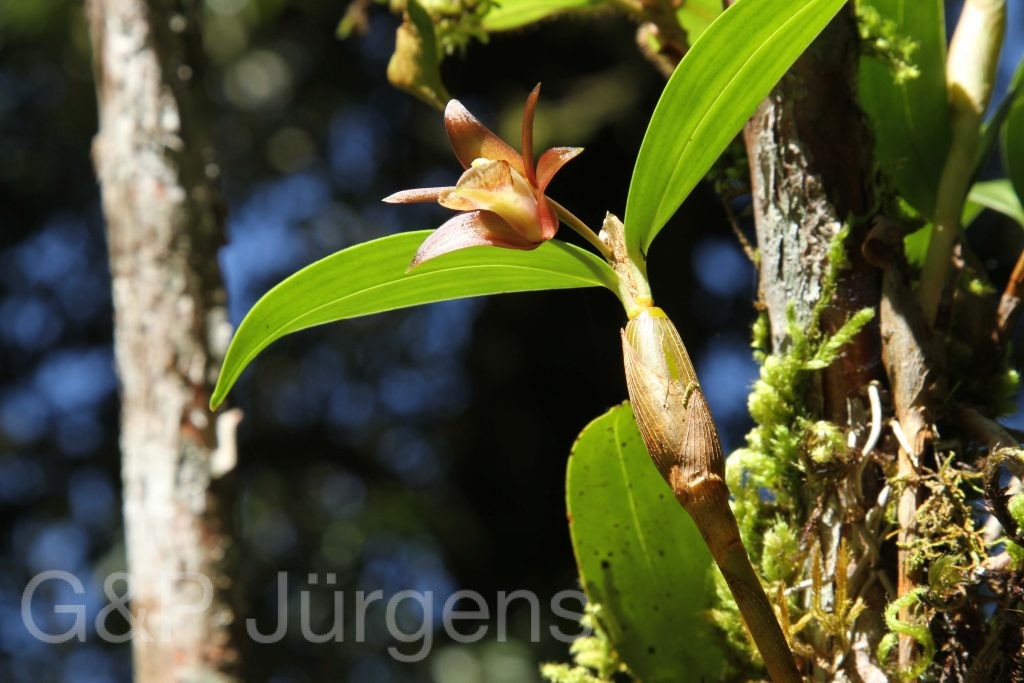
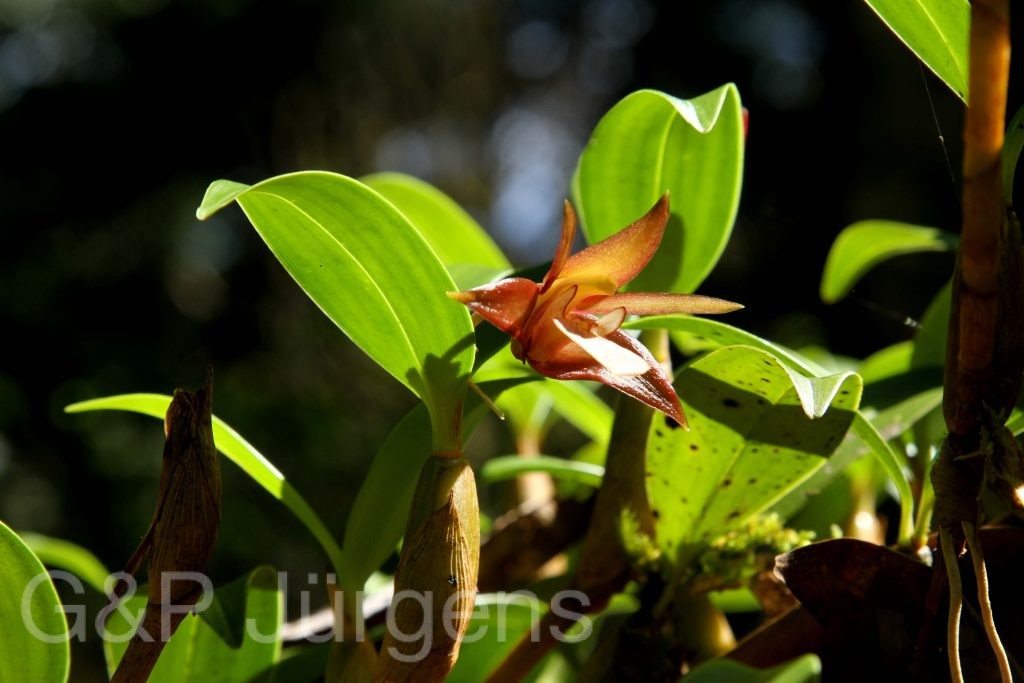
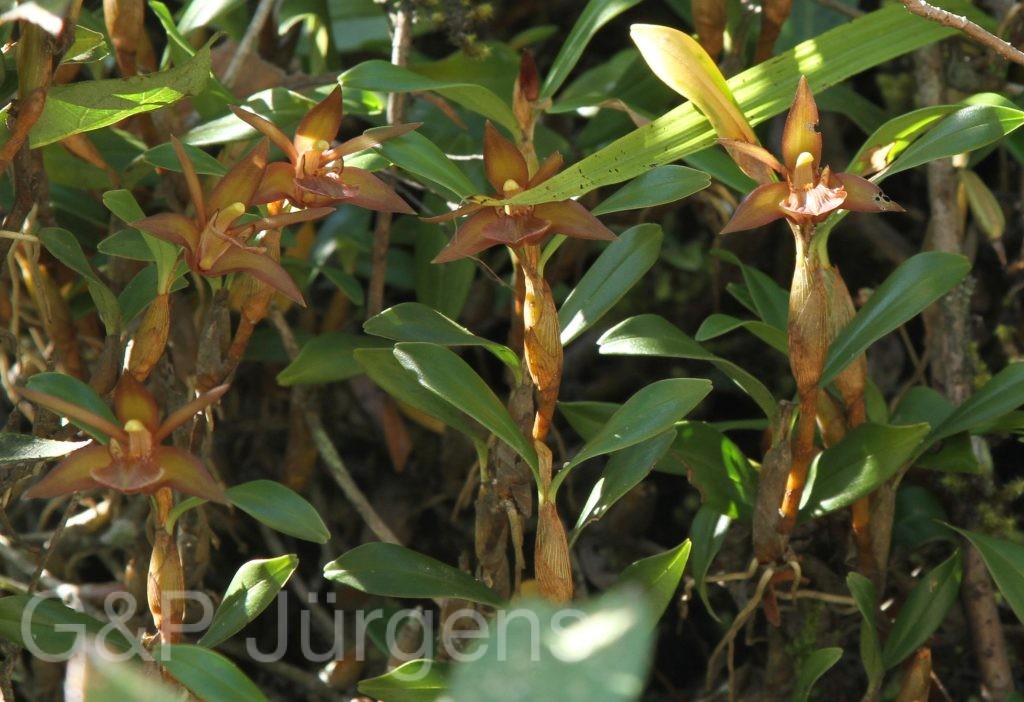
Dendrobium fuscescens Griff. is an epiphytic orchid of the eastern Himalaya and adjacent Indo-Burmese region, recorded by GBIF from China, India, Myanmar, Nepal and Bhutan across some 69 occurrences. It grows on the trunks and branches of trees in humid broad-leaved and mixed forests, ranging over a broad altitudinal span as shown by the Bhutanese records at Jakar around 2500 m, in the Koma-Chu valley near 950 m, and at Sandrup about 1500 m, all in October. This spread from warm temperate valleys to cooler montane forest reflects a tolerance of moist, shaded, mossy bark substrates with good air movement.

The plant produces clustered, slender, elongate cane-like pseudobulbous stems that are somewhat flattened and grooved, becoming yellowish with age. The thin-textured, lanceolate to oblong leaves are distichously arranged along the stems and are usually deciduous in the dry season, leaving the canes bare. Short lateral racemes of a few small flowers arise from nodes on the older leafless stems; the flowers are pale, often tinged greenish or brownish-yellow (the epithet fuscescens alluding to the darkening tint), with spreading lanceolate sepals and petals and a labellum bearing a hairy or papillose disc and recurved lateral lobes, the lateral sepals forming a short mentum at the column foot.

Dendrobium is one of the largest orchid genera, and D. fuscescens belongs among the slender deciduous-caned Himalayan species. It is poorly documented, with few georeferenced records, and like most epiphytic orchids it is sensitive to deforestation and collection. No formal assessment singles it out as threatened, but its dependence on intact forest canopy makes habitat protection important, and all Dendrobium are listed on CITES Appendix II.

Author: Griff. · Sources: POWO (Kew), GBIF, Flora of Bhutan, Flora of China, World Checklist of Dendrobium, Seidenfaden monograph of Orchids of Indochina
Paxton

Bhutan2012 755
Bhutan Galephu 1000m, October
Bhutan2012 756
Bhutan Galephu 1000m, October
Bhutan2012 754
Bhutan Galephu 1000m, October
Bhutan2012 455
Bhutan Wangdi 2500m, September
Bhutan2012 1007
Bhutan Trithangebe 900m, October

Description

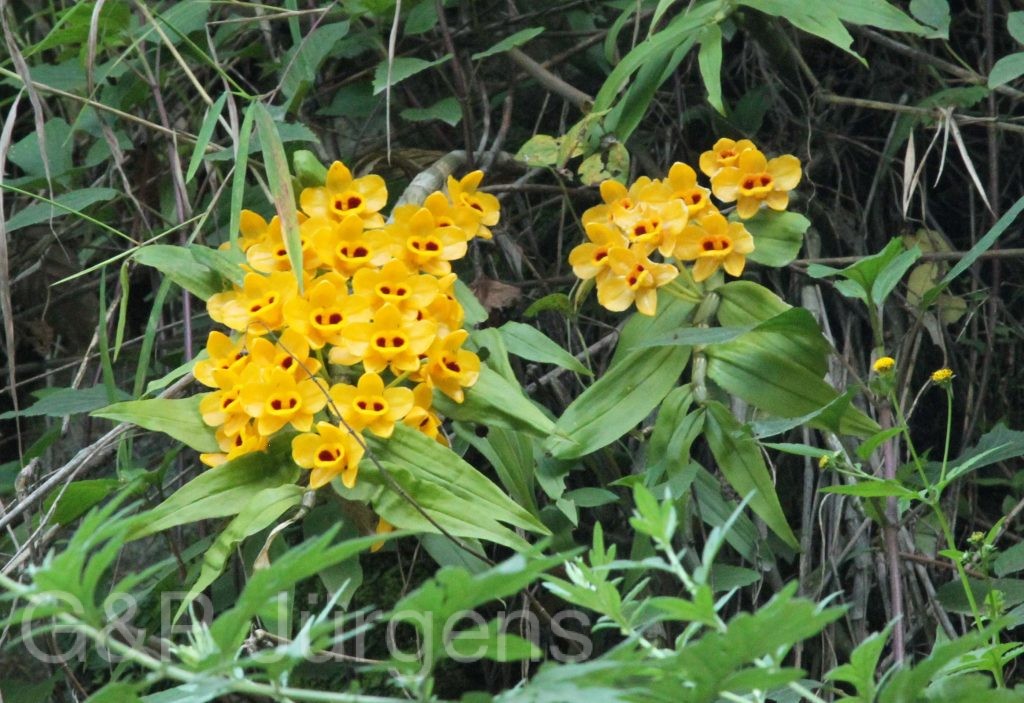
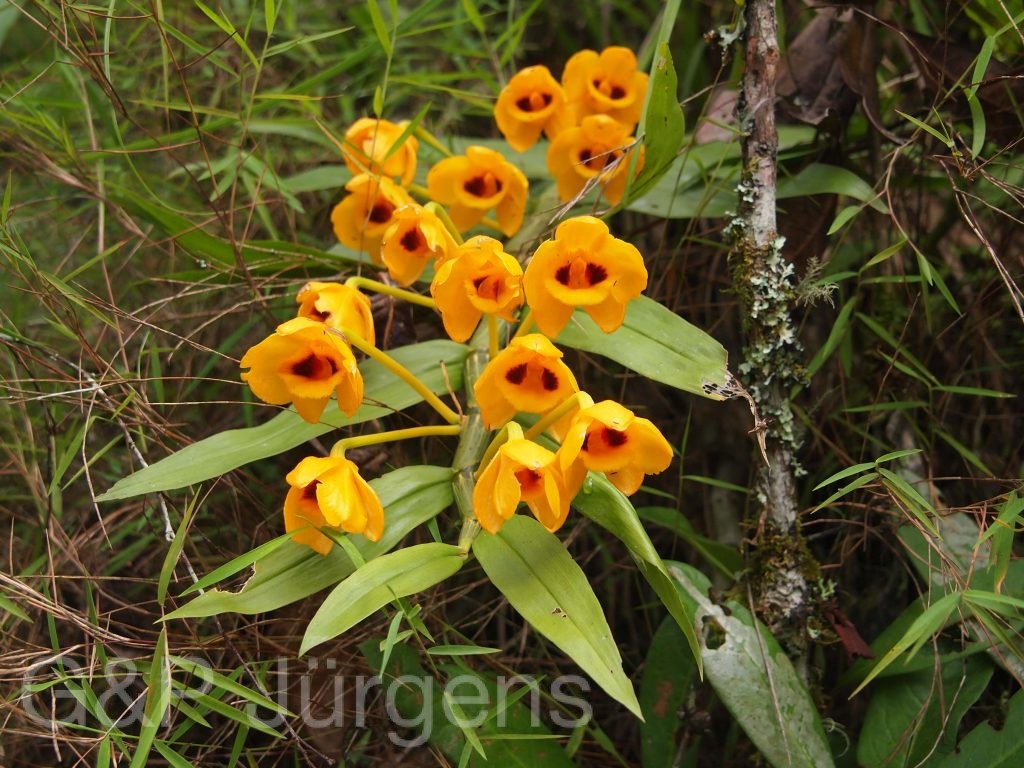
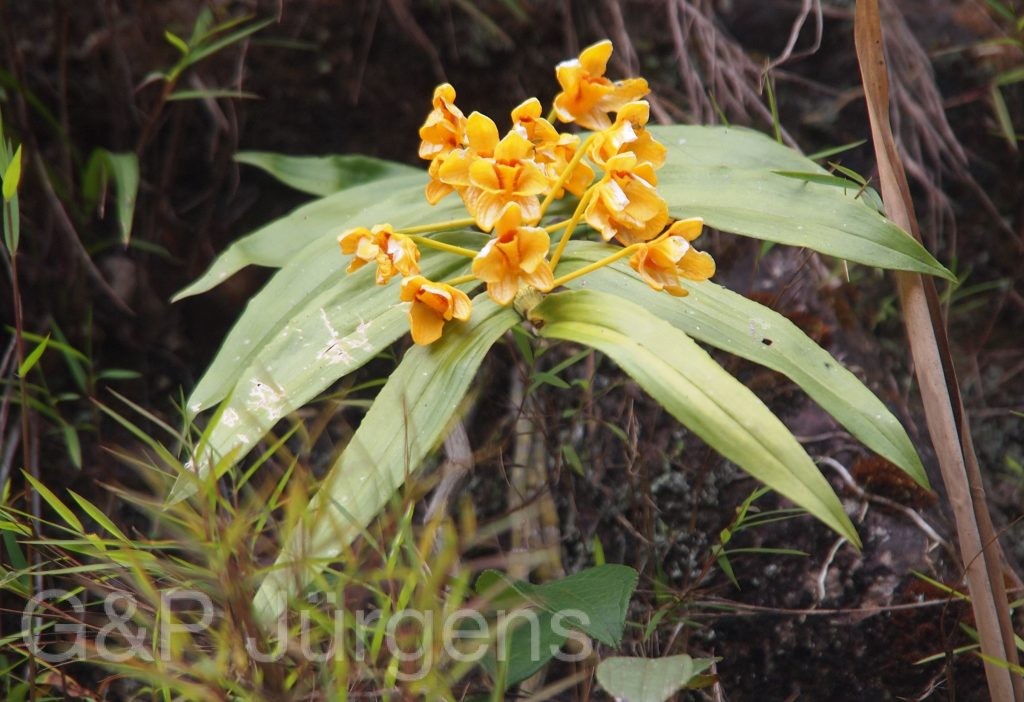
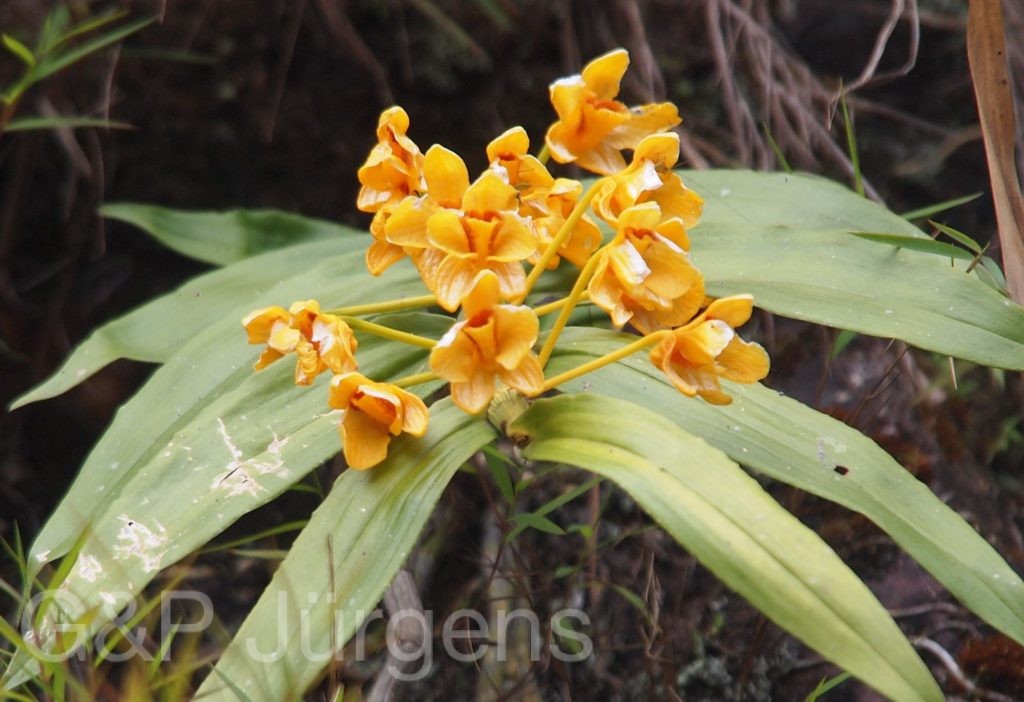
Dendrobium gibsonii is an epiphytic orchid widespread across the Sino-Himalayan and Indo-Chinese region, recorded from China, India, Thailand, Myanmar, Vietnam, Nepal, Bhutan, Laos and Malaysia, with 87 GBIF occurrences mapping a broad subtropical to lower-montane distribution. It is an epiphyte of warm, seasonally moist evergreen and semi-deciduous forest, favouring well-lit branches where it endures a pronounced dry season. In Bhutan it was photographed across a notable altitudinal spread, from Galephu and Trithangebe at around 900-1000 m in October to Wangdi at 2500 m in September, illustrating its tolerance of both the hot southern foothills and cooler inner valleys.

The plant produces long, pendulous to arching, slender canes that are somewhat swollen and channelled, bearing distichous, oblong-lanceolate, deciduous leaves. The inflorescences arise laterally on the older leafless canes as short, pendent racemes of several golden-yellow flowers. The sepals and petals are spreading and orange-yellow, while the broad, rounded lip is conspicuously fringed at the margin and marked with a pair of dark maroon or purple-brown blotches in the throat, a diagnostic feature. The fruit is a pendulous ribbed capsule.

The species belongs to Dendrobium section Dendrobium (the so-called nobile alliance), characterised by leafy canes that flower from the nodes after leaf fall. Its showy fringed, blotched lip makes it horticulturally desirable, and wild collection for the ornamental trade adds to pressure from habitat loss across the foothill forests. Although the wide range buffers it against immediate extinction risk, like many Asian Dendrobium it is listed under CITES Appendix II to regulate international trade.

Author: Paxton · Sources: POWO (Kew), GBIF, Flora of China, Flora of Bhutan, Dendrobium and its Allies (Lavarack, Harris & Stocker)

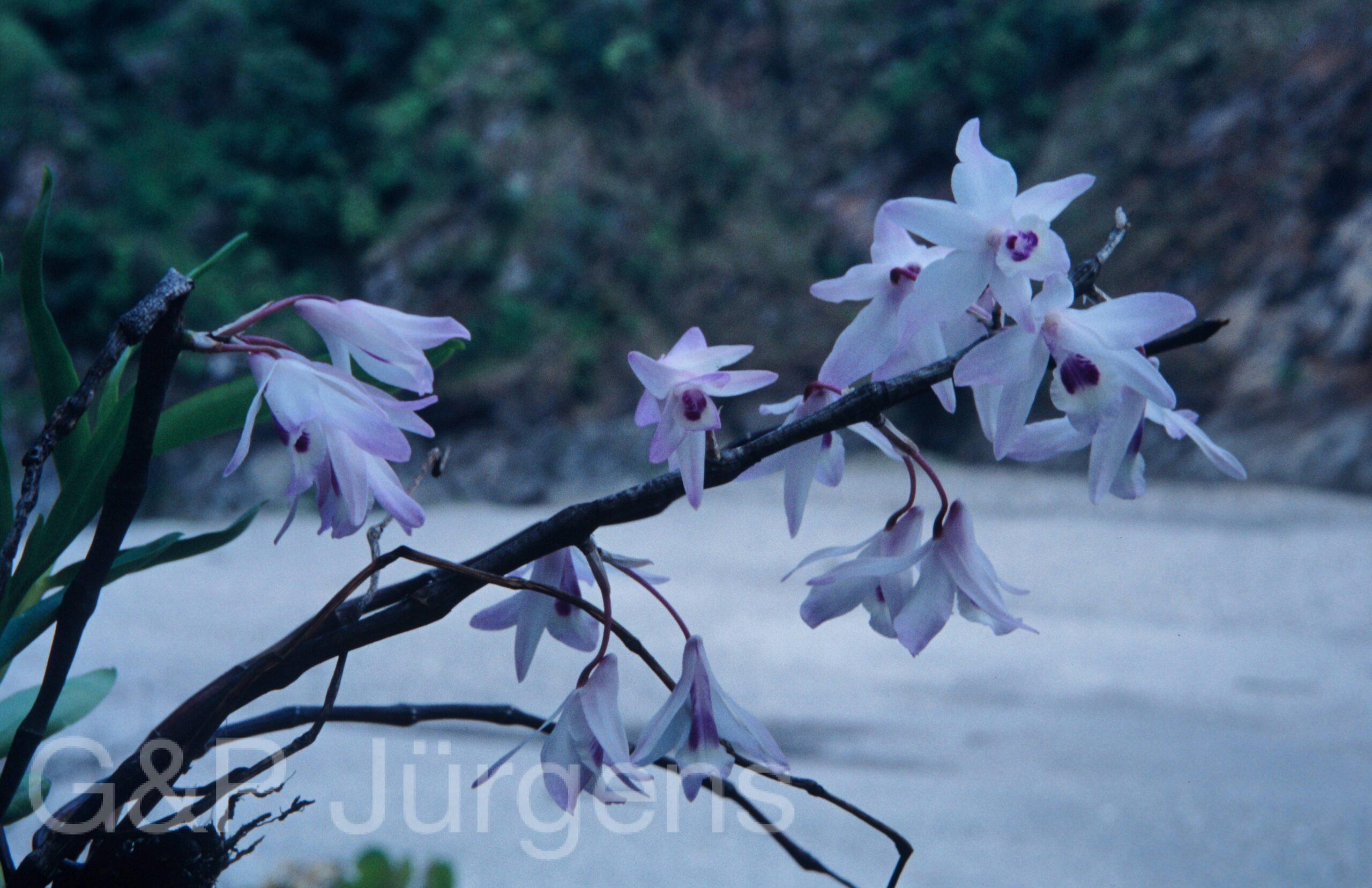
Wall. ex Lindl.

Description

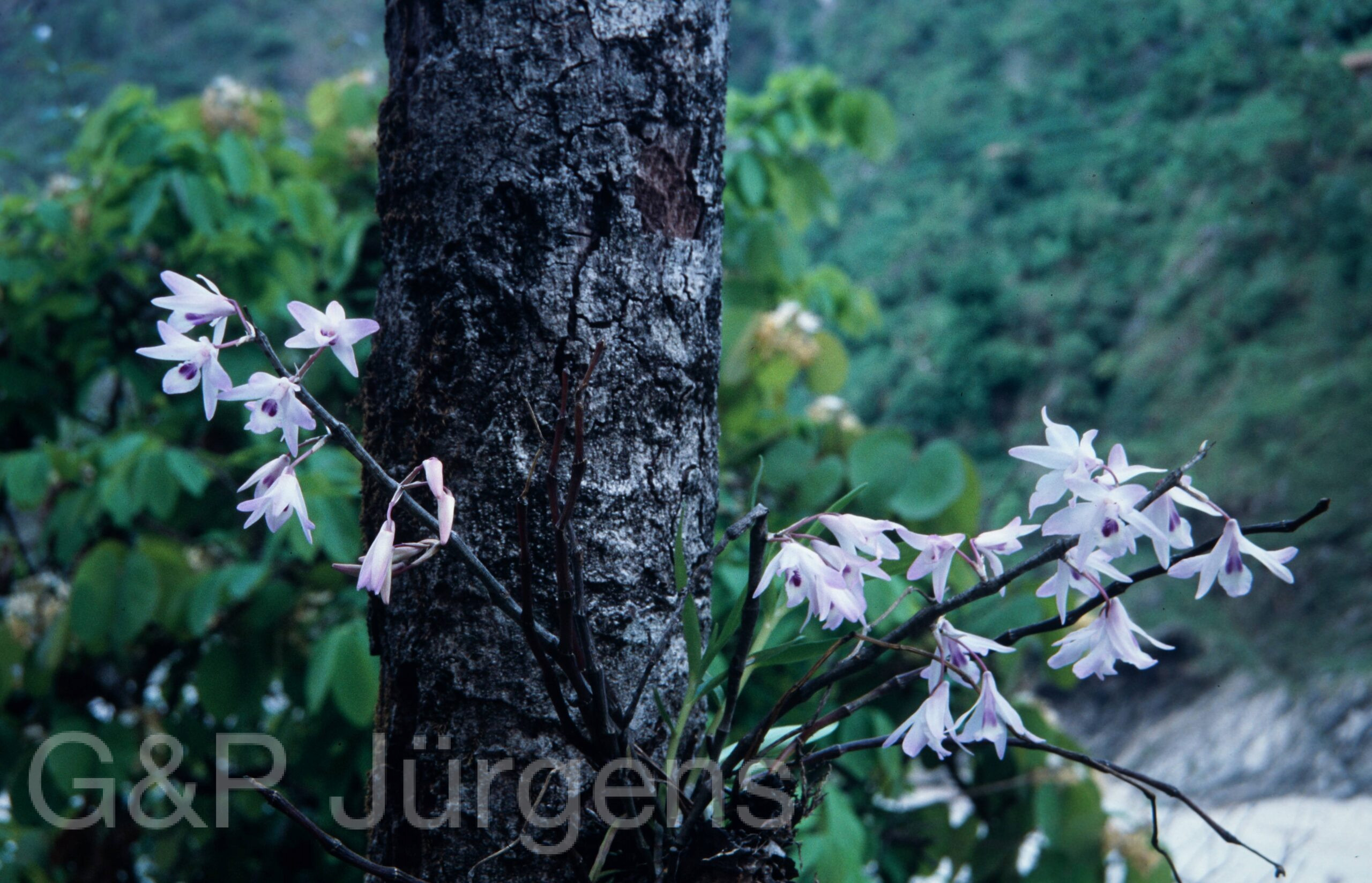
Dendrobium transparens is an epiphytic orchid distributed across the eastern and central Himalaya and into the Indo-Burmese region, recorded from India, Nepal, Bhutan, China, Myanmar and Thailand, with introduced or cultivated occurrences in western Europe. The species favours warm-temperate to subtropical broad-leaved forest, growing on tree trunks and mossy branches between roughly 800 and 1800 m. The photographed plant from Gorkha at Labubhesi, central Nepal, around 1200 m and flowering in May, is typical of its preferred mid-elevation, humid forested ravines where seasonal monsoon moisture and bright filtered light coincide.

The plant forms slender, pendent or sub-erect, cane-like stems that are somewhat flattened and longitudinally grooved, sheathed by membranous leaf-bases. The leaves are distichous, narrowly lanceolate, thin-textured and deciduous, leaving the leafless canes to bear flowers. Inflorescences are short, lateral, two- to three-flowered fascicles from the nodes of older stems. The flowers are translucent white to pale rose, the sepals and petals delicate and spreading; the labellum is broadly obovate to sub-orbicular, often marked with two deep magenta to purple blotches at the throat, and the short mentum gives the bloom its semi-pendent posture.

The specific epithet transparens alludes to the thin, almost translucent perianth segments. Within Dendrobium it belongs among the deciduous-leaved, soft-caned sections allied to D. nobile, a complex of considerable horticultural interest. As with most Himalayan epiphytic orchids, it is dependent on intact forest cover and mycorrhizal associations, and is vulnerable to habitat clearance and collection pressure, though it remains locally frequent across its broad range.

Author: Wall. ex Lindl. · Sources: POWO (Kew), GBIF, Flora of China Vol. 25, Flora of Bhutan Vol. 3, Flora of Nepal, The Genus Dendrobium (Wood)

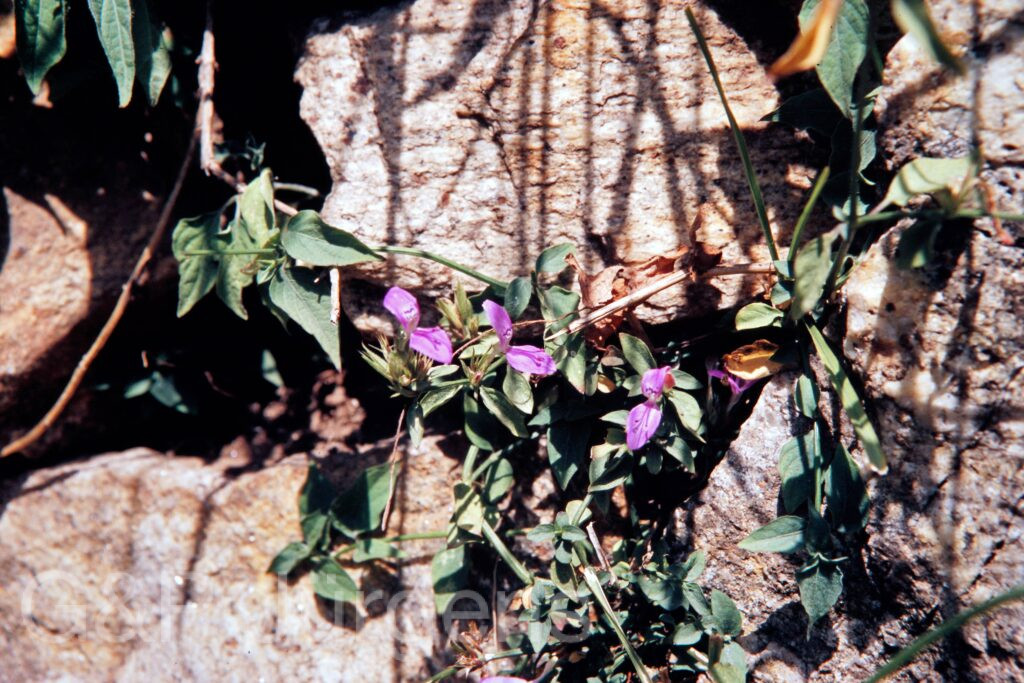
(Forssk.) I.Darbysh.

Garh 07 15 ergebnis
India Garhwal Uniana at Mandakini 1300m, June

Description

Dicliptera paniculata (Forssk.) I.Darbysh. is a widespread herb of the Acanthaceae with a remarkably broad palaeotropical distribution spanning Africa and southern Asia. Its more than two thousand georeferenced records extend from West and East Africa and the Arabian Peninsula across Pakistan, India and into China, with strong representation in arid and seasonally dry tropical environments. It is a plant of disturbed ground, scrub, dry hillsides, roadsides and the margins of cultivation, generally at low to moderate elevations. The population shown at Uniana on the Mandakini in Garhwal, photographed at 1,300 m in June, marks the foothill Himalayan extension of its range, where it flowers with the onset of the monsoon.

The plant is an erect to ascending annual or short-lived perennial herb with quadrangular, somewhat swollen-noded stems that are often sparsely pubescent. The leaves are opposite, ovate to lanceolate, entire and shortly petiolate, with the characteristic cystoliths of the family visible as fine streaks. The inflorescence is a lax, paniculately branched arrangement of cymose clusters, each subtended by paired bracts; the flowers have a slender, bilabiate corolla, typically pink to pinkish-purple, with two stamens. The fruit is the explosively dehiscent, clavate capsule typical of the family, ejecting seeds borne on hooked retinacula.

The species was long known under Forsskål's basionym and other generic placements before its current combination, reflecting ongoing reassessment of Dicliptera and allied genera within tribe Justicieae. Its wide ecological amplitude and tolerance of disturbance make it a successful colonist of human-modified landscapes, and it is nowhere considered at risk. As a nectar source it is visited by a range of insects, and within the Himalayan foothills it forms part of the seasonal weedy flora of the monsoon months.

Author: (Forssk.) I.Darbysh. · Sources: POWO (Kew), GBIF, Flora of China Vol. 19, Flora of Pakistan, Darbyshire et al.: Acanthaceae (Flora of Tropical East Africa)

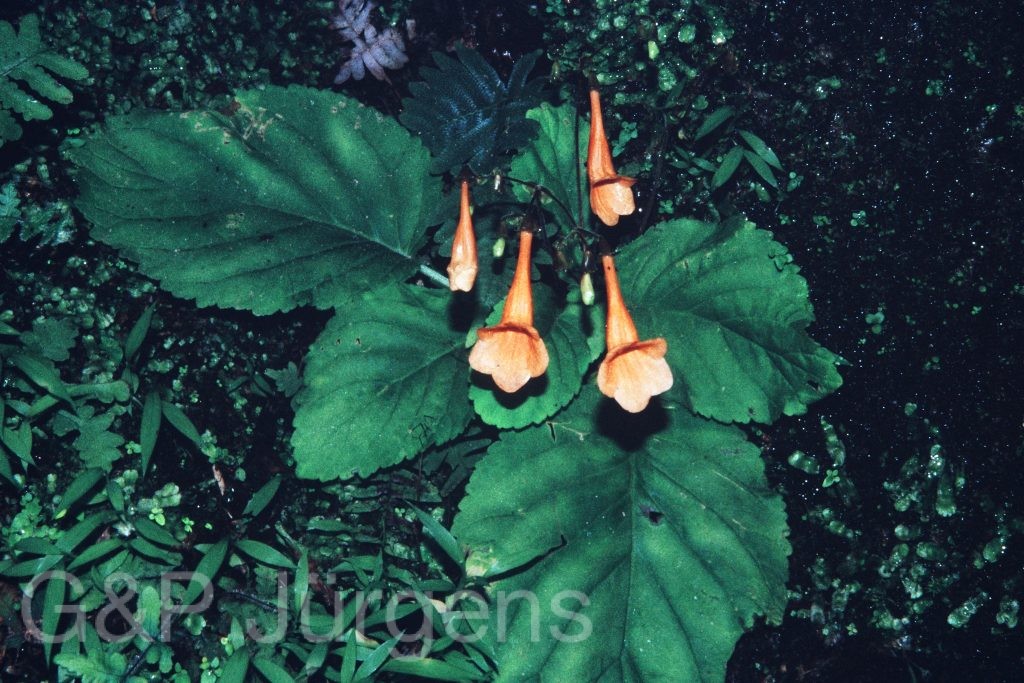
C.B.Clarke

Sikkim2003 22 G26
Sikkim Rathong-Chu 1200 m, August

Description

Didymocarpus aurantiacus is an eastern Himalayan gesneriad recorded from India, Nepal and Bhutan, with around 33 occurrences concentrated in the wet, monsoon-drenched subtropical to lower temperate belt of Sikkim, Darjeeling and adjacent regions. It is a lithophyte and epipetric herb growing on shaded, moss-covered rocks, cliff faces and damp ravine walls within evergreen broad-leaved forest, typically between roughly 1000 and 2000 m. The illustrated material from the Rathong-Chu valley in Sikkim at 1200 m, flowering in August, reflects its main flowering during the rainy season, when the humid rock habitats it favours are kept constantly moist by mist and seepage.

It is a small perennial herb with a short rhizomatous base and crowded, opposite or subrosulate leaves. The lamina is ovate to elliptic, with a crenate-serrate margin, an acute to acuminate apex and a thinly hairy surface, the venation impressed above and prominent beneath. The inflorescence is an axillary cyme borne on a slender peduncle. The flowers have a tubular, lobed calyx and a tubular, somewhat ventricose corolla that is orange to orange-yellow (as the epithet aurantiacus indicates), two-lipped with a shorter upper and spreading lower lip. There are two fertile stamens with cohering anthers and staminodes; the gynoecium develops into the elongate, septicidal, two-valved capsule characteristic of the genus.

The input places this taxon under "Didymocarpinae", which is the subtribe within tribe Trichosporeae of the Gesneriaceae rather than a family; the species is correctly accommodated in the genus Didymocarpus. The name D. aurantiacus C.B.Clarke is accepted. As a narrow-ranged rock specialist tied to perhumid forest, it is dependent on intact, shaded microhabitats and is therefore potentially sensitive to deforestation and habitat drying, though it has not been formally assessed.

Author: C.B.Clarke · Sources: POWO (Kew), GBIF, Flora of Bhutan Vol. 2, Flora of Nepal, Weber Gesneriaceae of the World (monograph), Clarke Commelynaceae et Cyrtandreae Bengalenses

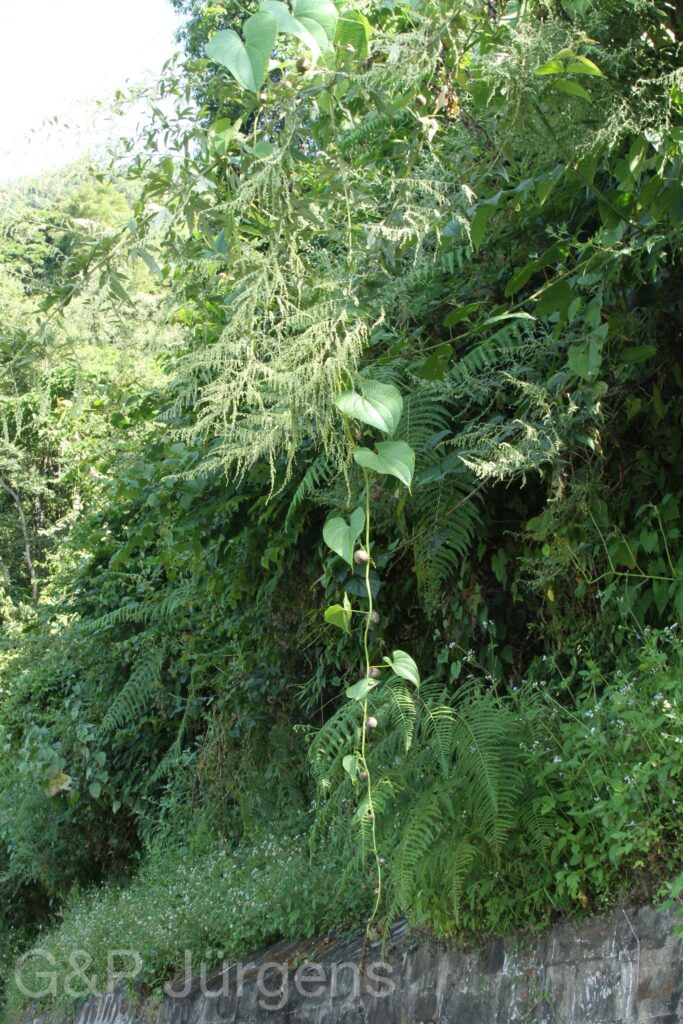
L.

Bhutan2015 172
Bhutan Zhemgang 1000m, October

Description

Dioscorea bulbifera, the air potato or aerial yam, is a widely distributed twining vine of the Old World tropics, native across tropical Africa and Asia and now pantropically naturalised, including invasive populations in the southern United States, the Pacific and the Neotropics. It is among the most heavily recorded yams, GBIF holding over 16,000 occurrences. In the Himalaya it grows in subtropical forest, forest margins, thickets and disturbed ground at low to middle elevations. The plant from Zhemgang in central Bhutan at 1000 m in October occupies this warm foothill zone, where its aerial tubers ripen toward the season's end.

It is a herbaceous perennial climber arising from an underground tuber, the slender stems twining to the left (sinistrorse) and bearing in the leaf axils the diagnostic rounded to angular aerial bulbils that give the plant its names and serve as its chief means of propagation. The leaves are alternate, broadly cordate-ovate with a deeply notched base and long acuminate apex, palmately veined and long-petiolate. It is dioecious: the minute flowers are borne in slender pendulous spikes, staminate clustered and pistillate more lax, with a perianth of six tepals; the fruit, where set, is a three-winged loculicidal capsule with winged seeds, though sexual reproduction is often supplanted by the prolific bulbils.

Dioscorea, the type genus of Dioscoreaceae, is a large pantropical genus of economically vital yams. D. bulbifera is enormously variable, comprising numerous cytotypes and forms; some strains are cultivated for edible tubers while others are bitter and toxic, containing the sapogenin diosgenin and the toxic principle dioscorine. Its facility for clonal spread by bulbils has made it a notorious invasive weed beyond its native range, though within the Himalaya it is a common, unremarkable component of the disturbed subtropical flora.

Author: L. · Sources: POWO (Kew), GBIF, Flora of China Vol. 24, Flora of Bhutan Vol. 3, Annotated Checklist of the Flowering Plants of Nepal, Burkill account of Asiatic Dioscoreaceae

Buch.-Ham. ex D.Don

Bhutan2015 87
Bhutan Galephug 700m, October
Bhutan2015 86
Bhutan Galephug 700m, October
Bhutan2015 286
Bhutan Zhemgang 910m, October

Description

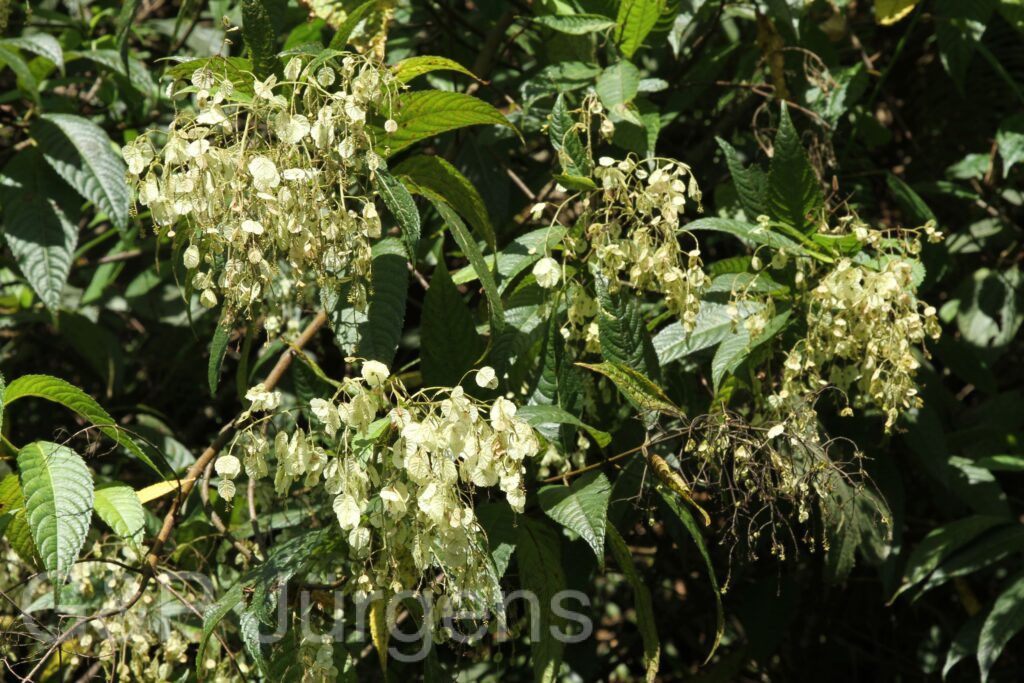
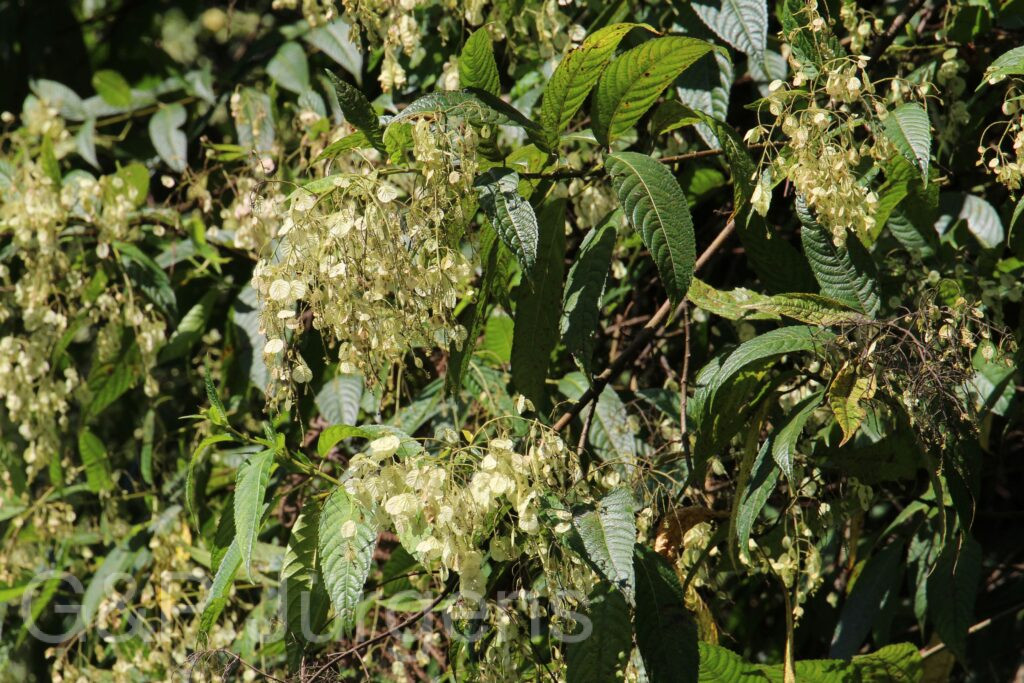
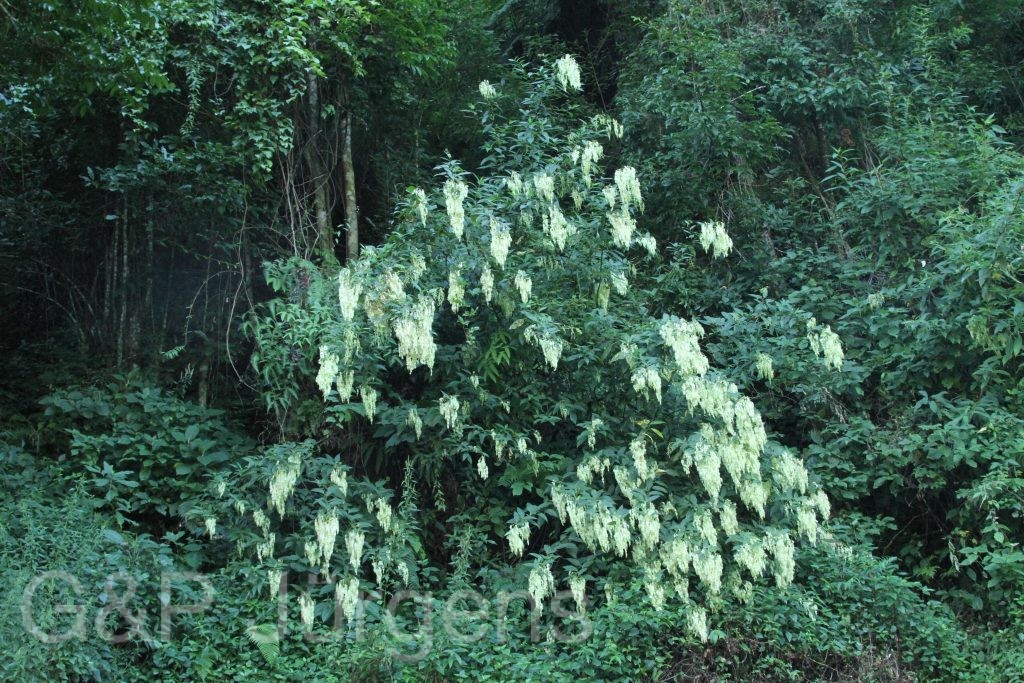
Dobinea vulgaris is a shrub or small subshrub of the eastern Himalaya and adjoining parts of southwestern China and northern Southeast Asia, recorded by GBIF from China, Nepal, India, Bhutan, Myanmar and Thailand across roughly 263 georeferenced occurrences. It is a plant of warm subtropical lower hill slopes, occupying open forest, scrub, rocky banks, ravines and disturbed roadside ground, generally at low to mid elevations. The Bhutanese records cited here, from Galephug at about 700 m and from Zhemgang at around 910 m, both in October, place it firmly in the low foothill zone of the southern Himalaya, where it flowers and fruits towards the close of the monsoon. It favours seasonally warm, humid conditions and is frequently found in secondary vegetation.

The plant has soft, somewhat herbaceous to weakly woody stems and opposite, simple leaves that are ovate to elliptic-lanceolate, acuminate, and conspicuously serrate or crenate-serrate along the margin, a foliage aspect unusual for the family. It is functionally dioecious: the small male flowers are borne in slender axillary or terminal panicles, while the female flowers are solitary or few and are remarkable for being adnate to an enlarged, persistent, leaf-like (foliaceous) bract that expands greatly in fruit and acts as a wing for wind dispersal. The fruit is a small compressed drupe-like structure carried on this accrescent membranous bract.

Dobinea is a small genus of only two species, and its placement within Anacardiaceae has historically been contentious; the herbaceous habit, opposite serrate leaves and unique bract-borne female flowers led some authors to segregate it (with Campylopetalum) into the family Podoaceae, although modern molecular phylogenetics confirms its position within an expanded Anacardiaceae, near the base of the family. This makes Dobinea vulgaris of particular interest to systematists studying the early diversification and morphological boundaries of the cashew family. The species is locally common within its range and is not regarded as of conservation concern.

Author: Buch.-Ham. ex D.Don · Sources: POWO (Kew), GBIF, Flora of China Vol. 11, Flora of Bhutan Vol. 2, Flora of Nepal, Flora of Pakistan, Pell et al.: systematics of the Anacardiaceae (including the Dobinea/Podoaceae problem)

(Roxb. ex DC.) Walp.

Nepal 97 52 P78
Nepal Mewa-Khola 1150m April
Nepal 97 53 P79
Nepal Mewa-Khola 1150m April
Nepal1992 77 P110 ergebnis
Nepal Sokathum1460m March 

Description

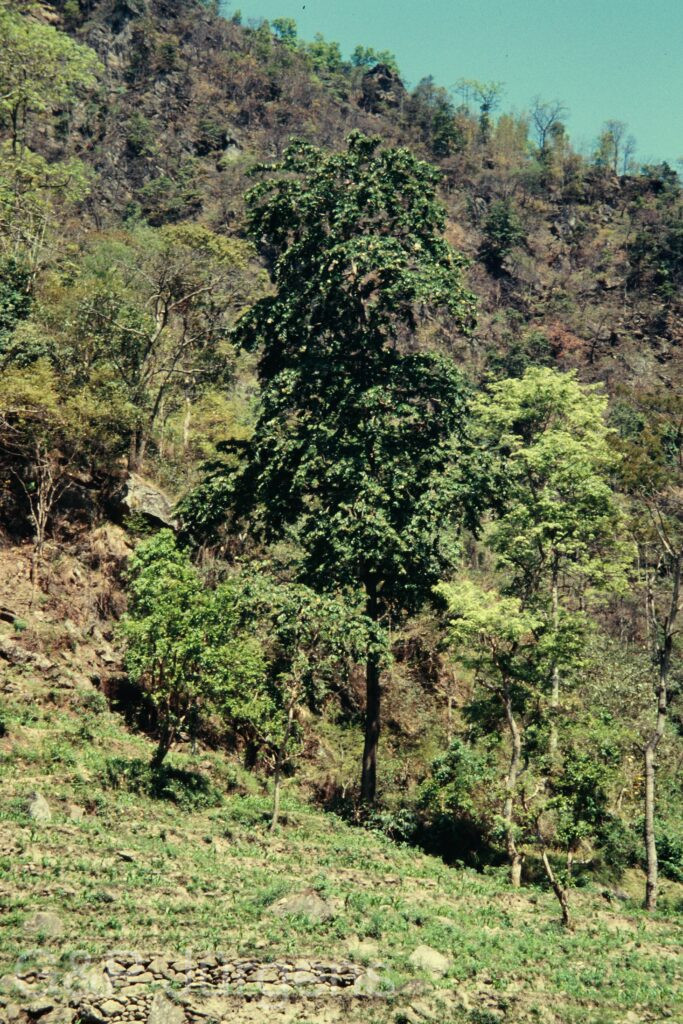
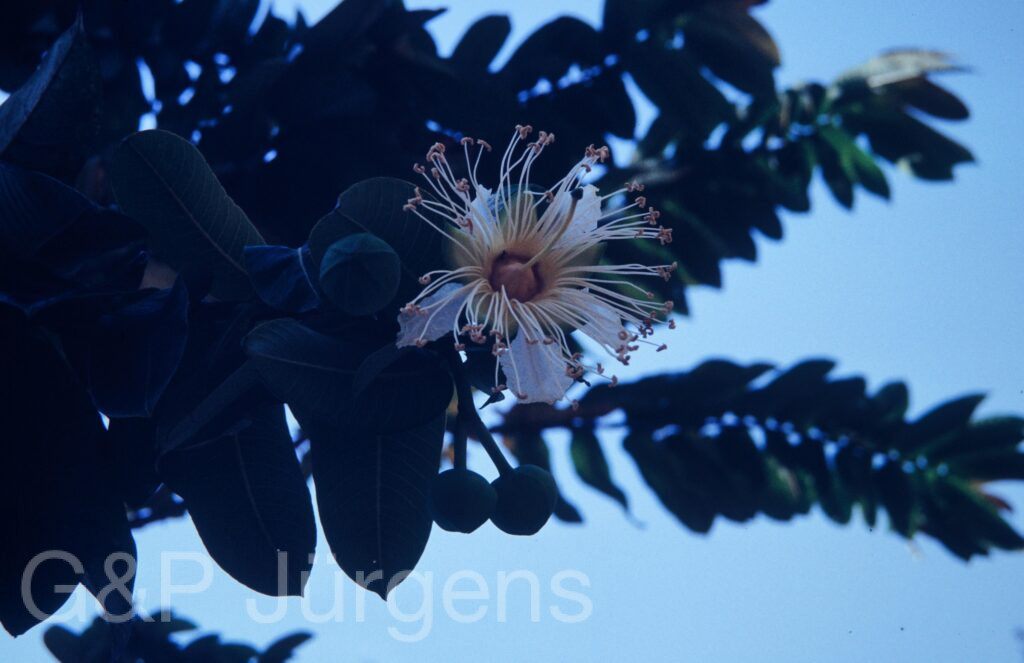
Duabanga grandiflora (Roxb. ex DC.) Walp. is a large, fast-growing evergreen tree of the Lythraceae distributed through the Indo-Himalayan and Southeast Asian tropics, native from India, Nepal, Bhutan and Bangladesh through Myanmar, Thailand, Laos, Vietnam, Malaysia and Indonesia into SW China, with around 712 georeferenced records and scattered introductions elsewhere. It is a characteristic tree of moist tropical and subtropical forest, particularly along rivers, in ravines and on alluvial flats, often a pioneer of streamside and secondary forest in regions of high rainfall. The photographed trees from Mewa-Khola at about 1,150 m in April and Sokathum at about 1,460 m in March in eastern Nepal lie at the upper, lower-montane end of its altitudinal range, which extends down into the lowland tropics.

It is a tall tree with a spreading crown and conspicuously horizontal, drooping branches. The leaves are opposite, large, oblong to oblong-lanceolate, leathery, with an obtuse to cordate base and entire margins, glabrous and prominently pinnately veined. The large, showy flowers are borne in few-flowered terminal cymes; each has a thick campanulate calyx of (four to) six fleshy lobes, white obovate petals, and very numerous stamens. The superior to half-inferior ovary develops into a hard, leathery, many-celled capsule that splits by valves to release abundant small seeds.

Duabanga is a small Indo-Malesian genus formerly segregated in its own family Duabangaceae but now placed within an enlarged Lythraceae. The night-opening flowers with their massed stamens are bat- and moth-pollinated, and the light, soft wood is locally used for boxes, matchwood and plywood. Widespread and often common as a riparian pioneer, the species is not considered threatened.

Author: (Roxb. ex DC.) Walp. · Sources: POWO (Kew), Flora of China Vol. 13, Flora of Bhutan Vol. 2, GBIF, Graham et al.: Phylogeny of Lythraceae (2005)

(Grierson & D.G.Long) Panigrahi

Nepal 97 51 P77
Nepal Mewa-Khola 1130m April
Nepal 97 50 P76
Nepal Mewa-Khola 1130m April

Description

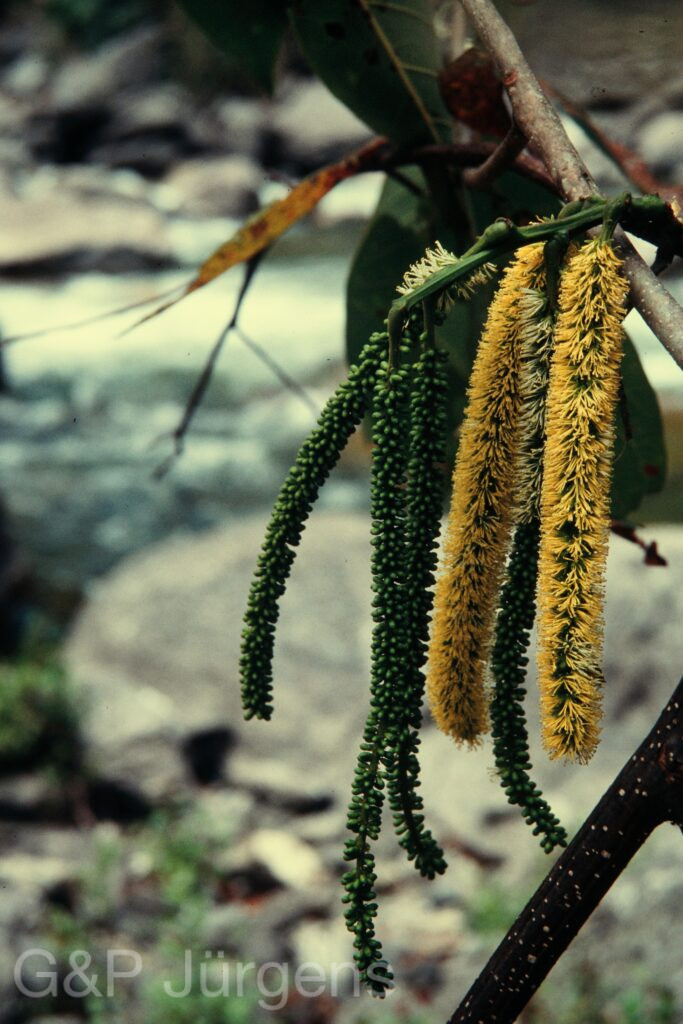
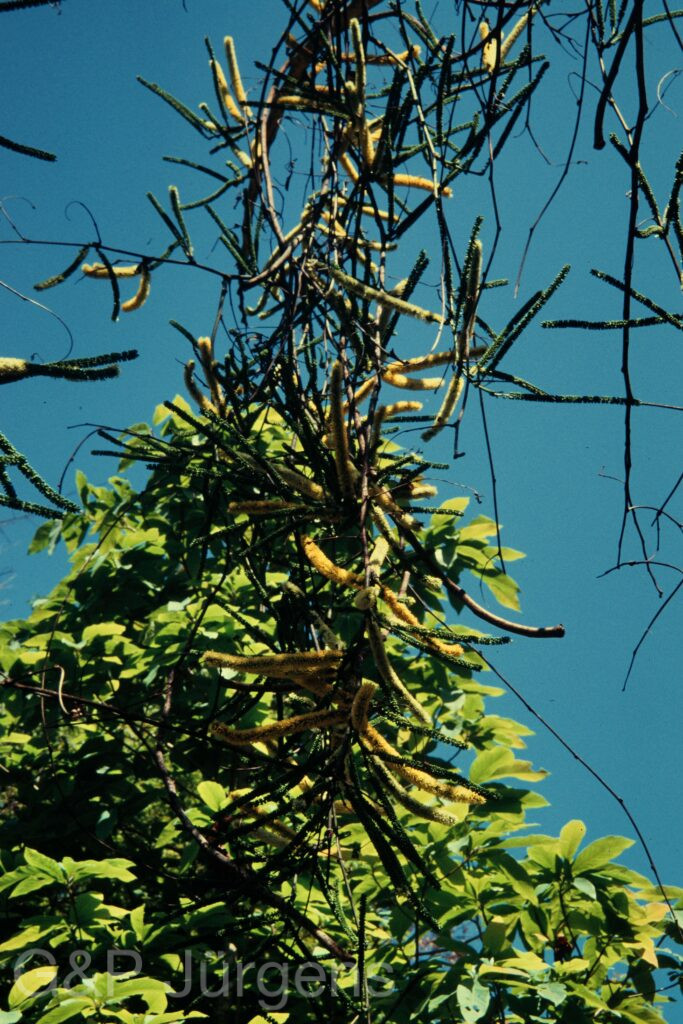
Entada rheedii subsp. sinohimalensis is a Sino-Himalayan liana of warm lower-montane forest, treated by GBIF as a synonym of the accepted Entada rheedii sinohimalensis (under E. rheedii Spreng.). It is a localised eastern Himalayan taxon ranging from Nepal and Sikkim into Bhutan and adjacent China and Myanmar; GBIF holds a single Bangladesh record, underscoring how sparsely this giant climber is documented. It grows in broadleaved subtropical forest and ravine vegetation at low elevations, as in the Mewa Khola of eastern Nepal at 1130 m in April, where it scrambles high into the canopy along humid river valleys.

It is a massive woody liana with stout, twining stems and tendrillate, bipinnate leaves whose pinnae bear several pairs of asymmetric oblong leaflets, the terminal pair of pinnae often modified into a coiling tendril. The flowers are small, sessile and crowded in slender elongate spikes, creamy white to greenish-yellow, with a five-toothed calyx, five free petals and ten exserted stamens giving the inflorescence a feathery aspect. The fruit is among the largest of any legume – a huge, woody, flattened pod up to a metre long that breaks transversely into one-seeded segments, each enclosing a large, hard, glossy brown "sea bean" capable of long-distance hydrochory.

Within the mimosoid clade of Fabaceae, Entada is a pantropical genus of lianas, and subsp. sinohimalensis represents the inland Himalayan-Chinese expression of the widespread E. rheedii. The buoyant, durable seeds are dispersed by water and ocean currents and are used as charms and in folk medicine. The taxon is rarely collected and its conservation status remains unassessed.

Author: (Grierson & D.G.Long) Panigrahi · Sources: POWO (Kew), GBIF, Flora of China, Flora of Bhutan, Annotated Checklist of the Flowering Plants of Nepal, Brenan monograph of Entada

Hook.f.

Bhutan2014 274
Bhutan Trithangebe 700m, May
Bhutan2014 276
Bhutan Trithangebe 700m, May

Description

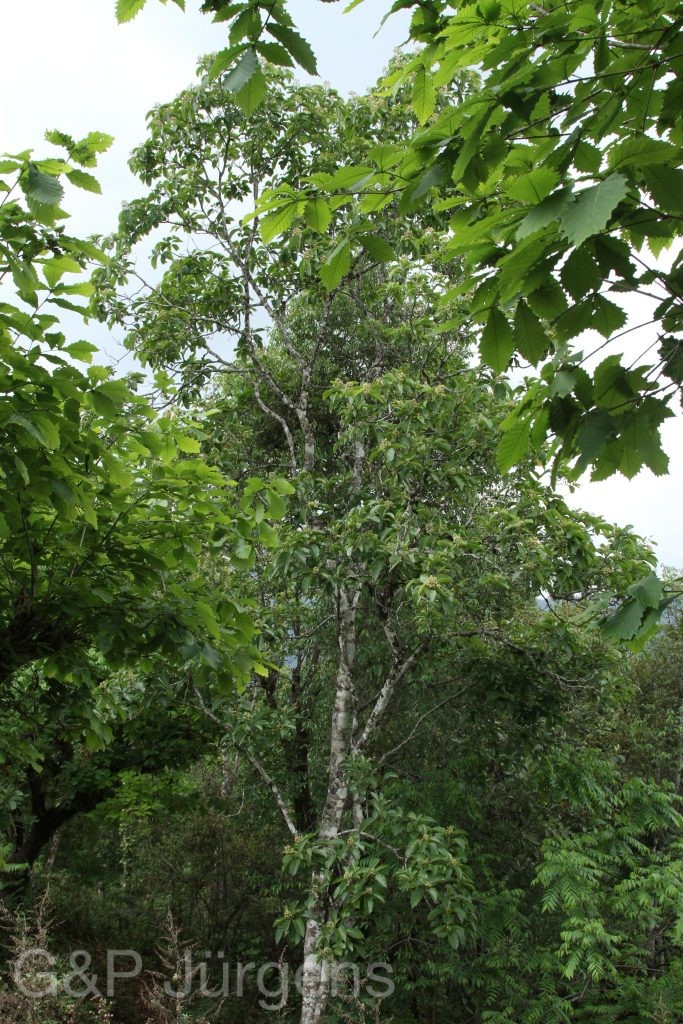
Eriobotrya petiolata is a small evergreen tree of the eastern Himalayan and Indo-Burmese subtropical forests, recorded from India, Bhutan, Myanmar, Bangladesh and China, with cultivated or vagrant records noted from Spain and the United States among the 62 GBIF occurrences. It inhabits warm broadleaved and subtropical hill forest at relatively low elevations. The photographed tree at Trithangebe in southern Bhutan at only 700 m, flowering in May, typifies its preference for humid, frost-free montane foothills well below the alpine plants that dominate the region's high passes.

The species is a tree with stout petiolate leaves, the feature underlying its epithet. The leaves are coriaceous, elliptic to oblong-lanceolate, with a prominent reticulate venation, an acuminate apex, and a margin that is entire to remotely serrate; young growth and the lower surface are typically clothed in rusty tomentum that weathers with age. The inflorescence is a terminal, much-branched, woolly panicle of small white flowers, each with five sepals, five petals, numerous stamens and an inferior ovary. The fruit is a small pome, fleshy at maturity and crowned by the persistent calyx, characteristic of the loquat genus.

GBIF treats the himalayaflora name as a synonym, with Eriobotrya petiolata (Hook.f.) the accepted entity in this dataset; the genus Eriobotrya is itself often submerged within Rhaphiolepis (and broadly within subfamily Maloideae of Rosaceae) in recent molecular treatments, so nomenclature remains in flux. Ecologically the fleshy pomes are dispersed by birds and mammals. As a forest tree of a comparatively restricted Himalayan-Burmese range, it is most threatened by lowland deforestation rather than by any intrinsic rarity.

Author: Hook.f. · Sources: POWO (Kew), GBIF, Flora of Bhutan, Flora of China (Rosaceae), Vidal Eriobotrya revision