Tag:

Subtropical (<1500 m)

(L.) Sw.

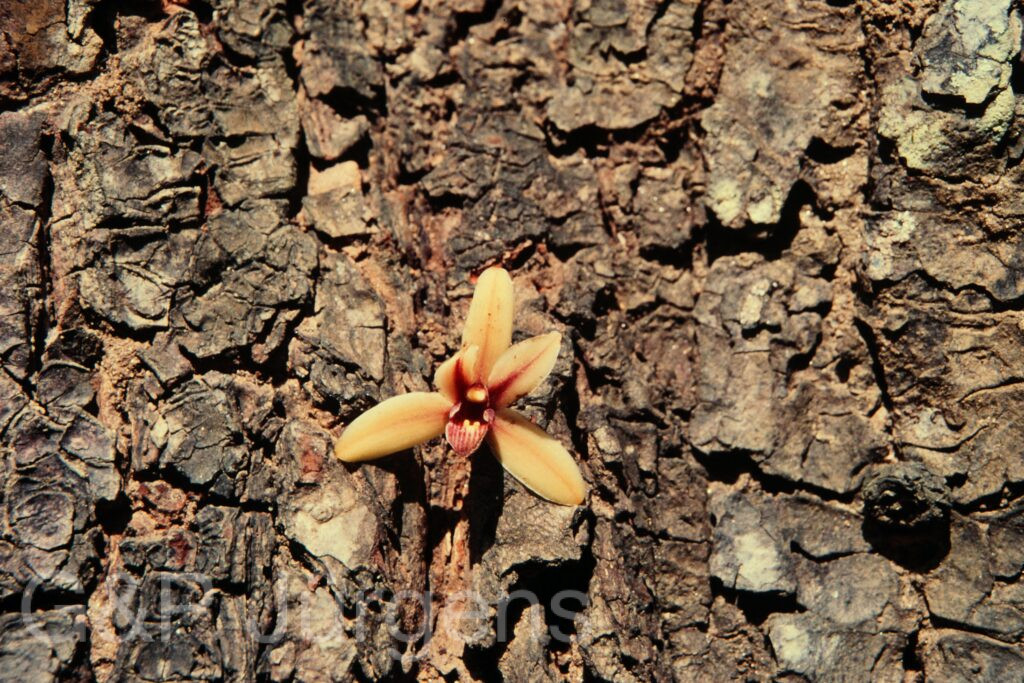
Nepal 97 589 P1136
Nepal Sabha-Khola 560m May
Nepal 97 590 P1138
Nepal Sabha-Khola 560m May

Description

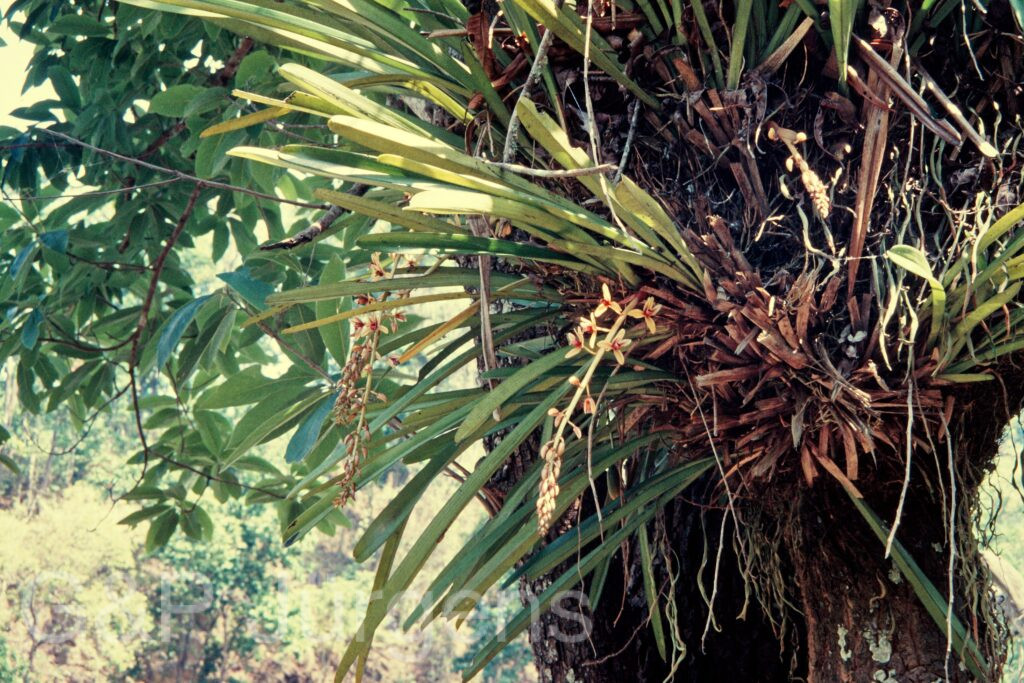
Cymbidium aloifolium is a widespread tropical Asian orchid recorded by GBIF (638 occurrences) from India, China, Vietnam, Thailand, Nepal, Sri Lanka, Indonesia, Bangladesh, the Philippines, Myanmar and Bhutan, alongside cultivated records farther afield. It is a robust epiphyte, and occasional lithophyte, of warm, seasonally dry lowland and submontane forest, growing on tree trunks and large branches and on rocky outcrops, generally below about 1000 m. The plant photographed in the Sabha Khola of Nepal at only 560 m in May represents its characteristic low-elevation, pre-monsoon flowering, the lowest-altitude species treated in this group.

The species forms dense clumps of ovoid pseudobulbs largely concealed by leaf bases. The leaves are several, distichous, thick and rigidly coriaceous, linear-ligulate and unequally bilobed at the apex, recalling those of an Aloe and giving the species its epithet. The inflorescence is a long, pendulous raceme bearing numerous closely set flowers. The sepals and petals are similar, oblong, pale yellow to cream and marked with a broad central reddish-brown to maroon stripe; the three-lobed labellum echoes this colouring, with erect lateral lobes and a recurved mid-lobe, and bears two longitudinal keels on the disc. The stout column carries waxy pollinia, and the fruit is an ellipsoid capsule.

Cymbidium aloifolium belongs to the section of pendulous-racemed, drought-tolerant epiphytic species adapted to monsoonal climates, in which the rigid leaves and water-storing pseudobulbs buffer the long dry season. The flowers are bee-pollinated, and the species is much collected for horticulture and traditional medicine. Although still locally common, like all Cymbidium it is listed on CITES Appendix II to regulate international trade in wild plants.

Author: (L.) Sw. · Sources: POWO (Kew), GBIF, Flora of China, Flora of Bhutan, Flora of Nepal, The Genus Cymbidium (Du Puy & Cribb)
Wall.

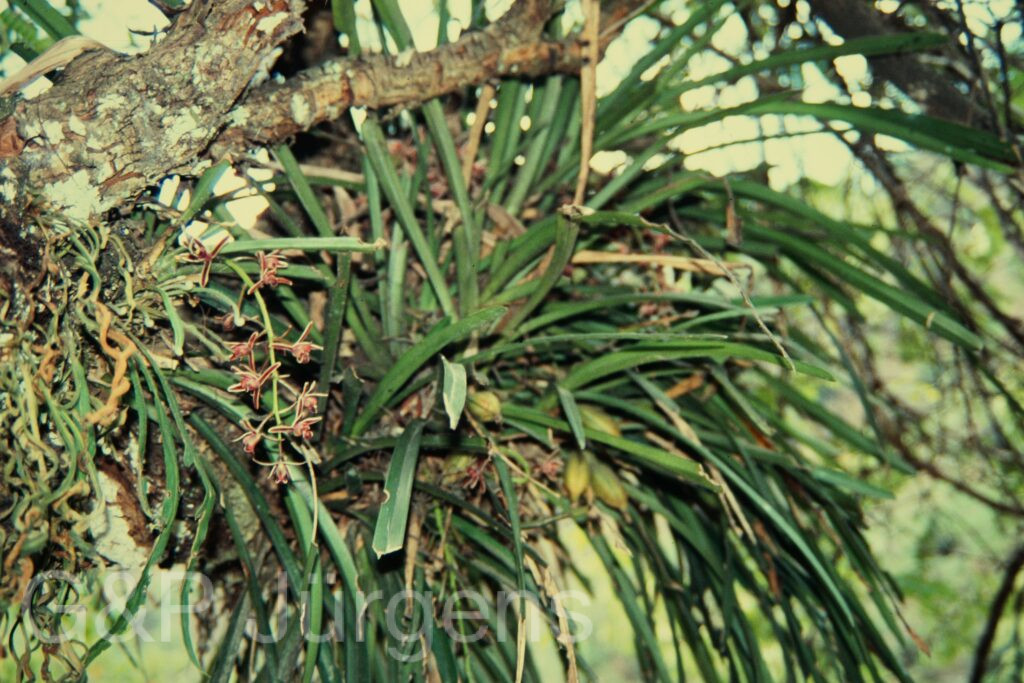
Nepal 97 58 G90
Nepal Mewa-Khola 1160m April
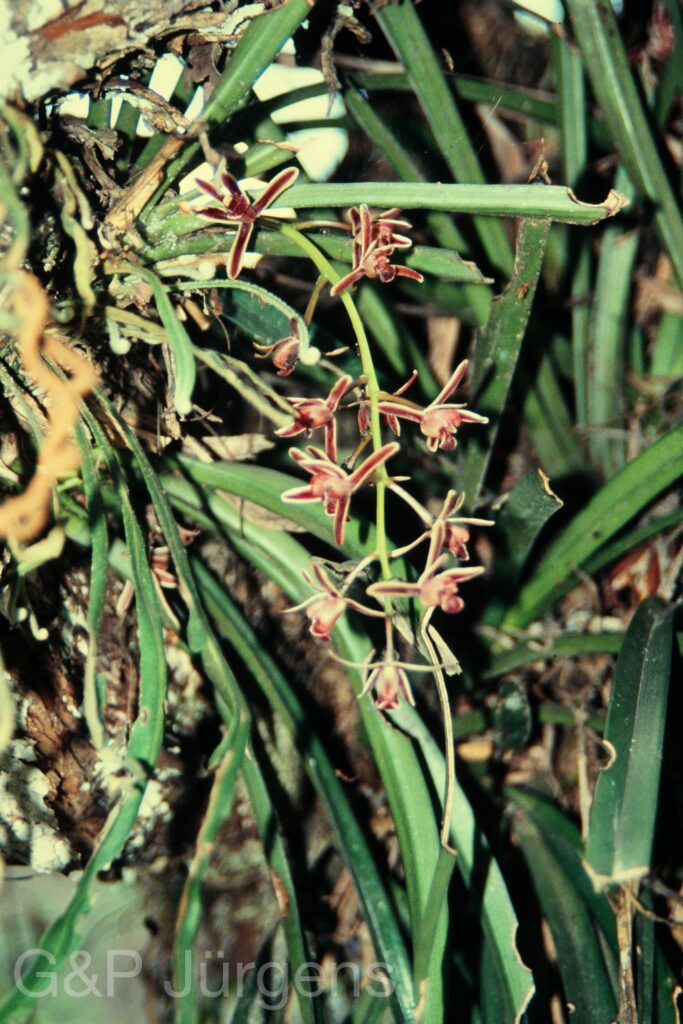
Nepal 97 59 G93
Nepal Mewa-Khola 1160m April

Description

Cymbidium crassifolium Wall. is an epiphytic to lithophytic orchid of the warm subtropical Himalaya and adjacent Southeast Asia, recorded from Nepal, Bhutan, north-east India, Myanmar, Thailand and southern China. It grows in broad-leaved evergreen and semi-deciduous forest at low to moderate elevations, frequently perched on mossy tree trunks, on shaded rock faces or on steep humus-covered banks in humid ravines. The photographed population from the Mewa-Khola valley of eastern Nepal at 1160 m, flowering in April, typifies its preference for lower hill forests near the warm-temperate transition, where it relies on free drainage, dappled light and a seasonal alternation of monsoon rains and a drier cool season.

The plant forms clustered, ovoid to spindle-shaped pseudobulbs partly enclosed by leaf bases, bearing several thick, leathery, linear-ligulate leaves (the epithet crassifolium referring to their fleshy texture). The inflorescence is an arching to pendent lateral raceme carrying numerous fragrant, relatively small flowers. Sepals and petals are narrow and spreading, yellowish to dull olive or brownish-green, often veined with maroon; the trilobed labellum is whitish marked with red-purple spotting and bears longitudinal keels on the disc. The fused column and stalked pollinia are typical of the genus, pollination being followed by an erect, ellipsoid dehiscent capsule.

The name has frequently been confused with the closely allied Cymbidium mannii, with which it shares the pendent, multiflowered habit. POWO accepts C. crassifolium as a distinct species within section Cymbidium. As a member of a genus heavily collected for the ornamental trade, wild populations are subject to over-collection and habitat loss; like all Orchidaceae it is listed under CITES, underscoring the need for in-situ protection of its subtropical forest habitat.

Author: Wall. · Sources: POWO (Kew), GBIF, Flora of China, The Genus Cymbidium (Du Puy & Cribb), Orchids of Nepal, CITES Orchid Checklist

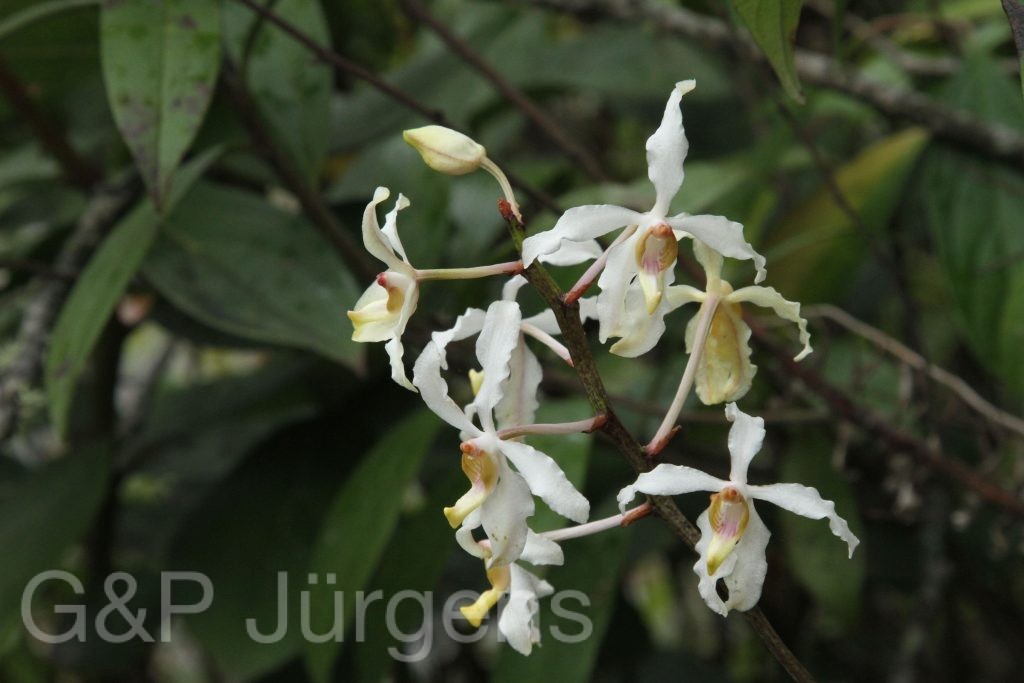
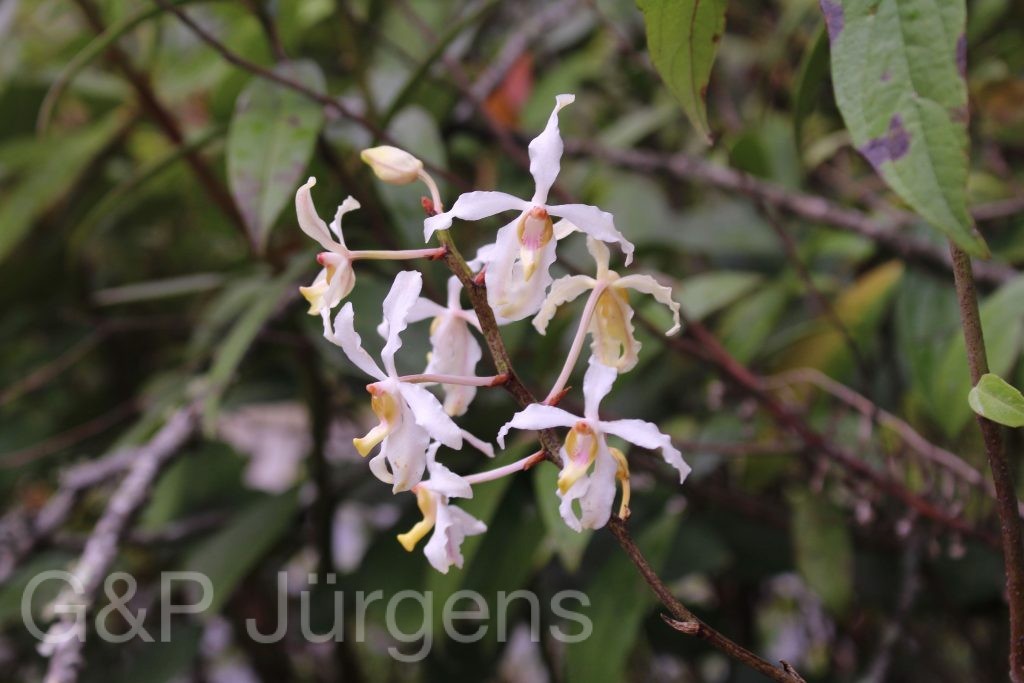
(Lindl.) D.K.Liu & Ming H.Li

Bhutan2014 39
Bhutan Trashigang 1100m, May
Bhutan2014 40
Bhutan Trashigang 1100m, May

Description

Cymbilabia undulata (formerly placed in Vandopsis) is an epiphytic orchid of the eastern Himalaya and adjacent areas, recorded from Nepal, north-east India, Bhutan, Myanmar and south-west China across some 129 georeferenced occurrences. It grows as an epiphyte on the trunks and larger limbs of trees in warm, humid subtropical to lower montane forest, favouring bright, well-drained positions. The Bhutan collection at Trashigang at about 1100 m reflects its preference for the warm subtropical belt, typically between roughly 700 and 1600 m, where seasonal monsoon rainfall and high humidity prevail.

It is a robust monopodial epiphyte with a stout, leafy stem and thick, fleshy roots. The leaves are distichous, ligulate to strap-shaped, coriaceous and unequally bilobed at the apex. The inflorescence is an axillary, branching raceme or panicle bearing numerous fleshy, long-lived flowers; these are yellowish marked with reddish-brown blotches, with spreading, undulate-margined sepals and petals. The lip is small, fleshy, three-lobed and saccate at the base, a diagnostic feature, and the column is short and stout bearing a waxy pollinarium.

The transfer from Vandopsis to Cymbilabia reflects molecular reassessment of the Aeridinae (subtribe of Vandeae), in which generic limits have been substantially revised. As with many Vandoid orchids, the showy resupinate flowers are adapted to insect pollination, and the dust-like seeds are wind-dispersed. Although fairly widespread, populations are vulnerable to habitat loss and orchid collecting; like all orchids the species is listed on CITES Appendix II, regulating international trade.

Author: (Lindl.) D.K.Liu & Ming H.Li · Sources: POWO (Kew), GBIF, Flora of Bhutan, Flora of China, The Orchids of Bhutan (Pearce & Cribb), Genera Orchidacearum (Pridgeon et al.)

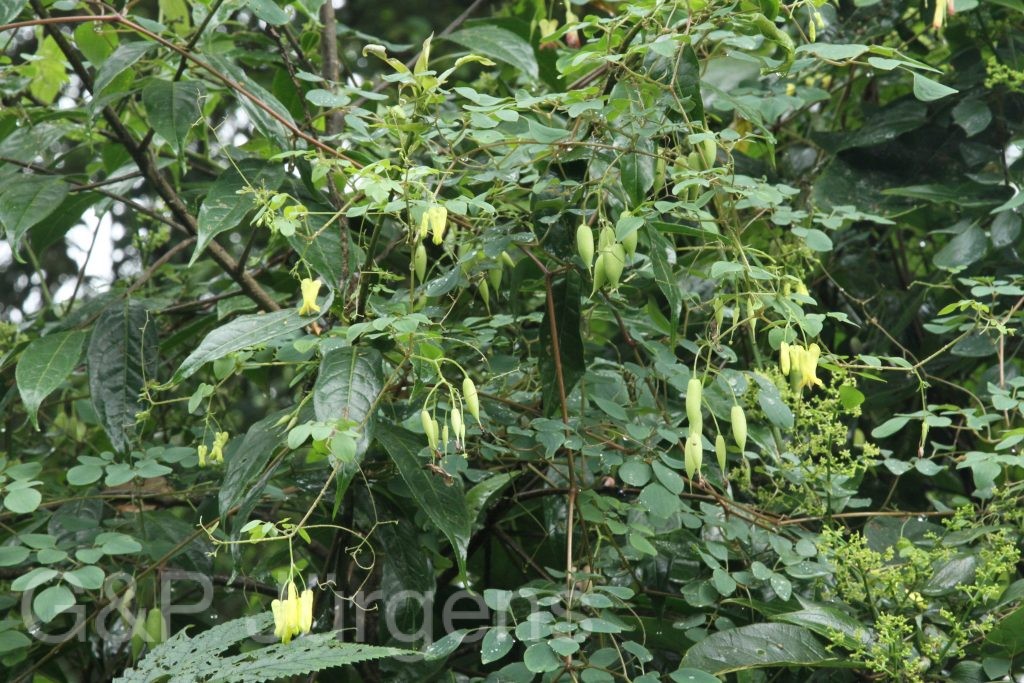
(Fedde.) Hand.-Mazz.

Bhutan2012 678
Bhuitan Tserang 1300m, June

Description

Dactylicapnos lichiangensis (Fedde) Hand.-Mazz. is a scandent herbaceous climber of the Fumarioideae, distributed across the eastern Himalaya and the Sino-Himalayan transition zone. GBIF records (136 occurrences) confirm its presence in southwest China (notably Yunnan, where the epithet references the Lijiang district) and Bhutan, where it ascends into the subtropical and warm-temperate belts. The species was photographed at Tserang in Bhutan at 1,300 m in June, a typical setting along moist forest margins, shaded ravines, and shrubby thickets where it scrambles over neighbouring vegetation. It favours humid, sheltered microhabitats on well-drained slopes between roughly 1,200 and 2,800 m.

The plant is a delicate, glabrous annual or short-lived perennial with slender, brittle, much-branched stems that climb by means of tendril-like terminations of the much-divided leaves. The foliage is biternately to triternately compound, the ultimate segments ovate to lanceolate, glaucous beneath. The pendent, few-flowered racemes bear distinctive yellow, heart-shaped flowers; the outer pair of petals is saccate at the base, forming a dorsal pouch characteristic of the genus, enclosing the inner petals. The fruit is a slender capsule containing several glossy black seeds, each typically bearing an elaiosome that promotes myrmecochorous dispersal.

Dactylicapnos was segregated from Dicentra on the basis of its climbing habit and tendrillar leaves, and lichiangensis sits within a cluster of yellow-flowered Sino-Himalayan species often confused in herbaria. Like many Fumarioideae it contains isoquinoline alkaloids of pharmacological interest. Although not formally assessed as threatened, its restricted distribution and dependence on intact forest-edge habitat make local populations sensitive to deforestation.

Author: (Fedde.) Hand.-Mazz. · Sources: POWO (Kew), Flora of China Vol. 7, Flora of Bhutan Vol. 1, GBIF, Lidén & Fukuhara: Taxonomy of Fumariaceae (1997)

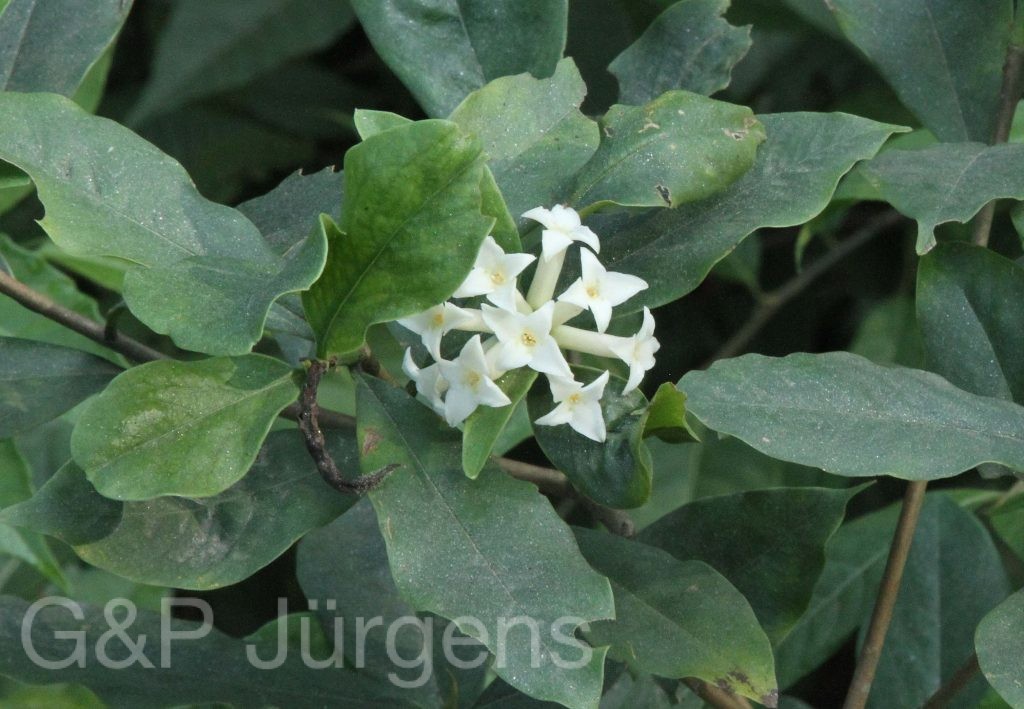
Daphne sureil

by GP Jürgens

W.W.Sm. & Cave

Bhutan2012 638
Bhutan Tserang, 1600m September
Bhutan2015 218
Bhutan Zhemgang 1000m, October
Bh2008 515 P790
Bhutan Chongsakha, 1800m April

Description

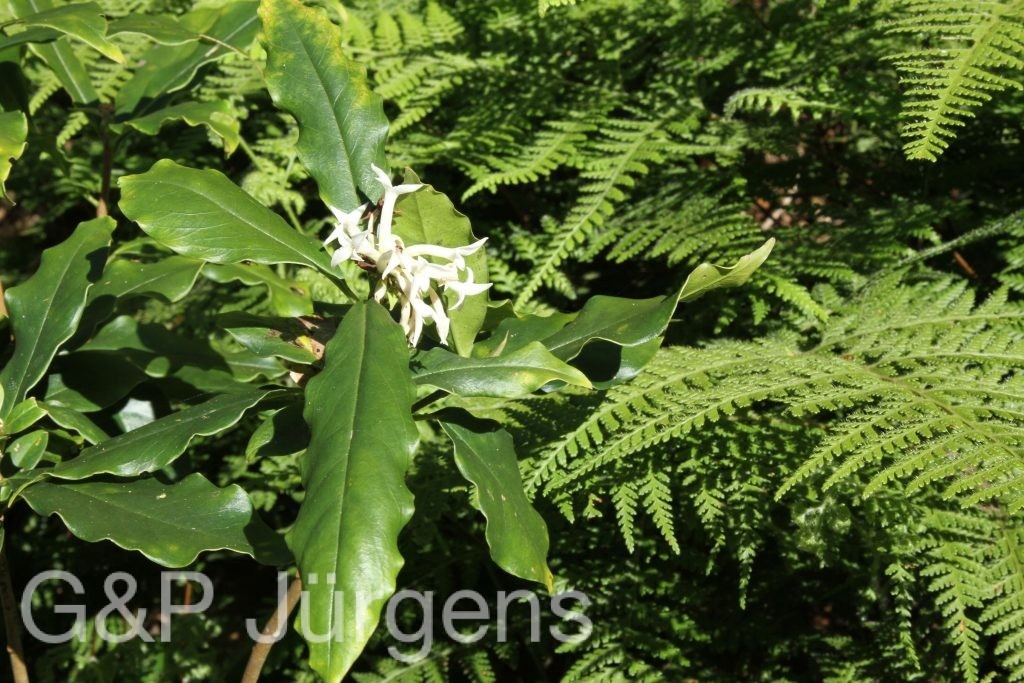
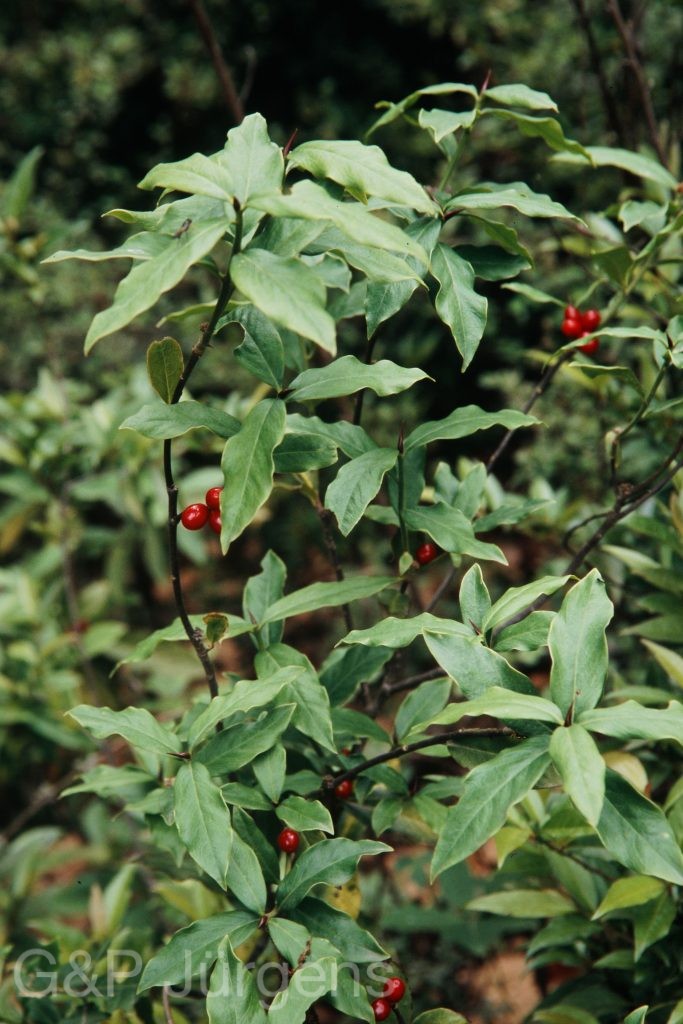
Daphne sureil is a shrub of the eastern Himalaya and adjacent Southeast Asia, recorded from India, Thailand, Nepal, Bhutan, Myanmar, Bangladesh and Vietnam, with about 124 documented occurrences. It is a plant of warm-temperate and subtropical broad-leaved forest, growing in the understorey and along forest margins, ravines and stream banks on moist, well-drained slopes. In Bhutan it occupies the lower to middle montane belt across a broad elevational span, as shown by collections from Tserang at about 1600 m in September, Zhemgang at 1000 m in October and Chongsakha at 1800 m in April, the spring date corresponding to its flowering period.

The species is an evergreen shrub with slender, glabrous branches bearing alternate, shortly petiolate leaves that are elliptic to oblanceolate, entire, acuminate or acute at the apex and tapering at the base, leathery and glossy above with a paler lower surface. The flowers are borne in small terminal clusters and lack petals, the floral display formed instead by a tubular, fragrant white to creamy perianth of four spreading lobes, the tube silky-pubescent without and enclosing eight stamens in two whorls. The fruit is a fleshy ovoid drupe, ripening red, containing a single seed.

Daphne sureil was described by W. W. Smith and Cave from the eastern Himalaya and belongs to the predominantly evergreen Asian assemblage of the genus. As in other Daphne species, the bark contains tough phloem fibres and the tissues bear the diterpenoid daphnane compounds responsible for their acridity and toxicity. The bird-dispersed drupes and strongly scented, presumably moth-pollinated flowers reflect typical thymelaeaceous biology. The species is locally frequent in suitable forest but, being tied to lower-montane broad-leaved woodland, is potentially vulnerable to habitat clearance at its lower elevational limits.

Author: W.W.Sm. & Cave · Sources: POWO (Kew), GBIF, Flora of Bhutan Vol. 1, Flora of China Vol. 13, Flora of Nepal, Halda monograph The Genus Daphne

Delonix regia

by GP Jürgens

(Bojer ex. Hook.) Raf.

Nepal 97 595 P1150
Nepal Sabha-Khola 1200m,May
Nepal 97 596 G1151
Nepal Sabha-Khola 1200m,May
Nepal 1994 335 2 ergebnis
Ost-Nepal Chainpur 400m May 

Description

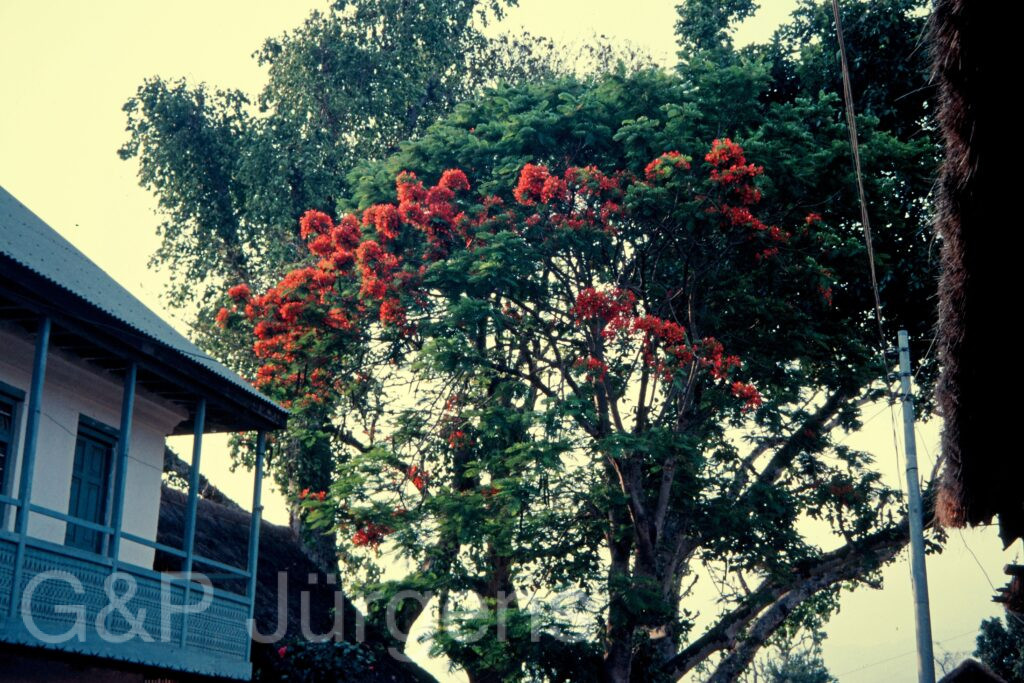
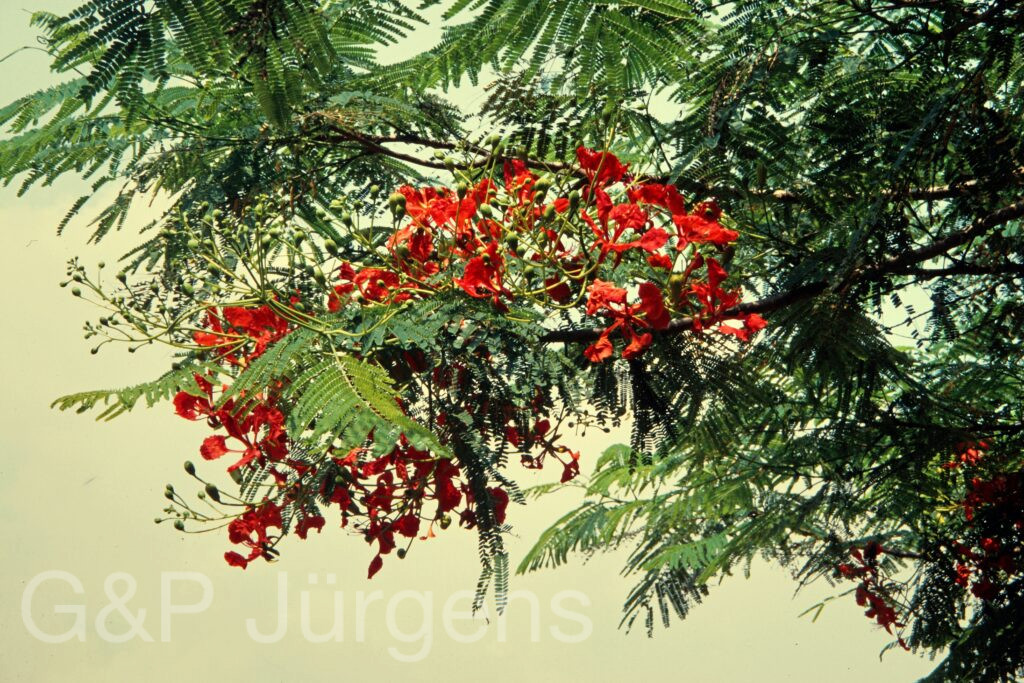
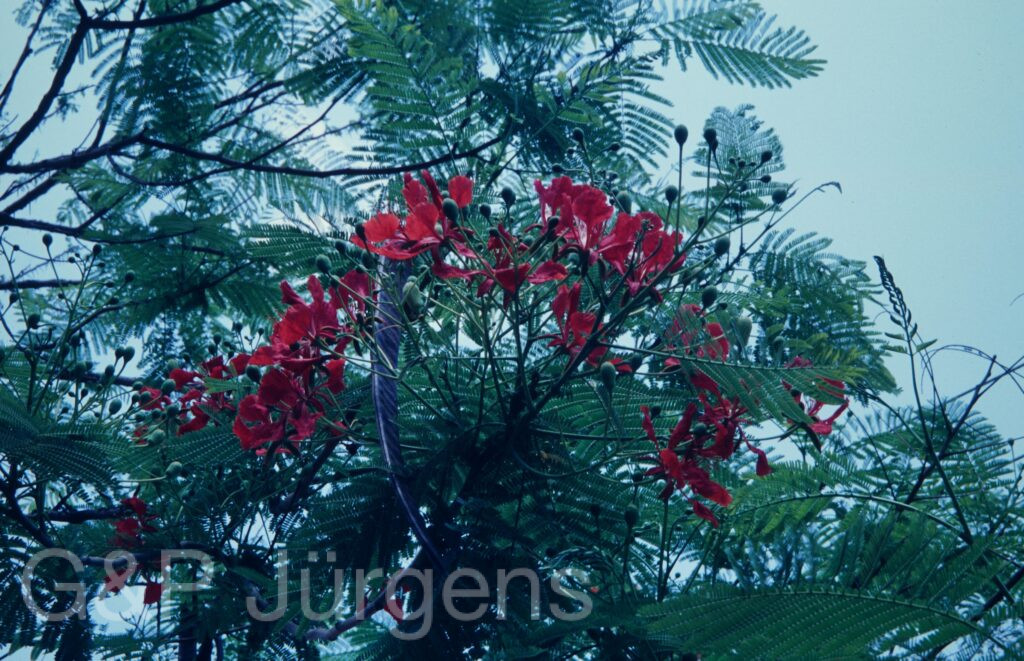
Delonix regia is one of the most widely cultivated ornamental trees of the tropics, native to the deciduous and dry forests of western Madagascar but now naturalised and planted across the warm regions of every continent. GBIF records reflect this pantropical spread, with occurrences across India, Australia, Brazil, Mexico, the United States, Tanzania, Madagascar, Thailand, China, Kenya, South Africa and the Dominican Republic, drawn from more than 27,000 documented collections. In the eastern Himalaya it occurs only as an introduced shade and avenue tree of the warm lowlands and foothills; the photographed material from the Sabha-Khola valley at 1200 m and from Chainpur in East Nepal at around 400 m, flowering in May, lies near the upper altitudinal limit at which the species thrives, requiring frost-free, seasonally dry, sun-exposed sites.

It forms a spreading, umbrella-crowned deciduous tree to 10–15 m, the trunk often buttressed and the bark smooth and grey. The leaves are large, bipinnate and fern-like, with 10–25 pairs of pinnae each bearing numerous small oblong leaflets. The flowers, borne in showy corymbose racemes, are large and zygomorphic with five clawed, spreading petals, four scarlet to orange-red and one larger, whitish or yellow petal streaked with red; the ten stamens are long and exserted with red filaments. The fruit is a large, woody, flattened legume to 60 cm long, persistent and dark brown when ripe, containing numerous hard, mottled seeds.

A member of the Caesalpinioid clade of the Fabaceae, Delonix is a small genus centred on Madagascar and East Africa. Though abundant in cultivation, the species is assessed as of conservation concern in its native range owing to deforestation and a highly restricted wild distribution. Its conspicuous flowering, drought tolerance and nitrogen-fixing capacity have made it a favoured street and amenity tree throughout the tropics, where it is valued equally for shade and ornament.

Author: (Bojer ex. Hook.) Raf. · Sources: POWO (Kew), GBIF, Flora of Nepal, Flora of Madagascar (Flore de Madagascar et des Comores), Legumes of the World (Lewis et al.)

Wall.

Garh 07 298 ergebnis
India Garhwal Sangam 1400m, June

Description

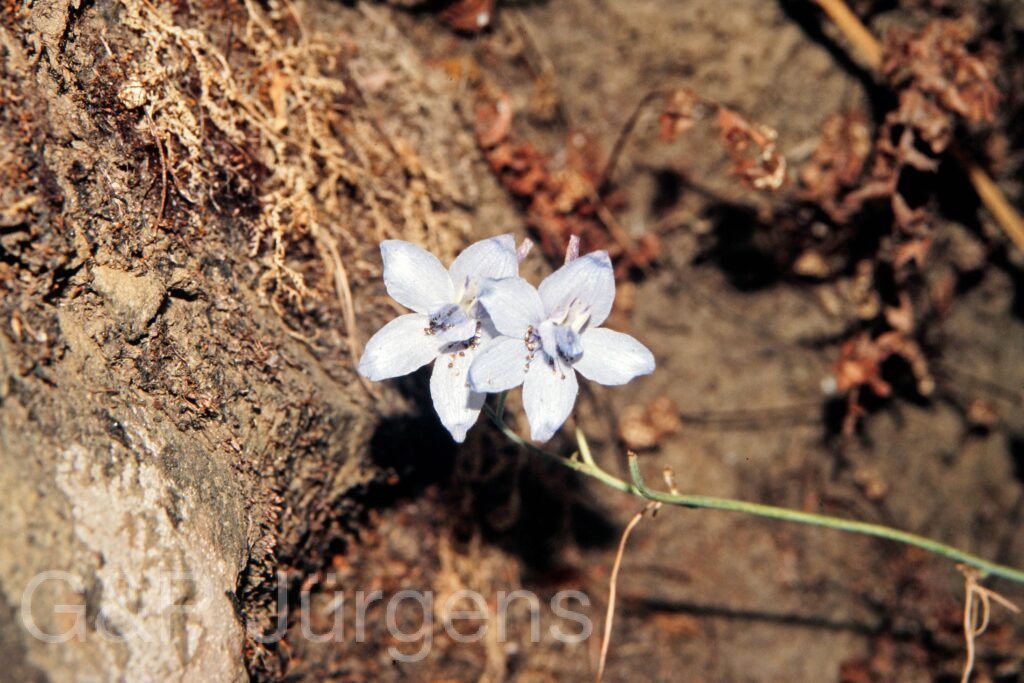
Delphinium denudatum is a perennial larkspur of the western and central Himalaya, documented by GBIF (58 occurrences) from India, Pakistan, Nepal and adjacent China. It occupies shaded, moist temperate forest, forest margins, shrubberies and grassy slopes, generally between about 1200 and 3000 m, lower than many alpine delphiniums. The cited record from Sangam in Garhwal at 1400 m in June reflects this warm-temperate forest habitat, where the plant flowers in early summer in cool, humid, partly shaded ground beneath broadleaved and mixed woodland of the western Himalayan ranges.

The species is an erect perennial herb arising from a tuberous to fibrous rootstock, with slender, sparingly branched stems. The leaves are palmately divided into several broad, toothed or lobed segments, the lower long-petiolate and the upper reduced. The inflorescence is a lax, few- to many-flowered raceme of zygomorphic flowers; the showy blue to violet perianth comprises five petaloid sepals, the uppermost prolonged backward into a conspicuous spur that encloses the nectar-bearing spurs of the two upper petals, while the smaller lower petals are often bearded. The fruit is a group of several erect, many-seeded follicles dehiscing along the ventral suture.

Delphinium belongs to the tribe Delphinieae of the Ranunculaceae, distinguished from Aconitum by its spurred rather than hooded flowers, and its alkaloid-rich tissues underlie a long history of medicinal use of the roots of this species in regional traditional systems. The spurred flowers are adapted for pollination by long-tongued bees. Though comparatively few collections are recorded, the species is fairly widespread in suitable habitat; localised harvesting for medicine warrants attention.

Author: Wall. · Sources: POWO (Kew), GBIF, Flora of Pakistan, Flora of Nepal, Flora of China Vol. 6, Munz A Synopsis of the Asian Species of Delphinium

Lindl.

Bhutan2012 1365
Bhutan Sandrup 1400m, October
Bhutan2012 1366
Bhutan Sandrup 1400m, October

Description

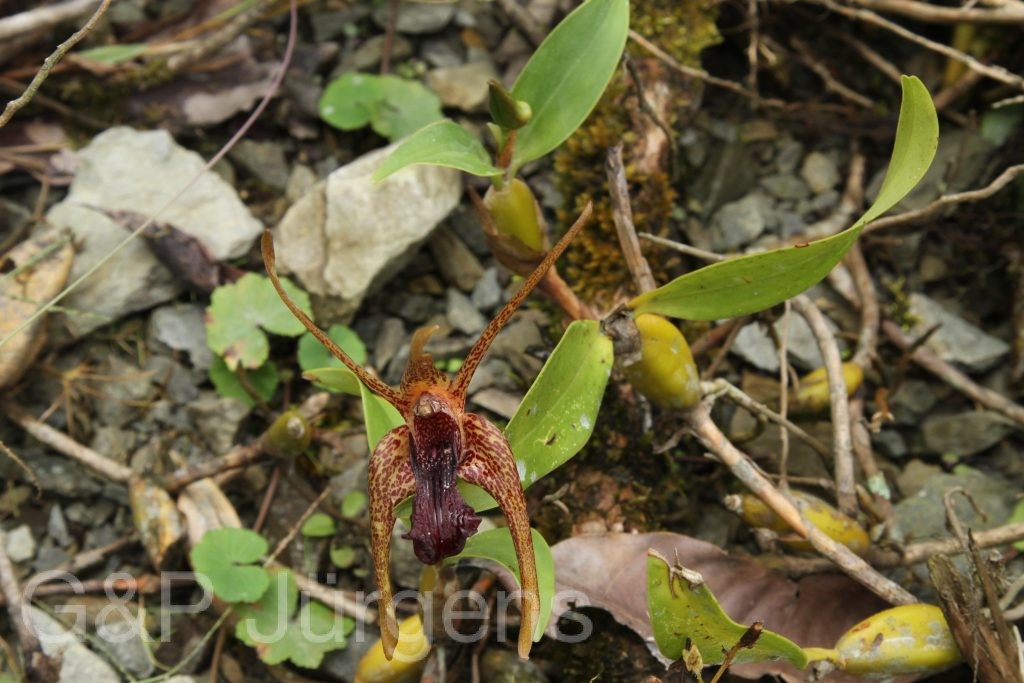
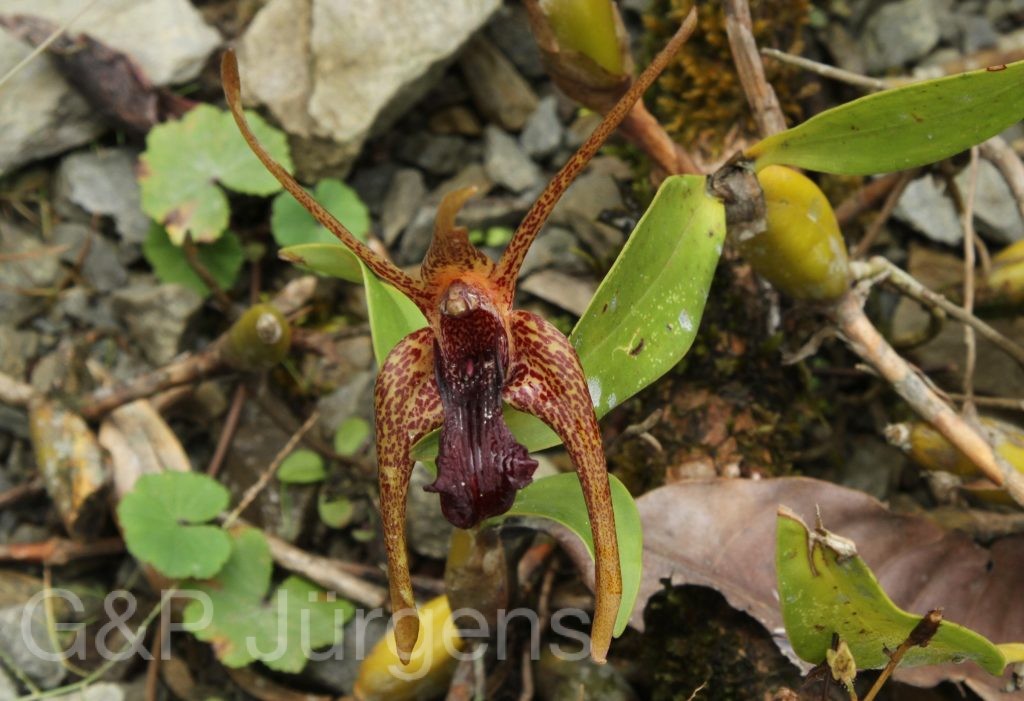
Dendrobium amplum (often treated under the segregate genus Epigeneium as E. amplum) is an epiphytic orchid distributed across the eastern Himalaya and adjacent Southeast Asia. GBIF documents 230 occurrences from China, India, Nepal, Bhutan, Myanmar, Bangladesh, Vietnam and Thailand, with herbarium and cultivated records also in Europe and North America. It inhabits mossy trunks and large branches in humid subtropical broadleaved forest, generally between roughly 1000 and 2000 m. The plant shown was recorded at Sandrup in Bhutan at 1400 m in October, a warm-temperate forest belt where seasonal monsoon moisture sustains a rich epiphytic flora.

The species has a creeping rhizome from which arise well-spaced, ovoid to fusiform pseudobulbs, each conspicuously four-angled and topped by two (rarely three) ovate-elliptic, coriaceous leaves. The inflorescence emerges from the apex of the pseudobulb and carries one to a few comparatively large, showy flowers. The spreading sepals and petals are pale green to yellowish, variously suffused or veined with brown and purple, while the three-lobed labellum bears a recurved, acute or apiculate midlobe and is marked with reddish-purple lines over a callused disc. The mentum is short and the column foot prominent.

Described by John Lindley, the species belongs to a group of broad-bulbed Dendrobium species frequently placed in Epigeneium, a genus whose limits remain debated; POWO accepts the Dendrobium placement. The autumn-flowering habit and large flowers make it attractive to collectors. While ranging widely and not formally listed as threatened, it depends on intact mature forest and is sensitive to habitat loss and over-collection.

Author: Lindl. · Sources: POWO (Kew), GBIF, Flora of Bhutan, Flora of China, Orchids of Bhutan, Dendrobium and its Relatives (Lavarack et al.)

C.E.C. Fisch.

Sikkim2011 17
Sikkim Lachen 2460m, June
Bhutan2014 703
Bhutan Wangdi Phodrang 2280m, May
BhutanPG2011 56 ergebnis
Bhutan Jakar, 20m June
Bhutan2014 702
Bhutan Jakar, 2600m June
Nepal 1994 8 ergebnis
Ost-Nepal Tumlingtar 340m April

Description

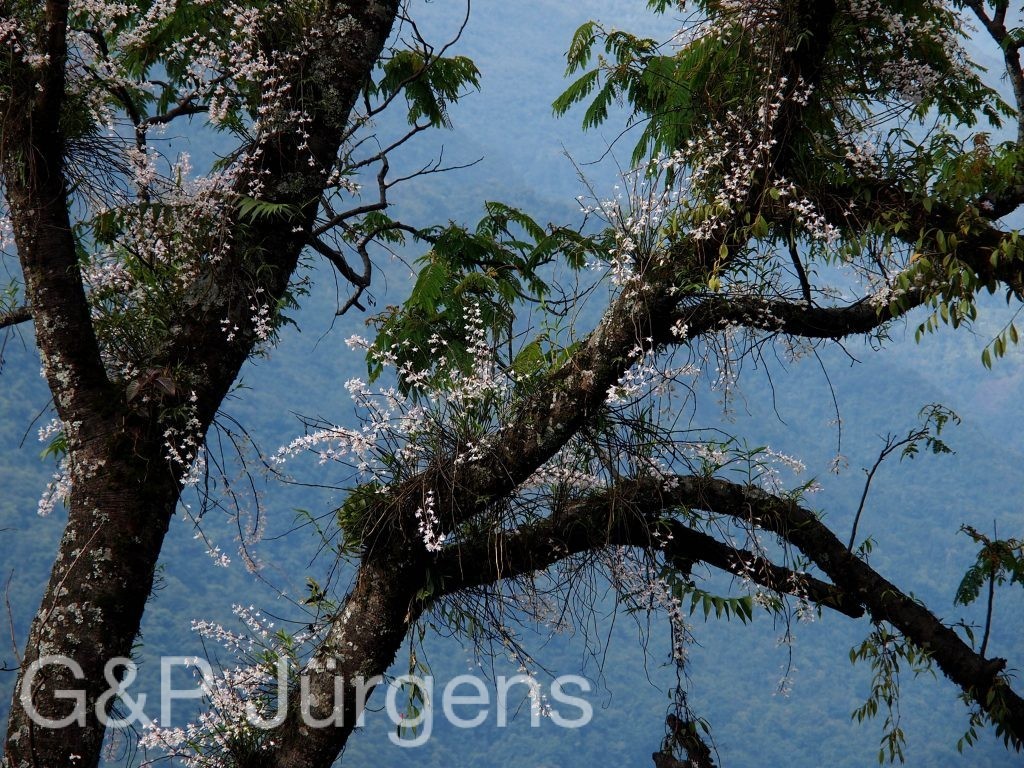
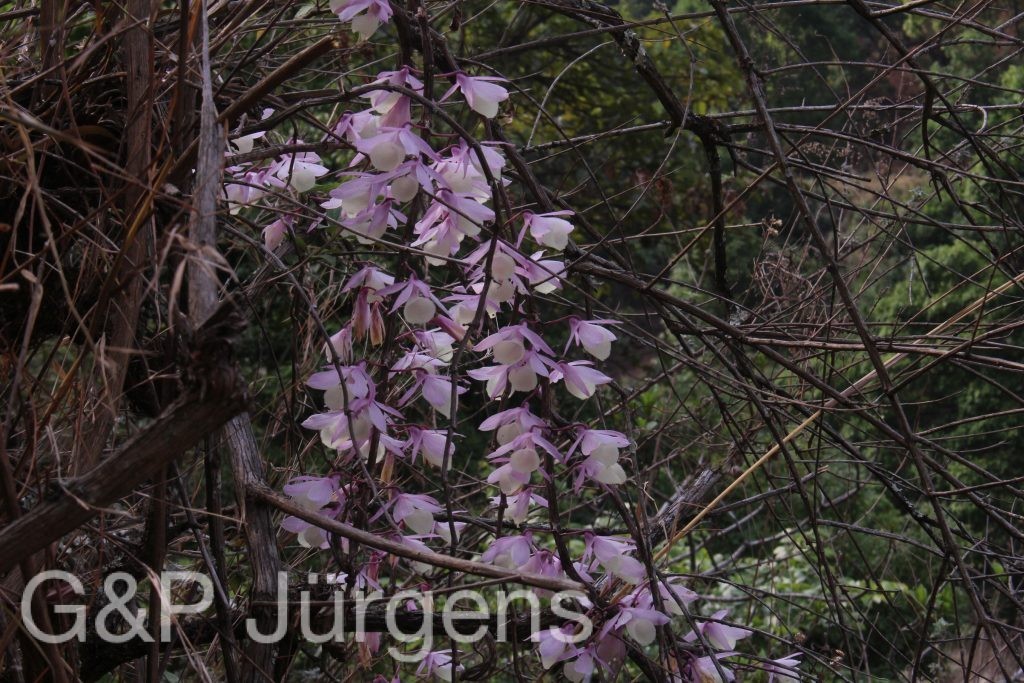
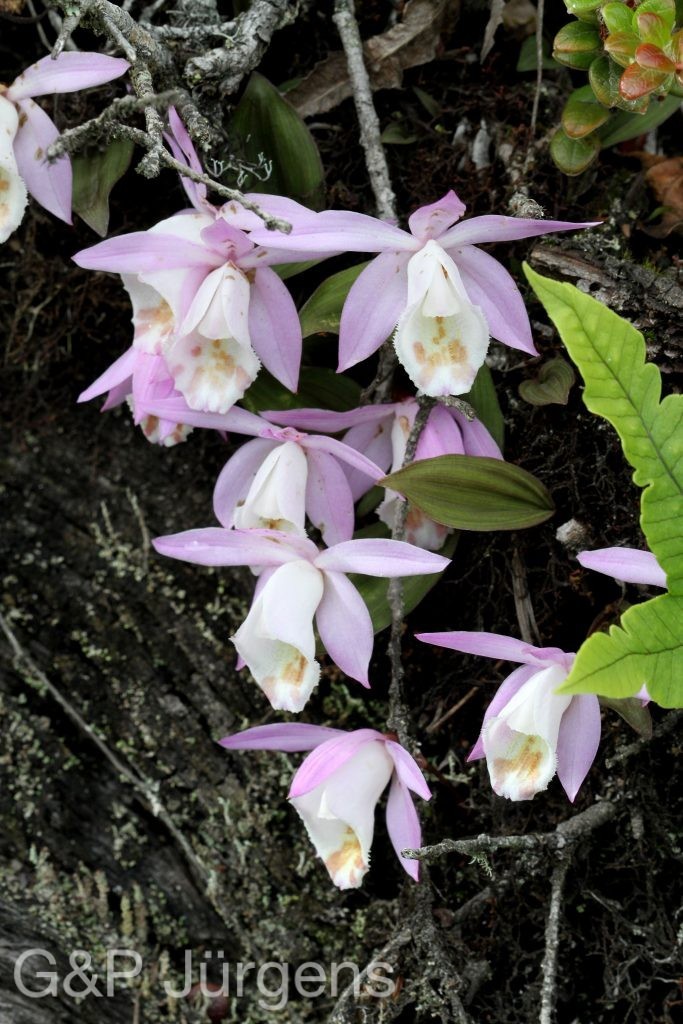
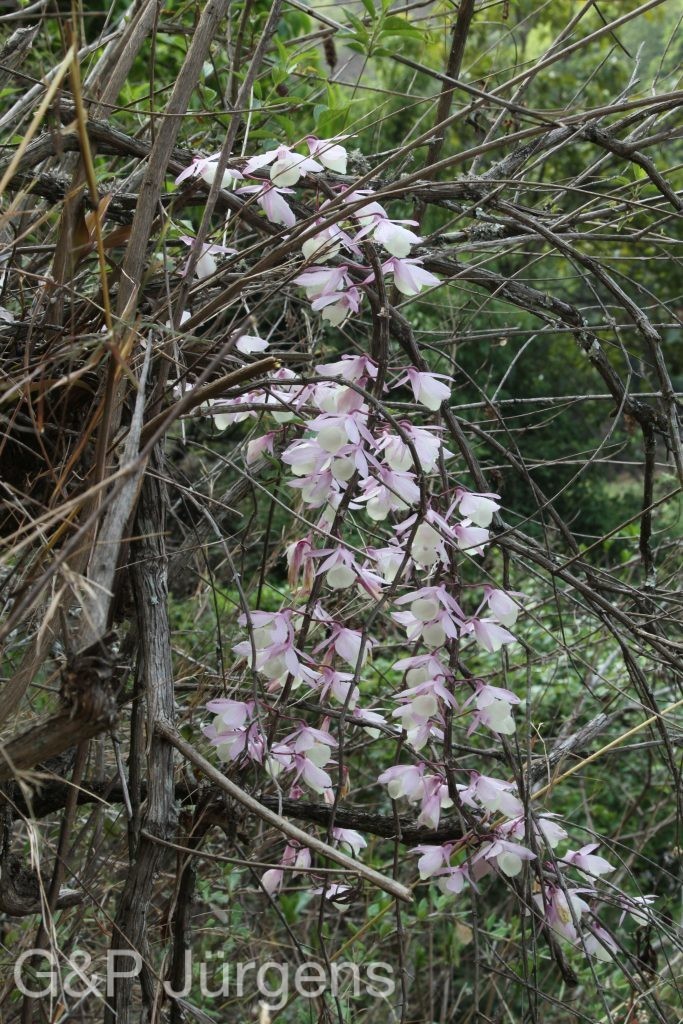
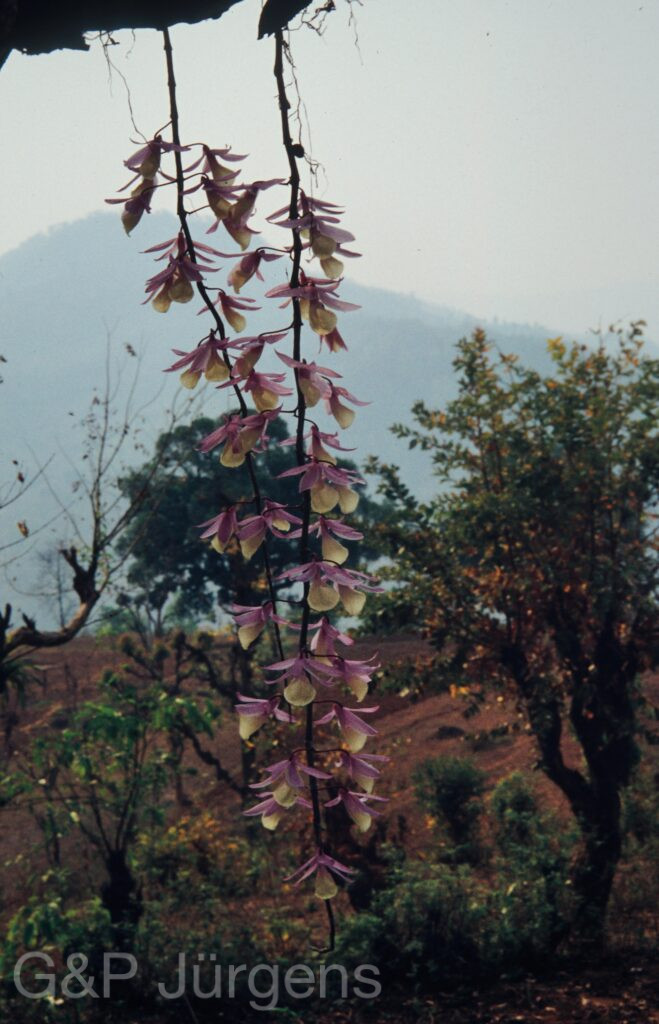
Dendrobium aphyllum is a widespread epiphytic orchid of tropical and subtropical Asia, ranging from India and Nepal through southern China and across mainland Southeast Asia, with GBIF documenting occurrences from India, China, Thailand, Bhutan, Nepal, Vietnam, Myanmar and Laos among many territories. It grows as an epiphyte, and sometimes a lithophyte, on tree trunks and rocks in warm, humid lowland and lower montane forest, enduring a distinct dry season during which the canes shed their leaves. It occupies low to middle elevations; the records span Tumlingtar in eastern Nepal at about 340 m to Sikkim's Lachen and Bhutanese sites up to roughly 2600 m, with the photographed material flowering from April through June across this broad altitudinal range.

The plant produces long, slender, pendulous cane-like stems that branch and trail from the host, leafy when young and largely leaf-shedding before flowering. The leaves are thin, lanceolate and deciduous. The flowers emerge in twos and threes from the nodes of the bare, hanging canes, fragrant and delicately coloured, with pale rose-pink to lilac sepals and petals. The labellum is broadly funnel-shaped to subobicular, cream to pale yellow and finely downy within, often marked with darker veining and rolled around the column to form a trumpet, the lower margin sometimes faintly fringed. The fruit is a pendent capsule.

D. aphyllum is placed in Dendrobium section Dendrobium and is characterised by its leafless flowering canes, as reflected in the epithet; it has accumulated synonymy and is sometimes confused with related pendent species such as D. primulinum and D. anosmum. Long cultivated as an ornamental and used in some traditional medicines, it remains common over much of its vast range, though localised populations are depleted by wild collection and lowland forest clearance.

Author: C.E.C. Fisch. · Sources: POWO (Kew), GBIF, Flora of China, The Orchids of Bhutan (Pearce & Cribb), Dendrobium and its Allies (Lavarack et al.)

Roxb. ex Lindl.

Nepal 2001 507 ergebnis ergebnis
Nepal (Gorkha) Arkhet 720m, May
Nepal 2001 508 ergebnis ergebnis
Nepal (Gorkha) Arkhet 720m, May

Description

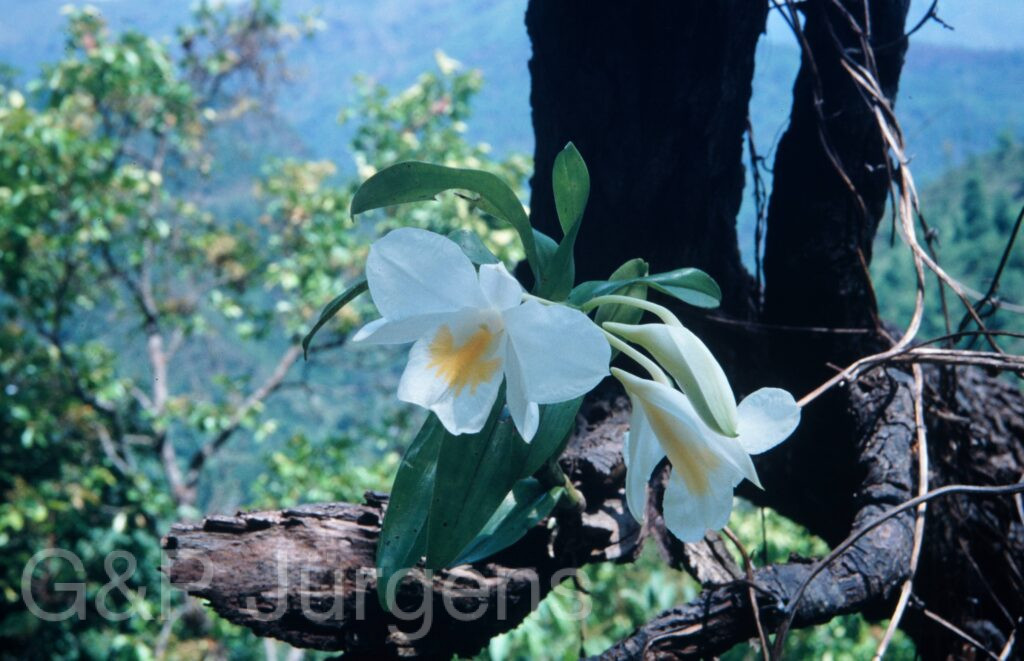
Dendrobium formosum is an epiphytic orchid of the eastern Himalaya and Indo-Burmese region, native to India, Nepal, Bhutan, Myanmar, Thailand and the Philippines; its roughly 88 georeferenced GBIF records also include cultivated material in Europe, the United States and Brazil, reflecting its horticultural popularity. In Nepal it occurs at low to mid elevations, as illustrated by the collection near Arkhet in Gorkha district at about 720 m in May, where it grows on trunks and branches in warm, humid subtropical broad-leaved forest, favouring shaded, mossy bark with high atmospheric humidity.

The species forms erect, cane-like pseudobulbous stems whose leaf sheaths, like the young growth, are clothed in conspicuous blackish-brown hairs, a feature of section Formosae. The leaves are distichous, oblong-lanceolate and leathery. Flowers are borne in short few-flowered racemes near the stem apex and are large and showy, with broad, pure white spreading sepals and petals and a trumpet-shaped labellum marked by a bright yellow or orange throat blotch. The fruit is a ribbed dehiscent capsule releasing dust-like seeds.

Within the vast genus Dendrobium, D. formosum anchors section Formosae, a group of black-haired species prized for their substantial white blooms. As a forest epiphyte dependent on intact canopies and mycorrhizal germination, it is vulnerable to deforestation and over-collection for the ornamental trade, and like all Orchidaceae is listed on CITES Appendix II regulating international commerce in wild-sourced plants.

Author: Roxb. ex Lindl. · Sources: POWO (Kew), GBIF, Flora of China Vol. 25, Flora of Bhutan Vol. 3, Flora of Nepal, The Genus Dendrobium (Lavarack, Harris & Stocker)