Tag:

Subtropical (<1500 m)

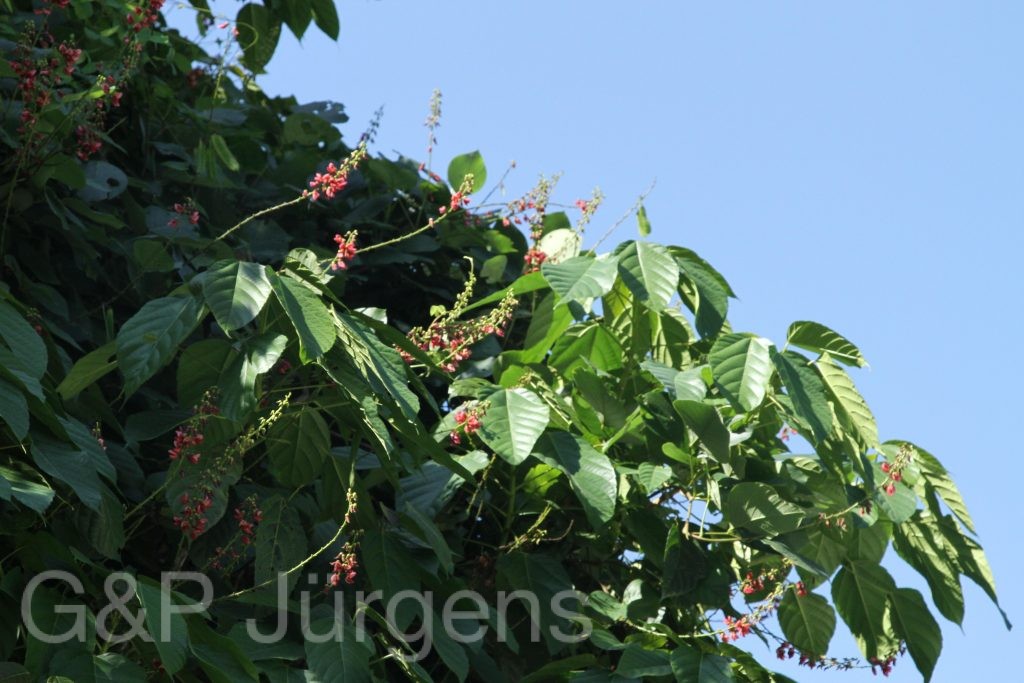
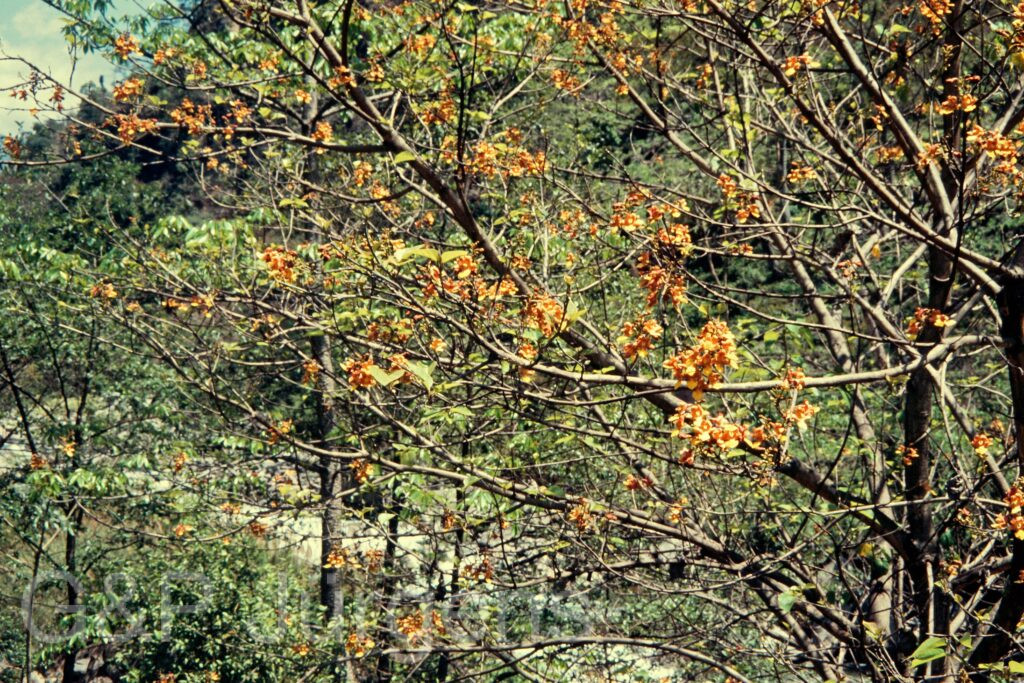
Erythrina stricta

by GP Jürgens

Roxb.

Nepal1992 23 P32 ergebnis
Nepal Kharang 1250m March 
Nepal1992 84 P118 ergebnis
Nepal Kharang 1250m, March 

Description

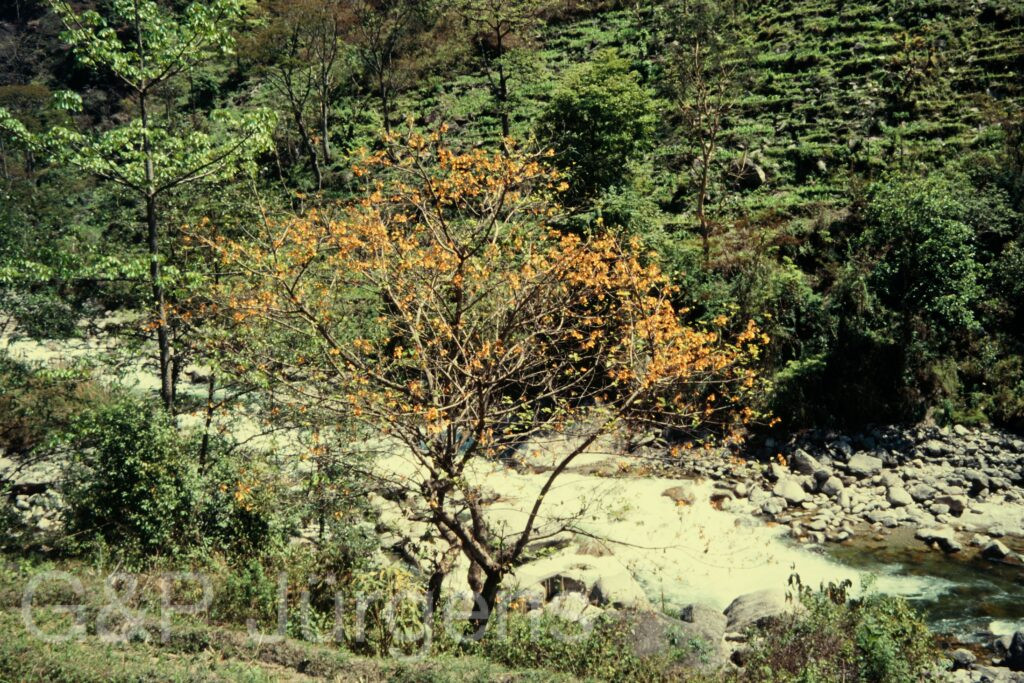
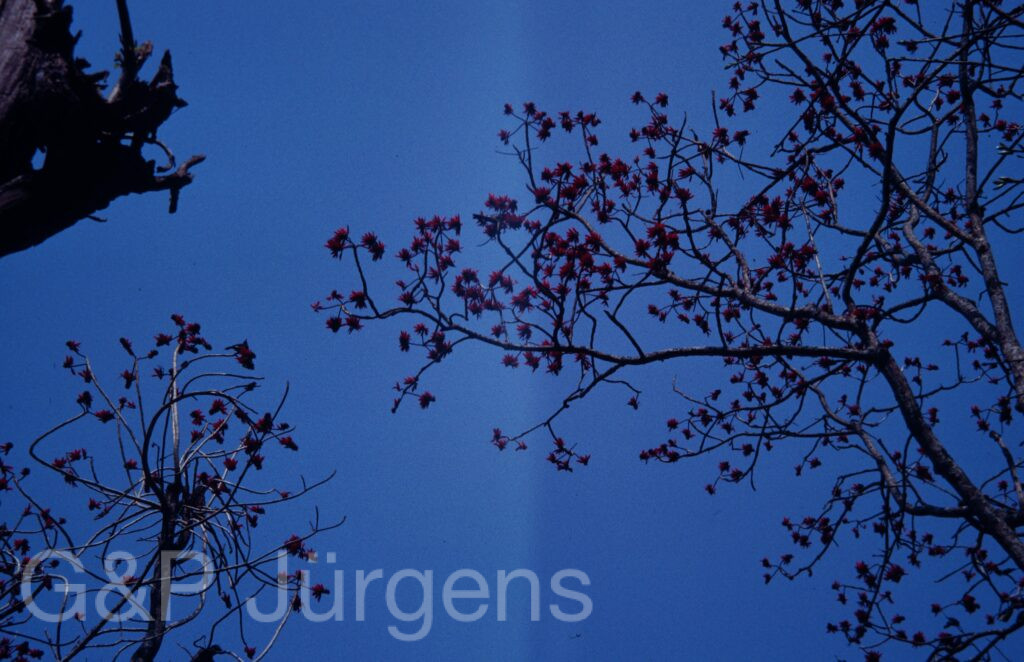
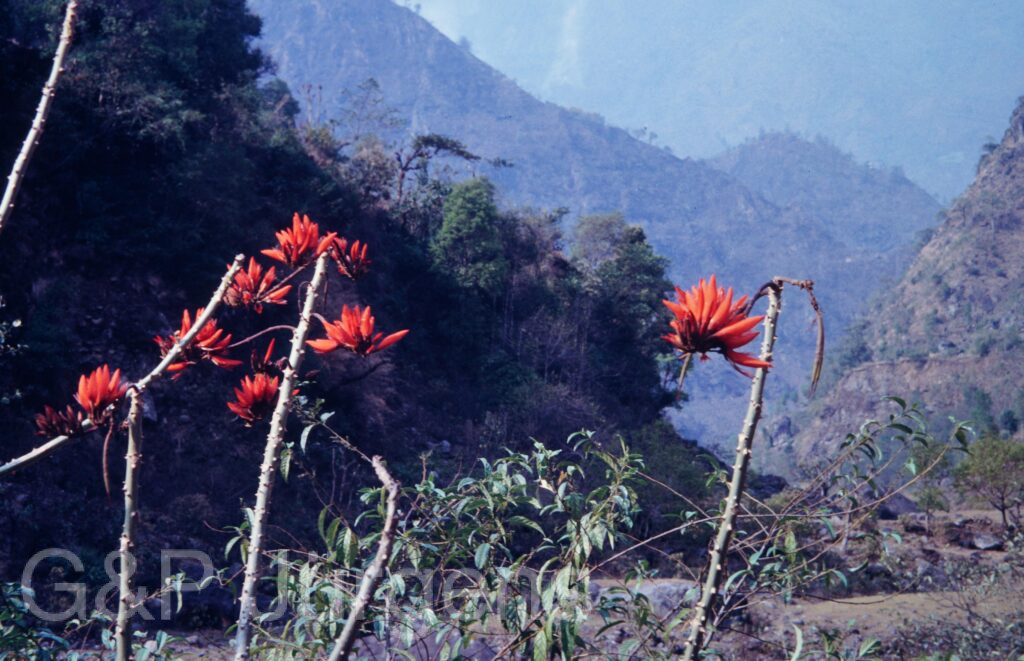
Erythrina stricta Roxb. is a deciduous coral tree widely distributed across tropical and subtropical Asia, recorded from India, Nepal, Bhutan, China, Myanmar, Thailand, Laos, Vietnam, Sri Lanka, Malaysia, Indonesia and the Philippines; its GBIF dataset of 346 occurrences reflects both wild populations and frequent planting. It occurs in open subtropical forest, forest margins, scrub and along cultivated land in the foothills, broadly from the lowlands to about 1500 m. The photographed tree at Kharang in Nepal at about 1250 m, flowering in March, exemplifies its dry-season, leafless flowering in the warm subtropical hill zone of the outer Himalaya, conspicuous as a flush of scarlet bloom on bare branches.

The species is a small to medium-sized deciduous tree with a straight bole and armed branches bearing scattered conical prickles. The leaves are alternate and trifoliolate with broadly ovate to deltoid, entire leaflets, the terminal one rhombic-ovate and larger than the laterals; they are typically shed before flowering. The inflorescence is a dense, erect, terminal raceme of showy papilionaceous flowers; the large, bright scarlet to crimson standard is narrow and nearly straight, much exceeding the small keel and wings, and the nectar-rich flowers attract birds. The fruit is an elongate, torulose, constricted legume that splits to release several reddish, bean-like seeds.

Erythrina (Fabaceae, subfamily Faboideae, tribe Phaseoleae) is a pantropical genus of bird-pollinated coral trees; E. stricta belongs to the Asian assemblage with erect, narrow-standard flowers on leafless branches. It is widely planted as an ornamental, shade and support tree and as a living fence, and its bark and seeds contain Erythrina alkaloids of pharmacological interest. Broadly distributed, fast-growing and commonly cultivated, it is of no conservation concern and serves ecologically as an early dry-season nectar source for birds and insects.

Author: Roxb. · Sources: POWO (Kew), GBIF, Flora of China, Flora of British India, Annotated Checklist of the Flowering Plants of Nepal, Krukoff & Barneby — Conspectus of the genus Erythrina
L.

Bhutan2012 1208
Bhutan Trashigang 1150m, October

Description

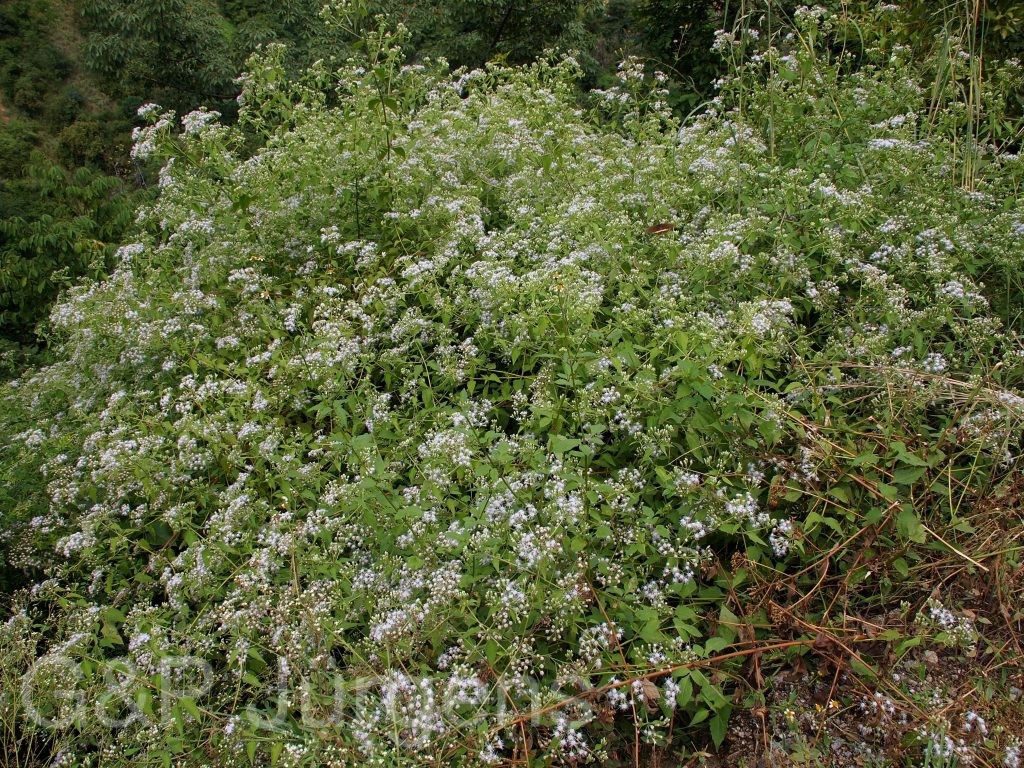
Eupatorium cannabinum, hemp-agrimony, is a wide-ranging temperate herb whose centre of distribution lies across Europe and western Asia; GBIF records overwhelmingly from France, Britain, the Netherlands, Germany, Belgium, Austria and many other European countries total over 687,000 occurrences, attesting to its abundance. In Asia related populations extend into the Himalaya, and the species was photographed at Trashigang in eastern Bhutan at 1150 m in October, in the warm subtropical lower valleys. Throughout its range it favours damp, fertile ground: marsh margins, ditches, wet meadows, streambanks and moist woodland clearings, flowering in late summer and autumn.

It is a robust erect perennial herb 0.5 to 1.5 m tall, with stout, often reddish, finely downy stems arising from a short rhizome. The opposite leaves are palmately divided into three to five lanceolate, toothed, hemp-like segments (hence cannabinum), the uppermost sometimes simple. The numerous small flower heads are crowded into dense, flat-topped terminal corymbs; each narrow head contains only a few tubular florets, discoid and dull pink to mauve, with conspicuously exserted bifid style branches giving the inflorescence a soft fuzzy appearance. The fruit is a small black five-angled cypsela bearing a pappus of fine white bristles.

The species belongs to tribe Eupatorieae; following segregation of many New World species into other genera, Eupatorium s.str. is now a small mainly Eurasian and North American group, of which E. cannabinum is the principal European representative. Its nectar-rich heads are heavily visited by butterflies, hoverflies and bees, an important late-season pollinator resource. It contains pyrrolizidine alkaloids and has a long history in folk medicine. Common on damp disturbed ground, it is of no conservation concern.

Author: L. · Sources: POWO (Kew), GBIF, Flora Europaea, Flora of Bhutan, Eupatorieae systematics (King & Robinson monograph)

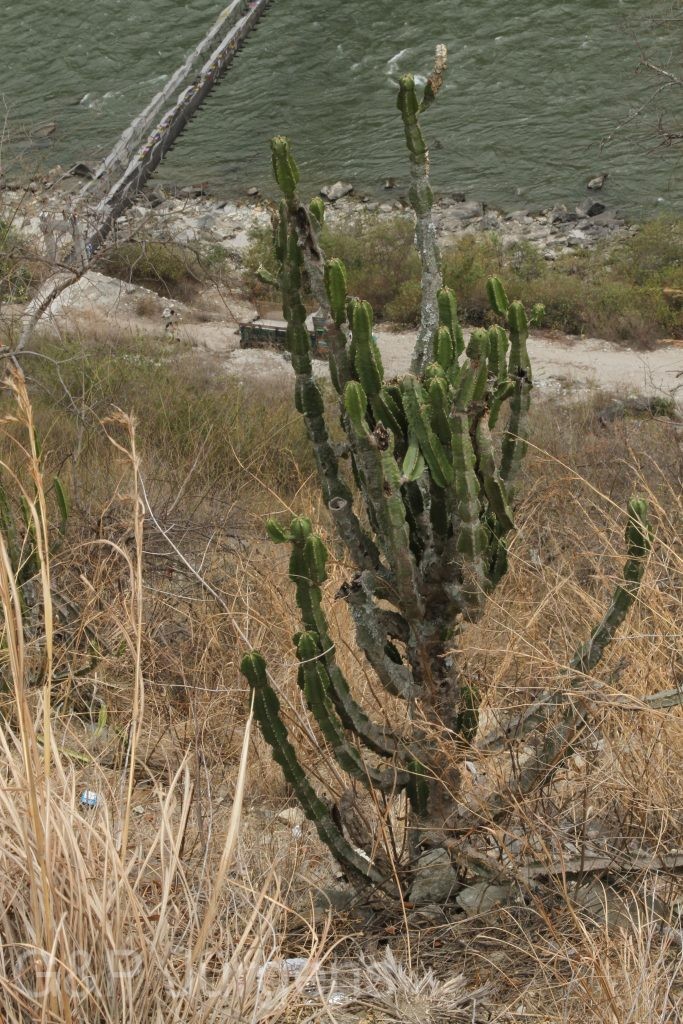
Boiss.

Bhutan2014 202
Bhutan Trashyangtse 2100m, May
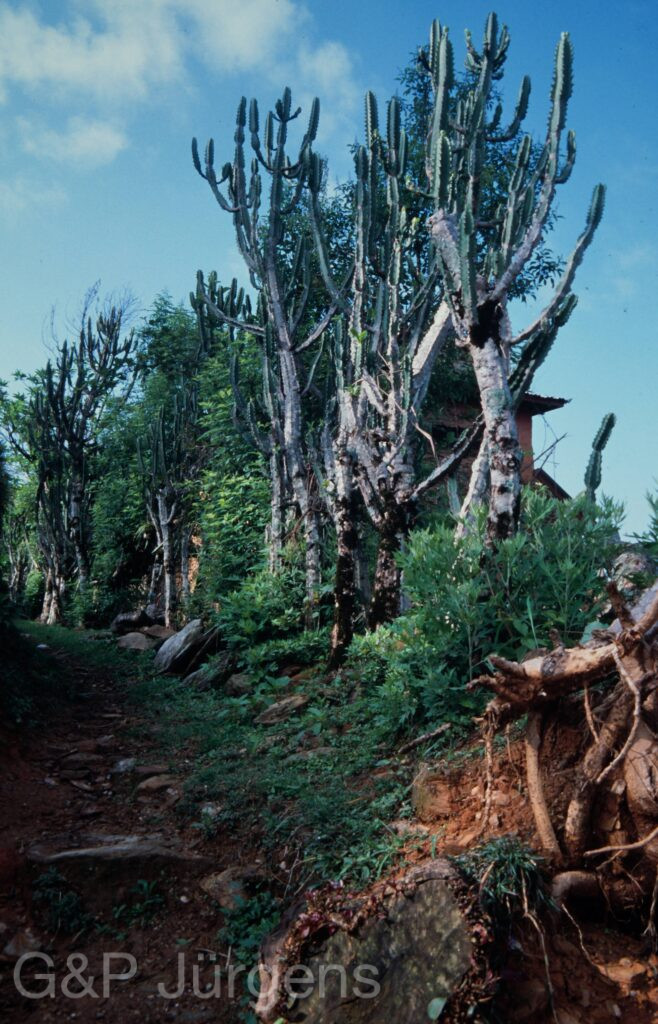
Bhutan2014 203
Bhutan Trashyangtse 2100m, May
Nepal 2001 516 ergebnis ergebnis
Nepal (Gorkha) Mulabari 1340m, May

Description

Euphorbia royleana is a succulent, tree-like spurge of warm, dry valleys across the Himalaya and adjacent regions. With 148 GBIF occurrences, it ranges through Nepal, India, China, Pakistan and Bhutan, with cultivated or introduced records noted elsewhere including Belgium, Egypt and the United States, reflecting its use as an ornamental and hedge plant. It is characteristic of hot, semi-arid slopes, rocky hillsides and degraded scrub in the subtropical to lower temperate zone, often on south-facing rain-shadow exposures. It was recorded at Trashyangtse in Bhutan at about 2100 m and at Mulabari in Gorkha, Nepal, at about 1340 m, both in May.

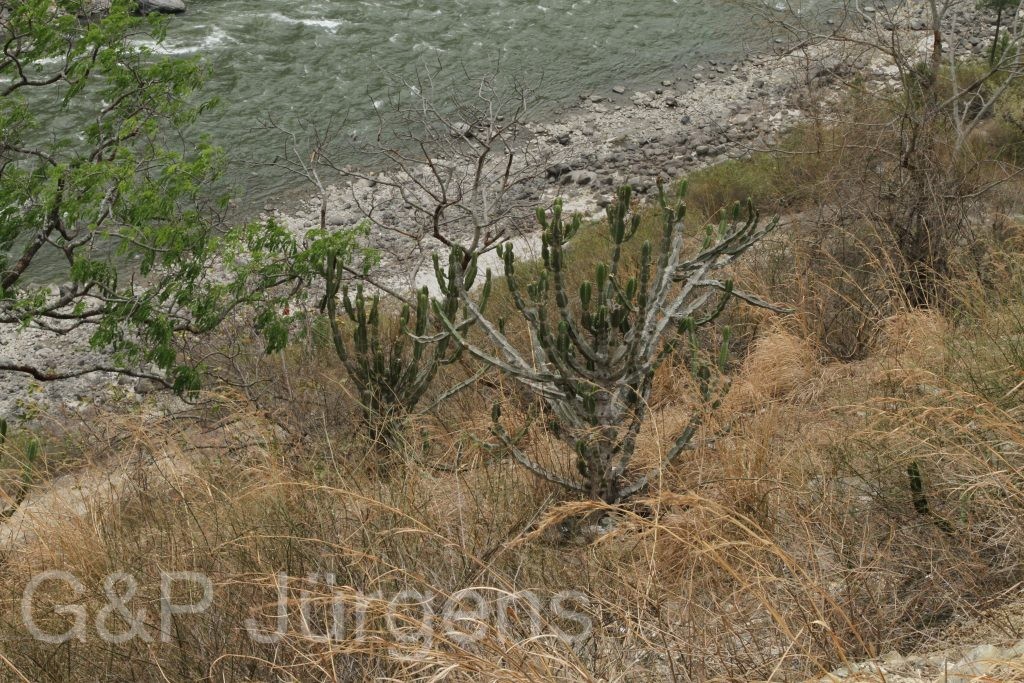
It is a stout, cactus-like succulent shrub or small tree with a short woody trunk and erect, candelabriform branches that are fleshy, grey-green and obtusely five- to seven-angled. Paired, short stipular spines arise on the angles, subtending small, fugacious leaves clustered near the branch tips. As in all Euphorbia the inflorescence is a cyathium: cup-like involucres bearing nectar glands enclose the reduced unisexual flowers, here borne in small cymose clusters and yielding the abundant caustic white latex typical of the genus. The fruit is a three-lobed capsule splitting into three mericarps.

Euphorbia (Euphorbiaceae) is among the largest of all plant genera, and E. royleana belongs to its succulent, xerophytic Old World element adapted to seasonal aridity. Long valued in the region for living fences and traditional medicine, it is widely planted, and its milky latex is irritant and toxic. The species is not of conservation concern, being common and frequently cultivated, but it is an important structural and biogeographic component of dry inner-Himalayan valley vegetation.

Author: Boiss. · Sources: POWO (Kew), GBIF, Flora of China, Flora of Pakistan, Annotated Checklist of the Flowering Plants of Nepal, Boissier's monograph of Euphorbia in de Candolle's Prodromus

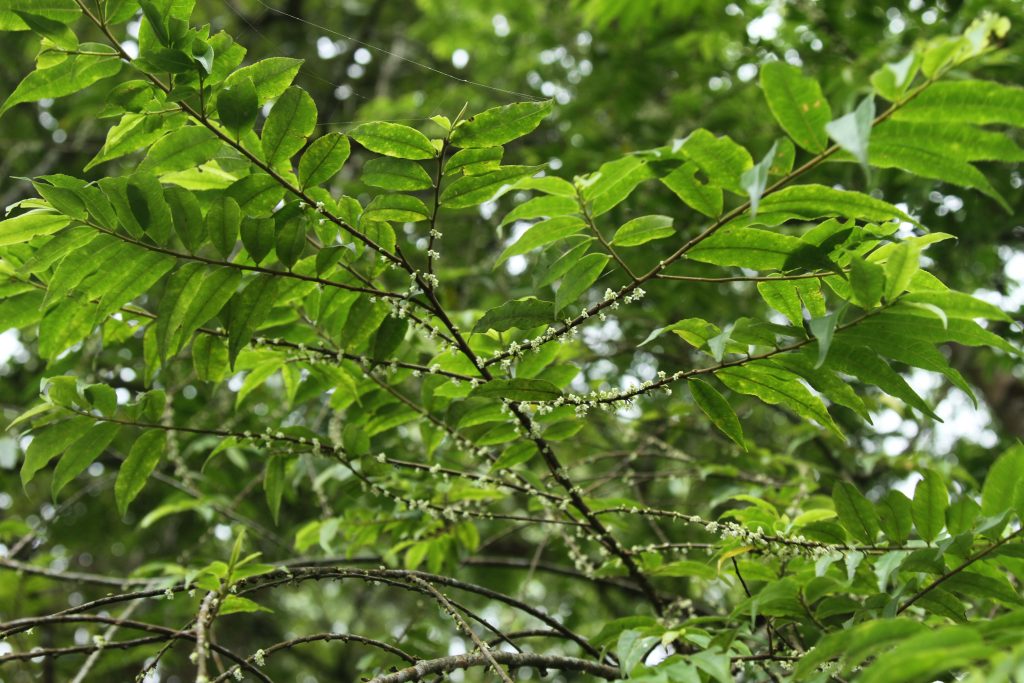
DC.

Bhutan2012 1009
Bhutan Trithangebe, 1000m October
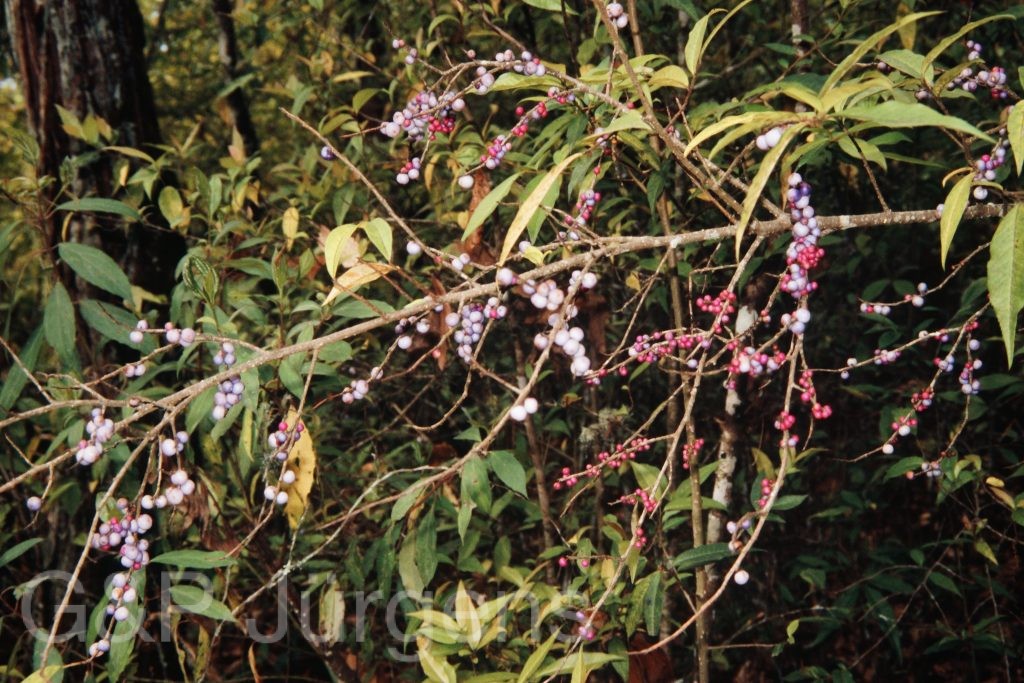
Bh2008 512 G786
Bhutan Chongsakha, 1850m April

Description

Eurya acuminata is an evergreen shrub or small tree widely distributed through tropical and subtropical Asia, ranging from the Himalaya across southern China, Taiwan and Japan to Indochina, the Malesian archipelago and New Guinea; its roughly 2614 GBIF occurrences span India, Nepal, Bhutan, China, Thailand, Malaysia, Indonesia and the Philippines. In Bhutan it occupies a broad altitudinal range, as recorded at Trithangebe around 1000 m in October and at Chongsakha near 1850 m in April. It grows in evergreen broad-leaved forest, along forest margins and in secondary woodland, often as an understorey or successional component of warm, moist forests.

The plant is a much-branched evergreen with leathery, alternate, distichous leaves that are lanceolate to oblong with the long-acuminate apex recorded in the epithet and a finely serrate margin; the young twigs are often two-edged. The species is dioecious, bearing small, axillary, fragrant flowers that are creamy to greenish-white with five sepals, five petals, and in male plants numerous stamens, while female flowers carry a superior ovary with a short divided style. The fruit is a small, globose, fleshy black berry containing several minute seeds, dispersed by birds.

Eurya, formerly placed in Theaceae and now referred to Pentaphylacaceae, is a large genus of Old World shrubs distinguished by its dioecy, bracteolate flowers and berry fruits; E. acuminata is among the most widespread and variable species, with several recognised varieties. As an abundant, generalist forest component spanning a vast area, it is of least concern, and its dense foliage and wood find local use as fuel, hedging and minor timber.

Author: DC. · Sources: POWO (Kew), GBIF, Flora of China Vol. 12, Flora of Bhutan Vol. 1, Flora of Nepal, Flora Malesiana (Theaceae/Pentaphylacaceae)

Wall. ex Benth.

Bhutan2015 109
Bhutan Galephu 500m, October

Description

Flemingia paniculata Wall. ex Benth. is a subshrubby legume of the warm submontane belt of tropical and subtropical Asia, recorded from Thailand, Myanmar, India, Nepal, Malaysia, China, Bhutan, Laos and the Philippines, with about 106 georeferenced occurrences in GBIF. It grows in open forest, scrub, grassy slopes, forest margins and disturbed ground at low to moderate elevations, broadly from near sea level to around 1500 m. The photographed plant was found at Galephu in southern Bhutan at about 500 m in October, in the hot, humid foothill zone where the species flourishes in seasonally dry secondary vegetation.

The plant is an erect or ascending perennial herb or small shrub with ribbed, often pubescent stems. The leaves are characteristically unifoliolate (reduced to a single leaflet, unlike the trifoliolate condition of many congeners), the blade ovate to elliptic, prominently veined and frequently glandular, subtended by persistent stipules. The flowers are borne in dense terminal and axillary panicles; the papilionaceous corolla is typically purplish to pinkish, enclosed by a calyx whose lobes are unequal. The fruit is a small, inflated, two-seeded legume that is somewhat hairy and gland-dotted, dehiscing to release the seeds.

Flemingia belongs to the tribe Phaseoleae and is closely allied to Cajanus, distinguished by its glandular indumentum and pod structure; the genus has medicinal and dye uses across its range, several species yielding the orange resin known as waras. Plants help colonise disturbed and degraded slopes and, as nitrogen-fixing legumes, contribute to soil enrichment. The species is widespread and not of conservation concern, though its foothill habitats face pressure from agricultural expansion.

Author: Wall. ex Benth. · Sources: POWO (Kew), GBIF, Flora of China, Flora of Bhutan, Flora of Thailand, Lewis et al. Legumes of the World

Gmelina arborea

by GP Jürgens

Roxb.

Nepal 97 56 P78
Nepal Mewa-Khola 1160m April
Nepal 97 54 P84
Nepal Mewa-Khola 1160m April

Description

Gmelina arborea, known as gamhar or white teak, is a fast-growing tropical tree native to the Indian subcontinent and Southeast Asia, ranging through Nepal, India, Sri Lanka, Myanmar, Thailand, Indochina, China, Indonesia and the Philippines; it is now extensively planted in tropical Africa and the Americas, and its 12,900 GBIF occurrences across countries from Colombia and Brazil to Nigeria, Tanzania and Mexico largely reflect this pantropical forestry use. In its native range it grows in moist and dry deciduous forest and along watercourses from the lowlands to about 1,500 m. The plant photographed along the Mewa Khola in eastern Nepal at 1,160 m in April shows it flowering in the leafless or newly leafing state typical of the dry pre-monsoon season in the Himalayan foothills.

It is a medium-sized to large deciduous tree reaching 15-30 m, with a straight bole, greyish bark and a spreading crown. The leaves are opposite, broadly ovate to cordate, 10-25 cm long, acuminate and entire, glabrescent above and finely fulvous-tomentose beneath, with gland-dotted petioles. The flowers are showy and brownish-yellow to orange-yellow, borne in terminal panicles that appear when the tree is largely leafless; the corolla is bilabiate and funnelform with a swollen tube, and the four didynamous stamens are included. The fruit is a fleshy, ovoid to obovoid drupe, yellow when ripe, with a hard stone enclosing one to several seeds.

Gmelina, traditionally placed in Verbenaceae but now referred to Lamiaceae, comprises some thirty-five Old World tropical species, of which G. arborea is by far the most economically important. Its rapid growth, pale lightweight timber and suitability for pulp and plantation forestry have made it one of the most widely cultivated hardwoods in the tropics, while its nectar-rich flowers attract bees and its drupes are taken by mammals and birds. Long valued in traditional medicine and listed among the classical Ayurvedic drugs, the species is abundant and of least concern, though its plantations occasionally naturalise beyond cultivation.

Author: Roxb. · Sources: POWO (Kew), GBIF, Flora of China, Annotated Checklist of the Flowering Plants of Nepal, World Agroforestry database, revision of Gmelina (Lamiaceae)

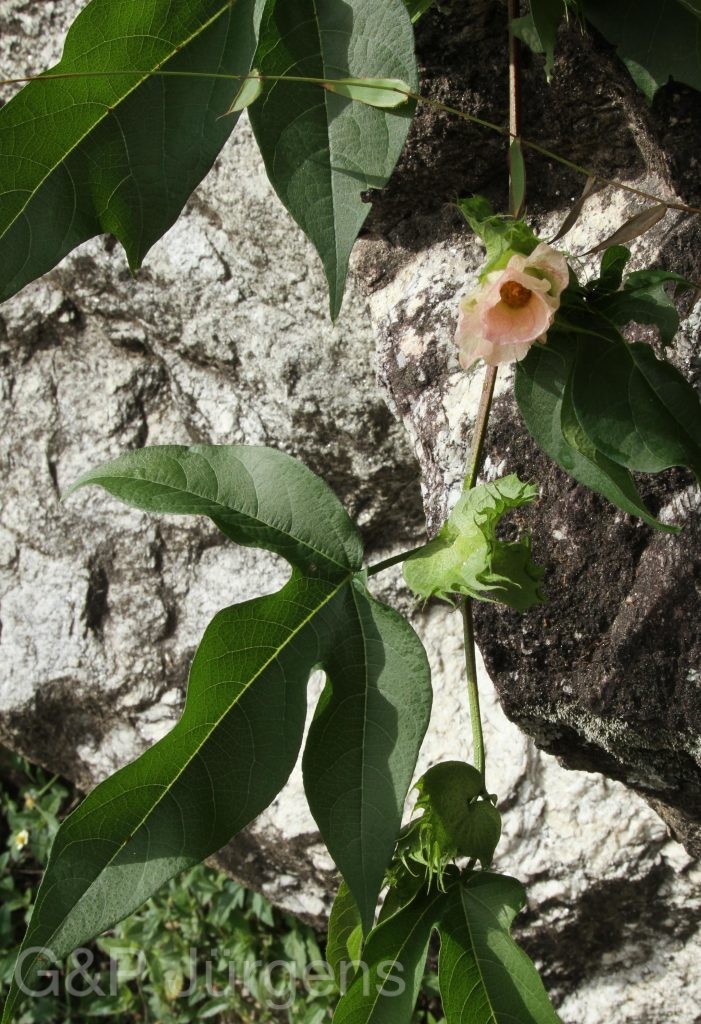
L.

Bhutan2012 1230
Bhutan Trashigang 1150m, October
Bhutan2012 1231
Bhutan Trashigang 1150m, October

Description

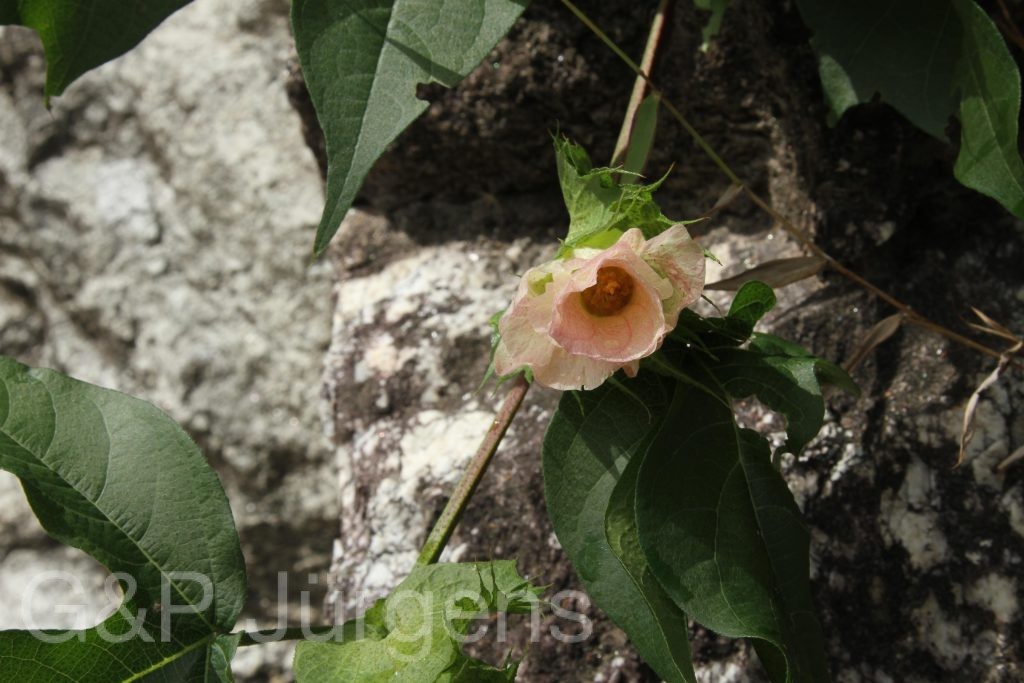
Gossypium hirsutum, Upland cotton, is native to Mesoamerica and the Caribbean but is now pantropical and warm-temperate in cultivation, accounting for the great majority of the world's cotton crop. Its 25,000-plus georeferenced records reflect this near-cosmopolitan distribution, with concentrations in the United States (US) and Mexico (MX) and naturalised or cultivated occurrences across Brazil, Uzbekistan, Australia, India, China and many other countries. In the Himalayan region it is a lowland cultigen and escape rather than a wild element; the plant photographed at Trashigang in eastern Bhutan at about 1150 m in October represents such warm subtropical valley cultivation, well below the montane flora. It thrives in hot, sunny, frost-free lowlands on deep, well-drained loams.

It is an erect, somewhat woody annual or short-lived perennial herb to shrub, with branching stems bearing scattered hairs and dark glandular dots. The leaves are alternate, broadly cordate and palmately three- to five-lobed, the lobes ovate-triangular and acuminate, with a basal nectary on the midrib beneath. The showy flowers are solitary and axillary, subtended by an epicalyx of three large, deeply incised, cordate bracts; the corolla is creamy white to pale yellow, often turning pink with age. The fruit is a three- to five-locular ovoid capsule (boll) that dehisces to reveal seeds embedded in copious white lint of elongated epidermal seed-hairs, the cotton fibre of commerce.

Gossypium (Malvaceae) is an economically pre-eminent genus whose allotetraploid New World cottons, including G. hirsutum, arose from hybridisation between Old and New World diploid lineages. The species is the foundation of global textile agriculture and a model for polyploid genomics. As a fully domesticated crop it has no conservation concern, though its wild and feral relatives are of interest for germplasm conservation and breeding.

Author: L. · Sources: POWO (Kew), GBIF, Flora of China, Flora of Pakistan, Fryxell monographic studies of Gossypium and the Malvaceae

Sheph. ex Ker Gawl.

Bhutan2012 668
Bhutan Tserang 1100m, September
Sikkim2003 45 P60
Sikkim above Yoksam 200m 08.2003

Description

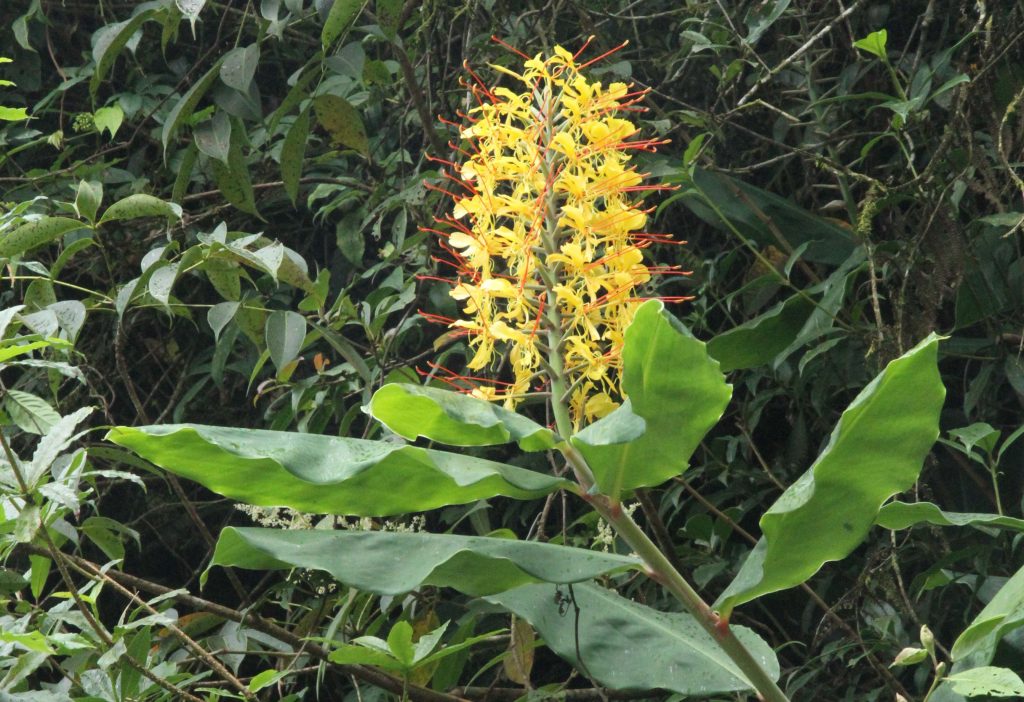
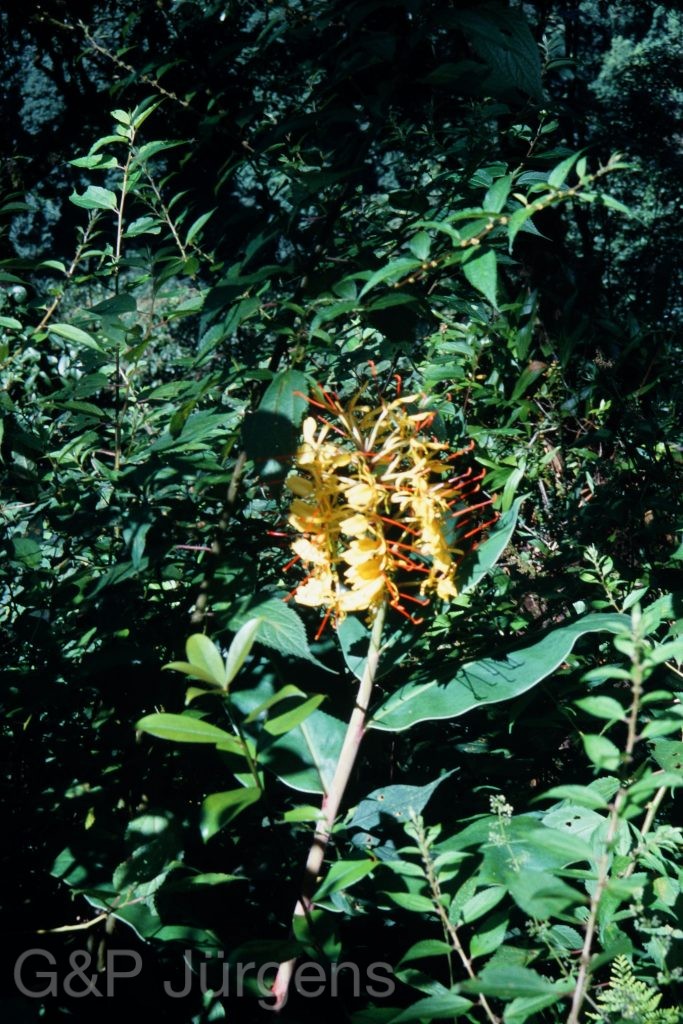
Hedychium gardnerianum, the Kahili ginger, is native to the eastern Himalaya of India, Nepal and Bhutan but has been very widely introduced and naturalised worldwide; GBIF records over 20,000 occurrences, the great majority from naturalised populations in Hawaii, New Zealand, the Azores, South Africa and Australia far outside its native range. In its homeland it grows in moist subtropical and lower temperate forest, on shaded banks, ravines and clearings. The images from Tserang in Bhutan at about 1100 m in September and above Yoksam in Sikkim show it flowering in late summer in its native warm, humid foothill forest belt.

It is a robust, clump-forming perennial herb arising from a stout, fleshy, branching rhizome and reaching two metres or more, with erect, leafy pseudostems formed by overlapping leaf sheaths. The leaves are large, oblong-lanceolate, glabrous above and shortly pubescent beneath, with a sheathing base and prominent midrib. The inflorescence is a dense, showy terminal cylindrical spike of many bracteate flowers; each is fragrant and lemon-yellow with a long-exserted bright red filament bearing the anther, the floral tube slender and the lip and lateral staminodes petaloid. The fruit is a fleshy capsule splitting to reveal numerous seeds enclosed in a bright orange-red aril.

Within Hedychium this species is notable for its conspicuous red stamens and is among the most ornamental gingers. The same vigour, rhizomatous spread and bird-dispersed arillate seeds make it a serious invasive in island and oceanic-climate floras, where it forms dense monocultures that suppress native regeneration, and it is listed among the world's worst invasive plants. Conservation concern thus relates not to its survival but to its impact where introduced.

Author: Sheph. ex Ker Gawl. · Sources: POWO (Kew), GBIF, Flora of Bhutan, Flora of China (Zingiberaceae), Branney Hardy Gingers including Hedychium, Roscoea and Zingiber

Sm.

Bhutan2012 706
Bhutan Galephu 850m, September
Nepal 95 11 P18 ergebnis
Nepal Gorkha 1200m, Octobre

Description

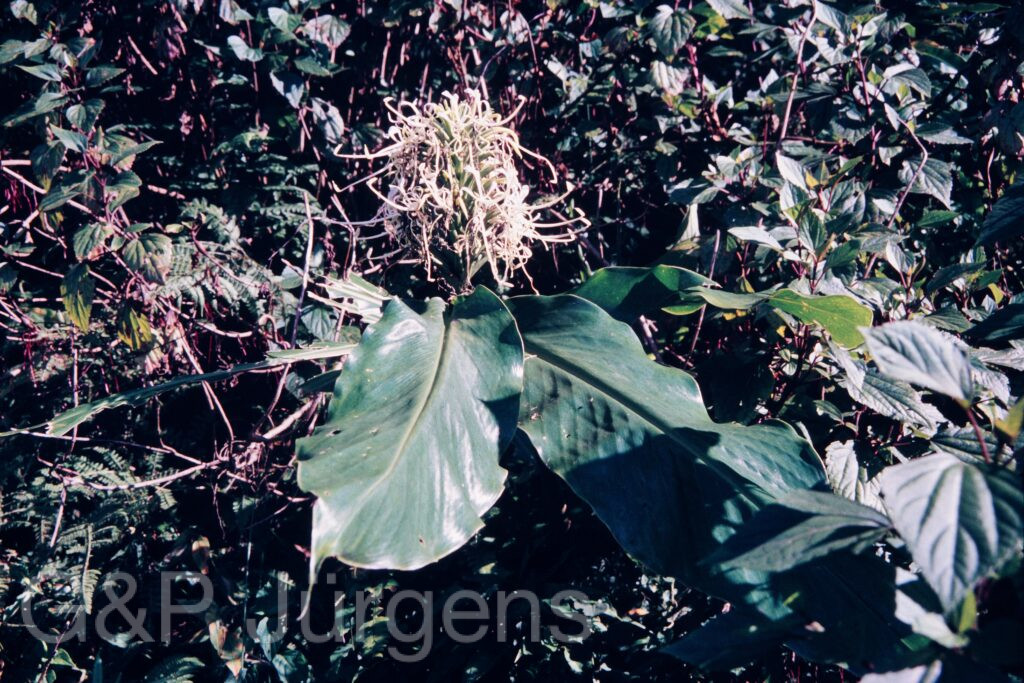
Hedychium thyrsiforme is a ginger lily native to the Himalayan foothills and northeastern India, ranging through Nepal, India, Bhutan and Bangladesh, with cultivated and naturalised records elsewhere (including Mauritius, Vanuatu, Brazil, the USA and Britain) reflected in its roughly 127 GBIF occurrences. It is a plant of warm, humid subtropical forest, favouring shaded banks, ravines and the margins of broadleaved woodland, and is frequently epiphytic or lithophytic on mossy trunks and rocks. The localities photographed, at Galephu in Bhutan at 850 m in September and at Gorkha in Nepal at 1200 m in October, lie within its typical low to mid-elevation belt where late-monsoon humidity sustains flowering.

It is a robust perennial herb growing from a fleshy, aromatic, creeping rhizome and producing leafy pseudostems formed by sheathing leaf bases. The leaves are distichous, oblong-lanceolate, glabrous above and shortly hairy beneath, with a conspicuous ligule. The inflorescence is a dense, cylindrical terminal thyrse from which the epithet derives, crowded with white flowers; each has a slender corolla tube, narrow reflexed segments, and the showy whitish labellum and greatly exserted long-filamented stamen that give the genus its butterfly-lily aspect. The fruit is a capsule splitting to reveal seeds with an orange-red aril.

Hedychium belongs to tribe Zingibereae of the Zingiberaceae and is centred on the Indo-Malayan region, where its long-tubed, fragrant flowers are adapted to hawkmoth pollination. Several species, this among them, are grown ornamentally and can naturalise in the tropics. The input family spelling "Zingiberacaea" is retained as given, though the accepted family is Zingiberaceae. The species is not regarded as threatened across its wide native range.

Author: Sm. · Sources: POWO (Kew), GBIF, Flora of Bhutan, Flora of British India, Hedychium revision (Wood / Sanoj & Sabu)

Bedd.

Bhutan2012 667
Bhutan Tserang 1100m, September

Description

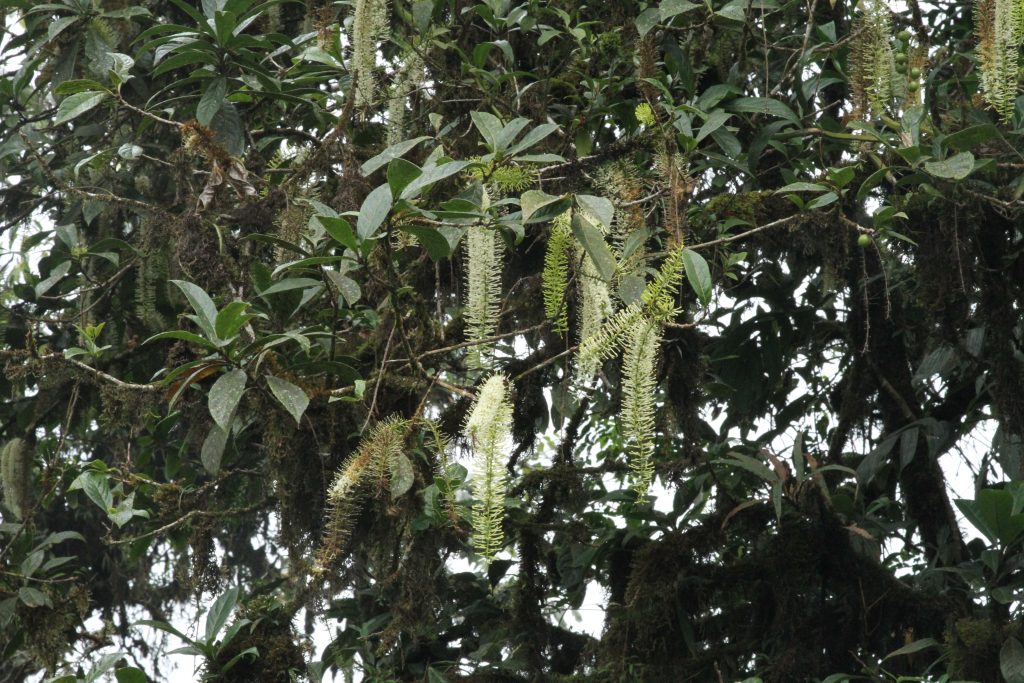
Helicia nilagirica is an evergreen tree or large shrub of subtropical and tropical montane Asia, distributed from southern and northeastern India and the Nilgiri hills (whence the epithet) through Nepal, Bhutan, Myanmar, Thailand, southern China, Vietnam and Cambodia; GBIF lists some 944 occurrences, the species being relatively well collected. It grows in evergreen and semi-evergreen broadleaved forest, on hill slopes, ridges and along forest streams, chiefly between about 800 and 2000 m. The photographed individual was recorded in eastern Bhutan at Tserang around 1100 m in September, a humid forest setting typical of this warm-temperate to subtropical Proteaceae.

It is a tree with smooth to finely fissured bark and coriaceous foliage. The leaves are alternate, often clustered toward the branch tips, elliptic to oblong-lanceolate, leathery, entire or with a few coarse teeth toward the apex, glabrous and glossy above. The flowers are small and borne in slender, elongate, axillary racemes; as in the genus they are bisexual with four tepals that recurve at anthesis, the four stamens inserted on the tepals, and a hypogynous disk. The fruit is a hard, globose to ellipsoid, indehiscent drupe-like nut with a single large seed.

Helicia (Proteaceae) is the largest Old World genus of the family, centred on tropical Asia and reaching its northern limit in the eastern Himalaya. H. nilagirica is among the more widespread Asian species, and its racemose inflorescences and one-seeded indehiscent fruits typify the genus. Broadly distributed and locally common, it is not considered globally threatened, though populations depend on subtropical broadleaved forest affected by clearance.

Author: Bedd. · Sources: POWO (Kew), GBIF, Flora of China Vol. 5, Flora of Bhutan Vol. 1, Flora of Nepal, Flora of Pakistan, Sleumer revision of Asian Proteaceae