Tag:

Summer

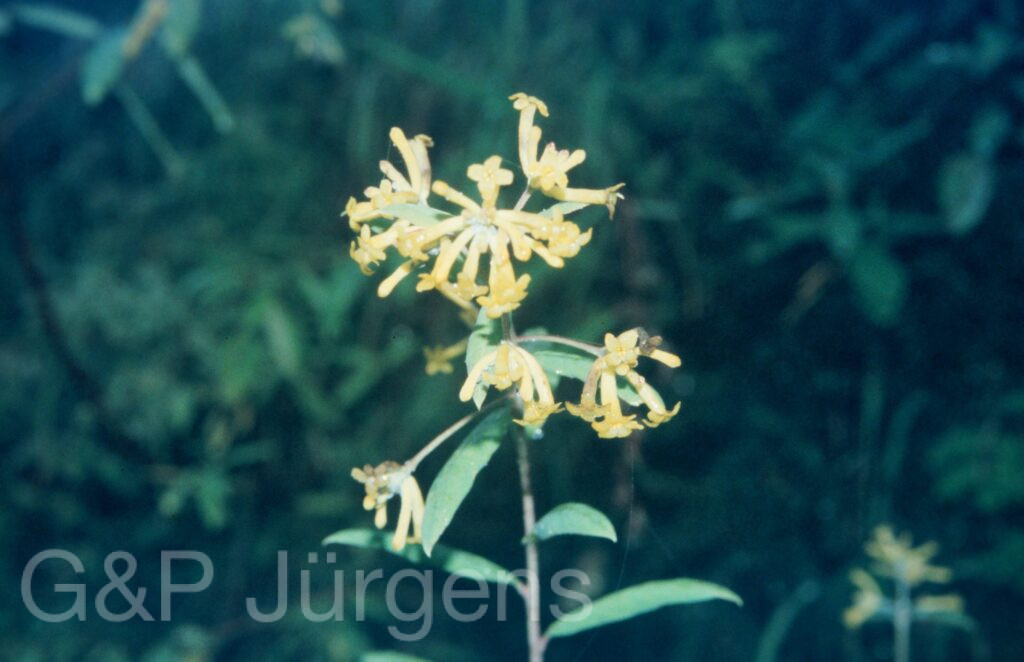
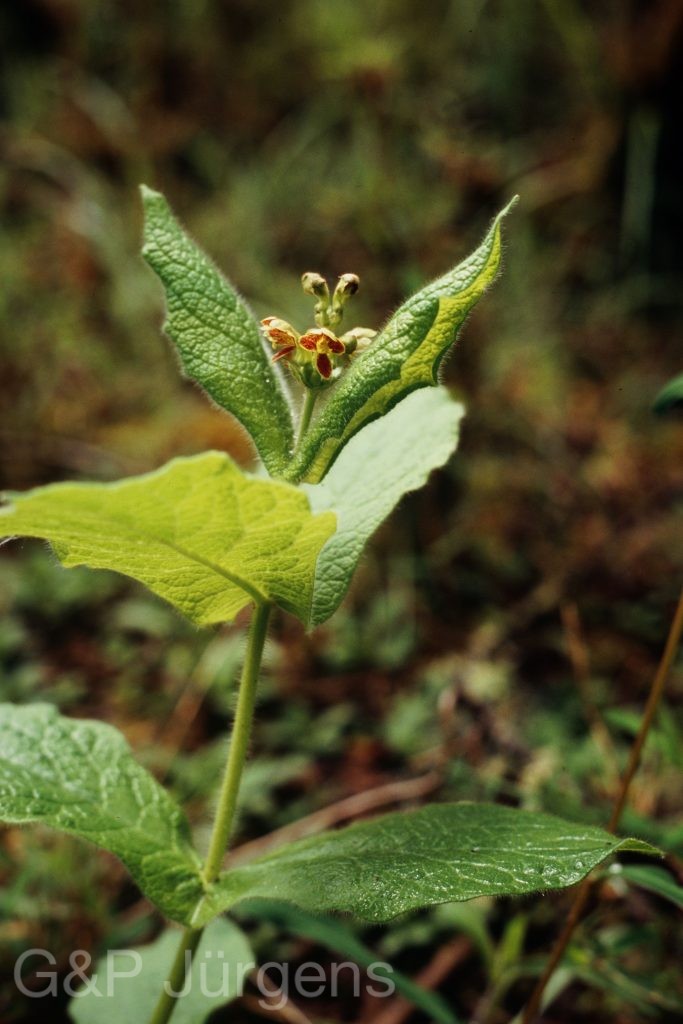
Wall.

Bh09 321 G527
Bhutan Jakar 3200m, June
Sikkim2003 377 G529
Sikkim Tista valley 3400m August

Description

Triosteum himalayanum is a Sino-Himalayan perennial herb distributed across China, Nepal, Bhutan, Sikkim and northern India, with GBIF aggregating around 990 occurrences. It is characteristic of the upper temperate to subalpine forest belt, recorded here from Jakar in Bhutan at 3200 m in June and the Tista valley in Sikkim at 3400 m in August. The species grows in moist shaded forest, woodland margins, scrub and tall-herb communities along streams and on cool, humus-rich slopes, typically between roughly 2500 and 4000 m, where it forms part of the shade-tolerant understorey flora.

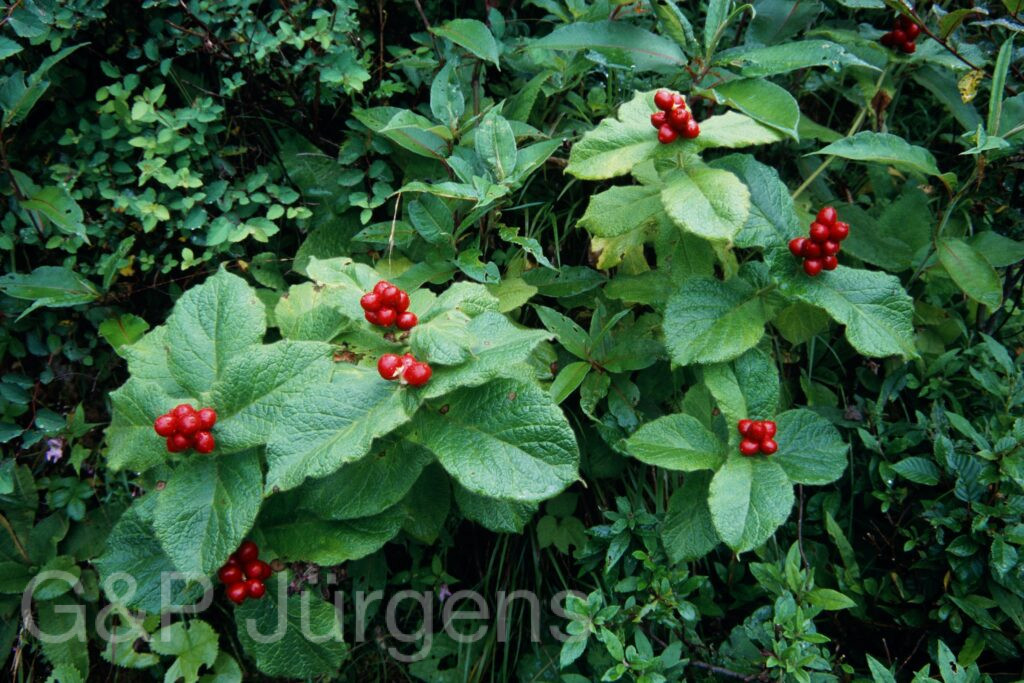
It is an erect, softly hairy herbaceous perennial 0.4-1 m tall arising from a stout rhizome, the stems unbranched and glandular-pubescent. The leaves are opposite, large, broadly obovate to elliptic, often shortly connate at the base around the stem (perfoliate to subconnate), entire to shallowly lobed and softly hairy on both surfaces. Small tubular flowers are clustered in dense axillary and terminal verticels; the corolla is dull purplish to greenish-yellow, weakly two-lipped, and the calyx bears persistent, leafy, ciliate lobes. The most conspicuous feature is the fruit, a fleshy, bright red, bristly-hairy drupe crowned by the persistent calyx and containing three bony pyrenes.

Triosteum (horse-gentian) is a small, disjunct genus of about six species in eastern Asia and North America, now placed within an enlarged Caprifoliaceae; this striking amphi-Pacific distribution makes it a classic example of the eastern-Asian-North-American biogeographic link. T. himalayanum is widespread and locally common within its montane range and is not of conservation concern; its showy red drupes are dispersed by birds, and the rhizome has a place in regional herbal traditions.

Author: Wall. · Sources: POWO (Kew), GBIF, Flora of China, Flora of Bhutan, Flora of British India (Hooker), Gould & Donoghue revision of Triosteum (Caprifoliaceae)
Lindl.

Description

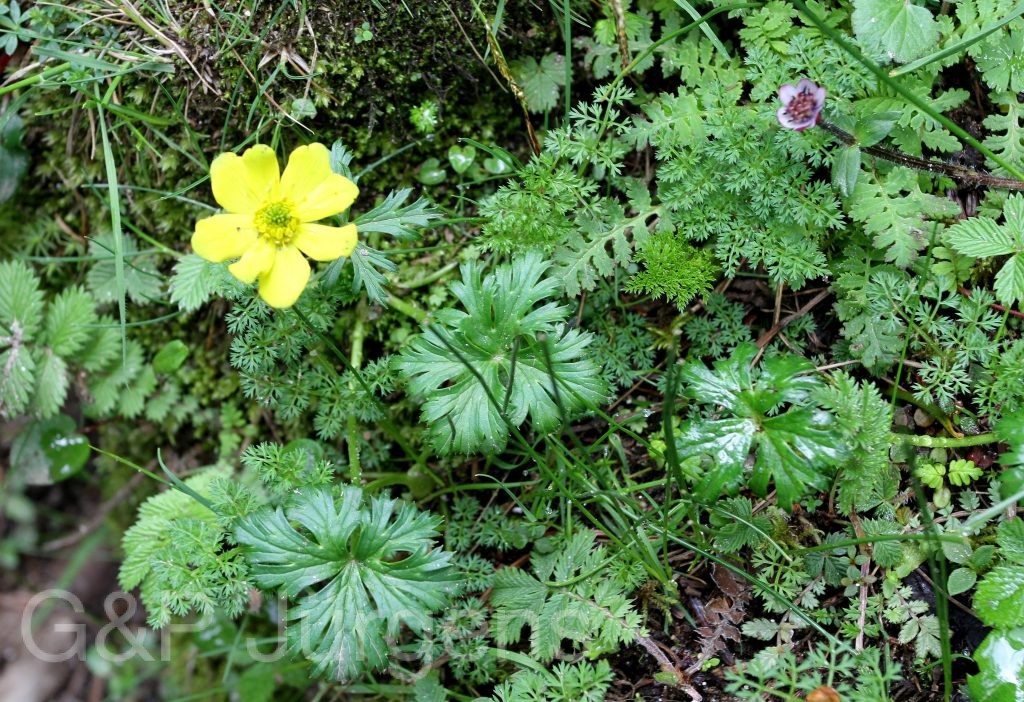
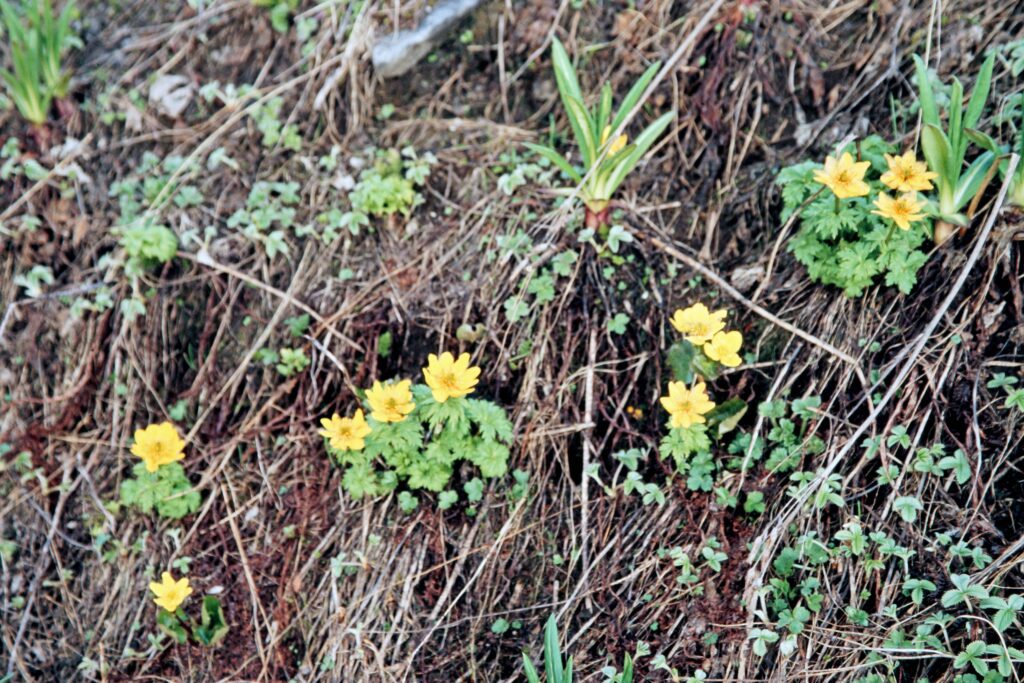
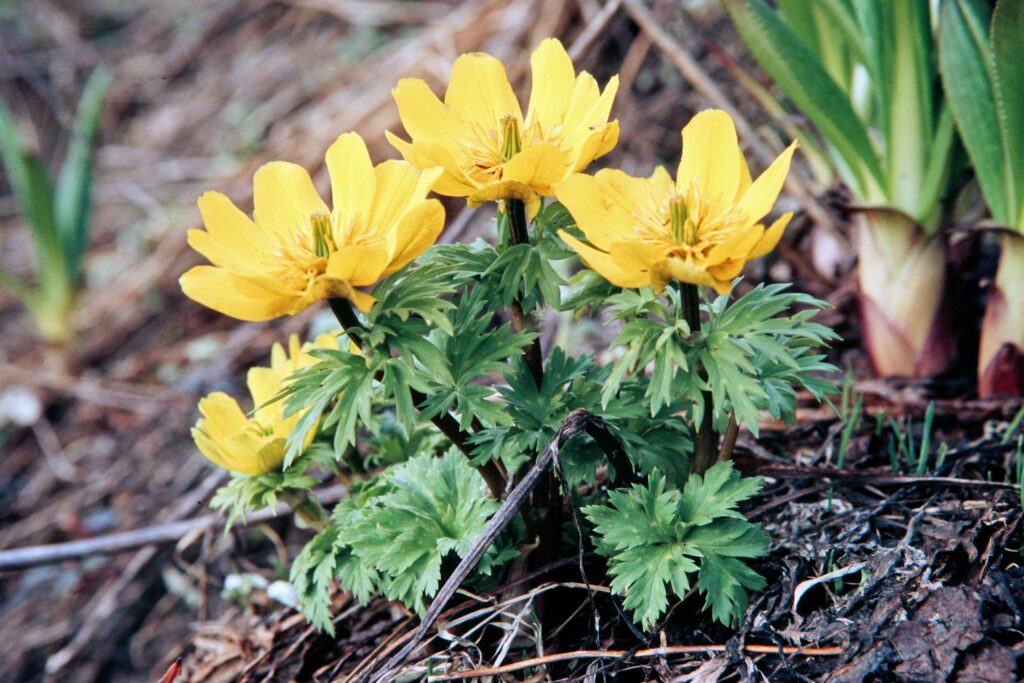
Trollius acaulis is a dwarf perennial of the high Himalaya, ranging along the alpine belt from Afghanistan and Pakistan through the western and central Himalaya into Nepal, Uttarakhand and Himachal Pradesh, and the western Tibetan Plateau in China. GBIF aggregates 188 georeferenced records, the species being strongest in the north-west. It grows in open alpine turf, moist grassy slopes, screes and snow-melt flushes, typically between 3000 and 4500 m. The plant photographed at Khiar Kutti in Garhwal at 3900 m in June is characteristic, flowering as the snow recedes.

It forms a compact, almost stemless herb arising from a short fibrous-rooted rhizome, the flowering stem reduced so the bloom appears to rest on the foliage (hence acaulis). The basal leaves are long-petiolate and palmately divided into deeply incised, toothed segments, glabrous and somewhat fleshy. The solitary flower is large, broadly cup-shaped and golden-yellow, the petaloid sepals enclosing numerous narrow nectariferous petals and a dense boss of stamens. The fruit is a head of many sessile, longitudinally veined follicles, each beaked and dehiscing ventrally to shed small angular seeds.

Within Ranunculaceae, Trollius (the globeflowers) is allied to Anemone and Ranunculus but set apart by its persistent petaloid sepals and clustered follicles. T. acaulis is among the most reduced, high-altitude members of the genus, its acaulescent habit an adaptation to short seasons, intense insolation and wind exposure. Like its congeners it yields acrid protoanemonin and is unpalatable to stock. Not assessed as threatened, it is nonetheless sensitive to overgrazing and the upward shift of climatic belts.

Author: Lindl. · Sources: POWO (Kew), GBIF, Flora of China Vol. 6, Flora of Pakistan, Flora of Bhutan Vol. 1, Annotated Checklist of the Flowering Plants of Nepal, Doroszewska monograph of the genus Trollius

D.Don

BhutanPG2011 332
Bhutan Jule-Tso 4250m, June

Description

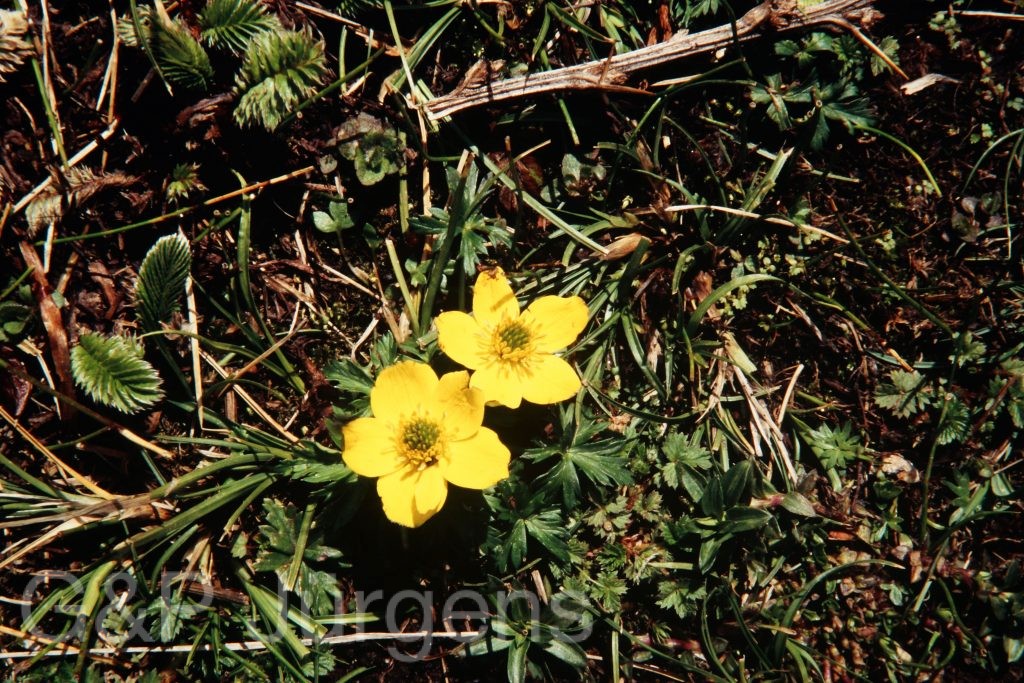
Trollius pumilus is a dwarf globeflower of the high alpine zone of the Himalaya and western China, native to China, Nepal, India and Bhutan, with over 520 georeferenced records (those reported from Europe, Canada and Japan representing cultivated and herbarium material). It grows in moist alpine meadows, on grassy and peaty slopes and beside snow-melt streams, typically between about 3500 and 4800 m. The photographed plant was recorded at Jule-Tso in Bhutan at 4250 m, flowering in June, early in the alpine growing season as snowbeds retreat and the high pastures come into bloom.

The species is a small, tufted perennial herb with a short rhizome and fibrous roots, the basal leaves long-petiolate with palmately three- to five-partite blades, the segments further lobed and toothed. The flowering stems are low, simple and few-leaved, bearing usually a single terminal flower. The flower is shallowly bowl-shaped and does not close into the globe characteristic of some congeners; the five or more petaloid sepals are bright golden-yellow, often flushed purplish or greenish outside, surrounding numerous small linear nectariferous petals (staminodes) and many stamens. The fruit is a cluster of several many-seeded follicles with short beaks.

Trollius, of the family Ranunculaceae and tribe Helleboreae, comprises the globeflowers of northern temperate and alpine regions; T. pumilus is among the smallest, distinguished by its open, single-flowered, low-growing habit. As an early snow-melt alpine it is insect-pollinated and a familiar component of Himalayan high-meadow flora. Widespread and locally abundant, it is of no conservation concern and is occasionally grown as an alpine ornamental.

Author: D.Don · Sources: POWO (Kew), GBIF, Flora of Bhutan, Flora of China, A Monograph of the Genus Trollius (Doroszewska)

(Bruehl) Dorosz.

BhutanPG2011 218
Bhutan Jimilangtso, 4000m June;
also included: Anemone rupestris Hook.f. & Thomson
Bh09 137 P239
Bhutan Jimilangtso, 4000m June

Description

Trollius sikkimensis is a high-alpine globeflower restricted to the eastern and central Himalaya, recorded from Nepal, China, Bhutan and India, with only about 31 georeferenced occurrences indicating a comparatively narrow and incompletely documented range. It inhabits moist alpine meadows, marshy turf, streamsides and the margins of glacial tarns between roughly 3500 and 4500 m. The photographed plants from Jimilangtso in Bhutan at 4000 m, flowering in June, exemplify its damp high-meadow habitat near alpine lakes, where it grows alongside other snowmelt herbs such as the Anemone rupestris noted from the same locality.

It is a glabrous perennial herb arising from a short rhizome, with erect, simple or sparingly branched stems. The basal leaves are long-petioled and palmately divided into deeply cut, toothed segments, the cauline leaves smaller and subsessile. The flowers are large and solitary or few, the showy part formed by several broad, spreading, golden-yellow petaloid sepals that open more widely than in the cupped European globeflowers; within are numerous narrow nectariferous petals and many stamens. The fruit is a head of many-seeded, beaked follicles.

Unlike the closed, globular flowers of Trollius europaeus, the open, saucer-shaped perianth of the Asian species facilitates access by a wider range of alpine pollinators. Trollius sikkimensis is closely allied to other Himalayan and Chinese globeflowers and is distinguished on perianth and follicle characters. Its restricted distribution and dependence on intact alpine wetlands make it potentially sensitive to grazing pressure and climatic warming.

Author: (Bruehl) Dorosz. · Sources: POWO (Kew), GBIF, Flora of Bhutan, Flora of China, Doroszewski's revision of Trollius

Oliv.

BhutanPG2011 698 01 01
Bhutan Luksor, 2850m July

Description

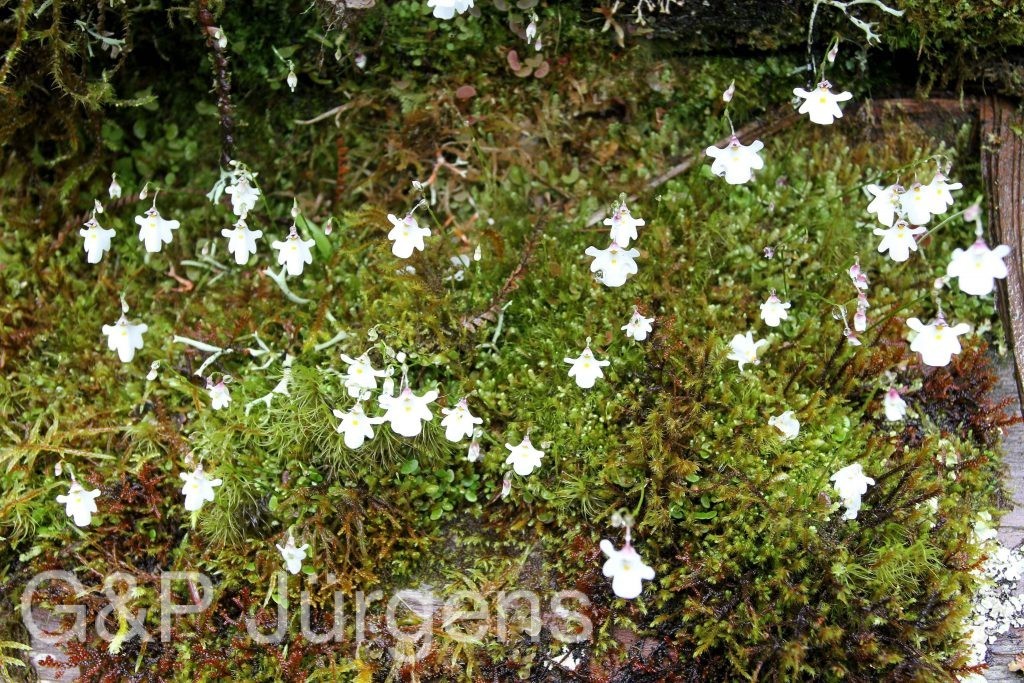
Utricularia brachiata is a small carnivorous herb of the Himalaya and adjacent mountains, recorded by GBIF (about 94 occurrences) from China, India, Nepal, Bhutan, Japan and Myanmar, a relatively modest tally reflecting both its inconspicuous habit and its specialised wet montane habitat. It is a terrestrial to subaquatic species of permanently moist ground: dripping rocks, mossy seepages, wet banks, boggy turf and the margins of springs and streams, generally between 2500 and 4000 m. The plant photographed at Luksor in Bhutan at about 2850 m in July grows in such a damp seepage habitat during the monsoon, the season when high humidity sustains the saturated substrates on which this bladderwort depends.

As in all members of the genus the vegetative body is much reduced and rootless, consisting of fine, thread-like stolons that ramify through the moss and wet soil. Borne on these are minute leaf-like organs and the diagnostic carnivorous traps: tiny bladders (utricles) that capture and digest microscopic soil and water invertebrates through a sophisticated suction mechanism triggered by sensory bristles. The flowering scape is slender and erect, bearing one to few small bilabiate flowers. The corolla is typically white to pale violet or bluish, with a prominent palate and a basal spur, the personate two-lipped form characteristic of the genus and adapted to small insect pollinators. The fruit is a tiny capsule releasing numerous minute seeds.

Lentibulariaceae are wholly carnivorous, and Utricularia, the bladderworts, is the largest and most widespread genus of carnivorous plants, its trap mechanism among the most morphologically refined in the plant kingdom. Carnivory allows U. brachiata to supplement nitrogen and phosphorus in the nutrient-poor, leached, waterlogged substrates it occupies, an adaptive strategy that defines its narrow ecological niche. Though not assessed as globally threatened, its dependence on intact high-altitude wetland seepages renders it locally sensitive to hydrological disturbance, drainage and the disruption of mountain spring systems.

Author: Oliv. · Sources: POWO (Kew), GBIF, Flora of China Vol. 19, Flora of Bhutan Vol. 2, Flora of Nepal, Taylor The Genus Utricularia: A Taxonomic Monograph

P. Taylor

Sikkim2003 80 P111
India Sikkim Choka 3100m, August

Description

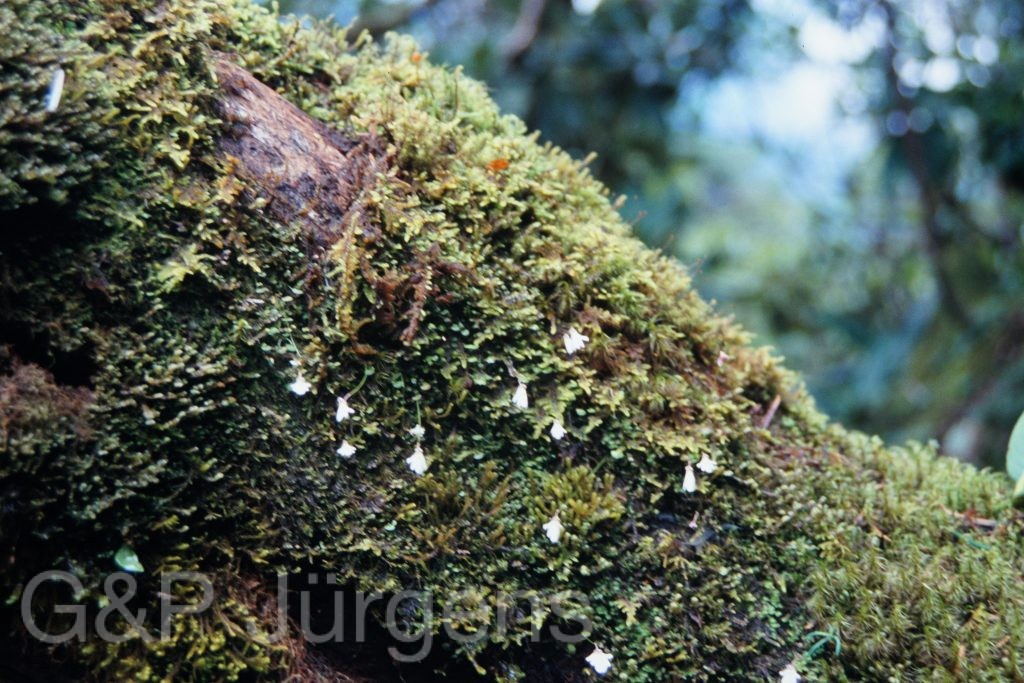
Utricularia christopheri P.Taylor is a small terrestrial bladderwort of the Lentibulariaceae, narrowly restricted to the eastern Himalaya. The very sparse GBIF record (only 14 occurrences) reflects its rarity and confined distribution across Nepal, north India, and Bhutan. It was photographed in Sikkim at Choka at 3,100 m in August, during the monsoon flowering season, in seepage-wet alpine and subalpine ground. The species grows on damp, mossy rocks, wet humic soil, and dripping banks at high elevations, where constant moisture sustains its carnivorous habit.

The plant is a diminutive, rootless herb with slender, creeping rhizoid stolons bearing numerous minute bladder-traps that capture protozoa and small soil invertebrates. The vegetative parts are inconspicuous, with small spathulate leaves. The flowering scape is erect and slender, bearing one to a few comparatively large violet to purplish flowers; the corolla is two-lipped and spurred, the lower lip prominent, distinguishing christopheri within the section to which it belongs by its floral proportions and high-montane ecology.

Utricularia, the largest carnivorous plant genus, is divided into numerous sections, and christopheri belongs to a small group of Himalayan terrestrial species. Its extreme rarity, narrow elevational band, and dependence on permanently wet microhabitats make it potentially vulnerable to hydrological disturbance and climate change, although its remoteness affords some protection. The species remains poorly collected, and its full range is likely undersampled.

Author: P. Taylor · Sources: POWO (Kew), Flora of Bhutan Vol. 2, Flora of Nepal, GBIF, Taylor: The Genus Utricularia – A Taxonomic Monograph (1989)

Decne.

Garh 07 119 ergebnis
India Garhwal Meggu Kichatti 3400m, June

Description

Valeriana pyrolifolia is a western Himalayan valerian distributed from Pakistan (northern areas, Azad Kashmir) through northwestern India (Kashmir, Himachal Pradesh, Uttarakhand). GBIF records 100 occurrences, predominantly from India and Pakistan. The species grows in subalpine meadows, grassy slopes, open scrub, and forest clearings at elevations of 2,800–4,200 m. The photograph from Meggu Kichatti in the Garhwal Himalaya at 3,400 m, taken in June, documents the species at a typical mid-range elevation during its early summer flowering period.
The plant is a perennial herb, 15–40 cm tall, arising from a stout, aromatic rhizome. Basal leaves are distinctive and diagnostic: simple, broadly ovate to orbicular, 3–7 cm long, with entire or obscurely crenate margins, glabrous, somewhat coriaceous, resembling the leaves of Pyrola — hence the specific epithet pyrolifolia. The basal leaves are long-petiolate, forming a conspicuous rosette. Cauline leaves are few, reduced, sessile, and sometimes pinnately lobed with 1–2 pairs of small lateral segments. The inflorescence is a compact, terminal, corymbose cyme that expands in fruit. Flowers are small, 3–5 mm long, funnel-shaped, white to pale pink, with three stamens and an inferior, unilocular ovary. The fruit is a small achene, 2–3 mm long, crowned by a feathery, plumose pappus derived from the accrescent calyx, aiding wind dispersal.
Valeriana pyrolifolia is readily distinguished from other Himalayan valerians by its entire, pyrola-like basal leaves, in contrast to the pinnately divided foliage typical of most congeners. The genus Valeriana, now placed in Caprifoliaceae following APG classifications (formerly Valerianaceae), is represented by numerous species in the Himalayan alpine zone. V. pyrolifolia is not currently considered threatened, though its relatively restricted western Himalayan range and dependence on subalpine grassland habitats merit monitoring in the context of climate change.

Author: Decne. · Sources: POWO (Kew), GBIF, Flora of Pakistan Vol. 150, Duthie: Flora of the Upper Gangetic Plain, Naithani: Flora of Chamoli Vol. 1

L.

Bh09 357 P574
Bhutan Wangdi, 2400m June

Description

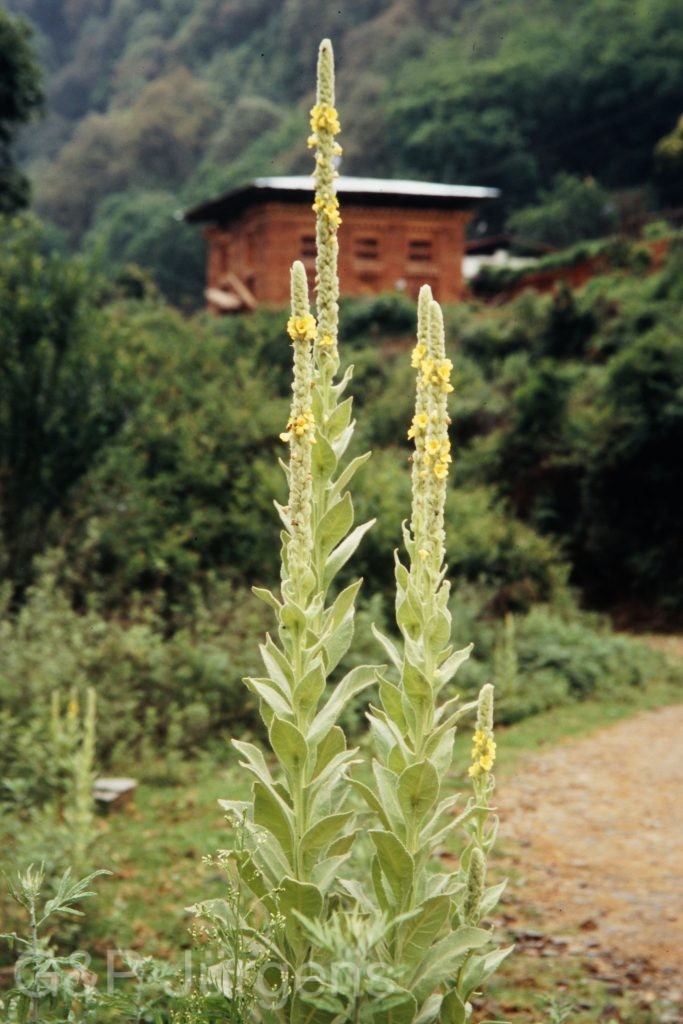
Verbascum thapsus L., common or great mullein, is a robust biennial herb native to Europe and western Asia and now one of the most widely naturalised plants on Earth. The enormous GBIF dataset (over 340,000 occurrences) reflects its near-cosmopolitan spread across North America, Europe, Australia, New Zealand and temperate Asia, including the Himalaya. It is a pioneer of open, disturbed, well-drained sites: roadsides, pastures, river gravels, fallow ground and waste places. The plant photographed at Wangdi in Bhutan at 2,400 m in June illustrates its successful establishment in the warm-temperate Himalayan valleys, where it behaves as a ruderal colonist of disturbed terrain.

In its first year the plant forms a dense basal rosette of large, oblong to obovate leaves; in the second it produces a stout, usually unbranched flowering stem up to 2 m tall. The whole plant is densely covered with soft, branched, stellate-woolly hairs giving a greyish, felted appearance and reducing water loss and herbivory. Leaves are decurrent along the stem. The inflorescence is a long, dense, spike-like raceme of yellow flowers; each flower has a five-lobed, slightly irregular rotate corolla and five stamens, the upper three with woolly white or yellowish filament hairs. The fruit is an ovoid septicidal capsule packed with very numerous minute seeds.

A single plant can produce hundreds of thousands of long-lived seeds, underpinning its weediness and its classification as an invasive species in parts of North America and Australasia. The placement of Verbascum has shifted between Scrophulariaceae and a narrowly circumscribed family in modern phylogenetic systems, but it is most often retained in Scrophulariaceae sensu APG. Long used in traditional medicine for respiratory complaints, it remains of pharmacological and ecological interest as a model colonising ruderal.

Author: L. · Sources: POWO (Kew), Flora of Pakistan, Flora of China Vol. 18, GBIF, Murbeck: Monographie der Gattung Verbascum (1933)

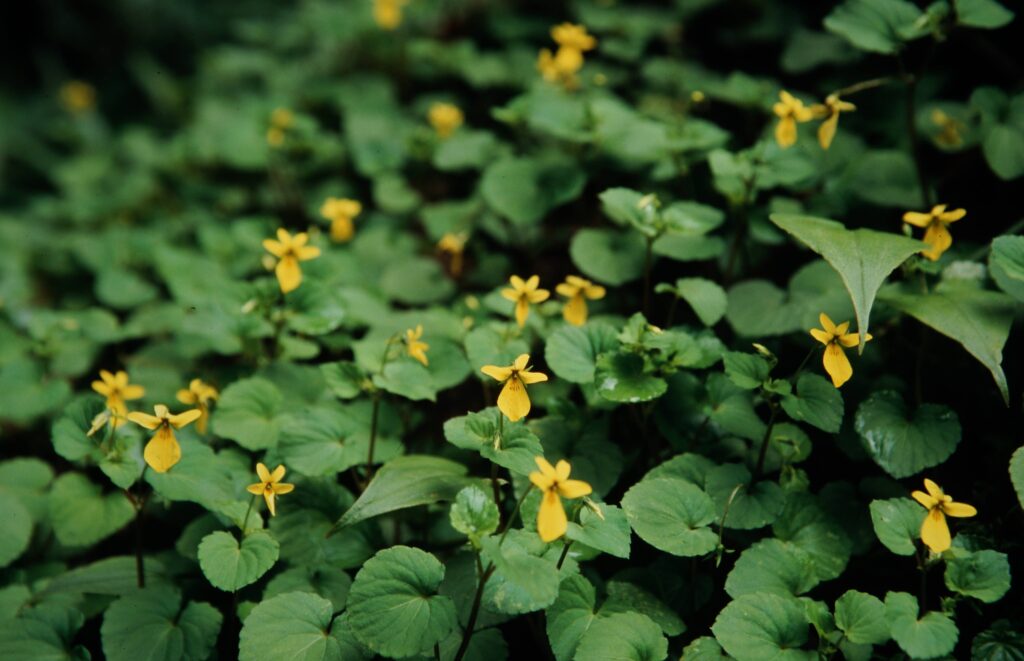
Ging.

Sikkim2011 165
Sikkim Vista-valley 2500m, June
Sikkim2011 167
Sikkim Vista-valley 2500m, June
Sikkim 2006 460 ergebnis
India West-Bengal, Ruigi-Chu 2100m, May

Description

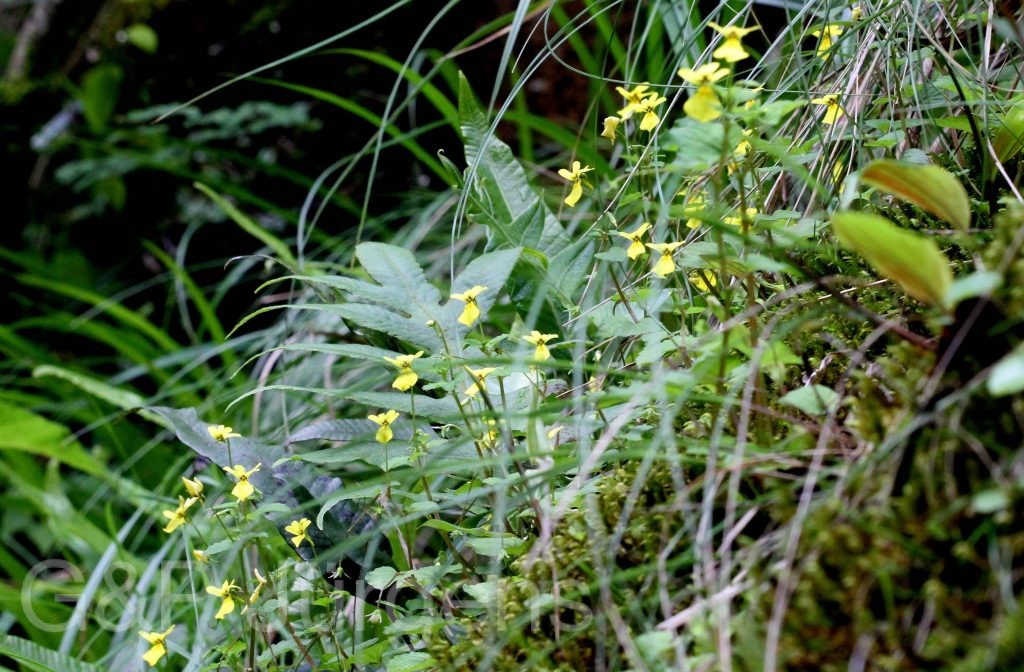
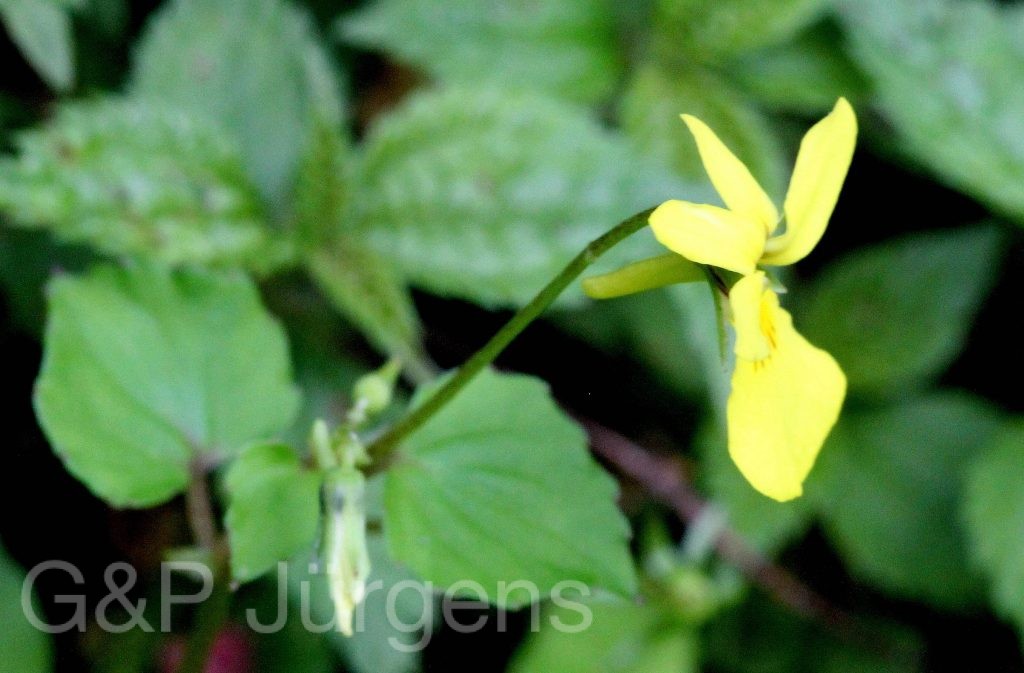
Viola wallichiana is a small perennial herb of the Himalaya, distributed through Nepal, northern India, Sikkim, Bhutan and southwestern China, with peripheral or introduced records noted from Australia; GBIF holds about 79 collections, reflecting a relatively localised eastern Himalayan range. It grows in shaded, moist temperate forest, on mossy banks, humus-covered slopes and shaded rock ledges, typically between about 2000 and 3000 m. The photographed plants were found in Sikkim's Vista valley at around 2500 m in June and in the West Bengal hills at Ruigi-Chu near 2100 m in May, on the cool, sheltered, leaf-littered forest floor it inhabits through late spring and the early monsoon.

The plant is a low, stemless to short-stemmed perennial arising from a slender rhizome, sometimes spreading by short stolons. The leaves are basal or nearly so, long-petiolate, the blade ovate to cordate or reniform with a crenate margin and conspicuous fringed stipules. The flowers are solitary on slender axillary peduncles, zygomorphic and spurred in typical violet fashion, pale violet to bluish or whitish with darker veining on the lower petal, the spur short. Cleistogamous flowers may also be produced. The fruit is a small loculicidal capsule that splits into three valves, ejecting the seeds elastically.

Viola (Violaceae) is a large, cosmopolitan genus, and V. wallichiana belongs to the temperate Himalayan group of rosulate, spurred-flowered violets, commemorating Nathaniel Wallich. Its cordate basal leaves, fringed stipules and pale veined flowers distinguish it from congeners. It is a typical understorey forb of mid-elevation forest, locally common but not assessed as threatened.

Author: Ging. · Sources: POWO (Kew), GBIF, Flora of China Vol. 13, Flora of Bhutan Vol. 2, Flora of Nepal, Flora of Pakistan, Becker conspectus of Himalayan Viola

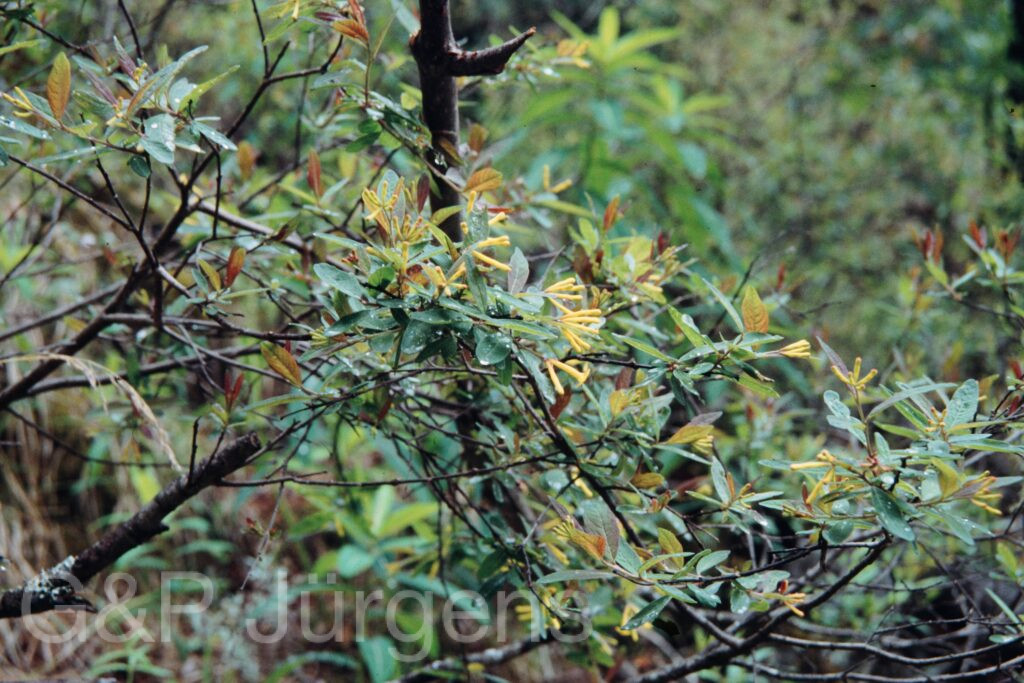
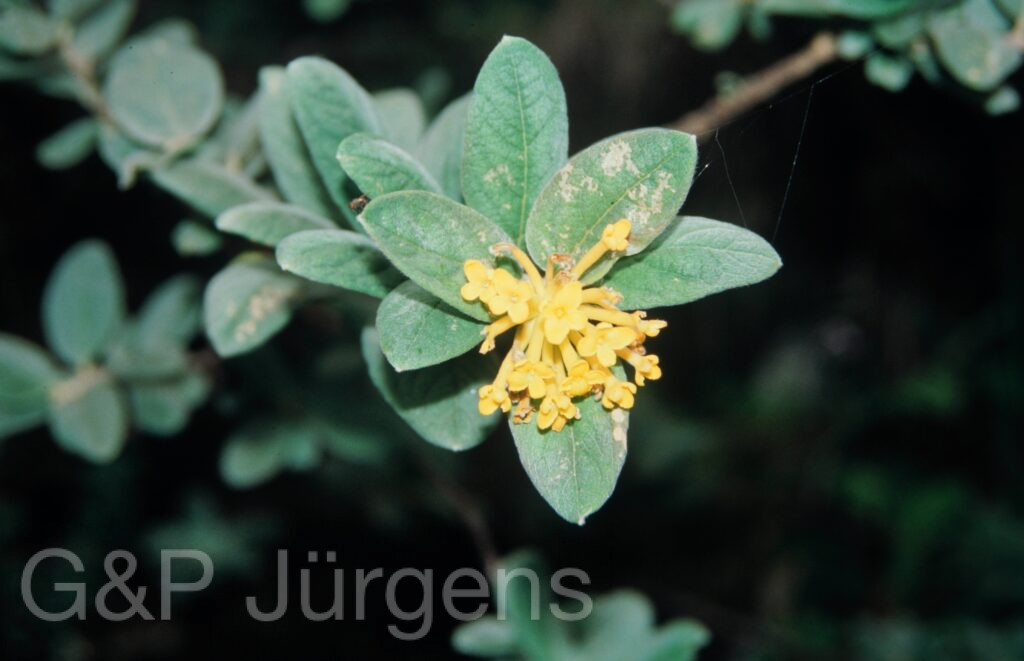
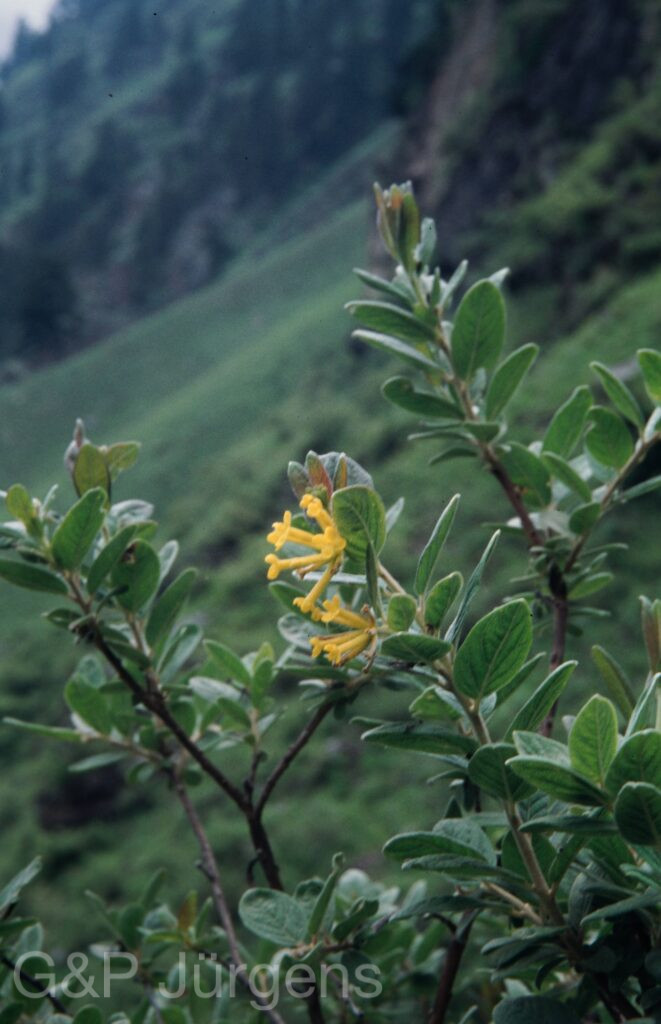
Meisn.

Nepal 99 57 ergebnis
West-Nepal Nyor Gaad 2700m, June
Nepal 99 935 ergebnis 1
West-Nepal Suli-Khola 2700m, July
Nepal 99 933 ergebnis
West-Nepal Ski-Khola 2700m, July
Garw 2005 236 ergebnis ergebnis
India Garhwal Guni 2350m, September

Description

Wikstroemia canescens (Meisn.) is a Himalayan to East Asian shrub of the family Thymelaeaceae, distributed from Pakistan and the northwest Himalaya through India, Nepal and Myanmar to China, Sri Lanka and Japan. The fewer than 600 GBIF records indicate a scattered but characteristically montane occurrence. It inhabits open slopes, forest margins, scrubland and rocky banks in the temperate zone, generally between 1,500 and 3,000 m. The several West Nepal localities at around 2,700 m, recorded from June through July, together with the Garhwal collection from Guni at 2,350 m in September, span its full flowering and fruiting season across the central and western Himalaya.

The plant is an erect, branching shrub up to about 2 m tall, with tough, fibrous bark and young branchlets covered in a fine greyish pubescence, hence the epithet canescens. The leaves are subopposite to alternate, shortly petiolate, elliptic to oblong-lanceolate, entire-margined and somewhat silky beneath. The small, tubular flowers lack petals and consist of a yellow to greenish-yellow, four-lobed calyx tube; they are clustered in short, terminal, head-like or umbellate inflorescences. The fruit is a small, dry to fleshy drupe.

Like many Thymelaeaceae, Wikstroemia canescens possesses an exceptionally strong inner bark rich in long fibres, and in the Himalaya it is used locally for cordage and in the traditional manufacture of hand-made paper, a use shared with the related Daphne species. The genus is closely allied to Daphne, the two differing chiefly in floral merosity and indumentum, and generic boundaries within the group remain debated. The species is widespread and not currently considered threatened.

Author: Meisn. · Sources: POWO (Kew), Flora of Nepal, GBIF, Flora of China Vol. 13, Halda: The Genus Daphne and allied Thymelaeaceae (2001)