Tag:

Tibet

Flowers of Tibet — 70 high-altitude species from the Tibetan plateau and its Himalayan borderlands, adapted to cold, arid and intensely sunlit alpine conditions. The Tibetan flora is distinctive for its cushion plants, saussureas, gentians and alpine poppies. Each entry includes a botanical description, distribution, habitat and flowering season with the original field photograph and altitude.

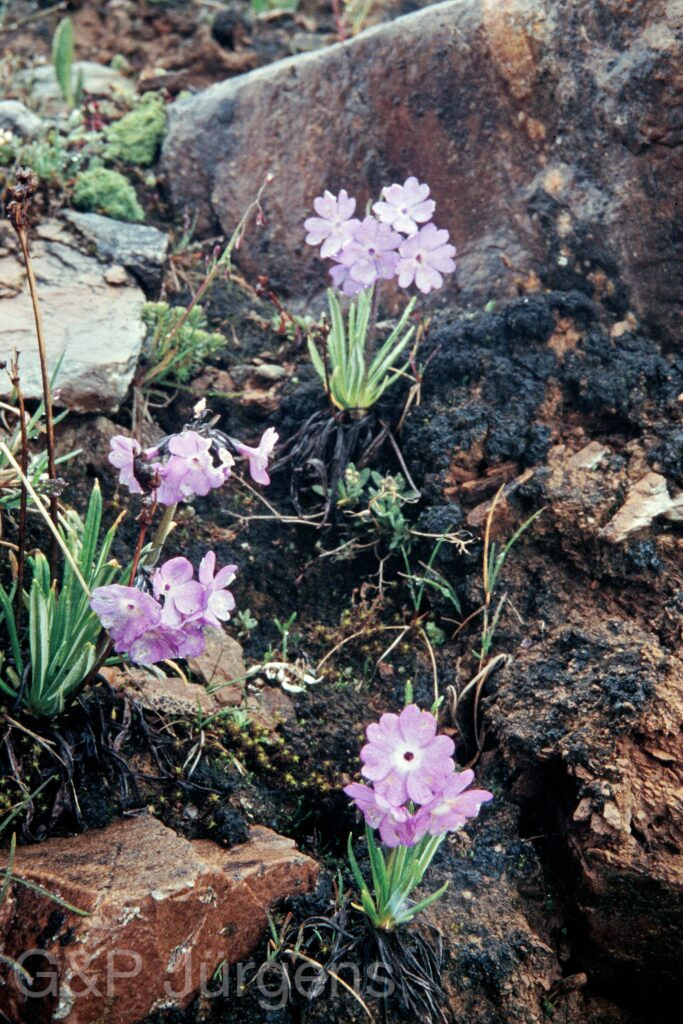
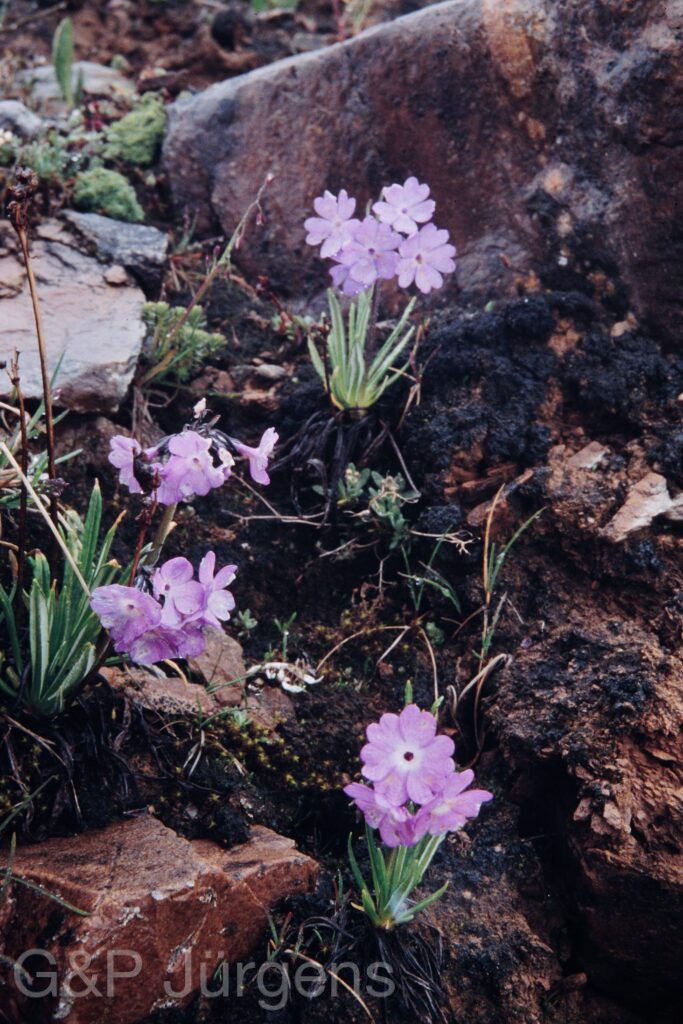
Primula glabra

by GP Jürgens

Klatt

Bhutan2014 920
Bhutan Chele-La 4000m, May
Bhutan2014 1014
Bhutan Chele-La 4000m, May
Bh2008 570 P857
Bhutan Chele-La, 3950m June

Description

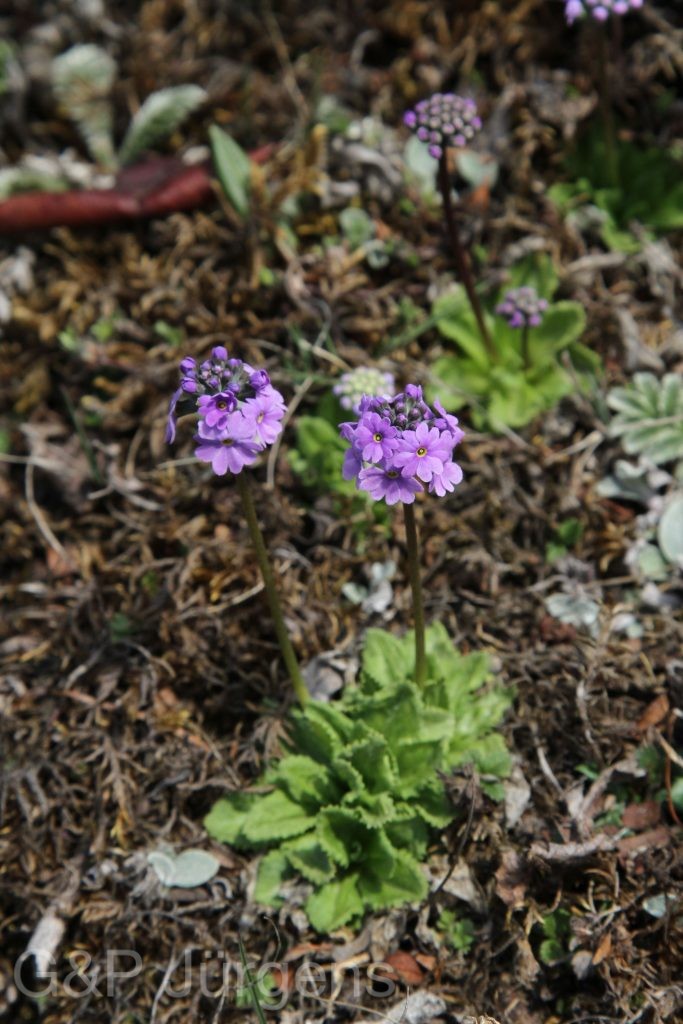
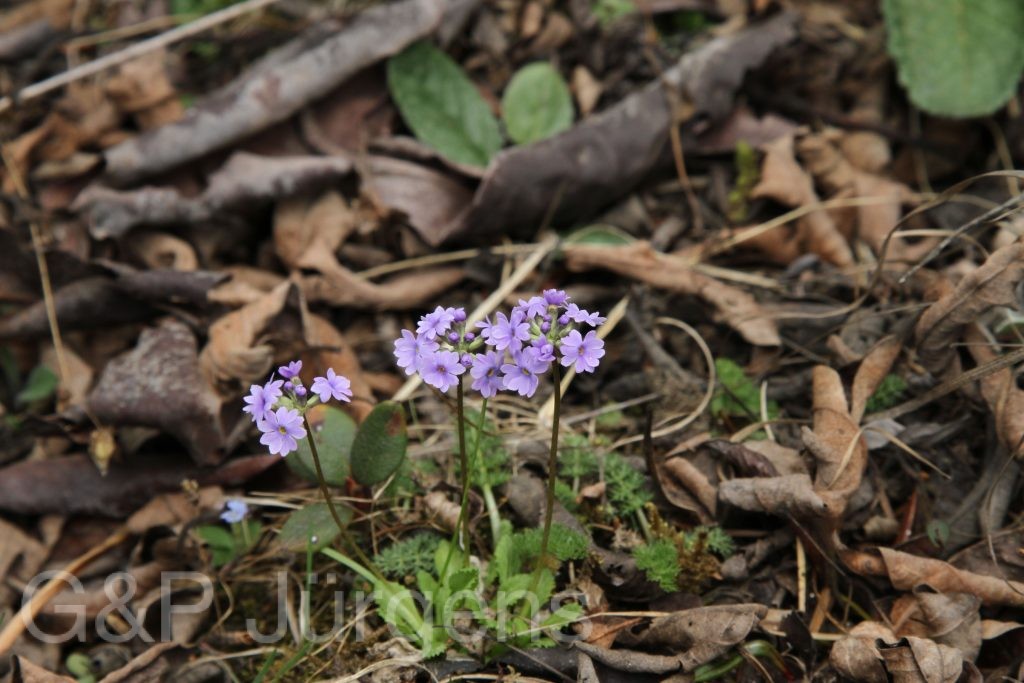
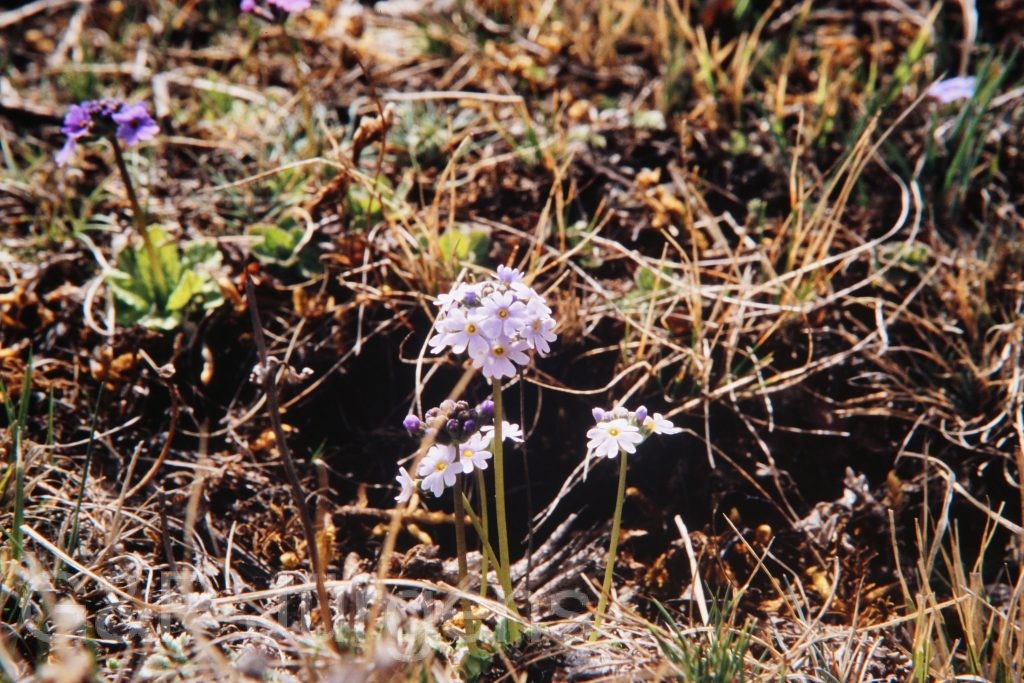
Primula glabra is a dwarf alpine primrose of the eastern Himalaya, distributed through China (south-eastern Tibet), Nepal, India, Bhutan and Myanmar, with GBIF logging 196 occurrences across this Sino-Himalayan zone. It is a plant of high alpine turf, moist meadows, rocky slopes, snowmelt flushes and damp gravelly ground above the treeline, broadly between 3800 and 4500 m. The photographed plants from the Chele-La pass in western Bhutan, at 3950-4000 m flowering in May and June, exemplify its preference for cold, open, snow-influenced alpine sites where it blooms among rocks and short turf as the snow melts in early summer.

The species is a small, glabrous (hence the epithet), tufted perennial herb, lacking the farinose (mealy) coating found in many alpine primulas. The leaves form a basal rosette and are oblanceolate to spathulate, entire to finely toothed, narrowing into an indistinct petiole. Flowers are borne in a compact terminal umbel atop a short scape, or sometimes nearly sessile among the leaves. Each flower has a tubular calyx and a salverform corolla, typically pink to purplish or violet with a contrasting paler or yellowish eye, the limb spreading into five notched lobes. The species is heterostylous, producing pin and thrum flowers. The fruit is a small capsule dehiscing to release numerous minute seeds.

Described by Klatt, the species belongs to the vast genus Primula, within the alpine sections (allied to section Minutissimae or related dwarf cushion groups) that radiated extensively across the high Sino-Himalaya. Its heterostylous breeding system promotes outcrossing by long-tongued alpine insects. As a specialist of high, snow-fed alpine habitats it is potentially vulnerable to climatic warming and upslope habitat compression, though its broad regional range currently buffers it; it remains formally unassessed.

Author: Klatt · Sources: POWO (Kew), GBIF, Flora of China, Flora of Bhutan, The Genus Primula in Cultivation and the Wild (Richards)
(Wall. ex Klatt) W.W. Sm. & H.R. Fletcher

Nepal 99 616 ergebnis
West-Nepal Kagmara-La 4300m, July
Nepal 99 617 ergebnis
West-Nepal Kagmara-La 4300m, July

Description

Primula macrophylla var. moorcroftiana is a high-alpine perennial distributed across the western and central Himalaya and adjoining Central Asian ranges, with GBIF documenting some 172 occurrences from India, Nepal, Pakistan, Tajikistan, Uzbekistan and China (Tibet). It inhabits open alpine meadows, moist screes, grazed turf and the margins of snowmelt flushes, typically between 3500 and 5000 m. The photographed plant was recorded at the Kagmara-La in West Nepal at 4300 m in July, a phenology typical of the taxon, which flowers as the snow recedes on cool, humus-rich substrates kept moist through the early monsoon.

The plant forms a stout rosette arising from a short rhizome clothed in persistent leaf-bases and farinose remains. The leaves are large for the genus, oblong-lanceolate to elliptic, entire to obscurely toothed, tapering gradually to a winged petiole and frequently coated beneath with white or yellowish farina. The scape is erect and conspicuously mealy, bearing a dense terminal umbel of several heterostylous flowers. The corolla is funnelform with a slender tube exceeding the campanulate calyx, the limb violet to purple with a paler or yellow eye and notched lobes. The fruit is a cylindrical capsule dehiscing by apical valves to release numerous small angular seeds.

Placed in Primula sect. Crystallophlomis (the nivalis alliance), the variety moorcroftiana is distinguished from typical P. macrophylla by its larger, more farinose foliage and robust habit. GBIF retains the name as accepted. As a snowbed and meadow specialist, it is sensitive to altered snow-lie and intensified summer grazing, though its broad transmontane range buffers it against immediate threat.

Author: (Wall. ex Klatt) W.W. Sm. & H.R. Fletcher · Sources: POWO (Kew), GBIF, Flora of Pakistan, Annotated Checklist of the Flowering Plants of Nepal, Smith & Fletcher monograph of Primula

W.W.Sm.

Sikkim2011 353
Sikkim, Lada-La 3900m, June

Description

Primula tsariensis is an alpine perennial endemic to the eastern Himalaya, with a distribution centred on the borderlands of Bhutan, southern Xizang (Tibet) and adjacent NE India, and recorded from Sikkim, where the photographed plant was found near the Lada-La pass at about 3,900 m in June. GBIF documents this distribution across Bhutan (BT), China (CN) and India (IN) on the basis of roughly 67 occurrence records. It is a plant of the upper alpine zone, frequenting moist turf, scree margins and seepage slopes among dwarf rhododendron, typically between 3,800 and 4,500 m.

The species forms a small rosette-forming herb arising from a short rhizome with fibrous roots. The leaves are oblanceolate to spathulate, narrowed to a winged petiole, with a crenate to denticulate margin and an efarinose to thinly farinose surface. The slender scape bears a terminal umbel of few flowers; the calyx is tubular-campanulate and divided into narrow lobes, while the corolla is violet to purple-blue with a paler or yellowish eye, the limb of five obcordate, emarginate lobes spreading from a narrow tube. The species is heterostylous, producing pin and thrum forms, and the fruit is a small capsule shorter than or equalling the persistent calyx, dehiscing to release numerous angular seeds.

Primula tsariensis belongs to the section Petiolares, a complex and taxonomically intricate assemblage of Sino-Himalayan primulas distinguished by their farinose tissues and early-spring flowering close to the receding snow. Its narrow range across the Assam Himalaya and southern Tibet makes it a useful biogeographic marker of this high-rainfall sector. Although not formally assessed as threatened, such localised alpine endemics are inherently vulnerable to climate-driven upward shifts of the snowline and to habitat disturbance from grazing.

Author: W.W.Sm. · Sources: POWO (Kew), Flora of China Vol. 15, Flora of Bhutan Vol. 2, GBIF, John Richards: Primula (2003)

Prunus rufa

by GP Jürgens

Wall. ex Hook.f.

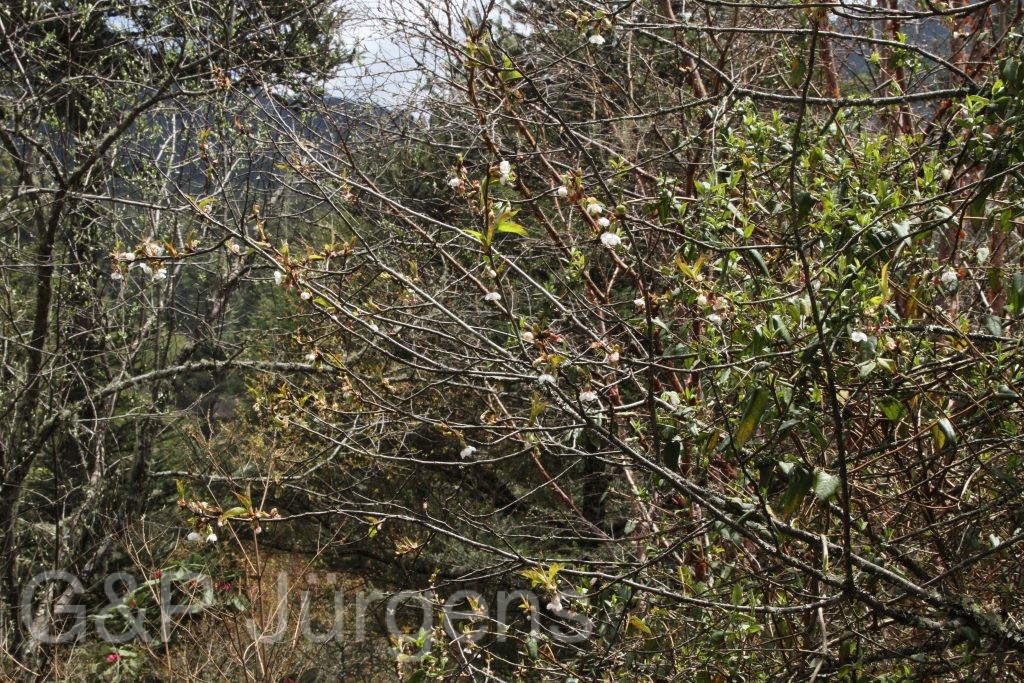
Bhutan2014 434
Bhutan Pele-La 3000m, May
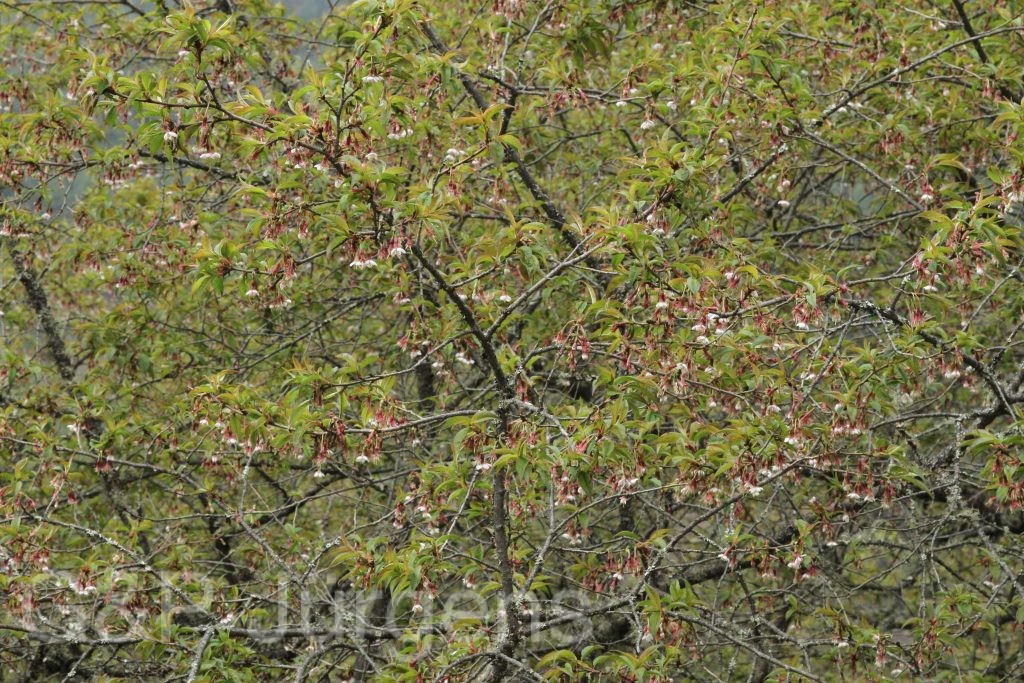
Bhutan2014 543
Bhutan Pele-La 3000m, May

Description

Prunus rufa, the Himalayan cherry, is a small tree of the eastern Himalaya, distributed through Nepal, Bhutan, northern India, China (south-eastern Tibet) and Myanmar, with GBIF logging 290 occurrences concentrated along this Sino-Himalayan belt. It grows in cool temperate and sub-alpine forest, on open slopes, forest margins and in mixed conifer-broadleaf woodland, broadly between 2700 and 3700 m. The photographed plant from the Pele-La pass in central Bhutan at about 3000 m, flowering in May, illustrates its spring blossoming as new growth emerges in the high passes, where it is valued for its striking bark and early flowers.

The species is a deciduous tree, often 5-12 m tall, conspicuous for its smooth, glossy, coppery to reddish-brown peeling bark, which gives rise to the epithet rufa. Young shoots and leaf undersides are clothed in distinctive rusty (rufous) hairs. The alternate leaves are ovate to elliptic, serrate at the margin, acuminate and short-petiolate. The flowers are solitary or in small clusters, opening with the young foliage; each is pentamerous with five white to pale pink petals, numerous stamens and a single carpel seated in a cupular hypanthium. The fruit is a small ovoid drupe, ripening reddish, with a thin flesh surrounding a single hard stone (endocarp).

Described by Wallich ex Hooker, the species belongs to genus Prunus subgenus Cerasus (the true cherries), within Rosaceae subfamily Amygdaloideae. Its rusty indumentum and burnished bark are diagnostic and make it a notable ornamental, cultivated in temperate gardens for its bark and spring flower. The drupes provide food for birds and mammals, aiding seed dispersal. With a broad Himalayan range it is not globally threatened, though high-elevation forest fragmentation and logging may locally reduce populations.

Author: Wall. ex Hook.f. · Sources: POWO (Kew), GBIF, Flora of China, Flora of Bhutan, The Plant Hunter's Guide to Asian Prunus (Cerasus monograph)

D. Don

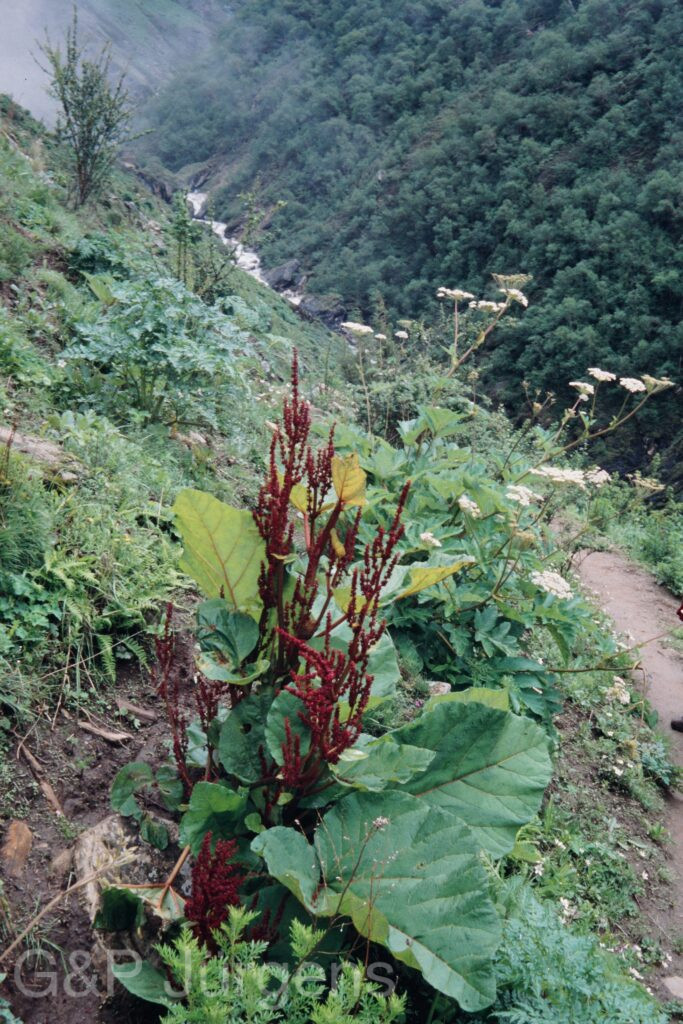
Nepal 99 583 ergebnis
West-Nepal Garpung-Khola 3500m, July

Description

Rheum australe, the Himalayan rhubarb, ranges along the Himalaya from Pakistan through India, Nepal and Bhutan into south-western China (Tibet), with the bulk of its roughly 210 GBIF records falling within this arc; occurrences in Germany, the United States, France, Belgium, Norway, Romania and Sweden derive from cultivation and herbarium accessions. It grows on open alpine and subalpine slopes, in moist rocky meadows, along stream banks and amid boulder fields, generally between 3000 and 4300 m. The photographed plant from the Garpung-Khola valley of West Nepal at 3500 m in July reflects its typical mid-summer growth on damp, high-elevation slopes.

It is a robust, tall perennial herb arising from a thick, woody, reddish rhizome and stout root. The large basal leaves are broadly ovate to orbicular-cordate, with palmate venation, an entire to undulate margin and long, reddish, fleshy petioles. The erect, hollow, often reddish flowering stem reaches one to two metres and bears a large, branched, paniculate inflorescence of small flowers with a dark red to purplish perianth of six segments. The fruit is a broadly winged, ovate-elliptic trigonous achene, the three reddish wings aiding wind dispersal across open terrain.

Rheum australe (long known as R. emodi) is the principal medicinal rhubarb of the Himalaya, its rhizome rich in anthraquinones and valued in traditional systems for digestive and purgative use. Sustained harvesting for the herbal trade, combined with slow regeneration in the alpine zone, has raised conservation concern, and the species is regarded as vulnerable to over-collection across parts of its range, prompting cultivation efforts.

Author: D. Don · Sources: POWO (Kew), GBIF, Flora of China, Flora of Bhutan, Annotated Checklist of the Flowering Plants of Nepal, Rheum (rhubarb) taxonomic monograph

H. Ohba

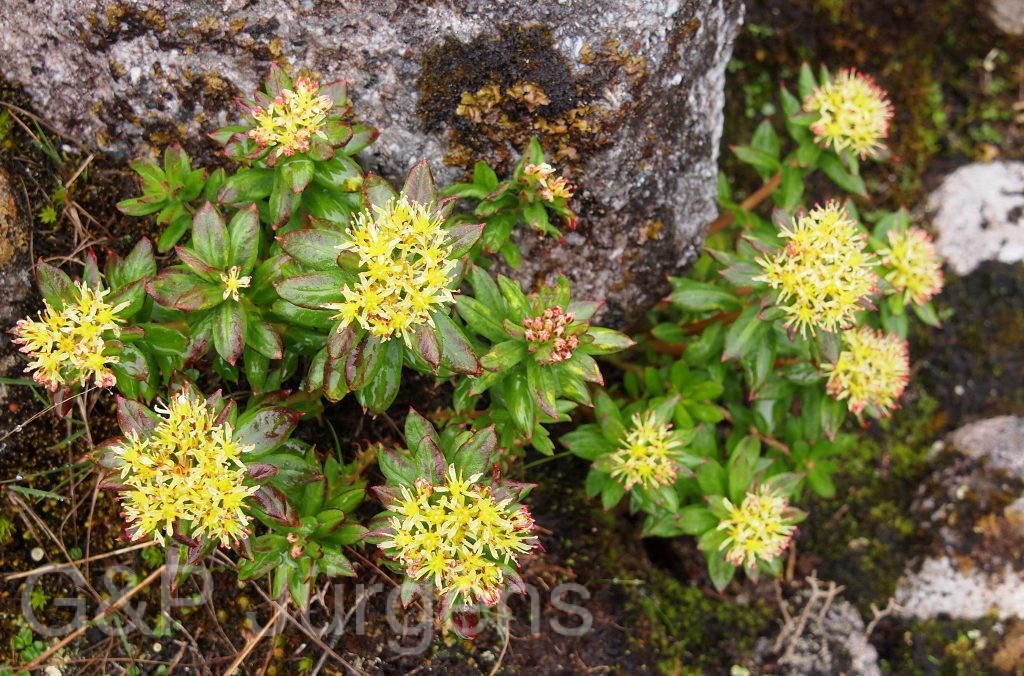
BhutanPG2011 518
Bhutan Dem-Tso, 4500m June

Description

Rhodiola sherriffii is a rare, narrowly distributed alpine succulent of the Eastern Himalaya, recorded from Bhutan, the adjacent Indian states (Sikkim, Arunachal Pradesh), Nepal and southern Tibet (China); GBIF documents only about 20 occurrences, underscoring its restricted range and the relative inaccessibility of its habitat. It is a plant of the high alpine zone, typically growing above 4000 m, as illustrated near Dem-Tso in Bhutan at 4500 m, where it occupies open stony slopes, glacial moraine, rock crevices and gravelly fellfield. Like other members of the genus it tolerates intense insolation, frost and a short growing season, flowering in early summer (June) as snow recedes.

It is a small, glabrous, glaucous perennial herb arising from a thick, woody, scaly caudex and rootstock. Several short, erect or ascending flowering stems bear numerous fleshy, succulent leaves that are entire to obscurely toothed, sessile, oblong to obovate and crowded along the stem. The inflorescence is a dense, terminal, corymbose to capitate cyme. The flowers are usually unisexual (the genus being dioecious), 4-5-merous, with petals and sepals that are commonly dark red to purplish; the carpels are erect, maturing into small, erect follicles containing numerous minute seeds.

Named for the plant collector George Sherriff, who with Frank Ludlow explored Bhutan and southeastern Tibet, the species belongs to a Himalayan complex of red-flowered Rhodiola allied to R. bupleuroides and R. coccinea. The genus Rhodiola was segregated from Sedum on the basis of its perennial scaly caudex and predominantly dioecious flowers. Many Rhodiola species accumulate medicinally valued secondary metabolites and are harvested as adaptogens, exposing the genus to collection pressure. Given its small population number and high-elevation habitat, R. sherriffii is potentially vulnerable to climate-driven habitat contraction, though it has not been formally assessed.

Author: H. Ohba · Sources: POWO (Kew), GBIF, Flora of Bhutan, Flora of China, Ohba's monograph of Himalayan Crassulaceae (Rhodiola)

Balf. f.

Sikkim2011 204
Sikkim Lachung 3100m, June
Sikkim2011 205
Sikkim Lachung 3100m, June
Sikkim2004 435 P758
Sikkim/India Lachung 3600m May

Description

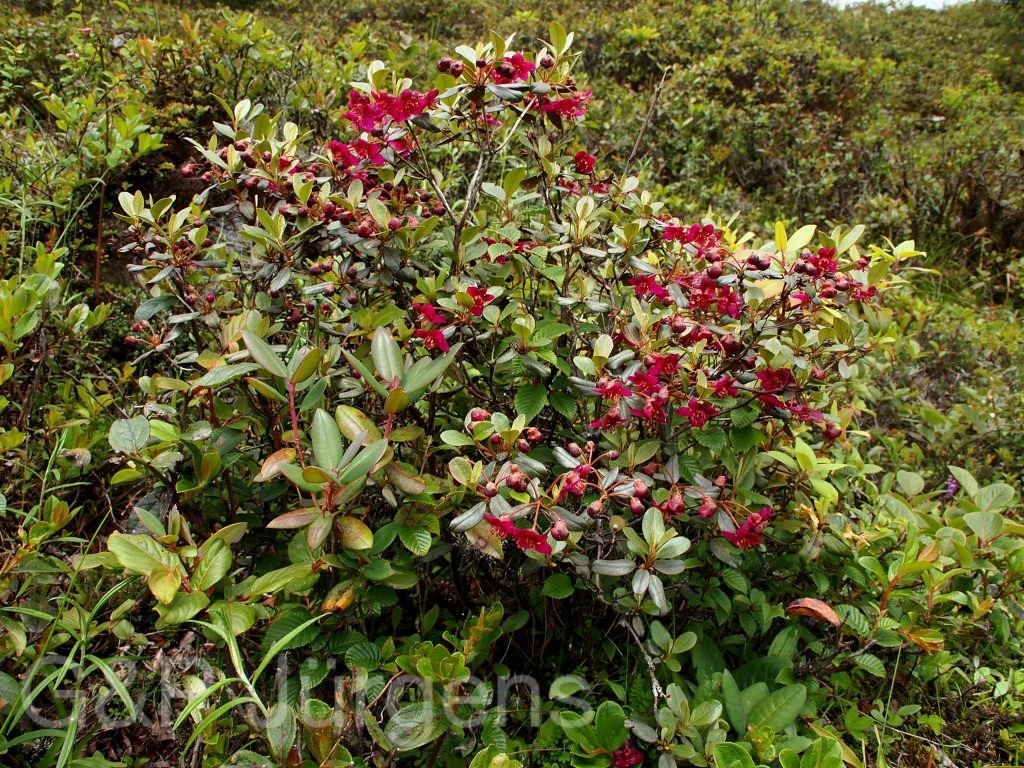
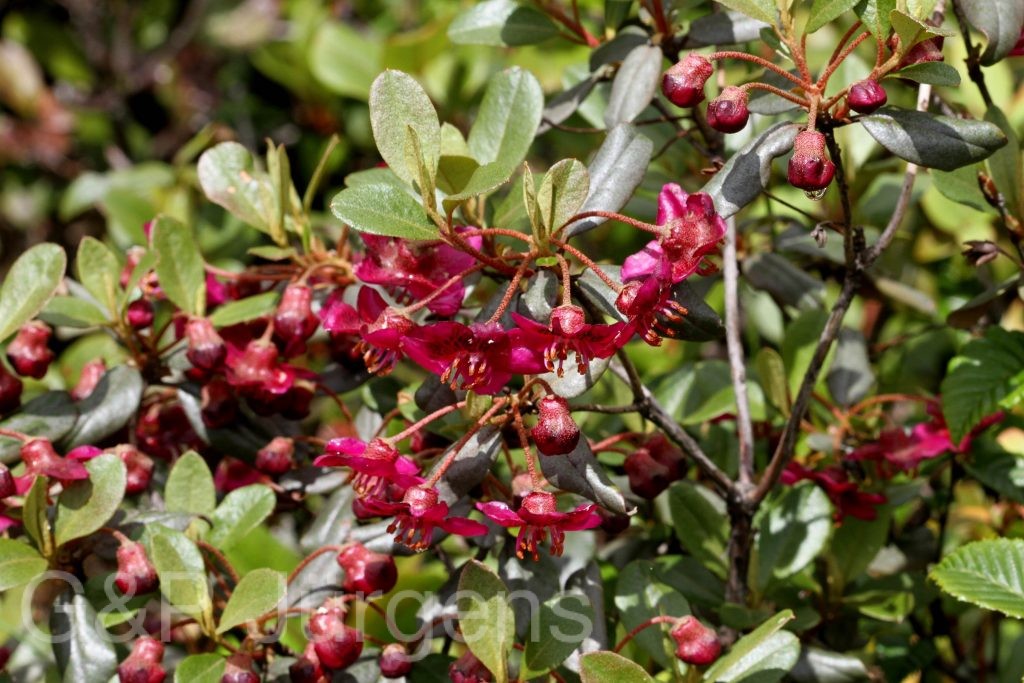
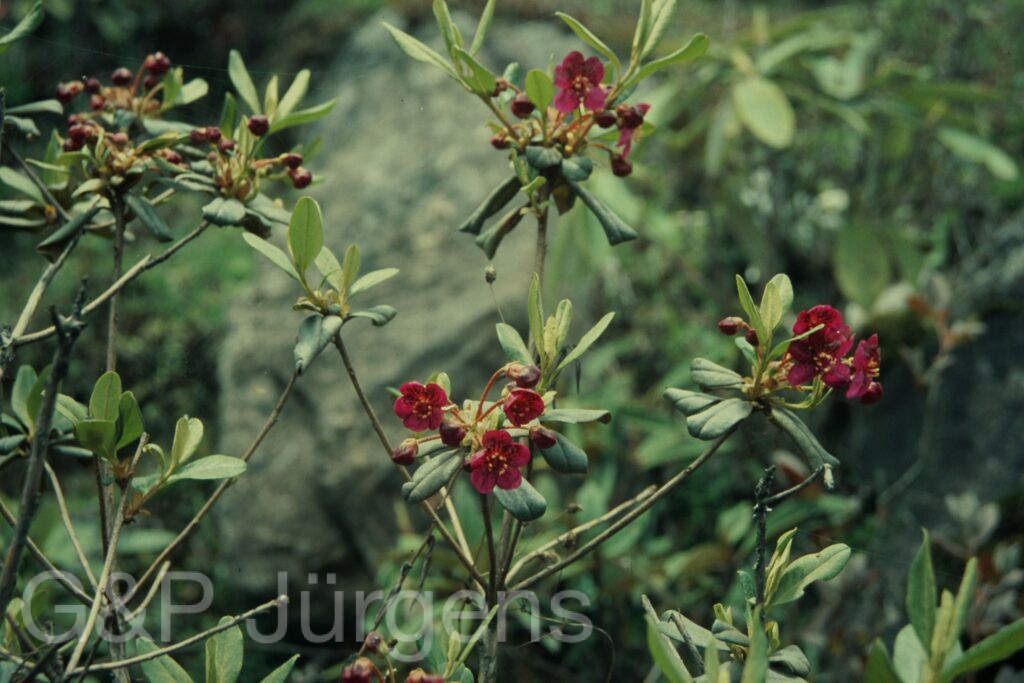
Rhododendron baileyi is a lepidote shrub of the eastern Himalaya, native to Sikkim and the rest of northern India, Bhutan and south-eastern Tibet in China, with the remaining GBIF records (Great Britain, Canada, Japan, Sweden, United States) reflecting its presence in cultivation. Its roughly 121 georeferenced records indicate a narrowly distributed but well-known garden plant. It grows in open subalpine forest, rocky slopes and rhododendron-dominated thickets at roughly 3000-4300 m. The Sikkim collections noted above, from the Lachung valley at 3100-3600 m in May and June, are characteristic of its montane habitat.

It is a small to medium evergreen shrub with scaly young shoots, the leaves elliptic to oblong, leathery and densely covered beneath with overlapping reddish-brown lepidote scales that give the undersurface a rusty, almost continuous coating. The flowers are borne in compact terminal clusters and are widely campanulate to saucer-shaped, deep reddish-purple to magenta, often darker-spotted within, with the corolla and the exserted stamens and style bearing scattered scales. The fruit is a small ovoid, scaly, septicidal capsule splitting to release numerous minute seeds.

Within the genus Rhododendron, R. baileyi belongs to the lepidote subgenus and is placed in subsection Baileya, a small group distinguished by its strongly flattened, overlapping leaf scales and richly coloured flat-faced flowers. Named for the explorer F. M. Bailey, it has been valued in horticulture since its introduction. Pollination is by bumblebees and other long-tongued insects of the high Himalaya. Although not broadly assessed, its limited natural range and dependence on intact subalpine shrubland make it locally sensitive to grazing, fire and forest disturbance.

Author: Balf. f. · Sources: POWO (Kew), GBIF, Flora of China, Flora of Bhutan, The Genus Rhododendron (Royal Botanic Garden Edinburgh) monograph

Hook. f.

Bh2008 237 P374
Bhutan Tumching-La, 3600m April
Bh09 83 G141
Bhutan Langchlakha, 3700m June
Sikkim2004 403 G687
Sikkim/India Lachung 3300m May
Sikkim 2006 372 ergebnis
India West-Bengal, Tamrong 2850m, May

Description

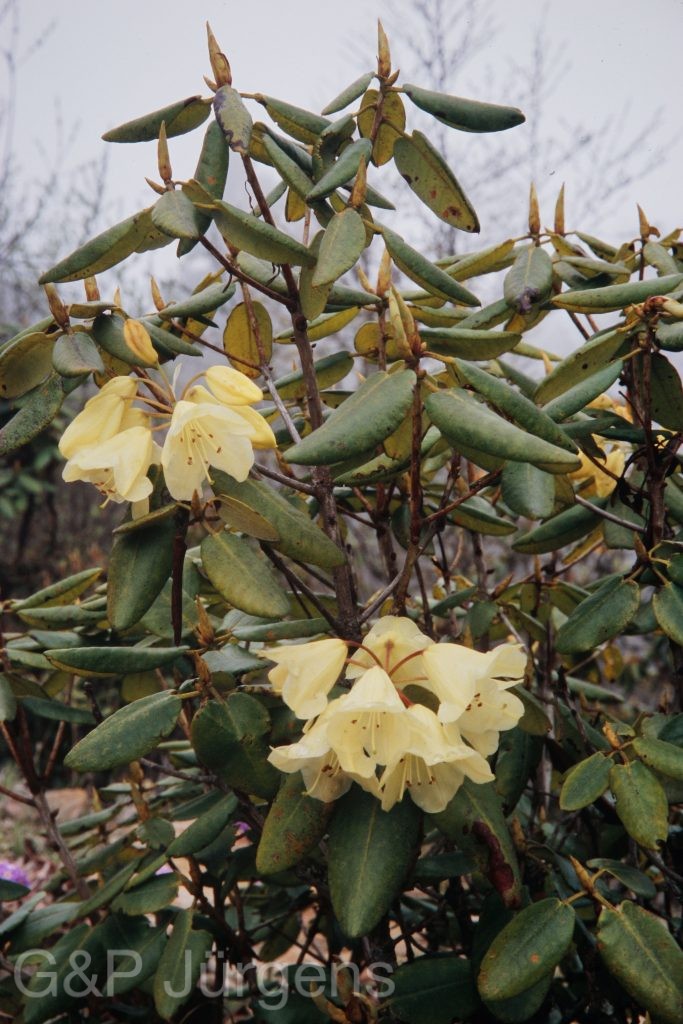
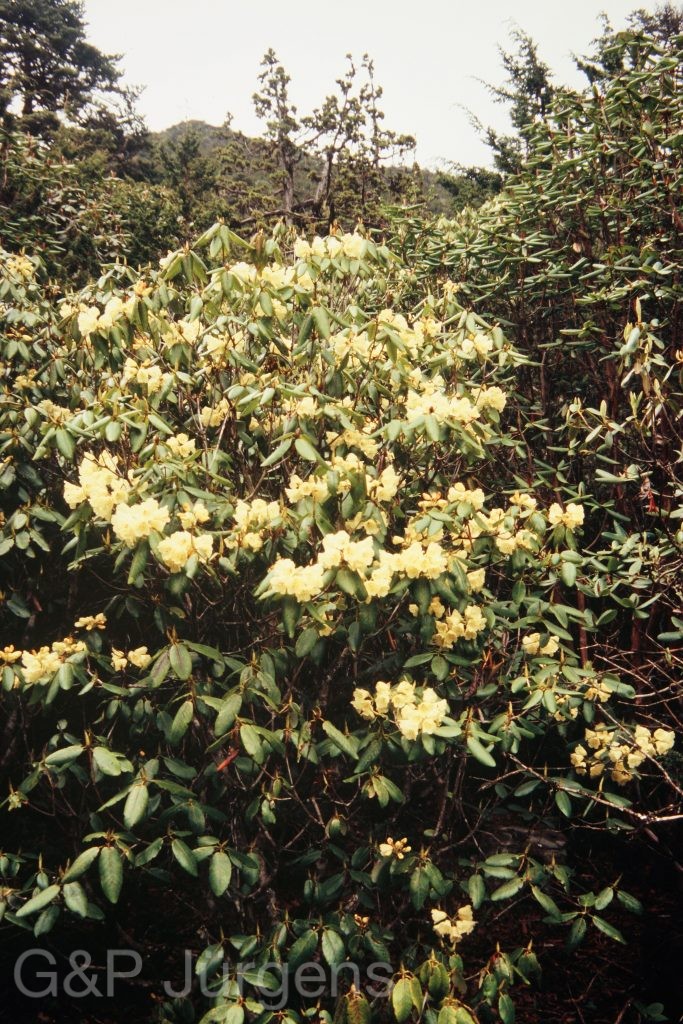
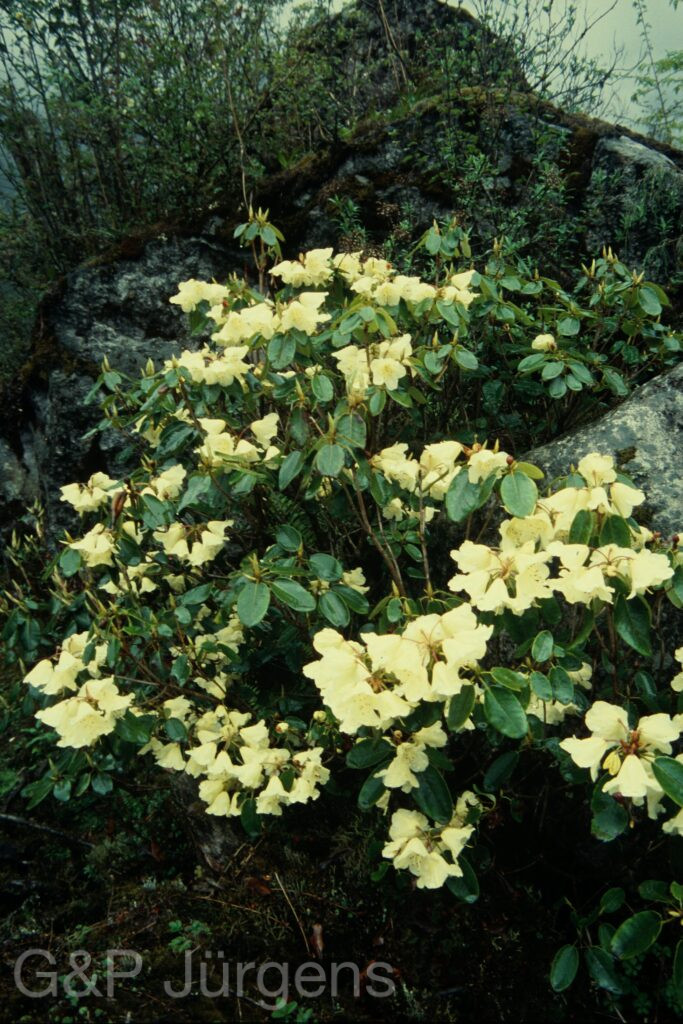
Rhododendron campylocarpum is an East Himalayan species distributed through the higher ranges of Nepal, Sikkim and Darjeeling in India, Bhutan, southern Tibet (China) and northern Myanmar, with abundant horticultural records (GB, US, NZ, etc.) reflecting long cultivation in temperate gardens; GBIF holds some 676 occurrences. It grows in the upper temperate and subalpine zone, typically between about 2850 and 3700 m, as documented at Tumching-La (3600 m) and Langchlakha (3700 m) in Bhutan, at Lachung (3300 m) in Sikkim and at Tamrong (2850 m) in West Bengal, inhabiting conifer and Abies forest margins, rhododendron thickets and moist rocky slopes near the treeline. It flowers in late spring and early summer (April-June).

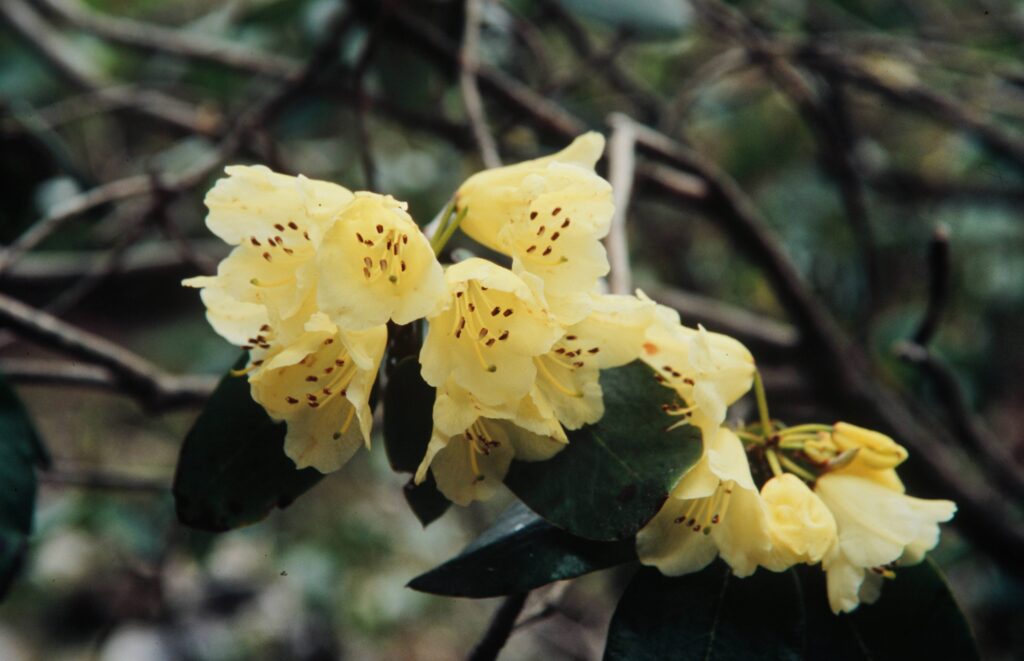
It is an evergreen, much-branched shrub or small tree reaching 1-4 m, with smooth, peeling bark. The leaves are alternate, clustered toward the branch tips, broadly ovate to elliptic-oblong, 4-10 cm long, rounded to cordate at the base, glabrous and dark green above and conspicuously glaucous beneath. The inflorescence is a lax, terminal truss of 5-12 flowers; the corolla is campanulate, 3-4 cm across, clear sulphur- to canary-yellow, frequently with a crimson basal blotch within. Stamens are 10, included; the ovary and slender style are usually glandular. The fruit is a curved, cylindrical capsule, the epithet ("campylocarpum", bent fruit) referring to this curvature.

The species belongs to subgenus Hymenanthes, subsection Campylocarpa, a small group of yellow-flowered Himalayan rhododendrons including R. wardii and R. callimorphum, and it hybridises freely in the wild and in cultivation. Introduced by J. D. Hooker in the 1850s, it became an important parent of many garden hybrids and is an early-summer nectar source for bumblebees and other high-altitude pollinators. Though locally common and not globally threatened, individual populations are subject to grazing, fuelwood collection and the upward shift of the treeline.

Author: Hook. f. · Sources: POWO (Kew), GBIF, Flora of Bhutan, Flora of China, The Genus Rhododendron (Cullen & Chamberlain monograph)

Sikkim2004 404 P689
Sikkim/India Lachung 3400m May

Description

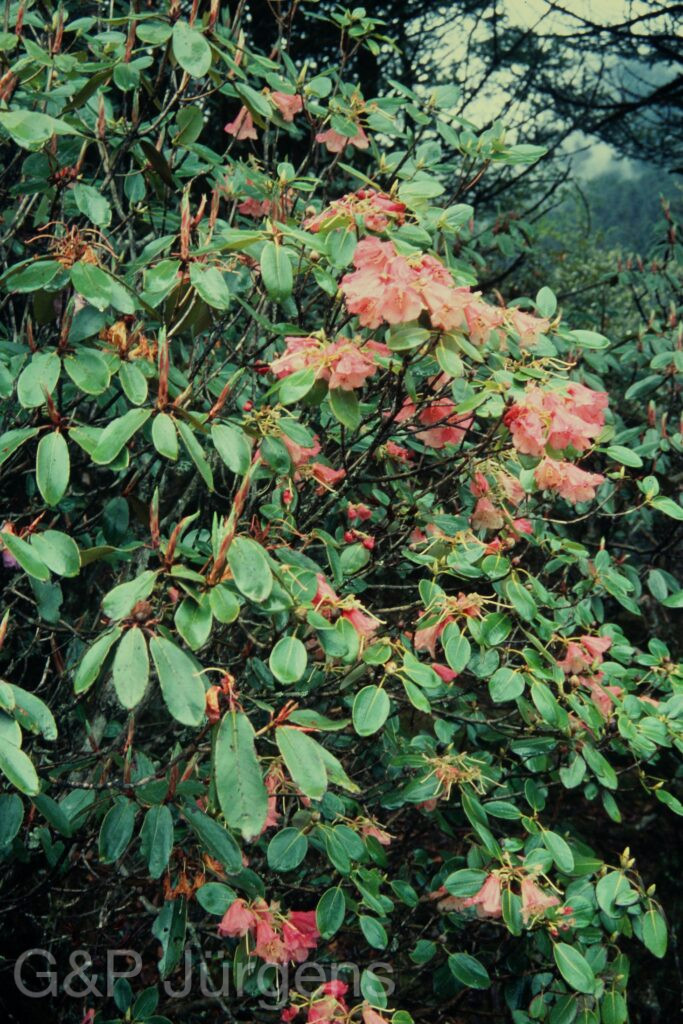
This plant is a natural hybrid between Rhododendron campylocarpum and Rhododendron thomsonii, both subalpine to alpine shrubs of the Eastern Himalaya whose ranges overlap broadly in Sikkim, Bhutan, eastern Nepal and southern Tibet. Because it is a hybrid rather than a described species, it carries no meaningful GBIF distribution of its own — the apparent global record set and the placeholder accepted name 'Plantae' reflect database artefacts, not a real occurrence pattern. Such intermediates arise wherever the two parents grow intermingled in mossy fir and Rhododendron forest and on open subalpine slopes. The photographed plant from Lachung in northern Sikkim, near 3400 m and flowering in May, lies squarely within the elevational overlap zone of about 3000-4000 m where natural hybridisation is frequent.

Morphologically the hybrid is intermediate between its parents. From R. thomsonii it tends to inherit smooth, often peeling, reddish bark, rounded to obovate-orbicular leaves glaucous beneath, and a calyx that is enlarged and cupular; from R. campylocarpum it derives a more campanulate corolla and a tendency toward yellow pigmentation. The resulting flowers are typically campanulate and pale yellow to creamy, frequently flushed or blotched pink to rose, borne in loose terminal trusses; the curved capsule shows the influence of campylocarpum (the 'curved-fruited' parent). Stamens number ten and the style is glabrous.

Both parents belong to Rhododendron subgenus Hymenanthes (the elepidote rhododendrons), and their hybrid swarms are a classic example of natural introgression, long noted in Sikkim by J. D. Hooker. These intermediates blur species limits in the field and are of horticultural importance, both parents being foundational in the breeding of yellow- and red-flowered garden hybrids.

Sources: POWO (Kew), GBIF, Flora of Bhutan, The Rhododendron Handbook (Royal Horticultural Society), Cox & Cox A Encyclopedia of Rhododendron Species, Hooker The Rhododendrons of Sikkim-Himalaya

Hook. f.

Bhutan2014 877
Bhutan Chele-La 2850m, May
Bhutan2014 882
Bhutan Chele-La 2850m, May
Bh2008 221 P349
Bhutan Tumching-La, 3400m April
Bh2008 222 G350
Bhutan Tumching-La, 3400m April
Sikkim2003 191 G262
Sikkim Dzongri 3900m 08.2003

Description

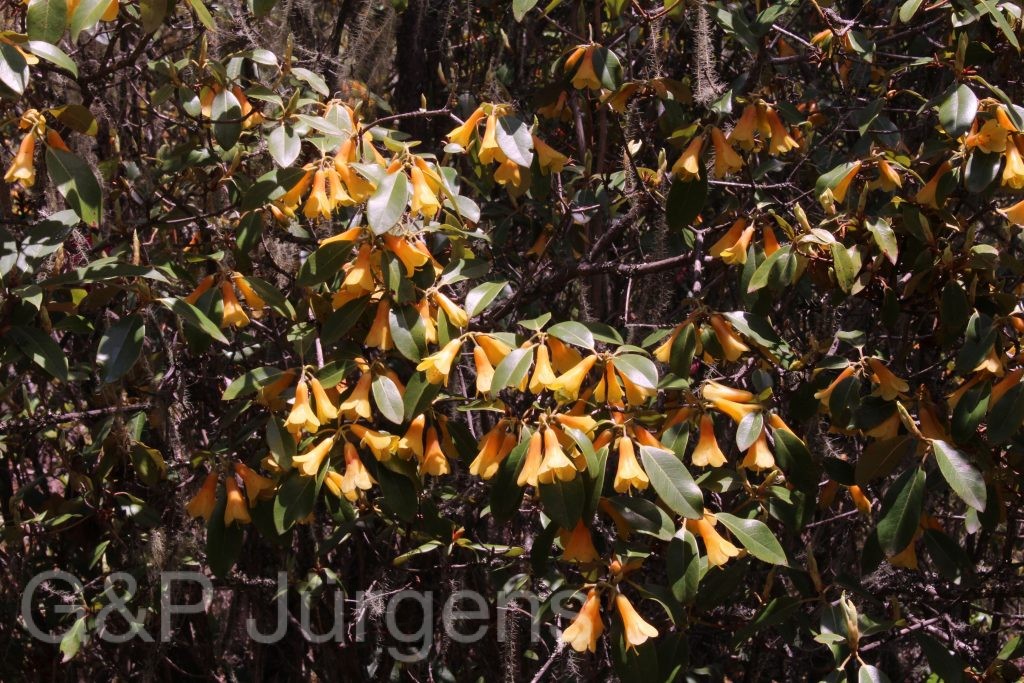
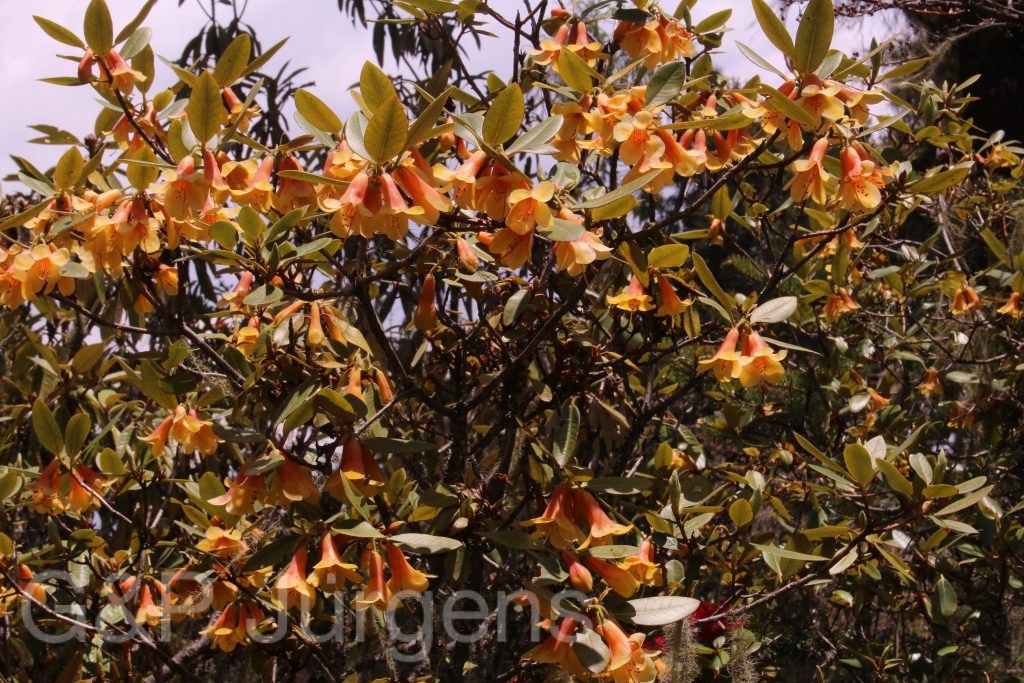
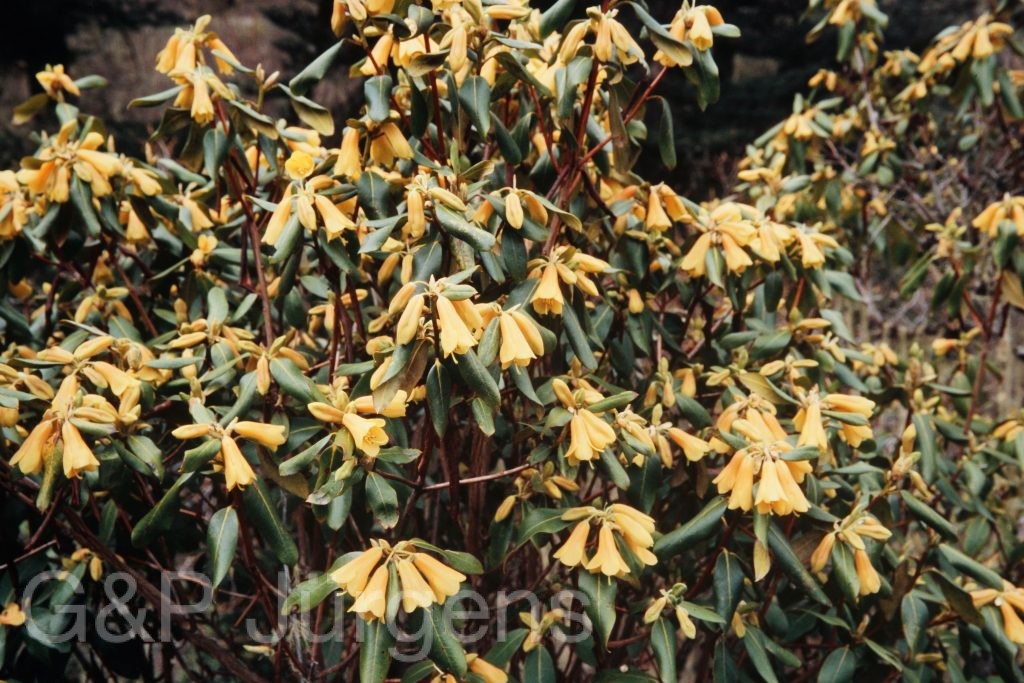
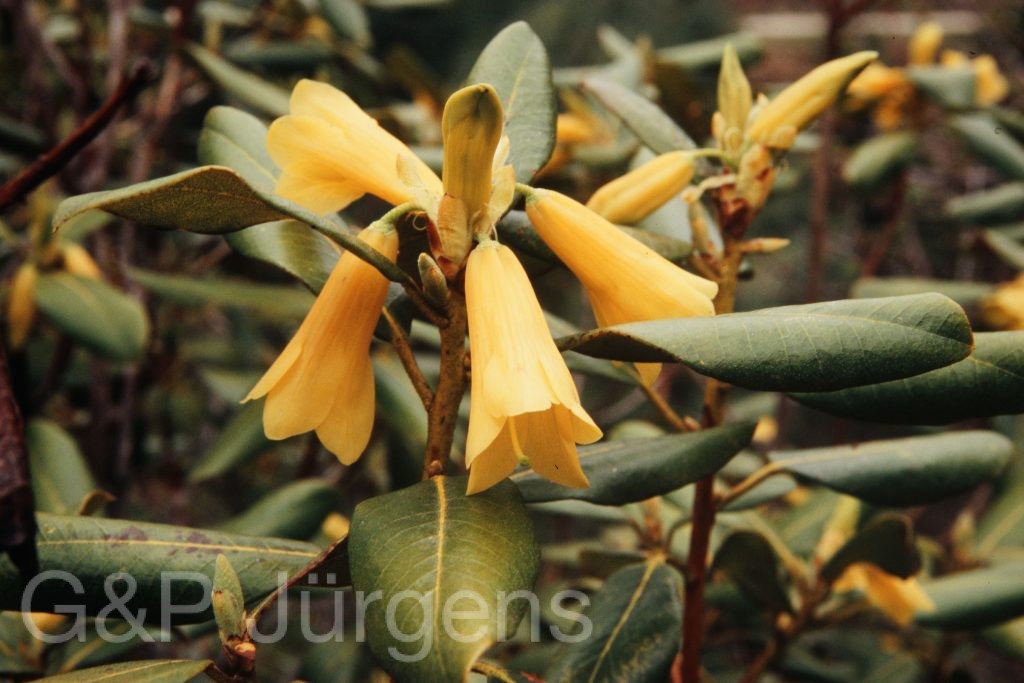
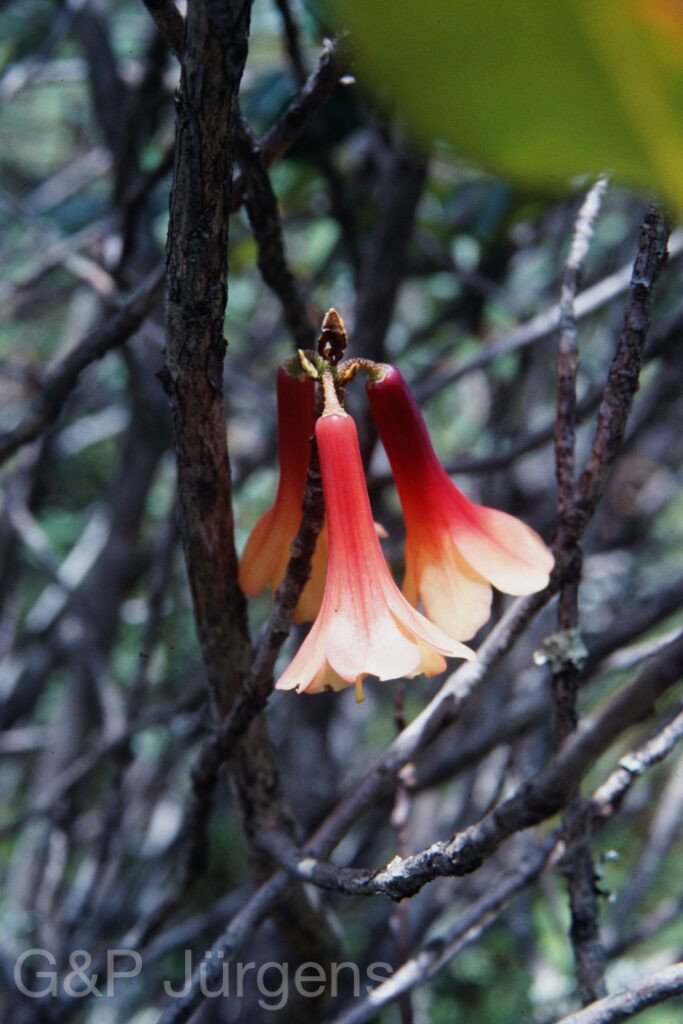
Rhododendron cinnabarinum is an Eastern Himalayan species native to Bhutan, Sikkim and adjacent northeastern India, Nepal and southern Tibet (China), the nearly 768 records also reflecting its popularity in cultivation in Britain, North America and elsewhere. It is a shrub of the cool temperate to subalpine zone, the images documenting plants on the Chele-La in Bhutan at about 2850 m in May, the Tumching-La at about 3400 m in April, and Dzongri in Sikkim near 3900 m. It grows in fir and mixed forest, rhododendron thickets, forest margins and open subalpine scrub on moist, acidic, humus-rich slopes within the monsoon-influenced humid belt of the range.

It is an evergreen shrub reaching one to several metres, with smooth bark and aromatic foliage. The leaves are elliptic to obovate, conspicuously glaucous-blue when young and densely scaly (lepidote) beneath, the scales being diagnostic of the lepidote rhododendrons. The pendulous, tubular-campanulate to narrowly funnel-shaped flowers are borne in small terminal trusses and are noted for their waxy texture and remarkable colour range, from cinnabar-red and orange to plum and yellow; the ten stamens and the style are enclosed within the elongate corolla tube, which matures into a scaly capsule.

Described by J.D. Hooker, the species is placed in subgenus Rhododendron, subsection Cinnabarina, the only members of the lepidote group with markedly tubular, drooping corollas suited to pollination by birds and long-tongued insects. It is variable across its range, with several recognised subspecies and varieties differing in flower colour and foliage, and is an important parent in horticulture. Locally common in suitable habitat and widely cultivated, it is not regarded as globally threatened, though parts of its native forest are under pressure.

Author: Hook. f. · Sources: POWO (Kew), GBIF, Flora of Bhutan, Flora of China, The Genus Rhododendron (Royal Botanic Garden Edinburgh)