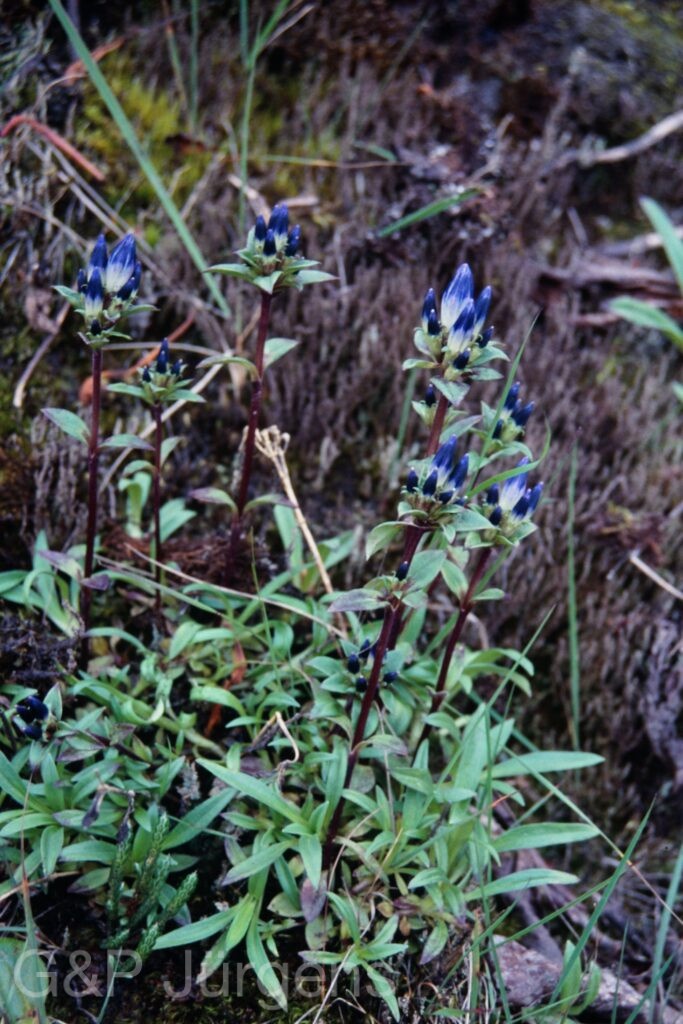
Tag:

Alpine (>3500 m)

(Hook.f. & Thomson) Al-Shehbaz, G.Q.Hao & J.Quan Liu
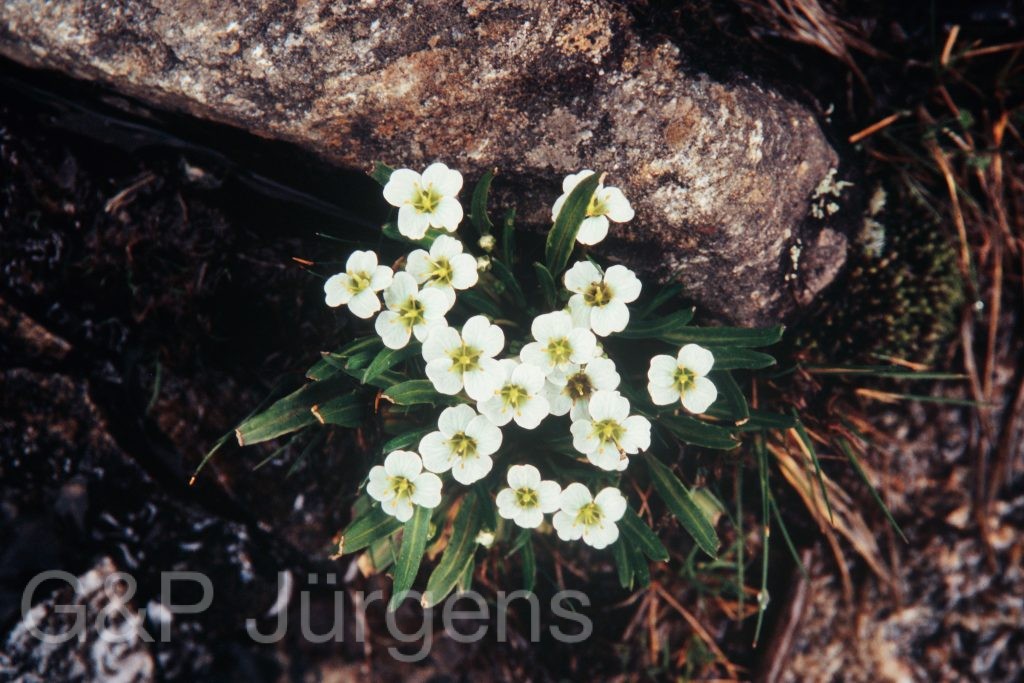
Bh09 144 P255
Bhutan Al-Shehbaz, 4100m June

Description

Eutrema scapiflorum (Hook.f. & Thomson) Al-Shehbaz, G.Q.Hao & J.Quan Liu is a dwarf alpine crucifer of the high Sino-Himalaya, recorded from China, India, Nepal, Bhutan and Myanmar. The species is illustrated from Bhutan at approximately 4100 m, flowering in June, consistent with its occurrence in the upper alpine belt. It inhabits open stony slopes, moraines, fellfield, gravelly flushes and the margins of snow-fed rills, generally between 3800 and 5000 m, where it endures intense insolation, freezing nights and a compressed growing season. With around 630 GBIF records it is a genuinely high-elevation specialist, scarce and patchily distributed across its range.

The plant is a small, glabrous, cushion- to rosette-forming perennial arising from a stout caudex and taproot. The basal leaves are crowded, spathulate to oblong-obovate, entire or obscurely toothed, and rather fleshy. As the epithet scapiflorum implies, the white flowers are borne on short, nearly leafless scapes scarcely exceeding the foliage, each flower with four spreading petals and the typical cruciferous tetradynamous androecium. The fruit is a short, oblong to linear silique or silicle, somewhat flattened, dehiscing to release a few seeds in two rows.

The taxon was long placed in the segregate genus Pegaeophyton (as P. scapiflorum), reflected in its original webpage URL, but molecular phylogenetic analyses have shown Pegaeophyton to be nested within Eutrema, prompting the present transfer. It belongs to the tribe Eutremeae, a predominantly Himalayan and Central Asian lineage of cold-adapted mustards. Its restricted high-alpine niche renders it sensitive to upslope vegetation shifts and the retreat of late-lying snow, though no formal conservation assessment has yet been made.

Author: (Hook.f. & Thomson) Al-Shehbaz, G.Q.Hao & J.Quan Liu · Sources: POWO (Kew), GBIF, Flora of China, Flora of Bhutan, Annotated Checklist of the Flowering Plants of Nepal, Al-Shehbaz revisions of Himalayan Brassicaceae
(Jeffrey & W.W.Sm.) Al-Shehbaz & Warwick

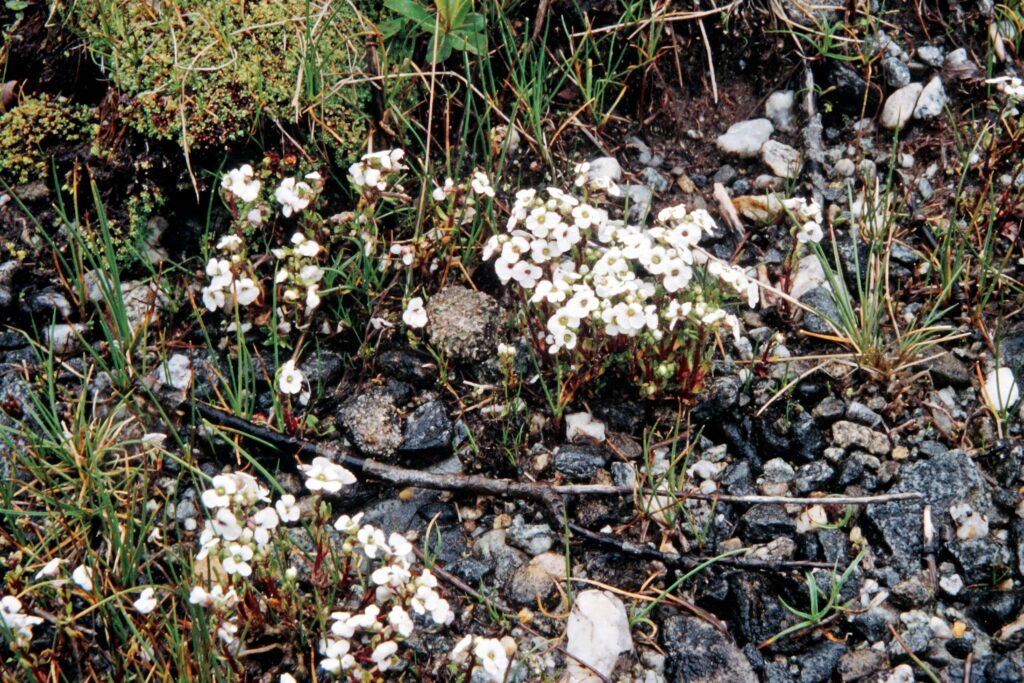
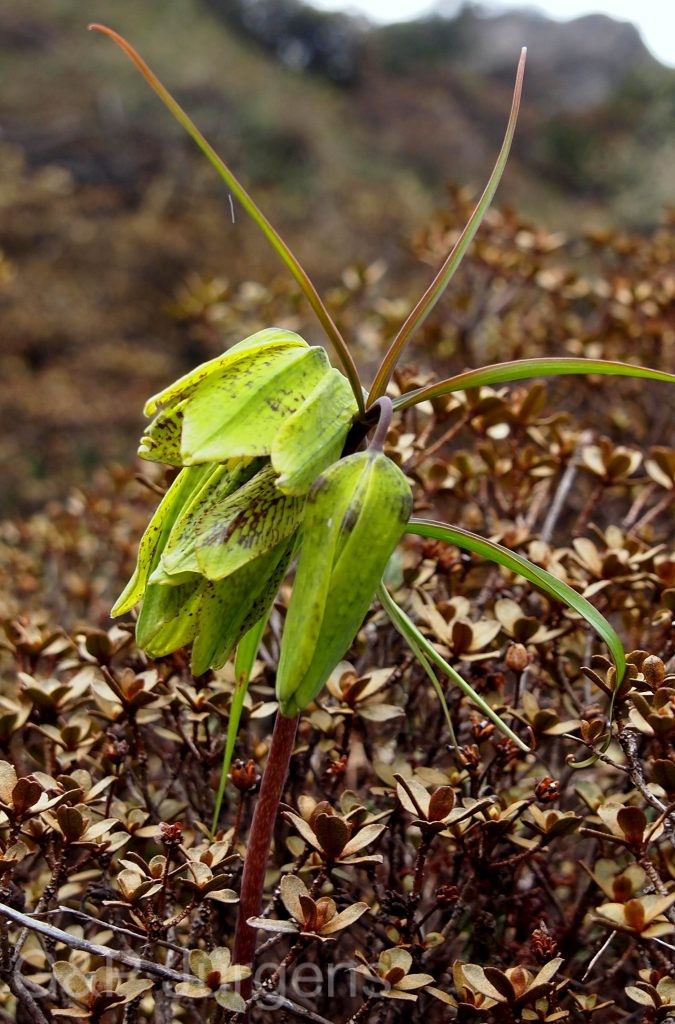
Nepal 99 525 ergebnis
Nepal Churt-Khola 3500m, July

Description

Eutrema verticillatum is a high-alpine crucifer of the Sino-Himalayan region, recorded from Nepal and adjacent SW China, with 96 GBIF occurrences indicating a relatively narrow, high-elevation distribution. It occupies open alpine turf, gravelly slopes, moist screes, streamsides and snow-flush ground in the upper alpine zone. The collection from the Churt Khola in Nepal at about 3,500 m in July is consistent with its summer flowering in cold, moist high-mountain habitats, where it grows as a low herb among rock and short alpine vegetation.

It is a glabrous perennial herb arising from a slender rootstock, with one to several erect or ascending stems. The basal and lower cauline leaves are petiolate and entire to slightly toothed, the upper leaves becoming sessile; the specific epithet alludes to a crowded, apparently whorled arrangement of leaves or flowers along the stem. The inflorescence is a terminal raceme of small white to pale flowers with the four petals and tetradynamous stamens typical of the family. The fruit is a silique or short silicula, the valves with a distinct midvein, dehiscing to release the seeds, as is characteristic of Eutrema.

The input family is recorded as "Uncategorized," but the species belongs to Brassicaceae (tribe Eutremeae); the binomial follows the recircumscription of Eutrema by Al-Shehbaz and Warwick, who transferred this taxon (basionym in Smelowskia/Braya) into the genus, and GBIF treats it as accepted. As a narrowly distributed Himalayan high-alpine endemic with few records, it warrants monitoring, though no formal conservation assessment is established.

Author: (Jeffrey & W.W.Sm.) Al-Shehbaz & Warwick · Sources: POWO (Kew), Flora of China Vol. 8, Flora of Nepal, GBIF, Al-Shehbaz & Warwick: Eutrema (Brassicaceae) revision (2005)

D.Don

Sikkim2011 68
Sikkim Tanghu 3900m, June
Sikkim2011 69
Sikkim Tanghu 3900m, June
Sikkim2004 414 G713
Sikkim/India Yumthang 3700m May
Sikkim2004 415 P712
Sikkim/India Yumthang 3700m May

Description

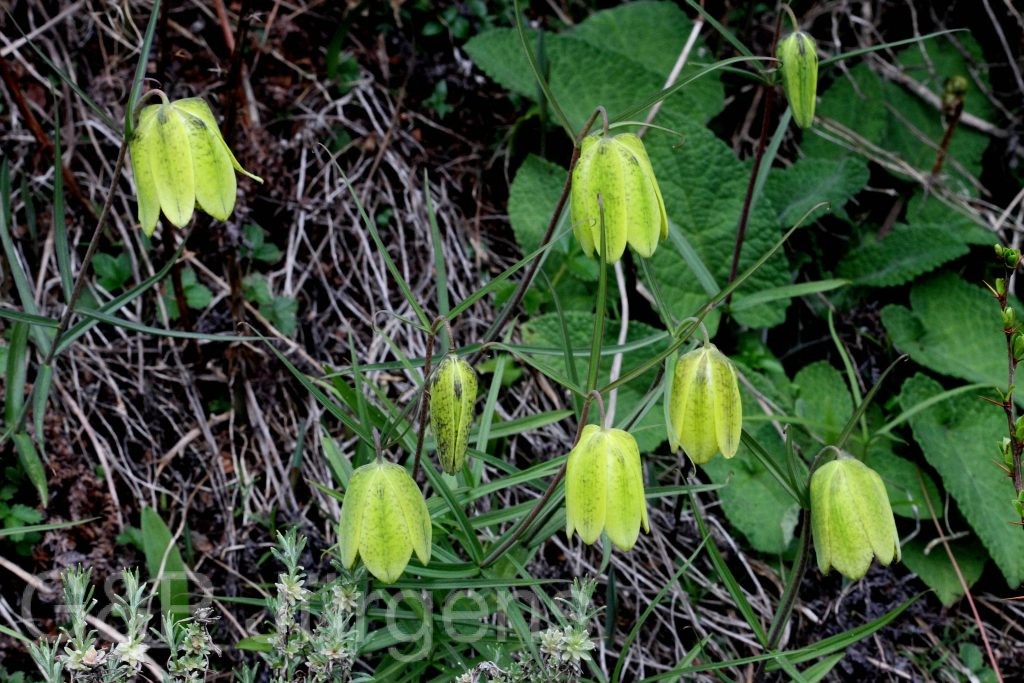
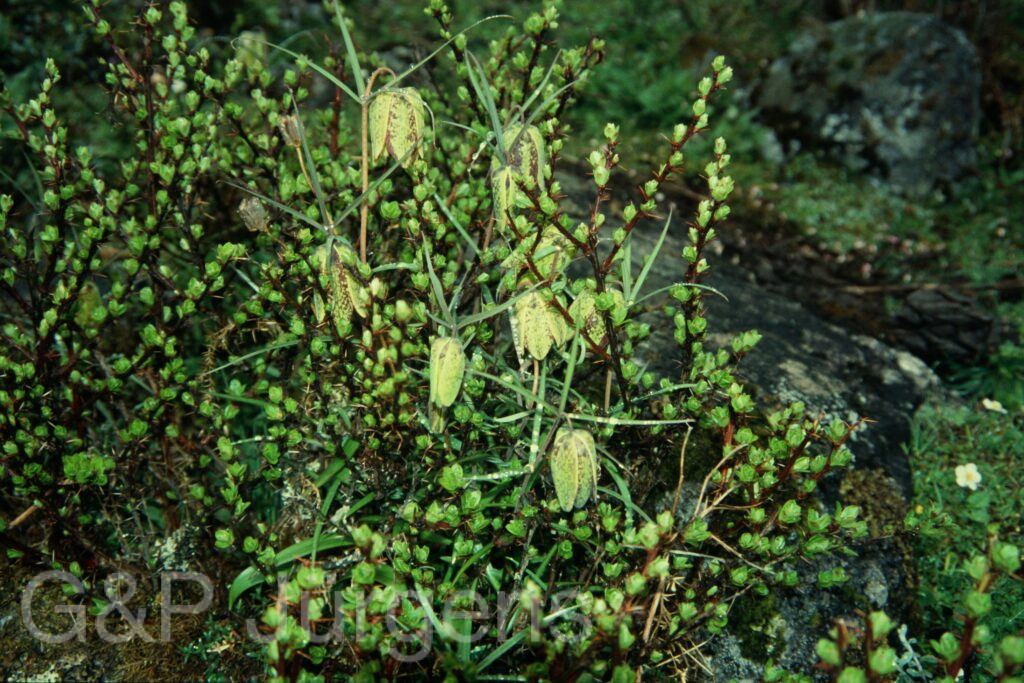
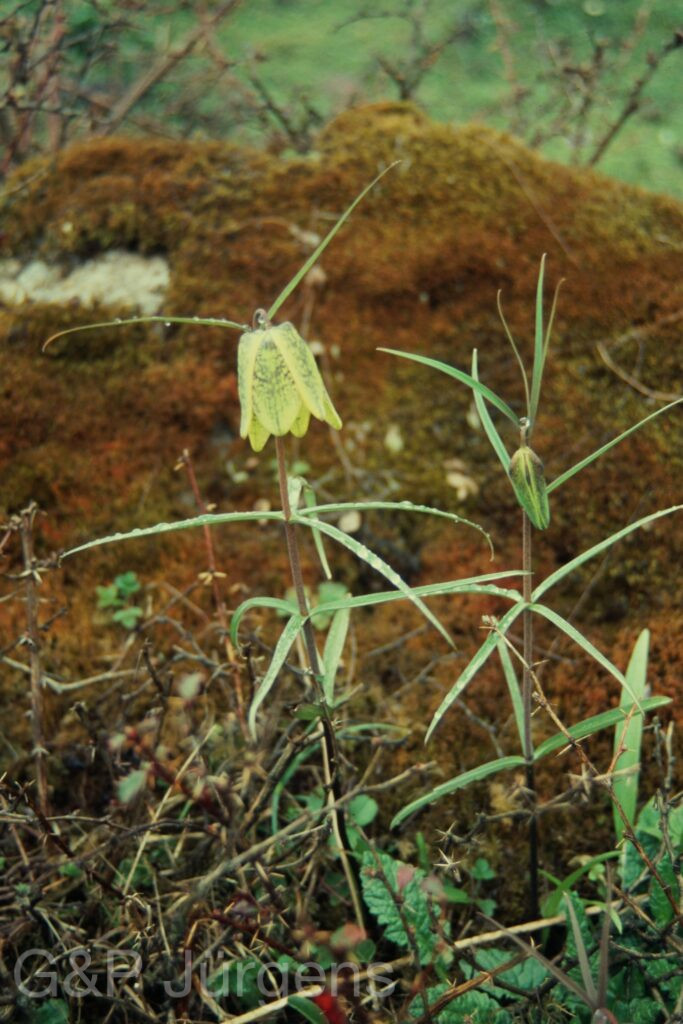
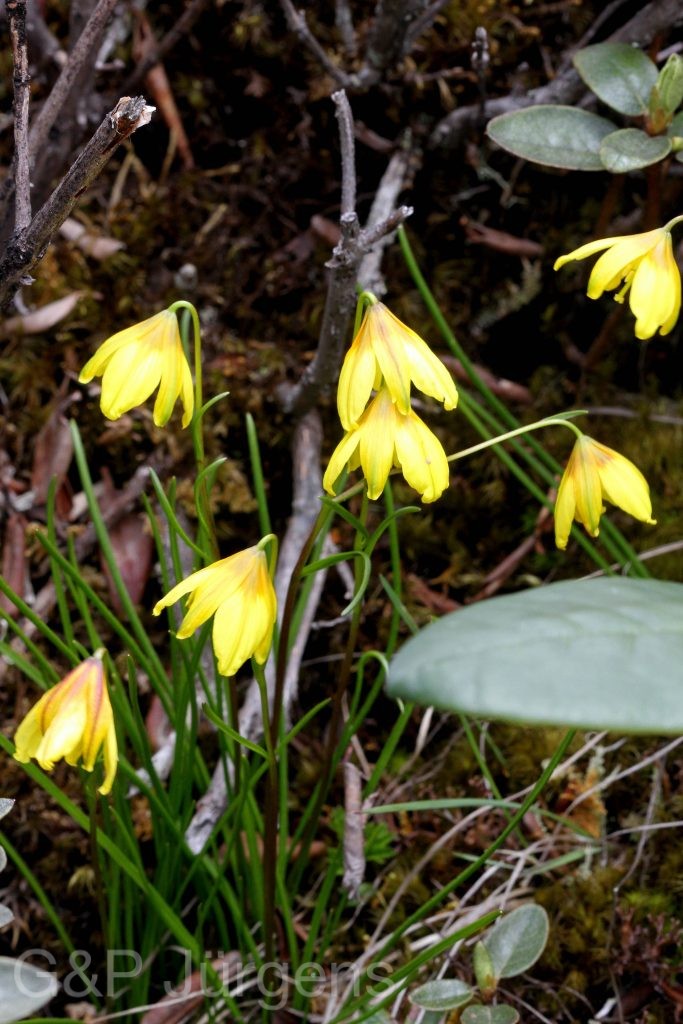
Fritillaria cirrhosa is a bulbous alpine lily of the Himalaya and the Hengduan mountains, native to China, India, Nepal, Pakistan, Bhutan and Myanmar, the very large total of c. 962 records reflecting its wide range and economic importance. It inhabits alpine meadows, scrub, rocky slopes, screes and grassy clearings, mostly between roughly 3200 and 4600 m. The illustrated plants were photographed at Tanghu in Sikkim at 3900 m in June and at Yumthang on the Sikkim/India border at 3700 m in May, sites characteristic of the species, which flowers shortly after snowmelt on cool, moist, well-drained high-montane ground.

It is a perennial herb arising from a small bulb of a few fleshy scales. The slender erect stem bears scattered to whorled, linear to lanceolate leaves, the uppermost of which are prolonged into slender, curling, tendril-like tips, the cirrhose feature from which the epithet derives. The flowers are usually solitary and nodding, broadly campanulate, with six tepals that are yellowish-green to purplish and conspicuously tessellated (chequered) with darker purple-brown; a nectary gland sits near the base of each tepal. The six stamens surround a superior trilocular ovary with a three-lobed style. The fruit is an erect, six-angled or narrowly winged loculicidal capsule.

Fritillaria (Liliaceae) is a Holarctic genus delimited by section on bulb structure, leaf arrangement and style form, and F. cirrhosa is a polymorphic species of the subgenus Fritillaria. Its dried bulb is the source of the renowned traditional Chinese medicine "chuan bei mu," used as an antitussive, and this heavy commercial harvesting is the principal conservation concern: although still widespread, the species is subject to intense wild collection, and the chuan bei mu trade has prompted cultivation efforts and regulatory attention across its range.

Author: D.Don · Sources: POWO (Kew), GBIF, Flora of China, Flowers of the Himalaya (Polunin & Stainton), Rix monograph of Fritillaria

Gagea flavonutans

by GP Jürgens

(H.Hara) Zarrei & Wilkin

Sikkim2011 100
Sikkim Chopta-valley 4200m, June
Sikkim2011 120
Sikkim Chopta-valley 4200m, June

Description

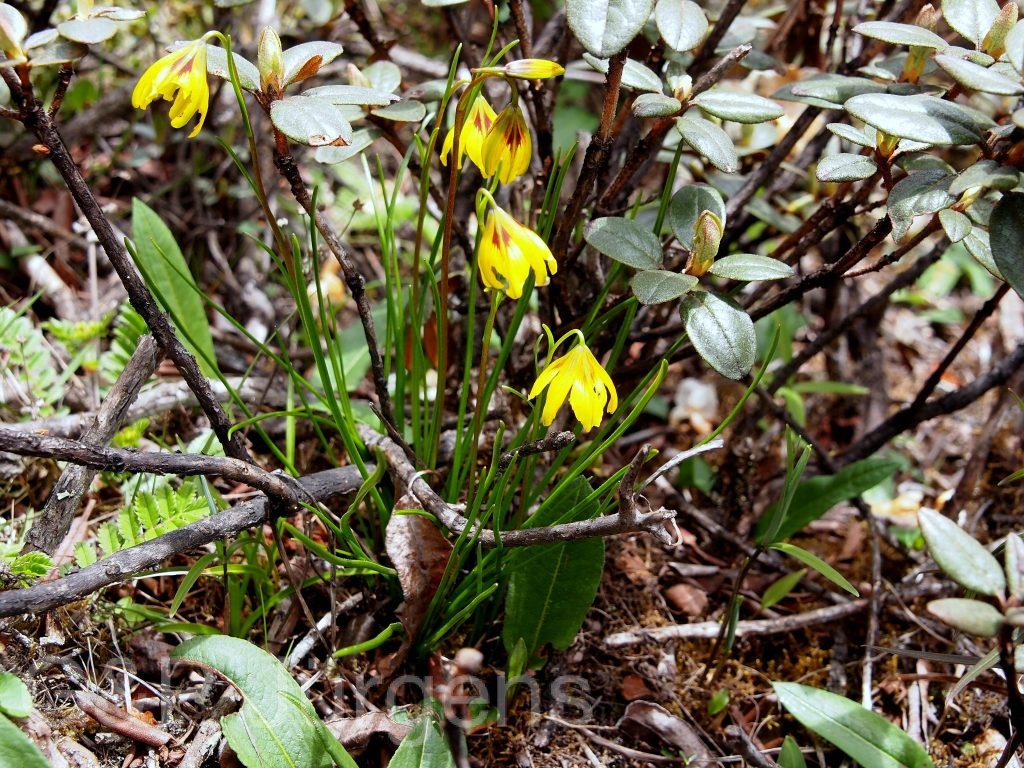
Gagea flavonutans is a small alpine bulbous geophyte of the eastern Himalaya, recorded from Nepal, India, China, Bhutan and Myanmar, with about 104 georeferenced occurrences clustered along the high inner ranges. It grows in open alpine turf, on grassy and stony slopes, screes and moist ground at the edge of melting snow, chiefly between roughly 3800 and 4500 m. The plant was photographed in the Sikkim Chopta Valley at 4200 m in June, an elevation and season characteristic of the genus, whose members flush and flower rapidly in the brief interval following snowmelt before the soil dries.

It is a slender, hairless perennial arising from one or few ovoid tunicate bulbs. There are typically two narrowly linear basal leaves, channelled and grass-like, considerably exceeding the short scape. The inflorescence is few-flowered, the flowers nodding as the epithet flavonutans implies. The perianth comprises six free, narrowly elliptic to oblong tepals, yellow within and often greenish or purplish-tinged on the outer surface; the six stamens have slender filaments and small anthers, and the superior tricarpellate ovary bears a single style. The fruit is a small loculicidal capsule containing numerous seeds.

Gagea (Liliaceae) is a large, taxonomically difficult Old World genus in which species are delimited by bulb structure, leaf number and section, and floral orientation; G. flavonutans, originally described by Hara, was transferred to Gagea in the molecular reassessment by Zarrei and Wilkin that absorbed the segregate Lloydia into a broadened Gagea. Its nodding yellow flowers and high-Himalayan range distinguish it within this complex. As a short-statured snowbed geophyte it is sensitive to changes in snow cover and grazing, though it remains locally frequent and is not currently regarded as threatened.

Author: (H.Hara) Zarrei & Wilkin · Sources: POWO (Kew), GBIF, Flora of China, Annotated Checklist of the Flowering Plants of Nepal, Zarrei & Wilkin phylogenetic revision of Gagea

(Lindl.) P.F.Hunt

Sikkim2011 207
Sikkim Lachung 3100m, June
Nepal 99 809 ergebnis
West-Nepal Baga-La-Phedi 4300m, July

Description

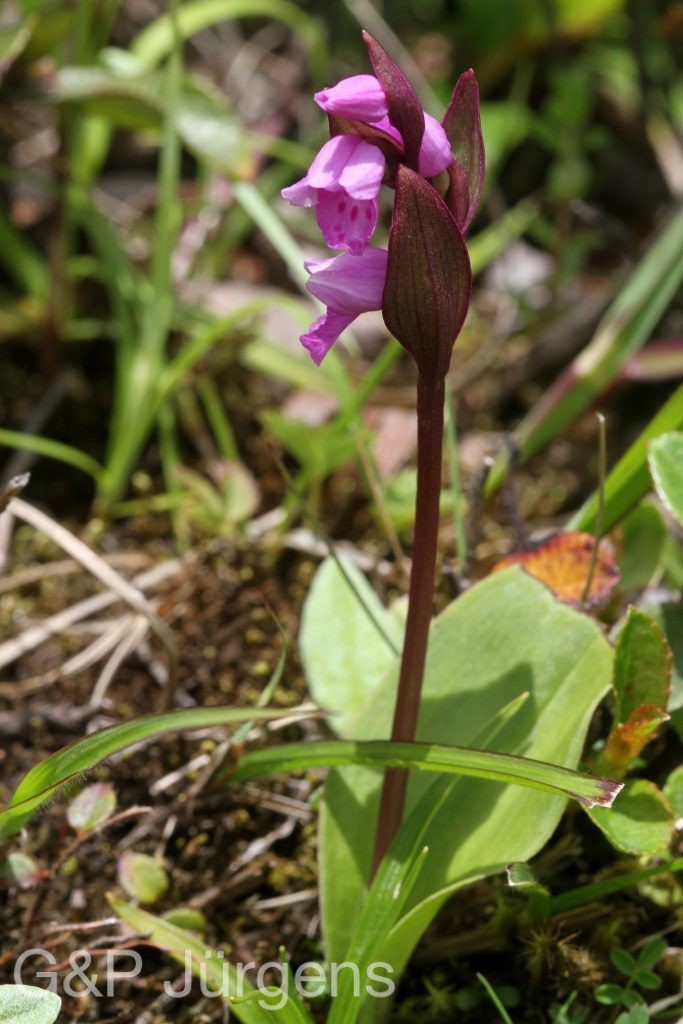
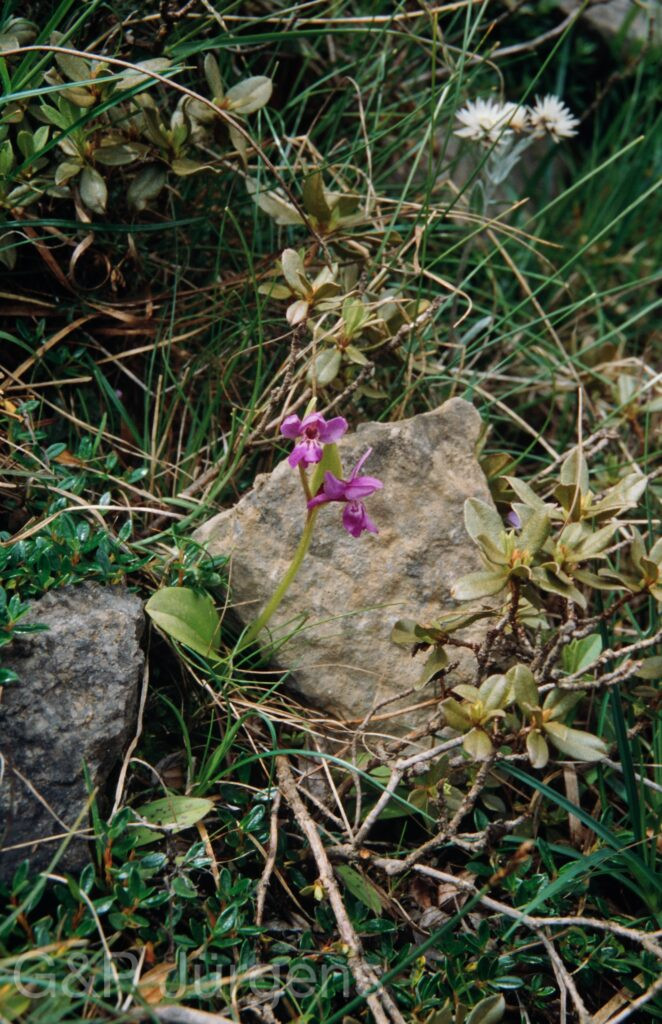
Galearis spathulata is a small terrestrial orchid of the high Himalaya and the mountains of western China, recorded from China, India, Nepal, Bhutan and Myanmar, with over 500 occurrences in GBIF. It is a plant of moist alpine and subalpine meadows, open Rhododendron and juniper scrub, grassy slopes and rocky turf, generally between about 3,000 and 4,500 m. The illustrated gatherings span this range, from Lachung in Sikkim at around 3,100 m in June to Baga-La-Phedi in West Nepal at about 4,300 m in July, where the species flowers through the early summer monsoon.

It is a dwarf, glabrous perennial herb arising from slender, fleshy root-tubers and bearing usually one or two basal, spathulate to oblong leaves that taper to a sheathing base. The short, erect stem terminates in a few-flowered raceme of small purplish-pink flowers, each subtended by a bract. The dorsal sepal and petals converge to form a hood over the column, the lateral sepals spreading; the labellum is entire to obscurely lobed, directed forward and produced at the base into a short, cylindrical to saccate spur. The fruit is an erect, ribbed capsule releasing dust-like seeds.

Galearis is a small holarctic-temperate to Sino-Himalayan genus segregated from Orchis, and G. spathulata is distinguished by its spathulate basal leaves and short-spurred, hooded flowers. Pollination is by insects, with seedling establishment dependent on mycorrhizal association, as in all orchids. Widespread and locally common across the alpine Himalaya, the species is not regarded as threatened, although, being an orchid, it falls under the general CITES Appendix II listing for the family.

Author: (Lindl.) P.F.Hunt · Sources: POWO (Kew), GBIF, Flora of China, Flora of Bhutan, Annotated Checklist of the Flowering Plants of Nepal, Pridgeon et al. Genera Orchidacearum

Hook.f. & Thomson ex Miq.

Bh09 327 P536
Bhutan Tumching, 3700m June
Bh09 328 G535
Bhutan Tumching, 3700m June
Sikkim 2006 130 ergebnis
India West-Bengal, Molley 3650m, May

Description

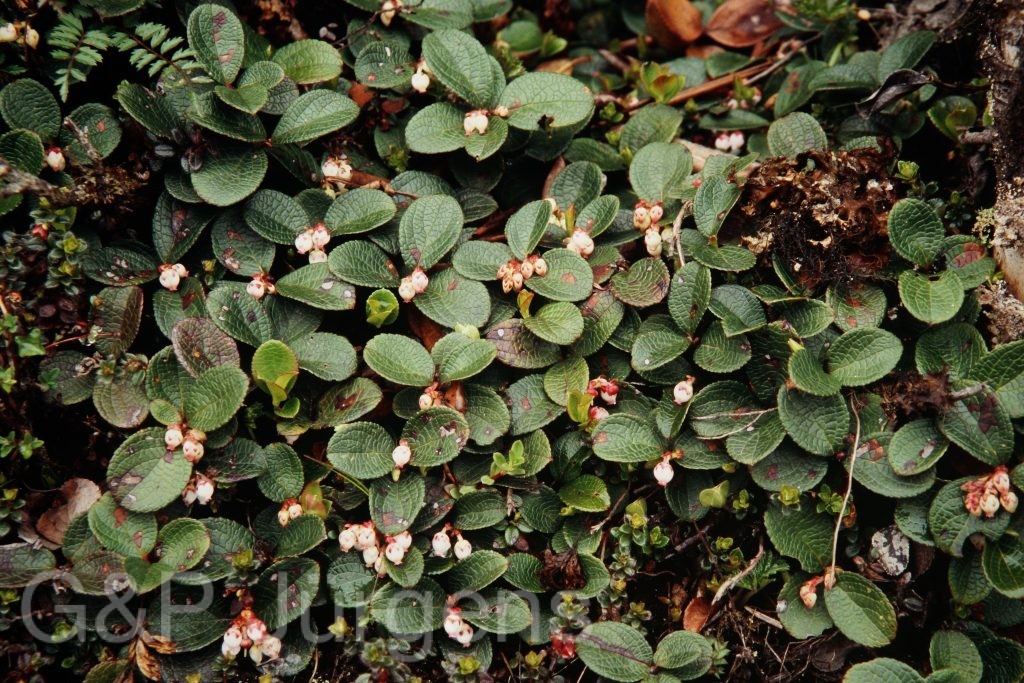
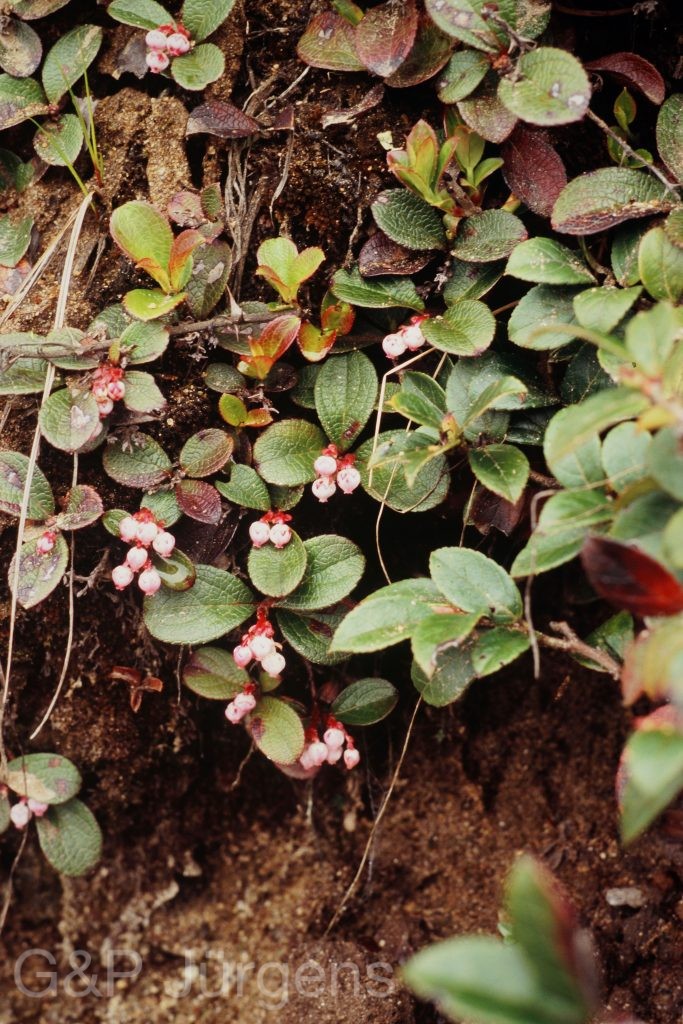
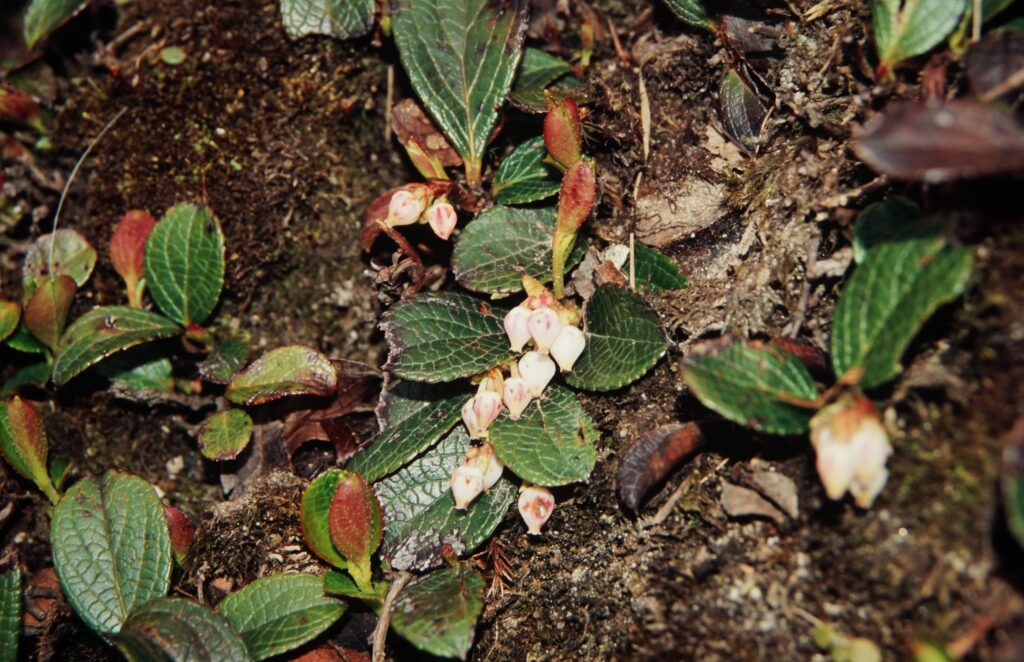
Gaultheria pyroloides is a dwarf evergreen shrublet of the eastern Himalaya and East Asia, with a notably disjunct northern range: its 652 georeferenced records span Japan (JP), China (CN) and the Russian Far East (RU) as well as the core Himalayan countries of Nepal (NP), India (IN) and Bhutan (BT). It is a plant of cool, humid, high-montane to subalpine habitats, growing on mossy banks, in the floor of conifer and rhododendron forest, on humus-rich rocks and at forest margins, generally between about 3000 and 4000 m. The plants documented at Tumching in Bhutan at 3700 m in June and at Molley in West Bengal at 3650 m in May are typical of these shaded, moss-rich montane situations.

It is a low, creeping to ascending undershrub forming mats, with slender, often reddish-bristly stems rooting at the nodes. The leaves are crowded toward the stem tips, more or less rosulate, obovate to broadly elliptic, leathery, glossy, with a finely serrulate, bristle-margined edge and a Pyrola-like aspect that gives the epithet pyroloides. The flowers are usually few, axillary or in short terminal racemes, the corolla urceolate to campanulate, white or pink-flushed, with a five-lobed limb. As in many of its relatives the calyx becomes fleshy and accrescent in fruit, enclosing or partly enclosing the small capsule to form a berry-like, blue to blue-black false fruit attractive to birds.

Gaultheria (Ericaceae, subfamily Vaccinioideae) is exceptionally diverse in the Himalaya, and the prostrate, rosette-leaved species such as G. pyroloides occupy the dwarf, ground-hugging end of the genus's growth-form spectrum. The wide but fragmented distribution into temperate East Asia points to a once more continuous circum-montane forest range. The species is not regarded as threatened, but its reliance on undisturbed, moist forest understorey renders it sensitive to disturbance.

Author: Hook.f. & Thomson ex Miq. · Sources: POWO (Kew), GBIF, Flora of Bhutan, Flora of China, Flora of Japan, Airy Shaw and Fritsch revisions of Gaultheria (Ericaceae)

Royle

Nepal 2001 411 ergebnis ergebnis
Nepal (Gorkha) Barpak 3050m, May
Garh 07 165 ergebnis
India Garhwal Kinkhola 3550m, June

Description

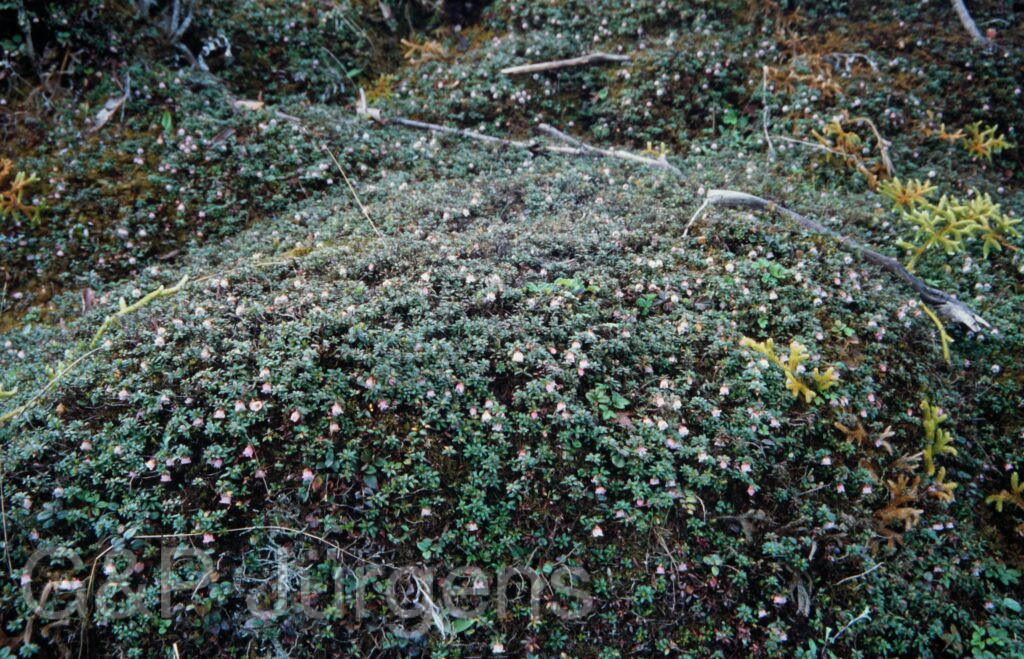
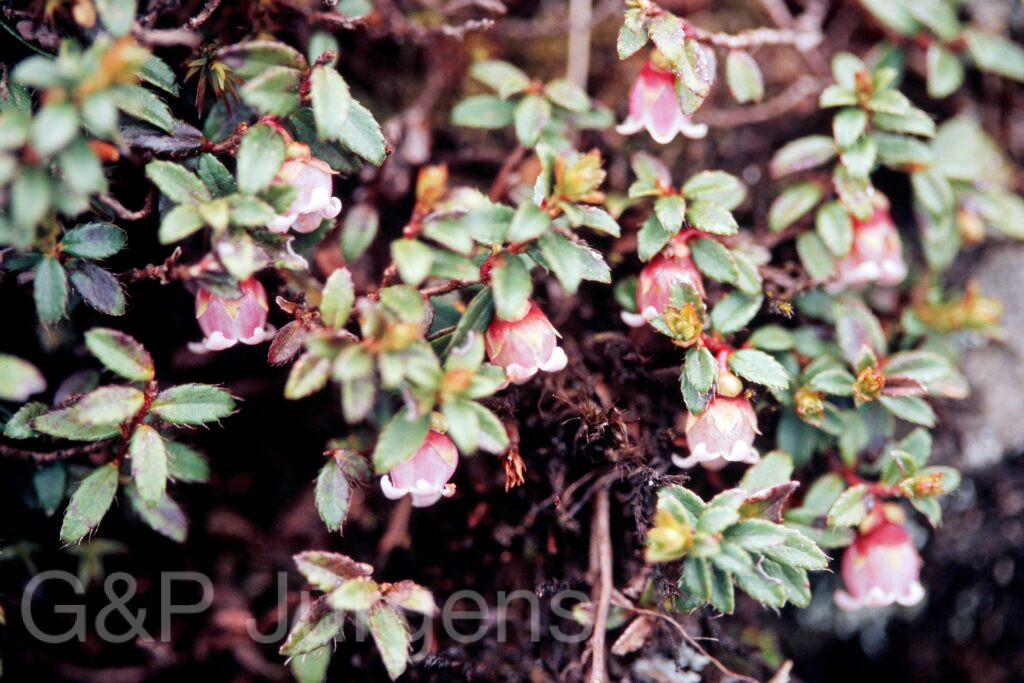
Gaultheria trichophylla is a low, mat-forming dwarf shrub of the high Himalaya, occurring across Nepal, northern India, Bhutan, Pakistan, Myanmar and southwestern China, with disjunct or introduced records from New Zealand, Canada, Chile and France; GBIF documents some 611 collections. It is a plant of open alpine and subalpine slopes, rhododendron scrub margins and humus-rich turf between about 3000 and 4500 m. The photographed material was gathered in central Nepal at Barpak (Gorkha) near 3050 m in May and in the Garhwal Himalaya at Kinkhola around 3550 m in June, on the moist, well-drained, peaty soils it favours under a cool monsoonal climate.

The plant forms compact, prostrate to ascending mats from slender, wiry, much-branched stems that are finely bristly-hairy and root at the nodes. The leaves are small, alternate, crowded, ovate to elliptic, leathery and shining, with a finely toothed, bristly-ciliate margin. Flowers are solitary in the leaf axils, the corolla urceolate to broadly campanulate, pink to pale rose, five-lobed, with a persistent calyx that becomes fleshy in fruit. The fruit is a depressed-globose capsule enclosed by the swollen, berry-like, bright blue calyx, a diagnostic generic feature aiding bird dispersal.

The genus Gaultheria (Ericaceae) is centred on eastern Asia and the Americas, and G. trichophylla belongs to a group of small-leaved alpine species in which the showy fleshy calyx replaces a true berry. Like its relatives it is calcifuge, demanding acidic substrates and forming ericoid mycorrhizal associations. It is widespread and locally abundant across its core Himalayan range and not regarded as threatened.

Author: Royle · Sources: POWO (Kew), GBIF, Flora of China Vol. 14, Flora of Bhutan Vol. 2, Flora of Nepal, Flora of Pakistan, Airy Shaw and Sleumer monograph of Asiatic Gaultheria

Buch.-Ham. ex D.Don

Garh 07 393 ergebnis
India Garhwal Meggu Kichatti 3200m, June 
Garh 07 420 ergebnis
India Garhwal Khiar Kutti 3900m, June

Description

Gentiana capitata is a Himalayan annual gentian distributed across Nepal, India, Bhutan, China and Pakistan and into Myanmar; GBIF records about 206 occurrences spanning the central and eastern Himalaya. It grows on open alpine and subalpine slopes, grassy meadows, terraced banks and pastures, generally between about 2500 and 4000 m. The photographed plants come from Garhwal, India, at Meggu Kichatti (3200 m) and Khiar Kutti (3900 m), both in June, a setting typical of this small monsoon-season gentian, part of the seasonal herb flora of the western Himalayan high meadows in early summer.

The species is a slender annual with erect, often few-branched, quadrangular stems arising from a fine root system. The leaves are opposite, sessile, ovate to lanceolate, the basal pairs sometimes forming a loose rosette. The flowers are clustered into a dense, head-like or capitate terminal cyme that gives the species its name, sometimes with additional flowers in the upper axils. Each flower has a tubular to funnel-shaped, pale blue to bluish-mauve corolla with five spreading lobes and small plicate folds between them; the calyx is tubular with five teeth. The fruit is a stalked, two-valved capsule releasing numerous minute seeds.

Gentiana capitata Buch.-Ham. ex D.Don belongs to the annual, small-flowered Himalayan section of the genus characterised by capitate inflorescences and plicate corollas. Widespread and locally common across the Himalaya, it tolerates grazed and disturbed ground and is of no conservation concern. As an annual it depends on regular seed production and the brief monsoon season, and it is a familiar component of the high-meadow flora pollinated by insects drawn to its blue flower clusters.

Author: Buch.-Ham. ex D.Don · Sources: POWO (Kew), GBIF, Flora of China, Flora of Nepal, Halda: The Genus Gentiana

Royle

Nepal 95 380 P673 ergebnis
Nepal Jaisuli Kund 4200m, October

Description

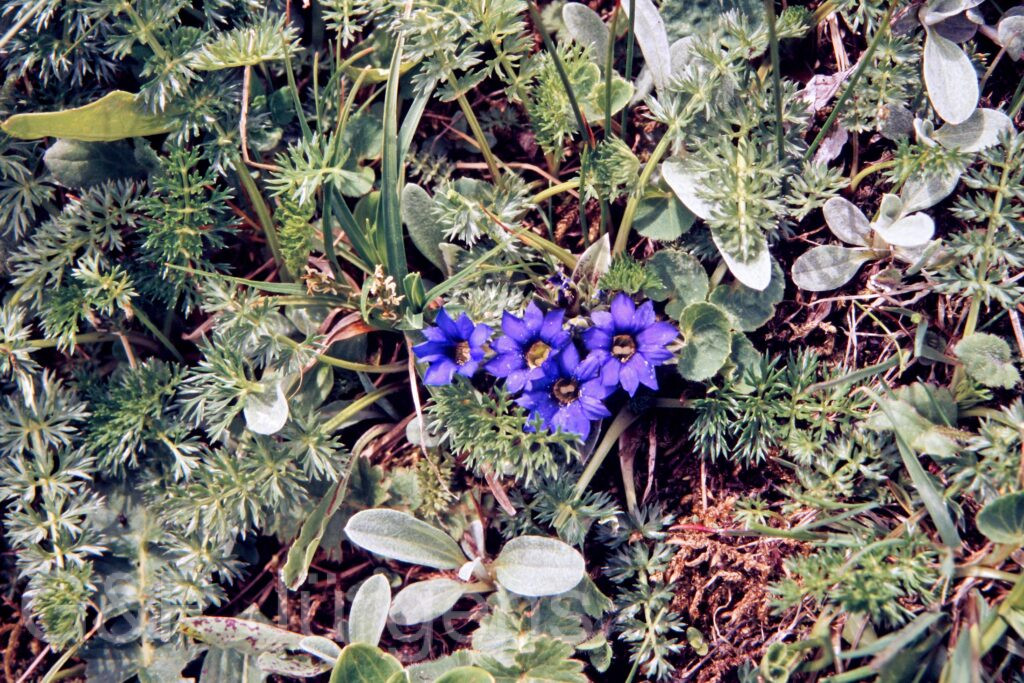
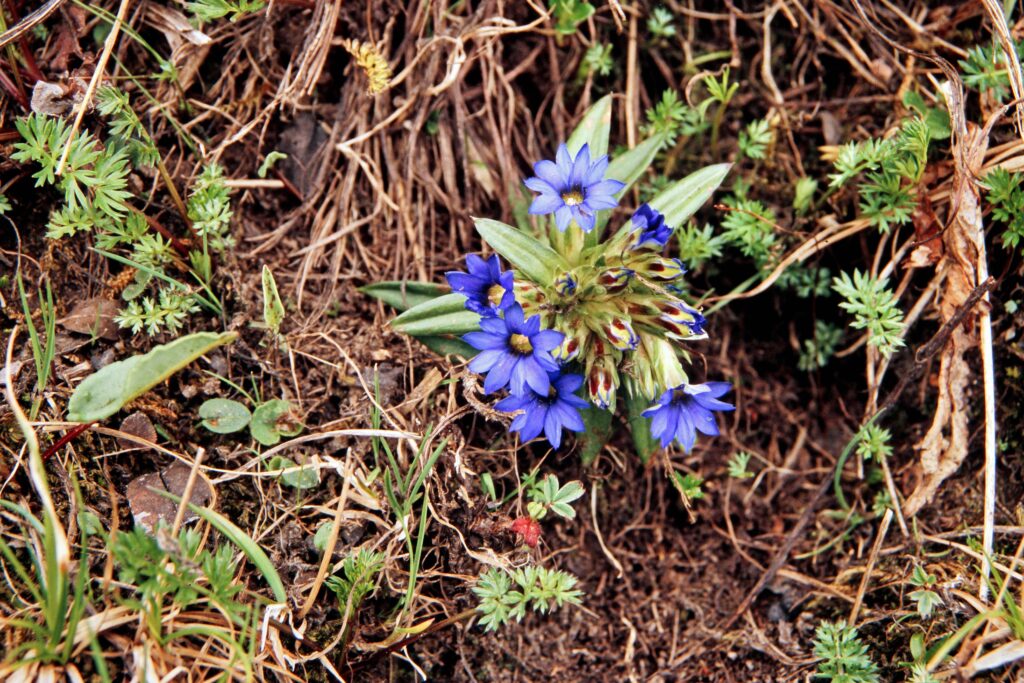
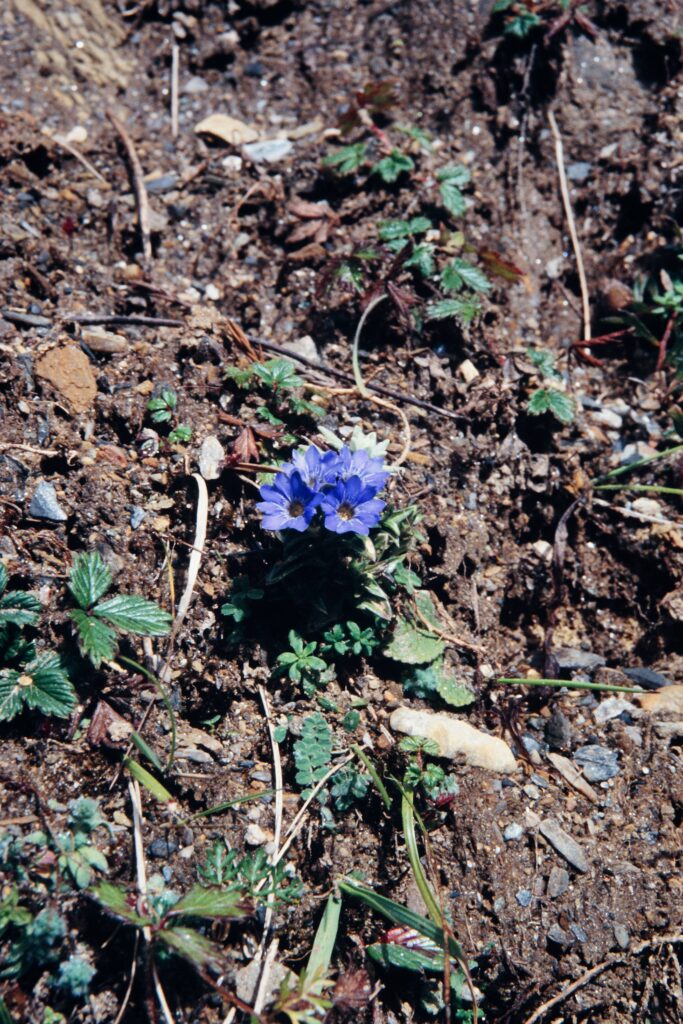
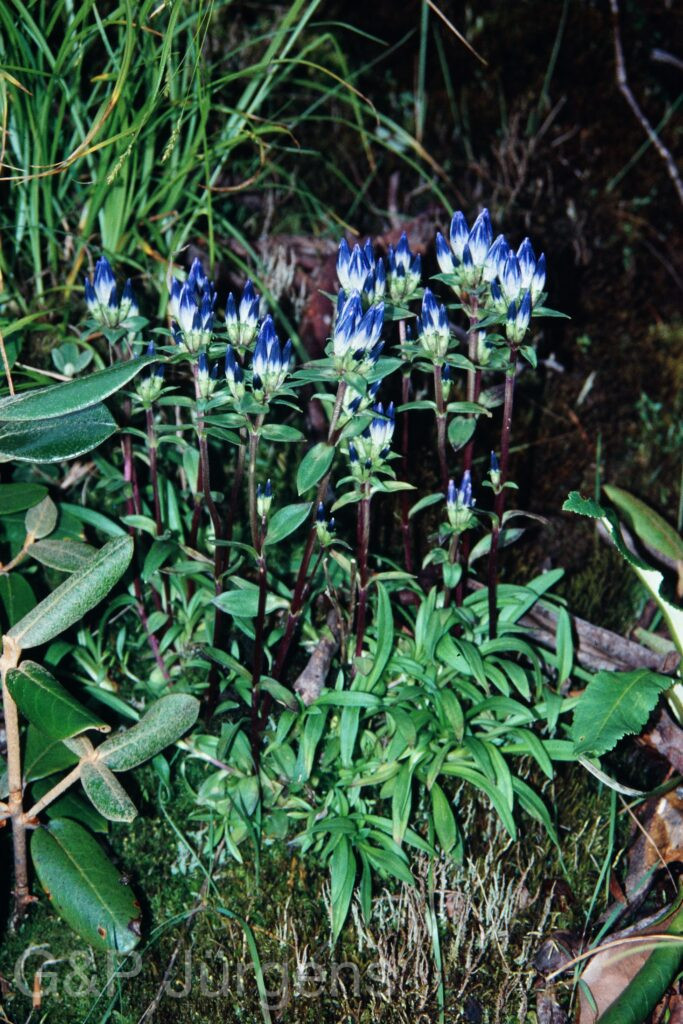
Gentiana coronata is a Himalayan alpine gentian distributed across the western and central Himalaya, from Pakistan through northern India (Kashmir, Himachal Pradesh, Uttarakhand) to Nepal. GBIF records 52 occurrences from India, Pakistan, and adjacent regions. The species typically grows in alpine meadows, moist grassy slopes, and along stream margins at elevations of 3,500–4,800 m. The photograph from Jaisuli Kund in Nepal at 4,200 m, taken in October, captures the species in its characteristically late flowering season when most alpine herbs have already set seed.
The plant is an annual or biennial herb, 5–15 cm tall, with erect or ascending stems that are simple or sparingly branched from the base. Basal leaves are ovate to elliptic, forming a loose rosette; cauline leaves are opposite, sessile, ovate-lanceolate, 8–20 mm long, with acute apices. Flowers are solitary and terminal or few in upper leaf axils, sessile or subsessile. The calyx is tubular, 10–15 mm long, with five lanceolate lobes. The corolla is tubular-campanulate, 20–30 mm long, pale blue to deep azure, with conspicuous plicae (inter-lobe folds) that are fringed or laciniate, forming the corona-like structure alluded to in the specific epithet. Stamens five, inserted at the middle of the corolla tube. The capsule is stipitate, ellipsoid.
Gentiana coronata belongs to section Chondrophyllae and is part of a complex of small annual gentians that diversified extensively in the high-altitude environments of the Himalaya and Tibetan Plateau. Its late-season phenology is ecologically significant, as it provides nectar resources for pollinators at a time when floral availability is minimal. The species is considered locally common in suitable habitats but faces potential long-term threats from climate-induced shifts in alpine vegetation zones.

Sources: POWO (Kew), GBIF, Flora of Pakistan Vol. 197, Ho & Pringle: Gentianaceae in Flora of China Vol. 16

C.B.Clarke

Sikkim2003 164 G219
Sikkim Dzongri 4000m, August
Sikkim2003 165 P220
Sikkim Dzongri 4000m, August

Description

Gentiana elwesii is an eastern Himalayan gentian recorded from Nepal (NP), Bhutan (BT), India (IN) and China (CN), with 100 GBIF occurrences reflecting its restricted high-mountain range. It is a plant of alpine meadows, open turf, grassy slopes and rocky pastures in the upper subalpine and alpine zones, generally between about 3500 and 4500 m. The illustrated material was collected at Dzongri in Sikkim at roughly 4000 m in August, when many Himalayan autumnal gentians come into flower at the close of the monsoon.

It is a small annual or biennial herb with a slender, erect to ascending, often branched stem arising from a basal rosette. The leaves are small, ovate to lanceolate, opposite and sessile, the rosette leaves frequently larger than the cauline ones. The flowers are borne singly or few together at the stem and branch apices; the calyx is tubular with narrow lobes, and the corolla is funnel-shaped to narrowly campanulate, typically blue to purplish-blue, with five spreading lobes alternating with smaller, fringed or toothed plicae in the sinuses, a diagnostic feature of the autumn-flowering gentians. The fruit is a stipitate, two-valved capsule releasing numerous minute seeds.

Gentiana elwesii belongs to the species-rich annual gentians (section Chondrophyllae and allies) that characterise Himalayan alpine grasslands, a group noted for intricate corolla-plait morphology and bee pollination. The Sino-Himalayan region is a global centre of Gentiana diversity, and such narrow-range alpine annuals are valuable indicators of high-elevation grassland habitats sensitive to grazing and climatic change.

Author: C.B.Clarke · Sources: POWO (Kew), GBIF, Flora of China, Flora of Nepal, Flora of Bhutan, Ho & Liu Worldwide Monograph of the genus Gentiana