Tag:

Alpine (>3500 m)

Hausskn.

Sikkim2003 213 G297
Sikkim Dzongri 3900m, August

Description

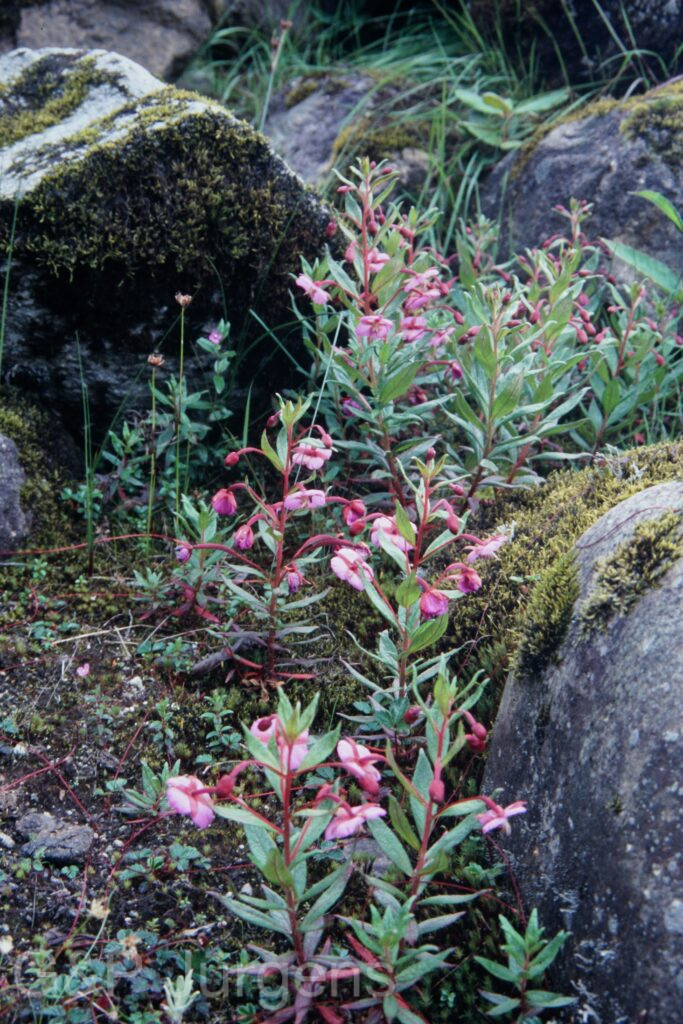
Epilobium conspersum is a perennial herb of the Sino-Himalayan and East Asian mountains, distributed through southwestern China, Nepal, northern India, Myanmar, Bhutan and Japan, with introduced records in the United States; GBIF documents about 134 occurrences. It is a plant of moist, open subalpine and alpine habitats such as stream banks, wet meadows and gravelly flushes, typically between about 3000 and 4200 m. The photographed plant was collected at Dzongri in western Sikkim at around 3900 m in August, on the cool, wet ground this willowherb favours during the monsoon. In GBIF the name carries the status SYNONYM, while Epilobium conspersum is here recognised as the accepted name for this Himalayan material.

The plant produces erect to ascending stems from a perennating base that overwinters by leafy rosettes or short turions. The leaves are opposite below and alternate above, sessile or shortly petiolate, lanceolate to ovate, with a toothed margin, the stems often finely hairy in lines. The flowers are borne in the upper leaf axils; as in the genus they have an inferior, elongate ovary, four notched pink to rose-purple petals, four sepals and eight stamens. The fruit is a long, slender, four-valved capsule that splits to release numerous seeds, each bearing a silky coma for wind dispersal.

Epilobium (Onagraceae) is a large temperate and cold-region genus in which the comose seeds and elongate capsular fruit are diagnostic. The Himalayan species form a taxonomically intricate group, and the synonymy reflected in the GBIF status underscores their nomenclatural complexity. Widespread along its moist alpine corridor, the species is not considered threatened.

Author: Hausskn. · Sources: POWO (Kew), GBIF, Flora of China Vol. 13, Flora of Bhutan Vol. 2, Flora of Nepal, Flora of Pakistan, Raven monograph of Old World Epilobium

(Lindl. ex DC.) Benth. & Hook.f.

BhutanPG2011 371
Bhutan Dur-Tso, 4000m June
Sikkim2003 429 G596
Sikkim Chopta Valley 4100m August

Description

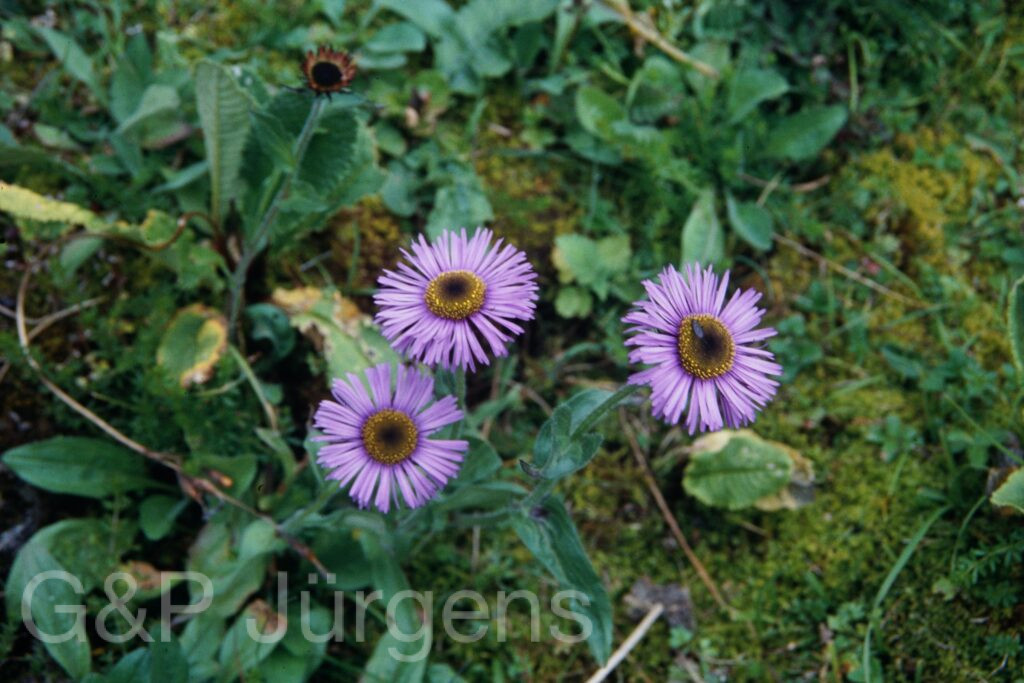
Erigeron multiradiatus (Lindl. ex DC.) Benth. & Hook.f. is a Himalayan and Sino-Himalayan fleabane distributed through China, Nepal, India, Pakistan, Afghanistan and Bhutan, with around 1400 georeferenced occurrences in GBIF. It is a plant of alpine and subalpine meadows, open grassy slopes, rocky ground and forest clearings, generally between about 2700 and 4500 m. The collections from Dur-Tso at 4000 m in June and the Chopta valley in Sikkim at 4100 m in August are characteristic of its high-altitude summer flowering across the central and eastern Himalaya.

It is a tufted perennial herb arising from a short rhizome, with erect, simple or sparingly branched stems bearing spreading hairs. The basal leaves are oblanceolate to spatulate, narrowed to a petiole and entire to slightly toothed, forming a rosette; the cauline leaves are smaller, sessile and clasping. The solitary or few terminal capitula are large and showy, with an involucre of narrow, hairy, somewhat purplish phyllaries; the numerous, very fine ray florets, alluded to in the epithet multiradiatus, are pinkish-purple to violet and surround a central disc of yellow tubular florets. The fruit is a small, compressed, hairy cypsela topped by a double pappus of fine bristles.

Erigeron is a large, taxonomically intricate genus, and the densely many-rayed alpine Himalayan species form a distinctive assemblage within it, recognised by their broad showy heads and high-elevation habitat. A widespread and locally common alpine herb, E. multiradiatus is of no particular conservation concern, though it is valued horticulturally and in regional traditional medicine.

Author: (Lindl. ex DC.) Benth. & Hook.f. · Sources: POWO (Kew), GBIF, Flora of China, Flora of Bhutan, Grierson & Long Flora of Bhutan Compositae account

(Cambess.) Christenh. & Byng

BhutanPG2011 207
Bhutan Tsochenchen, 3500m June
BhutanPG2011 586
Bhutan Ludlow-Sherriff-Trail Miluthang, 4450m July
Nepal 99 130 ergebnis
West-Nepal South of Rara-Lake 3800m, June
Nepal 99 529 ergebnis
West-Nepal South of Rara-Lake 3800m, June

Description

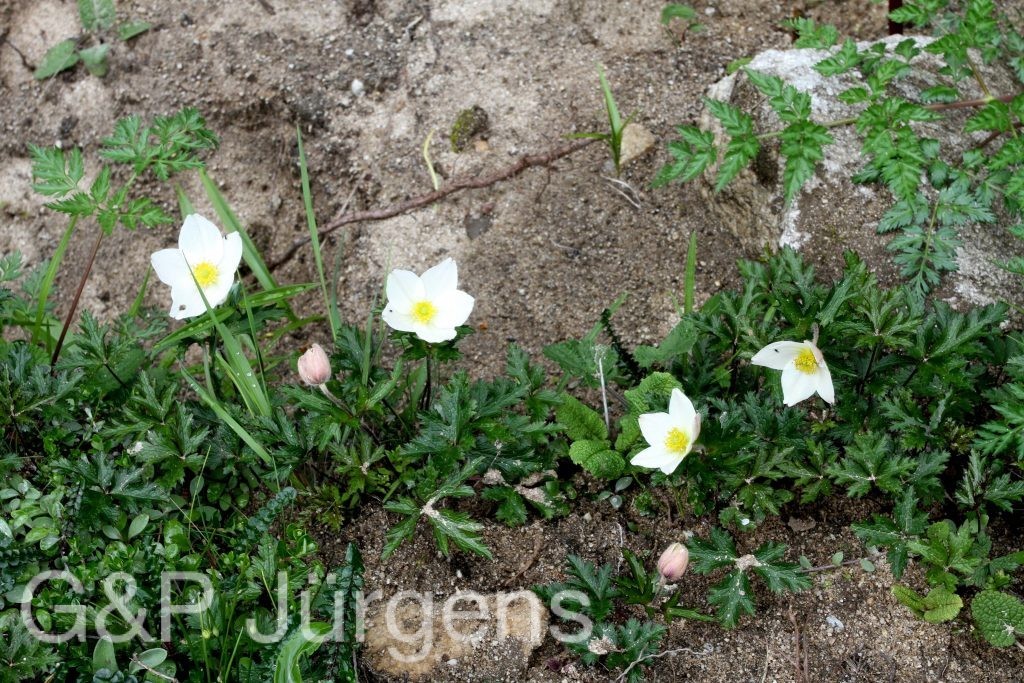
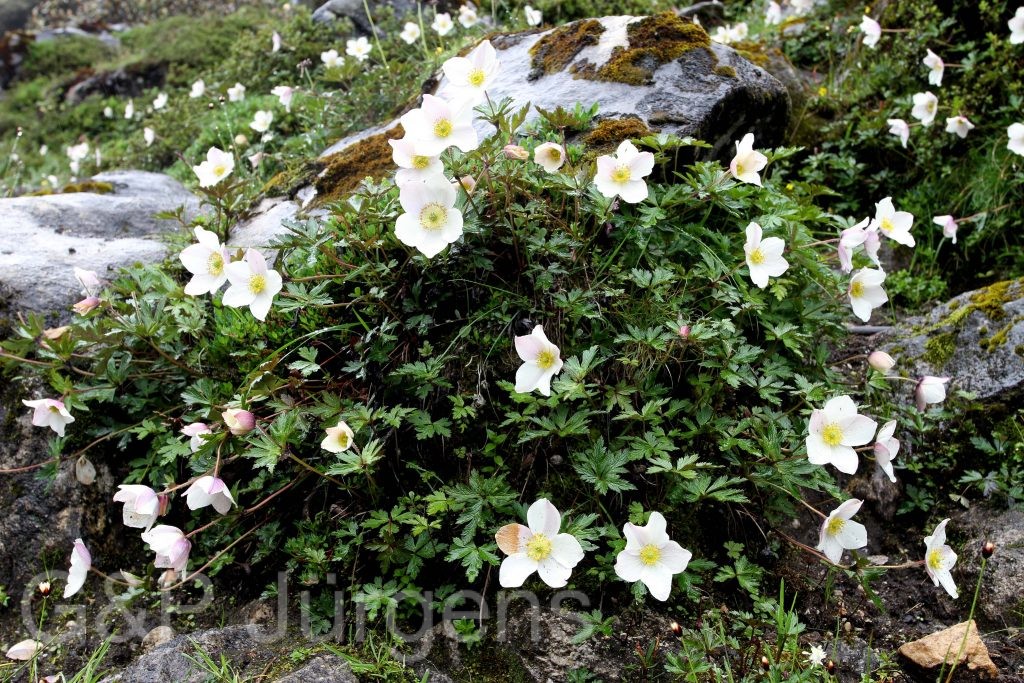
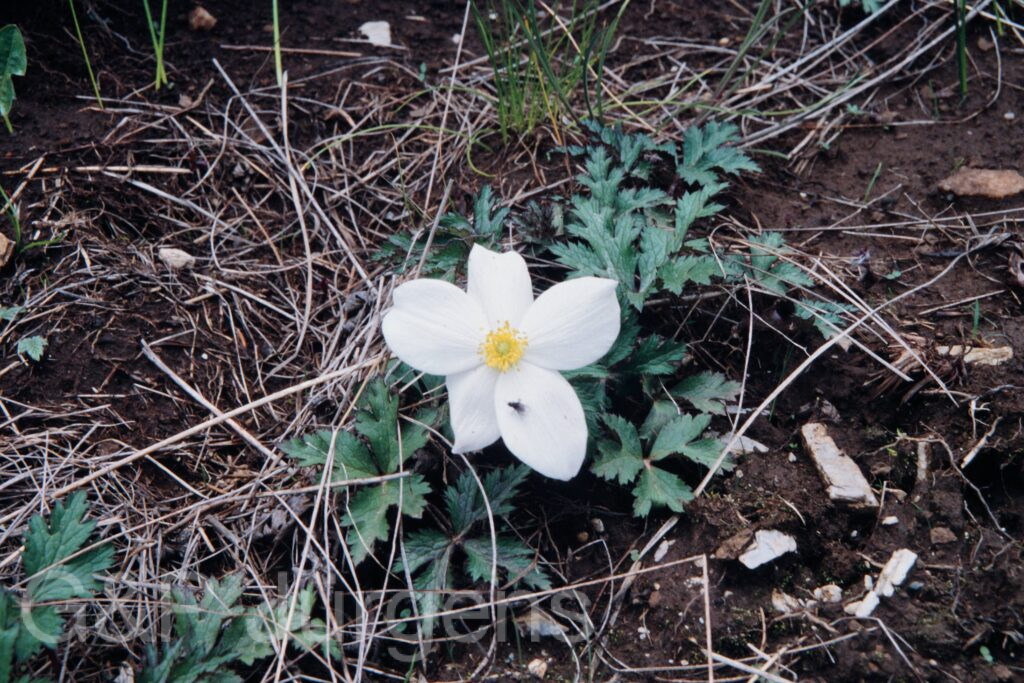
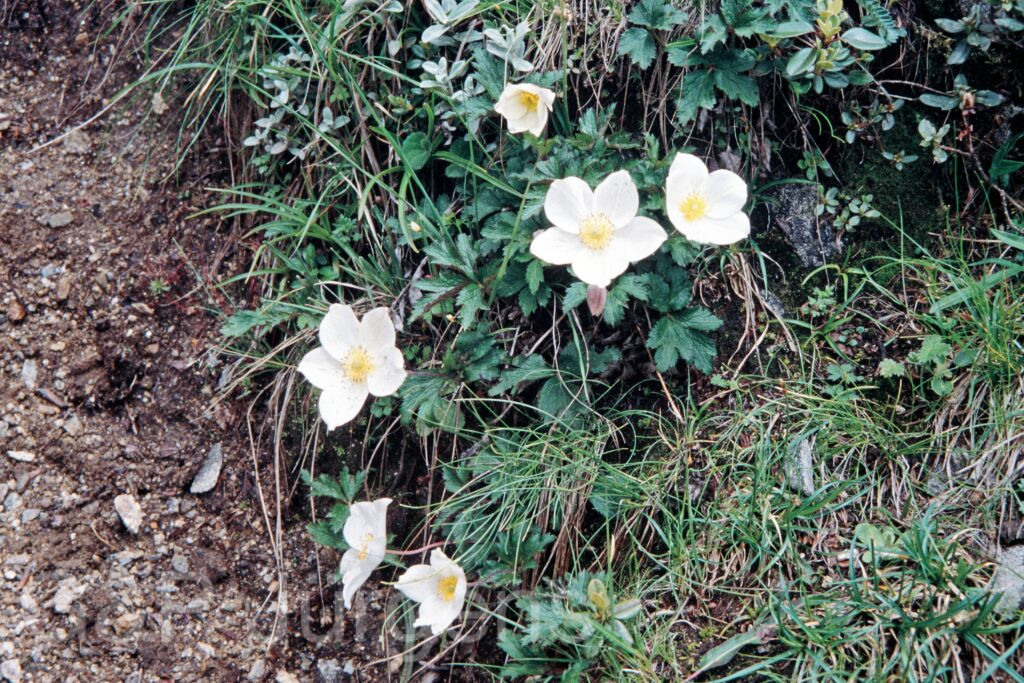
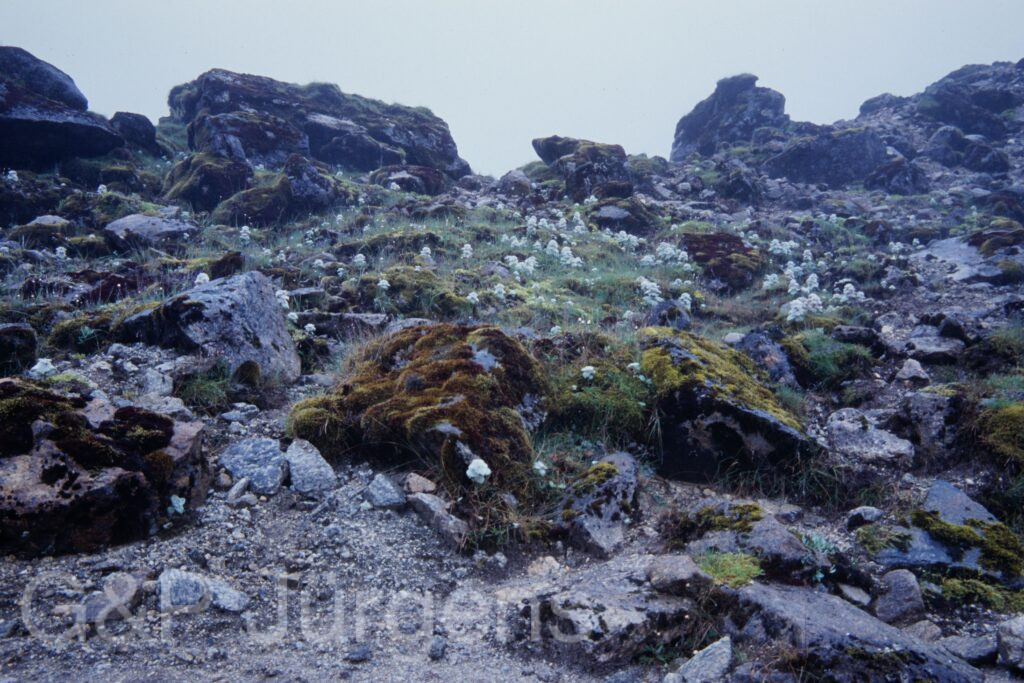
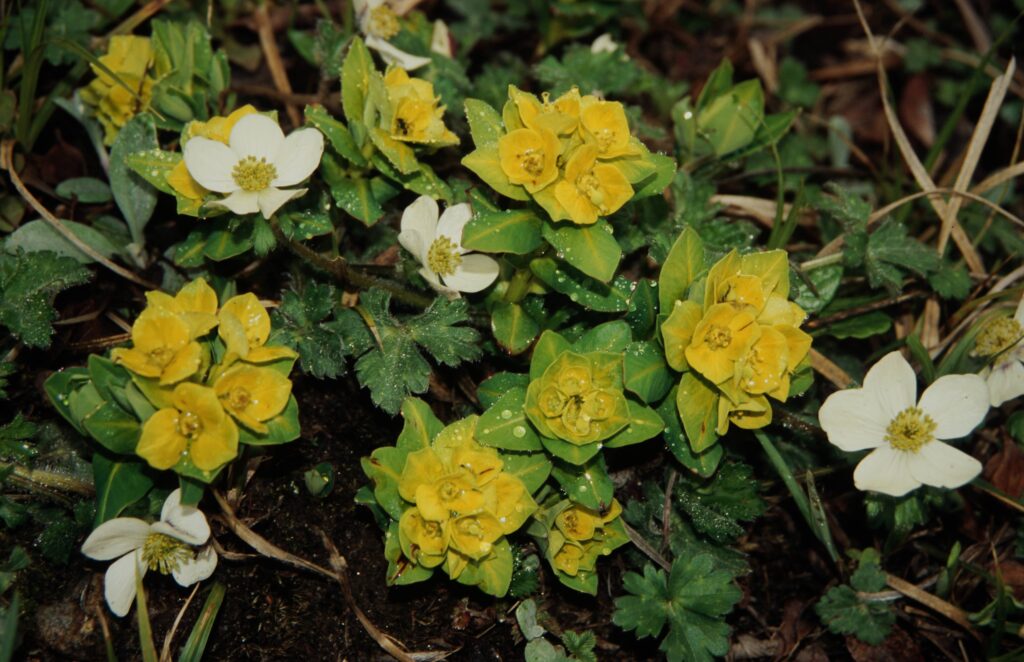
Eriocapitella rupicola, formerly Anemone rupicola, is a Himalayan and Sino-Himalayan herb distributed from Pakistan through Nepal, India and Bhutan into China, with around 507 GBIF occurrences. It grows in alpine and subalpine habitats, on rocky slopes, cliff ledges, open meadows, stony pastures and among boulders, often in well-drained sites in the upper subalpine to alpine zone. The images document it widely in the range: Bhutan at Tsochenchen around 3500 m in June and along the Ludlow-Sherriff Trail at Miluthang near 4450 m in July, and West Nepal south of Rara Lake at about 3800 m in June, where its white blooms open through the early summer.

It is a perennial herb arising from a stout rootstock, with basal leaves that are ternately to palmately divided into toothed, deeply cut segments, hairy on the surfaces. The flowering stems are erect and bear an involucre of stalked, leaf-like bracts below the flowers. The flowers are solitary or few, comparatively large and showy, with several (commonly five) petaloid white sepals, often flushed pink or bluish on the reverse, and numerous stamens surrounding a head of carpels. The fruit is a head of densely woolly, long-hairy achenes, the indumentum aiding wind dispersal.

The species has been transferred to Eriocapitella, a segregate genus carved from the broadly circumscribed Anemone on molecular and morphological grounds by Christenhusz and Byng; POWO accepts this placement, with Anemone rupicola as a synonym. The woolly achene heads (the basis of the generic name) are characteristic. The showy white flowers attract generalist alpine insect pollinators. Widespread across the Himalaya, it is common and of least conservation concern.

Author: (Cambess.) Christenh. & Byng · Sources: POWO (Kew), GBIF, Flora of China, Flora of Bhutan, Flora of Nepal, Christenhusz & Byng revision of Anemone s.l.

(Hedge) Ryding

Nepal 99 751 ergebnis
West-Nepal Poksundo-Lake 3650m, July

Description

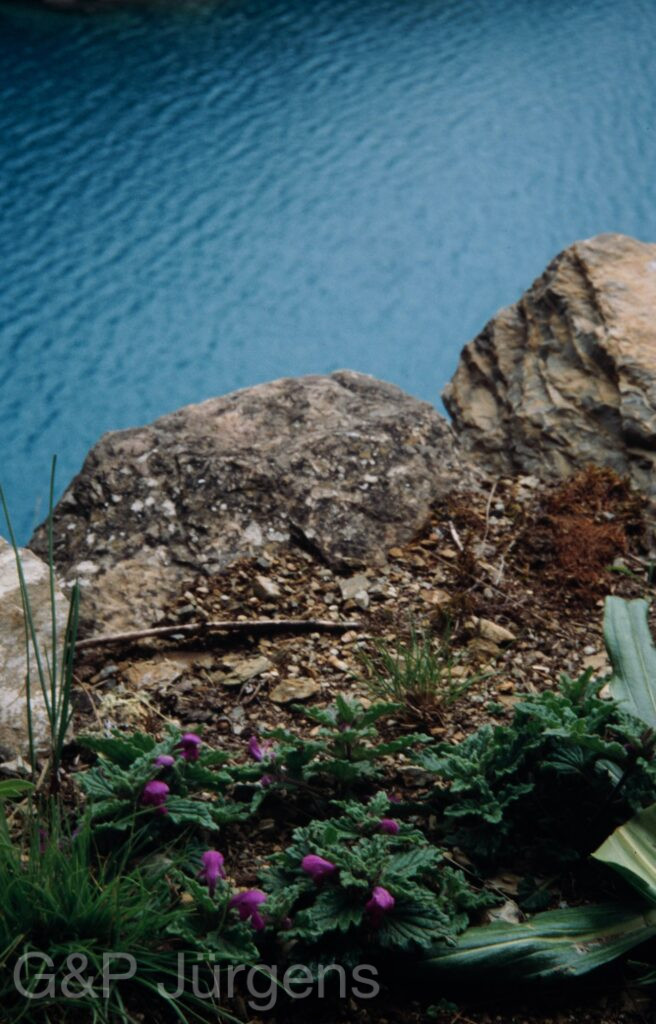
Eriophyton tuberosum is a high-alpine Himalayan labiate with a narrow distribution, GBIF holding only about 46 occurrences from Nepal, India and China. It is a plant of the alpine and subnival zones, occurring on open turf, scree margins, moist rocky slopes and stream-side flushes generally between about 3300 and 4300 m, enduring intense insolation, short growing seasons and cold nights. The population photographed beside Phoksundo (Poksundo) Lake in West Nepal at 3650 m, flowering in July at the height of the monsoon growing season, is typical of its restricted occurrence in cool, moist, high-elevation meadow and rock habitats of the western and central Himalaya.

It is a low perennial herb arising from a swollen tuberous rootstock, as the epithet indicates, with short, ascending to decumbent stems. The leaves are opposite and decussate, ovate to rounded, crenate, and—like many members of this alpine assemblage—somewhat fleshy and often woolly or villous, an adaptation to the harsh climate. The flowers are borne in axillary whorls toward the stem apex; each has a tubular, toothed calyx and a two-lipped corolla in shades of pink, purple or violet, with four didynamous stamens beneath the upper lip. The fruit comprises four smooth nutlets in the persistent calyx.

Transferred by Ryding to Eriophyton from Hedge's original placement, this species reflects a modern recircumscription absorbing several small Himalayan genera (notably Alajja) into an expanded Eriophyton of woolly alpine mints. Its very low occurrence count and narrow high-altitude band make it a regional endemic of conservation interest, sensitive to grazing and alpine warming, and a nectar source for high-altitude bumblebees.

Author: (Hedge) Ryding · Sources: POWO (Kew), GBIF, Flora of China, Annotated Checklist of the Flowering Plants of Nepal, Ryding revision of Eriophyton (Lamiaceae)

Benth.

Sikkim2003 319 P458
Sikkim Saniti-Lake 4300m August
Sikkim2003 322 P457
Sikkim Saniti-Lake 4300m August

Description

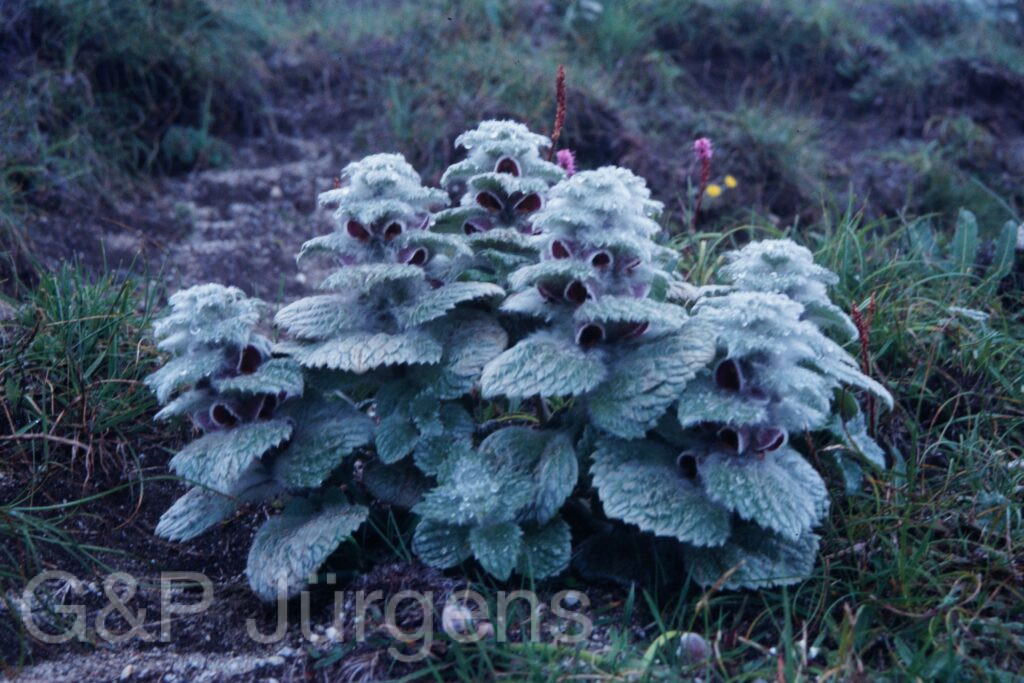
Eriophyton wallichii is a high-alpine perennial of the central and eastern Himalaya and the Tibetan Plateau, recorded from China, Nepal, India, Bhutan and Afghanistan, with some 605 georeferenced occurrences documented in GBIF. It is a characteristic plant of open screes, moraines and frost-heaved gravels of the upper alpine and subnival zones, typically between 3500 and 5000 m, where the growing season is brief. The photograph from the Saniti Lake area of Sikkim at about 4300 m in August captures the species in its preferred scree habitat at the height of the short montane summer.

The plant forms a stout, deeply buried rhizome from which arise short, ascending stems almost entirely concealed by the foliage. The most conspicuous feature is the dense covering of long, silky white woolly hairs that envelop the upper leaves, an adaptation buffering the flowers against cold and excessive radiation. The leaves are opposite, broadly ovate to suborbicular, becoming progressively larger and more densely lanate upward, where the uppermost pairs form a protective bracteal cup. The bilabiate flowers are borne in the axils of these terminal leaves, with a tubular calyx and a pink to purplish corolla whose lower lip is spreading; the fruit comprises four smooth nutlets enclosed within the persistent calyx.

The genus Eriophyton sensu lato (incorporating elements formerly placed in Alajja and Stachyopsis) is a small, distinctly Sino-Himalayan group of the Lamiaceae adapted to the harshest alpine environments. The pronounced indumentum exemplifies the convergent woolliness seen in unrelated subnival cushion and scree plants such as Saussurea and Soroseris. Long valued in Tibetan and Himalayan ethnomedicine, E. wallichii remains locally frequent across its broad range and is not presently considered threatened, though its specialised scree habitat is sensitive to glacial retreat and shifting alpine climates.

Author: Benth. · Sources: POWO (Kew), GBIF, Flora of China, Flora of Bhutan, Annotated Checklist of the Flowering Plants of Nepal, Harley et al. Labiatae in The Families and Genera of Vascular Plants

D.G.Long

Sikkim2004 412 P707
Sikkim/India Lachung 3700m May

Description

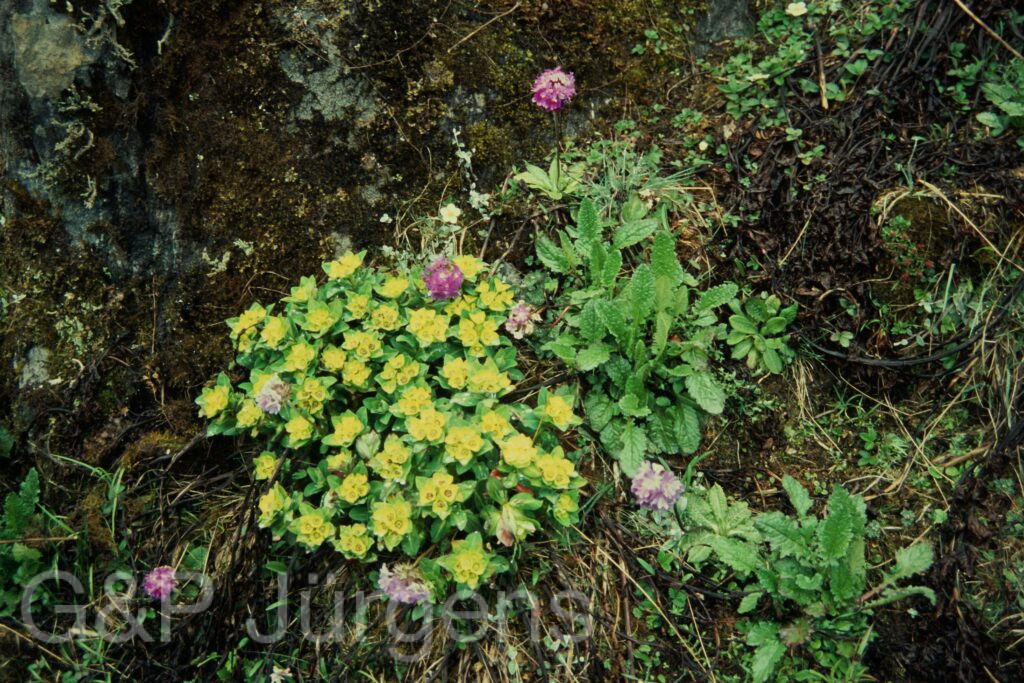
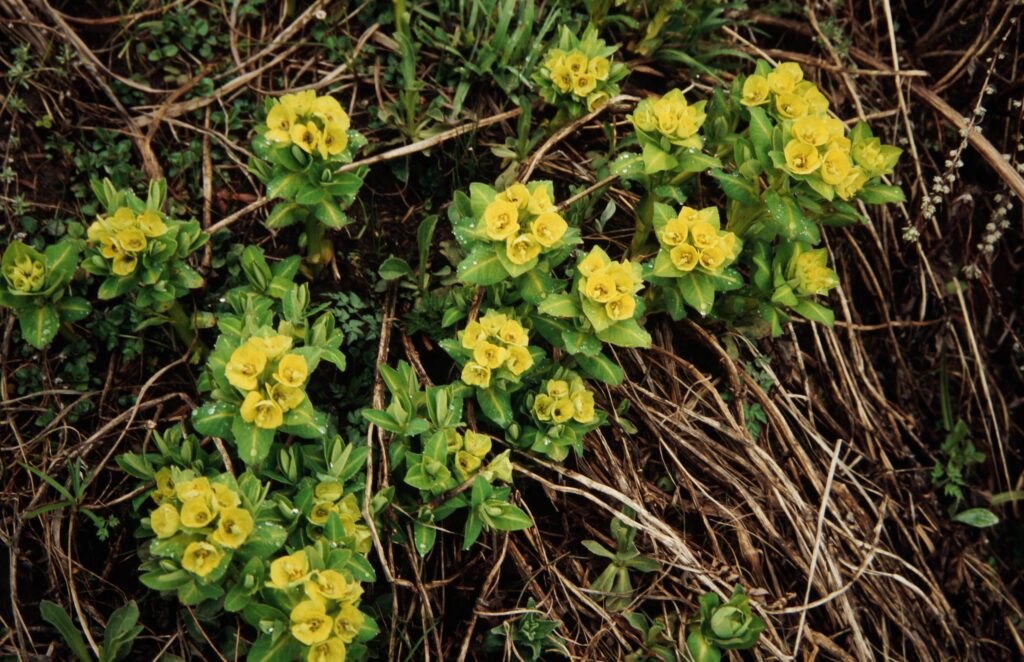
Euphorbia luteoviridis D.G.Long is an eastern Himalayan spurge recorded from Nepal, India, China and Bhutan (NP, IN, CN, BT), with GBIF documenting about 38 occurrences across this narrow range. It is a plant of the upper temperate to subalpine zone, growing on open slopes, forest margins, rocky banks and grazed pastures generally between about 3000 and 4000 m. The images from Lachung in Sikkim at 3700 m and Molley in West Bengal at 3630 m, both in May, illustrate its spring flowering, when the yellowish-green cyathial bracts emerge against the recovering alpine sward.

It is a perennial herb arising from a woody rootstock, producing one to several erect or ascending stems. The leaves are alternate, entire, oblong to oblanceolate or spathulate, with whorled, broader floral leaves subtending the inflorescence. This is the characteristic euphorbioid pseudanthium: a terminal pleiochasium with several rays, each cyathium subtended by yellow-green bracts and enclosing a single naked female flower surrounded by reduced male flowers, with crescentic nectar glands on the rim. The fruit is a three-lobed schizocarpic capsule splitting explosively into cocci; all parts exude the toxic milky latex typical of the genus.

Euphorbia luteoviridis was described comparatively recently by D.G.Long during work on the eastern Himalayan flora, and belongs to the herbaceous perennial spurges well represented in the high mountains. Its restricted distribution gives it significance as a regional endemic, while the latex confers chemical defence against herbivores in the grazed pastures it inhabits. No global threat assessment is widely published, but its limited range warrants attention.

Author: D.G.Long · Sources: POWO (Kew), GBIF, Flora of Bhutan Vol. 1, Flora of China Vol. 11, Flora of Nepal, Radcliffe-Smith treatments of Himalayan Euphorbia

Boiss.

Nepal 99 313 ergebnis
West-Nepal Kalmura 4200m, June
Nepal 99 314 ergebnis
West-Nepal Kalmura 4200m, June

Description

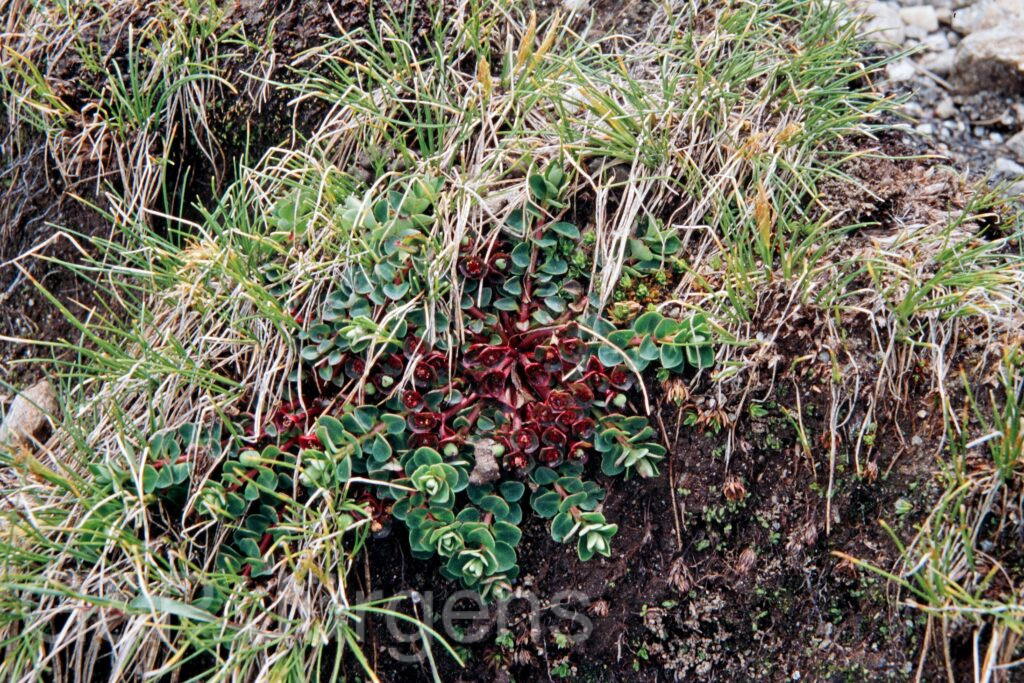
Euphorbia stracheyi is a widespread high-altitude spurge of the Himalaya and the Tibetan Plateau, distributed from Nepal, northern India and Bhutan eastward into SW China, with outlying records southeast to Laos and Vietnam. The GBIF dataset, with around 946 occurrences across CN, NP, IN, BT, LA and VN, confirms this broad Sino-Himalayan range. The plant shown was photographed in western Nepal at Kalmura at about 4,200 m in June. It is a true alpine, growing on open stony slopes, gravelly pastures, moraine and turf between roughly 3,000 and 4,800 m, where its prostrate, mat-forming habit suits the cold, exposed and seasonally snow-covered ground.

The species arises from a slender, often elongate creeping rhizome bearing numerous decumbent to ascending reddish stems. The leaves are small, alternate, obovate to oblong and entire. As in all Euphorbia, the inflorescence is a cyathium: the apparent flowers are condensed pseudanthia in which crescent-shaped or transversely elliptic nectar glands surround reduced unisexual flowers, the female reduced to a single stalked tricarpellate ovary and the males to single stamens, the whole subtended by leafy, often reddish-tinged bracts. The fruit is a smooth three-lobed schizocarpic capsule that splits into three mericarps, releasing ovoid seeds; the plant exudes the milky latex typical of the genus.

Euphorbia stracheyi belongs to the subgenus Esula, a group of herbaceous spurges well represented at high elevations across central Asia. Its dwarf, cushion-like form and reddish coloration are adaptations to intense radiation and short growing seasons. The caustic latex deters herbivory and the species is locally common; it is not considered threatened, though like all Euphorbia it falls under CITES listing of the genus for trade-monitoring purposes.

Author: Boiss. · Sources: POWO (Kew), Flora of China Vol. 11, Flora of Bhutan Vol. 1, GBIF, Radcliffe-Smith: Euphorbia in the Flora of Pakistan

D. Don

Sikkim2003 179 G245
Sikkim Dzongri 4100m 08.2003
Sikkim2003 504 P704
Sikkim Dzongri 4100m, August

Description

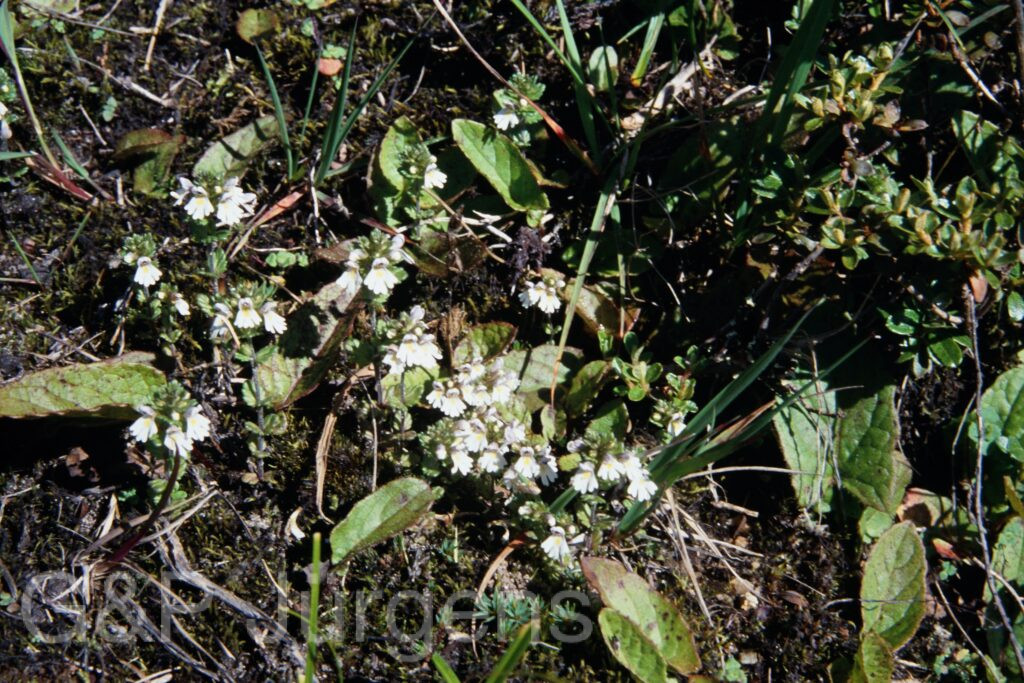
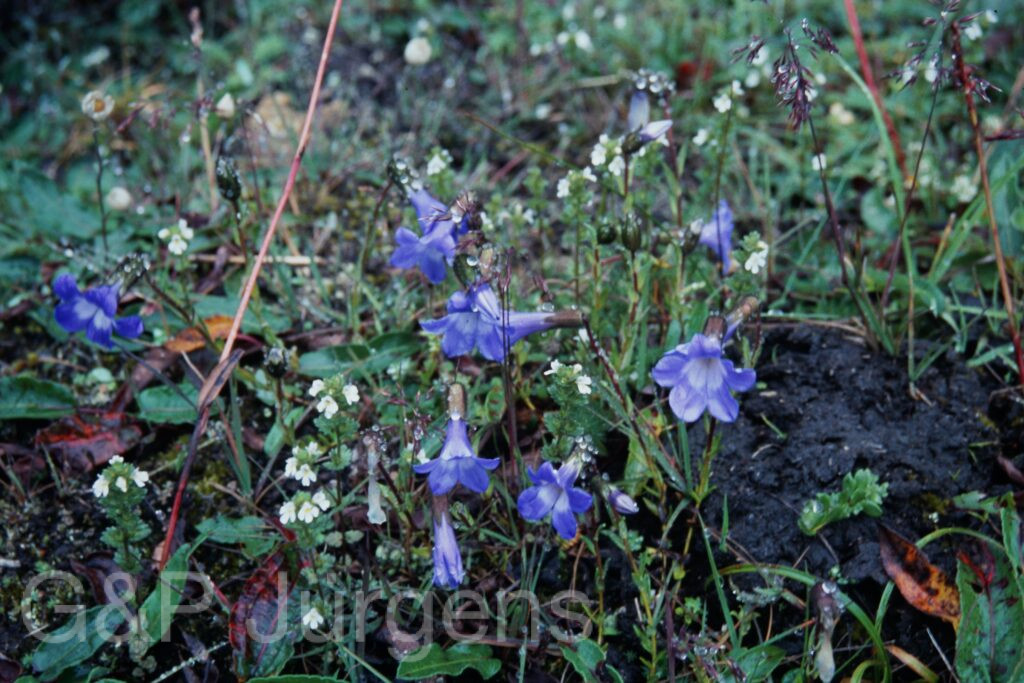
Euphrasia simplex is an alpine eyebright of the Himalaya, recorded from India and Nepal, and known from only a handful of georeferenced occurrences (five in GBIF), reflecting both its small stature, which makes it easily overlooked, and its restricted high-altitude range. It is a plant of short alpine turf, open grassy slopes and moist meadows above treeline. The illustrated material from Dzongri in Sikkim, gathered at about 4100 m in August, is characteristic of its occurrence high in the eastern Himalayan alpine zone, where it flowers in the late-summer growing season among low alpine vegetation.

The plant is a small, slender annual, as the epithet simplex suggests often little-branched or unbranched, with an erect, leafy stem. The leaves are small, opposite, sessile and ovate with a few coarse, often bristle-tipped teeth. The flowers are borne in the axils of the upper leaves, forming a leafy terminal spike; each has a tubular, four-lobed calyx and a two-lipped (bilabiate) corolla, the upper lip hooded and the lower lip three-lobed and spreading, the whole typically white to pale lilac with darker veining and a yellow throat-blotch. The fruit is a small, flattened, two-valved capsule containing several seeds.

Like other members of its genus, E. simplex is a hemiparasite, photosynthetic but attaching by haustoria to the roots of neighbouring grasses and herbs to draw water and nutrients; the genus has been transferred from the traditional Scrophulariaceae to the Orobanchaceae in light of this parasitic habit and molecular evidence. Euphrasia is notoriously difficult taxonomically owing to plasticity and hybridisation, and the high-altitude Himalayan species are imperfectly known. Its rarity in collections makes the status of E. simplex uncertain, and further field survey would clarify its true distribution and abundance.

Author: D. Don · Sources: POWO (Kew), GBIF, Flora of Nepal, Annotated Checklist of the Flowering Plants of Nepal, Yeo: monographic studies of the genus Euphrasia

(W.W.Sm.) H.Hara

BhutanPG2011 656 ergebnis
Bhutan Thitha-Tso 4360m,July

Description

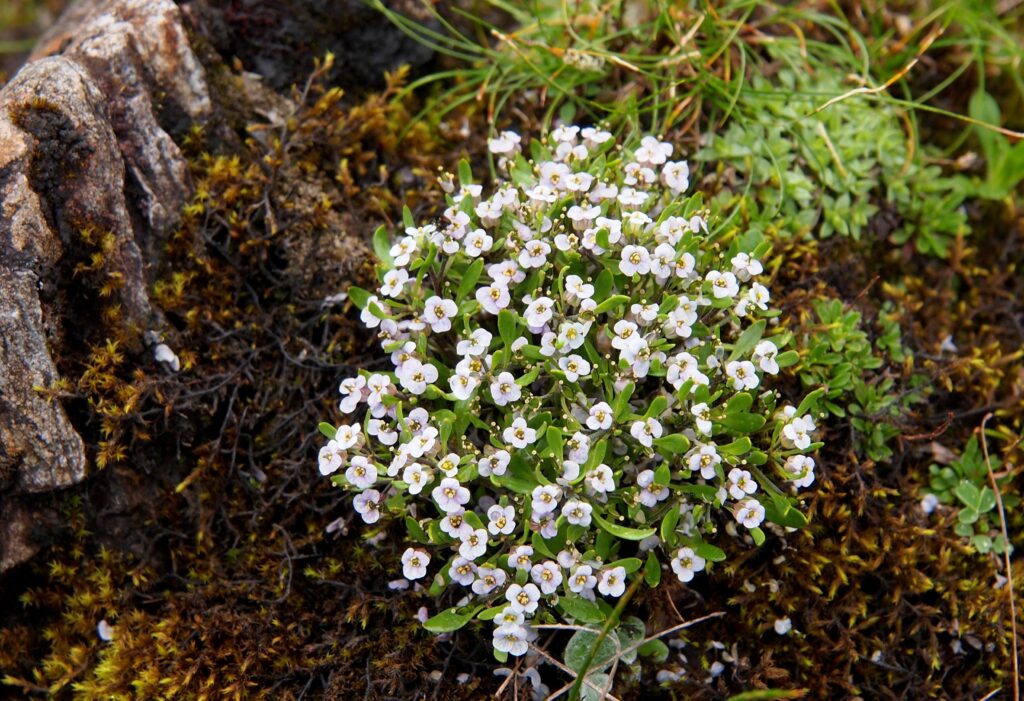
Eutrema heterophyllum is an alpine crucifer of the high mountains of central Asia and the Himalaya, recorded from China, Nepal, Bhutan, Japan, Tajikistan and Kyrgyzstan, with GBIF logging 226 occurrences. It grows on open alpine slopes, damp gravelly flats, screes and the moist margins of glacial lakes and snowmelt rills. The photographed plant comes from Thitha Tso in Bhutan at about 4360 m, flowering in July, a cold, high-elevation lakeside habitat typical of the species' upper-alpine preference.

It is a small, glabrous perennial or biennial herb arising from a slender rootstock, with one or more ascending stems. As the epithet heterophyllum signals, the foliage is variable: basal leaves are often petiolate and entire to lobed, while the cauline leaves differ in shape and become smaller upward. The flowers are borne in a terminal raceme, small, with four white petals in the cruciferous cross arrangement and six tetradynamous stamens. The fruit is a slender, somewhat flattened silique containing the seeds in a single row.

The taxon is accepted, having been transferred to Eutrema by H. Hara from W.W. Smith's original placement. Eutrema, the genus of wasabi, has been substantially recircumscribed by molecular work that drew in numerous small alpine Sino-Himalayan species formerly scattered among other crucifer genera. As a cold-adapted, broadly distributed high-altitude herb it exemplifies the central-Asian alpine element of the Himalayan flora and is unlikely to be threatened, though dependent on intact periglacial habitats.

Author: (W.W.Sm.) H.Hara · Sources: POWO (Kew), GBIF, Flora of China, Flora of Bhutan, Al-Shehbaz's systematic studies of Brassicaceae

Hook.f. & Thomson

Sikkim2011 248
Sikkim Yumthang 3800m, June

Description

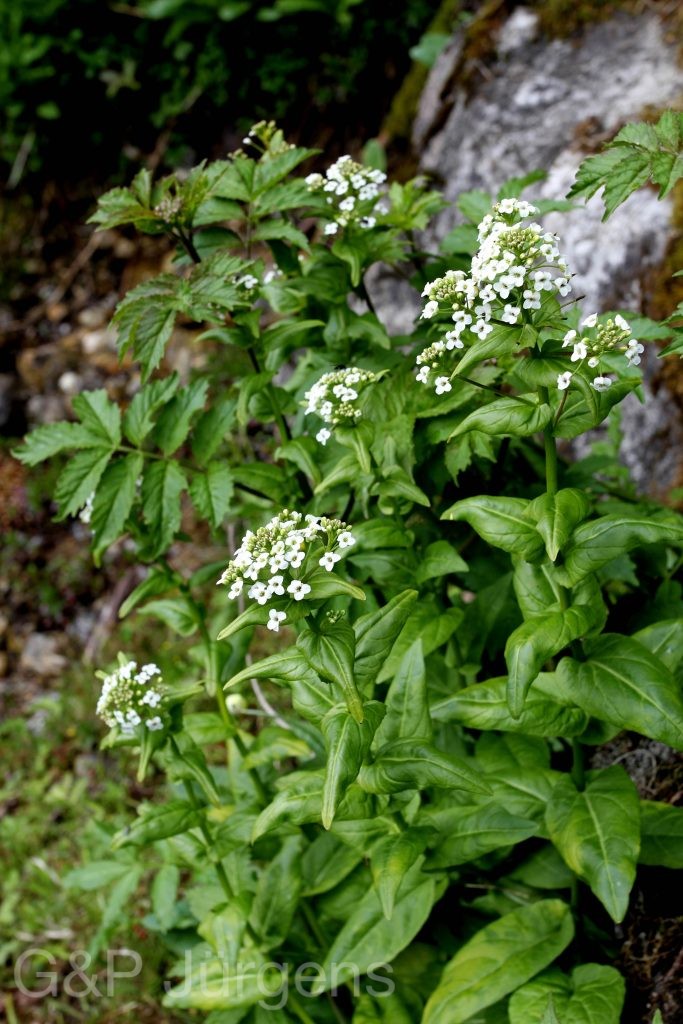
Eutrema himalaicum Hook.f. & Thomson is an alpine crucifer of the high Himalaya and adjacent China, recorded from China, India and Bhutan, with around 249 georeferenced occurrences in GBIF (further scattered records reflect cultivation and herbarium holdings). It occupies moist alpine meadows, streamsides, seepage slopes, gravelly flats and rocky places near snowmelt, generally between about 3500 and 4800 m. The photographed plant was found at Yumthang in Sikkim at about 3800 m in June, in the lush, well-watered subalpine to alpine turf that this small herb favours as the snow recedes.

The plant is a slender annual or short-lived perennial with erect or ascending, often glabrous stems arising from a basal rosette. The leaves are simple, the basal ones petiolate with ovate to deltoid or somewhat hastate blades (recalling the form once distinguished as E. deltoideum), the cauline leaves smaller and shortly stalked to subsessile. The flowers are small and borne in terminal racemes; each has four white petals arranged in the cruciform pattern typical of the family, four free sepals and the tetradynamous stamens of the Brassicaceae. The fruit is a slender silique, the seeds in a single row within each locule.

The genus Eutrema, which includes the cultivated wasabi (E. japonicum), has been substantially recircumscribed by molecular studies, absorbing several formerly segregate Himalayan genera; this accounts for the species' nomenclatural history and the alternate epithet seen on the source page. As a snowbed and seepage specialist it is adapted to short, cool growing seasons. The species is fairly widespread within its alpine band and not of conservation concern, though sensitive to habitat disturbance.

Author: Hook.f. & Thomson · Sources: POWO (Kew), GBIF, Flora of China, Flora of Bhutan, Al-Shehbaz revision of Eutrema and Tribe Eutremeae, Hara Flora of the Eastern Himalaya