

C.B.Clarke
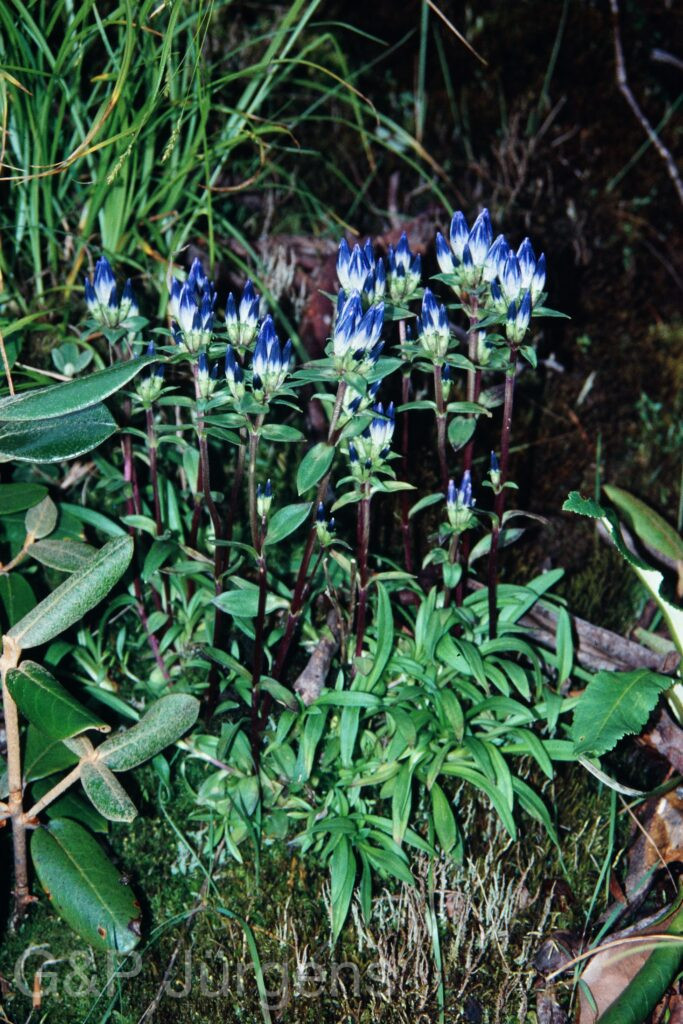
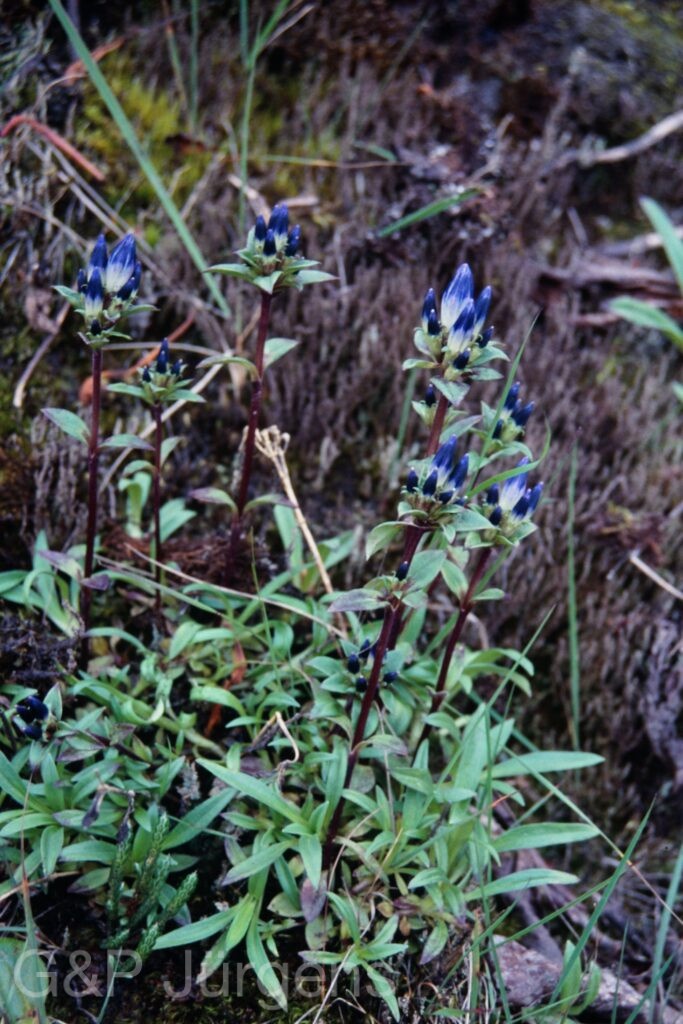
Description
Gentiana elwesii is an eastern Himalayan gentian recorded from Nepal (NP), Bhutan (BT), India (IN) and China (CN), with 100 GBIF occurrences reflecting its restricted high-mountain range. It is a plant of alpine meadows, open turf, grassy slopes and rocky pastures in the upper subalpine and alpine zones, generally between about 3500 and 4500 m. The illustrated material was collected at Dzongri in Sikkim at roughly 4000 m in August, when many Himalayan autumnal gentians come into flower at the close of the monsoon.
It is a small annual or biennial herb with a slender, erect to ascending, often branched stem arising from a basal rosette. The leaves are small, ovate to lanceolate, opposite and sessile, the rosette leaves frequently larger than the cauline ones. The flowers are borne singly or few together at the stem and branch apices; the calyx is tubular with narrow lobes, and the corolla is funnel-shaped to narrowly campanulate, typically blue to purplish-blue, with five spreading lobes alternating with smaller, fringed or toothed plicae in the sinuses, a diagnostic feature of the autumn-flowering gentians. The fruit is a stipitate, two-valved capsule releasing numerous minute seeds.
Gentiana elwesii belongs to the species-rich annual gentians (section Chondrophyllae and allies) that characterise Himalayan alpine grasslands, a group noted for intricate corolla-plait morphology and bee pollination. The Sino-Himalayan region is a global centre of Gentiana diversity, and such narrow-range alpine annuals are valuable indicators of high-elevation grassland habitats sensitive to grazing and climatic change.
Author: C.B.Clarke · Sources: POWO (Kew), GBIF, Flora of China, Flora of Nepal, Flora of Bhutan, Ho & Liu Worldwide Monograph of the genus Gentiana