Tag:

Bhutan

Flowers of Bhutan — 1326 plant species documented across the Bhutanese Himalaya, from dense broadleaf and conifer forests to alpine scrub and meadows. Bhutan’s largely intact wilderness shelters an exceptional diversity of orchids, rhododendrons, primulas and Himalayan poppies, many of them regional endemics. Each species page includes a botanical description, distribution, habitat and flowering time, with the original photograph and its recorded altitude and locality.

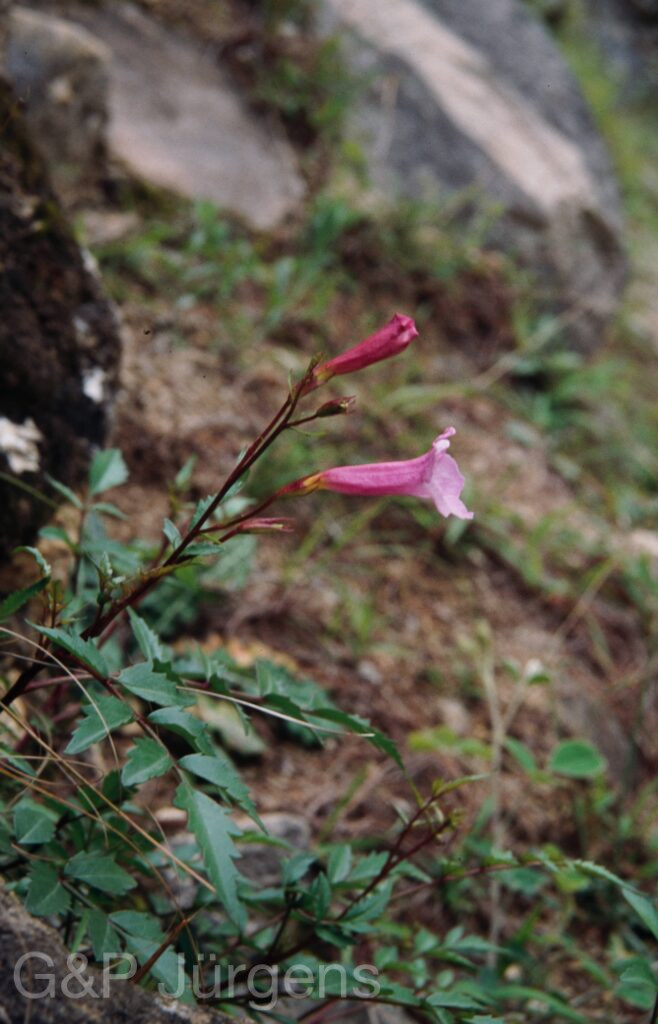
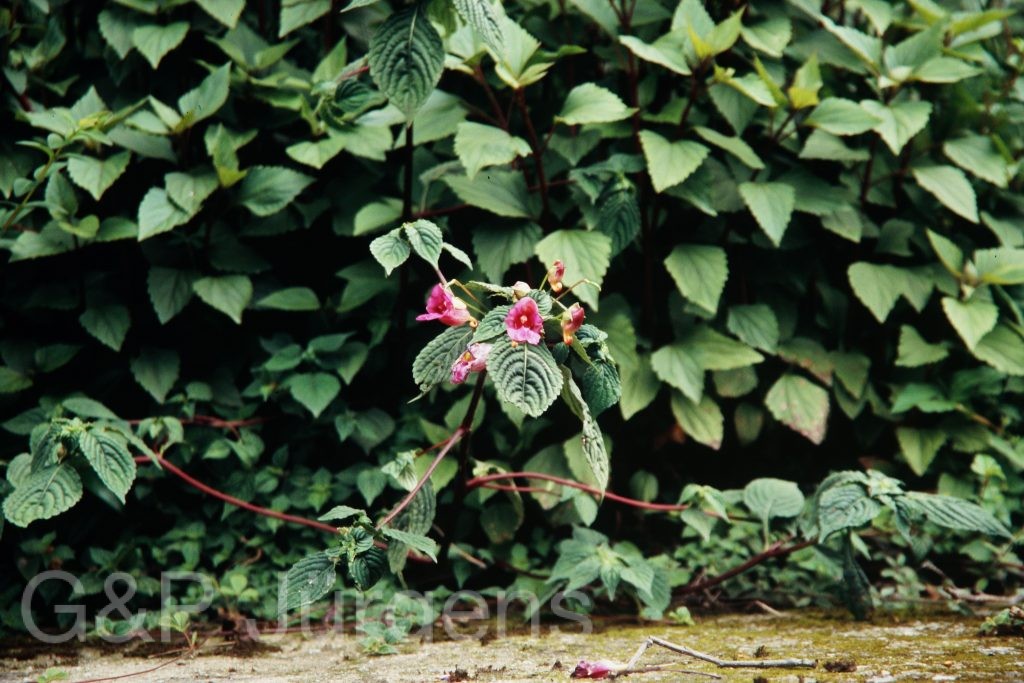
Roxb. ex DC.

Bhutan2015 120
Bhutan Galephug 600m, October
Bh09 288 G471
Bhutan Galephug 600m, October

Description

Impatiens tripetala is a succulent annual balsam of the warm, humid lowlands and foothills of the eastern Himalaya and Indo-Burma. GBIF lists 77 occurrences, centred on India, Myanmar, Bhutan and Nepal, with additional scattered or cultivated records reported under several country codes. It grows in moist shaded ground along forest streams, ditches and disturbed seepage sites in the subtropical belt, flowering late in and after the monsoon. The species was recorded at Galephug in southern Bhutan at about 600 m in October, a low foothill elevation reflecting its preference for warm, perhumid habitats.

It is an erect, glabrous herb with translucent, watery stems that are swollen at the nodes, rooting at the lower joints. The leaves are alternate, ovate to elliptic-lanceolate, crenate-serrate with the teeth often gland-tipped, and narrowed to a petiole. The zygomorphic flowers are borne on axillary peduncles; the lower sepal forms a spurred saccate pouch, and the corolla shows the reduced, apparently three-petalled appearance to which the epithet tripetala refers. The fruit is the characteristic fleshy, explosively dehiscent capsule of the genus, scattering its seeds by elastic recoil of the valves.

Impatiens (Balsaminaceae) is an enormous genus with a major centre of diversity in the Sino-Himalayan region, where many species are narrow endemics distinguished by flower colour, spur form and capsule shape. I. tripetala forms part of the rich lowland-to-submontane balsam flora of the eastern Himalaya. As an annual of moist, often disturbed ground it can be locally common, but the wider group is notable for high endemism and sensitivity to forest loss and hydrological change, themes relevant to its conservation context.

Author: Roxb. ex DC. · Sources: POWO (Kew), GBIF, Flora of Bhutan, Flora of British India, Annotated Checklist of the Flowering Plants of Nepal, Grey-Wilson monograph Impatiens of Africa and Asian revisions of Balsaminaceae
C.B.Clarke ex Hook.f.

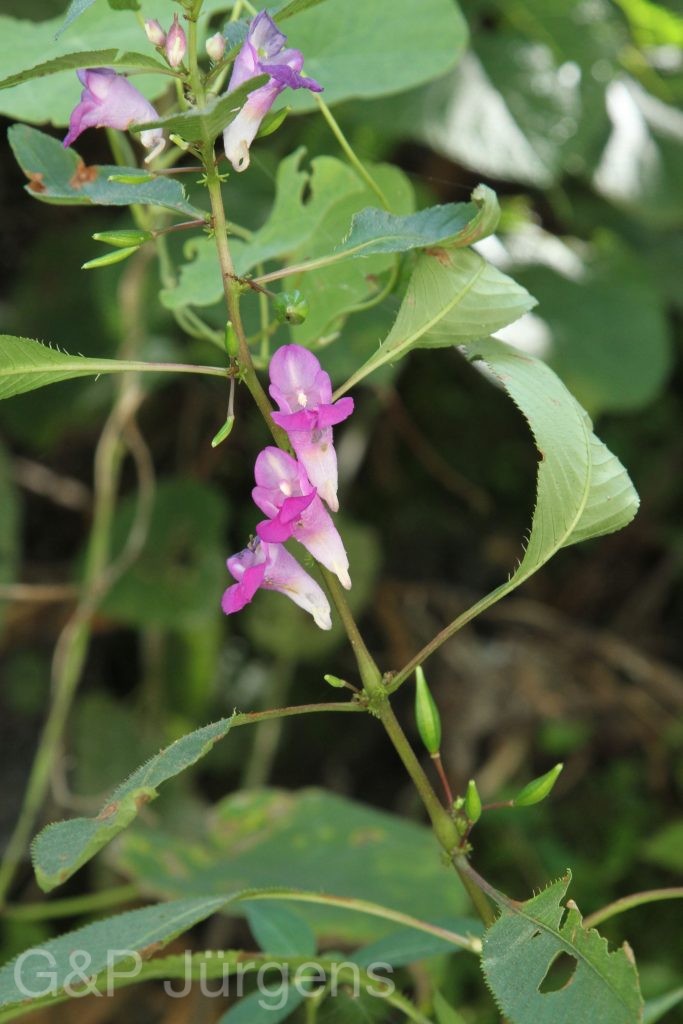
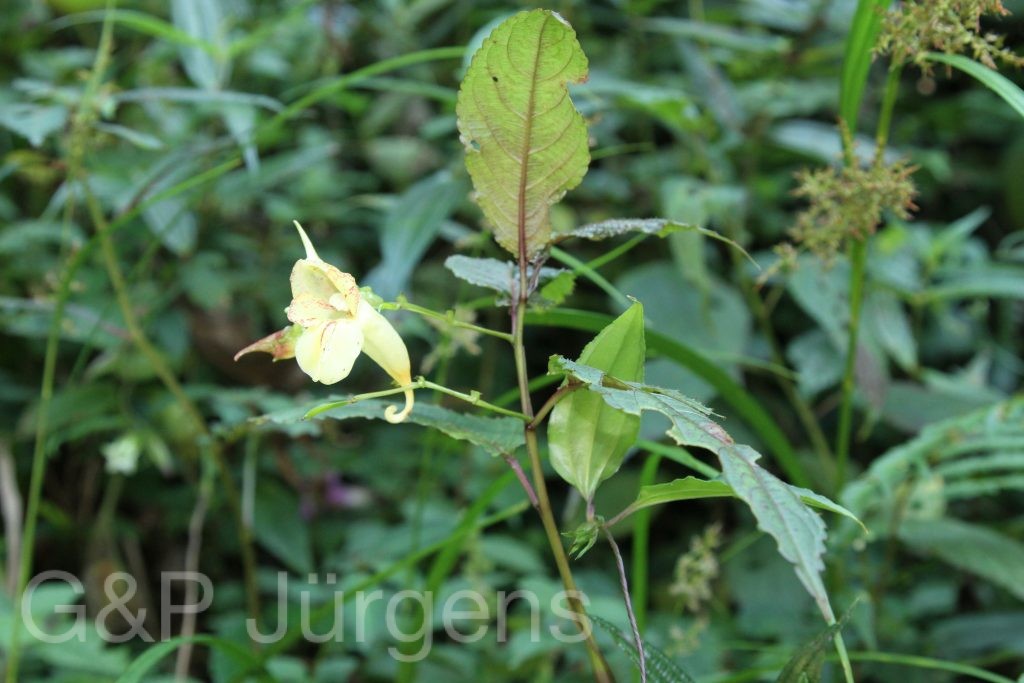
Bhutan2015 91
Bhutan Galephug 1200m, October

Description

Impatiens uncipetala is a Himalayan balsam recorded from India, Nepal, China and Bhutan, with 43 georeferenced occurrences across the central and eastern Himalaya. As with most Impatiens it is a moisture-demanding herb of shaded, humid habitats, growing along stream banks, on dripping rock faces, in ditches and on the floor of moist subtropical to lower temperate forest. The plant photographed at Galephug in Bhutan at 1200 m in October reflects its low-elevation, post-monsoon flowering, when the soft, succulent annuals reach maturity and bloom freely in the warm, wet foothill forests.

The plant is a tender annual herb with translucent, watery, brittle stems that are often swollen at the nodes and root readily where they touch the ground. The leaves are simple, alternate or sometimes subopposite, ovate to lanceolate, with toothed margins. The zygomorphic flowers hang on slender pedicels and display the characteristic balsam architecture: three sepals, the lowermost enlarged into a saccate nectar spur, and five petals in which the two lateral pairs are fused into wing-like structures. The epithet uncipetala refers to a hooked petal appendage. The fruit is a fleshy, five-valved capsule that splits and coils explosively, ejecting the seeds.

Impatiens is one of the largest angiosperm genera, with a major centre of diversity in the Sino-Himalayan and Indo-Burmese region where narrowly endemic species abound. Its explosive capsules and reliance on humid microhabitats foster localised, often patchy distributions. The moderate occurrence count for I. uncipetala suggests a regional but uncommon species best conserved through maintenance of intact moist forest.

Author: C.B.Clarke ex Hook.f. · Sources: POWO (Kew), GBIF, Flora of Bhutan, Flora of China, Impatiens of the Himalaya and China monographic studies (Balsaminaceae), Flowers of the Himalaya (Polunin & Stainton)

Royle

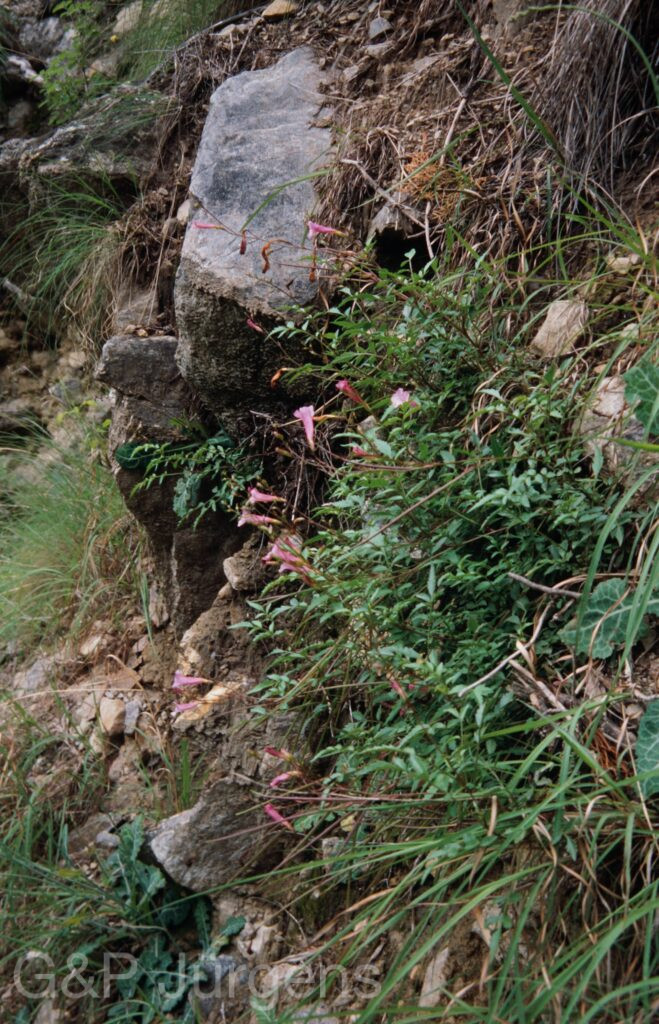
Nepal 99 904 ergebnis
West-Nepal Hanke 2660m, July
Nepal 99 905 ergebnis
West-Nepal Hanke 2660m, July

Description

Incarvillea diffusa is a herbaceous member of the Bignoniaceae distributed through the Himalaya into southwest and central China, with GBIF recording close to 1,900 occurrences chiefly from China, Nepal and India together with scattered cultivated and naturalised records elsewhere. It inhabits open, often disturbed ground at middle elevations: grassy and shrubby slopes, forest margins, roadside banks, ravines and rocky places, broadly between about 2000 and 3500 m. The photographed plant from Hanke in west Nepal at 2660 m, flowering in July, sits within this mid-montane band and at the height of the monsoon, the season when the species comes into bloom on moist, sunlit hillsides among grasses and scrub.

It is an erect to ascending, branching herb commonly reaching 30-80 cm, sometimes more, with a sturdy rootstock. The leaves are alternate and pinnately to bipinnately compound, the leaflets ovate, toothed and softly herbaceous, giving the plant a leafy, somewhat diffuse aspect that suits its specific epithet. The flowers are borne in lax terminal racemes or panicles; each has a campanulate calyx and a showy, bilabiate, funnelform to trumpet-shaped corolla, yellow with the throat and tube often marked or flushed, and four didynamous stamens enclosed within. The fruit is an elongate, narrowly cylindrical capsule that splits to release numerous flat, winged seeds.

Incarvillea is an Asian genus of around fifteen species centred on the Sino-Himalayan region and the Tibetan plateau, ranging from low herbs to robust perennials, and is unusual within the mostly woody, tropical Bignoniaceae in being entirely herbaceous. I. diffusa belongs to the yellow-flowered, pinnate-leaved group and is distinguished by its diffuse branching habit and floral details. Widespread and frequent in suitable open habitats, it is of no conservation concern, and its showy blooms have brought several relatives of the genus into horticulture.

Author: Royle · Sources: POWO (Kew), GBIF, Flora of China Vol. 18, Flora of Nepal, Grierson and Long's Flora of Bhutan Vol. 2, Grey-Wilson's revision of Incarvillea

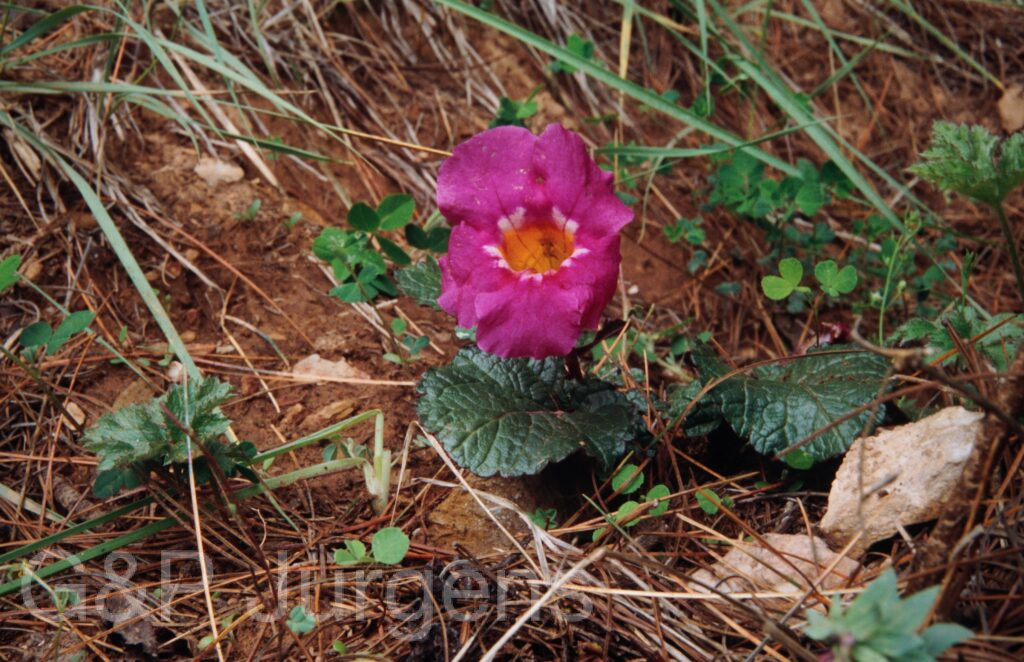
Sprague

Nepal 99 729 ergebnis ergebnis
West-Nepal Poksundo-Lake 3650m, July

Description

Incarvillea younghusbandii is a dwarf, ground-hugging alpine herb of the high Tibetan plateau and the adjoining Himalaya, recorded from China (Xizang), Nepal and Bhutan with about 180 GBIF occurrences. It is a specialist of cold, arid to semi-arid high-elevation habitats: gravelly flats, stony alpine steppe, sandy river terraces and screes, typically between roughly 3,600 and 5,000 m. The plant documented at Phoksundo Lake in West Nepal at 3,650 m, flowering in July, sits near the lower edge of its range and illustrates its association with the dry, rain-shadowed inner Himalayan valleys that grade into the Tibetan plateau flora.

The plant is a stemless or nearly stemless perennial arising from a thick, fleshy taproot. The leaves form a flat basal rosette and are pinnately or pinnatisect-compound with rounded, crenate leaflets, often somewhat fleshy and pressed close to the ground. The flowers are large and showy relative to the diminutive plant, borne almost sessile within the rosette; the corolla is broadly funnelform to trumpet-shaped, rose-pink to magenta with a paler or yellowish throat, weakly bilabiate with five spreading rounded lobes. The fruit is an elongate, beaked, dehiscent capsule releasing flattened, winged or hairy-margined seeds.

The rosette-and-taproot habit is a classic adaptation to the wind-blasted, frost-prone, short-season conditions of the plateau, minimising exposure while presenting flowers at ground level to insect pollinators. Incarvillea is the principal temperate Asian genus of the otherwise largely tropical Bignoniaceae, and this species belongs to its specialised high-alpine, acaulescent group. Though not formally assessed, its restricted habitat warrants attention.

Author: Sprague · Sources: POWO (Kew), Flora of China Vol. 18, Flora of Bhutan Vol. 2, GBIF, Grierson: Bignoniaceae revisions of the eastern Himalaya

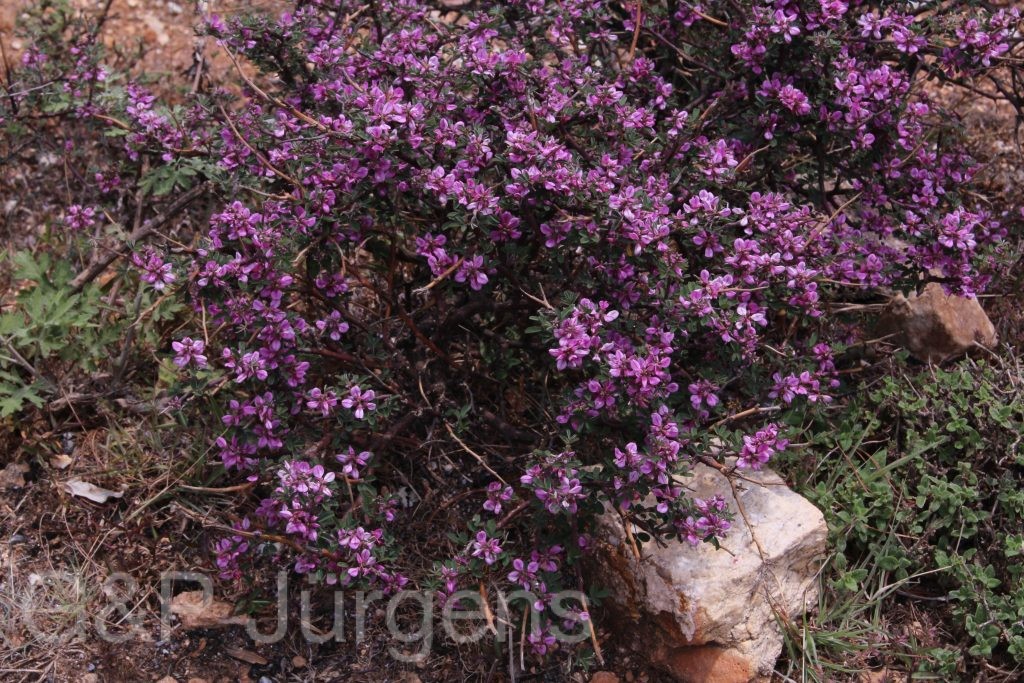
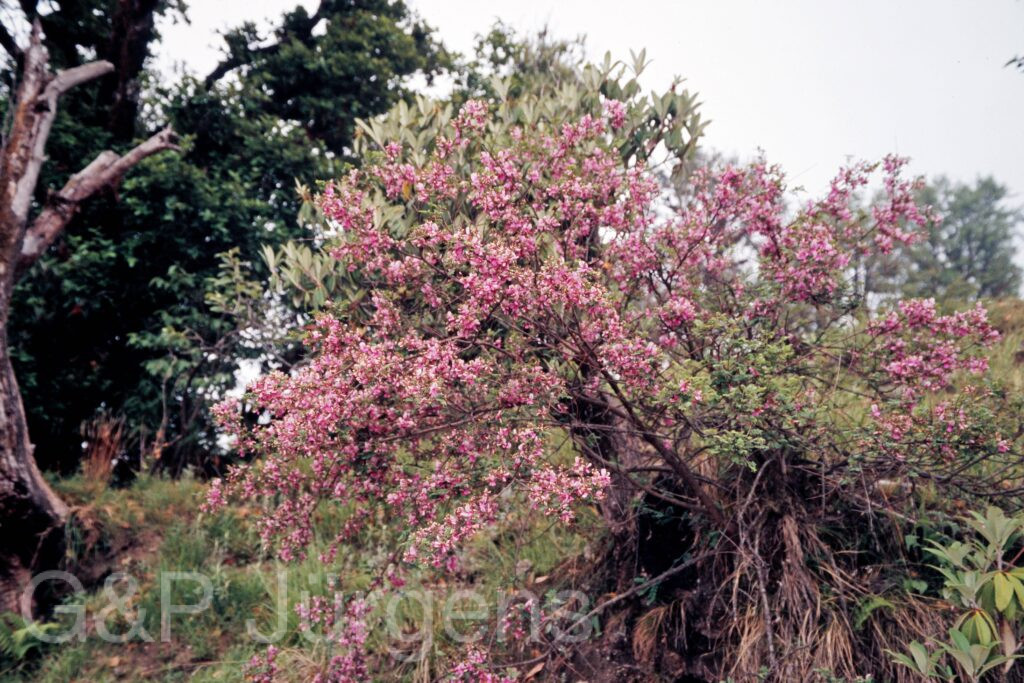
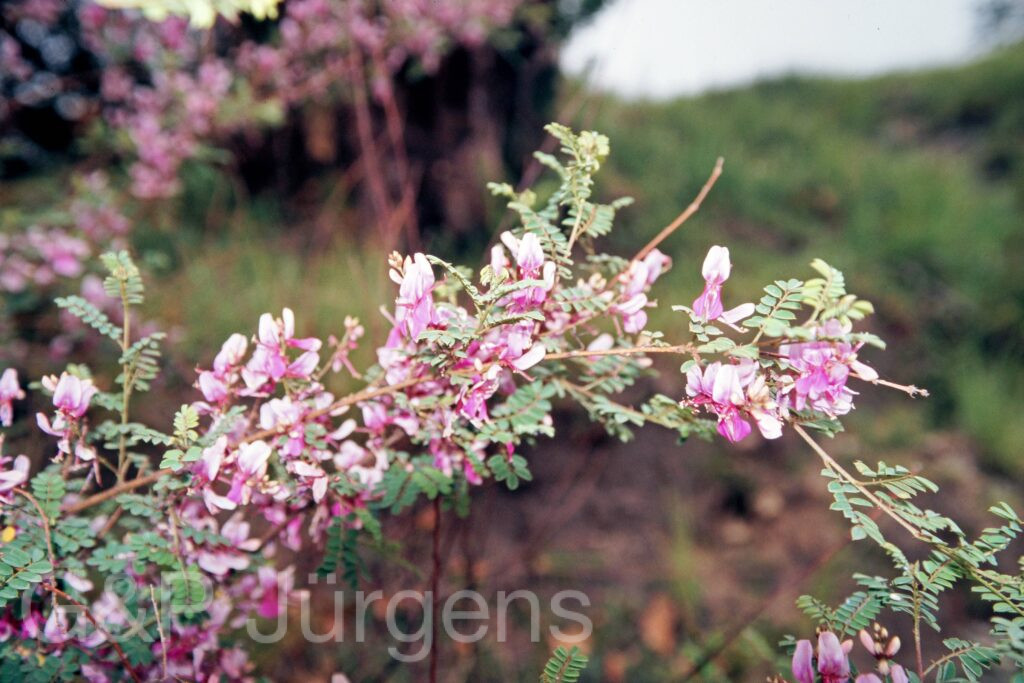
Buch.-Ham. ex D.Don

Bhutan2014 844
Bhutan Thimphu 2230m, May
Bh09 393 G625
Bhutan Mo-Chu, 1550m June

Description

A shrubby indigo widespread across the Himalaya and South to South-East Asia, native to India, Nepal, China, Bhutan, Myanmar, Thailand and Vietnam, with around 436 GBIF occurrences (numerous European and other records represent cultivated or herbarium material). It grows on sunny open slopes, scrub, forest margins, roadbanks and disturbed ground in the warm-temperate and subtropical zones, mostly between about 1200 and 2700 m. The featured plants were recorded in Bhutan in May and June, at Thimphu around 2230 m and the lower Mo-Chu valley at about 1550 m, both warm montane settings.

The species is a much-branched, erect to spreading shrub with slender, ribbed twigs bearing characteristic appressed, biramous (medifixed) hairs. The leaves are imparipinnate with numerous small, opposite, oblong to obovate leaflets that are sparsely strigose and minutely mucronate. Flowers are borne in slender, elongate axillary racemes; each papilionaceous flower has a small campanulate calyx and a pink to purplish-red corolla comprising a broad standard, two wings and a spurred keel, with diadynamous stamens. The fruit is a slender, straight, linear, terete to slightly compressed pod that splits along both sutures to release several small, cylindric seeds, the valves often twisting on dehiscence.

Accepted by POWO and GBIF, I. dosua belongs to the large, taxonomically complex genus Indigofera, distinguished from relatives by its leaflet number, indumentum and pod form. As a nitrogen-fixing legume it enriches poor montane soils and colonises disturbed sites, while its flowers attract bees. Widespread, adaptable and frequent in secondary habitats, it is of no conservation concern and is sometimes used locally for fodder, green manure and as a dye source.

Author: Buch.-Ham. ex D.Don · Sources: POWO (Kew), GBIF, Flora of Bhutan, Flora of China, Sanjappa monograph of Indian Indigofera

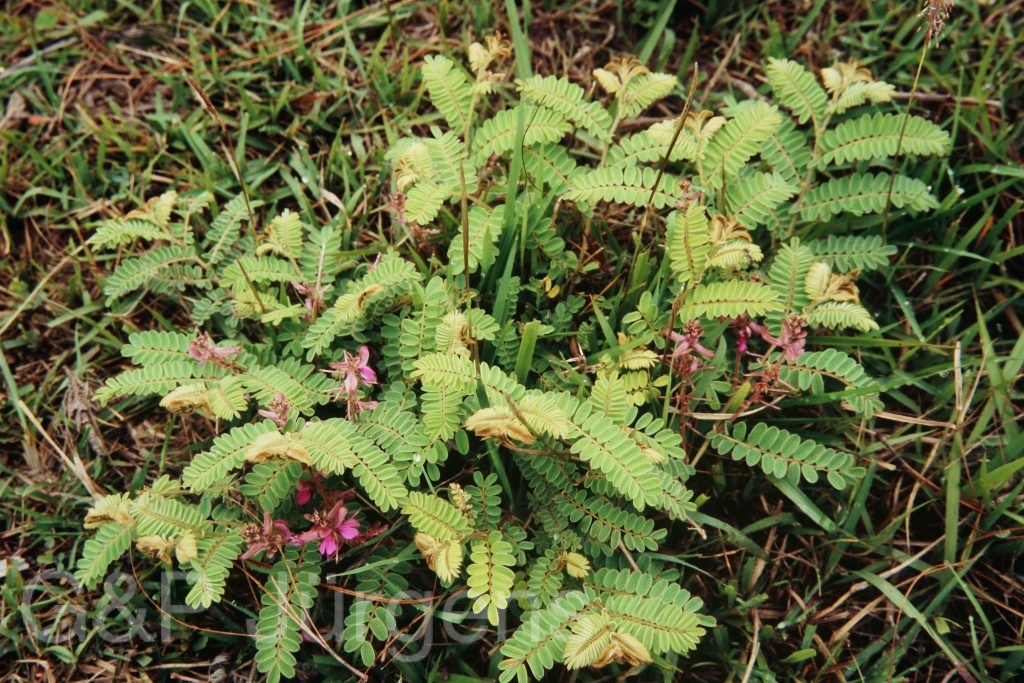
Wall. ex Brandis

Garh 07 220 ergebnis
India Garhwal Kawara 2000m, June
Garh 07 221 ergebnis
India Garhwal Kawara 2000m, June

Description

Indigofera heterantha (Wall. ex Brandis), a deciduous shrub of the subfamily Faboideae, is widely distributed across the western and central Himalaya, ranging from Afghanistan and Pakistan eastward through northern India, Nepal and Bhutan into southwest China. With over 1,100 georeferenced occurrences recorded in GBIF, it is a common and conspicuous element of the temperate zone, and has additionally become naturalised in cultivation across Europe, North America, Japan and the Southern Hemisphere. The species favours open hillsides, forest margins, dry stony slopes and degraded scrub, typically between 1,500 and 3,000 m, as reflected in the collection from Garhwal at Kawara, India, at 2,000 m in June, where it forms part of the sun-loving sub-alpine shrubbery.

The plant is an erect, much-branched shrub reaching 1–2 m in height, with slender, angular, greyish branchlets bearing appressed, biramous (medifixed) hairs that lend a canescent aspect to young growth. The leaves are imparipinnate with 11–21 small, obovate to elliptic leaflets, each mucronate at the apex and silky-pubescent beneath. Numerous purplish-red to bright pink-crimson papilionaceous flowers are borne in dense, erect axillary racemes that often exceed the subtending leaf; the calyx is shortly toothed and the standard petal silky on its outer face. The fruit is a slender, terete, glabrescent legume containing several cuboid seeds.

Formerly treated under the name Indigofera gerardiana, the species is taxonomically allied to the I. hebepetala group of Himalayan legumes. It is an important soil-binding pioneer on eroding slopes, contributing nitrogen through rhizobial symbiosis, and the tough stems are traditionally harvested for basketry and fuel. Its hardiness and floriferous habit have made it a popular ornamental in temperate gardens. The species is not considered threatened, being abundant throughout its broad montane range.

Author: Wall. ex Brandis · Sources: POWO (Kew), Flora of Pakistan, GBIF, Flora of China Vol. 10, Sanjappa: Legumes of India (1992)

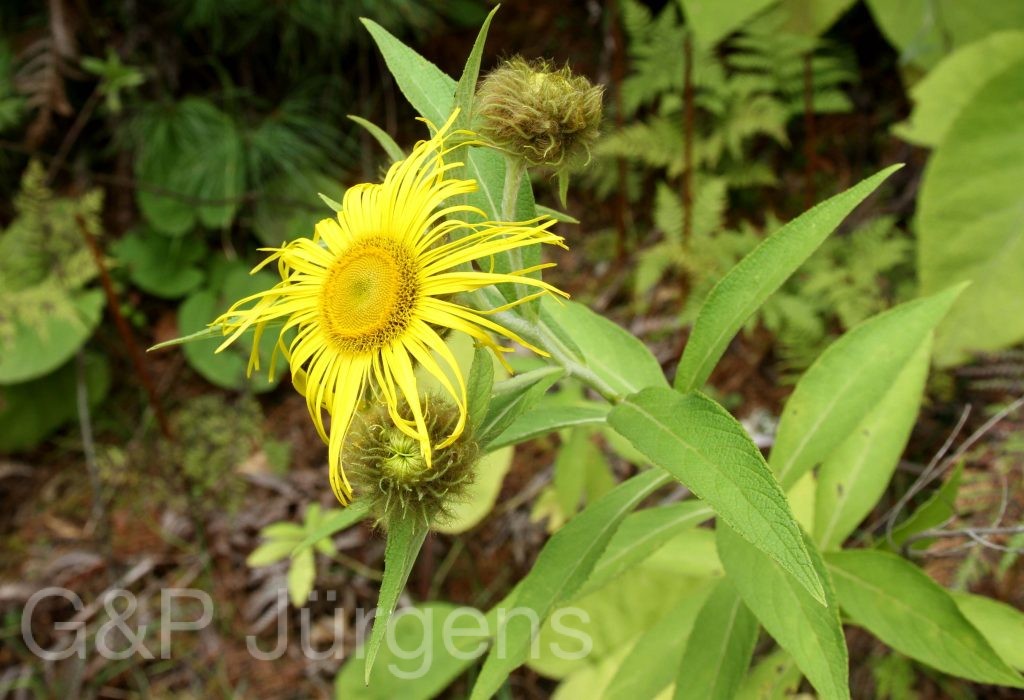
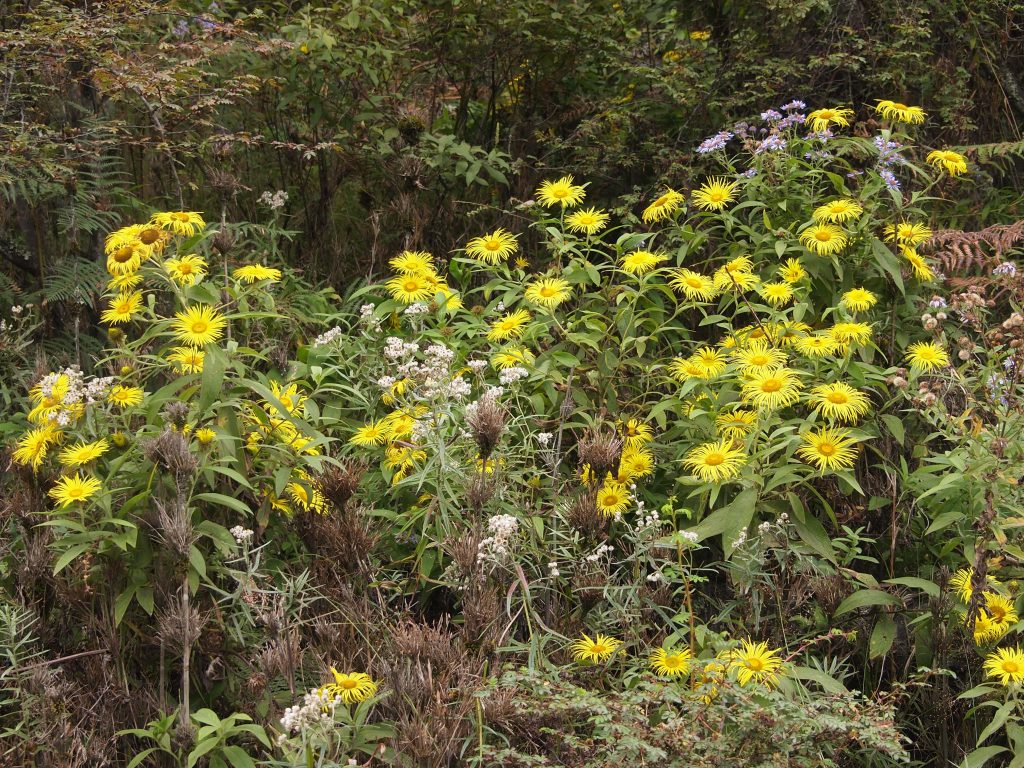
Inula hookeri

by GP Jürgens

C.B.Clarke

Bhutan2012 181
Bhutan Haar-Valley, 3200m September
Bhutan2012 846
Bhutan Nangsephal, 2700m October
Bhutan2012 848
Bhutan Nangsephal, 2700m October

Description

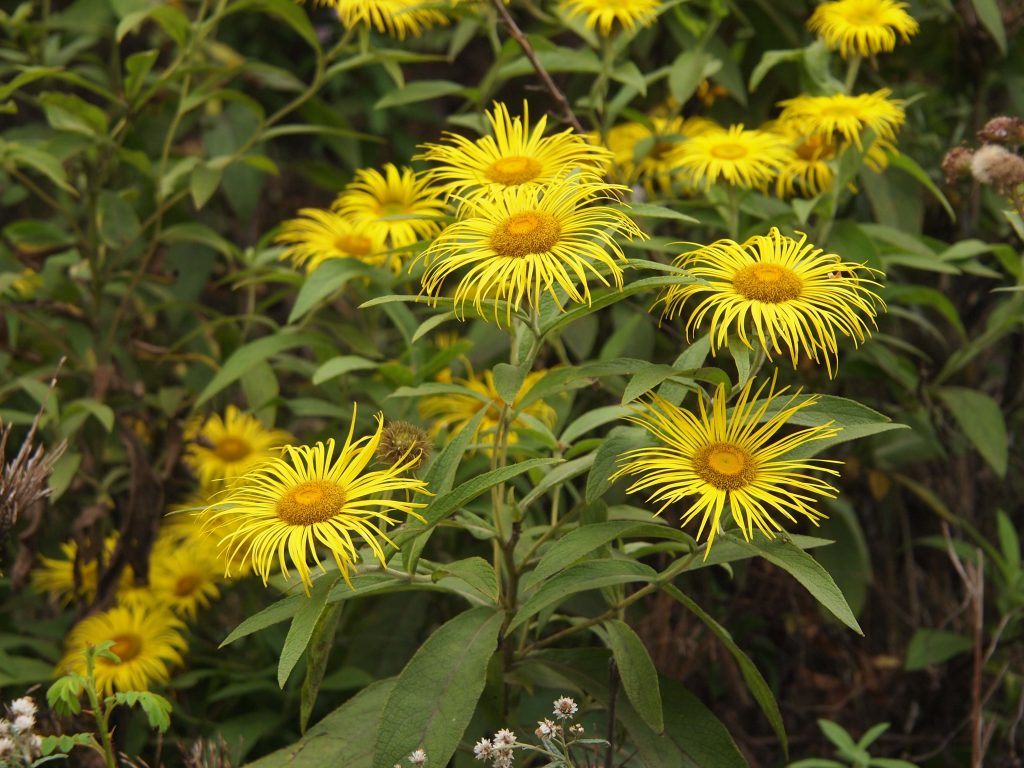
Inula hookeri is a showy yellow-flowered composite of the eastern Himalaya, native to China, Bhutan, Nepal, India and Myanmar, and frequently cultivated in temperate gardens, which accounts for British, Irish, North American and Antipodean records; GBIF lists about 383 occurrences. It grows in subalpine meadows, open forest, shrubby slopes and grassy clearings, mostly between about 2400 and 3600 m. The photographed plants are from the Haar valley in Bhutan at 3200 m in September and from Nangsephal at 2700 m in October, flowering through the late monsoon into autumn.

The plant is an erect, hairy perennial herb arising from a short rhizome, with leafy, softly pubescent stems. The leaves are alternate, oblong-lanceolate to elliptic, acuminate, finely toothed and clasping or sessile at the base, hispid on both surfaces. The capitula are large and solitary or few at the stem tips, radiate, with numerous very narrow, thread-like, pale to greenish-yellow ray florets spreading in a fringed circle around a disc of deeper yellow tubular florets; the involucre is hemispherical with linear, leafy, spreading phyllaries. The fruit is a small ribbed cypsela bearing a pappus of a single row of barbellate bristles.

Inula belongs to the tribe Inuleae, and I. hookeri, named for J. D. Hooker, is distinctive for its softly spidery, narrow-rayed heads that open from woolly buds. Valued in horticulture for its long flowering and attractiveness to pollinators, it is common in the wild and not considered threatened.

Author: C.B.Clarke · Sources: POWO (Kew), GBIF, Flora of Bhutan, Flora of China, Annotated Checklist of the Flowering Plants of Nepal, Systematics of Inula and allied genera (Inuleae)

(L.) Lam.

Bhutan2012 785
Bhutan Zemgang 1850m, October
Nepal 95 42 P74 ergebnis
Nepal Darondi-Khola 670m
Nepal 95 43 W75 ergebnis
Nepal Darondi-Khola 670m

Description

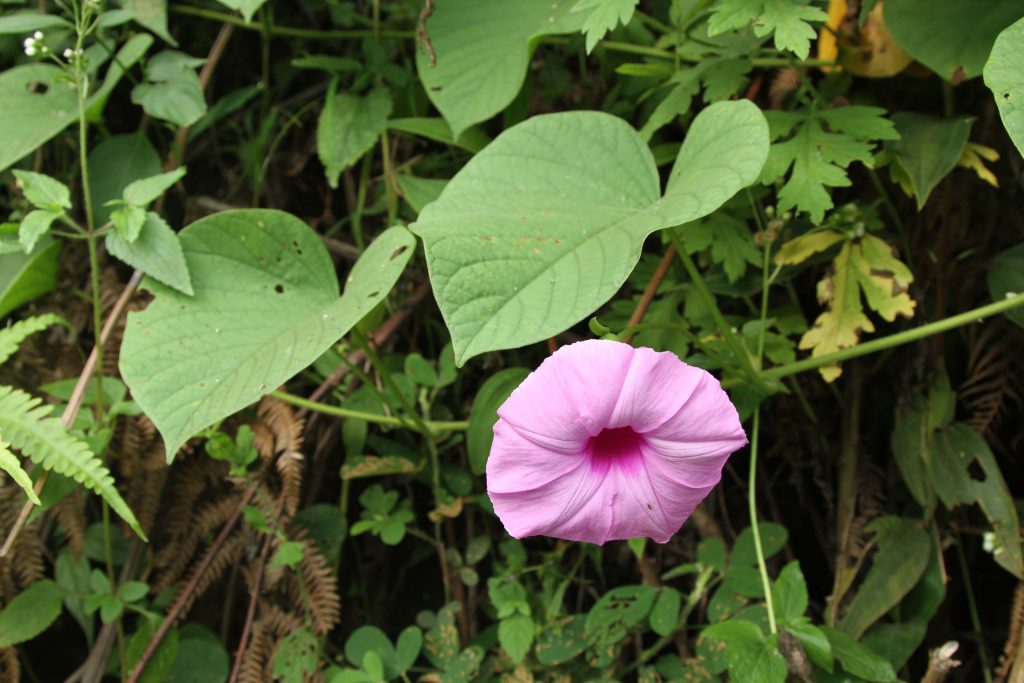
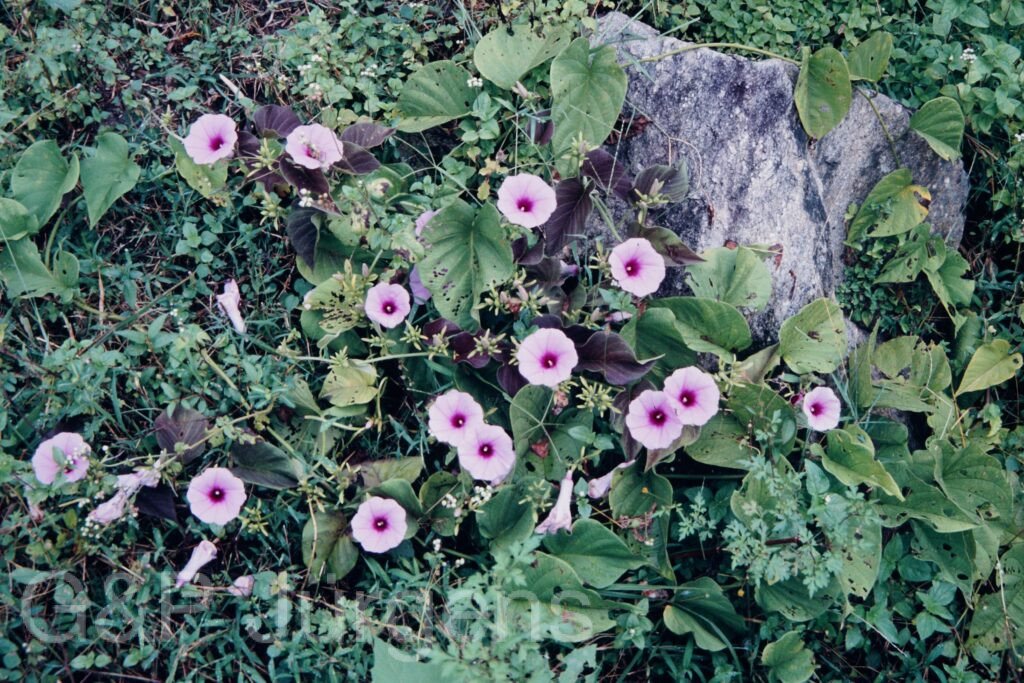
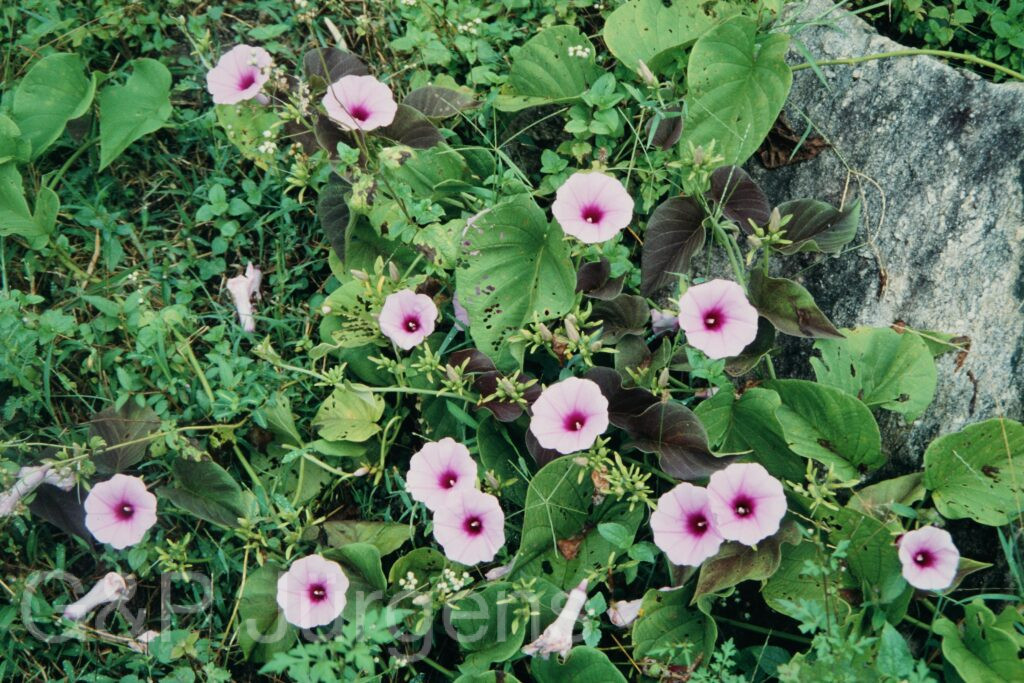
Ipomoea batatas, the sweet potato, is a cultigen of Neotropical origin now grown and naturalised throughout the tropics and warm-temperate world; GBIF records 38,679 occurrences spanning the Americas (Peru, Mexico, Brazil, the United States, Colombia, Ecuador and others) through to Asia and Oceania, including Thailand, Taiwan, the Philippines, Indonesia, China and Papua New Guinea. In the Himalaya it is a cultivated and escaped plant of village margins, terraced fields and warm valley bottoms. The illustrated material comes from Bhutan, Zhemgang, at about 1850 m in October, and from Nepal along the Darondi Khola at around 670 m, reflecting the sub-tropical farmed elevations where it is grown.

The plant is a perennial herbaceous vine with prostrate or twining stems that root at the nodes and arise from swollen, edible storage roots (tubers) of variable colour. Leaves are alternate, petiolate and highly variable, from broadly ovate-cordate to deeply palmately lobed, with an entire or sinuate margin. Flowers are borne in few-flowered axillary cymes; the corolla is funnelform and infundibuliform, lavender to pink-purple with a darker throat, subtended by a small calyx of unequal sepals. The five stamens are unequal and included, the ovary superior; the fruit is a small capsule, though many cultivars set seed poorly.

The sweet potato is a hexaploid of long domestication, its wild progenitors lying in Central America, and it ranks among the world's most important root crops. POWO and GBIF accept the name. Its trans-Pacific presence in pre-Columbian Oceania remains a celebrated biogeographic puzzle bearing on early human dispersal.

Author: (L.) Lam. · Sources: POWO (Kew), GBIF, Flora of China, Flora of Bhutan, Annotated Checklist of the Flowering Plants of Nepal, World Checklist of Convolvulaceae (Ipomoea monograph)

(L.) Roth

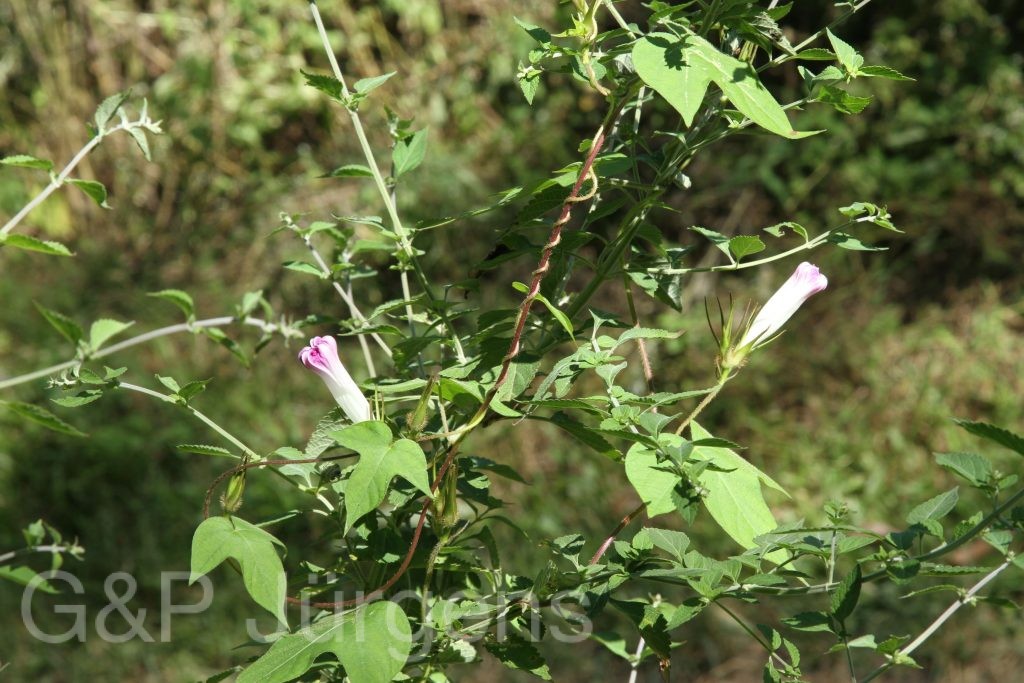
Bhutan2015 304
Bhutan between Zhemgang-Trongsa 1700m, October

Description

Ipomoea nil is a pantropical annual morning glory of uncertain native origin, most likely originating in tropical America but now cosmopolitan in warm regions worldwide. It occurs throughout South and Southeast Asia, East Asia, Africa, and the Americas, with over 13,000 occurrence records in GBIF spanning more than 70 countries. The species thrives in disturbed habitats, field margins, roadsides, waste ground, and forest edges from lowland areas up to approximately 2,500 m elevation. In Bhutan, it has been documented along the road between Zhemgang and Trongsa at 1,700 m, flowering in October during the late monsoon season.
Ipomoea nil is a twining or scrambling annual herb with stems 1–3 m long, retrorsely hispid with spreading, tawny hairs. Leaves are alternate, broadly ovate to orbicular in outline, 5–15 cm long, typically three-lobed (occasionally entire or five-lobed), with a cordate base and hispid indumentum on both surfaces. The inflorescence consists of one to three flowers on axillary peduncles. The calyx is deeply divided into five lanceolate, densely hispid sepals with long, spreading basal hairs — a key diagnostic character. The corolla is funnelform, 3–5 cm long, typically blue to purple, occasionally red, pink, or white, with a paler tube. Stamens are five, included. The fruit is a globose, trilocular capsule 8–10 mm in diameter, enclosed by the persistent calyx, containing four to six seeds that are dark brown to black and finely pubescent.
Ipomoea nil holds exceptional cultural significance in East Asia, particularly in Japan, where it has been cultivated since the Nara period (eighth century) and subjected to intensive selection that has produced hundreds of ornamental cultivars (asagao) with extraordinary floral diversity in form, colour, and patterning. It has also become a model organism in molecular genetics for the study of transposable elements controlling flower pigmentation. Taxonomically, I. nil belongs to Ipomoea section Pharbitis and is distinguished from the closely related I. purpurea by its densely hispid, long-awned calyx lobes.

Author: (L.) Roth · Sources: POWO (Kew), GBIF, Flora of China Vol. 16, Flora of Bhutan Vol. 2, Austin: Convolvulaceae of the Southeastern United States (1978)

(L.) Roth

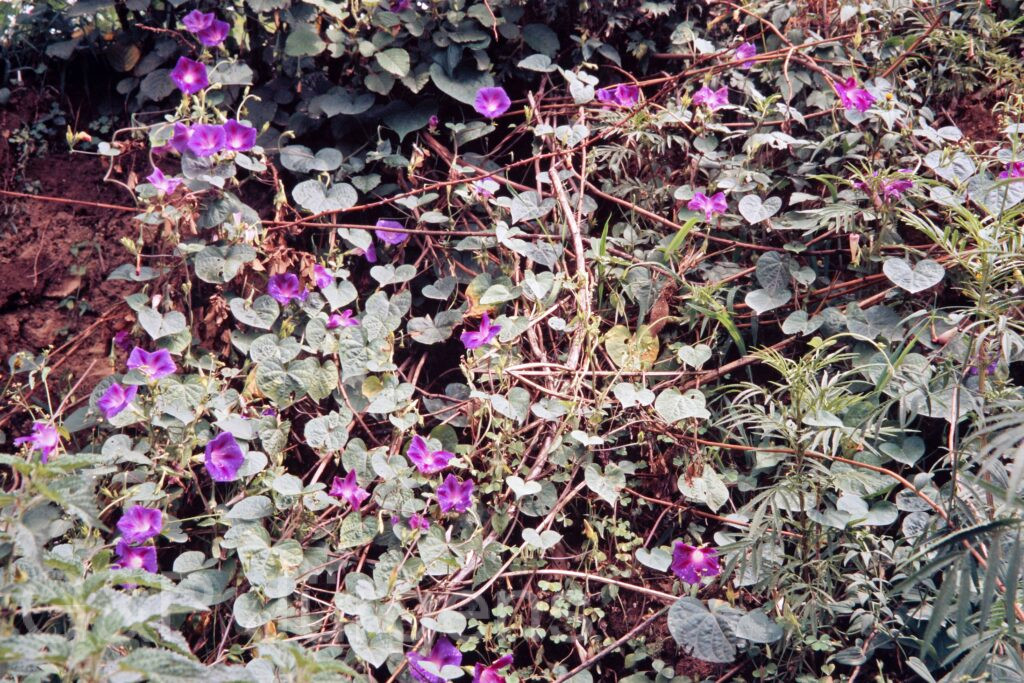
Garh 07 250 ergebnis
India Garhwal Barron Chatti 2300m, June
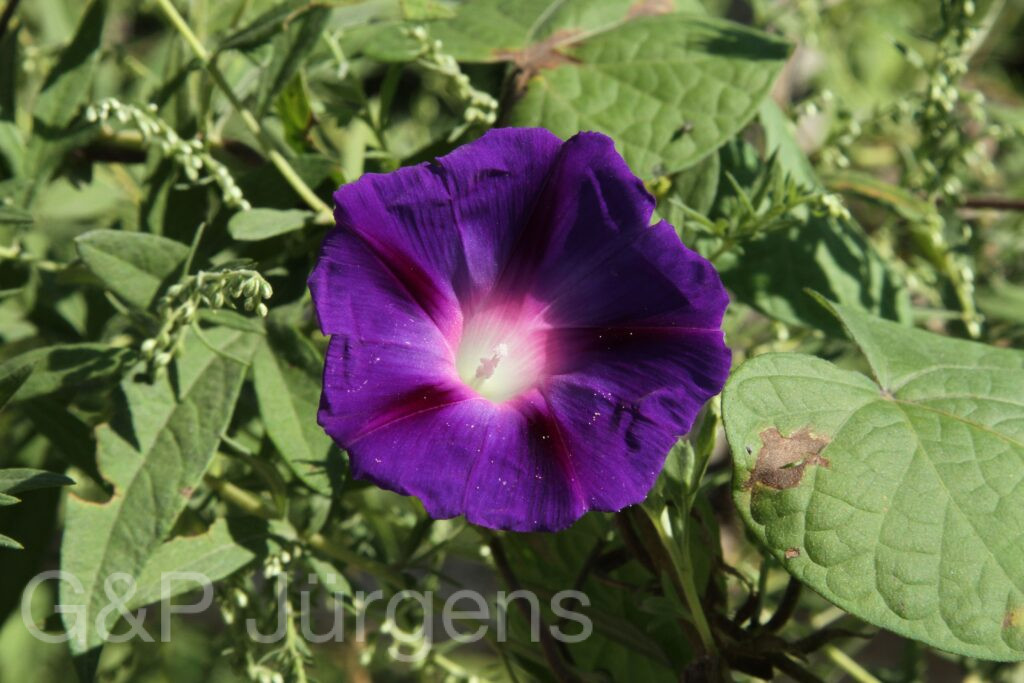
Bhutan2015 563
Bhutan Mo-Chu 1550m, October

Description

Ipomoea purpurea, the common morning glory, is a neotropical species of Mexican and Central American origin now thoroughly naturalised worldwide; GBIF records exceed 36,000 occurrences spanning the Americas (US, MX, BR, EC, PE, AR, BO, CO), Europe, southern Africa, eastern Asia and Australia. In the Himalaya it persists as an escaped ornamental and weed of disturbed ground, hedgerows, field margins and roadsides. The plants noted at Barron Chatti in Garhwal at 2300 m in June and along the Mo-Chu in Bhutan at 1550 m in October illustrate its tolerance of a broad warm-temperate to subtropical elevation range and its long, monsoon-spanning flowering season.

It is an annual twining herb with slender, retrorsely hairy stems climbing by means of left-handed coiling. The leaves are alternate, long-petiolate, broadly ovate-cordate and usually entire, acuminate at the apex with a deep basal sinus. Flowers arise in axillary cymes of one to several; each has a hairy, lanceolate-lobed calyx and a showy funnelform corolla 4 to 6 cm across, varying from purple and violet-blue to pink, magenta and white, with a paler throat and five faint interplical bands. The five stamens are unequal and included; the superior ovary ripens into a globose, three-locular capsule releasing several glabrous, dark trigonous seeds.

The species is taxonomically straightforward within Ipomoea but horticulturally polymorphic, with numerous colour cultivars. Its self-compatible, bee-pollinated flowers and prolific hard-coated seed make it a successful colonist and, in warm regions, an agricultural weed. It is of no conservation concern; rather, its capacity to naturalise warrants monitoring in ruderal habitats.

Author: (L.) Roth · Sources: POWO (Kew), GBIF, Flora of China Vol. 16, Flora of Bhutan Vol. 2, Flora of Pakistan, A Monograph of the Convolvulaceae (Ipomoea)