Tag:

Myanmar

Flowers of the Myanmar Himalaya — 604 species recorded from northern Myanmar (Burma) and the eastern Himalayan borderlands, a biodiversity hotspot linking the Himalaya to the mountains of Yunnan and Southeast Asia. The region’s forests and alpine slopes hold a rich flora of rhododendrons, orchids, balsams and gentians. Every page gives a botanical description, distribution, habitat and flowering time with the original photograph.

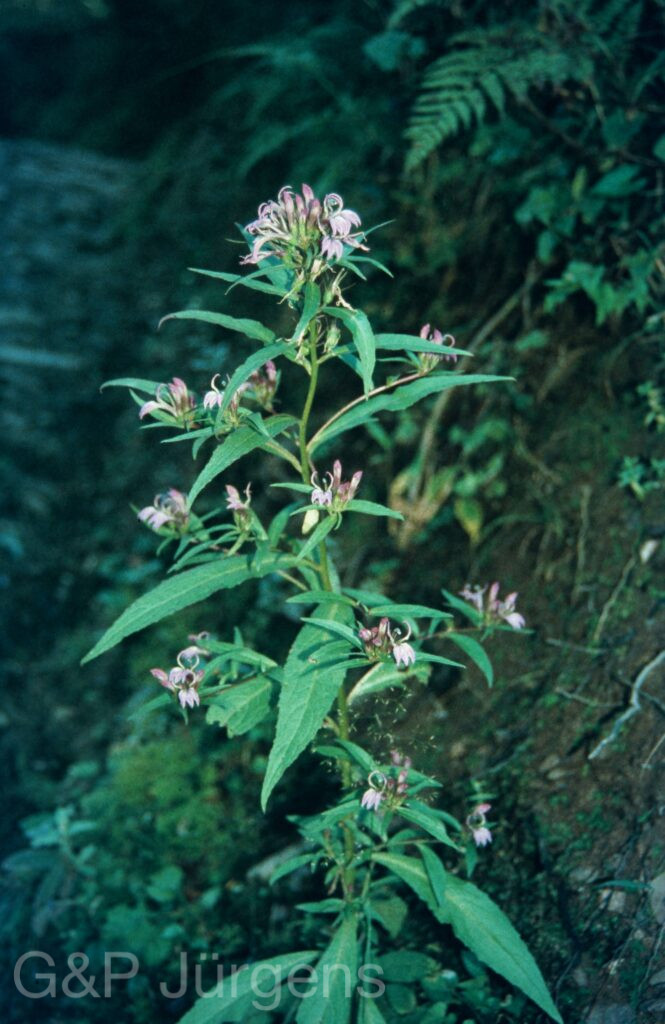
Wall.

Garw 2005 418 ergebnis
India Garhwal Didina 2470m, September

Description

Lobelia pyramidalis is a widespread Asian lobelia ranging through the Himalaya and into mainland Southeast Asia and southern China, with GBIF records from India, Nepal, Bhutan, Bangladesh, China, Taiwan, Myanmar, Thailand and Japan (a few extralimital records from the United States represent cultivation or introductions). Its nearly 419 documented occurrences confirm a broad and well-collected distribution. The species grows on grassy banks, open hillsides, forest margins, roadside cuttings and moist disturbed ground from the lowlands up to roughly 2,800 m. The photographed plant from Didina in Garhwal, India, at 2,470 m flowering in September illustrates its preference for the temperate Himalayan zone, where it flowers late in or after the monsoon.

The plant is an erect biennial or short-lived perennial herb with a tall, simple, pyramidal flowering stem reaching up to a metre or more. The leaves are alternate, sessile and crowded below, lanceolate to oblanceolate with finely toothed margins, the lower ones forming a basal rosette. The inflorescence is a long, dense, spike-like terminal raceme of many small zygomorphic flowers, each subtended by a leafy bract; the corolla is bilabiate and pale blue to lilac or whitish, with the two upper lobes erect and the three lower lobes spreading. The fruit is a small two-valved capsule containing numerous minute seeds.

The species belongs to Lobelia subgenus Tupa-related Asian lineages and, like its congeners, contains piperidine alkaloids that render it acrid and medicinally noteworthy in folk traditions. Its tolerance of disturbed and secondary habitats makes it locally common and of no conservation concern. Its wide latitudinal and altitudinal amplitude makes it a useful indicator of the disturbed grassland flora across monsoonal Asia.

Author: Wall. · Sources: POWO (Kew), Flora of China Vol. 19, Flora of Bhutan Vol. 2, GBIF, Lammers: World Checklist and Bibliography of Campanulaceae
Wall.

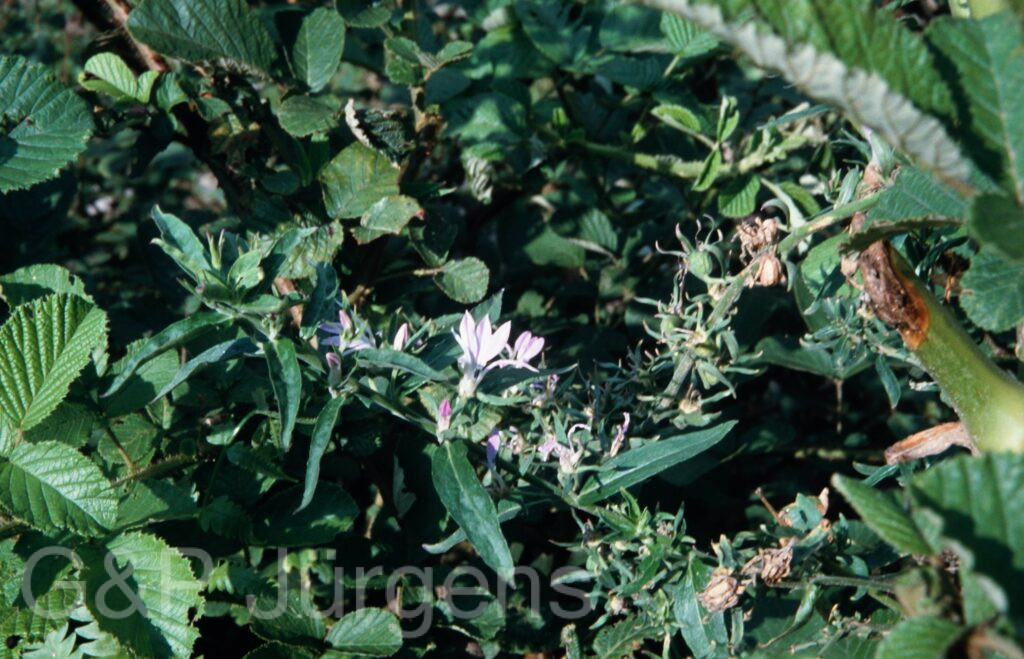
Nepal 2001 514 ergebnis ergebnis
Nepal (Gorkha) Mulabari 1340m, May

Description

Lobelia rosea is a slender annual or short-lived herb of the eastern Himalaya and Indo-Burmese region, ranging from Nepal, Bhutan and north-east India through Myanmar, Thailand, Laos and Vietnam to southern China and peninsular Malaysia. GBIF records 112 occurrences across this subtropical to warm-temperate arc. It favours moist open ground, stream and paddy margins, damp grassy banks and disturbed clearings at low to middle elevations. The plant from Mulabari in Gorkha, central Nepal, at 1340 m in May is a typical pre-monsoon population on humus-rich soil in light shade.

It is a delicate herb with erect or ascending, simple or sparingly branched stems exuding milky latex when broken. The leaves are alternate, sessile or shortly petiolate, ovate to lanceolate, serrate to denticulate and thin in texture. The flowers are borne in lax terminal racemes on slender pedicels. The corolla is markedly zygomorphic and two-lipped, pink to rose-purple (whence rosea), the tube split dorsally and the lower lip three-lobed; the five anthers are connate around the style into the Lobelia tube, the two lower ones tufted apically. The fruit is a small two-valved capsule dehiscing apically to shed numerous minute, reticulate seeds.

Lobelia, the largest genus of Campanulaceae (subfamily Lobelioideae), is sometimes segregated, but molecular evidence supports its retention within an expanded Campanulaceae. L. rosea belongs to a group of small-flowered Asian annuals delimited chiefly by corolla colour, leaf shape and capsule form. Like its congeners it contains piperidine alkaloids, and several Asian Lobelia species feature in traditional medicine. Widespread and weedy, persisting readily in disturbed seasonally moist habitats, it is of no conservation concern.

Author: Wall. · Sources: POWO (Kew), GBIF, Flora of China Vol. 19, Flora of Bhutan Vol. 2, Annotated Checklist of the Flowering Plants of Nepal, Lammers world checklist of Campanulaceae

Wall. ex DC.

BhutanPG2011 141
Bhutan Tsochenchen, 3550m June
Bh09 325 P531
Bhutan Tumching, 3700m June

Description

Lonicera angustifolia is a Sino-Himalayan honeysuckle distributed along the Himalaya from Afghanistan and Pakistan through India, Nepal and Bhutan to south-western China, with scattered records eastward to Myanmar; GBIF lists around 1,200 occurrences, several reflecting cultivation in Europe and North America. It is a shrub of the upper temperate and subalpine zones, occupying open coniferous and mixed forest, scrub, forest margins and rocky slopes, broadly from 2,400 to 4,000 m. The plants photographed at Tsochenchen at 3,550 m and Tumching at 3,700 m in Bhutan, both in June, show it flowering in early summer within high subalpine shrubbery near the upper forest limit.

It is an erect, much-branched deciduous shrub reaching 1-2.5 m, with slender greyish branchlets. The leaves are opposite, narrowly elliptic to oblong-lanceolate or linear, hence the epithet angustifolia ('narrow-leaved'), 1-4 cm long, entire and glabrous to thinly pubescent. The flowers are borne in axillary pairs on a common peduncle, each pair subtended by small bracts; the corolla is tubular-funnelform, two-lipped and pale pink to whitish, and the paired ovaries are partly fused. The two berries are connate at the base, ripening red and remaining largely free at the apex, each containing several seeds.

Lonicera section Isika, to which L. angustifolia belongs, comprises numerous shrubby, paired-flowered honeysuckles that are particularly diverse in the Himalaya and western China. Its tubular pink corollas are adapted to pollination by bees and long-tongued insects, while the bright red, partly fused berries are dispersed by birds and form an important food source in the subalpine zone. As a widespread, hardy and ecologically tolerant species spanning a broad elevational range, it is of least concern; its cold-hardiness and ornamental berries account for its occasional cultivation in temperate gardens.

Author: Wall. ex DC. · Sources: POWO (Kew), GBIF, Flora of China, Flora of Bhutan, Flowers of the Himalaya (Polunin & Stainton), monograph of Lonicera (Caprifoliaceae)

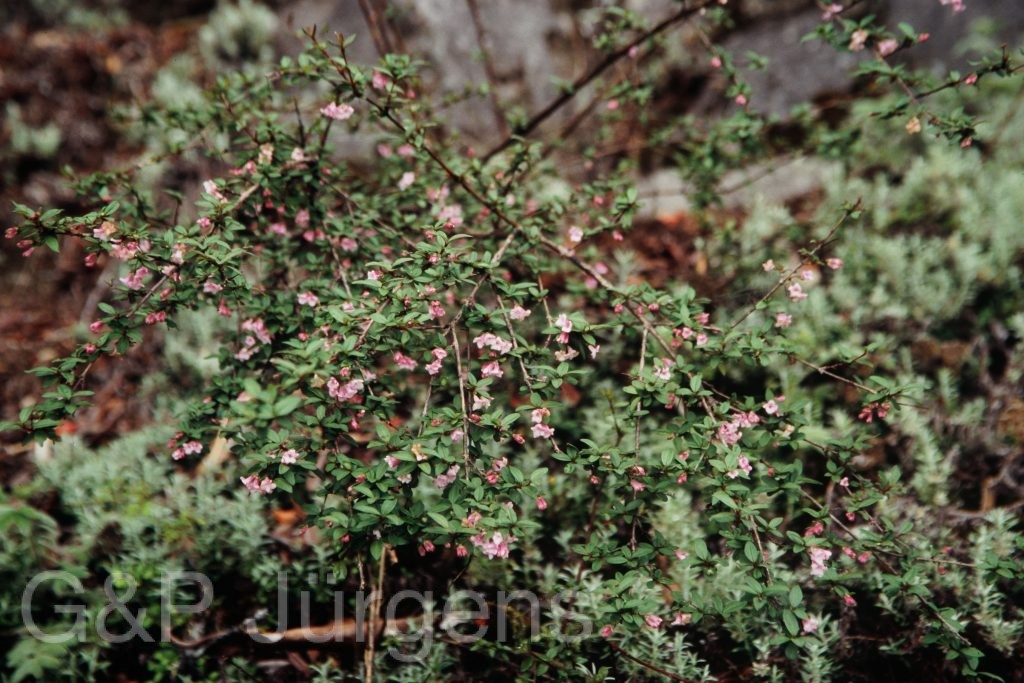
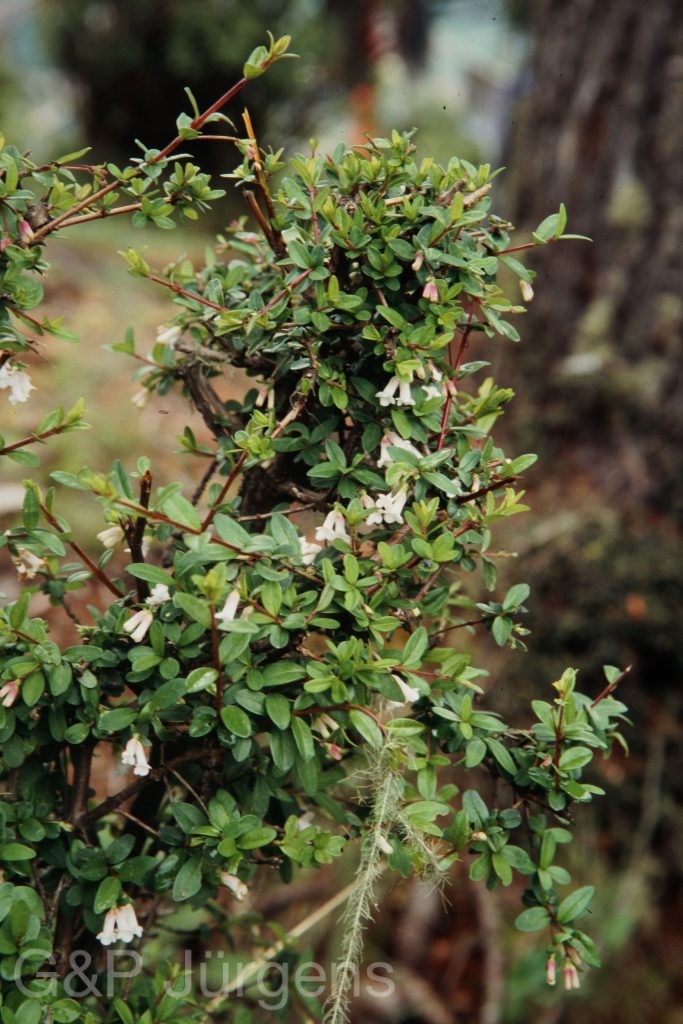
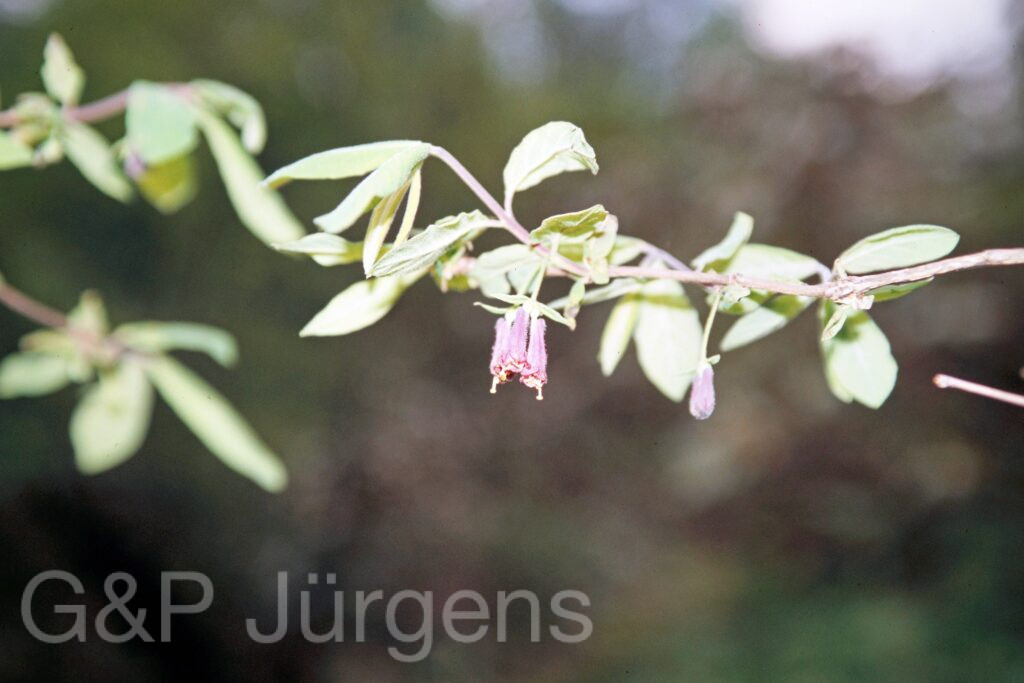
(Hook. f. & Thomson) Q. E. Yang, Landrein, Borosova & J. Osborne

Bh09 326 P532
Bhutan Tumching-La, 3700m June

Description

Lonicera angustifolia var. myrtillus is a high-montane to subalpine shrub of the Himalaya and adjacent ranges, recorded from China, Nepal, India, Pakistan, Bhutan, Afghanistan and Myanmar; GBIF holds about 873 occurrences for the taxon, with scattered cultivated records elsewhere. It is characteristic of the upper temperate and subalpine zone, typically between roughly 3000 and 4000 m, the photographed plant deriving from Tumching-La in Bhutan at 3700 m in June, at the onset of flowering. It grows in open coniferous and rhododendron forest, at the forest-line ecotone, and among scrub on rocky, well-drained slopes, often forming part of the dwarf-shrub understorey.

This variety is a small, much-branched deciduous shrub with slender, often arching twigs and small, opposite, entire leaves that are narrowly oblong to elliptic, the var. myrtillus being notably small-leaved and bilberry-like in aspect. The flowers are borne in axillary pairs on short peduncles; each pair subtended by bracts, the tubular-funnelform corolla is white to pale pink, weakly two-lipped or nearly regular. The paired ovaries are partly connate, and at maturity produce small, fused, juicy berries that ripen red, dispersed by birds, as is typical of the genus.

The combination (Hook. f. & Thomson) Q. E. Yang, Landrein, Borosova & J. Osborne reflects modern revisionary work on Himalayan Lonicera within an enlarged Caprifoliaceae. As an intraspecific taxon of a widespread, ecologically tolerant species, it is of no conservation concern, and like other shrubby honeysuckles it contributes nectar and fleshy fruit to subalpine pollinator and frugivore networks at the upper forest margin.

Sources: POWO (Kew), GBIF, Flora of China, Flora of Bhutan, Flora of Pakistan, Yang et al. revision of Lonicera (Caprifoliaceae), Rehder Synopsis of the Genus Lonicera

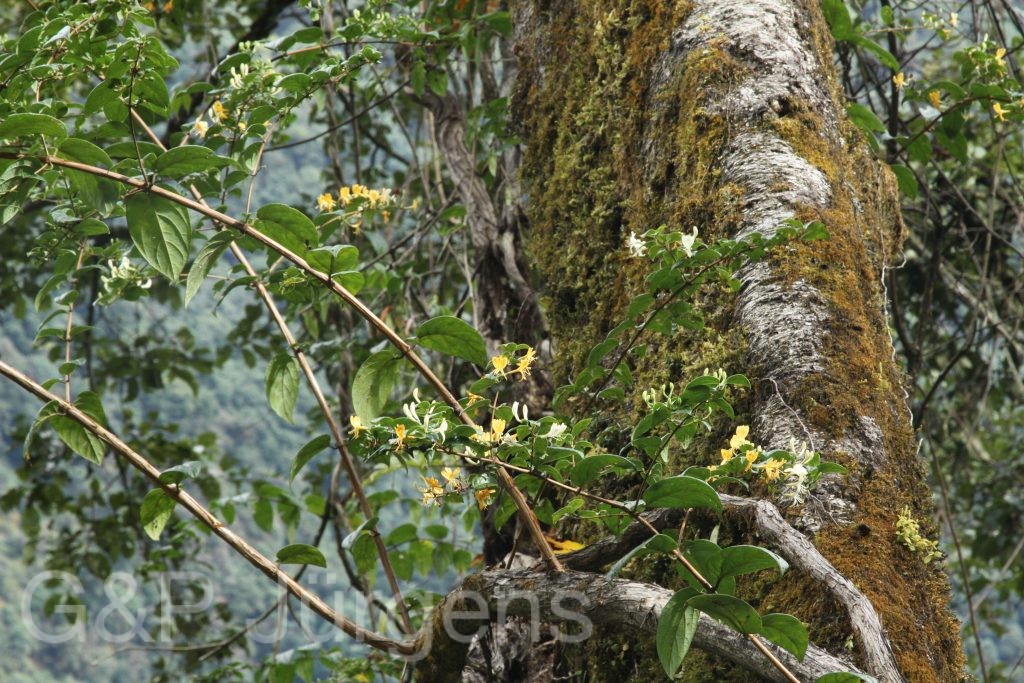
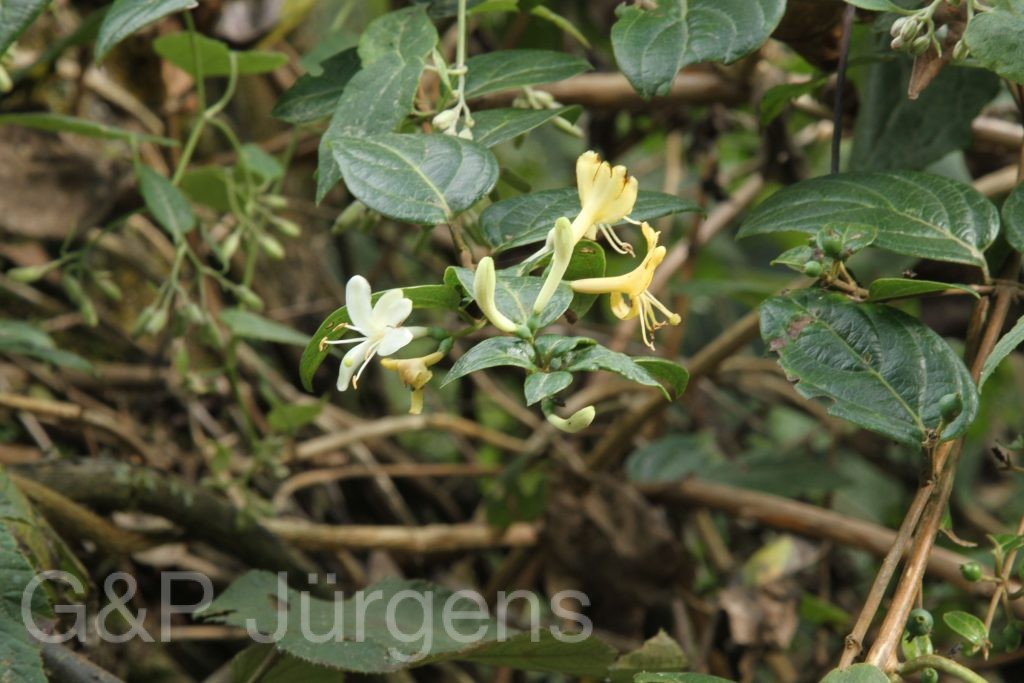
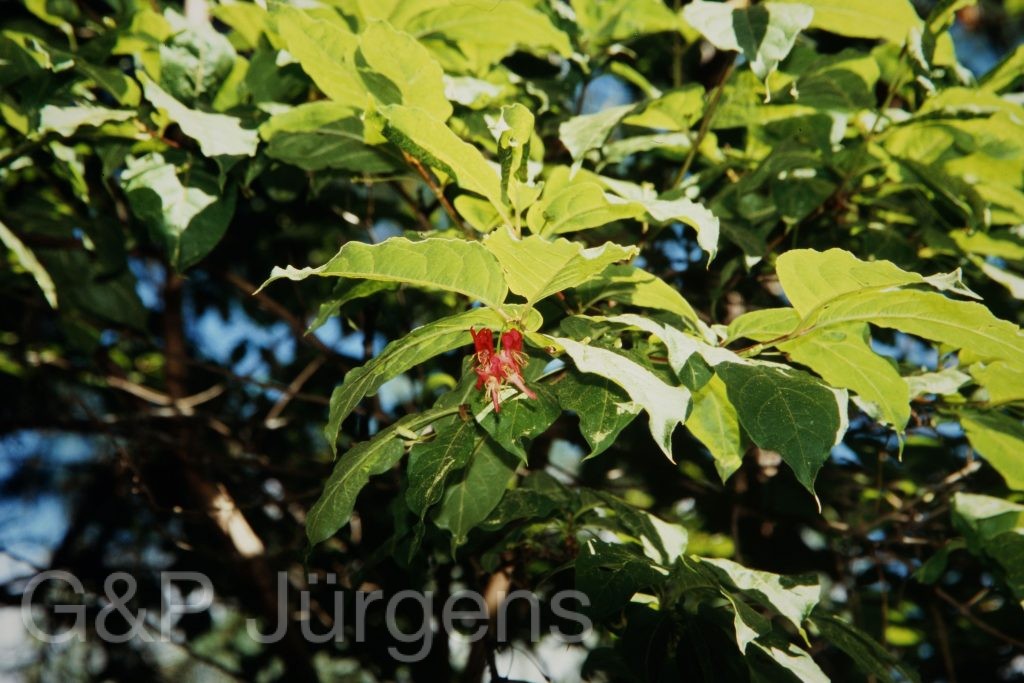
Wall.

Bhutan2015 600
Bhutan Gasa 1950m, October
Bhutan2015 601
Bhutan Gasa 1950m, October

Description

Lonicera glabrata is a Himalayan and Sino-Himalayan honeysuckle distributed from Nepal and India through Bhutan and Myanmar into south-western China; its c. 150 georeferenced records concentrate along the temperate forest belt of the eastern Himalaya. It grows in broadleaf and mixed forest, forest margins, thickets and shrubby slopes, generally between 1500 and 3000 m. The plant photographed at Gasa in northern Bhutan at 1950 m in October occupies the temperate forest zone, where its autumn fruiting follows the late-spring to early-summer flowering typical of the species.

It is a glabrous deciduous shrub, sometimes scandent, 1.5-3 m tall, distinguished as the epithet "glabrata" implies by its smooth, hairless foliage. The leaves are opposite, ovate to lanceolate, acuminate, entire and rather thin in texture. The flowers are borne in axillary pairs on a slender common peduncle, each two-lipped and creamy-white to pale yellow, fragrant, with a slender tube. Paired bracteoles subtend the ovaries. The fruit is a paired berry, the two ripening red to purplish-black, the partly fused pairs offering a conspicuous food reward. The four to five stamens and slender style are exserted from the corolla mouth.

Described by Wallich (as Wall.), L. glabrata belongs to Lonicera section Coeloxylosteum of the Caprifoliaceae, a group of paired-flowered Himalayan shrubs. The tubular, nectar-rich flowers are pollinated by bees and long-tongued insects, while the colourful berries are dispersed by birds. The species is widespread within its range and locally common in forest understorey, with no significant conservation concern, though it is sensitive to deforestation of mid-elevation broadleaf woodland.

Author: Wall. · Sources: POWO (Kew), GBIF, Flora of Bhutan, Flora of China, Flora of Nepal, Rehder's monograph of Lonicera (Caprifoliaceae)

Walp.

Garh 07 112 ergebnis
India Garhwal Meggu Kichatti 3200m, June

Description

Lonicera purpurascens Walp. is a deciduous shrubby honeysuckle of the western and central Himalaya. GBIF occurrence data place it principally in India, Pakistan, Nepal, Afghanistan, Bhutan and Myanmar, confirming a chiefly Himalayan distribution. It is a plant of subalpine forest and shrubberies, growing among Abies, Betula and Rhododendron stands and along open rocky slopes, generally between about 2,800 and 3,800 m. The illustrated plant from Meggu Kichatti in Garhwal at 3,200 m, flowering in June, is characteristic of its occurrence in the upper temperate to subalpine belt where it blooms shortly after snowmelt.

It is an erect to spreading shrub up to 1.5–2 m tall with terete, glabrescent young branches and ovate to elliptic, entire leaves that are often glaucous and purplish-tinged beneath. The flowers are borne in axillary pairs on a common peduncle, subtended by bracts; the corolla is two-lipped, gibbous at the base, and ranges from yellowish to purple-flushed, hence the epithet. The paired ovaries are partly fused, and the resulting berries are red, more or less connate, each containing several seeds.

The species is one of numerous Himalayan Lonicera within the section Isika, and the purplish foliage and connate fruits distinguish it from allied taxa such as L. quinquelocularis and L. webbiana. Its berries provide food for montane birds, contributing to seed dispersal. The species is widespread within the Himalayan arc and is not currently regarded as of conservation concern.

Author: Walp. · Sources: POWO (Kew), GBIF, Flora of Pakistan, Flora of Bhutan Vol. 2, Rehder: Synopsis of the Genus Lonicera

Wall.

Bh09 39 P71
Bhutan Paro 2400m, June

Description

Lonicera webbiana is a deciduous shrub of the temperate Himalaya and adjoining Central Asian mountains, distributed from Afghanistan, Pakistan and Kyrgyzstan eastwards through Kashmir, northern India, Nepal and Bhutan into south-western China and Myanmar, with over 2000 occurrence records (those from Europe and North America representing cultivated material). It grows in coniferous and mixed forest, forest margins, thickets and shrubberies, chiefly between about 2400 and 3600 m. The specimen photographed at Paro in Bhutan at 2400 m in June illustrates its early-summer flowering within the upper temperate forest belt.

The shrub reaches 2-3 m, with hollow young branches and ovate to elliptic-lanceolate leaves that are acuminate at the apex, often ciliate and softly pubescent beneath. Flowers are borne in pairs on a slender, drooping peduncle, each pair subtended by small linear bracts; the corolla is two-lipped and reddish to purplish, the tube short and gibbous at the base. The paired ovaries are largely free, and the fruit develops into red, ellipsoid berries which are partly fused at the base, a feature aiding recognition of the species.

Lonicera webbiana belongs to Caprifoliaceae and to the large, taxonomically complex section Isoxylosteum (the bush honeysuckles); it has at times been confused with related Himalayan species such as L. quinquelocularis and L. angustifolia. The nectar-bearing flowers attract long-tongued bees and other pollinators, while the conspicuous red berries are dispersed by birds. Widespread and locally frequent across an extensive range, the species is of least conservation concern and is a characteristic understorey shrub of Himalayan fir and spruce forests.

Author: Wall. · Sources: POWO (Kew), GBIF, Flora of China, Flora of Pakistan, Flora of Bhutan, Rehder revision of Lonicera, Annotated Checklist of the Flowering Plants of Nepal

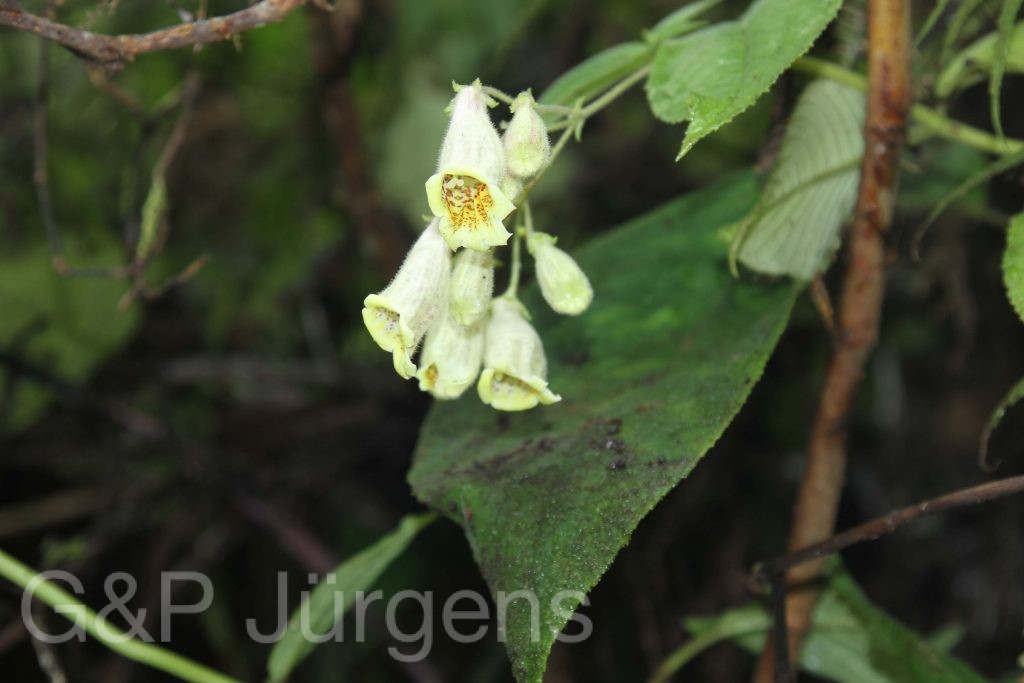
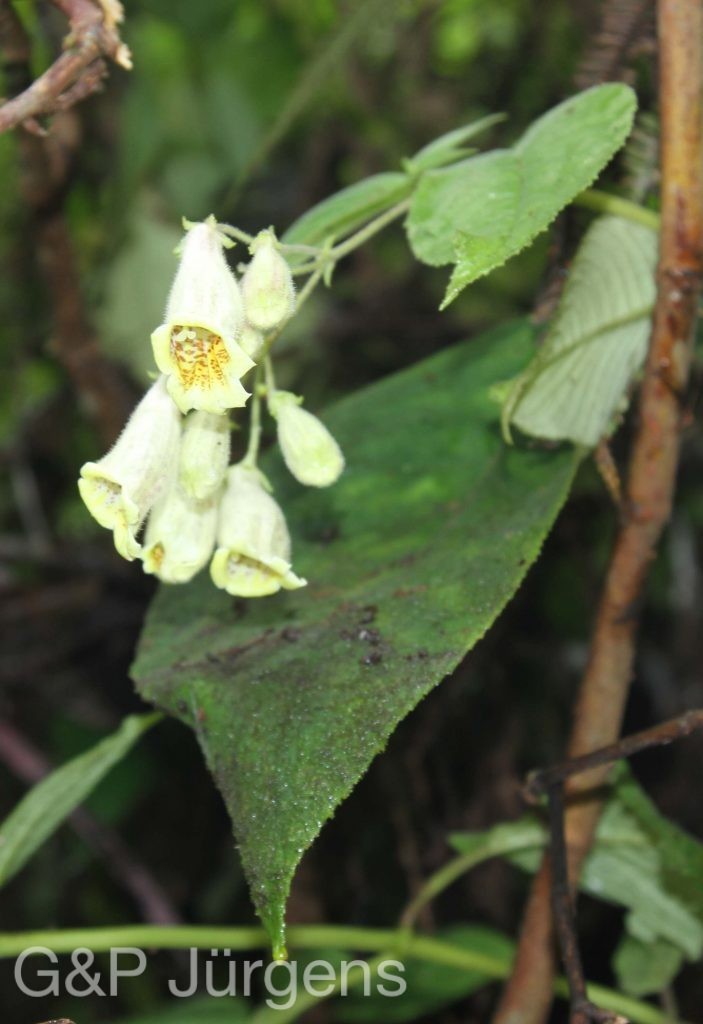
(C.B.Clarke) B.L.Burtt.

Bhutan2012 997
Bhutan Trithangebe 900m, October
Bhutan2012 998
Bhutan Trithangebe 900m, October

Description

Loxostigma kurzii is an epiphytic or lithophytic gesneriad of the eastern Himalaya and the Sino-Himalayan borderlands, recorded by GBIF (about 165 occurrences) from China, India, Nepal, Bhutan and Myanmar. It inhabits the humid subtropical and warm-temperate forest belt, growing on mossy tree trunks, shaded cliffs and dripping rock faces in deep shade and high humidity. The illustrated plant was found in Bhutan at Trithangebe at about 900 m in October, a low, frost-free montane forest locality typical of the species, which descends well below the conifer zone into the broadleaved evergreen forests of the foothills.

The plant is a soft, somewhat fleshy herb with pendulous or ascending, often rooting stems clothed in soft hairs. The leaves are opposite, those of a pair frequently unequal, ovate to elliptic, with a crenate-serrate margin and a pubescent surface. The flowers are solitary or few in the leaf axils, each on a slender pedicel; the calyx is five-parted, and the corolla is large, tubular-funnelform and yellow, often marked within with purplish lines and slightly two-lipped at the mouth. There are four didynamous stamens with coherent anthers, and a superior ovary bearing the obliquely placed stigma from which the genus takes its name (Loxostigma). The fruit is a long, slender, twisted capsule splitting to release many minute seeds.

The taxon is sometimes treated as Briggsia kurzii, reflecting past uncertainty over generic limits within the didymocarpoid Gesneriaceae; molecular work has placed Loxostigma as a distinct lineage near Briggsia. As a forest epiphyte dependent on undisturbed, humid woodland it is sensitive to deforestation, though it remains locally frequent and is not formally assessed as threatened.

Author: (C.B.Clarke) B.L.Burtt. · Sources: POWO (Kew), GBIF, Flora of China, Flora of Bhutan, Annotated Checklist of the Flowering Plants of Nepal, Weber and Burtt's classification of the Gesneriaceae

Sweet

Bhutan2012 418
Bhutan Tserang 1300m, September
Bhutan2012 1341
Bhutan Sandrup 1500m, September
Nepal 95 346 P619 ergebnis
Nepal Tibling 2200m October

Description

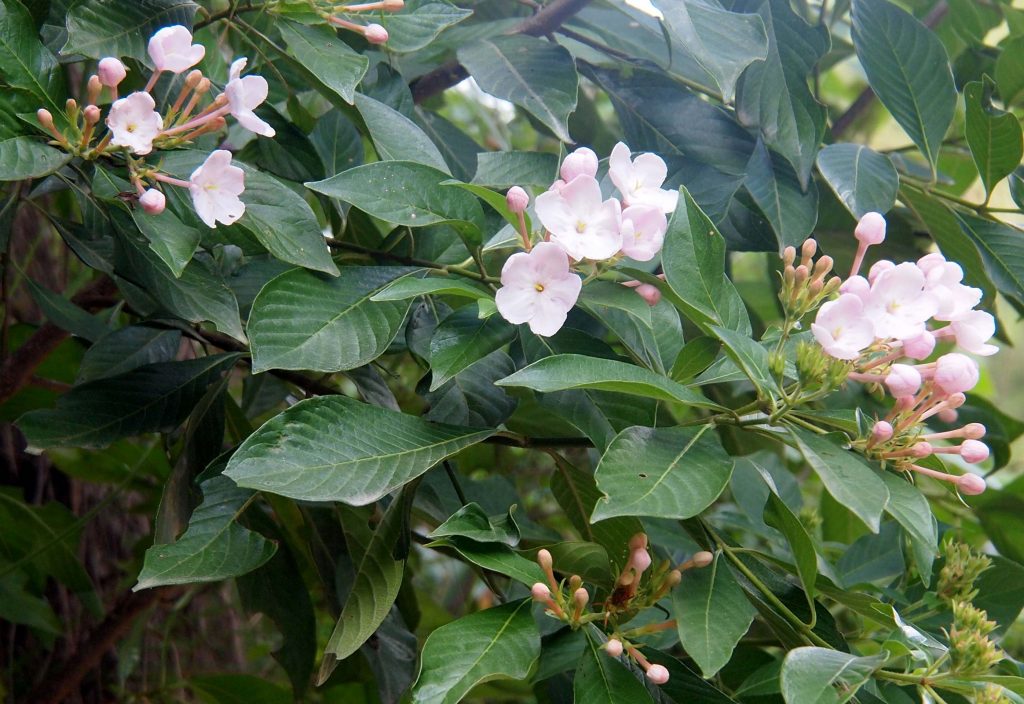
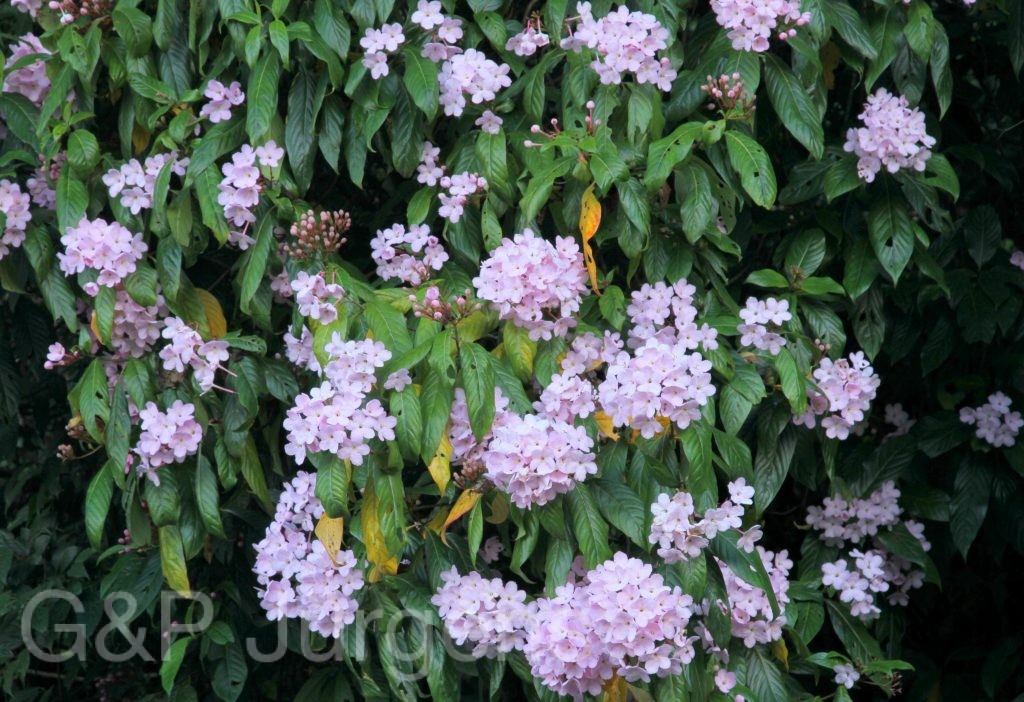
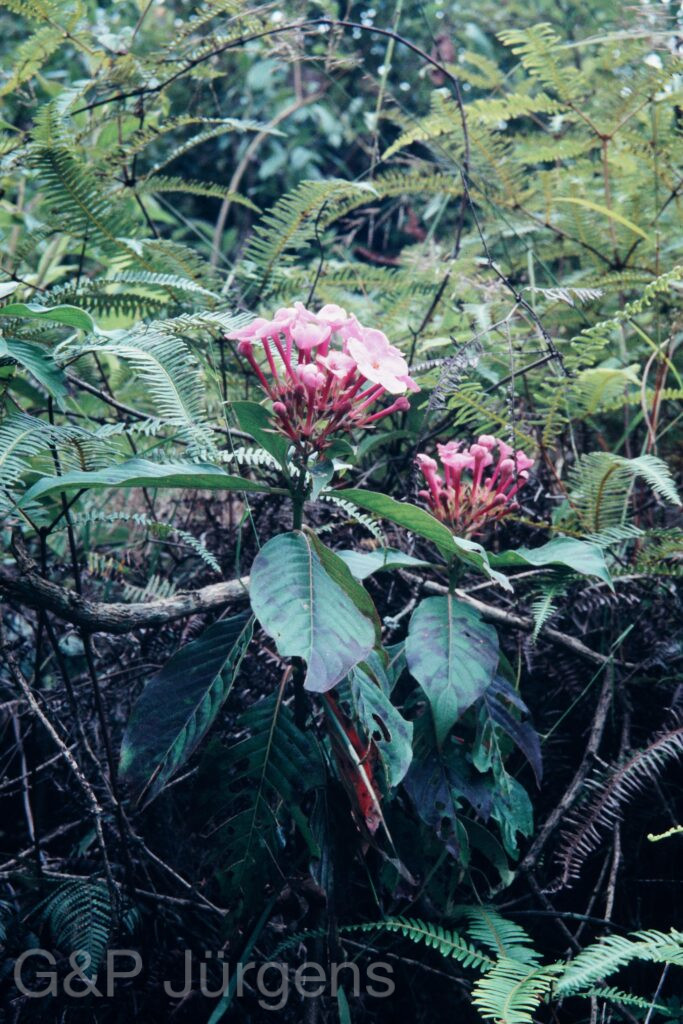
Luculia gratissima is a Himalayan and southwest Chinese shrub or small tree ranging from Nepal through Bhutan and northeast India into southern China, Myanmar, Thailand and Vietnam. GBIF records some 404 occurrences, including many cultivated specimens in temperate and subtropical regions worldwide. It inhabits subtropical to warm-temperate forest, forest margins, open hillsides and stream banks, generally between about 1000 and 2500 m. The photographed plants come from Bhutan at Tserang (1300 m) and Sandrup (1500 m) in September and from Tibling in Nepal at about 2200 m in October, the autumn flowering period typical of this fragrant species.

The species is an erect, branched shrub or small tree with terete, glabrescent branchlets. The leaves are opposite, large, elliptic to ovate-lanceolate, acuminate, with prominent pinnate venation and interpetiolar stipules. The flowers are borne in large terminal corymbose cymes and are showy and sweetly scented; each has a slender, elongate corolla tube opening into five spreading pink lobes, with small paired scales at the throat and exserted anthers. The fruit is an obovoid, ribbed, two-valved capsule that splits to release numerous small winged seeds adapted to wind dispersal.

Luculia gratissima Sweet is prized horticulturally for its fragrant pink autumn flowers and is widely grown in mild and subtropical gardens, which accounts for its many extralimital GBIF records. Within its native Himalayan and Indo-Chinese range it is widespread and not considered threatened. The genus Luculia, with its long-tubed scented flowers and winged capsular seeds, is of phylogenetic interest as an early-diverging lineage within the Rubiaceae.

Author: Sweet · Sources: POWO (Kew), GBIF, Flora of Bhutan, Flora of China, taxonomic revisions of Luculia (Rubiaceae)

(Wall.) Drude

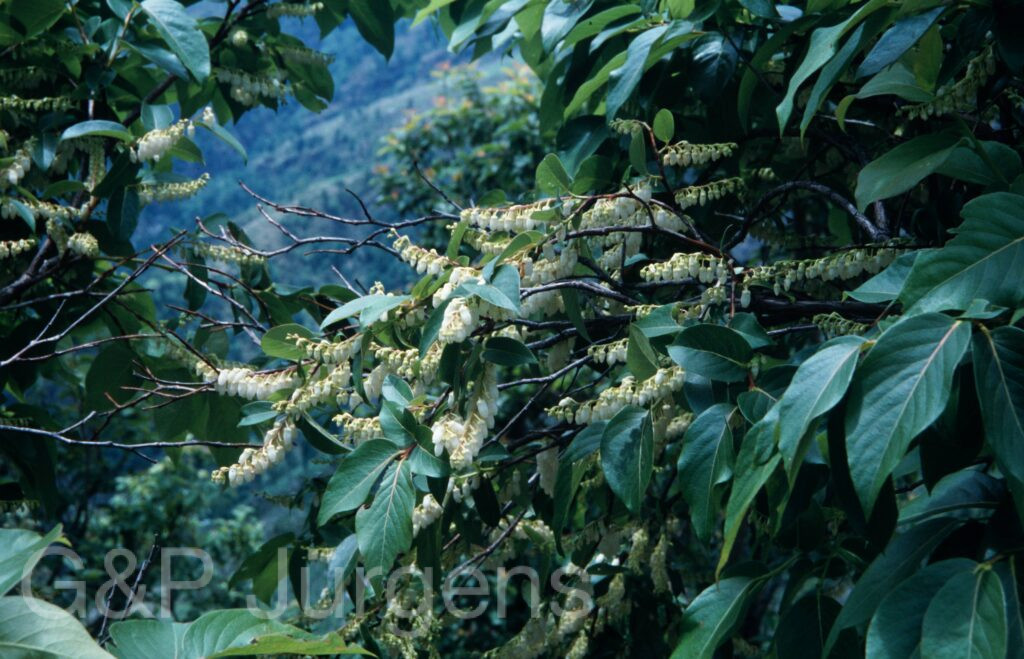
Nepal 97 517 P1015
Nepal Chinchilla 1950m May
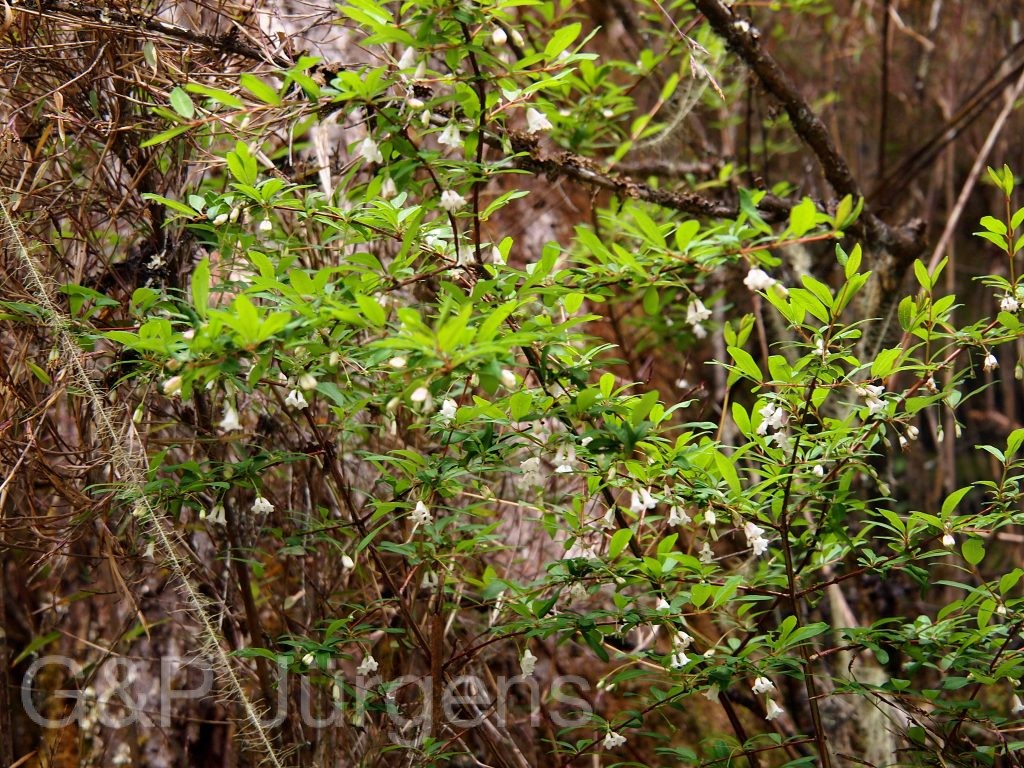
Nepal 2001 521 ergebnis ergebnis
Nepal (Gorkha) Mulabari 1360m, May

Description

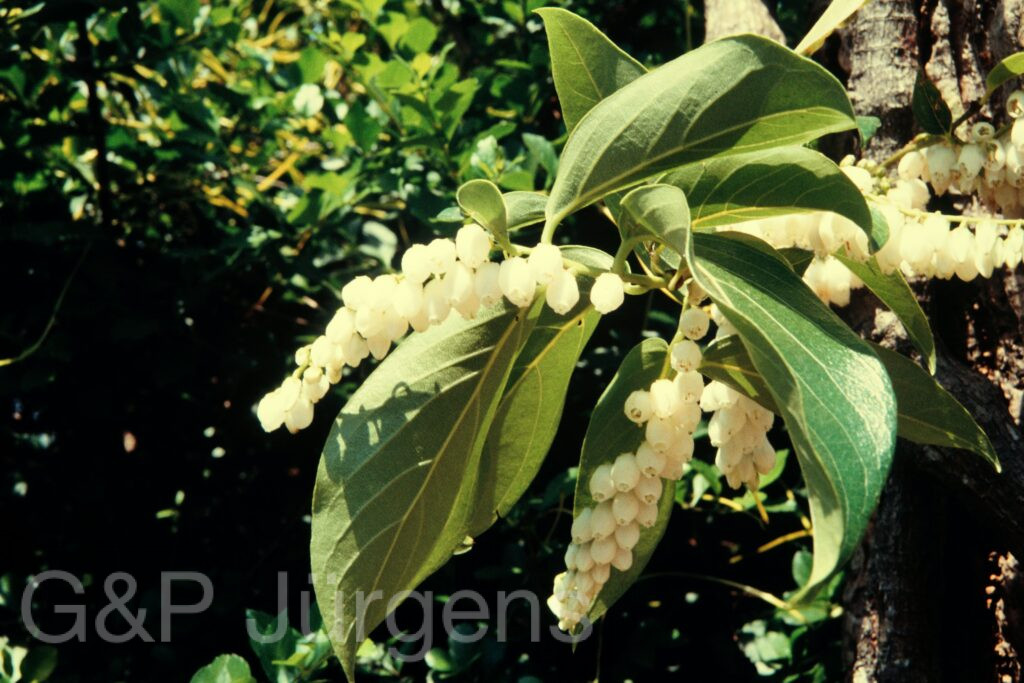
Lyonia ovalifolia is a widespread Sino-Himalayan and East Asian shrub or small tree distributed from China, Japan and Taiwan through Nepal, India, Bhutan, Pakistan, Myanmar, Thailand and Indochina, with a large GBIF dataset of over 13000 records. It grows on open hillsides, forest margins, thickets and in pine and oak forest understorey, typically between about 1000 and 3000 m. The illustrated plants from Chinchilla at 1950 m and Mulabari in Gorkha at 1360 m in Nepal, both flowering in May, are typical of its subtropical to temperate montane habitats, where it is a common component of the secondary scrub and open forest of the Himalayan midlands.

It is a deciduous to semi-evergreen shrub or small tree with reddish-brown, often somewhat zigzag young branchlets. The leaves are alternate, ovate to ovate-elliptic or ovate-lanceolate, with an entire margin, an acuminate apex and a rounded to subcordate base, with pinnate venation. The flowers are borne in axillary racemes along the shoots, each with a small five-lobed calyx and an urceolate (urn-shaped) white corolla with five short recurved lobes, ten included stamens and a superior ovary. The fruit is a small, ovoid, woody, five-valved loculicidal capsule with a persistent thickened placental axis, releasing numerous minute seeds.

Lyonia belongs to the subfamily Vaccinioideae of the Ericaceae and, in common with many members of that family, contains grayanotoxin-type diterpenes, making the foliage toxic to livestock; the plant has local uses as an insecticide and in folk medicine. The urn-shaped flowers are pollinated by bees and other insects, and the tiny seeds are wind-dispersed from the dehiscing capsules. As an abundant and ecologically tolerant species across a vast range, L. ovalifolia is of least conservation concern.

Author: (Wall.) Drude · Sources: POWO (Kew), GBIF, Flora of China Vol. 14, Flora of Bhutan Vol. 2, Flora of Nepal, Flora of Pakistan, Judd Revision of Lyonia (Ericaceae) monograph