Tag:

Nepal

Flowers of Nepal — 1313 wild plant species documented from the Nepalese Himalaya, from subtropical foothills to high alpine meadows above 4,000 m. Nepal’s dramatic elevation gradient makes it one of the richest botanical regions on Earth, home to rhododendrons, primulas, gentians and the famed blue poppies (Meconopsis). Every entry gives a botanical description, native distribution, habitat and flowering season, alongside the original field photograph and the location where it was taken.

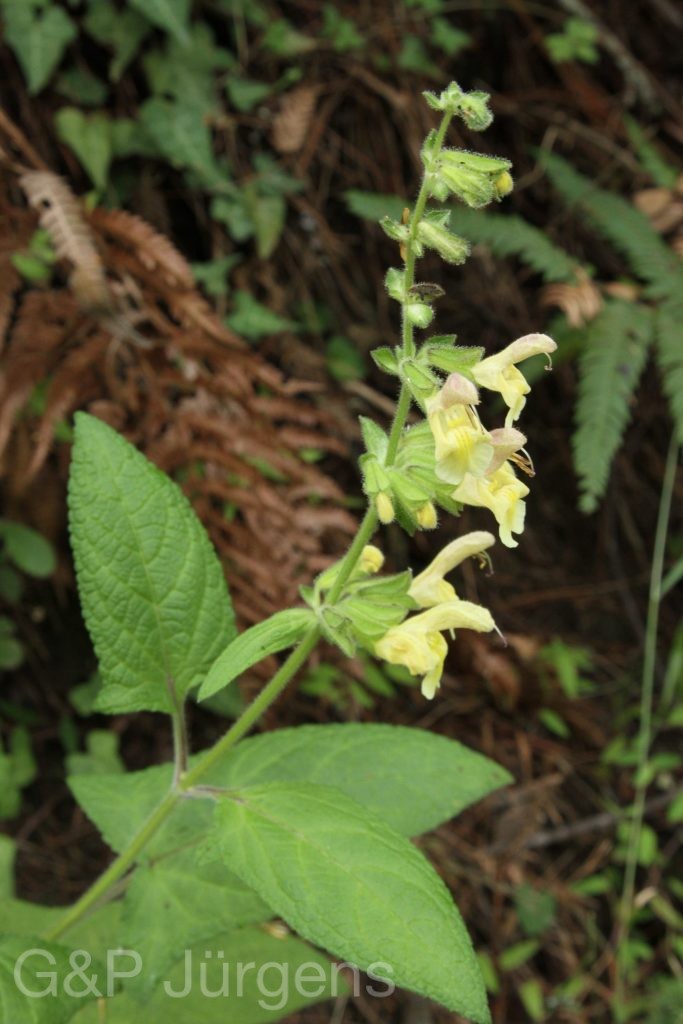
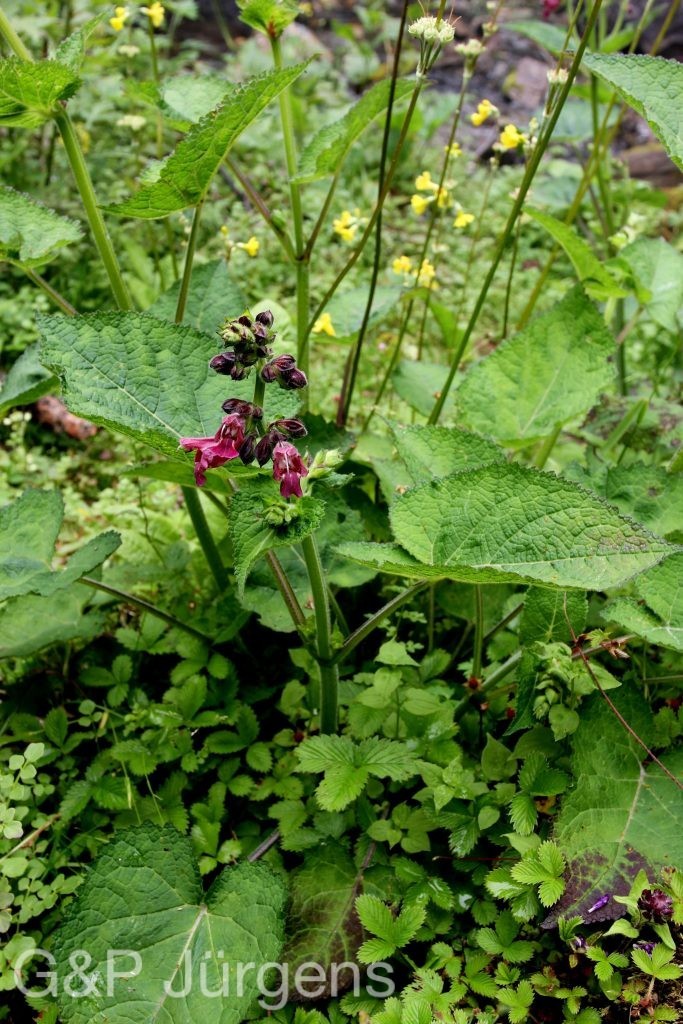
Salvia castanea

by GP Jürgens

Diels

BhutanPG2011 828 01 01
Bhutan Chele-La, 3400m July

Description

Salvia castanea is a montane perennial distributed across the eastern Himalaya and adjoining south-western China, with georeferenced collections recorded from China, Bhutan, Nepal and India; some 202 occurrences are documented in GBIF. It favours open forest margins, scrub, alpine meadows and grassy slopes between roughly 2700 and 4000 m, the photographed plant having been gathered at Chele-La in Bhutan at about 3400 m in July, at the height of the monsoon flowering season. It thrives on humus-rich, well-drained soils in cool, moist subalpine conditions.

The plant forms an erect, woody-based perennial herb 30-60 cm tall from a stout rootstock, with quadrangular, sparsely pubescent stems. The basal and lower cauline leaves are long-petiolate, the lamina ovate to oblong-lanceolate, cordate or subcordate at the base, crenate-serrate, and rugose with impressed venation. The inflorescence is a lax raceme of distant 2-6-flowered verticillasters; flowers bear a campanulate calyx and a chestnut-brown to dull purplish-red corolla 2.5-3.5 cm long, with an arched, galeate upper lip and the characteristic Salvia lever mechanism of two stamens. The fruit comprises four smooth nutlets enclosed in the persistent calyx.

The distinctive chestnut corolla colour, reflected in the epithet castanea, separates this species from most Himalayan sages, which tend toward blue or violet flowers. As a member of the large genus Salvia (Lamiaceae, subfamily Nepetoideae), it relies on long-tongued bees and occasionally birds for pollination via the staminal lever. Though not formally assessed as threatened, it is locally frequent within its restricted Sino-Himalayan range, where habitat continuity in subalpine meadows underpins its persistence.

Author: Diels · Sources: POWO (Kew), GBIF, Flora of China, Flora of Bhutan, A Revision of Salvia (Lamiaceae) in Asia
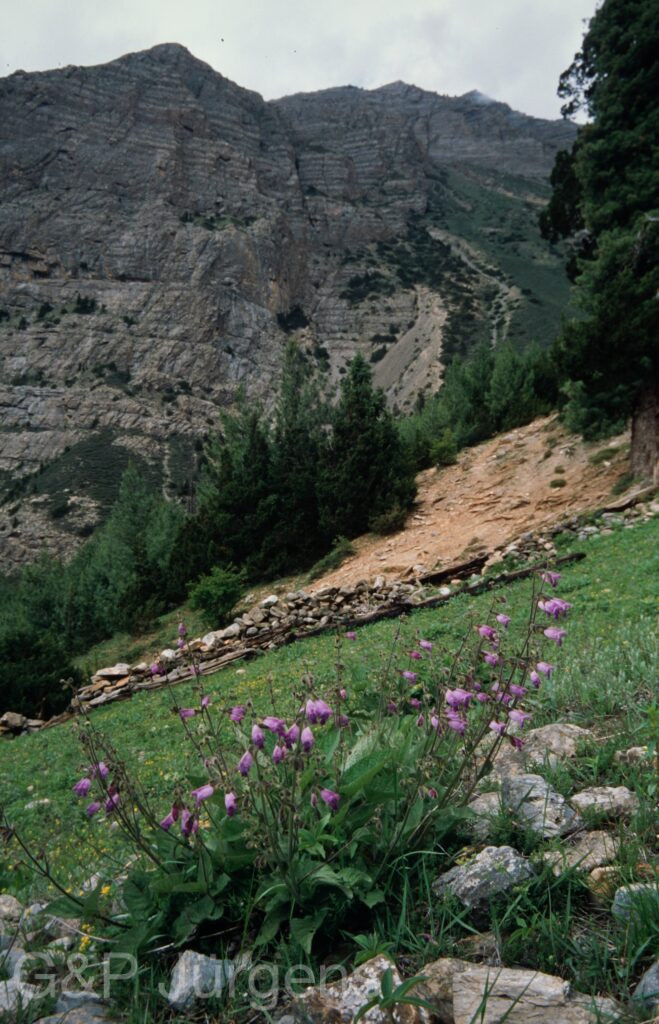
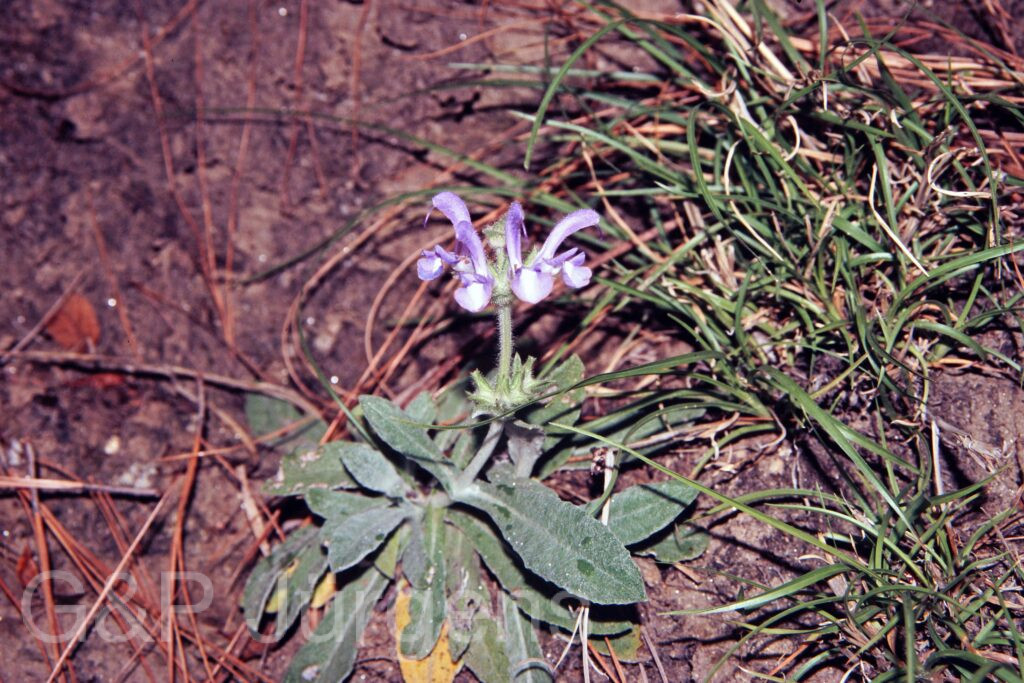
Royle ex Benth.

Nepal 99 867 ergebnis
West-Nepal Sanu Bheri 3500m, July

Description

Salvia hians is a Himalayan herbaceous perennial of the temperate to subalpine belt of the western and central Himalaya, with occurrences in India, Nepal, Pakistan and adjacent China; its c. 217 georeferenced records (further reports from Europe and North America reflect cultivated material). It favours open grassy slopes, forest margins, alpine meadows and moist rocky banks, typically between 2400 and 4000 m. The photographed plant from the Sanu Bheri valley in West Nepal at 3500 m, flowering in July, is characteristic of its summer-flowering subalpine habitat among tall herbs in the monsoon-watered turf.

It forms an erect, somewhat sticky-pubescent herb 30-90 cm tall arising from a stout rootstock, with mostly basal, long-petioled, ovate-cordate leaves bearing crenate to doubly serrate margins and a rugose surface. The inflorescence is a lax terminal raceme of distant verticillasters. The corolla is showy, c. 3-5 cm long and deep violet-blue to purple, conspicuously bilabiate with a strongly hooded, gaping (hence "hians") upper lip and a broad lower lip. The calyx is bell-shaped and two-lipped, and the two fertile stamens bear the characteristic lever mechanism of Salvia. The fruit comprises four smooth ovoid nutlets enclosed in the persistent calyx.

Described by Royle ex Bentham, S. hians belongs to the large, near-cosmopolitan genus Salvia, the most species-rich genus of Lamiaceae, and represents the showy Himalayan element of the subgenus Sclarea-group. The flowers are pollinated by long-tongued bees and bumblebees exploiting the staminal lever. Locally the species enters folk medicine and is occasionally grown ornamentally. It remains widespread and is not currently regarded as threatened, though habitat degradation through grazing and tourism affects some populations.

Author: Royle ex Benth. · Sources: POWO (Kew), GBIF, Flora of Nepal, Flora of Pakistan, Flora of China, Hedge's revision of Himalayan Salvia (Lamiaceae)

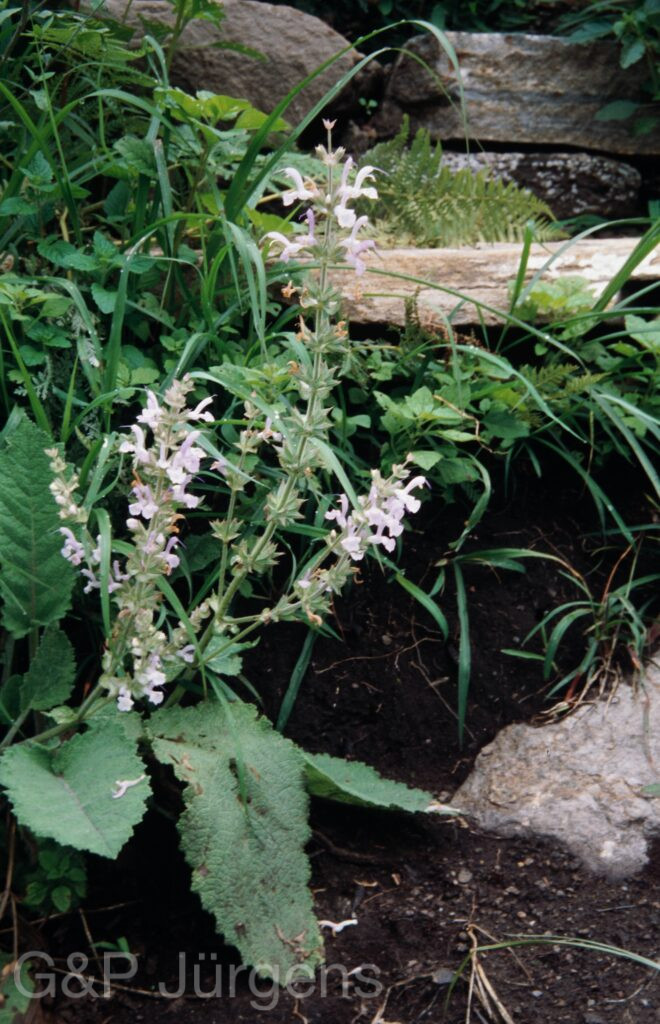
Wall. ex Benth.

Nepal 99 913 ergebnis
West-Nepal Roha 2800m, July

Description

Salvia moorcroftiana is a stout perennial sage of the western and central Himalaya, ranging from Afghanistan and Pakistan through northern India into Nepal, with cultivated and adventive records noted from Iran, Britain, Brazil and the United States. GBIF holds some 403 occurrences, concentrated in Pakistan, India, Afghanistan and Nepal. It is a plant of dry, open hillsides, overgrazed pastures, road banks, fallow fields and stony waste ground, generally between about 1500 and 3000 m, often forming conspicuous stands on degraded land. The specimen illustrated was recorded in West Nepal at Roha at 2800 m in July, flowering during the monsoon on open montane slopes.

The plant forms a large basal rosette of broadly ovate to oblong, rugose, wavy-margined leaves that are densely white-woolly beneath and borne on long petioles. From this rises a tall, branched, glandular inflorescence axis bearing well-separated verticillasters of large flowers subtended by coloured bracts. The two-lipped corolla is white to pale lilac, often flushed or veined with purple, the hooded upper lip enclosing two stamens with the characteristic lever-like connective of Salvia. The calyx is bell-shaped and persistent, and the fruit comprises four smooth nutlets retained within the dry calyx until dispersed.

Salvia, the largest genus of the Lamiaceae, is defined by its specialised staminal lever mechanism promoting precise pollen placement on visiting bees. S. moorcroftiana, named for the explorer William Moorcroft, is a long-established medicinal plant of the Himalayan foothills, its mucilaginous seeds and leaves used in traditional remedies for skin and digestive ailments. Tolerant of grazing and disturbance, it is widespread and of no conservation concern; indeed it often increases on degraded rangeland.

Author: Wall. ex Benth. · Sources: POWO (Kew), GBIF, Flora of Pakistan, Flora of British India, An Annotated Checklist of the Flowering Plants of Nepal, Salvia: The Genus Salvia

Bennet & Raizada

Garh 07 18 ergebnis
India Garhwal Uniana at Mandakini 1350m, June

Description

Salvia mukerjeei is a Himalayan endemic distributed along the southern flank of the western and central ranges, with georeferenced records spanning Pakistan, northern India and Nepal (GBIF documents 91 occurrences across these three countries). It favours shaded banks, forest margins and disturbed slopes in the warm-temperate to lower montane belt; the illustrated material was gathered in India, Garhwal, at Uniana near the Mandakini valley at about 1350 m in June, a setting typical of the moist mid-elevation gorges where the species recurs. Within this zone it grows on humus-rich soils beneath broad-leaved canopy and along streamsides flushed by the early monsoon.

The plant is an erect herb arising from a fibrous-rooted base, the quadrangular stems clothed in spreading eglandular and shorter glandular hairs. Leaves are opposite, petiolate and ovate to broadly cordate, with a crenate-serrate margin, an acuminate apex and a rugose, prominently veined lamina pubescent on both faces. The inflorescence is a lax terminal raceme of distant verticillasters, each subtended by deciduous bracts. Flowers show the characteristic bilabiate calyx and a two-lipped corolla with a hooded upper lip and spreading lower lip; the two fertile stamens bear the elongated connective lever diagnostic of the genus. The fruit comprises four smooth nutlets enclosed in the persistent calyx.

Described from Garhwal collections, the species honours the botanist Mukerjee and belongs to a complex of Asian Salvia centred on the Himalaya. POWO and GBIF treat the name as the accepted taxon. Its restricted range and dependence on undisturbed shaded habitats make it sensitive to forest clearance, though no formal IUCN assessment has been published.

Author: Bennet & Raizada · Sources: POWO (Kew), GBIF, Flora of Pakistan, Flora of British India, A Revision of Salvia in Asia (Lamiaceae monograph), Annotated Checklist of the Flowering Plants of Nepal

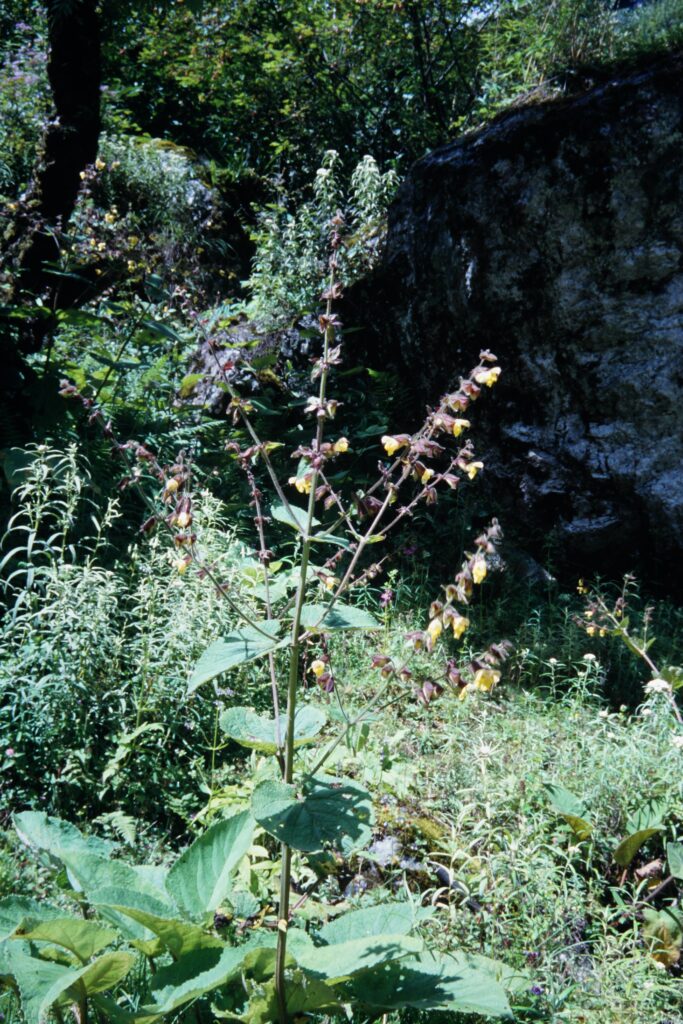
Salvia nubicola

by GP Jürgens

Wall. ex Sweet

Bhutan2012 15 scaled
Bhutan Paro, 2300m September

Description

Salvia nubicola is a robust herbaceous sage of the Himalaya and adjacent mountains, distributed from Afghanistan and Pakistan through Nepal, northern India and Bhutan into south-western China, with 372 GBIF occurrences that include naturalised or cultivated material in Europe, North America, Iran and New Zealand. It favours open slopes, forest margins, clearings, roadsides and disturbed ground in the temperate montane zone, broadly between 1800 and 3600 m. The illustrated plant was photographed at Paro in Bhutan at 2300 m in September, in the late-summer to autumn flowering season characteristic of the species at mid-elevations.

It is a stout perennial herb up to 1-1.5 m tall with quadrangular, glandular-hairy stems and a strong aromatic scent. The leaves are large, ovate-triangular to hastate with a cordate or sagittate base and crenate margin, long-petiolate and rugose. The flowers are arranged in widely spaced verticillasters forming an elongate terminal inflorescence, subtended by conspicuous bracts. The corolla is pale yellow, often blotched or veined with purple or brown on the lower lip, strongly two-lipped with a hooded galea-like upper lip; the two fertile stamens bear the characteristic lever-like connective of Salvia. The fruit comprises four smooth nutlets enclosed in the persistent two-lipped calyx.

The staminal lever mechanism deposits pollen on visiting long-tongued bees and is a defining synapomorphy of Salvia; in S. nubicola the pale, dark-marked flowers attract bumblebees. The species belongs to a Himalayan group of large-leaved yellowish-flowered sages allied to S. glutinosa of Europe. Wide-ranging, weedy-tolerant and locally common, it is of least concern, and like many sages it has minor local use in traditional medicine and is grown as an ornamental in temperate gardens.

Author: Wall. ex Sweet · Sources: POWO (Kew), GBIF, Flora of China, Flora of Pakistan, Hedge: Labiatae of South-West Asia

Maxim.

Sikkim2003 359 P502 ergebnis
India Sikkim Lachen 2840m, August

Description

Salvia roborowskii is a perennial herb distributed from the Himalayas across the Sino-Himalayan region to western China. Its range encompasses Nepal, northeast India (Sikkim), Bhutan, and China (Xizang, Yunnan, Sichuan, Qinghai, Gansu). The species inhabits montane forest clearings, grassy slopes, thicket margins, and alpine meadows at elevations of 2,400–4,200 m. It has been recorded from the Lachen Valley in Sikkim at 2,840 m, flowering profusely in August during the monsoon season, where it grows in open, herbaceous vegetation along stream margins and disturbed ground.
The plant produces erect, square stems 30–80 cm tall from a perennial rootstock, often branched in the upper portion. The stems are pubescent with short, retrorse hairs. The basal and lower cauline leaves are pinnately compound to pinnatisect, with 1–3 pairs of lateral lobes and a larger terminal lobe, the lobes ovate to oblong, irregularly crenate-serrate, sparsely pilose on both surfaces. The upper leaves are progressively reduced. The inflorescence is a series of verticillasters arranged in elongate, terminal, spike-like racemes. The calyx is bilabiate, glandular-pubescent. The corolla is blue to violet-purple, 8–12 mm long, bilabiate with an arched upper lip and a spreading, trilobed lower lip. The nutlets are ovoid, smooth, dark brown.
Salvia roborowskii was described by Maximowicz from material collected during Przewalski's expeditions in the Sino-Tibetan borderlands. With over 400 occurrence records in GBIF, it is one of the more frequently collected high-altitude salvias in the region. The species is ecologically significant as a nectar source for montane bumblebees and other long-tongued pollinators. Its broad elevational range and tolerance of disturbed habitats suggest a degree of ecological resilience, though it remains dependent on the persistence of open montane grasslands and forest margins. Taxonomically, it is placed within Salvia subgenus Salvia and is allied to other pinnate-leaved species of the Sino-Himalayan region.

Author: Maxim. · Sources: POWO (Kew), GBIF, Flora of China Vol. 17, Flora of Bhutan Vol. 2, Hedge: Salvia in Flora Iranica (1982)

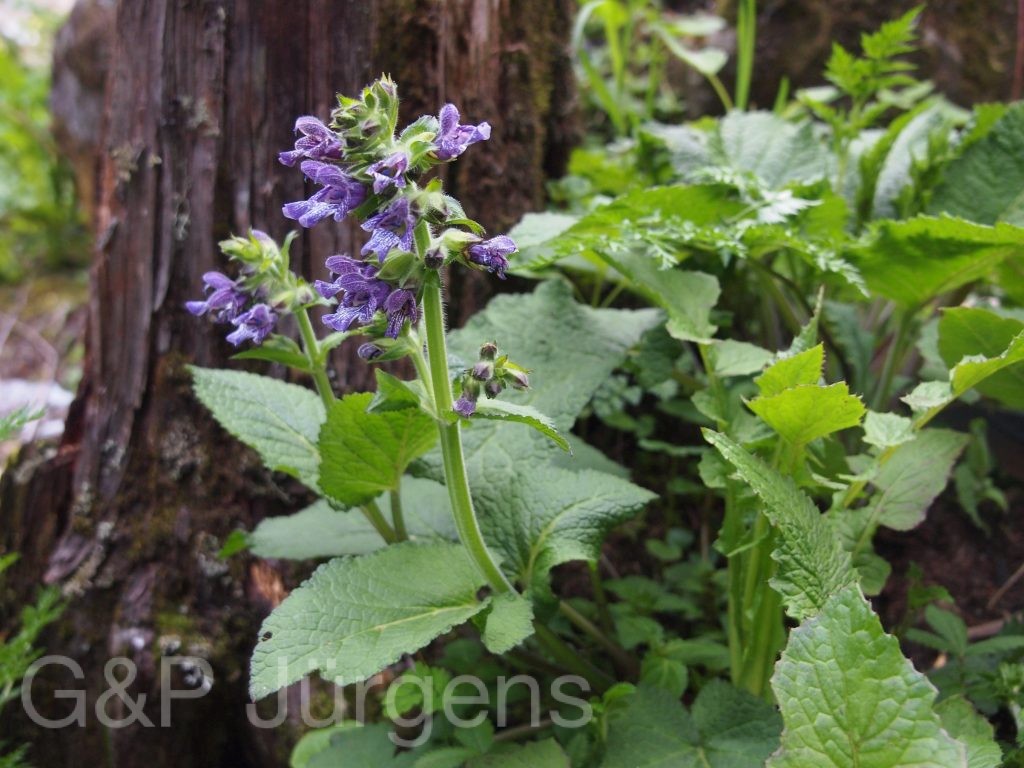
(E.Peter)

BhutanPG2011 130
Bhutan Kupang 3550m, June

Description

Salvia wardii is a Sino-Himalayan sage distributed across the eastern Himalaya and adjacent China, recorded from southern China (the Tibetan borderlands), Bhutan, Nepal and India, with an outlying record from Sri Lanka and only around 73 GBIF occurrences, a comparatively narrowly known species. It is a plant of subalpine and alpine habitats, growing on open grassy slopes, scrub margins, rocky banks and meadow clearings in the upper temperate to subalpine zone. The image documents the species at Kupang in Bhutan at about 3550 m in June, where it flowers among summer meadow vegetation alongside other perennial herbs of the high pastures.

It is an erect perennial herb arising from a woody rootstock, with quadrangular, pubescent stems. The leaves are mostly basal and lower-cauline, ovate to oblong, cordate to truncate at the base, crenate-serrate, rugose and softly hairy, on long petioles. The inflorescence is a lax terminal raceme of widely spaced verticillasters, each with few flowers. The calyx is bilabiate and glandular-pubescent; the corolla is showy, deep violet to purple-blue, with an exserted upper lip and a broad spreading lower lip, and the connective of the two fertile stamens is elongated and lever-like, characteristic of Salvia. The fruit comprises four smooth nutlets.

Named for the plant collector Frank Kingdon-Ward, Salvia wardii belongs to the Asian section of Salvia centred on the Sino-Himalayan mountains, a centre of diversity for the genus. The staminal lever mechanism promotes outcrossing by long-tongued bees and bumblebees foraging in the brief alpine summer. Its restricted range and small number of records suggest it warrants monitoring, though no formal threat assessment has been made.

Author: (E.Peter) · Sources: POWO (Kew), GBIF, Flora of China, Flora of Bhutan, Salvia: Flora Sinica account, World Checklist of Lamiaceae

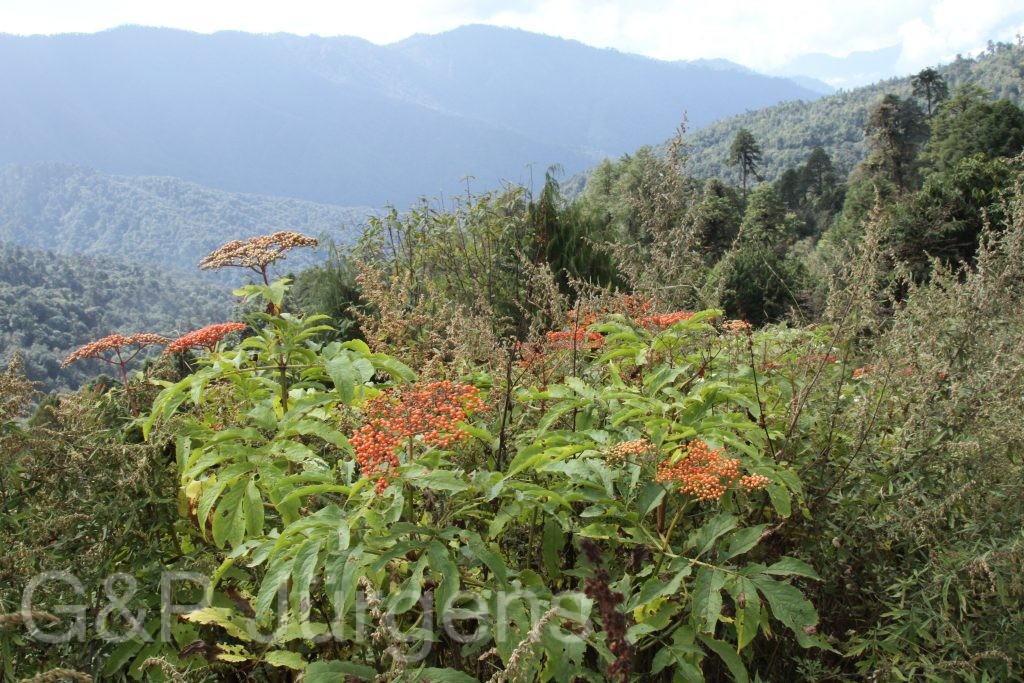
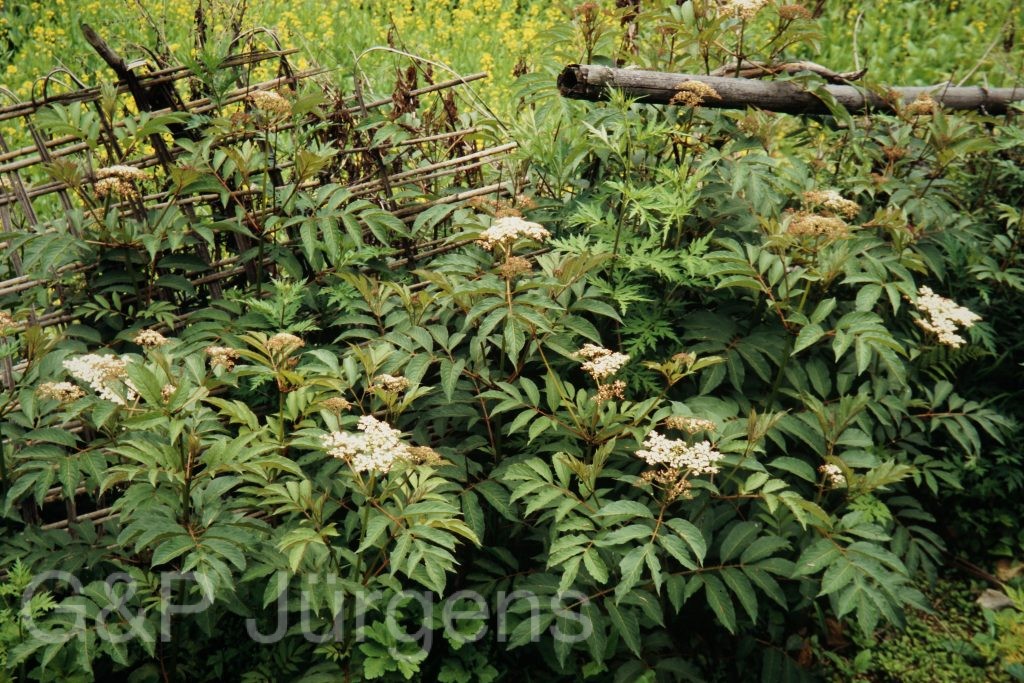
Sambucus adnata

by GP Jürgens

Wall. ex DC.

Bhutan2015 322
Bhutan Trongsa 2100m, October
Bh09 202 P341
Bhutan Thimphu, 2500m June

Description

Sambucus adnata is a herbaceous elder distributed across the Himalaya and western to central China, occurring in Nepal, Bhutan, northern India and widely in China, with its very numerous GBIF records (over 1700) concentrated in this region; records from Germany, the United States, Austria, Japan and elsewhere reflect cultivation and herbarium accessions. It grows in moist forest clearings, on shrubby slopes, along stream banks, roadsides and at forest margins, generally between about 1600 and 3600 m. The photographed plants from Trongsa (2100 m, October) and Thimphu (2500 m, June) in Bhutan illustrate its range through the cool, humid mid-montane belt of the eastern Himalaya.

Unlike its woody relatives, S. adnata is a tall, robust perennial herb dying back to a thick, fleshy, creeping rhizome. The stout, erect, ridged stems bear large, opposite, imparipinnate leaves with several pairs of lanceolate, serrate leaflets, the lowest leaflets often adnate to the rachis or with adnate stipule-like outgrowths, a feature reflected in the epithet. The inflorescence is a large, flat-topped to convex compound cyme of numerous small flowers with a rotate, whitish to pinkish corolla and conspicuous reddish anthers or nectaries. The fruit is a small, globose, red drupe containing a few seed-like stones.

Sambucus, formerly placed in the Caprifoliaceae, is now referred with the genus Adoxa and Viburnum to the Adoxaceae on molecular and morphological grounds. S. adnata is distinctive among elders for its fully herbaceous, rhizomatous habit. It is widespread, common and weedy in disturbed montane habitats, and is of no conservation concern; the plant has a record of local medicinal use for bruises and swellings.

Author: Wall. ex DC. · Sources: POWO (Kew), GBIF, Flora of China, Flora of Bhutan, Annotated Checklist of the Flowering Plants of Nepal, Sambucus (Adoxaceae) monograph

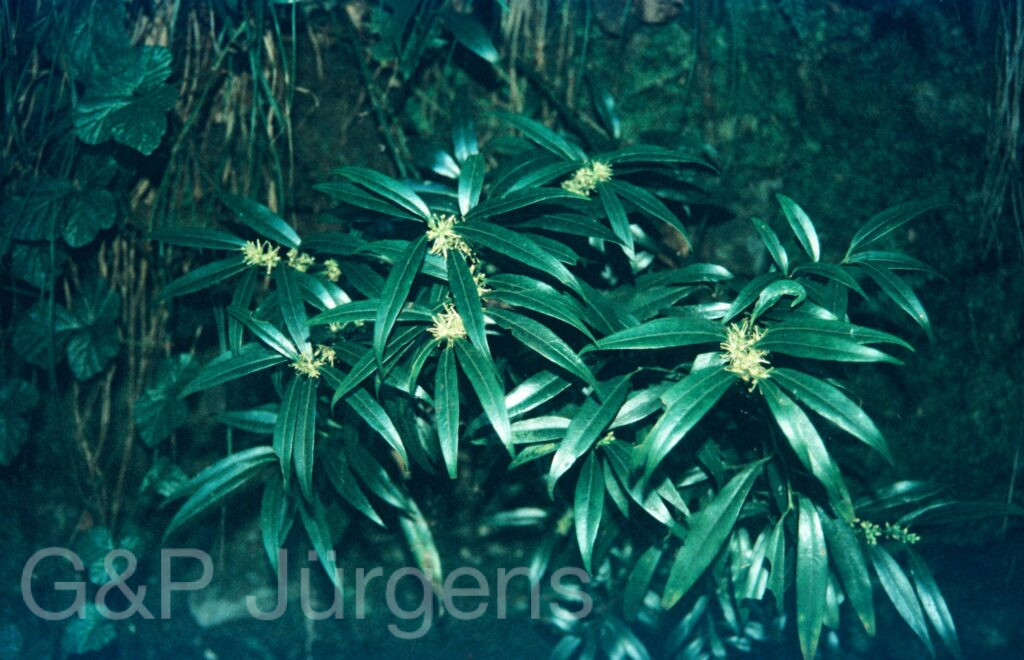
Müll.Arg.

Garw 2005 432 ergebnis
India Garhwal Barqargay 2100m, September

Description

Sarcococca saligna (Müll.Arg.), the willow-leaf sweet box, is an evergreen shrub of the family Buxaceae native to the Himalaya and adjacent uplands, ranging from Afghanistan and Pakistan through northern India and Nepal to China, with related records extending into Southeast Asia. The fewer than 400 GBIF occurrences point to a scattered montane distribution, supplemented by cultivated material in Europe and North America where the plant is grown as an ornamental. It inhabits shady, moist temperate forest, ravine slopes and the understorey of oak and conifer woodland, generally between 1,500 and 2,800 m, as shown by the Garhwal collection from Barqargay at 2,100 m in September.

The plant is a glabrous, much-branched shrub up to about 2 m tall, with slender green stems. The leaves are alternate, narrowly lanceolate to oblong-lanceolate, leathery, entire-margined, acuminate at the apex and tapering to a short petiole, the venation prominent beneath, distinguishing this species from its broader-leaved congeners. The small, fragrant, apetalous flowers are unisexual and borne in short axillary spikes or clusters, the plant being monoecious with the few female flowers placed below the more numerous male flowers; the male flowers display creamy-white stamens. The fruit is a small, globose, fleshy drupe ripening from red to purplish-black.

Sarcococca belongs to the same family as Buxus and Pachysandra, sharing the reduced, unisexual, perianth-simple flowers characteristic of the Buxaceae. The species is rich in steroidal alkaloids that have attracted pharmacological interest for their cholinesterase-inhibitory activity, and it is used in regional traditional medicine. Valued in gardens for its glossy foliage and intensely sweet winter fragrance, S. saligna is widely cultivated; in the wild it remains locally common and is not considered threatened.

Author: Müll.Arg. · Sources: POWO (Kew), Flora of Pakistan, GBIF, Flora of China Vol. 11, Köhler & Brückner: Buxaceae in The Families and Genera of Vascular Plants

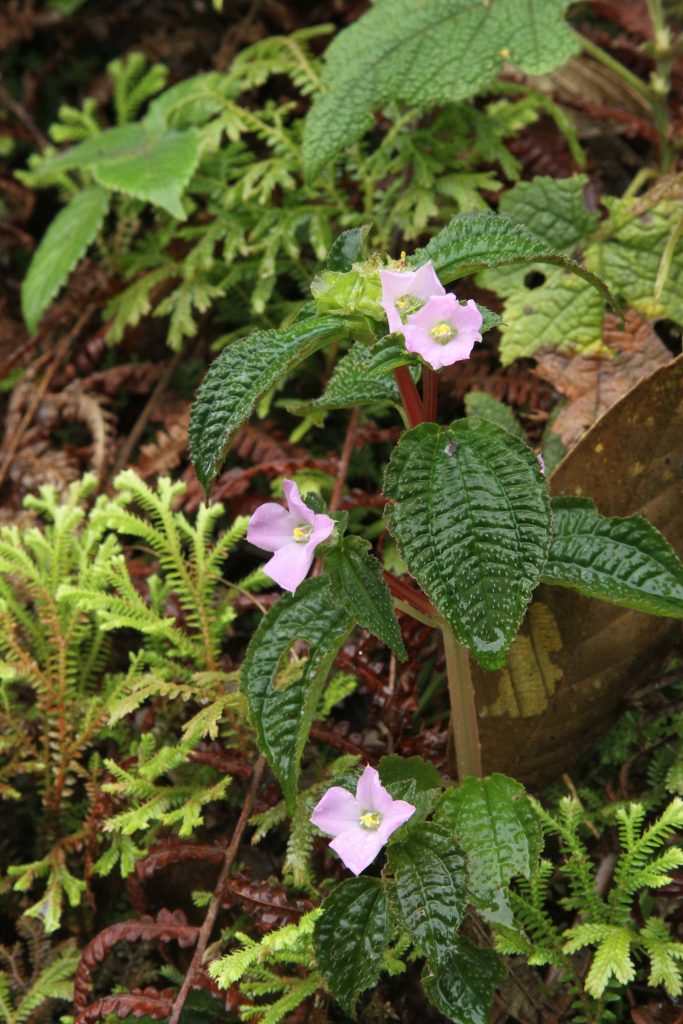
Wall.

Bhutan2012 676
Bhutan Galephu 900m, September

Description

Sarcopyramis nepalensis Wall. is a small, delicate herb of the Melastomataceae distributed through the eastern Himalaya and Southeast Asia. Its several hundred records range across Nepal, northeast India, Bhutan, southern China, Taiwan, Myanmar, Vietnam, Malaysia, Indonesia and the Philippines. The species is a denizen of cool, shaded, perpetually moist habitats, growing on damp humus-rich banks, mossy rocks, ravine sides and the forest floor of evergreen broad-leaved and subtropical forests. It generally occupies low to mid elevations, and the plant photographed near Galephu in southern Bhutan at 900 m in September, late in the monsoon when these herbs flower, is typical of its preference for humid, dripping microsites.

The plant is a small, succulent, low annual or short-lived perennial with weak, ascending, four-angled stems that often root at the lower nodes. The leaves are opposite, membranous, broadly ovate to elliptic, with the three to five arcuate, longitudinally curved veins characteristic of the family, the margins finely toothed and sometimes reddish beneath. The flowers are borne singly or in few-flowered terminal cymes; they have a distinctive urceolate, four-angled hypanthium with prominent crested or winged angles, four pink to pale rose-purple petals, and eight stamens with conspicuously appendaged connectives. The fruit is a small, four-lobed, cup-shaped capsule crowned by the persistent calyx.

Sarcopyramis is a small Asian genus closely allied to Bredia and Phyllagathis within tribe Sonerileae, and the species has at times been treated as a variable complex with several segregate taxa and varieties. Its dependence on humid, shaded forest microhabitats makes it a useful indicator of intact, moisture-rich forest understorey. While not currently regarded as threatened across its broad range, local populations are sensitive to deforestation and the drying of streamside and seepage habitats.

Author: Wall. · Sources: POWO (Kew), GBIF, Flora of China Vol. 13, Flora of Bhutan Vol. 2, Renner et al.: Melastomataceae systematics