
Müll.Arg.
Description
Sarcococca saligna (Müll.Arg.), the willow-leaf sweet box, is an evergreen shrub of the family Buxaceae native to the Himalaya and adjacent uplands, ranging from Afghanistan and Pakistan through northern India and Nepal to China, with related records extending into Southeast Asia. The fewer than 400 GBIF occurrences point to a scattered montane distribution, supplemented by cultivated material in Europe and North America where the plant is grown as an ornamental. It inhabits shady, moist temperate forest, ravine slopes and the understorey of oak and conifer woodland, generally between 1,500 and 2,800 m, as shown by the Garhwal collection from Barqargay at 2,100 m in September.
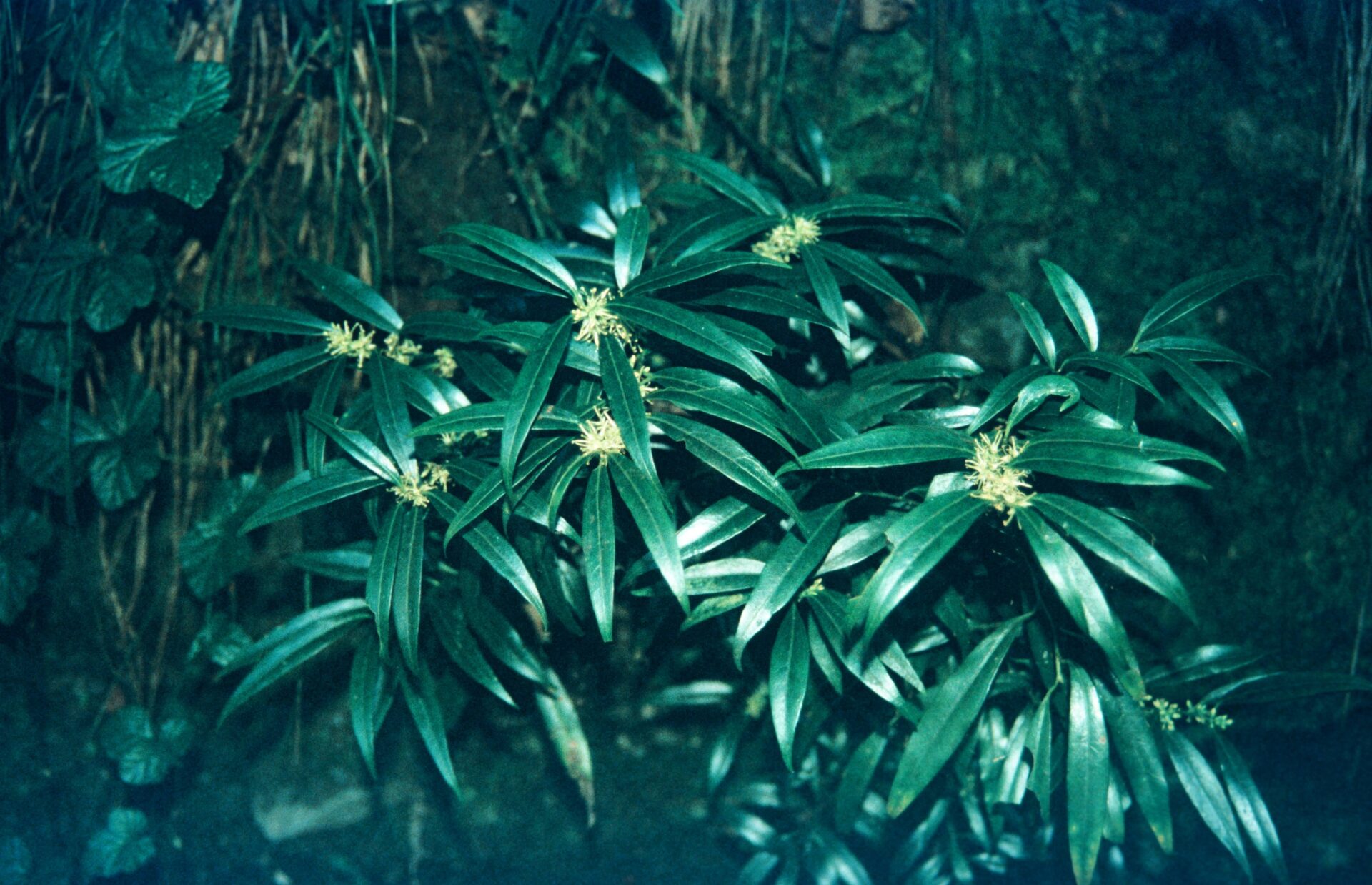
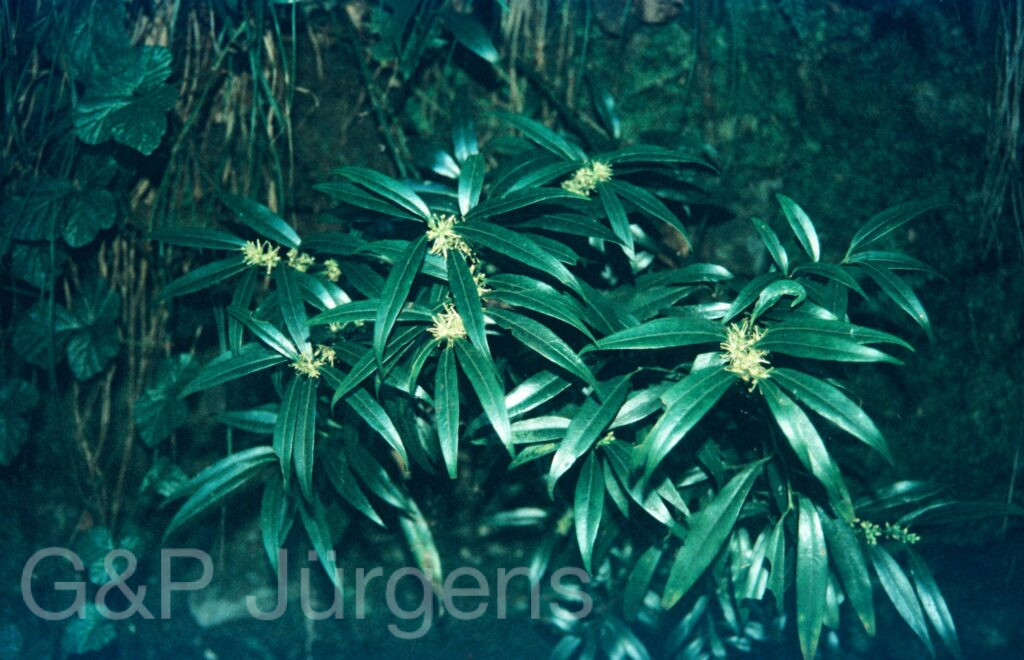
The plant is a glabrous, much-branched shrub up to about 2 m tall, with slender green stems. The leaves are alternate, narrowly lanceolate to oblong-lanceolate, leathery, entire-margined, acuminate at the apex and tapering to a short petiole, the venation prominent beneath, distinguishing this species from its broader-leaved congeners. The small, fragrant, apetalous flowers are unisexual and borne in short axillary spikes or clusters, the plant being monoecious with the few female flowers placed below the more numerous male flowers; the male flowers display creamy-white stamens. The fruit is a small, globose, fleshy drupe ripening from red to purplish-black.
Sarcococca belongs to the same family as Buxus and Pachysandra, sharing the reduced, unisexual, perianth-simple flowers characteristic of the Buxaceae. The species is rich in steroidal alkaloids that have attracted pharmacological interest for their cholinesterase-inhibitory activity, and it is used in regional traditional medicine. Valued in gardens for its glossy foliage and intensely sweet winter fragrance, S. saligna is widely cultivated; in the wild it remains locally common and is not considered threatened.
Author: Müll.Arg. · Sources: POWO (Kew), Flora of Pakistan, GBIF, Flora of China Vol. 11, Köhler & Brückner: Buxaceae in The Families and Genera of Vascular Plants