Tag:

Nepal

Flowers of Nepal — 1313 wild plant species documented from the Nepalese Himalaya, from subtropical foothills to high alpine meadows above 4,000 m. Nepal’s dramatic elevation gradient makes it one of the richest botanical regions on Earth, home to rhododendrons, primulas, gentians and the famed blue poppies (Meconopsis). Every entry gives a botanical description, native distribution, habitat and flowering season, alongside the original field photograph and the location where it was taken.

Sealy

BhutanPG2011 790 01 01
Bhutan Chele-La, 3800m July
BhutanPG2011 791 01 01
Bhutan Chele-La, 3800m July

Description

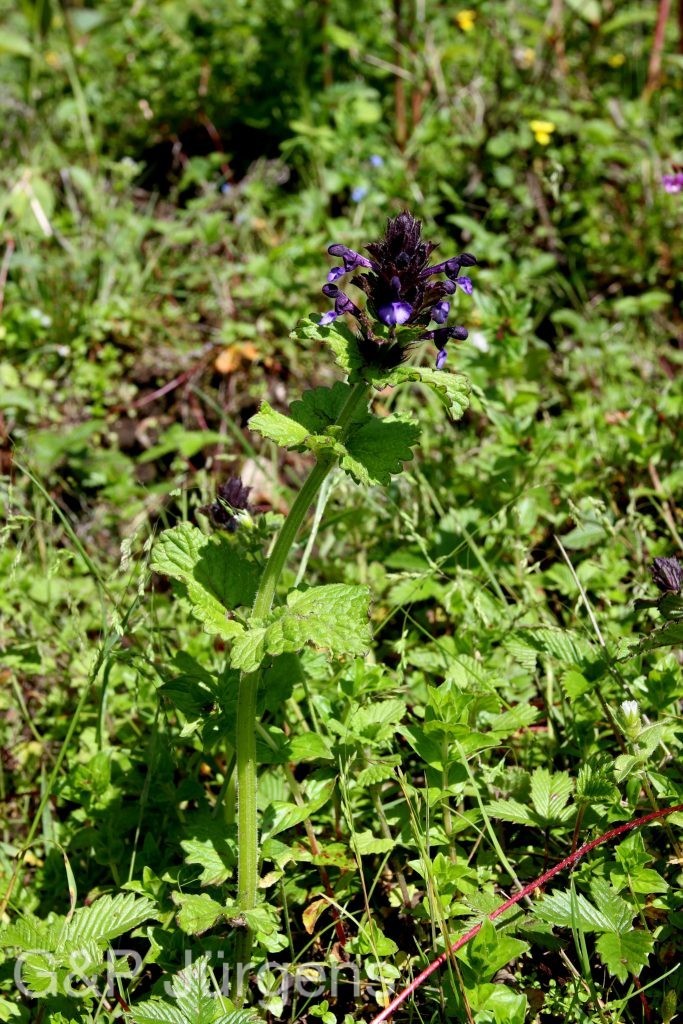
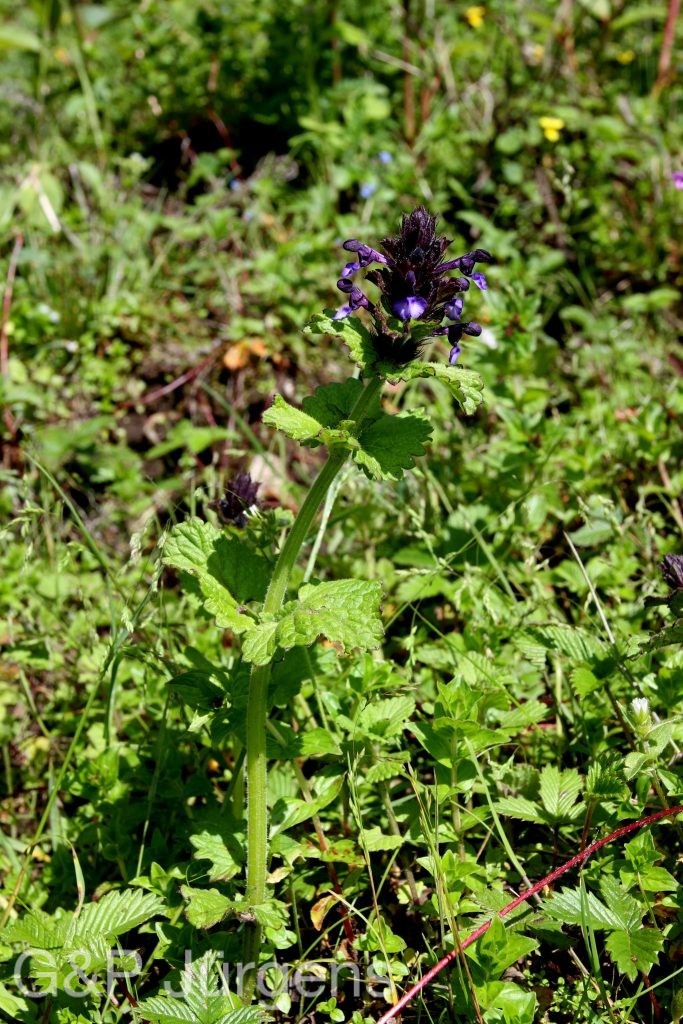
Dracocephalum wallichii is a Himalayan dragonhead recorded from India, China (Xizang), Nepal and Bhutan, with GBIF holding around 175 occurrences across the high eastern and central ranges. It is a plant of the alpine zone, growing on open stony slopes, gravelly meadows, scree and grassy banks typically between about 3500 and 4500 m. The photographed material from the Chele-La in western Bhutan at 3800 m, flowering in July, is characteristic: at this high pass the species blooms in the brief summer window after snowmelt, exploiting well-drained, sunny ground among the alpine turf and rock where competition from taller vegetation is limited.

It is a perennial herb with a woody rootstock giving rise to several erect or ascending quadrangular stems. The leaves are opposite, oblong to narrowly ovate, the margin crenate to incised, and often somewhat aromatic, as is general in the genus. The inflorescence is a dense, head-like to interrupted terminal spike of verticillasters subtended by conspicuous, often spine-toothed and ciliate floral bracts that are a notable feature of the species. Each flower has a tubular, two-lipped calyx and a strongly two-lipped corolla coloured blue to violet-purple, the hooded upper lip arching over the four didynamous stamens and the lower lip spreading and three-lobed as a landing platform for bees. The fruit comprises four smooth nutlets enclosed in the persistent calyx.

The species was described by Sealy and honours Nathaniel Wallich, an early collector of Himalayan plants. Dracocephalum is a genus of the temperate northern hemisphere centred on central Asia, well represented in alpine and steppe habitats; D. wallichii is one of its few truly Himalayan-alpine members and is distinguished by its bracteal armature and dense spike. Pollinated chiefly by bumblebees, it is a typical short-season alpine perennial, and being widespread in remote high terrain it is of no immediate conservation concern.

Author: Sealy · Sources: POWO (Kew), GBIF, Flora of China, Flora of Bhutan, Annotated Checklist of the Flowering Plants of Nepal, Budantsev revision of the genus Dracocephalum
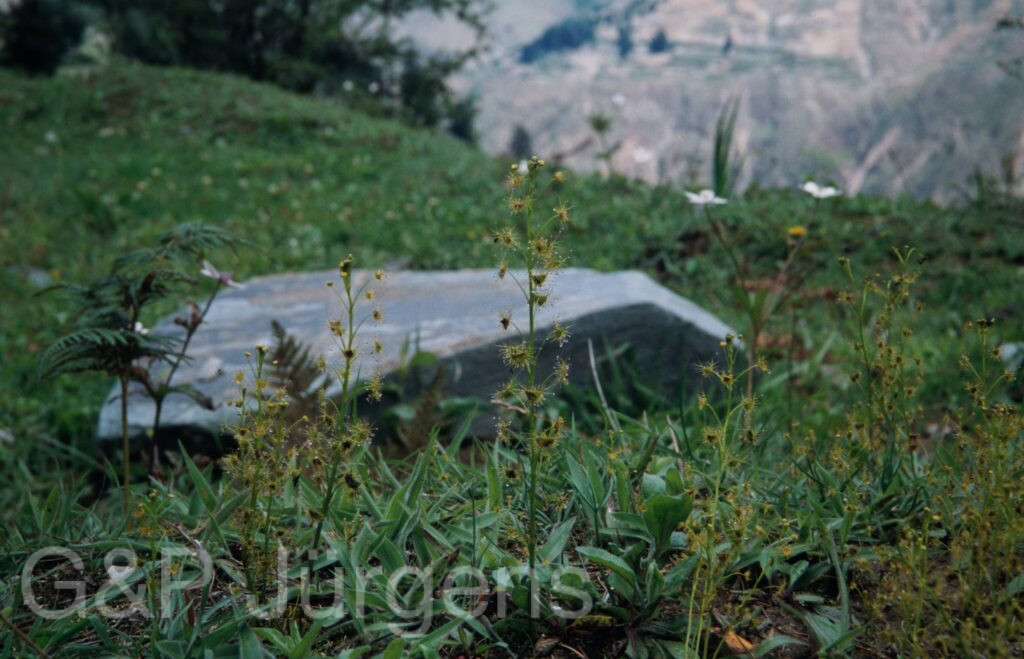
Drosera peltata

by GP Jürgens

Thunb.

Sikkim2011 185
Sikkim Lachung 2600m, June
Nepal 99 996 ergebnis
West-Nepal Juphal 2550m, July

Description

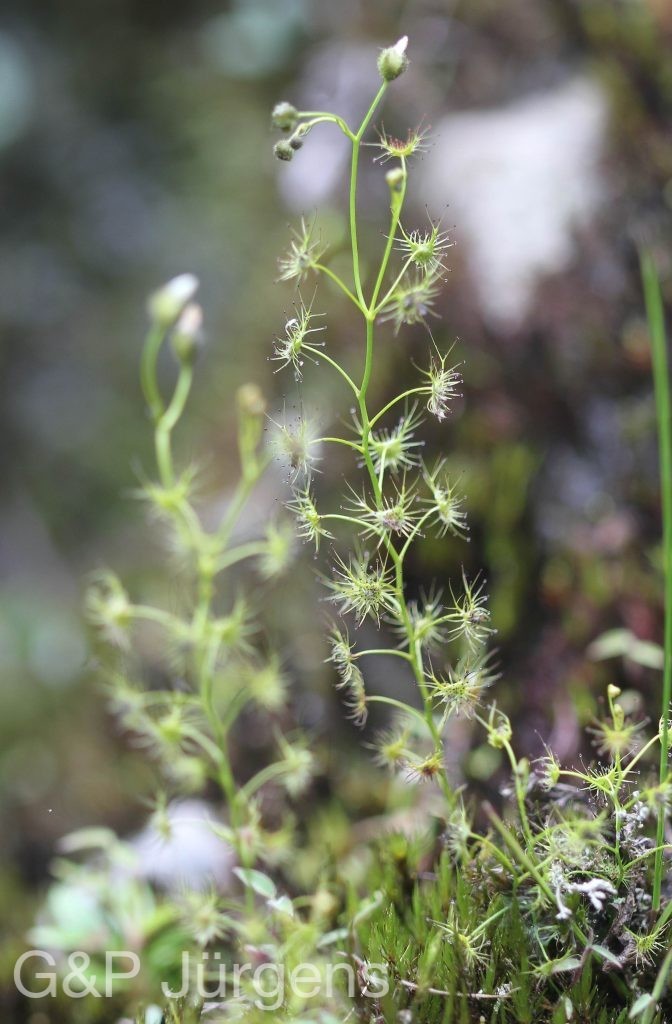
Drosera peltata is one of the most widely distributed of all sundews, a carnivorous herb ranging from Australia and New Zealand through East and Southeast Asia to the Himalaya, with GBIF holding an exceptional 32363 occurrences across Australia, China, Japan, India, Nepal, Thailand, Indonesia, the Philippines, Korea and many further countries. In the Himalaya it grows in open, wet, nutrient-poor situations: boggy grassland, mossy banks, seepage slopes, marshy meadows and damp roadside cuttings, generally between 1500 and 3000 m. The localities cited for the image, Lachung in Sikkim at about 2600 m in June and Juphal in West Nepal at around 2550 m in July, are typical mid-montane wet-meadow sites where the plant flowers during the early monsoon.

Unlike the rosette-forming sundews, D. peltata is an erect, often tuberous-rooted herb whose slender stem bears alternate, peltate to lunate leaves on long petioles. The leaf blades are crescent-shaped and clothed on their margins and upper surface with stalked glandular hairs (tentacles) tipped with glistening mucilaginous droplets that entrap small insects; the tentacles then bend inward and the leaf secretes enzymes to digest the prey. Basal rosette leaves may be present at germination but wither as the stem elongates. The inflorescence is a one-sided raceme of small white to pinkish five-merous flowers, opening in bright sunshine, and the fruit is a small capsule with numerous minute seeds.

Droseraceae are carnivorous, and the tuberous, stem-forming peltata complex constitutes a distinctive lineage within Drosera that has been variously subdivided into segregate species and subspecies by different authors, making it one of the more taxonomically contentious sundew groups. Insect capture supplies nitrogen and phosphorus otherwise scarce in the acidic, waterlogged soils it inhabits, and the underground tuber permits dormancy through dry or unfavourable seasons. Given its enormous geographic range the species as a whole is of no conservation concern, although individual Himalayan wetland populations are locally susceptible to drainage and habitat loss.

Author: Thunb. · Sources: POWO (Kew), GBIF, Flora of China Vol. 8, Flora of Bhutan Vol. 1, Flora of Nepal, Lowrie Carnivorous Plants of Australia Magnum Opus

(Roxb. ex DC.) Walp.

Nepal 97 52 P78
Nepal Mewa-Khola 1150m April
Nepal 97 53 P79
Nepal Mewa-Khola 1150m April
Nepal1992 77 P110 ergebnis
Nepal Sokathum1460m March 

Description

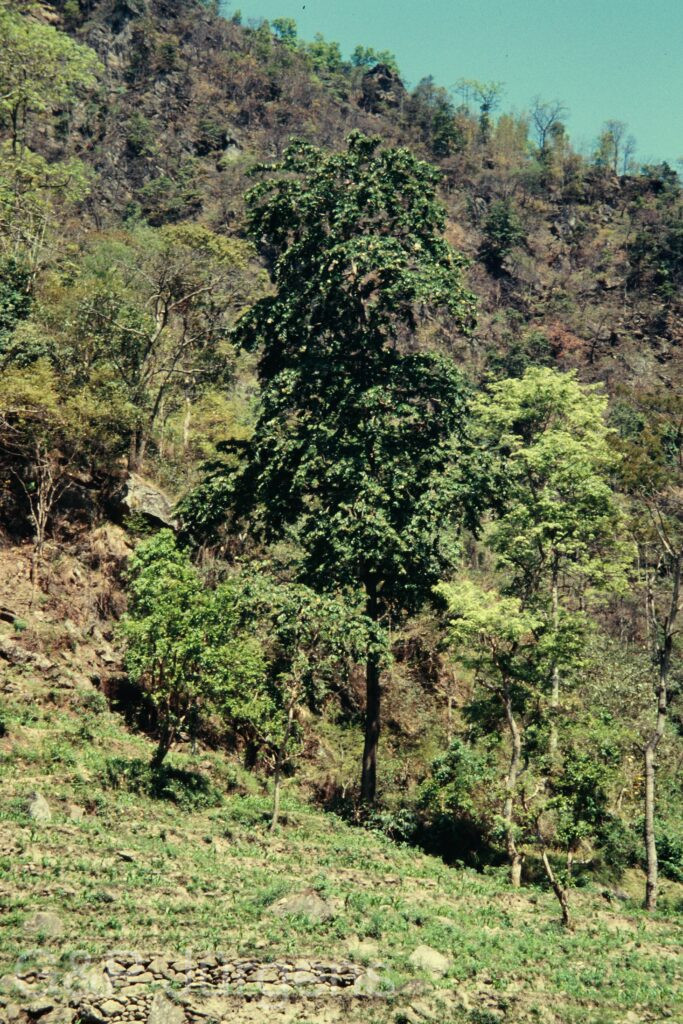
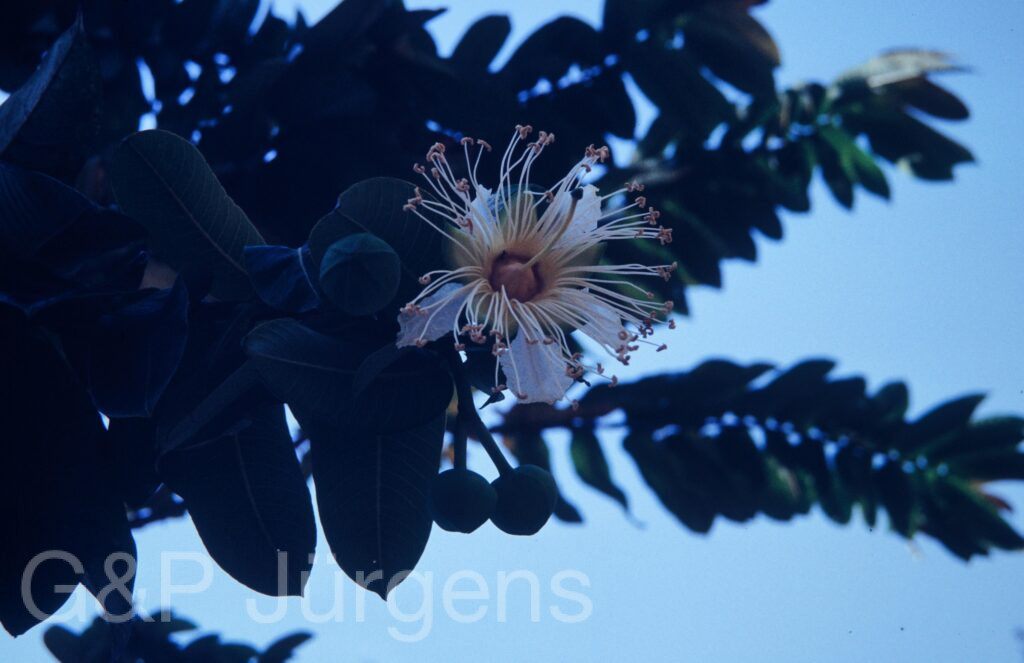
Duabanga grandiflora (Roxb. ex DC.) Walp. is a large, fast-growing evergreen tree of the Lythraceae distributed through the Indo-Himalayan and Southeast Asian tropics, native from India, Nepal, Bhutan and Bangladesh through Myanmar, Thailand, Laos, Vietnam, Malaysia and Indonesia into SW China, with around 712 georeferenced records and scattered introductions elsewhere. It is a characteristic tree of moist tropical and subtropical forest, particularly along rivers, in ravines and on alluvial flats, often a pioneer of streamside and secondary forest in regions of high rainfall. The photographed trees from Mewa-Khola at about 1,150 m in April and Sokathum at about 1,460 m in March in eastern Nepal lie at the upper, lower-montane end of its altitudinal range, which extends down into the lowland tropics.

It is a tall tree with a spreading crown and conspicuously horizontal, drooping branches. The leaves are opposite, large, oblong to oblong-lanceolate, leathery, with an obtuse to cordate base and entire margins, glabrous and prominently pinnately veined. The large, showy flowers are borne in few-flowered terminal cymes; each has a thick campanulate calyx of (four to) six fleshy lobes, white obovate petals, and very numerous stamens. The superior to half-inferior ovary develops into a hard, leathery, many-celled capsule that splits by valves to release abundant small seeds.

Duabanga is a small Indo-Malesian genus formerly segregated in its own family Duabangaceae but now placed within an enlarged Lythraceae. The night-opening flowers with their massed stamens are bat- and moth-pollinated, and the light, soft wood is locally used for boxes, matchwood and plywood. Widespread and often common as a riparian pioneer, the species is not considered threatened.

Author: (Roxb. ex DC.) Walp. · Sources: POWO (Kew), Flora of China Vol. 13, Flora of Bhutan Vol. 2, GBIF, Graham et al.: Phylogeny of Lythraceae (2005)

Dubyaea hispida

by GP Jürgens

DC.

Bhutan2012 56
Bhutan Shele-La, 4000m September

Description

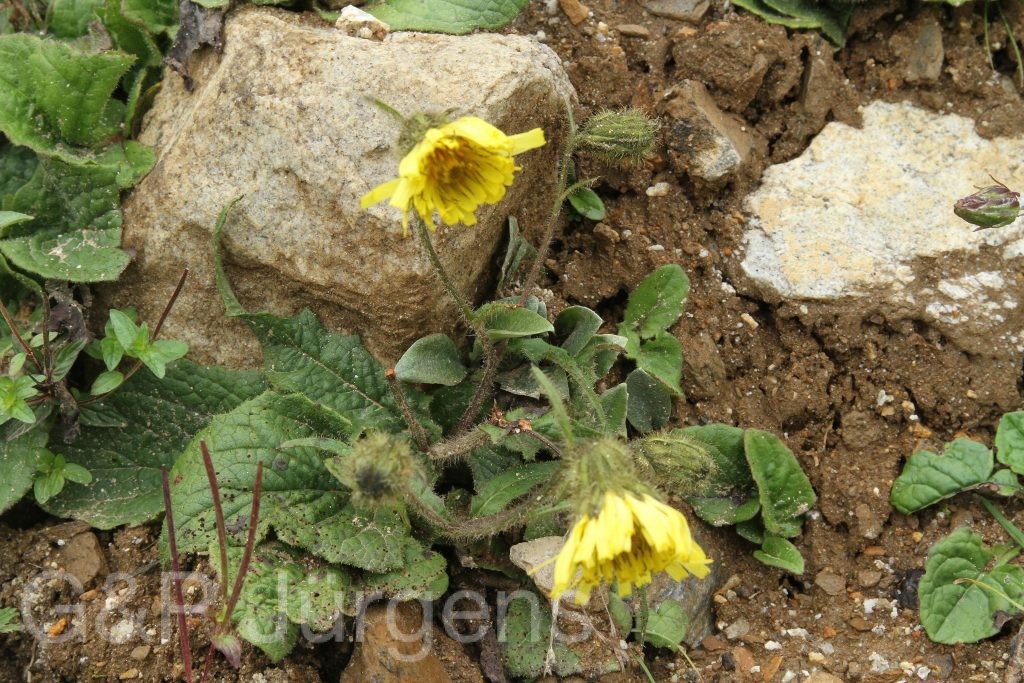
Dubyaea hispida is an alpine member of the lettuce tribe (Cichorieae) ranging across the eastern and central Himalaya into south-western China, with reliable records from Nepal, India, Bhutan, Myanmar, Pakistan and China (Xizang, Yunnan, Sichuan); extra-regional points in Austria and Great Britain among the 544 occurrences represent cultivated or misattributed material rather than native range. It grows in moist alpine meadows, scrub margins, rocky slopes and streamsides, typically between about 3000 and 4300 m. The plant figured from the Shele-La pass in Bhutan at roughly 4000 m in September reflects its characteristic late-season flowering in cool, humid high-mountain habitats.

The species is a perennial herb with a short rhizome and erect, hispid stems clothed, like the peduncles and involucres, in spreading blackish or purplish multicellular hairs. The leaves are thin, oblong to lyrate-pinnatifid, with a large terminal lobe and a winged, amplexicaul petiole base; the upper leaves are reduced. The capitula are several, nodding in a loose corymb, with an involucre of imbricate, hispid phyllaries. The florets are all ligulate and yellow, as in the milky-juiced Cichorieae. The cypselae are narrowly fusiform, ribbed and slightly narrowed above, bearing a pappus of soft, white, finely barbellate bristles.

Dubyaea is a small Sino-Himalayan genus of perhaps a dozen species centred on the eastern Himalaya and Hengduan Shan, segregated from the related Crepis and Soroseris by its nodding heads, dark-hispid indumentum and distinctive achene and pappus characters. The nodding capitula and abundant glandular-setose vestiture are adaptations to wet alpine conditions, sheltering florets from rain. As a widespread high-elevation species across multiple countries, D. hispida is not considered threatened, although it is naturally restricted to the narrow alpine belt.

Author: DC. · Sources: POWO (Kew), GBIF, Flora of China Vol. 20-21, Flora of Bhutan, Flora of Nepal, Stebbins Cichorieae of the Himalaya

(DC.) Anderb.

Bhutan2012 1356
Bhutan Sandrup 1500m, October

Description

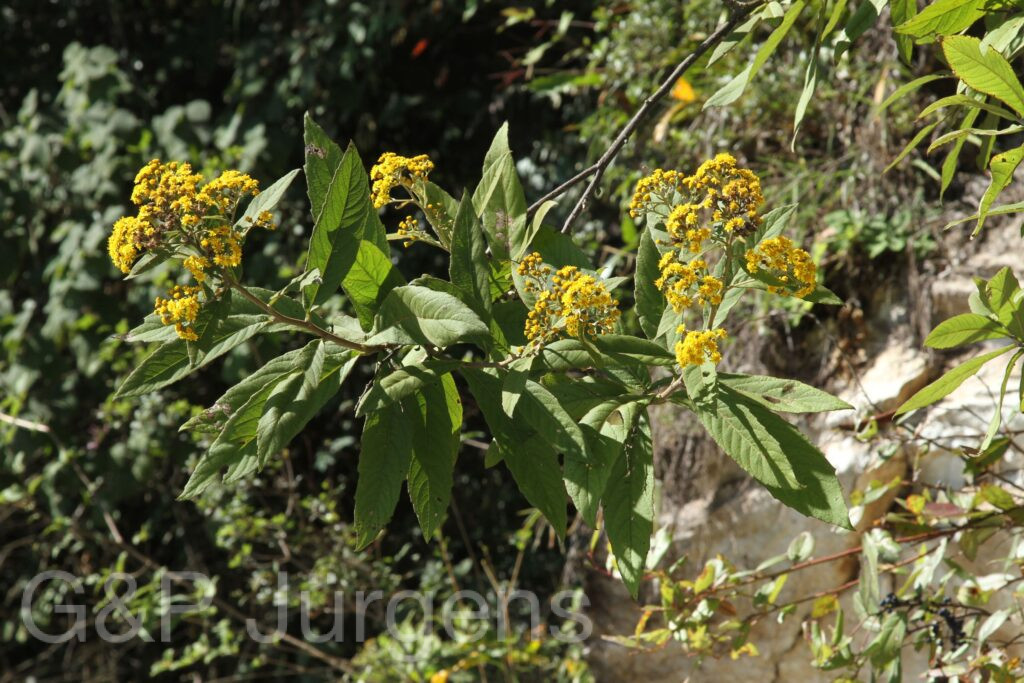
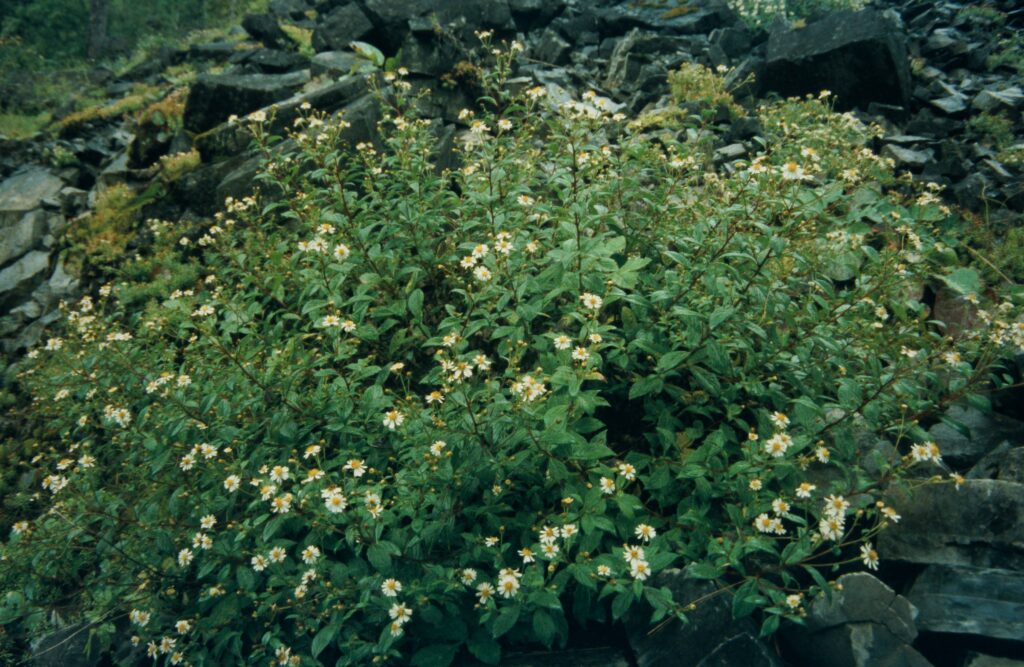
Duhaldea eupatorioides is a subtropical to warm-temperate composite of the Himalaya and adjacent montane Asia, recorded from India, China, Nepal, Bhutan, Thailand, Myanmar, Bangladesh, Pakistan, Laos and Vietnam, with GBIF listing about 156 occurrences. It grows on open hillsides, forest margins, scrub, roadcuts and grassy slopes in the foothill and lower montane belt, broadly from 1000 to 2500 m. The photographed plant was found in Bhutan at Sandrup at 1500 m in October, when the species comes into bloom at the close of the monsoon, its leafy stems carrying numerous small heads above the autumn grassland.

It is an erect, somewhat woody-based perennial herb or subshrub with leafy, branching, often pubescent stems. The leaves are alternate, ovate-lanceolate to elliptic, acuminate, with serrate margins and a finely hairy surface, narrowing to a short petiole or sessile base, the foliage recalling Eupatorium, hence the epithet. The capitula are small, numerous, and aggregated into terminal corymbose panicles; each head is radiate, with an involucre of several rows of imbricate bracts, marginal yellow ray florets and yellow tubular disc florets. The fruit is a ribbed, hairy cypsela crowned by a pappus of barbellate bristles, dispersed by wind.

The species belongs to the tribe Inuleae and to genus Duhaldea, a segregate split from the broadly defined Inula on molecular and morphological grounds; older floras may list it under Inula eupatorioides. A tolerant species of open and disturbed montane habitats, it is widespread and not of conservation concern. Its Sino-Himalayan to Indochinese range typifies the warm-temperate element of the southern Asian mountain arc.

Author: (DC.) Anderb. · Sources: POWO (Kew), GBIF, Flora of China, Flora of Bhutan, Flora of Nepal, generic revision of Inuleae (Anderberg)

(Wall. ex DC.) Anderb.

Garw 2005 265 ergebnis
India Garhwal Kuno 2800m, September

Description

Duhaldea nervosa is a perennial composite of the Himalaya and montane south-east Asia, recorded from China, Nepal, Thailand, India, Bhutan, Myanmar, Cambodia and Vietnam. Its roughly 584 georeferenced collections span the temperate to subtropical hill belt from the western Himalaya eastward into Indochina. It grows on grassy slopes, open hillsides, forest margins, roadside banks and in scrub, favouring well-drained sunny to lightly shaded ground. The photographed plant from Garhwal at Kuno at 2800 m, flowering in September, is typical of its upper-temperate habitat and its late-monsoon to autumn flowering, when the capitula open above the surrounding herbage.

It is an erect, often hairy perennial herb with leafy stems arising from a woody rootstock. The alternate leaves are elliptic to lanceolate or oblong, with a finely toothed margin and conspicuous, raised lateral veins on the lower surface, the prominent venation giving the species its epithet nervosa. The capitula are radiate and borne in terminal corymbose clusters, each head with an involucre of several rows of imbricate, herbaceous to membranous bracts. The yellow ray florets are female and ligulate, surrounding numerous yellow, tubular, bisexual disc florets. The fruit is a ribbed, cylindrical cypsela crowned by a pappus of barbellate bristles that aids wind dispersal.

Duhaldea was segregated from the broadly defined Inula and now comprises a group of Asian species formerly placed in that genus; D. nervosa was transferred from Inula by Anderberg, as the parenthetical authorship records. Members of the tribe Inuleae, these plants are visited by a range of generalist insect pollinators. D. nervosa is widespread and locally common across its extensive range and is of no conservation concern, several allied species being used in regional folk medicine.

Author: (Wall. ex DC.) Anderb. · Sources: POWO (Kew), GBIF, Flora of China Vol. 20-21, Flora of Bhutan Vol. 2, Flora of Nepal, Anderberg's Phylogeny and Reclassification of the Tribe Inuleae

Duranta erecta

by GP Jürgens

L.

Bhutan2015 508
Bhutan Phobjika 2800m, October

Description

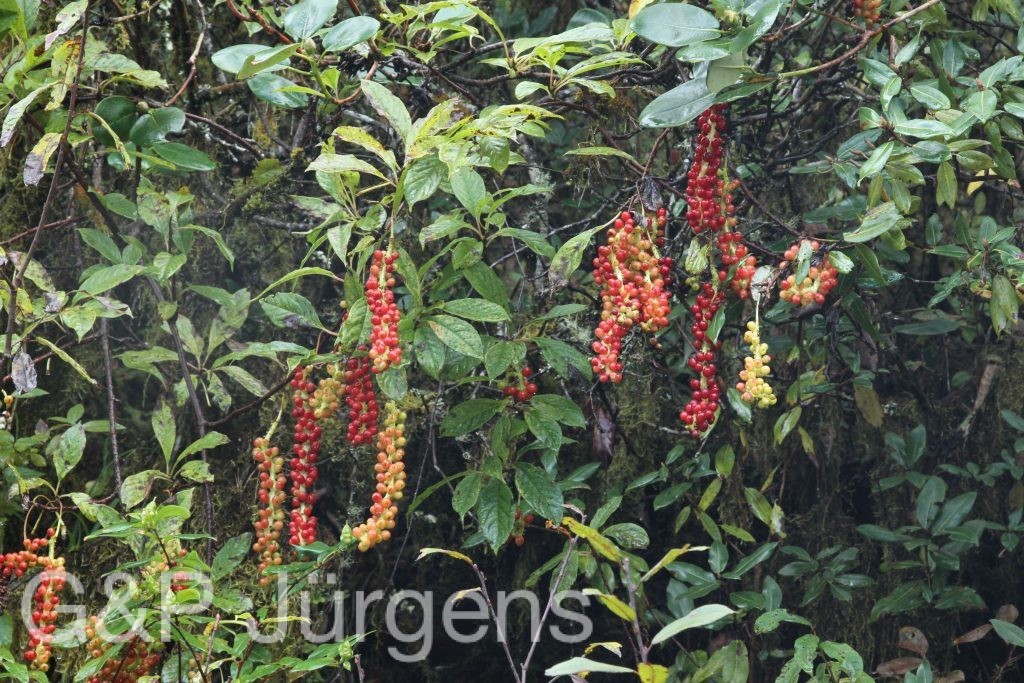
Duranta erecta, commonly called golden dewdrop or pigeon berry, is native to the Neotropics, ranging from Mexico, the Caribbean and Central America through tropical South America to Argentina and Brazil. It has, however, become one of the most widely cultivated and naturalised ornamental shrubs in warm regions worldwide, a fact reflected in its enormous GBIF tally of over nineteen thousand occurrences spanning the Americas, Asia, Africa and Australia. In the Himalaya it occurs only as a cultivated and locally escaping plant; the individual photographed at Phobjika in Bhutan at 2800 m in October represents such a planting in a temperate valley, well above the species' tropical comfort zone, where it is grown as a hedge or garden ornamental and flowers and fruits abundantly in the warm season. It thrives in disturbed ground, gardens, roadsides and waste places, and in many tropical countries is regarded as an invasive weed.

The plant is an evergreen, often spreading shrub or small tree to several metres, with slender, arching, sometimes pendulous and frequently spiny branches that may be four-angled when young. The leaves are opposite or whorled, elliptic to obovate, entire to toothed in the upper half, and light green. The flowers are borne in slender terminal and axillary racemes; the tubular corolla is pale blue to lavender (occasionally white), with five spreading, slightly unequal lobes. The fruit is a glossy, rounded, yellow to orange drupe enclosed by the persistent, beaked calyx, borne in showy pendent clusters; the berries and foliage contain saponins and are toxic to humans and livestock, though birds disperse the seeds freely.

Duranta is a small genus traditionally placed in the Verbenaceae, and D. erecta is its most familiar species, prized horticulturally for its long flowering season, attractive golden fruits and several variegated and golden-leaved cultivars. Its ornamental virtues are matched by a significant ecological downside: through bird-mediated seed dispersal it has become a serious environmental weed in parts of Australia, southern Africa and the Pacific. Its presence in the high Bhutanese Himalaya illustrates the global reach of horticultural commerce, and although frost limits its persistence at such elevations, its weediness elsewhere makes it a species of note for biosecurity rather than conservation.

Author: L. · Sources: POWO (Kew), GBIF, Flora of China Vol. 17, Flora of Bhutan Vol. 2 Part 2, Flora of Nepal, Flora of Pakistan, A Generic Revision of the Verbenaceae (Harold N. Moldenke)

DC.

Garw 2005 182 ergebnis ergebnis
India Garhwal Pana 2800m, September

Description

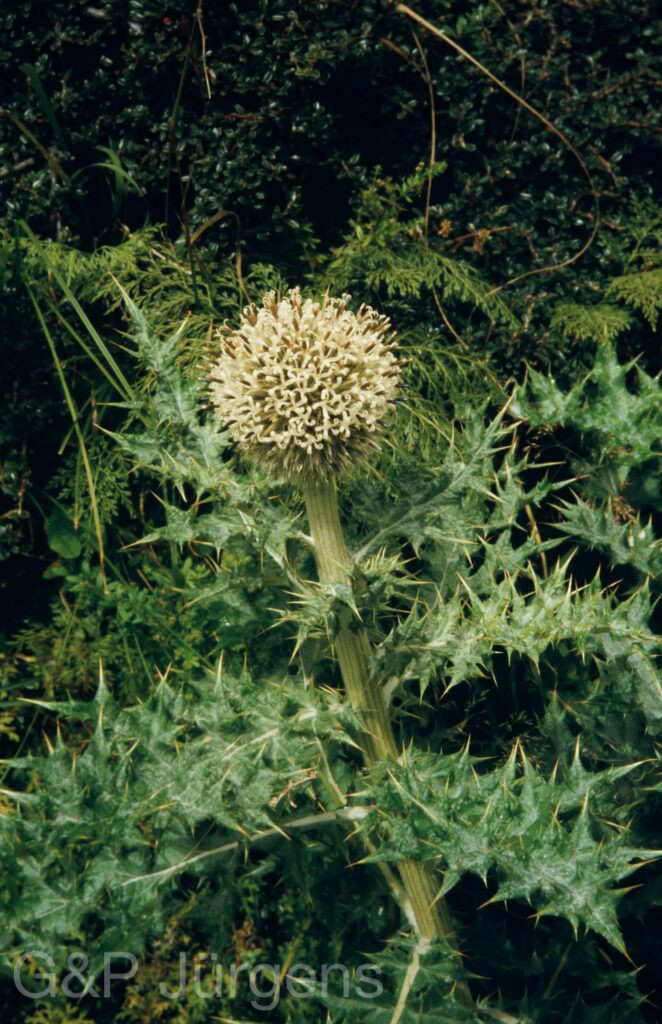
Echinops cornigerus is a Sino-Himalayan globe-thistle distributed across the western and central Himalaya and adjacent Tibetan plateau, with verified records from India, Pakistan, Nepal, Bhutan and China, alongside a scatter of cultivated or extra-regional occurrences (Iran, France, Belgium) among the roughly 294 georeferenced GBIF collections. It inhabits open, sunny slopes, dry stony pastures, forest margins and disturbed ground in the upper temperate to subalpine belt, typically between about 2000 and 3500 m. The plant photographed at Pana in the Garhwal Himalaya at 2800 m in September, fruiting at the close of the monsoon, exemplifies its preference for well-drained montane grassland exposed to strong insolation.

A stout perennial herb, it forms an erect, ridged and somewhat cottony-tomentose stem arising from a woody rootstock. The leaves are coriaceous, deeply pinnatifid to bipinnatifid, glabrescent and green above but white-tomentose beneath, the lobes terminating in conspicuous rigid yellowish spines. The inflorescence is the spherical compound capitulum characteristic of the genus: numerous one-flowered capitula aggregated into a globose synflorescence, each enclosed by stiff bristly involucral scales. The corollas are tubular, pale blue to whitish, and the achenes are cylindrical, densely hairy and crowned by a short pappus of fused scales.

The genus Echinops is taxonomically intricate, the spherical secondary head having evolved as a striking adaptation that pools many reduced florets into a single pollinator-attracting unit. The spiny architecture deters mammalian grazing, an advantage in heavily pastured Himalayan rangelands. Though not assessed as threatened, populations are locally affected by overgrazing and slope disturbance, and the species remains a useful indicator of dry montane grassland.

Author: DC. · Sources: POWO (Kew), GBIF, Flora of Pakistan, Flora of China (Asteraceae), Annotated Checklist of the Flowering Plants of Nepal, Kew monograph of Echinops

(Wall.) Meisn.

Nepal 1994 255 ergebnis
Ost-Nepal Mewa-Khola
2100m April
Nepal 1994 197 ergebnis
Ost-Nepal Mewa-Khola
2100m April
sub1hsn8
Nepal Amjilassa 2400m March

Description

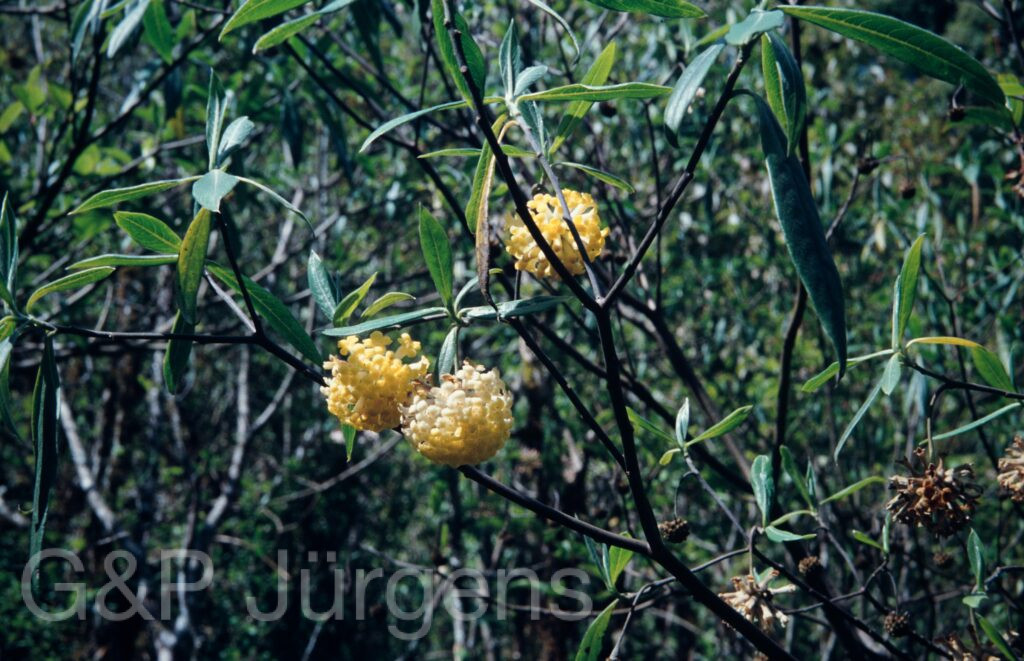
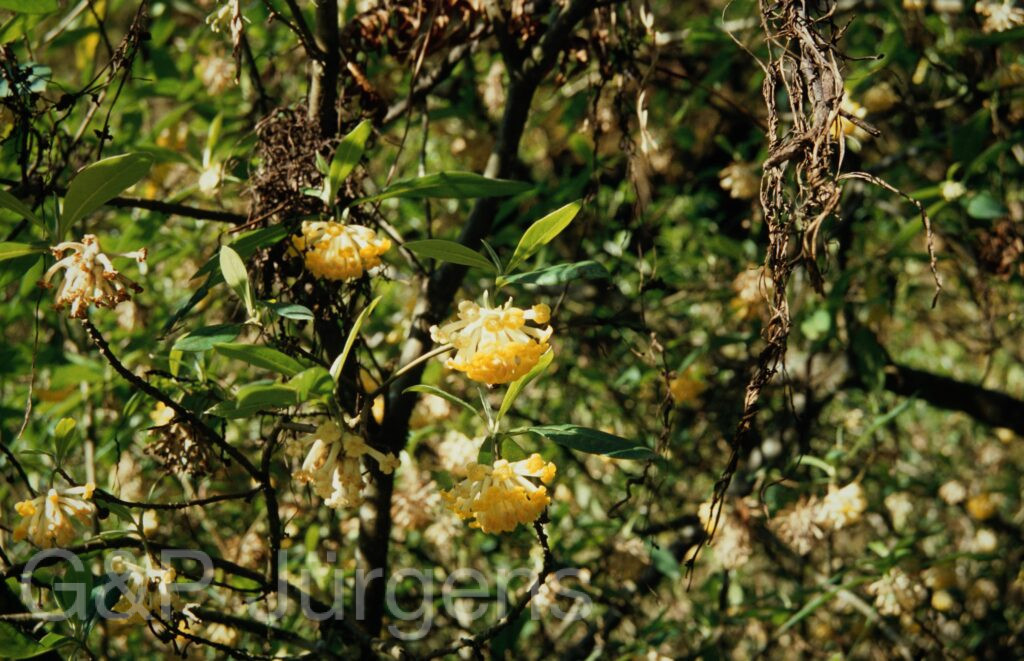
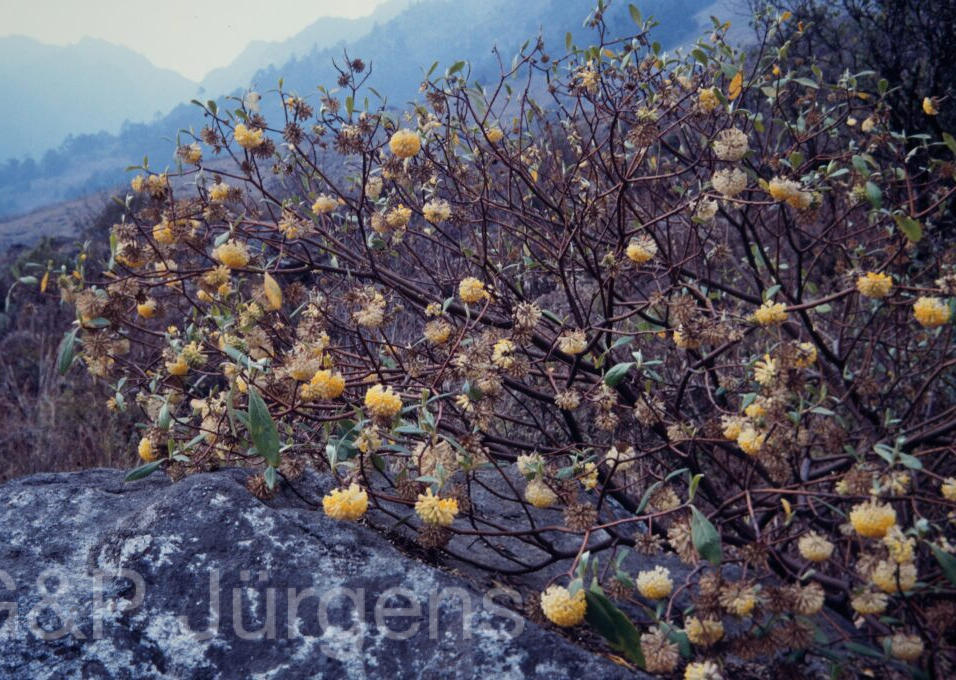
Edgeworthia gardneri is a deciduous to semi-evergreen shrub of the eastern Himalaya and adjacent mountains. GBIF records (some 484 occurrences) place it in China, Nepal, India, Bhutan, Myanmar, Bangladesh and Vietnam, with cultivated material in Japan, France, New Zealand and elsewhere. It grows in moist temperate broadleaved forest, forest margins, ravines and shrubby slopes, typically between about 1,500 and 2,800 m. The illustrated plants are from eastern Nepal at Mewa-Khola (2,100 m, April) and Amjilassa (2,400 m, March), flowering in late winter to early spring before or with leaf flush, characteristic of its phenology in the warm temperate zone.

The plant is a shrub 1–3 m tall with flexible, tough-barked branches that can be tied in a knot without breaking. The leaves are alternate, lanceolate to oblong-lanceolate, entire and somewhat silky beneath. The flowers are aggregated into dense, pendent, hemispherical heads on short peduncles; each flower lacks petals, the floral tube being silky-tomentose outside and yellow within, fragrant. The fruit is a small dry achene-like drupe enclosed in the persistent perianth base.

Like its relative Daphne, Edgeworthia yields strong bast fibre: the bark is an important source of traditional handmade paper (lokta-type) in Nepal and Bhutan, giving the genus economic significance. It is also valued as a winter-flowering ornamental. The species is widespread and not globally threatened, though bark harvesting represents a localised pressure on accessible wild stands.

Author: (Wall.) Meisn. · Sources: POWO (Kew), Flora of China Vol. 13, Flora of Bhutan Vol. 1, GBIF, Halda: The Genus Daphne (and allied Thymelaeaceae)

Schltdl.

Bh09 46 G84
Bhutan Paro 2400m, June
Bhutan2014 852 scaled
Bhutan Thimphu 2500m, May
Bhutan2014 853 scaled
Bhutan Thimphu 2500m, May

Description

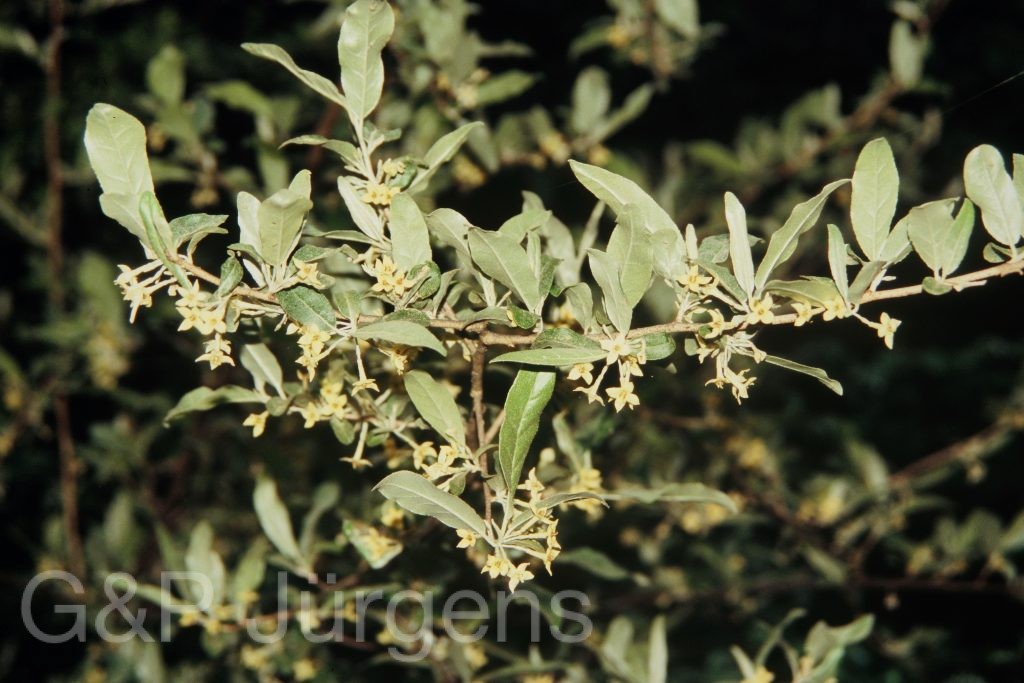
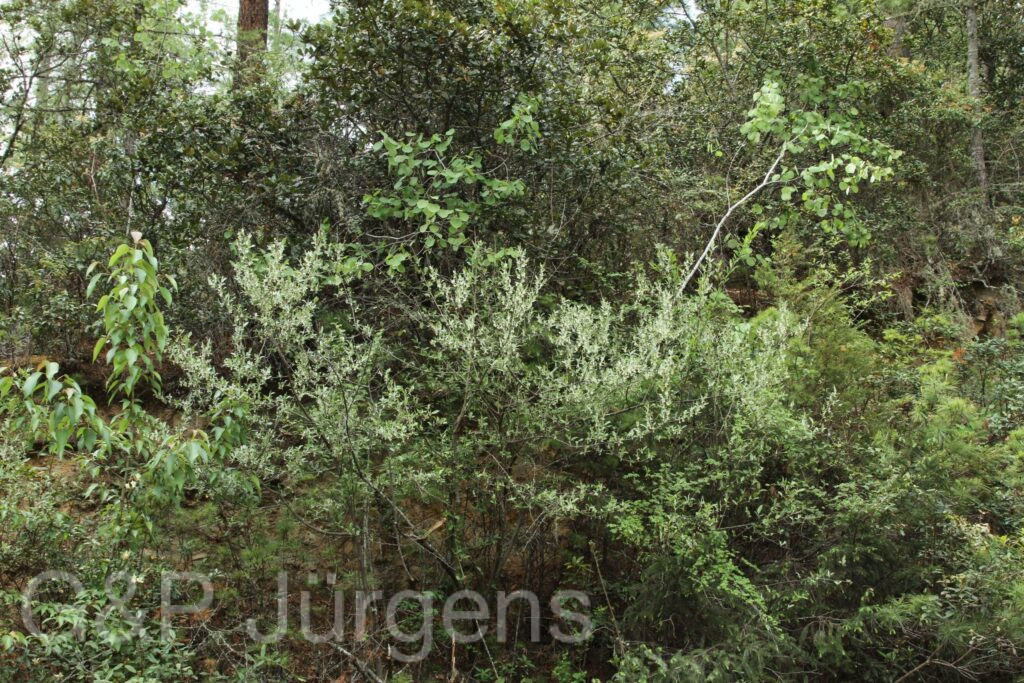
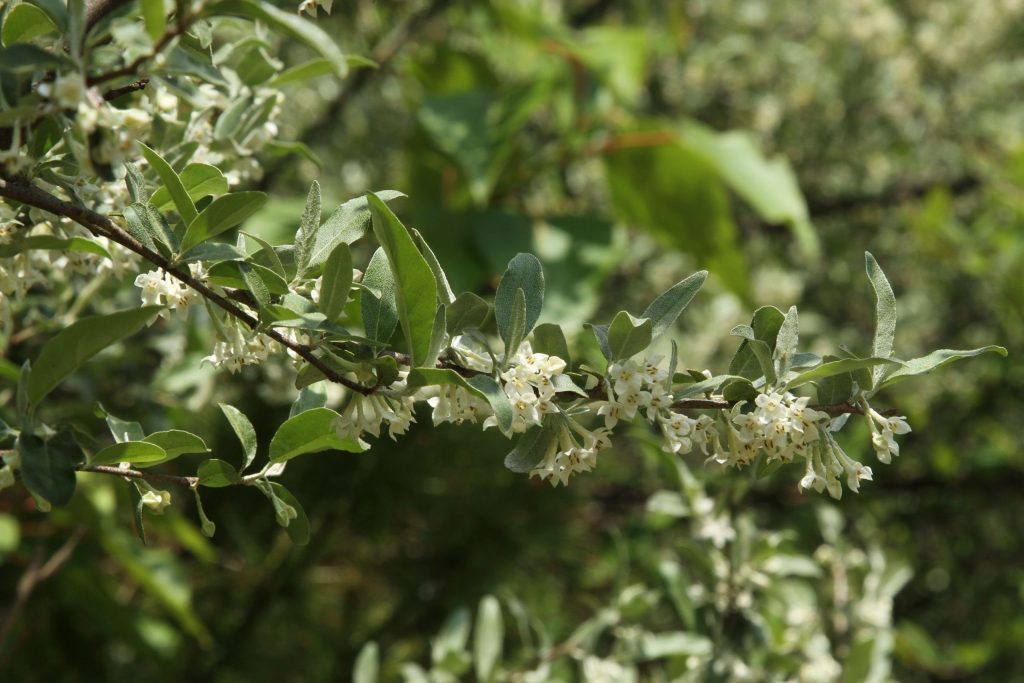
Elaeagnus caudata Schltdl. ex Momiy. is a shrub or small tree of the Elaeagnaceae endemic to the central and eastern Himalaya, known from Nepal, northern India and Bhutan. Documented from only a small number of georeferenced collections, it grows in temperate forest margins, thickets, shrubby slopes and along the edges of cultivation in the mid-montane zone. The photographed plants from the Paro and Thimphu valleys of Bhutan, recorded at 2,400–2,500 m in May and June, are characteristic of its preference for the cool, well-lit temperate belt where it flowers in late spring and early summer.

The plant is densely clothed throughout in the silvery to rusty-brown peltate scales typical of the family, which give the young shoots, leaf undersides and flowers a metallic lustre. The leaves are alternate, elliptic to ovate, often long-acuminate (the caudate apex giving the species its name), green and stellate-scaly above and silvery-lepidote beneath. The flowers are small, tubular and apetalous, with a four-lobed, silvery-scaly perianth, fragrant and borne in axillary clusters. The fruit is an oblong, drupe-like achene enclosed by the fleshy, accrescent perianth tube, ripening reddish and scaly, edible when fully mature.

Like other members of Elaeagnus, the species harbours nitrogen-fixing Frankia actinobacteria in root nodules, enabling it to colonise poor soils and contribute to soil fertility, a trait that makes such shrubs significant in montane succession. Its restricted Himalayan range and the small number of records suggest it is genuinely localised, though the difficulty of distinguishing the many scaly-leaved Himalayan Elaeagnus species means its true distribution may be under-documented and warrants further survey.

Author: Schltdl. · Sources: POWO (Kew), GBIF, Flora of Bhutan Vol. 1, Flora of China Vol. 13, Sun & Lin: Revision of Elaeagnus