Tag:

Nepal

Flowers of Nepal — 1313 wild plant species documented from the Nepalese Himalaya, from subtropical foothills to high alpine meadows above 4,000 m. Nepal’s dramatic elevation gradient makes it one of the richest botanical regions on Earth, home to rhododendrons, primulas, gentians and the famed blue poppies (Meconopsis). Every entry gives a botanical description, native distribution, habitat and flowering season, alongside the original field photograph and the location where it was taken.

Beauverd

Description

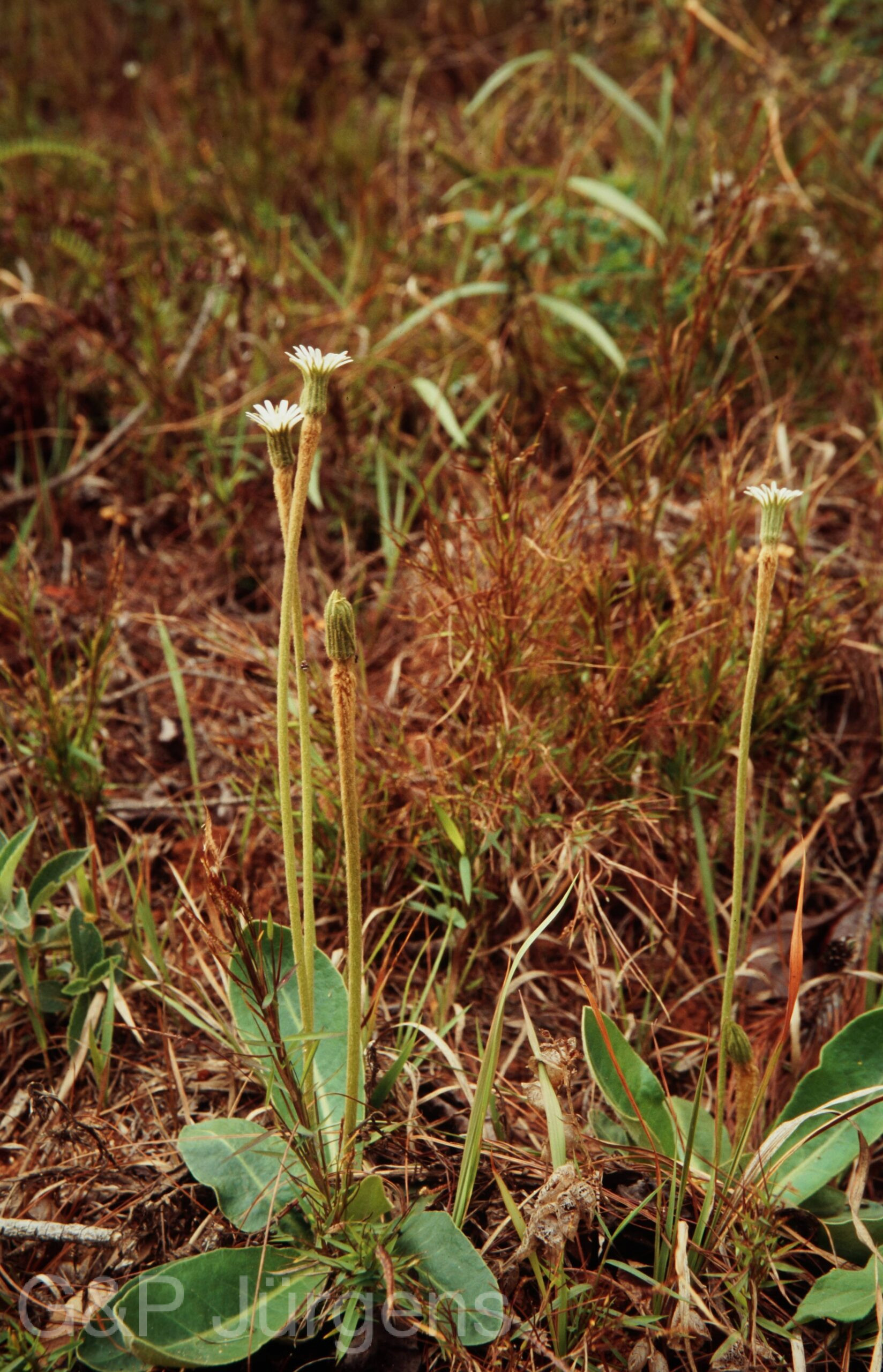
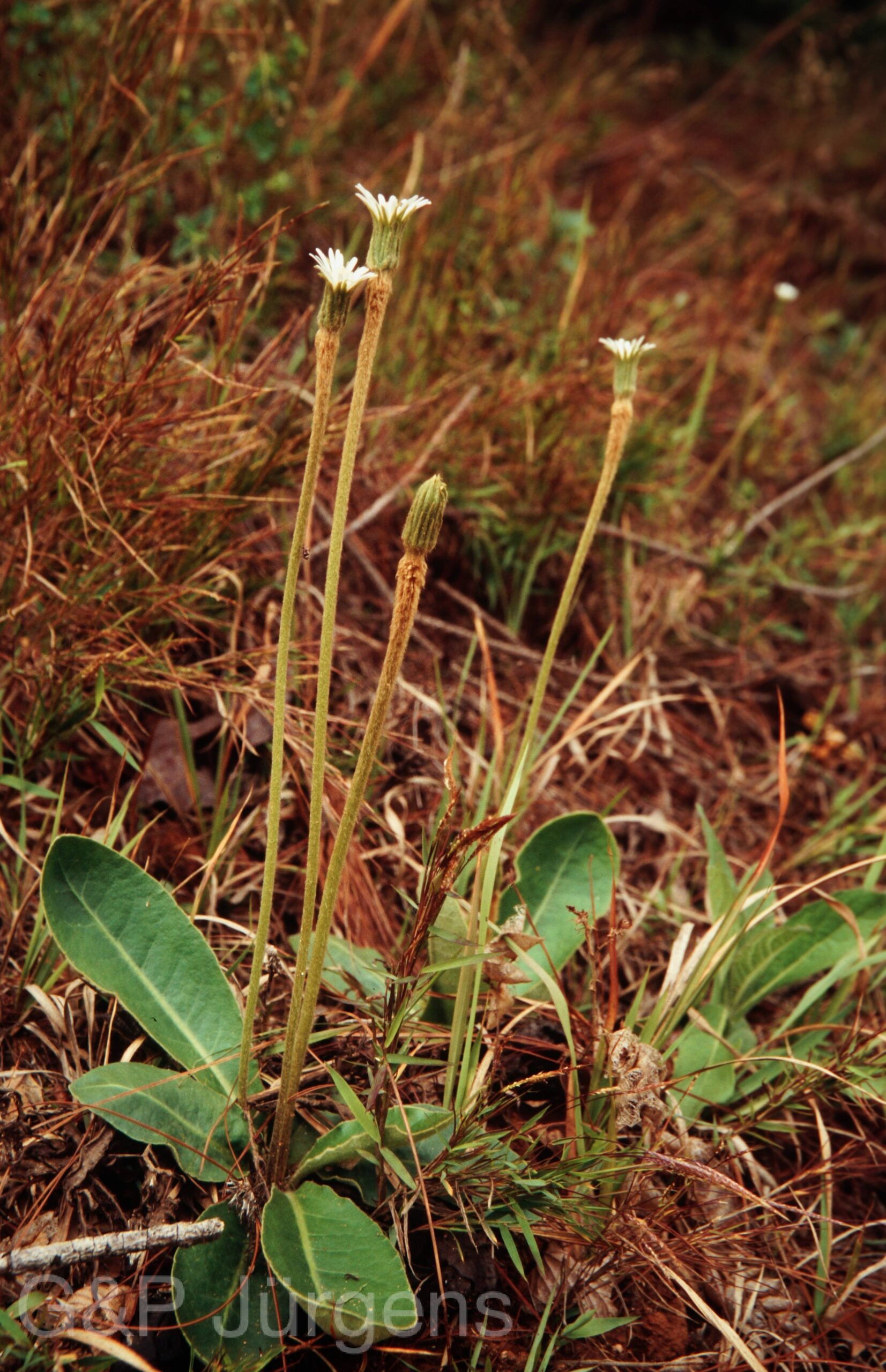
Gerbera maxima is an eastern Himalayan perennial herb distributed across Nepal, northern India, Bhutan and adjacent south-central China (Yunnan, Xizang), the modest tally of around seventeen georeferenced GBIF records reflecting its scattered occurrence rather than true rarity. It favours open grassy hillsides, forest margins, terraced banks and disturbed sunny slopes in the subtropical to lower temperate belt. The photographed plant, from the Indrawati-Khola valley in the Helambu region of central Nepal at roughly 1750 m and flowering in May, typifies its mid-montane preference for warm, well-drained, often grazed openings.

The species forms a stout caudex from which arises a basal rosette of large, lyrate-pinnatifid to broadly obovate leaves that are densely white-tomentose beneath and greener above, the margins sinuate-dentate and the petioles winged. From the rosette a leafless, woolly scape bears a solitary, comparatively large radiate capitulum. The involucral bracts are imbricate and tomentose; the ray florets are bilabiate, typically pale pink to whitish or yellowish, surrounding numerous tubular disc florets. The fruit is a slender, ribbed cypsela tapering into a beak and crowned by a pappus of barbellate bristles, adapted to wind dispersal.

Gerbera (Asteraceae, tribe Mutisieae) is an Old World genus centred on Africa and Asia, and G. maxima is here treated as the accepted name. The two-lipped ray corollas place it within the mutisioid lineage, and its tomentose indumentum is a xeromorphic adaptation to insolated, seasonally dry montane slopes. No formal conservation assessment exists; its tolerance of grazing and disturbance suggests local resilience, though habitat conversion across the mid-hills warrants monitoring.

Author: Beauverd · Sources: POWO (Kew), GBIF, Flora of China, Annotated Checklist of the Flowering Plants of Nepal, Hand-Mazzetti revision of Asian Gerbera (Mutisieae monograph)
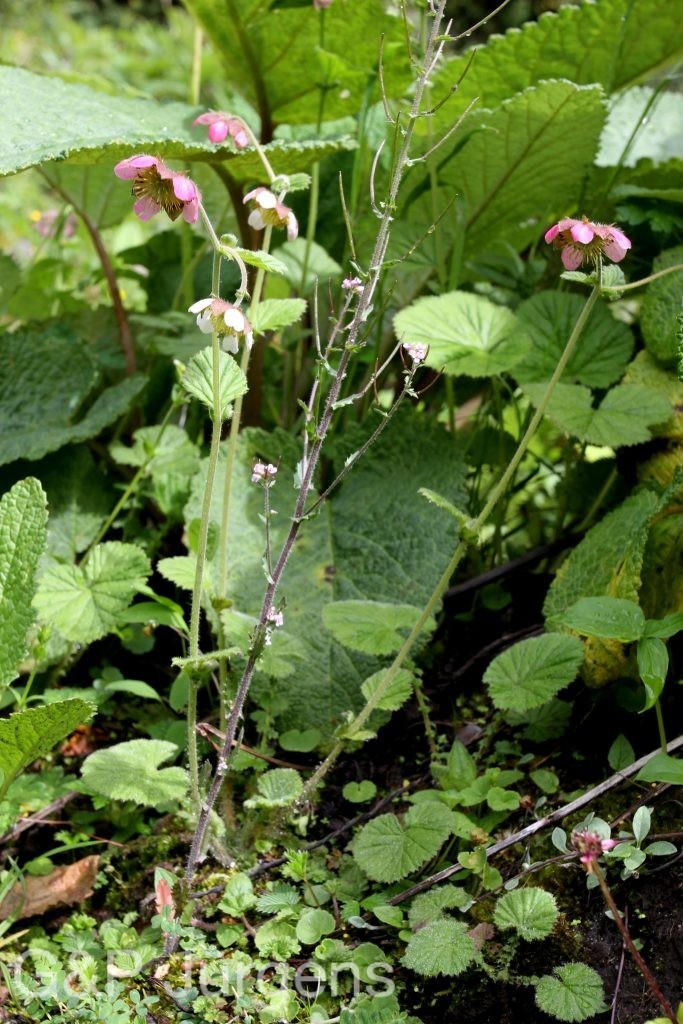
Geum elatum

by G & P Jürgens

Wall ex. G.Don.

Nepal 99 532 ergebnis
West-Nepal Churta-Khola 3600-3800m, June
Garw 2005 351 ergebnis
India Garhwal Patanathi 3800m, September

Description

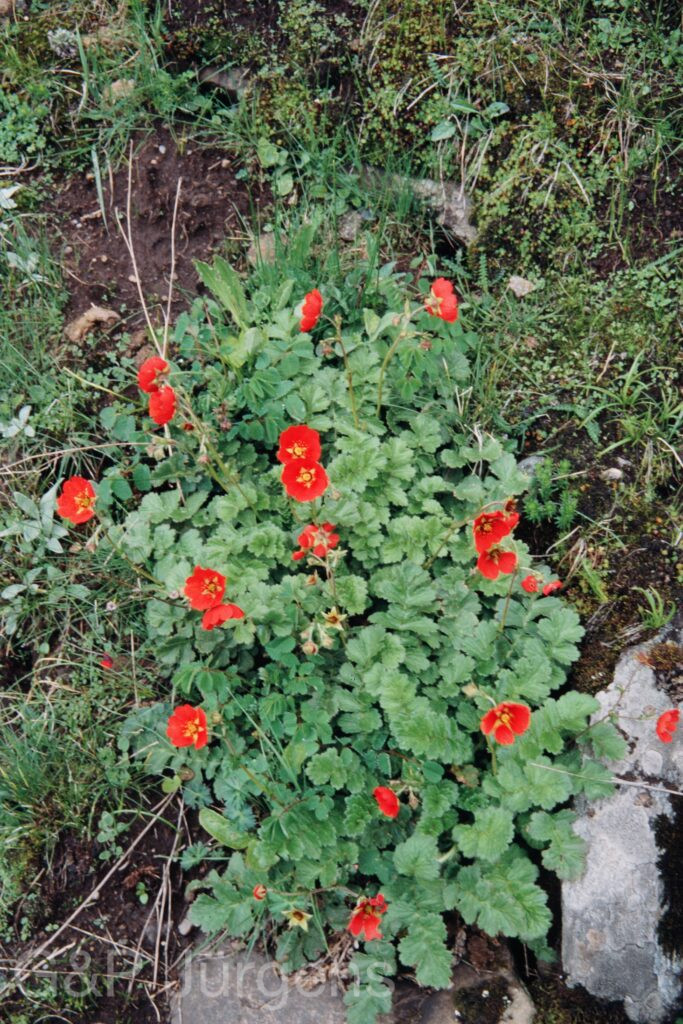
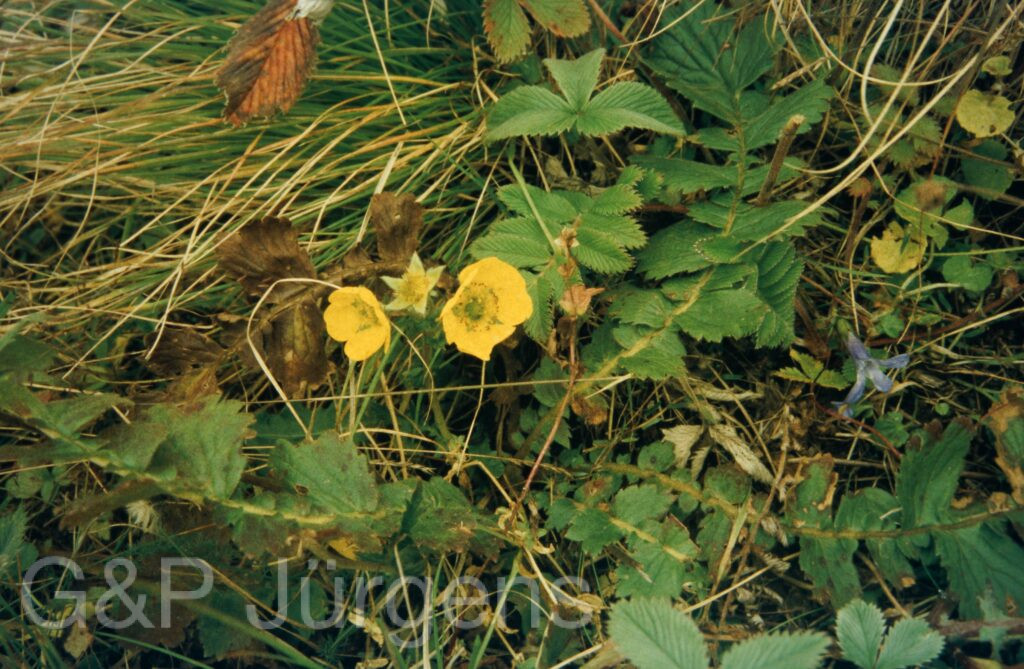
Geum elatum is a perennial herb of the high Himalaya, distributed along the alpine and subalpine belt from Pakistan and Afghanistan eastward through India, Nepal, Bhutan and south-western China. GBIF aggregates some 366 occurrences, densest in Nepal and the Indian Himalaya. It grows in open alpine meadows, moist grassy slopes, rocky ledges and snow-melt flushes, typically between about 3000 and 4500 m. The populations imaged in West-Nepal at Churta-Khola (3600-3800 m, June) and in Indian Garhwal at Patanathi (3800 m, September) typify its preference for cool, humid turf near the upper limit of vegetation.

The plant arises from a stout, scaly rhizome bearing a basal rosette of pinnate to lyrate-pinnatifid leaves, the terminal leaflet conspicuously enlarged, reniform to orbicular and crenate-lobed. Flowering stems are erect to ascending, simple or sparingly branched, bearing one to several comparatively large, nodding to suberect golden-yellow flowers. These have five spreading obovate petals, five reflexed sepals alternating with small epicalyx segments, numerous stamens, and many free carpels on a hairy receptacle. In fruit the styles elongate into persistent, often plumose or hooked awns, forming a globose head of achenes adapted to epizoochorous dispersal.

Geum elatum belongs to a Himalayan complex sometimes segregated under Acomastylis or Sieversia, and varieties (notably var. leiocarpum) have been recognised on indumentum and style characters. Its nodding, large-flowered habit and montane ecology distinguish it from lowland Geum species. As a widespread, locally common alpine perennial it is of no immediate conservation concern, though potentially sensitive to grazing and climate-driven upward shifts of the alpine zone.

Author: Wall ex. G.Don. · Sources: POWO (Kew), GBIF, Flora of China, Flora of Pakistan, Flora of Bhutan, Annotated Checklist of the Flowering Plants of Nepal, monograph of the genus Geum (Gajewski)

Geum sikkimense

by GP Jürgens

Prain

BhutanPG2011 676 01
Bhutan Luksur, 4700m July

Description

Geum sikkimense is a high-alpine avens of the eastern Himalaya, recorded in GBIF (a modest 47 occurrences) from Nepal, Bhutan and India. It is a plant of cold, open, high-elevation habitats, growing on alpine meadows, moist turf, screes and rocky slopes generally between about 4000 and 4800 m, flowering during the short summer monsoon window. The photographed plant from Luksur in Bhutan at 4700 m in July exemplifies its occurrence near the upper limit of vascular plant growth, where it persists in stony, snowmelt-watered ground.

It is a low, tufted perennial herb arising from a stout, woody rhizome clothed in old leaf bases. The leaves are mostly basal and lyrate-pinnate, with a large rounded, crenate-toothed terminal lobe and progressively smaller lateral leaflets, the surfaces hairy and the petiole long. The flowering stems are erect and bear one to few flowers; each flower has five green sepals (often with alternating epicalyx segments) and five spreading, obovate, yellow petals surrounding numerous stamens and carpels. The fruit is a head of dry achenes, each tipped with a persistent style that elongates into a hooked or feathery awn aiding epizoochorous dispersal.

Geum belongs to tribe Colurieae of the Rosaceae, allied to Sieversia and Acomastylis, genera with which several Himalayan high-alpine species have at times been associated. G. sikkimense is a narrow-range eastern Himalayan endemic adapted to the harsh, short growing season of the upper alpine zone. Given its limited known distribution and small number of records, it is poorly assessed, but its restriction to fragile high-altitude habitats makes it potentially vulnerable to climate-driven habitat contraction.

Author: Prain · Sources: POWO (Kew), GBIF, Flora of Bhutan, Annotated Checklist of the Flowering Plants of Nepal, Gajurel et al. studies on Himalayan Rosaceae, Smedmark revision of Colurieae

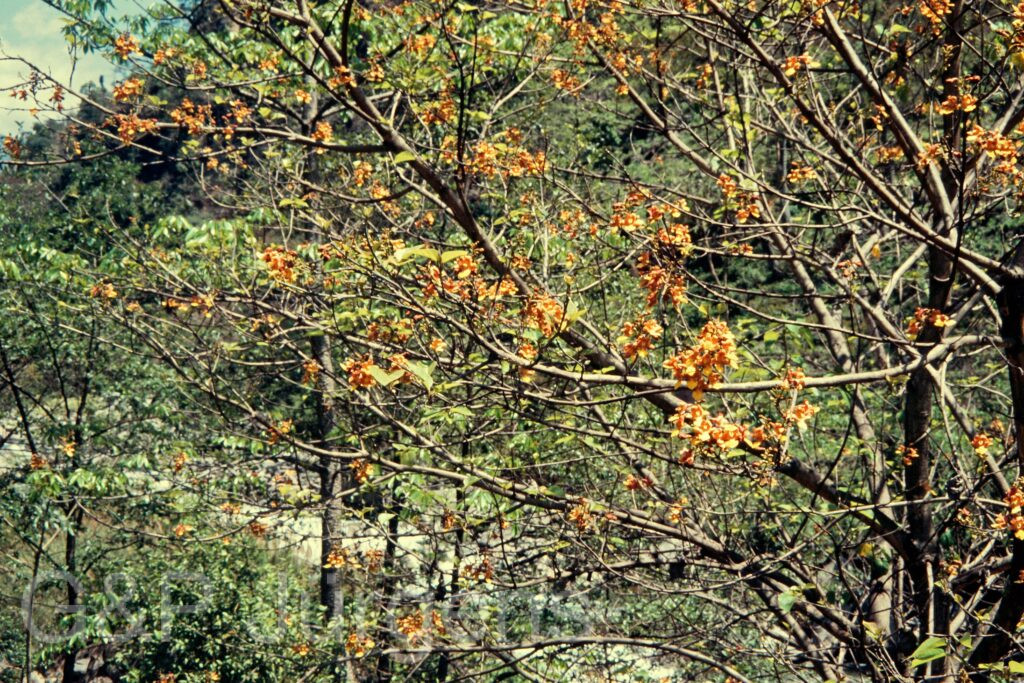
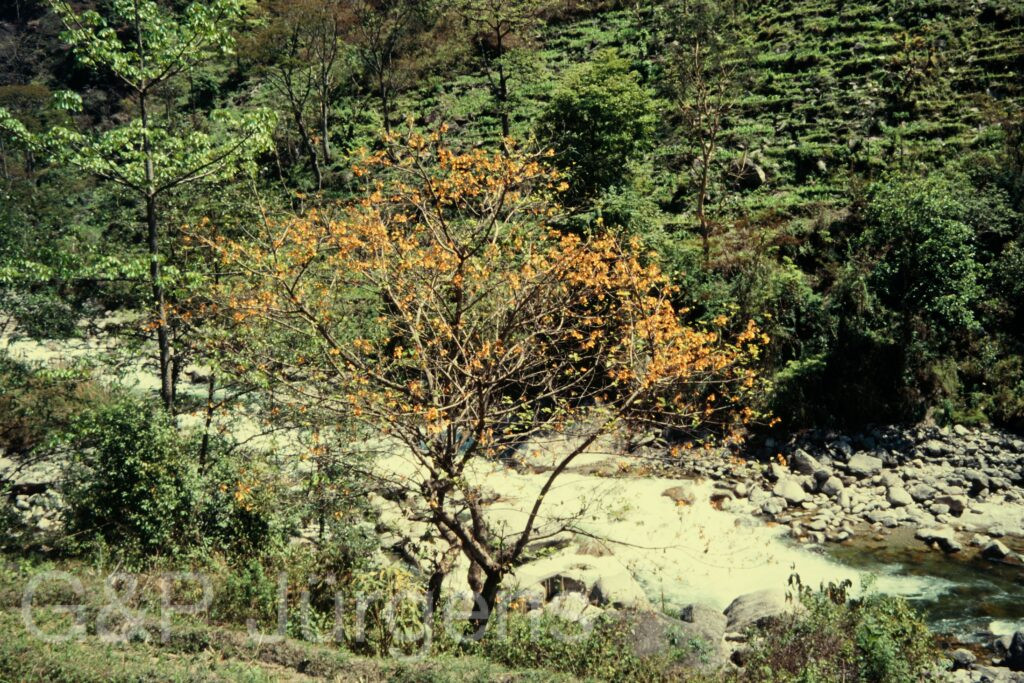
Gmelina arborea

by GP Jürgens

Roxb.

Nepal 97 56 P78
Nepal Mewa-Khola 1160m April
Nepal 97 54 P84
Nepal Mewa-Khola 1160m April

Description

Gmelina arborea, known as gamhar or white teak, is a fast-growing tropical tree native to the Indian subcontinent and Southeast Asia, ranging through Nepal, India, Sri Lanka, Myanmar, Thailand, Indochina, China, Indonesia and the Philippines; it is now extensively planted in tropical Africa and the Americas, and its 12,900 GBIF occurrences across countries from Colombia and Brazil to Nigeria, Tanzania and Mexico largely reflect this pantropical forestry use. In its native range it grows in moist and dry deciduous forest and along watercourses from the lowlands to about 1,500 m. The plant photographed along the Mewa Khola in eastern Nepal at 1,160 m in April shows it flowering in the leafless or newly leafing state typical of the dry pre-monsoon season in the Himalayan foothills.

It is a medium-sized to large deciduous tree reaching 15-30 m, with a straight bole, greyish bark and a spreading crown. The leaves are opposite, broadly ovate to cordate, 10-25 cm long, acuminate and entire, glabrescent above and finely fulvous-tomentose beneath, with gland-dotted petioles. The flowers are showy and brownish-yellow to orange-yellow, borne in terminal panicles that appear when the tree is largely leafless; the corolla is bilabiate and funnelform with a swollen tube, and the four didynamous stamens are included. The fruit is a fleshy, ovoid to obovoid drupe, yellow when ripe, with a hard stone enclosing one to several seeds.

Gmelina, traditionally placed in Verbenaceae but now referred to Lamiaceae, comprises some thirty-five Old World tropical species, of which G. arborea is by far the most economically important. Its rapid growth, pale lightweight timber and suitability for pulp and plantation forestry have made it one of the most widely cultivated hardwoods in the tropics, while its nectar-rich flowers attract bees and its drupes are taken by mammals and birds. Long valued in traditional medicine and listed among the classical Ayurvedic drugs, the species is abundant and of least concern, though its plantations occasionally naturalise beyond cultivation.

Author: Roxb. · Sources: POWO (Kew), GBIF, Flora of China, Annotated Checklist of the Flowering Plants of Nepal, World Agroforestry database, revision of Gmelina (Lamiaceae)

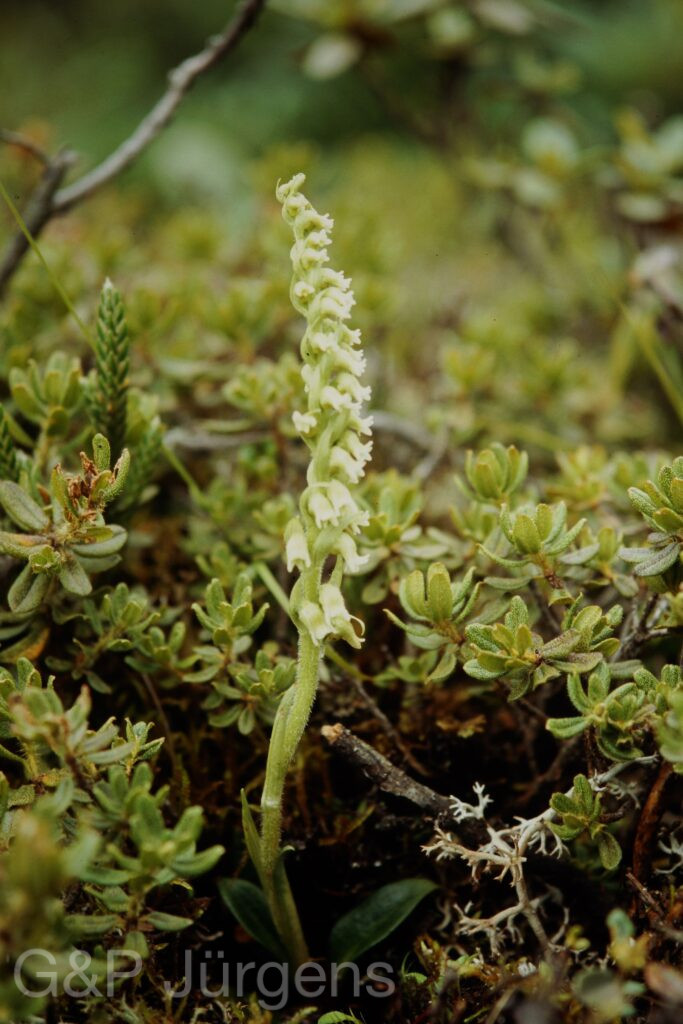
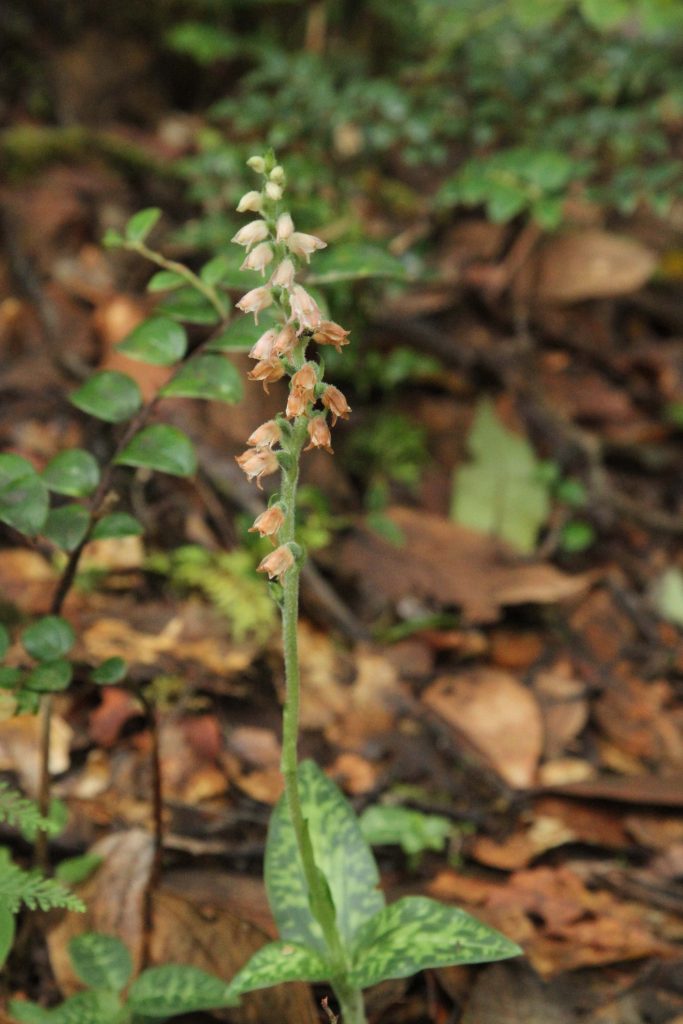
Hook.f.

Sikkim2003 457 K631.2
Sikkim Chopta Valley 3900m August

Description

Goodyera fusca is a terrestrial orchid of the higher Himalaya, ranging through Nepal, China, Bhutan, India and Myanmar (NP, CN, BT, IN, MM), with about 101 recorded occurrences. It grows in cool, shaded humus among mossy rocks, in subalpine Rhododendron and conifer thickets and at the upper forest margin, generally in the upper temperate to subalpine zone. The plant illustrated was found in the Chopta Valley of Sikkim at 3900 m in August, an elevation and late-summer flowering period typical of the species, where it occupies damp, sheltered pockets of leaf litter and bryophyte cover beneath open scrub near the treeline.

It is a small, erect herb arising from a creeping, fleshy, few-noded rhizome rooting at the nodes. The leaves are few and clustered toward the stem base, ovate to elliptic, somewhat fleshy, and in many populations marked with the reticulate veining characteristic of the 'jewel orchids'. The inflorescence is an erect, glandular-pubescent spike bearing a secund to spiralled series of small, dull brownish to greenish flowers, each subtended by a lanceolate bract. The dorsal sepal and petals are connivent to form a hood over the column, the lateral sepals spreading, and the saccate, concave lip lacks a free spur. The fruit is a small, erect, ribbed capsule releasing dust-fine seeds.

Goodyera (subtribe Goodyerinae, tribe Cranichideae of the Orchidaceae) is a chiefly Asian genus of forest-floor orchids whose germination and establishment depend on association with mycorrhizal fungi. The small, drab, nectar-bearing flowers are pollinated by small bees and other insects, and the minute seeds are wind-dispersed. As an obligately mycotrophic forest understorey orchid, G. fusca is vulnerable to disturbance of its humus-rich habitat, though across its wide Himalayan-Chinese range it is not currently regarded as threatened.

Author: Hook.f. · Sources: POWO (Kew), GBIF, Flora of Bhutan, Flora of China, Genera Orchidacearum (Goodyerinae)

King & Pantl.

Bhutan2012 347
Bhutan Dochu-La 3000m, September

Description

Goodyera hemsleyana is a terrestrial orchid of the cool, humid temperate forests of the eastern Himalaya and adjoining southwestern China. Documented occurrences (21 GBIF records) span India, Nepal, China, Bhutan and Myanmar, following the moist mid- to upper-montane belt of the Sino-Himalayan region. The species favours the deep, mossy humus and leaf litter of shaded broadleaved and mixed conifer forest, typically between about 2500 and 3500 m. The illustrated material was gathered at Dochu-La in western Bhutan at roughly 3000 m in September, a pass clothed in cloud forest where rhododendron and fir provide the shade and atmospheric moisture this orchid requires.

The plant is a small, creeping geophyte arising from a slender, fleshy, decumbent rhizome that roots at the lower nodes. The leaves are few, gathered toward the base, ovate to elliptic, and characteristically marked with a fine reticulate venation that distinguishes the 'jewel orchid' alliance. The erect inflorescence is a pubescent scape bearing a rather lax, secund raceme of small white to greenish-white flowers. Each flower shows the connivent dorsal sepal and petals forming a hood over the column, spreading lateral sepals, and a saccate, concave lip with an incurved, often shortly bifid apex; the ovary is glandular-hairy and twisted.

Goodyera is a large, near-cosmopolitan genus within tribe Cranichideae, subtribe Goodyerinae, and G. hemsleyana belongs to the assemblage of Himalayan species described from the King & Pantling collections. Like its congeners it is mycoheterotrophic in establishment, dependent on rhizoctonia-type fungal symbionts in the forest humus, which restricts it to undisturbed old-growth stands. Though not formally assessed as threatened, its reliance on intact mossy forest makes it sensitive to logging and grazing pressure across its range.

Author: King & Pantl. · Sources: POWO (Kew), GBIF, Flora of Bhutan, Flora of China, The Orchids of Bhutan (Pearce & Cribb)

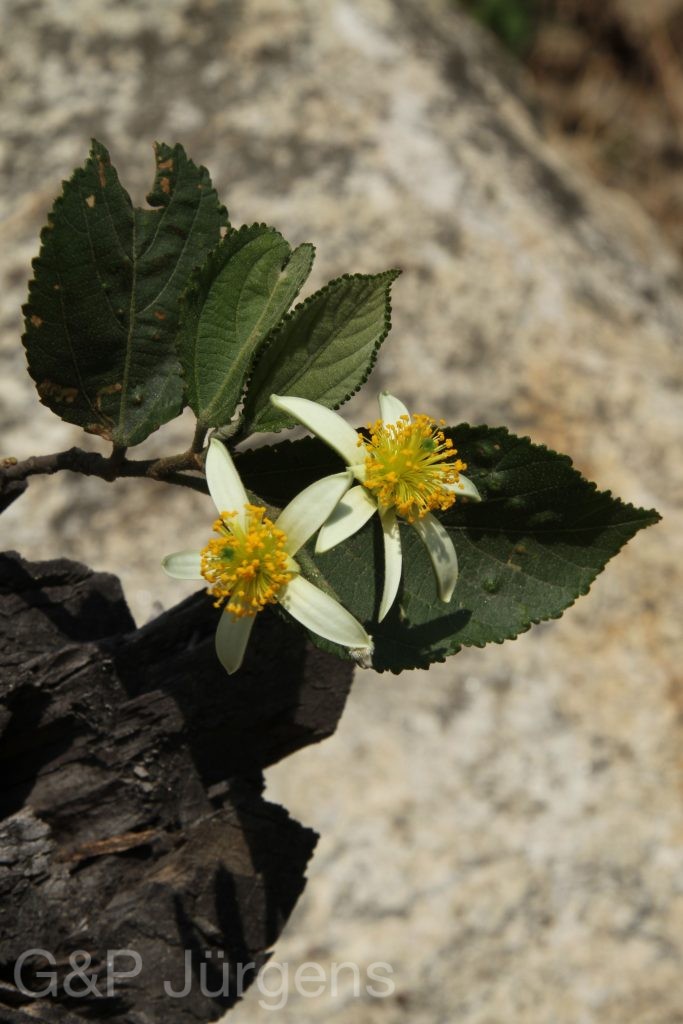
DC.

Bhutan2014 718
Bhutan Wangdi Phodrang 2000m, May

Description

Grewia serrulata is a shrub or small tree of the Indomalayan tropics, distributed through India, Nepal, Bangladesh, Myanmar, Malaysia, Bhutan, Indonesia, the Philippines, Pakistan and Thailand, with around 382 GBIF occurrences. It is a plant of warm subtropical to tropical hill forest, growing in open woodland, forest margins, scrub, ravine slopes and along roadsides and clearings, generally on well-drained ground in the foothill and lower montane belt. The record from Wangdi Phodrang in Bhutan at about 2000 m in May illustrates its occurrence in the warm temperate to subtropical zone of the eastern Himalayan foothills, flowering in the pre-monsoon season.

The plant is a much-branched shrub or small tree with young branchlets bearing stellate pubescence. The alternate, simple leaves are ovate to oblong-lanceolate with an asymmetric, rounded to subcordate base, an acuminate apex, a finely serrulate margin (as the epithet denotes) and prominent palmate basal venation, the lower surface often paler and stellate-hairy. The flowers are borne in small axillary or leaf-opposed cymes; each has five sepals, five spreading yellow to whitish petals each with a basal nectariferous gland, and a prominent central androgynophore bearing numerous stamens around a superior ovary. The fruit is a small, lobed, fleshy drupe, becoming reddish to purplish-black at maturity and bearing few stones.

Described by de Candolle, Grewia serrulata belongs to a large genus formerly placed in Tiliaceae but now subsumed, following molecular phylogenetics, within the broadly circumscribed Malvaceae (subfamily Grewioideae); the input family is retained accordingly. The genus is well known for its tough bast fibres and edible drupes, and several species are gathered for fruit, fodder and fibre. As a widespread, adaptable component of secondary and disturbed forest, G. serrulata is not regarded as threatened, though locally valued for its useful products.

Author: DC. · Sources: POWO (Kew), GBIF, Flora of British India, Flora of Bhutan, Flora of China, Bayer & Kubitzki treatment of Malvaceae

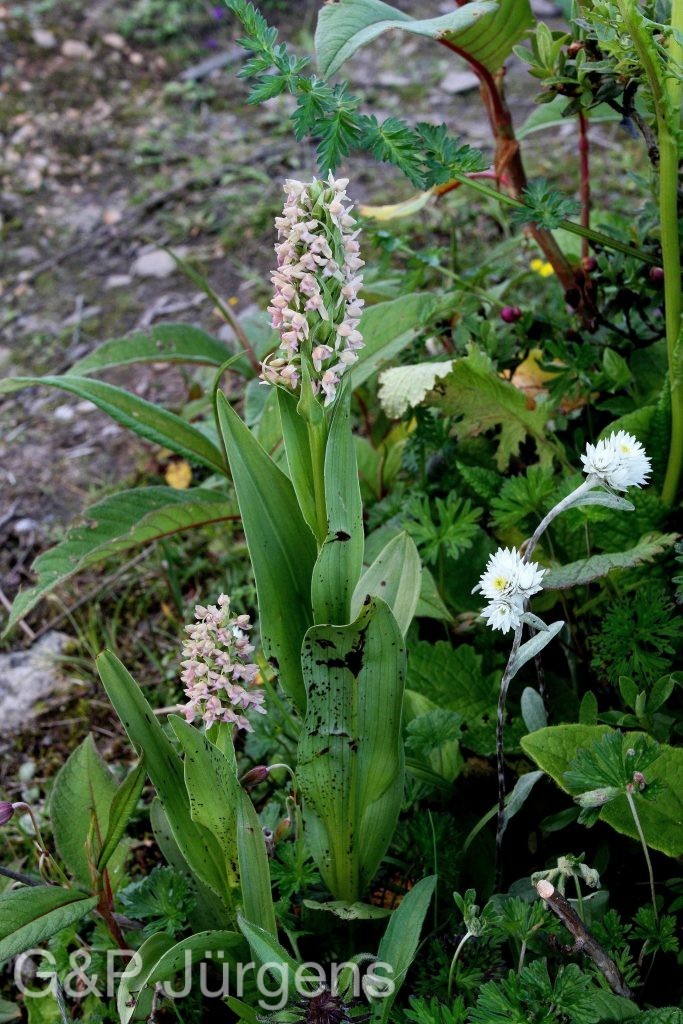
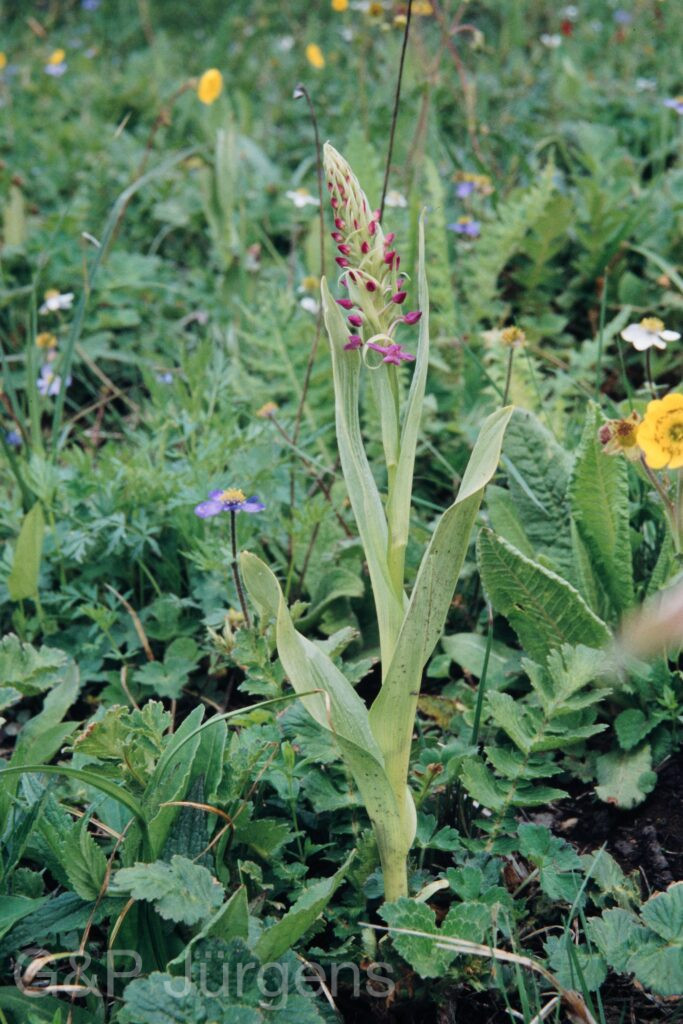
Lindl.

BhutanPG2011 801 01 01
Bhutan Chele-La, 3800m July
also included: Anaphalis busua (D.Don) DC. and Anemone demissa Hook.f. & Thomson
Nepal 99 371 ergebnis
West-Nepal Linji-Khola 3400m, June
Nepal 99 474 ergebnis
West-Nepal Churta-Khola 3200m, June

Description

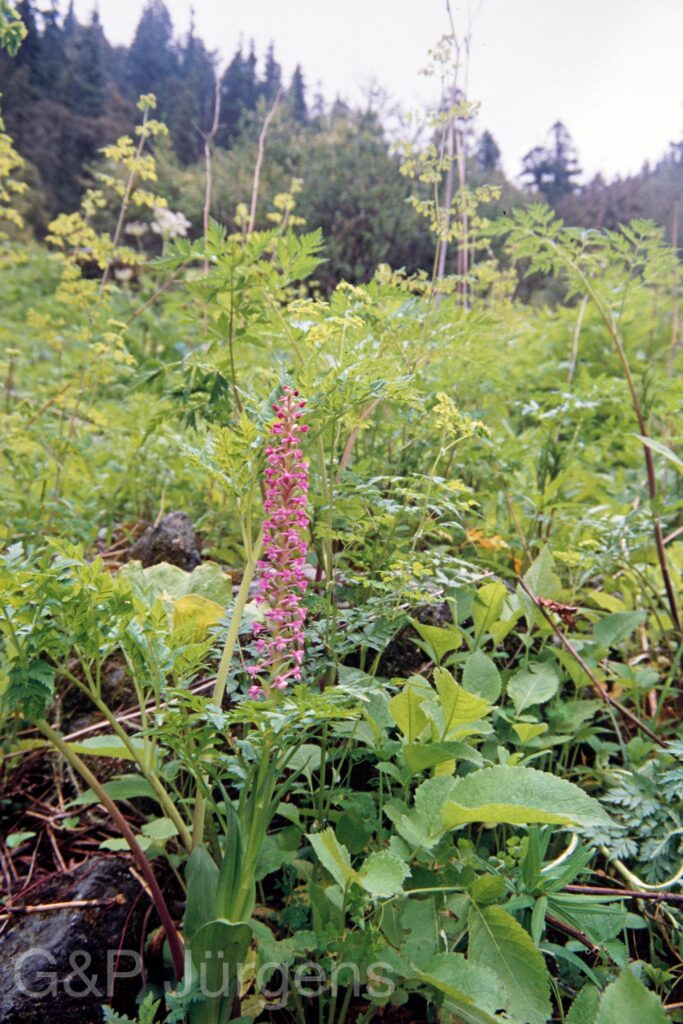
Gymnadenia orchidis is a terrestrial orchid of the Himalaya and adjacent China, distributed through China, Nepal, India, Bhutan, Myanmar and Pakistan, with GBIF documenting some 795 occurrences. It is a plant of open alpine and subalpine meadows, grassy slopes, forest clearings and damp turf, growing in full sun to light shade on humus-rich soils. The species occupies the upper montane to alpine zone; the photographed material from the Chele-La pass in Bhutan at about 3800 m in July, sharing its habitat with Anaphalis busua and Anemone demissa, and from the Linji-Khola and Churta-Khola valleys of West Nepal at 3200-3400 m in June, illustrates its summer flowering across this high-elevation belt.

The plant arises from palmately lobed, fleshy root-tubers and bears an erect, leafy stem. The leaves are several, oblong to lanceolate, sheathing at the base and reduced upward to bracts. The inflorescence is a dense, cylindrical terminal spike of many small flowers, ranging in colour from purple and pink-magenta to occasionally white. Each flower has spreading lateral sepals, a hooded arrangement of the dorsal sepal and petals, and a trilobed labellum bearing a slender, decurved spur about equalling or shorter than the ovary, containing nectar. The pollinaria have naked, exposed viscidia characteristic of the genus. The fruit is a small, erect capsule.

The species belongs to Gymnadenia, a genus of nectar-spurred terrestrial orchids closely allied to Dactylorhiza and Platanthera; it has at times been segregated into Habenaria or treated under broader generic concepts, reflecting ongoing debate over the limits of the orchidine genera. Pollinated by long-tongued insects attracted to its spur nectar, it remains widespread and locally common in Himalayan alpine grasslands, although meadow degradation and grazing may affect individual populations.

Author: Lindl. · Sources: POWO (Kew), GBIF, Flora of China, Flora of Bhutan, The Orchids of Sikkim and Bhutan (Pearce & Cribb)

(Roxb. ex Willd.) DC.

Bhutan2012 1313
Bhutan Pemagatse 1800m, October

Description

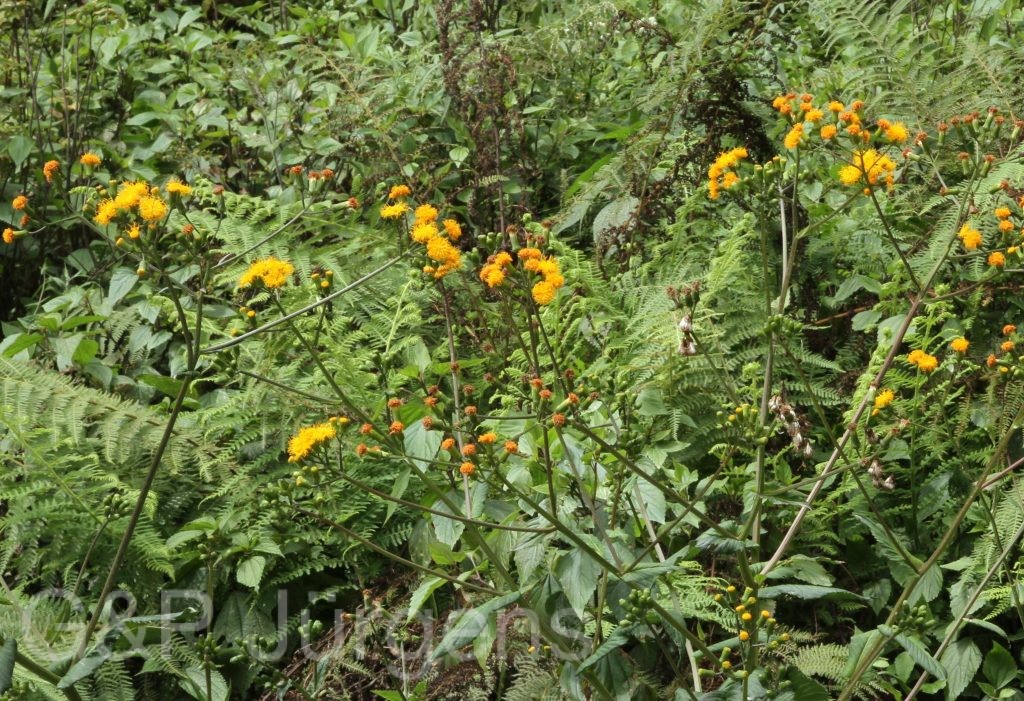
Gynura bicolor is a soft-stemmed composite of warm-temperate to subtropical Asia, native through China, Taiwan, Japan, India, Nepal, Thailand, Myanmar and Bhutan, and very widely cultivated and naturalised across the Pacific, Americas and elsewhere; GBIF lists over 600 occurrences reflecting both wild and grown plants. It occupies forest margins, moist shaded slopes, streamsides and disturbed ground, generally below about 2000 m. The photographed plant is from Pemagatse in Bhutan at 1800 m in October, growing in humid subtropical hill forest at the lower edge of the survey area.

The species is an erect to ascending perennial herb with fleshy, somewhat succulent, often purplish stems. The leaves are alternate, ovate to oblong-lanceolate, irregularly toothed to lyrately lobed, and strikingly bicolorous, green above and deep purple beneath, the source of the epithet. The capitula are discoid, lacking ray florets, and gathered in lax terminal corymbs; each head holds numerous orange to reddish tubular florets within a cylindrical involucre of narrow phyllaries, the long styles exserted with hairy, recurved branches. The fruit is a ribbed cypsela bearing a copious white pappus of fine bristles.

Gynura belongs to the tribe Senecioneae, and G. bicolor is well known as the edible "Okinawan spinach" or hong feng cai, grown as a leaf vegetable and used in traditional medicine, which accounts for its extensive cultivated distribution. It is of no conservation concern, being a vigorous, easily propagated plant tolerant of disturbance.

Author: (Roxb. ex Willd.) DC. · Sources: POWO (Kew), GBIF, Flora of China, Flora of Bhutan, Annotated Checklist of the Flowering Plants of Nepal, Revision of the Genus Gynura (Senecioneae)

D.Don

BhutanPG2011 233
Bhutan Tsochenchen, 3650m June
Bhutan2014 512
Bhutan Tsochenchen, 3600m June

Description

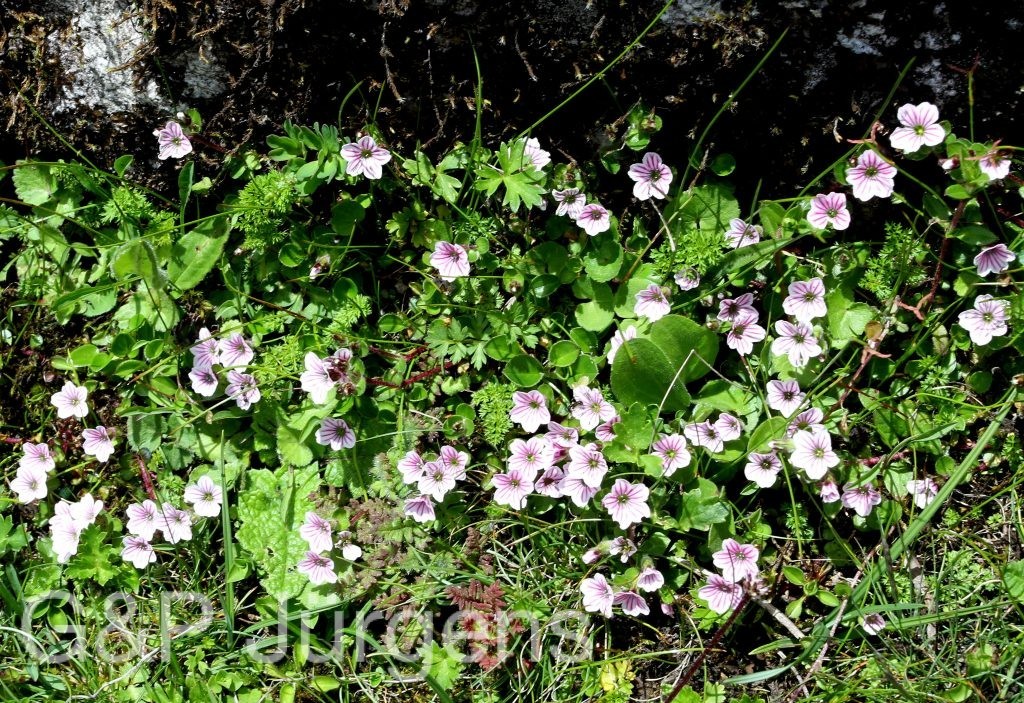
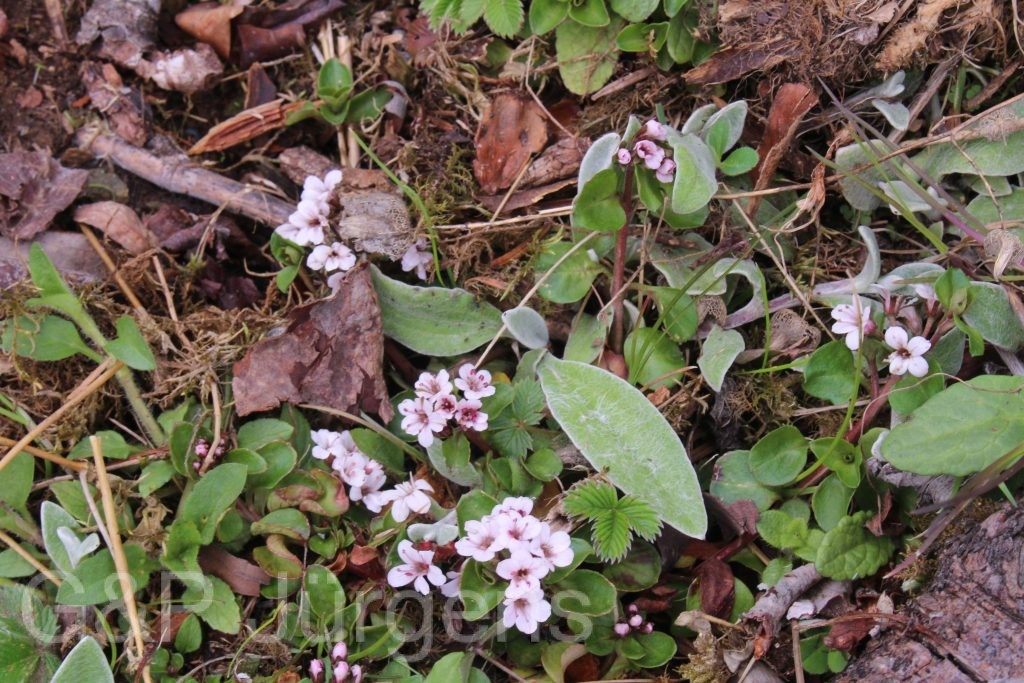
Gypsophila cerastoides is a mat-forming Himalayan pink ranging across India, Nepal and Bhutan, with the remaining GBIF country codes (USA, Austria) representing cultivated and herbarium records; the dataset holds about 65 occurrences. It is an alpine and upper subalpine plant of open stony slopes, gravelly flats, short turf and rock crevices, typically between about 3000 and 4500 m. The cushions photographed at Tsochenchen in Bhutan at roughly 3600 to 3650 m in June occupy exactly this kind of well-drained, sunlit high-mountain ground where the species flowers early in the season.

It forms low, spreading mats or loose cushions from a branched woody rootstock. The numerous small leaves are oblong to spathulate, sessile, somewhat hairy and crowded, recalling those of a Cerastium, hence the epithet. The flowers are borne singly or in few-flowered cymes on short stalks; each has five white to pale lilac petals conspicuously veined with violet or purple lines and often notched at the apex, set against a campanulate, five-toothed calyx. There are ten stamens and two styles, and the fruit is a small capsule opening by teeth to release minute seeds.

Unusual among Gypsophila for its broad, prettily veined petals and prostrate alpine habit, G. cerastoides is widely grown as a rock-garden and trough plant in temperate horticulture, which accounts for its appearance in European and North American records. Its cushion growth form is a typical adaptation to high-altitude wind, frost and drought. The species is locally common over a wide Himalayan arc and is not regarded as threatened, although alpine grazing and warming-driven vegetation shifts could affect particular populations at the margins of its range.

Author: D.Don · Sources: POWO (Kew), GBIF, Flora of Bhutan, Flora of China, Annotated Checklist of the Flowering Plants of Nepal, Barkoudah Revision of the Genus Gypsophila