Tag:

Spring

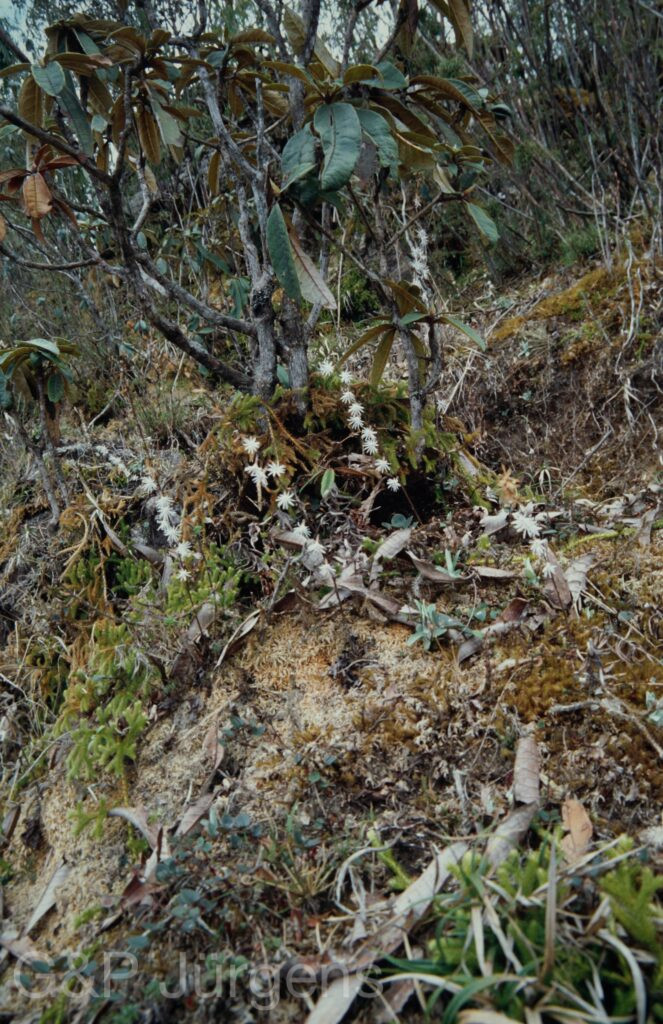
Ainsliaea aptera

by GP Jürgens

DC.

Bhutan2014 513
Bhutan Yatong-La 3200m, May
Nepal 1989 58
Nepal Bagachap 2300m, April
Nepal 1994 76 ergebnis
Ost-Nepal Jaljale Himal
3000m April

Description

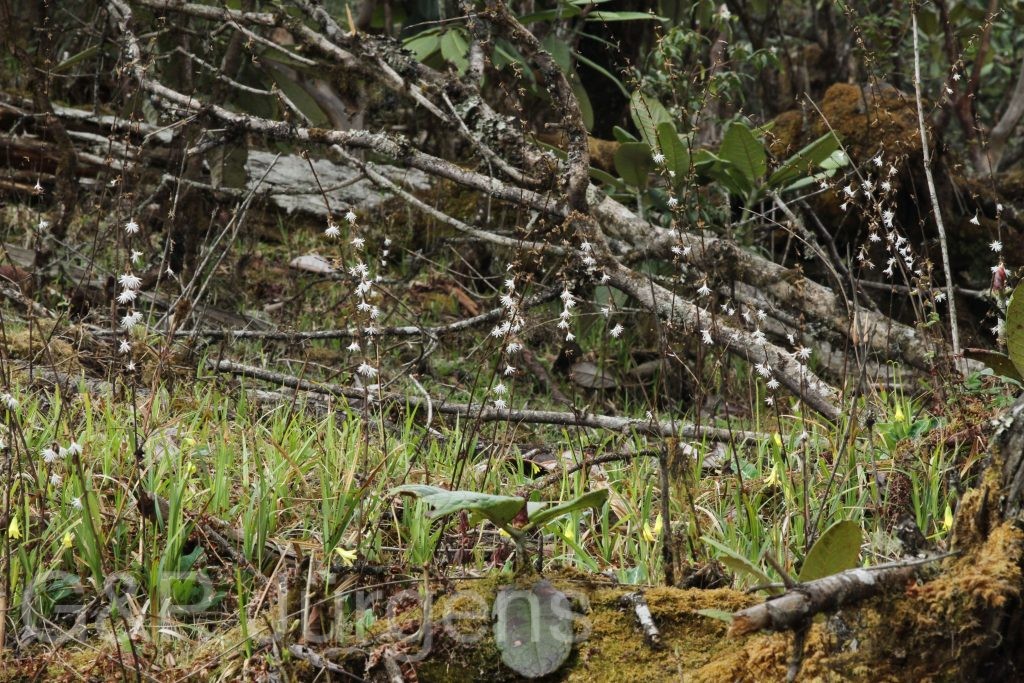
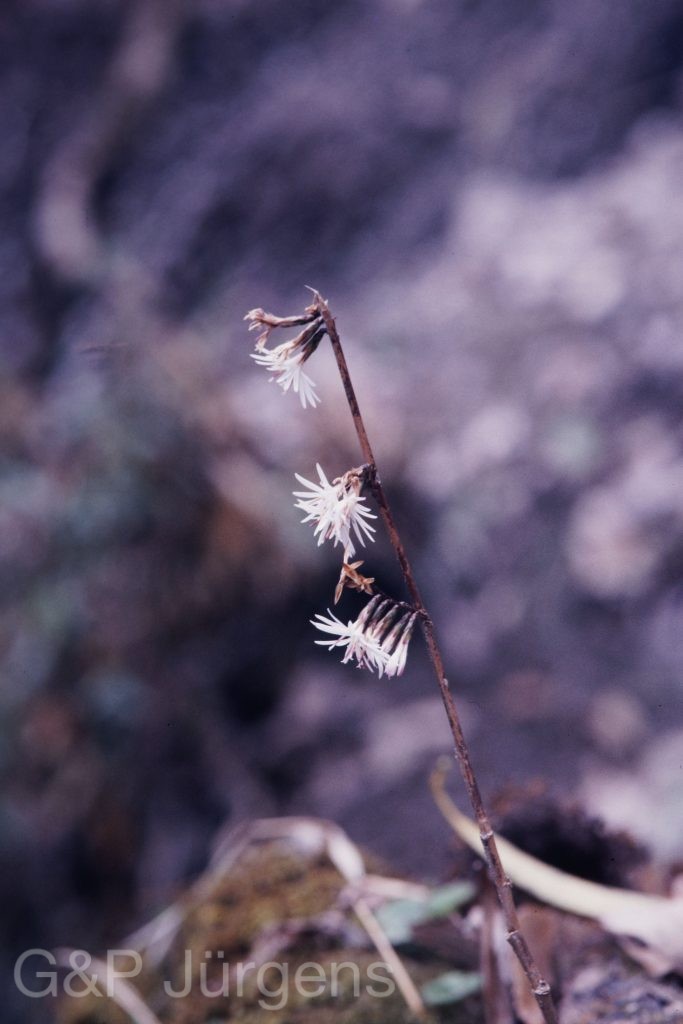
Ainsliaea aptera is a Himalayan rosette herb distributed along the range from Afghanistan and Pakistan through India, Nepal and Bhutan into China and Myanmar, with 358 GBIF occurrences. It grows in the understorey and on shaded banks of temperate broadleaved and conifer forest, on mossy slopes and rock ledges, generally between about 2000 and 3500 m. The illustrated material spans Bhutan's Yatong-La at 3200 m in May, Bagachap in central Nepal at 2300 m in April, and the Jaljale Himal of eastern Nepal at 3000 m in April, indicating a spring-flowering plant of cool, humid forest floors.

It is a perennial herb with a short rhizome bearing a basal rosette of ovate to elliptic, long-petiolate leaves that are firm, with cordate to rounded bases, entire or shallowly toothed margins, and often a sparse covering of hairs. From the centre rises a slender, nearly leafless scape carrying a narrow, spike-like or racemose arrangement of small, sessile capitula. Each head contains a few tubular florets with slender, deeply lobed, white to pinkish corollas. The cypselae are ribbed and clothed in a pappus of plumose (feathery) bristles, a diagnostic feature of the genus.

Described by de Candolle, Ainsliaea belongs to the basal asteraceous tribe Pertyeae (formerly Mutisieae), an Asian lineage notable for its plumose pappus and frequently spike-like inflorescences. The genus is centred on the Sino-Himalayan region and is of interest for the phylogeny of early-diverging Asteraceae. Widespread along the Himalayan forest belt, A. aptera is not regarded as threatened, though it depends on intact shaded forest habitat.

Author: DC. · Sources: POWO (Kew), GBIF, Flora of Bhutan, Flora of China, Revision of Ainsliaea (Mitsui & others), Flowers of the Himalaya (Polunin & Stainton)
 (D.Don) Sch.Bip.

Bh2008 62 G102
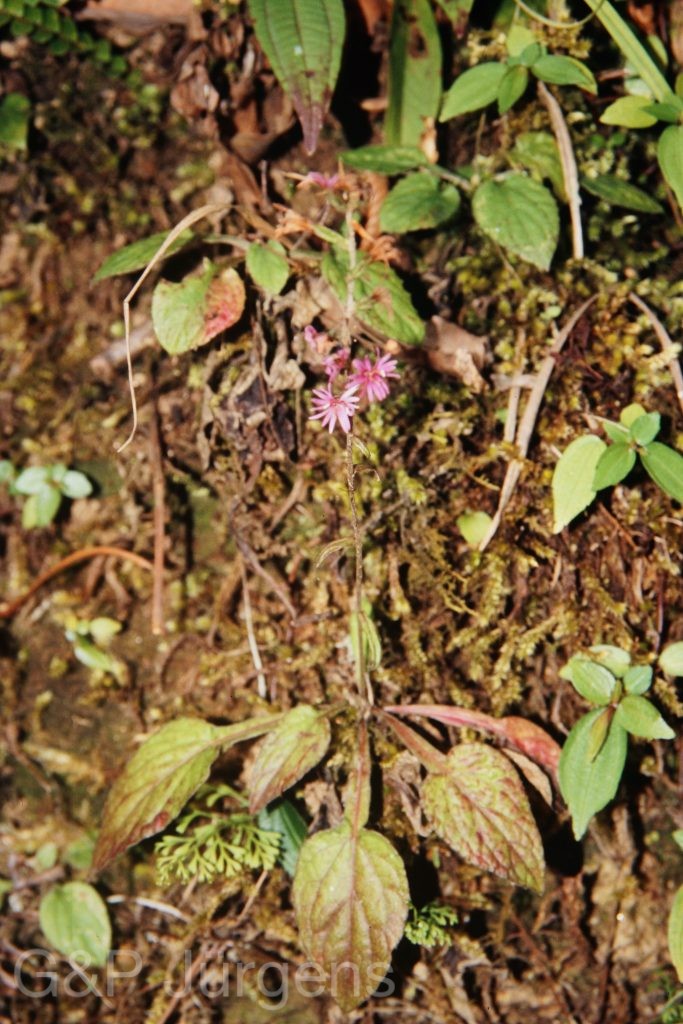
Bhutan Punaka-Chu, 1500m April

Description

Ainsliaea latifolia is a widely distributed perennial herb of the Sino-Himalayan and Southeast Asian region, recorded from China, India, Nepal, Bhutan, Pakistan, Bangladesh, Sri Lanka, Myanmar, Thailand, Vietnam, Taiwan, Malaysia and Indonesia, with over a thousand documented occurrences. It is a characteristic understorey plant of subtropical and warm-temperate broadleaved forest, growing on shaded banks, forest floors, grassy clearings and stream margins from the foothills to the middle hills. The individual shown was recorded along the Punakha Chu in western Bhutan at about 1500 m in April, a setting typical of its preference for moist, humus-rich ground beneath oak and evergreen forest.

The plant arises from a short, stout rhizome and is conspicuous for its basal rosette of broad, long-petiolate leaves; the laminae are ovate to broadly ovate or orbicular, cordate at the base, with a shortly acuminate apex and entire to denticulate margins, often purplish and pubescent beneath. From the centre of the rosette rises a slender, leafless or bracteate scape bearing an elongate, spike-like to narrowly paniculate inflorescence. The small capitula are cylindrical and characteristically three-flowered, each floret with a deeply lobed, bilabiate corolla typical of the Mutisioideae. The achenes are ribbed and pubescent, crowned by a copious pappus of plumose, reddish-brown bristles.

The species belongs to Ainsliaea, a genus of the basal asteraceous subfamily Mutisioideae centred on East Asia and the Himalaya, distinguished by its three-flowered heads and rosulate habit. It exhibits considerable variation in leaf shape and indumentum across its extensive range, and several infraspecific taxa have been recognised. Long used in regional folk medicine, it is locally common and faces no significant conservation concern across most of its distribution.

Author: (D.Don) Sch.Bip. · Sources: POWO (Kew), GBIF, Flora of China, Flora of Bhutan, Flora of British India, Revision of the genus Ainsliaea (Mutisieae)

Ajuga lobata 

by G & P Jürgens

D.Don

Sikkim 2006 23 ergebnis
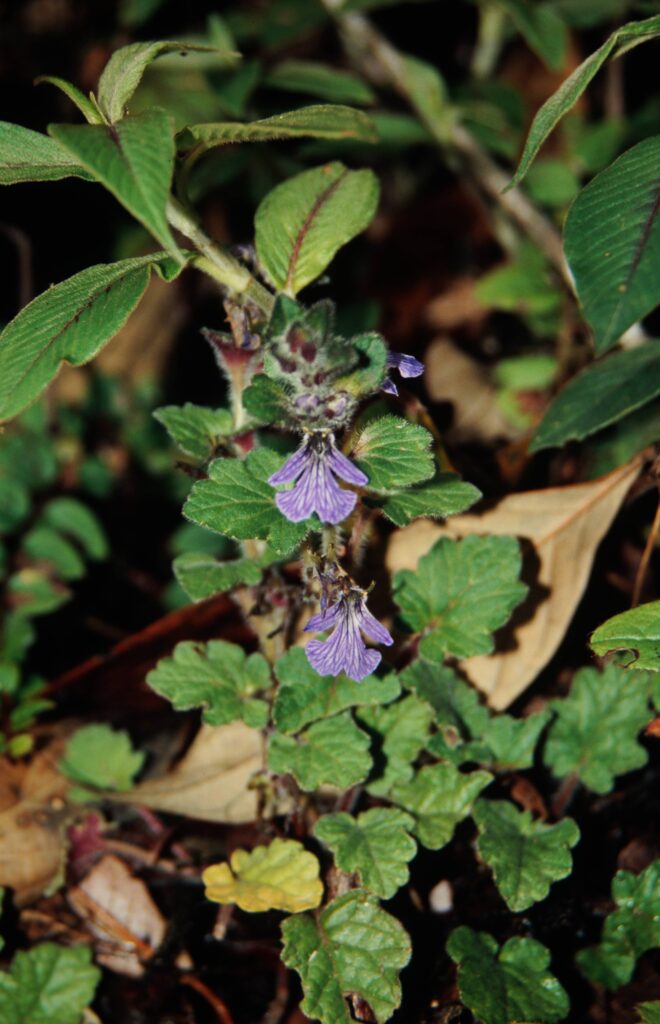
India West-Bengal Tonglu 3100m, May

Description

Ajuga lobata is an eastern Himalayan and Sino-Himalayan element distributed across Nepal, northern India, Bhutan, northern Myanmar and adjacent south-western China, with some 172 georeferenced occurrences documented. It is a plant of cool-temperate forest margins, mossy banks and open grassy slopes within the upper-montane to subalpine belt, typically between about 2400 and 3500 m. The population photographed at Tonglu (3100 m) on the Singalila ridge of West Bengal in May, flowering as the monsoon approaches, is characteristic: it favours humus-rich, freely draining soils in light shade beneath Rhododendron and oak.

It is a low, perennial, somewhat creeping herb arising from a slender rootstock, the quadrangular stems frequently decumbent at the base and rooting at the lower nodes before ascending. The leaves are opposite, ovate to obovate, the lamina conspicuously lobed or coarsely crenate-dentate, narrowed into a winged petiole and often tinged purplish beneath. Flowers are borne in axillary verticillasters forming a leafy terminal spike; the corolla is bluish to violet, two-lipped with a strongly reduced upper lip and a prominent, spreading three-lobed lower lip, the four didynamous stamens exserted. The fruit comprises four reticulate-rugose nutlets seated in the persistent campanulate calyx.

Within Ajuga (Ajugoideae) the species is distinguished by its markedly lobed leaves, a feature echoed in the epithet. Its montane distribution makes it a useful indicator of intact temperate forest ecosystems, and like many bugles it is visited by bees and serves as a minor nectar source. No conservation concern is presently recognised given its broad range, though it is locally restricted to suitable forest habitat.

Author: D.Don · Sources: POWO (Kew), GBIF, Flora of China Vol. 17, Flora of Bhutan Vol. 2, Flora of Nepal, A Revision of the Genus Ajuga (Labiatae)

Durazz.

Bhutan2014 696
Bhutan Wangdi Phodrang 2000m, May
Bhutan2014 699
Bhutan Wangdi Phodrang 2000m, May

Description

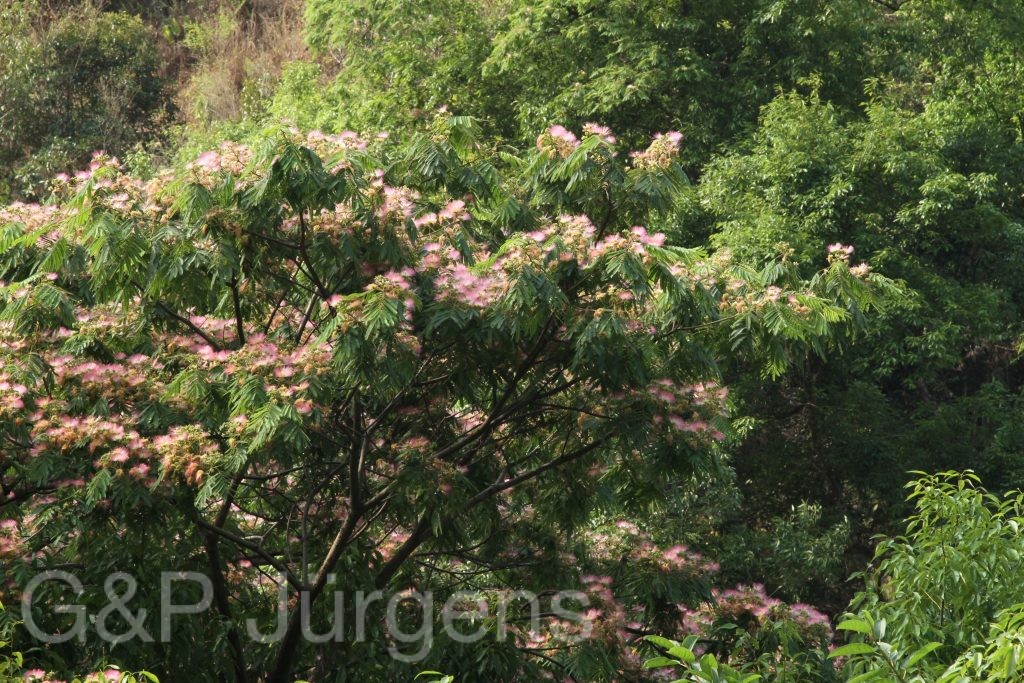
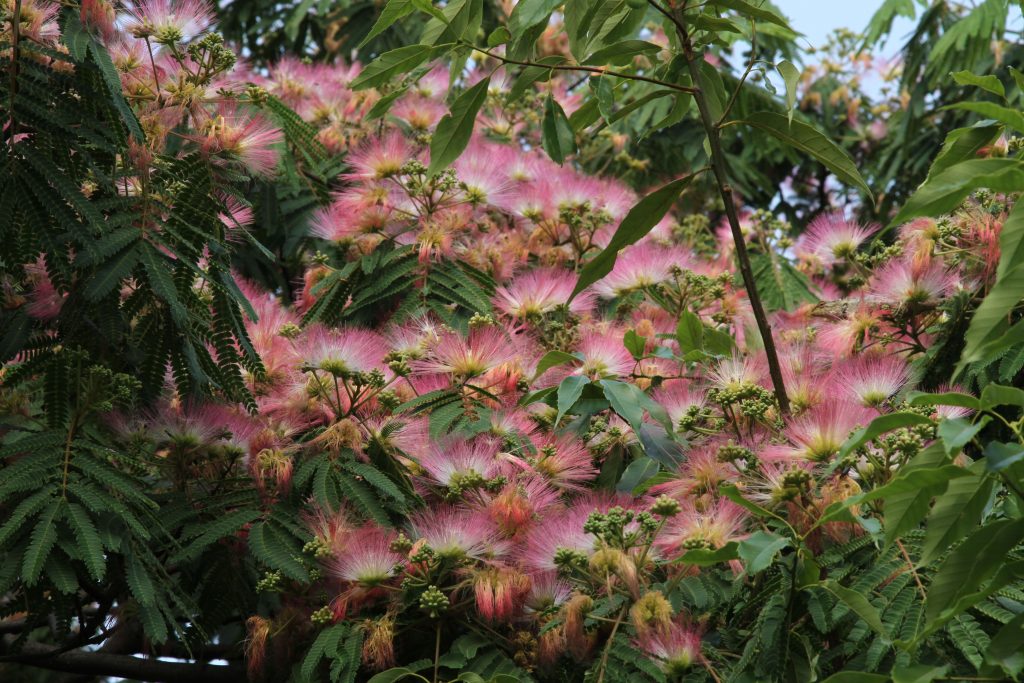
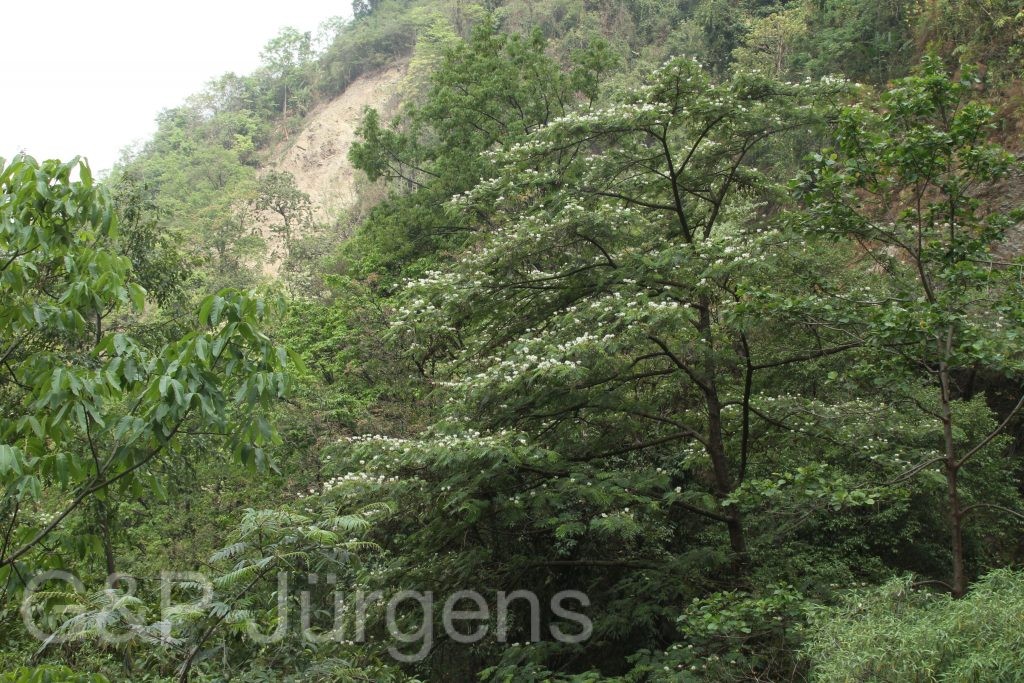
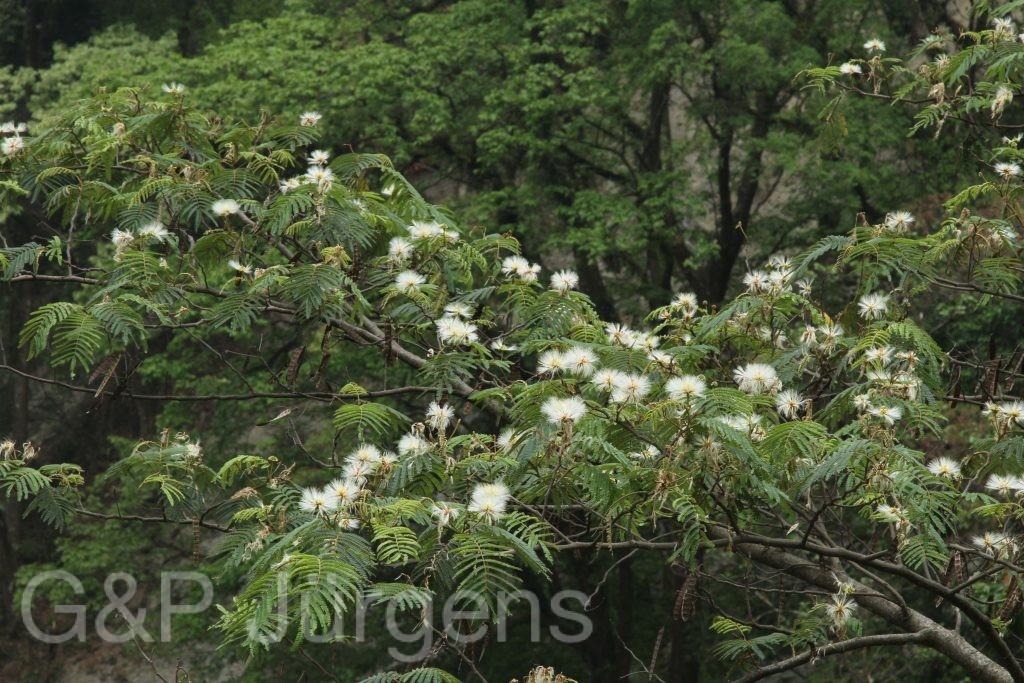
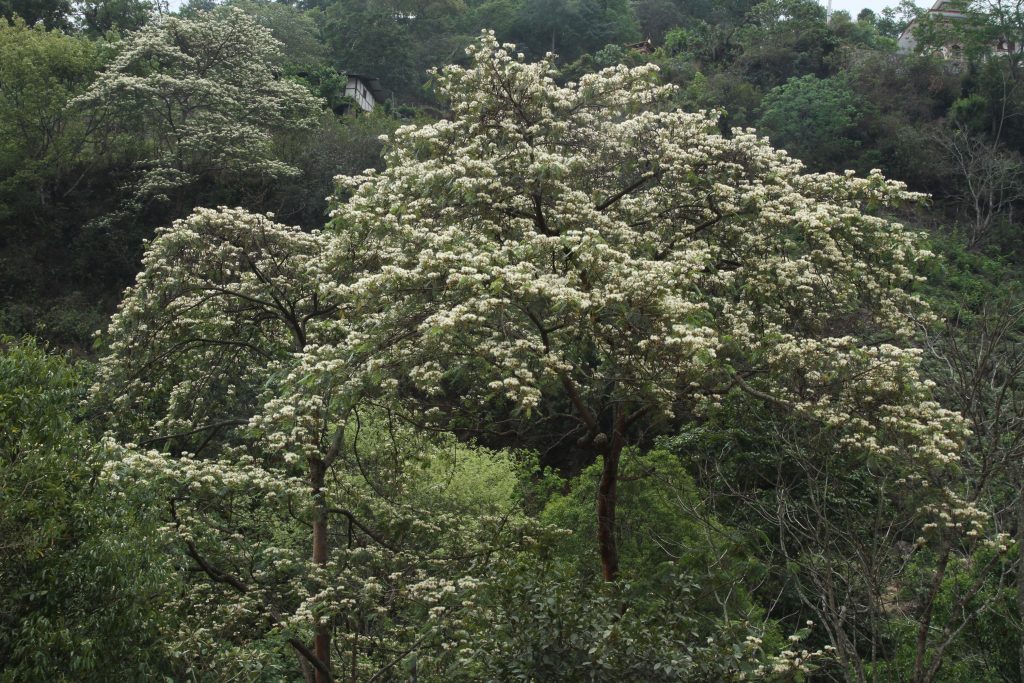
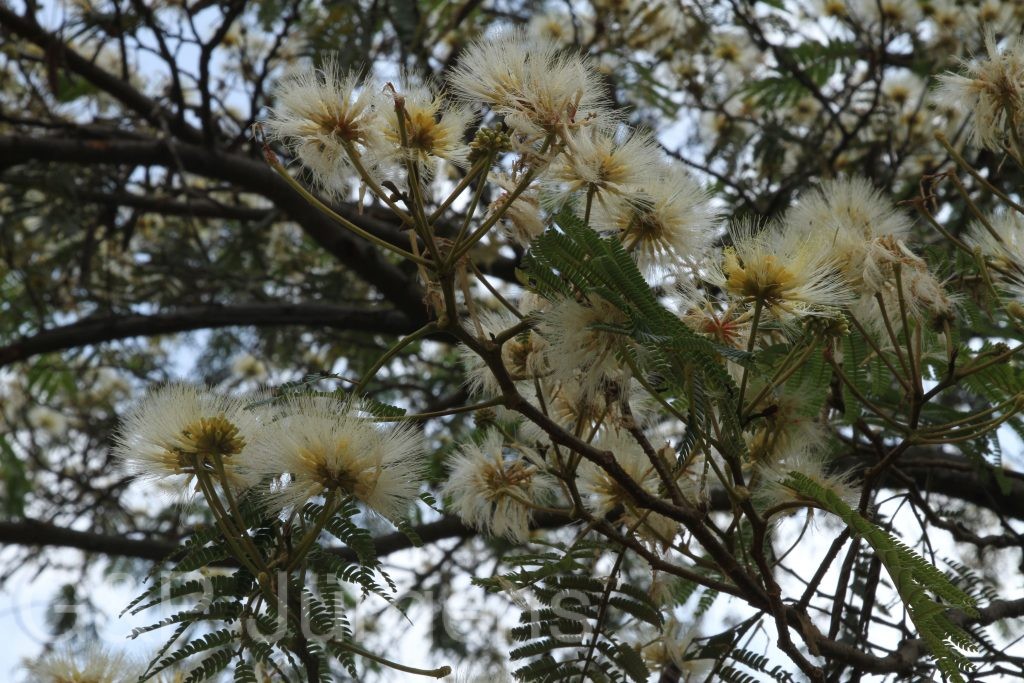
Albizia julibrissin, the silk tree or Persian silk tree, is a deciduous tree native from Iran and the Caucasus across to eastern Asia, now extensively planted and naturalised worldwide as shown by GBIF's more than 35000 occurrences spanning the United States, Korea, Japan, China, France, Turkey, Russia, Argentina, Italy and India among many others. In its Asian range it grows in warm-temperate broadleaf forest, open hillsides, valley margins and disturbed roadsides, from the lowlands to about 2500 m. The photographed tree from Wangdi Phodrang in Bhutan at 2000 m in May represents its occurrence in the warm inner Himalayan valleys, where it flowers in late spring and through the warm season.

It is a small, spreading tree with a broad, flat-topped, umbrella-like crown and smooth greenish-grey bark. The large, alternate leaves are bipinnate with numerous pinnae each bearing many small, oblong, asymmetric leaflets that fold together at night. The inflorescences are dense, hemispherical heads grouped in terminal panicles; the flowers are inconspicuous in their corollas but conspicuous through their numerous long, silky stamens, pink to deep rose distally and white below, giving a powder-puff effect. The fruit is a flat, papery, straw-coloured dehiscent legume containing several flattened seeds.

Albizia belongs to Fabaceae subfamily Caesalpinioideae (the mimosoid clade), characterised by actinomorphic flowers with showy stamens far exceeding the small petals. Nitrogen-fixing through root nodulation, fast-growing and widely cultivated as an ornamental, it has become invasive in parts of North America and elsewhere. Globally of Least Concern, it is valued horticulturally and ecologically as a pioneer of disturbed, well-drained, sunny sites.

Author: Durazz. · Sources: POWO (Kew), GBIF, Flora of China, Flora of Bhutan, Flora Iranica, Nielsen revision of Albizia and allied Mimosoideae

Albizia lebbeck

by GP Jürgens

(L.) Benth.

Bhutan2014 238
Bhutan Karu-Chu 1800m, May
Bhutan2014 240
Bhutan Karu-Chu 1800m, May

Description

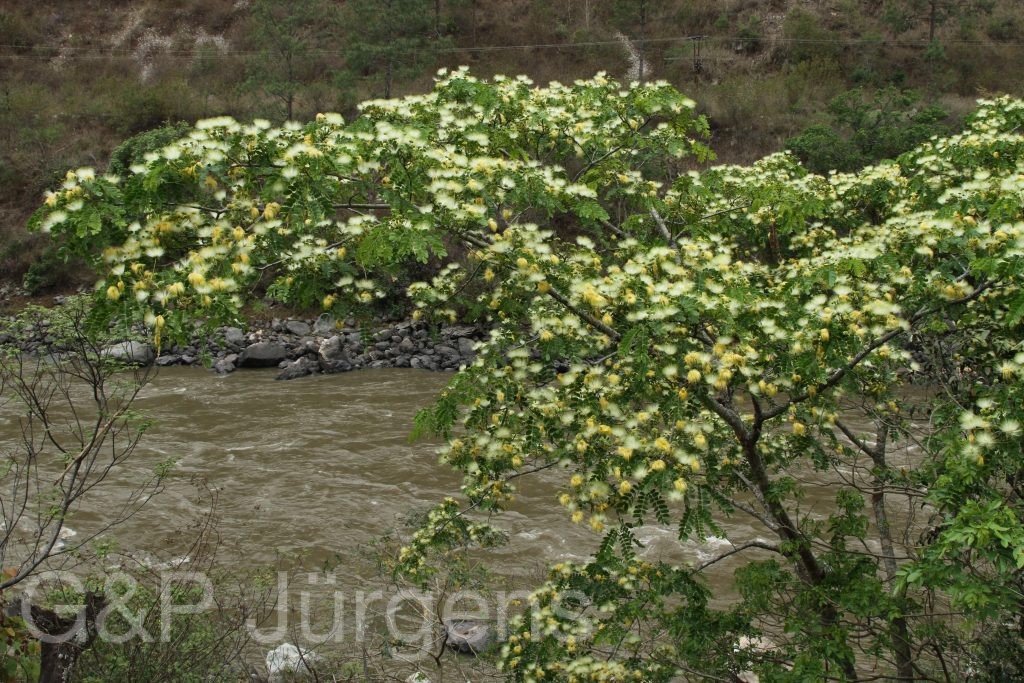
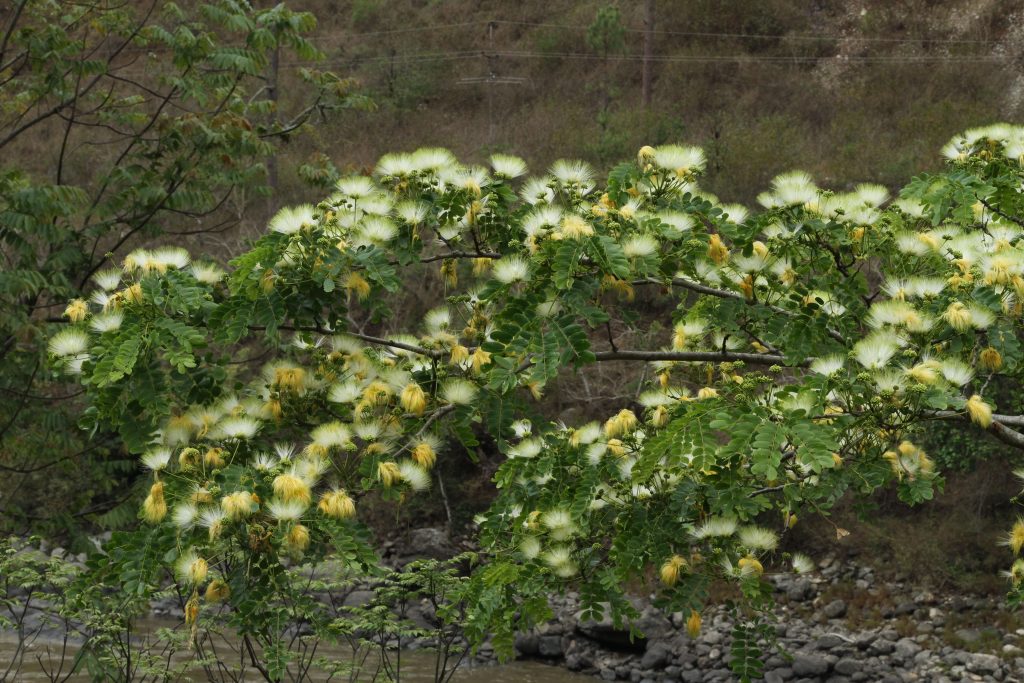
Albizia lebbeck is a fast-growing tropical tree native to the Indian subcontinent and tropical Asia but now pantropically naturalised, as its 13,114 GBIF occurrences from India, Australia, Brazil, Mexico, the United States, Madagascar, Nigeria and many other countries attest. It occupies open woodland, savanna, riverbanks, roadsides and disturbed ground from the lowlands to about 1800 m, and is widely planted for shade, timber and fodder. The photographed tree was recorded in Bhutan along the Karu-Chu at about 1800 m in May, near the upper limit of its altitudinal range in the warm Himalayan foothills.

It is a deciduous tree to 15-25 m with a spreading, flat-topped crown and grey, fissured bark. The leaves are bipinnate with 2-4 pairs of pinnae, each bearing 4-9 pairs of oblong, asymmetric leaflets, and a conspicuous gland on the petiole. The flowers are massed in showy, hemispherical axillary heads, each flower with a small calyx and corolla but numerous long, greenish-white to cream stamens fused below into a tube, giving a powder-puff appearance and a sweet fragrance. The fruit is a flat, straw-coloured, papery legume 15-30 cm long, persisting on the tree and rattling in the wind, containing several flattened seeds.

A member of the Fabaceae (subfamily Caesalpinioideae, mimosoid clade), Albizia lebbeck fixes nitrogen through root nodules and is valued in agroforestry, though it behaves as an invasive weed in parts of the Neotropics, Australia and Pacific islands. Pollination is by insects and birds attracted to the nectar-rich stamen brushes, and the buoyant pods aid wind and water dispersal. It is of least concern and globally abundant.

Author: (L.) Benth. · Sources: POWO (Kew), GBIF, Flora of British India, Flora of Bhutan, Nielsen Monograph of Asian Albizia

Albizia sherriffii

by GP Jürgens

Baker f.

Bhutan2014 3
Bhutan Sandrup 750m, May
Bhutan2014 5
Bhutan Sandrup 750m, May
Bhutan2014 224
Bhutan Karu-Chu 1800m, May
Bhutan2014 229
Bhutan Karu-Chu 1800m, May

Description

Albizia sherriffii is a tree of the eastern Himalayan foothills and adjoining ranges, recorded from Bhutan, north-east India, Myanmar and southern China, with GBIF holding about 65 occurrences that indicate a fairly restricted distribution. It occurs in warm subtropical to lower-temperate broad-leaved forest and along forest margins and river valleys, broadly between 700 and 1800 m, where the monsoon climate is warm and humid. The two illustrated Bhutanese gatherings, from Sandrup at 750 m and Karu-Chu at 1800 m, both in May, bracket its elevational range and show its flowering at the onset of the rains.

It is a medium-sized to large deciduous tree with spreading branches and bipinnate leaves bearing several pairs of pinnae, each with numerous small, oblong leaflets, the foliage often subtended by a gland on the petiole as is characteristic of the genus. The flowers are grouped in capitate or umbellate heads and, as in Albizia generally, owe their showy appearance to the long, numerous, exserted stamens united below into a tube, the small corolla being inconspicuous. The fruit is a flat, oblong, dehiscent legume (pod) containing several compressed seeds.

Named for the plant collector George Sherriff, A. sherriffii belongs to the mimosoid legumes (Fabaceae subfamily Caesalpinioideae, mimosoid clade), within which Albizia is distinguished from Acacia and allied genera by its stamen and pod characters. As a relatively narrowly distributed Himalayan tree, it is potentially sensitive to lowland forest clearance, though it has not been formally assessed in detail.

Author: Baker f. · Sources: POWO (Kew), GBIF, Flora of Bhutan, Legumes of the World (Lewis et al.), Flora of China

Alnus nepalensis

by GP Jürgens

D.Don

Bhutan2012 1150
Bhutan Tashiyangtse 1750m, October
Nepal 1994 159 ergebnis
Ost-Nepal Mewa-Khola
1800m, April

Description

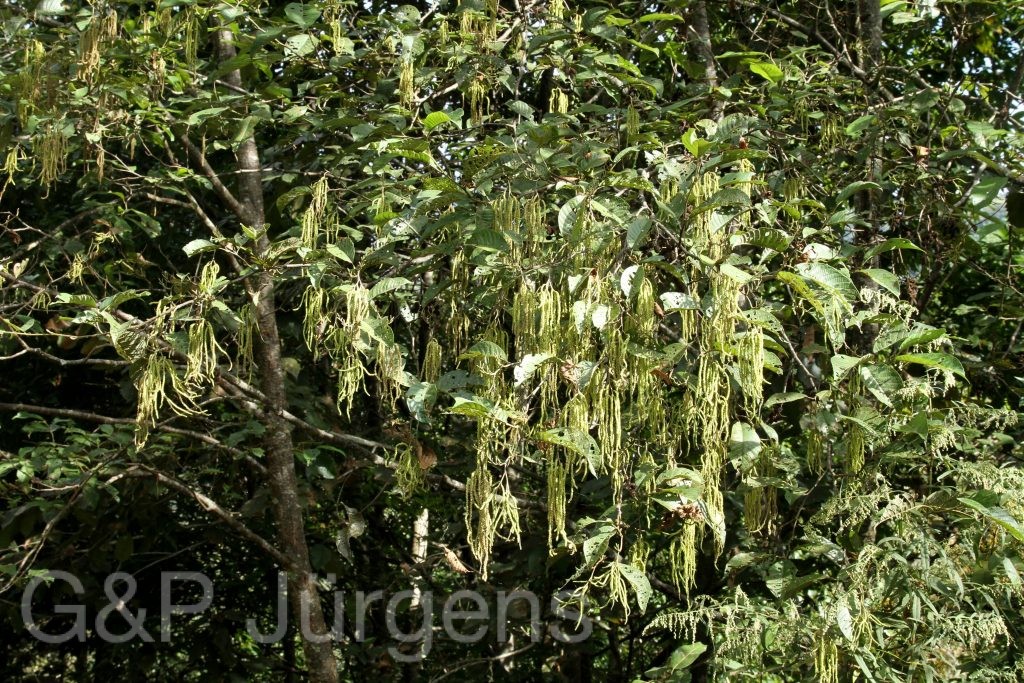
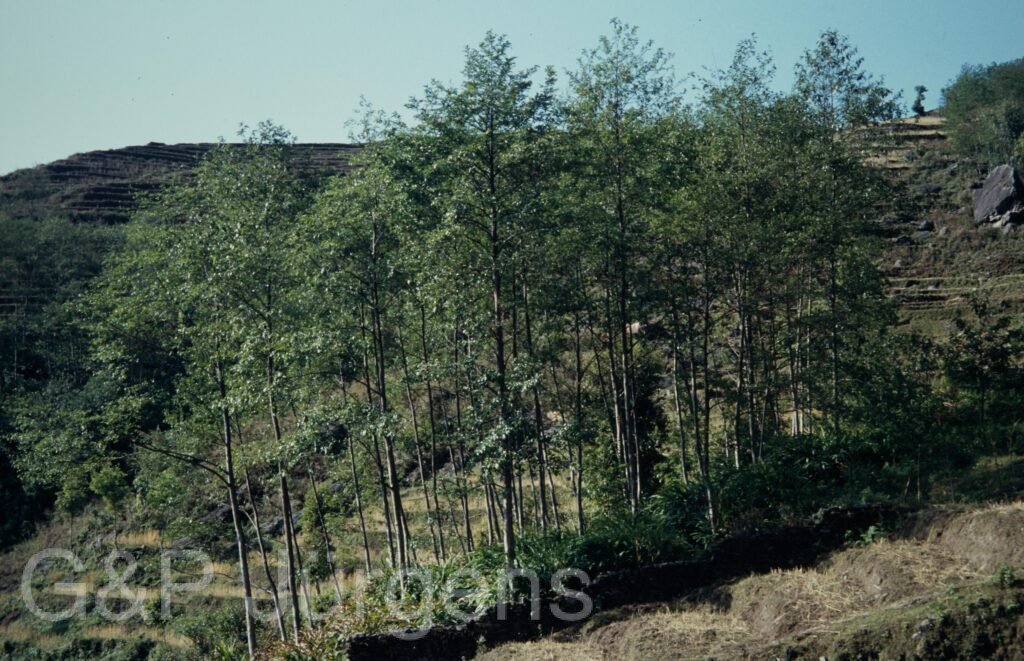
Alnus nepalensis D.Don, the Nepalese alder, is a deciduous tree of the Betulaceae distributed throughout the Himalaya and adjacent ranges, from Nepal and India through Bhutan to southwestern China, Myanmar and Vietnam (GBIF: c. 1,931 occurrences). It is a fast-growing pioneer of moist temperate and subtropical zones, colonising landslides, river terraces, abandoned fields and forest gaps, typically between about 900 and 2,700 m. The photographed trees from Tashiyangtse in eastern Bhutan (c. 1,750 m) and the Mewa-Khola in eastern Nepal (c. 1,800 m) exemplify its dominance on moist, disturbed mid-montane slopes.

The tree reaches 10–25 m, with smooth grey bark becoming fissured with age. The leaves are alternate, broadly elliptic to ovate, acuminate, with finely serrate to nearly entire margins and prominent pinnate venation. Unusually for the genus, A. nepalensis flowers in autumn: the slender pendulous male catkins and short erect female inflorescences appear together, and the female structures mature into small, woody, cone-like infructescences (strobiles) that persist on the tree and release tiny winged nutlets (samaras) for wind dispersal.

Alnus nepalensis is ecologically and economically significant as a nitrogen-fixing species, harbouring symbiotic actinomycetes of the genus Frankia in root nodules; this enables it to enrich degraded soils, making it valuable in agroforestry, soil reclamation, watershed restoration and as a shade tree in cardamom cultivation. The wood is used for timber, fuel and matchwood. The species is abundant and of least conservation concern.

Author: D.Don · Sources: POWO (Kew), Flora of China Vol. 4, Flora of Bhutan Vol. 1, Flora of Nepal, GBIF, Chen & Li: Betulaceae of China

D.Don

Nepal 97 45 G67
Nepal Mewa-Khola 1100m, April
Nepal 97 46 P68
Nepal Mewa-Khola 1100m, April

Description

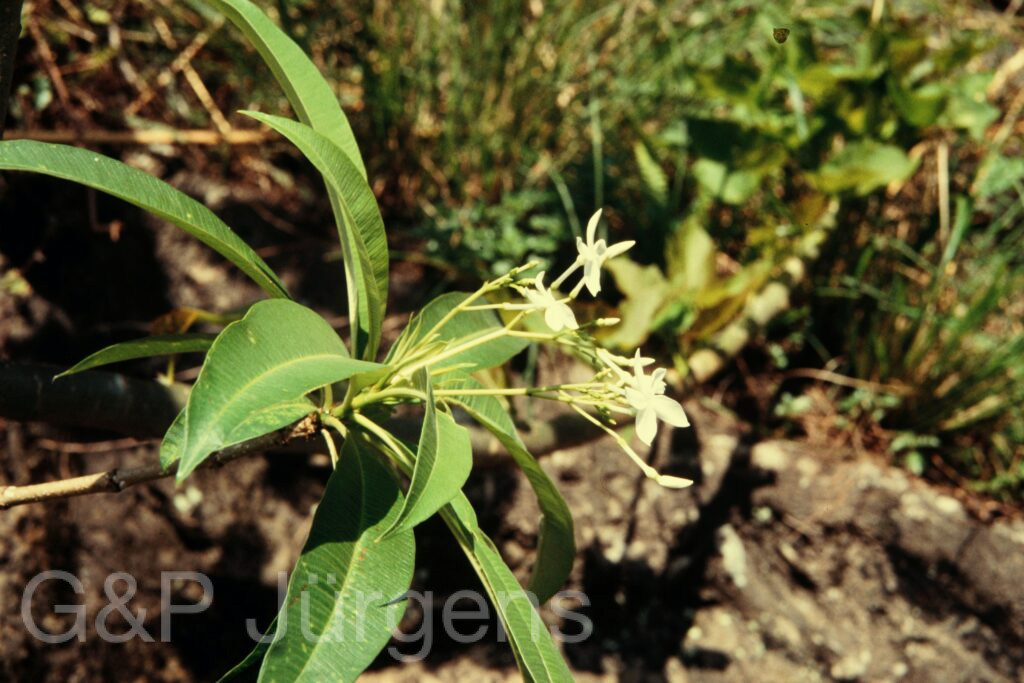
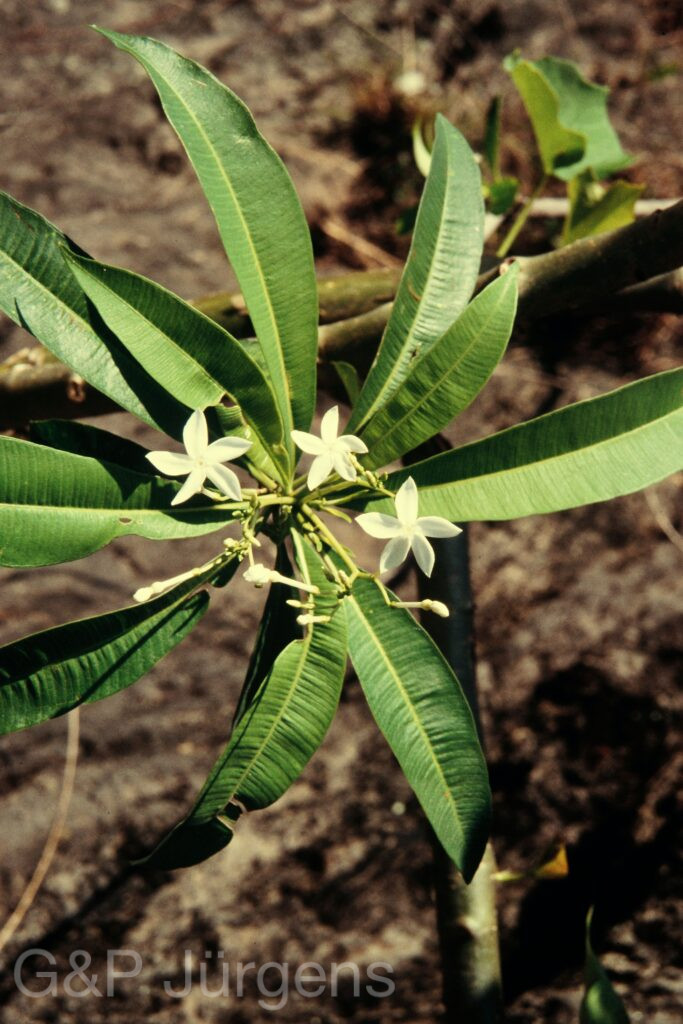
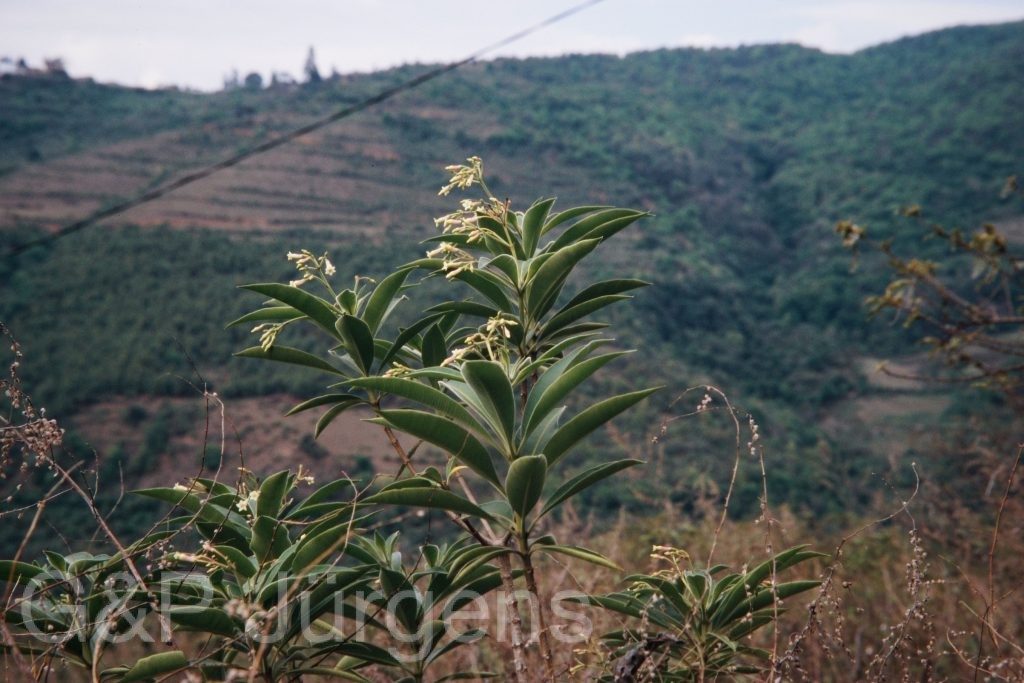
Alstonia neriifolia is a shrub or small tree of the warm, humid lower hills of the eastern Himalaya and Indo-Burmese region, recorded from India, Nepal, Bhutan, China and southwards into mainland and insular Southeast Asia including Vietnam, Indonesia and Singapore. It occupies subtropical broad-leaved forest, forest margins, stream banks and shaded ravines at low to moderate elevations. The specimen photographed at Mewa-Khola in eastern Nepal at 1100 m in April reflects its preference for the warm, moist foothill belt, where it flowers as the pre-monsoon temperatures rise.

Like other members of its genus it exudes a white latex when cut. The leaves are arranged in whorls of three or more, narrowly lanceolate to oblong and acuminate, recalling those of Nerium (oleander) and giving the species its epithet; the lamina is glabrous and leathery with numerous closely parallel lateral veins running to a marginal collecting vein. The flowers are borne in terminal cymose clusters, with a small five-lobed calyx and a salverform white to cream corolla whose lobes overlap to the left in bud. The fruit is a pair of slender, elongate follicles that split to release numerous flattened seeds bearing tufts of hairs at both ends for wind dispersal.

Alstonia is a pantropical genus of the Apocynaceae, subfamily Rauvolfioideae, well known for the indole alkaloids in its bark, several species of which are valued in traditional medicine and as timber. Alstonia neriifolia, described by D.Don, is distinguished from the better-known A. scholaris by its narrower, oleander-like leaves and smaller stature. Its comma-shaped, comose seeds and reliance on insect pollination of the fragrant flowers underpin its ecology in disturbed and successional foothill forest.

Author: D.Don · Sources: POWO (Kew), GBIF, Flora of China, Annotated Checklist of the Flowering Plants of Nepal, Flora of Bhutan, Middleton's revision of Asian Alstonia (Apocynaceae)

(Van Heurck & Müll.Arg.) Monach.

Bh2008 497 P766
Bhutan Samtengang, 2200m April

Description

Alstonia sebusi (the accepted spelling being Alstonia sebusii) is a tree of montane forests in the eastern Himalaya and adjacent Southeast Asia, recorded from Bhutan, India, China (Yunnan), Myanmar and Japan, with about 50 georeferenced occurrences in GBIF. It occurs in broadleaved evergreen and mixed montane forest, typically on slopes within the warm- to cool-temperate belt. The specimen illustrated was photographed at Samtengang in Bhutan at about 2200 m in April; across its range it generally favours humid, well-drained forest soils where it grows as a canopy or sub-canopy tree.

The species is a small to medium-sized evergreen tree exuding milky latex when cut, as is characteristic of the genus. The leaves are arranged in whorls of three to several at the nodes, simple, entire, leathery and elliptic to oblong, with numerous closely parallel lateral veins. The flowers are small, white to cream, borne in terminal cymose clusters, with a salverform corolla whose tube bears overlapping lobes; the gynoecium consists of two carpels. The fruit comprises a pair of slender, pendulous follicles that split to release numerous flattened seeds bearing tufts of hair at each end, adapted for wind dispersal.

Alstonia (Apocynaceae, subfamily Rauvolfioideae) is a pantropical genus of latex-bearing trees rich in indole alkaloids, several of which have medicinal and pharmacological interest. The whorled leaves and paired follicles with comose seeds are diagnostic. Like other Alstonia species it provides soft, light timber locally used for carving and utility purposes. No major conservation threat is documented, though the species is dependent on the continued integrity of mid-elevation montane forest, which faces pressure from logging and land conversion in parts of its range.

Author: (Van Heurck & Müll.Arg.) Monach. · Sources: POWO (Kew), GBIF, Flora of China, Flora of Bhutan, Flora of Bhutan and Sikkim, Sidiyasa Revision of the Genus Alstonia

Roxb.

Nepal 97 57 P87
Nepal Mewa-Khola 1160m, April

Description

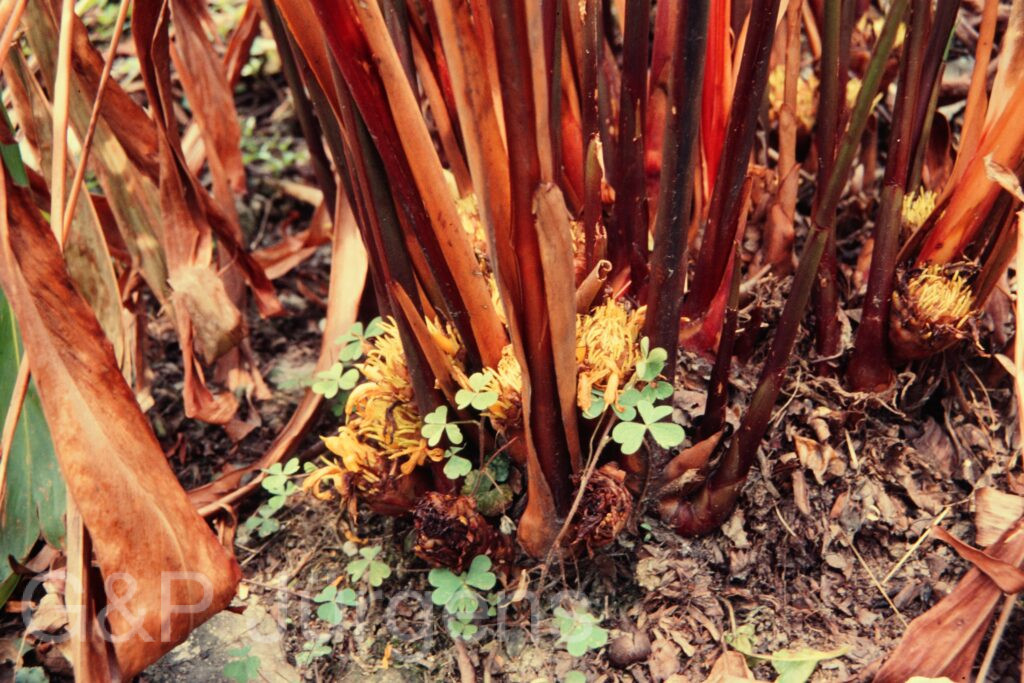
Amomum subulatum, the large or black cardamom, is native to the moist sub-Himalayan tracts of eastern Nepal, north-eastern India, Bhutan and adjacent China, the roughly 108 GBIF records reflecting both wild and extensively cultivated populations; records from the United States, Germany and Korea derive from cultivation and herbarium material. It grows in the shaded understorey of moist broad-leaved forest, along streams, ravines and damp shaded slopes, typically between about 600 and 2000 m, and is widely grown under forest shade as a cash crop. The photographed plant from the Mewa-Khola valley of Nepal at 1160 m in April is characteristic of its warm, humid lower-montane habitat.

It is a tall, tufted, rhizomatous perennial forming dense clumps of leafy pseudostems one to two metres high arising from a stout, creeping rhizome. The leaves are large, lanceolate, glabrous and distichous, with a long-acuminate (subulate) apex giving the species its name, and clasping sheaths. The inflorescence is a dense, head-like spike borne on a short scape at the base of the clump, the flowers with a yellowish, red-streaked labellum subtended by bracts. The fruit is a globose to ovoid, reddish-brown, ribbed and warty capsule containing numerous aromatic, blackish seeds.

Amomum belongs to the ginger family Zingiberaceae (here misspelled in the source) and is a major economic plant of the eastern Himalaya, the dried capsules forming the black cardamom of commerce, valued as a spice and in traditional medicine. Cultivation under natural forest canopy makes it an important agroforestry species. It is not of conservation concern, though wild genetic resources and the shade-forest systems that sustain its cultivation merit protection.

Author: Roxb. · Sources: POWO (Kew), GBIF, Flora of China, Flora of Bhutan, Annotated Checklist of the Flowering Plants of Nepal, Zingiberaceae of the Himalaya (taxonomic monograph)