Tag:

Spring

(Hook. f. & Thomson) Hook.f.
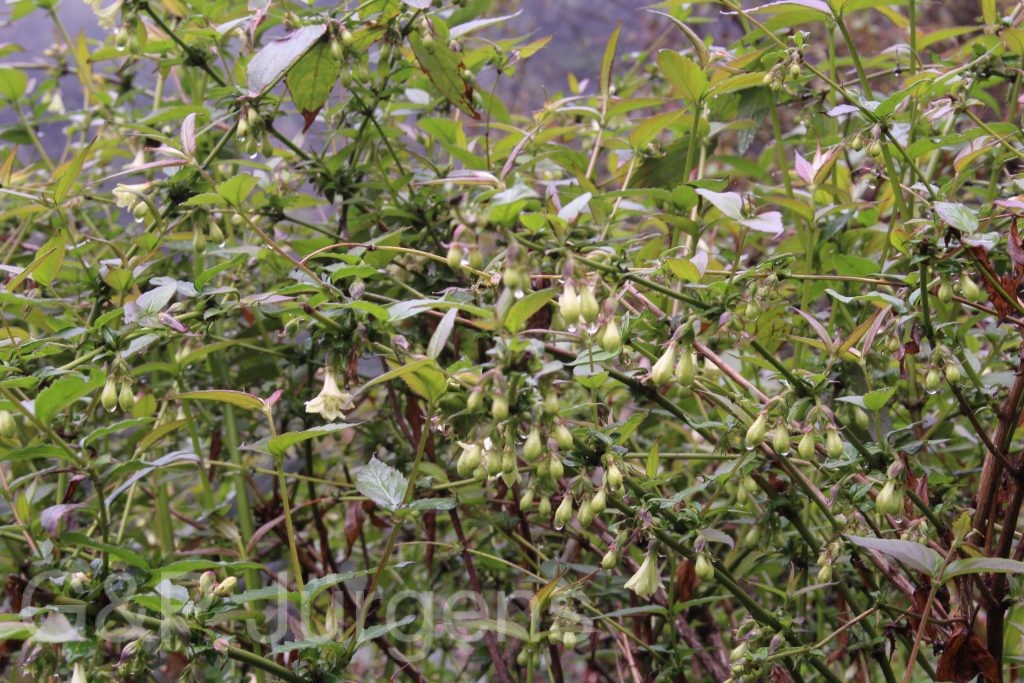
Bhutan2014 312
Bhutan Tumching-La 2600m, May

Description

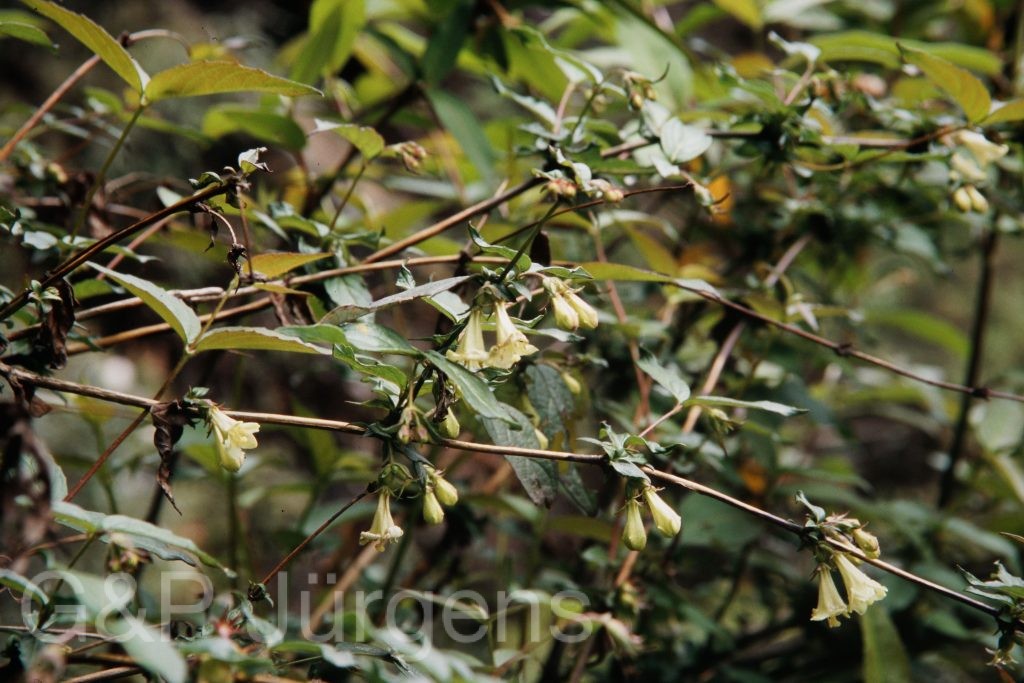
Leycesteria glaucophylla is an eastern Himalayan shrub distributed across India, China, Bhutan and Nepal and into Myanmar; GBIF documents about 113 occurrences, including a few cultivated records in Great Britain and New Zealand. It is a plant of temperate montane forest, occurring at forest margins, in shrubberies, along stream sides and in clearings, generally between about 2000 and 3000 m. The photographed individual grows in Bhutan at Tumching La at around 2600 m in May, a setting typical of this shade-tolerant honeysuckle relative within the cool, humid forests of the eastern Himalaya during the pre-monsoon period.

The species is an erect, deciduous shrub with hollow, often glaucous young stems. The leaves are opposite, ovate to lanceolate, acuminate, entire to slightly toothed, and conspicuously glaucous, particularly beneath, a feature reflected in the epithet glaucophylla. The flowers are borne in pendulous, bracteate terminal and axillary inflorescences subtended by leafy bracts; each has a tubular, funnel-shaped, white to pinkish corolla with five short lobes. The fruit is a many-seeded berry ripening to a dark purplish colour, attractive to birds which act as the principal seed dispersers.

Leycesteria glaucophylla (Hook.f. & Thomson) Hook.f. belongs to a small genus of Himalayan and Sino-Himalayan shrubs allied to Lonicera, placed in Caprifoliaceae; its showy bracts and pendulous spikes give the genus ornamental interest, and several species are cultivated. The species is restricted to the eastern Himalaya and adjacent ranges but is locally frequent in montane forest and not currently regarded as threatened. Its bird-dispersed berries aid colonisation of forest gaps and margins.

Author: (Hook. f. & Thomson) Hook.f. · Sources: POWO (Kew), GBIF, Flora of Bhutan, Flora of China, taxonomic revisions of Leycesteria (Caprifoliaceae)
(Kurz) Airy Shaw

Bh2008 326 P504
Bhutan Jakar, 3000m April

Description

Leycesteria gracilis is a Himalayan and Sino-Himalayan shrub, GBIF recording around 232 occurrences from China, India, Bhutan, Nepal and Myanmar, with scattered records from Japan. It grows in the understorey and at the margins of temperate broadleaved and mixed forest, in shrubberies, along forest tracks and on shaded, moist banks, generally at mid to upper montane elevations between about 2400 and 3300 m. The plant photographed from Jakar (Bumthang) in central Bhutan at 3000 m, in early flower in April, is characteristic of its preference for cool, humid montane forest where it leafs and blooms in spring ahead of the summer rains.

It is a slender, erect to arching deciduous shrub with hollow, often glaucous young stems, more delicate in habit than its relative L. formosa—hence "gracilis." The leaves are opposite, ovate-lanceolate to lanceolate, long-acuminate, entire to finely toothed and thin in texture. The flowers are borne in pendulous, interrupted spikes or whorled clusters subtended by leafy, sometimes purplish bracts; each has a small calyx and a tubular to funnel-shaped, five-lobed corolla in shades of white, pink or pale purple. The fruit is a small, several-seeded berry ripening dark purplish to nearly black.

Transferred by Airy Shaw from Kurz's original epithet, L. gracilis belongs to the small Himalayan genus Leycesteria, now placed in Caprifoliaceae in its broad modern sense. It is locally frequent and not regarded as threatened, though dependent on intact montane forest. Ecologically its tubular flowers attract insect and bird pollinators, while its fleshy dark berries are taken by birds that disperse the seed, making it a useful component of regenerating montane scrub.

Author: (Kurz) Airy Shaw · Sources: POWO (Kew), GBIF, Flora of Bhutan, Flora of China, Airy Shaw revision of Leycesteria (Caprifoliaceae)
Hook.f.

Sikkim2004 93 G163
Sikkim West-Bengal, Bersay 2700m April
Sikkim2004 117 G201
Sikkim West-Bengal, Bersay 2700m April

Description

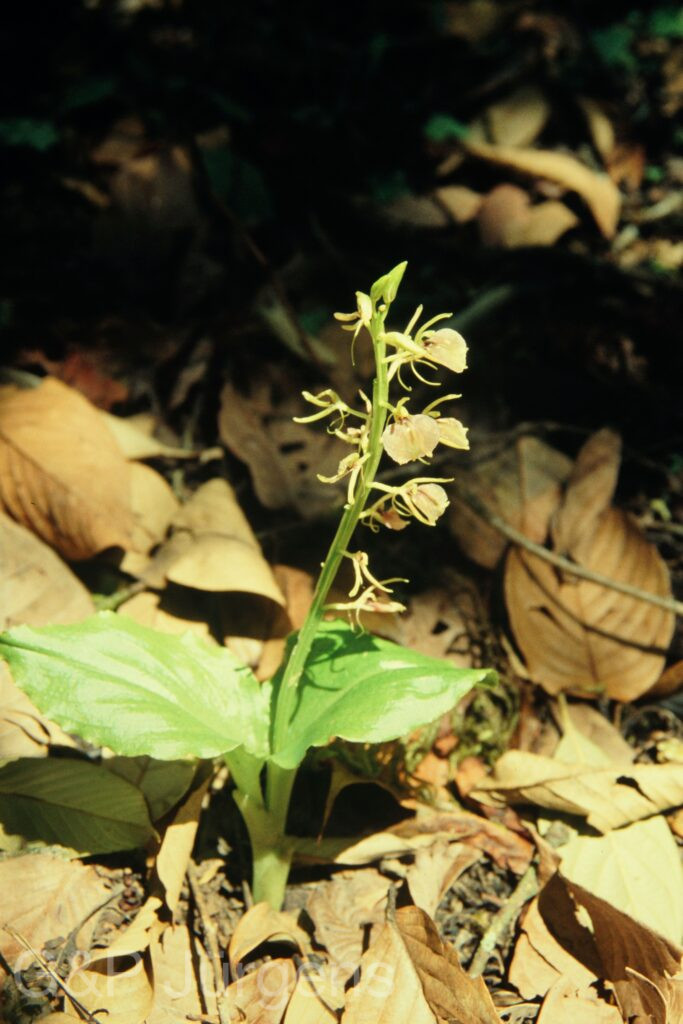
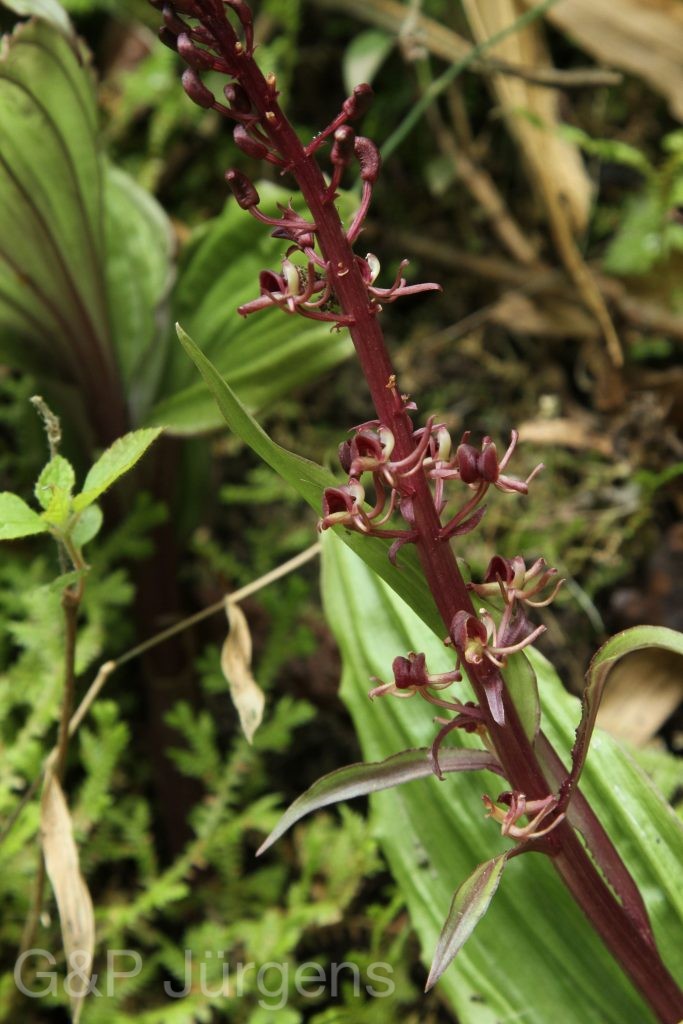
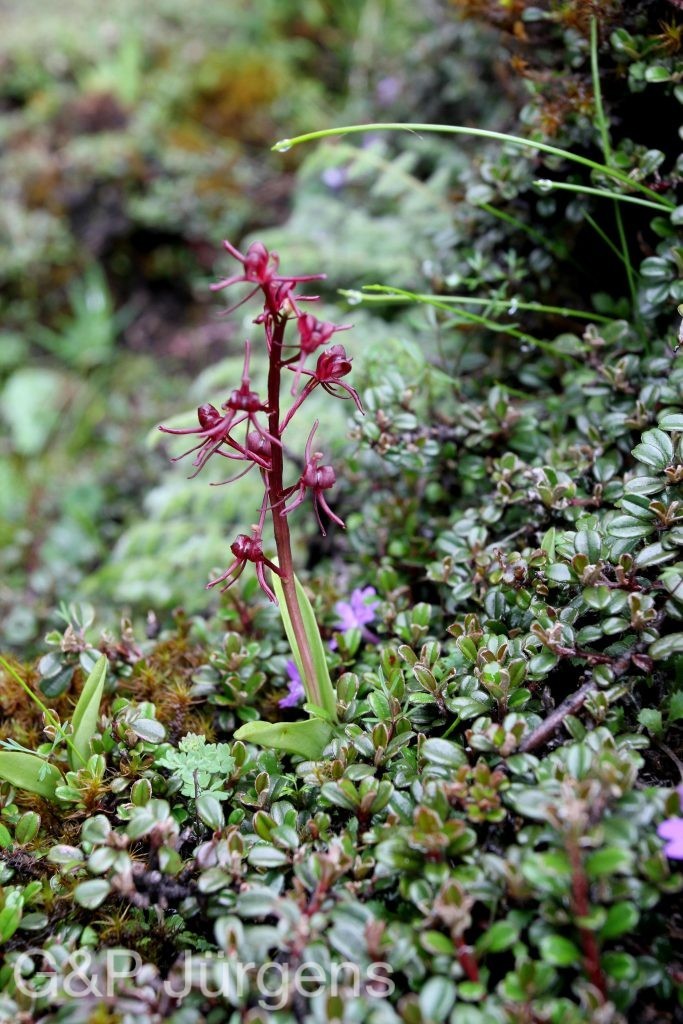
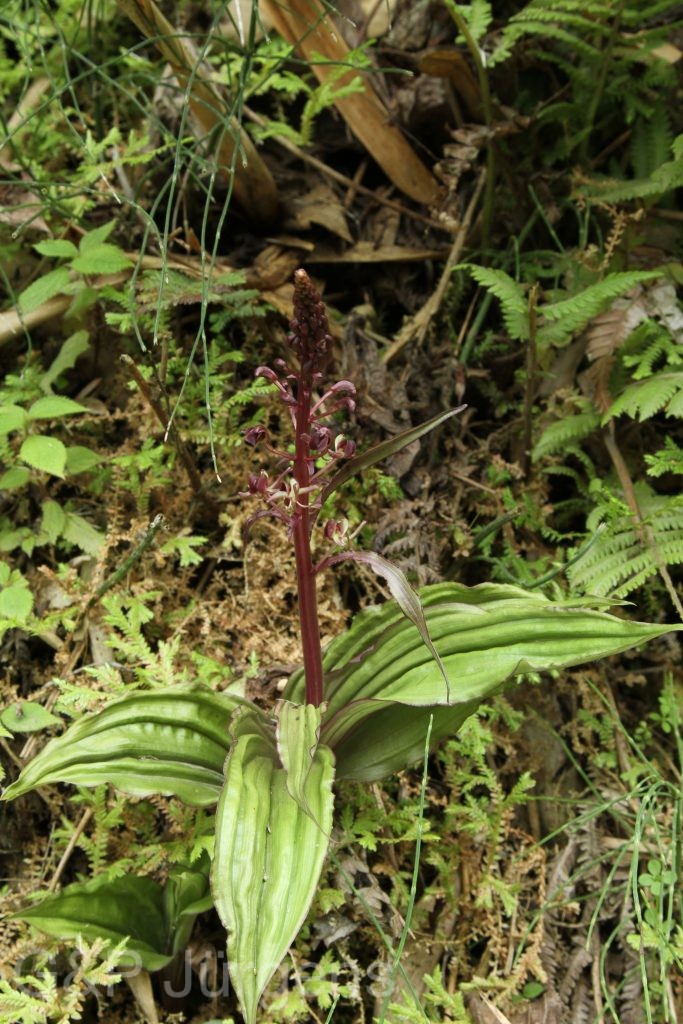
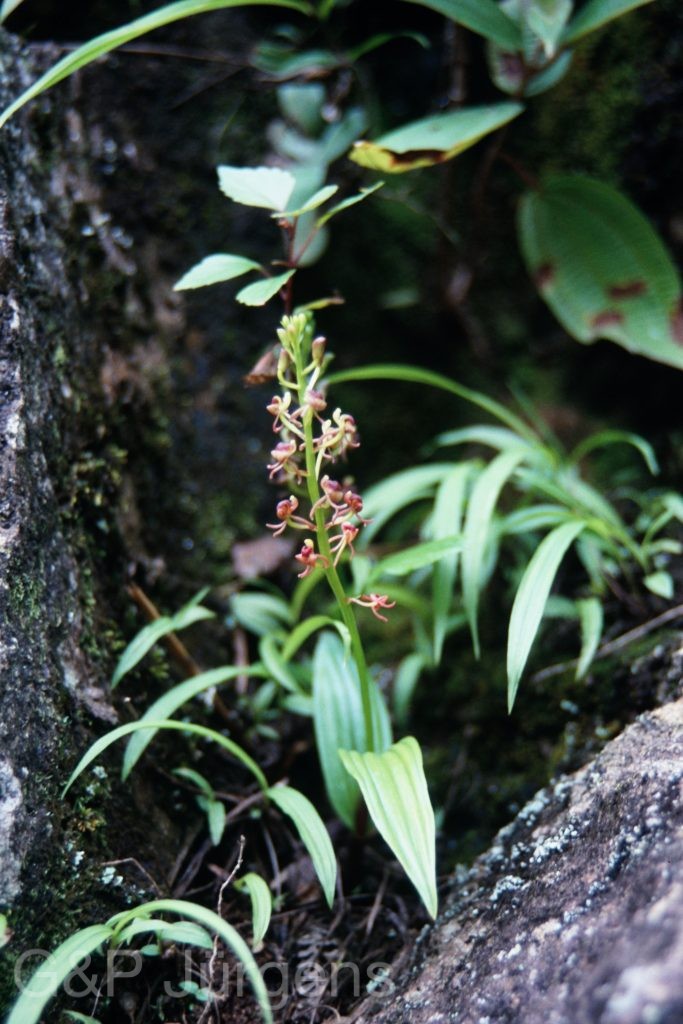
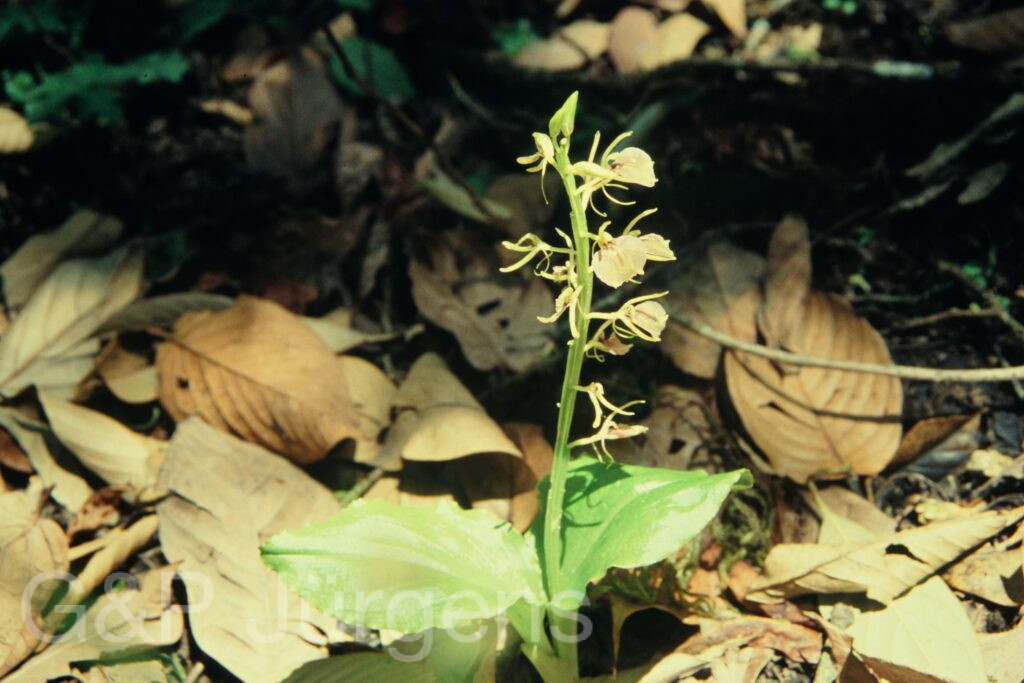
Liparis cathcartii is an East Himalayan terrestrial orchid known from a restricted range spanning northern India (Sikkim, West Bengal, Darjeeling), Nepal, Bhutan and south-eastern China; its modest tally of about 60 georeferenced occurrences (IN, CN, NP, BT) marks it as a regional endemic of the moist temperate forest belt. It grows in shaded, humus-rich leaf litter and on mossy banks within broad-leaved and mixed forest, generally between about 2000 and 3000 m. The plant photographed at Bersay on the Sikkim-West Bengal border at 2700 m in April, flowering early in the season, is typical of its cool, humid forest-floor habitat.

It is a small terrestrial herb arising from clustered, fleshy pseudobulbs partly sheathed by membranous scales. From each pseudobulb arise a few thin-textured, plicate, ovate to elliptic leaves with sheathing bases. The slender erect scape bears a lax raceme of several small flowers, greenish to purplish-brown in colour, with narrow spreading sepals and filiform petals; the lip (labellum) is the most distinctive organ, broad, recurved and often emarginate, contrasting with the slender column characteristic of the genus. The fruit is a small ellipsoid, ribbed capsule releasing abundant dust-like seeds dispersed by wind.

Liparis is a large, near-cosmopolitan genus of subtribe Malaxidinae, with Himalayan species notably diverse; L. cathcartii is allied to other temperate plicate-leaved members of the genus. Like most orchids it depends on mycorrhizal fungi for germination and is protected internationally under CITES Appendix II. Its narrow distribution and reliance on undisturbed forest make it sensitive to habitat loss, though it persists locally where forest cover remains intact.

Author: Hook.f. · Sources: POWO (Kew), GBIF, Flora of Bhutan, Flora of China, The Orchids of Sikkim Himalaya (King & Pantling), Genera Orchidacearum (Pridgeon et al.)

(Thunberg) Lindl.

Bhutan2014 786
Bhutan Wangdi Mo-Chu 1400m, May
BhutanPG2011 609 01
Bhutan Ludlow-Sherriff-Trail Ken-La, 4300m July
Also included: Cotoneaster microphyllus Lindb.
Bhutan2014 784
Bhutan Ludlow-Sherriff-Trail Ken-La, 4300m July
Sikkim2003 28 P39
Sikkim Rathong-Chu 1200m 08.2003

Rehder

Description

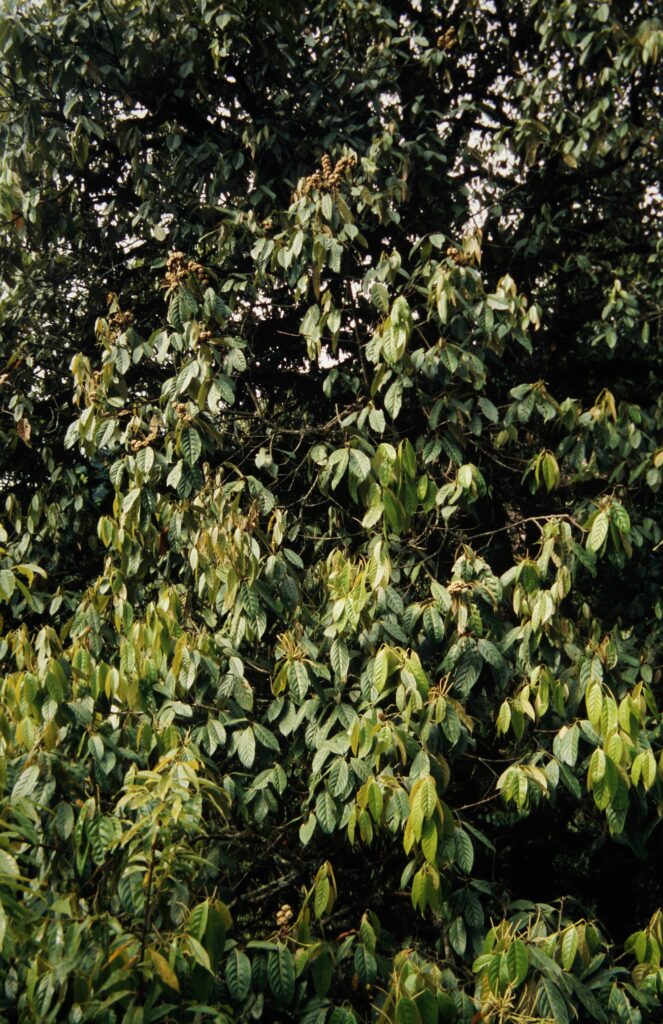
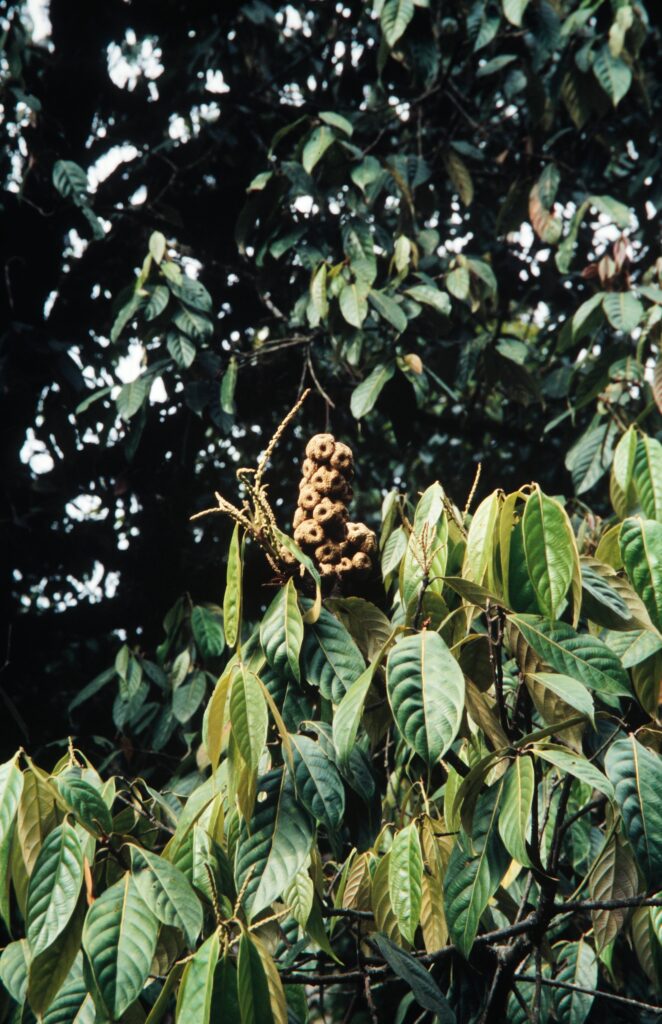
Lithocarpus pachyphyllus is a stone oak widely distributed across the eastern Himalaya and adjacent Southeast Asia, with records from China, India, Nepal, Myanmar, Bhutan, Thailand and Vietnam and a substantial occurrence base of around 229 georeferenced collections. It is a canopy and subcanopy tree of montane evergreen broadleaved forest, forming a conspicuous element of the laurophyllous oak-laurel belt on humid, well-drained slopes. The tree photographed at Ramman in West Bengal (India) at about 2250 m in May represents its characteristic position in the mid-montane cloud-forest zone, where Lithocarpus and Quercus species dominate the wet temperate forests of the southern Himalayan front.

It is an evergreen tree with a dense, rounded crown and grey, finely fissured bark. The leaves are coriaceous and pachyphyllous (thick-textured, as the epithet indicates), elliptic to oblong-lanceolate, entire-margined, glabrous and glossy above and dull beneath, with a prominent midrib and arcuate lateral veins. As in all Lithocarpus, the staminate flowers are borne in erect, rigid catkins rather than the pendulous catkins of true oaks, while the pistillate flowers are clustered at the base of the inflorescence axis. The fruit is a thick-walled nut seated in a woody cupule whose scales are typically arranged in concentric rings; the acorns are often densely aggregated along the rachis.

Lithocarpus is distinguished from Quercus chiefly by its erect staminate catkins and frequently aggregated, sessile fruits, features expressed clearly in this species. Its heavy, animal-dispersed acorns provide an important mast resource for montane wildlife, while the species contributes substantially to the structure and carbon stock of Himalayan oak forest. Although not currently of conservation concern across its broad range, local populations are reduced by timber extraction and the conversion of mid-elevation forest, making it a key indicator of intact wet temperate woodland.

Author: Rehder · Sources: POWO (Kew), GBIF, Flora of China Vol. 4, Flora of Bhutan Vol. 1, Flora of Nepal, Camus Les Chênes: Monographie du genre Lithocarpus

Roth

Bhutan2015 35
Bhutan Dochu-La 2700m, October
Bhutan2015 36
Bhutan Dochu-La 2700m, October
Bhutan2014 286
Bhutan Trithangebe at a farm, 800m May
Bhutan2012 338
Bhutan Dochu-La 3000m, September

Description

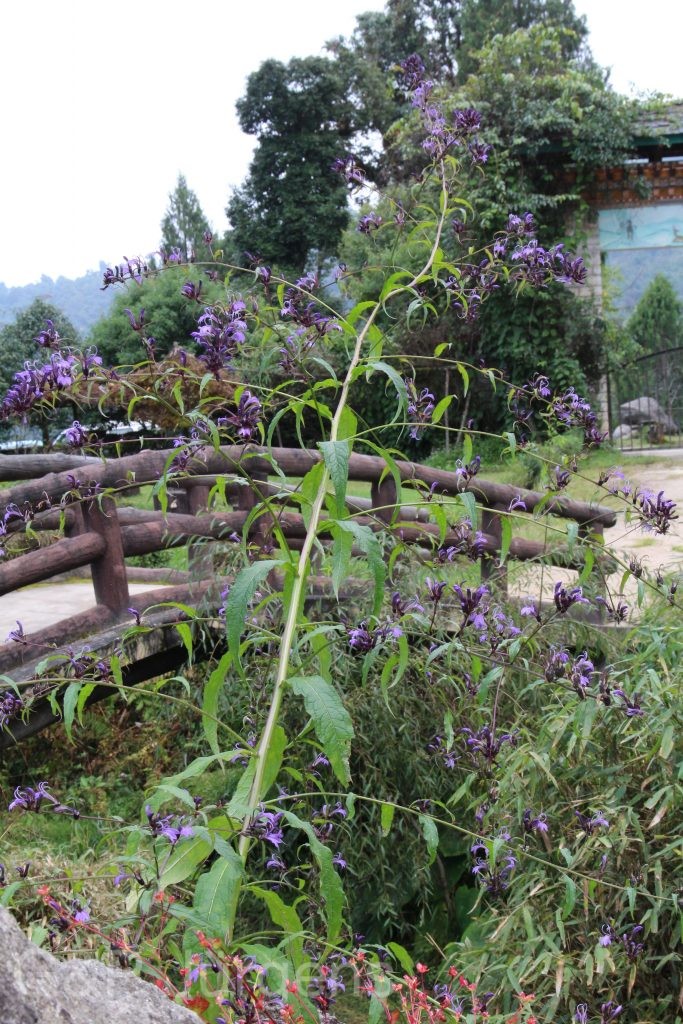
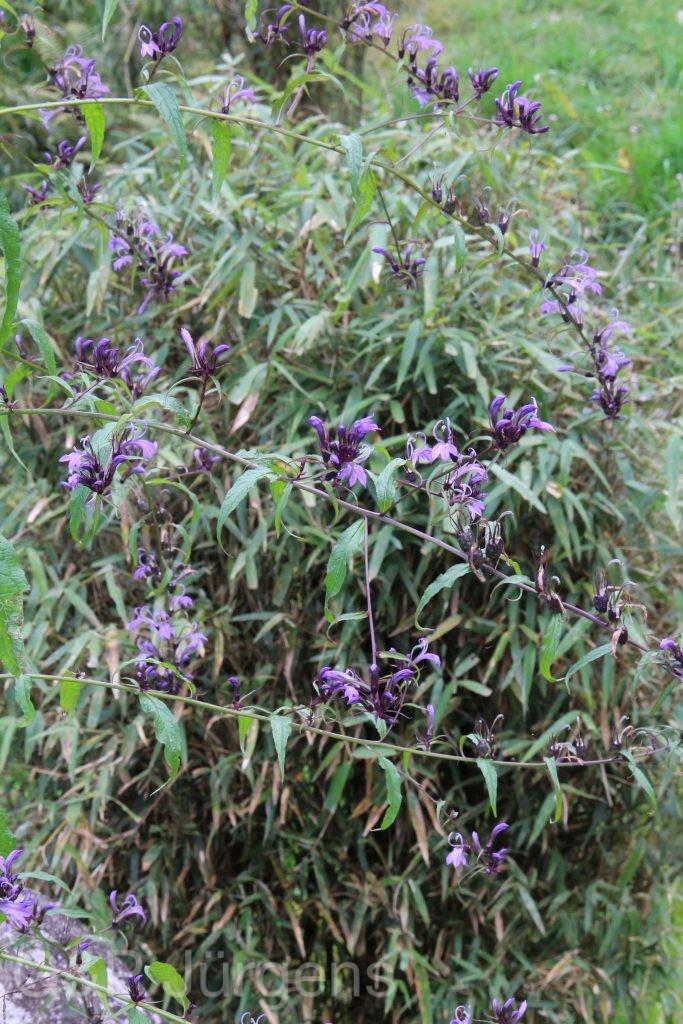
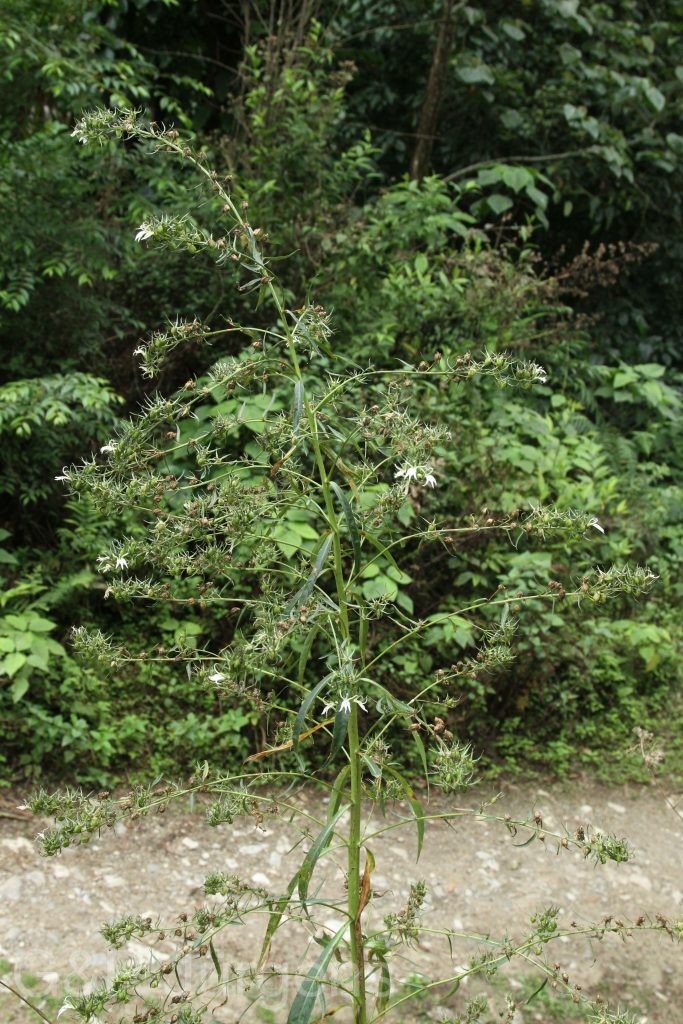
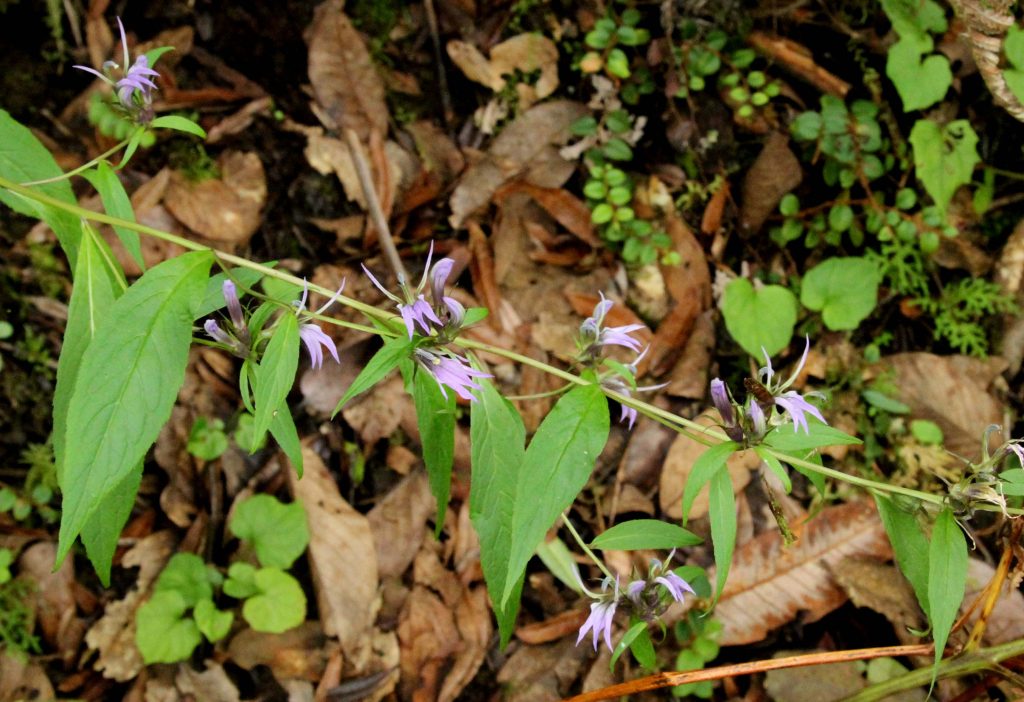
Lobelia nicotianifolia is a robust, wide-ranging lobelia of the Indian subcontinent and tropical Asia, documented from India, China, Sri Lanka, Nepal, the Philippines, Thailand, Myanmar, Indonesia, Bangladesh, Vietnam, Bhutan, Laos, Malaysia and Taiwan, with around 763 occurrences making it one of the better-collected species in this set; New World records reflect cultivation or error. It occupies a wide altitudinal span, from warm foothill farmland to cool montane forest margins, favouring open, disturbed, moist ground along roadsides, clearings and field edges. The Bhutanese collections illustrate this breadth, ranging from a farm at Trithangebe at about 800 m in May to the Dochu-La between roughly 2700 and 3000 m flowering in September and October.

It is a tall, stout biennial or short-lived perennial herb, sometimes exceeding two metres, with an erect, little-branched stem exuding acrid milky latex when cut. The leaves are large, alternate, lanceolate to elliptic, finely toothed and tobacco-like in size and texture, hence the epithet nicotianifolia, the lower ones forming a substantial basal array. The flowers are borne in a long, dense terminal raceme; each is zygomorphic with a tubular, two-lipped corolla, typically pale greenish-white to bluish, split nearly to the base, the upper lip of two narrow lobes and the lower of three, the stamens connate into a staminal tube around the style. The fruit is a many-seeded capsule dehiscing at the apex.

Within Campanulaceae, Lobelia is a large genus distinguished by strongly bilabiate flowers and syngenesious anthers, and tall species such as this are notable for their imposing single-stemmed inflorescences and their pyridine alkaloids related to lobeline, giving them a long history of medicinal and folk use. The acrid latex deters herbivores, and the protandrous flowers favour outcrossing by insect visitors. Common and adaptable across a vast range, the species is of no conservation concern and behaves as a colonist of disturbed, anthropogenic habitats.

Author: Roth · Sources: POWO (Kew), GBIF, Flora of Bhutan, Flora of China, Flora of British India, Lammers's monographic studies of Lobelia (Campanulaceae)

Lam.

Sikkim 2006 457 ergebnis
India West-Bengal, Ruigi-Chu 2100m, May

Description

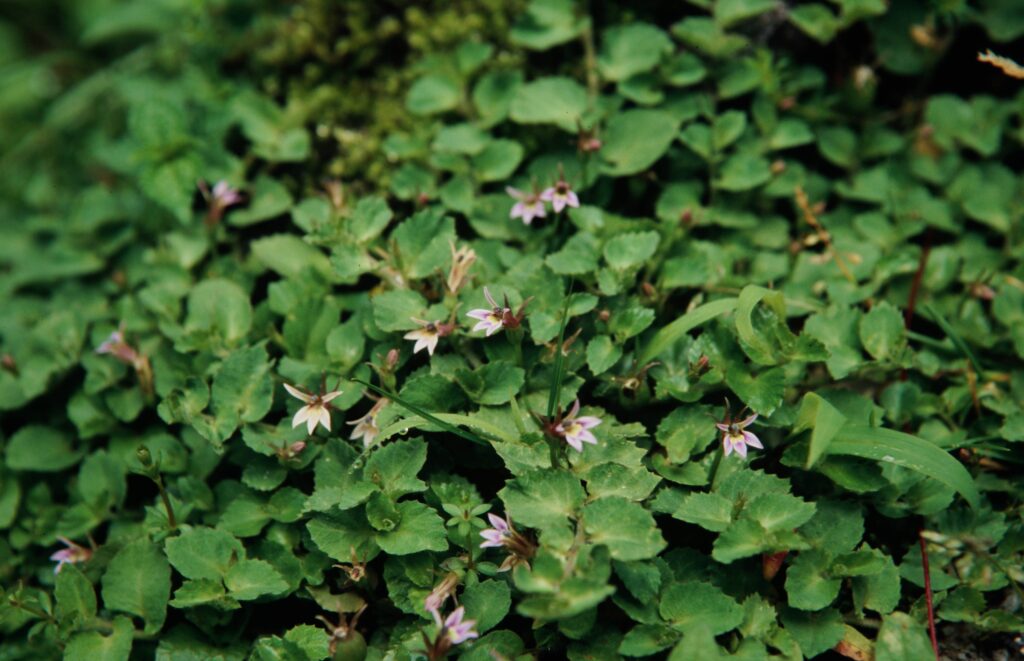
Lobelia nummularia is a creeping, mat-forming perennial herb of the Campanulaceae (subfamily Lobelioideae), widely distributed across tropical and subtropical Asia. GBIF data (over 2,600 occurrences) confirm a broad native range spanning the eastern Himalaya, southern China, Taiwan, Indochina, the Malesian region and Papua New Guinea, with naturalised or cultivated records further afield. The species favours shaded, humid forest floors, mossy banks, ravine sides and the margins of streams in evergreen broadleaved and subtropical montane forest. The collection from the Ruigi-Chu valley in West Bengal at 2,100 m in May illustrates its habit of carpeting damp, sheltered ground in the lower montane belt.

The slender, prostrate stems root at the nodes and form extensive mats. Leaves are alternate, small, orbicular to broadly ovate or cordate, shortly petiolate, with shallowly crenate to serrate margins, the rounded coin-like blades giving rise to the epithet nummularia. The solitary axillary flowers are borne on long, filiform pedicels. The corolla is bilabiate, pale purplish-pink to whitish, with the two upper lobes erect and the three lower lobes spreading; the five anthers are fused into a tube around the style. The fruit is a small, more or less globose to subglobose capsule containing numerous minute seeds.

Members of subfamily Lobelioideae are characterised by their resupinate, strongly zygomorphic flowers and connate anthers, and like many lobelias the species contains piperidine alkaloids. As a ground-cover element of intact understorey, L. nummularia contributes to soil stabilisation on humid forest banks. Its very wide distribution renders it secure overall, though forest clearance threatens local populations dependent on continuous shade and humidity.

Author: Lam. · Sources: POWO (Kew), Flora of China Vol. 19, Flora of Bhutan Vol. 2, GBIF, Lammers: World Checklist and Bibliography of Campanulaceae (2007)

Wall.

Nepal 2001 514 ergebnis ergebnis
Nepal (Gorkha) Mulabari 1340m, May

Description

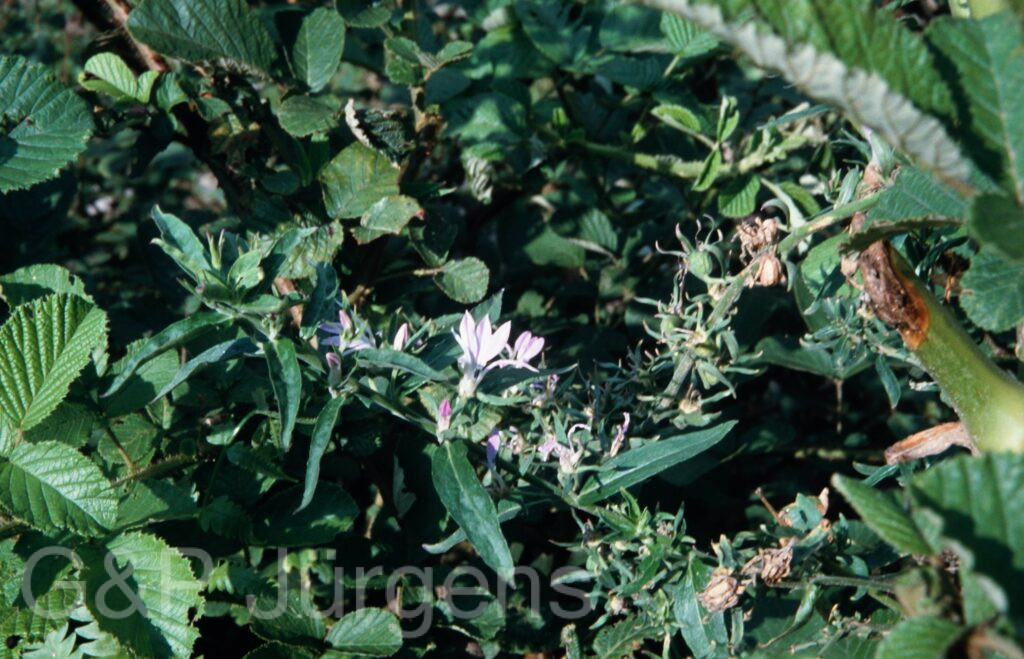
Lobelia rosea is a slender annual or short-lived herb of the eastern Himalaya and Indo-Burmese region, ranging from Nepal, Bhutan and north-east India through Myanmar, Thailand, Laos and Vietnam to southern China and peninsular Malaysia. GBIF records 112 occurrences across this subtropical to warm-temperate arc. It favours moist open ground, stream and paddy margins, damp grassy banks and disturbed clearings at low to middle elevations. The plant from Mulabari in Gorkha, central Nepal, at 1340 m in May is a typical pre-monsoon population on humus-rich soil in light shade.

It is a delicate herb with erect or ascending, simple or sparingly branched stems exuding milky latex when broken. The leaves are alternate, sessile or shortly petiolate, ovate to lanceolate, serrate to denticulate and thin in texture. The flowers are borne in lax terminal racemes on slender pedicels. The corolla is markedly zygomorphic and two-lipped, pink to rose-purple (whence rosea), the tube split dorsally and the lower lip three-lobed; the five anthers are connate around the style into the Lobelia tube, the two lower ones tufted apically. The fruit is a small two-valved capsule dehiscing apically to shed numerous minute, reticulate seeds.

Lobelia, the largest genus of Campanulaceae (subfamily Lobelioideae), is sometimes segregated, but molecular evidence supports its retention within an expanded Campanulaceae. L. rosea belongs to a group of small-flowered Asian annuals delimited chiefly by corolla colour, leaf shape and capsule form. Like its congeners it contains piperidine alkaloids, and several Asian Lobelia species feature in traditional medicine. Widespread and weedy, persisting readily in disturbed seasonally moist habitats, it is of no conservation concern.

Author: Wall. · Sources: POWO (Kew), GBIF, Flora of China Vol. 19, Flora of Bhutan Vol. 2, Annotated Checklist of the Flowering Plants of Nepal, Lammers world checklist of Campanulaceae

Hardw.

Bhutan2014 1083
Bhutan Paro 2000m, May

Description

Lonicera quinquelocularis is a deciduous shrub of the Himalayan and Sino-Himalayan temperate zone, ranging from Afghanistan and Pakistan eastward through India, Nepal and Bhutan into south-western China; with some 873 georeferenced records it is among the better-documented honeysuckles of the region (European and North American records reflect cultivation). It grows in open forest, scrub, forest margins, riverine thickets and rocky hillsides, chiefly between 1500 and 3000 m. The illustrated plant from Paro in western Bhutan at 2000 m, flowering in May, typifies its occurrence in the temperate broadleaf and conifer zone where it forms part of the understorey and forest-edge shrub community.

It is a much-branched shrub 2-5 m tall with greyish, peeling bark and ovate to elliptic, entire leaves that are softly pubescent, often greyish beneath, arranged in opposite pairs. The flowers are borne in axillary pairs on a common peduncle; each is two-lipped and creamy-white, ageing to yellow, fragrant, with a short tube. The bracts and bracteoles subtend the paired ovaries. A diagnostic feature reflected in the epithet is the five-locular ovary. The most striking character is the fruit: the two berries of each pair fuse and ripen translucent, the seeds visible within, turning purple-black, giving rise to the English name "translucent-berry honeysuckle."

Described by Hardwicke (as Hardw.), the species belongs to Lonicera section Coeloxylosteum of the Caprifoliaceae. The conspicuous semi-transparent berries are dispersed by birds, while the nectar-rich flowers attract bees and other insects. The species is widespread and locally common, used as fuel and hedging and occasionally cultivated as an ornamental; it is not considered threatened.

Author: Hardw. · Sources: POWO (Kew), GBIF, Flora of Bhutan, Flora of Pakistan, Flora of China, Rehder's monograph of Lonicera (Caprifoliaceae)

(Wall.) Drude

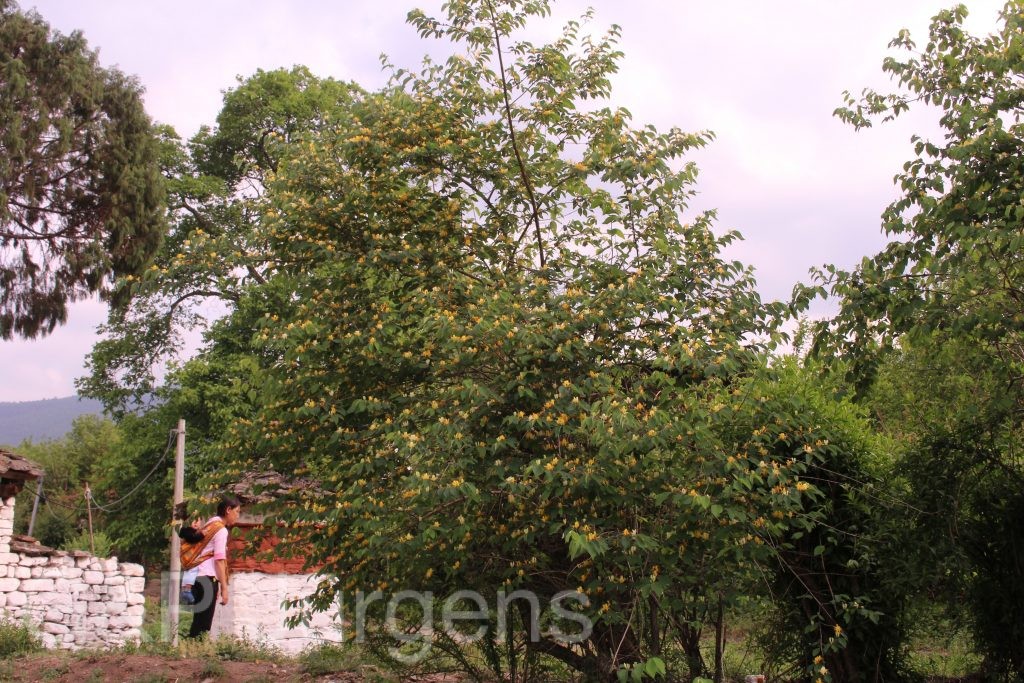
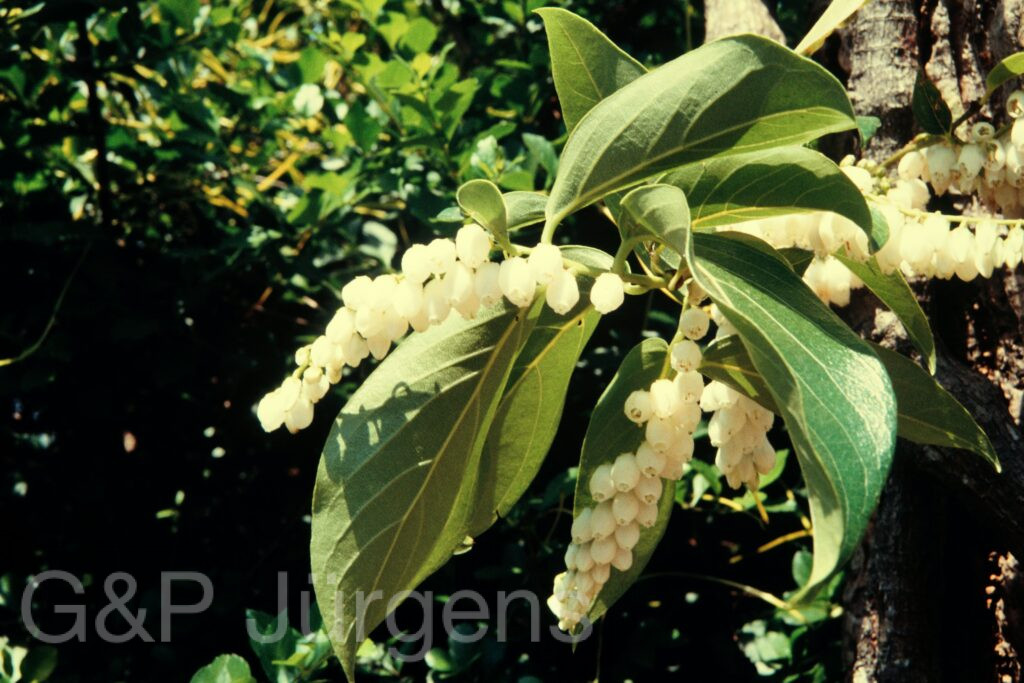
Nepal 97 517 P1015
Nepal Chinchilla 1950m May
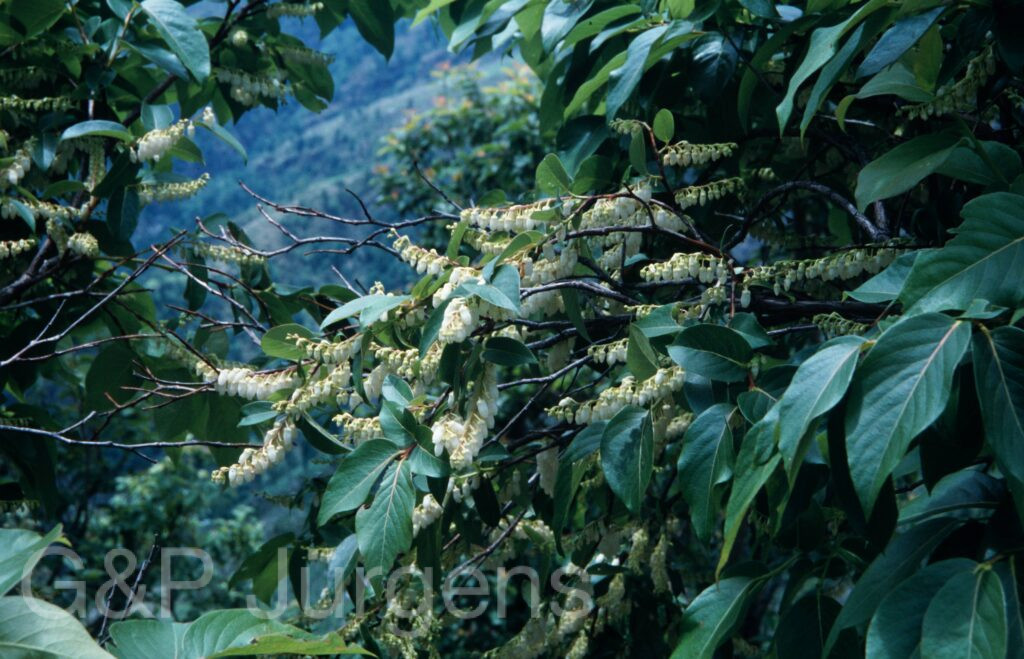
Nepal 2001 521 ergebnis ergebnis
Nepal (Gorkha) Mulabari 1360m, May

Description

Lyonia ovalifolia is a widespread Sino-Himalayan and East Asian shrub or small tree distributed from China, Japan and Taiwan through Nepal, India, Bhutan, Pakistan, Myanmar, Thailand and Indochina, with a large GBIF dataset of over 13000 records. It grows on open hillsides, forest margins, thickets and in pine and oak forest understorey, typically between about 1000 and 3000 m. The illustrated plants from Chinchilla at 1950 m and Mulabari in Gorkha at 1360 m in Nepal, both flowering in May, are typical of its subtropical to temperate montane habitats, where it is a common component of the secondary scrub and open forest of the Himalayan midlands.

It is a deciduous to semi-evergreen shrub or small tree with reddish-brown, often somewhat zigzag young branchlets. The leaves are alternate, ovate to ovate-elliptic or ovate-lanceolate, with an entire margin, an acuminate apex and a rounded to subcordate base, with pinnate venation. The flowers are borne in axillary racemes along the shoots, each with a small five-lobed calyx and an urceolate (urn-shaped) white corolla with five short recurved lobes, ten included stamens and a superior ovary. The fruit is a small, ovoid, woody, five-valved loculicidal capsule with a persistent thickened placental axis, releasing numerous minute seeds.

Lyonia belongs to the subfamily Vaccinioideae of the Ericaceae and, in common with many members of that family, contains grayanotoxin-type diterpenes, making the foliage toxic to livestock; the plant has local uses as an insecticide and in folk medicine. The urn-shaped flowers are pollinated by bees and other insects, and the tiny seeds are wind-dispersed from the dehiscing capsules. As an abundant and ecologically tolerant species across a vast range, L. ovalifolia is of least conservation concern.

Author: (Wall.) Drude · Sources: POWO (Kew), GBIF, Flora of China Vol. 14, Flora of Bhutan Vol. 2, Flora of Nepal, Flora of Pakistan, Judd Revision of Lyonia (Ericaceae) monograph