Tag:

Spring

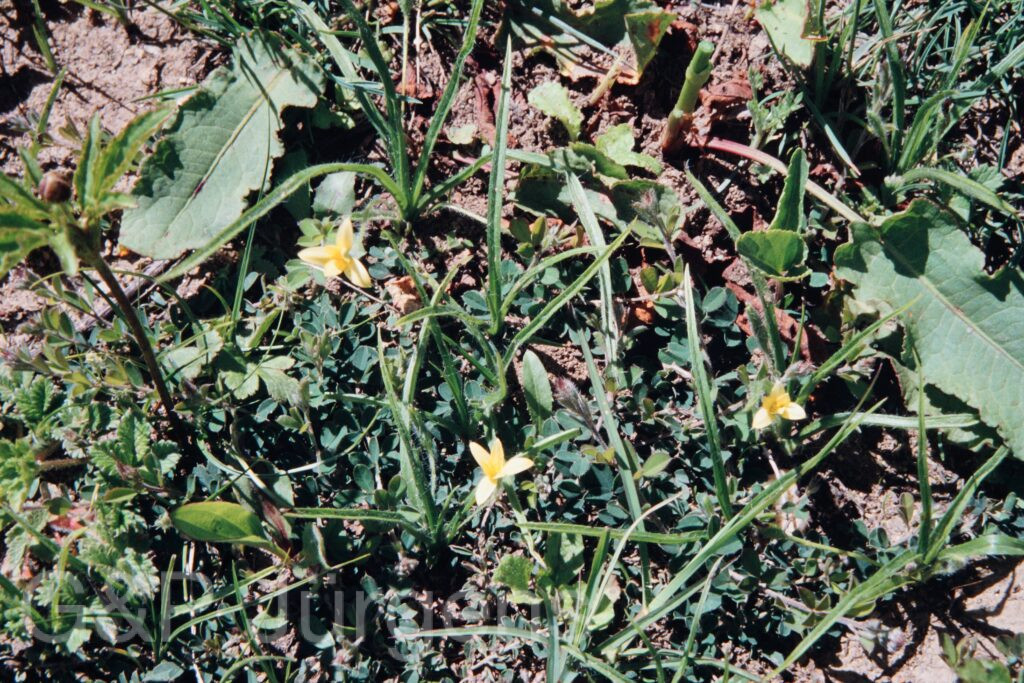
Hypoxis aurea

by GP Jürgens

Lour.

Nepal 97 491 P962
Nepal Num 1650m May
Nepal 99 198 ergebnis
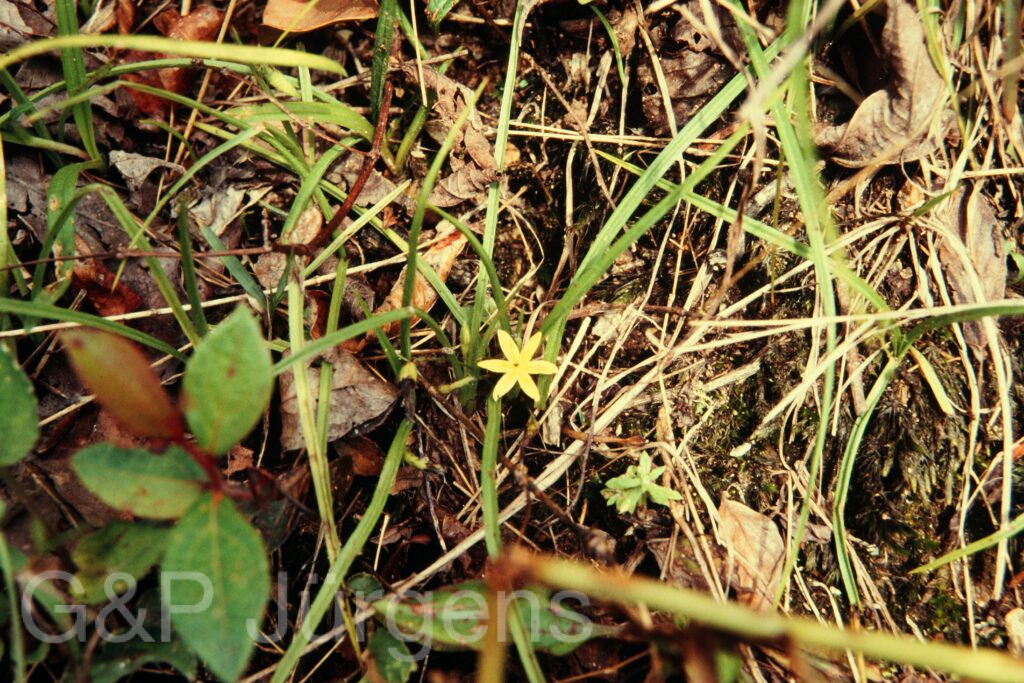
West-Nepal Lara-Lake 2900m, June

Description

Hypoxis aurea Lour. is a small cormous geophyte of the Hypoxidaceae with a wide Asian and Pacific distribution, recorded from India, Nepal, Bhutan, Sri Lanka and China through Taiwan, Japan and Korea, across Southeast Asia (Myanmar, Thailand, Vietnam, Laos, Cambodia, Indonesia, the Philippines) to New Guinea, with around 1,240 georeferenced occurrences. It grows in open, well-lit grassy habitats: hill grassland, open pine and oak woodland, pasture, terrace banks and disturbed slopes, often in seasonally moist soils. The photographed plants from Num at about 1,650 m and from the Lara-Lake area of West Nepal at about 2,900 m, flowering in May and June, show its broad altitudinal span from subtropical foothills to the lower-temperate zone in the Himalaya.

It is a perennial herb arising from a small ovoid to tuberous corm. The leaves are all basal, several, narrowly linear and grass-like, often keeled and clothed (especially toward the base) in long soft hairs. The flowers are borne singly or few together on slender scapes shorter than or about equalling the leaves; each has six spreading yellow tepals, golden within and frequently greenish and hairy on the outer surface, with six stamens and an inferior, hairy ovary. The fruit is a small capsule opening to release numerous tiny black, often muricate seeds.

Hypoxis is a chiefly tropical and warm-temperate genus of grassland geophytes, and its members are well adapted to fire and seasonal drought through the perennating corm, which resprouts after burning or dry-season dormancy. The yellow, pollen-rich, nectarless flowers attract pollen-gathering insects. Widely distributed and frequently associated with grazed and disturbed grassland, H. aurea is common across its range and not considered threatened.

Author: Lour. · Sources: POWO (Kew), Flora of China Vol. 24, Flora of Bhutan Vol. 3, GBIF, Nordal: Hypoxidaceae (in Kubitzki, 1998)
Wall.

Bh2008 420 P656
Bhutan Phobjika, 3100m April

Description

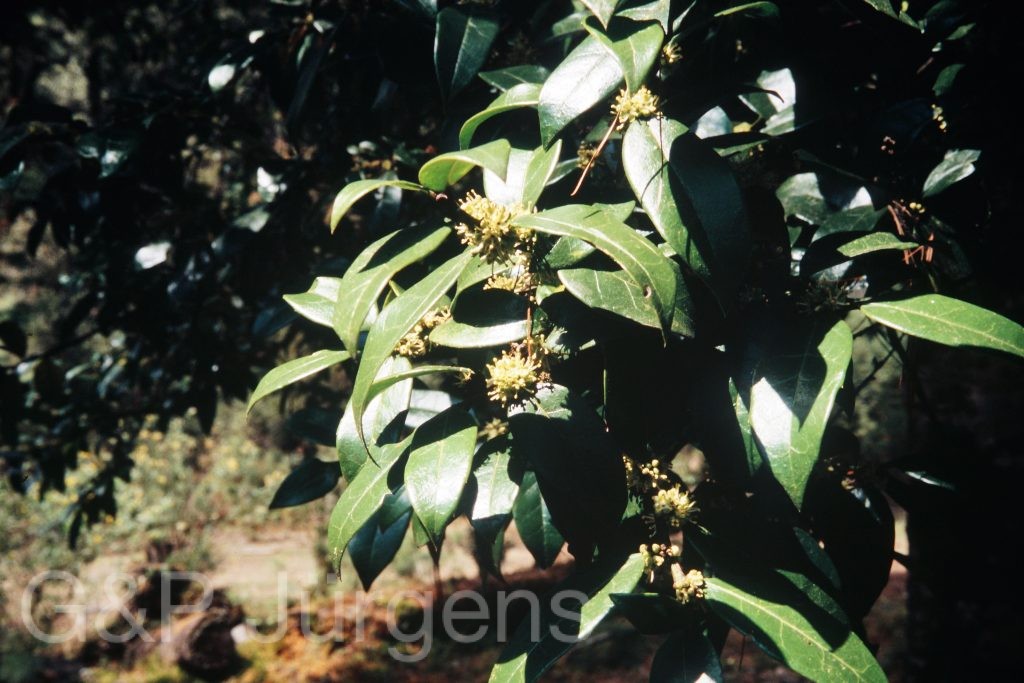
Ilex dipyrena, the Himalayan holly, is an evergreen tree or large shrub distributed along the Himalaya from Pakistan and northern India through Nepal, Sikkim and Bhutan into southern China (Yunnan, Xizang) and Myanmar. It is a characteristic constituent of cool temperate broad-leaved and mixed conifer forest, growing on shaded slopes, ridges and forest margins. It occurs mainly between about 1,800 and 3,300 m; the plant recorded in the Phobjikha valley of Bhutan at 3,100 m in April lies in the upper part of this band, within the moist temperate forest belt where it forms part of the evergreen understorey.

The plant is a small to medium-sized tree with greyish bark and glabrous twigs. The leaves are alternate, leathery and glossy dark green, elliptic to oblong-lanceolate, with a spinose-dentate margin bearing rigid marginal teeth on vigorous shoots, the teeth often reduced on older growth. The plant is dioecious, with small greenish-white, four-merous flowers clustered in the leaf axils. The fruit is a globose drupe ripening dull red, containing typically two pyrenes, a feature reflected in the epithet dipyrena, distinguishing it from the four- to five-seeded common holly.

Ilex is a large, near-cosmopolitan genus and the sole member of its family. Ilex dipyrena, described by Wallich, is the principal native holly of the Himalaya and a long-cultivated ornamental and parent of garden hybrids. Its evergreen, drupe-bearing habit provides food for birds, which disperse the seeds, and it contributes to the structure of temperate Himalayan forest. The species is widespread and common, and is not considered to be of conservation concern.

Author: Wall. · Sources: POWO (Kew), Flora of China Vol. 11, Flora of Bhutan Vol. 2, GBIF, Loizeau et al.: Ilex phylogeny

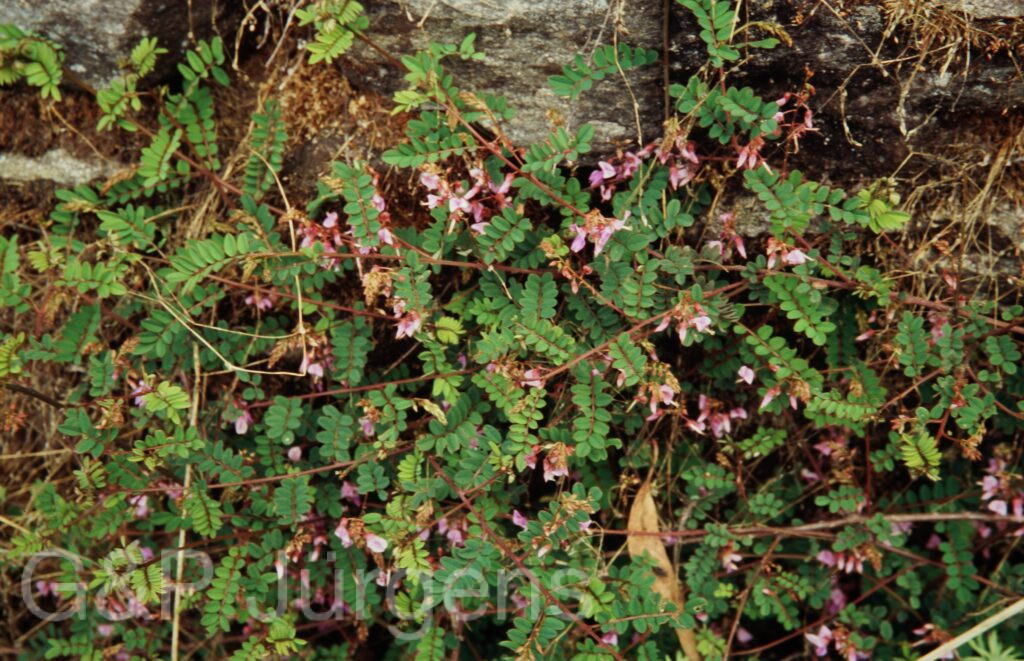
Buch.-Ham. ex D.Don

Bhutan2014 844
Bhutan Thimphu 2230m, May
Bh09 393 G625
Bhutan Mo-Chu, 1550m June

Description

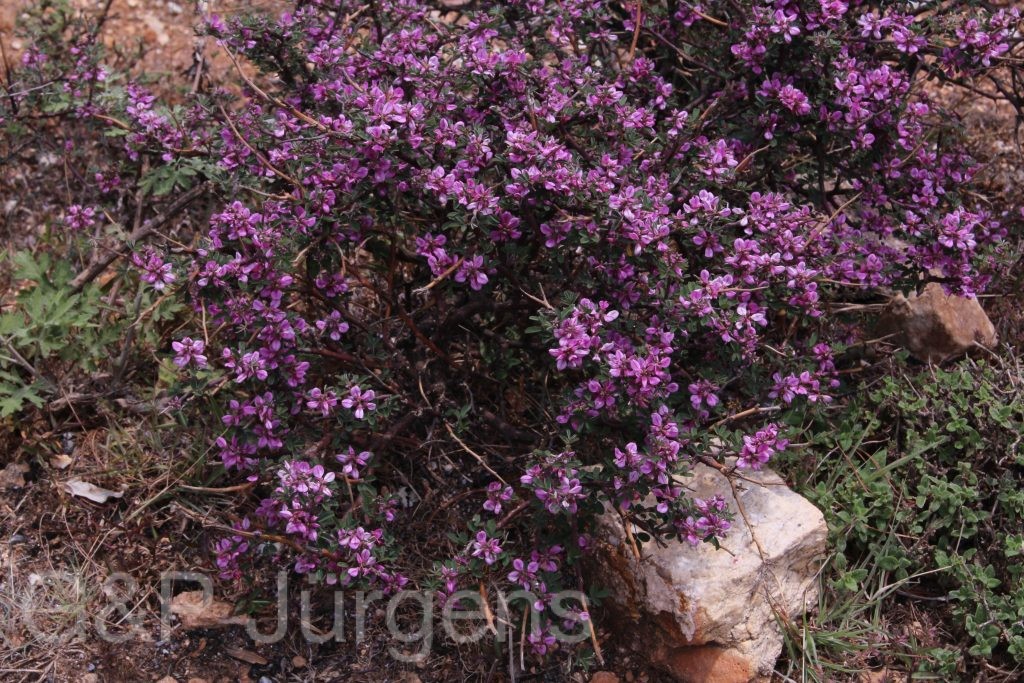
A shrubby indigo widespread across the Himalaya and South to South-East Asia, native to India, Nepal, China, Bhutan, Myanmar, Thailand and Vietnam, with around 436 GBIF occurrences (numerous European and other records represent cultivated or herbarium material). It grows on sunny open slopes, scrub, forest margins, roadbanks and disturbed ground in the warm-temperate and subtropical zones, mostly between about 1200 and 2700 m. The featured plants were recorded in Bhutan in May and June, at Thimphu around 2230 m and the lower Mo-Chu valley at about 1550 m, both warm montane settings.

The species is a much-branched, erect to spreading shrub with slender, ribbed twigs bearing characteristic appressed, biramous (medifixed) hairs. The leaves are imparipinnate with numerous small, opposite, oblong to obovate leaflets that are sparsely strigose and minutely mucronate. Flowers are borne in slender, elongate axillary racemes; each papilionaceous flower has a small campanulate calyx and a pink to purplish-red corolla comprising a broad standard, two wings and a spurred keel, with diadynamous stamens. The fruit is a slender, straight, linear, terete to slightly compressed pod that splits along both sutures to release several small, cylindric seeds, the valves often twisting on dehiscence.

Accepted by POWO and GBIF, I. dosua belongs to the large, taxonomically complex genus Indigofera, distinguished from relatives by its leaflet number, indumentum and pod form. As a nitrogen-fixing legume it enriches poor montane soils and colonises disturbed sites, while its flowers attract bees. Widespread, adaptable and frequent in secondary habitats, it is of no conservation concern and is sometimes used locally for fodder, green manure and as a dye source.

Author: Buch.-Ham. ex D.Don · Sources: POWO (Kew), GBIF, Flora of Bhutan, Flora of China, Sanjappa monograph of Indian Indigofera

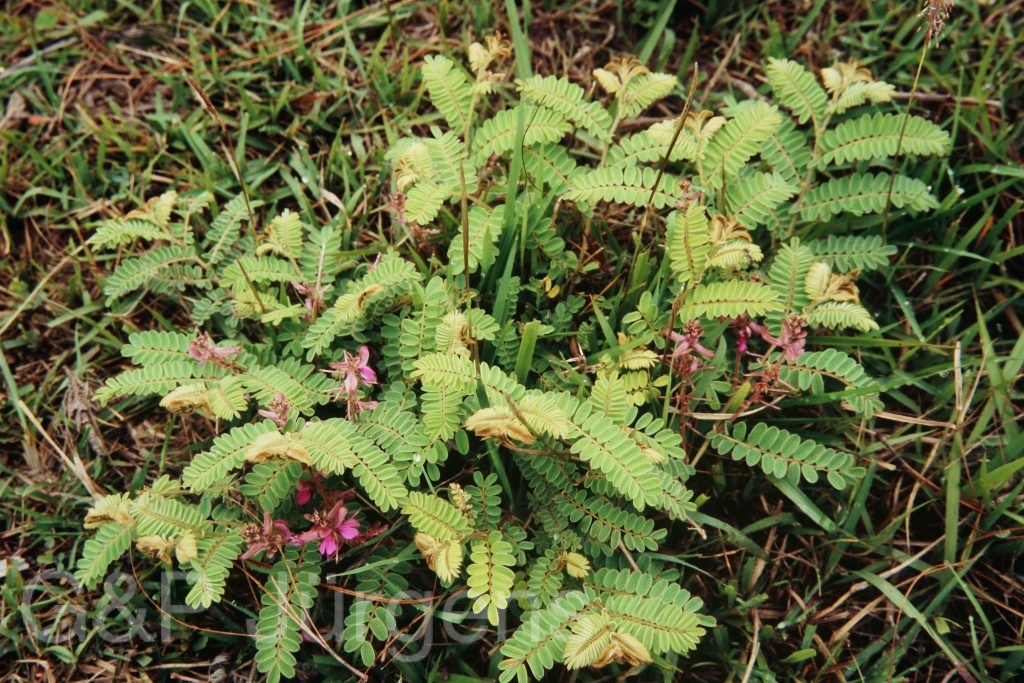
Nepal 2009 84 ergebnis
Nepal Helambu Bolgoau 2030, May

Description

Indigofera dosua var. dosua is a Himalayan shrub of the indigo genus, recorded by GBIF from Nepal and India with a comparatively small number of occurrences, around 19, reflecting limited collection rather than rarity. It grows on open hillsides, in scrub, along forest margins and on disturbed slopes in the subtropical to warm-temperate montane belt. The photographed plant was found in Nepal in the Helambu region at Bolgoau, around 2030 m, in May, a typical mid-elevation setting for this colonising legume of sunny, well-drained terrain.

It is an erect, branching shrub whose young shoots bear the appressed, two-armed (medifixed) malpighiaceous hairs characteristic of Indigofera. The leaves are imparipinnate with several pairs of small, opposite, elliptic to obovate leaflets, each mucronate and finely hairy. The flowers are borne in slender axillary racemes and have the typical papilionaceous structure, with a standard, two wings and a keel, generally pink to reddish or purplish, the keel bearing lateral spurs. The stamens are diadelphous and the superior ovary develops into a slender, cylindrical, several-seeded legume, the pod straight to slightly curved and dehiscing along both sutures.

GBIF accepts the name and its autonymic variety. Indigofera is a large pantropical genus historically significant as a source of natural indigo dye, and several Himalayan species are nitrogen-fixing pioneers of degraded slopes. The recognition of var. dosua implies the existence of other infraspecific variants distinguished by indumentum and leaflet number. As a widespread early-successional shrub, it is of no conservation concern.

Sources: POWO (Kew), GBIF, Flora of Nepal, Flora of British India, monograph of Asian Indigofera

L.

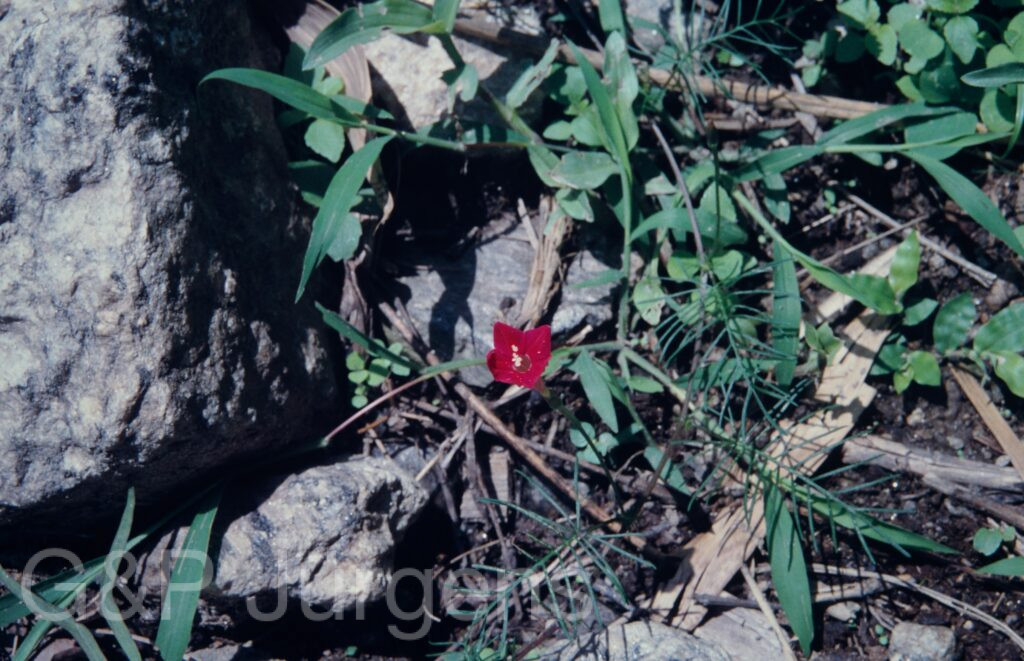
Nepal 1994 231 ergebnis
Ost-Nepal Mewa-Khola 1800m April 

Description

Ipomoea quamoclit, the cypress vine, is a twining annual of Neotropical origin now pantropically naturalised, with over 11,650 GBIF occurrences spanning the Americas (USA, Mexico, Brazil, Colombia, Ecuador, Peru, Venezuela), Asia (India, China, Taiwan, Korea, Japan, Indonesia, Thailand, Nepal), Australia and Africa. In its adventive Asian range it occupies disturbed ground, hedgerows, field margins, riverbanks and village thickets, frequently escaping from cultivation as an ornamental. The collection from the Mewa Khola in eastern Nepal at about 1,800 m in April reflects its establishment in warm low- to mid-montane situations.

It is a slender, glabrous, herbaceous climber to several metres. Its most distinctive feature is the foliage: the leaves are alternate, ovate in outline but pinnately divided almost to the midrib into numerous fine, filiform, parallel segments, giving a delicate feathery appearance. The flowers are solitary or few in axillary cymes, with a long, slender corolla tube expanding into a flat, five-angled, salverform limb about 1.5–2 cm across, brilliant scarlet (rarely white), with exserted stamens and style. The fruit is a small ovoid capsule containing few blackish, ovoid seeds.

The species, sometimes segregated as Quamoclit pinnata, is firmly placed within an enlarged Ipomoea, and GBIF treats the name as accepted. Its salverform red corolla and long tube reflect specialisation for pollination by hummingbirds in its native America and by butterflies and sunbirds elsewhere. Widely grown and self-seeding, it is locally weedy but of no conservation concern.

Author: L. · Sources: POWO (Kew), Flora of China Vol. 16, Flora of Nepal, GBIF, Austin & Huáman: A Synopsis of Ipomoea in the Americas (1996)

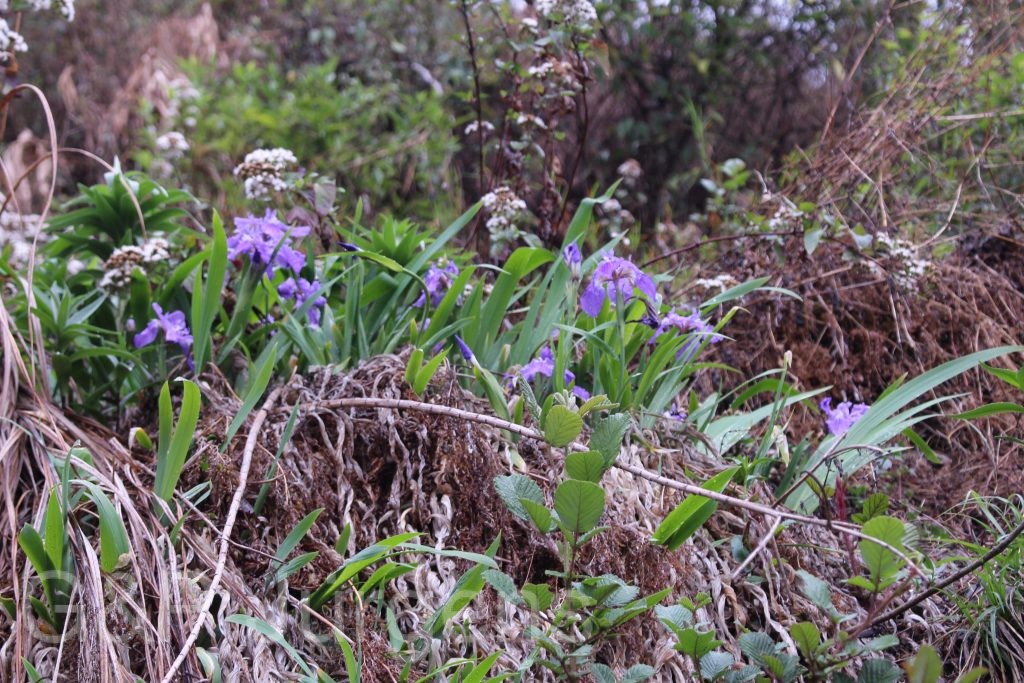
Iris tectorum

by G & P Jürgens

Maxim.

Bhutan2014 42
Bhutan Trashigang 1200m, May
Bhutan2014 974
Bhutan Chele-La 3400m, May
Bhutan2014 975
Bhutan Chele-La 3400m, May

Description

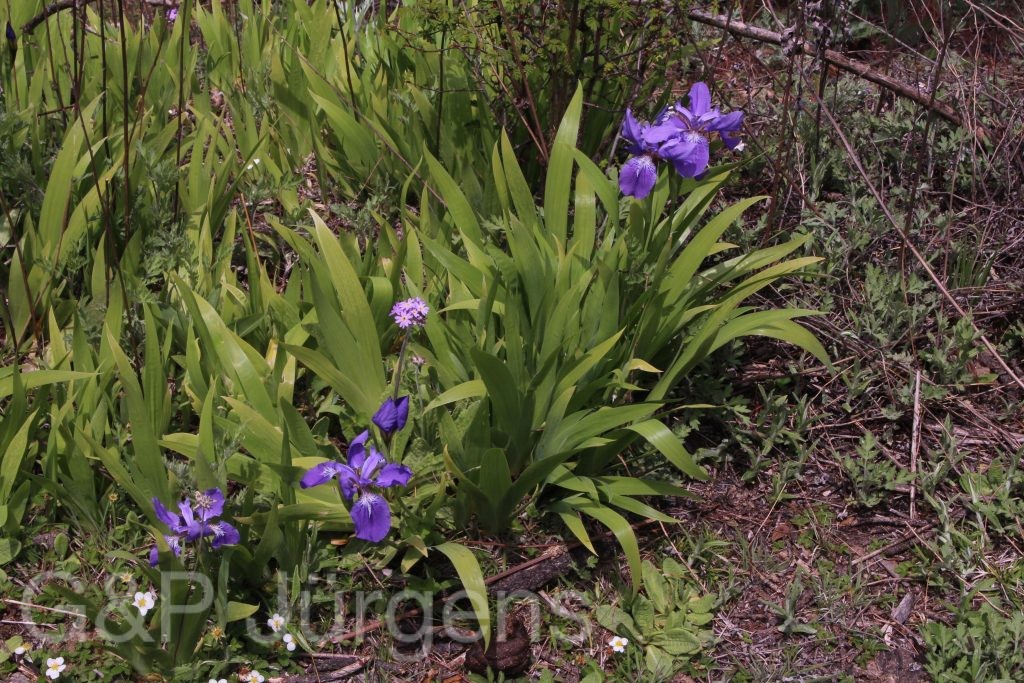
Iris tectorum, the roof iris or wall iris, is native to China and long cultivated across East Asia, with naturalised and planted populations widely recorded; GBIF documents 1128 occurrences in China, Japan, Korea, the United States, India, Bhutan, Myanmar, Taiwan, Kazakhstan and parts of Europe. It grows on dry banks, grassy slopes, rocky ground and, famously, on thatched roofs and old walls where it was traditionally established. In Bhutan the illustrated plants span a wide range, from Trashigang at about 1200 m to Chele-La at 3400 m, both flowering in May, showing its tolerance of both warm valley and high-pass conditions.

The plant is a rhizomatous perennial with a stout, shortly creeping rhizome bearing tufts of broadly ensiform, soft, ribbed leaves arranged in flat fans. The flowering stem is branched and bears several large flowers; each has the iris structure of three spreading, reflexed outer perianth segments (falls) and three smaller erect inner segments (standards). The falls are pale lilac-blue, conspicuously veined and mottled with darker blue, and bear a fringed or crested white-and-violet ridge in place of a beard, identifying it as a crested (Evansia) iris. The three petaloid style branches arch over the stamens; the inferior ovary matures into an oblong, ridged loculicidal capsule releasing rounded seeds.

Assigned to subgenus Limniris and the crested-iris alliance, I. tectorum is a long-standing ornamental and the source material for traditional medicinal use of its rhizome. POWO and GBIF accept the name. Its frequent cultivation accounts for the scattered extralimital records far beyond its East Asian native range.

Author: Maxim. · Sources: POWO (Kew), GBIF, Flora of China, Flora of Bhutan, The Iris (Iridaceae monograph), Annotated Checklist of the Flowering Plants of Nepal

D.Don

Bhutan2014 737
Bhutan Punaka 1200m, May

Description

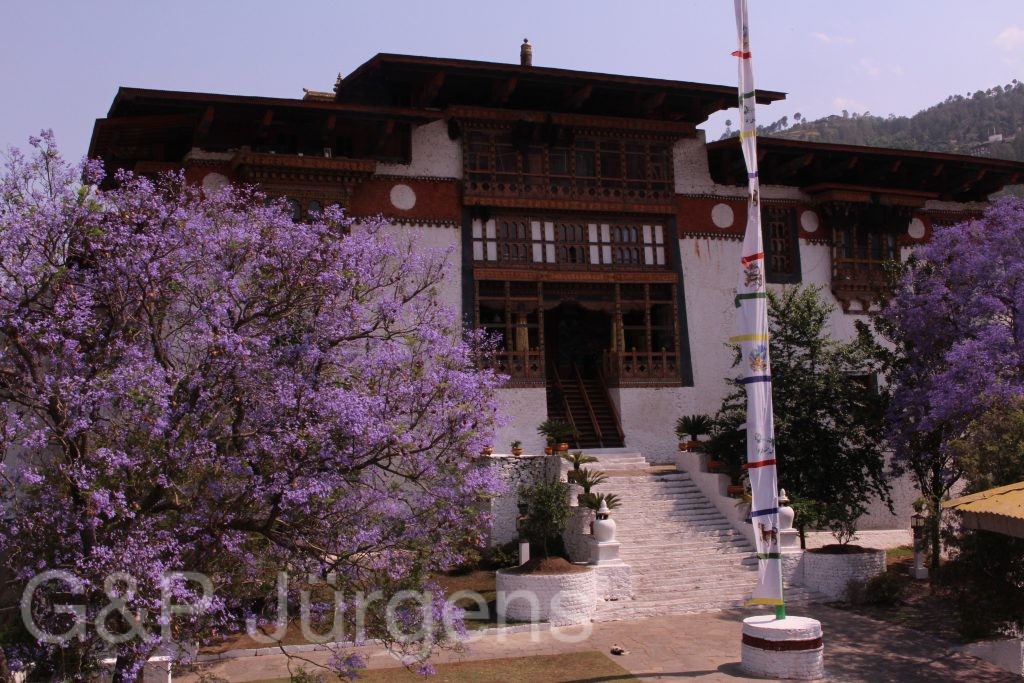
Jacaranda mimosifolia is a deciduous tree native to subtropical South America, in particular northwestern Argentina and adjacent Bolivia, but it is now one of the most widely planted ornamental trees in warm-temperate and tropical regions worldwide; its more than twenty thousand occurrence records span Australia, South Africa, Spain, Kenya, Mexico, the United States and far beyond. It thrives in well-drained soils in warm valleys, parks and roadsides and is frost-sensitive. The tree photographed at Punakha in Bhutan at 1200 m in May is a cultivated street or garden specimen, flowering in its characteristic spring blaze in the warm lower Himalayan valley, well outside its native New World range.

It is a medium to large tree with a spreading, rounded crown and smooth grey bark. The leaves are large, opposite and bipinnate with many small, oblong, mucronate leaflets, recalling those of mimosoid legumes and giving the species its epithet. The flowers are produced in showy terminal panicles, typically before or with the new foliage; each has a small campanulate calyx and a tubular, two-lipped blue to violet corolla that swells above a narrow base. Four didynamous stamens and a staminode are enclosed within. The fruit is a flattened, woody, rounded to oblong capsule that splits along two valves to release numerous thin, broadly winged, wind-dispersed seeds.

Jacaranda is a Neotropical genus of the Bignoniaceae, and J. mimosifolia is its most familiar member, prized for its lavender-blue spring flowering. In its native range it is assessed as Vulnerable owing to limited and fragmented wild populations, even as it flourishes in cultivation globally; in several regions it has become naturalised or weedy. Its nectar-rich flowers attract bees and other insects, and its showy display has made it an emblematic urban tree across the subtropics.

Author: D.Don · Sources: POWO (Kew), GBIF, Flora Argentina, IUCN Red List assessment, Gentry's treatment of Bignoniaceae

Wall.

Nepal 97 92 P153
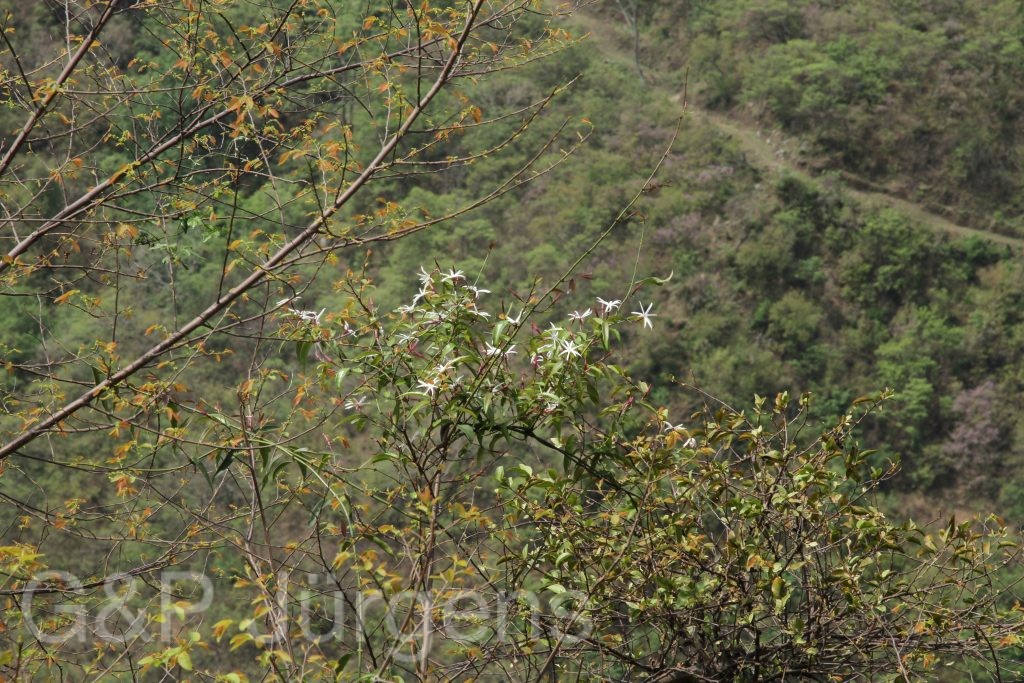
Nepal above Meta-Khola 2250m April
Nepal 97 312 P616
Nepal above Meta-Khola 2250m April

Description

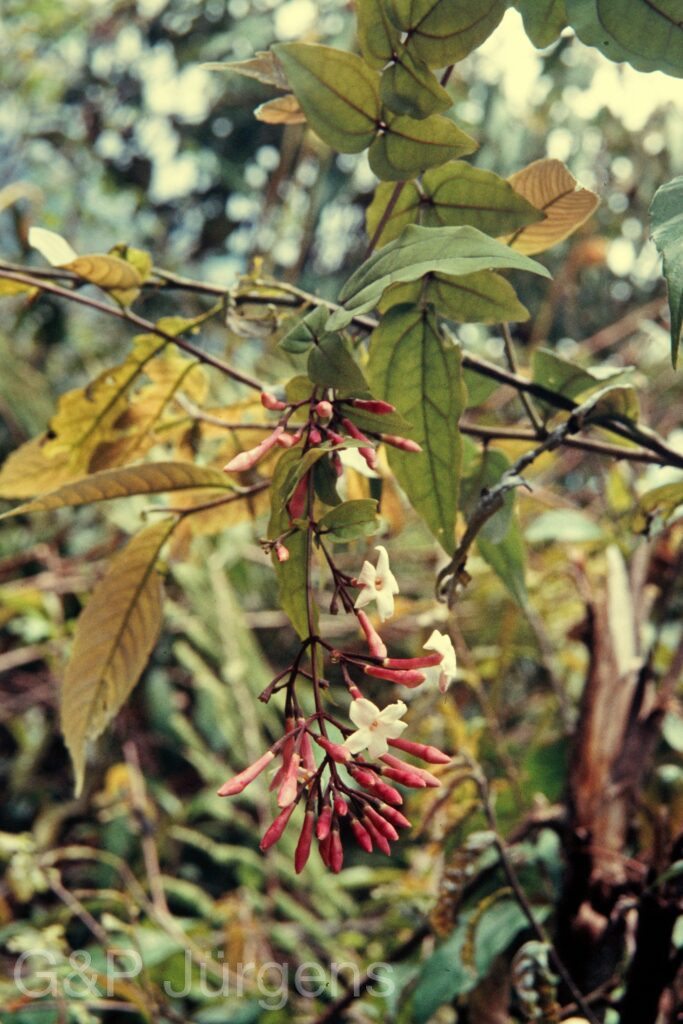
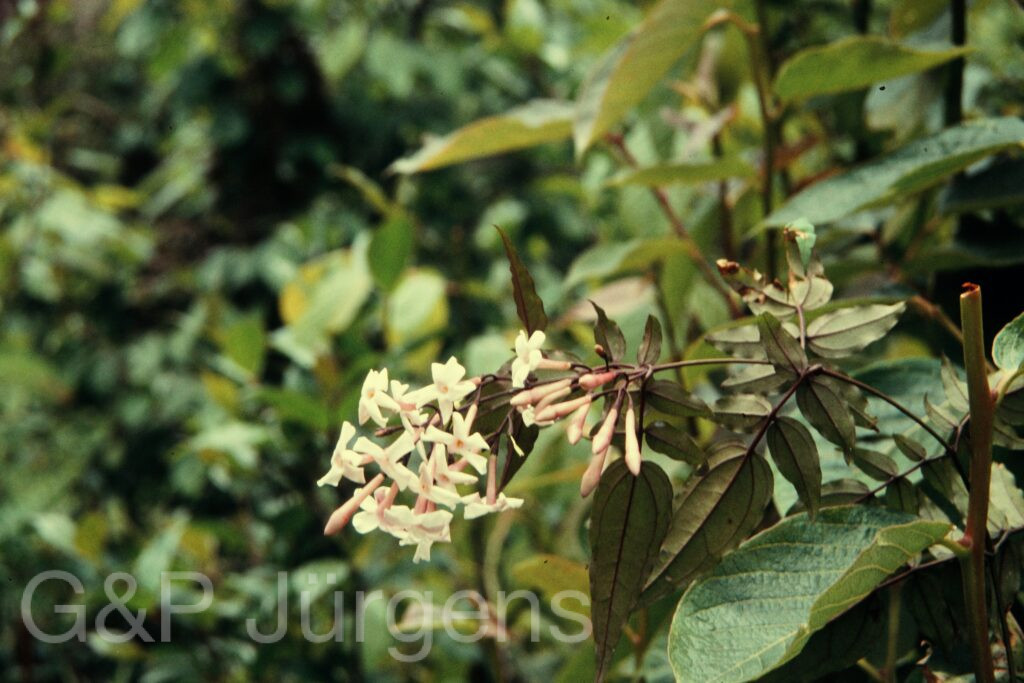
Jasminum dispermum is a scandent or climbing jasmine widely distributed across the Himalaya and montane south-east Asia, recorded from China, India, Nepal, Myanmar, Thailand and Bhutan, with outlying records (ID, KR, RU, ZZ) reflecting cultivation and herbarium material. Of more than 400 georeferenced collections, the core range lies along the subtropical-to-temperate forest belt of the Himalayan foothills. It grows in forest margins, scrub, ravines and along streams, scrambling over rocks and shrubs in the warm-temperate zone. The photographed plant from above the Meta-Khola in Nepal at 2250 m, flowering in April, is typical of its lower montane habitat and its spring flowering ahead of the monsoon.

It is a woody, twining shrub or liana with terete, often pubescent branchlets. The leaves are opposite and pinnately compound, usually with five to seven leaflets (sometimes reduced to three or trifoliolate uppermost ones), the leaflets ovate to lanceolate, acuminate and entire. The fragrant flowers are borne in terminal and axillary cymose panicles; each has a small, toothed calyx and a salverform corolla with a slender tube and spreading lobes, white within and frequently flushed pink or rose-purple on the outside in bud. Two stamens are inserted in the corolla tube. The fruit, reflected in the epithet dispermum, is a paired or two-seeded berry that ripens black.

Jasminum is a large Old World genus of the olive family centred on tropical and warm-temperate Asia and Africa, many species prized for their scent. J. dispermum is a vigorous, ornamentally attractive climber, occasionally cultivated, and remains common throughout its native range with no conservation concern. Its nocturnally fragrant, pale flowers suggest pollination by long-tongued moths and other nectar-seeking insects.

Author: Wall. · Sources: POWO (Kew), GBIF, Flora of China Vol. 15, Flora of Bhutan Vol. 2, Flora of Nepal, Green's Synopsis of the Oleaceae

Roxb. ex Hornem.

Bhutan2014 149
Bhutan Trashigang 2000m, May

Description

Jasminum laurifolium is a climbing jasmine native to the eastern Himalaya and South-East Asia, occurring in north-eastern India, Bhutan, Nepal, Myanmar, Thailand and southern China, and widely cultivated as an ornamental; its GBIF records (over 440) span this native range together with numerous cultivated occurrences in the Americas, the Pacific and the West Indies that account for the scattered records in Brazil, Colombia, Mexico, French Polynesia and the Caribbean. It grows in evergreen and mixed forest, on forest margins, thickets and shrubby slopes, generally up to about 2000 m. The photographed plant from Trashigang in eastern Bhutan at 2000 m in May reflects its occurrence in warm, humid mid-elevation forest.

It is an evergreen, woody twining shrub or liana with slender, glabrous, terete branchlets. The opposite, simple leaves are leathery and glossy, ovate-lanceolate to elliptic and laurel-like (whence laurifolium), with an entire margin, a long-acuminate apex and prominent pinnate venation. The fragrant flowers are borne in terminal and axillary cymes; each has a small, toothed calyx and a salverform white corolla with a slender tube and several narrow, spreading lobes. The fruit is a small, two-lobed black berry, often only one lobe maturing.

Jasminum is a large genus of the olive family Oleaceae, well represented in tropical Asia. J. laurifolium, sometimes treated with the variety brachylobum, is grown for its fragrant white flowers and is a familiar ornamental and source of perfume. Widespread in the wild and broadly cultivated, it is not of conservation concern, and its escape and naturalisation in warm regions outside its native range account for many of the extralimital records.

Author: Roxb. ex Hornem. · Sources: POWO (Kew), GBIF, Flora of China, Flora of Bhutan, Flora of Thailand, Jasminum (Oleaceae) revision (Green monograph)

Fisch. & C.A.Mey.

Sikkim2011 92
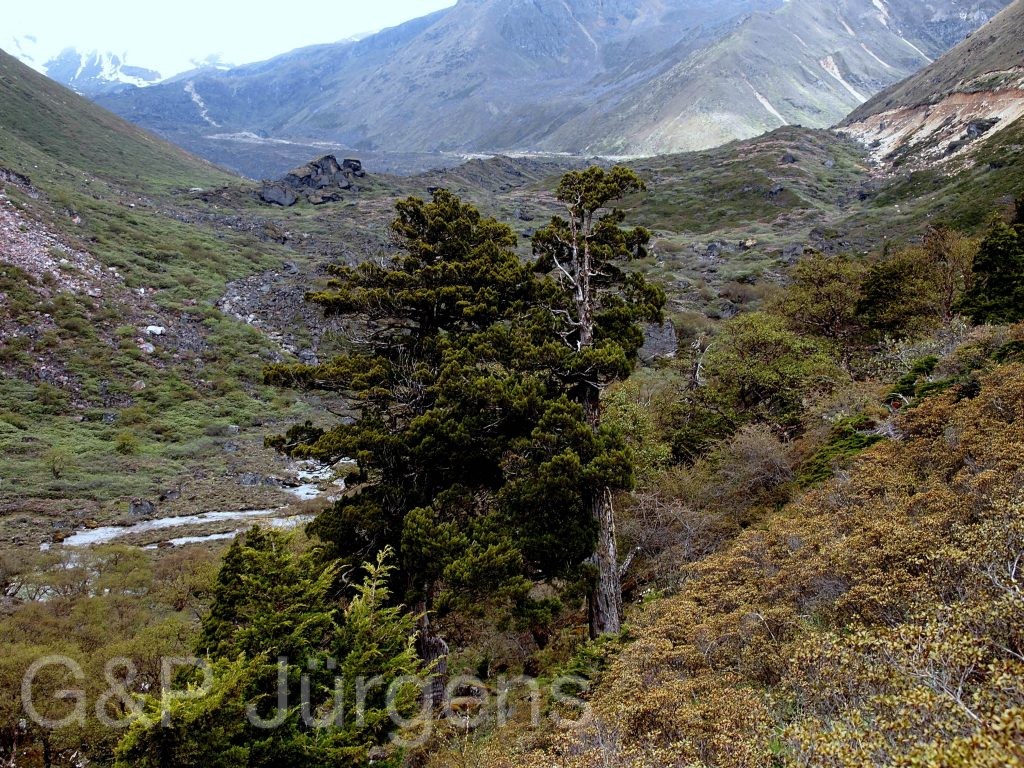
Sikkim Chopta-valley 4300m, June
Nepal1992 120 P170 ergebnis
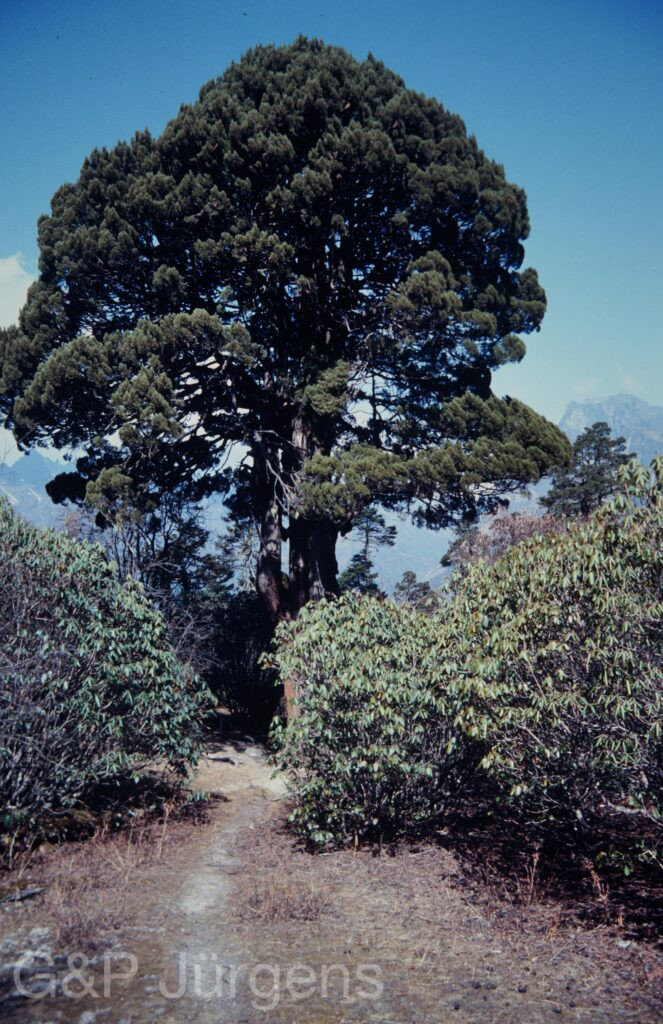
Nepal Ghunsa 3400m March

Description

Juniperus pseudosabina is a coniferous shrub of the high mountains of Central Asia and the Himalaya, with GBIF documenting around 1678 occurrences across Russia, Kazakhstan, China, Uzbekistan, Mongolia, Kyrgyzstan, Pakistan, Tajikistan, India, Nepal, Afghanistan and Bhutan. It is a constituent of the upper subalpine and alpine zones, forming krummholz and prostrate thickets on stony slopes, rocky ridges, moraines and at the timberline. The photographed plants were recorded in Sikkim's Chopta valley at 4300 m in June and at Ghunsa in Nepal at 3400 m in March, illustrating its occupation of cold, exposed high-montane sites near and above the tree limit.

It is typically a low, spreading, mat-forming or procumbent shrub, occasionally a small tree, with reddish-brown shredding bark. The foliage is mostly squamiform (scale-like), with small, closely appressed, rhombic leaves bearing a conspicuous dorsal resin gland; needle-like juvenile leaves may persist on vigorous shoots. The species is usually dioecious; the pollen cones are small and terminal, while the seed cones are berry-like galbuli that ripen blue-black to purplish-black, are glaucous, and characteristically contain a single large seed.

GBIF accepts the name. Belonging to section Sabina, the multi-seeded and single-seeded savin junipers, J. pseudosabina is closely allied to several Himalayan and Central Asian junipers with which it has been taxonomically confused. Its galbuli are dispersed by birds, and the dwarfed, wind-pruned habit reflects adaptation to severe alpine exposure. Wide-ranging and locally abundant, it is assessed as of least concern.

Author: Fisch. & C.A.Mey. · Sources: POWO (Kew), GBIF, Flora of China, Flora of Nepal, Farjon monograph of Juniperus