Tag:

Spring

Buch.-Ham. ex D.Don

Bh2008 394 P610
Bhutan Gogona 3160m, May

Description

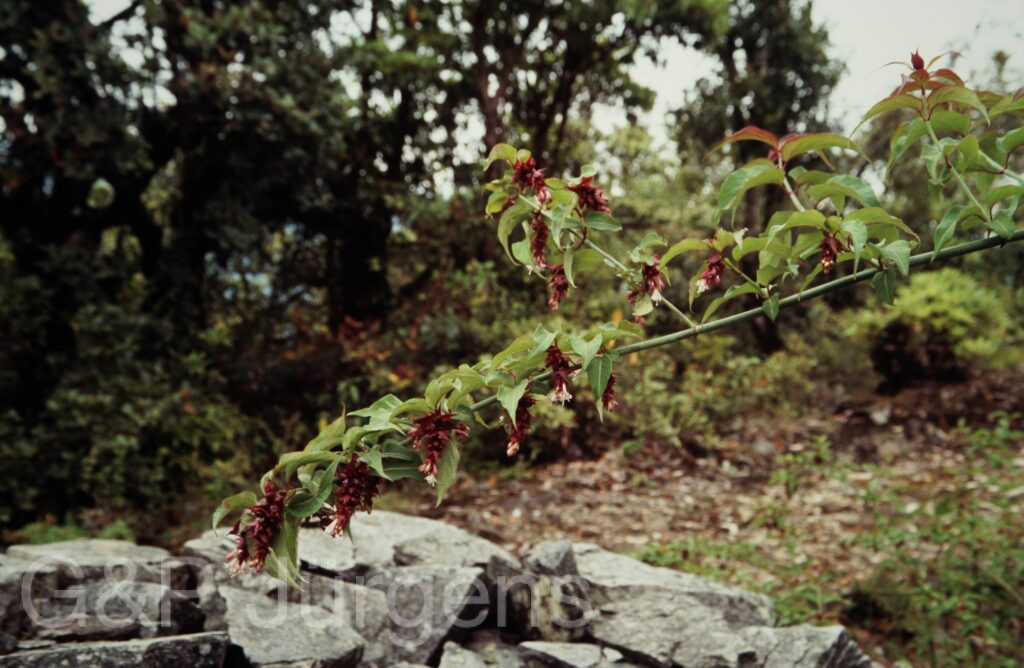
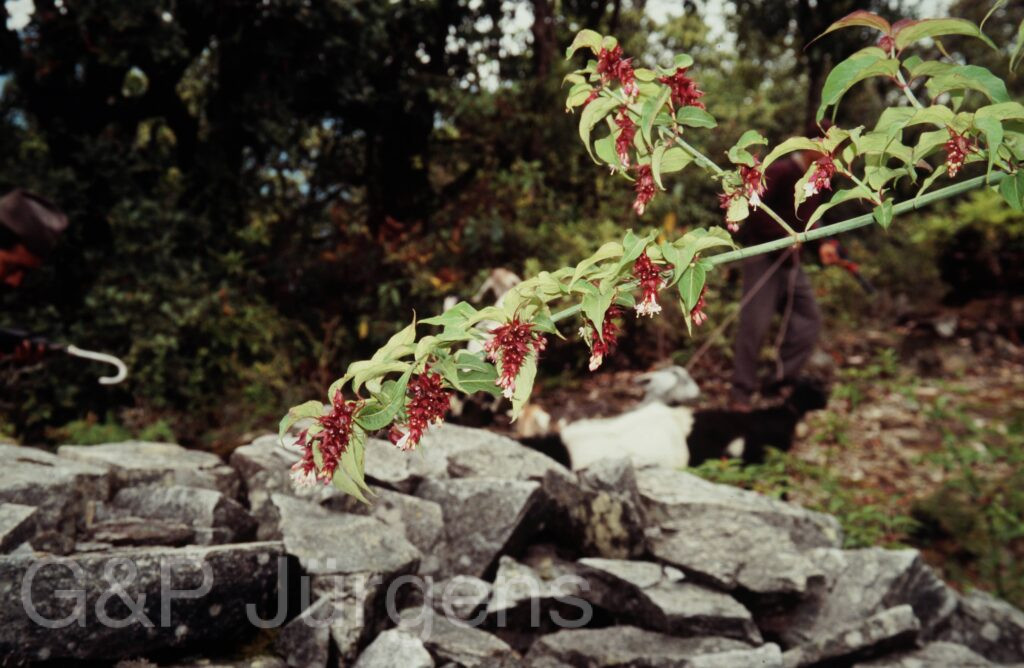
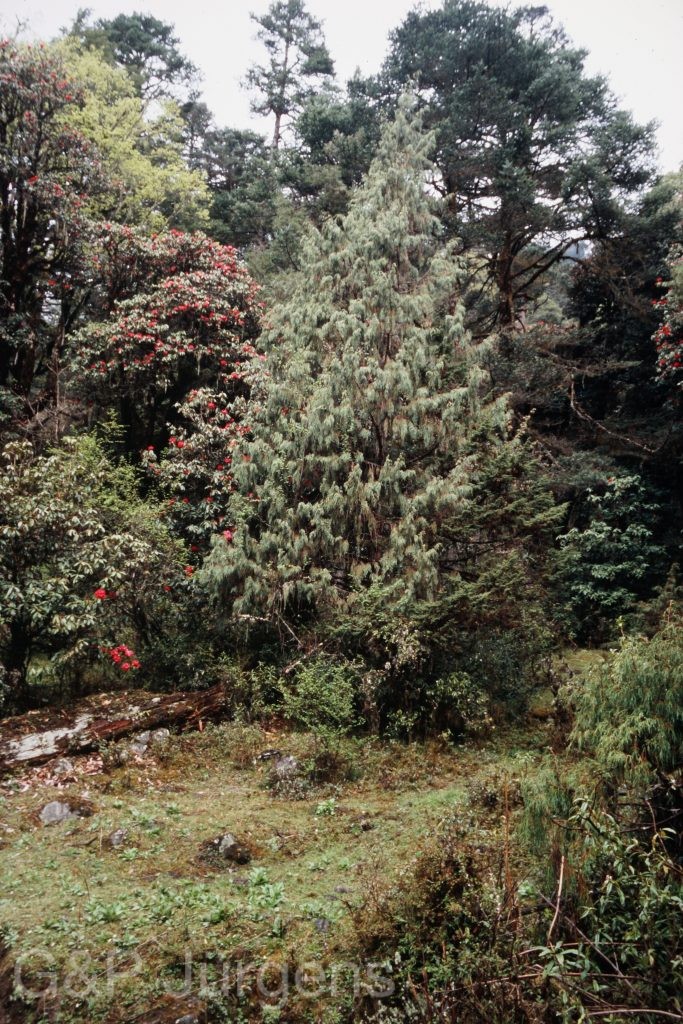
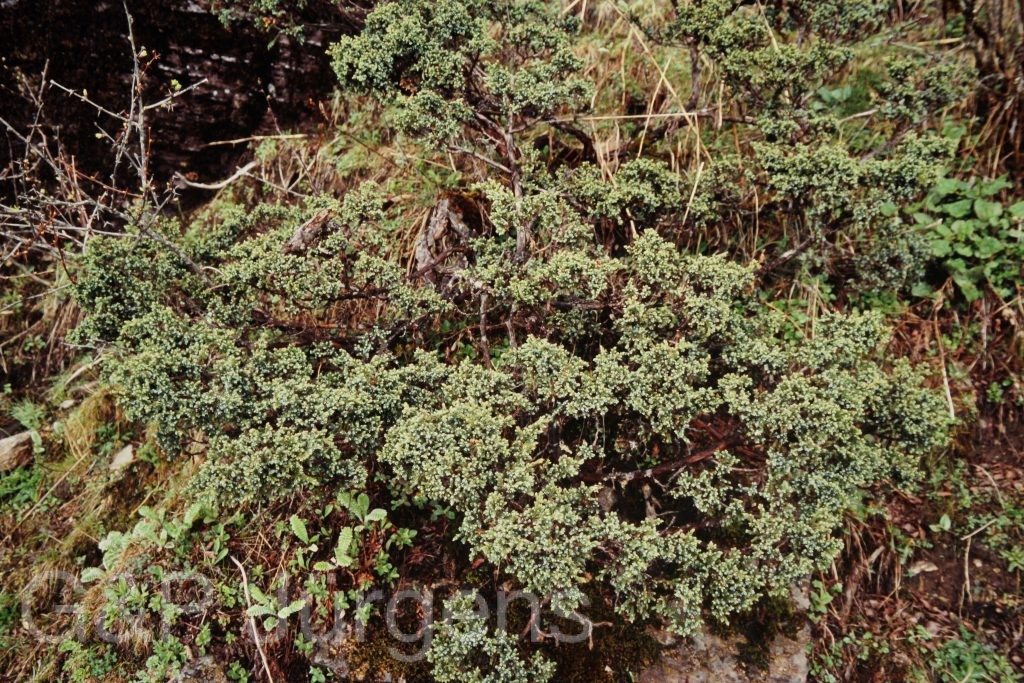
Juniperus recurva, the drooping or Himalayan weeping juniper, is a high-mountain conifer native across the Himalaya and adjacent China, with a core distribution in China, Nepal, India, Bhutan, Myanmar, Afghanistan and Pakistan; its very large GBIF tally of around 1185 records includes numerous cultivated occurrences in Great Britain, the United States, Spain, New Zealand, Japan and Germany, reflecting its long history in horticulture. In the wild it is a tree of the subalpine and alpine zones, forming open woodland, krummholz and scattered stands at and above the timberline on dry, rocky slopes. The tree photographed at Gogona in Bhutan at about 3160 m in May typifies its occurrence in the upper subalpine belt, where it often mingles with Abies, Rhododendron and Betula.

It is an evergreen tree or large shrub with characteristically pendulous, drooping branchlets and reddish-brown, fibrous bark that peels in long strips. The foliage consists of needle-like (acicular) juvenile-type leaves borne in whorls of three, incurved and sharply pointed, with a glaucous adaxial band; the leaves are retained as adults rather than reduced to scales. The species is typically dioecious, with small terminal pollen cones and ovulate cones that mature over two seasons into fleshy, berry-like galbuli that ripen blue-black to brownish and usually contain a single seed.

Juniperus recurva belongs to section Juniperus (the needle-leaved junipers) and includes the well-known coffin-juniper variant (var. coxii) with especially long pendulous shoots. Its fleshy cones are dispersed by birds and mammals, and the aromatic foliage is traditionally burned as incense across the Buddhist Himalaya. Although globally widespread and not classed as threatened, local populations near settlements are depleted by cutting for incense and fuel, and as a slow-growing timberline species it is potentially sensitive to warming-driven shifts in the upper forest limit.

Author: Buch.-Ham. ex D.Don · Sources: POWO (Kew), GBIF, Flora of China Vol. 4, Flora of Bhutan Vol. 1, Flora of Nepal, Adams Junipers of the World: The Genus Juniperus
Siebold & Zucc.

Bh2008 391 P606
Bhutan Gogona 3250m, May

Description

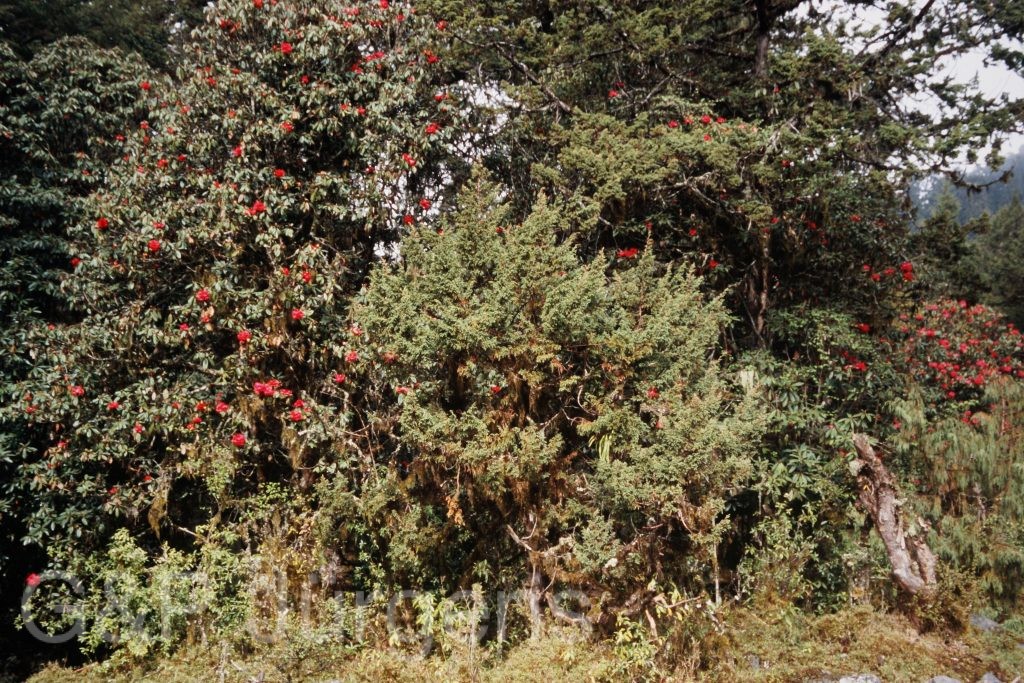
Juniperus rigida is a coniferous shrub or small tree of temperate East Asia, very well represented in GBIF with 6235 occurrences centred on Korea, Japan, China and the Russian Far East, alongside numerous cultivated records in Europe and North America. It grows on dry, rocky slopes, exposed ridges, sandy soils and open montane woodland, tolerating poor substrates and cold, often from the hills to the subalpine zone. The individual photographed at Gogona in Bhutan at 3250 m in May reflects its occurrence at higher Himalayan elevations, where it persists on stony, well-drained ground in cool montane conditions.

The plant is a dioecious, evergreen shrub or tree with spreading to pendulous branches and reddish-brown, fibrous bark that peels in strips. The leaves are all needle-like (acicular), borne in whorls of three, rigid, sharply pointed and deeply grooved adaxially with a single white stomatal band, a combination giving the foliage a harsh, prickly texture reflected in the epithet rigida. The male cones are small and axillary, shedding pollen in spring; the female structures develop into fleshy, berry-like seed cones (galbuli) that ripen blue-black with a glaucous bloom over about two years, each typically enclosing three seeds.

Juniperus rigida belongs to section Juniperus, the needle-leaved junipers, and is closely allied to J. communis, from which it differs in its longer, more rigid leaves and arching habit. It is widely cultivated as an ornamental and for bonsai, explaining many of its extralimital records. Ecologically it is a hardy pioneer of disturbed and stressful sites, and it remains common and of least concern across its broad native range.

Author: Siebold & Zucc. · Sources: POWO (Kew), GBIF, Flora of China Vol. 4, Flora of Bhutan Vol. 1, Flora of Nepal, Flora of Pakistan, Adams' Junipers of the World

Buch.-Ham. ex D.Don

Bh09 168 P297
Bhutan Labana 3600m May

Description

Juniperus squamata Buch.-Ham. ex D.Don is a variable, mostly prostrate to shrubby juniper of the Cupressaceae, native across the Himalaya and central and western China and recorded from Nepal, India, Bhutan, Pakistan, Afghanistan and Myanmar; with over 3,300 georeferenced records, many from cultivation in Europe, North America and Australasia, it is a widely grown ornamental as well as a wild montane species. In the wild it occupies high-altitude scrub, rocky alpine slopes, open conifer forest margins, ridges and exposed crests near and above the treeline. The photographed plant from Labana in Bhutan at about 3,600 m in May is typical of its subalpine to alpine station, where it often forms low spreading mats anchoring thin stony soils.

It is an evergreen shrub, frequently decumbent and mat-forming but sometimes erect and small-tree-like, with reddish-brown, flaking bark and ascending branchlet tips that are characteristically nodding. The foliage is entirely needle-like (acicular) and arranged in dense whorls of three, each leaf rigid, sharply pointed, concave and glaucous-white on the upper surface, giving the plant a frosted appearance. The species is usually dioecious; the seed cones are small, ovoid, ripening from green through reddish to glossy black, fleshy and berry-like, and contain a single seed.

Juniperus squamata belongs to section Juniperus, the needle-leaved junipers, and is morphologically variable across its range, having given rise to numerous horticultural cultivars selected for habit and foliage colour. As a slow-growing pioneer of harsh exposed sites it contributes to soil stabilisation at high elevation. The species is widespread and assessed as Least Concern, though local stands are affected by grazing and fuelwood collection.

Author: Buch.-Ham. ex D.Don · Sources: POWO (Kew), Flora of China Vol. 4, Flora of Bhutan Vol. 1, GBIF, Adams: Junipers of the World (2014)

L.

Nepal1992 15 P20 ergebnis
Nepal Tumlingtar 1200m March 
Nepal1992 16 P21 ergebnis
Nepal Tumlingtar 1200m March 

Description

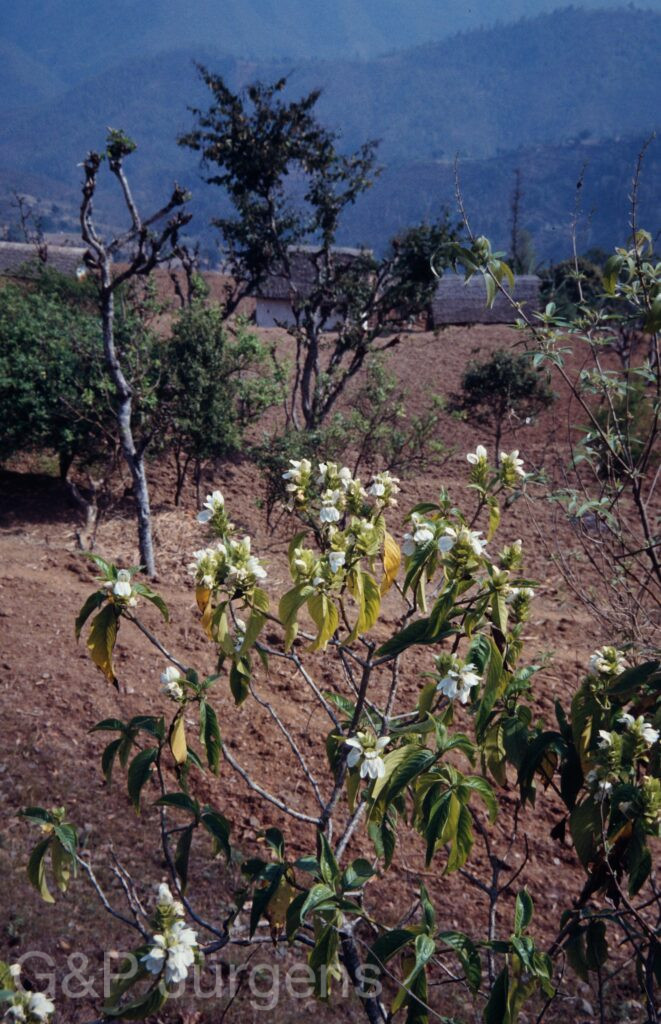
Justicia adhatoda, the Malabar nut or vasaka, is a widely distributed shrub native to the Indian subcontinent and now naturalised or cultivated across much of the tropics and subtropics; GBIF records (over 1500) span India, Nepal, Pakistan, Sri Lanka, China, Southeast Asia and many introduced regions in the Americas, Europe and beyond. In its Himalayan range it grows in the subtropical foothills and warm valleys, along streamsides, forest margins, fallow land and roadside scrub, generally below about 1300 m. The photographed plant from Tumlingtar in eastern Nepal (1200 m, flowering in March) sits squarely within this lower-elevation, dry-season-flowering habitat.

The plant is a robust, evergreen, much-branched shrub reaching 1–3 m, with opposite, lanceolate to elliptic-oblong, entire leaves that are pinnately veined and emit a strong odour when crushed. The flowers are borne in dense, axillary or terminal, bracteate spikes, the large ovate bracts conspicuous. Each flower is strongly two-lipped (bilabiate): the corolla is white to pale, the lower lip marked with purple to pinkish veining and a yellow throat. There are two stamens with bithecous anthers whose cells are unequally inserted. The fruit is a clavate, four-seeded capsule that dehisces explosively, the seeds projected from retinacula in the manner characteristic of Acanthaceae.

The species is of considerable economic and ethnobotanical importance, long used in Ayurvedic and Unani medicine for respiratory complaints; its leaves contain the quinazoline alkaloid vasicine (peganine) and related compounds with bronchodilatory and expectorant activity. Taxonomically it was formerly segregated in the monotypic genus Adhatoda but is now embedded within a broadly circumscribed Justicia. Being weedy and widely cultivated, it is of no conservation concern.

Author: L. · Sources: POWO (Kew), GBIF, Flora of Nepal, Flora of British India, Flora of China (Acanthaceae), A Revision of the genus Justicia (Acanthaceae)

L.

Nepal 97 410 P792
Nepal Tashigaon 3000m May
Nepal 2001 173 ergebnis ergebnis
East-Nepal Sabha-Khola 2100m, April

Description

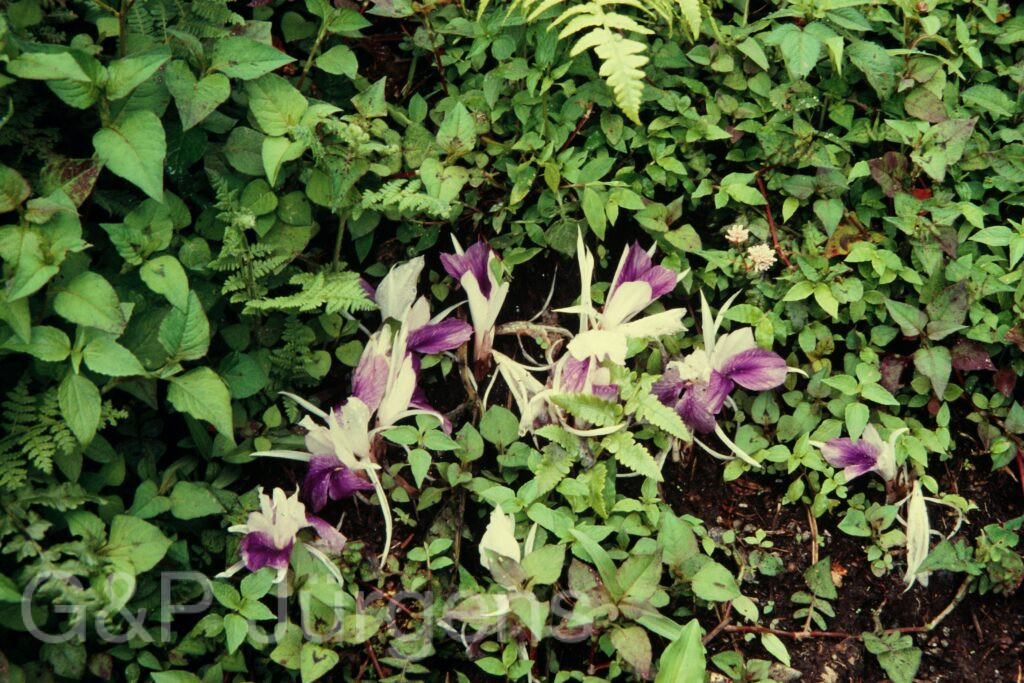
Kaempferia rotunda L. is a tuberous, rhizomatous herb of the ginger family native to tropical and subtropical Asia and very widely cultivated, so that its GBIF record (586 occurrences) spans India, Myanmar, China, Thailand, Bangladesh, Cambodia, Laos, Vietnam, Indonesia and the Philippines alongside many introduced localities in the Neotropics, North America and the Pacific. In the Himalayan foothills it grows in warm, shaded forest, scrub and disturbed ground; it was recorded in eastern Nepal at Sabha-Khola near 2100 m in April and at Tashigaon around 3000 m in May, the latter elevation being unusually high and probably reflecting sheltered, low-frost microsites or local cultivation.

The plant arises from a clustered, aromatic rhizome bearing fleshy tuberous roots. The leaves, two to four per shoot, are oblong-lanceolate, often handsomely variegated with dark and silvery-green zones above and purplish beneath, and appear after or with flowering. The inflorescence is hysteranthous, emerging directly from the rhizome at ground level before the leaves expand: a cluster of short-lived flowers with white, narrowly oblong corolla lobes, two petaloid white staminodes, and a conspicuous, deeply bilobed lilac to violet labellum. The fruit is a three-valved capsule, though propagation is largely vegetative.

Kaempferia rotunda is the type species of its genus and is grown ornamentally as 'peacock ginger' and used in traditional medicine across South and Southeast Asia, its rhizomes valued for fragrant essential oils. Its enormous naturalised range testifies to long human movement of the species. Pollination of the showy ephemeral flowers is by bees and other insects attracted to the labellar nectar guides, while persistence in cultivation buffers it against any wild conservation concern.

Author: L. · Sources: POWO (Kew), GBIF, Flora of China, Flora of Bhutan, Flora of British India, Zingiberaceae monograph (Larsen & Larsen; K. Schumann Zingiberaceae)

Kuntze

Bhutan2014 260
Bhutan Karu-Chu 1800m, May

Description

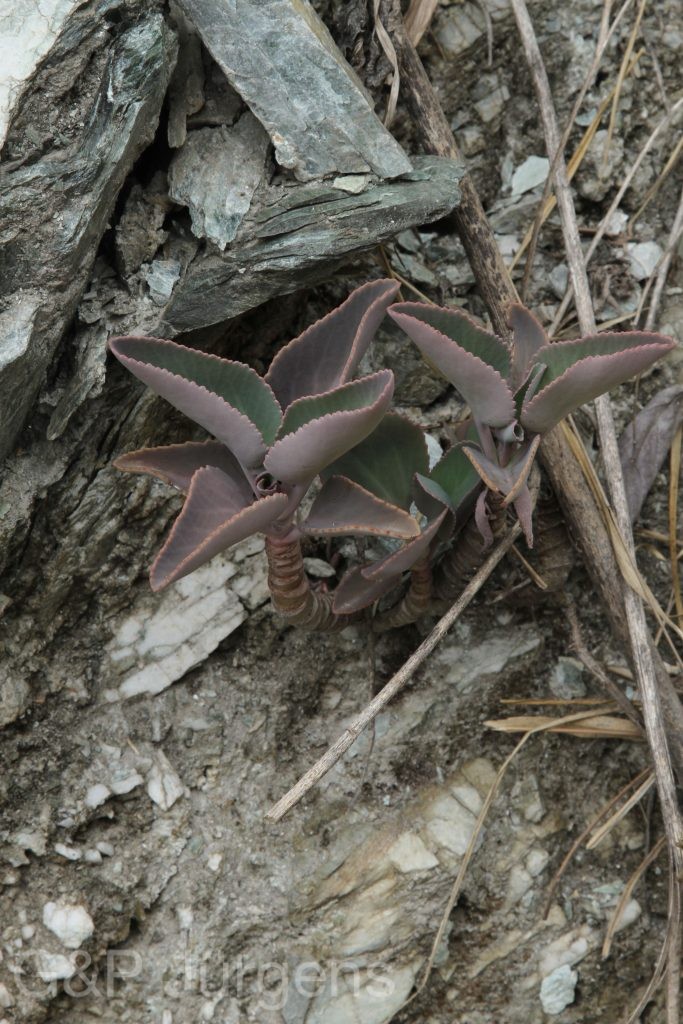
Kalanchoe integra is a succulent herb of broad palaeotropical and introduced distribution, recorded by GBIF (around 902 occurrences) across tropical and subtropical Asia and beyond, including Taiwan, Indonesia, the Philippines, India, Thailand, China, Japan, Nepal, Myanmar and Bhutan, as well as introduced or cultivated populations in the Americas and Europe. It grows on warm, dry, rocky slopes, open hillsides, walls, ledges and disturbed ground, favouring sunny, well-drained sites in the foothill and lower montane zones. The collection from Karu-Chu in Bhutan at about 1800 m in May marks a Himalayan foothill occurrence and reflects its preference for relatively low, warm elevations and its spring flowering at the onset of the growing season.

The plant is an erect, glabrous, fleshy perennial or biennial herb with a stout, often simple stem. The succulent leaves are opposite and decussate, the lower ones petiolate and obovate to oblong with a crenate or shallowly toothed margin, the upper leaves becoming sessile and sometimes pinnately lobed. The inflorescence is a large, terminal, much-branched corymbose cyme of numerous pendent, tubular flowers. Each flower has a fused, somewhat inflated tubular calyx and a longer tubular corolla in shades of yellow to orange or reddish, with four spreading lobes. There are eight stamens inserted on the corolla tube, and the four free carpels mature into many-seeded follicles.

Described under the combination by Kuntze, Kalanchoe integra belongs to a large Old World genus of the Crassulaceae noted for crassulacean acid metabolism (CAM), an adaptation enabling water conservation in seasonally dry habitats. The genus is taxonomically intricate, many names being confused within the K. integra-K. laciniata-K. spathulata complex. The species is used in traditional medicine in parts of its range and is sometimes cultivated. Being widespread, weedy and tolerant of disturbance, it is not of conservation concern.

Author: Kuntze · Sources: POWO (Kew), GBIF, Flora of China, Flora of Bhutan, Flora of British India, Raymond-Hamet revision of Kalanchoe

(D.Don) Tzvelev

Sikkim2004 102 P173
India West-Bengal, Utaray 2000m April
Sikkim 2006 186 ergebnis
India West-Bengal, Samadan 2400m, May

Description

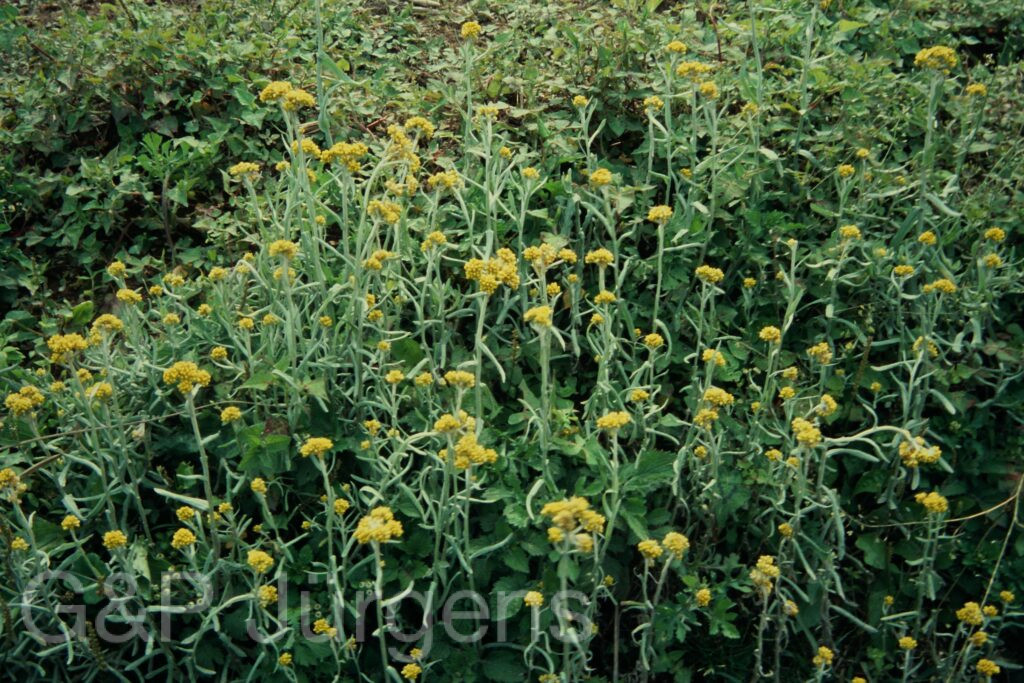
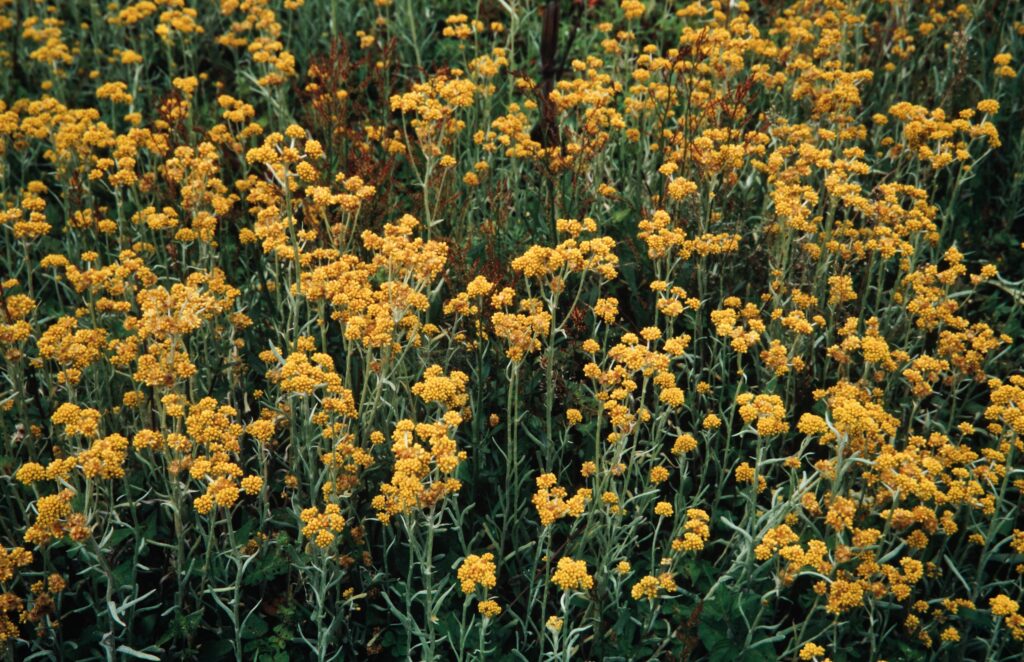
Laphangium affine is a widespread East and South Asian cudweed recorded from China, Japan, India, Taiwan, Vietnam, Nepal, Pakistan, Thailand, Georgia and Turkey, the roughly 99 georeferenced occurrences reflecting a broad continental range that extends westward into the Caucasus and Anatolia. It occurs from lowland to mid-montane elevations, the images documenting plants in West Bengal, India, at Utaray about 2000 m in April and Samadan about 2400 m in May. A plant of open, disturbed and seasonally moist ground, it colonises fields, fallows, roadsides, terrace banks, streamsides and weedy grassland, behaving as a fast-growing ruderal of cultivated and human-modified landscapes.

It is an erect annual or short-lived herb with simple or branched stems clothed, like the foliage, in a soft greyish-white woolly tomentum. The leaves are alternate, sessile, narrowly oblanceolate to linear-spathulate, entire-margined and densely lanate on both surfaces, the lower often withered at flowering. The numerous small capitula are aggregated into dense terminal and axillary glomerules; each head bears straw-coloured to yellowish, dry, scarious involucral bracts and contains many slender female florets surrounding a few central bisexual ones. The cypselae are minute and crowned by a caducous pappus of barbellate bristles, adapted for wind dispersal.

Under GBIF this name is treated as a synonym, with Laphangium affine itself standing as the accepted name; the taxon has been variously placed in Gnaphalium and Pseudognaphalium, reflecting the unsettled generic limits of the woolly cudweeds in tribe Gnaphalieae. Originally described by D. Don and transferred by Tzvelev, it is a successful weed across much of Asia, valued in some regions for medicinal and edible use. Given its wide range and ruderal ecology it is of no conservation concern.

Author: (D.Don) Tzvelev · Sources: POWO (Kew), GBIF, Flora of China, Flora of Pakistan, Gnaphalieae generic revision (Asteraceae)

Hook.f.

Bhutan2014 610
Bhutan Phobjika 2810, May
Bh2008 266 P418
Bhutan Tumchinching-La 3760m, April

Description

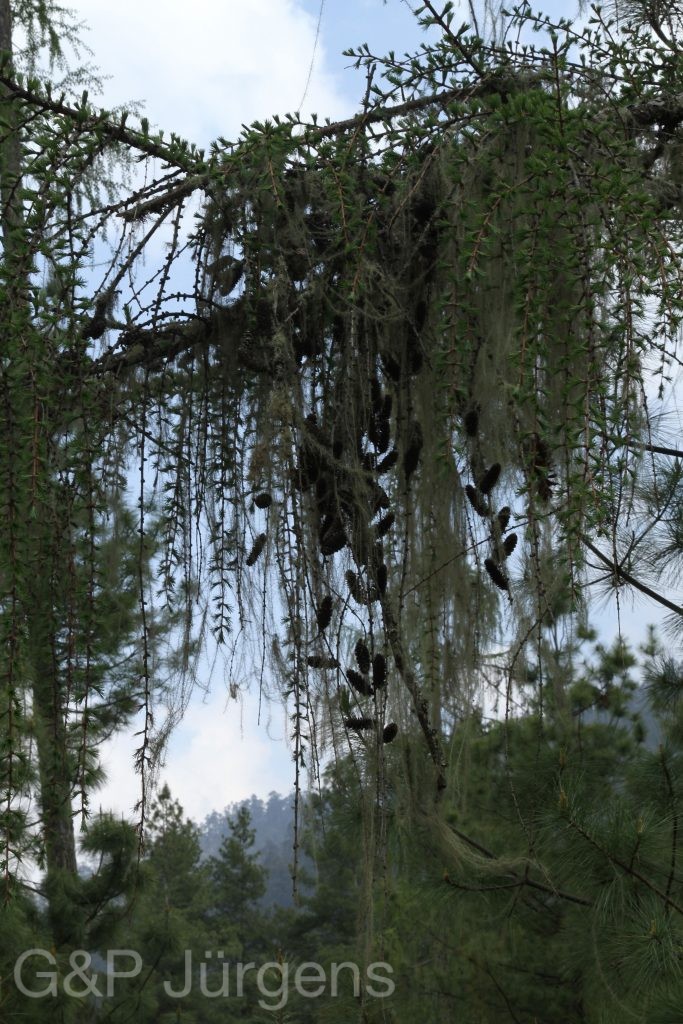
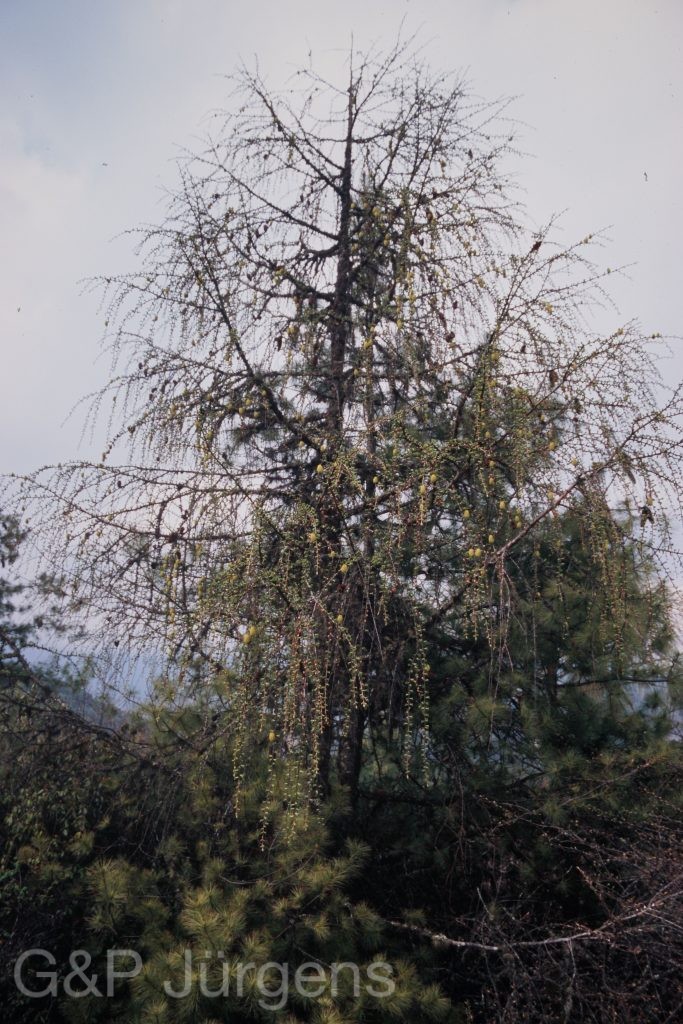
Larix griffithii, the Sikkim or Himalayan larch, is a deciduous conifer of the eastern Himalaya, native to China (Xizang), Bhutan, India (Sikkim) and Nepal; GBIF lists 525 occurrences, including many cultivated specimens in temperate arboreta abroad. In the wild it forms open montane to subalpine forests, often near the treeline on rocky slopes and moraines, generally between about 2800 and 4100 m. The trees illustrated were photographed in Bhutan at Phobjika (2810 m) in May and at the Tumchinching-La pass (3760 m) in April, the latter near its upper altitudinal limit.

It is a medium-sized deciduous tree with a conical crown and long, often pendulous branchlets. The soft, needle-like leaves are borne singly on long shoots and in dense rosette-like clusters on short, knob-like spur shoots; they are bright green, flushing in spring and turning golden-yellow before falling in autumn, an unusual habit among Himalayan conifers. The pendulous seed cones are oblong-cylindrical with conspicuous, exserted, often reflexed bracts that exceed the seed scales, a key diagnostic character; the winged seeds are wind-dispersed when the cones open.

Larix griffithii belongs to Pinaceae and is the principal larch of the eastern Himalaya, characteristically associated with Abies, Picea and rhododendron scrub at the upper forest limit. Its long-exserted cone bracts readily distinguish it from other larches. The wood is used locally for timber and fuel, and the tree's graceful weeping form has led to its cultivation in temperate collections, accounting for the wide scatter of records. Restricted in natural range but locally frequent, it faces pressure from logging, fire and grazing in the fragile treeline ecotone.

Author: Hook.f. · Sources: POWO (Kew), GBIF, Flora of China, Flora of Bhutan, Conifers of the World, Farjon A Handbook of the World's Conifers

(Willd.) Sm.

Sikkim 2006 260 ergebnis
India West-Bengal, Lingza 1300m, May

Description

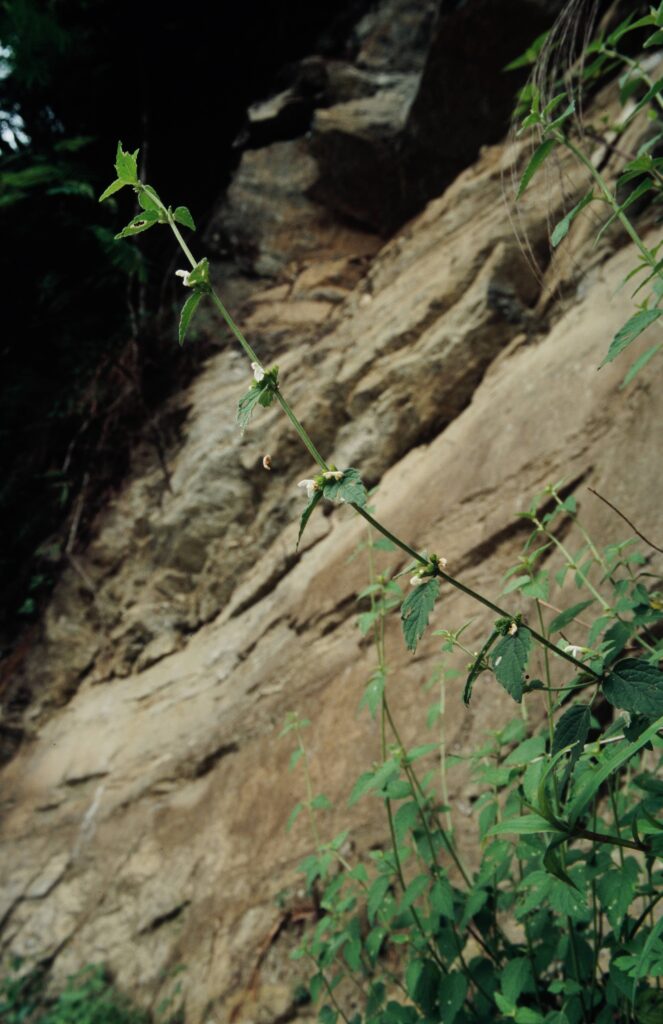
Leucas decemdentata is one of the most widely distributed members of its genus, ranging across tropical and subtropical Asia and out into the western Pacific. GBIF records, totalling more than 1,600 occurrences, document its presence in India, Nepal, Pakistan and Myanmar through China, Taiwan and Japan to Thailand, the Philippines, Indonesia, Timor-Leste and Papua New Guinea, and onward to Australia, Fiji, Tonga, Samoa, the Cook Islands and French Polynesia, as well as Christmas Island. In the eastern Himalaya it is a plant of warm-temperate to subtropical situations, frequenting open hillsides, roadside banks, cultivated margins, fallow fields and other disturbed ground. The photographed plant from Lingza in West Bengal, India, at about 1300 m and flowering in May, is typical of its lower montane occurrence, where it behaves as a weedy ruderal of sunny, well-drained slopes.

The species is an erect or ascending annual to short-lived perennial herb, usually 30-100 cm tall, with quadrangular stems that are retrorsely hairy along the angles. Leaves are opposite and decussate, ovate to lanceolate, with a crenate-serrate margin, an acute apex and a cuneate to attenuate base, the lamina sparsely pubescent and borne on short petioles. The white flowers are crowded into dense, globose, axillary verticillasters subtended by linear bracts. Each flower has a tubular, ten-toothed calyx with subequal spinescent teeth and a strongly two-lipped corolla, the upper lip arched and densely white-villous, the lower lip three-lobed with a larger middle lobe; the four didynamous stamens lie beneath the hood. The fruit comprises four smooth, trigonous nutlets enclosed in the persistent calyx.

The ten conspicuous calyx teeth give the species its epithet decemdentata and are a useful diagnostic character within the large, taxonomically intricate genus Leucas. Long included with the white-flowered, capitate-inflorescenced "thumbergia group" of species, it has frequently been confused with L. ciliata, L. mollissima and other allies, and several Asian names have been treated as synonyms. Ecologically it is a pioneer of open, disturbed habitats and a minor melliferous plant visited by bees and other insects. It carries no conservation concern, being abundant and adaptable across an enormous geographic range, and like many Leucas species it is used locally in folk medicine for fevers and skin complaints.

Author: (Willd.) Sm. · Sources: POWO (Kew), GBIF, Flora of China Vol. 17, Flora of Bhutan Vol. 2, Flora of Nepal, Flora of Pakistan, Revision of the genus Leucas (Lamiaceae) by Ryding

Wall.

Nepal 2009 106 ergebnis
Nepal Helambu Indrawati 2000, May
Nepal 2009 107 ergebnis
Nepal Helambu Indrawati 2000, May

Description

Leycesteria formosa is a Himalayan shrub native to the temperate forests of Nepal, India, Bhutan, Pakistan and southwestern China, where it grows in moist montane woodland, forest margins, ravines, streamsides and shrubby clearings, typically between about 1500 and 3000 m. The photographed plant from the Indrawati drainage in the Helambu region of Nepal, recorded in May, is characteristic of these cool, humid mid-elevation habitats. Far beyond its native range, however, the species is among the most frequently recorded plants in GBIF, with over 42,000 occurrences, the great majority from regions where it has become naturalised after cultivation as an ornamental, notably Great Britain, Ireland, France, the Netherlands, Belgium, Germany, Switzerland, Spain, Portugal, the United States, Australia and New Zealand, where it is regarded as an invasive woodland weed.

It is a deciduous, hollow-stemmed shrub 1-2.5 m tall, with erect, glaucous, bamboo-like green canes that are conspicuously jointed and unbranched or sparingly branched. The leaves are opposite, ovate to ovate-lanceolate, long-acuminate, entire to slightly toothed and often weakly cordate at the base, frequently with a few basal lobes. The inflorescences are pendent, interrupted spike-like racemes of whorled flowers subtended by showy, claret-purple, leaf-like bracts. Each funnel-shaped corolla is white flushed with purple-pink and five-lobed; the ovary is inferior. The fruit is a many-seeded berry that ripens from green through reddish-purple to a glossy deep maroon-black, soft and sweetish, much sought by birds, which disperse the abundant small seeds.

The genus Leycesteria, named for the Bengal magistrate William Leycester, comprises a small group of Sino-Himalayan shrubs traditionally placed in Caprifoliaceae (Lonicereae) near Lonicera. Bird-mediated seed dispersal underlies both the plant's ecological success and its problematic naturalisation abroad, where it colonises disturbed woodland and riparian thickets; in New Zealand in particular it is listed as an environmental weed. Within its native Himalayan range it is common and of no conservation concern, valued horticulturally for its colourful pendent inflorescences and ornamental berries, sometimes grown under the names "Himalayan honeysuckle" or "pheasant berry."

Author: Wall. · Sources: POWO (Kew), GBIF, Flora of China Vol. 19, Flora of Bhutan Vol. 2, Flora of Nepal, Flora of Pakistan, Airy Shaw's revision of Leycesteria