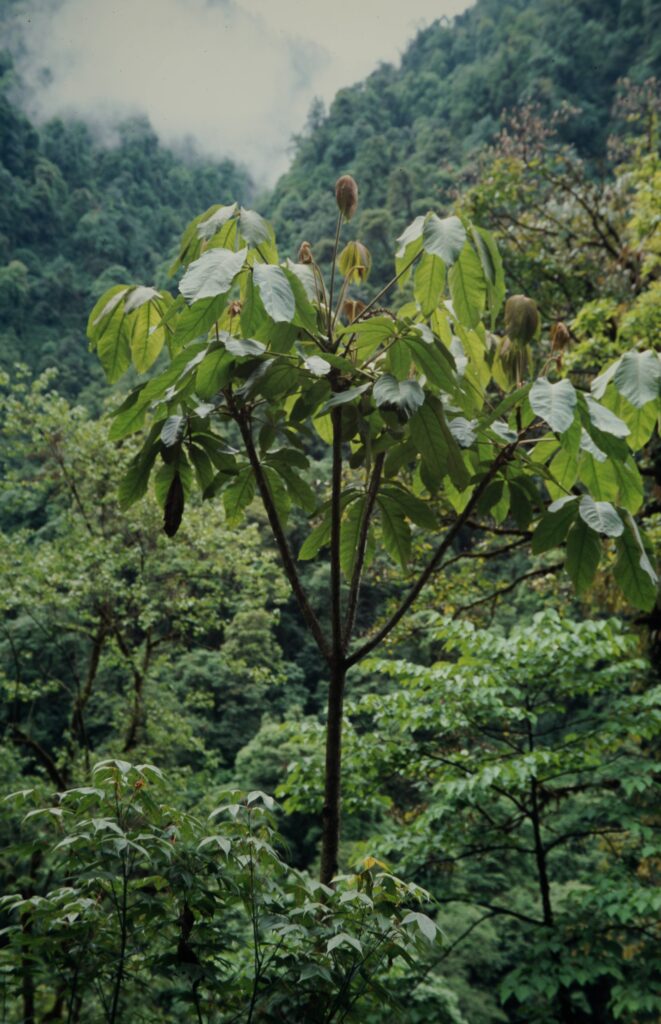
Tag:

Spring

(Seem.) ined.

Sikkim 2006 310 ergebnis
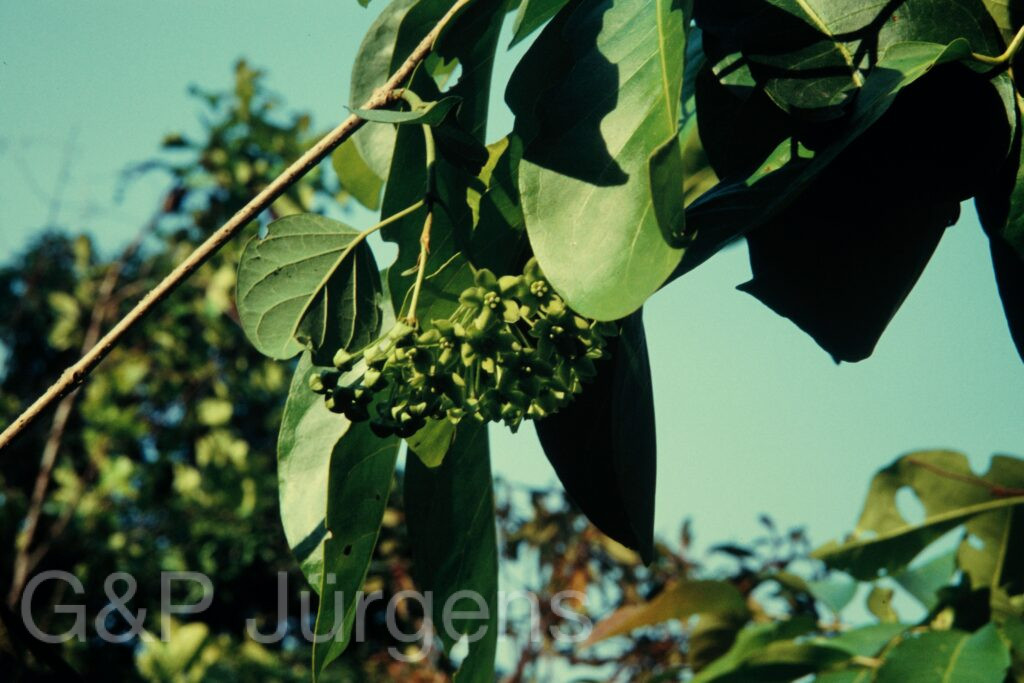
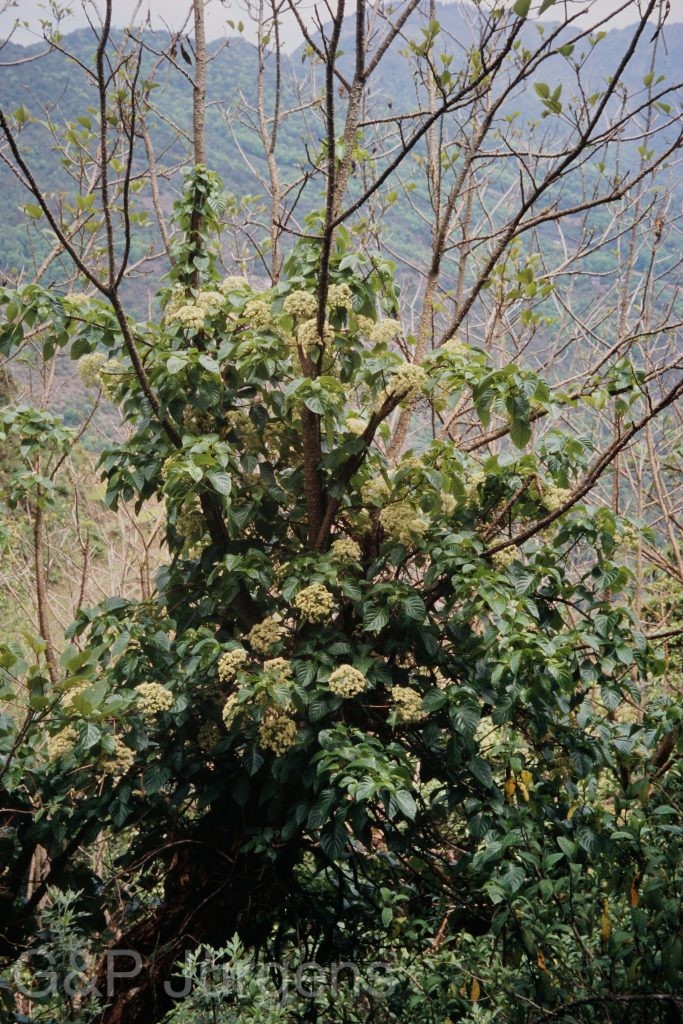
India West-Bengal, Chaana 1750m, May

Description

Heptapleurum griffithii is an eastern Himalayan araliad documented from Bhutan and adjacent south-western China, the GBIF record being sparse with only about three georeferenced occurrences, reflecting both its restricted range and limited collection. It grows in moist, broad-leaved evergreen and mixed montane forest, often as an epiphyte or hemiepiphyte on tree trunks and mossy rocks, or as a free-standing shrub, in the warm-temperate zone. The plant photographed at Chaana in West Bengal at 1750 m in May occupied this humid mid-elevation forest belt, where high atmospheric moisture and shade favour its establishment.

It is a glabrous shrub or small tree, sometimes epiphytic, with stout greyish branchlets. The leaves are alternate and palmately compound, the long petiole bearing a whorl of several leaflets; the leaflets are elliptic to oblong-lanceolate, leathery, entire, acuminate at the apex and cuneate at the base, with prominent lateral venation and a sheathing petiole base. The inflorescence is a large terminal panicle of umbels; the small flowers are greenish to creamy, with five petals, five stamens and an inferior ovary crowned by a low stylar disc. The fruit is a small subglobose drupe, ribbed when dry and containing several pyrenes.

GBIF lists the name as a synonym while retaining Heptapleurum griffithii as accepted; the species was long placed in Schefflera, and the recircumscription of that polyphyletic genus has returned many Asian species to Heptapleurum. As a forest-canopy and epiphytic component it contributes to structural diversity, its fleshy drupes dispersed by birds. Given its narrow documented range, intact mid-montane forest is important to its persistence.

Author: (Seem.) ined. · Sources: POWO (Kew), GBIF, Flora of China Vol. 13, Flora of Bhutan Vol. 2, Flora of Nepal, A Generic Revision of Araliaceae (Schefflera and allies)
(Griff.) G.M.Plunkett & Lowry

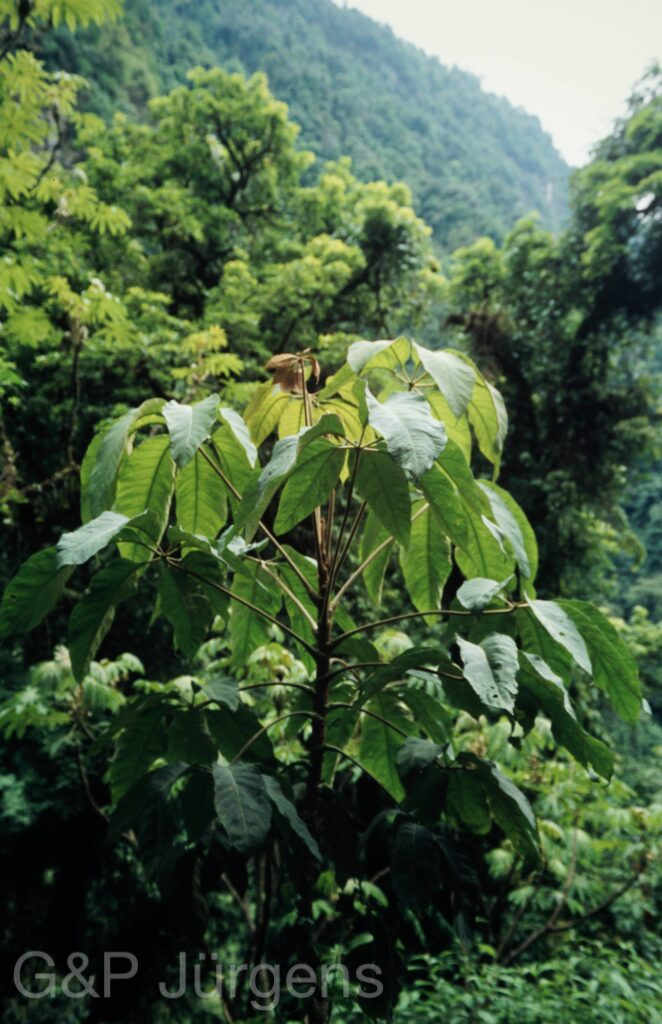
Sikkim 2006 482 ergebnis
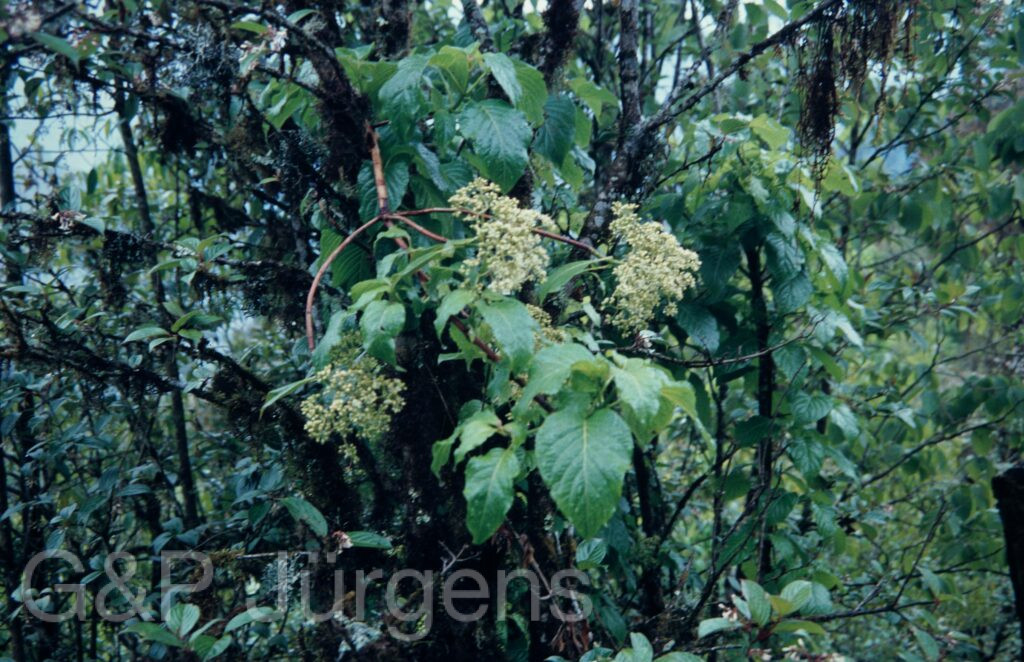
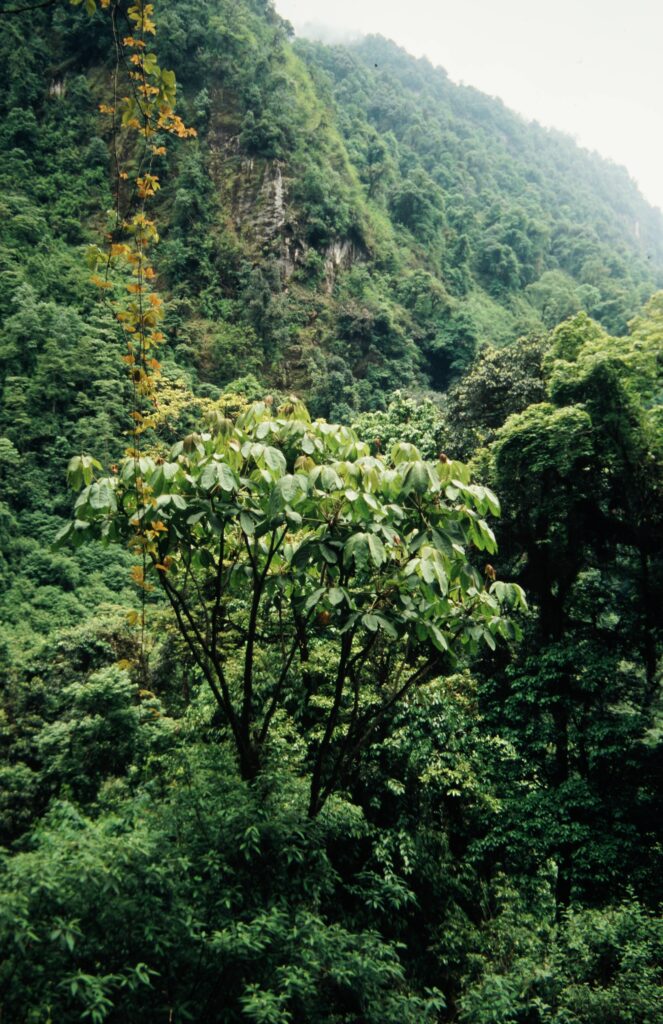
India Sikkim, Ringi Chu 1900m, May
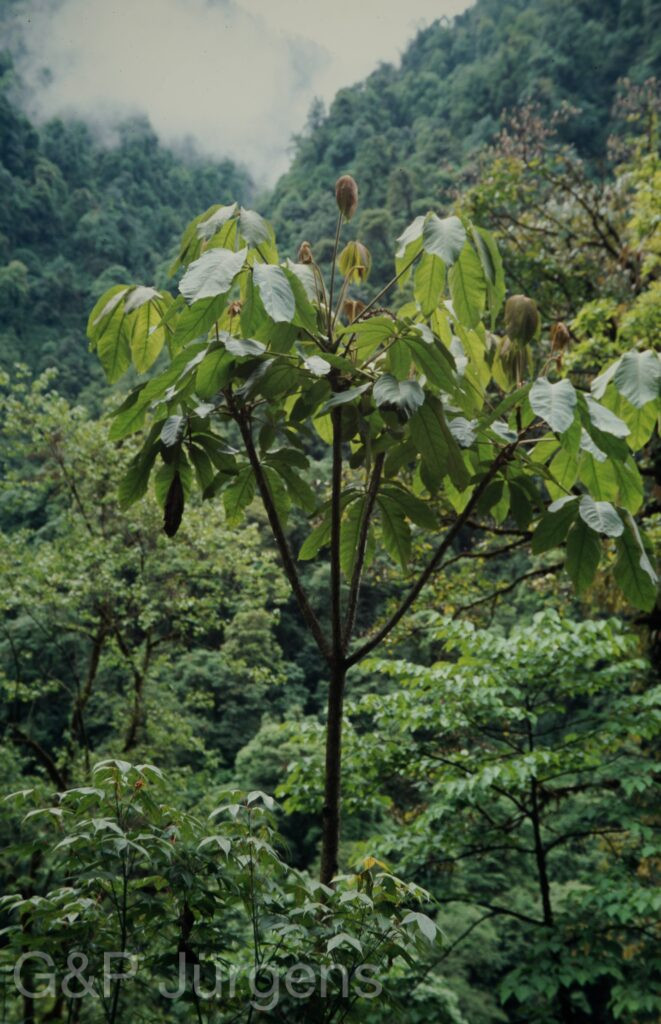
Sikkim 2006 310 ergebnis
India Sikkim, Ringi Chu 1900m, May

Description

Heptapleurum rhododendrifolium is an epiphytic to semi-epiphytic shrub distributed across the eastern Himalayas and into Southeast Asia, with records from Nepal, Sikkim, Bhutan, northeast India, Myanmar, southern China, and extending to Fiji, Papua New Guinea, and Indonesia. GBIF documents 136 occurrences across this broad range. The species inhabits subtropical and warm-temperate evergreen forests at elevations of 1,200–2,500 m, where it typically grows as an epiphyte on mossy tree trunks and branches, or occasionally as a terrestrial shrub on steep, humus-rich banks in areas of persistent cloud immersion and high rainfall.
Heptapleurum rhododendrifolium is an evergreen shrub, 1–4 m tall, with stout, sparsely branched stems. The leaves are digitately compound, clustered near the branch tips, with 5–9 coriaceous leaflets. Leaflets are oblong-elliptic to oblanceolate, 8–20 cm long, glossy dark green above and often pale or ferruginous-tomentose beneath, with entire margins and a prominent midrib — the overall appearance recalling Rhododendron foliage, hence the epithet. Petioles are stout, 10–20 cm long. The inflorescence is a terminal, compound umbel of numerous small, greenish-white flowers, each 3–4 mm across, with 5–7 petals and an equal number of stamens. The ovary is inferior, 5–7-locular. The fruit is a subglobose drupe, 4–6 mm in diameter, ripening to dark purple or black, with persistent style remnants.
This species was long placed in Schefflera sensu lato, but recent molecular phylogenetic studies by Plunkett and Lowry have led to its transfer to the reinstated genus Heptapleurum, which accommodates the Asian and Pacific clade formerly within Schefflera. The photographed specimen from Ringi Chu in Sikkim at 1,900 m represents a typical mid-elevation epiphytic occurrence in one of the wettest valleys of the eastern Himalayas. The species plays an ecological role as a provider of fruit resources for montane bird communities. Its broad distribution from the Himalayas to the Pacific islands reflects an ancient tropical Asian lineage with considerable dispersal capacity.

Author: (Griff.) G.M.Plunkett & Lowry · Sources: POWO (Kew), GBIF, Flora of China Vol. 13, Flora of Bhutan Vol. 2, Plunkett & Lowry (2018) — Phylogenetics of Araliaceae

(Dyer) Hook.f.

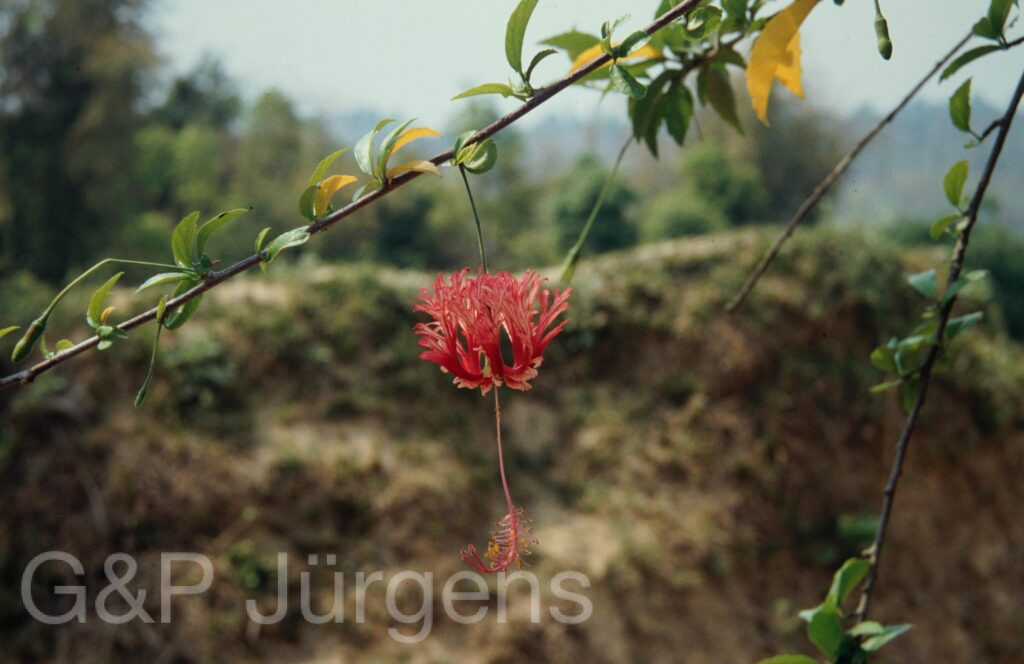
Nepal 1994 17 ergebnis
Ost-Nepal Kandbari 490m April

Description

Hibiscus schizopetalus is native to coastal East Africa, particularly Kenya, Tanzania and Mozambique, but is now a pantropical ornamental, the GBIF dataset of some 2536 records spanning India, China, Hong Kong, Thailand, Indonesia, the Philippines, Japan, Fiji, French Polynesia, Réunion, and the Neotropics from Brazil and Colombia to Mexico, Costa Rica, Panama and Puerto Rico. In its introduced range it is grown as a garden and hedge shrub in warm lowland to lower-montane settings, escaping locally in disturbed and ruderal sites. The photographed plant from Khandbari in eastern Nepal at 490 m in April reflects this cultivated occurrence in the warm subtropical foothills, well outside its African origin.

It is an evergreen shrub reaching 2–3 m, with slender, often arching to pendulous glabrous branches. The leaves are alternate, ovate to elliptic, 4–7 cm long, with serrate margins, an acuminate apex and short petioles. The flowers are solitary, axillary and conspicuously pendulous on long jointed pedicels; the distinctive corolla consists of five deeply laciniate, recurved petals that are intricately fringed and pinnatifid, coloured pink to red, giving the species its common name fringed or coral hibiscus. The staminal column is long-exserted and pendent, bearing numerous anthers and a five-branched style with capitate stigmas. The fruit is a loculicidal capsule, though fruiting is sparse in cultivation.

Hibiscus schizopetalus belongs to section Lilibiscus of Hibiscus, allied to H. rosa-sinensis with which it readily hybridises and shares ornamental use. The deeply dissected, dangling flowers are an adaptation favouring sunbird and butterfly pollination in its native range. Widely propagated by cuttings, it is of no conservation concern as a cultivar, though wild African populations warrant attention.

Author: (Dyer) Hook.f. · Sources: POWO (Kew), GBIF, Flora of China Vol. 12, Flora of Tropical East Africa (Malvaceae), Flora of Nepal, Hibiscus: A Monograph

(Wall. ex Roxb.) T.Yamaz.

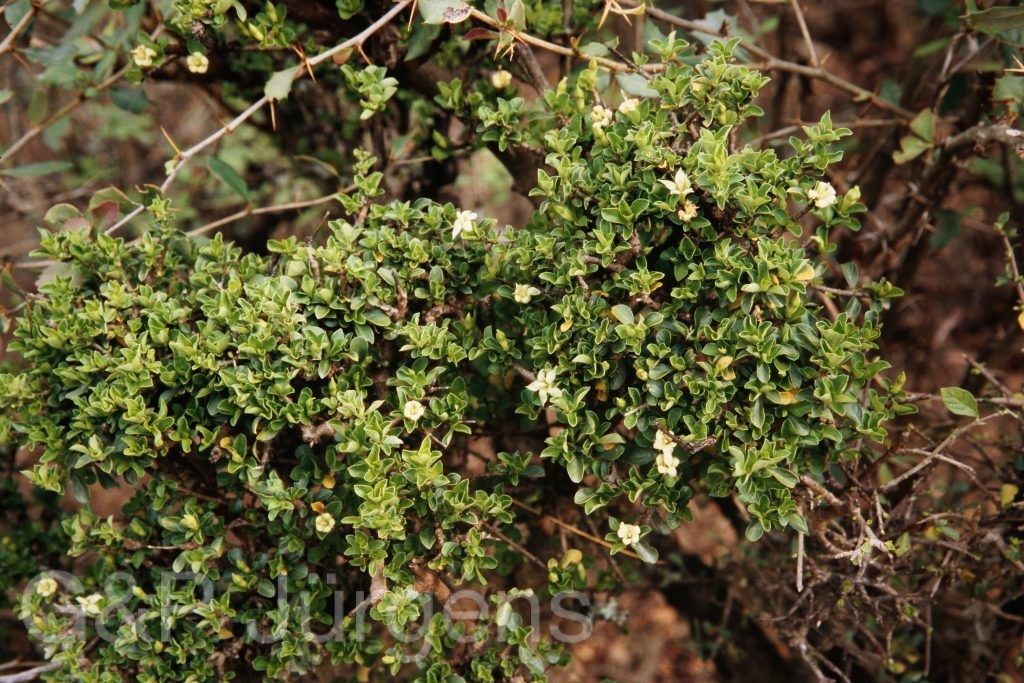
Bh2008 491 P760
Bhutan Samtengang, 2300m April
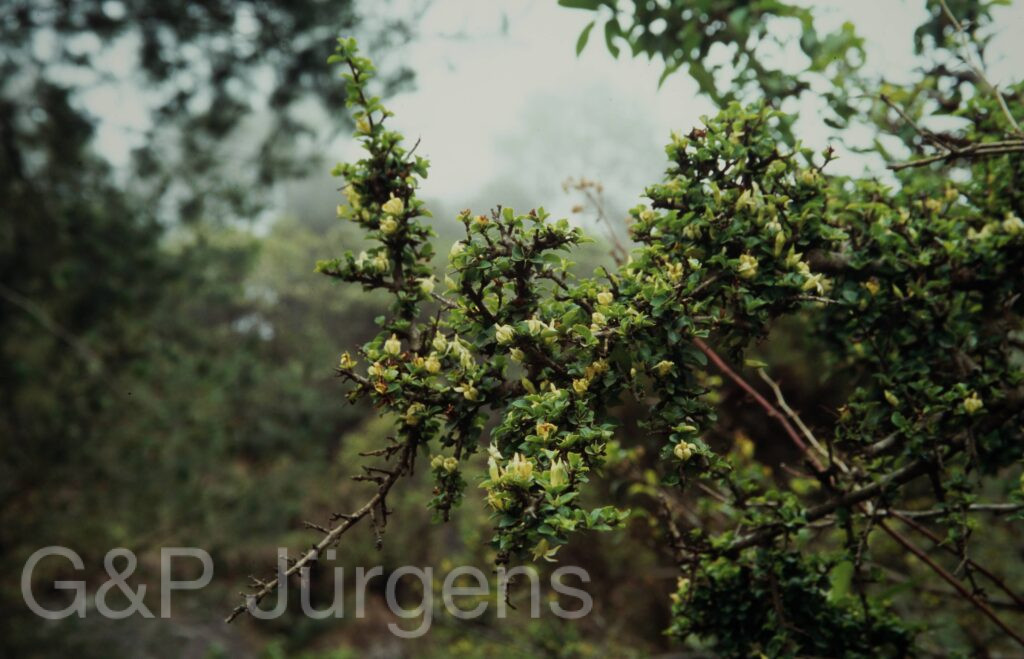
Nepal 2009 10 ergebnis
Nepal Helambu Sheno-Okrini 1900m, May

Description

Himalrandia tetrasperma is a spiny shrub of the Rubiaceae endemic to the Himalaya and its western foothills, recorded by GBIF (about 176 occurrences) from India, Nepal, Pakistan, Bhutan and Afghanistan. It is a plant of warm, often dry, open forest, scrub and rocky hillsides in the subtropical and lower temperate zone, frequently on sunny slopes and ravine sides. The illustrated material was gathered in Bhutan at Samtengang near 2300 m in April and in the Helambu region of Nepal at Sheno-Okrini around 1900 m in May, both flowering in spring, which is consistent with the genus producing its blossom on the bare or newly leafing wood of the dry season.

The plant is a much-branched, deciduous shrub whose short lateral shoots are modified into stout, woody spines, a distinctive armament for the family. The leaves are opposite or clustered on the dwarf shoots, small, obovate to elliptic, entire and glabrescent, with interpetiolar stipules. The flowers are solitary or in small fascicles, fragrant and white, with a short calyx and a salverform corolla of five spreading lobes opening from a slender tube. There are five stamens inserted in the throat and an inferior, bilocular ovary. The fruit is a small, fleshy to leathery berry, the epithet tetrasperma referring to the typically four-seeded fruit.

Himalrandia is a small genus segregated from the broadly circumscribed Randia, to which the species was long referred (as Randia tetrasperma); its placement among the Gardenieae has been confirmed by revision. As a hardy shrub of disturbed and semi-arid hill country it is locally common and not regarded as threatened, its fragrant flowers pollinated by insects and its berries dispersed by birds.

Author: (Wall. ex Roxb.) T.Yamaz. · Sources: POWO (Kew), GBIF, Flora of Pakistan, Flora of Bhutan, Annotated Checklist of the Flowering Plants of Nepal, Tirvengadum's studies of Asian Gardenieae (Rubiaceae)

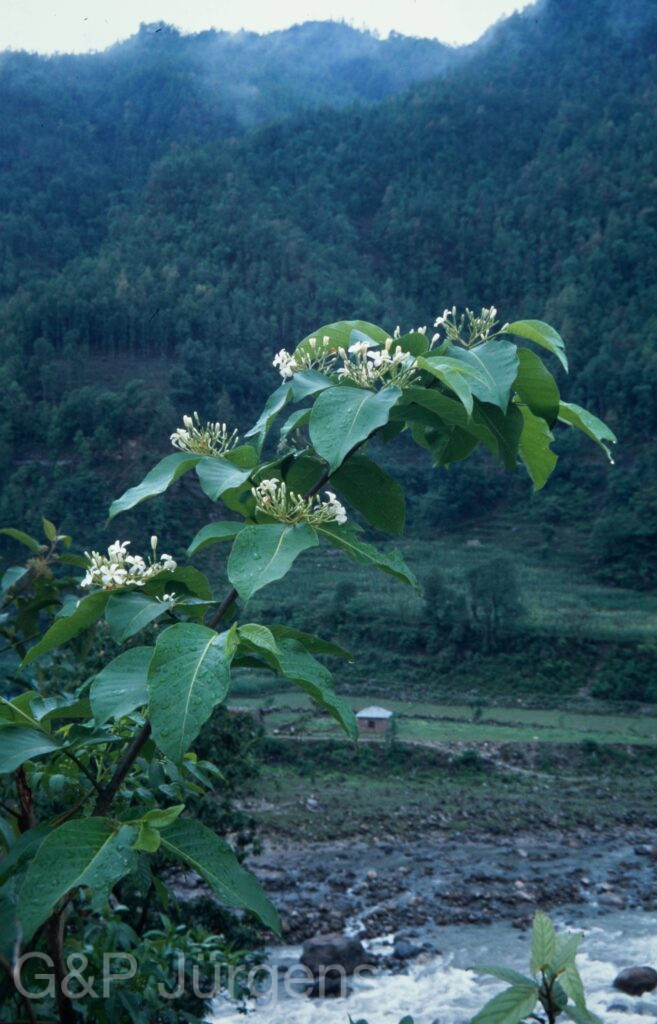
Wall. ex G.Don

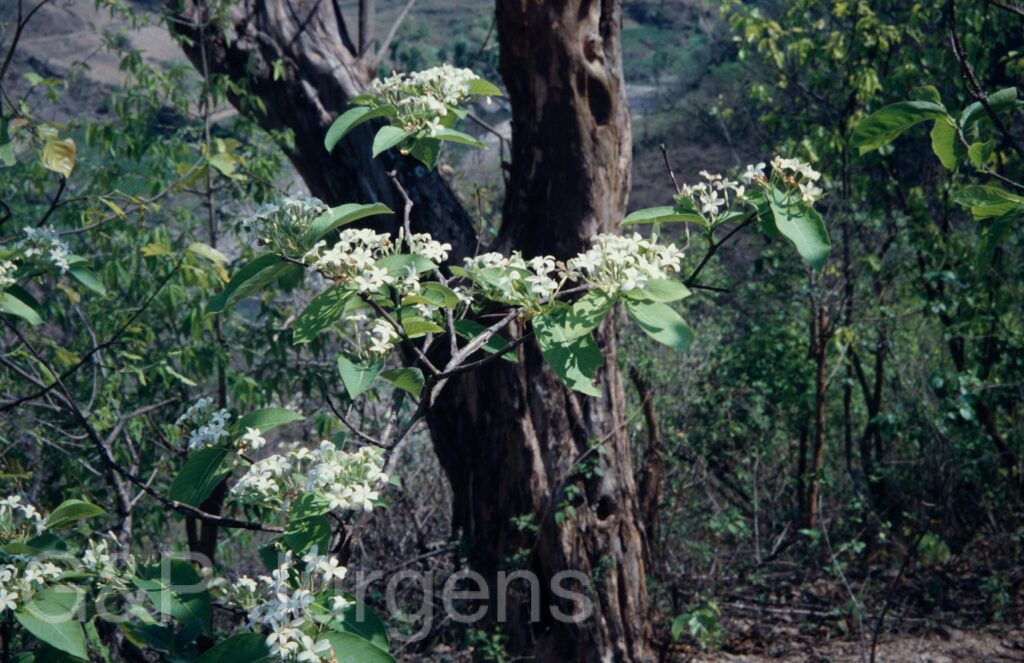
Nepal 1994 329 ergebnis
Ost-Nepal Chainpur 1300m May 
Nepal 2001 503 ergebnis ergebnis
Nepal (Gorkha) Arkhet 720m, May

Description

Holarrhena pubescens is a widely distributed paleotropical shrub or small tree with one of the broadest ranges in this set, documented by over 3,000 GBIF records spanning the Indian subcontinent (India, Nepal, Bangladesh, Pakistan), Southeast Asia (Myanmar, Thailand, Laos, Vietnam, Cambodia, Malaysia), southern China and much of sub-Saharan Africa (Tanzania, Malawi, Mozambique, Zimbabwe, Zambia, South Africa, Kenya, Democratic Republic of the Congo). It is a plant of dry deciduous forest, savanna woodland, scrub and ravine margins, generally below about 1,300 m. The cited Nepalese plants, from Chainpur in the east at 1,300 m and from Arkhet in Gorkha at 720 m, both flowering in May, mark the upper Himalayan foothill edge of its altitudinal range.

The plant is a deciduous shrub to small tree exuding milky latex when cut. The leaves are opposite, simple, broadly elliptic to ovate, shortly petiolate, softly pubescent beneath and entire-margined. The flowers appear with or before the new leaves in dense terminal corymbose cymes; each is salverform with five white, fragrant, contorted petals on a slender tube, collectively giving a showy, jasmine-like display. The fruit is a pair of long, slender, pendulous cylindrical follicles, often spotted, splitting to release numerous flat seeds bearing an apical tuft of silky hairs adapted for wind dispersal.

The species is medicinally important: its bark and seeds (the drug "Kurchi") yield steroidal alkaloids such as conessine, long used against amoebic dysentery. It is the type-related species of the small Old World genus Holarrhena within tribe Malouetieae of subfamily Apocynoideae. Despite extensive harvesting for traditional medicine, its wide range and habitat tolerance keep it secure.

Author: Wall. ex G.Don · Sources: POWO (Kew), Flora of China Vol. 16, Flora of Pakistan, GBIF, Endress & Bruyns: A revised classification of the Apocynaceae

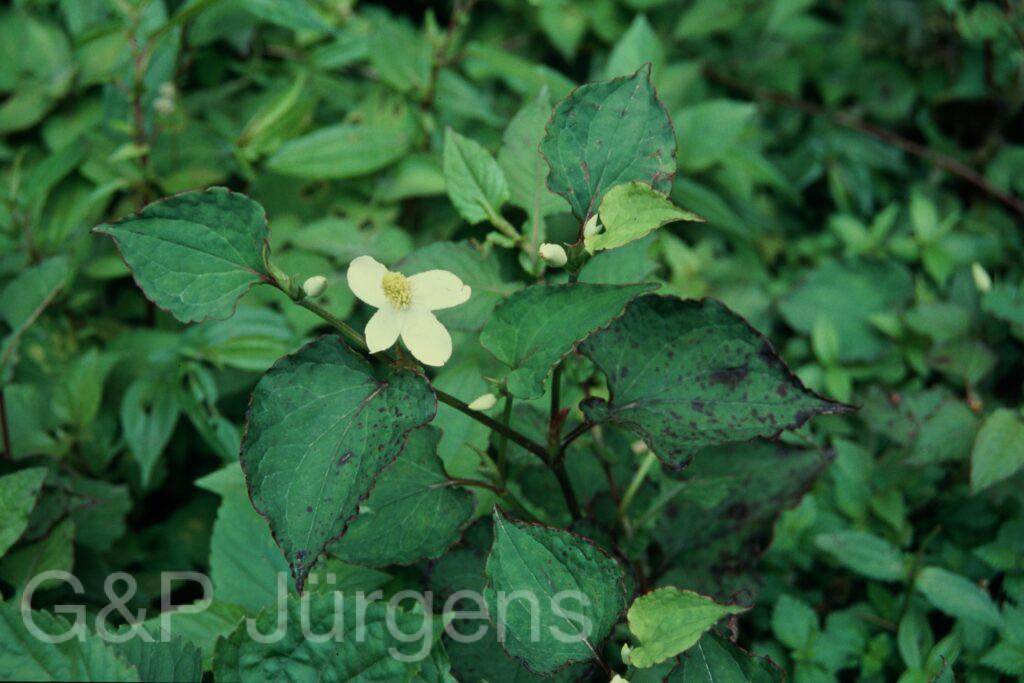
Thunb.

Sikkim2004 369 P644
Sikkim/India Tista-Valley 1900m May
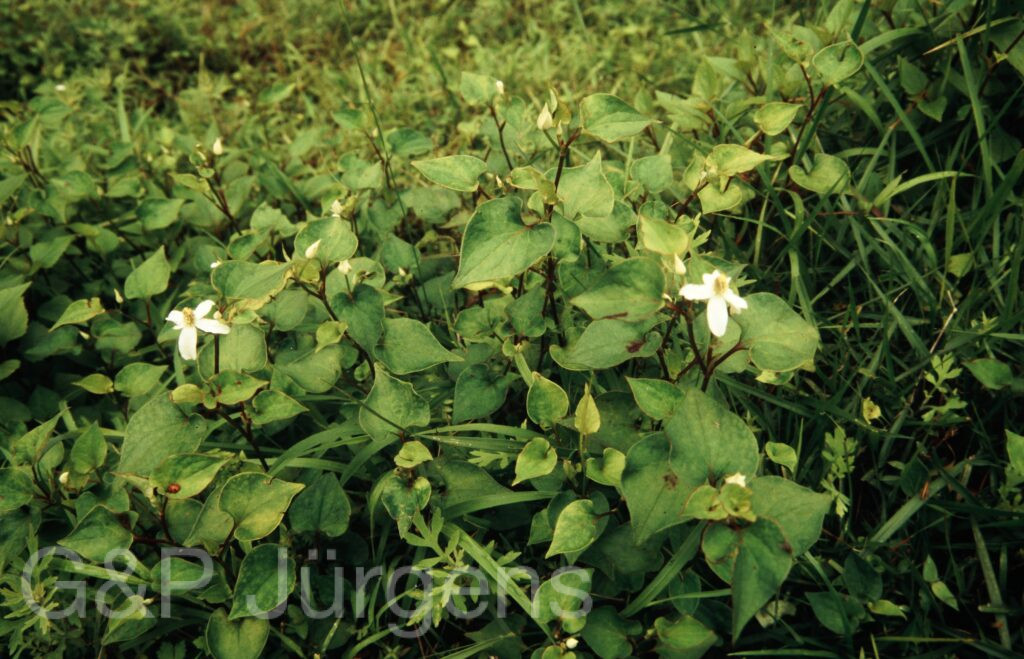
Nepal 2009 64 ergebnis
Nepal Helambu Doroli 1850, May

Description

Houttuynia cordata is a widespread East Asian and Himalayan herb with a very large GBIF dataset of nearly 18000 records spanning Japan, China, Korea, Taiwan, India, Nepal, Bhutan, Vietnam and Thailand, together with numerous naturalised and cultivated occurrences in Europe and North America. It grows in moist and wet places, along streamsides, ditches, marsh margins, wet meadows and shaded forest floors, from the lowlands up to around 2500 m. The illustrated plants from the Tista valley in Sikkim/India at 1900 m and from Doroli in the Helambu region of Nepal at 1850 m, both flowering in May, are typical of its damp, shaded montane habitats in the Himalaya.

It is a rhizomatous perennial herb emitting a strong fish-like odour when bruised. The slender rhizomes creep underground, giving rise to erect, simple or sparingly branched stems. The leaves are alternate, broadly ovate-cordate with a deeply cordate base, an acuminate apex, an entire margin and palmate venation, often tinged red beneath, and the petiole base is sheathing with a membranous stipule. The minute, perianthless flowers are densely crowded on a short terminal spike that is subtended by four (occasionally more) showy, petaloid white involucral bracts, giving the whole structure the appearance of a single flower. Each tiny flower has three stamens and a one-locular ovary of fused carpels; the fruit is a small capsule with numerous seeds.

Houttuynia cordata is one of only a few genera in the small basal angiosperm family Saururaceae (order Piperales). It is widely used as a culinary herb and in traditional medicine across East Asia, and the variegated forms are popular ornamentals. It spreads vigorously by its creeping rhizomes, forming clonal colonies, and can become weedy where introduced. It is exceedingly common and of least conservation concern.

Author: Thunb. · Sources: POWO (Kew), GBIF, Flora of China Vol. 4, Flora of Bhutan Vol. 1, Flora of Nepal, Liang & Tucker Saururaceae systematic studies (monograph)

Hoya obcordata

by GP Jürgens

Hook.f.

Nepal 97 554 P1081
Nepal Sabha-Khola 550m May
Nepal 97 553 P1080
Nepal Sabha-Khola 550m May

Description

Hoya obcordata is an epiphytic climber of the eastern Himalayan foothills and adjacent subtropical forests, documented from north-east India and Bhutan, with collections also referable to lowland Nepal. It is poorly recorded, GBIF holding only five georeferenced occurrences, reflecting both its restricted range and the difficulty of collecting canopy epiphytes. It grows as a twining liana or root-climber on tree trunks and rocks in humid broad-leaved and riverine forest at low elevations. The plant from Sabha Khola in eastern Nepal at 550 m in May occupies just such a warm, humid valley floor, flowering in the late dry season.

It is a glabrous, somewhat succulent vine with slender twining stems rooting adventitiously at the nodes and exuding milky latex. The leaves are opposite, thick and fleshy, obovate to obcordate with a notched or rounded apex (whence obcordata) and shortly petiolate. The flowers are borne in pendent, umbelliform cymes from extra-axillary peduncles, each umbel of many small star-shaped blooms. The corolla is rotate and five-lobed, pale and reflexed, surmounted by the fleshy five-parted corona typical of Hoya around the gynostegium of fused stamens and stigma. The pollen forms waxy pollinia, and the fruit is a slender paired follicle releasing comose, wind-dispersed seeds.

Hoya belongs to subfamily Asclepiadoideae of an expanded Apocynaceae, defined by the gynostegium, corona and pollinium-bearing flowers formerly placed in Asclepiadaceae. H. obcordata is among the less collected Himalayan members of this largely Malesian genus, and its scarcity in herbaria leaves its full distribution imperfectly known. Such epiphytes are vulnerable to lowland deforestation, and the species would merit targeted survey to clarify its conservation status.

Author: Hook.f. · Sources: POWO (Kew), GBIF, Flora of China Vol. 16, Flora of Bhutan Vol. 2, Annotated Checklist of the Flowering Plants of Nepal, Wallich revisions of Asiatic Hoya

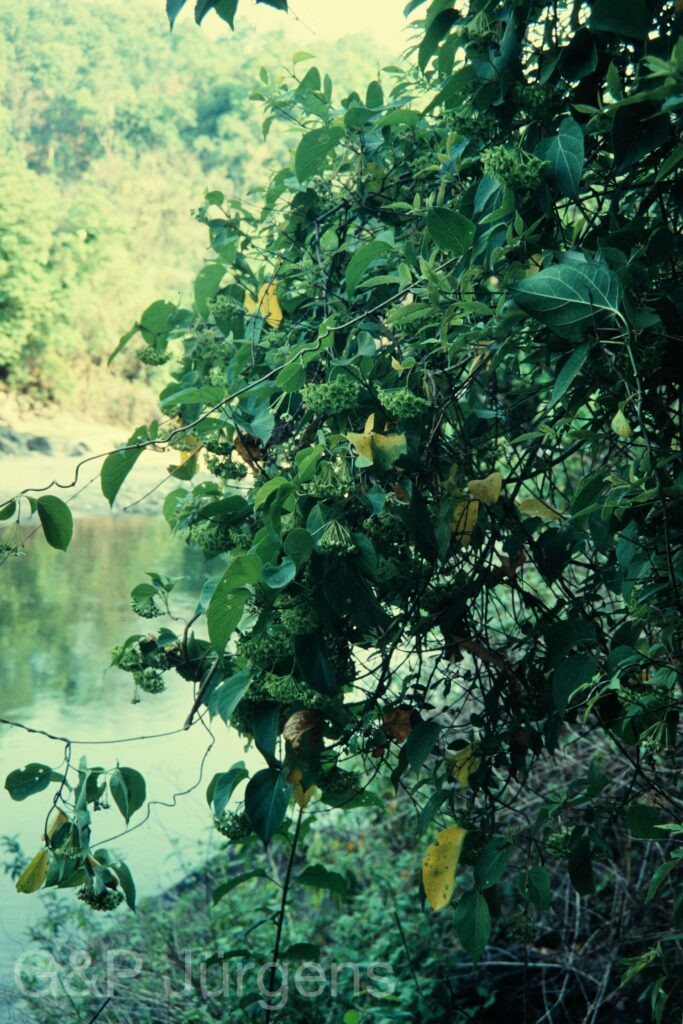
D. Don

Bh2008 472 P734
Bhutan Samtengang, 2040m April
Bh2008 473 P736
Bhutan Samtengang, 2040m April
Nepal 1994 251 ergebnis
Ost-Nepal Milka-Danda 2400m April 

Description

Hydrangea anomala is a climbing shrub of temperate montane forests, one of the most widely recorded species in this group with over 2000 GBIF occurrences. Its native range extends along the Himalaya and through China, Taiwan, Myanmar, Japan and Korea, and it is widely grown in temperate gardens, generating cultivated records across Europe, North America and beyond. It inhabits moist broadleaved and mixed forest, climbing tree trunks and rock faces by adventitious aerial roots. It was photographed at Samtengang in Bhutan at about 2040 m and on the Milka-Danda ridge of eastern Nepal at about 2400 m, both in April, when the flat inflorescences open in the spring forest.

It is a deciduous, root-climbing liana with peeling, reddish-brown bark, attaching by clinging rootlets along the stems. The leaves are opposite, ovate to elliptic, acuminate, serrate and glabrescent, on slender petioles. The inflorescence is a broad, flattened corymb in which numerous small fertile flowers, with minute whitish petals and stamens, are surrounded by a marginal ring of showy sterile flowers bearing three to four enlarged, petaloid white sepals. The fruit is a small, ribbed, urn-shaped capsule opening between the persistent styles to release many minute seeds.

Hydrangea (Hydrangeaceae) comprises shrubs, climbers and small trees of east Asia and the Americas; the climbing species, including H. anomala, are sometimes placed in subgenus Calyptranthe, and H. petiolaris is often regarded as an allied subspecies. Long cultivated as an ornamental climber, H. anomala is widespread and secure across its native range, and is of biogeographic interest within the disjunct Sino-Himalayan to Japanese temperate forest flora.

Author: D. Don · Sources: POWO (Kew), GBIF, Flora of China, Flora of Bhutan, Annotated Checklist of the Flowering Plants of Nepal, McClintock's monograph of Hydrangea (Hydrangeaceae)

(Lour.) Y.De Smet & C.Granados

Sikkim2003 52 P71^
Sikkim above Yoksam 2300m, August

Nepal 2001 431 ergebnis ergebnis
Nepal (Gorkha) Laprak 2000m, May

Description

Hydrangea febrifuga, long familiar under the name Dichroa febrifuga, is a widely distributed shrub of subtropical and warm-temperate Asia, ranging from the Himalaya (Nepal, Sikkim, Bhutan, northeast India) eastward through southern China, Myanmar, Thailand and Indochina to Malesia and the Philippines. It inhabits moist, shaded forest, ravines and streamsides, forming part of the evergreen broad-leaved understorey. It is recorded from low to mid elevations; the populations shown above Yoksam in Sikkim at 2,300 m in August and at Laprak in the Gorkha region of Nepal at 2,000 m in May span its typical mid-montane range in humid forest.

The plant is an erect, much-branched shrub with subquadrangular, often purplish young stems. The leaves are opposite, elliptic to oblong-lanceolate, with a serrate margin, acuminate apex and a glabrous to sparsely pubescent surface. The inflorescence is a terminal or axillary corymbose to paniculate cyme bearing numerous small bisexual flowers; the calyx is shortly toothed and the corolla blue to violet or whitish with thick, valvate petals, the stamens conspicuous. Distinctively for the family, the fruit is a fleshy, indigo-blue berry crowned by the persistent calyx and containing many minute seeds.

Molecular phylogenetic work has shown the segregate genus Dichroa to be nested within Hydrangea, prompting the recombination as Hydrangea febrifuga by De Smet and Granados; the basionym traces to Loureiro's original description of Lourea. The species is of long-standing ethnomedical importance: its roots and leaves, rich in the alkaloid febrifugine, have been used in traditional Chinese and Himalayan medicine against malaria and fevers, a property reflected in the epithet. It remains common and is not considered threatened.

Author: (Lour.) Y.De Smet & C.Granados · Sources: POWO (Kew), Flora of China Vol. 8, Flora of Bhutan Vol. 1, GBIF, De Smet et al.: Hydrangea phylogeny (TAXON)

Wight & Arn.

Bhutan2014 8
Bhutan Sandrup 750m, May
Bhutan2014 222
Bhutan Karu-Chu 1800m, May

Description

Hypericum hookerianum is a Himalayan and Sino-Himalayan shrubby St John's wort, native across China, NE India, Nepal, Bhutan and Myanmar, with GBIF recording some 638 occurrences including numerous cultivated and naturalised records from Europe, North America and Australasia. In the wild it grows in forest margins, clearings, scrub and on open rocky slopes. The photographed Bhutanese plants from Sandrup (750 m) and Karu-Chu (1,800 m), both in May, illustrate its wide altitudinal tolerance from the subtropical foothills to the warm temperate belt.

It is an evergreen or semi-evergreen shrub with terete, often reddish branches. The leaves are opposite, ovate to oblong or lanceolate, sessile or nearly so, frequently glaucous beneath and dotted with pale translucent glands. The flowers are large and showy, borne singly or in few-flowered cymes; they are cup-shaped to bowl-shaped, deep golden-yellow, with five broad concave petals and a dense central boss of numerous stamens grouped in five fascicles surrounding a stout ovary with several styles. The fruit is a many-seeded septicidal capsule.

Hypericum hookerianum is a parent of several widely grown ornamental cultivars and hybrids, valued for its robust habit and bold flowers, which accounts for its scattered occurrence well beyond its native range. The translucent and dark glands of the foliage, characteristic of the genus, contain hypericin and hyperforin and related bioactive compounds. Within the large and complex genus Hypericum, the species belongs to the woody section Ascyreia, distinguished by its shrubby habit, large bowl-shaped flowers and fascicled stamens; it is of no conservation concern given its breadth of range and cultivation.

Author: Wight & Arn. · Sources: POWO (Kew), Flora of Bhutan Vol. 1, GBIF, Flora of China Vol. 13, Robson: Studies in the Genus Hypericum (Bulletin of the Natural History Museum)