Tag:

Subalpine (2500-3500 m)

DC.

Bhutan2014 866
Bhutan Chele-La 3000m, May

Description

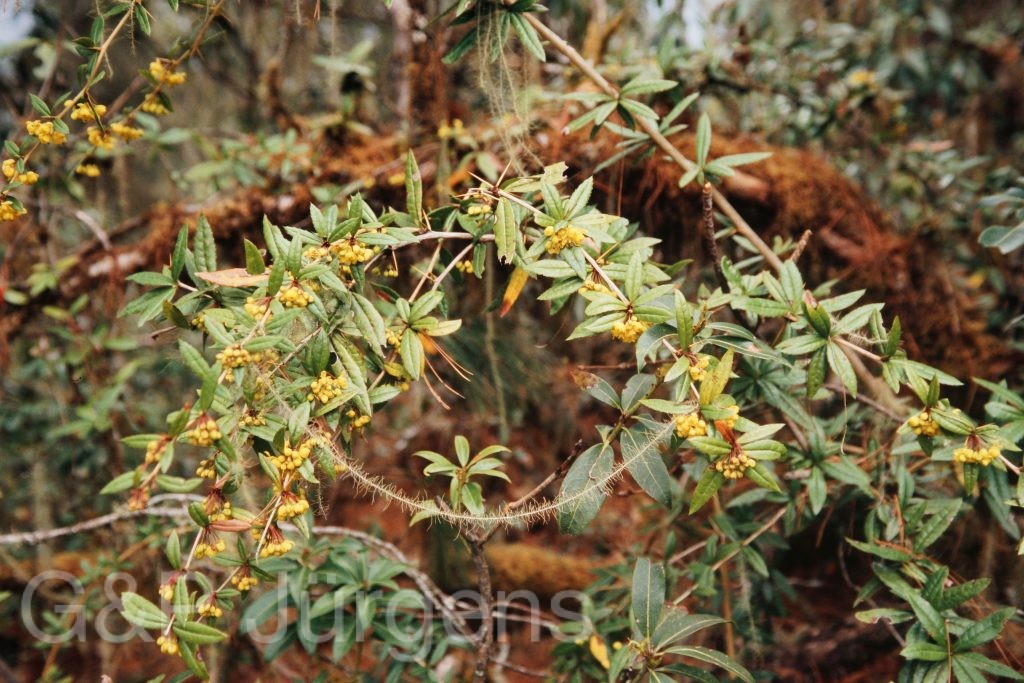
Berberis aristata is a widespread Himalayan barberry native to Nepal, India, Bhutan, Pakistan and China and now naturalised or cultivated far beyond, the very large dataset of c. 926 records including introductions in New Zealand, Australia, Mexico, South Africa and parts of Europe and North America. Within its native range it occupies open hill forest, scrub, forest margins, ravines and dry rocky slopes of the temperate Himalaya, broadly between about 1800 and 3500 m. The plant was photographed at Chele-La in Bhutan at 3000 m in May, a site characteristic of the species, flowering in spring on sunny, well-drained montane slopes.

It is a spiny, much-branched evergreen or semi-evergreen shrub up to about 3.5 m, the older bark yellowish-brown and the wood bright yellow. The nodes bear stout three-fid spines (modified leaves), in whose axils the true leaves are clustered in fascicles on short shoots; the leaves are obovate to elliptic, leathery, with spinulose-toothed margins. The flowers are golden-yellow, borne in pendulous or corymbose racemes, with the typical berberidaceous arrangement of sepaloid and petaloid whorls, six stamens with sensitive, irritable filaments, and a single carpel. The fruit is an ovoid bluish-black berry covered with a glaucous bloom.

Berberis (Berberidaceae) is a large genus distinguished from the related Mahonia by simple leaves and spiny stems, and B. aristata is among its most economically important Asiatic species. The yellow inner bark and roots are rich in the alkaloid berberine and yield "rasaut," used extensively in Ayurvedic and folk medicine, while the berries are edible. Widespread, ecologically tolerant and weedy where introduced, it is in no way threatened; rather, its medicinal harvesting and invasive potential abroad are the chief concerns associated with it.

Author: DC. · Sources: POWO (Kew), GBIF, Flora of China, Flowers of the Himalaya (Polunin & Stainton), Ahrendt monograph of Berberis and Mahonia
Hook.f. & Thomson

Bhutan2014 336
Bhutan Tumching-La 2900m, May

Description

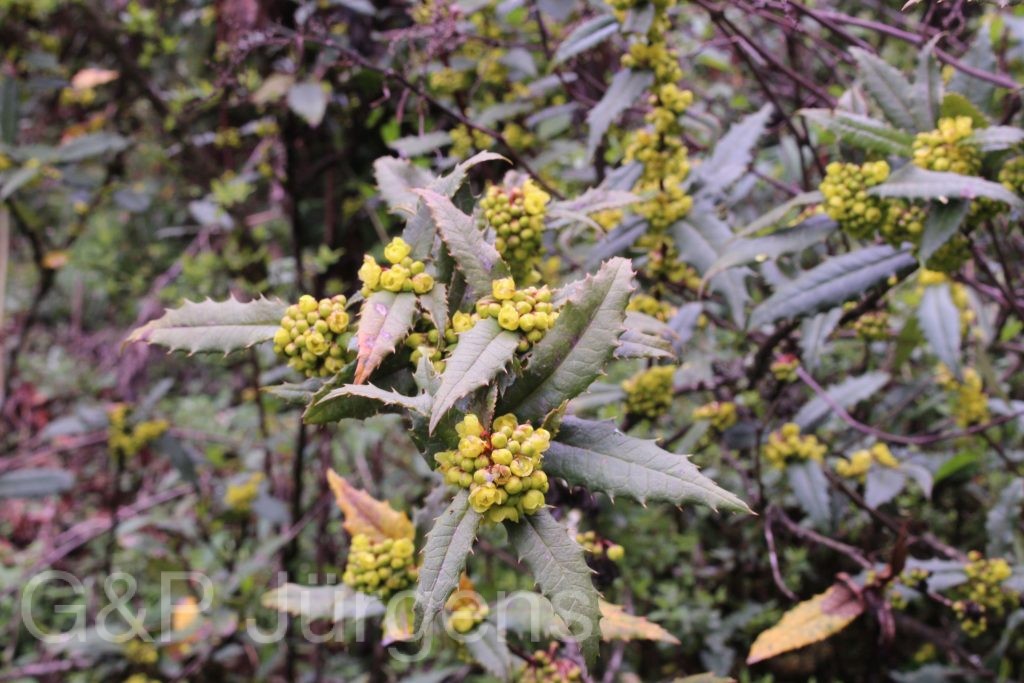
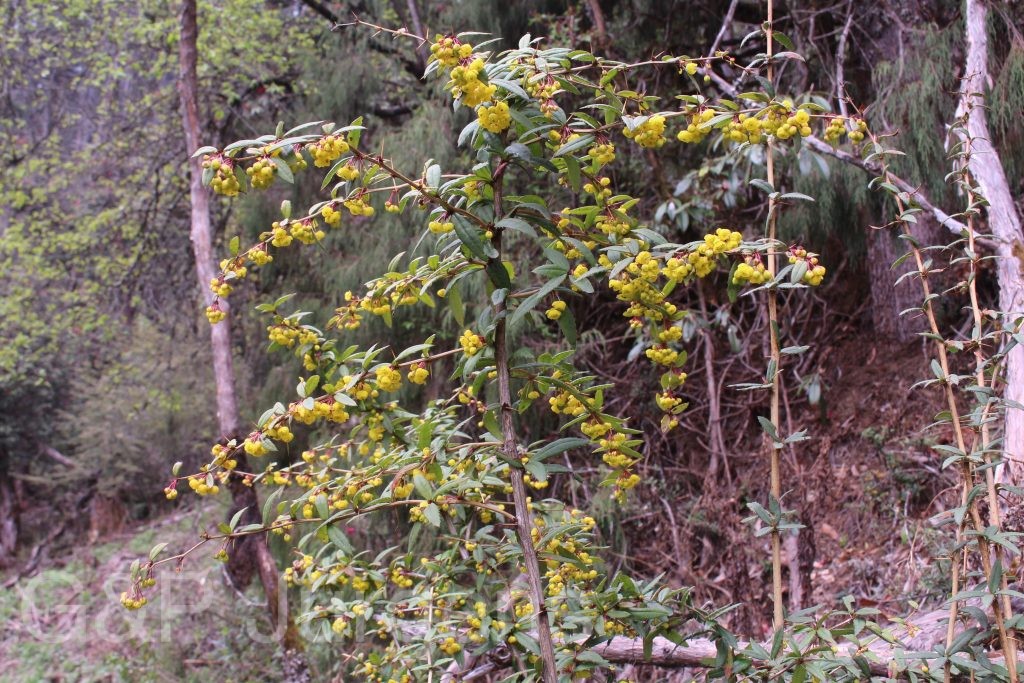
Berberis insignis is an evergreen barberry of the eastern Himalaya, native to Nepal, India, Bhutan and adjacent China, with its 161 georeferenced occurrences also reflecting cultivated material in Britain, the United States and elsewhere. It inhabits cool, moist temperate forest, shrubberies and shaded ravine margins, frequently in the rhododendron and oak belt. The specimen recorded at Tumching-La in Bhutan at 2900 m in May illustrates its occurrence in the upper temperate zone and its late-spring flowering, when the conspicuous yellow blossoms appear among the previous season's foliage.

Distinctively for the genus, B. insignis is a spineless or nearly spineless shrub, lacking the stout nodal thorns of most barberries. The leaves are large, leathery and lustrous, elliptic to oblong-lanceolate, with strongly spinulose-toothed margins and a prominently reticulate venation, borne in tufts on short shoots. The flowers are golden-yellow, clustered in dense axillary fascicles; each flower has the typical berberidaceous arrangement of sepals and petals in whorls of three, with six stamens that respond to touch, and a single carpel. The fruit is an ellipsoid to oblong berry, ripening dark blue-black with a glaucous bloom.

Berberis is a large genus traditionally divided into spiny-leaved evergreen and deciduous groups; B. insignis is notable for combining bold evergreen foliage with the absence of stem spines, characters that have made it a recognised parent in horticulture. Within its native range it is locally frequent in undisturbed forest, and its broad eastern-Himalayan distribution indicates no immediate conservation concern.

Author: Hook.f. & Thomson · Sources: POWO (Kew), GBIF, Flora of China, Flora of Bhutan, The genus Berberis monograph (Ahrendt), Flowers of the Himalaya (Polunin & Stainton)

C.K.Schneid.

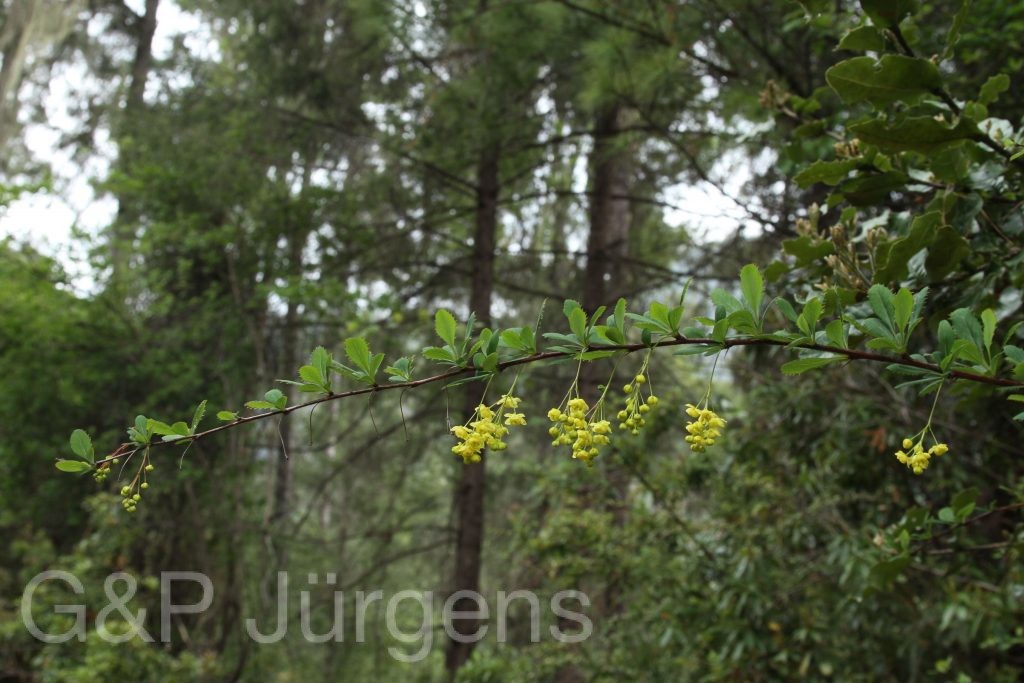
Bhutan2014 590
Bhutan Gogona 3000m, May
Bh2008 25 P43
Bhutan Paro 2300m, April

Description

Berberis praecipua is an eastern Himalayan barberry centred on Bhutan and adjacent India, Nepal and southern China, with about 39 occurrences (the additional records from Canada and Britain representing cultivated or herbarium material). It grows in temperate forest margins, open hillsides, scrub and clearings, typically between roughly 2300 and 3300 m. The photographed plants from Gogona at 3000 m (May) and Paro at 2300 m (April) in Bhutan illustrate its spring flowering across this montane belt, where it occupies sunny, well-drained slopes within and around mixed conifer and broad-leaved forest.

It is a deciduous, much-branched spiny shrub with terete, often reddish-brown young shoots armed with three-fid spines derived from modified leaves. The foliage leaves are clustered on short shoots in the axils of the spines, obovate to oblanceolate, with an entire to spinulose-toothed margin, glaucous beneath. The flowers are yellow, borne in pendulous racemes or fascicles, each with the typical Berberis arrangement of six sepals in two whorls, six petals each bearing two basal nectariferous glands, and six stamens with sensitive filaments and valvate anther dehiscence. The ovary is superior and unilocular, ripening into an ellipsoid to oblong berry that is red to purplish-black and often pruinose, containing few seeds.

Berberis is a large, taxonomically intricate genus in which the Himalayan deciduous species form a difficult complex separated on fruit, leaf and inflorescence characters; B. praecipua C.K.Schneid. is the accepted name. The bright flowers are insect-pollinated, with the touch-sensitive stamens promoting pollen transfer, while the fleshy berries are dispersed by birds (ornithochory). As a relatively localised eastern Himalayan endemic it has not been formally assessed but appears locally frequent within its range.

Author: C.K.Schneid. · Sources: POWO (Kew), GBIF, Flora of China Vol. 19, Flora of Bhutan Vol. 1, Flora of Nepal, Ahrendt Berberis and Mahonia: A Taxonomic Revision

(Haw.) Sternb.

Sikkim2011 28
Sikkim Lachen 2800m, June
Nepal 97 303 G604
Nepal Honggaon 2360m May
Nepal 2001 463 ergebnis ergebnis
Nepal (Gorkha) Gunda 1700m, May

Description

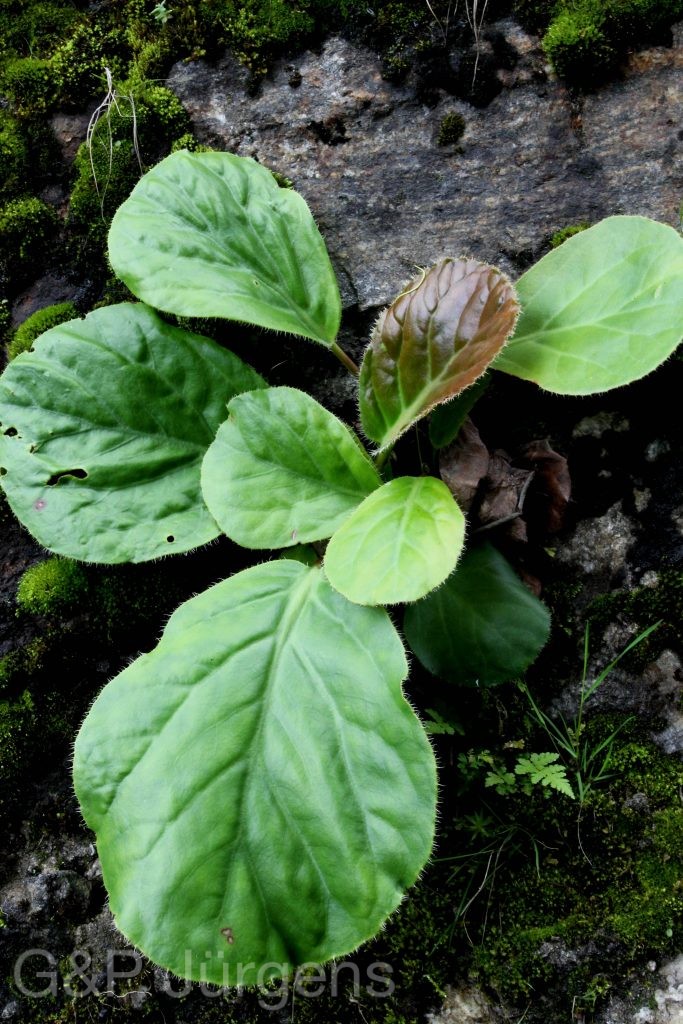
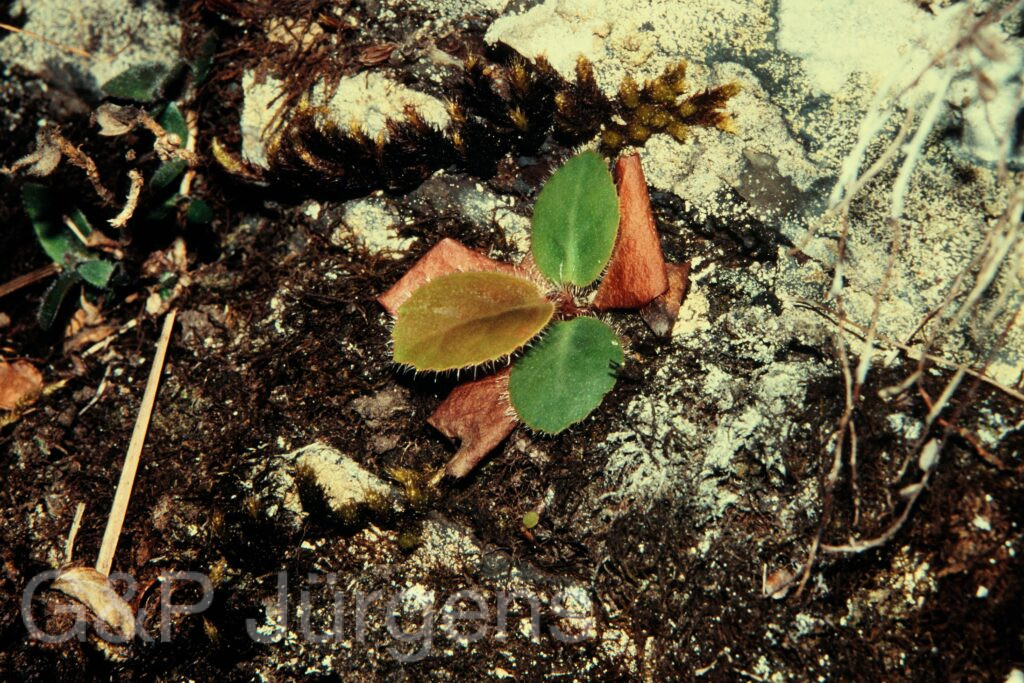
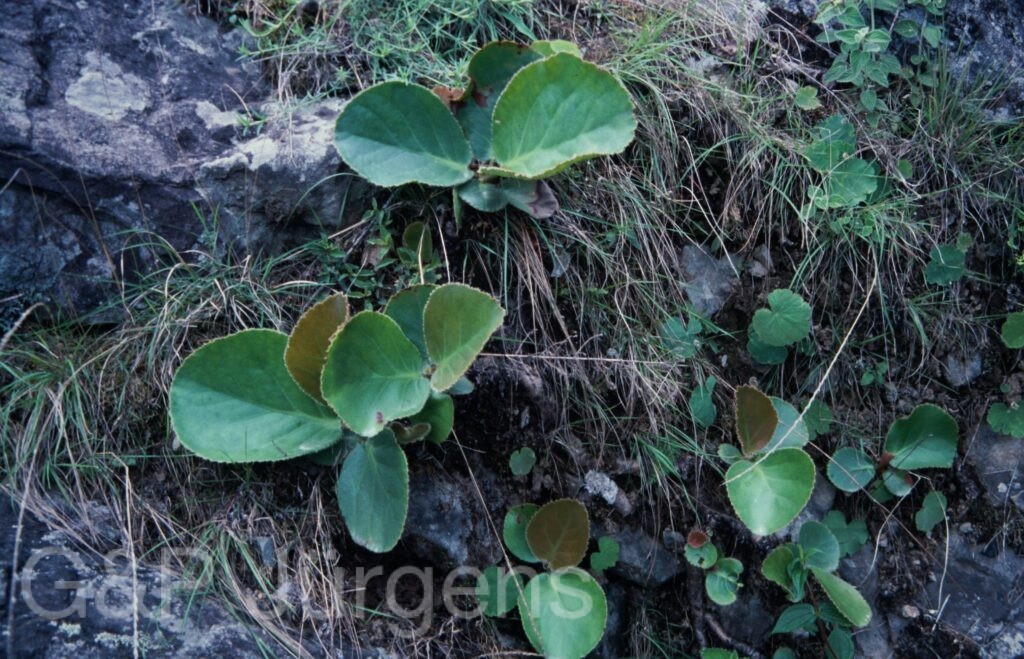
Bergenia ciliata (Haw.) Sternb. is a robust rosette-forming perennial widely distributed through the Himalaya from Pakistan and Afghanistan eastward across India, Nepal, Sikkim and Bhutan into south-west China. It is a characteristic plant of shaded, moist rock crevices, cliff ledges, stream banks and boulder-strewn slopes in the temperate forest belt, generally between about 1500 and 3000 m. The photographed gatherings span this range, from Gunda in the Gorkha region of Nepal at 1700 m and Honggaon at 2360 m up to Lachen in northern Sikkim at 2800 m, flowering in May and June. It favours cool, humid, semi-shaded microsites with seepage and good drainage, often forming extensive colonies on damp rock.

The plant arises from a stout, fleshy, creeping rhizome bearing the persistent remains of old leaf bases. The leaves are large, obovate to broadly elliptic, rounded and shortly toothed at the margin, and notably ciliate-hairy on both surfaces and margin (the basis of the epithet ciliata), distinguishing it from the glabrous-leaved B. purpurascens. The leafless scape carries a branched cymose panicle of showy flowers; the five petals are white to pale pink, broadly obovate, set off by a reddish calyx and conspicuous stamens, opening often before the new foliage is fully expanded. The fruit is a two-lobed capsule containing numerous small seeds.

Within Saxifragaceae the genus Bergenia is a small Asian group, and B. ciliata is one of its most widespread members, intergrading with relatives where ranges overlap. The thick rhizome ("pashanbhed") is important in Ayurvedic and folk medicine, valued for treating urinary calculi, which has led to heavy wild harvesting. Though not globally threatened, localised over-collection and habitat disturbance make sustainable management of this medicinally prized saxifrage a conservation concern.

Author: (Haw.) Sternb. · Sources: POWO (Kew), GBIF, Flora of China, Annotated Checklist of the Flowering Plants of Nepal, Flora of Bhutan, A Monograph of the Genus Bergenia (Yeo)

Buch.-Ham.

Bhutan2014 432
Bhutan Yatong-La 2800m, May

Description

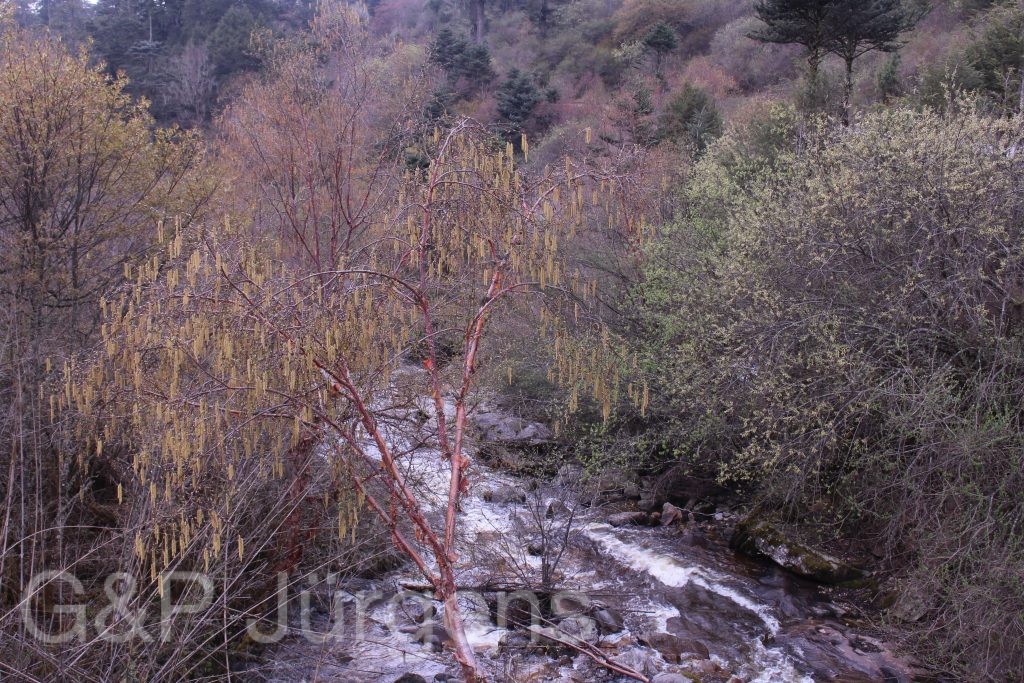
Betula alnoides Buch.-Ham. ex D.Don is a tall, fast-growing birch of the warm-temperate and subtropical mountains of southern and eastern Asia. Its distribution covers Nepal, northeast India, Bhutan, southern China, Myanmar, Thailand, Laos and Vietnam, with cultivated and trial occurrences recorded elsewhere. It is a light-demanding, often pioneering tree of moist broad-leaved and mixed montane forests, ravines and disturbed slopes, typically between about 1,000 and 2,800 m. The tree photographed at Yatong-La in Bhutan at 2,800 m in May sits near the upper edge of this band, within the humid mid-montane forest belt where the species frequently colonises gaps and forest margins.

The tree is deciduous and may reach 20–30 m, with smooth, brownish to reddish bark that exfoliates in thin papery sheets and bears conspicuous horizontal lenticels. The leaves are alternate, ovate-lanceolate with a long acuminate apex, doubly serrate margins and several pairs of straight lateral veins. As in all birches the plant is monoecious: the pendulous male catkins elongate at anthesis, while the smaller female catkins develop into slender, drooping, cylindrical infructescences that disintegrate to release small two-winged samaras adapted for wind dispersal.

Betula alnoides is the most important commercial birch of subtropical Asia, valued for its high-quality, reddish, fine-grained timber and increasingly grown in plantations and agroforestry across southern China and adjacent countries. Its rapid early growth and ability to fix sites make it useful in reforestation of degraded montane land. The species belongs to a group of subtropical birches distinct from the better-known temperate white birches, and although widely exploited it remains common and is not regarded as threatened.

Author: Buch.-Ham. · Sources: POWO (Kew), GBIF, Flora of China Vol. 4, Flora of Bhutan Vol. 1, Ashburner & McAllister: The Genus Betula (2013)

Betula utilis

by GP Jürgens

D.Don

Nepal 95 182 P303 ergebnis
Nepal North of Rupien La 3200 m October

Description

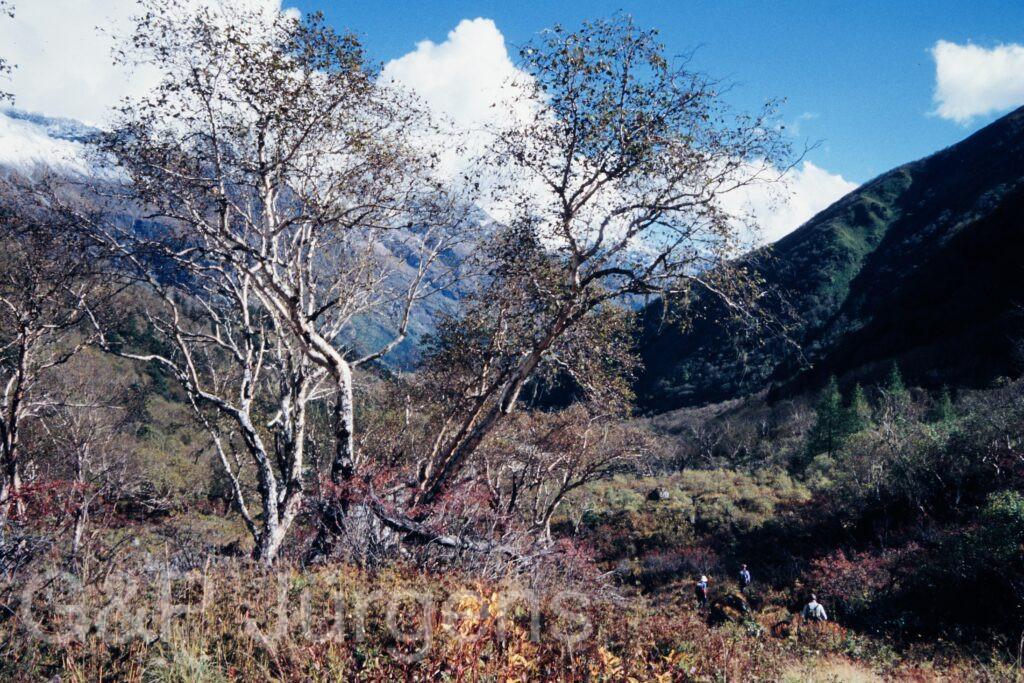
Betula utilis, the Himalayan birch, is the characteristic tree of the upper subalpine forest belt throughout the Himalaya and into western China, native across China, Nepal, India, Pakistan, Bhutan and Afghanistan; its roughly 6400 GBIF records combine wild Himalayan occurrences with cultivation in Britain, Germany, France and North America. It forms the treeline forests of the range, as recorded north of the Rupien La in Nepal at about 3200 m in October, typically between 3000 and 4000 m. There it forms pure stands or grows with rhododendron, fir and juniper on cool, moist north-facing slopes, marking the limit of arborescent vegetation.

The species is a deciduous tree, often gnarled near the treeline, with the famous smooth, papery, peeling bark ranging from white and pinkish to coppery or dark brown that exfoliates in horizontal sheets. The leaves are alternate, ovate, doubly serrate and acuminate, turning gold in autumn. As a wind-pollinated monoecious birch it bears separate male and female catkins; the pendulous male catkins shed pollen in spring, while the female catkins mature into cylindrical, disintegrating fruiting catkins releasing small, winged nutlets.

Betula utilis is taxonomically variable, divided into several subspecies and varieties differing in bark colour and leaf form, including the white-barked western populations grown horticulturally as var. jacquemontii. Ecologically it is a keystone of Himalayan treeline ecosystems, its bark long used as a writing material and in traditional medicine. As the treeline shifts under climatic warming and forests face grazing pressure, it is an important indicator species in studies of mountain ecosystem change.

Author: D.Don · Sources: POWO (Kew), GBIF, Flora of China Vol. 4, Flora of Bhutan Vol. 1, Flora of Nepal, Birches: The Genus Betula (Ashburner & McAllister)

(Roth) O.Deg.

Bhutan2012 401
Bhutan Wangdi 2700m, September

Description

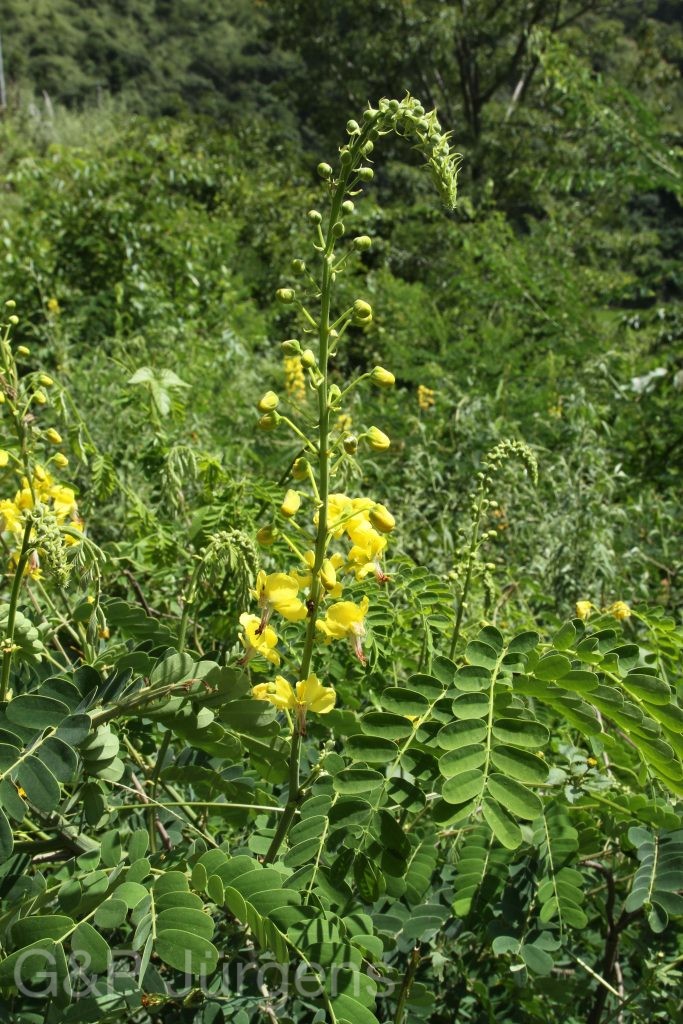
Biancaea decapetala (formerly Caesalpinia decapetala), the Mysore thorn, is a vigorous scrambling shrub native to tropical and subtropical Asia but now widely naturalised across the tropics; its 9040 GBIF occurrences span China, India and much of Asia together with Africa, Australia, the Americas and Pacific islands, reflecting an extensive introduced range. In its native Himalayan setting it grows in thickets, forest margins, riverbanks, scrub and waste ground from the lowlands to about 2700 m. The collection figured, from Wangdi in Bhutan at 2700 m in September, represents the upper subtropical edge of its range, where it forms dense thorny tangles on warm, disturbed valley slopes.

It is a robust, scandent shrub or liana with long arching woody branches armed with numerous stout, recurved prickles and a rusty-brown indumentum on young growth. The leaves are large, alternate and bipinnate, with several pairs of pinnae each bearing many small oblong leaflets. The inflorescence is an erect, elongate terminal raceme of showy flowers; the corolla is bright yellow with five slightly unequal petals (the epithet alluding to ten perianth parts), and the ten free stamens have hairy, reddish filaments. The fruit is a flattened, woody, oblong pod, beaked at the apex and indehiscent or tardily splitting, containing several seeds.

The genus on the source page is given as Caesalpinia; molecular and morphological studies have segregated this species into Biancaea (Fabaceae, subfamily Caesalpinioideae), the combination accepted by POWO. Used regionally for impenetrable hedges and in traditional medicine, the species is an aggressive coloniser and a serious invasive weed in South Africa, Australia and elsewhere, smothering native vegetation; it is consequently a biosecurity and conservation concern well beyond its native Asian range.

Author: (Roth) O.Deg. · Sources: POWO (Kew), GBIF, Flora of China, Flora of Bhutan, Legumes of the World (Caesalpinioideae)

H.Lév.

Nepal 99 35 ergebnis
West-Nepal Nyor Gaad 2700m, June

Description

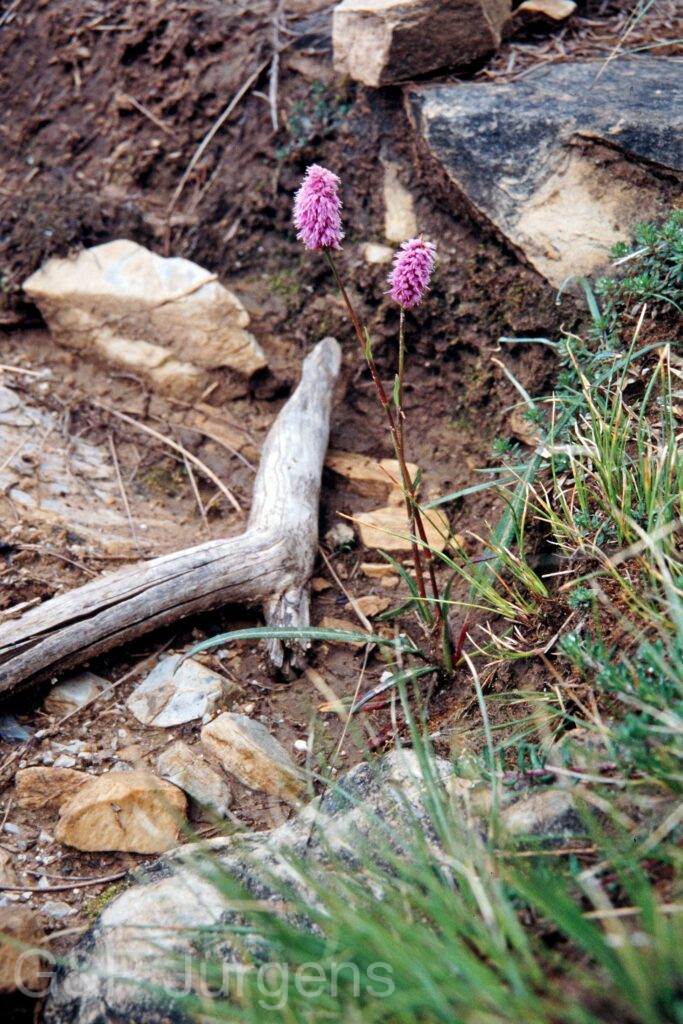
Bistorta milletii is a Sino-Himalayan knotweed distributed through China, Nepal, India and Bhutan, with GBIF recording 185 occurrences along this temperate to subalpine arc. It grows in open grassy slopes, moist meadows, forest margins and rocky banks, broadly between about 2500 and 4000 m. The illustrated plant was photographed in West Nepal at Nyor Gaad at 2700 m in June, a representative mid-montane meadow station where the species flowers through the early summer. It commonly forms patches in damp turf alongside other alpine and subalpine herbs.

The plant is a rhizomatous perennial herb arising from a stout, often contorted rhizome that anchors it in the sward. Basal leaves are long-petiolate with ovate-lanceolate to narrowly elliptic blades, the base cuneate to subcordate and the lower surface frequently pale; the membranous, tubular ochreae sheathing the stem are diagnostic of the family. The flowering stem is simple and erect, terminating in a dense, cylindrical, spike-like raceme. The small flowers have a five-parted, petaloid perianth, deep pink to red, with eight exserted stamens and a superior ovary bearing three styles. The fruit is a small, trigonous, dark brown achene enclosed in the persistent perianth.

The species belongs to genus Bistorta, segregated from Polygonum sensu lato and supported as a distinct lineage by molecular work; the input file's alternate web slug references the related B. affinis. POWO and GBIF accept the name B. milletii. As a meadow component with starch-rich rhizomes, members of the genus are locally grazed and occasionally used as famine food.

Author: H.Lév. · Sources: POWO (Kew), GBIF, Flora of China, Flora of Bhutan, Annotated Checklist of the Flowering Plants of Nepal, A Systematic Revision of Bistorta (Polygonaceae)

(Hook.) Meisn.

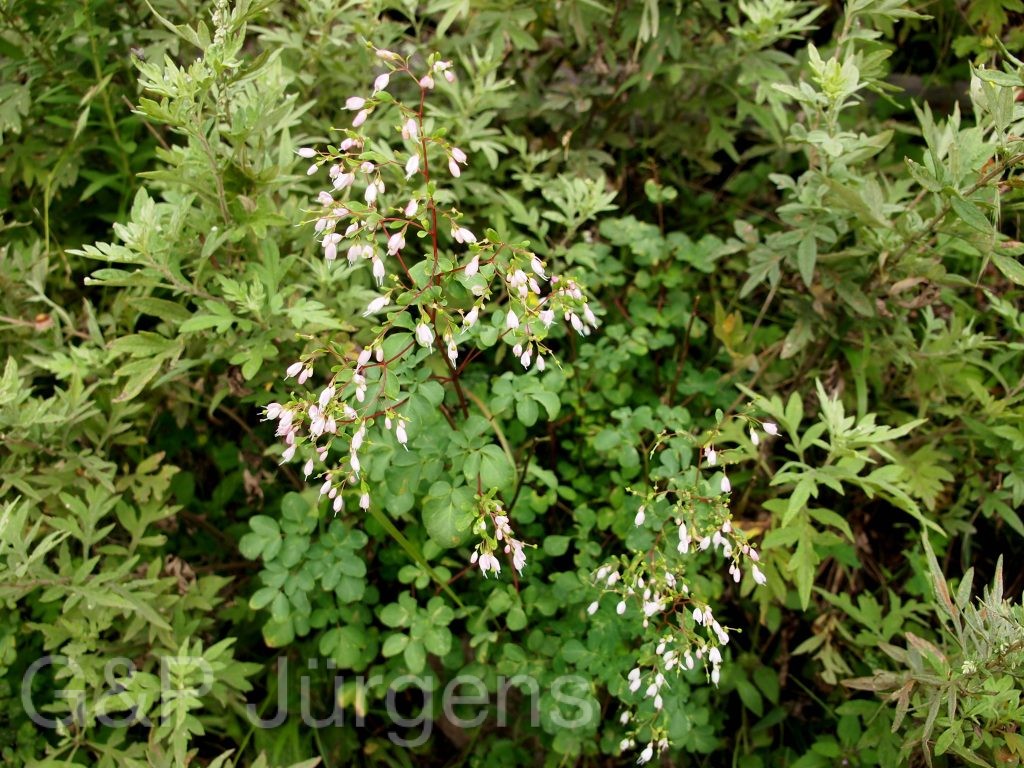
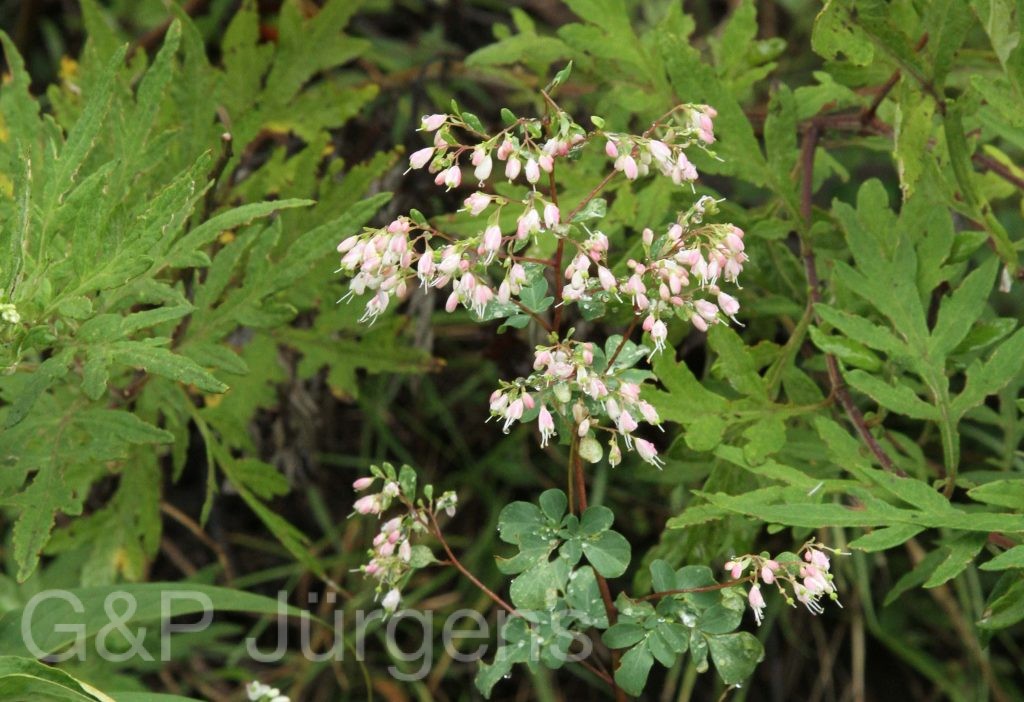
Bhutan2012 123
Bhutan Haar-Valley, 3100m September
Bhutan2012 125
Bhutan Haar-Valley, 3100m September

Description

Boenninghausenia albiflora is a delicate, aromatic herb of the Sino-Himalayan and East Asian region, recorded by GBIF from China, Japan, Taiwan, the Himalaya and Southeast Asia, with more than 5600 occurrences attesting to its frequency. It grows on shaded forest floors, mossy banks, rocky stream gullies and clearings in temperate and subtropical woodland, often on humus-rich or stony ground. The photographed population occurs in Bhutan in the Haa Valley at about 3100 m, flowering in September toward the end of the monsoon; the species ranges broadly from around 1000 to 3500 m across its Himalayan distribution.

The plant is a glabrous, gland-dotted perennial or subshrub with slender, much-branched stems woody only at the base, the whole exuding the citrus-rue scent characteristic of the family. The leaves are alternate and two- to three-pinnately compound, the small ultimate leaflets obovate to oblong, thin, glaucous beneath and conspicuously pellucid-punctate. Numerous small white to cream flowers are borne in lax terminal panicles, each with four petals, eight long-exserted stamens, and a gynophore-borne ovary. The fruit comprises four spreading follicle-like carpels that dehisce to release small reniform seeds.

Boenninghausenia is a small genus of the Rutaceae allied to Ruta, distinguished by its herbaceous habit and stipitate ovary. The pellucid oil glands contain volatile compounds and coumarins, and the plant has a history of use in traditional medicine and as an insect repellent. Variable in leaf division and stature, it has been split into several infraspecific taxa across its wide range. It is common and of least concern, readily recolonising disturbed shady ground.

Author: (Hook.) Meisn. · Sources: POWO (Kew), GBIF, Flora of China, Flora of Bhutan, Rutaceae monograph (Hartley)

J. D. Hooker et Thomson

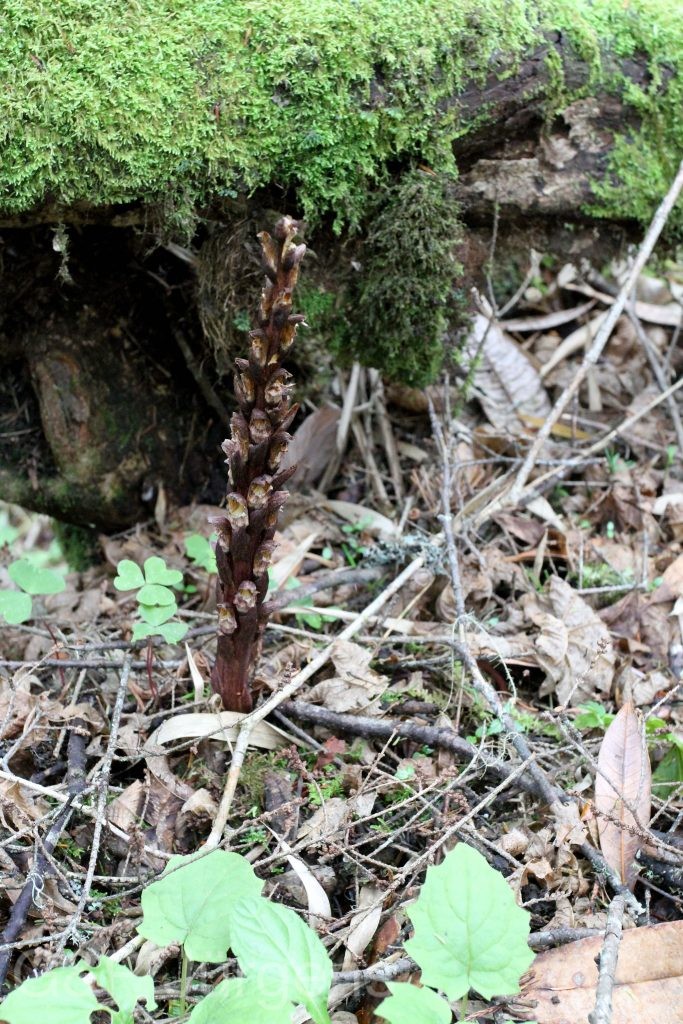
BhutanPG2011 101
Bhutan Chognam 3240m, June

Description

A non-photosynthetic, root-parasitic herb of the eastern Himalaya and East Asia, recorded from China, Taiwan, Nepal, India, Bhutan, Japan and Myanmar, with about 711 GBIF occurrences (a few outlying entries reflect data errors). It parasitises the roots of woody Ericaceae, particularly Rhododendron and Gaultheria, and is found in subalpine shrubberies, forest margins and moist thicket floors, generally between about 2700 and 4000 m. The illustrated plant was photographed in June at Chognam in Bhutan at around 3240 m, a typical rhododendron-dominated montane habitat.

Lacking chlorophyll, the plant draws all nutrition from its host. It arises from a swollen, tuberous, scale-covered basal organ attached to the host root, from which emerge fleshy, erect, unbranched stems coloured purplish-brown, yellowish or reddish and clothed only in small scale-leaves. The inflorescence is a dense, cylindrical, many-flowered terminal spike. Each flower is subtended by a bract and has a short cup-like calyx and a two-lipped, tubular corolla in dull purple to brownish-yellow, with a hooded upper lip and a shorter spreading lower lip; four didynamous stamens are inserted in the tube. The superior ovary ripens into a capsule packed with numerous minute, dust-like seeds adapted to wind dispersal.

Accepted by POWO and GBIF, B. himalaica is one of a small genus of broomrape relatives specialised on ericaceous hosts. Its life cycle is intimately governed by host availability and the germination of its tiny seeds in response to host-root chemical cues. Because it depends entirely on healthy Rhododendron-rich communities, it serves as an indicator of intact subalpine ericaceous vegetation. It is widespread but inconspicuous and locally sporadic; no significant conservation concern is recognised at present.

Author: J. D. Hooker et Thomson · Sources: POWO (Kew), GBIF, Flora of China, Flora of Bhutan, Beck monograph of Orobanchaceae