
DC.
Description
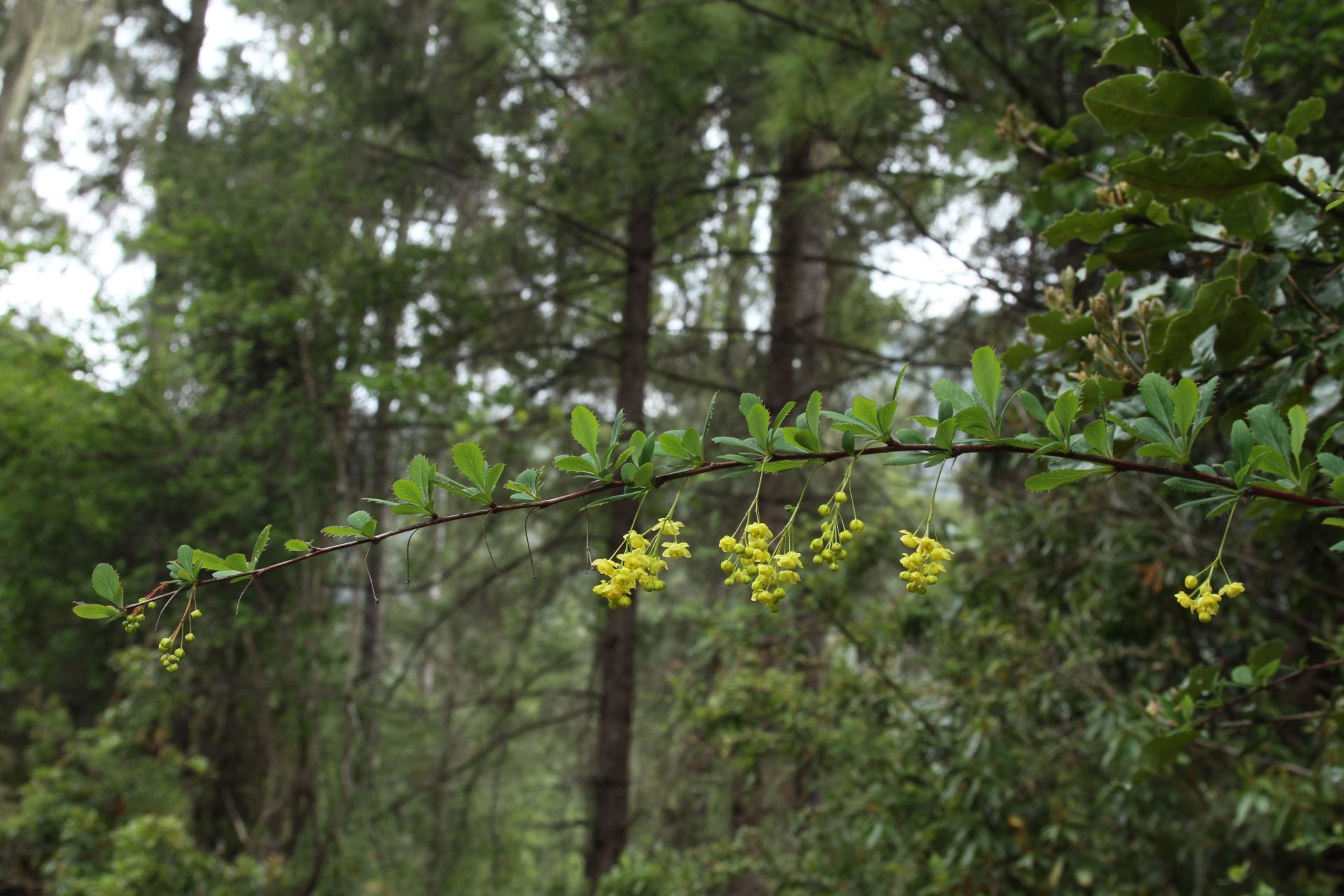
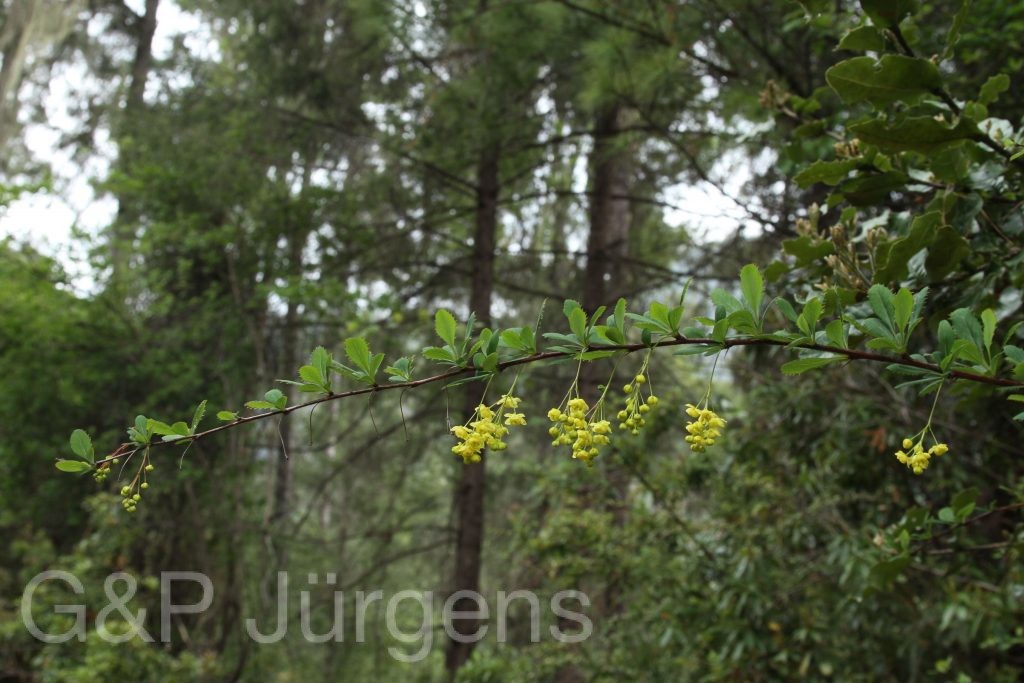
Berberis aristata is a widespread Himalayan barberry native to Nepal, India, Bhutan, Pakistan and China and now naturalised or cultivated far beyond, the very large dataset of c. 926 records including introductions in New Zealand, Australia, Mexico, South Africa and parts of Europe and North America. Within its native range it occupies open hill forest, scrub, forest margins, ravines and dry rocky slopes of the temperate Himalaya, broadly between about 1800 and 3500 m. The plant was photographed at Chele-La in Bhutan at 3000 m in May, a site characteristic of the species, flowering in spring on sunny, well-drained montane slopes.
It is a spiny, much-branched evergreen or semi-evergreen shrub up to about 3.5 m, the older bark yellowish-brown and the wood bright yellow. The nodes bear stout three-fid spines (modified leaves), in whose axils the true leaves are clustered in fascicles on short shoots; the leaves are obovate to elliptic, leathery, with spinulose-toothed margins. The flowers are golden-yellow, borne in pendulous or corymbose racemes, with the typical berberidaceous arrangement of sepaloid and petaloid whorls, six stamens with sensitive, irritable filaments, and a single carpel. The fruit is an ovoid bluish-black berry covered with a glaucous bloom.
Berberis (Berberidaceae) is a large genus distinguished from the related Mahonia by simple leaves and spiny stems, and B. aristata is among its most economically important Asiatic species. The yellow inner bark and roots are rich in the alkaloid berberine and yield "rasaut," used extensively in Ayurvedic and folk medicine, while the berries are edible. Widespread, ecologically tolerant and weedy where introduced, it is in no way threatened; rather, its medicinal harvesting and invasive potential abroad are the chief concerns associated with it.
Author: DC. · Sources: POWO (Kew), GBIF, Flora of China, Flowers of the Himalaya (Polunin & Stainton), Ahrendt monograph of Berberis and Mahonia